The Soil Champion Who Might Hold the Key to a Hopeful Climate Future

Civil Eats

The Soil Champion Who Might Hold the Key to a Hopeful Climate Future

In his new book, David Montgomery goes deep on the economic and climate-saving potential of healthy soil around the world.

By Claire Luchette, Agroecology, Climate  November 6, 2018

[Editor’s note: Today, the 23rd annual U.N. climate talks begin in Bonn, Germany, and this week Civil Eats continues to explore agriculture’s role in causing—and mitigating—climate change. In addition to this interview, be sure to also read an exclusive excerpt from David Montgomery’s latest book, Growing a Revolution: Bringing Our Soil Back to Life.]

Compared to sea level rise and super storms, soil is not at the center of most people’s thinking about climate change. But David Montgomery is here to change that.

For the former MacArthur fellow’s most recent book, Growing a Revolution: Bringing Our Soil Back to Lifeand his third book about soil, Montgomery traveled the world to document the wide range of methods farmers are using to restore the health of the world’s soil. Like a travelogue for the environmental set, the book elegantly integrates Montgomery’s research with age-old wisdom about farming.

For decades, the Professor of Earth and Spaces Sciences at the University of Washington argues, soil has been degraded and taken for granted as farming practices have become increasingly industrialized. But as he spends time with farmers from the Dakotas to Ghana, Montgomery sees firsthand that soil regeneration is the key to increasing crop production and slowing climate change.

Civil Eats recently spoke with Montgomery about his book, “crazy” farmers, and what it will take to bring back healthy soil on a global scale.

You write that soil is the resource that “consistently gets overlooked or short-changed in public discourse and policy.” Why do you think those of us who aren’t farmers and scientists fail to recognize the value of dirt?

In part because we think of it as “dirt” and not “soil.” We think of it as something we don’t want to track into the house rather than the living foundation of agricultural civilizations. And we don’t tend to think of soil as something that changes because soil erosion and degradation occur slowly enough to escape notice year by year. It is only over a lifetime that one can really notice the changes to the land. Quite simply, we take it for granted.

I’m struck by the hopeful tone of the book. When you set out to research for the book, were you feeling “positive about our long term prospects,” as you were at the end of this process?

Frankly, no. I finished my previous book, Dirt: The Erosion of Civilizations, with a call for treating the world’s soils as an intergenerational trust. But I was not anywhere near as optimistic about our potential to actually do that before I visited farmers around the world who have already restored fertility to their land and now use far less diesel and agrochemical inputs—and spend a lot less on fertilizer and pesticides.

Can you identify a turning point—a conversation or insight—during your research at which your “ecopessimism” turned around?

I really started to see that we really could turn the ancient problem of soil degradation around when my wife, Anne Biklé, and I noticed how fast all her mulching and composting was improving the soil in our garden, bringing it back to life in remarkably short order. There was one day when we noticed that the soil in our planting beds had gotten a lot darker—it was kind of like, hey remember that khaki beach sand colored soil we had, now it’s milk chocolate. This set us off to write The Hidden Half of Nature about our experiences learning about the importance of microbes in our garden—and our gut. Wondering whether soil restoration could be done as rapidly on farms started me on the path to writing Growing a Revolution.

I especially enjoyed learning about Gabe Brown’s surprising success using cattle to rebuild soil. Do you think there’s any hope for the small farm to have a come back?

Yes, I do. I was incredibly impressed with how Gabe and his son Paul have created a viable new model for a prosperous family farm. This new style of regenerative agriculture that relies less on expensive chemical inputs can help reshape the economics of smaller farms. After the second World War, American farmers got squeezed between low commodity crop prices and rising inputs costs. By improving their soil health, so that they don’t need as much in the way of inputs, farmers can improve their bottom line. The challenge, of course, is that it requires thinking about the soil differently and walking away from conventional practices to ditch the plow, plant cover crops, and grow a diversity of plants.

The book features only conventional farmers, except for the Rodale Institute. How did you choose the farmers you did?

I wanted to visit a broad range of farms, organic and conventional, large and small, and in the developed and developing worlds to find out whether the system of conservation agriculture (no-till, cover crops, and diversity) worked across the board. So I visited large farms and ranches in the U.S. and Canada, small subsistence farms in equatorial Africa (Ghana) and coffee plantations and agroforestry farms in Central America (Costa Rica). I visited the Rodale Institute to ask about whether no-till could be done on organic farms, motivated in part by hearing from conventional farmers that it couldn’t be done [because no-till generally involves controlling weeds with herbicides]. But I found that the folks at Rodale have been doing organic no-till for years.

Most of the farmers I visited were conventional because I wanted to learn what adopting this new system could do for the soil on farms practicing [growing] functional monocultures with intensive tillage and chemical use. I [also] wanted to visit farmers who had already restored fertility to the land to find out what worked and see what could be generalized from their varied experiences and stories. I found that farmers who had adopted the general principles of conservation agriculture had not only greatly enhanced the quality and fertility of their soil, but returned profitability to their farms by spending less on diesel and chemicals. I started calling them “organic-ish” farmers because they were hardly using any chemicals.

What do you think is standing in the way of wider change to how we treat our soil?

We all know that habits are hard to break. And to abandon the plow and seek to minimize the use of agrochemicals is a really different way of looking at the soil and farming. But enough science now supports the value of restoring health and fertility to the world’s agricultural soils that I’m confident that the farmers I visited are not anomalies. And their successes have already had a great impact in the regions where they live as other farmers notice that the “crazy” folks trying out new ideas are actually prospering. [Conventional] farmers are squeezed between the low prices they get for harvesting commodity crops and the high prices of the diesel, fertilizer, pesticides, and patented seeds.

I didn’t meet a single farmer who objected to the idea of paying less for diesel and fertilizer. The challenge will be to figure out how to tailor the general principles of conservation agriculture to specific practices that work for farmers in different regions, with different soils, climates, and crops. But that is a challenge that I think farmers and researchers are up to.

If it were up to you, who would be your pick for U.S. Secretary of Agriculture?

Hands down, my choice would be Howard G. Buffett. His vision of a Brown Revolution to restore agricultural soils is inspiring and he’s a farmer who knows the business side of agriculture.

Carbon Farming Works. Can It Scale up in Time to Make a Difference?

Civil Eats

Carbon Farming Works. Can It Scale up in Time to Make a Difference?

The knowledge and tools to sequester carbon on farmland have blossomed rapidly in California; now farmers and ranchers just need funding to make it happen.


Lani Estill is serious about wool. And not just in a knitting-people-sweaters kind of way. Estill and her husband John own thousands of sweeping acres in the northwest corner of California, where they graze cattle and Rambouillet sheep, a cousin of the Merino with exceptionally soft, elastic wool.

“Ninety percent of our income from the sheep herd comes from the lamb we sell,” says Estill. But the wool, “it’s where my passion is.”

Wool, an often-overlooked agricultural commodity, has also opened a number of unexpected doors for Bare Ranch, the land Estill and her family call home. In fact, their small yarn and wool business has allowed Lani and John to begin “carbon farming,” or considering how and where their land can pull more carbon from the atmosphere and put it into the soil in an effort to mitigate climate change. And in a rural part of the state where talk of climate change can cause many a raised eyebrow, such a shift is pretty remarkable.

Rambouillet sheep. (Photo credit: Paige Green)

Rambouillet sheep. (Photo credit: Paige Green)

Over the last two years, the Estills have started checking off items from a long list of potential changes recommended in a thorough carbon plan they created in 2016 with the help of the Fibershed project and Jeffrey Creque, founder of the Carbon Cycle Institute (CCI). The plan lists steps the ranchers can take to create carbon sinks on their property. And in the first two years, they’ve gotten started by making their own compost out of manure and woodchips and spreading it in several strategic places around the land.

They’ve also planted more vegetation in the areas of the ranch that border on streams and creeks to help them absorb carbon more efficiently, and this year they’ll be putting in a 4,000-foot row of trees that will act as a windbreak, as well as a number of new trees in the pastured area, applying a practice called silvopasture.

All these practices have allowed the Estills to market their wool as “Climate Beneficial,” which is a game-changer for them. They’ve also sold wool to The North Face, which used it to developed the Cali Wool Beanie—a product the company prominently touts as climate-friendly. The company, which has marketed several other regional products as part of their ongoing collaboration with Fibershed, also gave the Estills a one-time $10,000 grant in 2016 that the ranchers combined with some state and federal funding to help them start enacting parts of their carbon plan.

Like the Estills, the owners of dozens of farms, vineyards, and ranches in 26 counties around California have drawn up ambitious carbon plans that take into account the unique properties of each operation and lay out the best, most feasible ways to absorb CO2 over the long term. In arid ranching counties like Marin, that might mean re-thinking grazing practices, while in Napa Valley it could mean building soil in vineyards by tilling less and planting cover crops, and in San Diego County, it may mean protecting existing citrus and avocado orchards from encroaching development and working with farmers to plant more orchards.

It’s early days for the effort, but in a state that plans to reduce greenhouse gas emissions by 40 percent below 1990 levels by 2030—the most ambitious target in North America—these plans are laying out a solid plan to help farming and ranching become heavy hitters in the fight against climate change. They’re also helping create a model that is being watched closely by lawmakers in states like Colorado and Montana, where other carbon farming projects are coming together.

Agriculture accounts for around 8 percent of California’s greenhouse gas (GHG) emissions, but that number doesn’t quite reflect the impact of the gases themselves. Croplands in the state are the primary contributor of nitrous oxide, the most potent GHG, and account for 50 percent of the N2O that ends up in the atmosphere. While the bulk of the state’s methane emissions—25 times more damaging to the atmosphere than carbon dioxide—also originate on animal farms. On a global level, food production accounts for between 19 and 29 percent of climate-warming GHG emissions.

Lani Estill. (Photo credit: Paige Green)

Lani Estill. (Photo credit: Paige Green)

It’s not surprising then, that some farmers are eager to be part of a solution. But as the rubber hits the road in California, the big question is how farmers will fund these changes. While solutions like the ones the Estills are tapping into, which combine consumer interest with public funding, seem promising, there’s still a long way to go before the efforts scale up in earnest around the state.

The momentum may be growing, however: The Marin Carbon Project, which pioneered carbon farming in California, recently had its day in the sun with a New York Times Magazine feature. And success stories like that of the Estills may soon bring more food producers on board.

A Beneficial Partnership

For Lani Estill, everything began to change in 2014, when she developed a small yarn brand. But she was only able to sell a small percentage of the wool directly to consumers, and most of it went to the wholesale market, where it sold for next to nothing. Some years, Estill says, they’d store it to see if they could get a better price the following year.

In 2014, Estill met Rebecca Burgess, a persuasive enthusiast of California wool with a vision to reinvigorate the supply chain for regional fiber, yarn, and cloth while building a market for those things simultaneously. Burgess, who had built a statewide network of fiber producers through her Fibershed network, was connected with the Marin Carbon Project and several other nonprofits campaigning hard to make carbon farming a reality.

When the idea came up to write a carbon plan, with funding from The North Face, Estill says it took some convincing. “Ranchers have been threatened constantly by the environmental community,” Estill told Capitol Public Radio in January. “So, we had to kind of open up our minds a little bit to accept what was being offered as a genuine offer.”

Burgess had also developed the “Backyard Project” with The North Face, which revolved around creating a shirt, and then several sweatshirts, using a transparent, mostly regional supply chain. The beanie made with climate beneficial wool was a natural next step.

“We make products so people can go explore and enjoy nature. And addressing climate is obviously an important issue,” says James Rogers, director of sustainability at The North Face. Based on their own internal lifecycle assessments, the company also determined that focusing on the types of materials it uses and how those materials are made offered the most effective way to address its environmental impact.

But Rogers says that the chance to make a positive impact was also appealing. “Frankly, a lot of companies are trying to do less bad, by reducing their environmental impact. And the thing that’s so exciting about climate beneficial wool is that through those ranching practices [the Estills] are actually taking carbon out of the atmosphere and sequestering it into the soil, while at the same time making that soil more healthy and retaining more water. So instead of just trying to be less bad, we’re actually doing more good.”

The Cali Wool Beanie was the top-selling beanie on The North Face’s website when it was released last fall, suggesting that some consumers are onboard with supporting carbon farming with their dollars.

The North Face's promotion of the Cali Wool Beanie.

The North Face’s promotion of the Cali Wool Beanie. (Photo courtesy The North Face)

But Fibershed’s Burgess adds that, although the climate benefits are front and center in the marketing, the carbon plans themselves are an ongoing process. “With the beanie, we’re working toward every pound of wool representing nine pounds of carbon sequestered. But we’re not there yet,” she says. “We actually need people [and companies] to buy more wool at a re-valued price, which that beanie provides. The more wool sells, the more carbon we can sequester at Bare Ranch. And that’s actually how regenerative systems work. It’s call and response between us and the ecosystem.”

Lani Estill, who has begun to sell more of her wool at non-commodity prices, agrees. She’s also created a community supported cloth project (a CSA for wool) as a way to invite home crafters and small brands to take part in that call and response.

Mounting Evidence

The idea of crafting farm-specific carbon plans grew out of the Marin Carbon Project, a collaborative research effort between landowners John Wick and Peggy Rathmann, scientists at the University of California, and several conservation groups. Launched in 2008, the project has spent the last decade looking at the role that applied compost and grazing management practices can play in helping soil absorb more carbon from the atmosphere on the state’s 54 million acres of rangeland.

Whendee Silver, a professor of ecosystem ecology at the University of California, Berkeley, managed a team of researchers who compared the CO2 and water retained in a series of plots of land—one where a thin layer of compost was applied, one that was plowed, one where both compost application and plowing took place, and a control plot.

In 2014, the team published the first round of evidence that showed that compost applications and other carbon farming techniques have the potential to help mitigate climate change by building biomass and transferring carbon from the atmosphere back into the soil.

The researchers found that a single application of a half-inch layer of compost on grazed rangelands can increase grass and other forage plant production by 40 to 70 percent, help soil hold up to 26,000 liters more water per hectare, and increase soil carbon sequestration by at least 1 ton per hectare per year for 30 years, without re-application. And because the dairy manure the project used to create the compost would have otherwise released methane to the atmosphere, the result was particularly promising for the climate.

Spreading compost at Bare Ranch. (Photo credit: Paige Green)

Spreading compost at Bare Ranch. (Photo credit: Paige Green)

“We’ve discovered is that there’s a version of agriculture that actually could transform atmospheric carbon into carbohydrates [i.e., grass] and soil carbon,” says Wick, who has spent over a decade evangelizing the benefits of carbon farming on his own ranch and envisioning a state where such practices become the norm. “So for us the challenge is how do we communicate that? Now that we have this new understanding, how do we inspire people to put new importance on the same old things that we’ve always looked at—like sunshine, rain, and soil?”

For Wick and others, this shift in perspective feels especially urgent. He points to the latest International Panel on Climate Change (IPCC) risk assessment, which makes it clear that “emission reductions will no longer stop this runaway destabilization of the climate. It says, ‘We must develop an ongoing strategy of removing carbon from the atmosphere that is sustainable.’ And that’s what we’ve done. Agriculture is the only system on earth large enough—directly under human influence right now—to actually transform enough carbon to actually cool the planet, not just stop how warm it gets, but actually reverse that trend.”

This year, Wick has returned his focus to his own land, while a handful of nonprofits such as the CCI and the California Climate and Ag Network, as well as county-level resource conservation districts (RCDs), are carrying on the change to scale up the statewide effort.

Since 2013, CCI has been working with RCDs all over the state to craft carbon plans that speak to the specifics of each farm’s geography, soil type, and lifecycle. “We’re not just spreading compost everywhere,” says CCI’s Torri Estrada. “We want to get on a farm and really understand the ecology, the farm production, and really push the envelope and give them a very comprehensive assessment.”

Nancy Scolari, the executive director of the Marin Resource Conservation District, says it has been interesting to see carbon farming go from a fairly abstract concept to an actual set of fundable practices in just a few years.

For many farmers, she says, the fact that they can’t actually see carbon in the air or the soil, made the Marin Carbon Project “hard to really appreciate at first.” But when Silver’s research was released, Scolari says it filled in some important gaps in the wider conservation world.

“The reason RCDs were created in the first place was all around soil, after the Dust Bowl. If you completely overuse your soils, you’ll feel it in the end. So to kind of reconnect with that past has been pretty interesting,” says Scolari. “All of the information around increasing soil organic matter and total carbon is like, ‘wow, this is the piece we’ve been missing for some time now.’ And it’s a piece that farmers really connect with.”

And while Estrada admits that the interest so far has mostly come from farmers who are already working outside the agriculture mainstream, in most counties the early adopters, who want to make—and execute on—a carbon plan for their farms still outnumber the local RCDs’ capacity there. Four northern California counties—Napa, Sonoma, Mendocino, and Marin—have all developed templates that can be adapted in other parts of the state with rangelandsvineyardsorchards, and forests.

In Marin, 10 farms had completed carbon plans as of the end of 2017, and five more are working on them this year. But the Scolari says she only has a few small pots of potential funding—from land trusts, the state’s coastal conservancy, and the U.S. Department of Agriculture’s National Resource Conservation Service—to offer farmers.

“The biggest barrier to scaling is the technical assistance of farmers,” says CCI’s Estrada. “It really requires planning assistance, implementation assistance, and then monitoring, which the RCDs and others do. But it’s really underfunded.”

For instance, planning to spread a layer of compost across every acre of your farm may sound relatively simple, but the cost of making it (or buying it), hauling it, and spreading it can add up quickly. And no farm has executed on every item in their carbon plan just yet. “We have producers doing one or two practices, which is really great. But the bottom line budget for [the whole plan] is hundreds of thousands of dollars,” says Estrada.

Piles of compost to be spread. (Photo credit: Paige Green)

Piles of compost to be spread. (Photo credit: Paige Green)

In 2017, the state set aside $7.5 million for the Healthy Soils Program and a larger Healthy Soils Act as part of its cap and trade program. That was a good start, says Estrada, but adds that Marin County alone “could spend that twice over with a full build-out of its plan.” And there are no funds allocated for healthy soils in the state’s current fiscal year budget.

Larger structural investments are also helping paving the way. Fifty million dollars from the cap and trade pool have also been made available to large dairy farms that compost their waste, at which point it can be made available to farms and ranches. And the state’s recycling agency has also set aside $72 million for new compost facilities.

When farmers are able to raise the funds to enact their carbon plans, they’re likely to see a return on their investment over the long term. “If we can increase organic matter in soils, we thereby increased water-holding capacity,” points out Scolari. And in drought-prone California, that alone has enormous value.

As John Wick sees it, money can definitely help kick-start the process of sequestering carbon on farms, but so can time.

In areas of Wick’s ranch where the soil was once losing carbon, he says, he’s seeing a slow but powerful process unfold. “Where we put compost, which we imported at first, we reversed that trend and that system is making more biomass so I can make even more compost on-site. So now making my own compost as medicine and putting a single dose on my poor soils creates even more [compost]. And so I have this sweet spot of success that’s expanding outward.”

Calla Rose Ostrander, a consultant who works with Wick as well as the People, Food and Land Foundation, acknowledges that the funding so far has been relatively small, but considering the scope of the work to be done, she believes the inflection point isn’t far off.

“It’s going to require funding from multiple places before farmers can fully get to where they are implementing this at scale on the landscape,” she says. “However, all those funding doors are open now. Now it’s just a matter of growing the size and amount of funds that come through to the ground. The pathways are built, the relationships are there, the interest is there. The crucial moment—and this happens in any movement—is how you get from, ‘we’ve got the ideas, we’ve got the policies’ to ‘we’ve got to get the money on the ground.’”

“We’ve built a new pathway from scratch,” adds Wick. “And it didn’t matter at first how much flowed through it—we’re testing it now for leaks and gaps. And so the first flow is trickling through. That’s the moment; and it’s a very exciting moment.”

Want Healthier Soil? Link it to Crop Insurance

Civil Eats

Want Healthier Soil? Link it to Crop Insurance

Scientists now say incentivizing soil health would improve food security and sustainability, especially as the climate changes.

By Elizabeth Grossman, Agroecology, Climate    June 5, 2018


[Update: In September 2017, Rep. Earl Blumenauer (D-Ore.) introduced legislation that would require “all farmers who receive crop insurance premium subsidies to abide by basic conservation requirements.”]

Most farmers know that the health of their soil is important, but they don’t all prioritize it over, say, maximizing what they grow each year. Now, some scientists are looking into ways to ensure that more farmers—especially those producing commodity crops in the middle of the country—start taking soil seriously.

The world’s biggest crop insurance program, the U.S. Federal Crop Insurance Program (FCIP) provides coverage to help farmers recover from “severe weather and bad years of production.” But recently, a pair of Cornell University scientists looked at what might happen if crop insurance were also tied to soil quality—that is, if insurance companies began considering soil data when determining rates.

In a new paper, Cornell University assistant professor of agricultural business and finance Joshua Woodard and post-doctoral research assistant Leslie Verteramo Chiu argue that tying the Crop Insurance Program to the health of a farm’s soil could make it a powerful tool for promoting more sustainable and resilient farming. Including soil data in crop insurance criteria, they write, would “open the door to improving conservation outcomes” and help farmers better manage risks to food security and from climate change.

Or, as Paul Wolfe, National Sustainable Agriculture Coalition (NSAC) senior policy specialist, explained, “The big picture is that crop insurance could be a great way to incentivize conservation, but it isn’t now.”

Current Program Fails to Recognize Conservation Practices

What is the FCIP and why are its policies so influential? The program began in the 1930s to help farmers recover from the devastating losses of the Dust Bowl and the Great Depression. Now it covers everything from drought-related crop losses to dips in revenue.

About 900,000 farmers participate in the program, which currently covers about 90 percent of “insurable” U.S. farmland—more than 298 million acres in 2015—with policies worth about $100 billion annually. And it covers more than 100 different crops. The program is a public-private partnership managed by the Federal Crop Insurance Corporation, which has been administered by the U.S. Department of Agriculture’s (USDA) Risk Management Agency (RMA) since 1996. The USDA sets insurance rates and authorizes which private insurance companies can sell policies; the costs of premiums are subsidized by the federal government to the tune of $0.62 per $1. It’s the largest direct subsidy program to domestic commercial agriculture and currently costs U.S. taxpayers about $10 billion annually.

The USDA itself has said that, “Improving the health of our Nation’s soil is one of the most important conservation endeavors of our time.” Healthy soil is also key to helping farmers manage the extreme weather—including droughts and floods—that comes with climate change.

But as it stands, the FCIP bases premiums on what a farm produces from year to year, without considering the conditions—such as soil quality—that influence those yields. “Crop insurance doesn’t really look beyond what you do in a single year,” said NSAC’s Wolfe. “Its goal is a very short-term effort based on the maximum a farmer can produce in one year,” he explained. “In some ways it discourages conservation practices with its extreme short-term view.”

This means that a farmer who puts in a cover crop to rebuild its soil capacity could end up paying more in premiums if that practice reduced his or her annual yield. Similarly, a farmer who puts marginal land into production to increase yields while increasing erosion or runoff would not pay a price for those impacts.

As Woodard writes, including soil type and quality information in setting crop insurance rates would be “a first step toward creating a crop insurance system” that could improve agricultural sustainability and “improve conservation outcomes.” But without this information, the program doesn’t provide any incentive for farmers to adopt practices that would, for example, increase soil water retention or increase soils’ organic matter—potentially increasing long-term productivity.

If soil data were part of crop insurance, it could also reduce the agricultural runoff now causing damaging algae blooms in the Great Lakes, Chesapeake Bay, and Gulf of Mexico, said Wolfe. And it would do so “with a carrot, not a stick.”

“As a farmer, I have always resented that the price my neighbors—who don’t do a good job with conservation—pay is the same as what someone who does practice conservation [pays],” said Bruce Knight, principal of Strategic Conservation Solutions and former chief of the USDA’s Natural Resources Conservation Services, who raises calves, corn, soybeans—and some years, wheat, sunflowers, and alfalfa—in South Dakota.

“We’re now subsidizing riskier operations the same as less risky ones, Knight explained. Getting information about soil “incorporated into crop insurance will completely revolutionize how that works and revolutionize taxpayers’ role as well,” he added.

Critics of the current program, including the Environmental Working Group, contend that crop insurance policies actually encourage—and subsidize—poor farming practices and could lead to another Dust Bowl in regions hardest hit by drought and heat.

Challenges of Transforming the Farm Landscape

Of course, changing the farm landscape won’t be as easy as some might hope. “Every farmer knows that … improving soil health reduces risk,” explained Meridian Institute senior partner Todd Barker. “But to effect change in the crop insurance program you have to prove without a doubt, in a data-intensive way, that there’s a correlation between A and B. Insurance companies require that level of detail.”

Through its AGree program, the nonprofit Meridian has been working with academic researchers like Woodard, farmers, conservation groups, and former USDA leaders to develop ways to incorporate soil data into the FCIP.

Linking crop insurance premium subsidies to soil data and measures of soil health would be the equivalent of a safe-driver discount on auto insurance, Wolfe explained. It would reward better practices. But getting the USDA to make such a move won’t be easy. After all, the FCIP has been in place for nearly 80 years and linking crop insurance to soil data would require changes to the Farm Bill—and would require the USDA to share information about crop yields that aren’t now readily available.

“There are some people out there who don’t want to change at all,” says Wolfe. “But a lot of people, if provided the right sort of encouragement and incentives, would be moving the needle on reducing runoff, reducing soil loss, and improving water quality.”

It’s tough to say whether any of this will come to pass in the short term. FCIP changes are expected to come under discussion as the 2018 Farm Bill is debated. But, so far, the agriculture committees mainly appear interested in reducing premium subsidies for the wealthiest farmers and insurance payouts based on inflated post-disaster harvest prices.

Newly sworn-in Secretary of Agriculture Sonny Perdue has voiced support for the crop insurance program. Yet his stance on soil protection and increase resiliency to climate change remains unclear, especially given his past dismissal of climate change science and his investments in companies that sell agricultural chemicals, including fertilizer. Still, Woodard’s paper lays the groundwork to show that if and when the USDA is ready to make a move, soil quality data could play a key role in transforming crop insurance for the better.

Costa Rica is about to become the first country to ban single-use plastics!

We Can Save The World

June 20, 2018

Costa Rica is about to become the first country to ban single-use plastics!

Costa Rica Bans Plastic

Costa Rica is about to become the first country to ban single-use plastics!

Posted by We Can Save The World on Wednesday, June 20, 2018

Ocasio-Cortez Becomes Most Ambitious Climate Democrat After Surprise Primary Win

EcoWatch

Ocasio-Cortez Becomes Most Ambitious Climate Democrat After Surprise Primary Win

Olivia Rosane       June 27, 2018

Alexandria Ocasio-Cortez – 2018

After what CNN called a surprise primary victory Tuesday over 10-term incumbent Representative Joe Crowley in New York’s 14th congressional district, Alexandria Ocasio-Cortez just became the leading Democrat on fighting climate changeThe Huffington Post reported.

Ocasio-Cortez, a 28 year old Democratic Socialist, is now likely to win November’s general election in the historically Democratic district that stretches from the Bronx to Queens, meaning she will join Congress with some of the most ambitious climate plans of any current representative, according to The Huffington Post.

In an email to The Huffington Post, she explained her plans for a Green New Deal to help America switch to 100 percent renewable energy by 2035, which advocates say is our best shot of keeping warming below 1.5 degrees above pre-industrial levels.

“The Green New Deal we are proposing will be similar in scale to the mobilization efforts seen in World War II or the Marshall Plan,” she wrote. “We must again invest in the development, manufacturing, deployment, and distribution of energy, but this time green energy.”

Ocasio-Cortez’s climate plans dovetail with some of the other progressive points on her platform, such as a Federal Jobs Guarantee and Solidarity with Puerto Rico following the devastation of Hurricane Maria.

Ocasio-Cortez told The Huffington Post that the island would be the ideal place to test-run a Green New Deal to help with recovery efforts.

“Our fellow Americans on the island have suffered horrendous losses and need investment at a scale that only the American government can provide,” she said.

On her platform, Ocasio-Cortez also links the fight against climate change with her commitments to economic justice and immigrant rights.

“Rather than continue a dependency on this system that posits climate change as inherent to economic life, the Green New Deal believes that radically addressing climate change is a potential path towards a more equitable economy with increased employment and widespread financial security for all,” her platform reads.

Her platform also says fighting climate change is necessary “to avoid a world refugee crisis.” Concern for immigrants is a large part of her platform. She supports abolishing the Immigration and Customs Enforcement (ICE) which was created in 2003 in the post-9/11 escalation of national security operations and executive power and operates outside the Department of Justice, unlike previous immigration enforcement.

The link between the potential for global warming to increase the number of climate refugees and the need to improve the treatment of current immigrants, many of which are already fleeing deteriorating environmental conditions, is something picked up by the Democratic Socialists of America, the group to which Ocasio-Cortez belongs, on the platform for its climate and environmental justice working group, according to The Huffington Post.

RELATED ARTICLES AROUND THE WEB

A Socialist Woman of Color Just Turned the Entire Democratic Party

Democratic socialist Alexandria Ocasio-Cortez ousts Joe Crowley in

BNSF: Estimated 230,000 gallons of oil spilled in derailment

Orlando Sentinel

BNSF: Estimated 230,000 gallons of oil spilled in derailment

Associated Press, Doon, Iowa       June 24, 2018

Des Moines Register

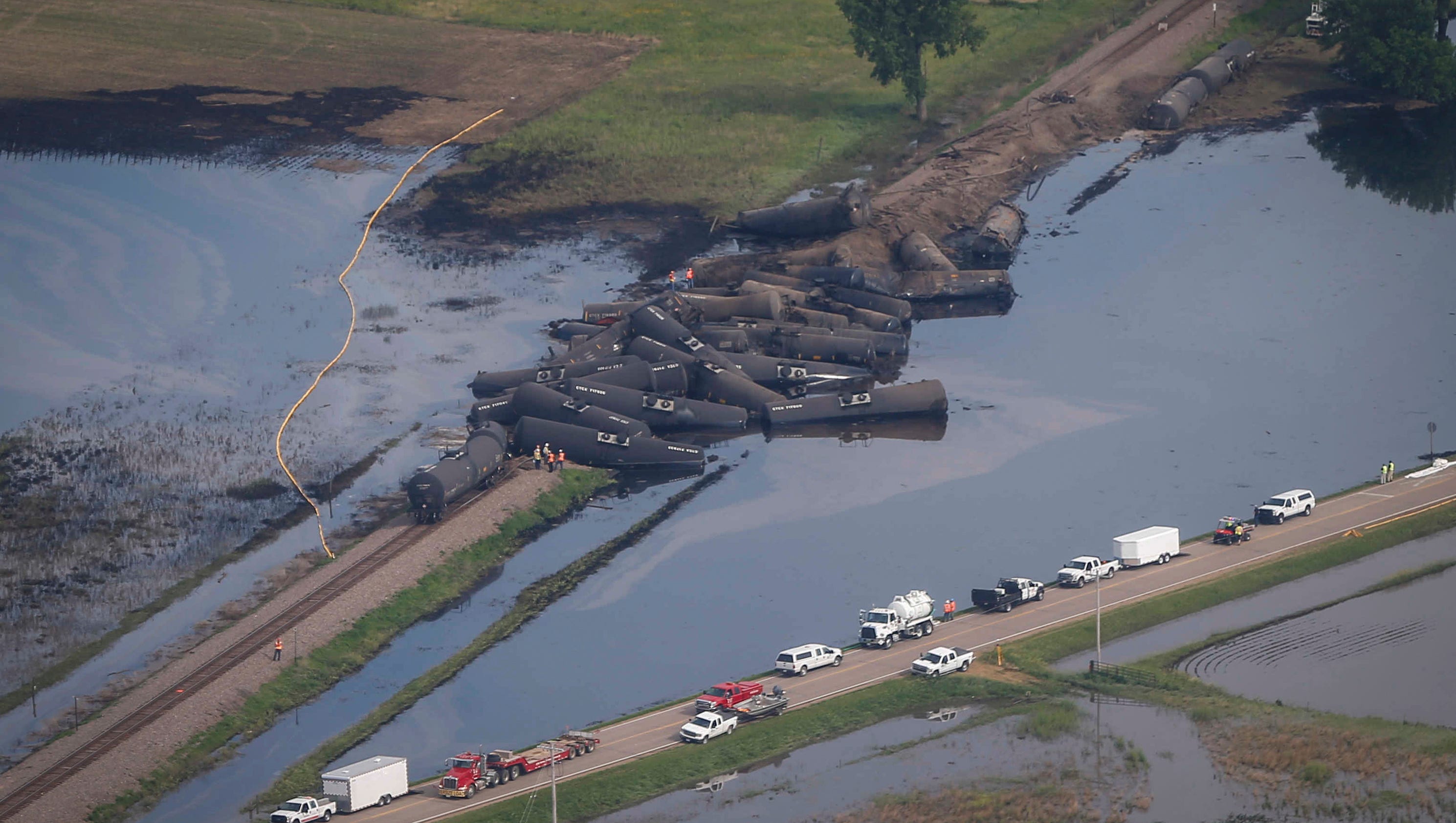
An estimated 230,000 gallons (870,619 liters) of crude oil spilled into floodwaters in the northwestern corner of Iowa following a train derailment, a railroad official said Saturday.

BNSF spokesman Andy Williams said 14 of 32 oil tanker cars just south of Doon in Lyon County leaked oil into surrounding floodwaters from the swollen Little Rock River. Williams had earlier said 33 oil cars had derailed.

Nearly half the spill — an estimated 100,000 gallons (378,530 liters) — had been contained with booms near the derailment site and an additional boom placed approximately 5 miles (8.05 kilometers) downstream, Williams said. Skimmers and vacuum trucks were being used to remove the oil. Crews will then use equipment to separate the oil from the water.

“In addition to focusing on the environmental recovery, ongoing monitoring is occurring for any potential conditions that could impact workers and the community and so far have found no levels of concern,” Williams said.

Officials still hadn’t determined the cause of Friday morning’s derailment, but a disaster proclamation issued by Gov. Kim Reynolds for Lyon and three other counties placed the blame on rain-fueled flooding. Reynolds visited the derailment site Saturday afternoon as part of a tour of areas hit by recent flooding.

Some officials have speculated that floodwaters eroded soil beneath the train track. The nearby Little Rock River rose rapidly after heavy rain Wednesday and Thursday.

A major part of the cleanup work includes building a temporary road parallel to the tracks to allow in cranes that can remove the derailed and partially-submerged oil cars. Williams said officials hoped to reach the cars Saturday.

The train was carrying tar sands oil from Alberta, Canada, to Stroud, Oklahoma, for ConocoPhillips. ConocoPhillips spokesman Daren Beaudo said each tanker can hold more than 25,000 gallons (20,817 imperial gallons) of oil.

Beaudo said Saturday that the derailed oil cars were a model known as DOT117Rs, indicating they were newer or had been retrofitted to be safer and help prevent leaks in the event of an accident.

The derailment also caused concern downstream, including as far south as Omaha, Nebraska, about 150 miles (240 kilometers) from the derailment site. The spill reached the Rock River, which joins the Big Sioux River before merging into the Missouri River at Sioux City.

Omaha’s public water utility — Metropolitan Utilities District — said it was monitoring pumps it uses to pull drinking water from the Missouri River.

Rock Valley, Iowa, just southwest of the derailment, shut off its water wells within hours of the accident. It plans to drain and clean its wells and use a rural water system until testing shows its water is safe.

For the latest information about the derailment: https://bit.ly/2K1wIAZ

Story has been corrected to show that 32 oil tanker cars derailed, not 33.

Farm Bill With Huge Giveaways to Pesticide Industry Passes House

EcoWatch

Farm Bill With Huge Giveaways to Pesticide Industry Passes House

 Olivia Rosane      June 22, 2018

A farm bill that opponents say would harm endangered species, land conservation efforts, small-scale farmers and food-stamp recipients passed the U.S. House of Representatives 213 to 211, with every House Democrat and 20 Republicans voting against it, The Center for Biological Diversity reported.

similar farm bill failed to pass the House in May when it was caught in the crossfire over immigration reform, but the new bill retains its most controversial provisions.

The bill, officially titled H.R. 2, the Agriculture and Nutrition Act of 2018, is a major win for the pesticide industry, which spent $43 million on lobbying this Congressional season. It would ax a requirement that the U.S. Fish and Wildlife Service assess a pesticide’s impact on endangered species before the Environmental Protection Agency (EPA) approves it and relax the Clean Water Act’s provision that anyone releasing pesticides into waterways obtain a permit.

“This farm bill should be called the Extinction Act of 2018,” Center for Biological Diversity Government Affairs Director Brett Hartl said. “If it becomes law, this bill will be remembered for generations as the hammer that drove the final nail into the coffin of some of America’s most vulnerable species.”

The bill would also be devastating for land conservation efforts. It would allow logging and mining in Alaskan forests, including the world’s largest intact temperate rainforest, the Tongass, and get rid of the Conservation Stewardship program, which funds farmers who engage in conservation on their land, according to Environment America.

Democratic Representative Tulsi Gabbard of Hawaii, who opposed the bill, also said it favored agribusiness over ordinary farmers.

“The Farm Bill rewards mega-agribusinesses and Wall Street, while slashing funding for nutrition, rural agriculture development, and clean energy programs, cutting key agricultural research and development efforts critically needed to help fight invasive species like the coffee berry borer, macadamia felted coccid, and more,” she said in a statement reported by Big Island Now.

The bill is also controversial because of proposed changes to the Supplemental Nutrition Assistance Program (SNAP), commonly referred to as food stamps, Reuters reported. House Republicans have pushed for measures that would increase the number of recipients who must work in order to receive food stamps, including limiting states’ abilities to waive those requirements in areas with poor economies.

Reuters noted that the Senate version of the 2018 farm bill does not include any changes to the SNAP program and that the House bill is unlikely to pass into law because of those provisions.

Environmental groups also prefer the Senate version of the bill.

“House Republican leaders have decided to gamble with farmers’ crucial government support by attaching dangerous policy riders to the farm bill. These would put Americans’ health at risk, pollute our waters, and imperil bees, monarch butterflies, and other bedrock species,” Federal Affairs Director at the Natural Resources Defense Council (NRDC) Brian Siu said in a statement.

“For the most part, the Senate is pursuing a serious, bipartisan measure that would support farmers and those needing help buying food. We look forward to working with lawmakers to help pursue that approach,” Siu said.

RELATED ARTICLES AROUND THE WEB

New Farm Bill Contains Sneak Attack on the Environment With Toxic

Senate’s Farm Bill Moves Forward—But What Is It, Anyway?

‘Sick Joke’: House Agriculture Committee Advances Farm Bill

Deep-Water Drilling Is Back

Bloomberg

Deep-Water Drilling Is Back

With Trump set to revive offshore exploration, Big Oil is developing cheaper ways to drill.

By Kevin Crowley    June 21, 2018

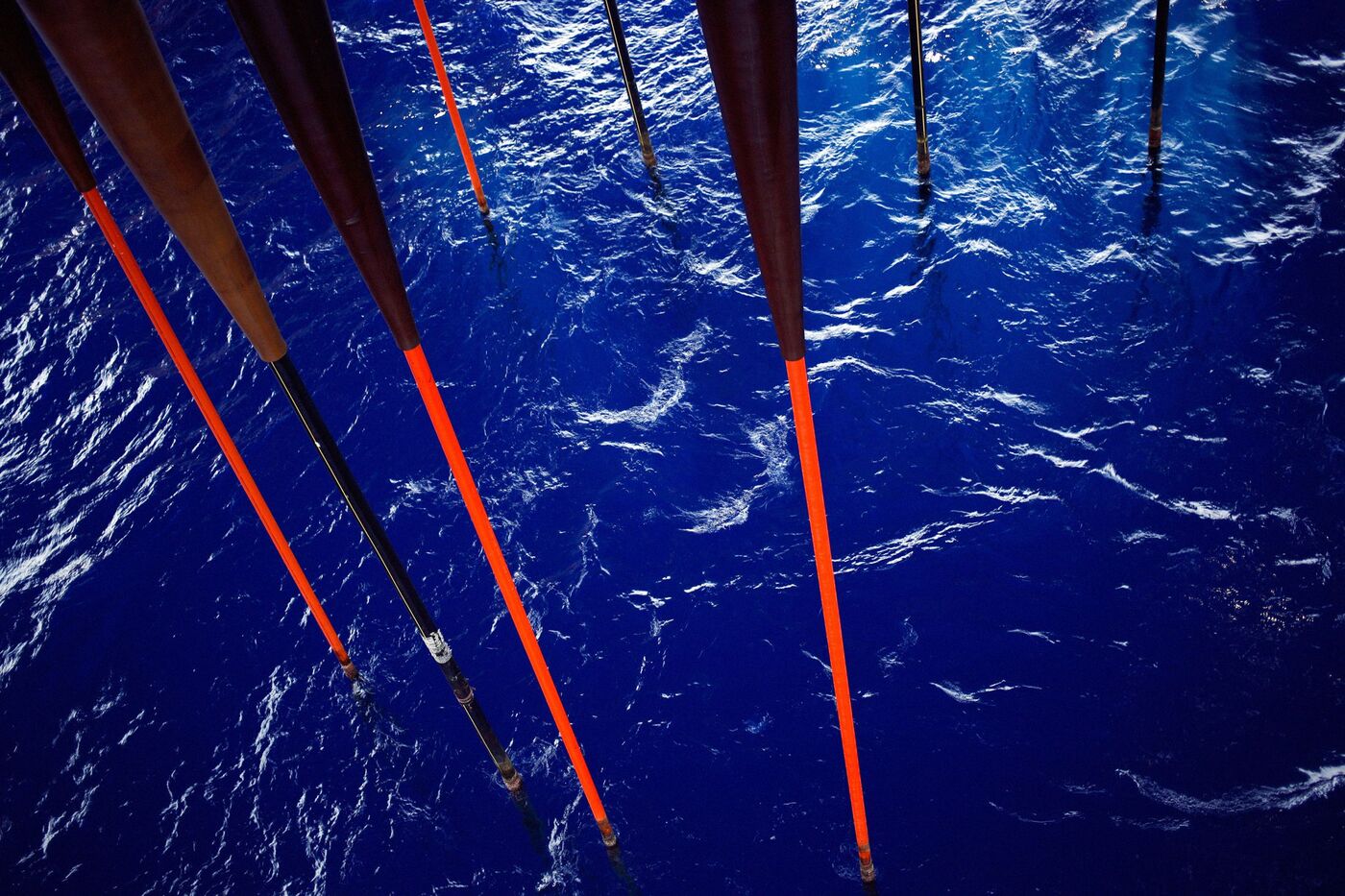
Pipes and mooring lines rise from the Gulf of Mexico beneath Chevron Corp.’s Jack/St. Malo deep-water oil platform about 200 miles off the coast of Louisiana on May 18, 2018. Photographer: Luke Sharrett/Bloomberg
On a hot, sunny May afternoon, flying fish leap out of the Gulf of Mexico’s brilliant blue waters near the steel legs of a Chevron Corp. oil platform, pursued by deep-water predators. “Is that a shark chasing them?” asks barge supervisor Jamie Gobert, peering over a rail. “Think it’s yellow-fin tuna or maybe dolphin fish,” says Emile Boudreaux, his colleague.

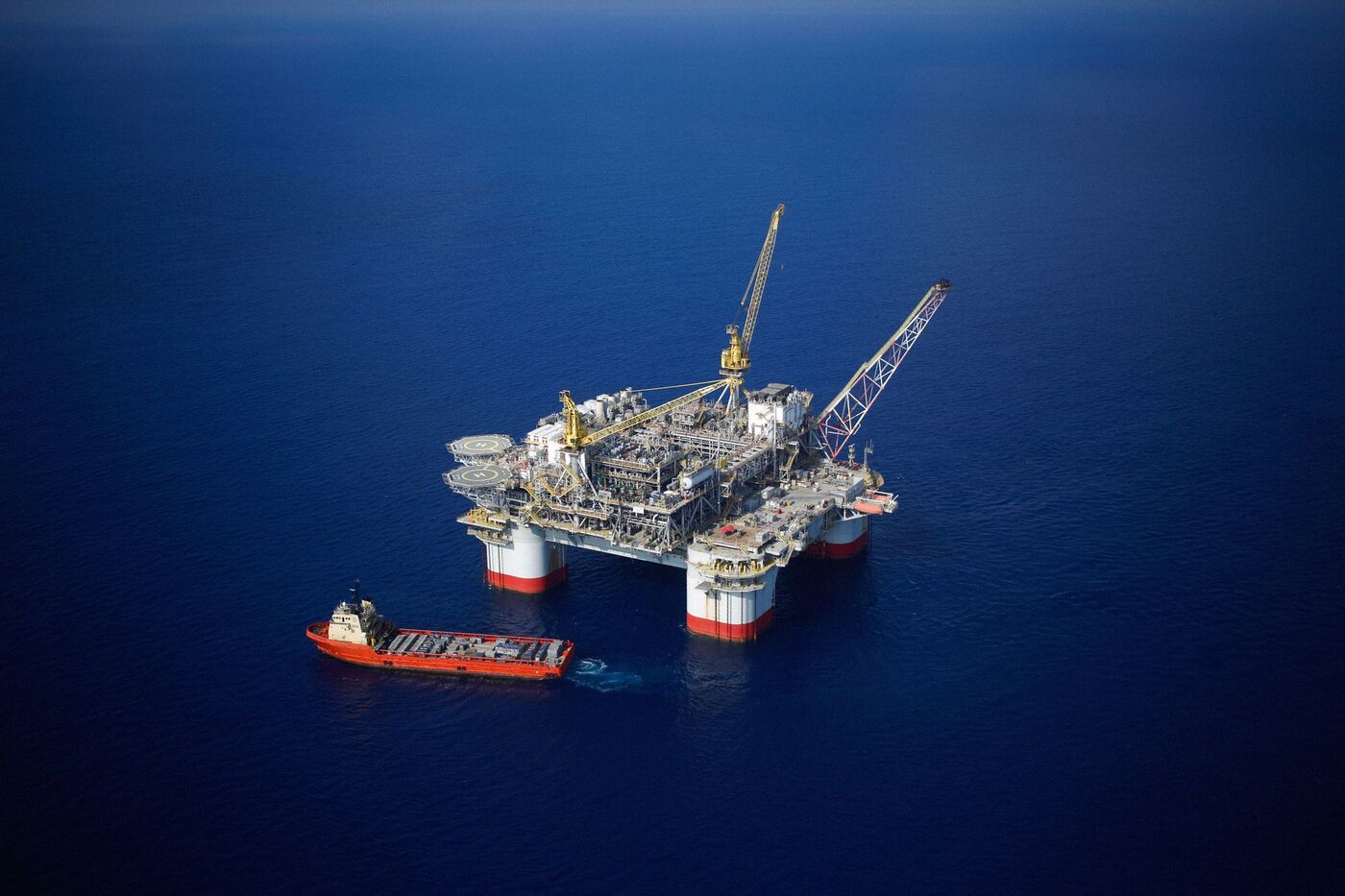
Typically in the region, seeing so many deep-water creatures converging on a single spot would be unusual. But these denizens of the Gulf have a road map of sorts to Chevron’s huge Jack/St. Malo platform, a floating steel structure the size of three football fields about 200 miles off the Louisiana coast. The fish are following giant underwater pipelines that carry crude from three oil fields about 15 miles away in different directions from the Jack/St. Malo, like tentacles of an octopus. Unlike old-style platforms that suck oil from a field directly below, this web like arrangement lets the Jack/St. Malo pump more than 3,000 gallons of crude a minute from the trio of fields.

The three-for-one hub is part of a wave of innovation by oil majors including Chevron, BP Plc, and Royal Dutch Shell Plc that’s allowing deep-water production in the Gulf to bounce back from disasters both environmental (BP’s Deepwater Horizon spill in 2010) and financial (the oil price).

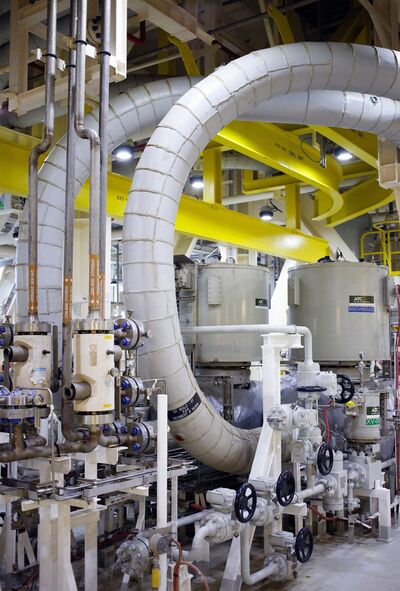
                                               Oil production equipment onboard Chevron’s Jack/St. Malo platform. Photographer: Luke Sharrett/Bloomberg
While U.S. shale production has been dominating markets, a quiet revolution has been taking place offshore. The combination of new technology and smarter design will end much of the overspending that’s made large troves of subsea oil barely profitable to produce, industry executives say. New projects are targeting costs of about $35 to $40 a barrel, which would compete with the lowest-cost shale assets. Cutting costs lets operators tap oil reserves that were previously uneconomic to exploit.

The Gulf of Mexico has been the vanguard of global experimentation for offshore oil, and success this time could encourage more drilling in the world’s hot new oil basins in countries including Brazil, Guyana, Mexico, and Mozambique. Further on, it could even encourage more U.S. offshore production, if President Trump is able to fulfill his plan to open much of the nation’s coastline to fresh exploration. “In the past, a lot of the cost of development has been new technology,” says Jeff Shellebarger, president of Chevron’s North American division. “With the types of reservoirs we’re drilling today, most of that learning curve is behind us. Now we can keep those costs pretty competitive.”

Two things drive drilling: crude prices and production costs. In the 2000s, higher prices spurred much of the growth in the Gulf. Operators fixated on building technically advanced production platforms that were the biggest, the deepest, and able to handle the highest-pressure wells—at almost whatever the cost. They demanded customized equipment including valves and pumps, even when standard models with practically the same specifications were cheaper. Shell had an encyclopedia of 100,000 engineering standards. In some lines of business, it has cut that back 95 percent, says Harry Brekelmans, Shell’s projects and technology director.

Complexity and cost didn’t seem to matter much when oil averaged more than $100 a barrel from 2011 to 2014. But when prices plunged to a 12-year low of $28 a barrel in 2016, the biggest drop in a generation, many projects and companies were generating big losses. “We knew there was incredible waste, but 2014 was the trigger,” Brekelmans says. “We knew there was no way we could put forward a project in the same way again.”

Platform supply vessel Kobe Chouest anchored alongside Jack/St. Malo. Photographer: Luke Sharrett/Bloomberg
Take BP’s Mad Dog 2, designed in 2012 to be the biggest platform in the world. The initial plan was so large and complicated that a Finnish shipyard would need to be expanded to build it. The platform’s projected cost was $20 billion. BP executives realized that was outlandish, even before crude prices dropped. So they redesigned the platform, stripping out features and cutting the bill to $9 billion.

BP, the Gulf’s biggest operator, now wants to do more exploration around its existing platforms and pipe oil back to them, as is done at Jack/St. Malo, rather than build expensive new floating hubs. This approach is possible because the range of the so-called tiebacks—the pipes that carry the crude from the drill site to the platform—has increased markedly in the past few years due to new subsea pump technology. Chevron expects it will soon be able to use tiebacks as long as 60 miles, almost four times the length of those at Jack/St. Malo.

If an oil field is in range, tiebacks can save about $12 a barrel compared with the cost of building a new platform, according to researcher Wood Mackenzie Ltd. “The philosophy is around infrastructure-led exploration, maintaining capacity at those hubs and filling them up,” says Starlee Sykes, BP’s regional president for the Gulf of Mexico and Canada. “We’re focused on using technology to be safer and more efficient rather than to build the biggest ever.”

Chevron and BP have cut operating expenses in the Gulf by half since 2013, the companies say, by a combination of using standardized equipment, applying better technology, eliminating jobs, and selling higher-cost assets. Shell has also reduced spending substantially, Brekelmans says.

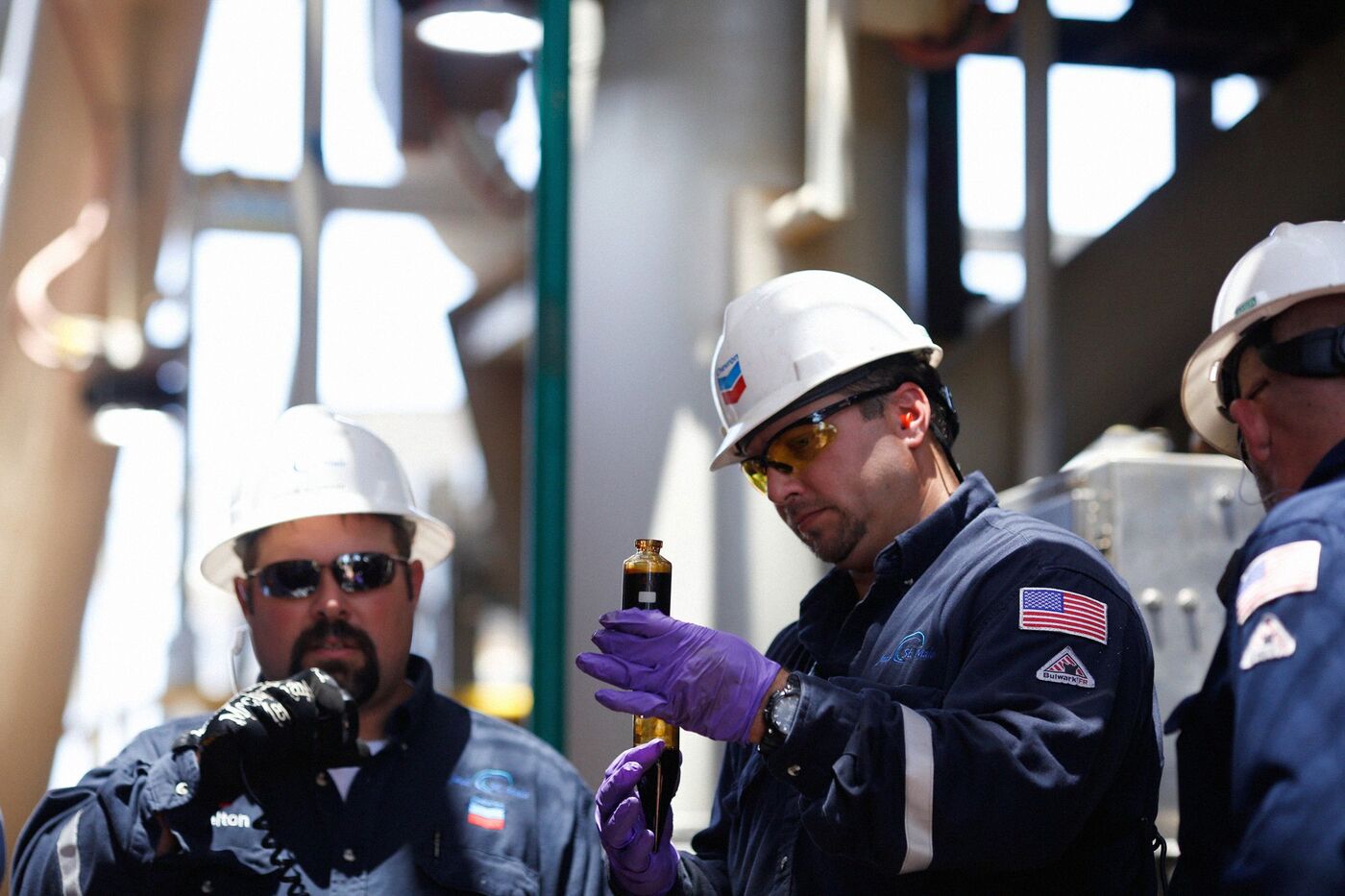
Chevron workers examine hydrocarbon samples on Jack/St. Malo. Photographer: Luke Sharrett/Bloomberg

“People ask about the big hitter in terms of cost savings,” says Stephen Conner, general manager of Chevron’s Gulf of Mexico operations. “But in truth, it’s the one thousand little things we’ve done.”

Analysts remain skeptical about whether the industry is truly reformed. As oil bounces back—it’s up 62 percent in the past year—costs may rise again, especially as drilling and construction suppliers seek to increase their own prices, says William Turner, a Wood Mackenzie senior research analyst. “Margins for servicers are just not sustainable,” he says. “I see costs creeping up, albeit from a low base.”

It might seem unnecessary for companies to put so much money and effort into risky offshore projects when oil from onshore shale production is booming. Output from the Permian Basin of West Texas and New Mexico will more than double over the next five years, to 5.4 million barrels a day, more than that produced by any OPEC member other than Saudi Arabia, according to IHS Markit Ltd.

But some companies such as BP lack significant shale assets, so they don’t have a choice. Even for those that do like Chevron, the advantage of drilling offshore is the sheer volume of oil that can be produced. In the Permian, a top-performing well produces about 2,000 barrels of oil daily for a few weeks before declining sharply. In the Gulf, fields can produce as much as 100,000 barrels a day for decades.

Activity in the region is picking up. Shell in April said it will build a deep-water platform named Vito, a project that had to be re-engineered after the 2014 oil-price crash. Chevron’s Big Foot is expecting to produce its first oil by the end of the year. BP’s Mad Dog 2 is also in development mode.

Not surprisingly, BP, Shell, and Chevron all support Trump’s plan to open up more than 90 percent of the U.S. outer continental shelf to drilling. But even if the administration is able to overcome strong environmental opposition by most of the coastal states, it would likely be the mid-2020s before any exploration activity could begin.

On Jack/St. Malo, Gobert and Boudreaux are showing off valves, pumps, enormous lifting chains, pipelines, safety choke points, and a three-turbine generator system that could power 58,000 houses, all floating on its giant frame. Taken together, the equipment cost $7.5 billion, and that figure excludes day-to-day running costs, taxes, and royalty payments. What makes it worth all the effort? Gobert watches as a colleague pours a sample of oil from a tap, as if from a beer keg, connected to a maze of pipes extending 14-feet high. “We call this the cash register,” he says.

Bottom Line – Rising production of oil from shale fields has reinvigorated the U.S. oil industry. But new technology to make offshore drilling more economical could have a longer-lasting impact.

Trump scraps Obama policy on protecting oceans, Great Lakes

Associated Press

Trump scraps Obama policy on protecting oceans, Great Lakes

John Flesher, Associated Press       June 21, 2018

In this April 21, 2010, file photo, the Deepwater Horizon oil rig burns in the Gulf of Mexico following an explosion that killed 11 workers and caused the worst offshore oil spill in the nation’s history. President Donald Trump is throwing out a policy devised by his predecessor for protecting U.S. oceans and the Great Lakes, replacing it with a new approach that emphasizes use of the waters to promote economic growth. President Barack Obama issued his policy in 2010 after the Deepwater Horizon oil spill in the Gulf of Mexico. Trump says it was too bureaucratic. (AP Photo/Gerald Herbert, File)

Traverse City , Mich. (AP) — President Donald Trump has thrown out a policy devised by his predecessor to protect U.S. oceans and the Great Lakes, replacing it with a new approach that emphasizes use of the waters to promote economic growth.

Trump revoked an executive order issued by President Barack Obama in 2010 following the Deepwater Horizon oil spill in the Gulf of Mexico. The largest offshore oil spill in U.S. history, it killed 11 workers and spewed millions of gallons of crude that harmed marine wildlife, fouled more than 1,300 miles of shoreline and cost the tourism and fishing industries hundreds of millions of dollars.

Obama said the spill underscored the vulnerability of marine environments. He established a council to promote conservation and sustainable use of the waters.

In his order this week, Trump did not mention the Gulf spill. He said he was “rolling back excessive bureaucracy created by the previous administration” and depicted the Obama council as bloated, with 27 departments and agencies and over 20 committees, subcommittees and working groups.

The Republican president said he was creating a smaller Ocean Policy Committee while eliminating “duplicative” regional planning bodies created under Obama.

But he said federal agencies could participate in regional partnerships formed by states. His administration has encouraged a “cooperative federalism” approach that shifts more responsibility to state governments.

Trump’s order downplays environmental protection, saying the change would ensure that regulations and management decisions don’t get in the way of responsible use by industries that “employ millions of Americans, advance ocean science and technology, feed the American people, transport American goods, expand recreational opportunities and enhance America’s energy security.”

In another reversal of Obama policy, Trump earlier this year called for opening most coastal waters to offshore oil and gas drilling, drawing fierce opposition from many coastal states. His administration also is stepping up federal leases for offshore wind energy development.

“Domestic energy production from federal waters strengthens the nation’s security and reduces reliance on imported energy,” Trump said in his order, which also mentioned shipping, fishing and recreation as among industries standing to benefit from his plan.

The order drew praise from a group representing offshore energy producers.

Jack Belcher, managing director of the pro-industry National Ocean Policy Coalition, said the new approach would remove “a significant cloud of uncertainty” for marine commerce.

Environmentalists said it erases a national mandate to improve ocean health.

“In another attempt to reverse progress made under President Obama, the Trump administration is recklessly tossing aside responsible ocean management and stewardship,” said Arian Rubio, legislative associate for the League of Conservation Voters.

U.S. Rep. Rob Bishop, a Republican and chairman of the House Natural Resources Committee, said Trump’s approach would “help the health of our oceans and ensure local communities impacted by ocean policy have a seat at the table.”

Rep. Raúl M. Grijalva, an Arizona Democrat and ranking member of the committee, demanded a hearing and accused Trump of “unilaterally throwing out” years of conservation work.

Associated Press reporters Patrick Whittle in Portland, Maine, and Matthew Daly in Washington, D.C., contributed to this story.

World’s Plastic Waste Problem Now Predicted to Reach 111 Million Metric Tonnes by 2030

EcoWatch

World’s Plastic Waste Problem Now Predicted to Reach 111 Million Metric Tonnes by 2030

Lorraine Chow        June 21, 2018

Mountains of plastic waste are building up around the globe after China implemented a ban on other countries’ trash.

By 2030, an estimated 111 million metric tons of single-use drink bottles, food containers and other plastic junk will be displaced because of China’s new policy, according to a new paper from University of Georgia researchers, who cited UN global trade data for their study.

Before the ban, China reigned as the world’s largest importer of plastic leftovers. The paper, published Wednesday in the journal Science Advances, said that China has imported 106 million metric tons of plastic waste for recycling since 1992, making up 45.1 percent of all cumulative imports.

But last year, China announced it no longer wanted to take in other countries’ trash, so it could focus on its own pollution problems.

The unexpected policy shift has left exporters in the U.S., CanadaIrelandGermany and other European countries scrambling for solutions for their trash. The U.S. alone had sent 13.2 million tons scrap paper and 1.42 million tons of scrap plastics to China’s recycling centers annually.

Western states, which heavily relied on Chinese recycling plants, have seen bales of mixed plastics and paper building up in recycling centers, the New York Times reported last month. In some cities, the pile-up has even resulted in recyclables being directly sent to landfills.

Some of this waste is now being sent to Vietnam, Malaysia and Thailand, but experts have said that these countries might not be able to fill the void left by China, CNBC News reported.

Amy Brooks, the first author on the current study and a doctoral student in engineering at the University of Georgia, suggested that countries need to be better at managing and recycling their own waste.

“This is a wake-up call. Historically, we’ve been depending on China to take in this recycled waste and now they are saying no,” she told the Associated Press. “That waste has to be managed, and we have to manage it properly.”

More than 8.3 billion metric tons of new plastics have been generated, distributed and discarded as of 2017. Much of that material ends up in our oceans. Every year humans send an estimated 8 million metric tons of plastic out to sea. If plastic consumption continues at this rate, we are on pace to fill oceans with more plastic than there are fish by 2050.

As the researchers of the paper concluded, “Bold global ideas and actions for reducing quantities of non-recyclable materials, redesigning products, and funding domestic plastic waste management are needed.”

RELATED ARTICLES AROUND THE WEB

Plastics Recycling: Could The Future Be In India?

A Whopping 91% of Plastic Isn’t Recycled

U.S. Asks China to ‘Immediately Halt’ Ban on Foreign Waste

Rubbish already building up at UK recycling plants due to China