Did Trump keep his promise to revive the coal industry?

CNN Replay
Did Trump keep his promise to revive the coal industry?

January 7, 2019

More coal-fired power plants have closed under President Trump than in Barack Obama‘s first term. Bill Weir travels to Pennsylvania for a #RealityCheck on the coal industry.

Did Trump keep his promise to revive the coal industry?

More coal-fired power plants have closed under President Trump than in Barack Obama's first term. Bill Weir travels to Pennsylvania for a #RealityCheck on the coal industry.cnn.it/2SBuxnU

Posted by CNN Replay on Monday, January 7, 2019

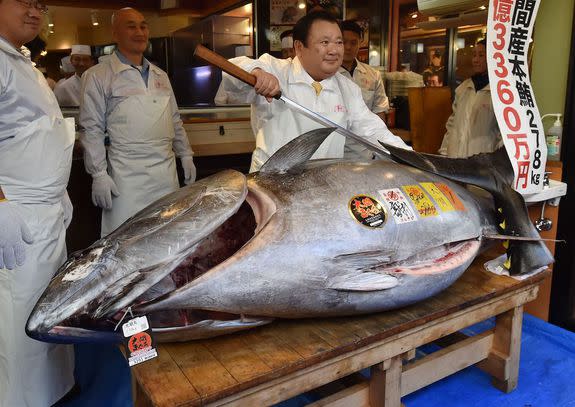
Bluefin tuna auctioned for $3 million at Tokyo market

Unexpected climate change consequences

DeSmog
January 3, 2019

Researchers have found another unexpected climate change consequence: rivers and lakes are drying up despite increased rain fall.

Unexpected Climate Change Consequences: Rivers & Lakes Drying Up DESPITE More Rain Fall

Researchers have found another unexpected climate change consequence: rivers and lakes are drying up despite increased rain fall.

Posted by DeSmog on Wednesday, January 2, 2019

‘Freedom Farmers’ Tells the History of Black Farmers Uniting Against Racism

Civil Eats

‘Freedom Farmers’ Tells the History of Black Farmers Uniting Against Racism

In her new book, Monica M. White details the cooperative practices of Black farmers in the Deep South and Detroit who played a key role in the Civil Rights movement.

When Monica M. White was growing up, her family would travel from Detroit to visit her grandparents in Eden, North Carolina, where they kept a small store in their living room. The store came with the ever-present promise of sweets, her mother’s warnings not to eat too much junk, and her grandparents’ determination to slip her snacks nevertheless.

It was only recently—when the sociologist and University of Wisconsin professor was researching for her new book Freedom FarmersAgricultural Resistance and Black Freedom Movement—that White’s aunt explained the store was more than just her own personal candy jar.

“It was called The Community Store. My grandfather, Kenneth, along with eight other Black farmers, co-owned a car and the store was their co-op … I knew my granddaddy was a farmer, but I had no idea he was a member of a cooperative,” said White. “To hear about the collective … I still get goosebumps even just mentioning it, because it shows the serendipity of how we study who we are.”

Freedom Farmers tells the story of how Black farmers in the Deep South and Detroit—independent farmers who owned their property, sharecroppers, tenant farmers, and urban gardeners alike—banded together to counter white racism, fight economic deprivation in an age of increasing mechanization and commercial agriculture, and articulate a different vision of the future.

Many of these groups were founded in remote places that were hotbeds for grassroots labor agitation. Take Mississippi’s North Bolivar County Farm Collective (NBCFC). It was formed in 1965 when a group of Black farmers, many of whom were tractor drivers on a white-owned plantation, turned off their engines to demand a better hourly wage. After they were fired and evicted from their homes, they built a temporary tent settlement, Strike City, close to the plantation.

Two years later, the NBCFC was up and running, with its members loaning land, tools, and divvying up the resources and work. The collective fed farmers and their families, provided children with clothing so they could attend school, and launched conversations about the need to disrupt the entire food system—from decisions about what to plant to how to keep the power to process food out of factories.

Freedom Farmers is not your conventional Civil Rights narrative, couched in terms of campaigns for voting rights, school desegregation, and lunch counter seats, though there are familiar historical figures: W.E.B. Du Bois, Booker T. Washington, and Fannie Lou Hamer, whose Freedom Farm Cooperative gave the book its title. It’s a timely, connective, and expansive book; one that reframes the whiteness of agricultural history and calls us to remember the fact that the Black freedom struggle is an ongoing labor movement in places far and wide.

It also locates Black farmers in a Civil Rights narrative that goes beyond their historic and continuing legal struggles against USDA discriminationFreedom Farmers moves beyond stories of subsistence and survival; it centers Black farmers as unsung food justice advocates and organic intellectuals who imagined better communities, food systems, and politics. And then, depending on one another, they started building.

Civil Eats spoke with White about the book, the ethos of Black farming communities, and why she coined the term “collective agency.”

This book made me realize how much of Civil Rights history really focuses on the urban South. What did you learn about rural folks and Black farmers, specifically?

Doing this work on rural Black Southerners flipped what I thought I knew about the South. When we were kids in Detroit, [my friends and I] would talk about what we wouldn’t do if we lived in the South and how we wouldn’t put up with [racism]. That was an overly simplistic view of how oppression manifests and people’s reaction and responses to it. One thing that I have fallen so in love with is the farmer’s freedom. There’s a certain kind of freedom that people who produce food have; they feel a sense of agency. And I don’t think it’s ever discussed when we talk about who farmers are.

I learned the genius of what it means to be a farmer, especially a Southern Black farmer. For example, Ben Burkett [of the National Family Farm Coalition] can look at a bag of seeds and tell you how many bushels he’ll get out of that, what the profit will be. Farmers don’t get credit for knowing applied mathematics.

I’m also fascinated by what rural Southern communities offered us in terms of open methods of communications—the way they supported each other, organized, and cared for each other. I feel like this book taught me a lot about the South that I didn’t understand but came to know through meeting Black folks who were raised there, but (unlike my family) never left.

You define “farmer” broadly, to include those who don’t own the land but work it.

When I first came to [the University of] Wisconsin, I presented my early ideas on what has become the book. One of my colleagues said, “You use ‘gardener’ and ‘farmer’ interchangeably, and I think you need to really [differentiate].’ In the ag language, a gardener is someone who does it for a hobby. A farmer has a certain percentage of land, a certain percentage of their income, a certain percentage of land ownership. In a broad sense, I wanted to complicate the idea of farmers only being those who own the land. For me, the expansive definition really captures the people who feed us, the people who stand out in the weather and the bugs and all conditions to make sure that we have food—often at their own expense.

The book describes a heartbreaking but brief episode when landless Black farmers occupied an abandoned military base in 1966 Mississippi. That kind of protest seems like it was within the Civil Rights strategic playbook, but with very different “characters.”

When I found out about this story, it wasn’t too long after the Bundys and white nationalists occupied federal land in the West and didn’t have a license. I thought about how different we treated them from how we treated the sharecroppers and seasonal workers who occupied the Greenville Air Force Base.

In January ’66, about 70 folks occupied an abandoned Air Force base and they were like, “Look, this is federal land, we pay federal taxes, and so we want to use this space as a strategy for our survival.” They were unemployed or [some] may have been fired because of their political inclinations or efforts to vote. So folks brought in blankets and stoves and all kinds of resources. Their demands were: “We want land, we want food, we want jobs, we want shelter.”

And please be clear: They said, “We’re not asking for a handout, we’re asking for an opportunity to uplift ourselves, our family, and our community.” They were evicted in a violent sort of extraction [as opposed to the years-long conflict in which Nevada rancher Cliven Bundy illegally grazed on public land and negotiated with the Bureau of Land Management]. These were folks who were asking for land to grow food.

After the eviction, federal attention turned to the state and resources were then allocated to Mississippi in terms of food, shelter, and housing. It’s important to recognize that this occupation was right in that area where Hamer and her freedom farm was and in the Mississippi Delta. There was this air of resistance and resilience in the region.

You coin the term “collective agency” to describe how Black farmers mobilize, whether that’s in Mississippi or Detroit. Can you say more about that?

I didn’t feel like there was a way to help us understand what happens in cities like Detroit, where the economic bottom is falling out. People are left to fend for themselves, and they collectively engage in something that impacts or changes the political, economic, and social context of their future.

  • Support Civil Eats Today!

    Support from readers like you is what keeps Civil Eats going.
    Please consider making a year-end donation or signing up for an annual subscription if you haven’t already.

    Thank you from the Civil Eats team!

Agency is mostly defined as a very individual thing. The language has to capture that as an individual, yes, you make the decision that you’re going to grow food. But what about when several people decide they want to [farm] as a strategy for increasing access to nutrient-rich food and pool our resources together? What happens when we care about each other in terms of health, education, safety, security, and wellness and there’s this collective decision to move in these directions? I couldn’t find a way to explain it other than “collective agency.”

In my research in Detroit, folks would tell me, “I have a backyard garden … and I contribute to the food that’s grown in the community garden, I don’t harvest anything there. I do it because this is for us.” That’s a collective agency that we don’t talk about.

How do you connect Black farmers to other seminal Black thinkers in the book? You have a different take on the relationship between W.E.B. Du Bois (who is often framed as an elitist who only wanted to educate the “talented tenth,”) and Booker T. Washington, (who is often framed as telling Black people to stay on the land and not aim higher). Both frames lack nuance.

I was really cautious about this. But I thought: If Booker T. was talking about farmers, was that not 90 percent of the population? If Du Bois is talking about the talented tenth, what would happen if the two of them were actually in a room together to say, “Here’s 90, here’s 10, and this is how we’re going to get free.” Then as I read more and more about Du Bois, I realized that he stopped talking about the talented tenth, and really started investing in thinking about cooperatives in ways that people haven’t really understood until Jessica Gordon Nembhard’s book Collective Courage came out.

We don’t have to do binaries. What tools can we use from Washington? What tools can we use from Du Bois, George Washington Carver, and Hamer?

What’s your relationship to the soil? Because this book is chipping away at the idea that, after slavery, Black people wanted to remove themselves from agriculture.

I really love this question. I have some soil from [New Orleans’] Congo Square in a little container. I have soil from Hamer’s final resting place. I have soil from Burkett. I have soil from Tuskegee. Soil is a substance that I greatly revere. I have an immense amount of respect for the stories that soil holds. It’s not unlike the Equal Justice Initiatives Legacy Museum’s remembrance project [where people collect soil from places where people were lynched]. My connection to the soil is that I see freedom and a medium through which birth and death are connected.

This interview has been edited for length and clarity.

Author photo by G. Greg Wells.

Three Generations, Two Families, and One Organic Farm Model Succession

Cival Eats

Three Generations, Two Families, and One Organic Farm Model Succession

At Meadowlark Organics in Wisconsin, a young couple has partnered with an experienced farmer to take stewardship of his 950-acre sustainable operation.

“They have the desire and motivation to lift the heavy stuff off my shoulders,” says Paul Bickford from his place at the kitchen table in a recently renovated farmhouse. Bickford is the 65-year-old owner of Bickford Organics. “It’s nice to see what I envisioned, what I built, continue,” he says.

Bickford is speaking about the 950-acre organic grain farm in the Driftless Region of Southwest Wisconsin, which he has managed and owned through several incarnations across the span of four decades. Bickford is in the process of transitioning the farm to the young couple seated across from him.

Bickford’s successors, John and Halee Wepking, hold sweat equity in the farmhouse renovations. In exchange for their work, they live here with their growing family on the farm they now co-manage with Bickford, who lives just down the road. The couple holds no familial relation to Bickford, and met him through a Craigslist ad. But, Halee says, to the nodding of heads, “We have become a family.”

Even the farm’s title is in transition, with the old-guard Bickford Organics easing out of the spotlight to make room for Meadowlark Organics, a name adopted by the Wepkings to carry the farm into the future.

Meadowlark Organics is an organic farm that specializes in growing grains: wheat, rye, polenta corn, and buckwheat. They also grow hay and recently added a small beef herd of around 20 breeding cows to the mix. With plans to continue diversifying with the addition of a granary and flour mill, Meadowlark Organics is poised to lead the Driftless region of Wisconsin into a new era of local, value-added organic grain products grown with an eye for soil conservation and land stewardship.

All this has been made possible by Bickford, who—in wanting to ensure his farm found the right heirs—allowed an enterprising couple to realize their dreams in an industry where many newcomers struggle to ever achieve viability.

Paul Bickford with John and Halee Wepking and their childrenThough the Wepking’s children, a three-year-old and his baby sister, are with their grandmother on this day, a countertop collection of toy tractors suggests that the kids usually fill the kitchen with life.

“It’s my responsibility to see the operation survives because they have a family,” Bickford says. “I take that quite seriously.”

Farmer ISO Protégés

Bickford, who has carried the farm from its beginnings as a confined dairy, through its transition to rotational grazing, and on to its most recent incarnation as an organic small-grain producer, only began to think about retirement around 55.

Bickford’s children are now adults following their own paths—and though he has a son who farms with him, he would prefer to stay out of the farm’s management. So, Bickford has had to pursue a less conventional route to transitioning the farm.

Lucky for all, just the right eyes landed on the ad Bickford posted early in 2015. It read: “I am seeking a forward-thinking individual or couple to join my 950-acre organic farming operation … Ethics and trust are a cornerstone of organic farming and are important to my operation. I want to share my 40 years of farm experience with someone who is willing to work to improve my farm.”

The Wepkings met working in the kitchen at Prune in the East Village of New York City. A Wisconsin native, John had always dreamed of farming, and Halee, who is from Arizona and holds a degree in modern dance and years of professional experience in kitchens, was eager to support this dream. “I was always moving toward what felt important to me,” Halee says. “Farming, producing people’s food—that felt important.”

When the Wepkings moved back to Wisconsin, they hoped to farm on John’s family land. When that proved infeasible for reasons beyond their control, they began to look for other options.

The initial investment necessary to raise livestock alongside grains at a marketable scale limited the Wepking’s ability to start from scratch. To create the farm they envisioned, they sought an established operation managed by someone willing to build them and their vision into the farm’s future.

When the Wepkings answered Bickford’s ad, they were still wet behind the ears. But they shared Bickford’s values—they wanted to farm as land stewards using practices modeled by balanced ecosystem function. In teaming up with Bickford, they found a perfect fit.

Forging a Path Forward Together

“My first month on the job was a blur,” says John. He spent much of that first stretch alone on a tractor with three times the horsepower of anything he’d ever operated. Halee had given birth to the couple’s first child just a few weeks into the new arrangement, and through these earliest days Bickford was nearly absent—a fire had burned a building on his property, and as happens on farms, he was pulled in opposing directions.

Before joining Bickford, the Wepkings gained much of their understanding of farming practices through online research. Halee says they both gleaned as much as they could from resources such as Practical Farmers of Iowa and MOSES.

  • Support Civil Eats Today!

    Support from readers like you is what keeps Civil Eats going.
    Please consider making a year-end donation or signing up for an annual subscription if you haven’t already.

    Thank you from the Civil Eats team!

When they finally did get to work side by side, John says Bickford shared knowledge of another sort. The veteran farmer knows how fields will carry water after a rain, when to plant or weed, and what grows well where and why. In short, Bickford knows the intimate details of his land and its seasons.

Three years into their arrangement, their roles have developed definition. Halee takes the lead with the kids, manages marketing, keeps the books, and collaborates on planning decisions. Bickford is mechanically inclined: he likes his tractors and enjoys the hands-on aspects of farming. John, Bickford says, “is the boss.”

“John has very good skills at organization,” Bickford continues. He “has a grasp on the organic plans and the food that we’re going to grow.”

Extending Rotations, Diversifying Production, and Looking to Value-Added Products

John soon demonstrates his ease with planning as he launches into a description their crop rotations. “When we started, it was a pretty typical Southern Wisconsin rotation of corn, soybeans, and small grain—in spring, start with small grain like oats or barley to establish alfalfa and make hay, then plow that alfalfa under for corn again,” he says. “What we’ve done is extend that into fall with planting grains.”

meadowlark organics grains for sale at the farmers' marketThey also transitioned the spring grain mix to include spring wheat for bread flour, and last year, they started growing buckwheat. “So we’re looking at more of a six-to-seven-year rotation as opposed to four to five,” John says.

On top of these changes, with the aid of a Farm Service Agency (FSA) microloan, the Wepkings have introduced a small beef herd to the mix. The cattle allow the farmers to keep their soil nutrients in a closed loop, and the longer crop rotations allow them to, in Halee’s words, “limit tillage; manage weeds, pests, and diseases; and grow and conserve our soils.”

Bickford has always been open to adaptation, but thanks to the Wepkings, he has come to truly value diversification.

“Our current agricultural system is not going to support family farms as is, so we have to be thinking of how we diversify, where we capture value,” Halee says.

Along with the new crops, Meadowlark has expanded into value-added products such as milled flour and polenta that they sell to area co-ops, restaurants, bakeries, and consumers at markets and online. They have already invested in grain storage bins, and their long-term plans include a grain cleaning and production facility as well as a small flour mill. Ultimately their hope is to create an organic grain hub to supply the region with locally produced, consistent products on a scale that keeps pace with the burgeoning local markets.

ORIGIN Breads, an organic bakery based in nearby Madison, already bakes exclusively with grains sourced from Meadowlark Organics. When the small-scale bakery opened two years ago, owner and head baker Kirk Smock says he was faced with a decision: “Organic or local?”

With Meadowlark Organics, he and his customers get both. Meadowlark now plans their yearly production with ORIGIN Breads in mind, but allows Smock to pay for his purchases incrementally. The arrangement is somewhat unconventional, but Smocks says it is one of the many benefits to the relationships that grow through sourcing locally.

The focus on relationship-building is reflected in the farm transition. The Wepkings and Bickford have yet to work out the fine print, but they’re okay with letting the transition take shape organically. Bickford sees himself easing into full retirement within five to 10 years. In those years, the group plans to continue to evolve alongside their ideas about how best to delegate responsibilities and ownership. For now, they’re content to know they share a vision and common goals.

When asked what others might learn from their experience, Halee says, “You don’t need to have a certain salary; you need to be secure in your life. You need to have a path forward in your future. It’s about our common goal and our values. It’s about maintaining this land organically.”

Bickford chimes in, “And about feeding people healthy food.”

This 15-year-old activist just called out world leaders for their global inaction on climate change.

U.S. Senator Bernie Sanders
December 14, 2018

“You say you love your children above all else, yet you are stealing their futures right before their very eyes,” – This 15-year-old activist just called out world leaders for their global inaction on climate change.

15-year-old Climate Activist Calls Out World Leaders for Inaction

"You say you love your children above all else, yet you are stealing their futures right before their very eyes," – This 15-year-old activist just called out world leaders for their global inaction on climate change.

Posted by U.S. Senator Bernie Sanders on Friday, December 14, 2018

Ryan Zinke Is Leaving Interior Department

New York Times

By Julie Turkewitz and Coral Davenport     December 15, 2018
Mr. Zinke had been the subject of at least a half-dozen federal investigations, one of which was recently referred to the Justice Department.CreditCreditCliff Owen/Associated Press.

Interior Secretary Ryan Zinke, a key figure in President Trump’s sweeping plan to reshape the nation’s environmental framework, resigned under pressure on Saturday as he faces numerous ethics investigations into his business dealings, travel and policy decisions.

“Secretary of the Interior @RyanZinke will be leaving the Administration at the end of the year after having served for a period of almost two years,” Mr. Trump wrote on Twitter. “Ryan has accomplished much during his tenure and I want to thank him for his service to our Nation.” The president said he would name a replacement this coming week.

Mr. Zinke is the latest Trump official to exit an administration plagued by questions of ethical conflict. And his departure comes as Mr. Trump has begun a shake-up in his administration. In early November, the president fired Attorney General Jeff Sessions, and last weekend he announced that his chief of staff, John F. Kelly, was leaving.

In one of the final acts of Mr. Kelly’s tenure, his team told Mr. Zinke that he should leave by year’s end or risk being fired in a potentially humiliating way, two people familiar with the discussion said.

Mr. Trump has been looking at replacing a number of other cabinet officials. He has been telling associates for weeks that the commerce secretary, Wilbur Ross, will be leaving now that the midterm elections are over, and he has also frequently complained about Betsy DeVos, the education secretary. The homeland security secretary, Kirstjen Nielsen, is also seen as likely to depart soon.

But Mr. Trump is aware that the confirmation processes for any new nominees are likely to be more contentious in the second half of his term, as he faces re-election.

Mr. Zinke, a former Montana congressman and member of the Navy SEAL’s best known for riding an Irish sport horse through Washington on his first day in office, oversaw mineral extraction and conservation on roughly 500 million acres of public land. He had become the subject of several federal investigations, one of which his department’s top watchdog has referred to the Justice Department, a potential step toward a criminal investigation.

The inquiries include an examination of a real estate deal involving Mr. Zinke’s family and a development group backed by the Halliburton chairman, David J. Lesar. Mr. Zinke stood to benefit from the deal, while Mr. Lesar’s oil services company stood to benefit from Mr. Zinke’s decisions on fossil fuel production.

Mr. Zinke has repeatedly denied wrongdoing. “I love working for the President and am incredibly proud of all the good work we’ve accomplished together,” he said on Twitter. “However, after 30 years of public service, I cannot justify spending thousands of dollars defending myself and my family against false allegations.”

Mr. Trump had tolerated the seemingly endless drips of scandal surrounding Mr. Zinke in part because he liked him personally and in part because his focus on the cabinet was concentrated on his desire to oust Mr. Sessions.

At the same time, though, Mr. Trump disliked the bad press that was amassing for Mr. Zinke, given how it reflected on him personally. And as the incoming House Democratic majority made clear that Mr. Zinke would be a prime target, Mr. Trump’s aides convinced him that the time had come to shove out Mr. Zinke.

A few months ago, the White House Counsel’s Office indicated to some West Wing aides that officials would be less likely to be subpoenaed by the new House majority if they left before the new Congress was sworn in in January. That has helped speed up the departures of several.

“This is no kind of victory, but I’m hopeful that it is a genuine turning of the page,” said Representative Raúl M. Grijalva, who as the incoming chairman of the House Natural Resources Committee has repeatedly tangled with Mr. Zinke. He added, “The next interior secretary should respect the American people’s desire for strong environmental standards and an end to corporate favoritism.”

Mr. Zinke’s exit follows that of the other major architect of the Trump administration’s environmental policies, Scott Pruitt, the administrator of the Environmental Protection Agency. Mr. Pruitt, also known for his aggressive rollback of environmental regulations, resigned in July amid questions about alleged spending abuses, first-class travel and cozy relationships with lobbyists. Among other actions, Mr. Pruitt came under fire for reaching out to the chief executive of Chick-fil-A with the intent of helping his wife open a franchise.

Beyond examining the real estate deal, the Interior Department’s inspector general had faulted Mr. Zinke for allowing his wife, Lola, to travel in government vehicles, contrary to department policy, and chided him for using $12,000 in taxpayer money to take a charter plane after a talk to a hockey team owned by one of his biggest donors.

The inspector general has also been examining the secretary’s decision to block two Native American tribes from opening a casino in Connecticut after his office received heavy lobbying from MGM Resorts International. The entertainment giant had been planning its own casino not far from the proposed tribal one.

Delaney Marsco, ethics counsel at the Campaign Legal Center, a nonpartisan watchdog group, said Mr. Zinke’s actions had sometimes been overshadowed by Mr. Pruitt’s more obvious fumbles. That let the secretary operate in an “ethical Wild West,” she said.

“There are these laws and these ethical norms that are being blown to bits by these cabinet secretaries,” Ms. Marsco said. “And that’s the pattern, the problem, that keeps us up at night.”

You’re Hired! You’re Fired! Yes, the Turnover at the Top of the Trump Administration Is … “Unprecedented.”

Since President Trump’s inauguration, White House staffers and cabinet officials have left in firings and resignations, one after the other.

The federal investigations follow several other examinations of Mr. Zinke’s behavior. He has been criticized for claiming on dozens of occasions that he is a geologist, though he has never held a job as one. When he was a candidate for Congress, campaign finance experts questioned whether it was legal for him to benefit from a super PAC that he had created. And as a Navy SEAL, he admitted to improperly billing the government $211 for a trip home to Montana, something that two admirals told The New York Times prevented him from rising to senior levels in the Navy.

Mr. Zinke’s resignation, rather than an end to his pro-fossil fuel policies, quite likely signals a passing of the playbook. Mr. Zinke’s deputy, David Bernhardt, a former oil lobbyist, is expected to step in as acting head of the department.

Mr. Zinke, 57, grew up in Whitefish, Mont., a timber and tourism town at the edge of Glacier National Park. When he took charge of the Interior Department, he promised that his youth in the West would help him balance conservation and extraction on the land in his care. Much of that land is in the West, and it includes the national parks and monuments that have become the nation’s environmental icons.

With his flashy leadership style and aggressive approach to deregulation, Mr. Zinke had largely escaped the public thrashing that Mr. Trump has directed at other cabinet members. But in recent weeks the president had signaled that the secretary’s tenure might be coming to end, possibly as a result of the ethics inquiries.

“I do want to study whatever is being said,” Mr. Trump said at a news conference on Nov. 7, referring to the investigations into Mr. Zinke. “I think he’s doing an excellent job, but we will take a look at that, and we’ll probably have an idea on that in about a week.”

Mr. Zinke was considered a surprise choice for the position. He had reportedly gained favor with Donald Trump Jr., because, like the president’s son, he is an avid game hunter.

He ran the office with a swaggering flair that won him the admiration of the president and conservative Westerners, many of whom applauded his effort to move major department operations to places like Denver or Boise, Idaho. But his style also drew derision from the environmental community and the quiet mockery of many career staff members in his own agency.

In Washington, he flew a special interior secretary flag above the Interior building when he was present, and he often skipped a coat and tie for fishing shirts and boots. Beyond the capital, he hiked and rode across landscapes in a cowboy hat, even as he pushed plans to drastically reduce monument boundaries.

In June, Politico reported that Mr. Lesar, the Halliburton chairman, was lending financial backing to a major development in Mr. Zinke’s hometown, Whitefish, that would significantly raise the value of property owned by Mr. Zinke. The development would include a hotel, shops and a brewery, and Mr. Zinke’s wife had pledged in writing to allow the developer to build a parking lot that would help make the project possible. The land for the potential lot is owned by a foundation created by Mr. Zinke.

Because Halliburton is the nation’s largest oil services company, and because Mr. Zinke regulates the oil industry on public land, the deal raised questions as to whether it constituted a conflict of interest. Mr. Zinke’s schedule also showed that he had hosted Mr. Lesar and a developer involved with the hotel-brewery project in his secretarial office in 2017.

In response, three Democrats sent a letter to the Interior Department’s top watchdog, Mary L. Kendall, requesting an investigation into whether Mr. Zinke had used his position as secretary for personal financial gain. In July, Ms. Kendall complied, opening an investigation. In October, her department forwarded at least one inquiry to the Justice Department.

Heather Swift, a spokeswoman for Mr. Zinke, has said that the secretary did nothing wrong and that he resigned from his charitable foundation’s board of directors before the deal was made.

Before Mr. Zinke joined the Trump administration, he often called himself a conservative conservationist. But as secretary, he quickly became one of the chief proponents of Mr. Trump’s energy-first agenda, promoting policies that seek to open the East Coast to offshore drilling, weaken the standards of the Endangered Species Act and shrink two national monuments, constituting the largest rollback of federal land protection in the nation’s history.

Last year under Mr. Zinke, the United States offered up 12.8 million acres of federally controlled oil and gas parcels for lease, triple the average offered during President Barack Obama’s second term, according to an analysis by The New York Times.

These policies won Mr. Zinke favor with Mr. Trump, who had made promotion of the fossil fuel industry a key part of his campaign platform, as well as from the oil and gas companies that had increasingly made up Mr. Zinke’s donor base as a Montana politician.

His policies have angered environmentalists, who have filed lawsuits trying to block these plans. Many have argued that Mr. Zinke has turned his back on the nation’s environmental heritage just as dire news about climate change has made land, water and air protection increasingly urgent.

The likely replacement by Mr. Bernhardt of his former boss in an acting capacity echoes events that followed the resignation of Mr. Pruitt at the E.P.A. Mr. Pruitt, once a favorite of Mr. Trump’s for many of the same reasons as Mr. Zinke, was replaced in an acting capacity by his deputy, Andrew Wheeler, a former coal lobbyist with a low profile and a deep knowledge of the agency he ran and the regulations he sought to undo.

While Mr. Zinke spent his tenure as the face of many of the Trump administration’s efforts, many on the inside saw Mr. Bernhardt as the effective manager who was able to push policies through. Mr. Bernhardt, with years of experience in the George W. Bush administration, and as a former lawyer and lobbyist for some of the nation’s largest oil companies, brings a deep insider’s knowledge to his job that Mr. Zinke lacked. His former legal clients included the Independent Petroleum Association of America and Halliburton.

Since his Senate confirmation last summer, Mr. Bernhardt has generated criticism from environmental and government watchdog groups that his new role will create a conflict of interest, as he oversees proposals that could directly benefit his former clients.

Maggie Haberman and Sheryl Gay Stolberg contributed reporting.

Trump says GM shift to electric vehicles is ‘not going to work’

Reuters

Trump says GM shift to electric vehicles is ‘not going to work’

WASHINGTON — President Donald Trump on Thursday said General Motors’ decision to shift much of its focus to electric vehicles will not succeed, and he asserted a new trade deal will make it harder for the company to move work to other countries.

GM last year said it planned to launch 20 new electric vehicles by 2023 as it faces rising regulatory requirements for zero-emission vehicles in China and elsewhere.

The largest U.S. automaker has come under enormous criticism in Washington after it announced on Nov. 26 plans to close four plants in the United States and cut up to 15,000 jobs in North America.

Trump questioned GM CEO Mary Barra’s business strategy in an interview with Fox News. “They’ve changed the whole model of General Motors. They’ve gone to all-electric. All-electric is not going to work … It’s wonderful to have it as a percentage of your cars, but going into this model that she’s doing I think is a mistake,” Trump said.

Barra was on Capitol Hill for two days of meetings last week to discuss the company’s decision with angry lawmakers from states where plants are closing. “To tell me a couple weeks before Christmas that’s she’s going to close in Ohio and Michigan — not acceptable to me,” Trump said.

Trump has repeatedly said GM should reverse a decision to close an assembly plant in northeast Ohio, an area potentially crucial in the 2020 presidential election. “Ohio is going to replace those jobs in like two minutes,” Trump said. “She’s either going to open fast, or somebody else is going to go in.”

GM shares fell 1.4 percent in trading Thursday.

Asked to respond, GM said it timed its job cut announcement so employees could accept open jobs at other plants.

“We continue to produce great vehicles today for our customers while taking steps toward our vision of a world with zero crashes, zero emissions and zero congestion,” GM said.

Trump suggested that a new free trade deal with Mexico and Canada makes it “very uncomfortable” for GM to build cars outside the United States.

“I don’t like that General Motors does that … General Motors is not going to be treated well,” he said without elaborating.

Trump signed a new trade deal with Mexico and Canada on Nov. 30 to replace the North American Free Trade Agreement, but that deal has not been approved by the U.S. Congress.

The deal boosts the North American content requirements for vehicles to be traded tariff free and requires a significant percentage of vehicles to be made by workers earning at least $16 an hour.

Some Democrats argue the trade deal may need changes to deter GM and other automakers from continuing significant production in Mexico. GM is not backing off its plans to build the new Chevrolet Blazer SUV in Mexico.

Reporting by David Shepardson and Lisa Lambert

The Border Wall Is Going to Be an Environmental Disaster

GQ

The Border Wall Is Going to Be an Environmental Disaster

Luke Darby             December 13, 2018
The Border Wall Is Going to Be an Environmental Disaster
The Supreme Court has decided that the Trump administration can ignore more than two dozen public health and environmental laws to build the wall faster.

Donald Trump made it clear earlier this week that he was willing to wage all out war on the U.S. government if that’s what it takes to get them to give him money to pay for his border wall, his biggest vanity project since whatever last garish building he slapped his name on. While he hasn’t managed to wrest funding from either Congress or Mexico, the administration has already started moving forward with private land seizures. They’ve also, it turns out, been quietly exempting themselves from environmental and public health laws in the hopes of speeding up construction.

According to The Guardian, the most diverse butterfly sanctuary in the country, the 100-acre National Butterfly Center in Missions, TX, is in the way of Trump’s wall. Normally, the federal government wouldn’t be allowed to cut through and demolish sections of the sanctuary, but the Supreme Court ruled last week that the administration had the right to waive 28 laws that would otherwise have prevented or slowed construction. Now, it’s likely to be bulldozed.

A small sample of the laws that the Court decided the Trump administration doesn’t have to follow include: the Endangered Species Act, the Clean Water Act, the Clean Air Act, the Safe Drinking Water Act, the Solid Waste Disposal Act, and the Native American Graves Protection and Repatriation Act. This seems extreme, but it’s now common Republican ideology that laws and regulations that protect the environment and public health are overly burdensome obstacles for businesses, and it should be up to the free market to determine who does and doesn’t have access to things like drinking water.

But there’s an even more insidious aspect to how and where portions of the wall will be built. From the Guardian:

“This is not just that they will drive ocelots to extinction,” said [Scott Nicol, co-chair of the Sierra Club Borderland team], referring to the critically endangered wild cat found in the Rio Grande Valley. “Families trying to come into this country will be pushed into the desert to die.”

“Border walls are death sentences for wildlife and humans alike,” said Amanda Munro of the Southwest Environmental Center, an organization that works to restore and protect native wildlife and habitats. “They block wild animals from accessing the food, water and mates they need to survive. They weaken genetic diversity, fragment habitat, and trap animals in deadly floods. At the same time, they drive desperate asylum seekers to risk their lives in the unforgiving desert.”

That’s the point, or course. Trump is a fan of using punishing deterrents, and has admitted himself that his family separation policy was designed to horrify immigrants into not trying to enter the U.S. And the Border Patrol has long had an unofficial stance that it’s preferable for people to die crossing the desert than to make it across and be arrested, as shown by video evidence of officers destroying water left throughout the border region to keep migrants from dying of dehydration.

If the administration is willing to so casually engage in atrocities at the border, it should come as no surprise that they’re fine with ignoring laws meant to keep both people and the environment safe and healthy.

U.S. solar is cheaper than ever.

Reuters

U.S. solar takes hit from Trump tariffs but is cheaper than ever: report