Ganges: sewers making water quality of India’s great river worse

Ganges: sewers could be making water quality of India’s great river worse

Celebrations for Kumbh Mela, 2019.  EPA -EFE/Rajat Gupta

The Ganges is a lifeline for millions of people who live within its catchment as a source of water, transport and food. During the Hindu pilgrimage known as Kumbh Mela the Ganges plays host to the largest human gathering on Earth as 120 m people arrive to bathe in the river over 49 days.

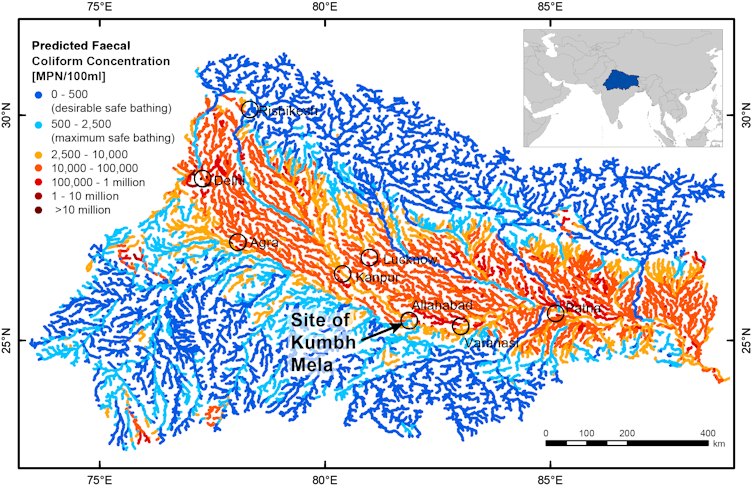
Despite its tremendous spiritual significance, the Ganges is also notorious for having some of the most polluted water in the world. For 79% of the population of the Ganges catchment, their nearest river fails sewage pollution standards for crop irrigation. Some 85% of the population live near water that isn’t safe for bathing and Allahabad – where Kumbh Mela takes place in 2019 – is one of those places.

Our own research suggests that as the number of people living in nearby cities increases, the problem with water quality in the Ganges worsens. Urban populations in the Ganges catchment contribute around 100 times more microbial pollution per head to the river than their rural counterparts. This means that untreated sewage discharged from a sewer appears worse for river water quality than sewage discharge where there are no sewers at all.

The waters of the Ganges catchment are vital for life here at Jahangira Island, but pollution is a health risk. Jack Wickes/Flikr, CC BY-ND


When we examined 10 years of water quality data we found that the concentration of fecal coli forms – a common pollution indicator found in human feces – increased when the density of people living upstream increased. This makes sense: more people means more poo.

But we also found that people living in cities in India contribute more pollution per person than those in rural areas – how much more depends on the population density. A person living in an area in India with 1,000 people per km², a density similar to central London, contributes on average 100 times more pollution to the nearest river than they would in an area with 100 people per km² – say, rural Devon in the UK.

So why does it appear that a person living in an Indian city produces more sewage pollution than someone living in the countryside?

Of course, people in the cities are unlikely to actually contribute significantly more feces than those in rural communities. Instead, it’s probably sewers that are to blame. In cities, extensive sewage networks efficiently flush sewage to the river, whereas in rural areas more people defecate in the open or in pit latrines. This means feces in rural areas are less likely to be washed into the river and the bacteria and viruses they carry are more likely to die in situ.

Predicted sewage pollution across the Ganges catchment including Allahabad – the site of the Kumbh Mela. Milledge et al., 2018Author provided.


As the population density of a place increases, sewers become more common. Sewage removal is essential for the protection of public health, but without effective treatment, as is typically the case in the Ganges catchment, it comes at the cost of increased river pollution and waterborne diseases for people living downstream.

It’s therefore clear that water quality in the Ganges is a more complex and widespread problem than previously thought. We’d expected that cities, with their more advanced sewage management, would be better for the river. What we found was the opposite – more sewers without sewage treatment makes river pollution worse.

The urgency to invest, not only in sewers, but in the treatment of sewage has never been greater – especially in the most densely populated areas. However, the Western approach of taking all waste to a central treatment plant is expensive and so may not be the best solution.

Onsite treatment technologies such as off-grid toilets or decentralised treatment plants are rapidly developing and may help improve river water quality sooner, enabling more and more people to celebrate Kumbh Mela safely.

Feeding the Bees!

Natural Beekeeping Trust

January 12, 2019

Father: What are you feeding them
Daughter: Pollen
#beelove in Kuwait

Come and eat, sweet bees

Father: What are you feeding themDaughter: Pollen#beelove in Kuwait

Posted by Natural Beekeeping Trust on Saturday, January 12, 2019

Food is Helping Flint, Michigan Recover

Civil Eats

Food is Helping Flint Recover and Reimagine Itself

Addressing the water crisis head on, multiple healthy food initiatives are working to improve health, nutrition, and food security while jump-starting the local economy.

By Brian Allnutt, Health, Local Eats, Nutrition   January 16, 2019

Flint Farmers Market


It’s a cold, snowy Thursday in Flint, Michigan, but business is more than steady in the Flint Farmers’ Market where Clinton Peck runs Bushels and Peck’s Produce. Locally grown micro-greens, beets, Brussels sprouts, and cabbage cover the booth, along with tropical fruit and other items he picked up at the produce terminal in Detroit. Elsewhere, the late lunch crowd is enjoying the offerings at the nearby restaurants. Later in the day, a group of kids from the city will participate in a cooking class in one of the market’s industrial kitchens.

It’s probably safe to say that this sort of diverse, foodie environment isn’t the picture most people conjure when they think of Flint—a town that is now synonymous with industrial decline and one of the worst public health crises in the nation’s recent history. Yet this market is booming—more than half a million people visited its 45 year-round and 30 seasonal vendors last year, according to farmers’ market managers.

What’s going on behind the scenes here is just as interesting. Peck’s produce stand operation is supported in part by a primary care pediatric facility called the Hurley Children’s Clinic (HCC), located in the same building. Through an initiative called the Nutrition Prescription Program, sponsored by the Rite-Aid Foundation, caretakers of children visiting the clinic receive a $15 voucher for fresh fruits and vegetables to spend at the market. Peck says he gets about $200 to $250 worth of business from these vouchers every market day.

The prescription program parallels other investments in the Flint food system designed to mitigate some of the worst effects of the water crisis. Programs like Flint Kids Cook—also coordinated by the HCC—as well as Double Up Food BucksFlint Fresh, and investments in community businesses such as the North Flint Food Market are helping Flint residents access fresh fruit and produce, as well as milk products, that are a proven to lessen the effects of lead on the body. For the most part, the produce that Peck sells and Flint Fresh distributes comes from outside the city proper, but Flint Fresh has a specific program of soil-testing and post-harvest handling for growers within the city limit to address lead concerns.

Double Up Food Bucks has grown since 2016, when it was used by 9 percent of SNAP households, to its present reach of over 50 percent. Other promising signs of growth include the facts that Flint Fresh is developing a regional food hub for food processing that could help area growers, and the North Flint Food Market just received a large grant from the Michigan Good Food Fund. In addition to getting healthy foods into the hands of more people, these initiatives are creating openings for the development of sustainable local businesses—and laying the foundation for radical change by giving citizens more control over their health and livelihood.

“Flint is a city like Detroit that is essentially having to re-imagine itself and rebuild itself from the ground up,” says Lisa Pasbjerg, market manager for the nonprofit Flint Fresh. “We want to get fresh produce to our community, but of course we also need to build and have a sustainable local economy.”

Balancing these two efforts hasn’t been easy. Although many nonprofit initiatives have expanded in the city and benefitted small businesses, 42 percent of Flint’s population lives in poverty, according the U.S. Census Bureau, and much of the development is clustered around a gentrifying downtown.

Increasing Access to Nutrition—With a Focus on Children

In 2014, the Flint Farmers’ Market moved to a new location next to the Mass Transportation Authority Transit Center—the source of 80 percent of Clinton Peck’s customers—and also near the YMCA and other amenities. The move preceded the water crisis, as did the co-location of the Hurley’s Children Clinic, but these changes took on a prophetic quality as the fallout from the disaster hit the city.

Since the water crisis, various programs have effectively helped residents—especially young ones—access the fresh food for sale in the market.

When the Nutrition Prescription Program launched in 2016, it gave patients small bags of fresh produce or $5 produce vouchers. As it continued, Amy Saxe-Custack, an assistant professor at Michigan State’s Department of Food Science and Human Nutrition, who runs it along with other researchers, realized their clients weren’t just using these benefits to supplement their diets, but to meet basic food needs. With additional funding from the Rite-Aid Foundation, the HCC was able to increase the amount of the vouchers from $5 to $10 dollars later in 2016 and then from $10 to $15 in 2018.

This effort is groundbreaking for its focus on children and preventative medicine. Saxe-Custack says that most of the food prescription initiatives in other parts of the nation focus on low-income adults with chronic conditions like high blood pressure or diabetes.

“From a dietary perspective, there is tons of evidence to suggest that dietary patterns are established early,” she says, and the attendant research she’s doing for the program may provide some data that could establish it as a model.

A cooking class at Flint Kids Cook. (Photo courtesy of Flint Kids Cook)A cooking class at Flint Kids Cook. (Photo courtesy of Michigan State)

Families using the center also expressed a desire to teach their children how to cook. This inspired Flint Kids Cook, which launched in 2017, sponsored by an anonymous family foundation in New York City that wanted to do something about the water crisis, says Saxe-Custack. Initially the program had trouble attracting enough young people to participate. But now the class at the market has a waiting list and is expanding to other sites in the city.

Saxe-Custack believes the success of the classes stems from the fact that it’s not just a nutrition class or cooking demo: “They’re measuring, they’re mixing, they’re cutting, they’re over a stove … It’s actually hands-on cooking,” she says.

And chefs from the market, such as Ian Diem of Chubby Duck Sushi, help teach the class. “The kids are enamored with the chefs,” as Saxe-Custack puts it. The class could also prepare kids for jobs in a sector that appears to be growing in the city.

Food System Investments Putting Power in Residents’ Hands

The economic benefits of charitable investments in the food sector have grown thanks to programs like Double Up Food Bucks as well. Administered by the Fair Food Network, a national nonprofit that has been using federal, state, and philanthropic funding to match SNAP benefits spent on fruits and vegetables for a decade. At the Flint Farmers’ Market, the effort has translated into more than $110,000 of additional sales annually, according to market manager Karianne Martus.

After the water crisis, the Fair Food Network set out to grow the program by stepping up their outreach to the people of Flint, where they had already established a strong base for the program. They also allowed people to use Double Up Food Bucks on dairy products because calcium has been shown to decrease the absorption of lead in the body.

Since October 2016, the number of residents using the Double Up program has grown from 4,000 to over 13,000. And Holly Parker, senior director of programs at the Fair Food Network, estimates that over 50 percent of SNAP recipients in the city are using the program, which brings more business to people like Peck at the farmers’ market, who says it has boosted his sales by between 8 and 12 percent.

Clinton Peck of Bushels and Pecks at the Flint Farmers' Market.Clinton Peck of Bushels and Pecks at the Flint Farmers’ Market. (Photo courtesy of the Flint Farmers’ Market)

Flint Fresh was also created to respond to the water crisis and is aimed at improving nutrition and food security while supporting local business. Along with mobile farmers’ markets, they deliver around 300 boxes of fresh produce to local families and individuals every month. Both platforms accept Double Up Food Bucks and Nutrition Prescription vouchers, as well as prescriptions from other programs. In the summer, 50 percent of the produce comes from local farms, some of them in Flint itself.

Flint Fresh’s Pasbjerg says that her organization is in the initial phases of building a regional food hub that would help the organization distribute produce. “The idea is that, long term, we would be able to process stuff for local farmers,” she says, “and then use that in the school systems and for local grocery stores.”

In addition to Double Up Food Bucks, the Fair Food Network is partnering with Capital Impact PartnersMSU’s Center for Regional Food Systems, and the W.K. Kellogg Foundation to invest in Flint as part of the Michigan Good Food Fund, which provides financing and counseling to organizations promoting healthy food access, economic development, and other goals. Among this year’s award winners is the North Flint Reinvestment Corporation, which will be receiving $40,000 to help create the city’s first member-owned co-operative grocery store, the North Flint Food Market.

The co-op is another example of the way the water crisis—as well as the disappearance of two large grocery store chains—engendered the desire for radical change. “The conventional food system isn’t going to come back into that neighborhood,” says Rick Sadler, assistant professor of Family Medicine at Michigan State and a member of the store’s steering committee. Starting the co-op was, in Sadler’s words, a way of “putting the power of the investment in the hands of the residents.”

The Challenges of Radical, Food-based Change

Despite all these positive changes, however, the city still faces structural problems caused by overall disinvestment in most of its neighborhoods and the clustering of new investment around Flint’s small downtown.

For these reasons, Flint businesses will still face a lack of a customer base for the immediate future, Sadler says. “It’s just so hollowed-out, and the momentum of getting investment back into the city has been so slow-going,” he added.

There’s also the fact that most grant-based initiatives don’t offer permanent funding. Double Up Food Bucks, according to Emilie Engelhard, senior director of external affairs for the Fair Food Network, seems to be secure after the Senate voted to protect healthy produce incentives in the most recent farm bill. And the Nutrition Prescription Program is funded through 2019 at the farmers’ market and through May 2020 at a second location. But relying on grants for economic stimulus will always be an uncertain proposition.

The exact potential of food businesses as an economic driver in Flint is also unknown. One study based in Detroit, which is 60-some miles away from Flint and dealing with similar structural issues, found that food was the third-largest employment sector in the city and could soon move to second.

Similar research hasn’t been done in Flint, but the city’s master plan projects that “food and hospitality” jobs in the county will be increasing 51.9 percent by 2040, second only to “health care and social assistance.”

Given this projection—and the progress these initiatives have made so far—Flint’s ability to use some of its current nutritional programming to bring investment back to the city could then be a very important for Flint residents. Although Pasbjerg emphasizes that in one of the nation’s poorest cities, “there’s a ton that needs to be done still.”

Edible Landscapes

Civil Eats

Edible Landscapes Are Un-Lawning America

These 12 businesses are among many nationwide ready to turn sterile, water- and chemical-intensive lawns into food forests.

By Stephanie Parker, Local Eats, Urban Agriculture    January 15, 2019

Lawns are ubiquitous in the United States and according to a 2015 NASA study, they take up three times as much space as the next largest irrigated crop, corn. These familiar patches of green require 9 billion gallons of water per day, around 90 million pounds of fertilizers and 75 million pounds of pesticides per year. Plus, the lawnmowers that maintain them largely use gas and emit pollutants. All for a crop we can’t eat.

A growing group of people and businesses are trying to change that. For over a decade, “unlawning,” or the act of turning sterile lawns into fertile, edible landscapes, has been gaining popularity in the United States. These edible yards aren’t just backyard garden plots with a few squash and tomato plants, rather they are landscapes that incorporate edible native plants, like paw paw trees or bush cherries, along with fruit trees, pollinator habitats, medicinal herbs and water features.

One well-known proponent of edible landscapes is Fritz Haeg, an artist who in 2005 began a years-long project called “Edible Estates,” during which time he traveled the country and turned ordinary yards into edible masterpieces. In the years since Haeg’s project, there has been a steady growth in awareness of edible landscapes in the U.S.

“When we began, there was very little ecological literacy,” says Sarah Kelsen, an ecological engineer and co-owner of Land Beyond the Sea, an edible design firm founded in 2010 in Ithaca, New York. But now, she says of ecological awareness and her own business, “It feels like there’s been a completely exponential increase.”

Ben Barkan, an edible landscaper who started HomeHarvest LLC 10 years ago in Boston, has also seen the difference. “Not a lot of people were used to the idea of replacing parts of their lawn or ornamental landscapes with edible landscapes,” Barkan says about the first years of his business. Now, he says, there is more interest and his business has grown a lot.

“The trend toward planting food is on the rise again,” says Fred Meyer, who started his edible landscaping organization, Backyard Abundance, back in 2006. Meyer believes that the chaos and insecurity that the U.S. has been experiencing since the 2008 recession contributed to unlawning’s rising popularity, since people tend to fall back on growing food in times of insecurity.

He likens the trend to that of the Victory Gardens during World War II, which grew an estimated 40 percent of produce consumed in the United States. Today, America grows less than half of its own fruit and just over two-thirds of its fresh vegetables. But home gardening is becoming more popular, with a 2014 study showing that one-third of Americans currently grow food at home, an increase of 17 percent from 2008. “I see it continuing as long as things continue to be unpredictable,” Meyer says.

parents and children in an edible gardenThe trend toward turning yards into gardens is a win for biodiversity as well. A recent study published in Landscape and Urban Planning found that lawn maintenance was responsible for a lack of biodiversity in sites around major cities like Baltimore, Boston, Miami, and Phoenix. It also found that “well-maintained” lawns were strikingly similar nationwide: A person’s maintained lawn in Baltimore would have more in common ecologically with a maintained lawn in Miami than it would with their neighbor’s unmanaged yard.

Edible landscapes, on the other hand, increase the diversity of insect populations, create habitat for birds and other wildlife, and provide ideal conditions for the millions of microbes that make up healthy soil, which is critically important for their ability to store carbon and slow climate change.

All that being said, lawns are still as American as apple pie, and not everyone is rushing to turn theirs into a productive landscape. “Houston is a tough market,” says Josh Reynolds, owner of the Houston-based Texas Edible Landscapes. “I am trying to educate Texans through the use of workshops, but interest remains low.”

And sometimes there can be resistance even from local government and rule makers. Homeowners associations (HOAs) are known for being sticklers about the appearance of one’s yard in a neighborhood. Successful edible designers take this into account, however, creating landscapes that are not just productive, but pretty as well.

Whether you want a consultation, a small raised bed, a full overhaul to turn your yard into an edible forest, or just to chat with someone about ecology, below are 12 businesses and groups around the country that can help.

Northeast/Mid-Atlantic

Earthbound Artisan
Located: Lancaster, Pennsylvania
Serving: Pennsylvania’s Berks, Chester, Dauphin, Lancaster, Lebanon, and York counties
Details: Earthbound Artisan was founded in 2014 by Garrett Book and Tim Seifarth after Seifarth, who has been a landscaper now for over 20 years, became disillusioned with “conventional” landscaping that included installing lawns and ornamental trees as status symbols. Earthbound offers traditional native gardens and designs based on permaculture, or what they call “design with a purpose.”

Ecologia Design
Located: Frederick, Maryland
Serving: Maryland, northern Virginia, and the Washington, D.C. area
Details: Owner Michael Judd started Ecologia Design in 2010 after working for 18 years in Nicaragua on tropical and edible landscapes and food security. Ecologia offers services from consultations to full-service installations. Judd also has a nursery and a permaculture site at his home in Frederick, where he leads talks and demonstrations. He also wrote a book, Edible Landscaping with a Permaculture Twist, to help people create these edible landscapes on their own.

HomeHarvest LLC
Located: Boston, Massachusetts
Serving: Boston and the Greater Boston Area
Details: Founded by Ben Barkan a decade ago when he was 18 years old, this business has grown from a kid on a bike towing a trailer and a shovel to a full-service edible landscaping company with five employees and a truck. Barkan is a licensed landscaper offering full-service edible landscaping with features including custom stonework, pollinator gardens, and medicinal herbs.

Land Beyond the Sea Ecological Design
Located: Ithaca, New York
Serving: New York’s Finger Lakes region
Details: Founded in 2010, Land Beyond the Sea offers planning and implementation for a number of services including site planning, landscape design, arborist consultation, and forestry and urban forestry. The eight-year-old design firm is owned by Miguel Berrios, the lead landscape designer, and Sarah Kelsen, the ecological engineer. Berrios is New York State’s only technical service provider certified to write Pollinator Habitat Plans for the National Resource Conservation Service (NRCS), which allow clients to install pollinator habitats fully funded by the NRCS.

South

Bountful Backyards

Located: Durham, North Carolina

Serving: The Triangle area

Bountiful Backyard founders Kate DeMayo and Keith Shaljian in front of their peach tree.

Details: Owners Kate DeMayo and Keith Shaljian began Bountiful Backyards in 2007 as an alternative to starting farm, which they say was out of reach due to the cost of land. They offer design and installation services of low-maintenance gardens that use permaculture principles and comply with HOA requirements. Some of the installations they provide include vegetable gardens, fruit trees, herbal and tea gardens, pest management, water catchment and rain gardens. They also teach classes and give workshops in the community.

Fleet Farming
Located: Orlando, Florida
Serving: Orlando
Details: Fleet Farming is a nonprofit urban agriculture program that also offers edible landscaping services. After an initial consultation, the Fleet Farming team will install raised beds fitted with timed drip irrigation. They provide soil, seeds, plants, and a gardening guide. In addition, they offer edible forests that include perennial vegetables and fruiting trees that include such tropical plants as bananas, mangos, and avocados. The non-profit also has educational events and demonstration plants in a number of Orlando neighborhoods.

Texas Edible Landscapes
Located: Houston, Texas
Serving: Southeast Texas
Details: Started in 2016 by Josh Reynolds, who says his specialty is suburban landscapes where Homeowner Associations (HOAs) discourage the planting of anything besides pretty, ornamental lawns. “I like to design food-producing ecosystems that disguise themselves as typical ornamental plants that fit in with the neighborhood,” he says. The company is a design and consultation firm that contracts out to trusted associates if a client wants an installation.

Midwest

Backyard Abundance
Located: Iowa City, Iowa
Serving: Iowa City and surrounding areas including parts of Illinois, Minnesota, Nebraska, and Wisconsin
Details: Started by Fred Meyer in 2006, Backyard Abundance creates edible landscapes to meet their clients’ lifestyles and habits. Before he designs a landscape, Meyer does an in-depth consultation to understand what his client is looking for. “We want to create a positive beneficial relationship between the homeowner and their landscape,” he says. Meyer also focuses on aesthetics so that none of his clients will face problems from their HOA. In addition, Backyard Abundance has established edible classrooms, forests, and parks in Iowa City.

Custom Foodscaping
Located: St. Louis, Missouri
Serving: St. Louis and the surrounding area
Details: This two-year-old company creates custom edible landscapes. “I was inspired to start the business because I hope to help communities reimagine the places in which we grow food,” says owner Matthew Lebon. In the last year, he’s done around 40 consultations, five designs, and 10 installations. He also is a “garden coach” for a handful of clients. His focus is on planting perennial food crops—pears, chestnuts, asparagus, and others—in the hopes of creating a regenerative system based on perennial food crops.

West

Foodscapes Hawaii
Located: Honolulu, Hawaii
Serving: Honolulu and the rest of Oahu
Details: Foodscapes Hawaii offers a number of products and services to easily turn a patch of yard into a productive garden. After an extended site visit, owner Fran Butera and her Foodscapes Hawaii team designs a garden based on the client’s budget and builds it. Once the garden is planted, Foodscapes Hawaii offers other services, like a monthly subscription plan to weed and maintain the garden a few times a month. They also offer other services like gardening workshops, compost station or worm bin set-ups, and green home consulting.

The team from Foodscapes Hawaii after installing a new garden in Manoa Valley, Honolulu. They designed and built the raised redwood planters and planted a variety of edibles in their custom organic soil mix.

The team from Foodscapes Hawaii after installing a new garden in Manoa Valley, Honolulu. They designed and built the raised redwood planters and planted a variety of edibles in their custom organic soil mix.

Portland Edible Gardens
Located: Portland, Oregon
Serving: Portland metro area and surrounding suburbs
Details: Portland Edible Gardens was founded in 2013 by Ian Wilson to help people who wanted to grow their own food but don’t know how. “Portland has always had a reputation for valuing sustainability and fresh, local and organic food,” Wilson says. “But even in such a ‘green’ city I became aware that people had very few resources for actually learning how to grow their own food at home.” The business offers consultations and installations of raised garden beds, fruit trees, and berry bushes. They also do garden maintenance and one-on-one garden mentorship, bringing everything a client needs to start a garden.

Urban Plantations
Located: San Diego, California
Serving: San Diego County and Orange County, California
Details: Karen Contreras began Urban Plantations in 2008 at the height of the Great Recession. However, her risk paid off as San Diego families turned to growing their own food as a way to cut costs. Contreras stepped down in 2016 and the company is now run by Paige Hailey and Mat Roman. The business has around 20 employees and install roughly 50 new gardens and orchards each year.

Don’t worry if you don’t see a business near you on this list, there are many more out there that you can find online.

This article was updated to correct the spelling of Mat Roman’s name, and the area that Urban Plantations serves.

We Can Solve This!

EcoWatch
January 15, 2019

All across the world, young people are mobilizing to take their futures into their own hands.

➡️ https://bit.ly/2MasWDe

We Can Solve This

Cutting Class For Climate

All across the world, young people are mobilizing to take their futures into their own hands.➡️ https://bit.ly/2MasWDeWe Can Solve This

Posted by EcoWatch on Tuesday, January 15, 2019

Has Trump kept his promises to coal workers?

Late Night with Seth Meyers
January 15, 2019

Has Trump actually kept his promises to coal workers? Seth checks in.

The Check In: Trump Country

Has Trump actually kept his promises to coal workers? Seth checks in.

Posted by Late Night with Seth Meyers on Tuesday, January 15, 2019

Inside one community’s battle against environmental racism

Sierra Club shared a post

January 13, 2019

Inside one community’s battle against environmental racism

St. James Parish in Louisiana — also known as “cancer alley” — is a textbook case of environmental racism, where toxic industry ends up near communities of color.

Inside one community's battle against environmental racism

Welcome to ‘Cancer Alley,’ a predominantly black area in Louisiana that's experiencing the dire effects of chemical pollution.

Posted by Consider It on Wednesday, January 2, 2019

“Wildlife and The Wall.”

The River and the Wall

“Wildlife and The Wall.” A short film showing some of the ecological and wildlife impacts of a border wall.

This is some of the pristine landscape where Trump wants to build a wall.

Tell the Senate to pass the House spending bills and the #TrumpShutdownhere:

Wildlife and The Wall

"Wildlife and The Wall." A short film showing some of the ecological and wildlife impacts of a border wall.

Posted by The River and the Wall on Friday, March 23, 2018

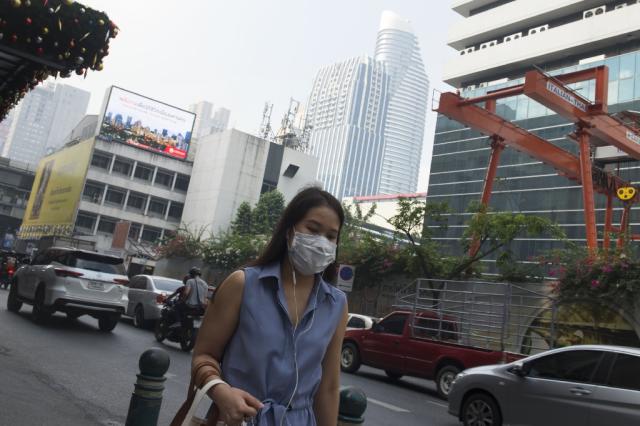
Bangkok Residents Told to Stay Inside as Pollution Reaches Dangerous Levels

Can We Feed the World Without Destroying It?

Civil Eats

Feeding the World Without Destroying It

In a new book, Food First Executive Director Eric Holt-Giménez argues that responsible, truly sustainable food production will require a convergence of diverse social movements.

By Eva Perroni, Agroecology, Food Justice      January 10, 2019

For more than four decades, Eric Holt-Giménez has been at the center of food movements across the globe that are seeking progressive social and economic change. From documenting the rise of the farmer-led sustainable agriculture movement in Central America to growing the food justice movement in North America as the executive director of Food First, Holt-Giménez’s work brings the perspectives of struggling communities to broader development and policy debates.

His new book, Can We Feed the World Without Destroying It?, is a three-part essay addressing the agronomy and ecology of farming, as well as the political economy of food. It covers the way resources, value, and power are distributed across the entire system—from farm to fork.

Feeding the world without destroying it will not simply require better food waste redistribution or climate-smart technologies, Holt-Giménez argues. Instead, it will also take social movements to create the political will for food system transformation. “How we produce and consume determines how our society is organized,” he writes. “But how we organize socially and politically can also determine how we produce and consume.”

Civil Eats recently spoke with Holt-Giménez about his new book, prevailing food system myths, and how a powerful food movement might catalyze society to demand the deep systemic reforms upon which he believes our collective future depends.

The book opens with the assertion that the global food system is subject to a whole new set of problems related to overproduction and over-consumption. Isn’t it counter-intuitive to produce more food than we could possibly consume?

Overproduction is a chronic problem for capitalism—and for our food system. Though hunger and malnutrition are actually getting worse, we’ve been producing one-and-a-half times more than enough food to feed everyone on the planet for half a century. The glut of food keeps prices low for grain traders and processors of animal feed and junk food. Competition drives these companies to out-produce each other, each coming out with cheaper and cheaper processed food products. We end up with lousier food than the market can absorb and with a lot of grain-fed meat that hungry people can’t afford. Prices drop and margins shrink, but cheap food hasn’t ended hunger, and it comes at a tremendous social and environmental cost.

On one hand, 40 percent of food is wasted, so we are throwing away precious water, energy, and nutrients and producing a lot of unnecessary methane. Driving the land to produce more than its soils and aquifers can naturally sustain degrades and erodes not just farms, but the surrounding environment.

Our food system is a major source of greenhouse gases, and the over-fertilization of crops results in contaminated aquifers and massive “dead zones” in our lakes and oceans. Our bodies have become toxic dumps for the chemicals and antibiotics used in industrial food production, and we have at least as many people suffering malnutrition and diet-related disease as there are from hunger.

Overproduction results in monopolization up and down the food chain, giving agri-food corporations tremendous economic and political power to continue doing business as usual. These unregulated firms pay for none of the “externalities” they produce—we do.

Yet there are repeated calls for the need to double food production by 2050 to feed the world. Why does the scarcity myth prevail?

Scarcity serves several important functions in a capitalist economy, especially with food. Because capital can’t expand when markets are saturated, scarcity must be constantly created, both materially and ideologically. Corporations perpetuate the myth of scarcity because if the real reason for hunger was revealed, then society would begin to question the efficiency and the moral foundation of the capitalist food system.

The thing about the myth of scarcity is that it both manipulates and obscures the difference between need and demand. Nearly a third of the world’s human population needs more healthy food to meet their daily nutritional requirements than they can afford to buy.

The real market demand for food is for cheap meat to meet the appetites of the expanding middle class, so much of the investment in “food” is really an investment in the cultivation of feed for grain-fed livestock and poultry. This doesn’t feed the poor at all, but under the guise of “feeding the world,” it expands the markets of the seed, chemical, grain, and livestock industries.

Corporations invite us to believe that if we just produced more cheap food, poor people would be able to afford it, and we’d end hunger. But even the cheapening of food hasn’t lowered the ratio of hungry people in the world, because most of the world’s hungry are poor farmers who actually produce over half the world’s food on less than a quarter of the planet’s agricultural land. Essentially, poor people feed the poor.

Why do you feel that those trying to change the food system need to understand capitalism?

If we want to change it, we need to understand how it works. This seems straightforward, but because capitalism is so ubiquitous, it is invisible to many people in the food movement. On the other hand, those who do recognize it often feel as if it is so powerful the only thing we can do is accept it and work for minor reforms and safety nets to mitigate its damage to people and the environment. There is talk about a “food revolution” that has somehow taken place without affecting the power of capitalist food monopolies.

Because our global food systems respond to the logic of capital, problems like hunger, malnutrition, and global warming are viewed as opportunities for profit. Therefore, technological innovations that can be bought and sold on the market as commodities take precedence over other proven redistributive approaches such as land reform and agroecological diversification.

It’s fashionable these days to talk about “disrupting” the food system with clever apps, but in reality, technical solutions are carefully selected to fit into the existing system in ways that enhance rather than fundamentally challenge the power of agribusiness monopolies or the industrial model of production. Since the capitalist model is at the heart of the problem, this leads to some remarkably contradictory approaches.

For example, virtually none of the proposals to deal with food waste (composting, feeding pigs, selling “ugly fruit,” etc.) address the cause of food waste: capitalist overproduction. Farmers are competing with each other—ramping up production—to sell to the new “waste market”. Simple supply management quotas coupled with fair price floors for farmers could eliminate overproduction, but these well-known measures are ignored in favor of inventing new commodities. The food waste industry is in its infancy right now, and there is a lot of excitement about how this can help poor communities. But these start-ups will be eventually taken over by the retail monopolies. Then prices to farmers will drop, and prices to consumers will rise.

Another example is “climate-smart” agriculture. Giant soy, maize, and wheat plantations in the U.S. and Latin America are celebrated for using “precision agriculture” and “big data” to make efficient use of fertilizers and pesticides. But these plantations are displacing diversified small farms, grasslands, and forests at an astonishing rate in order to supply feed to confined animal feedlot operations (CAFOs) in China and the U.S. As researcher Marcus Taylor of Queens University in Canada quipped, climate-smart agriculture is really “climate-stupid consumption.”

What specific policies should members of the food movement come together to change?

Now is the time to push for transformative reforms that address overproduction, poverty, exploitation, and climate change by rolling back monopoly power and creating favorable conditions for a more localized, resilient, and equitable food systems worldwide.

We need strong antitrust laws, especially for the retail, grain, and chemical monopolies. The financial sector needs to be regulated to stop speculation with our food. Agricultural land should be de-commodified and made accessible to family farmers and to young farmers who want to prioritize local markets and regenerate local watersheds. Issues of equity and reparations should be addressed through redistributive policies. These farmers need to be supported by fair, parity prices conditioned on sustainable, regenerative practices that build resiliency and guarantee fair labor practices for farm and food workers.

We need supply management programs that stop overproduction, and we need to level the playing field between family farms and monopolistic corporations by using a “polluter pays” principle and demanding fair, living wages for all workers. Grain reserves should be re-established to help keep prices stable and hedge against shortages. Local, cooperative banks and credit associations need to be supported and guaranteed by the federal government to make local loans in agriculture, housing, and local businesses.

We need to ensure good health, education, and welfare policies in the countryside through investments in the “social wage”– i.e., public investments in the health, education, and welfare of rural and peri-urban communities. The countryside needs to be a good place to live, and farming should be desirable work. This would go a long way to a real food revolution.

Do the U.S. food and farm justice movements have an opportunity to drive some of these transformative reforms by getting behind something like the Green New Deal?

Much like the era of the Great Depression, today, our farm, food, and climate justice movements are calling for sweeping reforms for a Just Transition to shift from an extractive economy to a resilient, regenerative, and equitable economy. While these alliances are coming together, they have yet to articulate a clear agrarian vision for a just climate transition. I’d say that is high on the list for a powerful convergence.

On the crest of the recent “blue wave” in the U.S. Congress, new leadership proposed a Green New Deal to address the climate crisis. But the initiative faces political obstacles in Congress, and it is not clear just how a Green New Deal will ensure the participation and equity demanded by social justice movements.

As expected, the corporate wing of the Democratic Party is resisting the Green New Deal. Nevertheless, I think we need to take advantage of the present political moment. If farmer, farmworker, climate, and racial justice leaders come together to envision a New Deal for a Just Transition, whatever happens, we can advance the broad-based, multi-racial, working-class alliance we need to reverse global warming and transform the food system.

This interview has been edited for length and clarity.