A scandal EPA chief Scott Pruitt may not be able to survive

MSNBC

Rachel Maddow Show / The MaddowBlog

A scandal EPA chief Scott Pruitt may not be able to survive

By Steve Benen     April 2, 2018

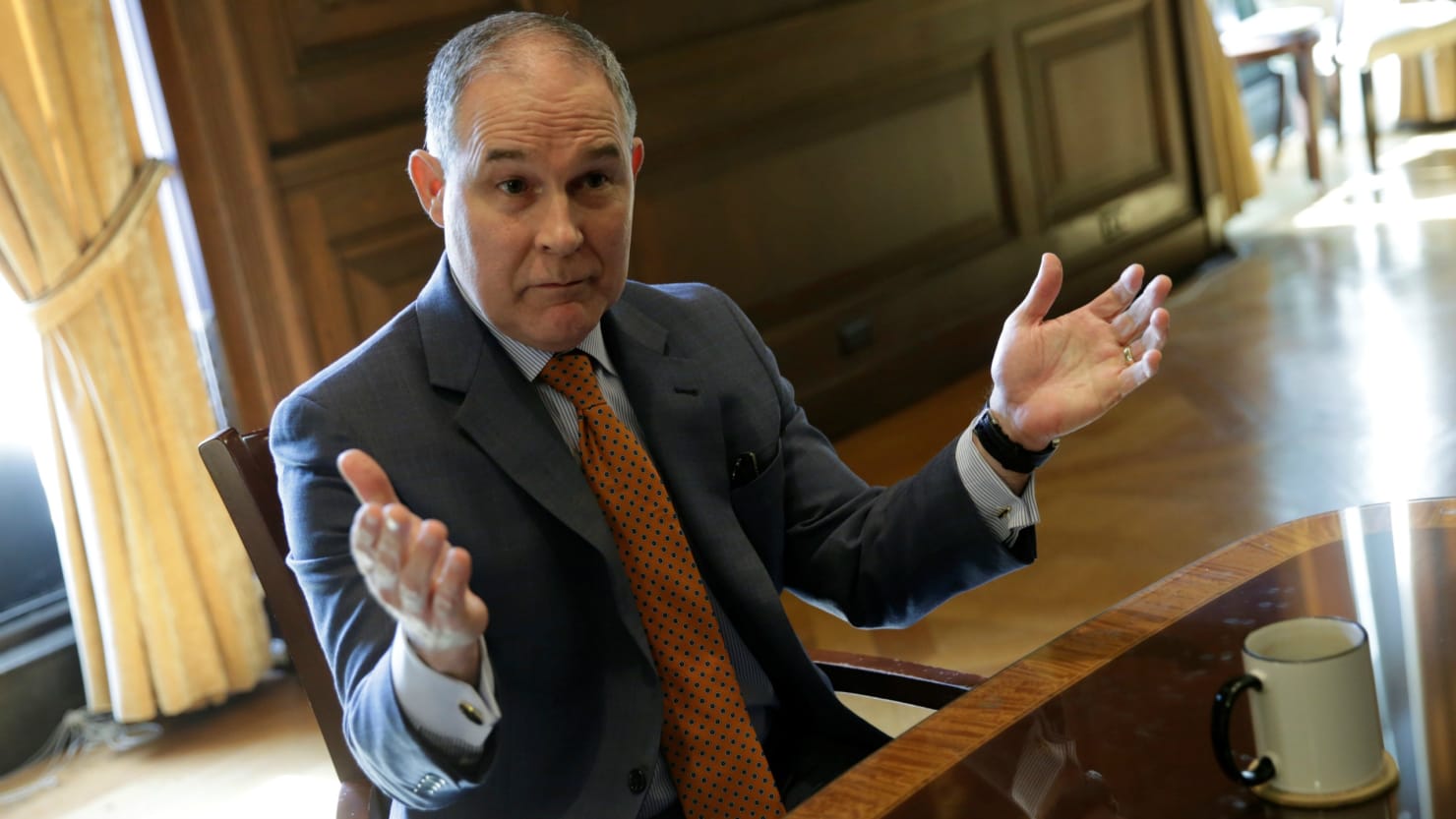
FILE PHOTO: EPA Administrator Scott Pruitt speaks during a meeting held by U.S. President Donald Trump on infrastructure at the White House in Washington,…Kevin Lamarque

EPA Administrator Scott Pruitt’s latest scandal came up during a roundtable discussion on ABC’s “This Week” yesterday, and it led to an interesting exchange between George Stephanopoulos and former Gov. Chris Christie (R-N.J.).

STEPHANOPOULOS: Does he have to go?

CHRISTIE: Listen, I don’t know how you survive this one. And if he has to go, it’s because he never should have been there in the first place.

The former Republican governor, who was briefly tapped to lead Donald Trump’s transition team before being replaced the week after the election, had a series of related concerns, which seemed to be part of an effort to avoid blame for the president’s mess.

But at the heart of the message was an important observation: common sense suggests the EPA chief’s scandal will cost him his career. The traditional political rules sometimes don’t apply in the Trump era, but in this instance, I think Christie’s correct.

As we discussed on Friday, the first sign of trouble came when Pruitt took a first-class trip to Morocco late last year – it cost $40,000 and you paid for it – in order to have the EPA chief pitch “the potential benefit of liquefied natural gas (LNG) imports on Morocco’s economy.”

Why the head of the EPA would make economic energy recommendations to foreign countries was unclear. The answer, however, soon after seemed to come into focus.

The only LNG export plant in the country hired a lobbyist, and Scott Pruitt lived in a Capitol Hill condo – for $50 a night, far below market value – in the Capitol Hill home owned by the lobbyist’s wife.

And in case the story weren’t quite alarming enough, ABC News also reported on Friday afternoon, “The Environmental Protection Agency paid a Capitol Hill condo association $2,460 after Administrator Scott Pruitt’s security detail broke down the door, believing he was unconscious and unresponsive and needed rescue, ABC News has confirmed.”

Apparently, Pruitt was napping at the time.

The same report added the EPA chief’s adult daughter also lived there during her time as a White House intern last year.

Pruitt was already one of the most controversial members of the president’s cabinet, but this mess is almost certainly the most serious scandal of his tenure. Or as Chris Christie put it, “I don’t know how you survive this one.”

Postscript: The energy lobbyist in question is J. Steven Hart. If his name sounds at all familiar, it’s because Hart is also assisting the NRA in its controversy surrounding foreign assistance it’s accused of receiving.

Comments:

Lebowsky Dude: Scott Pruitt in the EPA is a scandal, republicans absolutely violated their pledges to this country by confirming him, and every single day this cretin remains in the government is a bad day…

Lebowsky Dude: To put this into context, its a scandal that many members of congress were found to be sleeping in their offices because of the high cost of housing in Washington DC… To have this loser getting a special deal from a lobbyist is actually criminal if you ask me…
jazzbeau

Pruitt was napping… Evidently destroying the environment is tiring work. Another interesting attempt at lessening the the scope of this graft is Pruitt saying he only used one bedroom (as most people do), sounds like only wanting to pay for the seat you occupied on a chartered jet.

Republicans rigged our democracy. Here’s how Democrats can fight back

The Guardian

Republicans rigged our democracy. Here’s how Democrats can fight back

David Faris    March 31, 2018

Republicans have been using the constitution’s flaws to wage a one-sided war against their political opponents. It’s time for Democrats to respond

Can the Democrats lead a democratic revival? Illustration: Rob Dobi

Donald Trump wasn’t elected because Democrats lost a policy fight in 2016. What Democrats did was lose a procedural fight that has been going on since the early 1990’s, when Republicans began waging a relentless, brutal, and completely one-sided war, systematically using their lawmaking power to disadvantage their adversaries in elections and political mobilization.

Gerrymandering, the Citizens United atrocity that declared money is speech, blocking US Supreme Court nominations and obstructing legislation are some of the Republican party’s tactics. Depraved, racist voter ID laws that obviously target people who are likely to vote Democratic, and the cruel way that many states prevent current or former felons from voting, are others.

Standing in the way of reforms to our nonsensical, undemocratic electoral college system for electing the president helps the Republicans too, as does ensuring the United States remains the only country in the entire world that holds its critical national elections on a regular working Tuesday as if we literally couldn’t care less who is able take off work to cast a ballot.

Indeed, one has to grudgingly respect the single-mindedness with which the Republican party has pursued its advantage, even as we condemn the damage it has wreaked on our democracy.

Democrats, now that they are in the minority for the foreseeable future, must pay homage to their Republican overlords and use what little power they have to slow down legislation, turn the public against the Republican Congress, and then retake total power in 2018 and 2020. Then, what they must do with that power is to fundamentally alter key aspects of our political system that we take for granted but that are not, contrary to popular belief, outlined in the US constitution.

Ingenious for its time, if deeply morally deficient, the constitution saddles the country with a series of difficult political problems. Some are explicit design flaws, such as the way that every state in the United States, whether it has 38 million or 600,000 residents, gets two and only two US senators, or how the entire 435-member House of Representatives is put up for re-election every two years, the shortest election calendar in the entire world. Others are crimes of omission, like the document’s relative silence about voting rights.

But the biggest problem is that it is underspecified. It doesn’t adequately describe the powers granted to the supreme court it created, or explain what a militia is in the second amendment, or outline what happens if the Senate decides it simply can’t be bothered to carry out its constitutional obligations by approving appointments made by the president. It contains no information about how elections should be funded. And the thing is well nigh impossible to amend.

Beginning with the Gingrich radicals who took over the House in 1994, the modern Republican party has been willing to exploit the constitution’s design flaws and the constitutional order’s reliance on informal understandings between political actors to sabotage the functioning of Congress, destroy the Obama presidency, and seize vastly more power than the American people would otherwise have granted it.

When they retake power, Democrats should use those same flaws to revive not the party, but our democracy.

First, they should grant statehood to Washington DC and Puerto Rico – long-suffering territories whose citizens are utterly deprived of voting rights and representation in federal elections. This can help rectify the Democrats’ structural imbalance in the US Senate. Breaking the deep-blue state of California into seven states can finish the job, by finally creating about as many blue-leaning as red-leaning states and delivering lasting power (or at least parity) to Senate Democrats and their allies.

The theft of Merrick Garlands seat by Republicans and the deepening intensity of congressional battles over federal judicial appointments should lead the next Democratic administration to pack the supreme court, by adding liberal justices until progressives finally have their first majority in a long generation, as well as creating hundreds of new judgeships in the federal judiciary.

The constitution does not stipulate the number of justices either on the supreme court or the lower courts, and Democrats should use the threat of court-packing to press for a constitutional amendment to end lifetime tenure in the federal judiciary as well as enacting other reforms that would finally remove destructive, ugly battles over the courts from our political landscape.

Progressives should also get behind a change in how we elect our representatives to the House, enacting proportional representation reforms that would not only eliminate the grotesque chicanery of gerrymandering but also make it possible for smaller parties to finally win a seat at the governing table. And they should double the size of the House to bring the constituent-to-legislator ratio more in line with what the founders envisioned.

Finally, any serious progressive governing coalition must immediately address our litany of voting problems, from the disenfranchisement of felons to the racist voter-ID laws implemented by cynical Republicans across the country, by passing a comprehensive new voting rights act.

Step one in bringing this vision to fruition is to stop bringing pistols to the nuclear war. Democrats must be prepared to mimic their tormentors by intentionally destroying the Trump administration and then unleashing this dizzying array of electoral and institutional reforms when they recapture total power.

Only by changing the rules that are currently rigged against them, while clinging to a set of minimal behavioral standards, will Democrats ever hold power long enough to truly transform American politics in a lasting progressive direction.

Doing so will require party leaders to pursue policy changes that will be ridiculed by their opponents as outrageous affronts to democratic decency and received by their own voters with puzzlement or even shock. They need to do it anyway. The shock will wear off.

Most of these structural reforms would require only a law to be passed by a Democratic-controlled Congress and then signed by a Democratic president. If instituted as a bloc, they will improve access to the ballot; increase participation in our elections; decrease destructive tensions over the supreme court; mitigate the fundamental flaws of the Senate; bring members of the House closer to their constituents and open the world of national politics to many more citizens.

At the end of this process, Americans will despise their own politics a bit less, and feel more connected to the system. The purpose of this partisanship is nothing short of dragging the United States kicking and screaming into the 21st century.

From It’s Time To Fight Dirty. Used with permission of Melville House. Copyright © 2018 by David Faris

David Faris is the program director of Political Science at Roosevelt University

Oklahoma Teachers Prepare For Walkout As Red State Revolt Spreads

HuffPost

Oklahoma Teachers Prepare For Walkout As Red State Revolt Spreads

Dave Jamieson, HuffPost           March 30, 2018

Teachers in Oklahoma still plan to walk off the job next week after state legislators passed an education funding bill that fell apart within hours.

Initially it seemed the legislation, signed Thursday by Gov. Mary Fallin (R), would quell the statewide walkout that educators had set for April 2 to demand more money for schools. But not even a day after the state Senate approved the first tax increase package in years, legislators in the state House voted to undo one of its main provisions, a tax on hotel and motel stays.

After applauding legislators for approving the funding bill, the state’s leading teachers union, the Oklahoma Education Association, renewed its call late Thursday for teachers around the state to stay out of school and descend on the Capitol in Oklahoma City on Monday.

“Yesterday, the Legislature passed a historic education funding increase,” the union said Thursday in a Facebook post. “Today, they started dismantling it by cutting millions out of the plan. Now they’re gone for the weekend. Oklahoma: we’ll see you at 9 a.m. April 2 at the Capitol.”

Oklahoma is one of a wave of red states now facing a teacher revolt after years of anemic funding for education.

Over the past decade, Oklahoma carried out a series of tax cuts that, combined with falling energy prices, have left the oil- and gas-rich state with little money to steer toward teachers or textbooks. It’s more or less the same story that played out in West Virginia, where tax cuts forced educators to forego raises while their health care costs increased. Teachers there walked off the job for nine days in February and March, prompting the state legislature to fund pay increases for public employees.

The historic and successful strike in West Virginia has inspired a burgeoning uprising among austerity-weary teachers around the country. In addition to Oklahoma, Arizona could soon face a strike by teachers, who are demanding the state boost pay by 20 percent and return to pre-recession funding levels for education. (Meanwhile, teachers in Kentucky shut down public schools in 25 counties on Friday to protest proposed cuts to the state pension plan.)

Teachers in West Virginia, Oklahoma and Arizona are all among the lowest-paid in the country, with schools facing growing teacher shortages. Republicans control the statehouse and governor’s office in all three states.

“After ten long years in a lot of these conservative states, the chicken is finally coming home to roost,” said Lily Eskelsen Garcia, president of the National Education Association, the 3-million member union with which the Oklahoma Education Association is affiliated. “They’ve given tax breaks to big corporations, defunded public schools, and said, ‘What could go wrong?’”

After Oklahoma legislators passed the tax hike, it seemed the walkout could turn instead into a one-day rally on Monday. Now nobody knows for sure what next week will bring. The mixed actions by Oklahoma’s legislature could lead to a situation where some school districts close only for Monday or not at all, while others engage in a work stoppage for days. Many Oklahoma teachers on Facebook have called for keeping schools shut down until all their demands are met.

We have buildings that are falling apart and textbooks that need to be taped together. Beth Wallis, assistant band director

To a certain degree, their walkout will require the cooperation of their largely sympathetic superintendents, who decide whether schools are formally open or closed. If schools are open and teachers refuse to return to work, the state could consider it an illegal strike. Several districts announced Friday that their schools would not be open on Monday.

Beth Wallis, an assistant band director who teaches in a Tulsa suburb, said teachers in her district voted unanimously to stay off the job beyond Monday. Although the legislation passed this week includes average pay raises of $6,100, Wallis said the lack of state funding guaranteed in the bill could leave local districts on the hook to pay for them. She also said securing teacher pay raises is secondary to increasing general school funding.

“The school funding in the bill is laughably small,” Wallis said. “It’s not enough to buy every kid in my district a single textbook. We have buildings that are falling apart and textbooks that need to be taped together.”

Like most states, Oklahoma cut school funding in the wake of the Great Recession. But it also pursued tax cuts during the economic recovery that followed, dropping income taxes and reducing the gross production tax on oil and gas companies. With little money to devote to schools, Oklahoma has led the nation over the past decade in cuts to its education formula funding, which is the main well of state money for individual districts.

“They sort of maximized the damage that the recession did to their schools and other public services, and as the economy improved, they kept cutting taxes,” Michael Leachman, an analyst at the Center on Budget and Policy Priorities, recently told HuffPost. “You’re just digging your hole even deeper.”

With less funding, many cash-strapped schools have gone to four-day weeks, while certifying a growing number of emergency teachers to fill vacant jobs. Such teachers don’t meet the state’s normal minimum requirements to teach in public school. The union says the state will have to increase salaries and school funding significantly if it wants to stop losing teachers to Arkansas and other nearby states that pay better.

Reversing course will not be easy. Approving tax hikes in Oklahoma is extraordinarily difficult, requiring a three-fourths supermajority in both chambers. Legislators were barely able to approve the tax package that has already foundered. Legislators had only hours to digest that bill before it was passed, and many apparently did not have time to read it. One state representative argued that the bill had a $75 million hole in it before taking the repeal of the hotel and motel tax into account.

“The more the bill has gotten to sit,” Wallis said, “the more people have gotten to read it and find problems with it.”

Oklahoma teacher has 5 jobs because he doesn’t earn enough teaching to support his family

March 30, 2018

He’s a high school algebra teacher in Oklahoma. And a bus driver. And a Little League umpire. And he drives for Uber and Lyft. All because he says his teaching salary isn’t enough to support his family.

The many jobs of Oklahoma's teachers

He’s a high school algebra teacher in Oklahoma. And a bus driver. And a Little League umpire. And he drives for Uber and Lyft. All because he says his teaching salary isn’t enough to support his family.

Posted by CNN on Friday, March 30, 2018

Pruitt’s EPA security broke down door to lobbyist condo

ABC – Good Morning America

EXCLUSIVE: Pruitt’s EPA security broke down door to lobbyist condo

Matthew Mosk, John Santucci, Stephenie Ebbs, GMA,  March 30, 2018

Environmental Protection Agency Administrator Scott Pruitt’s protective detail broke down the door at the Capitol Hill condo where he was living, believing he was unconscious and unresponsive and needed rescue, in a bizarre incident last year that the EPA has for months refused to discuss, according to sources and police radio traffic obtained by ABC News.

The incident occurred in the late afternoon on March 29, 2017 at the Capitol Hill address Pruitt was renting, which was co-owned by the wife of a top energy lobbyist. A Capitol Police officer called 911 at the behest of Pruitt’s security detail, which had tried unsuccessfully to reach him by phone, and by banging on the building’s front door, according to police recordings obtained by ABC News.

“They say he’s unconscious at this time,” the 911 operator is told, according to the recordings. “I don’t know about the breathing portion.”

Responding fire units from a Capitol Hill station house mobilized. “Engine three, Medic two respond to unconscious person,” the radio transmission said.

The protective detail then broke down the building’s glass-paneled front door and ascended two flights to Pruitt’s $50-a-night bedroom, where two sources tell ABC News he was found groggy, rising from a nap. It is unclear what led to the panic that caused the response. Pruitt declined medical attention, and a police report was never filed.

The EPA eventually agreed to reimburse the condo owner for the damage to the door, a source familiar with the arrangement told ABC News. EPA spokesman Jahan Wilcox did not respond to requests for information on the incident or the reimbursement payments.

The previously unreported incident occurred while Pruitt was living at Capitol Hill condo co-owned by the wife of a top energy lobbyist. Vicki Hart and her husband, lobbyist, J. Steven Hart, both confirmed the events, but neither would say how much the damage to the door cost to repair.

The EPA has since reimbursed Pruitt’s former landlord, Vicki Hart, for the cost of the door.

ABC News first reported Thursday that Pruitt had lived in the condo in 2017, during his first six months in Washington. The condo is in a prime location – less than a block from the U.S. Capitol complex – and other apartments in the building complex have rented for as much as $5,000-a-month, according to a source familiar with a neighboring lease.

The EPA allowed Bloomberg News to review copies of canceled checks that Pruitt paid to the condo owner. The news outlet reported that the checks show varying amounts paid on sporadic dates — not a traditional monthly “rent payment” of the same amount each month, according to Bloomberg. In all, Pruitt paid $6,100 over six months to the limited liability corporation for the Capitol Hill condo co-owned by Vicki Hart, whose husband J. Steven Hart is chairman of a top D.C. lobbying firm and who is registered to lobby for several major environmental and energy concerns.

Two sources told ABC News that Pruitt’s daughter also used the apartment in 2017 during her tenure as a White House summer intern.

“The rental agreement was with Scott Pruitt,” Vicki Hart told ABC News. “If other people were using the bedroom or the living quarters, I was never told, and I never gave him permission to do that.”

The EPA did not respond to requests for comment or clarification on the living arrangement with Pruitt’s daughter. McKenna Pruitt, now a law student, could not be reached by phone or email.

Wilcox released a statement from EPA Senior Counsel for Ethics Justina Fugh Friday, saying she did not “conclude that this is a prohibited gift at all. It was a routine business transaction and permissible even if from a personal friend.” Wilcox did not say when Fugh reviewed the matter or what led her to look into it.

Bryson Morgan, who is in private practice and served as Investigative Counsel at the U.S. House of Representatives Office of Congressional Ethics, said he thought it raised red flags.

“I think it certainly creates a perception problem, especially if Mr. Hart was seeking to influence the agency,” Morgan said.

Gift rules prohibit executive branch employees from accepting items of value, Morgan said in an interview prior to the EPA’s release of the details. In addition to traditional gifts, those rules apply to favorable terms on a lease.

EXCLUSIVE: EPA chief Pruitt joined by family in condo tied to lobbyist ‘power couple’

Pruitt arranged condo deal through energy lobbyist, source says

Democrats want details of Pruitt’s DC condo tied to lobbyist ‘power couple’

“It’s not just if he is paying market rent,” Morgan said. “A short-term lease is expensive. Is he given the ability to end it any day? Is this an arrangement any other person could get on the open market? My assumption would be this situation does not involve the hallmarks of a specific fair market transaction,” he said in an interview conducted before the checks were revealed.

The new disclosure comes as Democrats in Congress are demanding that Pruitt disclose to them more details about his 2017 use of the Capitol Hill home. U.S. Rep. Don Beyer, a Virginia Democrat, called on Pruitt to resign over his failure to disclose the rental deal tied to an energy lobbyist.

“As he has done over and over again, he showed contempt for transparency, ethical guidelines, and the public interest,” Beyer said. “Pruitt must resign. If he refuses to do so he should be fired immediately.”

Hart is the chairman of lobbying firm Williams and Jensen that lobbies on EPA policies like the Clean Air Act, according to its website. The firm also lobbied on issues related to the export of liquefied natural gas and represented Cheniere Energy Inc., which owned the only active Liquid Natural Gas export plant in the United States at the time.

Pruitt traveled to Morocco last December and the EPA said in a press release that liquid natural gas exports were a topic of discussion during that trip.

Last year, Cheniere Energy Inc. reported paying Hart’s firm $80,000.

Hart’s firm specifically lobbied on “issues related to the export of liquefied natural gas (LNG), approval of LNG exports and export facilities.” The firm also lists on its website that it lobbies on other EPA policies like the Clean Air Act.

Hart was registered with several companies to lobby on energy issues, but he told ABC News on Friday that he never contacted the EPA for clients.

“I made no lobby contacts at the EPA in 2017 or 2018,” Hart said.

The EPA did not respond to ABC News’ questions about whether Hart’s lobbying firm had any involvement in arranging meetings during Pruitt’s trip to Morocco.

Cheniere Energy spokeswoman Rachel Carmichel told ABC News the company ended its relationship with Hart’s firm in December 2017. The spokeswoman went on to say Cheniere was unaware of the relationship between Pruitt and the lobbyist and had not used Hart’s firm to have conversations with the EPA.

Another lobbying client of Hart’s, the railroad Norfolk Southern, spent $160,000 last year on lobbying Congress on “issues affecting coal usage, oil production, and transportation, including EPA regulation.”

Norfolk Southern also declined to comment when reached by ABC News.

Craig Holman, an ethics specialist at Public Citizen, a non-partisan watchdog group, wrote to the EPA Inspector General Thursday to request an investigation into the rental arrangement. If the rental arrangement was anything other than a market rate deal, he wrote, “it would at least constitute a violation of the federal statutes and executive branch rules prohibiting gifts to covered officials from prohibited sources.”

“Since Administrator Pruitt is already involved in allegations of accepting gifts of travel, the question arises whether a sense of entitlement may have led him to violate the gift rules on this rental arrangement as well,” Holman wrote.

The head of the nonprofit watchdog group the Environmental Integrity Project and former EPA Director of Civil Enforcement Eric Shaffer called on the EPA’s inspector general and Congress to look into the issue.

“Does this explain why Pruitt flew to Morocco to pitch natural gas exports, which isn’t really an EPA concern?” Schaeffer wrote in a statement.

The EPA inspector general’s office is aware of the report, according to spokesman Jeff Lagda.

The agency’s inspector general is already looking into the cost of Pruitt’s travel and whether the agency followed all proper procedures.

Walker’s Wasting Taxpayer Money Fighting Democracy

Esquire – U.S.

Walker’s Wasting Taxpayer Money Fighting Democracy

Charles P. Pierce, Esquire       March 29, 2018 

From Esquire

Being our semi-regular weekly survey of what’s goin’ down in the several states where, as we know, the real work of governmentin’ gets done, and where the shepherd is asleep and the willows weep.

Because we are on our way to San Antone-mandatory nod to Bob Wills-we are making only two stops on our tour this week, but both of them are cherce. We begin in Wisconsin, where the desperate attempts of Scott Walker, the goggle-eyed homunculus hired by Koch Industries to manage that particular midwest subsidiary, and his pet legislature to subvert both democracy and the duties of Walker’s office have reached the level of what my sainted mother used to call high-sterics.

For the benefit of customers who may have come to tinhorn politicians late, the Republican majorities in the Wisconsin legislature gerrymandered the state so badly that even this Supreme Court gagged on the result. In addition, two seats in the state legislature came open and Walker was required by law to call special elections to fill them. Given the pasting Republicans have taken in similar elections around the country, this did not fill Walker and his pet legislature with either optimism or glee. So, he simply refused to call the elections.

Last week, however, a judge that Walker appointed told him to get the Koch Brothers’ mitts off his puppet strings and call the elections. This occasioned a week of huffing and blowing all throughout the capitol in Madison. The legislature has before it a bill that would eliminate the special elections on the grounds that the Republicans might lose them. (I’m paraphrasing here.) Meanwhile, Walker appealed the previous court’s decision and, on Wednesday, another court in Dane County slapped him down. From The Wisconsin State Journal:

“Walker hasn’t argued that he can’t order the elections or that Reynolds was wrong in requiring him to do so, Niess said. Rather, he said, the governor wants to be allowed to delay carrying out “his mandatory, compulsory duty because there are now other reasons that he has brought to the court’s attention.” “But these other reasons don’t change the fact that his duty under the law remains the same,” Niess said. “No court that I’m aware of is at liberty to ignore the law in order to facilitate the Legislature’s consideration of bills that might become law. When and if a legislative bill becomes law it can be brought to the court, and at that time the arguments can be made as to what the effect of that law is on an already pending (order).”

In other words, Walker argued that his pet legislature will pass his blatant power-grab and so the judge should stay the elections until he and the legislature get their chance to destroy them entirely. This argument, while quaint, did not impress the judge.

Walker then threatened to bring the whole matter before the state supreme court, but he chickened out almost instantaneously, largely because an appellate court judge did everything but knock him silly with the gavel. From the State Journal:

“Earlier Wednesday, 2nd District Appellate Court Judge Paul F. Reilly dismissed Walker’s argument that the court should allow time for the Legislature to rewrite state law that would effectively block the special elections. Reilly issued the one-page ruling hours after DOJ appealed two Dane County judges’ decisions ordering Walker to call the special elections. “Representative government and the election of our representatives are never ‘unnecessary,’ never a ‘waste of taxpayer resources,’ and the calling of the special elections are as the Governor acknowledges his ‘obligation’ to follow,” Reilly wrote.”

Walker had been thumping his tubs for weeks about how “outside forces” were making the good people of Wisconsin pay for special elections that Walker was obligated by law to call. (This is not dissimilar to the argument he made successfully against the campaign to recall him.) Judge Reilly had quite enough of that. Walker finally hollered uncle and scheduled the special elections for June 5. (The bill to do away with them appears to be dead as well.) There was no accounting for all the money the good taxpayers of Wisconsin had to kick into Walker’s attempts to find a legal way not to do his job. They really would rather some people not get to vote. Jesus, these people.

And we conclude, as is our wont, in the great state of Oklahoma, where Blog Official Derelict Gas Station Inspector Friedman of the Plains brings us an illuminating moment from a debate in that state’s legislature regarding education policy. From KFOR-4, Oklahoma’s News:

“On Monday, members of the Oklahoma House of Representatives debated a bill that would fund a teacher pay raise through several revenue-raising measures. “Money is not the number one issue,” said Rep. John Bennett. “Maybe if we spanked our kids at home a little better with a paddle, made them mind and be good kids, the teachers wouldn’t have it so hard in the classroom.” On Tuesday, Bennett stood by his words. “I’ve told all my kids’ teacher that, ‘If they get out of line, use a paddle on them,’” Bennett said. “If they get out of line after that, call me and I’ll come up and paddle them in front of the whole class because they will not disrespect their elders or teachers in school.” Bennett said bad behavior in schools is costing the state money. “Oh, absolutely,” Bennett said. “It wastes the teachers’ time, and money and effort because teachers aren’t supposed to be parents. They’re a role model but not a parent. The parents need to do what they’re supposed to do as parents, put them on the learning foundation and then send them to school. And, then our teachers can do their job, which they do so well, and teach their kids.”

I think Representative Bennett should be at the top of the list of any PTA that classifies its students as enemy combatants.

This is your democracy, America. Cherish it.

Respond to this post on the Esquire Politics Facebook page.

Scientists Weigh in on Glyphosate’s Cancer Risks

Civil Eats

Inside Monsanto’s Day in Court: Scientists Weigh in on Glyphosate’s Cancer Risks

U.N. cancer scientists and Monsanto experts face off over the science surrounding the world’s most widely used herbicide.

By Pam Strayer – Food Policy, Health, Pesticides     March 29, 2018

Lee Johnson, a 46-year-old resident of Vallejo, California developed a severe skin rash in 2014, two years after he started spraying Roundup as part of his grounds-keeping job at the Benicia Unified School District. “He read the label on the container,” says his lawyer, Timothy Litzenburg, “and he followed all the safety instructions, which were written by Monsanto.”

The rash turned into an aggressive form of non-Hodgkin lymphoma, a cancer of the lymphatic system. Doctors estimate Johnson has six months left to live; he will leave behind a wife and two children. He is one of 2,400 lawsuits filed against Monsanto by cancer victims in courts across the country, and Johnson’s case is the first one scheduled for a jury trial.

These victims are suing to hold Monsanto accountable, claiming that glyphosate, the listed, active ingredient in its popular herbicide Roundup, caused their non-Hodgkin lymphoma.

“About half of [these] cases are from people who sprayed Roundup for school districts or parks, while the others are from people who sprayed it around their homes,” Litzenburg said.

Plaintiffs are seeking monetary settlements in jury trials that could potentially amount to billions of dollars—settlements that could zero out the $2.8 billion in revenue Monsanto expects to make from Roundup this year alone. With more than 276 million pounds of glyphosate used in 2014 on farms, business, schools, parks and homes around the world, the stakes are high.

The lawsuits raise the question of whether the courts can accomplish what U.S. regulators have not: control or accountability over glyphosate, a chemical that international authorities in the U.N.’s top cancer group have deemed a probable carcinogen.

Earlier this month in San Francisco, U.S. District Judge Vince Chhabria began the process of determining whether or not scientific experts in these trials are using sound methods to reach their conclusions, and which experts can be called to the stand during upcoming federal trials.

Field test-spraying of glyphosate. (Photo credit: Boasiedu)

The 2,000 cases pending in state courts are not subject to Chhabria’s gatekeeping decisions and are already proceeding with the first case—Johnson’s—which is scheduled to begin in June.

To rule on the validity of the scientists and science, Chhabria heard from the 10 experts attorneys brought forward for the cancer-victim plaintiffs and for Monsanto in evidentiary hearings. He dubbed the Daubert hearings “Science Week,” and they served as his crash course on how world-class experts conduct cancer risk assessment.

“The judge’s role in a Daubert hearing is to find out if any of the evidence shouldn’t be presented to a jury because it lacks validity,” said Dr. Steven N. Goodman, an outside observer who is the Chief of Epidemiology for Health Research and Policy at Stanford School of Medicine. Dr. Goodman also been an instructor in judicial education courses on Daubert hearings.

Plaintiffs’ attorney Michael Baum agreed. “It’s supposed to keep ‘Ouiji board’ science out of the courtroom,” he said.

Good Data, Bad Data? IARC’s Experts vs. Monsanto’s Scientists

Daubert hearings permit both sides to present science, and in most cases, the lawyers present the scientists and studies that support their side of the argument. The scientists who testified under oath and on camera were experts in toxicology, animal studies, biostatistics, and epidemiology—all disciplines involved in cancer risk assessment.

The hearings marked the first time that Monsanto scientists faced off in court against three top scientists who had served on the U.N.’s International Agency for Research on Cancer (IARC), which in 2015 labeled glyphosate as a probable carcinogen. It was also the first time the three U.N. scientists had spoken in detail about the data and analysis underlying their decision.

Testifying for the plaintiffs, Dr. Jameson, an animal toxicology expert retired from the National Cancer Institute and the National Institutes of Health, explained how scientists work together to consider the totality of the evidence published in peer-reviewed studies. Animal studies come first. If rodent studies show evidence of carcinogenicity, scientists turn to studies of human populations to see if humans in the real world—at real-world exposure levels—are similarly affected.

Jameson told the court that IARC benefited from what he said was an “extraordinarily high amount of animal study data” on glyphosate and that animal studies consistently showed that glyphosate causes cancer.

After listing a dozen studies showing replication of different cancers in mice and rats, Jameson concluded, “It is my opinion that exposure to glyphosate not only can cause non-Hodgkin lymphoma [in humans], but it is currently doing so, at current exposure levels today.”

Farm tractor spraying crops. (Photo credit: hpgruesen)

Another of the plaintiffs’ expert witnesses, Dr. Chadi Nabhan, an oncologist and medical director for Cardinal Health in Chicago, testified to the conservative nature of IARC’s history of labeling compounds as carcinogenic.

First of all, Nabhan said, there are barriers to getting IARC to even undertake an analysis. “You have to prove that there is enough human exposure to get IARC’s interest, and that there’s enough animal data,” he said. Over IARC’s 53-year history, he said the group had considered 1,003 compounds and found only 20 percent of them to be either carcinogenic or probable carcinogens.

“I firmly believe in the conclusions of the IARC, and that actually makes a huge difference for us as clinicians,” Nabhan said, adding that he tells his patients not to use Roundup and glyphosate. “These are modifiable risk factors,” he said.

Monsanto has vigorously opposed IARC’s ruling, spending millions of dollars on a wide-ranging campaign to discredit these scientists as well as IARC itself, calling its methodology “junk science.”

Monsanto’s experts, who specialized in biostatistics, veterinary medicine, and prostate cancer, challenged the validity of the plaintiffs’ experts’ data and studies and presented their own views of the data as well as conflicting research.

Animal studies expert Dr. Thomas Rosol, an Ohio University veterinary medicine professor, for instance, challenged the widely held scientific concept of biological plausibility, which assumes a substance found to be carcinogenic in mice should also be presumed to cause cancer in humans, citing one instance where a new drug that caused cancer in mice did not cause cancer in humans.

Dr. Lorelei Mucci, an associate professor at Harvard whose research focuses on prostate cancer, relied heavily on a 2017 paper that analyzed data from a long-term study of 90,000 commercial pesticide applicators, farmers, and farmers’ spouses from Iowa and North Carolina and found no relationship between glyphosate exposure and cancer. The plaintiffs’ epidemiology experts, in response, highlighted the flaws they observed in that study, pointing instead to multiple studies that showed an association between glyphosate and an increased risk of getting non-Hodgkin lymphoma.

This kind of back-and-forth, with each side presenting data that supports its point of view, is common in Daubert hearings, said Stanford’s Goodman. “It’s very hard for a judge to understand in the adversarial context what are legitimate criticisms and what aren’t,” he said. “And then often what happens is minor or moderate disagreements or uncertainties are blown up or magnified to make the really big distinctions just seem like differing judgments.”

He added that, while scientists can “clearly tell the difference between reasonable scientific differences and unreasonable scientific differences,” judges often cannot. But, he cautioned, the judge’s role in such hearings is not to decide the case itself, but to allow a jury to hear from all of the expert scientists who meet professional standards.

What Comes Next

At the end of Science Week, Chhabria shared what he had learned from it—both as his first Daubert hearing as well as a crash course in cancer risk assessment. A week later, Chhabria invited two of the plaintiffs’ experts back for further questioning. While he felt confident that the science shows that glyphosate causes cancer in animals, he said, the epidemiological conclusions were not as clear.

“My biggest takeaway is that epidemiology is a loosey-goosey science and that it is highly subjective,” said Chhabria, adding that he found the population health study evidence on the plaintiffs’ side to be “pretty sparse.”

Chhabria said, “I have a difficult time understanding how an epidemiologist could conclude … that glyphosate is in fact causing non-Hodgkin lymphoma in human beings…. But I also question whether anyone could legitimately conclude that glyphosate is not causing non-Hodgkin lymphoma in human beings.”

Whatever the judge’s beliefs may be, Chhabria noted that they are outside his purview within a Daubert hearing. “My role is to decide whether the opinions offered by the plaintiffs’ experts are within the range of reasonableness,” Chhabria said. “And the courts tell us that even a shaky opinion can be admissible because … that expert will then be subject to cross-examination. And the jury will get to hear all of the evidence, and decide who’s right and who’s wrong.“

Corn seed genetically engineered to withstand glyphosate spray. (Photo credit: Orin Hargraves)

Ricardo Salvador, a senior scientist and director of the Food and Environment Program at the Union of Concerned Scientists, said it’s hard for a non-scientist to assess the validity of epidemiological studies. “I think that epidemiology is being held to standards here that it cannot possibly meet because it’s an observational science,” he told Civil Eats. “The precision of the measurements are not going to be like controlled studies and lab bench work.”

Epidemiology, he explained, “is the tool that we have to detect signals at the population level. And when then a signal turns out to be something like non-Hodgkin lymphoma, there’s a public interest reason why we should pursue potential triggers or causes of that sort of epidemiology.”

Stanford’s Goodman notes that Daubert hearings require a judge to be willing to do “a lot of reading and homework outside the courtroom.” Since so much of what is said in the court is part of the arguments, he added, “The lawyers can always make little disagreements sound big, and sometimes big disagreements sound small.”

For instance, at the end of the oral arguments, Monsanto’s attorneys summed up the proceedings and told the judge that the plaintiffs’ experts had not used adjusted odds ratios in some of their calculations. The plaintiffs’ attorneys countered by citing the precise instances where their experts had used the proper methodology.

The tactic illustrates what Goodman says is one often used in Daubert hearings. “If a judge is not anchored by something outside of what he hears in the courtroom,” he said, “it’s going to be very hard—they’re trying to throw sand in his eyes. And it’s very, very difficult to see.”

Meanwhile, Michael Baum, an attorney for some of the plaintiffs, said that the Monsanto Papers—emails and internal memos received from Monsanto as part of the discovery process of these trials, and which revealed the company’s efforts to discredit IARC and mainstream science—had already made waves elsewhere in the world.

“It’s like the Wizard of Oz,” Baum said. “When you pull back the curtain, and when we sent all this evidence to E.U. decision makers, regulators, and legislators, they started seeing they’ve been fooled. Decision makers are starting to make different decisions.”

The E.U. voted in 2017 to limit glyphosate’s license renewal for a period of only five years, and many European countries have announced plans to end its use within three years. “Countries like France and Italy and Austria are saying … ‘we’re not waiting three to five years, we’re moving as soon as there is a viable alternative,’” Baum added.

Salvador cautioned that the process works differently in the U.S. In Europe, “the default is to be precautionary, so that the interest of the public, and public well-being and health are paramount,” he said. “In the United States, the worldview is that the interests of industry and their right to make a profit are dominant … which is very convenient for folks that profit from spewing chemicals into the environment.”

Chhabria last week scheduled followup hearings April 4-6 for more in-depth questioning of two of the plaintiff’s experts on their epidemiological conclusions. He is expected to rule in May about scientific evidence and experts permissible in federal cases. Meanwhile, lawsuits against Monsanto in state courts are set to start in June.

More Cabinet trouble for Trump? EPA chief lived in condo tied to lobbyist ‘power couple’

ABC News

EXCLUSIVE: More Cabinet trouble for Trump? EPA chief lived in condo tied to lobbyist ‘power couple’

By John Santucci, Matthew Mosk, Stephanie Ebbs    March 29, 2018

Scott Pruitt: Everything you need to know
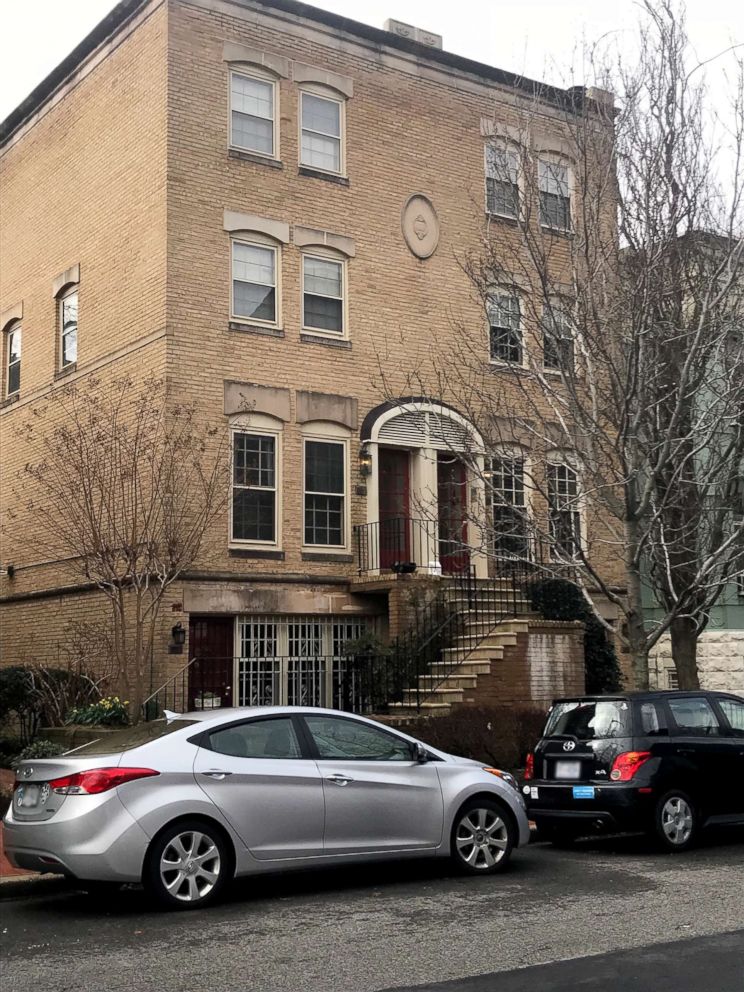
For much of his first year in Washington, President Trump’s EPA Administrator Scott Pruitt occupied prime real estate in a townhouse near the U.S. Capitol that is co-owned by the wife of a top energy lobbyist, property records from 2017 show.

Neither the EPA nor the lobbyist, J. Steven Hart, would say how much Pruitt paid to live at the prime Capitol Hill address, though Hart said he believed it to be the market rate. The price tag on Pruitt’s rental arrangement is one key question when determining if it constitutes an improper gift, ethics experts told ABC News.

ABC News. A townhouse near the U.S. Capitol where EPA Administrator, Scott Pruitt is said to have stayed. The building is co-owned by the wife of a top energy lobbyist, property records from 2017 show. more +

“I think it certainly creates a perception problem, especially if Mr. Hart is seeking to influence the agency,” said Bryson Morgan, the former investigative counsel at the U.S. House of Representatives Office of Congressional Ethics. “That’s why there is a gift rule.”

Hart confirmed to ABC News in a brief interview that Pruitt had lived in the flat, which is owned by a limited liability company that links to an address listed to Hart and his wife Vicki Hart, a lobbyist with expertise in the healthcare arena. Steven Hart said Vicki Hart co-owns the condo. He said his wife was not the majority owner, but would not identify her partners.

“I have no ownership interest,” he said. “Obviously, I know the owners.”

Vicki Hart does no lobbying involving the EPA, her husband said. Her website says she previously worked as a senior health policy advisor for two Senate Majority Leaders before establishing her firm in 2002.

Steven Hart served in the Reagan Justice Department and became, according to his website, is one of the nation’s top fundraisers, donating more than $110,000 to Republican political candidates and committees last election cycle, records show.

In 2010, the newspaper Roll Call referred to the Harts as a “lobbyist power couple.”

Mr. Hart is the chairman and CEO of Williams and Jensen, a firm that reported more than $16 million in federal lobbying income in 2017, according to the Center for Responsive Politics. Among his many clients are the NRA, for whom he serves as outside legal counsel.

Just last year, Cheniere Energy Inc. reported paying Hart’s firm $80,000.

Hart’s firm specifically lobbied on “issues related to the export of liquefied natural gas (LNG), approval of LNG exports and export facilities.” The firm also lists on its website that it lobbies on other EPA policies like the Clean Air Act.

EPA spent almost $118,000 on Scott Pruitt’s flights, many of them first class

Environmental groups launch ads on Fox & Friends to ‘boot Pruitt’

EPA chief Scott Pruitt defends Italy trip after increased scrutiny of travel costs

Cheniere Energy Inc. owned the only active Liquid Natural Gas export plant in the United States at the time. Liquid natural gas exports was on the agenda for discussion during Pruitt’s December 2017 trip to Morocco, according to an agency press release.

On the trip, Pruitt pitched “the potential benefit of liquefied natural gas (LNG) imports on Morocco’s economy,” the release said.

Environmental Protection Agency. EPA Administrator Scott Pruitt, right, meets with Moroccan Minister of Energy, Mines and Sustainable Development, Aziz Rabbah during a trip to Morocco in December of 2017. more +
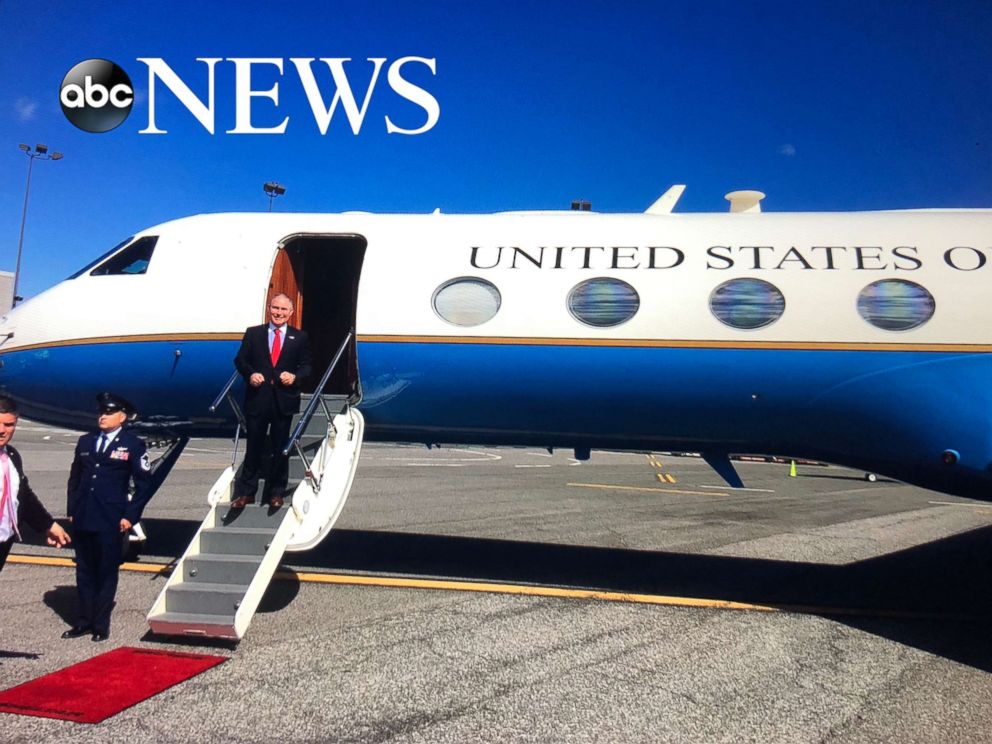
The revelations about Pruitt’s living situation come as more questions are being raised by members of Congress about his travel habits. The Morocco trip was one of Pruitt’s most expensive. ABC News has learned that Pruitt, his head of security, and an additional member of his staff, Samantha Dravis, all flew first class on the trip.

The EPA inspector general expanded an audit of Pruitt’s travel to include the Morocco trip in response to a request from Sen. Tom Carper, the ranking Democrat on a committee with oversight of EPA. Carper specifically asked the agency watchdog to look into whether Pruitt’s activities on the trip were “in line with EPA’s mission ‘to protect human health and the environment.”

Both environmental groups and members of Congress pointed out that the jurisdiction over natural gas exports typically falls to the Department of Energy – not the EPA.

Obtained by ABC News. A photo obtained by ABC News shows EPA Administrator Scott Pruitt deplaning a military-owned plane in June 2017 at New York’s John F. Kennedy International Airport. more +
A spokeswoman for Cheniere Energy declined to comment.

Another lobbying client of Hart’s, the railroad Norfolk Southern, spent $160,000 last year on lobbying Congress on “issues affecting coal usage, oil production, and transportation, including EPA regulation.”

Norfolk Southern also declined to comment when reached by ABC News.

Morgan, an ethics expert in private practice in Washington, D.C., said the lobbying connection only further muddies the living arrangement. He said the rental agreement could create ethics problems for Pruitt even if he did reimburse his landlord for rent.

“What are the terms of the rental agreement?” Morgan asked. “It’s not just a question if he is paying market rent. Was he given the ability to end it immediately? Would someone come after him if he were not to pay rent?”

Morgan said the most recent guidance from the Office of Government Ethics “emphasized that executive branch officials should decline even a permissible gift if it could cause the public to question their integrity or impartiality.”

EPA spokesman Jahan Wilcox declined to answer questions about the arrangement.

Vicki Hart reached on her cell phone, said she would call back to discuss the matter but never did.

Steven Hart declined to address details of the rental agreement, saying it was a private matter and up to Pruitt to decide whether they should be made public.

The White House has not responded to a request for comment from ABC News.

ABC News’ Katherine Faulders and Ali Dukakis contributed to this report

Why I blew the whistle on the Rick Perry meeting

CNN

Why I blew the whistle on the Rick Perry meeting

By Simon Edelman      March 29, 2018

Simon Edelman is the former Department of Energy chief creative officer. The views expressed in this commentary are his own.

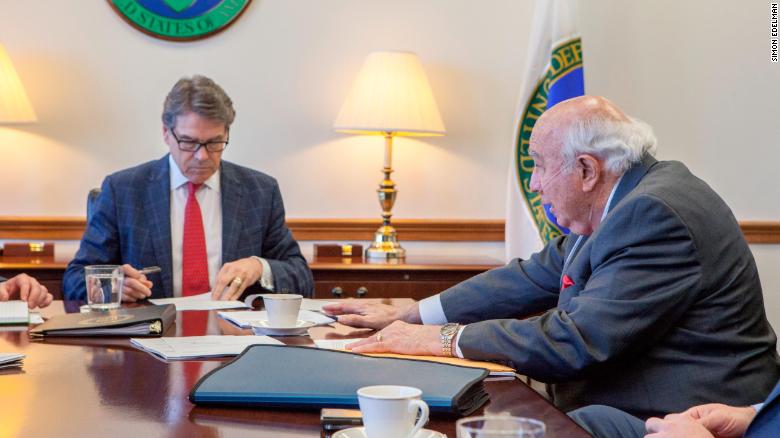
(CNN) was fired from my job as Department of Energy chief creative officer for releasing public domain photos of a meeting between Rick Perry, secretary of energy, and Robert Murray, CEO of Ohio-based Murray Energy, a large US coal company. There was no classified information present, I didn’t engage with either of them and I didn’t interrupt their conversation.

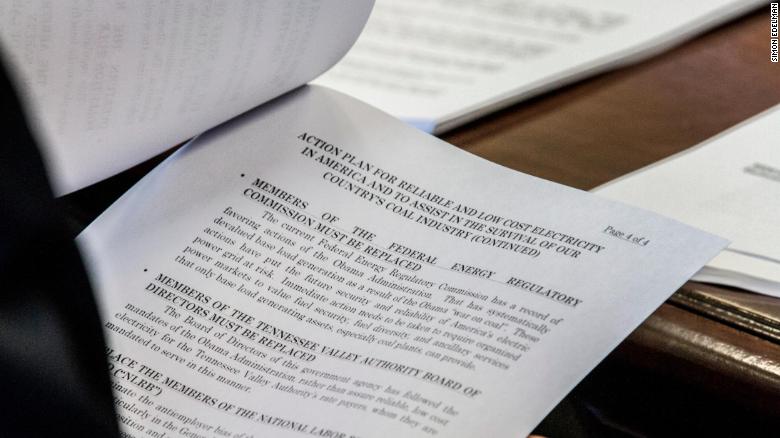
The pictures showed Murray, who donated $300,000 to Donald Trump’s presidential inauguration, give Perry an “action plan.” Murray’s company has previously lobbied the Trump administration to end new federal public health protections for greenhouse gas emissions and smog pollution, loosen mine safety rules, and cut the staff of the Environmental Protection Agency by “at least half.”

                                                                  Simon Edelman

Perry and Murray shook hands, hugged and agreed to get it done. Then they kept everything that happened that day a secret.

If this raises a few flags for you, then you understand the predicament I was in when I was still employed at DOE in March 2017. I thought about it and decided to release the photos and the story to the public, after which I was placed on leave and then fired. My personal laptop was seized (though it was recently returned to me), and I was subjected to intimidation tactics from DOE staff.

Some of the policies Murray’s company has advocated for have been faithfully executed without research, thoughtful public comment periods or policy input from public health professionals. President Trump pulled out of the Paris Agreement on climate that cuts down on greenhouse gas emissions globally, and his administration gave notice of repealing the landmark Clean Power Plan, which reduced greenhouse gas emissions from coal plants nationwide. The Trump administration attempted to delay, but was eventually forced to proceed due to lawsuits, clean air protections against smog pollution. The President also nominated a coal company consultantto oversee national mine safety and began cutting EPA scientists and other career agency staffers in droves.

Secretary of Energy Rick Perry reviews Murray Energy CEO Robert Murray’s “action plan.”
Additionally, during this time, the rapidly growing clean energy industry that employs hundreds of thousands of people was also relegated to a footnote through cuts to solar and wind energy research and shifts in focus to fossil fuel development. Perry also tried, unsuccessfully, to manipulate the energy market by attempting to force electricity customers to pay billions of extra dollars to prop up uneconomic coal plants that were ready for retirement. Not surprisingly, the news reports and industry analysts found that the coal plants that would benefit the most from Perry’s manipulation attempt would be ones supplied by Murray’s coal mines.

But that’s not even the worst of it. At that same meeting, Andrew Wheeler, the nominee for the number two position at the Environmental Protection Agency, was present. Prior to his nomination, Wheeler spent much of his career as a mining lobbyist, where he worked for Murray and other mining interests in Washington, fighting to shape clean air and water protections in his clients’ favor.

In addition to Wheeler’s past relationship with Murray, it’s also been reported that he proactively fundraised last year for two senators on the Senate Environment and Public Works Committee. This committee is responsible for determining Wheeler’s fitness for the EPA and voting to bring his nomination to the Senate floor, making Wheeler’s confirmation out of committee along partisan lines last month a potential conflict of interest.

Secretary of Energy Rick Perry and Murray Energy CEO Robert Murray meet.

If he is confirmed by the entire Senate, he will likely vigorously try to prop up the coal industry in the same ways Perry has, despite the fact the coal industry has been in a tailspin for the past decade. The United States has rapidly been transitioning to cleaner, cheaper resources like solar, wind and energy efficiency, while coal plants are being retired due to their costs and pollution.

With full knowledge of these market realities, however, Wheeler, Murray and the Trump administration are adamant on using taxpayer funds to create rules to prop them up — and for releasing some photos that highlighted this fact, I was let go.

I showed the public what I felt they were entitled to see and now believe we need to do more to hold the Trump administration accountable. We cannot turn back time and undo a meeting that’s already been done, but Congress does have an opportunity to limit the extent to which fossil fuel billionaires and D.C. lobbyists influences our government’s policies.

Some good first steps would be delving into the governmental access given to coal, oil and fracked gas executives and rejecting the nomination of Wheeler when it comes to the floor of the Senate for a final vote.

Rick Perry fired me for exposing the truth about how energy policy was being made under the Trump administration. Now it’s up to Congress to hold him and this administration accountable.

Editor’s Note: DOE spokeswoman Shaylyn Hynes declined to comment on the circumstances surrounding Edelman’s firing, but she did reiterate her earlier statement to CNN, saying Edelman’s conclusions about the significance of the Perry-Murray meeting were “ridiculous” and that Edelman’s statements are “based on his own subjective opinions and personal agenda.”


Fired VA Secretary Says White House Muzzled Him

NPR

Fired VA Secretary Says White House Muzzled Him

Laurel Wamsley and Scott Neuman     March 29, 2018

Veterans Affairs Secretary David Shulkin testifies before the Senate Veterans Affairs Committee on Sept. 27, 2017 in Washington, D.C. Win McNamee/Getty Images

Fired Veterans Affairs Secretary David Shulkin tells NPR’s Morning Edition that political forces in the Trump administration want to privatize the VA — and he was standing in the way.

“There are many political appointees in the VA that believe that we are moving in the wrong direction or weren’t moving fast enough towards privatizing the VA,” he said. “I think that it’s essential for national security and for the country that we honor our commitment by having a strong VA. I was not against reforming VA, but I was against privatization.”

POLITICS

Trump Cabinet Turnover Sets Record Going Back 100 Years

Those political forces may be responsible for why Shulkin says he wasn’t allowed to speak out to defend himself against an ethics controversy that he says was overhyped and intended to weaken him.

“This was completely mischaracterized,” Shulkin said, defending himself. “There was nothing improper about this trip, and I was not allowed to put up an official statement or to even respond to this by the White House. I think this was really just being used in a political context to try to make sure that I wasn’t as effective as a leader moving forward.”

Privatization has been the major issue at the department, and political appointees within the administration had been discussing removing Shulkin over the matter. Shulkin demurred from pointing a finger squarely at President Trump, but described a VA riddled with political pressure and conflict.

President Trump announced Wednesday that he was nominating his personal doctor to replace Shulkin.

Shulkin described great support from Congress, but noted the VA has struggled for many decades — with high turnover of its leadership as one cause.

“We’ve gotten so much done,” he said, “but in the last few months, it really has changed. Not from Congress, but from these internal political appointees that were trying to politicize VA and trying to make sure our progress stopped. It’s been very difficult.”

Shulkin’s departure comes weeks after the release of an inspector general’s report that was highly critical of an official trip he took to Europe last spring. Shulkin brought along his wife, paying for her travel with agency funds as the two enjoyed several days of tourism in between the secretary’s official meetings. The report also said he had improperly accepted a gift of Wimbledon tennis tickets on the trip.

POLITICS

Why Trump Appointees Refer To ‘Optics’ When Discussing Spending Scandals

Shulkin told NPR that all expenses were approved in advance by an internal ethics committee, and that when the Inspector General later didn’t like the expenditures, Shulkin wrote a check to the government.

“No one’s ever mentioned what the purpose of this trip was,” he argued. “This was the five allies conference, a trip that the VA secretary has participated in for 40 years with major allies. We had over 40 hours of direct meetings. I gave three separate lectures. This is our one forum where we share how to care for our veterans among all of our allies.

“This was being characterized as a European vacation, it was far from that. … I went out, never used government money for that. The single expenditure spent was on a coach airfare for my wife who was officially invited. Everything was pre approved by our ethics committee. When the inspector general didn’t like the way that my staff had handled the approval, I wrote a check back to the government.”

He is the second administration official to lose his job in part over travel expenses after Health and Human Services Secretary Tom Price’s resignation in September.

POLITICS

Ronny Jackson: The White House Doctor Who Gave Trump A Clean Bill Of Health

The president said he would nominate his personal physician, Adm. Ronny L. Jackson, to the post. Although he is a relative unknown as an administrator, he reportedly has expressed eagerness to take over the reins of the VA.

The White House says chief of staff John Kelly informed Shulkin of his dismissal before the president tweeted it on Wednesday.

Shulkin, a former hospital executive who was undersecretary at the VA during the Obama administration, is the latest in a long line of high-level White House departures in recent weeks. This month alone, National Security Advisor H.R. McMaster, Deputy FBI Director Andrew McCabe, Secretary of State Rex Tillerson, Trump’s personal assistant John McEntee and Director of the National Economic Council Gary Cohen have either left or are on their way out.

As NPR’s Quil Lawrence, who covers veterans’ affairs, reported on Morning Edition Thursday, emails had been exchanged between political appointees within the administration “who were actively planning to use this investigation to push out Shulkin and his top deputies because they thought he was not moving fast enough to increase the use of private care at the VA.”

In a New York Times op-ed published the same day he was fired, Shulkin pointed to successes in his time at the VA, citing reduced wait time, better mental health services, faster processing of claims. “Unemployment among veterans is near its lowest level in years, at 3.5 percent, and the percent of veterans who have regained trust in V.A. services has risen to 70 percent, from 46 percent four years ago,” he writes.

The big veterans organizations were pulling for Shulkin, Quil says, even though he was not a veteran.

In a statement following the announcement of his dismissal, the American Legion said: “Secretary Shulkin has acted in the best interests of America’s veterans and was making meaningful, positive changes at the VA.”

The Legion said it would “… continue to work vigorously to ensure our nation’s veterans have the efficient, transparent, and properly functioning VA that they deserve.”

Adm. Jackson’s profile rose in Trump’s eyes after he conducted a sweeping news conference in January in which he delivered a rosy picture of the president’s health, according to The Associated Press.

However, some veterans groups say they are concerned over his lack of qualifications to lead the VA, a vast agency employee some 300,000 staff members.

“We are disappointed and already quite concerned about this nominee,” said Joe Chenelly, the national executive director of AMVETS. “The administration needs to be ready to prove that he’s qualified to run such a massive agency, a $200 billion bureaucracy.”

Disabled American Veterans said in a statement: “While we look forward to learning more about the qualifications and views of the new nominee, we are extremely concerned about the existing leadership vacuum in VA.”

“At a time of critical negotiations over the future of veterans health care reform, VA today has no Secretary, no Under Secretary of Health, and the named Acting Secretary has no background in health care and no apparent experience working in or with the Department,” it said.