The Best Renewable Energy Stock You’ve Never Heard Of (And It Pays a 3.3% Dividend)

The Motley Fool

The Best Renewable Energy Stock You’ve Never Heard Of (And It Pays a 3.3% Dividend)

This utility is retiring coal plants ahead of schedule and investing billions in renewables, which could supply 45% of its power by 2027.

Maxx Chatsko       May 10, 2018

Things are moving fast in renewable energy. Really fast. Consider that in 2008 wind farms supplied just 1.5% of all electricity in the United States. But by 2019 wind power is expected to contribute 6.9% of American electricity and overtake hydropower as the top renewable energy source.

The rise of wind power wouldn’t have been possible without two companies in particular, which combine to own 20.7 gigawatts of wind capacity, or about 24% of the country’s total. Investors wouldn’t be surprised to learn that clean energy provider NextEra Energy is one of the renewable energy stocks most important to American wind power. However, the relatively unheard of natural gas and electric utility Xcel Energy (NASDAQ:XEL) doesn’t seem to garner nearly the same level of attention. Overlooking it could be a mistake.

With 10-year total returns of 226% and plans to grow its dividend and EPS at annual clips of 5% to 7% — all while investing billions in new wind and solar capacity — it could be the best renewable energy stock you’ve never heard of.

IMAGE SOURCE: GETTY IMAGES.

By the numbers

One look at Xcel Energy’s geographic footprint shows why it’s a leading player in wind power. All of its operations are located in the American wind corridor from the Dakotas to West Texas. The region is home to the majority of the nation’s wind capacity, including all of the company’s 6.7 GW.

That will make it a lot easier to reach the long-term goals to shift its generation mix away from fossil fuels and toward renewable energy. Consider how the company’s generation mix has changed and is expected to change over time:

Generation Source 2005 2017 2027 (estimate)
Coal 56% 37% 22%
Natural gas 23% 23% 17%
Nuclear 12% 13% 13%
Renewables 3% 23% 45%

SOURCE: COMPANY PRESENTATION.

Early retirements of coal-fired power plants and pouring billions into renewable energy have reduced Xcel’s carbon emissions 35% from 2005 to 2017. Using 2005 as a baseline, Xcel Energy is targeting 50% reductions in carbon emissions by 2022 and greater than 60% by 2027. The next phase will be driven by $4.25 billion of investment into renewables between this year and 2022. Most of it will fund over 3 GW of new wholly owned wind capacity, boosting the company’s total installed capacity 46%.

It’s all part of the “steel for fuel” strategy. The idea is simple: Xcel Energy will replace perpetual fuel expenses from traditional power sources, such as coal, with “steel in the ground” for wind turbines, which don’t require fuel inputs once installed. The company’s advantageous position in the American wind corridor and the installation of highly efficient turbines have already proven the strategy. Fuel expense fell from 44% of electric revenue in 2013 to less than 39% in 2017. It was a win-win for shareholders and the company’s electric utility customers: average monthly bills dropped from $83.52 to $81 in that span.

IMAGE SOURCE: GETTY IMAGES.

When combined with rate increases from state regulators, lower fuel expenses helped to boost Xcel Energy’s net income 17% from 2013 to 2017. That’s despite revenue growth of just 4.5% in the period. In fact, renewable energy investments have allowed the company to grow EPS at a compound annual growth rate of 5.9% from 2005 to 2017. The dividend has grown 6.3% annually from 2013 to 2018.

That track record should give investors confidence that the company can deliver on its goals of growing EPS 5% to 6% per year and the dividend 5% to 7% per year. And in case investors aren’t convinced, fuel expenses are projected to fall to just 28% of electric revenue by 2027, freeing even more cash flow for reinvestment into the business or redistribution to shareholders.

Similarly, Xcel Energy’s renewable energy leadership should provide confidence in its ability to deliver on the next phase of the growth plan, from 2022 onward, which includes a stronger focus on solar power and energy storage. Right now, however, the focus is on the nearer term.

The main focus is on an upcoming decision from state regulators in Colorado on the company’s proposal to shutter 660 MW of coal and replace it with 1 GW of new wind, 700 MW of solar, and another 700 MW of natural gas or energy storage. If given the green light in summer 2018, then Xcel Energy will have no remaining question marks surrounding its current investment plan that runs through 2022. The stock could respond well to the added certainty.

IMAGE SOURCE: GETTY IMAGES.

Is this renewable energy stock a buy?

Xcel Energy has largely flown under the radar in discussions of renewable energy stocks, but that’s no fault of the company. The predominantly electric utility is a shining example of how companies can lead the United States to a clean energy future — and proving that it can be a profitable endeavor. A healthy 3.3% dividend (and growing), falling operating expenses, and a long-term history of beating the total returns of the S&P 500 show that this renewable energy stock is worth a closer look at the very least — and maybe even a spot in your portfolio.

Maxx Chatsko has no position in any of the stocks mentioned. The Motley Fool has no position in any of the stocks mentioned. The Motley Fool has a disclosure policy.
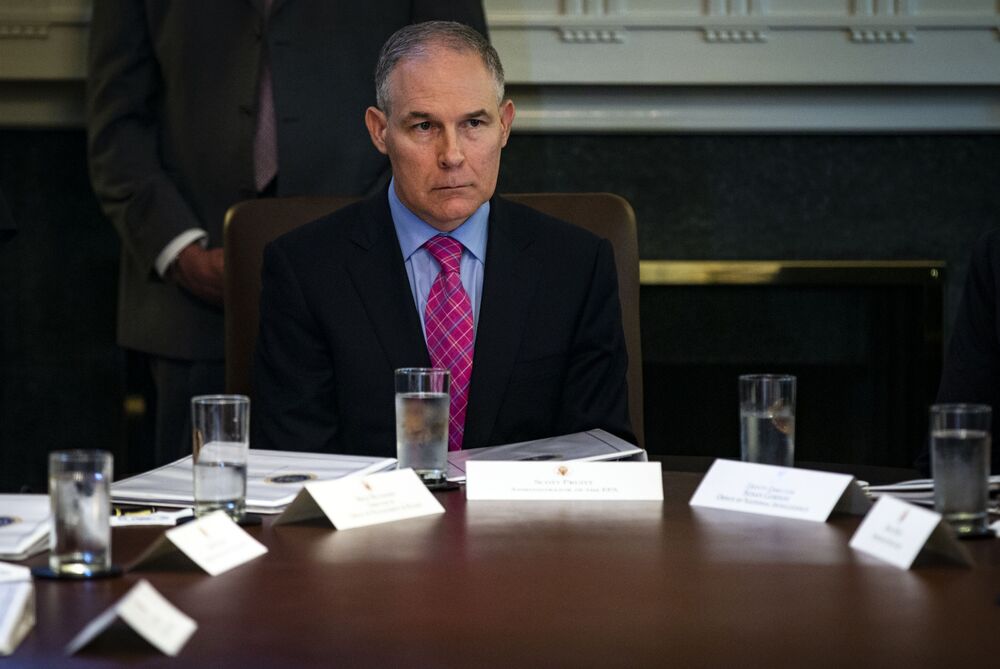
Pruitt Resumes Courting Industry as Ethics Controversies Swirl

Bloomberg – Politics

Pruitt Resumes Courting Industry as Ethics Controversies Swirl

By Jennifer A. Dlouhy and Ari Natter      May 9, 2018

EPA chief holds summit with mining, railroad, and other groups…No need to choose between environment and business, he says

EPA Administrator Scott Pruitt. Photographer: Al Drago/Bloomberg

Embattled EPA Administrator Scott Pruitt is seeking to shift the limelight away from questions about his ethics and instead focus attention on his efforts to eliminate regulations on oil drillers, farmers, home builders and automakers.

Pruitt convened a meeting Wednesday of industry representatives, ranging from the National Mining Association to the Association of American Railroads, with a pledge to collaborate.

The session marked the second meeting of the Environmental Protection Agency’s newly revived “Smart Sectors” program, designed to formally solicit the input of the industries the agency regulates. Although 13 specific sectors, including mining, agriculture and chemical manufacturing are part of the program, it doesn’t include environmentalists and public health experts.

Pruitt told the group they no longer had to choose between protecting the environment and industry, as he outlined plans to accelerate permitting of new factories and refineries. Other industry groups that participated in the session included the National Association of Home Builders, the American Chemistry Council, the American Petroleum Institute, and the Portland Cement Association.

Oil and Coal Executives Clamored for Meetings With Pruitt

“Permitting should not be used as obstruction,” Pruitt told the industry leaders who assembled in a wood-paneled room at the EPA headquarters Wednesday. Signs bearing slogans such as “True Environmentalism” stood in the background. “It should not be used to delay and obstruct so people don’t invest capital,” he said.

Quick-Take: Here’s a Scorecard of the Scott Pruitt Investigations

The session took place amid criticism the EPA has taken a pro-business tilt at the expense of environmental issues.

’We Like Him’

It also came amid a swirl of controversies around Pruitt, who has been dogged for weeks by disclosures about his unorthodox condo rental from a lobbyist, questionable spending decisions and frequent taxpayer-funded travel.

There was no mention of that at the meeting on Wednesday. When asked by a reporter if he still had the confidence of the White House, Pruitt said: “I think they’ve spoken very clearly.”

Earlier in the day, Marc Short, the White House’s legislative director, said the administrator would remain in his position “for the foreseeable future.”

“We like him,” Short told reporters at the Capitol. “He’s doing a good job.”

The meeting was in keeping with Pruitt’s business-focused schedule recently. He has tried to maintain a low profile with continued public appearance in front of generally friendly audiences. For instance, he said on Twitter that he also met Wednesday with the Industrial Minerals Association to highlight how the EPA is “striving to provide greater regulatory certainty for miners.”

Pruitt also has met with the National Association of Farm Broadcasting to highlight policy changes that could benefit farmers and ranchers, and last month visited Georgia to talk about forest management.

Trump and His Administration Are a Parasite on American Government

Esquire

Trump and His Administration Are a Parasite on American Government

The blight of corruption is festering beneath the surface.

By Charles P. Pierce     May 9, 2018

Getty Images

A few years back, in a national forest in Oregon, researchers found the largest single living organism ever discovered on earth. It was a fungus of the genus Armillaria. It covered 1000 hectares of land and it was nearly 9,000 years old. Through a vast system of thick tendrils called rhizomorphs, Armillaria can spread over a huge area and survive by latching onto the root systems of trees, from which it slowly and parasitically dines on the nutrients of the trees until the trees finally fall over, dead. Most of the damage is done underground, and one Armillariacan kill an entire conifer forest.

I’m beginning to think that the corruption of this administration* is the political equivalent of one of these super-fungi. It is so vast, and so much of it is hidden from view, that we may never see it entirely until it’s too late, and a whole lot of important things about this country go dead and topple down.

RELATED STORY: The Word You Are Looking for Is ‘Lie’

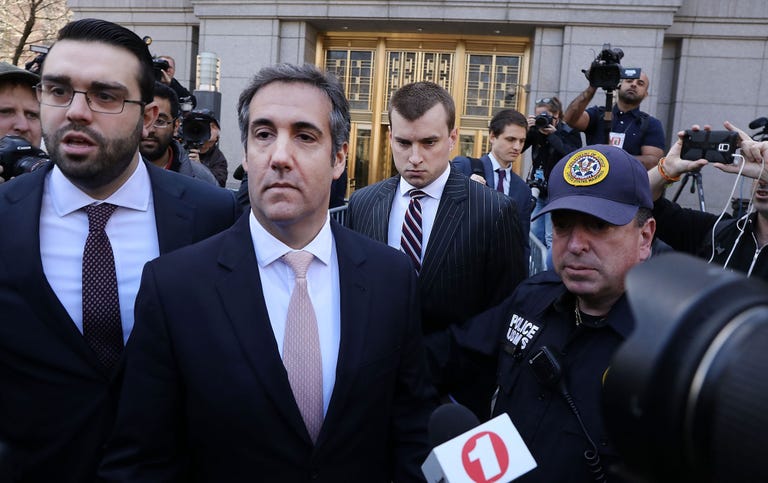
The revelations on Tuesday that Michael Cohen, the president*’s personal lawyer, was one of the most ambitious bagmen in American political history all emerged from an improbable source: a lawsuit lodged against the president* by an adult-film actress with whom he allegedly had an affair. We discovered that Cohen reportedly got a half-million dollars from a Russian oligarch with “links” to Vladimir Putin, as though you could even be a Russian oligarch and stay alive without some kind of “links” to the newly re-elected goon-in-chief.

We also learned that a shell company set up by Cohen took in $200,000 in “consulting payments” from AT&T for, as the leaked documents put it, “insights into understanding the new administration.” They could’ve paid me half that and I would have told them all they needed to know: that these people are all a bunch of crooks and that the companies should adjust their payment schedules accordingly.

Getty Images

I mean, really. Trump. Nixon. AT&T. ITT. Where have you gone, Dita Beard? A president* turns his greedy eyes to you.

Robert Mueller’s team already has interviewed Victor Vekselberg, Cohen’s buddy from Moscow, so we can probably assume there’s more there than we already know. (More women who were paid off? Checks with “kompromat” written in Cyrillic on the memo line? Who knows at this point?) The criminal rhizomorphs of this parasitic blight on government extend god knows where. That members of the administration—hi there, Scott Pruitt—see public service as an All-U-Can-Eat buffet on our dime is no secret any more. We’ve had Pruitt’s $43,000 phone booth, Ben Carson’s dinette set, and a great love for taxpayer-funded air travel by almost everyone.

Getty Images

Nor is the fact that the president* has brought the principles he employed in private business into his public duties—to wit, keeping all the really rotten stuff underground by any means necessary, and reneging on debts you don’t have the money to pay anyway. And still, dammit, they can surprise you. As one of the scientists studying the massive Armillaria lamented to The Atlantic:

“I wish all of the substrate would be transparent for five minutes, so I could see where it is and what it’s doing. We would learn so much from a five-minute glimpse.”

Whether we’d all have the guts to look at what this spreading parasitic growth is doing to our country, however, is a whole different matter. If we saw it whole, we might have to do something about it, and then where would we be?

Respond to this post on the Esquire Politics Facebook page here.

RELATED STORY:

None of Us Really Know These Guys

Esquire

None of Us Really Know These Guys

Eric Schneiderman completes the unholy trinity of New York’s prominent liberal politicians.

By Charles P. Pierce        May 8, 2018

Getty Images

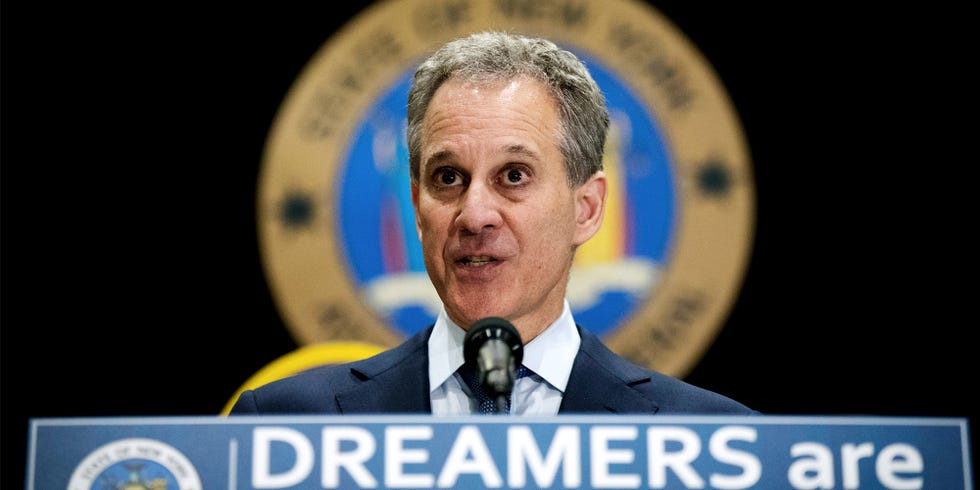
The downfall of New York Attorney General Eric Schneiderman completes the unholy trinity of prominent liberal New York politicians whose careers went into the acid bath because, at one level or another, they failed to see women as actual human beings. Eliot Spitzer got involved with a prostitution ring. Anthony Weiner used women as sounding boards for his own pleasure. And Schneiderman, allegedly, physically assaulted his romantic partners. And, in this, again, political pundits learn the lesson that gets drummed into every sportswriter over and over: none of us really know these guys.

Hero worship among sportswriters is annoying, but largely harmless and, besides, there’s always someone who doesn’t buy into it. Hero worship in our politics, however, is a dangerous business. The search for the person on a white horse is an open invitation to counterfeit engagement and artificial activism. The impact of celebrity on our politics has been devastating enough; see the current tenant at 1600 Pennsylvania Avenue for details. It’s a by-product of the constant calls for “leadership” among our political class, many of which are simple appeals for someone—anyone!—to remove the burdens of citizenship and self-government from our shoulders. And that has worked far too well.

Getty Images

Let us dispense easily with any attacks on the journalism in the New Yorker piece. Ronan Farrow just won a Pulitzer for this kind of thing and Jane Mayer is a damn national treasure. Seeing your name as the subject of a story carrying both their bylines is like seeing your career’s death warrant. And Schneiderman’s original statement—that he was engaged in consensual rough sex—was, shall we say, inadequate. (He also allegedly used the considerable power of his office to threaten his victims into silence. Jesus, what a goon.) His swift resignation was more than justified and his disappearance from the ongoing drama of this presidency, while unfortunate, is wholly appropriate. He should’ve been in jail years ago.

Instead, for the purposes of this story, we should focus on one small slice of the account:

After the former girlfriend ended the relationship, she told several friends about the abuse. A number of them advised her to keep the story to herself, arguing that Schneiderman was too valuable a politician for the Democrats to lose. She described this response as heartbreaking. And when Schneiderman heard that she had turned against him, she said, he warned her that politics was a tough and personal business, and that she’d better be careful. She told Selvaratnam that she had taken this as a threat.

Who in the hell counsels a friend to hush up a violent assault on these grounds? My politics are as important to me as anyone’s are but if, say, Sherrod Brown came and burglarized your house, I wouldn’t tell you to let him keep your jewelry because we need him to save Social Security. (Note to Senator Brown: I do not believe you are a cat burglar.) This is turning your politics into a graven image, a golden calf of the soul. Believe it or not, there are some things that politics ought not to touch. Physical abuse of any kind is high on that list.

Getty Images

(Not for nothing, and it’s a trivial matter compared to the horrors these women say they went through, but the great Dave Dayen has been making the case on the electric Twitter machine that, as a political actor and prosecutor, Schneiderman was pretty much a show-pony anyway.)

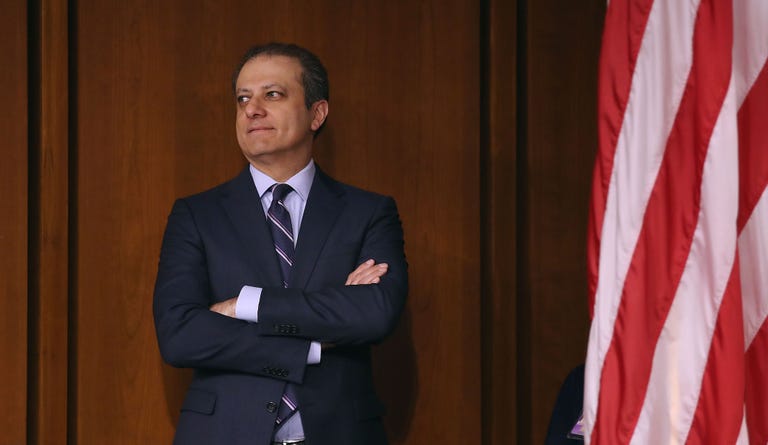
These instincts, alas, kicked in almost immediately after Schneiderman’s swift exit from the scene. There were instant calls for Preet Bhahara to replace Schneiderman. (Dayen’s not high on this idea, either.) These were based largely on the fact that Bhahara was 86’d by the president* after having been a thorn in his side as a U.S. Attorney for the Southern District of New York. And, just for fun, and for the possibility that the mere rumor would cause the president* to paint his body blue and dance a naked tarantella on the Truman Balcony, I suggested that we get the hashtag, #HRCforNYAG trending.

Preet Bharara. Getty Images

In truth, however, the search for a replacement should not be the search for A Name. For example, there are a lot of people saying good things about Ben Lawsky, a former U.S. Attorney and New York’s first Superintendent of Financial Services, an office created in response to the economic meltdown of 2008-2009. Just a cursory search of the Intertoobz reveals Lawsky to have exactly the kind of attitude that this job needs going forward. In 2014, he said this to The Financial Times:

“Corporations are a legal fiction. You have to deter bad individual conduct within corporations. People who did the conduct are going to be held accountable.”

Hire this man immediately.

Because, even though there is great crowing within the pixels this morning about liberal hypocrisy and how no investigation of the current president* can be trusted, the work goes on. Lawyers and investigators you never heard of are beavering away—in Robert Mueller’s offices, and in the chambers of the New York Attorney General, whoever he may turn out to be. You’re still on the hook, Knocko. There’s just going to be someone new on the other end of the line. And, once the evidence is in, one way or the other, we shouldn’t look to some famous politician to tell us what to do with it. Once we know the truth, it’s on us to provide the consequences.

Respond to this post on the Esquire Politics Facebook page here.

RELATED STORY: Oliver North Named President of the NRA

Clean Energy Sector Employs More Than 10 Million For The First Time

Forbes

Clean Energy Sector Employs More Than 10 Million For The First Time

Mike Scott, Opinions expressed by contributors are their own. May 8, 2018

A worker installs solar panels atop a house in the Netherlands. (Photo by Yuriko Nakao/Getty Images)

More than half a million jobs around the world were created in the renewable energy sector in 2017 , bringing the total number of people employed in the sector to more than 10 million for the first time.

Figures from the International Renewable Energy Agency (IRENA) show that more than 70% of clean energy jobs are in just six countries – China, Brazil, the US, India, Germany and Japan – suggesting the sector has significant scope to continue growing in years to come.

IRENA’s fifth Renewable Energy and Jobs – Annual Review showed that the sector employs 10.3 million workers, with 60% of jobs in Asia. “Although growing numbers of countries are reaping the socio-economic benefits of renewables, the bulk of manufacturing takes place in relatively few countries and domestic markets vary enormously in size,” IRENA said.

“ Renewable energy has become a pillar of low-carbon economic growth for governments all over the world, a fact reflected by the growing number of jobs created in the sector,” said Adnan Z. Amin, director-general of IRENA.

“The data also underscores an increasingly regionalised picture, highlighting that in countries where attractive policies exist, the economic, social and environmental benefits of renewable energy are most evident,” he continued. “Fundamentally, this data supports our analysis that decarbonisation of the global energy system can grow the global economy and create up to 28 million jobs in the sector by 2050.”

The biggest sector is the solar photovoltaics industry, where the number of jobs grew by almost 9% to 3.4 million, two thirds of them in China. The top five countries, which also include Japan, the US, India and Bangladesh, have about 90% of the world’s solar PV employees.

The next biggest sector, wind, has just a third of the workers found in PV at 1.15 million, with 84% of all wind jobs based in China, Europe or North America. The wind industry remains highly concentrated geographically, with half of the 10 countries with the highest installed capacity in Europe. This is in part because the sector originated there, and in part because it has been the first part of the world where wind farms have spread from the land to the seas around its coastlines.

Steven Colbert explores China’s plan to assign its citizens social credit grades

The Late Show with Stephen Colbert posted a new episode.

May 8, 2018

Stephen explores the China’s government-instituted plan to assign its citizens overall social credit grades, and gets one himself.

Watch The Late Show weeknights at 11:35/10:35 c on CBS and CBS All-Access!

Everyone In China Is Getting A “Social Credit Score”

Stephen explores the China’s government-instituted plan to assign its citizens overall social credit grades, and gets one himself.Watch The Late Show weeknights at 11:35/10:35c on CBS and CBS All-Access!

Posted by The Late Show with Stephen Colbert on Tuesday, May 8, 2018

All About Monarchs: The Royals of the Butterfly World

EcoWatch

All About Monarchs: The Royals of the Butterfly World

By Natural Resources Defense Council – May 3, 2018

UnSplash

The Migration and Importance of Monarchs

Monarch butterflies, which pollinate many different kinds of wildflowers, are among nature’s great wonders. Their annual migration is one of the most awe-inspiring on Earth: Each fall, millions of these striking black-and-orange butterflies take flight on a 3,000-mile journey across the U.S. and Canada to wintering grounds in Mexico’s Sierra Madre mountains.

The Population Plummet

The monarch population, which is determined by measuring the number of hectares the butterflies occupy in their Mexico habitat, has declined to 2.48 hectares—almost 30 percent less than last year’s population. The population has been in steady decline for the past 20 years—reaching a high of more than 20 hectares in 1997 and plunging to 0.67 hectares in 2014. Two decades ago, nearly one billion wintering monarchs blanketed the mountain forests of Mexico. Today, that number has dropped by more than 80 percent.

Herbicides and Milkweed

Heavy use of an herbicide called glyphosate (marketed by Monsanto as Roundup) has greatly diminished milkweed, a native wildflower that is the sole food source for monarch caterpillars and the only plant on which adult monarchs lay their eggs. As milkweed disappears, monarch populations have also plummeted, and the annual migration of monarchs to Mexico is in danger of collapse. And yet the U.S. Environmental Protection Agency (EPA) recently reapproved the registration for Dow’s Enlist Duo, a combination herbicide designed to kill milkweed.

Solutions?

Much effort has gone into planting milkweed throughout the continental U.S. in the past several years in an attempt to make up for the milkweed that has been lost through agricultural practices. Planting milkweed is a great way to help other pollinators, too, as it provides nectar to a diverse suite of bees and butterflies.

But this year’s monarch butterfly population demonstrates that we need to do much, much more if we are going to be successful at building its population back up again to secure numbers. We also need to curb the use of pesticides that are eliminating milkweed in the first place and come up with sustainable solutions—not just for butterflies, but for farmers and our public health.

How NRDC Is Helping Secure a Healthy Future for Monarchs

NRDC envisions a future where monarch populations across North America are healthy and resilient. To achieve this, we’re working at the federal, state, and international levels to secure limits on the use of toxic herbicides and create new milkweed habitat.

We’re taking legal action against the EPA to win restrictions on toxic herbicides, such as glyphosate, that are killing off native milkweed. And we’re calling on agribusiness companies to withdraw their toxic products. At the state level, we’re working with officials to plant new milkweed habitat along the monarchs’ migration route. Internationally, we’re leveraging pressure by petitioning UNESCO’s World Heritage Committee to upgrade its protection of monarch wintering habitat in Mexico.

Recent NRDC Milestones in the Fight to Save Monarchs

We mobilized more than 113,000 of our members and activists to sign a petition demanding Dow AgroSciences remove Enlist Duo from the market. Not only that, we generated an outcry against Enlist Duo in Congress that included signatures from 32 lawmakers calling on the EPA to take a closer look at the devastating health and environmental impacts of this herbicide.

On the global arena, we ramped up international pressure, including 50,000 petitions from NRDC members and activists, on the UNESCO World Heritage Committee to declare the Monarch Butterfly Biosphere Reserve in Mexico in danger due to the destruction of monarch habitat in the U.S. and Canada by glyphosate. In response, UNESCO launched a formal evaluation of the request.

NRDC and Monarch Watch Planting Milkweed

Monarch Watch is a nonprofit educational outreach program based at the University of Kansas that focuses on the monarch butterfly, its habitat, and its spectacular fall migration. NRDC partners with Monarch Watch to plant milkweed at schools, churches and garden clubs to help save North American monarch butterflies.

Since 2016, Monarch Watch has been distributing milkweed plants, featured in this Monarchs for Moms campaign, for planting on tribal lands and other locations along the monarchs’ migration route.

RELATED ARTICLES AROUND THE WEB

Help Rebuild Monarch Butterfly Populations By Planting Monarch

Monarch Butterfly Migration Could Collapse, Scientists Warn

Climate Change and Invasive Milkweed Could Make Toxic Cocktail

Dicamba Drift Could Put 60 Million Acres of Monarch Habitat at Risk

Investors Want Green Solutions Even if Trump Doesn’t

Bloomberg

Investors Want Green Solutions Even if Trump Doesn’t

Mathew Carr        May 8, 2018 

Ulsan, South Korea – March 16: The power plant of SK Corporation oil refiner on March 16, 2006 in Ulsan, South Korea. The SK Corporation is Asia’s leading energy and petrochemical company and South Korea’s leading refiner, the fourth largest refiner in Asia and is also the World’s second largest single complex oil refinery. Founded in 1962 as South Korea’s first oil refiner. (Photo by Chung Sung-Jun/Getty Images) Photographer: Chung Sung-Jun/Getty Images AsiaPac

Donald Trump may think climate change is a hoax, but investors managing some $30 trillion of assets are increasingly prodding the world’s biggest polluters to come up with stronger green strategies.

HSBC Global Asset Management and Legal & General Group Plc are among the 250 wealth managers in a group known as the Climate Action 100+ that are asking the companies they own to bring their investment programs in step with the Paris Agreement on limiting global warming.

“Companies with business models that are robust within the Paris framework are going to find it easier to access capital than those who aren’t,” said Stephanie Maier, a director of responsible investment at HSBC Global Asset Management, which helped develop Climate Action 100+.

Action by investors contrasts with Trump’s vow to remove the U.S. from the Paris deal, which was agreed with more than 190 nations in the French capital in 2015. Envoys from those nations including the U.S. are in Bonn, Germany, this week to discuss ways to take the deal forward, with the fund managers playing a supporting role.

Watch a video about how the world will fight climate change without the U.S. by clicking here.

Investors will favor companies that recognize the world needs to shift toward cleaner forms of energy, according to Nick Stansbury, a fund manager and energy specialist at Legal & General investment unit, which manages about 983 billion pounds ($1.3 trillion).

The fossil-fuel industry could “completely screw itself up” by fighting for market share with each other once oil demand starts to fall, said Stansbury. Investors may favor fossil fuel companies prepared to buy back shares instead of competing fiercely against renewables, he said. He expects oil demand to peak within two decades, “upending oil markets in a dramatic way.”

The Climate Action 100+ group formed in September is asking companies to outline in greater detail how they will cope with tightening environmental rules suggested by the Paris deal. It’s using a range of tools to apply pressure, including:

Meetings with directors and management to prod companies to align their business plan with the emission-reduction targets

Resolutions at annual shareholder meetings to encourage cleaner business

Votes against directors unwilling to embrace the energy transition, cleaner operation

Some of the investors are divesting from fossil-fuel related stocks and voting against directors who resist change.

Read: HSBC Pledges to Stop Financing New Coal and Dirtiest Oil and Gas

Read: More Shell shareholders sign on to support climate resolution

The talks in Bonn may set out additional signals that governments are making an effort to clean up the environment.

Stansbury said he’d like to see wider adoption of carbon markets and a price of about $60 a ton by 2030 — four times the current cost of emissions certificates in Europe. Higher carbon prices would help renewables at the expense of coal, oil and natural gas.

The envoys in Bonn will work on specific rules to apply the Paris deal, which would help give investors certainty which industries will prosper as governments tighten environmental protections.

Here’s how Paris will help investors make choices:

It requires nations to set emissions targets and gradually tighten them

It asks countries to justify why their targets are adequate

It makes countries measure their emissions

It’s seeking to install rigorous standards to prove compliance with targets, including rules for countries wanting to collaborate or trade emission credits

Maier said the priority for companies and governments is to back the UN’s overreaching goal of limiting temperature increases “to ensure that we stay within the 2 degrees, because that’s what ultimately what we want to see,” Maier said.

4 inventions that give us hope for the planet this year.

EcoWatch shared We Need This‘s episode.
May 7, 2018

We Need This posted a new episode.

4 inventions that give us hope for the planet this year.

Inventions for the Planet

4 inventions that give us hope for the planet this year.

Posted by We Need This on Monday, April 30, 2018

Conaway facing uphill battle on farm bill as conservatives bash it

Politico

Conaway facing uphill battle on farm bill as conservatives bash it

By John Lauinger      May 7, 2018

The hard-line conservative faction of just under three dozen members has been noncommittal and uncharacteristically quiet since Mike Conaway released his legislation last month. | AP Photo

Conservative groups are piling on against the House farm bill, underscoring the challenges confronting House Agriculture Chairman Mike Conaway as he seeks the GOP backing he needs to get it to the floor in May.

While Conaway’s team used last week’s congressional recess to whip the bill, H.R. 2 (115), groups including Heritage Action and Americans for Prosperity made the case to reporters and lawmakers that the bill fails to reform farm subsidies and benefits wealthy farmers and agribusiness over taxpayers.

Though farm bills have a history of being bipartisan, Democrats are vehemently opposed to Conaway’s version because it would impose new work requirements on between 5 million and 7 million low-income people enrolled in the Supplemental Nutrition Assistance Program and invest billions of dollars to expand capacity in state-run SNAP employment and training programs.

Without Democratic backing, Conaway will need to get the support of some conservative House Freedom Caucus members to pass the bill, which he hopes to bring to the floor the week of May 14. But the hard-line conservative faction of just under three dozen members has been noncommittal and uncharacteristically quiet since Conaway released his legislation last month. And the increasingly vocal opposition from outside groups isn’t helping the chairman’s cause.

“There’s not a whole lot of excitement around this bill,” among GOP conservatives, Dan Holler, vice president of Heritage Action, said last week at a briefing for reporters.

The pile-on began on Tuesday at the briefing by the Heritage Foundation, where the group’s political arm, Heritage Action, formally came out against the bill. On Wednesday the group joined about a dozen other right-leaning, free-market organizations in writing to Congress to denounce the legislation. And on Thursday, two conservative groups linked to the influential Koch brothers — Americans for Prosperity and Freedom Partners — penned a letter to Congress that said the bill moves the system farther away from free-market principles.

The groups took aim at some of the bill’s SNAP provisions, but their opposition is rooted in the farm policy side of the bill and, specifically, its lack of cutbacks to subsidy programs.

“Quite simply, respect for farmers doesn’t mean tolerance for wasting taxpayer money on handouts,” read the letter signed by Heritage Action and 13 other groups. “Our organizations are taking farm subsidy reform very seriously in the upcoming farm bill debate.”

Americans for Prosperity and Freedom Partners noted recent big-ticket spending bills the 115th Congress has passed, writing that the “reckless budget deal and the irresponsible omnibus bill” have made it increasingly important for farm and nutrition programs to be reassessed and put on a “fiscally responsible path.”

Instead, the groups wrote, the farm policy side of the House bill is “rife with corporate welfare” and includes provisions to expand access to subsidies for members of a family-owned farm, allowing cousins, nieces and nephews to qualify to collect government payments without having to live or work on a farm.

“These lavish programs already vastly exceed a reasonable safety net, yet this bill expands them further,” they wrote.

Their letter, like the one from Heritage Action and the 13 other conservative groups, faulted the House bill for ignoring subsidies reforms called for by the White House.

A spokeswoman for the House Agriculture Committee did not respond to multiple requests for comment.

When the committee marked up the bill last month, Conaway opened the session by outlining what’s at stake for the nation’s producers: “We’ve seen a 52 percent drop in net farm income over the last five years. Chapter 12 bankruptcies are up 33 percent over the last two years alone. And not long ago two key universities informed us that two-thirds of the representative farms that they use to model economic conditions in agriculture are currently in marginal or poor financial condition.”

The markup, like the entirety of the farm bill reauthorization cycle up until that point, was dominated by Democratic sniping over the bill’s proposals for SNAP.

Last week, the Congressional Budget Office released an analysis of cost estimates for the House measure. It found that placing stricter work requirements on able-bodied adults receiving SNAP benefits would save $9.2 billion over a decade as people lose eligibility. But government spending costs would grow by $7.7 billion due to costs from state employment and training programs and administrative expenses. Overall, CBO projects the nutrition title would cost taxpayers about the same over the next decade under the bill, even with the projected drop in participation.

Americans for Prosperity and Freedom Partners highlighted the proposals to strengthen SNAP work requirements as “positive elements” of the bill, but questioned the call to redirect expected savings from those reforms into a ramp-up of SNAP Employment and Training programs, noting that those programs have “a poor track record for delivering results.”

According to the CBO, expanding SNAP job training could take more than 10 years, but states would be given just two years to complete build-outs. CBO estimated that “by the end of 2028, about 80 percent of the beneficiaries who are subject to the work requirement would be offered such services through a state program.”

Nan Swift, director of federal affairs for the National Taxpayers Union, a conservative fiscal watchdog, argued in a blog post on Thursday that there’s “little reason” to assume that a major expansion of SNAP Employment and Training programs would lead to more SNAP beneficiaries entering the workforce.

“Legislators should think twice before creating a new opportunity to exacerbate our entitlement spending crisis,” Swift wrote.

On the other side of the political spectrum, House Agriculture ranking member Collin Peterson (D-Minn.) also criticized the call to build out SNAP E&T. “I think that people should work; I agree with that,” he said during a radio interview on Wednesday. “What I don’t agree with is this huge amount of money that’s being spent on a bureaucracy that is not going to accomplish anything. It’s not enough money to actually train anybody.”

The Minnesota Democrat, in a statement to POLITICO, cited “the gaggle of conservative groups lined up in opposition to this bill” as evidence that “the clear and present danger to the farm bill comes from Republicans, not from Democrats.” He also pointed to the fiscal 2019 budget blueprint that the 154-member conservative Republican Study Committee released recently that called for deep cuts to farm bill programs.

“I’ve suggested to my colleagues that we don’t offer any amendments,” Peterson added, referring to House Democrats. “We’re ready to take a step back, sit down and do this the right way, but the Republicans clearly have some deeper divisions to contend with.”

Helena Bottemiller Evich and Maya Parthasarathy contributed to this report.