Martin Luther King Jr.’s family calls on Sen. Kyrsten Sinema to ‘ensure that the Jim Crow filibuster does not stand in the way’ of voting rights
Connor Perrett January 15, 2022
Sen. Kyrsten Sinema, D-Ariz., arrives for a Senate Homeland Security and Governmental Affairs Committee markup in Dirksen Building on Wednesday, October 6, 2021.Tom Williams/CQ-Roll Call Inc. via Getty Images
Relatives of Dr. Martin Luther King Jr. marched Saturday in Arizona.
They marched in support of expanding voting rights, a priority of Democrats.
Martin Luther King III called on Sen. Kyrsten Sinema “to urgently pass federal voting rights legislation.”
Family members of the civil rights activist Martin Luther King Jr.’s organized in Phoenix, Arizona, on Saturday to call on Sen. Kyrsten Sinema to support efforts to expand voting rights.
Martin Luther King III, the late civil rights leader’s eldest son, was joined Saturday by his wife, Arndrea Waters King, and by his daughter, Yolanda Renee King. Several prominent lawmakers were also in attendance, including House Speaker Nancy Pelosi, a California Democrat, and Rep. Joyce Beatty, an Ohio Democrat who serves as the chair of the Congressional Black Caucus, according to a press release from Deliver for Voting Rights.
“Arizona, in one sense, is near ground zero, I say near because unfortunately, there are 19 states that have passed regressive laws, including our own state of Georgia,” King III told MSNBC’s Vaughn Hillyard on Saturday ahead of the rally.
He added: “And we believe that as it relates to getting this, these bills passed, that Senator Sinema has been one of the challenges. And so it made sense to come to Arizona. Some regressive laws, we feel, have been put in place that make it harder for people to vote.”
Ahead of the march Saturday, King III in a press release said the Saturday event was organized “to call on Senator Sinema to urgently pass federal voting rights legislation and ensure that the Jim Crow filibuster does not stand in the way,” The Hill reported.
After speeches, the King family led a march through the city of Phoenix, CNN journalist Sara Boxer reported on Twitter.
As Insider previously reported, Sinema, a Democrat representing Arizona, on Thursday took to the Senate floor reaffirmed her support for her support of the 60-vote threshold and her opposition to making changes to the Senate rules on a party-line basis.
Democrats, including President Joe Biden, have called for the elimination of the filibuster to allow Democrats, who hold a narrow majority in the Senate, to pass key legislative priorities — like the expansion of voting rights — without interference from members of the GOP.
House Democrats this week passed a pair of bills to advance voting rights. One of the bills is a sweeping voting-rights and democracy-reform bill while the other aims to refortify parts of the Voting Rights Act that were struck down or weakened by federal courts, Insider previously reported.
“These bills help treat the symptoms of the disease, but they do not fully address the disease itself,” Sinema said on Thursday. “And while I continue to support these bills, I will not support separate actions that worsen the underlying disease of division infecting our country. The debate over the Senate’s 60-vote threshold shines a light on our broader challenges.”
“While Sen. Sinema remains stubborn in her ‘optimism,’ Black and Brown Americans are losing their right to vote,” said Martin Luther King III in a statement. “She’s siding with the legacy of Bull Connor and George Wallace instead of the legacy of my father and all those who fought to make real our democracy.”
MSNBC guest: Manchin and Sinema ‘are the white people Martin Luther King Jr. warned us about’.
David Edwards January 17, 2022
Manchin and Sinema finally feel the heat as Democrats battle over Biden’s agenda
Elie Mystal, a justice correspondent for The Nation, asserted over the weekend that Sens. Joe Manchin (D-WV) and Kyrsten Sinema (D-AZ) “are the white people that Martin Luther King Jr. warned us about.”
During a Sunday interview on MSNBC, Mystal reflected on Democrats’ failure to pass voting rights legislation.
“People like Joe Manchin and Kyrsten Sinema, these are the white people that Martin Luther King Jr. warned us about,” Mystal explained. “These are the white liberals who have no sense of urgency, commitment or integrity when it comes to the progress of justice in the country. And that’s just a fact.”
“I don’t know if they can live with themselves with that, but that is the reality,” he added.
Mystal also called Supreme Court Justice John Roberts the “chief architect of this assault on voting rights” because he helped to strike down parts of the Voting Rights Act.
“It is he that has been an enemy of voting rights and racial equality from his very first job out of law school, which was to oppose the 1982 amendments to the Voting Rights Act,” he observed. “This has all been done by Federal Society conservatives that have been put on the Supreme Court.”
Breivik, a far-right extremist, killed 77 people in Norway’s worst peacetime atrocity in July 2011. He killed eight with a car bomb in Oslo and then gunned down 69, most of them teenagers, at a Labour Party youth camp.
With a shaven head and dressed in a dark suit, Breivik made a white supremacist sign with his fingers before raising his right arm in a Nazi salute to signal his far-right ideology as he entered the court.
He also carried signs, printed in English, including one that said “Stop your genocide against our white nations” and “Nazi-Civil-War”.
He was later told to stop displaying them as the prosecution presented its case.
“I don’t want to see anything of the kind when the prosecution speaks,” Judge Dag Bjoervik said.
Breivik shook his head several times as the prosecution made its case, which included a passage from the original 2012 verdict which said that even after serving for 21 years in prison the defendant would still be a very dangerous man.
Breivik will address the court later on Tuesday. His lawyer Oeystein Storrvik has said Breivik is intent on eventually securing his release.
Miami Florida will be under water within 10 years, so huckster
trump plans on building 2,300 new homes at the struggling Doral resort
Benard Condont. January 18, 2022
FILE – In this Nov. 20, 2019 file photo, the entrance to the Trump National Doral resort is shown in Doral, Fla. Donald Trump plans to build thousands of new luxury homes at his struggling Doral golf club in hopes of reviving the fortunes of the Miami-area property. The club is the biggest revenue generator in his golf business, but has suffered from a one-two punch of a divisive presidency that led groups to cancel events followed by coronavirus shutdowns. (AP Photo/Wilfredo Lee, file)
NEW YORK (AP) — Donald Trump plans to build 2,300 luxury homes at his Doral golf resort in the Miami area, part of a flurry of recent moves to revive a family business suffering from the one-two punch of a divisive presidency and coronavirus shutdowns.
In a news release Monday, the 45th president called the plans for his sprawling Trump National Doral resort “perhaps the most exciting development in the country” but was short on details such as the size of the homes and what they may cost. The release said the plans called for the construction of retail and commercial space as well.
The Doral, the biggest revenue generator among Trump’s 17 golf properties, has been a drain on the business in recent years.
In 2019, Trump announced plans to hold the global meeting of Group of Seven leaders at the resort, a potential big money maker for hosts. But he had to cancel after a bipartisan outcry over self-dealing and a possible violation of a constitutional ban on presidents receiving gifts or payments from foreign leaders.
The resort had hoped to regain ground after the PGA and other organizations pulled events there, but finances have only gotten worse since. Revenue plunged more than by $33 million over the next two years, down more than 40%, according to financial statements filed with a federal government ethics office. As of last year, the Trump company had $125 million borrowed on the property.
The Trump Organization did not reply to requests for comment.
The press release had an official U.S. government seal with an American eagle at top, an unusual use given the release was promoting a private business venture. Former presidents can use the seal for matters involving their former office, but are not allowed to profit from it. Under federal law, the seal can only be used for official government business.
The Trump Organization’s plans for Doral are part of a string of recent business moves after months of relative quiet.
In September, several news outlets reported that the company had struck a preliminary deal to sell the lease underlying its Washington, D.C., hotel to Miami-based CGI Merchant Group for $375 million, much more than many hotel experts had expected for the money-losing property.
In October, Trump announced a new rival to Twitter, Facebook and other social media platforms that had banned him after his supporters stormed the U.S. Capitol on Jan. 6 last year. The business said it is will give voice to others who’ve been taken off social media sites as part of “cancel culture.” Last month, it said it had raised $1 billion from unnamed investors and plans to launch the messaging app called Truth Social early this year.
Biden administration takes action on toxic coal ash plaguing Kentucky and Indiana
James Bruggers January 17, 2022
The Biden administration is making its first significant move toward corralling lingering and widespread problems with toxic ash from coal-fired power plants, one of the nation’s most prominent environmental health legacies from more than a century of coal-fired electricity generation.
The agency’s action could have major implications in states such as Kentucky, Indiana and Tennessee, each of which has been wrestling with the consequences of huge volumes of waste products left behind by burning coal.
It is also where decisions are being made on whether coal ash can be safely entombed where it was once-storied in watery pits, or whether the waste should be removed and sent to modern, dry landfills with liner systems and other measures to protect groundwater.
In 2015, the EPA under the Obama administration put forth the first national rules on coal ash, which required most of the nation’s approximately 500 unlined coal ash surface impoundments to stop receiving waste and begin closing by April 2021.
Those ash dumps, laced with contaminants like mercury, cadmium and arsenic, often pollute groundwater and send particulate air pollution into nearby communities.
While the Trump administration allowed utilities to request extensions, the Biden EPA announced Tuesday it is taking action on nine of 57 extension applications filed.
The agency denied three, including one filed by the Clifty Power plant in Madison, Indiana. It approved one, at East Kentucky Power’s Spurlock power plant in Maysville, Kentucky, and it found four incomplete and one ineligible.
More determinations, EPA officials said, are coming.
EPA deems retired Gallagher plant in Indiana out of compliance
The EPA also said it was putting several power plants on notice regarding their obligations to comply with rules, and it was working on plans for future changes to regulations aimed at making sure coal ash dumps meet strong environmental and safety standards.
One of those plants to get a letter saying it was out of compliance was the now-retired Gallagher plant in New Albany, owned by Duke Energy, which had stored millions of tons of coal ash near the banks of the Ohio River across from western Louisville.
The plant, whose twin stacks sent air pollution to Louisville for six decades, prompting prolonged regulatory battles, has two surface impoundments with ash sitting in 20 feet of groundwater, according to EPA. If Duke wants to avoid removing the ash, it will have to demonstrate how it can keep it in place without causing contaminants in the ash from getting into the groundwater, EPA said.
Duke Energy told the IndyStar it believes its current work was done in full compliance with regulations and industry standards. Still, “we have a shared interest with federal and state regulators to ensure customers and communities continue to remain protected in the future,” said utility spokeswoman Angeline Protogere.
In the agency’s actions, environmental lawyers who have been fighting for coal ash regulations saw a reason for optimism.
Abel Russ, a senior attorney with the group Environmental Integrity Project, said EPA’s proposed actions show it understands utilities are not properly monitoring groundwater in ways that can preclude cleanup requirements.
Tennessee Valley Authority riddled with leaky coal ash pits
The Southern Environmental Law Center, which has litigated and won coal ash cleanup cases in states like North Carolina and South Carolina, said EPA’s determinations set a precedent for compliance nationwide, including in Tennessee, where the law center says tens of millions of tons of coal ash remains in leaky coal ash pits at Tennessee Valley Authority power plants.
“The U.S. Environmental Protection Agency has stepped up to offer communities hope and to protect clean water, rivers, and drinking water supplies from the threats posed by coal ash,” said Frank Holleman, a senior attorney at the law center. “With EPA’s leadership, we now have the opportunity to put coal ash pollution and catastrophes behind us and to restore common-sense protections for communities across the South who have lived with coal ash contamination for far too long.”
The Edison Electric Institute, a trade group that represents investor-owned utilities, has long maintained that electric companies are managing coal ash “in ways that put safety first, protect the environment, minimize impacts to the community, and manage costs for customers.”
Institute spokesman Brian Reil did not immediately return requests for comment on the EPA actions. Nor did Jim Roewer, the executive director of the Utility Solid Waste Activities Group, an association of more than 131 utilities.
Utilities have argued they can remove the surface water from a coal ash pit and cover it up to protect the environment.
One of the coal-ash ponds at the Gallagher power plant in New Albany, Ind. Industry officials say the settling ponds are designed to keep pollution from getting into the environment.
In announcing its proposed determinations, the agency said it was affirming its view that ash disposal pits or landfills cannot be closed with ash in contact with groundwater. Limiting contact between coal ash and groundwater after closure is critical to minimizing releases of contaminants into the environment and contamination of water for drinking and recreation, it stated.
“I’ve seen first-hand how coal ash contamination can hurt people and communities,” EPA administrator Michael Regan said in announcing Tuesday’s action. “Coal ash surface impoundments and landfills must operate and close in a manner that protects public health and the environment. Today’s actions will help us protect communities and hold facilities accountable.”
What is coal ash?
Coal ash and other combustion wastes are what remains after coal is burned to generate electricity.
The mercury, cadmium and arsenic contained in waste piles can pollute the air and groundwater and are associated with cancer and other health ailments. Over the last century, hundreds of power plants produced billions of tons of ash and other combustion wastes, including scrubber sludge.
Lisa Evans, a senior attorney specializing in hazardous waste law at Earthjustice, a national environmental law organization, described the new EPA proposed actions, taken together, as a potential “game-changer.”
She said they signal that the agency intends to use enforcement powers it has not previously employed to crack down on what she described as “blatant noncompliance” by utilities that has left what often are communities of color exposed to toxic pollution.
Still, Evans noted the EPA announcement does not address the problem of coal ash that was dumped and buried before the 2015 EPA regulations went into effect — perhaps as much as half of all the coal ash ever produced.
Inside Climate News is a nonprofit, nonpartisan news outlet that covers climate, energy and the environment.
Democracy under attack: how Republicans led the effort to make it harder to vote
Sam Levine in New York December 27, 2021
Photograph: Mandel Ngan/AFP/Getty Images
2021 was the year that America’s democracy came under attack from within.
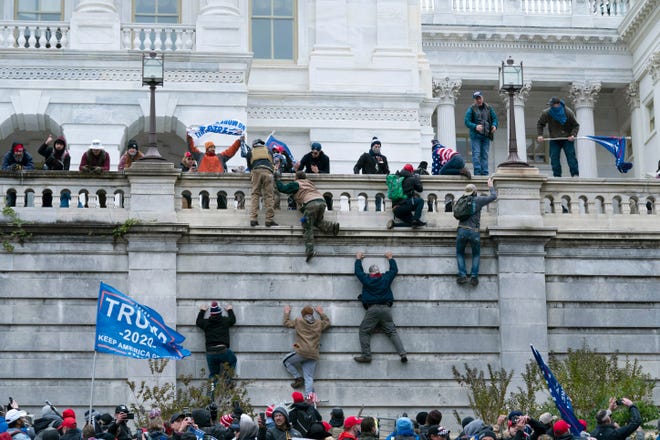
Donald Trump’s effort to overturn the election results, an endeavor that culminated in the 6 January assault on the Capitol, ultimately failed. But the lies the former president spread about fraud and the integrity of the 2020 results have stuck around in a dangerous way. False claims about the election have moved to the center of the Republican party.
Republican lawmakers have seized on the fears created by those baseless claims and weaponized them into new laws that make it harder to vote. Between January and October, 19 states enacted 33 laws to restrict voting access, according to the Brennan Center for Justice.
But Republicans haven’t stopped there. There is now a concerted effort to take more partisan control of election administration. Trump is supporting election deniers in their efforts to take control of key offices that control the rules of elections and counting of ballots. That effort has elevated fears that Trump is laying the groundwork for another coup in 2024, when supporters in those roles could help overturn the election results.
All these actions are taking place against the backdrop of the once-per-decade redistricting process, which Republicans dominate in many states. Republicans are taking full advantage of that power, drawing districts that will entrench their control of state legislatures and win congressional seats for the next decade.
Joe Biden has described this attack as “the most significant test of our democracy since the civil war”. But Democrats in the US Senate have been unable to pass two bills with significant voting rights protections. Whether Biden and Senate Democrats can find a way to get those bills through Congress looms as a major test of his presidency.
Here are the ways that voting rights emerged as the most important story in American politics in 2021:
New voting restrictions
When state legislatures convened at the start of 2021, many moved quickly to enact new laws making it harder to cast a ballot. Many of these new measures targeted voting by mail, which a record number of Americans used in 2020.
One of the most high profile battles was in Georgia, a state Trump targeted with baseless claims of fraud after a surprising loss to Biden there. Republicans enacted a law that requires voters to provide additional identification information on both absentee ballot request forms and the ballot itself. They also restricted the availability of absentee ballot drop boxes, a popular method of returning ballots in 2020. The law also criminalized providing food and water to people standing in line within 150ft of a polling place.
In Florida, Republicans enacted a new law that also restricts the availability of ballot drop boxes, imposes new rules around third-party registration groups, and requires voters to more frequently request absentee ballots.
The fight over new voting restrictions exploded in July, when Democrats in the Texas legislature fled the state for several weeks, denying Republicans the quorum they needed to pass new voting restrictions. Republicans eventually succeeded in passing a law that banned 24-hour voting, established regular citizenship checks for voter rolls, made it harder to assist voters, and empowered partisan poll watchers.
Undermining confidence in elections
A staggering number of Americans continue to deny the results of the 2020 election. A September CNN poll found 36% of Americans do not believe Biden was the legitimate winner of the election.
Trump has fed that disbelief by continuing to make claims of irregularities that have already been debunked. Republicans in several states continue to call for the “decertification” of elections, something that is legally impossible.
Republicans in some places have gone even further, authorizing unusual post-election inquiries into election results.
The most high-profile of those reviews was in Arizona, where Republicans hired a firm with no election experience, called Cyber Ninjas, to examine all 2.1m votes cast in Maricopa county, the most populous in the state. That monthslong effort, which included a hand count of every single ballot, was widely criticized by election experts, who noted that the firm had shoddy methodology and its leader had embraced conspiracy theories about the election. Ultimately, the Cyber Ninjas effort affirmed Biden’s win in Maricopa county.
Republicans elsewhere have embraced similar reviews. In Wisconsin, Republicans in the legislature have hired a former Republican supreme court justice to examine the election, but that effort has been marked by sloppiness and accusations of partisan bias.
“This is a grift, to be clear,” Matt Masterson, a former top official at the Department of Homeland Security, who works on election administration, said in December.
These efforts have been coupled with an even more alarming effort in Republican legislatures to empower lawmakers to alter election results. Lawmakers in seven states, including Michigan, Arizona, Missouri and Nevada, introduced 10 bills this year that would empower them to override or change election results, according to the Brennan Center for Justice. Some of the bills would allow partisan lawmakers to outright reject election results, while others would allow for post-election meddling in the vote count.
Attacks on election officials
Over the last year, there’s been a surge in election administrators who have left their positions because of threats and harassment. Experts are deeply concerned about that exodus and say that it could make room for more inexperienced, partisan workers to take over the running of elections. Ben Ginsberg, a longtime Republican election lawyer, said earlier this month the effort was an attempt to take election administration “from the pros” and give it “to the pols”.
Trump has endorsed several candidates who have embraced the myth of a stolen election to be the secretary of state, the chief election official, in many states. So far, he’s made endorsements in GOP primaries in Michigan, Arizona, Georgia and Nevada – all swing states that could play a determinative role in 2024.
Extreme partisan gerrymandering
At the start of each decade, state lawmakers across the US draw new congressional and state legislative districts. In 2020, Republicans dominated the down-ballot races that determine who gets to control the redistricting process. And this year, they’ve used their power remarkably powerfully.
In Texas, where 95% of the state’s population growth was from non-white people, Republicans drew maps blunting the political power of minorities. They drew no new majority-minority districts, instead giving Republicans an advantage at winning the state’s two new congressional seats. Republicans have also moved to shore up their advantage in politically competitive states like North Carolina, Ohio and Georgia. Democrats are gerrymandering the states where they have power, like Illinois and Maryland, but control the redistricting process in far fewer places than Republicans do.
These rigged districts will insulate Republicans from threats to their political power for the next decade.
Federal voting rights legislation
One of the biggest frustrations of the first year of Biden’s presidency has been that Democrats have not been able to pass two crucial pieces of voting rights legislation through Congress. One bill would set a minimum of access across the country, guaranteeing things like 15 days of early voting, as well as prohibiting partisan gerrymandering. The second bill would re-establish a critical piece of the 1965 Voting Rights Act requiring states where there is repeated evidence of voting discrimination to get voting changes approved by the federal government before they go into effect.
There is growing frustration that Biden has not pushed hard enough to get rid of the filibuster, which Republicans have relied on to stall those bills. Democrats have pledged to find a way around the filibuster next year.
Abcarian: Kevin McCarthy is a spineless noodle who nonetheless owes us the truth
Robin Abcarian January 16, 2022
On Jan. 6, 2021, House Minority Leader Kevin McCarthy takes to the floor to condemn the rioters and said that then-President Trump was responsible. Then he changed his tune. (FedNet)
Now that Devin Nunes has slunk off to the Trump-a-verse, is there anyone in Washington who is as transparently cynical, cowardly and dishonest as House Minority Leader Kevin McCarthy, the Republican shape-shifter from Central California?
Here is a man who blamed then-President Trump for inciting the Jan. 6, 2021, insurrection … before changing his mind.
A man who was for a bipartisan investigation of the horrible events of that day … before he was against it.
A man who said he was willing to testify before an investigative committee about his conversations with Trump on that terrible day … before he decided not to.
On Thursday, CNN’s Don Lemon described “the duality of Kevin McCarthy — that’s a kind way of putting it.”
And now, because McCarthy is desperately trying to stay on Trump’s right side and become House speaker, McCarthy is threatening to retaliate against House Democrats for pursuing the crucial Jan. 6 investigation, for doing their jobs.
If Republicans do retake the House in November and McCarthy ascends to the top post, he said last week that he would strip Democratic Reps. Adam B. Schiff, Eric Swalwell and Ilhan Omar of their committee assignments.
Why?
Because he would rather retaliate than legislate.
Because Democrats stripped two far-right conspiracy-addled GOP representatives, Marjorie Taylor Greene of Georgia and Paul Gosar of Arizona, of their committee assignments for truly despicable behavior.
It wasn’t just Democrats who were repulsed; 11 Republicans joined House Democrats in February to punish Greene for, among other things, supporting violent threats against Democrats. Two Republicans joined Democrats in November in censuring Gosar for promulgating a video depicting him murdering Rep. Alexandria Ocasio-Cortez (D-N.Y.) by plunging a sword into her neck.
And, of course, in July, House Speaker Nancy Pelosi refused to seat two of McCarthy’s five picks for the House Jan. 6 committee. She accepted three Republicans and nixed two, the unbearable Jim Jordan of Ohio and Jim Banks of Indiana.
McCarthy, it should be noted, then picked up his marbles and went home. He withdrew from the process entirely and refused to appoint any of his members. In response, Pelosi invited onto the committee two Republicans who have not been cowed by Trump, Liz Cheney of Wyoming and Adam Kinzinger of Illinois.
Pelosi, by the way, was not just within her rights as speaker to refuse to seat Jordan and Banks. She essentially had no choice.
Jordan and Banks have both demonstrated zero interest in sussing out the truth about Jan. 6. Both were vocal critics of the committee’s very existence. Nominating them in the first place was simply further proof of McCarthy’s bad faith, fealty to Trump and obstructionism.
Jordan beclowned himself every time he opened his mouth during the House Intelligence Committee’s hearings on the first Trump impeachment. For his performance, Trump awarded him the Medal of Freedom.
But more important, Jordan has no business on the committee because he is a material witness to the events of Jan. 6. And so, for that matter, is McCarthy. Both have refused the committee’s invitation to testify, speciously claiming they have no relevant information to share — as if it’s up to them to make that judgment — that the investigation is an exercise in Democratic partisanship and serves no legitimate legislative purpose.
Contrast that to the House Republicans’ Benghazi hearings spectacle. Recall that McCarthy infamously admitted on national television that they were nothing more than political theater designed to dirty up Hillary Clinton. “Everybody thought Hillary Clinton was unbeatable, right?” he told Sean Hannity. “But we put together a Benghazi special committee, a select committee. What are her numbers today? Her numbers are dropping. Why? Because she’s untrustable. But no one would have known any of that had happened, had we not fought.”
The refusal of McCarthy and Jordan to cooperate puts committee members in the uncomfortable position of having to decide whether to issue subpoenas to their own colleagues.
“I wish that he were a brave and honorable man,” Cheney said ruefully of McCarthy last week in an interview with CNN. “He’s clearly trying to cover up what happened. He has an obligation to come forward and we’ll get to the truth.”
At her weekly news conference, Pelosi said McCarthy “has an obligation, as we seek the truth, to help with that.”
Schiff, who used to be friendly with McCarthy, did not mince words: “By his own admission, Kevin McCarthy is a key witness to the events of January 6 and Trump’s response to the violence,” he said by email Friday. “Nevertheless, it should come as no surprise that McCarthy is refusing to cooperate with the Select Committee’s investigation, because McCarthy always puts Donald Trump’s interests ahead of the country. And from the very beginning, Trump and McCarthy have vigorously opposed any effort at accountability.”
Thankfully, the truth about Jan. 6 is already emerging in ways that are beyond the control of Trump lackeys like McCarthy and Jordan.
On Thursday, the Justice Department announced that 11 people, including Oath Keepers founder Stewart Rhodes, had been arrested and charged with “seditious conspiracy” in connection with the plot to invade the Capitol to prevent Congress from certifying President Biden’s victory.
Contrary to sweeping Republican efforts to downplay the attempted coup, this was not a spontaneous act by dupes who let Trump goad them into criminal behavior.
According to the federal grand jury indictment, the Oath Keepers, a right-wing militia group that recruited former and current military and law enforcement personnel, conspired to violently thwart the peaceful transfer of power.
The defendants, according to the Justice Department, organized into “teams that were prepared and willing to use force and to transport firearms and ammunition into Washington, D.C.”
The indictment quoted many of the Oath Keepers’ internal communications, many about weapons being stashed just outside Washington. “It will be a bloody and desperate fight,” wrote Rhodes in one. “We are going to have a fight. That can’t be avoided.”
There is no question now, a year later, that anti-democratic conspirators armed to the teeth were prepared to do violence to overturn the results of a fair and fraud-free election.
The fact that they failed does not make the attempt any less grave.
McCarthy needs to tell Americans what he knew, when he knew it and exactly what Trump told him on Jan. 6.
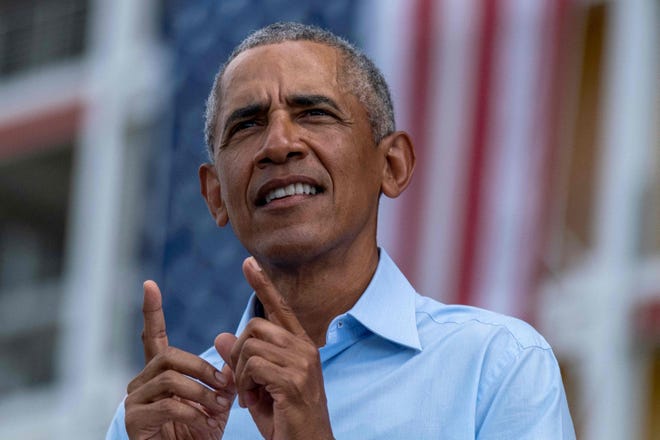
Former President Barack Obama: We need to follow John Lewis’ example and fight for our democracy
“The world, and future generations, will be watching,” Obama writes as he calls on Senate to “do the right thing” and pass legislation to protect voting rights.
Barack Obama Special to USA TODAY January 12, 2022
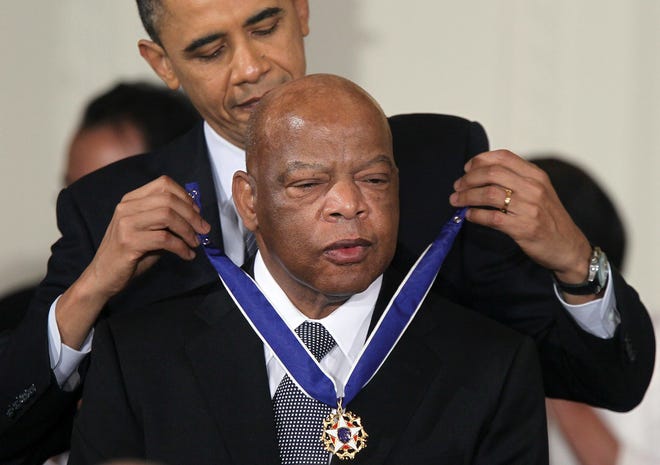
When I spoke at John Lewis’ memorial service two years ago, I emphasized a truth John knew better than just about anyone. Our democracy isn’t a given. It isn’t self-executing. We, as citizens, have to nurture and tend it. We have to work at it. And in that task, we have to vigilantly preserve and protect our most basic tool of self-government, which is the right to vote.
At the time, various state legislators across the country had already passed a variety of laws designed to make voting harder. It was an attack on everything John Lewis fought for, and a challenge to our most fundamental democratic freedoms.
Since then, things have only gotten worse.
Slow unraveling of basic democratic principles
While the American people turned out to vote at the highest rate in a century in the last presidential election, members of one of our two major political parties – spurred on by the then-sitting president – denied the results of that election and spun conspiracy theories that drove a violent mob to attack our Capitol.
Although initially rejected by many Republicans, those claims continued to be amplified by conservative media outlets, and have since been embraced by a sizable portion of Republican voters – not to mention GOP elected officials who do, or at least should, know better. Those Republican officials and conservative thought leaders who have courageously stood their ground and rejected such anti-democratic efforts have found themselves ostracized, threatened and subjected to primary challenges.
Meanwhile, state legislators in 49 states have introduced more than 400 bills designed to suppress votes. Some of these bills we’ve seen before: legislation that would discourage voters, including racial minorities, low-income voters and young people from casting a ballot. Others aim to treat certain polling locations differently, creating one set of rules for voters living in cities and another set for people living in more conservative, rural areas.
We’re also seeing more aggressive attempts to gerrymander congressional districts. Gerrymandering, which essentially allows politicians to choose their voters instead of the other way around, isn’t new – and both parties have engaged in it.
But what we’re seeing now are far more aggressive and precise efforts on the part of Republican state legislatures to tilt the playing field in their favor. In states that have approved new congressional maps, there are now 15 fewer competitive districts than there were before. Fewer competitive districts increases partisanship, since candidates who only have to appeal to primary voters have no incentive to compromise or move to the center.Get the Opinion newsletter in your inbox.
What do you think? Shape your opinion with a digest of takes on current events.Delivery: DailyYour Email
Finally and perhaps most perniciously, we’ve seen state legislatures try to assert power over core election processes including the ability to certify election results. These partisan attempts at voter nullification are unlike anything we’ve seen in modern times, and they represent a profound threat to the basic democratic principle that all votes should be counted fairly and objectively.
The good news is that the majority of American voters are resistant to this slow unraveling of basic democratic institutions and electoral mechanisms. But their elected representatives have a sacred obligation to push back as well – and now is the time to do it.
Now, there are bills in front of the Senate that would protect the right to vote, end partisan gerrymandering, and restore crucial parts of the Voting Rights Act. Bill sponsors have diligently reached out to their Republican colleagues to obtain their support. Sadly, almost every Senate Republican who expressed concern about threats to our democracy in the immediate aftermath of the Jan. 6 insurrection has since been cowed into silence or reversed their positions. When one of the bills in front of the Senate today was introduced in November, every Democrat supported it. And every Republican but one voted against moving it forward.
Protecting our democracy wasn’t always a partisan issue. The Voting Rights Act was the result of Democratic and Republican efforts, and both President Reagan and President George W. Bush signed its renewal when they were in office. But even if Senate Republicans now refuse to stand up for our democracy, Democrats should be able to get the job done with a simple majority vote. There are already 50 Senators who support bills to safeguard elections. The only thing standing in the way is the filibuster – a Senate procedure that allows a minority of just 41 Senators to prevent legislation from being brought up for a vote.
The filibuster has no basis in the Constitution. Historically, the parliamentary tactic was used sparingly – most notably by Southern senators to block civil rights legislation and prop up Jim Crow. In recent years, the filibuster became a routine way for the Senate minority to to block important progress on issues supported by the majority of voters. But we can’t allow it to be used to block efforts to protect our democracy. That’s why I fully support President Joe Biden’s call to modify Senate rules as necessary to make sure pending voting rights legislation gets called for a vote. And every American who cares about the survival of our most cherished institutions should support the president’s call as well.
Protecting our democratic institutions
For generations, Americans of every political stripe have taken pride in our status as the world’s oldest continuous democracy. We have spilled precious blood and spent countless treasure in defense of democracy and freedom abroad. But as we learned during the Jim Crow era, our role as democracy’s defender isn’t credible when we violate the rights and freedoms of our own citizens. And at a time when democracy is under attack on every continent, we can’t hope to set an example for the world when one of our two major parties seems intent on chipping away at the foundation of our own democracy.
No single piece of legislation can guarantee that we’ll make progress on every challenge we face as a nation. But legislation that ensures the right to vote and makes sure every vote is properly counted will give us a better chance of meeting those challenges. It’s how we can overcome the gridlock and cynicism that’s so prevalent right now. It’s how we can stop climate change, and reform our broken immigration system, and help ensure that our children enjoy an economy that works for everyone and not just the few.
Now is the time for all of us to follow John Lewis’ example. Now is the time for the U.S. Senate to do the right thing. America’s long-standing grand experiment in democracy is being sorely tested. Future generations are counting on us to meet that test.
Barack Obama was the 44th president of the United States. This is the first opinion piece he’s authored since leaving the White House on Jan. 20, 2017.
Liz Cheney’s Wyoming Nemesis Is an Oath Keeper Who Was at Capitol Rally
Sam Brodey January 16,2022
CQ-Roll Call
When the Department of Justice indicted members of the Oath Keepers last week for their role in the Jan. 6 insurrection, one Republican official might have taken more notice of the arrests than others.
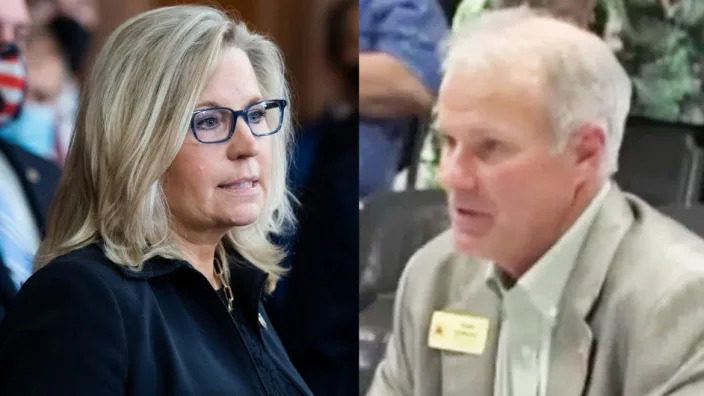
Frank Eathorne, who was revealed in a leak last year to be one of 191 Wyoming-based members of the far-right militia group, was in Washington for protests on Jan. 6. But Eathorne is no rank-and-file fringe crank. He is the sitting chairman of the Wyoming Republican Party.
That role has made him one of the more influential Republican officials in the country. Eathorne is presiding over what is perhaps the GOP’s highest-profile primary battle of the 2022 election: the MAGA-fueled campaign to unseat Rep. Liz Cheney (R-WY) for her unrelenting criticism of former President Donald Trump’s lies about the 2020 election.- ADVERTISEMENT -https://s.yimg.com/rq/darla/4-10-1/html/r-sf-flx.html
And rather than remain neutral, Eathorne has been one of the top figures fighting to defeat Cheney. He has appeared frequently in conservative media to denounce her since her January 2021 vote to impeach Trump for inciting the riot, which kicked off the nasty primary campaign.
In February 2021, Eathorne supported an effort by the party to formally censure Cheney, which narrowly succeeded. In November, he presided over a successful vote to no longer recognize Cheney as a member of the Republican Party.
But the Oath Keepers indictments mean that Eathorne’s aggressive efforts to keep the pressure on Cheney—in hopes of replacing her with a MAGA acolyte—are going to be complicated by his association with an extremist group facing grave, and rare, federal criminal charges.
Aside from his aggressive efforts to bring down Cheney, Eathorne has made national news for amplifying the most fringe of right-wing ideas. Appearing on former Trump adviser Steve Bannon’s podcast in 2021, he expressed interest in the idea of Wyoming seceding from the United States. The remark prompted a quick and strident rebuke from Bannon.
In 2022, state and local Republican Party organizations are home to figures like Eathorne. But Eathorne stands out for his association with the Oath Keepers, as well as his participation in the Jan. 6 riots.
Of the 700-plus Capitol rioters who have been charged with a crime, Oath Keeper leaders and members are facing some of the most serious prosecutions. Eleven members of the Oath Keepers—including the group’s founder, Stewart Rhodes—have been charged with “seditious conspiracy.”
These charges cover the specific crime of conspiring to overthrow the government or disrupt its functioning, and they are rarely brought. The federal government has not charged anyone on these grounds since 2010.
Oath Keepers militia founder Stewart RhodesReuters
In fall 2021, a whistleblower group called Distributed Denial of Secrets published a trove of hacked documents and information about the Oath Keepers. The identities of more than 38,000 members were in that data dump, sparking nationwide scrutiny on politicians and law enforcement officers who were named.
In the aftermath, BuzzFeed News reported that 28 elected officials nationwide were Oath Keepers, including a pair of GOP state legislators from Alaska and Arizona who traveled to the Capitol on Jan. 6.
Using that data, the Wyoming-based news site WyoFile reported in December that Eathorne, along with former governor candidate Taylor Haynes, were members of the militia group.
Lindsay Schubiner, program director at the Western States Center—a nonprofit advocacy group that tracks far-right extremism, particularly in the West—called the militia membership of party figures like Eathorne a “dangerous signal about the state of our democracy.”
“It’s troubling to see leaders in institutions that should be engaging in the democratic process not only condone paramilitaries, but officially join them,” Schubiner said.
Eathorne did not respond to a request for comment.
The Republican National Committee, which oversees state-level GOP organizations, did not respond to questions about whether Eathorne should remain the leader of the Wyoming GOP, nor did Sens. John Barrasso or Cynthia Lummis, the state’s two Republican U.S. senators. A Cheney spokesperson also declined to comment on Eathorne.
But Cheney has made no secret of her views on Eathorne. “Certainly, there are people in the state party apparatus of my home state who are quite radical,” Cheney said during an interview with Fox News’ Bret Baier on Jan. 7. “And some of those same people, include people who were here on Jan. 6, include a party chair who has toyed with the idea of secession.”
Eathorne was not mentioned in the federal indictment of Oath Keepers, and he has not been arrested or charged with any offense in relation to Jan. 6.
In a statement a day after the insurrection, Eathorne confirmed he was in Washington for the events, including “a brief stop in the vicinity of the Capitol building property.”
“I retired from the public gathering near mid-afternoon and watched the news of some reported events I personally had not witnessed,” Eathorne said.
The Southern Poverty Law Center now describes the Oath Keepers as one of the largest far-right groups operating in the U.S. today. Many of its members are former military and law enforcement personnel.
The federal government’s filing details a painstaking plan by Rhodes and his fellow militiamen to disrupt the certification of Joe Biden’s presidential election victory to ensure Trump remained in power.
The indictment alleges that the defendants “conspired through a variety of manners and means,” including recruiting members to come to Washington on Jan. 6 and procuring and transporting paramilitary gear and weapons.
It is also alleged that the defendants used organized, military-style tactics to breach the U.S. Capitol that day “in an effort to prevent, hinder and delay the certification of the electoral college vote.”
If convicted, defendants face a maximum of 20 years in federal prison. Nine of the 11 Oath Keepers charged with seditious conspiracy have already been charged with other crimes in connection with Jan. 6.
Schubiner, with the Western States Center, emphasized that while the Oath Keepers are known for their far-right, anti-government, and frequently bigoted views, the insurrection underscored that they are focused on seizing power. The mainstreaming of their members, she said, is part of achieving that goal.
“It’s incredibly important for Republican leaders and any political leaders,” she said, “to denounce affiliations with paramilitary groups, if they do not want their party to become identified with those groups.”
Frustrated Democrats Call for ‘Reset’ Ahead of Midterm Elections
Lisa Lerer and Emily Cochrane January 15, 2022
Sen. Joe Manchin (D-W.Va.) speaks with reporters outside his office on Capitol Hill in Washington, Jan. 4, 2022. (Al Drago/The New York Times)
WASHINGTON — With the White House legislative agenda in shambles less than a year before the midterm elections, Democrats are sounding alarms that their party could face even deeper losses than anticipated without a major shift in strategy led by the president.
The frustrations span the spectrum from those of the party’s liberal wing, which feels deflated by the failure to enact a bold agenda, to the concerns of moderates, who are worried about losing suburban swing voters and had believed Democratic victories would usher a return to normalcy after last year’s upheaval.
Democrats already anticipated a difficult midterm climate, given that the party in power historically loses seats during a president’s first term. But the party’s struggle to act on its biggest legislative priorities has rattled lawmakers and strategists, who fear their candidates will be left combating the perception that Democrats failed to deliver on President Joe Biden’s central campaign promise of rebooting a broken Washington.
“I think millions of Americans have become very demoralized — they’re asking, what do the Democrats stand for?” said Sen. Bernie Sanders, the Vermont independent in charge of the Senate Budget Committee. In a lengthy interview, he added, “Clearly, the current strategy is failing, and we need a major course correction.”
Rep. Tim Ryan, a Democrat from a blue-collar Ohio district who is running for the state’s open Senate seat, said his party isn’t addressing voter anxieties about school closures, the pandemic and economic security. He faulted the Biden administration, not just for failing to pass its domestic agenda but also for a lack of clear public health guidance around issues such as masking and testing.
“It seems like the Democrats can’t get out of their own way,” he said. “The Democrats have got to do a better job of being clear on what they’re trying to do.”
The complaints capped one of the worst weeks of the Biden presidency, with the White House facing the looming failure of voting rights legislation, the defeat of their vaccine-or-testing mandate for large employers at the Supreme Court, inflation rising to a 40-year high and friction with Russia over aggression toward Ukraine. Meanwhile, Biden’s top domestic priority — a sprawling $2.2 trillion spending, climate and tax policy plan — remains stalled, not just because of Republicans but also opposition from a centrist Democrat.
“I’m sure they’re frustrated — I am,” said Sen. Dick Durbin of Illinois, the No. 2 Senate Democrat, when asked this week about the chamber’s inability to act on Biden’s agenda. Discussing the impact on voters before the midterm elections, he added, “It depends on who they blame for it.”
The end of the week provided another painful marker for Democrats: Friday was the first time since July that millions of U.S. families with children did not receive a monthly child benefit, a payment established as part of the $1.9 trillion pandemic relief plan that Democrats muscled through in March without any Republican support.
Plans to extend the expiration date for the payments, which helped keep millions of children out of poverty, were stymied with the collapse of negotiations over the sprawling domestic policy plan. And additional pandemic-related provisions will expire before the end of the year without congressional action.
“That’s just about as straightforward as it gets,” said Ryan. “If the Democrats can’t get on with a tax cut for working families, what are we for?”
In recent days, Biden has faced a wave of rising anger from traditional party supporters. Members of some civil rights groups boycotted his voting rights speech in Atlanta to express their disappointment with his push on the issue, while others, including Stacey Abrams, who is running for governor in Georgia, were noticeably absent. Biden vowed to make a new forceful push for voting right protections, only to see it fizzle the next day.
And last week, six of Biden’s former public health advisers went public with their criticisms of his handling of the pandemic, calling on the White House to adopt a strategy geared to the “new normal” of living with the virus indefinitely. Others have called for the firing of Jeffrey Zients, who leads the White House pandemic response team.
“There does not seem to be an appreciation for the urgency of the moment,” said Tré Easton, a senior adviser for Battle Born Collective, a progressive group that is pushing for overturning the filibuster to enable Democrats to pass a series of their priorities. “It’s sort of, ‘OK, what comes next?’ Is there something that’s going to happen where voters can say, yes, my life is appreciatively more stable than it was two years ago.”
White House officials and Democrats insist that their agenda is far from dead and that discussions continue with key lawmakers to pass the bulk of Biden’s domestic plans. Talks over an omnibus package to keep the government open beyond Feb. 18 have quietly resumed, and states are beginning to receive funds from the $1 trillion infrastructure law.
“I guess the truth is an agenda doesn’t wrap up in one year,” said White House press secretary Jen Psaki.
While there’s widespread agreement around the electoral peril that the party faces, there’s little consensus over who, exactly, is to blame. Liberals have been particularly scathing in their critique of two centrist senators, Joe Manchin of West Virginia and Kyrsten Sinema of Arizona, and their long-standing objections to undermining the Senate filibuster, as well as Manchin’s decision to abruptly reject the $2.2 trillion spending plan last month. For months, Democratic lawmakers, activists and officials have been raising concerns about sinking support among crucial segments of the party’s coalition — Black, female, young and Latino voters — ratings many worry could drop further without action on issues like voting rights, climate change, abortion rights and paid family leave.
“In my view, we are not going to win the elections in 2022 unless our base is energized and ordinary people understand what we are fighting for, and how we are different than the Republicans,” Sanders said. “That’s not the case now.”
But many in the party concede that the realities of their narrow congressional majorities and united Republican opposition have blocked their ability to pass much of their agenda. Some have faulted party leaders for catering to progressives’ ambitions, without the votes to execute.
“Leadership set out with a failed strategy, and while I guess, maybe they can message that they tried, it actually isn’t going to yield real laws,” said Rep. Stephanie Murphy, a Florida centrist, who is retiring but has signaled aspirations for a future Senate run.
Rep. Cheri Bustos, a Democrat from rural Illinois, said Democrats should consider less ambitious bills that could draw some Republican support to give the party accomplishments it can claim in the midterm elections.
“We really kind of need to reset at this point,” said Bustos, who is retiring from a district that swung to Donald Trump in 2020. “I hope we focus on what we can get done and then focus like crazy on selling it.”
Biden effectively staked his presidency on the belief that voters would reward his party for steering the country out of a deadly pandemic and into economic prosperity. But even after a year that produced record job growth, widely available vaccines and stock market highs, Biden has not begun to deliver a message of success nor focused on promoting his legislative victories.
Many Democrats say they need to do more to sell their accomplishments or risk watching the midterms go the way of the off-year elections, when many in the party were surprised by the intensity of the backlash against them in races in Virginia, New Jersey and New York.
“We need to get into the business of promotion and selling and out of the business of moaning and groaning,” said Bradley Beychok, a senior adviser of American Bridge 21st Century, a Democratic group.
Others say that as president, Biden has fallen out of step with many voters by focusing on issues like climate change and voting rights. While crucial for the country, those topics aren’t topping the list of concerns for many voters still trying to navigate the uncertainties of a pandemic stretching into a third year.
“The administration is focused on things that are important but not particularly salient to voters and sometimes as president you have to do that,” said Matt Bennett, a co-founder of Third Way, a moderate Democratic think tank. “Now, we need to begin to move back to talking about the things that people do care about.”