Nick Saban, others urge Manchin to protect voting rights

Associated Press

Nick Saban, others urge Manchin to protect voting rights

Leah Willingham January 18, 2022

Alabama head coach Nick Saban watches warm ups before the College Football Playoff championship football game against Georgia Monday, Jan. 10, 2022, in Indianapolis. (AP Photo/Paul Sancya)

Alabama head coach Nick Saban watches warm ups before the College Football Playoff championship football game against Georgia Monday, Jan. 10, 2022, in Indianapolis. (AP Photo/Paul Sancya)

Sen. Joe Manchin, D-WVa., speaks to the media after senate democrats luncheon, on Capitol Hill in Washington, Thursday, Jan. 13, 2022. Biden is meeting privately with Senate Democrats at the Capitol, a visit intended to deliver a jolt to the party's long-stalled voting and elections legislation. ( AP Photo/Jose Luis Magana)

Sen. Joe Manchin, D-WVa., speaks to the media after senate democrats luncheon, on Capitol Hill in Washington, Thursday, Jan. 13, 2022. Biden is meeting privately with Senate Democrats at the Capitol, a visit intended to deliver a jolt to the party’s long-stalled voting and elections legislation. ( AP Photo/Jose Luis Magana)

CHARLESTON, W.Va. (AP) — University of Alabama head football coach Nick Saban and other prominent sports figures with ties to West Virginia have urged U.S. Sen. Joe Manchin to support sweeping legislation to protect the right to vote.

Saban was joined by NBA Hall of Famer Jerry West, a fellow West Virginia native, in a Jan. 13 letter penned to the Democratic senator ahead of the Senate’s debate of the Freedom to Vote: John R. Lewis Act. The Senate took up the bill Tuesday, and it appeared headed for defeat.

The package before the Senate would make Election Day a national holiday and require access to early voting and mail-in ballots that became overwhelmingly popular during the COVID-19 pandemic. Voting advocates nationwide have warned that Republican-led states have passed laws making it more difficult for Black Americans and others to vote by consolidating polling locations, requiring certain types of identification and ordering other changes.

In the letter, the group said the principles that help ensure fair and free elections are “now under intentional and unprecedented challenge.”

“We are all certain that democracy is best when voting is open to everyone on a level playing field; the referees are neutral; and at the end of the game the final score is respected and accepted,” the letter reads.

The letter was also signed by former NFL players Oliver Luck and Darryl Talley, both of whom are West Virginia University graduates, as well as former NFL commissioner Paul Tagliabue.

The group said that lawmakers must “guarantee that all Americans have an equal voice in our democracy and that Federal elections are conducted with integrity so that the votes of all eligible voters determine the election outcomes.”

The voting bill was the Democrats’ top priority this Congress, and the House swiftly approved the legislation, only to see it languish in the Senate, opposed by Republicans. With a 50-50 split, Democrats have a narrow Senate majority — Vice President Kamala Harris can break a tie — but they lack the 60 votes needed to overcome the GOP filibuster.

Attention is focused intently on Democrats Manchin and Kyrsten Sinema of Arizona, who were singled out with a barrage of criticism during Martin Luther King Jr. Day events for their refusal to change what civil rights leaders call the “Jim Crow filibuster.”

Martin Luther King III, the son of the late civil rights leader, compared Sinema and Manchin to the white moderate his father wrote about during the civil rights battles of the 1950s and 1960s — a person who declared support for the goals of Black voting rights but not the direct actions or demonstrations that ultimately led to passage of the landmark legislation.

Both Manchin and Sinema say they support the package, but they are unwilling to change the Senate rules to muscle it through that chamber over Republican objections.

Asked about the letter Tuesday, Manchin told reporters that Saban had added a footnote, that was not included in the released letter, saying he supports the filibuster and to not get rid of it.

“We should all support the right the vote, everyone, but not breaking the rules to make new rules,” Manchin said.

Nick Saban and Jerry West sign letter pushing West Virginia Sen. Joe Manchin to support voting rights bill

Yahoo! Sports

Nick Saban and Jerry West sign letter pushing West Virginia Sen. Joe Manchin to support voting rights bill

Nick Bromberg, January 18, 2022

Alabama coach Nick Saban and NBA legend Jerry West are among five prominent West Virginia sports figures pushing Sen. Joe Manchin (D) to support the Freedom to Vote Act.

Manchin and Sen. Krysten Sinema (D-Ariz.) have refused to support making a filibuster exception for the voting rights bill. A bill can be filibustered in the Senate if it doesn’t have 60 votes; if the voting rights bill was exempt from the filibuster and Manchin and Sinema voted for it, the bill would pass a 50-50 Senate by virtue of a tiebreaking vote from Vice President Kamala Harris.

The letter, also signed by former West Virginia athletic director Oliver Luck, former NFL commissioner Paul Tagliabue, and former Buffalo Bills linebacker Darryl Talley, urges “Congress to exercise its Constitutional responsibility to enact laws that set national standards for the conduct of Federal elections and for decisions that determine election outcomes.”

An excerpt of the letter is below. You can view it in full here.

Elections open to all Americans: Our democracy is at its best when all Americans are encouraged to participate. We support measures to provide voters with arange of opportunities to obtain and cast a lawful ballot, including robust in-person, early, and absentee voting options. We support the use of election security, equipment and record-keeping measures that are reliable and evidence-based, and clearly support the integrity of election processes. 

Impartial conduct and score-keeping. Election administration and vote certification must be nonpartisan, professional and transparent. State legislators and other officials cannot apply or change rules, standards or procedures, prospectively or retroactively, in amanner that may nullify Federal election results by excluding voters or overruling voter choices.

The voting rights bill would allow for no-excuse absentee voting, expand the voter registration process and make Election Day a federal holiday among other provisions. Republicans have been mostly united in their opposition to the bill and a filibuster exception for it. 

There is a footnote at the bottom of the letter that says Saban “is not in favor of getting rid of the filibuster in the Senate.” That footnote, however, does not specify if Saban is specifically referencing an exception for the voting rights bill or the concept of the filibuster in general. 

West and Saban supported Manchin’s re-election bid

The letter is perhaps the most outspoken the most successful coach in modern college football has ever been regarding politics, though Saban and West have been longtime supporters of Manchin, a Democratic senator in a state that former president Donald Trump won by nearly 40 points in 2020. Saban was born in West Virginia and West stayed in his home state to play basketball at West Virginia before he was chosen with the No. 2 pick in the 1960 NBA draft.

Saban, West and West Virginia coach Bob Huggins endorsed Manchin in an ad a month before his re-elction in November of 2018. Saban, who said he grew up with Manchin in the ad, spoke glowingly of the senator in the commercial. Manchin, 74, has been in the Senate since 2010 and is one of the most conservative Democrats in the legislative body.

Bernie Sanders says he would support primary challengers to Joe Manchin and Kyrsten Sinema if they continue to oppose scrapping filibuster

Insider

Bernie Sanders says he would support primary challengers to Joe Manchin and Kyrsten Sinema if they continue to oppose scrapping filibuster

Bryan Metzger, Grace Panetta. January 18, 2022

Sens. Kyrsten Sinema and Bernie Sanders at the Capitol on July 29, 2020.
Sens. Kyrsten Sinema and Bernie Sanders at the Capitol on July 29, 2020.Bill Clark/CQ-Roll Call, Inc via Getty Images
  • Bernie Sanders said he’s open to supporting primary challengers to Joe Manchin and Kyrsten Sinema.
  • The moderate duo have been stalling Democrats’ agenda for months and oppose changing the filibuster.
  • “They’re gonna have to go home and explain to their constituents,” Sanders said.

Independent Sen. Bernie Sanders of Vermont opened the door on Tuesday to support primary challengers to Democratic Sens. Kyrsten Sinema and Joe Manchin when both come up for reelection in 2024.

Speaking with reporters ahead of a caucus meeting, Sanders said the stakes for changing the Senate filibuster rules — which require 60 votes to end debate and thus currently gives Senate Republicans the power to block major pieces of legislation — are high.

“What’s at stake is the future of American democracy,” said Sanders. “And the fact that all over this country, Republican governors and legislators are moving aggressively to suppress the vote and to impose extreme gerrymandering, among many other things.”

“Anybody who believes in American democracy has got to vote to enable us to go forward with 50 votes to suspend the filibuster, at least on this vote,” he added.

Democrats are pushing reforms to the Senate filibuster to ensure passage of major voting rights legislation, and are expected to vote on a rules change to return to the so-called talking filibuster. Both Manchin and Sinema, however, have made their opposition clear to lowering the current 60-vote threshold to end debate on legislation. And Manchin opposes making changes to the senate’s rules along party lines.

Sanders left it up to voters when asked by Punchbowl News what he thought about potential primary challenges for the duo, and any other senators who oppose changing filibuster rules.

“There’s a very good chance that people in those states— it’s up to the people in those states but it’s not just even the voting rights,” he said. Asked whether he himself would support a primary challenger, Sanders answered in the affirmative without elaborating further.

“Well, yeah, I would,” he said.

Progressive Democrats are increasingly looking for a candidate to challenge Sinema in 2024 following her reaffirmation of her opposition to changing Senate filibuster rules last week, with Democratic Rep. Ruben Gallego of Arizona emerging as a strong potential primary contender. Another shoe dropped for Sinema on Tuesday when EMILY’s List, a group that backs pro-choice Democrats for office, said it would not endorse Sinema for reelection in 2024 if she continued to oppose filibuster reforms.

As for Manchin, he said at a press conference outside his office on Tuesday that he doesn’t mind the prospect of a challenger.

“Bring it on,” he said when asked about the idea.

Manchin, who represents a deeply conservative state, easily defeated a progressive primary challenger, Paula Jean Swearengin, in 2018 with nearly 70% of the vote. Swearengin, whose run against Manchin was featured in the 2019 documentary “Knock Down the House,” was endorsed by groups including Justice Democrats and The People for Bernie Sanders (though not Sanders himself).

Majority Leader Chuck Schumer also notably did not unequivocally oppose backing primary challengers to Manchin and Sinema when asked about the idea when taking questions from reporters on Tuesday evening.

“I’m not getting into the politics,” Schumer said, shaking his head in dismay at the question. “This is a substantive, serious issue.”

Democrats line up to challenge Wisconsin Sen. Ron Johnson

Yahoo! News

Democrats line up to challenge Wisconsin Sen. Ron Johnson

Christopher Wilson, Senior Writer January 18, 2022

Republican Sen. Ron Johnson’s decision to run for reelection has affirmed his position as a top target for Democrats in a race expected to be among the most hotly contested of the 2022 midterms.

Johnson, first elected to the Senate from Wisconsin during the tea party wave of 2010, had initially pledged to serve for only two terms but explained his change of mind in a Wall Street Journal op-ed and a campaign ad. He said that because Democrats have control of Congress and the presidency, he did not want to step down as he had originally promised.

“If you’re in a position to help make our country safer and stronger, would you just walk away?” Johnson said in the ad. “I decided I can’t. I’ll stand and fight for freedom.”

Wisconsin has been a key battleground state in recent years. Donald Trump carried the state by less than 1 percent of the vote in 2016, while Joe Biden won the state by a similarly narrow margin four years later. In 2018, Democrat Tony Evers was elected governor over incumbent Republican Scott Walker by just over 1 percent of the vote.

Sen. Ron Johnson
Sen. Ron Johnson, R-Wis., at a Senate Foreign Relations Committee hearing in September. (Drew Angerer/Getty Images)

The nonpartisan Cook Political Report currently rates the 2022 contest a toss-up, while the University of Virginia Center for Politics gives Johnson a modest edge.

Polls in recent months have indicated that Johnson is unpopular with Wisconsinites. At the same time, Democrats in the Badger State will likely have their work cut out for them. The party in power tends to struggle in midterm elections, and Biden continues to be dogged by low approval ratings.

Over the course of his second term, Johnson has emerged as one of the most prominent promoters of conspiracy theories on both the 2020 election and the COVID-19 pandemic. He has continually downplayed the Jan. 6, 2021, Capitol violence, calling it a largely “peaceful protest” by people “who loved this country” and “truly [respected] law enforcement.”

Johnson has also suggested that “fake Trump protesters” and “agent provocateurs” might have been responsible for the assault, and that the FBI has not been forthright about its knowledge of a possible attack. Last year, he repeatedly floated the idea that vaccines are unsafe while promoting unproven treatments for the disease, including mouthwash. His COVID misinformation led to a brief suspension of his YouTube account.

Days after Johnson announced he would be running again, the Senate Democrats’ main super-PAC announced a $1 million ad buy highlighting his broken two-term pledge as well as his push for a tax break that primarily benefited two billionaire families in Wisconsin.

Last summer, ProPublica reported that Johnson had said he would withhold his vote on the Republicans’ 2017 tax cut unless it included a special loophole that helped the two families, who had both contributed millions of dollars to his campaigns. Johnson told the outlet that his stance “had nothing to do with any donor or discussions with them” and instead stemmed from his belief that the tax code “needs to be simplified and rationalized.”

Wisconsin Lt. Gov. Mandela Barnes
Wisconsin Lt. Gov. Mandela Barnes, one of several candidates who may challenge Johnson. (Brian Snyder/Reuters)

The question of who Democrats will select to challenge Johnson is still very much up in the air, with more than 10 candidates having declared for the primary, scheduled for Aug. 9. The major candidates who’ve created a gap in early fundraising are Lt. Gov. Mandela Barnes, state treasurer Sara Godlewski, NBA executive Alex Lasry and Outagamie County Executive Thomas Nelson.

Polling in the race has been sparse, but a November release from Data for Progress showed Barnes approaching 40 percent of the vote, which is in line with an internal survey recently released by the Barnes campaign.

Barnes, 35, served as a state legislator before winning the spot as Evers’s running mate in 2018. A Milwaukee native, he is the first Black lieutenant governor in Wisconsin history. Evers appointed him to run the state’s climate task force, and Barnes was outspoken in the aftermath of the 2020 police shooting of Jacob Blake in Kenosha.

Barnes was critical of law enforcement when prosecutors failed to file charges against the officer who shot Blake. He also questioned why Kyle Rittenhouse, an Illinois teenager who killed two men during a violent protest following Blake’s shooting, was not immediately arrested. Barnes likewise criticized Rittenhouse’s acquittal.

“Over the last few weeks, many dreaded the outcome we just witnessed. The presumption of innocence until proven guilty is what we should expect from our judicial system, but that standard is not always applied equally,” Barnes said. “We have seen so many Black and brown youth killed, only to be put on trial posthumously, while the innocence of Kyle Rittenhouse was virtually demanded by the judge.”

It was a contrast to the statement issued by Johnson, who said, “I believe justice has been served in the Kyle Rittenhouse trial. I hope everyone can accept the verdict, remain peaceful, and let the community of Kenosha heal and rebuild.”

Kyle Rittenhouse
Kyle Rittenhouse at the Kenosha County Courthouse on Nov. 15, 2021. (Sean Krajacic/Pool/Getty Images)

Godlewski, who entered the Senate race last April, points to her successful statewide run in 2018 as proof of her electability. Prior to running for office, she successfully advocated against a ballot measure that would have eliminated the treasurer office entirely. In October, Godlewski invested $1 million of her own money into her campaign, telling the Milwaukee Journal-Sentinel, “I am putting my money where my mouth is.”

“As someone who has run two successful statewide campaigns, I know firsthand winning in Wisconsin is tough,” she said. “Ron Johnson, Mitch McConnell, and dark money groups are going to do whatever it takes to win, and I am not going to allow them to outwork us or outspend us.”

Lasry and Nelson were two of the earliest entrants into the race. Lasry is on leave from his position with the Milwaukee Bucks, which won the 2021 NBA Championship and are co-owned by his father, Marc, a billionaire hedge fund manager. A former staffer for the Obama White House, Lasry has also argued that he was instrumental in bringing the 2020 Democratic National Convention to Milwaukee.

Nelson served in the state Legislature, including as Democratic majority leader, before first winning the Outagamie County executive seat in 2011. The Wisconsin native supports Medicare for All as well as the Green New Deal climate package.

Barnes has received endorsements from Sen. Elizabeth Warren, D-Mass., Sen. Cory Booker, D-N.J., and Rep. Jim Clyburn, D-S.C., while Godlewski has earned the support of EMILY’s List, a well-funded Democratic PAC. Lasry, meanwhile, has won support from the Teamsters Union, and Nelson the endorsement of the Wisconsin chapter of the progressive climate group Sunrise.

All four of the leading Democratic candidates have called for an end to the Senate filibuster, which makes it more difficult to pass legislation at the federal level.

Pro-choice PAC Emily’s List will cease support for Sen. Kyrsten Sinema over voting rights: ‘She will find herself standing alone in the next election’

Insider

Pro-choice PAC Emily’s List will cease support for Sen. Kyrsten Sinema over voting rights: ‘She will find herself standing alone in the next election’

Erin Snodgrass January 18, 2022

Sen. Kyrsten Sinema
Senator Kyrsten Sinema of Arizona.Chip Somodevilla/Getty Images
  • A prominent pro-choice political action committee said it will stop supporting Sen. Kyrsten Sinema.
  • Emily’s Choice issued a statement slamming the senator for blocking voting rights legislation.
  • The group warned that Sinema will “find herself standing alone” in her next election.

One of the largest pro-woman, pro-choice PACS in the country has pulled its support for Sen. Kyrsten Sinema over the Arizona lawmaker’s refusal to support changes to the filibuster that would allow Democrats to pass voting rights legislation.

The president of Emily’s List, a political action committee focused on electing Democratic pro-choice women, announced Tuesday the organization plans to no longer support Sinema in future elections.

“Right now, Sen. Sinema’s decision to reject the voice of allies, partners, and constituents who believe the importance of voting rights outweighs that of an arcane process means she will find herself standing alone in the next election,” Laphonza Butler wrote in a statement.

The announcement comes days after Sinema effectively killed President Joe Biden’s push to pass legislation that would protect voting rights across the country. Doing so would have required every single Democrat in the 50-50 Senate to vote in favor of overhauling the filibuster, but Sinema and Sen. Joe Manchin of West Virginia – two moderate Democrats who have long been opposed to gutting the Senate rule – reaffirmed their resistance last week.

“While I continue to support these bills, I will not support separate actions that worsen the underlying disease of division infecting our country,” Sinema said in a Thursday floor speech.

In Tuesday’s statement from Emily’s List, Butler said the group contributed to Sinema’s 2018 campaign but has not funded her since she was elected. The organization added that it has lobbied Sinema to support voting rights legislation in the Senate ahead of the impending 2022 elections.

“So far those concerns have not been addressed,” Butler wrote.

The organization said the country has reached an inflection point in the fight for both voting rights and reproductive freedom and emphasized the necessity of “free and fair elections” in their push to elect pro-choice Democrat women.

“So, we want to make it clear: If Sen. Sinema can not support a path forward for the passage of this legislation, we believe she undermines the foundations of our democracy, her own path to victory and also the mission of Emily’s List, and we will be unable to endorse her moving forward,” Butler wrote.

A spokesperson for Sinema did not immediately respond to Insider’s request for comment.

In the aftermath of her Thursday floor speech, Sinema has faced an onslaught of criticism from progressives and voting rights activists, including Martin Luther King Jr.’s family, who called on the Arizona lawmaker to “ensure that the Jim Crow filibuster does not stand in the way” of voting rights.

Her critics are fundraising off her speech and looking for a challenger to primary her in 2024, with Arizona Democrat Rep. Ruben Gallego, emerging as a favorite.

Ron DeSantis Opens Antibody Centers That Are Useless Against Omicron

Daily Beast

Ron DeSantis Opens Antibody Centers That Are Useless Against Omicron

Opinion by Michael Daly – January 18, 2022

If Florida Gov. Ron DeSantis were a responsible leader dedicated to the well-being of his constituents, he would have made clear that the Regeneron monoclonal antibody being administered at his five new treatment sites is all but useless in the current COVID-19 surge.

But DeSantis is DeSantis and therefore his own top priority. He is happy to offer false hope in the middle of a pandemic—as his state breaks infection records week after week—if he believes it is to his political advantage.

Last month, DeSantis held a press conference outside Ocala Medical Center with a sign reading “Early Treatment Saves Lives” and touted monoclonal antibodies as the answer to COVID crisis. His surgeon general, Joe Ladapo, described vaccines, masks, and testing as a “trifecta” of “lunacy.”

Omicron had already begun to spread in Florida and elsewhere, so quickly that it was soon responsible for the overwhelming majority of new cases. The federal government stopped distributing two of the three mjaor monoclonal antibody treatments—Regeneron and bamlanivimab—on the grounds they were ineffective against the new variants. The third treatment, sotrovimab, remains in such short supply it is reserved for only the most vulnerable people.

DeSantis accused the Biden administration of falling victim to “hysteria.” Lapado made public a letter he wrote to Health and Human Services Secretary Xavier Becerra saying, “The federal government is is actively preventing the effective distribution of antibody treatments in the U.S.” Never mind that it was because the treatments themselves are ineffective.© Provided by The Daily BeastRon DeSantis has been pushing Regeneron instead of masks and vaccines. Chandan Khanna/AFP via Getty

On Jan. 3, DeSantis tweeted a video of himself standing with the “Early Treatment Saves Lives” sign outside at Broward Health.

“Instead of keeping a stranglehold on monoclonal antibodies, the federal government must release its stockpiles to states who want them and allow states to purchase these medications directly,” he said.

On Jan. 4, he posted a video of himself with the well-traveled sign in Jacksonville.

“Governor DeSantis is in Jacksonville ready to open a monoclonal antibody treatment site IF the federal government would provide the supply Florida needs,” he declared.

On Jan. 5, he insisted, “With Omicron, there’s not enough evidence to say that Regeneron and the bamlanivimab work. There’s not enough evidence to say if it’s going to be as effective or more against Delta, we just don’t know.”

In fact, there was already considerable evidence to the contrary. Prominent medical experts were reaching a consensus that Regeneron and bamlanivimab do not work against Omicron.

“It’s equivalent to giving them a placebo,” Dr. Jeanne Marrazzo, director of Infectious Disease at University of Alabama Medicine, told the Daily Beast. “We just assume there’s not going to be any benefit to using them.”

But on Jan. 7, the Biden administration caved. DeSantis reported that Florida had secured 15,000 doses of Regeneron. He announced that they would be distributed at five new sites.

“Free Monoclonal Antibody Treatment,” signs outside read.

By all reports, there was a big turnout. A registered nurse at the Lake Worth location told a TV reporter, “We can slow down the transmission of the virus from getting into the cells if you do it sooner.”

If it was the Delta variant, sure. But with Omicron this was just the waste of a nurse when there is a critical shortage of them in hospitals statewide. That gives rise to the issue of squandering precious resources while the health care system nationwide is overused and exhausted.

“To me, it’s diversion at best,” Marrazzo said.

Another important question is whether the people who arrive are being given false hope to further the illusion that DeSantis is addressing the pandemic in a way that is acceptable to his anti-vax, anti-mask base.

DeSantis himself may hope the monoclonal sham will help people forget that he allowed a million at-home kits to expire while people were waiting hours in line to get tested. He initially denied that such a stockpile existed and was joined by Ladapo in scoffing at people who clamored to get tested.

When the truth came out, DeSantis and Ladapo suddenly began talking about getting the tests to people in nursing homes. And of course he continued his mantra of monoclonal, monoclonal, monoclonal.

One research scientist, Tom Hladish of the Emerging Pathogens Institute at the University of Florida, suggested to The Daily Beast that reliance on monoclonal antibodies would be poor public health policy even if they work against Omicron.

One shortcoming is what he termed “a volume problem.”

“It’s not like you can get a jab in the shoulder and five minutes later they’ll be doing the next one,” he said.

Another hitch is that monoclonal antibodies do considerably less than vaccines to reduce the spread.

“When people are receiving monoclonal antibodies, they’re already symptomatic,” he noted. “And so they’ve already done most of their transmitting.”

He said the resulting reduction in the spread of the virus is only linear, whereas with vaccines it is exponential.

“The vast majority of epidemiologists feel that the best intervention we have right now is vaccines,” he said. “And it’s because vaccines, even against Omicron…they still likely reduce transmission somewhat. They make it somewhat less likely that you’ll get infected. You tend to be infected for a shorter period of time. And so you still see a greater than linear benefit as you vaccinate more and more people.”

A leader such as the people of Florida deserve would tell anybody who shows up at those five new sites to go get vaccinated. And, as even former President Trump is saying, to be sure to get the booster.

DeSantis will still not say whether or not he got the booster. But the greater shame is his failure to tell the truth about the five new placebo centers.

Chinese have most trust in institutions, Americans near bottom, and Russians dead last, new survey shows

The Week

Chinese have most trust in institutions, Americans near bottom, and Russians dead last, new survey shows

Grayson Quay, Weekend editor January 18, 2022

U.S. Capitol
U.S. Capitol Drew Angerer/Getty Images

A new survey suggests people living under authoritarian regimes increasingly trust their major institutions more than citizens of democratic countries trust theirs, Axios reported Tuesday.

According to the 2022 Edelman Trust Barometer, which surveyed 35,000 respondents across 28 countries, trust in NGOs, business, government, and the media fell most sharply in Germany, Australia, the Netherlands, South Korea, and the United States since 2021.

China and the United Arab Emirates saw the biggest gains. Average trust in institutions stood at 83 and 76 in the two nations, up 11 and nine points, respectively, from last year. Saudi Arabian institutions also improved on an already high score, with trust rising from 69 in 2021 to 72 in 2022

South Korean institutions scored a 42 in 2022. Institutions in the U.S. did only one point better.

Developed democracies, especially Western democracies, occupied most of the bottom two-thirds of the trust index rankings, but one authoritarian regime — Russia — finished dead last, with an average trust rating of only 32.

Those surveyed were asked, for each institution, to indicate on a nine-point scale “how much you trust that institution to do what is right.”

The survey spanned 35,000 respondents across 28 countries via online interviews held between November 1-24, 2021. The margin of error is 2.9 percentage points.

Dozens of former Trump officials including John Kelly and Stephanie Grisham are formulating plans to thwart their former boss in 2022 and 2024

Business Insider

Dozens of former Trump officials including John Kelly and Stephanie Grisham are formulating plans to thwart their former boss in 2022 and 2024

Cheryl Teh January 18, 2022

donald trump touching head
President Donald Trump at the National Prayer Breakfast at a hotel in Washington, DC, on February 8, 2018.MANDEL NGAN/AFP via Getty Images
  • Dozens of former Trump staffers had a conference call to figure out how to thwart him, CNN reports.
  • The call was said to have included John Kelly, Anthony Scaramucci, and Alyssa Farah Griffin.
  • Stephanie Grisham had said the goal was to “do some things to try and stop” the ex-president.

About three dozen former US officials who served under President Donald Trump jumped on a conference call this week to figure out how to thwart Trump’s efforts in the 2022 and 2024 elections, according to CNN.

Jake Tapper reported on the call, which was said to have taken place last Monday and involved high-profile Trump officials including John Kelly, Trump’s former chief of staff. Also on the call, per CNN, were the former White House staffers Alyssa Farah Griffin and Anthony Scaramucci, the former Department of Homeland Security official Elizabeth Neumann, and Chris Krebs, the former director of the Cybersecurity and Infrastructure Security Agency.

CNN noted that the people associated with the call were known critics of Trump. Kelly has made several statements about Trump, saying the former president “doesn’t know any history at all, even some of the basics on the US.” He also said in August 2020 that informing Trump that the things he planned to do were illegal was like “French kissing a chainsaw.”

Scaramucci, who held the role of White House communications director for less than two weeks, has broken with Trump and repeatedly feuded with the former president. Griffin, a former spokeswoman for Vice President Mike Pence who also served as Trump’s communications director, was ridiculed by the president, who called her a “clown.” She also commented in January that the Republican Party was “morally in disrepair” because of the GOP’s failure to acknowledge the January 6 Capitol riot was a “big deal.”

According to Tapper, Miles Taylor, a Trump official turned prominent Trump critic, helped lead the call and told CNN the participants were “overflowing with ideas” on how to stop Trump. Ideas, according to Tapper, included “shining a light” on the former president’s financial backers and figuring out how to defeat Trump-endorsed candidates running in 2022 and 2024.

“We all agreed passionately that letters and statements don’t mean anything,” Taylor told CNN. “The two operative words are ‘electoral effects.’ How can we have tangible electoral effects against the extremist candidates that have been endorsed by Trump?”

Taylor is best known for anonymously writing a scathing 2018 New York Times op-ed article titled “I Am Part of the Resistance Inside the Trump Administration.”

The Trump-era White House press secretary Stephanie Grisham was said to have missed the call because of a COVID-19 infection but told CNN she was still engaged with the group. Grisham signaled the group’s plans earlier this month, saying on January 6 that the group planned to meet to talk about how they could “formally do some things to try and stop” Trump.

The group — which has not released its name or published a list of members — is among several GOP-linked organizations that have expressed opposition to Trump. In October, a Republican group called Republicans for Voting Rights put up several billboards across the US, including in Times Square, to remind the former president that he lost the 2020 election. The Lincoln Project, founded by current and former Republicans, also worked during the 2020 election to prevent Trump’s reelection.

Trump has not yet announced a 2024 presidential run and said in November that he would “probably” wait until after the 2022 midterm elections to confirm his decision on a 2024 presidential bid.

We Have Breached the Planetary Boundary for Plastics and Other Chemical Pollutants, Scientists Say

EcoWatch – Science

We Have Breached the Planetary Boundary for Plastics and Other Chemical Pollutants, Scientists Say

Olivia Rosane January 18, 2022

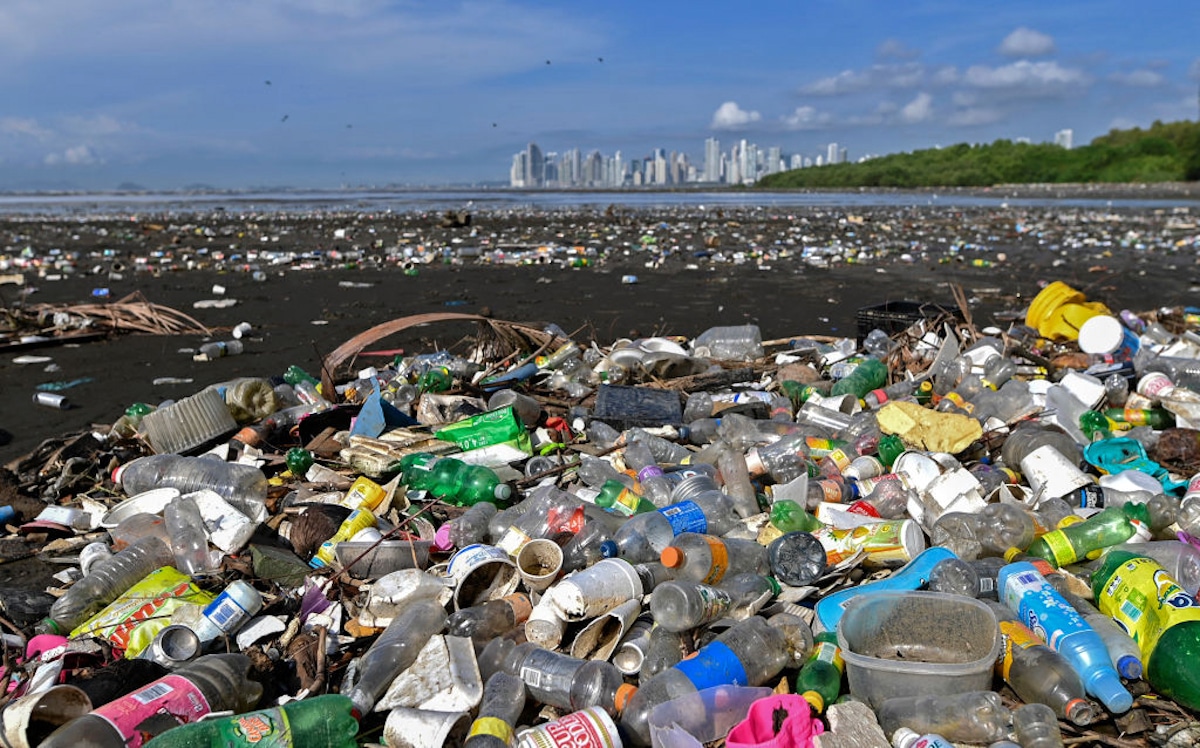
Plastic pollution on a Panama beach.

Plastic pollution on a Panama beach. Photo credit: LUIS ACOSTA / AFP via Getty Images

Humanity is currently releasing more chemical and plastic pollution into the environment than Earth can support.

That’s the conclusion of a first-of-its-kind study published in Environmental Science and Technology Tuesday, which argues that the planetary boundary for novel entities has been exceeded by human activity. The researchers defined “novel entities” as manufactured chemicals that do not appear naturally in large quantities and have the potential to disrupt Earth’s systems. 

“There has been a 50-fold increase in the production of chemicals since 1950. This is projected to triple again by 2050,” study co-author Patricia Villarubia-Gómez from the Stockholm Resilience Centre(SRC) at Stockholm University said in a press release emailed to EcoWatch. “The pace that societies are producing and releasing new chemicals and other novel entities into the environment is not consistent with staying within a safe operating space for humanity.”

In 2009, a team of researchers identified nine planetary boundaries that have led to a stable Earth for the last 10,000 years. These include greenhouse gas emissions, the ozone layer, forests, freshwater and biodiversity. The new research builds on this foundation by quantifying the planetary boundary for novel entities. 

The researchers concluded that the boundary had been breached because production and release of plastics and other chemicals now surpasses the ability of governments to assess and monitor these pollutants.

“For a long time, people have known that chemical pollution is a bad thing,” study co-author Dr. Sarah Cornell of the SRC told The Guardian. “But they haven’t been thinking about it at the global level. This work brings chemical pollution, especially plastics, into the story of how people are changing the planet.”

Scientists have previously concluded that humanity has exceeded the planetary boundaries for global heating, biodiversity loss, habitat loss and nitrogen and phosphorous pollution. 

The researchers noted that there are around 350,000 different types of manufactured chemicals on the global market, with almost 70,000 introduced in the last decade. Among them are plastics, pesticides, industrial chemicals and pharmaceutical products. 

Plastics are especially concerning, the study authors said. They now weigh more than double the mass of living animals and around 80 percent of all the plastics ever produced persist in the environment instead of being properly recycled. Further, plastics are made up of more than 10,000 other chemicals that can enter the environment in new combinations when they degrade. 

In order to address the risk posed by plastics and other chemical pollutants, the study authors argued that it is important to curb their production and release into the environment. 

“We need to be working towards implementing a fixed cap on chemical production and release,” study co-author Bethanie Carney Almroth from the University of Gothenburg said in the press release. 

They also supported calls for a circular economy.

“That means changing materials and products so they can be reused not wasted, designing chemicals and products for recycling, and much better screening of chemicals for their safety and sustainability along their whole impact pathway in the Earth system,” Villarubia Gómez said in the press release. 

2022 Planetary Boundaries Novel Entities · Owen Gaffney

Op-Ed: Arizonans need Kyrsten Sinema to stand up for their voting rights

Los Angeles Times

Op-Ed: Arizonans need Kyrsten Sinema to stand up for their voting rights

Sonja Diaz January 17, 2022

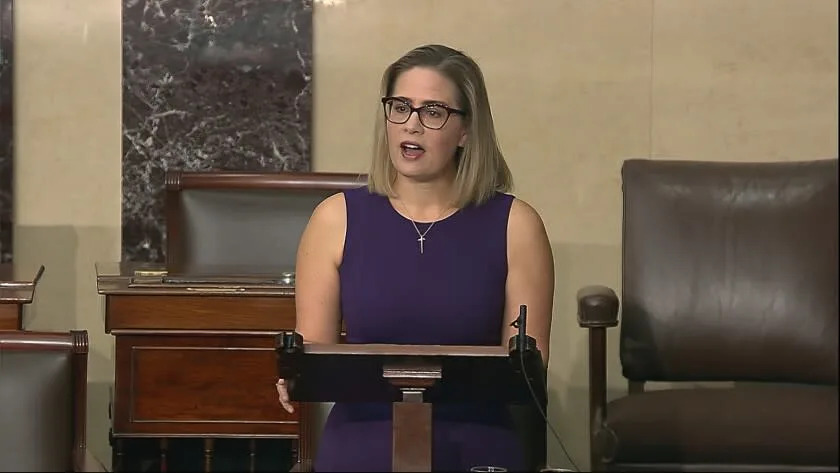
In this image from Senate Television, Sen. Kyrsten Sinema, D-Ariz., speaks on the floor of the U.S. Senate on Thursday, Jan. 13, 2022. President Joe Biden is set to meet privately with Senate Democrats at the Capitol, a visit intended to deliver a jolt to the party's long-stalled voting and elections legislation. Before he arrived Sinema blunted the bill's chances further, declaring she could not support a "short sighted" rules change to get past a Republican blockade. (Senate Television via AP)
Sen. Kyrsten Sinema (D-Ariz.) speaks on the floor of the U.S. Senate on Thursday, saying she would not support a change in the Senate’s filibuster rule. (Associated Press)

A little over a year ago, a violent insurrection, fueled by disinformation and hate, threatened to destroy our fragile democracy. Soon, our lawmakers may finish what the insurrectionists began if they cannot find a way forward on common-sense federal voting rights legislation.

The 2020 census made clear that America is at a demographic tipping point, and standing in the way of securing our democracy is a dysfunctional Senate that has failed to effectively govern for a generation. Even as we celebrate Martin Luther King Jr. — who was hated, brutalized and assassinated for his efforts to expand the vote — senators are faced with a critical decision that will determine the future of America and our standing as a representative democracy.

Republican senators are now set to use the filibuster to block the Freedom to Vote Act and the John Lewis Voting Rights Advancement Act, which would protect voting rights for all Americans. Yet two Democrats, Arizona Sen. Kyrsten Sinema, along with West Virginia Sen. Joe Manchin, are refusing to put us on the road to progress by changing Senate rules to pass the legislation.

Since the Supreme Court’s 2013 Shelby County vs. Holder decision, which gutted a core provision of the 1965 Voting Rights Act, an avalanche of voter suppression tactics from closing polling places to purging voter rolls to passing restrictive voter ID laws have been employed across the country. In the face of unprecedented voter turnout amid a global pandemic, 49 state legislatures introduced 440 pieces of legislation in 2021 that sought to limit access to the ballot box. This year isn’t shaping up to be much better, with 152 billed carried over into 2022 legislative sessions and 72 bills pre-filed last month.

When it comes to anti-voter legislation, Arizona takes the cake for most creative. State lawmakers have passed bills — fueled by the big lie that the 2020 presidential election was stolen — that discourage voting through various tactics, including expanding voter roll purges and making it harder for voters to fix a mail-in ballot. Some of their most audacious ideas were not signed into law last year, like Arizona House Bill 2720, which sought to allow lawmakers to overrule the state’s popular election results and choose its own slate of presidential electors, and House Bill 2792, which would have made it a felony for an election official to send a voter an early ballot unless that voter requested it.

The partisan nature of these efforts coupled with the increasing importance of voters of color, who lean Democrat, cannot be understated. But Sinema — who represents a state with a growing population of Latinos that helped to elect her in 2018 and to flip Arizona blue in 2020 — is refusing to take action that would not only support her reelection but would strengthen our democracy, starting with her home state.

Sinema said that her refusal to end the filibuster, even for the voting rights legislation, is in the name of democracy and an effort to reduce division. The reality is that her unwillingness to unite with her own party is holding back voting rights and election integrity practices that voters broadly support. Unfortunately, her inaction allows the will of a minority of the population to have an outsized influence on who can participate in our democracy.

We are facing an all-out assault on free and fair elections that coincides with the growth and consequence of voters of color. Communities that have historically been disenfranchised by poll taxes, vote dilution and voter identification laws are being left behind in the face of intersecting crises, including COVID-19, income inequality and climate change.

The 2020 census, flawed as it was, showed that these communities are the future of not only Arizona, but of all of America. The census found that while the country’s white population is declining, Latinos and Asian Americans — both youthful populations — are growing, driving a significant shift in the under-18 population. America’s future prosperity depends upon the very populations that far too many lawmakers are trying to cut out of our democracy. Sinema has a role to play in giving equal political voice to all Americans, not a minority of lawmakers who defy their constituents and subvert the U.S. Constitution.

Nearly 60 years ago, members of Congress put the will of the people first and answered a call to take courageous action to pass the 1965 Voting Rights Act. They did so in a nation at a crossroads with race, war and inequality. Congress went on to reauthorize that law five times, the last time in 2006. Each time, it acted to expand access to the ballot and take a step to fortify our democracy. Now, Sinema faces the same choice. She, too, has the power to take decisive action that puts Arizonians and the American people first. The question is, will she act?

Sonja Diaz is a civil rights attorney and the founding director of the UCLA Latino Policy and Politics Initiative.