Texas trump supporters don’t even like butterflies !

HuffPost

Texas Butterfly Sanctuary Closes Due To ‘Credible Threats’ From Pro-Trump Event

Josephine Harvey January 28, 2022

A South Texas butterfly conservatory said it will temporarily close after being warned that it could be a target of a nearby rally headlined by conspiracy theorists and allies of former President Donald Trump.

The National Butterfly Center announced Friday that it would shutter until Sunday due to “credible threats” regarding activities planned during the three-day We Stand America rally in the neighboring border town of McAllen. The closure comes one week after a right-wing congressional candidate from Virginia accused the center’s staff of being “OK with children being trafficked and raped.”

The sanctuary’s director, Marianna Treviño-Wright, said she was warned by an acquaintance, former Republican state lawmaker Aaron Peña, that “she should be armed at all times or out of town this weekend” because the rally included a “Trump Train-style caravan to the border” that would likely make a stop at the butterfly center. She said she was advised that both she and the sanctuary were targets.

Peña did not immediately respond to a request for comment.

“We simply cannot risk the safety and lives of our staff and visitors during this dangerous time,” the sanctuary said, noting that it would pay its staff during the unexpected closure.

The rally will focus on border security and is set to feature former Trump administration officials Michael Flynn, a QAnon supporter who served as national security adviser, and Thomas Homan, who was an acting director of Immigration and Customs Enforcement. Other QAnon-supporting, pro-Trump personalties are also expected to attend, including Mark Finchem, the Arizona state lawmaker running for Arizona secretary of state.

One right-wing group whose post was featured on the event website told supporters that “the McAllen event is not just a rally. It’s a boot camp with a full day of how-to training, to push back against and defeat the Marxists.”

The National Butterfly Center, a 100-acre nature preserve located just north of the U.S.-Mexico border in Mission, Hildago County, has become an unlikely combatant in a war with Trump allies.

The center’s parent group, the North American Butterfly Association, sued the Trump administration in 2017 for beginning border wall preparations without conducting the appropriate environmental assessments. The conservationists have since been embroiled in legal standoff with both the Trump administration and later with We Build The Wall, an organization that claimed to be crowdfunding private donations to build the border wall, including a section near the nature preserve.

The butterfly center said We Build The Wall founder Brian Kolfage and Steve Bannon, a chief strategist in the Trump White House, attempted to boost fundraising efforts by attacking the sanctuary and Treviño-Wright with defamatory and malicious lies in late 2019 and early 2020.

Both men were charged in August 2020 for allegedly using the group’s donations for personal expenses.

In 2019, Kolfage assailed the butterfly park’s staff on Twitter for pushing back against his efforts to build the wall, calling them “freaks” and saying the sanctuary was a “sham.” He accused staff of ignoring human trafficking and seemed to suggest that the sanctuary’s operators might have been involved in some kind of international butterfly-smuggling scheme.

In one tweet, he wrote: “The only butterflies we saw were swarming a decomposing body surrounded by tons of rotting trash left behind by illegals.”

The sanctuary said it faced online harassment as a result of the posts.

Treviño-Wright said a doctored image of rafts at the butterfly center's dock was shared online in 2019. (Photo: via National Butterfly Center)
Treviño-Wright said a doctored image of rafts at the butterfly center’s dock was shared online in 2019. (Photo: via National Butterfly Center)

Police were called to the butterfly center last week after a Virginia congressional candidate, Kimberly Lowe, and her friend had an altercation with staff.

Lowe is currently traveling around the southern border and sharing videos of Border Patrol, migrants being apprehended and processed, and sections of wall. She said in one video that she is learning about it so “we can save America and stop the drugs that are crossing the border and destroying our families.”

According to an affidavit provided by Treviño-Wright, her son Nicholas Wright interrupted her during a conference call at around 1:30 p.m. on Jan. 21. He said that two women were trying to enter the preserve without paying admission “but wanted us to open up the gate for them to access the back 70 acres of the property, so they could go see ‘illegals crossing on rafts.’”

“He said one of the women claimed to be running for Congress and the other claimed to be with the Secret Service,” Treviño-Wright wrote.

Aaron Peña and Kimberly Lowe at an event in Texas. <br /><br />Treviño-Wright said she contacted Aaron Peña after she looked up Kimberly Lowe on Facebook and saw the two pictured together at a recent event. (Photo: Kimberly Lowe for Congress/Facebook)
Aaron Peña and Kimberly Lowe at an event in Texas.

Treviño-Wright said she contacted Aaron Peña after she looked up Kimberly Lowe on Facebook and saw the two pictured together at a recent event. (Photo: Kimberly Lowe for Congress/Facebook)

Treviño-Wright said she looked up Lowe on Facebook and saw her videos from the border, then went to meet the women at reception and told them they were not welcome.

“At this point they started saying things like, ‘So, you’re not about keeping the illegals out?’ and ‘you are OK with children being raped,’ and the like,” she said in her affadavit. “They continued to say things like that as they moved toward the front door.”

Audio of the altercation provided and recorded by Treviño-Wright verifies this exchange, including that Lowe’s friend claimed she was a member of the Secret Service.

Lowe told HuffPost she had not suggested that Treviño-Wright was “involved with anything” and accused her of making things up. She said Treviño-Wright was “mentally ill” and that she had “verbally and physically assaulted us, stole my phone, kidnapped us, and tried to keep us from leaving, and filed a false police report.”

As the women stepped outside the front doors of the center, Treviño-Wright said, she noticed that Lowe was filming her and tried to stop her. She said she “panicked” because she, her children and the center had been threatened before after conservative figures posted photos of her.

“I moved to stop her from doing this, by knocking or taking away her phone and retreating inside the building to wait for the police,” Treviño-Wright said. “Then I was thrown to the ground.”

In the audio, a scuffle can be heard, including a woman’s voice saying, “You did not take my phone … get the fuck down, bitch.”

Lowe was livestreaming the end of the exchange to Facebook but later deleted the video.https://www.youtube.com/embed/pl9csBaK3Yw?rel=0

In a livestream from her car later, Lowe told viewers that “this is what you have down here at the border with crazy freakin’ people who are OK with children being trafficked and raped. I was just assaulted at the butterfly center.” Lowe’s three children were in the back seat.

Treviño-Wright sent a copy of Lowe’s livestream to HuffPost. Lowe sent HuffPost the same video, but excluded the second half.

Treviño-Wright said she filed a report with the Mission Police Department and submitted recordings and signed affidavits from herself and her son.

The Mission Police Department, McAllen Police Department, Hildago County Sheriff and Border Patrol did not immediately return requests for comment.

On Friday night, following the publication of this report, Lowe called HuffPost and said she was rejected from the We Stand America event when she arrived earlier that day, thanks to media “hit” pieces.

She said she was turned away by Christie Hutcherson, the founder of Women Fighting for America, and Finchem, both of whom were advertised as attendees of a ticketed reception that included the tour to the wall.

Lowe said Finchem told her that “because of me, the entire event almost got canceled.”

She was told that she’d be reimbursed for her ticket.

“I would have thought that the people who are supposed to be in my party would have supported me and instead they removed me,” she said. “These are pretty big bridges burned for me.”

She said she was facing online harassment and abuse and had left Texas to drive back to Virginia.

HuffPost has contacted Hutcherson and Finchem for comment.

1 in 5 American’s Never Really Bought Into the Democratic Experiment Justice Breyer and President Lincoln Revered.

The New York Times

For Many Who Marched, Jan. 6 Was Only the Beginning

Elizabeth Dias and Jack Healy January 23, 2022

President Donald Trump speaks at a rally near the White House in Washington, Jan. 6, 2021. (Pete Marovich/The New York Times)

PHOENIX — There were moments when Paul Davis questioned his decision to join the crowd that marched on the U.S. Capitol last January. When he was publicly identified and fired from his job as a lawyer. When his fiancée walked out.

But then something shifted. Instead of lingering as an indelible stain, Jan. 6 became a galvanizing new beginning for Davis. He started his own law practice as a “lawyer for patriots” representing anti-vaccine workers. He began attending local conservative meetings around his hometown, Frisco, Texas. As the national horror over the Capitol attack calcified into another fault line of bitter division, Davis said his status as a Jan. 6 attendee had become “a badge of honor” with fellow conservatives.

“It definitely activated me more,” said Davis, who posted a video of himself in front of a line of police officers outside the Capitol but said he did not enter the building and was expressing his constitutional rights to protest. He has not been charged with any crime from that day. “It gave me street cred.”-

The postmortems and prosecutions that followed that infamous day have focused largely on the violent core of the mob. But a larger group has received far less attention: the thousands who traveled to Washington at the behest of then-President Donald Trump to protest the results of a democratic election, the vast majority of whom did not set foot in the Capitol and have not been charged with any crime — who simply went home.

For these Trump supporters, the next chapter of Jan. 6 is not the ashes of a disgraced insurrection but an amorphous new movement fueled by grievances against vaccines and President Joe Biden, and a deepened devotion to his predecessor’s lies about a stolen election.

In the year since the attack, many have plunged into new fights and new conspiracy theories sown in the bloody chaos of that day. They have organized efforts to raise money for the people charged in the Capitol attack, casting them as political prisoners. Some are speaking at conservative rallies. Others are running for office.

Interviews with a dozen people who were in the large mass of marchers show that the worst attack on American democracy in generations has mutated into an emblem of resistance. Those interviewed are just a fraction of the thousands who attended the rally, but their reflections present a troubling omen should the country face another close presidential election.

Many Jan. 6 attendees have shifted their focus to what they see as a new, urgent threat: COVID-19 vaccine mandates and what they call efforts by Democratic politicians to control their bodies. They cite Biden’s vaccine mandates as justification for their efforts to block his presidency.

Some bridled at Trump’s recent, full-throated endorsements of the vaccine and wondered whether he was still on their side.

“A lot of people in the MAGA patriot community are like, ‘What is up with Trump?’” said Davis, the Texas lawyer. “With most of us, the vaccines are anathema.”

In interviews, some who attended the Capitol protests gave credence to a new set of falsehoods promoted by Trump and conservative media figures and politicians that minimize the attack, or blame the violence falsely on left-wing infiltrators. And a few believe the insurrection did not go far enough.

“Most everybody thinks we ought to have went with guns, and I kind of agree with that myself,” said Oren Orr, 32, a landscaper from Robbinsville, North Carolina, who had rented a car with his wife to get to the Capitol last year. “I think we ought to have went armed and took it back. That is what I believe.”

Orr added that he was not planning to do anything, only pray. Last year, he said he brought a baton and Taser to Washington but did not get them out.

More than a year later, the day may not define their lives, but the sentiment that drove them there has given them new purpose. Despite multiple reviews showing the 2020 elections were run fairly, they are adamant that the voting process is rigged. They feel the news media and Democrats are trying to divide the country.

The ralliers were largely white, conservative men and women who have formed the bedrock of the Trump movement since 2016. Some describe themselves as self-styled patriots, some openly carrying rifles and handguns. Many invoke the name of Jesus and say they believe they are fighting a holy war to preserve a Christian nation.

The people who went to Washington for Jan. 6 are in some ways an isolated cohort. But they are also part of a larger segment of the public that may distance itself from the day’s violence but share some of its beliefs. A question now is the extent to which they represent a greater movement.

A national survey led by Robert Pape, director of the Chicago Project on Security and Threats at the University of Chicago, concluded that about 47 million American adults, or 1 in every 5, agreed with the statement that “the 2020 election was stolen from Donald Trump and Joe Biden is an illegitimate president.” Of those, about 21 million, or 9% of American adults, shared the belief that animated many of those who went beyond marching and invaded the Capitol, Pape said: that the use of force was justified to restore Trump to the presidency.

“They are combustible material, like an amount of dry brushwood that could be set off during wildfire season by a lightning strike or by a spark,” he said.

Some downplay Jan. 6 as a largely peaceful expression of their right to protest, comparing the Capitol attack with the 2020 racial justice protests that erupted after George Floyd’s murder. They complain about a double standard, saying that the news media glossed over arson and looting after those protests but fixated on the violence Jan. 6.

They have rallied around the 700 people facing criminal charges in connection to the attack, calling them political prisoners.

Earlier this month in Phoenix, a few dozen conservatives met to commemorate the anniversary of Jan. 6 as counterprogramming to the solemn ceremonies taking place in Washington. They prayed, sang “Amazing Grace” and broadcast a phone call from the mother of Jacob Chansley, an Arizona man whose painted face and Viking helmet transformed him into an emblem of the riots. Chansley was sentenced to 41 months in prison after pleading guilty to federal charges.

Then it was Jeff Zink’s turn at the microphone. Zink is one of several people who attended the Capitol protests and who are running for public office. Some won state legislature seats or local council positions in last November’s elections. Now, others have their eyes on the midterms.

Zink is making an uphill run for Congress as a Republican in an overwhelmingly Democratic swath of Phoenix and said he will fight for Jan. 6 defendants — a group that includes his 32-year-old son, Ryan.

Father and son marched up the Capitol steps together and were steps away as police subdued a man who smashed a window. Zink said he and his son were peacefully documenting the event and never actually entered the building. A federal criminal complaint accuses Ryan Zink of unlawfully entering a restricted area of the Capitol and obstructing an official proceeding.

The complaint against Ryan Zink quotes a Facebook message from Jan. 6: “Broke down the doors pushed Congress out of session I took two flash bangs I’m OK I’ll be posting pictures in a little bit when we get back I’m hurt but we accomplished the job.”

Jeff Zink, a onetime church deacon, referenced the biblical Book of Proverbs as he outlined why he believed COVID-19 was a bioweapon meant to convert the United States to socialism and lamented that the United States “was no longer a Christian nation.” And despite the fallout from their decision to join the Jan. 6 rally, he said he would “absolutely” do it again.

“Godly men and godly women need to stand up,” he said.

Julie McKechnie Fisher, who went to Washington to hear Trump speak Jan. 6, helped organize more than 30 candlelight vigils nationwide like the one where Jeff Zink spoke, to honor the defendants. She is working with a right-wing group called Look Ahead America, which aims to register new voters in states like Virginia and Pennsylvania, and train them to lobby for what the group’s website calls “America First initiatives,” like changing election laws and “helping to clean up voter rolls.”

“We just can’t become complacent,” she said. “I can’t see anything good that this administration has done for us, and it doesn’t feel like he loves our country.”

Several people who marched on the Capitol described the day as a kind of Trumpian Fort Sumter — part of a life-or-death fight against socialism, anti-Christian secularism and the tyranny of Biden’s masking and vaccine mandates.

Their views began to take shape in the hours just after Jan. 6 and have been buttressed by a flood of misinformation on social media, talk radio and from revisionist documentaries. Some said they had watched a program by Fox News host Tucker Carlson that floated conspiracy theories suggesting Jan. 6 was a “false flag” operation.

Several people charged in the breach of the Capitol have expressed remorse as they pleaded guilty and made requests for sentencing leniency, telling federal judges that they now feel duped or wish they could do it over. A Colorado man wrote that he was “guilty of being an idiot.” A Kansas City, Missouri, man said he was “ashamed.”

Still, those who have been charged have supporters whose movement is wrapped not only in feelings of anger but also of belonging. It is a reason the spirit of that day carries on.

That sense of community resonates for people like Greg Stuchell, a city councilman from Hillsdale, Michigan, who took an overnight bus to Washington last year with his teenage daughter to protest the election results. He said he did not enter the Capitol. For him, Jan. 6 is like the annual March for Life in Washington, he said, where people simply show up to protest laws and values they believe should fall. For every one person who attends, there are another 100 who wish they could have, too, he said.

Since the election Stuchell, a Catholic convert who opposes abortion, has channeled his anger by marching with other men around the Hillsdale courthouse on the first Sunday of every month. He found solidarity, he said, in similar men’s groups growing in Hungary and Poland. “Men got to step up. We don’t have that many men anymore,” he said. At the machine shop he manages, some male co-workers have been tossing around ideas to protest what they see as a rigged government and election system, like not filling out W2s or not paying taxes, he said.

“If they don’t fix it, I don’t know what happens,” he said. “People need to stand up and say, ‘Enough.’”

Why don’t Arizona cities require residents to conserve water?

Why don’t Arizona cities require residents to conserve water? It’s simple, really

Joanna Allhands, Arizona Republic January 29, 2022

Few Arizona cities mandate water conservation measures now, but most have plans to do so in the future.

Why don’t cities mandate conservation measures if Arizona needs to save water?

This is a question I get frequently, and there’s a simple answer: Because we’re not at that stage yet.

That doesn’t mean saving water is unimportant. Cities can and should be doing more to help residents use less.

But there are reasons why Arizona cities aren’t yet forcing residents and businesses to save – and we can see them playing out in California.-

California has struggled to save more water

California has essentially cut off State Water Project supplies to many cities and farmers this year because there isn’t enough water to go around. It also has announced another round of mandatory statewide restrictions on things like outdoor watering and car washing.

The state enacted mandatory conservation measures for the first time in 2015 to reduce usage by 25%. Many cities have generally sustained those savings, the result of converted landscaping and other measures.

But the state also widely missed its target last year to save an additional 15% – in part because those 2015 mandates took out the low-hanging fruit. If California wants to save more water now, it’ll require behavioral changes that residents may not be so eager to make, much less sustain over time.

That’s the downside of mandatory measures. If people aren’t willing to play along, the only way to get there is by enforcement, which is expensive, time consuming and usually anger producing.

That’s why Arizona cities are loath to use mandates.

Nearly all Arizona cities will mandate, eventually

But nearly all have plans to enact them, eventually.

Arizona water providers are required to create a drought preparedness plan – somewhat of a misnomer, considering that they are really about handling water shortages, not preparing for drought.

Actions increase as the stages progress, though the triggers for each stage vary by provider. Scottsdale and Tucson tie their stages in part to levels of shortage at Lake Mead, which makes sense, considering that they rely on a larger portion of Colorado River water than other major cities. Other cities base their triggers on more general reductions to surface water or their overall supply.

The actions that cities will take at each stage also vary. Most begin with cuts to water use at city facilities and voluntary actions for homeowners and businesses, which grow into mandates as the stages increase.

Most cities spell out which mandates they will consider at various stages, such as turning off water to splash pads, limiting ornamental turf, creating restrictions on outdoor watering or imposing fines on water wasters. Some require city council approval for actions taken in later stages.

Scottsdale and Tucson are already in stage 1

Because Lake Mead has reached its first level of shortage, Scottsdale and Tucson have already moved into stage 1 of their plans.

Scottsdale will no longer make water available to those who live outside city limits and is asking residents to voluntarily conserve 5%, perhaps by replacing turf and water-intensive landscaping, choosing not to overseed grass in the winter or by scheduling a free, city-provided review of their water use.

The water department is asking for additional money this year to fund its turf removal rebate and is ratcheting up its messaging about saving water. Officials hope that the more they can conserve voluntarily now, the less they will have to mandate later as Mead sinks into deeper levels of shortage.

Meanwhile, Tucson is sharing information with homes and businesses about their historical use and will send targeted conservation recommendations to those who use more water than their peers. The city also is reviewing whether to suspend new requests to join its water service area.

Do more to save – but voluntarily, for now

Some argue that cities should already be doing this stuff, and they have a point. If most actions in the first stage of cities’ plans are voluntary, why wait for a shortage trigger to enact them?

But cities also are right that rather than jumping to heavy-handed mandates that people may reject over time, the focus now should be on creating a positive culture of water conservation, where everyone agrees that if we’re going to live in the desert, we need to use less water, and any water we use must be done wisely.

Cities have done a decent job of that so far. Existing voluntary measures, along with more efficient appliance standards, have vastly cut water use over time. Arizona uses less water now than it did in the 1950s, even though millions more people live here.

It’s also worth noting that while metro Phoenix’s largest cities are home to half of the state’s 7-plus million population, they use 11% of Arizona’s water supplies. Even drastic cuts in use among these cities probably wouldn’t be enough to keep Lake Mead from falling into deeper tiers of shortage.

That doesn’t mean water is OK to waste, or that cities shouldn’t do more to encourage residents and businesses to use less water.

But the balance between carrots and sticks matters. And while mandates won’t be off the table forever, they are probably not the best way to compel lower use now.

Nobody Cares Whether You ‘Believe’ in the Separation of Church and State. That’s the Law, Champ.

Esquire

Nobody Cares Whether You ‘Believe’ in the Separation of Church and State. That’s the Law, Champ.

Jack Holmes January 28, 2022

Photo credit: Joel Prince - Getty Images
Photo credit: Joel Prince – Getty Images

Looking around the Republican farm system, it’s hard not to feel an escalating sense of doom for this ball club and the league they play in. Unfortunately, the rest of us are stuck in Major League Batshit with these people, a competition in desperate need of a relegation system. Politico enlivened this Friday with a report on an internecine MAGA dispute out of Tennessee, in which the batting champ got himself in hot water with other luminaries of the movement. Apparently, Madison Cawthorn and Candace Owens and Matt Gaetz and Marjorie Taylor Greene are unhappy that Donald Trump backed Morgan Ortagus, whom he once plucked from Fox News to serve as a spokesperson for the State Department, over Robby Starbuck, a MAGA social-media influencer, for a congressional endorsement. Donald Trump Jr. and Dan Scavino  are also reportedly mad at Daddy, though not in public, and have you ever heard a list of such abysmally low-quality people exercising this kind of influence over one of our two major political parties? Whoever wins, this country loses.

Speaking of which, there’s the Ohio Senate primary. J.D. Vance, the venture-capitalist everyman backed by $10 million from a technovampire planting nice little seeds all over our politics, has had to play second fiddle to a more shameless and relentless MAGA devotee in Josh Mandel. This is Mandel’s third attempt at becoming a senator from Ohio, and it’s not hard to see why the first two campaigns came up short. The guy has Stephen Miller vibes. But in today’s Republican Party, he appears to be the frontrunner for the nomination, to the extent that he engaged in what looked like a general-election debate against a prospective Democratic opponent, Morgan Harper, before the primary races have been decided. (Congressman Tim Ryan is also running competitively in the Democratic primary.) On Thursday evening, Mandel at one point suggested that Obama orchestrated a George Soros-funded invasion of Haitians. People in the audience laughed loudly.

But we’ll leave aside the now-standard immigration hysteria and engage with one piece of Mandel’s reactionary exhibition in particular. We have returned, yet again, to the issue of church and state. The issue that will not die, from the corporate Christian push of the 1930s to the online message boards of Web 1.0, the issue that Mandel probably raised in the hopes of generating articles like this one that he can point to as evidence that the Woke Mob is out to Silence him.

Luckily, this principle does not require Mandel to “believe” in it for it to be a bedrock of American law and history. “When you read the United States Constitution,” he continued, “Nowhere in the United States Constitution do you read about separation of church and state.” Helpfully, Mandel botched the wording to make his point even weaker here. Had he said that the Constitution does not explicitly mention “a separation of church and state,” that would be correct, not that it’s anything more than pedantic. (As Princeton historian Kevin Kruse, author of a seminal volume on this dispute, put it on Twitter, “Every single reference to religion in the Constitution puts it at arms length from the state.”) Here’s a part of the constitutional text Mandel may want to consult:

Amendment I

Congress shall make no law respecting an establishment of religion…

Interesting that it’s the first line of the Bill of Rights. Seems important. But then again, the opening phrase of the Second Amendment (“A well regulated militia…”) has also been entirely erased somehow. The First Amendment doesn’t explicitly say there’s a separation between church and state, however. That’s true. Does that suggest something about The Founders, as Mandel tells us? Let’s ask some guy named Thomas Jefferson what this all means. From his “Letter to the Danbury Baptists” in 1802:

Believing with you that religion is a matter which lies solely between Man & his God, that he owes account to none other for his faith or his worship, that the legitimate powers of government reach actions only, & not opinions, I contemplate with sovereign reverence that act of the whole American people which declared that their legislature should “make no law respecting an establishment of religion, or prohibiting the free exercise thereof,” thus building a wall of separation between Church & State.

Ah. And I thought we liked walls these days? But Jefferson wrote the Declaration of Independence, not the Constitution. Let’s talk to the guy who wrote much of the latter, James Madison, who explained a veto in an 1811 speech as president thusly:

Because the Bill exceeds the rightful authority, to which Governments are limited by the essential distinction between Civil and Religious functions, and violates, in particular, the Article of the Constitution of the United States which declares, that “Congress shall make no law respecting a Religious establishment.”

And as usual, it’s Madison who gets to the core of the issue. Civil functions are separate from religious functions. If you want to make policy for civil society through the government, you must appeal to the principles undergirding the legal regime of civil society. Your religious beliefs are your own, and they may—and likely do—influence your opinions on matters of civil policy. But when you make an argument for rules everyone should live by, regardless of their religious beliefs, your justification cannot be the belief system of your own one religion. It doesn’t matter what your religion is. A spiritual belief is not grounds for making secular policy, and secular policy is what the United States government, at all levels, is in the business of making. You may feel, devoutly even, that America is a Christian Nation, but as we often hear these days, the facts do not care about your feelings. Besides, would Jesus really approve of American immigration policy?

Pittsburgh bridge collapse injures 10 people

Pittsburgh bridge collapse injures 10 people

By Alex Sundby January 28, 2022

A Pittsburgh bridge collapsed Friday morning, sending multiple vehicles and a public bus plummeting into a park below, officials said. Ten people suffered minor injuries and four people were taken to area hospitals, but none of the injuries were life-threatening, CBS Pittsburgh reports.

“This could have been much worse,” Pennsylvania Lieutenant Governor John Fetterman told CBS Pittsburgh at the collapse site. Fetterman noted a winter storm delayed the start of schools and kept people off the roads.

Images from the scene showed vehicles piled up amid the rubble. Gas lines running along the bridge ruptured, causing a large leak, and crews shut off the lines, officials said in a statement.

Five vehicles and an Allegheny County Port Authority bus were on the overpass when it collapsed into Frick Park below at around 6:40 a.m., officials said in the statement. Crews were searching the area to see if anyone may have been in the park when the collapse happened.

The bridge was last inspected in September, Mayor Ed Gainey told reporters. Fire Chief Darryl Jones said authorities were investigating what caused the collapse, which happened hours before President Biden was scheduled to visit the area to speak about infrastructure and other topics.

“With him coming today to talk about this infrastructure bill, to discuss why this funding is so important, today is significant,” Gainey told reporters.”… At the end of the day, we could have had some serious injuries.”

Vehicles are seen in a pileup after a bridge collapsed in Pittsburgh on January 28, 2022.
Vehicles are seen in a pileup after a bridge collapsed in Pittsburgh on January 28, 2022.JEREMY H.
At collapse site, Biden calls state of U.S. infrastructure “just mind-boggling”

At the bridge collapse site, President Biden said it was “mind-boggling” how far behind the U.S. has been on investing in its infrastructure. The president made the comments to a group of elected officials and first responders as he surveyed the damage from the collapse.

“We have been so far behind on infrastructure for so many years it’s just mind-boggling,” Mr. Biden said. “…We used to be number one in the world.”

Biden visits bridge collapse site

President Biden is visiting the bridge collapse site shortly after he arrived in the Pittsburgh area for a previously scheduled event.

Five vehicles and a bus were on bridge when it collapsed

Five vehicles and an Allegheny County Port Authority bus were on the bridge when it collapsed into Frick Park below at around 6:40 a.m., officials said in a statement. Crews were searching the area to see if anyone may have been in the park when the collapse happened.

“This could have been much worse”

Pennsylvania Lieutenant Governor John Fetterman said it was fortunate that a winter storm hitting Pittsburgh at the time of the collapse helped keep people off the roads.

“This could have been much worse,” Fetterman told CBS Pittsburgh at the collapse site. “We were fortunate that there was a public school delay and the traffic could have been much more pronounced.”

“I’m just grateful nobody was killed,” Fetterman told the station. 

Rescuers used ropes and human chain to pull people to safety

Pittsburgh Fire Chief Darryl Jones said rescuers repelled down between 100 feet and 150 feet on ropes to reach people after the collapse. Others formed a human chain to pull people up to safety.

“It wasn’t vertical, but it was fairly steep,” Jones told reporters.

No life-threatening injuries reported

Ten people suffered minor injuries and three people were taken to area hospitals, but none of the injuries were life-threatening.

Vehicle pileup seen amid the rubble

Images from the scene showed vehicles piled up amid the rubble. CBS Pittsburgh reports a gas line runs under the bridge, and officials said the gas line was shut off.

Vehicles are seen in a pileup after a bridge collapsed in Pittsburgh on January 28, 2022.
Vehicles are seen in a pileup after a bridge collapsed in Pittsburgh on January 28, 2022.JEREMY H.
Biden visiting Pittsburgh later today

The collapse happened hours before President Biden was scheduled to visit Pittsburgh to speak about infrastructure and other topics. White House press secretary Jen Psaki that Mr. Biden’s trip was expected to go on as planned.

Couldn’t have come at a better time. Pennsylvania will receive an extra $1.63 billion in federal infrastructure funds to fix bridges

Pittsburg Post Gazette

Pennsylvania will receive an extra $1.63 billion in federal infrastructure funds to fix bridges, 3rd most in U.S.

Ed Blazina, Pittsburgh Post-Gazette  January 14, 2022 

A man walks on the Nine Mile Run Trail — which passes under the Commercial Street Bridge — on March 9, 2020, in Squirrel Hill.

Pennsylvania has the second most bridges in poor condition and will receive an additional $1.63 billion in federal funds over the next five years to help fix some of them, according to details of a federal bridge program announced Friday.

Background material released by senior Biden Administration officials shows that Pennsylvania has 3,353 bridges listed in poor condition — second behind Iowa, which has 4,571. The state will receive the third most money for bridges under the federal infrastructure bill, one of seven states to receive at least $1 billion over five years.

The state is waiting for decisions by regional planning organizations before it announces which bridges will benefit from the new program, which will bring $327.2 million to the state this year. Possibilities in this area include two structures on the Parkway East — the Commercial Street Bridge on the inbound side near the Squirrel Hill Tunnel and the Frazier Street Bridge near Oakland — and the McKees Rocks Bridge.

“As far as specific bridges, we’re not at that point yet,” said Alexis Campbell, spokeswoman for the Pennsylvania Department of Transportation. “We’re doing the 2023 update [to the state bridge program] now. We will put that money to good use, for sure.” Ashley MurrayAirports, including those in Western Pennsylvania, first among transit hubs to get funds under bipartisan infrastructure law

The Southwestern Pennsylvania Commission, which oversees transportation projects in 10 counties, expects to decide which road and bridge projects to fund at its June meeting.

Gov. Tom Wolf joined U.S. Transportation Secretary Pete Buttigieg in Philadelphia Friday morning to highlight the program. Mr. Wolf called the program “a historic investment” for the state and nation.

“Strong infrastructure is critical to the quality of life for all Pennsylvanians, especially strong, safe bridges,” the governor said. “Bridges are the lifelines that connect our communities to one another, while modern, reliable infrastructure is essential for Pennsylvania-based businesses to expand.”

Other Democrats also touted their support for the program.

“For a long time, Pennsylvanians have had to make do with driving over thousands of bridges in poor condition,” Sen. Bob Casey said in a statement. “ Now, I am proud to say that this year alone, hundreds of millions of dollars will go towards repairing and upgrading those bridges, which are so vital to the Commonwealth. 

“This investment will better connect communities, stimulate job growth across Pennsylvania and make commutes to work and school much safer.”

Rep. Conor Lamb, D-Mt. Lebanon said the additional money will help the state fix hundreds of bridges “in desperate need of repair.” 

“This historic federal funding — passed with bipartisan support — will ensure that we are able to invest in these critical transportation connections in communities across our region and create good, union jobs for construction and trades workers,” he said in a statement.

Allie Carroll, spokeswoman in Pennsylvania for the Republican National Committee, said Mr. Buttigieg’s visit was an attempt by the Biden Administration to cover for “an insanely horrible week” in Washington, where it appears the federal voting rights act is not likely to move forward.

“As Pete Buttigieg grandstands in Philadelphia today, voters know that Biden’s sputtering agenda is on a bridge to nowhere,” she said in a statement.

The program requires a state match of 20% for bridges that are owned by the state. As an incentive for the state to help other levels of government, the new program waives that local match for bridges owned by counties, cities, boroughs and townships. 

The additional money for bridges comes in addition to $4 billion over five years for state roads the agency will receive under the infrastructure bill. That will average out to about $1.33 billion extra for five years, but it still falls way short of the extra $8.1 billion a year the state says it needs to meet normal annual road and bridge work.

So that extra money will not stop the state from pursuing additional funding from other sources. That includes charging tolls on nine major bridges, including the Interstate 79 bridge near Bridgeville, that the department wants to turn over to private firms for replacement and maintenance for 30 years using tolling proceeds.

It also wants to replace the gasoline tax with fees for each package delivered to homes and for rides provided by services such as Uber and Lyft as well as eventually charging motorists a fee for miles driven. 

Federal officials said the bridge money is available immediately and states can begin spending it this spring. They acknowledged some areas, including local PennDOT projects, have experienced trouble obtaining steel and other material due to supply chain problems.

The long-term nature of the program should stimulate industry to step up production and the shortage of materials should not delay the program overall, they said.

Nationally, the bridge program will invest $27.3 billion over five years, which the federal Department of Transportation called the “largest dedicated bridge investment since the construction of the interstate highway system” in the 1950s. Officials stressed that the money was allocated to states, Washington, D.C., Puerto Rico and tribal nations according to need.

The amount each state gets varies by the size and condition of its poor bridges. For example, Iowa has the most bridges rated poor at 4,571, but many of them are small so it will receive $438 million for upgrades while California’s 1,634 bridges are larger and more expensive, so it will receive the most money at $4.2 billion.

As far as neighboring states, New York will receive the second most money at $1.9 billion for 1,702 poor bridges; New Jersey will get $1.1 billion for 502 poor bridges; West Virginia $506.7 million for 1,5454 bridges; and Ohio $483.3 for 1,377 bridges.

This program also isn’t the only one dedicated to bridges. The department is developing guidelines for a five-year, $12.5 billion competitive grant program.

Big Myth About Donald Trump, GOP Leaders Is Busted In Blistering New Ad

HuffPost

Big Myth About Donald Trump, GOP Leaders Is Busted In Blistering New Ad

Lee Moran September 30, 2021

Progressive PAC MeidasTouch calls out the “malignant force” of the GOP in its blistering new ad.

The 2 1/2-minute spot, released Wednesday, slams the Republican Party for becoming a “misguided personality cult” in honor of ex-President Donald Trump.

The video highlights Trump’s catastrophic mishandling of the COVID-19 pandemic, noting how some GOP governors continue to “recklessly” ignore facts and sacrifice lives “in the callous pursuit of votes.”

“These aren’t leaders of a political movement, they’re leaders of a cult. And they kill,” the PAC, founded by attorney Ben Meiselas and his two brothers in 2020, captioned the clip with the hashtag #TrumpCultKills.

Both the video and the hashtag have gone viral on Twitter, joining otherhard-hittingclips from the PAC to garner hundreds of thousands of views online.

A federal judge canceled major oil and gas leases over climate change

NPR – Climate

A federal judge canceled major oil and gas leases over climate change

Nathan Rott – January 28, 2022. – Heard on Morning Addition

A man fishes near docked oil drilling platforms in 2020 in Port Aransas, Texas. A federal judge has revoked oil and gas leases sold in the Gulf of Mexico in November, saying the Interior Department did not take into account its impact on climate change.Eric Gay/AP

Late last year, just days after pledging to cut fossil fuels at international climate talks in Glasgow, Scotland, the Biden administration held the largest oil and gas lease sale in U.S. history.

On Thursday, a federal judge invalidated that sale in the Gulf of Mexico, saying the administration didn’t adequately consider the costs to the world’s climate.

The administration used an analysis conducted under former President Donald Trump that environmental groups alleged was critically flawed.

CLIMATE
The Biden administration sold oil and gas leases days after the climate summit

The decision represents a major win for a coalition of environmental groups that challenged the controversial sale, calling it a “huge climate bomb.”

Eighty million acres — an area twice the size of Florida — were put up for auction in November.

Climate groups urged the Biden administration to stop the sale, but the Interior Department said it was compelled to move forward after a different federal judge struck down the administration’s temporary moratorium on new oil and gas lease sales. Oil and gas companies only ended up bidding on 1.7 million acres in the Gulf of Mexico.

Those leases will be vacated by the U.S. District Court of the District of Columbia’s decision, and the Interior Department will have to conduct a new environmental analysis if it decides to hold another sale.

“We are pleased that the court invalidated Interior’s illegal lease sale,” said Earthjustice’s senior attorney, Brettny Hardy. ”We simply cannot continue to make investments in the fossil fuel industry to the peril of our communities and increasingly warming planet.”

ENVIRONMENT
The Western megadrought is revealing America’s ‘lost national park’

The development and consumption of fossil fuels is the largest driver of climate change. The world has already warmed by more than 1 degree Celsius since preindustrial times, worsening wildfires, hurricanes and heat waves, and disrupting the natural world.

Roughly a quarter of the country’s total greenhouse gas emissions come from fossil fuels extracted from public lands.

The Biden administration has promised to review the country’s oil and gas leasing program to better account for its contribution to climate change.

Shortly after taking office, it temporarily blocked all new oil and gas leasing on public lands while it conducted its review, but the moratorium was struck down after being challenged by more than a dozen Republican-led states.

Scheduled lease sales resumed after that decision, including the massive sale in the Gulf, which elicited nearly $200 million in bids.

CLIMATE
Lawsuit alleging oil companies misled public about climate change moves forward

The climate impact analysis used by the Biden administration was actually conducted under Trump. It argued that not leasing the acreage would result in more greenhouse gas emissions because it would increase fossil fuel production abroad.

U.S. District Judge Rudolph Contreras wrote that the Interior Department acted “arbitrarily and capriciously in excluding foreign consumption from their greenhouse gas emissions,” adding that the “error was indeed a serious failing.”

“The U.S. offshore region is vital to American energy security and continued leases are essential in keeping energy flowing from this strategic national asset,” said Erik Milito, president of the National Ocean Industries Association, in a statement.

The Biden administration could choose to do a new analysis and put the section of the Gulf of Mexico up in another lease sale. Environmental groups would be waiting.

“The fight is not over,” said Hallie Templeton, legal director at Friends of the Earth. “We will continue to hold the Biden administration accountable for making unlawful decisions that contradict its pledge to take swift, urgent action on ‘code red’ climate and environmental justice priorities.”

Sequela: Long after a pandemic is ‘over’, new and terrible symptoms can appear.

Daily Kos

Sequela: Long after a pandemic is ‘over’, new and terrible symptoms can appear.

Mark Summer, Daily Kos Staff January 26, 2022 

Dr. James Samuel Pope, looking into a Covid-19 patients room, makes his rounds in the ICU with his team of fellow doctors, physician assistants, pharmacist and other medical workers at Hartford Hospital in Hartford, Connecticut on January 18, 2022. (Photo by Joseph Prezioso / AFP) (Photo by JOSEPH PREZIOSO/AFP via Getty Images)
Health care workers conducting rounds within an ICU filled with COVID-19 patients

“Sequela” is a word that few Americans recognize today. Unfortunately, it’s a word that is much more likely to become familiar over the next few years… even decades. A sequela is a long-term pathological effect resulting from exposure to a disease. When the pandemic ends, the damage is not going to be over. 

There’s often a tendency in the media—and in social media—to try to frame the damage of COVID-19 to an either-or situation. Someone gets sick for a few days, and they either recover and are fine, or they die and count among the ever-growing total deaths. It’s that sort of all-or-nothing approach that allows people to say things like, “Well, the survival rate is 99.9%, so …” Add more nines to the end of that number, depending on how many right-wing news programs you watch. 

Nationally, the actual survival rate is something closer to 98.8%, but that’s not the point. Studies have already indicated that 43% of those who have had at least one symptomatic COVID-19 infection tend to have issues that persist over an extended period. For those who have required hospitalization, the number jumps to 57%. In the United States alone, that’s something over 15 million people who are now suffering protracted illness due to a single, nonlethal infection from COVID-19.

Those suffering these persistent symptoms aren’t really going through a never-ending infection with SARS-CoV-2. “Long COVID” is a sequela—a long-term pathological effect resulting from exposure to COVID-19. For some of these 15 million, the damage is minor and transient. For others, it is debilitating and possibly lifelong.

Many sequelae aren’t obvious. And they may not show up for years.

What kind of long-term effects can be generated by an infection is difficult to predict. As an example, mumps is a viral infection that’s mostly focused on the salivary glands. The primary symptoms include pain on the sides of the face, difficulty in swallowing, fever, headache, and fatigue.

But mumps can also cause temporary or permanent hearing loss. That loss can be subtle. It can be severe. It can affect one ear. It can affect both. Most importantly, hearing loss can have an onset that begins at the same time as other symptoms of the disease, but it can also not appear until months after other symptoms have passed. 

Shingles may be one of the best-known sequela. Unusual in that it represents a continuous infection of the herpes zoster virus over a period of years or decades, shingles can even produce its own sequela in the form of postherpetic neuralgia: debilitating pain that persists for months or years after the typical shingles rash has disappeared.

Similarly, highly infectious measles is primarily a viral infection of the respiratory system. However, it can generate horrific damage to the central nervous system that doesn’t become evident for years. Among the possible consequences of a measles infection is subacute sclerosing panencephalitis (SSP), which is described as “a progressive, disabling, and deadly brain disorder.” This disorder is relatively rare, but when it does appear in measles patients, the SSP comes seven to 10 years after that first infection.

An infectious disease places an enormous strain on the body. In the case of a viral disease, cells in the affected area are hijacked to produce millions of copies of the invading virus. Then those cells are torn apart as the virus particles escape. It’s also not unusual for this replication process to fail, leaving behind fragmentary bits, proteins, and the contents of all those exploded cells. In the case of a large, rapid mutation—like the omicron variant—a virus may generate a large number of transcription errors, resulting in a lot of “junk” floating around the system.

The long-term results of tissue damage, viral fragments, and the efforts of the body’s own systems attempting to control the infection are hard to judge. But this much should be clear: A large-scale pandemic has consequences that can appear well after the infection itself has been brought under control. In the case of a novel virus that suddenly infects a large portion of the population in a short period, the resulting sequelae can be expected to be significant, both in terms of the number of cases, and their effect on every aspect of society.

In particular, neurological sequelae are frequently associated with epidemics and pandemics. 

Nervous system infection or dysfunction during pandemics is common and its enduring consequences, especially among vulnerable populations, are frequently forgotten.

After the 1918 flu pandemic, whole new waves of symptoms appeared in flu survivors years after the immediate threat was past. One of the first sequela to be noticed in the United States was a big increase in miscarriages, stillbirths, premature delivery, and maternal mortality that peaked a year after the flu was gone.

More mysteriously, the years after the 1918 flu saw a wave of fatigue and depression that spread around the world. Sometimes, the symptoms were easy to miss—after all, this was a society just moving on from World War I—and there was a tendency to connect the cases that appeared afterward with similar symptoms that had happened years before. 

But the wave of what would come to be known as “La Von Economo’s encephalitis lethargica,” which peaked in 1923, went beyond some kind of international weltschmerz or even an outbreak of depression. Those suffering the disorder presented with a whole spectrum of symptoms, among which was a sleepiness so profound that patients would drift into a fugue at any time of the day. After a week or two, patients improved. Or they got worse, tumbling toward coma and death. Those affected were described as having “corpse-like” faces that were rigid and devoid of emotion, 50% of those affected died.

In some areas, the wave of encephalitis lethargica generated a secondary wave of famine because the “debilitating lethargy” left people unable to plant and harvest crops. 

How far into the future can the sequelae from the COVID-19 pandemic stretch? The consequences will literally be with us for the lifetimes of all those infected. Possibly longer. Male babies born during the 1918-1919 flu pandemic were at increased risk of heart disease six decades later.

Calculating the loss of lives, much less quality of lives, seems impossible.

What kind of sequelae can we expect from this pandemic? We don’t know. Studying those suffering “long COVID” may provide some clues. So should a look at the consequences of past pandemics. But because the SARS-CoV-2 virus infects so many parts of the body, nasty surprises can be expected for a long time. 

The problem with such a broad pandemic is that even rare side effects can generate enormous numbers. Encephalitis affects 1 out of 1000 mumps patients. But with 73 million COVID-19 cases in the U.S. alone, a rare problem is going to be way too common. Any planning for health care in the future should be made based on the assumption that the 2020-2022 pandemic is going to cast a long shadow down the decades, one that will extend through generations.

Oh, and … wear a mask.

How Corporations Took Over Our Food System

In These Times – Rural America

Death of a Sales Barn: How Corporations Took Over Our Food System

A new report explains how a handful of agribusiness firms came to dominate U.S. agriculture, how they’re ruining rural America, and how we can stop them.

Zoe Pharo January 26, 2022

GETTY IMAGES

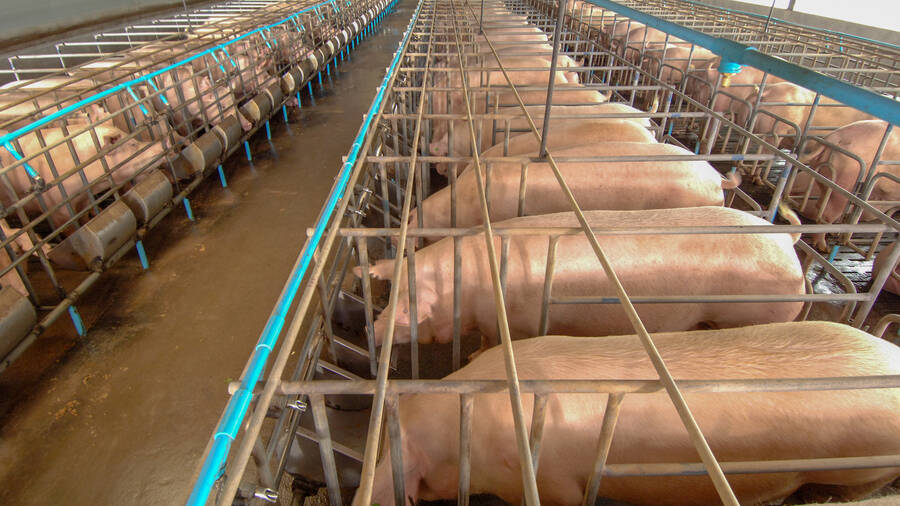
Joe Maxwell, a fourth-generation hog farmer in Mexico, Missouri, used to sell his pigs at the Mexico sales barn, which held livestock auctions almost every day of the week. Today, the barn only hosts a sale once a week. Maxwell remembers the decline this way: ​“When we got ready to sell our pigs, there got to be fewer and fewer people wanting to buy,” he says, ​“until there was just about one.”

The death of the small-town sales barn, not to mention other local businesses, illustrates the dramatic changes that have consumed U.S. agriculture in recent decades. These changes have transformed farming from a decentralized model largely in the public arena — with local livestock auction houses and publicly-funded agricultural research — to a highly-concentrated model in the private arena — in which seeds, research, and equipment software are seen as intellectual property and guarded by dominant agribusiness firms. 

As of 2020, 2 million farmers and 21 million food and farm workers stand on one side of the U.S. food system while 325 million eaters stand on the other. In between them are a handful of multinational companies — Tyson, JBS, Bayer, to name some of the biggest — who manage nearly every step of how food gets from producer to consumer. 

But if this concentrated, corporatized food system seems inevitable or inescapable, it isn’t. In a new report, titled ​“Bigger Is Not Better: The High Cost of Agribusiness Consolidation,” the international human-rights federation ActionAid explains how we got here and details the nearly 70 years of policy decisions that created our industrial food system.

Today’s consolidation, according to the report, can be traced back to the post-World War II period, when politicians worked to dismantle the New Deal Agriculture framework. This included programs like the Agricultural Adjustment Act, Roosevelt’s economic recovery program, which paid farmers to limit their crop production. The legacy of the New Deal model is complicated — it discriminated against Black farmers and encouraged mechanization and consolidation — but it did set up generations of farmers for success. 

In the 1950s, inspired by technological innovation, business groups worked to address the ​“inefficiencies of farming,” and according to the report, they saw the primary problem as an excess of labor — in other words, too many farmers. These groups aimed to replace a third of family farms, which numbered in the millions, with a few larger farms, capable of producing commodities with less labor and more technology. As Earl Butz, Nixon’s secretary of agriculture, famously put it, ​“get big or get out.” 

A series of federal farm bills brought more acres into production and lowered price floors (the lowest legal price that can be paid for a good) which allowed agribusiness companies to pay less for farm goods than they cost farmers to produce. As farmers scrambled to make up for lost revenue and increase their volume, federal enforcement of antitrust laws, which prevent unlawful mergers and business practices and encourage competition among buyers, declined under both the Carter and Reagan administrations. 

In 1996, the U.S. Farm Bill, known as the ​“Freedom to Farm Act” (or, to many farmers, as the ​“Freedom to Fail Act”) put the nail in the coffin of small holders. This law ended the last vestiges of supply management, once the dominant farm policy in the United States. 

Supply management, says Gary Hoskey in a video by ActionAid, can be described as ​“don’t raise more than what can be consumed.” Its necessary components are a floor price for commodities based on the cost of production, a commodity reserve that fluctuates depending on crop success, and conservation programs that take agricultural land out of production — allowing farmers to remain in production during long periods of low prices. 

Instead, the new farm bill further entrenched industrial farming practices by encouraging farmers to plant chemical- and machinery-dependent monocrops like corn and soybeans. Around this time, meatpacking companies began investing in hog confinement and moving to vertical integration. According to the report, their model was that of Don Tyson, the former president of Tyson Foods, in which his company owned all parts of the supply chain except the riskiest: the farm.

These days, the largest food retailers are getting into livestock and dairy markets themselves, cutting out farmers altogether. For example, in 2019, Costco opened its own, fully vertically-integrated meatpacking plant in Nebraska to produce its $4.99 rotisserie chickens. As firms grow, according to the report, they prefer to source from fewer companies in their supply chain, as this simplifies ordering, transport, and other processes. 

Even cooperatives, ​“farmer-run organizations formed to give farmers a better shot against big corporations,” the report says, ​“now too often look like corporations themselves.” Many now own processing facilities as well, making them both the buyer and seller, which undercuts farmers in the same way as vertically-integrated companies. In the late 2000s, farmers filed two class action lawsuits against Dairy Farmers of America (DFA), the nation’s largest dairy cooperative, but settled out of court.

As processors have concentrated, sales have shifted from open cash markets — like sales barns — to contract arrangements between processor and grower. ​“While contracts can guarantee a secure future price for a farmer,” the report notes, ​“the reality is that the buyer generally sets the terms, which can be extremely restrictive for and unfavorable to the farmer.” For livestock, for example, the company supplies specific feed, medicine, and other inputs. 

As a result of these forces, farms these days are fewer and bigger, and mid-sized farms have been the hardest hit. A quick measure that economists use to see whether a market is freely competitive or subject to manipulation is to look at the percentage controlled by the top four firms. When four companies control over 40%, the market is considered uncompetitive, and over 70% indicates a monopoly. Today, the top four companies control 85% of the beef market, 85% of the corn seed market, and 90% of grain trade. Meanwhile, 20% of farms control nearly 70% of U.S. farmland.

Political Promises to Farmers

In 2008, when Barack Obama campaigned on enforcement of antitrust rules and breaking up agribusiness power, the message resonated in rural areas and farming communities. During his campaign, Obama said he planned to ​“reinvigorate antitrust enforcement.””As president, Obama allowed for the continued consolidation of corporate power in the food system. This is a large part of why Trump won Dunn County decisively in 2016 and in 2020.”

After he was elected, Obama’s Department of Justice (DOJ) and Department of Agriculture (USDA) launched a landmark, year-long investigation into the issue in 2010. Thousands of farmers testified and submitted public comments, the ActionAid report says, often at great risk to their livelihoods. However, the inquiry ended quietly: the release of a 24-page memo in which the federal government simply reiterated its ​“commitment to vigorous antitrust enforcement in the agricultural sector” but took no serious action. 

In fact, in the decade since, agribusiness consolidation has only increased. According to ActionAid, the DOJ has since greenlighted many major agribusiness mergers, including those that shrank the ​“Big Six” seed and chemical companies down to the ​“Big Three” and those that further consolidated the meatpacking industry.

Democrats’ failure to address agribusiness consolidation, some argue, has real political consequences. Bill Hogseth, who lives in a rural Wisconsin county that went for Obama twice before swinging to Trump in 2016, put it this way in an essay for Politico: ​“Rural voters appreciated Obama’s repeated campaign promises to challenge the rise of agribusiness monopolies. But as president, he allowed for the continued consolidation of corporate power in the food system…. [T]hese moves signaled that his administration did not have the backs of family farmers. This is a large part of why Trump won Dunn County decisively in 2016 and in 2020.”

Politicians on both sides of the aisle have reason not to push policies distasteful to agribusiness. The largest multinational corporations — including Bayer, Smithfield, and grain dealer Archer Daniels Midland — spend millions in direct lobbying and political donations, according to the report. 

These corporations have cleverly styled themselves as the ​“farm lobby” and have a great deal of influence in Washington, D.C. and state capitals, using farmers as a front to push their agenda. The Farm Bureau, for example, has state-level chapters in all 50 states and claims to be ​“the voice of agriculture,” but its real business is selling insurance through FBL Financial Group. 

The Farm Bureau is not the only group claiming to represent family farmers while supporting big businesses. ActionAid reports that almost two dozen commodities have research and promotion boards funded by ​“checkoffs,” a mandatory tax collected from farmers, for every animal or pound of raw goods they sell. Though not explicitly political, these boards have financial connections with trade groups that lobby for specific state laws — for example, those that exempt concentrated animal feeding operations (CAFOs) and other large-scale operations from environmental regulations. 

The Environmental Impact of Consolidation

The corporate consolidation of farming also has devastating environmental impacts, according to the report. Industrial livestock production, one of the most consolidated and technology-dependent parts of the food system, is responsible for 14.5% of total global greenhouse gas emissions, which is comparable to the entire global transportation sector.
“You couldn’t design a better system to breed deadly diseases.”

Pesticides, herbicides, fertilizers and manure from CAFOs can also damage water and air quality. Four companies control 70% of the global agrochemical market, and the chemicals they manufacture are linked to water contamination and serious health effects — and are often banned in other countries. U.S. regulatory oversight generally depends on voluntary self-monitoring and manufacturer reporting, and decisions are driven by cost-benefit analyses that place a monetary value on health weighed against the financial benefits of chemical use.

With climate change making water and arable land even more scarce, investors and multinational corporations have identified farmland as a lucrative asset class and are buying up farmland around the world. For example, TIAA, the retirement fund manager with close to $1 trillion in assets, is now the world’s largest land investor, with holdings from Brazil to Illinois. The report says these farmland investments are often more subtle than traditional land grabs, in which a corporation or government simply seizes land from its original owner or steward without negotiation or payment, but raise many of the same ecological, legal and human rights concerns.

In addition to damaging the land, industrial agriculture is a major public health hazard. According to evolutionary biologist Rob Wallace, farming monocultures of genetically similar animals and plants, increasing deforestation and the spread of antibiotic-resistant bacteria via the widespread use of antibiotics in CAFOs all make people more vulnerable to future epidemics. ​“You couldn’t design a better system to breed deadly diseases,” Wallace says in the report.

This system locks countries into the production of particular goods for export — in the United States, corn and soybeans — which undermines each country’s own food security and sovereignty. The report notes that a highly specialized and concentrated supply chain is vulnerable to shocks and bottlenecks. During the pandemic, for example, shuttering just three pork packing plants impacted 10% of the nation’s pork supply — hog prices plummeted and farmers had to euthanize their animals, while shoppers faced shortages. 

In April 2020, Trump invoked the Defense Production Act to force meatpacking plants to reopen but did not mandate any worker protections. According to the report, by September 2020, more than 44,000 plant workers had tested positive for Covid-19 and at least 210 had died, with rural areas becoming some of the worst virus hot spots in the nation. 

How We Can Really Feed the World

Farming in the United States, once dependent on diversification and complex ecosystem knowledge, is now highly mechanized and dependent on fossil-fuel based technology, ranging from chemical fertilizers and pesticides to genetically-modified seeds, GPS-guided precision agriculture techniques, and automated climate-controlled barns. 70% of the world’s population still successfully relies on small-scale or peasant farmers for their food.

Agribusiness frequently promotes these innovations and consolidation as the only way to feed the world, but this system still fails us: at least 720 million people, including 42 million in the United States, still go hungry, according to the report. And, despite the reach of consolidation, 70% of the world’s population still successfully relies on small-scale or peasant farmers for their food. The report puts it this way: ​“It is actually a network of localized and regionalized farmers and markets that most efficiently feeds the world, community by community.” 

Though agriculture has great potential to support ecosystems and benefit the environment — by raising fewer animals, using cover crops, rotationally grazing, saving seeds from year to year and using food waste as feed, to name a few regenerative methods — these practices are generally discouraged by the current agricultural regime. Instead, agribusiness has so far responded to climate change by proposing market-based mechanisms, like soil carbon markets and ​“green finance,” that, according to the report, do not protect against further consolidation. 

To begin undoing the consolidated power block that is corporate agribusiness, the report has a few suggestions. First, an immediate moratorium on agribusiness mergers and on all mergers and acquisitions for agribusiness companies. Revisiting the Food and Agribusiness Merger Moratorium and Antitrust Review Act, last introduced in 2019 by Sen. Cory Booker, would be a start, and would allow time to develop new, stricter procedures for mergers and acquisitions.

Other helpful steps, according to the report, could include creating land trusts to provide land access to young and marginalized farmers, ensuring living wages for farmers and farmworkers, establishing incentives for conservation practices and developing a new federal farm program that guarantees farmers a fair price based on the costs of production. ActionAid adds that the USDA and EPA must enforce protections for farmers, workers and the environment, including stronger Grain Inspection, Packers and Stockyards Administration (GIPSA) rules. 

A sustainable future for agriculture may not look like a return to the days of the sales barn but, as this report makes clear, it doesn’t look like corporate control, either. Instead, ActionAid’s report makes the case that we need to move towards a decentralized food system with re-localized economies, and quickly.

Zoe Pharo is a Chicago-based writer and In These Times editorial intern. She holds a degree in political science from Carleton College.