Biden made Putin wince; hopefully he meant what he said

The Herald Mail

Biden made Putin wince; hopefully he meant what he said

Tim Rowland – January 30, 2022

An ex-spy to the core of his icy blue eyes, if you stuck a needle in his thigh down to the bone, it is assumed Vladimir Putin would not so much as blink. Yet he cut loose with an uncharacteristic squeal last week when President Biden said he was prepared to go after Putin’s personal assets should Russia invade Ukraine.

By the end of the day, Putin was back under control, the stony poker player showing no trace of emotion. But American diplomats certainly noticed the “tell.”

Putin’s spokesman was quick to say that such a move would be highly “destructive” to U.S.-Russian relations, and Americans with such designs were wasting their time because Putin doesn’t have any overseas assets.

Kremlin spokesman Dmitry Peskov said it has “long been prohibited for representatives of senior leadership and officials” to hold foreign assets. “Therefore, of course, such a formulation of the question is absolutely not painful for any one of the representatives of the top management.”

He went on to sniff that American politicians “who are not entirely familiar with this topic,” should defer to “those who are professionally engaged in Russia.”

Um hm. Now I’m just an old country journalist, but to me this sounds a lot like, “Putin doesn’t have any overseas assets to seize — and if you do seize them, you’ll be in real trouble.”

But OK, for sake of argument, let’s say Putin doesn’t have any foreign assets — you can bet that his oligarch cronies do, and they would be very displeased if these funds were jeopardized.

More from Tim Rowland: Biden has succeeded at not being Trump

Bad education: Politician ready to fix curriculum with incorrect history

Russia’s wealthy cannot invest all their money in Russia, for the simple reason that there is not enough to invest in. You could multiply Russia’s GDP by 10 and it still wouldn’t be within $5 trillion of America’s. We produce a quarter of the world’s GDP; Russia produces 1.95%.

As massive as it is, Russia’s productivity trails nations such as Canada, Italy and Brazil. Its most valuable asset is not based in technology, medicine, industry or even petroleum — it’s trees. So what we are witnessing on the Russian-Ukrainian border is nothing more than the manifestation of a titanic inferiority complex.

We are told Putin is unpredictable, when in fact he is as predictable as a child whose brother is getting all the attention. For years now the world has treated Putin’s Russia like the afterthought he has made it into. Rather than lifting up his people he has lifted up himself and a few dozen of his closest and richest friends.

Now he is paying the price. By failing to spread around the wealth, by failing to invest, by failing to diversify beyond petroleum and weapons, he has relegated his nation to the back bench of world economies.

How it must steam Putin to see the U.S. and China clash angrily over intellectual property, monetary policy, markets and natural resources. No American president is starting a trade war with Russia, because Russia doesn’t have anything Americans want.

Feeling left out and ignored, Putin was bound to do something beyond his petty-thief equivalent of computer hacking and stirring up Americans on Facebook.

By invading Ukraine, Putin would hope to, one, take his people’s minds off of the miserable conditions he has created for them and, two, try to convince the world that he matters. If you seek parallels, look no further than North Korea, where little whatshisname, jealous of all the attention Russia is currently winning, began firing off a bunch of missiles over this past week. You wonder if Putin has enough self-awareness to see the similarities.

Unlike North Korea, Russia does have meaningful amounts of oil and gas to use as leverage — except that when petroleum is all you have to sell, cutting off supply to Europe is like drinking poison and hoping your enemy dies. Already, suppliers of liquified natural gas, including the U.S., seem to have enough capacity to compensate for any spigot Russia chooses to close.

Long term, of course, fossil fuels are not a growth industry. Renewables are increasing exponentially, and it won’t be long before Russia’s last card has been played.

The danger to the world is that Putin has gotten himself into a fix that he can’t get out of without an untenable loss of dignity. That’s what makes him dangerous. The difference between war and peace may depend on diplomats’ skill in providing Putin with a “concession,” however meaningless, with which he can make a case to the people and the world that he has won the staredown.

The other hope is that there’s something out there Putin values more than dignity, namely money. Last week Joe Biden made Vladimir Putin wince. Let’s hope the president meant it. If there were ever a time to play hardball, this would be it.

Tim Rowland is a Herald-Mail columnist.

What is Congress doing to strengthen U.S. election laws?

Reuters

Explainer-What is Congress doing to strengthen U.S. election laws?

David Morgan – February 1, 2022

FILE PHOTO: U.S. Senator Amy Klobuchar (D-MN) speaks to reporters after a Senate Democrats caucus meeting on Capitol Hill in Washington
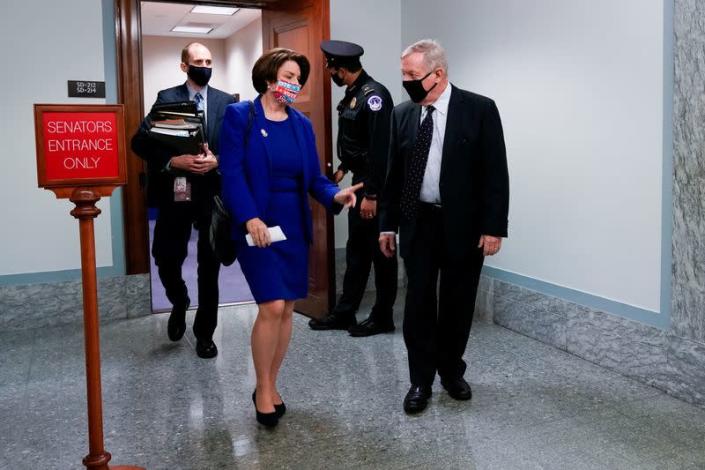
FILE PHOTO: Senators Klobuchar and Durbin depart the Senate Judiciary Committee hearing on Judge Barrett's nomination to serve on the U.S. Supreme Court in Washington

FILE PHOTO: U.S. Senator Amy Klobuchar (D-MN) speaks to reporters after a Senate Democrats caucus meeting on Capitol Hill in Washington

WASHINGTON (Reuters) – Democrats and Republicans in the U.S. Senate hope to prevent a repeat of the deadly Jan. 6 Capitol riot by reforming a 135-year-old election law laying out the roles that Congress and the vice president play in certifying presidential election results.

Democratic Senators Amy Klobuchar and Dick Durbin and independent Angus King, who caucuses with the Democrats, released a proposal on Tuesday.

A separate bipartisan group led by Republican Susan Collins is also working on the issue and is expected to meet later this week.

WHAT HAS CONGRESS DONE ON ELECTION REFORM UP TO NOW?

Democrats have pushed to strengthen voting rights in response to a wave of voting restrictions passed in Republican-led states following Republican President Donald Trump’s false claim that the 2020 election was stolen from him. Republicans opposed that effort as a power grab that undercut state and local control of elections, and the effort ran aground in the Senate last month.

However, Republicans have been more open to tightening the way the United States counts votes once they are cast.

WHY IS REFORM NEEDED?

Lawmakers want to clarify the 1887 Electoral Count Act so that Congress would have a harder time blocking the certification of elections and to make it clear that vice presidents cannot overturn them.

The law was used as a pretext for another false Trump claim that his vice president, Mike Pence, had the authority to overturn the 2020 election of Democrat Joe Biden. Pence concluded that he did not have that power, much to Trump’s frustration.

As Congress worked to certify the election results on Jan. 6, 2021, Trump criticized Pence at a rally near the White House for disagreeing with him and urged supporters to march to the Capitol. Thousands then stormed the Capitol in the worst assault on Congress since the War of 1812.

Trump was impeached in the House of Representatives but acquitted in the Senate on a charge of inciting the assault.

Since then, the former president has criticized Pence repeatedly for failing to interfere with the vote count.

WHAT ARE DEMOCRATS PROPOSING?

The Democrats’ draft legislation would make it clear that the vice president has no power to resolve disputes over electors or to determine the validity of electors or their votes.

It would limit the circumstances under which members of Congress can object to election results. It would require one-third of the House and Senate to sign an objection in order for it to be considered, and three-fifths of both chambers to vote to support an objection.

Currently, an objection must be signed by only one senator and one House member to be considered separately by each chamber. To succeed, an objection must then be agreed to by simple majorities in both the House and Senate. In 2021, Republicans objected to election results from Arizona and Pennsylvania. Eight senators and 139 House members — all Republicans — later voted to support either or both.

The proposal would establish Election Day in November as the time for choosing presidential electors and prohibit states from choosing electors on any other day — a response to the Trump campaign’s attempts to round up alternate electors in the weeks after the 2020 vote.

It also sets a Dec. 20 deadline for states to resolve controversies or contests involving an election outcome.

WHAT IS THE COLLINS GROUP CONSIDERING?

The Collins-led group of Democrats and Republicans is looking at similar reforms. But it is also weighing federal penalties for anyone who threatens an election official or a poll worker, protections from unwarranted removal from office for election officials, stronger election security measures and election management improvements.

WHERE COULD THINGS GO FROM HERE?

The involvement of Klobuchar, the Senate Rules Committee chair, and Durbin, the Senate’s No. 2 Democrat, is seen as a sign that Democratic leaders support the effort.

The White House has also said it is open to reform efforts but does not view them as a replacement for the more sweeping voting rights legislation that failed to win approval in the Senate.

The Collins group has drawn tentative interest from Senate Minority Leader Mitch McConnell.

Some lawmakers and aides say there is a chance that elements of the two initiatives could be incorporated into a single piece of legislation that can draw enough support to win 60 votes, a threshold for most legislation to advance in the 100-seat chamber.

(Reporting by David Morgan; editing by Andy Sullivan and Jonathan Oatis)

Republicans, how many more authoritarian rants from Trump will you tolerate?

Los Angeles Times

Letters to the Editor: Republicans, how many more authoritarian rants from Trump will you tolerate?

February 1, 2022

Former President Donald Trump speaks at a rally, Saturday, Jan. 29, 2022, in Conroe, Texas. (Jason Fochtman/Houston Chronicle via AP)
Former President Trump speaks at a rally in Conroe, Texas, on Saturday. (Jason Fochtman / Associated Press)

To the editor: Former President Trump told supporters at a rally on Jan. 29 that if he runs for and wins the presidency in 2024, he will consider pardoning those arrested and charged with crimes associated with the Jan. 6, 2021 insurrection.

Does he mean the more than 700 rioters who injured nearly 140 police officers that fateful day, or just Trump insiders like Stephen K. Bannon, Rudolph W. Giuliani and Mark Meadows?

Pardon me for asking, but what happened to the rule of law? Wake up, Republicans. How much longer are you going to turn a blind eye to the former president’s every whim? It’s time that GOP electeds and the rank and file take a stand.

Simply put, are you for the country or for Trump? Because the future of our fragile democracy depends on you making the right decision now — and it really shouldn’t be a hard choice to make.

Denny Freidenrich, Laguna Beach

..

To the editor: Trump recently referred to himself as the “45th and the 47th” president of the United States. Is this a Freudian slip concession that even he doesn’t believe that he won in 2020?

Marshall Barth, Encino

..

To the editor: Columnist Harry Litman considers whether Trump can evade legal culpability by being so sociopathic that he truly thinks he won in 2020.

Someone may truly believe that Jews are out take over the world, but we don’t allow that to be used as an excuse for killing people at a synagogue. The person may be sent to a mental hospital rather than prison, but we don’t let them walk free.

As for Litman’s analysis of whether his acts make him culpable regardless of his state of mind, with the current Supreme Court’s decisions making it clear it has become as polarized as society in general, I’m reminded of Humpty Dumpty’s comment in “Through the Looking Glass”: “When I use a word, it means just what I choose it to mean — neither more nor less.”

John Snyder, Newbury Park

..

To the editor: I have serious doubts about whether Trump will ever be convicted in a criminal court. Legal niceties aside, where might prosecutors find a dozen truly unbiased jurors to determine guilt?

Sure, the court might hear most prospective jurors avow their lack of political affiliation. But who would be surprised by a fan of the most mendacious president ever opting to conceal his political leanings for a chance to help Trump evade conviction?

Still, I’m confident that Trump ultimately will be convicted — by most if not all historians. But that assumes our democracy somehow survives the devastation he wreaked.

P. Jane Weil, Sacramento

Explainer-What is Congress doing to strengthen U.S. election laws?

Reuters

Explainer-What is Congress doing to strengthen U.S. election laws?

David Morgan – February 1, 2022

FILE PHOTO: U.S. Senator Amy Klobuchar (D-MN) speaks to reporters after a Senate Democrats caucus meeting on Capitol Hill in Washington

FILE PHOTO: U.S. Senator Amy Klobuchar (D-MN) speaks to reporters after a Senate Democrats caucus meeting on Capitol Hill in Washington

FILE PHOTO: Senators Klobuchar and Durbin depart the Senate Judiciary Committee hearing on Judge Barrett's nomination to serve on the U.S. Supreme Court in Washington
FILE PHOTO: Senators Klobuchar and Durbin depart the Senate Judiciary Committee hearing on Judge Barrett’s nomination to serve on the U.S. Supreme Court in Washington
FILE PHOTO: Senate Democrats Caucus Leadership News Conference
FILE PHOTO: Committee Chairman Senator Dick Durbin, a Democrat from Illinois, delivers opening remarks as Merrick Garland, U.S. attorney general, testifies before a Senate Judiciary Committee hearing in Washington

FILE PHOTO: Committee Chairman Senator Dick Durbin, a Democrat from Illinois, delivers opening remarks as Merrick Garland, U.S. attorney general, testifies before a Senate Judiciary Committee hearing in Washington

WASHINGTON (Reuters) – Democrats and Republicans in the U.S. Senate hope to prevent a repeat of the deadly Jan. 6 Capitol riot by reforming a 135-year-old election law laying out the roles that Congress and the vice president play in certifying presidential election results.

Democratic Senators Amy Klobuchar and Dick Durbin and independent Angus King, who caucuses with the Democrats, released a proposal on Tuesday.

A separate bipartisan group led by Republican Susan Collins is also working on the issue and is expected to meet later this week.

WHAT HAS CONGRESS DONE ON ELECTION REFORM UP TO NOW?

Democrats have pushed to strengthen voting rights in response to a wave of voting restrictions passed in Republican-led states following Republican President Donald Trump’s false claim that the 2020 election was stolen from him. Republicans opposed that effort as a power grab that undercut state and local control of elections, and the effort ran aground in the Senate last month.

However, Republicans have been more open to tightening the way the United States counts votes once they are cast.

WHY IS REFORM NEEDED?

Lawmakers want to clarify the 1887 Electoral Count Act so that Congress would have a harder time blocking the certification of elections and to make it clear that vice presidents cannot overturn them.

The law was used as a pretext for another false Trump claim that his vice president, Mike Pence, had the authority to overturn the 2020 election of Democrat Joe Biden. Pence concluded that he did not have that power, much to Trump’s frustration.

As Congress worked to certify the election results on Jan. 6, 2021, Trump criticized Pence at a rally near the White House for disagreeing with him and urged supporters to march to the Capitol. Thousands then stormed the Capitol in the worst assault on Congress since the War of 1812.

Trump was impeached in the House of Representatives but acquitted in the Senate on a charge of inciting the assault.

Since then, the former president has criticized Pence repeatedly for failing to interfere with the vote count.

WHAT ARE DEMOCRATS PROPOSING?

The Democrats’ draft legislation would make it clear that the vice president has no power to resolve disputes over electors or to determine the validity of electors or their votes.

It would limit the circumstances under which members of Congress can object to election results. It would require one-third of the House and Senate to sign an objection in order for it to be considered, and three-fifths of both chambers to vote to support an objection.

Currently, an objection must be signed by only one senator and one House member to be considered separately by each chamber. To succeed, an objection must then be agreed to by simple majorities in both the House and Senate. In 2021, Republicans objected to election results from Arizona and Pennsylvania. Eight senators and 139 House members — all Republicans — later voted to support either or both.

The proposal would establish Election Day in November as the time for choosing presidential electors and prohibit states from choosing electors on any other day — a response to the Trump campaign’s attempts to round up alternate electors in the weeks after the 2020 vote.

It also sets a Dec. 20 deadline for states to resolve controversies or contests involving an election outcome.

WHAT IS THE COLLINS GROUP CONSIDERING?

The Collins-led group of Democrats and Republicans is looking at similar reforms. But it is also weighing federal penalties for anyone who threatens an election official or a poll worker, protections from unwarranted removal from office for election officials, stronger election security measures and election management improvements.

WHERE COULD THINGS GO FROM HERE?

The involvement of Klobuchar, the Senate Rules Committee chair, and Durbin, the Senate’s No. 2 Democrat, is seen as a sign that Democratic leaders support the effort.

The White House has also said it is open to reform efforts but does not view them as a replacement for the more sweeping voting rights legislation that failed to win approval in the Senate.

The Collins group has drawn tentative interest from Senate Minority Leader Mitch McConnell.

Some lawmakers and aides say there is a chance that elements of the two initiatives could be incorporated into a single piece of legislation that can draw enough support to win 60 votes, a threshold for most legislation to advance in the 100-seat chamber.

(Reporting by David Morgan; editing by Andy Sullivan and Jonathan Oatis)

George Soros warns China is facing an economic crisis

George Soros warns China is facing an economic crisis

By Charles Riley, CNN Business – January 31, 2022

"China is facing an economic crisis": Soros on China and Xi Jinping

London (CNN Business) China is facing an economic crisis after a real estate boom ended with a bang last year, according to investor George Soros. The billionaire said in a speech at Stanford University’s Hoover Institution Monday that President Xi Jinping may not be able to restore confidence in the troubled industry, which has been hit by a series of defaults by developers and falling prices for land and apartments. China’s real estate boom was based on an “unsustainable” model that benefited local governments and encouraged people to invest the bulk of their savings in property, Soros said.

Government policies designed to curb the boom made it difficult for indebted real estate behemoth Evergrande to pay its debts, he added.

The developer is reeling under more than $300 billion of total liabilities, including about $19 billion in offshore bonds held by international asset managers and private banks on behalf of their clients. Evergrande has been scrambling for months to raise cash to repay lenders.

Government officials have been sent into the company to oversee a restructuring, but there’s little clarity about what comes next. Evergrande has appealed for more time, but some lenders appear unwilling to wait. On Sunday, the company said that receivers had been appointed over a plot of land in Hong Kong, which it pledged as collateral against a $520 million loan last year.”It remains to be seen how the authorities will handle the crisis,” Soros said, during a panel discussion about developments in China and how the United States should respond. “They may have postponed dealing with it for too long, because people’s confidence has now been shaken.”George Soros looks on after delivering a speech on the sidelines of the World Economic Forum on January 23, 2020.George Soros looks on after delivering a speech on the sidelines of the World Economic Forum on January 23, 2020.Soros has in recent years emerged as a prominent critic of Xi and China’s ruling Communist Party. The legendary investor and chair of the Open Society Foundations said in September that asset manager BlackRock was making a “tragic mistake” by doing more business in China. He has criticized Beijing over its surveillance policies and a crackdown on private business.

The Chinese president now faces risks from the property market, according to Soros, who was speaking just days before the start of the Winter Olympics in Beijing. Falling prices will “turn many of those who invested the bulk of their savings in real estate against Xi Jinping, ” Soros said, adding that the current situation “doesn’t look promising.” “Xi Jinping has many tools available to reestablish confidence — the question is whether he will use them properly,” said Soros.An aerial view shows the Evergrande Changqing community on September 26, 2021 in Wuhan, China. An aerial view shows the Evergrande Changqing community on September 26, 2021 in Wuhan, China.Analysts have been long been concerned that Evergrande’s collapse could trigger wider risks for China’s property market, hurting homeowners and the broader financial system. Real estate and related industries account for as much as 30% of the country’s GDP.

China’s economy expanded 8.1% last year, far exceeding the government’s own targets. But weakening growth in the closing months of 2021 suggests the real estate crisis, renewed Covid outbreaks and Beijing’s strict approach to controlling the virus are taking a toll. The International Monetary Fund expects economic growth to slow dramatically to 4.8% in 2022.

Some Republicans warn Trump’s latest Jan. 6 speech shows he would ‘do it all again’

Reuters

Some Republicans warn Trump’s latest Jan. 6 speech shows he would ‘do it all again’

David Morgan January 31, 2022

FILE PHOTO: Donald Trump holds a rally in Conroe, Texas

WASHINGTON (Reuters) – A handful of Republicans pushed back against former President Donald Trump’s weekend offer to consider pardoning people convicted of joining the deadly Jan. 6, 2021, assault on the U.S. Capitol, saying it showed he would “do it all again” if he regains the White House in 2024.

“Trump uses language he knows caused the Jan. 6 violence; suggests he’d pardon the Jan. 6 defendants, some of whom have been charged with seditious conspiracy; threatens prosecutors; and admits he was attempting to overturn the election,” U.S. Representative Liz Cheney posted on Twitter on Monday. “He’d do it all again if given the chance.”

Cheney is one of just two Republicans taking part in the U.S House of Representatives’ official investigation of Jan. 6.

Cheney and a few other Republicans spoke out after a weekend in which former President Trump at a Saturday rally in Conroe, Texas, offered to consider pardoning people convicted of joining the attack if elected to a second term in 2024 and called for protests against prosecutors in New York and Georgia investigating him and his company.

He followed up Sunday evening with a statement repeating his false claims that his vice president, Mike Pence, “could have overturned the Election” that Trump lost to Democrat Joe Biden.

He also lambasted a bipartisan effort led by Republican Senator Susan Collins to reform the federal law that allows Congress members to dispute presidential election results.

Representative Adam Kinzinger, the other Republican on the Jan. 6 committee, wrote on Twitter late on Sunday that it was “time for every Republican leader to pick a side … Trump or the Constitution, there is no middle on defending our nation anymore.”

Trump’s comments on targeting prosecutors led Fulton County, Georgia, District Attorney Fani Willis, who is investigating whether Trump tried to influence the state’s handling of the election, to ask the FBI for additional security for her office.

She noted in a Sunday letter to the FBI’s Atlanta field office that her concerns were driven by Trump’s comments in Texas attacking “radical, vicious racist prosecutors” and encouraging protests in Washington, New York and Atlanta.

Trump was impeached in the House but acquitted in the Senate last year on a charge of inciting the deadly Jan. 6 attack, in which thousands of his supporters stormed the Capitol in the worst assault on Congress since the War of 1812. Cheney and Kinzinger voted for his impeachment, and Collins voted to convict him.

Fueled by Trump’s false claims that his November 2020 election defeat was the result of fraud, the attackers sought to stop Congress from certifying Biden’s victory and threatened to hang Pence for refusing to overturn the results. More than 700 people have been charged with joining in the assault.

Other Republicans on Sunday also rejected his remarks about pardons.

“The folks that were part of the riots and, frankly, the assault on the U.S. Capitol, have to be held accountable. There is a rule of law,” New Hampshire Governor Chris Sununu told CNN.

Senator Lindsey Graham, a staunch Trump ally, voiced his own concerns about the potential for repeated violence.

“I don’t want to reinforce that defiling the Capitol was OK. I don’t want to do anything that would make this more likely in the future,” he told CBS.

(Reporting by David Morgan, additional reporting by Susan Heavey and Doina Chiacu; Editing by Scott Malone and Jonathan Oatis)

Anti-vaxxer tells supporters the new COVID antidote is in ‘urine therapy’

USA Today

Anti-vaxxer tells supporters the new COVID antidote is in ‘urine therapy’

Gabriela Miranda January 30, 2022

As the pandemic has evolved and vaccinations have become politicized, the door has opened for some questionable alternatives to treat COVID-19.

Urine therapy – where advocates encourage people to drink their own urine to tap into its redemptive properties – is among the latest, and a recent video calling the therapy the next “COVID antidote” was viewed over 366,000 times.

“I’ve seen a rise in anti-vaxxers and conspiracists supporting urine, Viagra and other odd alternatives to the vaccine,” said Dr. Amanda Torres, a physician at Winchester Hospital in Boston. “It’s dangerous.”

Christopher Key, who travels the country to preach about the dangers of vaccines and masks, has taken to promoting urine therapy on his “Vaccine Police” website.  

“OK, and I know to a lot of you this sounds crazy, but guys, God’s given us everything we need,” said Key, who claims “tons of research” has been done on urine therapy..

There is no scientific or peer-reviewed research to support Key’s claims.

Key’s Twitter account was suspended as of Tuesday morning but his Telegram account, where Key often promotes his beliefs, remained active.

COVID-19 updates: Pfizer developing vaccine to target omicron, unvaccinated make up most cases in NY

“Now drink urine!” he said. “This vaccine is the worst bioweapon I have ever seen. I drink my own urine!”

Torres told USA TODAY the COVD-19 vaccine is “not a bioweapon” and there’s no research to prove urine therapy is beneficial for those vaccinated or unvaccinated.

“The matter of the fact is the COVID vaccine is safe and the best protection against the virus. Urine and whatever other therapy people want to believe has not been proven,” Torres said.

The vice dean for research at the University of Louisville College of Medicine was among many other healthcare professionals who shared their thoughts on the topic.

“Do not, I repeat do not, drink urine to treat COVID,” Dr. Jon Klein wrote.

Key’s video comes just days after his recent court appearance for his arrest last April, AL.com reported. Key appeared in court on Jan. 4 after he was arrested for refusing to wear a mask inside of a Whole Foods in Alabama. After being asked to leave by the staff and refusing, Key was charged with third-degree trespassing.

While inside the courtroom, Key also refused to wear a mask and didn’t stop recording when asked to. 

Since the COVID-19 pandemic, different unproven “alternatives” to the vaccine have been promoted. The U.S. Food and Drug Administration said there was a “growing interest in a drug called ivermectin for the prevention or treatment of COVID-19 in humans.”

The FDA said only certain formulas of ivermectin have been approved to treat parasites in animals.

“However, the FDA has received multiple reports of patients who have required medical attention, including hospitalization, after self-medicating with ivermectin intended for livestock,” according to the FDA’s website.

Here we go again, with another money sucking Arizona election audit

AZ Central – The Arizona Republic

Here we go again, with another money sucking Arizona election audit

Laurie Roberts, Arizona Republic – January 31, 2022

Maricopa County ballots from the 2020 general election are examined and recounted by contractors hired by the Arizona senate, June 21, 2021, at the Veterans Memorial Coliseum, Phoenix.

The Great Arizona Hunt for Election Fraud continues as a special master and three – count ‘em, three – IT experts from across the nation gear up to examine Maricopa County’s election equipment.

Yeah, I know. You thought the audit of the 2020 election was over, that it ended in September when the Senate’s own Trump supporting auditors could find no evidence of widespread fraud.

O ye, of far too much faith that, at some point, sanity will sink in.-

That the state Senate’s Trump contingent will accept the fact that their guy lost, freeing us poor taxpayers from having to continue shelling out money to chase a conspiracy that doesn’t – and didn’t – exist.

They won’t and so we will. Open our wallets wide once again, that is.

Another audit for an already answered question

This time for a special master and three IT experts to answer the already answered question:

Was the county’s election management system hooked up to the internet and thus vulnerable to Chinese (or maybe Venezuelan?) hackers who, as the conspiracy theory goes, switched thousands of Donald Trump votes to Joe Biden?

The county has long said the equipment wasn’t connected to the internet.

The Republican-run Maricopa County Board of Supervisors hired two sets of elections experts who concluded that the election equipment wasn’t connected to the internet.

The Senate’s own audit provided the most convincing evidence of all that the election equipment wasn’t connected to the internet. (More on that in a moment.)

None of it was good enough for the Senate’s conspiracy crew. Republican senators demanded that the county turn over its computer routers but the county refused, saying their release could result in the release of confidential information about county residents.

So, we’re paying John Shadegg $500 an hour

Facing the potential loss of hundreds of millions of dollars in state-shared funding, the county and Senate finally agreed to a compromise.

Former Rep. John Shadegg is that compromise. He’s a former Republican congressman who is serving as a $500-an-hour special master, contracted by the county to answer the senators’ detailed questions about the routers.

To do that, Shadegg on Friday hired three IT experts, each of whom will travel to Arizona to examine the county’s routers and the Splunk logs that are used to analyze computerized data.

We don’t yet know how much those three experts will cost county taxpayers. Shadegg already has billed us $16,800, and the examination of equipment has not yet even begun.

Of course, that’s chicken feed compared to the millions of dollars that county and state taxpayers already have paid to accommodate a bunch of sore losers who have screamed so loudly and so often that the election was stolen – without proof – that now a shockingly number of people believe them.

And so we continue paying whatever it takes to produce facts in order to change apparently unchangeable minds.

If there was an internet connection … oh, never mind

It’s a colossal waste of our money.

Consider that the Senate’s own audit already produced the most convincing evidence of all that there was no funny business afoot by hackers or nefarious state actors.

Think about it.

The reason the election equipment was supposedly hacked, as the conspiracy theory goes, was to change thousands of votes from Trump to Biden.

But the Senate’s own Cyber Ninja auditors hand counted the paper ballots, all 2.1 million of them.

That hand count matched the machine tally by Dominion Voting Systems. And both counts showed Biden got more votes than Trump.

But if the machines had been hacked, wouldn’t that hand count be diff … oh, never mind.

Confederate Flags, Conspiracies, and the Ghost of JFK Jr.: What I Saw at Trump’s Bananas Texas Rally

Rolling Stone

Confederate Flags, Conspiracies, and the Ghost of JFK Jr.: What I Saw at Trump’s Bananas Texas Rally

Steven Monacelli, January 30, 2022

Donald Trump - Credit: AFP /AFP via Getty Images

Conroe, Texas — The Donald trump train made its second stop here this Saturday with a coterie of politicians, conspiracy theorists, and grifters in tow. It came on the heels of a Lara trump rally in north Texas this past Thursday and just two weeks after a similar rally in Phoenix, Arizona. Meanwhile, six hours south at the border, the disgraced QAnon peddling general Michael Flynn and other far-right figures held an event at the exact same time followed up by a caravan to the border on Sunday. Texas Agriculture Commissioner Sid Miller, who spoke at a QAnon conference in Dallas last July, was featured as a speaker at both events.

This confluence of events in Texas demonstrates the sort of far-right politics that is coalescing here: paranoid, obsessed with or tolerant of bigoted conspiracy theories, eager to appeal to violence, and convinced they’re fighting against a secret Marxist plot. If this sounds familiar, it’s because similar politics emerged during the Weimar period in Germany, were honed by the Nazis, and later trafficked into mainstream politics via the John Birch Society — one of the sponsors of the event at the border.

More from Rolling Stone

Dozens of politicians from across the state and country turned out for the rally, seeking to ride on Trump’s political coattails. Governor Greg Abbott, Lt. Governor Dan Patrick, Attorney General Ken Paxton, and State Senator Dawn Buckingham all spoke glowingly of Trump and touted their endorsements from the former president.

We were in one of the reddest counties in one of the reddest states, and it showed: When I arrived at the press check-in station, the first thing I saw was a merchandise vendor with a Confederate flag — the banner of a nation that lasted only 4 years before being routed out of existence — that says “Come And Take It.” It was set up directly across from a wooden cross.

Having attended the prior rally in Arizona and the Lara trump event on Thursday, a twisted sense of deja vu came over me when I got into the venue and began to hear the same songs, watch the same videos, listen to the same speeches, and see the same people. There were many familiar faces — election conspiracy peddling MyPillow CEO Mike Lindell and the JFK Jr. obsessed QAnon cult leader Michael Protzman — and in some instances, near word for word repeats of previous events.

Trump opened the Houston rally in the exact same manner as he did in Arizona: saying it’s the biggest rally ever, that the media is fake, and that they won’t turn their cameras around to show the crowd size. He even repeated the false claim about a 29 mile long line of cars, but this time it was 30 miles long. The crowd began to jeer at the press. When I turned around to take a photo of the overflow crowd, someone flipped me off.

From inside the press pen I was able to observe Michael Protzman, aka Negative 48, and over one hundred of his followers secure prime seats directly to the left of the stage. The Protzmanians arrived over a day early and began lining up for the event the night before, just as they had in Arizona. The group was in rare form, dancing and singing together. They wore matching red ties and shirts depicting Donald Trump, JFK, and JFK Jr. Prior to the event, Protzman predicted to his group that who they would be seeing speak at the event was not actually Trump but JFK in disguise — a claim they’ve made before regarding the Rolling Stones concert in Dallas, Texas.

When I approached Protzman and asked him what he expected to see, he responded cryptically. “You never know,” he said, before bopping off to tend to his flock and dance with one of his lieutenants, Stephen Tenner, who at one point shook hands with Mike Lindell. As of late the Protzmanians have taken to compiling a variety of non-standard calendars to ensure they have every combination of possible dates to check against their “decoding” of the numerology. This is because none of their dates or predictions have panned out.

The entire scene — replete with more merch vendors than a Grateful Dead concert — made me think of the Church of Unlimited Devotion, the infamous subset of Deadheads who believed Jerry Garcia was the second coming of Jesus. One of the central claims of Protzman’s belief system sounds awfully similar: JFK is the second coming of Jesus Christ. They also traffick in fascist propaganda and Holocaust denial.

The Protzmanians, like the Church of Unlimited Devotion, are a relatively small sect. Neither are fully representative of the larger movements from which they emerged, but they demonstrate what can happen when magical thinking and cults of personality collide and provide us an understanding of how far some folks have fallen off the map. Even if only a little over 100 out of the thousands of people at the Trump rally truly believe that JFK Jr. is secretly alive or somehow related to Christ, many attendees seem to be willing to believe other things that aren’t true, like that refugee immigration from crisis-stricken countries is a part of a sinister Marxist plot or that murders have gone up one thousand and nine hundred percent.

This strain of political thought, particularly the notion of a secret Marxist plot, isn’t new in this country. The paranoid anti-communism of McCarthyism gave way to the John Birch Society, which has sought to mainstream its far-right ideology for decades. In Conroe, I witnessed the fruits of their labor. Hats and shirts for sale that simply say “God, Guns, and Trump” and speeches that I can only describe as full-blown Bircherism.

Without a hint of irony, Texas Agriculture Commissioner Sid Miller said the upcoming elections are a race between “Patriots and Traitors,” suggesting that the side that isn’t on trial for seditious conspiracy is the traitorous one. Lt. Governor Dan Patrick said the election was stolen and that Marxists want to “take away the country from us.” Gov. Abbott made an abstruse comparison between Biden’s response to the Russian army at the Ukraine border to the Texas-Mexico border, doubling down on the idea that immigration is a part of a planned invasion. The crowd chanted “build that wall,” which Biden has continued to do in some parts.

When Trump finally took the stage after hours of patience, the temperature had dropped significantly. My toes were cold and my soles regretted the choice of cowboy boots. Trump repeated much of what he said in Arizona but mixed in some of his trademark stream of consciousness riffs to keep things fresh. Less than an hour into his speech, the crowd started to thin out. I’d heard it all before, so I decided to follow suit.

(Indeed, it was more than an hour into his rambling speech when Trump offered something new: teasing a 2024 presidential run and dangling pardons for Jan. 6 rioters if he retakes office.)

As I approached the main exit, Trump was talking about Hillary Clinton. “Lock her up!” the crowd chanted. A woman walking beside me said to no one in particular, “Clinton’s a witch, that’s why they’re never going to lock her up.”

And as I approached the parking lot by the nearby baseball fields where I’d parked, I overheard a conversation between two older women. “How does Trump expect us to stand around for five hours?” one said to the other, referring to the ban on any form of lawn chair at the event. “By the time he started talking, we were hurting.” For the first time all day, I agreed with what I was hearing.

Later that evening, I went back to a pizza place by my hotel about 40 minutes south of Conroe in an upscale suburb of Houston called The Woodlands. I got to chatting with my server, a young man with a ponytail and glasses. When I told him I’d been in Conroe, his eye twitched. He said he grew up in Conroe and that his eye had twitched for a reason. When I told him what I had seen there, he asked me if I wanted a free shot of whiskey. I wish I had asked for two.

Farmers flourish under Biden, see recovery from Trump-era trade wars

Farmers flourish under Biden, see recovery from Trump-era trade wars

The prices of corn and soybeans have increased and demand is up for American exports.

By Teaganne Finn January 29, 2022

Image: A farmer surveys his land during a rice harvest on a farm in Bolivar County, Miss., on Sept. 15, 2020.

A farmer surveys his land during a rice harvest on a farm in Bolivar County, Miss., on Sept. 15, 2020. Rory Doyle / Bloomberg via Getty Images

WASHINGTON — Donald Trump often espoused his love for America’s farmers during his presidency.

But after a year under President Joe Biden, farmers say they’re actually feeling the love.

“Well, certainly the difference between 2019 and 2021 is the differences in administrations,” Montana Farmers Union President Walter Schweitzer said in an interview. “In 2019, our administration was at war with all of our customers.” Under Biden, he said, the nation is “rebuilding our relationships with our customers.”

Trump courted support from farmers during his failed re-election campaign in 2020 and touted his administration’s trade relief, saying they were better off with government payments than relying solely on sales.

While the focus of the Biden administration has been on its handling of the Covid-19 pandemic, and more recently the global standoff with Russian President Vladimir Putin over Ukraine, the farm sector has fared quite well under the new administration, as farmers ease off of government bailouts and see a boost in commodity prices.

“We had farm income that was up by a pretty fair amount in 2021, almost to the record level of 2013, but not quite,” said Patrick Westhoff, director of the University of Missouri’s Food and Agricultural Policy Research Institute. “Part of that, of course, was continuing government payments, but there was a very strong recovery in both crop and livestock prices last year.”

Soy and corn prices, two of the largest cash crops in the United States, have suffered slightly, falling below $9 and above $3 a bushel, respectively, during the pandemic. Now, exports have had an increase in demand, in part because of exports to China and poor weather affecting South American producers. Soy was up to $14 in 2021 and corn is projected to continue above $5 in 2022.

Net farm income, a broad measure of profits, is estimated to have increased by $15.7 billion in 2020 relative to 2019, according to the U.S. Department of Agriculture’s Economic Research Service. The agency also forecast net farm income at $116.8 billion in 2021, the highest level since 2013.Trade spats

Schweitzer points out that in 2021, the majority of net farm income came from commodity sales and actual production “off the farm.” Whereas in 2019, a “big chunk” of the income was coming from Market Facilitation Program payments, which were at the core of the Trump administration’s effort to mitigate losses from its disputes with China and other trading partners.

The cost of the second round of tariff aid was estimated to be about $16 billion and came with added provisions that aimed to address allegations that large corporations had disproportionately benefited over smaller farms in the initial phase.

Vincent Smith, a visiting fellow at the right-leaning American Enterprise Institute, said the Trump administration “severely disadvantaged” farmers with an ill-advised trade policy.

Image: Soybeans are harvested in Wyanet, Ill., on Sept. 25, 2020.
Soybeans are harvested in Wyanet, Ill., on Sept. 25, 2020.Daniel Acker / Bloomberg via Getty Images

“The Trump administration, in terms of these trade war subsidies, was entirely reactive to shore up support in the farm sector,” Smith said, adding that both Trump and Biden remain interested in garnering the votes of farmers.

In 2020, Trump won a number of traditionally Republican farm states including Iowa, Texas, North Carolina and Nebraska.

Trump’s administration faced criticism when critics said then-Agriculture Secretary Sonny Perdue used his position to promise more help for farmers during an August 2020 campaign event in North Carolina in a bid to woo voters.

Trump was able to prevail in North Carolina, one of the few swing states that he was able to win. Playing fairly

While Biden is seeing a rebound in the farming sector, some of the improvement may not all be driven by his own policies.

On trade, his administration has been in a holding pattern, and officials have yet to outline how it intends to tackle a litany of leftover trade disputes with China.

But there are a number of farm-focused efforts underway.

Biden has tried to address nagging supply chain issues in hopes of boosting profits for family farms and lowering prices for consumers.

“I think the real optimism in agriculture is that we’ve got a president that is willing to stand up to these corporate monopolies and tell them ‘enough is enough.’ You need to play fairly, you need to share your profits,” Schweitzer said.

Building on an executive order from July 2021, the Biden administration announced earlier this month it intends to provide $1 billion in American Rescue Plan funds to help expand independent processing capacity, and provide funding that would give independent meat producers access to cold storage and other equipment to improve distribution of their products.

It will also work with lenders to provide independent processors with credit and devote money to workforce training and safety, the White House said in a statement highlighting the project.

With meat and poultry prices leading the broader nationwide increase in the cost of groceries, the White House has spent months arguing that anti-competitive consolidation within the meatpacking industry is to blame for the soaring prices.

Four companies — Tyson, JBS, Marfrig and Seaboard — control as much as 85 percent of the nation’s meatpacking business, according to a White House estimate.

Agriculture Secretary Tom Vilsack predicted in early January that there would be localized price reductions.

“People are eating more at home than they ever have and that has caused a slight disruption in the market,” he said in an interview, referring to the initial impact of the Covid omicron variant.

He added, “It’s going to take a little time, but I think you’re going to see a moderation of prices over time by virtue of the fact that we’re going to expand processing capacity in this country. We’re going to make it a much more competitive market.”

Westhoff says the farming sector is “watching to see just how that translates into practice.”

“I think a lot of folks are skeptical of how much can be done to change that in the very short run, but certainly there’s a lot of people who want to find a way to do that,” he said.