Climate change is why New Mexico’s wildfire season started early this year

Yahoo! News

Climate change is why New Mexico’s wildfire season started early this year

Ben Adler, Senior Editor – May 4, 2022

SANTA FE, N.M. — The smoke emerges, like a white veil draped across the sky, on the drive up from Albuquerque to this picturesque city of 84,000.

Historically, New Mexico’s wildfire season begins in May or June, but this year, wildfires sprung up in the drought-parched New Mexican desert in April. By April 23, more than 20 wildfires were burning in 16 of the state’s 33 counties. Last week, two of them merged into one megafire, the Hermits Peak/Calf Canyon Fire. By Sunday, the New York Times reported, it had burned nearly 104,000 acres — more than 160 square miles — and smoke from it and another wildfire had blanketed most of northern New Mexico.

A satellite image of Hermits Peak wildfire.
A satellite image shows a color-infrared view of the Hermits Peak wildfire, east of Santa Fe, N.M., on Sunday. (Maxar Technologies/Handout via Reuters)

About 6,000 people from 32 communities in the area have been ordered to evacuate, and 1,100 firefighters have been working to contain the blaze.

Scientists say that this is not just a freak occurrence but rather the new normal caused by climate change.

“We’re really seeing an increase in these fires outside the normal summer season, the normal warm season, really across the West,” Kaitlyn Weber, a data analyst at the research organization Climate Central, told Yahoo News.

The McBride Fire in Ruidoso, New Mexico.
The McBride Fire burns in the heart of the village in Ruidoso, N.M., on April 12. (Ivan Pierre Aguirre/USA Today Network via Reuters)

Warmer temperatures, which cause more evaporation, dry out the landscape and create the conditions for wildfires to break out. In addition, climate change causes more extreme weather, such as unseasonably warm days in winter, and may even be causing stronger winds — another risk factor for fire — due to jet-stream disruption.

“We had the big Marshall Fire in December in Colorado, we had the Big Sur fires here in California in January. [Fires] have just been happening throughout the year,” Weber said.

“Our risk season is incredibly and dangerously early,” New Mexico Gov. Michelle Lujan Grisham said on April 23, by which time 200 structures in her state had already burned.

An aircraft dumps fire retardant near the Hermit Peak Fire in New Mexico.
An aircraft dumps fire retardant near the Hermit Peak Fire and homes in Las Vegas, N.M., on Tuesday. (Eddie Moore/Albuquerque Journal via ZUMA Press Wire)

In August 2021, Climate Central released a report showing that the number of “fire weather days” — hot, dry, windy days that are ripe for wildfires — has increased dramatically over the last few decades. Analyzing data from 225 weather stations in 17 states across the West since 1973, Climate Central found that these days have become much more common, especially in New Mexico.

“Parts of New Mexico, Texas, and Southern California have experienced some of the largest increases in fire weather days each year,” the report’s summary stated. “Areas of New Mexico are now seeing two more months of fire weather than was the case nearly a half century ago.”

A resident prepares horses to evacuate.
A Las Vegas, N.M., resident prepares horses to evacuate as authorities battle the nearby Hermits Peak and Calf Canyon wildfires on Monday. (Adria Malcolm/Reuters)

“As climate change continues to warm our Earth, it increases temperatures across the landscape,” Weber said. “It causes this drying trend that’s really happening throughout the Southwest. So we’re seeing warm temperatures, drier days and, if the winds pick up, really dangerous conditions.”

The drying out of New Mexico — a February study in the journal Nature Climate Change found that the last 20 years were the driest two decades in at least 1,200 years — is largely responsible.

“As it gets warmer, then it increases evaporation, things gets drier, plants get drier, basically setting up fuels for these big fires. So when they happen, they burn longer, more severely,” Weber said.

Smoke rises in the distance from wildfires in New Mexico.
Smoke rises from the nearby Hermits Peak and Calf Canyon wildfires on Monday. (Adria Malcolm/Reuters)

Along New Mexico State Road 518, part of which runs along the scenic route known as the High Road to Taos, one can see the pale, dead grasses and pine trees, sitting like kindling along the roadside. Some stretches of intersecting roads are blocked, to keep traffic from getting too close to the ongoing blazes.

Living near nature, with the desert in sight, is central to the charm that has drawn tourists and new residents to the state. As a result, Climate Central estimates that more than 1.4 million people in New Mexico, approximately 70% of its population, lives in an area at-risk from wildfires, the so-called “wildland-urban interface.”

Right now, smoke comes and goes in Santa Fe and other nearby towns, depending on the winds. At best, the sky overhead is clear and the smoke to the west creates a startlingly magenta sunset. At worst, the smoke settles in around you, creating a fog-like haze, and it can be smelled and tasted in the air. On those days, the Air Quality Index (AQI) — the Environmental Protection Agency’s measure of air pollution — spikes well into the “unhealthy” range. Taos experienced those conditions on Sunday, and Santa Fe did on Monday.

Smoke is seen at sunset in Sante Fe, New Mexico.
Smoke is seen at sunset in Sante Fe, N.M., on April 30. (Ben Adler/Yahoo News)

“This morning, I couldn’t see anything, I couldn’t see the mountains when I left my house. I couldn’t see any of the vistas or any of the landscapes, so there was no point in going hiking today,” Whitney Joiner, a resident of Taos, N.M., told Yahoo News on Sunday. “Not only could you not breathe, it hurt to breathe and people were wearing masks. And then a friend of mine who I go hiking with, she has asthma and she said she was inside with the air purifier and she was still coughing.”

“The Air Quality Index was 159, and when I looked up ‘Should I go outside at 159?’ it was like, ‘No,’” Joiner added. “I don’t really know anything about AQI, but that’s a new way of looking at my life.”

Climate change has also made it harder to perform routine forest maintenance — in which overgrown areas are deliberately burned with controlled fires — to reduce the risk of wildfires that can spin out of control and threaten communities.

A man wearing a face mask is seen spraying water on his property.
David Lopez hoses down his property as the authorities battle the wildfires nearby on Monday. (Adria Malcolm/Reuters)

“One of these fires was actually a prescribed burn fire that actually burned out of control when the winds picked up,” Weber noted. “As we see more of these fire weather days, we’re going to see a decrease in the number of days where you can do prescribed burns, which is really helpful, but you need the right conditions to do that.”

Other states throughout the West have also experienced megafires in recent years. A 2016 study from Climate Central found that “across the Western U.S., the average annual number of large fires (larger than 1,000 acres) burning each year has more than tripled between the 1970s and the 2010s.” Last summer, wildfires ravaged Washington state, Oregon and British Columbia, Canada.

An American flag on a fence blows in the wind as heavy plumes of smoke billow in the distance.
An American flag blows in the wind along State Road 22 in New Mexico as the Cerro Pelado Fire burns in the Jemez Mountains in the distance in April. (Robert Browman/Albuquerque Journal via ZUMA Press Wire)

In February, a United Nations report declared a “global wildfire crisis” is developing due to climate change, pointing to recent extreme fire outbreaks in countries such as Australia and even in Russian towns north of the Arctic Circle.

“As long as we keep emitting greenhouse gases into the atmosphere, we can expect that we are going to keep seeing this warming trend, we are going to keep seeing this drying trend — at least out here in the Southwest and the West, and so we’re going to see more of these fire weather days per year,” Weber said.

As climate-change-fueled drought worsens, California issues water restrictions for millions of residents

Yahoo! News

As climate-change-fueled drought worsens, California issues water restrictions for millions of residents

David Knowles, Senior Editor – April 28, 2022

Officials in California, now in its third year of drought that scientists have linked to climate change, have issued unprecedented water restrictions for millions of residents.

In the southern part of the state, where the start of 2022 was the driest in recorded history and average temperatures continue to rise at a faster pace than other parts of the country, the Metropolitan Water District of Southern California (MWD) has issued restrictions on roughly 6 million customers. The cutback, which begins on June 1, prohibits residents from watering lawns and plants more than one day per week.

“We are seeing conditions unlike anything we have seen before,” Adel Hagekhalil, the district’s general manager, told the Los Angeles Times. “We need serious demand reductions.”

The MWD sources its water from the State Water Project, which funnels water from rivers in the northern part of the state southward to 27 million residents, and from the Colorado River. Approximately 40 million people in the Southwest rely on the Colorado for water, and with extreme drought worsened by climate change showing no signs of easing, supplies from the river have been stretched thin.

Earlier this month, the federal government declared a water shortage at Lake Mead, one of the Colorado’s biggest reservoirs, that triggered water supply cuts. In March, California’s State Water Project announced that after a promising start to the state’s rainy season, the bone-dry first few months of 2022 meant it would limit its anticipated allocation of water to just 5% of normal.

Aerial view of Lake Mead, a reservoir formed by Hoover Dam on the Colorado River, shown at 30% capacity on Jan. 11, 2022, near Boulder City, Nevada.
Lake Mead, a reservoir formed by Hoover Dam on the Colorado River, is shown at 30% capacity on Jan. 11. (George Rose/Getty Images)

“We are experiencing climate change whiplash in real time, with extreme swings between wet and dry conditions,” Karla Nemeth, director of the California Department of Water Resources, said in a written statement.

Water restrictions are also being issued in the northern part of the state, which typically supplies water to Southern California. In the San Francisco Bay Area, the East Bay Municipal Utility District board voted Wednesday to immediately begin water restrictions for 1.4 million residents, following its declaration of a Stage 2 Drought Emergency. Homeowners in the district, which includes Oakland, Berkeley and many other areas east of San Francisco, will now be prohibited from watering lawns between 9 a.m. and 6 p.m. and can report others who are not adhering to the new rules. The overall goal, EBMUD said, is to cut water use by 10% in the district.

Late-season snowstorms in the Sierra Nevada in recent days have boosted what little had remained of the snowpack, giving ski resorts a welcome reprieve, but an annual April 1 survey conducted by the Department of Water Resources found that snow levels were just 38% of the annual average.

Sprinklers spray water onto grass as a jogger runs through a city park in San Diego.
Sprinklers spray water onto grass as a jogger runs through a city park in San Diego. (Mike Blake/Reuters)

Numerous scientific studies have established the connection between drought and climate change, with warmer temperatures speeding up evaporation, drying out soils and plant life.

“Drought — a year with a below-average water supply — is a natural part of the climate cycle, but as Earth’s atmosphere continues to warm due to climate change, droughts are becoming more frequent, severe, and pervasive,” NASA says on its website. “The past 20 years have been some of the driest conditions in the American West on record.”

Warmer temperatures and extreme heat waves are also exacerbating drought in places like SomaliaIndia and Pakistan, threatening crops and posing health risks for residents.

‘Everything is halted’: Shanghai shutdowns are worsening shortages

The Washington Post

‘Everything is halted’: Shanghai shutdowns are worsening shortages

Abha Bhattarai – April 26, 2022

Containers are seen at the Yangshan Deep-Water Port in Shanghai, China

Thousands of air fryers are stuck in factories, warehouses and ports in central China, where shutdowns have stalled millions of dollars worth of inventory for Yedi Houseware, a family-run business in Los Angeles.

How quickly those backlogged appliances make it to the United States could have wide-ranging implications across the U.S. economy, as domestic manufacturers and retailers brace for another round of disruptions from recent covid-related shutdowns in Shanghai, China’s largest city. White House officials are paying close attention to the disruptions to monitor the potential impact on the U.S. economy.

“Things are getting crazy again,” said Bobby Djavaheri, the company’s president. “Everything is halted. There are closures this very minute that are adding to the supply chain nightmare we’ve been experiencing for two years.”

Other executives are dealing with similar scrambles as the situation in China appears to change every day, sweeping up many different sectors.

Widespread covid outbreaks in China have bought entire cities to a standstill and hobbled manufacturing and shipping hubs throughout the country. An estimated 373 million people – or about one-quarter of China’s population – have been in covid-related lockdowns in recent weeks because of what is known as the country’s zero covid policy, according to economists at Nomura Holdings. There are also fears that new lockdowns could soon take hold in the capital city, Beijing, escalating the threat to the global economic recovery.

Anxiety over new disruptions has already caused the Chinese stock market to fall sharply, weighing on U.S. stock indexes as well.

And there are signs things could only get worse. Continuing lockdowns in Shanghai – a major hub for America’s semiconductor and electronics supply chains – has set up automakers, electronics companies and consumer goods firms for months of delays and higher costs.

The challenges come on top of more than two years of global shipping disruptions that some had hoped would ease this year.

Tech giants and major automakers rely heavily on Shanghai-based suppliers and ports. Roughly one-half of Apple’s top suppliers, for example, are based in or near the city, according to an analysis by Nikkei Asia. (Apple did not immediately respond to requests for comment.) Meanwhile, Volkswagen’s chief executive said this month that the automaker is “temporarily unable to meet high customer demand” because of ongoing lockdowns. The company, which had to stop production at certain facilities for more than a month for covid-related reasons, says it is gradually resuming production now.

“If Shanghai continues being unable to resume work and production, from May, all tech and industrial players involving the Shanghai supply chain will completely shut down, especially the auto industry!” Richard Yu, head of consumer and auto business at Chinese tech giant Huawei, was reported to have said on the social media platform WeChat.

The delays and closures are adding to costs and could pose another threat to long-term inflation, which is already at a 40-year high. Yedi Housewares, for example, raised prices on all of its products, including air fryers, electric pressure cookers and bread makers, by 10 percent in January.

Costs have continued to climb since then, in part because of the war in Ukraine. The price of plastic, a major component in air fryers, is up about 5 percent this year, Djavaheri said. The company is also paying more for transportation, since it’s begun moving goods by truck from Shanghai to ports in Ningbo, three hours away, in hopes of putting them on a ship there.

White House officials are closely monitoring the situation in Shanghai, with the State Department providing frequent updates on the potential impacts. New economic data from March shows Chinese exports of good rose by 15 percent relative to last year, but this data does not reflect the impact of the Shanghai lockdown that began at the end of last month, according to a White House official, who spoke on the condition of anonymity to provide internal administration assessments.

The administration is already seeing “significant impacts” to airports critical to air cargo shipments and links in the supply chain such as factories and warehouses, the person said. Despite the closure of the port, White House officials are seeing alternate ports ratcheting up their work, relieving some of the expected pressure for consumers.

Mark Beneke, who co-owns a used car dealership in Fresno, Calif., says it’s become increasing difficult to secure parts for Asian-made vehicles like Hyundai Sonatas and Kia Optimas since the Shanghai lockdown began a month ago.

Used car prices are already up 35 percent from a year ago, according to the Bureau of Labor Statistics, and Beneke says he expects them to climb even higher in coming weeks as a result of new shortages and delays.

“We were expecting prices to start coming down this summer, but it looks like they’re going to keep going up,” he said.

In some cases, though, retailers are better positioned to weather the latest challenges than they were a year ago. Many have stashed away extra inventory in U.S. warehouses and stores to guard against supply chain delays. Roughly 90 percent of goods at grocery and drugstores are in stock, according to data analytics firm Information Resources. And the number of import containers sitting on the docks for more than nine days at the ports of Los Angeles and Long Beach has been cut by one-half since October.

At the same time, consumer demand for many goods – including clothing, toys and furniture – appears to be waning as people spend more on travel, dining out and other experiences that they largely avoided earlier in the pandemic.

“The demand just isn’t there anymore,” said Isaac Larian, chief executive of MGA Entertainment, the toy giant behind popular brands like Little Tikes and L.O.L. Surprise. “Sales are slowing down. Families are saying, ‘I’ll take my kids to Disney this summer instead of buying more toys.”

The shipping time for toys from China to U.S. stores has ballooned from 21 days to 159 days during the pandemic, he said.

“All holiday toys have to ship out of China by the beginning of August, but that is not going to happen,” Larian said. “The factories are having a tough time getting labor, prices are going up, China keeps closing provinces. The big picture is bad, worse than last year.”

Back in Los Angeles, Djavaheri of Yedi Houseware, says he’s just beginning to recover from closures in southern China earlier this year, where his company makes electric pressure cookers. The brand – which has been featured in Oprah’s Favorite Things list for three years in a row – is still struggling to make enough products to meet demand.

“To be honest, I don’t even want to be in China but it’s the only option,” Djavaheri said. “If there was a way to make air fryers or electric pressure cookers in America, I would’ve been there yesterday. Instead we’re dealing with hurdle after hurdle: Inflation, logistics, it’s a constant nightmare.”

The Washington Post’s Jeff Stein contributed to this report.

Best, worst cities for air quality: California ranks among worst, East Coast is cleaner

USA Today

Best, worst cities for air quality: California ranks among worst, East Coast is cleaner

Jordan Mendoza, USA TODAY – April 22, 2022

A report released by the American Lung Association revealed millions of Americans are breathing unhealthy levels of air pollution across the country.

State of the Air 2022, based on data from the U.S. Environmental Protection Agency from 2018 to 2020 also revealed which cities had the best and worst air quality.

The rankings are based on three categories: ozone pollution, year-round particle pollution and short-term exposure particle pollution over 24 hours.

The report, released Thursday, listed climate-change-driven wildfires as one of the biggest contributors for the rise in air particle pollution, a factor reflected in the rankings. Western cities have been plagued by historic wildfires in recent years.

Most of the cities with the cleanest air quality were on the East Coast.

Here are are the best and worst cities for air quality, according to the American Lung Association:

Los Angeles ranked poorly in multiple categories in this year's State of the Air report.
Los Angeles ranked poorly in multiple categories in this year’s State of the Air report.

‘Very unhealthy’: US air quality remains ‘hazardous’ for millions of Americans, new report says

Worldwide: These countries have the most polluted air in the world, new report says

Worst air in the United States

It isn’t West Coast best coast when it comes to air.

California dominated the worst-air rankings, with three of the state’s cities topping each of the categories for worst air. The Los Angeles-Long Beach area had the worst air by ozone, Bakersfield had the worst year-round particle pollution, and the Fresno-Madera-Hanford area had the worst air by short-term particle pollution.

The top 10 cities in each of the three categories were in Western states; the most eastern city was Houston. Here are the worst air cities:

Worst air by ozone:

  1. Los Angeles-Long Beach, California
  2. Bakersfield, California
  3. Visalia, California
  4. Fresno-Madera-Hanford, California
  5. Phoenix-Mesa, Arizona
  6. San Diego-Chula Vista-Carlsbad, California
  7. Denver-Aurora, Colorado
  8. Houston-The Woodlands, Texas
  9. Sacramento-Roseville, California
  10. Salt Lake City-Provo-Orem, Utah

Worst year-round particle pollution:

  1. Bakersfield, California
  2. Fresno-Madera-Hanford, California
  3. Visalia, California
  4. San Jose-San Francisco-Oakland, California
  5. Los Angeles-Long Beach, California
  6. Medford-Grants Pass, Oregon
  7. Fairbanks, Alaska
  8. Phoenix-Mesa, Arizona
  9. Chico, California
  10. El Centro, California

Short-term particle pollution:

  1. Fresno-Madera-Hanford, California
  2. Bakersfield, California
  3. Fairbanks, Alaska
  4. San Jose-San Francisco-Oakland, California
  5. Redding-Red Bluff, California
  6. Chico, California
  7. Sacramento-Roseville, California
  8. Los Angeles-Long Beach, California
  9. Yakima, Washington and Visalia, California
Best air in the United States

While the Pacific states had the worst air, the East Coast and some Midwest cities are breathing better.

But Cheyenne, Wyoming, is an outlier from the West. The Wyoming capital ranked first in cleanest cities for year-round particle pollution, despite being roughly 95 miles away from Denver, which had the seventh-worst ozone air pollution. Casper, Wyoming, also made the top 10.

Another exclusion from the Pacific is Hawaii. Two areas – Honolulu and the Kahului-Wailuku-Lahaina region – were in the top five.

Best cities in year-round particle pollution:

  1. Cheyenne, Wyoming
  2. Wilmington, North Carolina
  3. Urban Honolulu, Hawaii
  4. Kahului-Wailuku-Lahaina, Hawaii
  5. Bangor, Maine
  6. Casper, Wyoming
  7. Bellingham, Washington
  8. Bismarck, North Dakota, Elmira-Corning, New York, Sioux Falls, South Dakota and St. George, Utah

Numerous cities were tied for first in ozone air (64) and short-term particle pollution (80). Here are some of the biggest cities in each category:

Best cities for ozone air

  • Charlottesville, Virginia
  • Cheyenne, Wyoming
  • Eugene-Springfield, Oregon
  • Jacksonville-St. Marys-Palatka, Florida-Georgia
  • Lexington-Fayette-Richmond-Frankfort, Kentucky
  • Lincoln-Beatrice, Nebraska
  • Shreveport-Bossier City-Minden, Louisiana
  • Urban Honolulu, Hawaii
  • Virginia Beach-Norfolk, Virginia-North Carolina

Best cities for short-term particle pollution

  • Boston-Worcester-Providence, Massachusetts-Rhode Island-New Hampshire-Connecticut
  • Champaign-Urbana, Illinois
  • Greensboro-Winston-Salem-High Point, North Carolina
  • Hartford-East Hartford, Connecticut
  • Knoxville-Morristown-Sevierville, Tennessee
  • Milwaukee-Racine-Waukesha, Wisconsin
  • Montgomery-Selma-Alexander City, Alabama
  • New Orleans-Metairie-Hammond, Louisiana-Mississippi
  • Richmond, Virginia

Climate change: ‘We are not backing down,’ White House climate advisor says

Yahoo! Finance

Climate change: ‘We are not backing down,’ White House climate advisor says

Akiko Fujita, Anchor/Reporter – April 22, 2022

White House National Climate Advisor Gina McCarthy defended the Biden administration’s policies to ease record energy prices, even as the president struggles to balance the immediate threat of inflation with long-term challenges posed by climate change.

Speaking to Yahoo Finance Live, McCarthy said the president’s commitment to halve U.S. greenhouse gas emissions from 2005 levels remains “absolute.”

“We’re not backing down,” McCarthy said. “Nor are we giving up on our targets. They are aggressive. But we are on target domestically to do what we need to do.”

McCarthy’s comments come amid growing unease among environmentalists that the White House is backing off of ambitious climate pledges set one year ago in the face of public frustration over rising energy costs.

President Biden addresses a press conference at the COP26 UN Climate Change Conference in Glasgow on November 2, 2021. (Photo by Brendan Smialowski/AFP)

The president rejoined the Paris Agreement on his first day in office, and vowed to lead global leaders in putting countries on path to carbon neutrality by 2050.

At the White House’s first Leaders Summit on Climate last year, Biden announced the U.S. would nearly double its commitment to reducing emissions, while aiming to eliminate fossil fuels from the country’s electric grids by 2035.

However, higher energy prices brought on by pandemic-related supply shortages and the Russia-Ukraine War have threatened to derail those policies. Gas prices have climbed nearly 20% between February and March, though they have moderated in recent weeks.

Under pressure to act, the president has publicly accused oil companies of holding back production to keep prices high. In March, Biden announced a record release of 1 million barrels of oil a day by tapping into the Strategic Petroleum Reserve. He followed that by issuing an emergency waiver to allow for the year long sale of fuel with higher ethanol content, typically banned during the summer because of higher smog levels.

Last week, the Interior Department announced it would resume selling leases to drill in 145,000 acres of federal land across nine states, reversing his campaign pledge.

White House Climate Adviser Gina McCarthy speaks at a news conference about the American Jobs Plan on April 22, 2021 in Washington, DC. (Photo by Drew Angerer/Getty Images)

“The problem is that we have a Putin war that has actually created an emergency, which the president is making sure he takes control of,” McCarthy said. “We believe we can still get [to the climate targets] but we need Congress to help.”

Biden’s key climate and social spending bill, Build Back Better (BBB), remains stalled in Congress amid opposition from Sen. Joe Manchin (D-WV), a crucial swing vote. McCarthy said lawmakers are looking to break up the $500 billion in climate initiatives tied up in BBB to ensure passage of policies that are critical to keeping the administration’s policies on track.

Manchin has held informal talks with the administration, and told staff that the legislation must be voted on before the August recess, according to the Washington Post.

“We know that Congress is interested in moving,” McCarthy said. “What we want to make sure we do is have enough conversations with Senator Manchin that we can be assured that we can move this forward in reconciliation.”

McCarthy has faced speculation about her own future within the administration as the climate agenda she helped craft sputters. Earlier this week, she released a statement amid reports she was planning to step down next month. McCarthy, who previously led the National Resources Defense Council, said she had no plans to return to the private sector just yet.

“I’m sticking around because there’s still so much more work to do,” she said. “I wouldn’t be staying around if I didn’t think that work was available to us.”

Akiko Fujita is an anchor and reporter for Yahoo Finance. 

Experts predict lasting environmental damage from Russia’s invasion of Ukraine

Good Morning America

Experts predict lasting environmental damage from Russia’s invasion of Ukraine

Julia Jacobo – April 20, 2022

As Russia’s invasion of Ukraine continues, environmental experts and activists are warning of a ripple effect of problems, including long-lasting damage to the war-ravaged country’s urban, agricultural and industrial areas.

Nearly two months into its invasion, Russia has begun its long-feared offensive in eastern Ukraine along the 300-mile front near Donbas, a region with a 200-year history of coal mining and heavy industry.

The past seven weeks have been mired by death, displacement and the demolition of a country’s landscape that will take years to repair, experts told ABC News. In addition to the direct impact on Ukrainians, consequences of the war will be felt socially, economically and environmentally.

“Russia’s invasion of Ukraine raises a host of unique and potentially profound environmental concerns for not only the people of Ukraine, but the wider region, including much of Europe,” Carroll Muffett, president and CEO of the Center for International Environmental Law, told ABC News. “Those human impacts of the war take on a lot of forms and a lot of dimensions, and many of them last long after long after the hostilities have ceased.”

While there were catastrophic environmental consequences during World War I and II, conflicts during recent history provide a more detailed blueprint for the sheer amount of greenhouse gases emitted during modern wars.

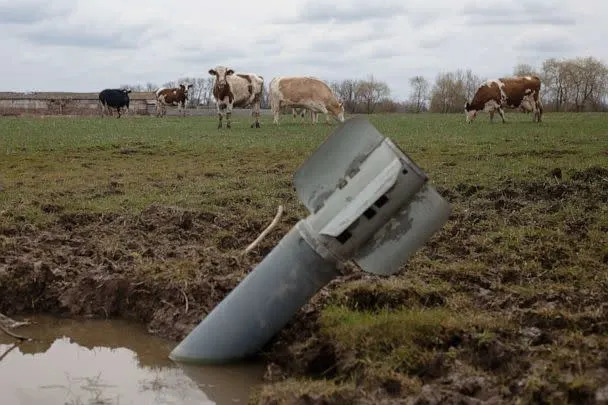
PHOTO: A rocket sits in a field near grazing cows on April 10, 2022 in Lukashivka village, Ukraine. (Anastasia Vlasova/Getty Images)

As a result of the global War on Terror that began in 2001, 1.2 million metric tons of greenhouse gases were released, the equivalent to the annual emissions of 257 million passenger cars — more than twice the current number of cars on the road in the U.S., according to a 2019 report released by Brown University’s Watson Institute of International and Public Affairs.

In addition to the hundreds of thousands of tons of carbon monoxide, carbon dioxide, nitrogen oxides, hydrocarbons and sulfur dioxide emitted from military vehicles, and other heavy machinery, heavy deforestation occurred in Afghanistan as a result of illegal logging, especially by warlords, which then destroyed wildlife habitat, according to the report.

“We now understand the environmental dimensions of war in ways that we didn’t decades ago,” Muffett said. “This is a particularly egregious situation, because the entire world is calling for Russia to end its its invasion right now.”

Once the conflict is over, the environment in Ukraine is going to be the local government’s “No. 1 priority,” Doug Weir, research and policy director of The Conflict and Environment Observatory, told ABC News.

MORE: Russia begins long-feared offensive in Ukraine’s east

These are the areas of most environmental concern, according to experts:

Industrial regions

Ukraine is a heavily industrialized country, especially in its eastern regions. It contains a large number of mines and refineries of chemical plants that produce substances such as ammonia and urea, Muffett said.

Assessing the damage from attacks on industrial sites and new nuclear facilities will be among the Ukrainian government’s priorities, Weir said.

In addition, there are “serious concerns” about the forced closure of several coal mines, which are now flooding with acid mine drainage without the proper methods to pump out the water, Weir said. Those toxins are then seeping into the groundwater aquifers

“We’ve already seen hints at how those could play out,” she said, adding that multiple refineries in Ukraine have already been hit. “One of the things that the lessons of the the invasion of Kuwait and the Iraq war is teach us is that strikes against facilities of these kinds pose profound risks for massive releases and really long-term damage.”

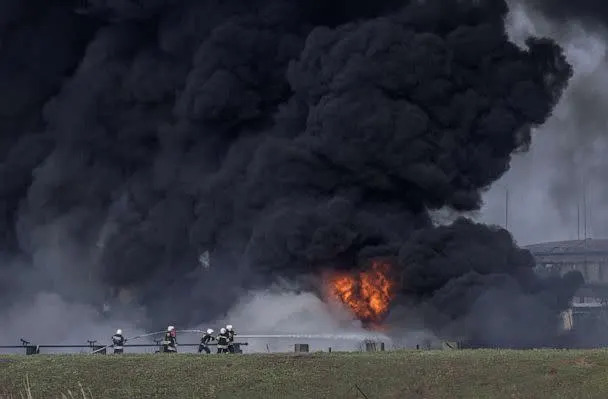
PHOTO: Firefighters work to put out a blaze at the Lysychansk Oil Refinery after if was hit by a missile, April 16, 2022, in Lysychansk, Luhansk region, Ukraine. (Marko Djurica/Reuters)
Agricultural fields

Researchers are estimating that millions of people could suffer from malnutrition in the years following the invasion as a result of lack of arable land.

Initial assessments show large swaths of agriculture areas affected by heavy shelling an unexploded ordinances, Weir said.

Olha Boiko, a Ukrainian climate activist and coordinator for the Climate Action Network for Eastern Europe and East Asia, said she and her fellow activists still in Ukraine are worried about the state of the agricultural fields and their suitability to grow wheat after the war, which is one of the country’s largest exports, she said.

PHOTO: Goats eat grass next to unexploded shell of multiple rocket launch system, in the village of Teterivka, in Kyiv region, Ukraine, April 14, 2022. (Vladyslav Musiienko/Reuters)
Wildlife and natural ecosystems

The plethora of military vehicles trampling over the Ukrainian border are creating an unforgiving landscape, experts said.

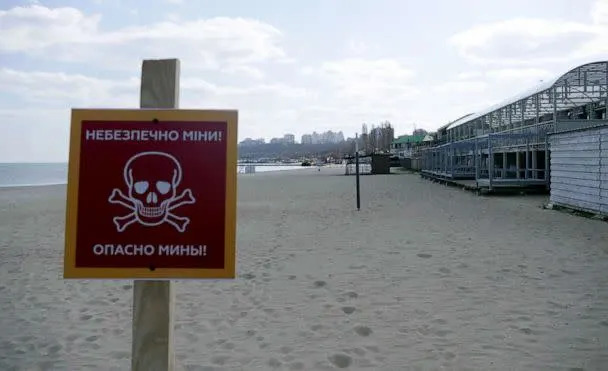
In an effort to defend their country, Ukrainian military laid landmines over at least one beach near Odesa, according to the Conflict and Environment Observatory.

Boiko also alleged that Russian forces have blown up oil exporting equipment, polluted the Black Sea and filled fields with landmines, which were found as Russian forces retreated the regions surrounding Kyiv.

MORE: Images show destruction left in Ukraine town of Borodyanka after Russian occupation

Fighting close to Kherson, near the southern coast of Ukraine, resulted in fires in the Black Sea Biosphere Reserve that were so large they were detectable from space and likely destroyed trees and unique habitats for birds, according to the observatory.

“There have been risks to wildlife and biodiversity we’ve seen that play out in Ukraine, with active battles in in insignificant wetlands,” Muffett said.

PHOTO: A sign warns beach-goers of potential land mines, in Odessa, Ukraine, April 4, 2022. (Igor Tkachenko/Reuters)
Urban areas

One of Russia’s military strategies has been to besieging cities by firing weapons indiscriminately into them, Weir said.

When Russian troops retreated the areas on the outskirts Kyiv after failing to take the capital, the devastation left in cities such as Bucha, Borodyanka and Irpin was immediately apparent.

Buildings were burned or completely destroyed. Burned-out cars littered the roadways. Entire neighborhoods were reduced to rubble.

The rebuilding phase is going to be a “huge task,” Weir said.

“From an environmental point of view, there’s going to be a huge amount of work needed to properly assess these sites, locate potentially hazardous sites,” Weir said, adding that environmental remediation process for the potentially hazardous sites can be complex and expensive.

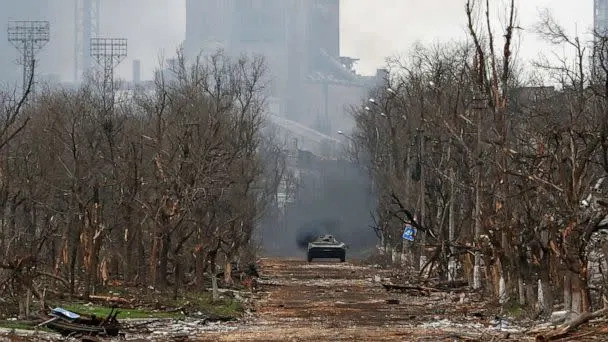
PHOTO: An armored vehicle of pro-Russian troops drives along a street during fighting near an iron and steel plant in the southern port city of Mariupol, Ukraine, April 12, 2022. (Alexander Ermochenko/Reuters)
Nuclear facilities

Soon after the conflict began, Russian troops took hold of the exclusion zone surrounding the Chernobyl power plant, raising concerns that an errant explosive could create another radioactive event at the site of the world’s worst nuclear accident in 1986.

The destroyed reactor was sealed in 2019 under a $2 billion stadium-sized metal structure, but the other three untouched reactors remain fully exposed. Within them sits a pool of 5 million pounds of spent nuclear fuel, as well as dangerous isotopes, such as uranium and plutonium. If hit, the storage facility has the potential to cause an even larger disaster than in 1986 and could prompt widespread evacuations all over Europe, Muffett said.

MORE: Protecting natural resources could lead to less armed conflict: Report

“The conduct of active military operations in a country with four nuclear facilities and 15 active nuclear reactors poses extraordinary risks,” Muffett said, admonishing Russia for immediately targeting Chernobyl despite “no legitimate military objectives associated with that site.”

Russian troops have cut off power to Chernobyl in ways the site was not “sustained for,” and untrained Russian servicemen disturbed radioactive soil and raised dust as they moved through the area, Muffett said.

“We’ve seen missile strikes actually put a nuclear facility on fire,” she said. “And, in the immediate hours after the fire began, firefighters were unable to reach the blaze, because they were in a live fire situation. These are these are really extraordinary risks.”

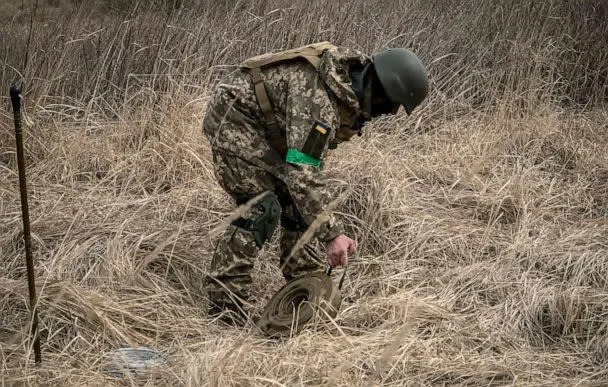
PHOTO: A member of a bomb disposal squad works in a mine field near Brovary, northeast of Kyiv, Ukraine, April 14, 2022. (Fadel Senna/AFP via Getty Images)
The role Russian oil plays in the conflict

The conflict in Ukraine is the latest demonstration of the “deep linkages between fossil fuels and conflict,” Muffett said. Boiko, who left Kyiv on Feb. 24, said the connection that fossil fuels play in the current war are “obvious,” because Russia is using the funds from its oil industry to fund the conflict.

“We’ve seen Putin’s regime look to weaponize its own natural gas and oil resources as a way to intimidate countries in Europe and beyond from coming to Ukraine to aid,” Muffett said. “And so, this is a fossil fueled conflict in every conceivable way.”

The environmental activists who remain in Ukraine, those who aren’t helping with the immediate humanitarian relief, are bringing attention to the fact that the E.U. and U.S. have been “very dependent” on Russia’s fossil fuels for years, Boiko said.

While the U.S. has imposed sanctions on all Russian oil and other energy sources, the European Union’s embargo only extends to coal, and not to oil and gas. About 40% of the EU’s gas comes from Russia, according to the observatory.

“This is exactly the leverage that has been used by Russia that is pressuring, basically, other countries to not impose sanctions to not do anything about this war to not help Ukraine,” Boiko said.

MORE: Concerns mount over conflict in Chernobyl exclusion zone

But Boiko said the conflict and the aftermath could eventually lead to positive steps in the fight against climate change, because the sanctions imposed on Russia lead to less less fossil fuel consumption. She said the phasing out of fossil fuels could happen more quickly, now that a major world player in oil exports has essentially been eliminated.

“The fact that this conflict is accelerating conversations within Europe about how they free themselves from reliance on fossil oil and fossil gas is also a big step forward,” Muffett said.

Pandemic, war, and inflation has spurred some people to a life of ‘homesteading’ and ‘prepping.’ Here’s how these practitioners live off the land and plan for disaster.

Insider – Home Economy

Pandemic, war, and inflation has spurred some people to a life of ‘homesteading’ and ‘prepping.’ Here’s how these practitioners live off the land and plan for disaster.

Gabrielle Bienasz – April 16, 2022

A photo of a garden with a house in the background.
The Green Gardens Homestead in Washington. 
  • Homesteading is living off the land, but social media influencers have added a modern spin.
  • After the pandemic, war, and inflation, it’s grown even more attractive.
  • Prepping, another survivalist-style niche, has overlap with homesteading and has seen an uptick, too. 

Looking to stay up to date on the news? Get our daily newsletter delivered to your inbox.Email addressBy clicking ‘Sign up’, you agree to receive marketing emails from Insider as well as other partner offers and accept our Terms of Service and Privacy Policy.

Five years ago, Nivek Anderson-Brown and her husband moved to Virginia, where they now raise chickens, grow crops, sell at farmer’s markets, and broadcasts content on TikTok as the Leaf and Bean Farm — all part of the life of a 21st century, live-off-the-land homesteader.

“People were like, ‘Are you crazy?’ when we first did it. And then, when the pandemic happened, they were like, ‘Tell us what you did!'” Brown said. 

Lettuce growing in a garden.
Greens of Brown’s homestead. 

In a time of chaotic supply chainsrising food pricesinflation, and war anxiety, being able to provide for yourself has a new glow, whether it’s through “homesteading” or its close cousin, “prepping,” 10 of the communities’ online members told Insider. 

The homesteading life

“Any small amount of trying to grow your own food or preserving. That’s homesteading,” says Ciearra Evans, of The Thrifted Planer homestead. 

But the lifestyle tends to build upon itself, Brown said. For example, she started out growing and drying herbs, then realized she had enough land to forage. 

Once she did, she found a patch of the mint-like plant horehound — which led to her making homemade cough drops.

“It was just like one thing rolling into another,” she said. “It takes on a life of its own.” 

Jars of food.
Preserving at Brown’s homestead. 

The term “homesteading” has been co-opted throughout history, from 1970s hippie communes to formerly enslaved Black Americans seeking land in Kansas to fundamentalist Christians raising children off the grid, said Brian Cannon, professor of history at Brigham Young University and author of a book about post-World War II homesteading. 

“I think we have, in the US, dating clear back to Thomas Jefferson, the conviction that rural life is wholesome,” he added. 

Chickens pecking at the ground.
Chickens at Brown’s homestead. 

Homesteading also can be a form of political or social dissent, according to a 2016 dissertation Jordan Travis Radke on modern homesteaders, from the University of North Carolina at Chapel Hill. It’s a way to “opt out” of systems that feel entrenched, from the government to climate change, she wrote. 

Many homesteaders tend to be white, Cannon said, which is no surprise, considering land is a key (but not essential) element of homesteading, and many Black Americans have lost land throughout US history

It’s something on the minds of Evans and Brown, who try to garden and create content as well as give voices to Black homesteaders online. 

“There aren’t a lot of people that look like me that do this,” Brown said. 

Homesteader’s cousin

For some, homesteading can eventually or immediately evolve into “prepping,” a term coined for another survivalist-type niche that focuses on preparing for a harder or possibly more dystopian future, the perception of which has come to pass for some.

Jars of food
More preserved food at Brown’s homestead. 

In particular, prepping has seen heightened interest as inflation has grown worse and amid Russia’s invasion of Ukraine-driven anxiety about food shortages, prepper-influencers told Insider. 

Tiffany Holloway, an apartment-style prepper on TikTok, said her following grew by about tens of thousands in March amid increasing inflation.

Holloway herself got into prepping after the 2021 ice storms in Texas. One of her neighbors ran out of baby formula. “I ended up having to nurse her baby for her,” via pumping, Holloway said. “This whole experience taught me that you have to prepare.” 

Holloway now teaches prepping on TikTok for people with small spaces and lower budgets, as well as focusing on prepping for potential domestic violence as a DV survivor herself – i.e., having a bag with a burner phone, money, and financial and identifying documents. 

However, there can be a darker side to the prepper community, as far as folks who lean too far into extreme anxiety or paranoia.

Holloway said she finds some of the content on TikTok fear-monger-y, though she said that’s not her niche.

“I try to keep it pretty positive on my page,” she said. 

Most preppers isolate and stay silent about their stores, something known as the “gray man” trope.

“People will become desperate. Ninety-five percent of people don’t have food at their house,” said Cam Hardy of The Casual Preppers Podcast.

If they know you have food, “they’ll know exactly where to go,” he said

Florida might lose its fourth insurance company in as many months as lawmakers are polled on special

CBS 47 Fox 30 – Action News Jax

Florida might lose its fourth insurance company in as many months as lawmakers are polled on special

Jake Stofan – April 15, 2022

Florida has lost three property insurance companies in as many months and could be on the verge of losing another after FedNat insurance was downgraded Friday.

The four losses combined would leave as many as 400,000 policyholders without coverage.

Homeowners in Northeast Florida are now beginning to see the double-digit year-over-year rate hike that was once reserved for places like Miami.

Some state lawmakers are arguing that without a special session, things are just going to keep getting worse.

Ronnie Rohn is 78.

He lives on Social Security and works here and there to make ends meet.

So, when he was told he’d be seeing his homeowner’s insurance increase by $600 this year, it hurt.

“Half our Social Security goes toward medicine and stuff and the extra $600 would help,” said Rohn.

Rohn is far from alone in his financial struggles.

Rising rates in Northeast Florida are driving more and more Duval residents to the state’s insurer of last resort.

Citizens Insurance has seen its number of Duval policies double over the last year.

“What started out as being a south Florida issue has started to work its way throughout the state,” said Citizens spokesperson Michael Peltier.

State Senator Jeff Brandes (R-St. Petersburg) told us the state’s private insurance market is on life support.

He has initiated a call for a special session to help stop the bleeding.

“And the Legislature’s either going to get our arms around this or the whole market is going to start shutting down,” said Brandes.

The Secretary of State sent out an official poll of lawmakers Thursday.

Two-thirds of lawmakers from both chambers will have to agree by Monday for a special session to be called.

Brandes said that even with a special session, any reforms will take between 18 and 24 months to affect rates, but he argues waiting is no longer an option.

“Let’s make this the primary focus of everything we’re dealing on. This is quickly becoming the number one issue and the number one challenge facing the State of Florida,” said Brandes.

We’ll have a first look at the number of those who have voted yes sometime Friday evening.

As the world questions globalization, China will become the big loser

Los Angeles Times

Op-Ed: As the world questions globalization, China will become the big loser

Minxin Pei – April 14, 2022

In this photo taken Wednesday April 25, 2012, a China Shipping Line container ship makes its way toward the Golden Gate past the San Francisco skyline in this view from Sausalito, Calif. (AP Photo/Eric Risberg)
China has been the world’s largest exporter, shipping $3.3 trillion in goods last year. (Eric Risberg / Associated Press)

Russia’s unprovoked war against Ukraine has accelerated the division of the world into two blocs, one comprising the world’s democracies, and the other its autocracies. This has exposed the risks inherent in economic interdependence among countries with clashing ideologies and security interests. And although the coming deglobalization process will leave everyone worse off, China stands to lose the most.

Of course, China was headed toward at least a partial decoupling with the United States well before Russia invaded Ukraine. And it has been seeking to ensure that this process happens on its terms, by reducing its dependence on U.S. markets and technology. To that end, in 2020 China unveiled its so-called dual-circulation strategy, which aims to foster domestic demand and technological self-sufficiency.

And yet, last year, China was still the world’s largest exporter, shipping $3.3 trillion in goods to the rest of the world, with the U.S. its leading export market. In fact, overall trade with the U.S. grew by more than 20% in 2021, as total Chinese trade reached a new high. Trade with the European Union also grew, reaching $828 billion, even as disagreements over human rights torpedoed a controversial EU-China investment agreement.

That agreement had been born of the belief that Europe would maintain strategic neutrality in the Sino-American cold war in order to reap the economic benefits of engagement with China. But if human rights concerns were enough to convince the European Parliament not to ratify the deal, Russia’s war against Ukraine — in which China has tacitly supported Russia, and which has pushed the U.S. and the EU closer together — seems likely to drive the EU toward a broader economic decoupling from China.

One cannot blame Western democracies or their autocratic adversaries for prioritizing security over economic welfare. But they must brace for the economic consequences. And a middle-income autocracy like China will bear a far larger cost than rich democracies like the U.S. and its European allies.

For starters, China will suffer from reduced access to major Western markets. In 2021, Chinese merchandise exports to the U.S., the EU, and Japan — accounting for 38% of total exports — amounted to nearly $1.3 trillion. If China’s access to these three markets is halved over the next decade — a likely scenario — the country will need other markets to absorb roughly 20% of its exports, worth some $600 billion (based on 2021 trade data).

Here, China appears to have no good options. China’s dual-circulation strategy indicates that not even its leaders expect other external markets to pick up the slack left by the U.S. and its allies. And China’s apparent belief that domestic demand can offset this loss also seems farfetched.

High debt, rapid population aging, and an imploding real-estate sector will continue to hamper GDP growth, while sharp income inequality, soaring housing costs, and inadequate social protections will constrain consumer demand. The closure of factories producing goods for export, and the associated job losses, will exacerbate these challenges further. A significant share of China’s infrastructure — especially energy and transportation networks — will be underused or even become redundant.

Aside from facing shrinking export markets, China will lose access to the technologies it needs to build a knowledge economy. U.S. sanctions have already crippled telecom giant Huawei and prevented SMIC, a semiconductor manufacturer, from getting its hands on the most advanced technologies. If the U.S. persuades the EU and Japan to revive the Coordinating Committee for Multilateral Export Controls (CoCom) to choke off technology flows to China — a prospect made more likely by the Ukraine war — China will have little chance of winning the technology race with the U.S.

The third key cost of deglobalization for China is harder to measure, but it may well turn out to be the highest: the loss of efficiency gains from dynamic competition. Products made and sold in China are of a far higher quality today than they were two decades ago, largely because Chinese companies must compete with their Western rivals. But if they are insulated from such pressure, they will not face pressure to produce higher-quality products at lower cost. This will hamper innovation and hurt consumers.

All of these costs might be bearable if economic decoupling actually made China more secure. And, at first, it might seem to be doing just that, with China reducing its vulnerability to the kinds of economic and financial weapons that the West has deployed against Russia. But as China’s economic might declines, so will its position on the global stage and the Communist Party’s status at home.

Seven decades ago, Mao Zedong embraced economic self-reliance and foreign-policy militancy, which turned China into an impoverished pariah state. This history should be a stark warning to President Xi Jinping. If he allows Russia, China’s “no limits” strategic partner, to divide the world with its war on Ukraine, it is China that will pay the heaviest price.

Minxin Pei is a professor of government at Claremont McKenna College.

Backed-up pipes, stinky yards: Climate change is wrecking septic tanks

The Washington Post

Backed-up pipes, stinky yards: Climate change is wrecking septic tanks

Jim Morrison – April 12, 2022

This trench was dug to help alleviate rainwater issues in the yard of Roosevelt Jones, whose septic system has increasingly failed at his Suffolk, Va., home. (Kristen Zeis for The Washington Post)

Lewis Lawrence likes to refer to the coastal middle peninsula of Virginia as suffering from a “soggy socks” problem. Flooding is so persistent that people often can’t walk around without getting their feet wet.

Over two decades, Lawrence, the executive director of the Middle Peninsula Planning District, has watched the effects of that problem grow, as rising waters and intensifying rains that flood the backyard render underground septic systems ineffective. When that happens smelly, unhealthy wastewater backs up into homes.

Local companies, he said, call the Middle Peninsula the “septic repair capital of the East Coast.” “That’s all you need to know,” he added. “And it’s only going to get worse.”

As climate change intensifies, septic failures are emerging as a vexing issue for local governments. For decades, flushing a toilet and making wastewater disappear was a convenience that didn’t warrant a second thought. No longer. From Miami to Minnesota, septic systems are failing, posing threats to clean water, ecosystems and public health.

Video: The psychological impact of climate change

The psychological impact of climate change

Psychological research shows that climate change can alter an individual’s mental health both directly and indirectly, impacting how we respond to this crisis.

About 20% of U.S. households rely on septic, according to the Environmental Protection Agency. Many systems are clustered in coastal areas that are experiencing relative sea-level rise, including around Boston and New York. Nearly half of New England homes depend on them. Florida hosts 2.6 million systems. Of the 120,000 in Miami-Dade County, more than half of them fail to work properly at some point during the year, helping to fuel deadly algae blooms in Biscayne Bay, home to the nation’s only underwater national park. The cost to convert those systems into a central sewer plant would be more than $4 billion.

The issue is complex, merging common climate themes. Solutions are expensive, beyond the ability of localities to fund them. Permitting standards that were created when rainfall and sea-level rise were relatively constant have become inadequate. Low-income and disadvantaged people who settled in areas with poor soils likely to compromise systems are disproportionately affected. Maintenance requirements are piecemeal nationwide. And while it’s clear that septic failures are increasing, the full scope of the problem remains elusive because data, particularly for the most vulnerable aging systems, are difficult to compile.

“The challenges are going to be immense,” said Scott Pippin, a lawyer and researcher at the University of Georgia’s Institute for Resilient Infrastructure Systems who has studied the problem along the state’s coast. “Conditions are changing. They’re becoming more challenging for the functionality of the systems. In terms of large-scale, complex analysis of the problem, we don’t really have a good picture of that now. But going forward, you can expect that it’s going to become more significant.”

Pippin’s work in Georgia is one of several studies as states from New Hampshire to Alabama confront the effects of septic system failures. Michigan’s Department of Environment, Great Lakes and Energy estimates that 24% of the state’s 1.37 million septic systems are failing and contaminating groundwater. A project funded by the National Oceanic and Atmospheric Administration is examining the potential longer-term impacts of climate change on septic systems in the Carolinas. Virginia has created a Wastewater Infrastructure Policy Working Group to address the issue.

An EPA spokesman said the agency didn’t have a report on the septic problem but noted that sea level rise, changing water tables, precipitation changes and increased temperature can cause systems to fail. The infrastructure bill passed last year provides $150 million to replace or repair systems nationwide.

For a century, conventional septic systems have been an inexpensive solution for wastewater. They work by burying a tank that collects wastewater from sinks, toilets, showers and washing machines, holding the solids while the liquid percolates through a few feet of filtering soil, where microbes and other biological processes remove harmful bacteria.

When that doesn’t happen, bacteria and parasites from human waste flow into drinking water supplies or recreational waters, creating a public health problem. Nitrogen and phosphorous, also a byproduct of the waste, pollute waters, creating oxygen-depleted zones in rivers and along the coast, closing shellfish harvests and killing fish.

For decades, septic systems have been designed with the assumption that groundwater levels would remain static. That’s no longer true. “Systems that were permitted 40, 50 years ago and met the criteria at that time now wouldn’t,” said Charles Humphrey, an East Carolina University researcher who studies groundwater dynamics. In North Carolina’s Dare County, which includes Outer Banks destinations such as Nags Head and Rodanthe, groundwater levels are a foot higher than in the 1980s.

That means there’s not enough separation between the septic tank and groundwater to filter pollutants. The threat isn’t only along the coasts. More intense storms dumping inches of rain in a few hours soak the ground inland, compromising systems for weeks. Too little precipitation is a problem as well. The lack of early, insulating snow in the Midwest, attributed to climate change, drives down the frost line, freezing drain fields and causing failures.

Georgia spent years creating a comprehensive database of septic systems, the only state to complete one. “Everybody wants to skip to a solution – how do we build a new infrastructure for the future? But I think the story is really the value of investing in the data and in that preliminary research to make smart investments and wise decisions,” Pippin said.

While Virginia’s Middle Peninsula has a soggy socks problem, Miami-Dade County has a porous limestone bedrock problem. The soil under its 2.7 million South Florida residents allows septic tank effluent to reach groundwater, a problem intensified by climate change.

About half of the area’s 120,000 septic tanks were compromised during storms or wet years, according to a study. Roughly 9,000 are vulnerable to compromise or failure under current conditions. That number is expected to rise to 13,500 by 2040. The solution is to connect properties to a central sewer system, beginning with the most-threatened areas. So far, the county is using $100 million from the American Rescue Plan to begin converting homes to sewer and another $126 million to convert 1,000 commercial septic tanks. The plan is to expand sewer to the 9,000 most vulnerable properties within five to 10 years, if funding can be secured.

Connecting will cost between $5,000 and $20,000. Miami-Dade County Mayor Daniella Levine Cava said the county is looking for funds to help low- and moderate-income property owners.

“What’s at stake?” she asked. “I’m sitting on my 29th-floor office looking out the window at the beautiful bay. This is our lifeblood. Without a clean bay, we don’t have tourism. We don’t have health. We don’t have a marine industry. It is the lifeline, the economic driver.”

The cost Levine Cava outlined can be a barrier to low-income communities. In the Chuckatuck borough of Suffolk, a sprawling city in Southeast Virginia, the mostly Black, elderly residents of the Oakland neighborhood have suffered repeated septic failures in recent years. They blame the combination of new development increasing storm-water runoff and a failure by the city to maintain ditches carrying away the water.

When Roosevelt Jones, 81, moved into the neighborhood in 1961, he used an outhouse. Soon after, he installed septic. But in recent years, his system and others in the neighborhood have increasingly failed, backing up in sinks and toilets. During the 2020 winter, Jones, who has lived in his 1,300-square-foot cottage since 1961, had to pump his tank out four times at $350 each. “Normal is every five years,” he said. “When we get a bad rain, it’s going to flood my septic tank.”

When his toilet fills with sewage, Jones, who retired from a quality control position for a warehouse but still works custodial jobs, slips into a church he cleans up the road.

After the city ran a pipeline through their neighborhood to provide sewer service to a development of more than 100 homes uphill with prices starting at $300,000, residents were given the option to tie into the system. But it came at a cost – roughly $7,000 or more per house. Many in the village are on a fixed income. The price was too high. Only 33 of 75 property owners voted, with 18 of them favoring a sewer connection. “A lot of people got them [the petitions] and ended up throwing them away,” Jones said.

On Virginia’s low-lying Middle Peninsula, surrounded on three sides by the Chesapeake Bay, the Rappahannock River and the York River, Lawrence has had a preview of the effects of climate change and the challenges to septic systems. Failing to address the problem, he said, could eliminate decades of environmental progress.

“You’re sitting on all of the work for the last 30 years to clean up the Chesapeake Bay,” he said. One or two good hurricanes will destroy that because every residential home will become a brownfield because their septic tank is just sitting there full of bad stuff.”

Shortly after Lawrence started at the planning district in 1997, the General Assembly approved alternative septic systems in addition to the conventional gravity-fed systems. They’re engineered to have a secondary treatment that purifies the wastewater before discharging it into the soil.

Now, even those alternative systems are failing. Why? They don’t handle flooding well and flooding happens often on the Middle Peninsula.

Wastewater regulations for septic systems haven’t been overhauled in decades in states. Virginia updated requirements 20 years ago, said Lance Gregory, director of the Department of Health’s Water and Wastewater Services division. A bill passed last year directs the State Board of Health to create regulations making Virginia the first state to include the impacts of climate change on septic. The goal, Gregory said, is to not issue a permit for a system that 10 or 15 years from now will be an environmental and public health problem – and a costly repair for an owner.

Lawrence is looking for solutions, partnering with Rise, a Norfolk-based technology innovations accelerator, in a challenge to design septic systems that can be elevated much like HVAC systems. “Why are we building our communities the same way we built them 100 years ago when we know Mother Nature isn’t operating the same way she did 100 years ago? It makes no sense,” he said. “We’ve got to be reimagining and designing our communities differently. If you can elevate a heat pump, why can’t you elevate a $40,000 septic system?”

The problem percolating underground so concerned William “Skip” Stiles of the nonprofit Virginia advocacy group Wetlands Watch that he created an ad hoc group of policymakers and researchers from Georgia to Maine to share knowledge and discuss solutions.

He hopes the group’s “noodling” on the issues, as he calls it, will inform new regulations. In the end, the answer to the septic problem may not be to improve the regulations and the technology, but to leave threatened areas.

“The septic system is the canary in the coal mine,” Stiles said. “If you’ve got a house and the septic is starting to flood, it won’t be long before the house goes. We ought to be using septic failures as an early warning system for those areas we’re going to have to take people out of.”