Climate-driven flooding poses well water contamination risks

Associated Press

Climate-driven flooding poses well water contamination risks

Michael Phillis and John Flesher – June 8, 2022

FILE - Homes are surrounded by floodwaters from Tropical Storm Harvey in Spring, Texas, Tuesday, Aug. 29, 2017. Experts say more intense storms driven by climate change are boosting contamination risks for privately-owned drinking water wells. (AP Photo/David J. Phillip, File)
Homes are surrounded by floodwaters from Tropical Storm Harvey in Spring, Texas, Tuesday, Aug. 29, 2017. Experts say more intense storms driven by climate change are boosting contamination risks for privately-owned drinking water wells. (AP Photo/David J. Phillip, File)
This photo provided by Stefanie Johnson shows Johnson's private well in Blandinsville, Ill. Her well was contaminated during major flooding in 2013. Johnson's family was without drinking water for nearly two months. She says contaminated wastewater likely drained in through the top, causing her well to test positive for E. coli. (Stefanie Johnson via AP)
This photo provided by Stefanie Johnson shows Johnson’s private well in Blandinsville, Ill. Her well was contaminated during major flooding in 2013. Johnson’s family was without drinking water for nearly two months. She says contaminated wastewater likely drained in through the top, causing her well to test positive for E. coli. (Stefanie Johnson via AP)
Neil and Bea Jobe pose in their home March 8, 2022, in Primm Springs, Tenn., which sits near Lick Creek. Several times a year, when there is heavy rain and a nearby creek floods, their well water turns "dingy," Bea Jobe said. While estimates vary, roughly 53 million U.S. residents, about 17% of the population, rely on private wells, according to a study done in part by Environmental Protection Agency researchers. (AP Photo/Mark Humphrey)
Neil and Bea Jobe pose in their home March 8, 2022, in Primm Springs, Tenn., which sits near Lick Creek. Several times a year, when there is heavy rain and a nearby creek floods, their well water turns “dingy,” Bea Jobe said. While estimates vary, roughly 53 million U.S. residents, about 17% of the population, rely on private wells, according to a study done in part by Environmental Protection Agency researchers. (AP Photo/Mark Humphrey)
ASSOCIATED PRESS
FILE - An oil sheen drifts between a sunken shrimp boat and pieces of a destroyed home along Bayou Pointe au Chien in the aftermath of Hurricane Ida in Pointe-aux-Chenes, La., on Sept. 14, 2021. Experts say more intense storms driven by climate change are boosting contamination risks for privately-owned drinking water wells. (AP Photo/Gerald Herbert, File)
An oil sheen drifts between a sunken shrimp boat and pieces of a destroyed home along Bayou Pointe au Chien in the aftermath of Hurricane Ida in Pointe-aux-Chenes, La., on Sept. 14, 2021. Experts say more intense storms driven by climate change are boosting contamination risks for privately-owned drinking water wells. (AP Photo/Gerald Herbert, File)
In this photo taken in September 2017, Sandy Wynn-Stelt, of Belmont, Mich., stands in a wooded area near her home where industrial wastes containing PFAS chemicals were dumped for many years. High levels of the toxic compounds later were detected in drinking water from her well. While estimates vary, studies say roughly 53 million U.S. residents rely on private wells. While many provide safe water, experts say some are vulnerable to contamination from bacteria or other impurities from floodwaters or from groundwater tainted with PFAS or other pollutants. (Nic Antaya/The Grand Rapids Press via AP)
n this photo taken in September 2017, Sandy Wynn-Stelt, of Belmont, Mich., stands in a wooded area near her home where industrial wastes containing PFAS chemicals were dumped for many years. High levels of the toxic compounds later were detected in drinking water from her well. While estimates vary, studies say roughly 53 million U.S. residents rely on private wells. While many provide safe water, experts say some are vulnerable to contamination from bacteria or other impurities from floodwaters or from groundwater tainted with PFAS or other pollutants. (Nic Antaya/The Grand Rapids Press via AP)

ST. LOUIS (AP) — After a record-setting Midwestern rainstorm that damaged thousands of homes and businesses, Stefanie Johnson’s farmhouse in Blandinsville, Illinois, didn’t have safe drinking water for nearly two months.

Flood water poured into her well, turning the water a muddy brown and forcing Johnson, her husband and their two young children to use store-bought supplies. Even after sediment cleared, testing found bacteria — including E. coli, which can cause diarrhea. The family boiled water for drinking and cooking. The YMCA was a refuge for showers.

“I was pretty strict with the kids,” said Johnson, who works with a private well protection program at the local health department. “I’d pour bottled water on their toothbrushes.”

Though estimates vary, roughly 53 million U.S. residents — about 17% of the population — rely on private wells, according to a study conducted in part by Environmental Protection Agency researchers. Most live in rural areas. But others are in subdivisions near fast-growing metro regions or otherwise beyond the reach of public water pipes.

While many private wells provide safe water, the absence of regulation and treatment afforded by larger municipal systems may expose some users to health risks, from bacteria and viruses to chemicals and lead, studies have found.

Risks are elevated after flooding or heavy rainfall, when animal and human feces, dirt, nutrients such as nitrogen and other contaminants can seep into wells. And experts say the threat is growing as the warming climate fuels more intense rainstorms and stronger and wetter hurricanes.

“Areas that hadn’t been impacted are now. New areas are getting flooded,” said Kelsey Pieper, a Northeastern University professor of environmental engineering. “We know the environment is shifting and we’re playing catch-up, trying to increase awareness.”

Pieper is among scientists conducting well testing and education programs in storm-prone areas. After Hurricane Harvey caused widespread flooding along the Texas coast in 2017, sampling of more than 8,800 wells in 44 counties found average E. coli levels nearly three times higher than normal, she said.

Sampling of 108 wells in Mississippi following Hurricane Ida in 2021 produced a similar bump in E. coli readings. Other studies turned up higher levels in North Carolina after Hurricane Florence in 2018.

The following year, above-average snowfall and a March storm unleashed flooding in Nebraska. Levees and dams were breached. Fremont, a city of more than 25,000, turned into an island when the nearby Platte and Elkhorn rivers overflowed.

The municipal system continued to supply drinking water but some nearby private wells were damaged or contaminated. Julie Hindmarsh’s farm was flooded for three days, and it took months to make the well water drinkable again. At times, the cleanup crew wore protective suits.

“They didn’t know what was in that floodwater,” she said.

CONTAMINATION RISK

Groundwater is often a cleaner source than surface supplies because soil can provide a protective buffer, said Heather Murphy, an epidemiologist at the University of Guelph in Canada. But she said that can give well owners a false sense of security, leading them to forgo testing, maintenance and treatment.

“There’s a big misconception that it’s underground, therefore it’s safe,” said Murphy, who estimates 1.3 million cases of acute gastrointestinal illness in the U.S. are caused annually by drinking untreated water from private wells.

Old, poorly maintained wells are especially vulnerable to floodwaters entering through openings at the top. “It just runs right in and it’s full of bacteria,” said Steven Wilson, a well expert at the University of Illinois.

It doesn’t always take a flood or hurricane to pollute wells. Industrial contamination can reach them by seeping into groundwater.

Around 1,000 residential wells in Michigan’s Kent County were tainted for decades with toxic per- and polyfluoroalkyl substances, or PFAS, in landfill sludge from footwear company Wolverine World Wide. The pollution, discovered in 2017, spurred lawsuits and a $69.5 million settlement with the state that extended city water lines to affected houses.

“We thought we were getting this pristine, straight-from-nature water and it would be much better for us,” said Sandy Wynn-Stelt, who has lived across from one of the dump sites since the early 1990s.

She said tests detected high levels of PFAS chemicals in her water and blood, leaving her fearful to drink or even brush her teeth with well water. In a suit later settled, she blamed the contamination for her husband’s 2016 death from liver cancer. She was diagnosed with thyroid cancer four years later.

LITTLE REGULATION FOR WELL OWNERS

While many well owners don’t have the option of hooking up to a public water system, others are happy with well water. They might favor the taste or want to avoid monthly bills and government regulation.

“What I hear from people is freedom,” said Jesse Campbell, private well coordinator for the Midwest Assistance Program Inc., which addresses rural water needs.

Private well owners are responsible for them. While public water systems must meet federal safety standards, those rules don’t apply to wells that have fewer than 15 connections or serve fewer than 25 people.

State and local standards usually involve only construction and design, although some states set tougher rules.

New Jersey requires water quality testing before sales of property with private wells. Rhode Island requires testing when new wells are built and when property with a well is sold.

But many states rely on public outreach and voluntary action to protect private well users.

“There’s an overall lack of education,” Campbell said. He meets with well owners from Montana to Missouri, providing free inspections and advice.

A lot of harm can be prevented if owners make sure the well’s top keeps out debris and that the pump is turned off before a storm to keep out floodwaters. Experts recommend testing after a flood and decontaminating wells with chlorine if a problem is found.

“People aren’t regularly testing,” said Riley Mulhern, an environmental engineer at the research group RTI International.

Indiana’s health department offers testing for bacteria, lead, copper, fluoride and other contaminants. Some land-grant universities and private labs provide similar services.

While many owners know how to maintain their wells, others ignore problems even if the water isn’t sanitary. Water that tastes fine can still be contaminated.

“I wish I had a nickel for everyone who’s walked into a workshop and said, ‘I’ve been drinking this water forever and it’s fine,’” said Jason Barrett, who directs a Mississippi State University program that educates well owners.

It provides free testing. But where such assistance isn’t available, costs can run to a few hundred dollars, according to experts. Some owners avoid testing because they are concerned it will reveal an expensive problem.

Johnson, the Illinois resident whose well was fouled by the 2013 downpour that killed four people and caused $465 million in flood damage, paid about $3,500 for repairs and upgrades.

“Luckily, none of us became ill,” she said.

Even ordinary rainstorms can carry diseases into groundwater, said Mark Borchardt, a microbiologist formerly with the U.S. Department of Agriculture.

“A lot of times people say, ‘Well, no one got sick,’” Borchardt said. “It’s hard to see when people get sick unless it is a huge outbreak.”

Bea and Neil Jobe live in Primm Springs, Tennessee, an hour’s drive from Nashville. Several times a year, when there is heavy rain and a nearby creek floods, their well water turns “dingy,” Bea Jobe said.

The discoloration disappears after a few days but Jobe takes precautions such as keeping bottled water available.

“I guess I’m used to it,” she said.

Flesher reported from Traverse City, Michigan.

Trump Policies Sent U.S. Tumbling in a Climate Ranking

The New York Times

Trump Policies Sent U.S. Tumbling in a Climate Ranking

Maggie Astor – May 31, 2022

President Donald Trump walks towards a lectern to announce his decision to withdraw the U.S. from the Paris Climate Agreement, in the Rose Garden of the White House in Washington, June 1, 2017. (Doug Mills/The New York Times)

For four years under President Donald Trump, the United States all but stopped trying to combat climate change at the federal level. Trump is no longer in office, but his presidency left the country far behind in a race that was already difficult to win.

A new report from researchers at Yale and Columbia universities shows that the United States’ environmental performance has tumbled in relation to other countries — a reflection of the fact that, while the United States squandered nearly half a decade, many of its peers moved deliberately.

But, underscoring the profound obstacles to cutting greenhouse gas emissions rapidly enough to prevent the worst effects of climate change, even that movement was insufficient. The report’s sobering bottom line is that, while almost every country has pledged by 2050 to reach net-zero emissions (the point where their activities no longer add greenhouse gases to the atmosphere), almost none are on track to do it.

The report, called the Environmental Performance Index, or EPI, found that, based on their trajectories from 2010 through 2019, only Denmark and Britain were on a sustainable path to eliminate emissions by midcentury.

Namibia and Botswana appeared to be on track with caveats: They had stronger records than their peers in sub-Saharan Africa, but their emissions were minimal to begin with, and the researchers did not characterize their progress as sustainable because it was not clear that current policies would suffice as their economies develop.

The 176 other nations in the report were poised to fall short of net-zero goals, some by large margins. China, India, the United States and Russia were on track to account for more than half of global emissions in 2050. But even countries like Germany that have enacted more comprehensive climate policies are not doing enough.

“We think this report’s going to be a wake-up call to a wide range of countries, a number of whom might have imagined themselves to be doing what they needed to do and not many of whom really are,” said Daniel C. Esty, the director of the Yale Center for Environmental Law and Policy, which produces the EPI every two years.

A United Nations report this year found that there is still time, but not much, for countries to change course and meet their targets. The case of the United States shows how gravely a few years of inaction can fling a country off course, steepening the slope of emissions reductions required to get back on.

The 2022 edition of the index, provided to The New York Times before its release Wednesday, scored 180 countries on 40 indicators related to climate, environmental health and ecosystem vitality. The individual metrics were wide-ranging, including tree-cover loss, wastewater treatment, fine-particulate-matter pollution and lead exposure.

The United States ranked 43rd overall, with a score of 51.1 out of 100, compared with 24th place and a score of 69.3 in the 2020 edition. Its decline is largely attributable to the bottom falling out of its climate policy: On climate metrics, it plummeted to 101st place from 15th and trailed every wealthy Western democracy except Canada, which was 142nd.

The climate analysis is based on data through 2019, and the previous report was based on data through 2017, meaning the change stems from Trump-era policies and does not reflect President Joe Biden’s reinstatement or expansion of regulations.

American emissions did fall substantially over the full 10-year period examined, which also included most of the Obama administration and its efforts to regulate emissions, and the nation continues to outperform other major polluters.

But the pace of reduction has been insufficient given the United States’ extremely high starting point. The U.S. is the second largest emitter of greenhouse gases, behind China. If current trajectories held, it would be the third largest in 2050, behind China and India, the lowest-ranked country in the overall index.

At the other end of the spectrum is Denmark, ranked No. 1 on climate and overall, whose parliament has made a binding commitment to reduce emissions 70% below 1990 levels by 2030. The country gets about two-thirds of its electricity from clean sources, and its largest city, Copenhagen, aims to reach carbon neutrality in the next three years.

Denmark has hugely expanded wind energy, set a date to end oil and gas exploration in the North Sea, taxed carbon dioxide emissions and negotiated agreements with leaders in transportation, agriculture and other sectors. Its economy has grown as emissions have fallen.

“This is such a comprehensive transformation of our entire society that there’s not one tool that you can use, one policy you can use overall, and then that will just solve the problem,” said Dan Jorgensen, the Danish climate minister. Denmark showed “it is possible to make this transformation in a way that doesn’t hurt your societies,” he said.

“It’s not something that makes you less competitive,” Jorgensen said. “Actually, it’s the opposite.”

The report’s methodology distinguishes between countries like Denmark that are intentionally transitioning to renewable energy and countries like Venezuela whose emissions are dropping only as a side effect of economic collapse.

One piece of good news it found was that many countries, including the United States, have begun to “decouple” emissions from economic growth, meaning their economies no longer directly depend on the amount of fossil fuels they burn.

Broadly, wealthier countries still emit much more than poorer ones. But two countries with similar GDPs can have very different emissions levels.

“The main take-home right now is that policy does matter, and there are specific pathways toward a more carbon-neutral and climate-friendly future,” said one of the report’s co-authors, Alexander de Sherbinin, associate director and senior research scientist at Columbia’s Center for International Earth Science Information Network. “But it really takes high-level policy agreement.”

The report is the first edition of the EPI to estimate future emissions, and its methodology has limitations. Most obviously, because it relies on data through 2019, it does not factor in more recent actions. Nor does it account for the possibility of removing already-emitted carbon from the air; such technology is limited now but could make a significant difference down the line. And it reflects only what would happen if countries continued to reduce their greenhouse gas emissions at the same rate, rather than enacting stronger policies or, conversely, losing steam.

That accounts for a striking disagreement between the EPI researchers, who found Britain on track, and Britain’s independent Climate Change Committee, which advises the British government and has said current policies are insufficient. (There is also a technical distinction: In addition to domestic emissions, the committee considers what other countries emit in producing goods that Britain imports, and the EPI doesn’t.)

Britain’s recent reductions came largely from switching from coal to natural gas, and the Climate Change Committee is “somewhat pessimistic that the trend will continue now that the low-hanging fruit has been picked,” said Martin Wolf, the EPI’s project director. “I see the rapid expansion of renewable energy capacity in the U.K. as a sign that the country is still on track.”

Tanja Srebotnjak, director of the Zilkha Center for Environmental Initiatives at Williams College and an expert in environmental statistics, said she viewed the projection methodology as “a reasonable first attempt” that could be refined later.

How best to extrapolate current trends is a matter of debate, said Srebotnjak, who has worked on past EPI editions but was not involved in this year’s report or in developing the new metric. But she added, “I think it will help policymakers have another tool in their toolbox for tracking how they’re doing and for comparing themselves with peers, to maybe learn from each other.”

Giant Deep Ocean Turbine Trial Offers Hope of Endless Green Power

Bloomberg

Giant Deep Ocean Turbine Trial Offers Hope of Endless Green Power

Erica Yokoyama – May 30, 2022

(Bloomberg) — Power-hungry, fossil-fuel dependent Japan has successfully tested a system that could provide a constant, steady form of renewable energy, regardless of the wind or the sun.

For more than a decade, Japanese heavy machinery maker IHI Corp. has been developing a subsea turbine that harnesses the energy in deep ocean currents and converts it into a steady and reliable source of electricity. The giant machine resembles an airplane, with two counter-rotating turbine fans in place of jets, and a central ‘fuselage’ housing a buoyancy adjustment system. Called Kairyu, the 330-ton prototype is designed to be anchored to the sea floor at a depth of 30-50 meters (100-160 feet).

In commercial production, the plan is to site the turbines in the Kuroshio Current, one of the world’s strongest, which runs along Japan’s eastern coast, and transmit the power via seabed cables.

“Ocean currents have an advantage in terms of their accessibility in Japan,” said Ken Takagi, a professor of ocean technology policy at the University of Tokyo Graduate School of Frontier Sciences. “Wind power is more geographically suited to Europe, which is exposed to predominant westerly winds and is located at higher latitudes.” Japan’s New Energy and Industrial Technology Development Organization (NEDO) estimates the Kuroshio Current could potentially generate as much as 200 gigawatts — about 60% of Japan’s present generating capacity.

Like other nations, the lion’s share of investment in renewables has gone into wind and solar, especially after the Fukushima nuclear disaster curbed that nation’s appetite for atomic energy. Japan is already the world’s third largest generator of solar power and is investing heavily in offshore wind, but harnessing ocean currents could provide the reliable baseline power needed to reduce the need for energy storage or fossil fuels.

The advantage of ocean currents is their stability. They flow with little fluctuation in speed and direction, giving them a capacity factor — a measure of how often the system is generating — of 50-70%, compared with around 29% for onshore wind and 15% for solar.

In February, IHI completed a 3 ½ year-long demonstration study of the technology with NEDO. Its team tested the system in the waters around the Tokara Islands in southwestern Japan by hanging Kairyu from a vessel and sending power back to the ship. It first drove the ship to artificially generate a current, and then suspended the turbines in the Kuroshio.

The tests proved the prototype could generate the expected 100 kilowatts of stable power and the company now plans to scale up to a full 2 megawatt system that could be in commercial operation in the 2030s or later.

Like other advanced maritime nations, Japan is exploring various ways of harnessing energy from the sea, including tidal and wave power and ocean thermal energy conversion (OTEC), which exploits the difference in temperature between the surface and the deep ocean. Mitsui OSK Lines Ltd. has invested in UK-based Bombora Wave Power to explore the potential for the technology in Japan and Europe. The company is also promoting OTEC and began operating a 100 kW demonstration facility in Okinawa in April, according to Yasuo Suzuki, general manager of the corporate marketing division. Kyushu Electric’s renewable unit Kyuden Mirai Energy begins a 650 million yen ($5.1 million) feasibility test this year to produce 1 MW of tidal power around the Goto Islands in the East China Sea. The government this month also proposed changes to offshore wind auctions that could speed up development.

Among marine-energy technologies, the one advancing fastest towards cost-effectiveness is tidal stream, where “the technology has advanced quite a long way and it definitely works,” said Angus McCrone, a former BloombergNEF chief editor and marine energy analyst. Scotland-based Orbital Marine Power is one of several companies constructing tidal systems around Orkney, location of the European Marine Energy Centre. Others include SIMEC Atlantis Energy’s MeyGen array and California-based Aquantis, founded by US wind pioneer James Dehlsen, which reportedly plans to start testing a tidal system there next year.

While tidal flows don’t run 24 hours, they tend to be stronger than deep ocean currents. The Kuroshio current flows at 1 to 1.5 meters per second, compared with 3 meters per second for some tidal systems. “The biggest issue for ocean current turbines is whether they could produce a device that would generate power economically out of currents that are not particularly strong,” said McCrone.

Ocean Energy Systems, an intergovernmental collaboration established by the International Energy Agency, sees the potential to deploy more than 300 gigawatts of ocean energy globally by 2050.

But the potential for ocean energy is location dependent, taking into account the strength of currents, access to grids or markets, maintenance costs, shipping, marine life and other factors. In Japan, wave energy is moderate and unstable through the year, while areas with strong tidal currents tend to have heavy shipping traffic, Takagi said. And OTEC is better suited to tropical regions where the temperature gradient is bigger. One of the advantages of the deep ocean current is it doesn’t restrict navigation of ships, IHI said.

Still, the Japanese company has a long way to go. Compared with onshore facilities, it’s much more complicated to install a system underwater. “Unlike Europe, which has a long history of the North Sea Oil exploration, Japan has had little experience with offshore construction,” said Takagi. There are major engineering challenges to build a system robust enough to withstand the hostile conditions of a deep ocean current and to reduce maintenance costs.

“Japan isn’t blessed with a lot of alternative energy sources,” he said. “People may say that this is just a dream, but we need to try everything to achieve zero carbon.”

With the cost of wind and solar power and battery storage declining, IHI will also need to demonstrate that overall project costs for ocean current power are competitive. IHI aims to generate power at 20 yen per kilowatt-hour from large-scale deployment. That compares with about 17 yen for solar in the country and about 12-16 yen for offshore wind. IHI also said it conducted an environmental assessment before it launched the project and will use the test results to examine any impact on the marine environment and fishing industry.

If successful at scale, deep ocean currents could add a vital part in providing green baseline power in the global effort to phase out fossil fuels. IHI’s work could help Japan’s engineering take a leading role with government support, said McCrone.

IHI has to make a convincing argument that “Japan could benefit from being a technology leader in this area,” he said.

Most Read from Bloomberg Businessweek

Tariffs on solar panels threaten Biden’s climate change goals

Yahoo! News

Tariffs on solar panels threaten Biden’s climate change goals

Ben Adler, Senior Editor – May 26, 2022

An ongoing Department of Commerce investigation into whether China is circumventing tariffs on its solar energy products is slowing the expansion of solar power capacity in the U.S., according to industry and outside experts.

“In the blink of an eye, we’re going to lose 100,000 American solar workers and any hope of reaching the president’s clean energy goals,” Abigail Ross Hopper, president and CEO of the Solar Energies Industry Association (SEIA), said in a statement late last month.

On March 25, James Maeder, the deputy assistant secretary of commerce for anti-dumping and countervailing duty operations, announced an investigation into whether crystalline silicon photovoltaic cells from Cambodia, Malaysia, Thailand or Vietnam that use components from China violate tariffs on Chinese solar imports. Pending the outcome of that investigation, tariffs could be applied — even retroactively, for recent purchases — to solar panels from those four Southeast Asian countries.

Solar panel installers anxious not to run up what could potentially be a huge tax bill are therefore avoiding buying panels from those major suppliers and are often unable to fulfill orders.

A worker wearing a mask, head covering and rubber gloves, leans over a solar battery to assemble it in a bare manufacturing facility, with one other worker visible in the distance.
A worker assembles a solar battery at Irex Energy JSC’s manufacturing facility in Vung Tau, Vietnam, in 2019. (Yen Duong/Bloomberg via Getty Images)

As a result, on April 27, after surveying its members on the effect the investigation is having, the SEIA cut by 46% its forecast for new solar installations in 2022 and 2023. A May 10 analysis by Rystad Energy, an independent energy research consulting company, found a potentially even more dramatic contraction in the solar industry, concluding that 64% of the 27 gigawatts of new solar capacity that was to be installed in this year is in jeopardy.

With new tariffs potentially being imposed in August, clean energy advocates and experts say the problems may only grow worse in the months ahead. “Imports have fallen off, projects are being canceled, and projections of growth are being revised radically downward,” David Roberts, host of the podcast “Volts,” said Wednesday. “The tariffs could be anywhere from 30%-250%, which would radically change the economics of big solar projects, and, if applied, will be retrospective over the last two years, which means even existing contracts are in jeopardy. The uncertainty has cast a pall over the entire sector.”

President Biden is publicly committed to expanding solar capacity as quickly as possible to combat climate change. The White House has issued press releases and fact sheets touting its administrative moves to encourage the installation of wind turbines and solar panels on federal lands and waters, and the president has proposed tens of billions of dollars in subsidies for rooftop solar panels in his budget reconciliation package.

Joe Biden, in dark glasses and pursing his lips, in front of a solar array.
In June 2019, while running for president, Joe Biden walks past solar panels at the Plymouth Area Renewable Energy Initiative in Plymouth, N.H. (Brian Snyder/Reuters)

The administration is caught between its climate goals and its desire to protect American manufacturers from unfair trade practices. If China can produce cheaper solar panels, with or without a government subsidy, it benefits American consumers and helps speed up the replacement of fossil fuels that cause greenhouse gas emissions. But allowing a rival to dominate the supply chain of growing U.S. energy sources could be risky, as Europe has seen with its reliance on Russian oil and gas. Every president wants to create domestic manufacturing jobs, which tend to pay relatively well, especially for those without a college degree.

In 2012, the Obama administration imposed tariffs on Chinese solar panel components — increasing the cost by 24% to 36% — when it found that, in violation of trade agreements, Chinese manufacturers were unfairly undercutting American competitors by using loans from the Chinese government to produce more panels at lower prices. (Tariffs have since increased to as much as 250%.)

The measure was supposed to bolster American solar manufacturing, but it didn’t work out that way.

President Barack Obama at the microphone in front of a solar array.
In March 2012, President Barack Obama tours Sempra’s Copper Mountain Solar 1 facility in Boulder City, Nev. (Julie Jacobson/AP)

“What happened was not that American domestic manufacturing flourished. What happened was: The same Chinese manufacturers decided to locate some of their supply chain in other countries,” Marcelo Ortega, an analyst at Rystad Energy who produced its recent report, told Yahoo News. Those countries include the four in Southeast Asia at issue in this case. As U.S. imports of solar panels from China fell, imports from these other countries rose just as fast.

In February, Auxin Solar, a U.S. manufacturer of solar modules, filed a complaint with the Commerce Department, which is responsible for enforcing the tariffs, claiming that the solar manufacturers in Cambodia, Malaysia, Thailand and Vietnam are making an end run around the tariffs on Chinese photovoltaic cells. Imports from those countries accounted for 85% of all imported U.S. solar power capacity installed in 2021 and 99% of solar imports in the first two months of this year, according to Rystad’s analysis.

Companies that provide solar panels to U.S. customers say their business has been thrown for a loop.

“It makes deploying solar simply just more difficult and more expensive,” Gabe Phillips, CEO of Catalyst Power, a retail energy provider and solar developer, told Yahoo News. “On the distributed solar side, the pricing’s all over the place. They can’t commit to pricing. They’ll give me a price, with the caveat that it’s contingent on the outcome of this case. It’s stymieing the sales process.”

Two women in head coverings, masks, gloves and blue work clothes, bend over a production line.
Employees in Nantong City, in China’s Jiangsu province, work on the solar panel production line at a workshop of Jiangsu Fox Group on April 18. (Zhai Huiyong/VCG via Getty Images)

Apart from the uncertainty in pricing, the process of providing a customer with solar energy has become slower and less reliable.

“Suppliers don’t want to take the risk of being slapped with a potential 100% import tariff,” Ortega said. When the SEIA surveyed its members, 83% reported that purchases had recently been canceled or delayed.

“At the moment, the products we’re seeking to market have been pushed back at least a quarter,” Phillips said. “There’s less expectation of panel availability, and therefore dates for projects are being pushed back.”

The White House declined to comment on the record, noting that it does not get involved in legal proceedings such as the current Commerce Department investigation, but it reiterated the president’s commitment to deploying solar power.

“While we cannot comment on an ongoing, independent judicial investigation, the process cannot factor in policy or our solar strategy,” a White House official who spoke on the condition of anonymity wrote in an email. “President Biden remains committed to standing up clean solar energy across the country to lower energy bills for families, create good-paying union jobs, and … grow our clean energy economy. As the president has made clear from the earliest days of the campaign, solar power is at the heart of his agenda for cutting energy costs for American families, creat[ing] good jobs, and fight[ing] the climate crisis that is already causing unprecedented harm to our economy and national security.”

A worker in a red hardhat walks across a solar array followed by a colleague carrying a solar panel.
Electricians install solar panels at LaGuardia Airport in Queens, N.Y., in November 2021. (Mary Altaffer/AP)

The solar industry’s answer is to build up American solar manufacturing without resorting to jacking up the price on imports.

“I understand the detriment to American manufacturing that dumping causes,” Phillips said. “However, I’m not sure that I have a problem with the Chinese government subsidizing American renewable energy development. There are other ways that we could support our own domestic manufacturing of solar panels, other than sticking a tariff on someone else’s solar panels. We could do what China does and subsidize [it]. There must be tools that are available.”

Davos 2022: John Kerry says these businesses are ‘taking the lead’ on global climate efforts

Yahoo! Finance

Davos 2022: John Kerry says these businesses are ‘taking the lead’ on global climate efforts

Ben Werschkul, Senior Producer and Writer – May 25, 2022

John Kerry is at the World Economic Forum in Davos, Switzerland this week to highlight the role business can play in achieving the world’s ambitious global climate goals.

President Joe Biden’s Special Presidential Envoy for Climate appeared Wednesday alongside Bill Gates and leaders at Microsoft, Salesforce, and Google. In an interview with Yahoo Finance Editor-in-Chief Andy Serwer, he also highlighted the companies he says are “taking the lead in many places.”

Those leaders include Danish shipping company Maersk, which plans to launch a carbon neutral container ship next year. Another is Swedish carmaker Volvo, which is trying to buy more “green steel.” And Kerry pointed out that major airlines have agreed to use more sustainable aviation fuel.

The moves, a not-so-subtle contrast to the slow pace of some government action, represent “a gigantic shift,” Kerry says. The former secretary of state said these actions give key stakeholders the tools to tackle “the hard to do things” in the climate fight.

U.S. climate envoy John Kerry gestures as he takes part a panel discussion at the World Economic Forum 2022 (WEF) in the Alpine resort of Davos, Switzerland May 24, 2022.  REUTERS/Arnd Wiegmann
U.S. climate envoy John Kerry gestures as he takes part a panel discussion at the World Economic Forum 2022 (WEF) in the Alpine resort of Davos, Switzerland on May 24. (REUTERS/Arnd Wiegmann)

More than 50 major corporations have signed on to what Kerry and other leaders have dubbed the “First Movers Coalition.” The direct goal is targeting “hard to abate” sectors accounting for 30% of global emissions: aluminum, aviation, chemicals, concrete, shipping, steel, and trucking.

Steel production, as an example, accounts for 8% of total global CO2 emissions. Climate activists have tried to develop a “green steel” industry — produced using hydrogen rather than coal — with only limited success so far given the higher costs. Concrete is also responsible for roughly 8% of global carbon emissions with similar efforts underway to develop low-carbon production methods.

‘There are a whole lot of things that individual companies’ can do

Even fossil fuel companies can help combat climate change, Kerry says. They’re “working very hard to become energy companies and transition to producing electricity and doing it in a clean way, either through hydrogen or nuclear or in other ways.”

Not everybody agrees that oil companies deserve praise. Tesla (TSLA) CEO Elon Musk tweeted his disagreement last week when the Standard & Poor’s sustainability index dropped his company, the world’s largest electric vehicle maker, from its list but continued to feature companies like Exxon (XOM).

This week’s comments from Kerry come as government actions on climate change have slowed or stalled. In the U.S., the Biden administration has wrapped up its ambitious climate agenda in the still-stuck Build Back Better Plan. White House National Climate Adviser Gina McCarthy, Kerry’s domestic counterpart, told Yahoo Finance recently that U.S. government action is still possible this year but “we need Congress to join in.”

Kerry promises that at least on the private sector front, more announcements will come.

“There are a whole lot of things that individual companies, banks, major financial institutions and others” can do, he says.

Ben Werschkul is a writer and producer for Yahoo Finance in Washington, DC.

Lithuania now fully independent of Russian energy

Euractiv

Lithuania now fully independent of Russian energy

 By Giedre Peseckyte, Euractiv – May 23, 2022

Nord Pool, a pan-European power exchange, decided to stop trading Russian electricity from its only importer in the Baltic States Inter RAO, meaning Lithuania no longer imports Russian energy supplies such as oil, electricity, and natural gas. [Shutterstock/PX Media.

Lithuania on Sunday dropped Russian energy imports including oil, natural gas and electricity, making it completely free of Russian energy supplies.

Nord Pool, a pan-European power exchange, decided to stop trading Russian electricity from its only importer in the Baltic States Inter RAO, meaning Lithuania no longer imports Russian energy supplies such as oil, electricity, and natural gas.

“Not only it is an extremely important milestone for Lithuania in its journey towards energy independence, but it is also an expression of our solidarity with Ukraine. We must stop financing the Russian war machine,” said Energy Minister Dainius Kreivys.

Lithuania will achieve full energy independence when it successfully implements synchronisation, meets its electricity needs through local green energy production and becomes an electricity exporter, Kreivys also stressed.

For liquefied natural gas, the terminal in Klaipėda has received cargoes from the US. At the same time, local power generation and imports from EU countries through existing interconnections with Sweden, Poland and Latvia cover the country’s electricity needs. Meanwhile, Orlen Lietuva, the only oil importer in Lithuania, refused to import Russian crude oil more than a month ago.

Commenting on Lithuania’s decision to stop imports of Russian fossils and electricity, Ukrainian Energy Minister German Galushchenko tweeted on Sunday (22 May) that it is “a crucial milestone towards energy independence, a great sign of dignity, and a motivating example for the rest of Europe.”

“Ukraine is ready to support you [Lithuania] with our carbon-free electricity,” he added.


IKEA to Start Selling Solar Panels in California Stores

EcoWatch – Renewable Energy

IKEA to Start Selling Solar Panels in California Stores

Olivia Rosane, EcoWatch – May 16, 2022

Ikea San Diego

The Ikea at San Diego’s Mission Valley. Dünzl / ullstein bild / Getty Images

Swedish furniture-giant IKEA wants to bring the power of the sun into U.S. homes.

The company announced on May 12 that it was partnering with residential solar provider SunPower to make “home solar solutions” available to its U.S. customers. 

“At IKEA, we’re passionate about helping our customers live a more sustainable life at home,” IKEA U.S. CEO and Chief Sustainability Officer Javier Quiñones said in a press release.  “We’re proud to collaborate with SunPower to bring this service to the U.S. and enable our customers to make individual choices aimed at reducing their overall climate footprint.”

The name of the new initiative is Home Solar, and the program will first launch in certain California markets in the fall of 2022. The program will enable IKEA Family customer loyalty program members to purchase solar energy infrastructure for their homes through SunPower that allow them to both generate and store clean energy.

“The launch of Home Solar with IKEA will allow more people to take greater control of their energy needs, and our goal is to offer the clean energy service at additional IKEA locations in the future,” Quiñones said. 

The new program builds on IKEA’s broader sustainability initiatives both in the U.S. and abroad. The company has pledged to model a circular economy and be climate positive by 2030. It has already pledged to phase out plastic packaging by 2028. Further, it exceeded its goal of generating more renewable energy than it uses by 2020, according to Fast Company. It invested in two solar farms in the U.S. and a wind farm in Romania and also installed solar panels on nearly 90 percent of its stores worldwide and 90 percent of its U.S. stores.

It is also not new to offering home solar: It sells solar panels in 11 non-U.S. markets including the UK, according to Insider. Last year, it also launched a program in Sweden that allowed homeowners to purchase renewable energy from wind and solar parks and track their energy usage via an app, as Reuters reported at the time. IKEA Sweden head of sustainability Jonas Carlehed said he hoped that both the renewable energy program and residential solar panels would be available to all of its markets eventually. 

“IKEA wants to build the biggest renewable energy movement together with co-workers, customers and partners around the world, to help tackle climate change together,” the company said in a statement reported by Reuters.

IKEA’s partner in bringing home solar to the U.S. is the California-based SunPower, The Hill reported. The company has been in the solar business for more than 35 years, according to the press release. 

“We are thrilled to deliver exceptional solar products to IKEA customers through a unique and simplified buying experience,” SunPower CEO Peter Faricy said in the press release. “Together with IKEA, we can help introduce the incredible benefits of solar to more people and deliver on our shared value of making a positive impact on the planet.”

While IKEA has made efforts to become more environmentally friendly as a company, it has still faced criticism for generating both climate and air pollution by shipping goods to the U.S. 

EU Must Speed Green Deal to Shut Out Russian Gas, CEOs Say

Bloomberg

EU Must Speed Green Deal to Shut Out Russian Gas, CEOs Say

John Ainger – May 10, 2022

(Bloomberg) — More than 100 companies from Microsoft Corp. to Unilever Plc want the European Union to intensify its focus on renewable energy as the bloc races to end its dependency on Russian fossil fuels.

“At the core of the current energy security and price crises sits an overdependence on volatile, imported fossil gas, oil and coal,” chief executives and other business leaders said in a letter to European Commission President Ursula von der Leyen. “This is the time to be bold and double down on delivering the Green Deal,” the EU’s push for carbon neutrality by mid-century.

The EU can accelerate its shift by scaling up investments in renewable energy, improving building insulation and encouraging businesses to choose low-carbon technologies, according to the letter seen by Bloomberg. Tax cuts and income-support measures could help spur the change, said the companies, which include Iberdrola SA and retailer H&M.

Moscow’s invasion of Ukraine in February exacerbated an energy-supply crunch already under way in Europe, sending commodity prices soaring to record levels. Now the continent is facing potential fuel disruptions as Russia — the EU’s biggest gas provider — threatens to cut supplies if buyers don’t pay in rubles.

Next week the EU is set to launch its plan to slash the use of Russian gas by two-thirds this year. It’s set to include measures that will speed the permitting process for wind and solar farms, while also creating incentives for consumers to use less energy.

Also See: EU Seeks to Boost Solar Energy to Cut Russian Gas, Draft Shows

Before the war, Russia was responsible for around 40% of the EU’s gas imports, a figure the bloc wants to bring down to zero this decade. While the EU is burning more coal and seeking energy from alternative sources that could temporarily raise emissions, it wants to accelerate the transition in the longer term.

The CEOs called for a strengthening of key pillars of the Green Deal by increasing ambition in areas like the EU’s carbon market, albeit with more support for domestic industry. They’re also seeking to increase the specialized workforce needed for the transition to cleaner energy.

‘Forever chemicals’ may have polluted 20m acres of US cropland, study says

The Guardian

‘Forever chemicals’ may have polluted 20m acres of US cropland, study says

Tom Perkins – May 8, 2022

<span>Photograph: Tannen Maury/EPA</span>
Photograph: Tannen Maury/EPA

About 20m acres of cropland in the United States may be contaminated from PFAS-tainted sewage sludge that has been used as fertilizer, a new report estimates.

PFAS, or per- and polyfluoroalkyl substances, are a class of about 9,000 compounds used to make products heat-, water- or stain-resistant. Known as “forever chemicals” because they don’t naturally break down, they have been linked to cancer, thyroid disruption, liver problems, birth defects, immunosuppression and more.

Dozens of industries use PFAS in thousands of consumer products, and often discharge the chemicals into the nation’s sewer system.

The analysis, conducted by the Environmental Working Group (EWG), is an attempt to understand the scope of cropland contamination stemming from sewage sludge, or biosolids. Regulators don’t require sludge to be tested for PFAS or closely track where its spread, and public health advocates warn the practice is poisoning the nation’s food supply.

“We don’t know the full scope of the contamination problem created by PFAS in sludge, and we may never know, because EPA has not made it a priority for states and local governments to track, test and report on,” said Scott Faber, EWG’s legislative policy director.

All sewage sludge is thought to contain the dangerous chemicals, and the compounds have recently been found to be contaminating crops, cattle, water and humans on farms where biosolids were spread.

Sludge is a byproduct of the wastewater treatment process that’s a mix of human excrement and industrial waste, like PFAS, that’s discharged from industry’s pipes. Sludge disposal can be expensive so the waste management industry is increasingly repackaging it as fertilizer because excrement is rich in plant nutrients.

EWG found Ohio keeps the most precise records of any state, and sludge has been applied to 5% of its farmland since 2011. Extrapolating that across the rest of the country would mean about 20m acres are contaminated with at least some level of PFAS. Faber called the estimate “conservative”.

EPA records show over 19bn pounds of sludge has been used as fertilizer since 2016 in the 41 states where the agency tracks the amount of sludge that’s spread, but not the location. It’s estimated that 60% of the nation’s sludge is spread on cropland or other fields annually.

The consequences are evident in the only two states to consistently check sludge and farms for PFAS contamination. In Maine, PFAS-tainted fields have already forced several farms to shut down. The chemicals end up in crops and cattle, and the public health toll exacted by contaminated food in Maine is unknown. Meanwhile, the state is investigating about 700 more fields for PFAS pollution.

“There’s no easy way to shop around this problem,” Faber said. “We shouldn’t be using PFAS-contaminated sludge to grow food and feed for animals.”

Michigan faces a similar situation as it uncovers contaminated beef and farms, and growing evidence links sludge to public health problems and contaminated drinking water.

The health cost of using sludge outweighs the benefits, advocates say. Many have questioned the sense in spending billions of dollars to pull sludge out of water only to inject the substance into the nation’s food supply, and calls for a ban on the practice are growing louder.

“The EPA could today require treatment plants to test sludge for PFAS and warn farmers that they may be contaminating fields, but it has refused to do so,” Faber said.

The Ocean’s Biggest Garbage Pile Is Full of Floating Life

The New York Times

The Ocean’s Biggest Garbage Pile Is Full of Floating Life

Annie Roth – May 6, 2022

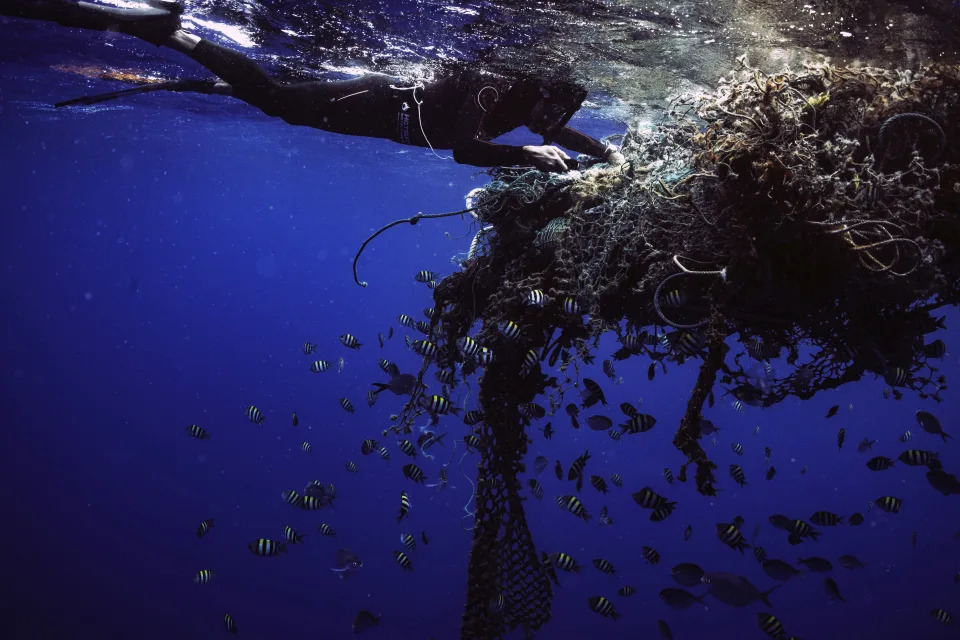
Scientists aboard a ship supporting Ben Lecomte's swim through the garbage patch sampled the water along the way, finding high concentrations of neuston, or organisms living at the water's surface. (Ben Lecomte via The New York Times)
Scientists aboard a ship supporting Ben Lecomte’s swim through the garbage patch sampled the water along the way, finding high concentrations of neuston, or organisms living at the water’s surface. (Ben Lecomte via The New York Times)

In 2019, French swimmer Benoit Lecomte swam more than 300 nautical miles through the Great Pacific Garbage Patch to raise awareness about marine plastic pollution.

As he swam, he was often surprised to find that he was not alone.

“Every time I saw plastic debris floating, there was life all around it,” Lecomte said.

The patch was less a garbage island than a garbage soup of plastic bottles, fishing nets, tires and toothbrushes. And floating at its surface were blue dragon nudibranchs, Portuguese man-o-wars and other small surface-dwelling animals, which are collectively known as neuston.

Scientists aboard the ship supporting Lecomte’s swim systematically sampled the patch’s surface waters. The team found that there were much higher concentrations of neuston within the patch than outside it. In some parts of the patch, there were nearly as many neuston as pieces of plastic.

“I had this hypothesis that gyres concentrate life and plastic in similar ways, but it was still really surprising to see just how much we found out there,” said Rebecca Helm, an assistant professor at the University of North Carolina and co-author of the study. “The density was really staggering. To see them in that concentration was like, wow.”

The findings were posted last month on bioRxiv and have not yet been subjected to peer review. But if they hold up, Helm and other scientists say, it may complicate efforts by conservationists to remove the immense and ever-growing amount of plastic in the patch.

The world’s oceans contain five gyres, large systems of circular currents powered by global wind patterns and forces created by Earth’s rotation. They act like enormous whirlpools, so anything floating within one will eventually be pulled into its center. For nearly a century, floating plastic waste has been pouring into the gyres, creating an assortment of garbage patches. The largest, the Great Pacific Patch, is halfway between Hawaii and California and contains at least 79,000 tons of plastic, according to the Ocean Cleanup Foundation. All that trash turns out to be a great foothold for living things.

Helm and her colleagues pulled many individual creatures out of the sea with their nets: by-the-wind sailors, free-floating hydrozoans that travel on ocean breezes; blue buttons, quarter-sized cousins of the jellyfish; and violet sea-snails, which build “rafts” to stay afloat by trapping air bubbles in a soaplike mucus they secrete from a gland in their foot. They also found potential evidence that these creatures may be reproducing within the patch.

“I wasn’t surprised,” said Andre Boustany, a researcher with the Monterey Bay Aquarium in California. “We know this place is an aggregation area for drifting plastics, so why would it not be an aggregation area for these drifting animals as well?”

Little is known about neuston, especially those found far from land in the heart of ocean gyres.

“They are very difficult to study because they occur in the open ocean and you cannot collect them unless you go on marine expeditions, which cost a lot of money,” said Lanna Cheng, a research scientist at the University of California, San Diego.

Because so little is known about the life history and ecology of these creatures, this study, though severely limited in size and scope, offers valuable insights to scientists.

But Helm said there is another implication of the study: Organizations working to remove plastic waste from the patch may also need to consider what the study means for their efforts.

There are several nonprofit organizations working to remove floating plastic from the Great Pacific Patch. The largest, the Ocean Cleanup Foundation in the Netherlands, developed a net specifically to collect and concentrate marine debris as it is pulled across the sea’s surface by winds and currents. Once the net is full, a ship takes its contents to land for proper disposal.

Helm and other scientists warn that such nets threaten sea life, including neuston. Although adjustments to the net’s design have been made to reduce bycatch, Helm believes any large-scale removal of plastic from the patch could pose a threat to its neuston inhabitants.

“When it comes to figuring out what to do about the plastic that’s already in the ocean, I think we need to be really careful,” she said. The results of her study “really emphasize the need to study the open ocean before we try to manipulate it, modify it, clean it up or extract minerals from it.”

Laurent Lebreton, an oceanographer with the Ocean Cleanup Foundation, disagreed with Helm.

“It’s too early to reach any conclusions on how we should react to that study,” he said. “You have to take into account the effects of plastic pollution on other species. We are collecting several tons of plastic every week with our system — plastic that is affecting the environment.”

Plastic in the ocean poses a threat to marine life, killing more than 1 million seabirds every year, as well as more than 100,000 marine mammals, according to UNESCO. Everything from fish to whales can become entangled, and animals often mistake it for food and end up starving to death with stomachs full of plastic.

Ocean plastics that do not end up asphyxiating an albatross or entangling an elephant seal eventually break down into microplastics, which penetrate every branch of the food web and are nearly impossible to remove from the environment.

One thing everyone agrees on is that we need to stop the flow of plastic into the ocean.

“We need to turn off the tap,” Lecomte said.