ALS Patient Asks Arizona Senator McCain To Help Save His Life

“Senator John McCain, you’re fighting for your life just like I am.” – Ady Barkan, who went viral for his conversation with Senator Jeff Flake on a plane, now pleads with John McCain to vote NO on the GOP tax plan.

Arizonians, tell Senator John McCain to do the right thing by the American people, and vote down this tax bill: (855) 378-7316

ALS Patient to Sen. McCain: Keep Your Promise

"Senator John McCain, you're fighting for your life just like I am." – Ady Barkan, who went viral for his conversation with Senator Jeff Flake on a plane, now pleads with John McCain to vote NO on the GOP tax plan.Arizonians, tell Senator John McCain to do the right thing by the American people, and vote down this tax bill: (855) 378-7316

Posted by MoveOn.org on Friday, December 15, 2017

Democrat Doug Jones beats Roy Moore to claim deep-red Alabama Senate seat

Yahoo News

Democrat Doug Jones beats Roy Moore to claim deep-red Alabama Senate seat

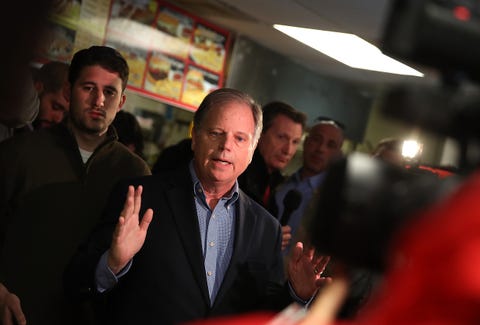
Alabama Democrat Doug Jones celebrates his victory over Judge Roy Moore at the Sheraton in Birmingham, Ala., on Tuesday, Dec. 12, 2017. (Photo: Bill Clark/CQ Roll Call, cover thumbnail photo: John Bazemore/AP)

In a stunning upset, Democrat Doug Jones defeated Republican Roy Moore in Alabama’s Senate special election Tuesday.

Liz Goodwin         December 12, 2017

With 95 percent of the votes counted in a race in which the lead shifted back and forth, the Associated Press declared Jones the winner.

Jones, a former U.S. attorney who prosecuted Ku Klux Klan members for an infamous 1963 church bombing in Birmingham, will be the first Democrat to represent deep-red Alabama in the Senate in 20 years. He fills the seat left vacant by Attorney General Jeff Sessions, and is not up for re-election until 2020.

A stunned looking Jones told supporters at a victory party that he didn’t know “what the hell to say” before recovering and launching into a thank you speech. “I always believed that the people of Alabama had more in common than divided us,” the senator-elect said. “We have shown the country the way that we can be unified.”

Jones said his win was a message to lawmakers that people want them to work together.

“Take this election from the great state of Alabama … and go ahead and fund that CHIP program before I get up there!” Jones said, referencing a children’s health insurance program that the GOP-controlled Senate has left unfunded for more than two months.

Moore appeared briefly in front of his supporters late Tuesday night and, refusing to concede, suggested there may be a recount in the election. “That’s what we’ve got to do: Wait on God,” Moore said, adding that he was upset that the media had portrayed his campaign unfavorably. Recounts are automatically triggered by wins of .5 percent and less—Jones’s lead is 1.5 percent with 99 percent of ballots counted.

The upset is a major embarrassment for President Donald Trump, who threw his full support behind Moore even after multiple allegations emerged that he had pursued sexual relationships with teenagers as an adult.

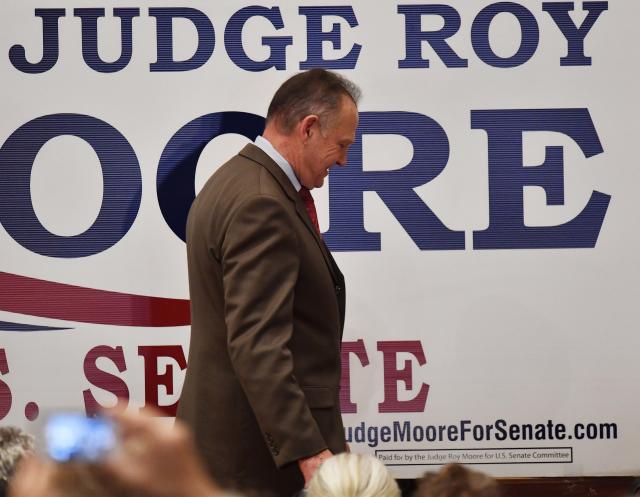
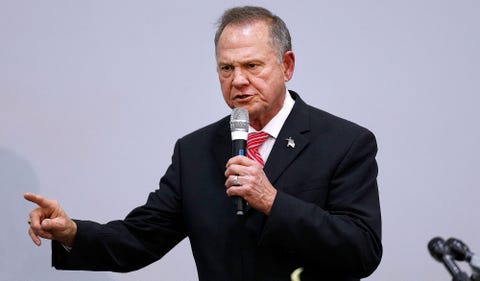
U.S. Senate candidate Roy Moore leaves the stage after speaking at the RSA activity center, Tuesday, Dec. 12, 2017, in Montgomery, Ala. Moore did not concede defeat to his Democratic opponent Doug Jones. (Photo: Mike Stewart/AP)

But shortly after Jones’ victory was solidified, Trump sounded a conciliatory note on Twitter.

“Congratulations to Doug Jones on a hard fought victory,” the president said. “The write-in votes played a very big factor, but a win is a win. The people of Alabama are great, and the Republicans will have another shot at this seat in a very short period of time. It never ends!”

Jones’ upset also a shot in the arm for Democrats, who are hoping that anger at Trump and congressional Republicans will fuel a “wave” election in 2018, flipping the U.S. House of Representatives, and perhaps even the Senate, blue.

Moore, a former judge who was removed from office twice before running for the Senate, was caught off guard by the allegations against him. One woman said Moore touched her sexually when she was 14; another said he sexually assaulted her when she was just 16 years old and he was an assistant district attorney.

Moore vehemently refuted the allegations, but several high-profile Republicans, including Senate Majority Leader Mitch McConnell, said they believed the women, who made the accusations on the record. Trump, however, never abandoned Moore, even cutting a robocall for him in Alabama that called Jones a “puppet of Nancy Pelosi and Chuck Schumer.” Trump won the state last year by 28 points, and his failure to push Moore over the finish line could spell trouble for the unpopular president’s political strategy going forward.

Moore’s troubled candidacy unexpectedly turned one of the most Republican states in the country into a battleground, with Moore leading his Democratic opponent by just 2 percentage points in an average of polls. In the end, Jones won, driven by high turnout in black communities and low turnout in whiter, rural parts of the state.

Supporters celebrate at the election night party for Democratic Alabama U.S. Senate candidate Doug Jones in Birmingham, Alabama, U.S., December 12, 2017. (Photo: Marvin Gentry/Reuters)

Jones’s victory also endangers Republicans’ tax reform legislation in Congress, which passed by a narrow majority in the Senate earlier this month. Both the Senate and the House will have to pass another combined version of the tax bill to send it to the president’s desk. With one fewer Republican in the chamber, McConnell can lose only one vote and still push through the bill, which has not attracted any Democratic support. Sen. Bob Corker, R-Tenn., has already voted against the legislation once, and Sen. Susan Collins, R-Maine, has made several demands regarding health care that must be met before she’ll support it again. McConnell could rush the vote before Jones is seated in January, however.

Though Moore’s defeat reduces McConnell’s razor-thin majority in the Senate, it also means Senate Republicans will not be associated with someone accused of abusing children.  Many Senate Republicans were openly hoping Moore would lose, and Sen. Jeff Flake, R-Ariz., tweeted after Jones’s victory that “decency” had won the night. They’ll also avoid what would have been a contentious ethics investigation and potential expulsion vote for Moore. Sen. Cory Gardner, R-Colo., put out a statement Tuesday night urging Jones to vote with Republicans in the Senate.

The loss will likely fuel the intra-conservative war between former White House strategist Steve Bannon, who fueled Moore’s populist candidacy, and McConnell and other establishment Republicans. Bannon has threatened to mount primary challenges against some mainstream Republican senators with insurgent candidates like Moore. McConnell has argued that extreme candidates have trouble winning general elections, and that Bannon should butt out.

Jones ran a vigorous campaign up to the end, targeting the state’s black population last weekend. He brought in Sen. Cory Booker, D-N.J., and Rep. Cedric Richmond, D-La., to stump for him. Jones also ran ads featuring prominent Republicans, including Sen. Richard Shelby, R-Ala., disavowing Moore, in a bid to peel off conservatives.

Meanwhile, Moore lay low, holding no campaign events until a rally Monday with Bannon.

“If you don’t believe in my character, don’t vote for me,” Moore said then.

The Bombs, the Church, the City, the State

Esquire

The Bombs, the Church, the City, the State

What was Alabama back then? And what is Alabama right now?

Getty

By Charles P. Pierce      December 11, 2017

BIRMINGHAM, ALABAMA—There are certain iconic places from our history on which we can all pretty much agree—Bunker Hill, Fort McHenry, the Motown studios in Detroit and the Stax studios in Memphis. There are some iconic places from our history that are, at best, unsettling and, at worst, divisive as all hell. We saw that exercised over the past years in places like Liberty Place in New Orleans, where a monument to a successful act of white supremacist terrorism was finally moved into the obscurity it has long deserved.

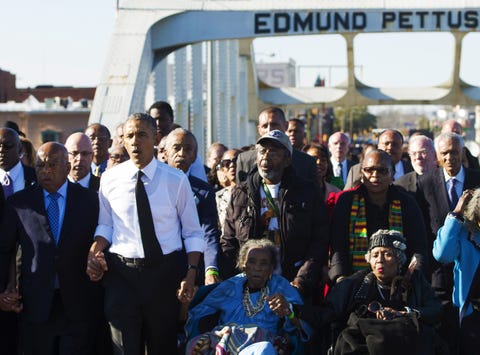
And then there are certain iconic places from our history that make us avert our moral inner eyes because, while we admire the people that made these places historic, we remain uncomfortable with the situations that made that courage necessary. They put a flinch in our historical memory. Since the 1950s, Alabama has been awash in these places. There is Montgomery, where the bus boycott began. There is the bus station in Anniston, where a mob tried to burn the Freedom Riders to death. There are the stops along Route 80, where the great march from Selma to Montgomery passed in 1965. There is the Edmund Pettus Bridge.

Getty

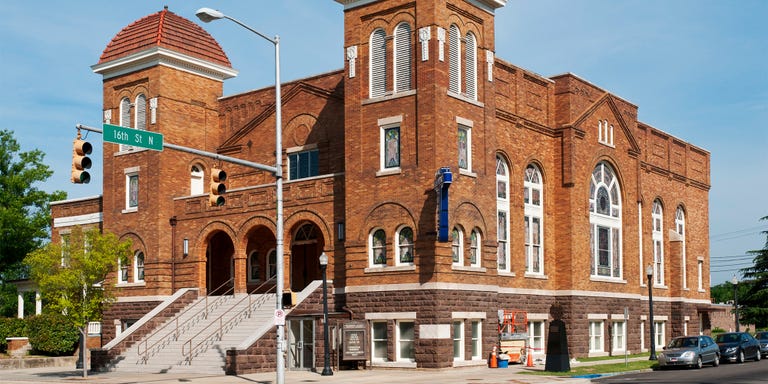
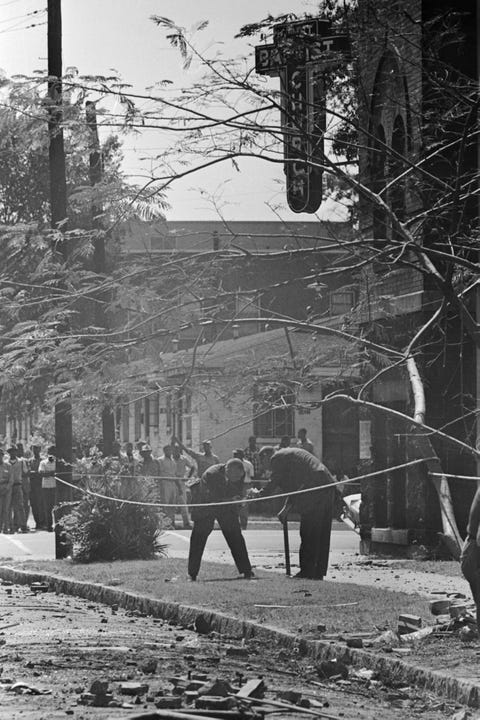
And there is the 16th Street Baptist Church here in Birmingham, which has been a gathering place for African-Americans since it was finished in 1911. Paul Robeson sang there. W.E.B. DuBois and Mary McLeod Bethune spoke there. And, at 10:22 a.m. on September 15, 1963, a Sunday morning, a group of four white supremacist terrorists planted 15 sticks of dynamite in the church and blew it up, killing four little girls and injuring at least 20 other parishioners, and converted the 16th Street Baptist Church into one of those places that all Americans of a certain age know about instinctively, and one of those places that many Americans talk about with a familiar flinch in their memory.

The flinch keeps too many of us from remembering that this was the third bombing in Birmingham over the previous 11 days, and that the campaign of destruction came in the wake of a federal court decision mandating the integration of Birmingham’s public schools. The flinch keeps us from remembering that the people of the church rebuilt it in less than a year, that a stained-glass window was donated by some people in Wales who were shocked and disgusted by something that had happened in America. The flinch never has left our national mind. It keeps us from remembering that the forces that brought down the walls of the church still maintain a certain destructive power. The flinch is caused by something real, something dark, something alive.

Getty

In the years between 1995 and 1997, the Department of Justice under Bill Clinton was examining a series of arsons that had struck largely African-American churches in the South. The head of the DOJ’s Civil Rights division was a Massachusetts lawyer named Deval Patrick. It was the largest DOJ investigation ever conducted, prior to the probe into the attacks of September 11, 2001. (The investigation resulted in more than 100 arrests, but no evidence of a conspiracy linking the attacks ever was found—which, in some ways, makes the whole thing worse.) During the course of that investigation, Patrick and his team picked up some information regarding suspects in the church bombing who never had been brought to justice.

In 1977, a Ku Klux Klan member named Robert Chambliss had been tried and convicted for his part in the crime, but the FBI and other investigators long had been convinced that Chambliss hardly acted alone. Now, over 30 years later, the FBI went back through the vast files it had accumulated at the time of the bombing. Eventually, two aging Klansmen, Bobby Cherry and Thomas Blanton were arrested and tried for their part in the 16th Street Baptist Church bombing. The two were convicted. Cherry died in prison and Blanton is still there. The prosecutor who put them there was an assistant U.S. Attorney named Doug Jones. He looked at the two old murderers and the flinch was not in him. He put them away.

THE FLINCH IS CAUSED BY SOMETHING REAL, SOMETHING DARK, SOMETHING ALIVE.

On Sunday, in the middle of a crowd on the sidewalk in front of Jones’s Birmingham headquarters, a fine Stetson hat on his head, Armond Bragg was making a lot of noise, leading chants and cheers, and generally having a high old time for himself, listening to Senator Cory Booker. Bragg ran his own pest control business for 30 years until he retired. He did not go in much for politics until Barack Obama ran for president in 2008. Now, though, he has worked day and night for Doug Jones because Armond Bragg remembers when they called his town “Bombingham.” He is a member of the 16th Baptist Church, and, as such, he is not afflicted at all by the flinch.

“I’m a member of the 16th Street Baptist Church and Doug convicted the bombers there back during a time when that wasn’t popular to do, especially for a white man. Then, he prosecuted the guy who bombed the abortion clinic. (Eric Rudolph, who later bombed Olympic Park during the 1996 Olympic Games in Atlanta.) I’ve just been impressed with his career.

“It wasn’t popular to do back in the day. It’s not popular now. Look, you got a guy who’s running who’s got an impeccable record, when you look at his history. And we got on the other side, a guy who’s done everything wrong to tell you the truth. It’s a no-brainer, when you look at the records. When you look at the two individuals, there’s no comparison.

“Doug Jones has run an impeccable campaign. I mean, you can’t just reach for African-American votes. You got to reach into other communities, too. That’s what I think needs to be done. You got to have a man who can go into—well, ‘Flour Country,’ I guess we call it—and also come to the city. Somebody’s got to do that. Doug Jones is that man.”

Getty

In so many ways, while Roy Moore is running a ghost campaign, Doug Jones is running a haunted one. He called the entire city out on its flinch, and some people resent the hell out of the fact that he did. He called the anti-choice movement out on its toleration of its wilder fringes, and some people resent the hell out of that, too. But not all the ghosts in our history are evil. The spirits of Addie Mae Collins, Denice McNair, Carole Robertson, and Cynthia Wesley called out over the decades for the peace and the justice they deserved. In 2001, their cries finally were heard.

On his stump speech, Doug Jones often quotes, from memory, a passage taken from The Cure at Troy, Irish poet Seamus Heaney’s magnificent re-imagining of Sophocles’s ancient play, Philocetes.

History says, don’t hope on the side of the grave.’

But then, once in a lifetime, the longed for tidal wave of justice can rise up.

And hope and history rhyme.

Sometimes, that rhyme is an epic poem, an Iliad from inside a Birmingham jail. And sometimes, often, that rhyme is a nursery rhyme, sung by children playing hard at double-dutch, but only after Sunday school is over.

Respond to this post on the Esquire Politics Facebook page.

U.S. not granting loan relief to defrauded students: inspector general

Reuters

U.S. not granting loan relief to defrauded students: inspector general

By Lisa Lambert, Reuters     December 11, 2017  

FILE – In this Oct. 13, 2017, file photo, Education Secretary Betsy DeVos speaks during a dinner hosted by the Washington Policy Center in Bellevue, Wash. DeVos says college students will soon be able to file their applications for federal student aid through a mobile app. DeVos is pledging to modernize the financial aid applications and make it more accessible and simpler. She spoke Tuesday at a conference of student aid professionals in Orlando, Florida. (AP Photo/Ted S. Warren, File)

WASHINGTON (Reuters) – The U.S. Education Department under President Donald Trump and Secretary Betsy DeVos has stopped cancelling the student-loan debt of people defrauded by failed for-profit schools and those borrowers face mounting interest and other burdens, its inspector general said on Monday.

DeVos is seeking to redo the process for cancelling the debts of people who attended Corinthian Colleges, which collapsed in 2015 amid government investigations into its post-graduation rates, and other failed schools.

In the final days of his administration, President Barack Obama approved rules speeding up the debt cancellations. DeVos has delayed implementing those rules, saying they would create significant costs for taxpayers.

According to a report by the inspector general, DeVos also brought the existing cancellation process to a crawl.

Since Trump’s inauguration on Jan. 20, the department has received 25,991 claims for discharging loans. It has denied two requests and approved none, the inspector general, an independent auditor within the agency, found.

That is in contrast to Obama’s final months in office. From July 1, 2016, through inauguration, the department received 46,274 claims and approved 27,986. It denied none.

Caught in limbo, borrowers are seeing interest and fees accrue and their credit damaged, the inspector general’s report showed. Borrowers could ultimately owe more on a denied discharge than if they had not asked for cancellation and simply continued making payments, the inspector said.

Some state attorneys general have pushed the department to cancel the loans, saying students cannot afford to repay the often-large amounts because the schools did not give them adequate training or a diploma.

The inspector general also found the department did not have a sufficient information system and had to manually retrieve claims data.

“Hundreds of thousands of students were defrauded and cheated by predatory colleges that broke the law, but today’s report confirms Secretary DeVos tried to shirk her responsibility to these students and shut down the borrower-defense program, leaving them with nowhere to turn,” said Senator Patty Murray, the senior Democrat on the Education Committee.

In a memo to the inspector general, A. Wayne Johnson, chief operating officer of the federal student aid program, said the department has “authorized an interest credit” for long-outstanding claims, will resume reviewing some claims and will soon approve claims for 11,000 Corinthian students.

(Reporting by Lisa Lambert; Editing by Cynthia Osterman)

Alabama has the worst poverty in the developed world, U.N official says.

Newsweek

Alabama has the worst poverty in the developed world, U.N official says.

by Carlos Ballesteros     December 10, 2017

U.N officials touring rural Alabama are shocked at the level of poverty and environmental degradation. They must not have seen Mississippi.
“I think it’s very uncommon in the First World. This is not a sight that one normally sees. I’d have to say that I haven’t seen this,” Philip Alston, the U.N.’s Special Rapporteur on extreme poverty and human rights, told Connor Sheets of AL.com earlier this week as they toured a community in Butler County where “raw sewage flows from homes through exposed PVC pipes and into open trenches and pits.”


The tour through Alabama’s rural communities is part of a two-week investigation by the U.N. on poverty and human rights abuses in the United States. So far, U.N. investigators have visited cities and towns in California and Alabama, and will soon travel to Puerto Rico, Washington, D.C., and West Virginia.

Of particular concern to Alston are specific poverty-related issues that have surfaced across the country in recent years, such as an outbreak of hookworm in Alabama in 2017—a disease typically found in nations with substandard sanitary conditions in South Asia and Subsaharan Africa, as reported by The Guardian.

GettyImages-465399018A pedestrian walks through a neighborhood with run down homes on March 6, 2015 in Selma, Alabama.(JUSTIN SULLIVAN/GETTY IMAGES)

The U.N. investigation aims to study the effects of systemic poverty in a prosperous nation like the United States.

According to the Census Bureau, nearly 41 million people in the U.S. live in poverty. That’s second-highest rate of poverty among rich countries, as measured by the percentage of people earning less than half the national median income, according to Quartz.

These income and wealth disparities affect minorities the most. Black, Hispanic, and Native American children, for example, are two to three times more likely to live in poverty than white kids, according to a study using Census data by the Annie E. Casey Foundation. Minorities in the United States have also historically had higher rates of unemployment, worked longer hours, and gotten paid less than their white counterparts on average, as reported in a 2013 article in The Atlantic that analyzed data from the Bureau of Labor Statistics stretching back to 1975.

Economic inequality and racial discrimination have also been linked with civil rights abuses, particularly in Alabama and other states across the South. Police shootings of unarmed black men and women are also of deep concern to the U.N.

Alston, who’s also a law professor at New York University, said in a statement announcing the start of the U.N. investigation that poverty in the U.S. has been overlooked for too long.

“Some might ask why a U.N. Special Rapporteur on extreme poverty and human rights would visit a country as rich as the United States,” Alston said. “But despite great wealth in the U.S., there also exists great poverty and inequality.”

Alston also pointed out that the U.S. “has been very keen” on other countries being investigated by the U.N. for civil and human rights issues.

“Now, it’s the turn to look at what’s going on in the U.S.,” Alston said. “There are pretty extreme levels of poverty in the United States given the wealth of the country. And that does have significant human rights implications.”

GettyImages-465399024Tires lay in the grass in front of a shuttered auto parts business on March 6, 2015 in Selma, Alabama.(JUSTIN SULLIVAN/GETTY IMAGES)

Despite these concerns, the Republican Party, which controls all three branches of the federal government, is on course to pass a tax bill before the end of the year that will increase the federal deficit by $1 trillion in 10 years—costs that GOP leaders have said will be offset by reducing an already-weakened social safety net.

For Alston, these political decisions are at the root of systemic poverty in the U.S.

“The idea of human rights is that people have basic dignity and that it’s the role of the government—yes, the government!—to ensure that no one falls below the decent level,” he said.  “Civilized society doesn’t say for people to go and make it on your own and if you can’t, bad luck.”

“Politicians who say, ‘there’s nothing I can do about that’ are simply wrong,” Alston told WKMS 91.3 FM, a public radio station in Ohio near one of the other sites under investigation by the U.N.

Police officer cleared of murder after shooting a sobbing man as he crawled along a hotel corridor 

The Telegraph

‘Please don’t kill me’: Police officer cleared of murder after shooting a sobbing man as he crawled along a hotel corridor

A body camera video captured the fatal shooting of 26-year-old Daniel Shaver.

https://www.yahoo.com/news/video-shows-fatal-police-shooting-161242848.html

Rozina Sabur, The Telegraph     December 8, 2017

A former Arizona police officer has been acquitted of murder after he shot and killed an unarmed man outside his hotel room.

Philip Mitchell Brailsford, 27, shot Daniel Shaver in 2016 when he was responding to call that someone there was pointing a gun out of a window.

The shooting occurred in the Phoenix suburb of Mesa after officers ordered Mr Shaver to exit his hotel room, lay face-down in a hallway and refrain from making sudden movements.

Mr Shaver, a 26-year-old father-of-two, sobbed as he begged police not to shoot and was ordered to crawl toward officers.

Video of the shooting, which Shaver’s family has referred to as an “execution”, has finally been released.

It shows a sobbing Mr Shaver lying on the floor and crawling towards the police officer. He can be heard begging “please don’t kill me” at the officers.

Daniel Shaver (pictured with his daughters) was heard saying “please don’t shoot me, please don’t shot me”, according to audio heard on a police video of the incident

Daniel Shaver (pictured with his daughters) was heard saying “please don’t shoot me, please don’t shot me”, according to audio heard on a police video of the incident

As he inched forward, he reached toward the waistband of his shorts. Mr Brailsford said he fired his rifle because he believed Mr Shaver was grabbing a handgun in his waistband.

While no gun was found on Mr Shaver’s body, two pellet rifles related to his pest-control job were later found in his room.

The detective investigating the shooting had agreed Mr Shaver’s movement was similar to reaching for a pistol, but has said it also looked as though Shaver was pulling up his loose-fitting basketball shorts that had fallen down as he was ordered to crawl toward officers.

The investigator noted he did not see anything that would have prevented officers from simply handcuffing Mr Shaver as he was on the floor.

Mr Brailsford’s attorney Michael Piccarreta put an arm around his client after the verdict was read.

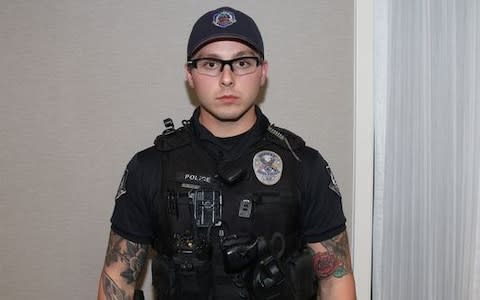
Mitch Brailsford has been fired from the Mesa police force and charged with second degree murder - Credit: Mesa Police department

Mitch Brailsford was fired from the Mesa police force and charged with second degree murderCredit: Mesa Police department

“There are no winners in this case, but Mitch Brailsford had to make a split-second decision on a situation that he was trained to recognize as someone drawing a weapon and had one second to react,” Mr Piccarreta said.

“He didn’t want to harm Mr Shaver… The circumstances that night that were presented led him to conclude that he was in danger. Try to make a decision in one second, life or death. It’s pretty hard.”

Mr Piccarreta also said he wasn’t sure his client would be interested in trying to get his police job back.   Mr Shaver’s widow, Laney Sweet, and Mr Shaver’s parents have filed wrongful-death lawsuits against the city of Mesa over the shooting death.

Ms Sweet shook her head after the jury’s decision and said she was not going to answer any questions.

During his trial testimony, Mr Brailsford described the stress that he faced in responding to the call and his split-second decision to shoot Mr Shaver.

Mr Brailsford told jurors that he was terrified for the safety of officers and a woman who was in the hallway. He also said he felt “incredibly sad” for Mr Shaver.

Mr Brailsford served as a Mesa officer for about two years before he was fired for violations of departmental policy, including unsatisfactory performance.

He is one of the few police officers in the US to be charged with murder for shooting someone while on duty.

The shooting occurred as police departments across the US became focal points of protests over deadly encounters with law enforcement.

Some Comments:

Tower: Tell the guy not to move, police officer can then go to him and cuff him. Why would you tell the man to crawl, making everything more dangerous and confusing?!?!

SkywardSword: More training? Nope. convicting them and holding them accountable will work better.

LDC4: A case where the jury totally got it wrong. This police officer murdered this unarmed civilian. The video more than shows this. This cop just plain panicked and did not know how to do his job and as a result an innocent human being is dead. And people wonder why the police are not trusted?

Mary: What was the point in making him crawl? This is murder.

Hank: i’m in New Zealand even makes me sick looking at the father with his 2 beautiful little girls now left without their father for the rest of their lives to read this article

James: Any reasonable person can see this cop had ZERO reason to fear for his safety. The man had already complied for a good 3 minutes. The officers commands were confusing and contradictory. Just awful.

Live Long And Prosper: Really? Made him crawl? Once he was on the floor, all they had to do was handcuff him. Idiots. Hope the family is planning for a HUGE civil trial…this dept. deserves being bankrupted.

Fish’nFinatic: How can anyone look at that video and not think the cop executed this guy?

Franz August: It’s honestly amazing. I am an American Soldier. If I did this to an Iraqi I would be in prison for war crimes. It is absolutely insane that police can treat citizens worse than enemy civilians

Arturo: Mr Brailsford you murdered this man.

I study liars. I’ve never seen one like Donald Trump.

Chicago Tribune

Commentary: I study liars. I’ve never seen one like Donald Trump.

I spent the first two decades of my career as a social scientist studying liars and their lies. I thought I had developed a sense of what to expect from them. Then along came President Donald Trump. His lies are both more frequent and more malicious than ordinary people’s.

In research beginning in the mid-1990s, when I was a professor at the University of Virginia, my colleagues and I asked 77 college students and 70 people from the nearby community to keep diaries of all the lies they told every day for a week. They handed them in to us with no names attached. We calculated participants’ rates of lying and categorized each lie as either self-serving (told to advantage the liar or protect the liar from embarrassment, blame or other undesired outcomes) or kind (told to advantage, flatter or protect someone else).

At The Washington Post, the Fact Checker feature has been tracking every false and misleading claim and flip-flop made by Trump this year. The inclusion of misleading statements and flip-flops is consistent with the definition of lying my colleagues and I gave to our participants: “A lie occurs any time you intentionally try to mislead someone.” In the case of Trump’s claims, though, it is possible to ascertain only whether they were false or misleading, and not what the president’s intentions were.

I categorized the most recent 400 lies that The Post had documented through mid-November in the same way my colleagues and I had categorized the lies of the participants in our study.

Manteno, IL: Residents Who Drive A CHEVROLET EQUINOX Should Check This Out

The college students in our research told an average of two lies a day, and the community members told one. (A more recent study of the lies 1,000 U. S. adults told in the previous 24 hours found that people told an average of 1.65 lies per day; the authors noted that 60 percent of the participants said they told no lies at all, while the top 5 percent of liars told nearly half of all the falsehoods in the study.) The most prolific liar among the students told an average of 6.6 lies a day. The biggest liar in the community sample told 4.3 lies in an average day.

In Trump’s first 298 days in office, however, he made 1,628 false or misleading claims or flip-flops, by The Post’s tally. That’s about six per day, far higher than the average rate in our studies. And of course, reporters have access to only a subset of Trump’s false statements — the ones he makes publicly — so unless he never stretches the truth in private, his actual rate of lying is almost certainly higher.

That rate has been accelerating. Starting in early October, The Post’s tracking showed that Trump told a remarkable nine lies a day, outpacing even the biggest liars in our research.

But the flood of deceit isn’t the most surprising finding about Trump.

Both the college students and the community members in our study served their own interests with their lies more often than other people’s interests. They told lies to try to advantage themselves in the workplace, the marketplace, their personal relationships and just about every other domain of everyday life. For example, a salesperson told a customer that the jeans she was trying on were not too tight, so she could make the sale. The participants also lied to protect themselves psychologically: One college student told a classmate that he wasn’t worried about his grades, so the classmate wouldn’t think he was stupid.

Less often, the participants lied in kind ways, to help other people get what they wanted, look or feel better, or to spare them from embarrassment or blame. For example, a son told his mother he didn’t mind taking her shopping, and a woman took sides with a friend who was divorcing, even though she thought her friend was at fault, too.

About half the lies the participants told were self-serving (46 percent for the college students, 57 percent for the community members), compared with about a quarter that were kind (26 percent for the students, 24 percent for the community members). Other lies did not fit either category; they included, for instance, lies told to entertain or to keep conversations running smoothly.

One category of lies was so small that when we reported the results, we just tucked them into a footnote. Those were cruel lies, told to hurt or disparage others. For example, one person told a co-worker that the boss wanted to see him when he really didn’t, “so he’d look like a fool.” Just 0.8 percent of the lies told by the college students and 2.4 percent of the lies told by the community members were mean-spirited.

My colleagues and I found it easy to code each of our participants’ lies into just one category. This was not the case for Trump. Close to a quarter of his false statements (24 percent) served several purposes simultaneously.

Nearly two-thirds of Trump’s lies (65 percent) were self-serving. Examples included: “They’re big tax cuts — the biggest cuts in the history of our country, actually” and, about the people who came to see him on a presidential visit to Vietnam last month: “They were really lined up in the streets by the tens of thousands.”

Slightly less than 10 percent of Trump’s lies were kind ones, told to advantage, flatter or protect someone else. An example was his statement on Twitter that “it is a ‘miracle’ how fast the Las Vegas Metropolitan Police were able to find the demented shooter and stop him from even more killing!” In the broadest sense, it is possible to interpret every lie as ultimately self-serving, but I tried to stick to how statements appeared on the surface.

Trump told 6.6 times as many self-serving lies as kind ones. That’s a much higher ratio than we found for our study participants, who told about double the number of self-centered lies compared with kind ones.

The most stunning way Trump’s lies differed from our participants’, though, was in their cruelty. An astonishing 50 percent of Trump’s lies were hurtful or disparaging. For example, he proclaimed that John Brennan, James Clapper and James Comey, all career intelligence or law enforcement officials, were “political hacks.” He said that “the Sloppy Michael Moore Show on Broadway was a TOTAL BOMB and was forced to close.” He insisted that other “countries, they don’t put their finest in the lottery system. They put people probably in many cases that they don’t want.” And he claimed that “Ralph Northam, who is running for Governor of Virginia, is fighting for the violent MS-13 killer gangs & sanctuary cities.”

The Trump lies that could not be coded into just one category were typically told both to belittle others and enhance himself. For example: “Senator Bob Corker ‘begged’ me to endorse him for reelection in Tennessee. I said ‘NO’ and he dropped out (said he could not win without my endorsement).”

The sheer frequency of Trump’s lies appears to be having an effect, and it may not be the one he is going for. A Politico/Morning Consult poll from late October showed that only 35 percent of voters believed that Trump was honest, while 51 percent said he was not honest. (The others said they didn’t know or had no opinion.) Results of a Quinnipiac University poll from November were similar: Thirty-seven percent of voters thought Trump was honest, compared with 58 percent who thought he was not.

For fewer than 40 percent of American voters to see the president as honest is truly remarkable. Most humans, most of the time, believe other people. That’s our default setting. Usually, we need a reason to disbelieve.

Research on the detection of deception consistently documents this “truth bias.” In the typical study, participants observe people making statements and are asked to indicate, each time, whether they think the person is lying or telling the truth. Measuring whether people believe others should be difficult to do accurately, because simply asking the question disrupts the tendency to assume that other people are telling the truth. It gives participants a reason to wonder. And yet, in our statistical summary of more than 200 studies, Charles F. Bond Jr. and I found that participants still believed other people more often than they should have — 58 percent of the time in studies in which only half of the statements were truthful. People are biased toward believing others, even in studies in which they are told explicitly that only half of the statements they will be judging are truths.

By telling so many lies, and so many that are mean-spirited, Trump is violating some of the most fundamental norms of human social interaction and human decency. Many of the rest of us, in turn, have abandoned a norm of our own — we no longer give Trump the benefit of the doubt that we usually give so readily.

Washington Post

Bella DePaulo is the author of “How We Live Now: Redefining Home and Family in the 21st Century” and “Singled Out: How Singles Are Stereotyped, Stigmatized, and Ignored, and Still Live Happily Ever After.”

The Russians risking all to oppose Vladimir Putin.

Trump voters must ask themselves: is this the “Great America” they had in mind, when they elected a Putin wannabe bent on dismantling America’s democratic institutions and installing an autocratic kleptocracy, run by oligarchs parading as crony capitalists? I hope not!       John Hanno

The Guardian

Navalny’s army: The Russians risking all to oppose Vladimir Putin.

Opposition politician’s campaign gathers steam ahead of 2018 election, but his supporters face threats and intimidation.
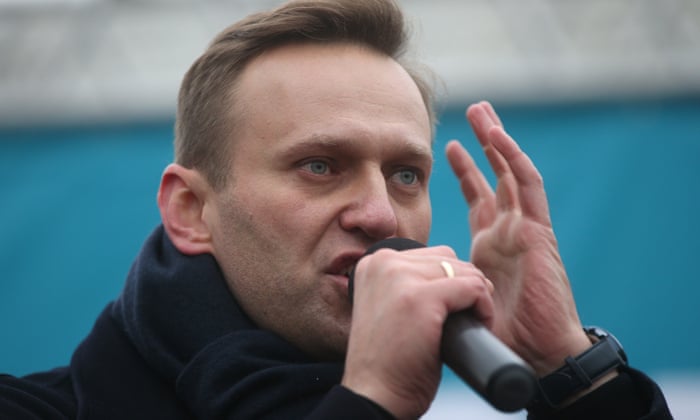
Alexei Navalny holds a rally in Izhevsk. His supporters are mainly young Russians who have known only a Putin presidency. Photograph: Yegor Aleyev/TASS 

Shaun Walker in Kemerovo     December 7, 2017

It has been a rough couple of months for Ksenia Pakhomova, a bright-eyed, garrulous 23-year-old from the Siberian mining town of Kemerovo. Her boyfriend was kicked out of university, her mother was fired from her teaching job at an arts school, and her grandmother was threatened with dismissal from her job at a gallery.

To top it off, someone plastered notices with her photograph in public places near her home, complete with her mobile number and an offer of sexual services.

All of this appears to be linked to Pakhomova’s job: she is the regional coordinator for the presidential campaign of Alexei Navalny, an opposition politician who wants to challenge Vladimir Putin for the Russian presidency in elections next March.

Putin finally declared his candidacy on Wednesday in a long-expected announcement, and is likely to win comfortably. Standing against him are a familiar cast of political has-beens and a few spoiler candidates whom few Russians are taking seriously.

Navalny will most likely be barred from standing due to a criminal conviction in a case that was widely seen as politically motivated, but the 41-year-old anti-corruption campaigner is ignoring this. Instead, he has chosen to engage in the kind of enthusiastic, grassroots campaigning that has been absent from Russia in recent years: real politics, in short. He has embarked on a marathon of trips across the country’s vast expanse, holding rallies and setting up campaign headquarters.

The liberal opposition has traditionally made few inroads in places like Kemerovo, a tough, working-class region four hours by plane from Moscow. Here, Navalny is attracting the support of a different kind of Russian from the chattering, Moscow intellectual class that many see as the natural supporters of the democratic opposition.

Navalny’s supporters are mainly young Russians who have known little in their lifetimes except a Putin presidency.

Pakhomova, who studied law at university, said she was not particularly political until earlier this year, when she started watching Navalny’s videos. She was particularly horrified by a video alleging staggering corruption on the part of the prime minister, Dmitry Medvedev, which led to major protests in Moscow and other cities earlier this year. In Kemerovo, she began volunteering for the local Navalny campaign, and in time, she was appointed head of the local office.

“Everyone in Russia knows that officials are corrupt, but when you see the details, how openly they think they can do it, it’s shocking,” she said.
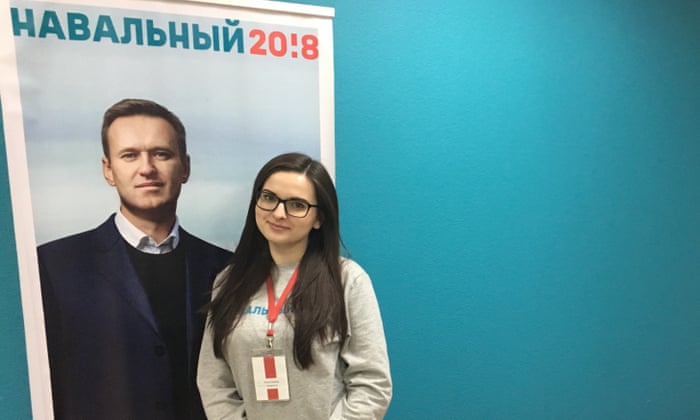
Ksenia Pakhomova, head of the Navalny campaign in Kemerovo. Photograph: Shaun Walker

Ksenia’s mother, 46-year-old Natalia Pakhomova, said she was warned in September that she should prevent her daughter from working for Navalny, but refused. At the end of October, she was removed from her job, on the pretext that anonymous parents had called the local administration and complained that teachers at her school were soliciting bribes. She had worked at the school for 26 years, and in April had received a medal from the local governor for her service.

Natalia’s 67-year-old mother, who works as a gallery attendant in the local art museum, was asked by her boss to talk her granddaughter out of working for Navalny and was also threatened with dismissal. She is on sick leave, which Natalia said was due to frayed nerves from the incident. Ksenia’s boyfriend was kicked out of university, though he has since been reinstated after an online campaign.

Navalny has said if he is not allowed on to the ballot, he will call for an “active boycott” of the elections.

“No other candidate has opened regional offices, no other candidate is properly campaigning,” he said in an interview in Moscow. “How can you have real elections without the only candidate who is campaigning?”

Navalny said that since the beginning of the year campaign staff had between them spent more than 2,000 days in jail and been fined more than 10m roubles (£129,000).

“What’s happening in Kemerovo is extreme, but it’s a pattern across Russia and it’s clearly directed from the top,” he said.

In almost every region, activists have found it hard to rent office space from which to run the campaign. In Kemerovo, Pakhomova’s team is looking to move office after its landlord said the local administration called him and warned him not to rent to the Navalny campaign.

Whenever Navalny travels, authorities also create problems, and he has been jailed or assaulted on numerous occasions this year. When he visited Kemerovo earlier this autumn, local authorities cancelled public transport to the area on the outskirts of town where they had given Navalny permission to speak.

Despite all this, more than 2,000 people attended the rally, making it one of the biggest demonstrations in Kemerovo since the miners’ strikes in the late 1980s and early 90s that heralded the collapse of the Soviet Union.

Views on how much damage Navalny can cause with his message that Putin’s inner circle are “crooks and thieves” vary. In Kemerovo, many people have still not heard of Navalny, and among those who have, views are mixed.

Boris Pavlov, the deputy head of the Kemerovo Navalny campaign, holds frequent one-man pickets (gatherings of more than one person require permission) with a Navalny sign in the centre of Kemerovo. “Sometimes people come to shake my hand, but other times I’ve had people spit at me and call me a traitor,” he said.

State television has long denied Navalny access to the airwaves, and claimed the opposition is working to promote foreign interests in Russia. Kremlin insiders portray him as a marginal figure who poses no serious electoral threat.

“His limit would be 5-10% in big cities and 2-3% overall,” said one source close to the Kremlin, who added that the only reason to keep him off the ballot was to prevent “negative vibes” around the election. “He’d have three months of telling everyone that the government is lying and corrupt, and nobody wants to listen to that.”
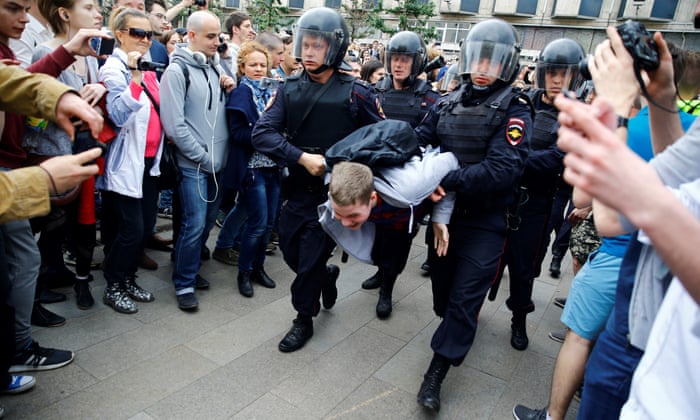
Russian police officers take into custody a protester during an unauthorized opposition rally in Moscow in June last year. Photograph: Anadolu Agency/Getty Images

But there are signs that Navalny’s message could potentially resonate among a new audience, in a country where up to now Putin has managed to remain above widespread anger at corruption.

Natalia, Ksenia’s mother, was always a Putin fan. She voted for him at the last election in 2012, and even bought Ksenia a Putin-themed calendar as a present that year, because her daughter was too young to vote, with the election falling a few days before her eighteenth birthday. But recent events have led to a recalibration of her views.

“Ksenia made me listen to the Navalny videos, and I’ll be honest, I’ve realised he’s really saying the right things. It has completely changed my views on politics,” she said.

Hers is not the only case of children changing the minds of their parents. At a training session run by Ksenia on how to deal with police last week, all but one of the eight attendees was under 18.

Dima, 14, was initially scolded by his mother for attending Navalny-backed protests in Kemerovo earlier this year, after the child support agency showed up at his house to complain. However, she is now helping to collect signatures for the campaign, and proudly took a selfie with Navalny when he came to Kemerovo.

“My mother had some problems with her politics,” said Dima, with the tone of a parent indulging an errant child, rather than vice-versa. “But afterwards she started watching Navalny’s videos and her political understanding is now more developed.”

Since you’re here …

… we have a small favor to ask. More people are reading the Guardian than ever but advertising revenues across the media are falling fast. And unlike many news organizations, we haven’t put up a paywall – we want to keep our journalism as open as we can. So you can see why we need to ask for your help. The Guardian’s independent, investigative journalism takes a lot of time, money and hard work to produce. But we do it because we believe our perspective matters – because it might well be your perspective, too.

I appreciate there not being a paywall: it is more democratic for the media to be available for all and not a commodity to be purchased by a few. I’m happy to make a contribution so others with less means still have access to information.Thomasine F-R.

If everyone who reads our reporting, who likes it, helps fund it, our future would be much more secure. For as little as $1, you can support the Guardian – and it only takes a minute. Thank you.

Support the Guardian

Senate Republicans Made a $289 Billion Mistake in the Handwritten Tax Bill They Passed at 2 a.m. Go Figure.

Not surprising that Republi-cons botched their rushed, tossed together tax bill. They are neither capable nor interested in governing effectively or crafting legislation that solves financial crisis’ for America’s middle class. Their goal was simply payback to the rich and powerful. Even a quick glance at the winners in the bill, mirrors the list of donors to Trump Inc. and the congressional GOP, not America’s other 98% or beguiled Trump voters.              John Hanno

Slate

Senate Republicans Made a $289 Billion Mistake in the Handwritten Tax Bill They Passed at 2 a.m. Go Figure.

By Jordan Weissmann      December 6, 2017

“Derp a derp derp derp derp.”  Alex Wong/Getty Images
It appears that Senate Republicans managed to make a $289 billion or so mistake while furiously hand-scribbling edits onto the tax bill they passed in the wee hours of Saturday morning. The problem involves the corporate alternative minimum tax, which the GOP initially planned to repeal, but tossed back into their stew at the last second in order to raise some desperately needed revenue. The AMT is basically a parallel tax code meant to prevent companies from zeroing out their IRS bills. It doesn’t allow businesses to take as many tax breaks but, in theory, is also supposed to have a lower rate.

Except not under the Senate bill. When Mitch McConnell & co. revived the AMT, they absentmindedly left it at its current rate of 20 percent, the same as the new, lower rate of the corporate income tax that the bill included. As a result, many companies won’t be able to use tax breaks that were supposed to be preserved in the legislation, including the extremely popular credit for research and development costs. Corporate accountants started freaking out about this over the weekend, but the situation reached high farce when a group of lawyers from Davis Polk pointed out that, by leaving the AMT intact, Republicans had essentially undermined their bill’s most important changes to the international tax code.

Without getting too stuck in the weeds, the GOP’s bill was supposed to take the U.S. from a “worldwide” system of taxation, where the IRS tries to take a cut of profits American companies earn anywhere on the globe, to a modified “territorial” system, where companies could bring back their profits either tax-free or at a much lower rate. With the AMT still kicking around at 20 percent, though, “the United States would continue to operate under a worldwide system of taxation,” the lawyers wrote.

Keeping the AMT was supposed to raise $40 billion, but that already appears to be a gross underestimate. (The figure came from Congress’ Joint Committee on Taxation, whose analysts I can only assume were running on Red Bull and fumes while trying to provide the GOP with last-minute scores.) NYU Law professor and tax expert Lily Batchelder concludes that the AMT will actually cost companies at least $329 billion—good for limiting the blow to the deficit, bad for the corporations who are supposed to be stumping for this legislative Frankenstein—just based on the value of the R&D credits and international exemptions that have been rendered useless.

Lily Batchelder tweets:

Appears corporate AMT provision probably raises >$300B, not $40B JCT estimated under duress Fri night. This means Rs have to take Senate bill to conference and can’t just have House pass it, unless they want to *really* piss off bus community. 1/5

Appears corporate AMT provision probably raises >$300B, not $40B JCT estimated under duress Fri night. This means Rs have to take Senate bill to conference and can’t just have House pass it, unless they want to *really* piss off bus community. 1/5

I’m getting >$300B from fact that provision appears to repeal R&D credit, which costs ~$113B, and participation exemption, which costs $216B. See JCT estimates at https://www.jct.gov/publications.html?func=startdown&id=4860 … and https://www.jct.gov/publications.html?func=startdown&id=5043 …. 2/5

I’m getting >$300B from fact that provision appears to repeal R&D credit, which costs ~$113B, and participation exemption, which costs $216B. See JCT estimates at https://www.jct.gov/publications.html?func=startdown&id=4860 … and https://www.jct.gov/publications.html?func=startdown&id=5043 …. 2/5

And corporate AMT provision does a lot more than this, so even $300B is probably low-balling. 3/5

When I talked to Batchelder briefly on the phone Tuesday night, she pointed out that while the GOP’s AMT debacle would end up raising more money than expected, there are almost certainly other, undiscovered mistakes in the bill that would lose revenue. “I think this evidences what can go wrong when you try to pass massive tax reform this quickly,” she said.

On the bright side, this mammoth screw-up will make it harder for the House to simply pass the Senate’s bill if the GOP’s conference committee hits a wall. Republicans have to enact something that fixes this, lest they tick off the very donors this legislation was meant to appease.

One more thing

You depend on Slate for sharp, distinctive coverage of the latest developments in politics and culture. Now we need to ask for your support.

Our work is more urgent than ever and is reaching more readers—but online advertising revenues don’t fully cover our costs, and we don’t have print subscribers to help keep us afloat. So we need your help. If you think Slate’s work matters, become a Slate Plus member. You’ll get exclusive members-only content and a suite of great benefits—and you’ll help secure Slate’s future. Join Slate Plus

Jordan Weissmann is Slate’s senior business and economics

Roy Moore’s Spokesperson Just Brought His Senate Campaign to a New Low

Esquire

Roy Moore’s Spokesperson Just Brought His Senate Campaign to a New Low

And, with seven days left, Moore’s team will likely sink further.

CNN

By Jack Holmes     December 5, 2017

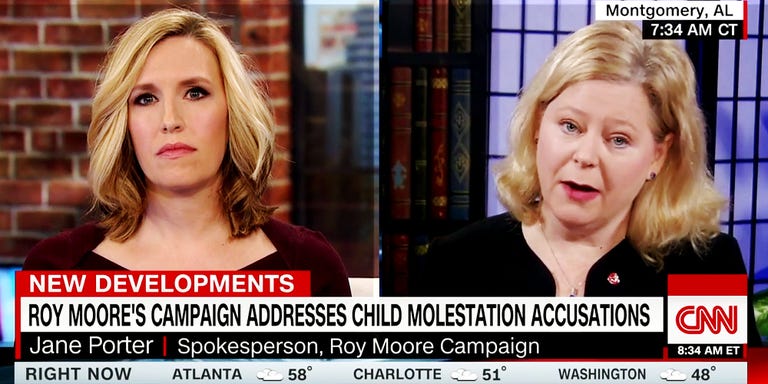
It’s easy to forget that, even before multiple women came forward to allege sexual misconduct against Roy Moore, his United States Senate campaign was already insane. The former Alabama state supreme court judge, thrown out of office twice for disregarding the rulings of higher courts, is uniquely unqualified for public service. If you needed a reminder of that, take a look at the people who have agreed to work on his campaign, such as his spokesperson, Jane Porter. She joined CNN Tuesday morning and kicked things off with a totally normal pregnancy congratulations for anchor Poppy Harlow:

“That’s why I came down as a volunteer to speak for Judge Roy Moore,” Porter said. “He’ll stand for the rights of babies like yours in the womb, while his opponent will support killing them up until the moment of birth.”

Moore’s campaign is hitting the abortion issue hard. Doug Jones, Moore’s Democratic opponent, is firmly pro-choice, though he opposes late term abortions. So, in a true shocker, Porter’s riff is shall-we-say, inaccurate. It brings to mind those Planned Parenthood “sting” videos from the 2016 campaign, which Carly Fiorina harped on incessantly. (Much of the contents turned out to be fabricated.) It also rings a bit hollow when you talk about protecting unborn children, but support a candidate whom one woman says lured her to his house when she was 14 years old and he was 32 and tried to get her to touch his genitals through his tighty-whities.

That woman, Leigh Corfman, is one of at least eight women to accuse Moore of sexual misconduct. We’re getting to the stage where some standup comedian would say, “Anyone here not a Roy Moore accuser?” Actually, that’s close to what Porter said on national television:

Yes, many women have accused Moore of sexual misconduct. But there are 150 million American women who haven’t. Why won’t the Fake News talk about that? This is both shameless and unsurprising. Oh, and that claim about Corfman’s mother undermining her story? That’s based on an attempted Breitbart smear job that admits(remarkably far down the page) that Corman’s mother clearly said the original Washington Post report was “truthful and it was researched very well.”

Sadly, the campaign’s relentless extremism is successful. Moore still incredibly has the support of 6 in 10 white women, evoking the triumph of Donald Trump in that category last year. It’s a stirring reminder that the motivating factor in the Alabama Senate race—as in every contest of this political era—is identity. Specifically, white, Christian, Real American identity versus The Other. White Alabamians will vote for Roy Moore because, like Donald Trump, he’s the White Candidate. Doug Jones, who prosecuted members of the Ku Klux Klan after the Birmingham church bombing, is the candidate of The Other. No matter that Moore is accused of molesting a 14-year-old. He’s tough on crime, while Jones is weak. Maybe that has something to do with who the crimes’ perpetrators are.

Getty

That’s been a running theme of Moore’s public career, where he has enforced the most reactionary line on every public policy issue available. Moore is lawless, as his defenestrations from the state supreme court for disregarding higher courts suggest. He is a theocrat, in that one of those removals involved his insistence on keeping a statue of the Ten Commandments on the courthouse grounds, in obvious violation of the First Amendment. He refused to recognize the Supreme Court ruling on same-sex marriage, an assertion that Christian law reigned supreme over United States civil law. Then, in a wicked piece of irony, he yelled and screamed that Sharia law was on the loose in Illinois, with the frightening idea that religious law was taking precedence over civil law. And of course, he once said Muslim Americans elected to Congress should not be seated because they are Muslim.

Oh, and he said women should not be permitted to serve in public office, either.

Getty

Moore is probably the worst American politics has to offer, although one hesitates to draw the line based on what’s happened over the last two years. His continued presence in our politics is only possible because the Republican Party has allowed it. That began with the Alabama GOP’s steadfast defense of the candidate, which involved some officials citing the Bible to defend Moore even if he did indeed sexually assault a 14-year-old. It has continued with the national party’s decision to re-enter the race on Moore’s behalf this week, after making a big show of pulling support. That mirrors Senate Majority Leader Mitch McConnell, Moore’s future colleague who went from declaring he believed Moore’s accusers and would demand an ethics investigation into him if he won to simply saying he’ll leave it up to Alabama voters. Oh, and the President of the United States fully endorsed him.

Truly, there is no bottom to the depravity. Moore will likely win the election, and McConnell will seat him in the Senate. His Republican colleagues will probably welcome him as another vote for plutocratic tax “reform,” and for conservative judges nominated for the federal bench. They might think twice about next year’s Bring Your Daughter to Work Day, though.