Trump is Peddling Arms as If There Were No Tomorrow.

Mint Press News

The Art of the Arms Deal: Trump is Peddling Arms as If There Were No Tomorrow.

Donald Trump has headed down a well-traveled arms superhighway, partnering with the likes of Lockheed Martin to sell weapons to dictatorships and repressive regimes that often fuel instability, war, and terrorism.

By William D. Hartung           April 2, 2018
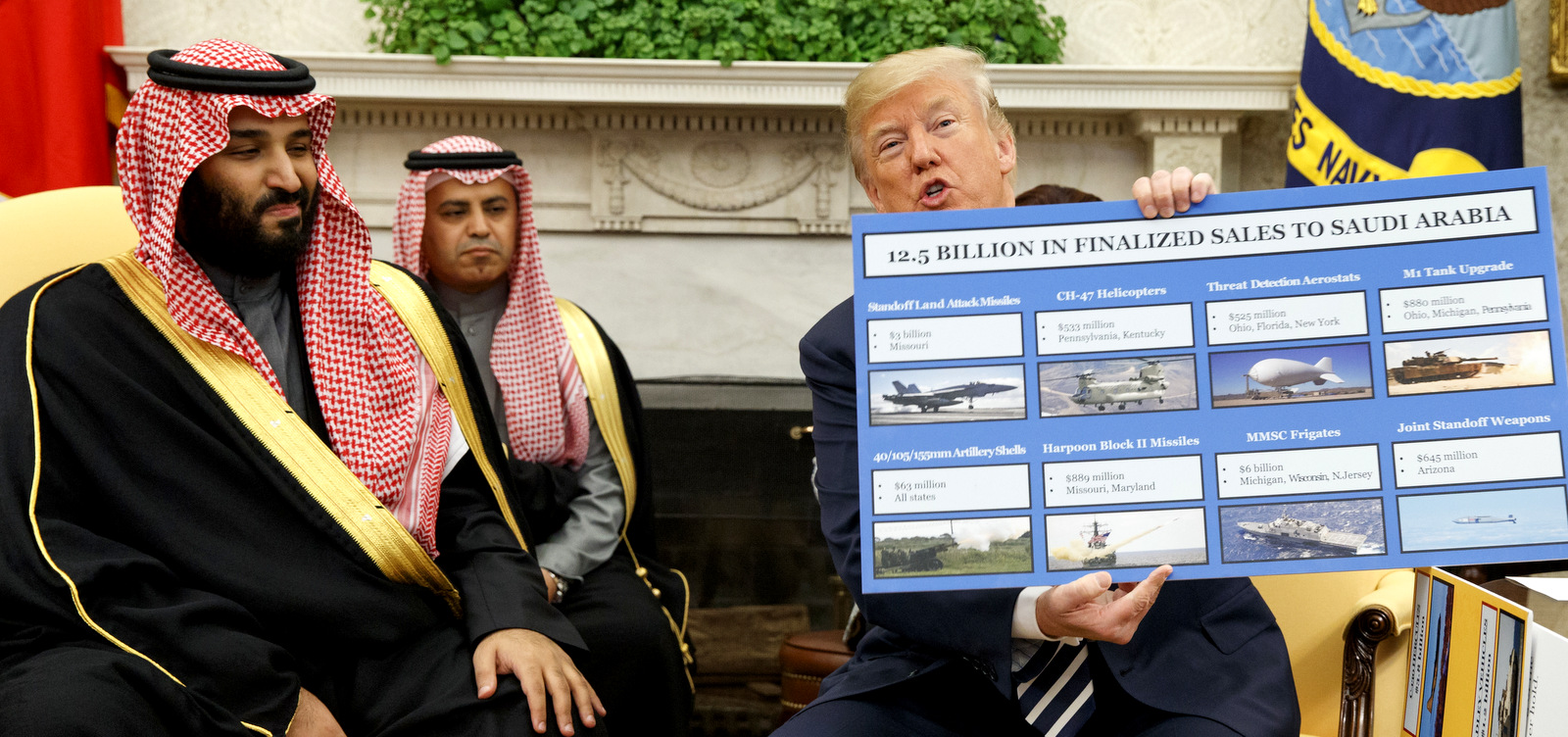
President Donald Trump shows a chart highlighting arms sales to Saudi Arabia during a meeting with Saudi Crown Prince Mohammed bin Salman in the Oval Office of the White House, Tuesday, March 20, 2018, in Washington. (AP/Evan Vucci)

It’s one of those stories of the century that somehow never gets treated that way. For an astounding 25 of the past 26 years, the United States has been the leading arms dealer on the planet, at some moments in near monopolistic fashion. Its major weapons-producers, including Boeing, Raytheon, and Lockheed Martin, regularly pour the latest in high-tech arms and munitions into the most explosive areas of the planet with ample assistance from the Pentagon. In recent years, the bulk of those arms have gone to the Greater Middle East. Donald Trump is only the latest American president to preside over a global arms sales bonanza. With remarkable enthusiasm, he’s appointed himself America’s number one weapons salesman and he couldn’t be prouder of the job he’s doing.

Earlier this month, for instance, on the very day Congress was debating whether to end U.S. support for Saudi Arabia’s brutal war in Yemen, Trump engaged in one of his favorite presidential activities: bragging about the economic benefits of the American arms sales he’s been promoting. He was joined in his moment of braggadocio by Saudi Crown Prince Mohammed bin Salman, the chief architect of that war. That grim conflict has killed thousands of civilians through indiscriminate air strikes, while putting millions at risk of death from famine, cholera, and other “natural” disasters caused at least in part by a Saudi-led blockade of that country’s ports.

That Washington-enabled humanitarian crisis provided the backdrop for the Senate’s consideration of a bill co-sponsored by Vermont independent Senator Bernie Sanders, Utah Republican Senator Mike Lee, and Connecticut Democratic Senator Chris Murphy. It was aimed at ending U.S. mid-air refueling of Saudi war planes and Washington’s additional assistance for the Saudi war effort (at least until the war is explicitly authorized by Congress). The bill generated a vigorous debate. In the end, on an issue that wouldn’t have even come to the floor two years ago, an unprecedented 44 senators voted to halt this country’s support for the Saudi war effort. The bill nonetheless went down to defeat and the suffering in Yemen continues.

Debate about the merits of that brutal war was, however, the last thing on the mind of a president who views his bear-hug embrace of the Saudi regime as a straightforward business proposition. He’s so enthusiastic about selling arms to Riyadh that he even brought his very own prop to the White House meeting with bin Salman: a U.S. map highlighting which of the 50 states would benefit most from pending weapons sales to the prince’s country.

You undoubtedly won’t be surprised to learn that Michigan, Ohio, and Florida, the three crucial swing states in the 2016 presidential election, were specially highlighted. His latest stunt only underscored a simple fact of his presidency: Trump’s arms sales are meant to promote pork-barrel politics, while pumping up the profits of U.S. weapons manufacturers. As for human rights or human lives, who cares?

To be fair, Donald Trump is hardly the first American president to make it his business to aggressively promote weapons exports. Though seldom a highlighted part of his presidency, Barack Obama proved to be a weapons salesman par excellence. He made more arms offers in his two terms in office than any U.S. president since World War II, including an astounding $115 billion in weapons deals with Saudi Arabia. For the tiny group of us who follow such things, that map of Trump’s only underscored a familiar reality.

On it, in addition to the map linking U.S. jobs and arms transfers to the Saudis, were little boxes that highlighted four specific weapons sales worth tens of billions of dollars. Three of those that included the THAAD missile defense system, C-130 transport planes, P-8 anti-submarine warfare planes, and Bradley armored vehicles were, in fact, completed during the Obama years. So much for Donald Trump’s claim to be a deal maker the likes of which we’ve never seen before. You might, in fact, say that the truest arms race these days is between American presidents, not the United States and other countries. Not only has the U.S. been the world’s top arms exporting nation throughout this century, but last year it sold one and a half times as much weaponry as its closest rival, Russia.

Embracing Lockheed Martin
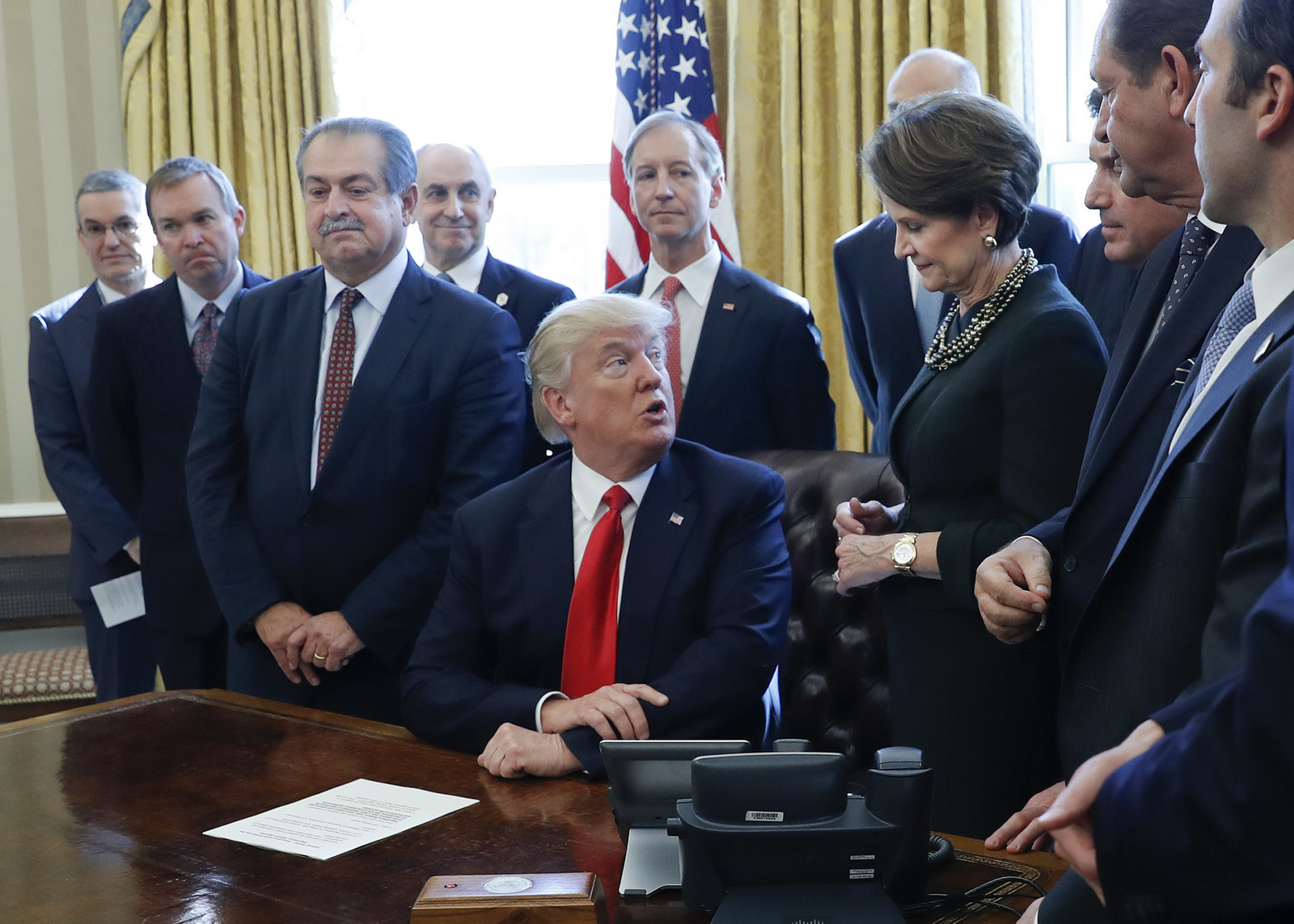
President Donald Trump looks over to Lockheed Martin Chairwoman, President and CEO Marillyn Hewson, right, before signing an executive order in the Oval Office of the White House in Washington, Feb. 24, 2017.(AP/Pablo Martinez Monsivais)

It’s worth noting that three of those four Saudi deals involved weapons made by Lockheed Martin. Admittedly, Trump’s relationship with Lockheed got off to a rocky start in December 2016 when he tweeted his displeasure over the cost of that company’s F-35 combat aircraft, the most expensive weapons program ever undertaken by the Pentagon. Since then, however, relations between the nation’s largest defense contractor and America’s most self-involved president have warmed considerably.

Before Trump’s May 2017 visit to Saudi Arabia, his son-in-law, Jared Kusher, new best buddy to Mohammed bin Salman, was put in charge of cobbling together a smoke-and-mirrors, wildly exaggerated $100 billion-plus arms package that Trump could announce in Riyadh. What Kushner needed was a list of sales or potential sales that his father-in-law could boast about (even if many of the deals had been made by Obama). So he called Lockheed Martin CEO Marillyn Hewson to ask if she could cut the price of a THAAD anti-missile system that the administration wanted to include in the package. She agreed and the $15 billion THAAD deal — still a huge price tag and the most lucrative sale to the Saudis made by the Trump administration — went forward. To sweeten the pot for the Saudi royals, the Pentagon even waived a $3.5 billion fee normally required by law and designed to reimburse the Treasury for the cost to American taxpayers of developing such a major weapons system. General Joseph Rixey, until recently the director of the Pentagon’s Defense Security Cooperation Agency, which granted that waiver, has since gone directly through Washington’s revolving door and been hired by — you guessed it — Lockheed Martin.

In addition, former Lockheed Martin executive John Rood is now the Trump administration’s undersecretary of defense for policy, where one of his responsibilities will be to weigh in on… don’t be shocked!… major arms deals. In his confirmation hearings, Rood refused to say that he would recuse himself from transactions involving his former employer, for which he was denounced by Senators John McCain and Elizabeth Warren. As Warrenasserted in a speech opposing Rood’s appointment,

“No taxpayer should have to wonder whether the top policy-makers at the Pentagon are pushing defense products and foreign military sales for reasons other than the protection of the United States of America… No American should have to wonder whether the Defense Department is acting to protect the national interests of our nation or the financial interests of the five giant defense contractors.”

Still, most senators were unfazed and Rood’s nomination sailed through that body by a vote of 81 to 7. He is now positioned to help smooth the way for any Lockheed Martin deal that might meet with a discouraging word from the Pentagon or State Department officials charged with vetting foreign arms sales.

Arming the Planet

Benjamin Netanyahu reaches to an American-made F-35 fighter jet at an unveiling ceremony in Nevatim Air Force base, Southern Israel. (AP/Ariel Schalit)

Though Saudi Arabia may be the largest recipient of U.S. arms on the planet, it’s anything but Washington’s only customer. According to the Pentagon’s annual tally of major agreements under the Foreign Military Sales program, the most significant channel for U.S. arms exports, Washington entered into formal agreements to sell weaponry to 130 nations in 2016 (the most recent year for which full data is available). According to a recent report from the Cato Institute, between 2002 and 2016 the United States delivered weaponry to 167 countries — more than 85% of the nations on the planet. The Cato report also notes that, between 1981 and 2010, Washington supplied some form of weaponry to 59% of all nations engaged in high-level conflicts.

In short, Donald Trump has headed down a well-traveled arms superhighway. Every president since Richard Nixon has taken that same road and, in 2010, the Obama administration managed to rack up a record $102 billion in foreign arms offers. In a recent report I wrote for the Security Assistance Monitor at the Center for International Policy, I documented more than $82 billion in arms offers by the Trump administration in 2017 alone, which actually represented a slight increase from the $76 billion in offers made during President Obama’s final year. It was, however, far lower than that 2010 figure, $60 billion of which came from Saudi deals for F-15 combat aircraft, Apache attack helicopters, transport aircraft, and armored vehicles, as well as guns and ammunition.

There have nonetheless been some differences in the approaches of the two administrations in the area of human rights. Under pressure from human rights groups, the Obama administration did, in the end, suspend sales of aircraft to Bahrain and Nigeria, both of whose militaries were significant human rights violators, and also a $1 billion-plus deal for precision-guided bombs to Saudi Arabia. That Saudi suspension represented the first concrete action by the Obama administration to express displeasure with Riyadh’s indiscriminate bombing campaign in Yemen. Conducted largely with U.S. and British supplied aircraft, bombs, and missiles, it has included strikes against hospitals, marketplaces, water treatment facilities, and even a funeral. In keeping with his focus on jobs to the exclusion of humanitarian concerns, Trump reversed all three of the Obama suspensions shortly after taking office.

Fueling Terrorism and Instability

A well-equipped Syrian rebel using a US-made BGM-71 TOW against the Syrian Arab Army. (YouTube Screenshot)

In fact, selling weapons to dictatorships and repressive regimes often fuels instability, war, and terrorism, as the American war on terror has vividly demonstrated for the last nearly 17 years. U.S.-supplied arms also have a nasty habit of ending up in the hands of America’s adversaries. At the height of the U.S. intervention in Iraq, for instance, that country’s armed forces lost track of hundreds of thousands of rifles, many of which made their way into the hands of forces resisting the U.S. occupation.

In a similar fashion, when Islamic State militants swept into Iraq in 2014, the Iraqi security forces abandoned billions of dollars worth of American equipment, from small arms to military trucks and armored vehicles. ISIS promptly put them to use against U.S. advisers and the Iraqi security forces as well as tens of thousands of Iraqi civilians. The Taliban, too, has gotten its hands on substantial quantities of U.S. weaponry, either on the battlefield or by buying them at cut-rate, black market prices from corrupt members of the Afghan security forces.

In northern Syria, two U.S.-armed groups are now fighting each other. Turkish forces are facing off against Syrian Kurdish militias that have been among the most effective anti-ISIS fighters and there is even an ongoing risk that U.S. and Turkish forces, NATO allies, may find themselves in direct combat with each other. Far from giving Washington influence over key allies or improving their combat effectiveness, U.S. arms and training often simply spur further conflict and chaos to the detriment of the security of the United States, not to speak of the peace of the world.

In the grim and devolving conflict in Yemen, for instance, all sides possess at least some U.S. weaponry. Saudi Arabia is, of course, the top U.S. arms client and its forces are a catalogue of American weaponry, from planes and anti-tank missiles to cluster bombs, but hundreds of millions of dollars in U.S. military aid were also provided to the forces of Yemeni autocrat Ali Abdullah Saleh during his 30 years of rule before he was driven from power in 2012. Later, however, he joined forces with the Houthi rebels against the Saudi-led intervention, taking large parts of the Yemeni armed forces — and their U.S.-supplied weapons — with him. (He would himself be assassinated by Houthi forces late last year after a falling out.)

Trump’s Plan: Make It Easier on Arms Makers
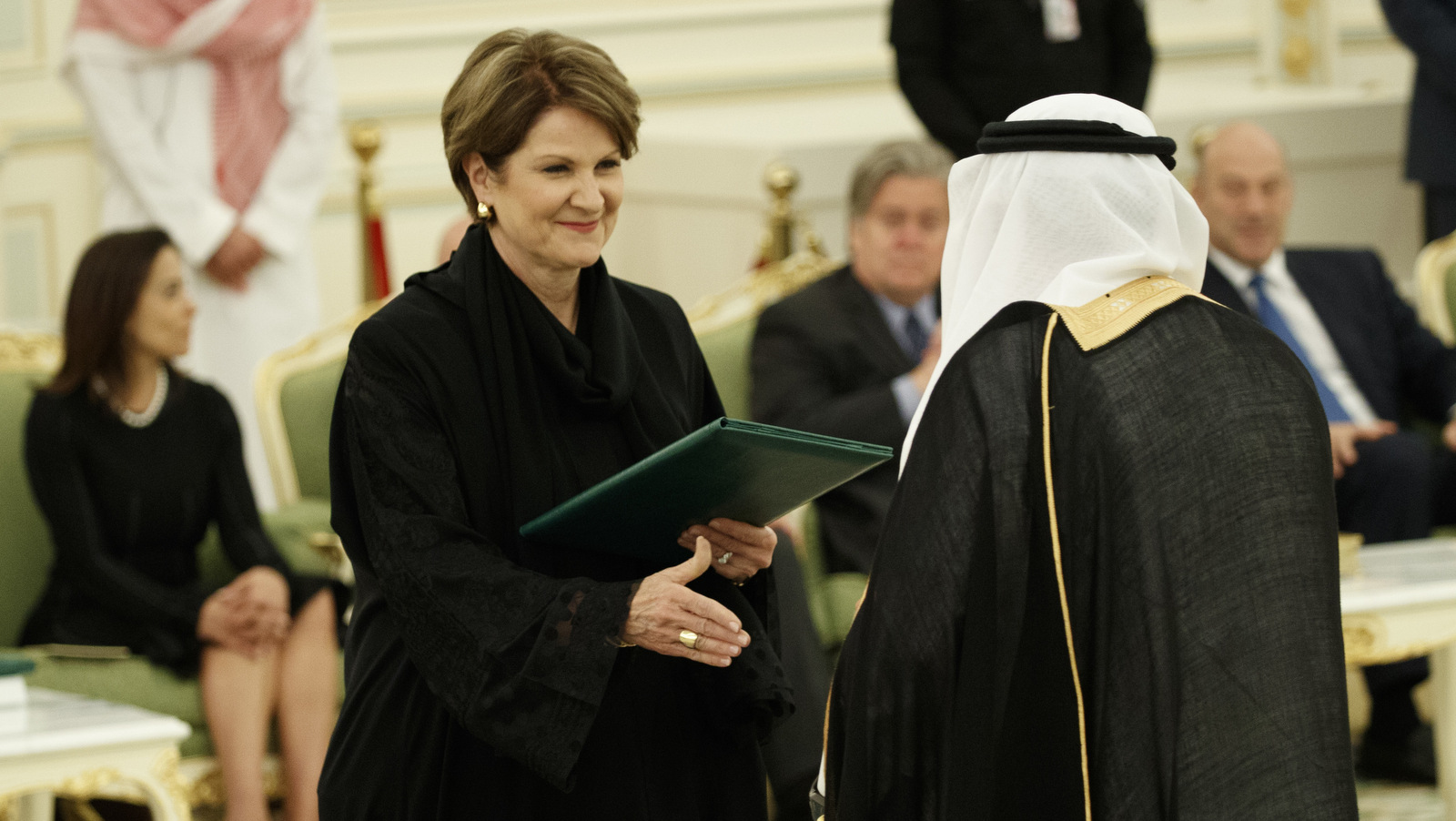
Lockheed Martin CEO Marillyn Hewson participates in a signing ceremony between President Donald Trump and Saudi King Salam, May 20, 2017, in Riyadh. (AP/Evan Vucci)

The Trump administration is poised to release a new policy directive on global arms transfers. A report by Politico, based on interviews with sources at the State Department and a National Security Council (NSC) official, suggests that it will seek to further streamline the process of approving arms sales, in part by increasing the already extensive role of U.S. government personnel in promoting such exports. It will also remove what a National Security Council statement has described as “unreasonable constraints on the ability of our companies to compete.” In keeping with that priority, according to the NSC official, “the administration is intent on ensuring that U.S. industry has every advantage in the global marketplace.”

In January, a Reuters article confirmed this approach, reporting that the forthcoming directive would emphasize arms-sales promotion by U.S. diplomats and other overseas personnel. As one administration official told Reuters, “We want to see those guys, the commercial and military attaches, unfettered to be salesmen for this stuff, to be promoters.”

The Trump administration is also expected to move forward with a plan, stalled as the Obama years ended, to ease controls on the export of U.S. firearms. Gun exports now licensed and scrutinized by the State Department would instead be put under the far-less-stringent jurisdiction of the Commerce Department. Some firearms could then be exported to allies without even a license, reducing the government’s ability to prevent them from reaching criminal networks or the security forces of potential adversaries. 

In September 2017, Democratic senators Ben Cardin, Dianne Feinstein, and Patrick Leahy sent a letter to then-Secretary of State Rex Tillerson raising concerns about such a change. As they wrote, “Combat firearms and ammunition are uniquely lethal; they are easily spread and easily modified, and are the primary means of injury, death and destruction in civil and military conflicts throughout the world. As such they should be subjected to more — not less — rigorous export controls and oversight.”

If Trump’s vision of an all-arms-sales-all-the-time foreign policy is realized, he may scale the weapons-dealing heights reached by the Obama administration. As Washington’s arms-dealer-in-chief, he might indeed succeed in selling American weaponry as if there were no tomorrow. Given the known human costs of unbridled arms trafficking, however, such a presidency would also ensure that whatever tomorrow finally arrived would prove far worse than today, unless of course you happen to be a major U.S. arms maker.

William D. Hartung, a TomDispatch regular, is the director of the Arms and Security Project at the Center for International Policy and the author of “Trends in Major U.S. Arms Sales in 2017: A Comparison of the Obama and Trump Administrations,” Security Assistance Monitor, March 2018.

Follow TomDispatch, where this article first appeared on Twitter and join them on Facebook. Check out the newest Dispatch Book, Alfred McCoy’s In the Shadows of the American Century: The Rise and Decline of U.S. Global Power, as well as John Dower’s The Violent American Century: War and Terror Since World War II, John Feffer’s dystopian novel Splinterlands, Nick Turse’s Next Time They’ll Come to Count the Dead, and Tom Engelhardt’s Shadow Government: Surveillance, Secret Wars, and a Global Security State in a Single-Superpower World.
The Newest Weapons Against Unions Are Employees

Bloomberg

The Newest Weapons Against Unions Are Employees

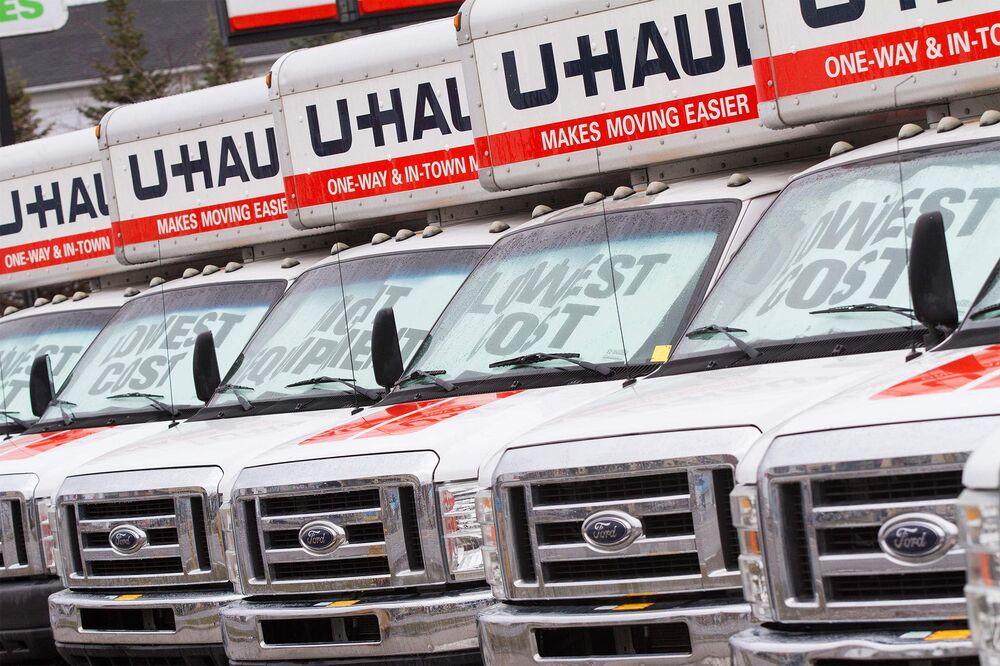
U-Haul workers sent a flood of letters seeking to reverse an Obama-era rule. Most used very similar language, in part because the company wrote it for them.

By Josh Eidelson and Hassan Kanu         April 2, 2018

Photographer: Stephen Hilger/Bloomberg

Thomas Neill wrote the government a letter Jan. 23 asking that it reverse an Obama-era rule that could make it easier for unions to win workplace elections. “Repeal the current rules; reinstate the prior rules; revise the election process in a way that brings them up to date in a sensible, fair manner,” he wrote. So did Brian Picanco, Paul Smedberg, Zane Rowland and Jim Smith.

On the same day. Using exactly the same words.

The men, along with dozens of other people working for U-Haul, the self-storage company, seem to have taken an outsized role in the debate over whether the Trump administration should revisit the rule. They’ve been doing this by flooding the National Labor Relations Board with very similar comments. While at least one employee said workers got together on their own, labor experts contend that the campaign has all the hallmarks of a company-influenced effort. U-Haul agreed, saying that while it didn’t compel workers to take part, it did provide the language for them to use.

Over the past few months, the NLRB received at least 100 similarly worded submissions urging it to throw out the policy that shortens the time between when some employees decide to unionize and when a vote is held. More than 60—roughly one out of every 25 comments submitted so far—used names matching people who work at the self-storage and rental giant, according to a review of LinkedIn pages and recent company announcements. More than a dozen additional comments appear to come from people who worked for the company in the past.

The U-Haul staffers ranged from a clerk for one of its local marketing units to a vice president for government relations, Joseph Cook. (Cook and the five men above didn’t respond to requests for comment.) Another submission was by Sam Shoen, who shares the surname of Joe Shoen, chairman of U-Haul’s parent, Reno, Nevada-based Amerco. The company said two people named Sam Shoen have been associated with U-Haul, one a former official and son of the founder, who said the submission wasn’t his. The other Sam Shoen is a manager who currently oversees one of the company’s storage components and couldn’t be reached for comment. Also among the commenters was Assistant General Counsel Michelle Walters, whose LinkedIn biography says her work for U-Haul includes “union avoidance/positive labor relations.” Walters couldn’t be reached for comment, but company spokesman Sebastien Reyes said in a March 30 response to a request for comment that she drafted the language used by U-Haul employees in their letters to the NLRB .

“We encouraged them to submit comments, and we circulated sample language,” Reyes wrote. “Individuals decided whether to submit a sample comment, write their comment or elect not to submit comments at all.” He confirmed that the people identified by Bloomberg in a review of correspondence sent to the NLRB were in fact U-Haul “team members.”

Photographer: Lars Hagber/Alamy

Founded in 1945, U-Haul claims thousands of locations across the U.S. and Canada. In February, Joe Shoen announced bonuses of more than $23.6 million for almost 29,000 employees, telling them it was thanks to the Republican tax overhaul signed by President Donald Trump.

The company has a history of disdain toward organized labor. An alert for U-Haul managers posted on the company’s human resources website (and since removed) emphasized the need to “harden our workplace against possible organizing” and mount a preemptive anti-union campaign that “begins now and lasts every single day.” The document, referring to an earlier legislative proposal, urged managers to participate in company “union avoidance” classes and instructed that the “preservation of our system members’ right to work in a union-free environment is management’s responsibility.” Staff, if treated well, “will keep the union bums out,” it said. (Reyes, the company spokesman, confirmed the document was an internal memorandum representing the company’s stance on organized labor, but added that it was taken down because it was mistakenly made public.)

After employees at two repair facilities voted 2-to-1 to unionize in 2003, the U-Haul Co. of Nevada shut down one of them, terminated 49 employees and allegedly refused to collectively bargain, arguing that the union election had been tainted by misconduct. A federal appeals court ruled against the company in 2007, and in 2008 the company agreed to pay $2.1 million to employees who the International Association of Machinists and Aerospace Workers alleged had been illegally terminated for supporting the union. The company didn’t admit any wrongdoing as part of the agreement.

But the workers declined to return to work there, and the IAM abandoned its efforts to secure a union contract, according to David Rosenfeld, an attorney for the union. “They were extremely vicious,” he said of the company. Of the employees, he added: “Nobody’s tried since then to organize them, as far as I know.” Reyes denied the 2003 firings were related to the union vote, declining further comment on the case or its aftermath.

“Companies are increasingly using their workers to change elections and public policy.”

The recent U-Haul employee comments to the NLRB come in response to a December invitation by the Republican-majority labor board. It seeks input on whether to amend or rescind the 2014 rule change by the Obama administration. The provisions included shortening the time between when workers petition for a vote on unionization and when the vote happens, leaving less time for companies to urge workers to stay union-free. The comments from people associated with U-Haul each urged more stringent rules, including a minimum “campaign period” of at least 40 days before a union vote. On March 14, the NLRB announced that it was pushing back the deadline for submitting comments, which had already been extended, to April 18.

The volume and similarity of comments raise questions as to whether there was a coordinated effort, said Paul Secunda, who directs the labor and employment law program at Marquette University. “These U-Haul employee comments to the NLRB smack of employee mobilization by the company itself,” he said, though encouraging employees to comment on proposed rulemaking is perfectly legal.

That companies urge employees to take part in campaigns for or against government regulations isn’t novel, but the tactic has enjoyed a renaissance of late. Employers and the business lobby have recently urged workers to fight various corporate taxes and support the recent tax legislation. Alexander Hertel-Fernandez, a political scientist at Columbia University who just wrote a book on the topic, recounted how a lobbyist bragged of helping a financial company get 100,000 letters opposing the fiduciary rule—the now-endangered conflict-of-interest regulation for financial advisers. Hertel-Fernandez said a telecommunications company interested in shaping a different debate established an internet portal for workers, providing letter templates they could tweak before sending.

“Companies are increasingly using their workers to change elections and public policy. This has become a key part of companies’ political arsenals,” Hertel-Fernandez said in an interview. “Workers who are most fearful of losing their jobs, or of retaliation from their employers, are most likely to respond to political requests made of them by their employers.”

When AT&T Inc. was fighting proposed net neutrality rules in 2009, its senior vice president for external and legislative affairs reportedly sent employees talking points to use in emails to the Federal Communications Commission, encouraging them to send messages from their personal email accounts. AT&T declined to comment.

There have been other alleged efforts to game the public comment system, both in and out of government, that have gone beyond coordinating employee letters. In December, the Wall Street Journal reported that it had identified comments submitted to five agencies that were posted under the names of people who hadn’t consented. Some of those comments were sent to the Labor Department, professing opposition to the fiduciary rule. Last month, environmental groups cried foul over a Trump administration memo summarizing public comments on its reassessment of an Obama-era sage grouse conservation plan, which advocates say omitted almost 100,000 comments.

Republicans rigged our democracy. Here’s how Democrats can fight back

The Guardian

Republicans rigged our democracy. Here’s how Democrats can fight back

David Faris    March 31, 2018

Republicans have been using the constitution’s flaws to wage a one-sided war against their political opponents. It’s time for Democrats to respond

Can the Democrats lead a democratic revival? Illustration: Rob Dobi
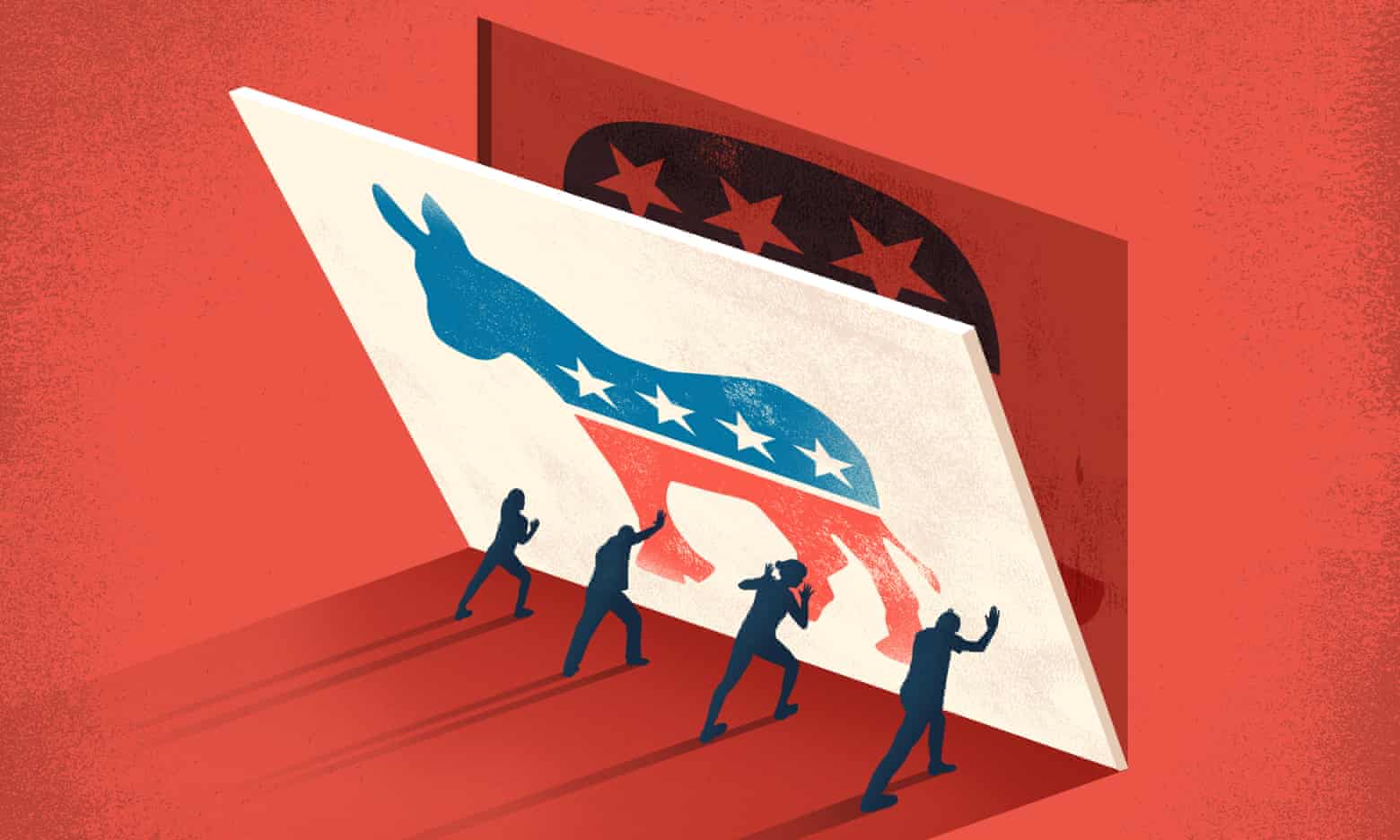
Donald Trump wasn’t elected because Democrats lost a policy fight in 2016. What Democrats did was lose a procedural fight that has been going on since the early 1990’s, when Republicans began waging a relentless, brutal, and completely one-sided war, systematically using their lawmaking power to disadvantage their adversaries in elections and political mobilization.

Gerrymandering, the Citizens United atrocity that declared money is speech, blocking US Supreme Court nominations and obstructing legislation are some of the Republican party’s tactics. Depraved, racist voter ID laws that obviously target people who are likely to vote Democratic, and the cruel way that many states prevent current or former felons from voting, are others.

Standing in the way of reforms to our nonsensical, undemocratic electoral college system for electing the president helps the Republicans too, as does ensuring the United States remains the only country in the entire world that holds its critical national elections on a regular working Tuesday as if we literally couldn’t care less who is able take off work to cast a ballot.

Indeed, one has to grudgingly respect the single-mindedness with which the Republican party has pursued its advantage, even as we condemn the damage it has wreaked on our democracy.

Democrats, now that they are in the minority for the foreseeable future, must pay homage to their Republican overlords and use what little power they have to slow down legislation, turn the public against the Republican Congress, and then retake total power in 2018 and 2020. Then, what they must do with that power is to fundamentally alter key aspects of our political system that we take for granted but that are not, contrary to popular belief, outlined in the US constitution.

Ingenious for its time, if deeply morally deficient, the constitution saddles the country with a series of difficult political problems. Some are explicit design flaws, such as the way that every state in the United States, whether it has 38 million or 600,000 residents, gets two and only two US senators, or how the entire 435-member House of Representatives is put up for re-election every two years, the shortest election calendar in the entire world. Others are crimes of omission, like the document’s relative silence about voting rights.

But the biggest problem is that it is underspecified. It doesn’t adequately describe the powers granted to the supreme court it created, or explain what a militia is in the second amendment, or outline what happens if the Senate decides it simply can’t be bothered to carry out its constitutional obligations by approving appointments made by the president. It contains no information about how elections should be funded. And the thing is well nigh impossible to amend.

Beginning with the Gingrich radicals who took over the House in 1994, the modern Republican party has been willing to exploit the constitution’s design flaws and the constitutional order’s reliance on informal understandings between political actors to sabotage the functioning of Congress, destroy the Obama presidency, and seize vastly more power than the American people would otherwise have granted it.

When they retake power, Democrats should use those same flaws to revive not the party, but our democracy.

First, they should grant statehood to Washington DC and Puerto Rico – long-suffering territories whose citizens are utterly deprived of voting rights and representation in federal elections. This can help rectify the Democrats’ structural imbalance in the US Senate. Breaking the deep-blue state of California into seven states can finish the job, by finally creating about as many blue-leaning as red-leaning states and delivering lasting power (or at least parity) to Senate Democrats and their allies.

The theft of Merrick Garlands seat by Republicans and the deepening intensity of congressional battles over federal judicial appointments should lead the next Democratic administration to pack the supreme court, by adding liberal justices until progressives finally have their first majority in a long generation, as well as creating hundreds of new judgeships in the federal judiciary.

The constitution does not stipulate the number of justices either on the supreme court or the lower courts, and Democrats should use the threat of court-packing to press for a constitutional amendment to end lifetime tenure in the federal judiciary as well as enacting other reforms that would finally remove destructive, ugly battles over the courts from our political landscape.

Progressives should also get behind a change in how we elect our representatives to the House, enacting proportional representation reforms that would not only eliminate the grotesque chicanery of gerrymandering but also make it possible for smaller parties to finally win a seat at the governing table. And they should double the size of the House to bring the constituent-to-legislator ratio more in line with what the founders envisioned.

Finally, any serious progressive governing coalition must immediately address our litany of voting problems, from the disenfranchisement of felons to the racist voter-ID laws implemented by cynical Republicans across the country, by passing a comprehensive new voting rights act.

Step one in bringing this vision to fruition is to stop bringing pistols to the nuclear war. Democrats must be prepared to mimic their tormentors by intentionally destroying the Trump administration and then unleashing this dizzying array of electoral and institutional reforms when they recapture total power.

Only by changing the rules that are currently rigged against them, while clinging to a set of minimal behavioral standards, will Democrats ever hold power long enough to truly transform American politics in a lasting progressive direction.

Doing so will require party leaders to pursue policy changes that will be ridiculed by their opponents as outrageous affronts to democratic decency and received by their own voters with puzzlement or even shock. They need to do it anyway. The shock will wear off.

Most of these structural reforms would require only a law to be passed by a Democratic-controlled Congress and then signed by a Democratic president. If instituted as a bloc, they will improve access to the ballot; increase participation in our elections; decrease destructive tensions over the supreme court; mitigate the fundamental flaws of the Senate; bring members of the House closer to their constituents and open the world of national politics to many more citizens.

At the end of this process, Americans will despise their own politics a bit less, and feel more connected to the system. The purpose of this partisanship is nothing short of dragging the United States kicking and screaming into the 21st century.

From It’s Time To Fight Dirty. Used with permission of Melville House. Copyright © 2018 by David Faris

David Faris is the program director of Political Science at Roosevelt University

Oklahoma Teachers Prepare For Walkout As Red State Revolt Spreads

HuffPost

Oklahoma Teachers Prepare For Walkout As Red State Revolt Spreads

Dave Jamieson, HuffPost           March 30, 2018

Teachers in Oklahoma still plan to walk off the job next week after state legislators passed an education funding bill that fell apart within hours.

Initially it seemed the legislation, signed Thursday by Gov. Mary Fallin (R), would quell the statewide walkout that educators had set for April 2 to demand more money for schools. But not even a day after the state Senate approved the first tax increase package in years, legislators in the state House voted to undo one of its main provisions, a tax on hotel and motel stays.

After applauding legislators for approving the funding bill, the state’s leading teachers union, the Oklahoma Education Association, renewed its call late Thursday for teachers around the state to stay out of school and descend on the Capitol in Oklahoma City on Monday.

“Yesterday, the Legislature passed a historic education funding increase,” the union said Thursday in a Facebook post. “Today, they started dismantling it by cutting millions out of the plan. Now they’re gone for the weekend. Oklahoma: we’ll see you at 9 a.m. April 2 at the Capitol.”

Oklahoma is one of a wave of red states now facing a teacher revolt after years of anemic funding for education.

Over the past decade, Oklahoma carried out a series of tax cuts that, combined with falling energy prices, have left the oil- and gas-rich state with little money to steer toward teachers or textbooks. It’s more or less the same story that played out in West Virginia, where tax cuts forced educators to forego raises while their health care costs increased. Teachers there walked off the job for nine days in February and March, prompting the state legislature to fund pay increases for public employees.

The historic and successful strike in West Virginia has inspired a burgeoning uprising among austerity-weary teachers around the country. In addition to Oklahoma, Arizona could soon face a strike by teachers, who are demanding the state boost pay by 20 percent and return to pre-recession funding levels for education. (Meanwhile, teachers in Kentucky shut down public schools in 25 counties on Friday to protest proposed cuts to the state pension plan.)

Teachers in West Virginia, Oklahoma and Arizona are all among the lowest-paid in the country, with schools facing growing teacher shortages. Republicans control the statehouse and governor’s office in all three states.

“After ten long years in a lot of these conservative states, the chicken is finally coming home to roost,” said Lily Eskelsen Garcia, president of the National Education Association, the 3-million member union with which the Oklahoma Education Association is affiliated. “They’ve given tax breaks to big corporations, defunded public schools, and said, ‘What could go wrong?’”

After Oklahoma legislators passed the tax hike, it seemed the walkout could turn instead into a one-day rally on Monday. Now nobody knows for sure what next week will bring. The mixed actions by Oklahoma’s legislature could lead to a situation where some school districts close only for Monday or not at all, while others engage in a work stoppage for days. Many Oklahoma teachers on Facebook have called for keeping schools shut down until all their demands are met.

We have buildings that are falling apart and textbooks that need to be taped together. Beth Wallis, assistant band director

To a certain degree, their walkout will require the cooperation of their largely sympathetic superintendents, who decide whether schools are formally open or closed. If schools are open and teachers refuse to return to work, the state could consider it an illegal strike. Several districts announced Friday that their schools would not be open on Monday.

Beth Wallis, an assistant band director who teaches in a Tulsa suburb, said teachers in her district voted unanimously to stay off the job beyond Monday. Although the legislation passed this week includes average pay raises of $6,100, Wallis said the lack of state funding guaranteed in the bill could leave local districts on the hook to pay for them. She also said securing teacher pay raises is secondary to increasing general school funding.

“The school funding in the bill is laughably small,” Wallis said. “It’s not enough to buy every kid in my district a single textbook. We have buildings that are falling apart and textbooks that need to be taped together.”

Like most states, Oklahoma cut school funding in the wake of the Great Recession. But it also pursued tax cuts during the economic recovery that followed, dropping income taxes and reducing the gross production tax on oil and gas companies. With little money to devote to schools, Oklahoma has led the nation over the past decade in cuts to its education formula funding, which is the main well of state money for individual districts.

“They sort of maximized the damage that the recession did to their schools and other public services, and as the economy improved, they kept cutting taxes,” Michael Leachman, an analyst at the Center on Budget and Policy Priorities, recently told HuffPost. “You’re just digging your hole even deeper.”

With less funding, many cash-strapped schools have gone to four-day weeks, while certifying a growing number of emergency teachers to fill vacant jobs. Such teachers don’t meet the state’s normal minimum requirements to teach in public school. The union says the state will have to increase salaries and school funding significantly if it wants to stop losing teachers to Arkansas and other nearby states that pay better.

Reversing course will not be easy. Approving tax hikes in Oklahoma is extraordinarily difficult, requiring a three-fourths supermajority in both chambers. Legislators were barely able to approve the tax package that has already foundered. Legislators had only hours to digest that bill before it was passed, and many apparently did not have time to read it. One state representative argued that the bill had a $75 million hole in it before taking the repeal of the hotel and motel tax into account.

“The more the bill has gotten to sit,” Wallis said, “the more people have gotten to read it and find problems with it.”

Oklahoma teacher has 5 jobs because he doesn’t earn enough teaching to support his family

March 30, 2018

He’s a high school algebra teacher in Oklahoma. And a bus driver. And a Little League umpire. And he drives for Uber and Lyft. All because he says his teaching salary isn’t enough to support his family.

The many jobs of Oklahoma's teachers

He’s a high school algebra teacher in Oklahoma. And a bus driver. And a Little League umpire. And he drives for Uber and Lyft. All because he says his teaching salary isn’t enough to support his family.

Posted by CNN on Friday, March 30, 2018

Walker’s Wasting Taxpayer Money Fighting Democracy

Esquire – U.S.

Walker’s Wasting Taxpayer Money Fighting Democracy

Charles P. Pierce, Esquire       March 29, 2018 

From Esquire

Being our semi-regular weekly survey of what’s goin’ down in the several states where, as we know, the real work of governmentin’ gets done, and where the shepherd is asleep and the willows weep.

Because we are on our way to San Antone-mandatory nod to Bob Wills-we are making only two stops on our tour this week, but both of them are cherce. We begin in Wisconsin, where the desperate attempts of Scott Walker, the goggle-eyed homunculus hired by Koch Industries to manage that particular midwest subsidiary, and his pet legislature to subvert both democracy and the duties of Walker’s office have reached the level of what my sainted mother used to call high-sterics.

For the benefit of customers who may have come to tinhorn politicians late, the Republican majorities in the Wisconsin legislature gerrymandered the state so badly that even this Supreme Court gagged on the result. In addition, two seats in the state legislature came open and Walker was required by law to call special elections to fill them. Given the pasting Republicans have taken in similar elections around the country, this did not fill Walker and his pet legislature with either optimism or glee. So, he simply refused to call the elections.

Last week, however, a judge that Walker appointed told him to get the Koch Brothers’ mitts off his puppet strings and call the elections. This occasioned a week of huffing and blowing all throughout the capitol in Madison. The legislature has before it a bill that would eliminate the special elections on the grounds that the Republicans might lose them. (I’m paraphrasing here.) Meanwhile, Walker appealed the previous court’s decision and, on Wednesday, another court in Dane County slapped him down. From The Wisconsin State Journal:

“Walker hasn’t argued that he can’t order the elections or that Reynolds was wrong in requiring him to do so, Niess said. Rather, he said, the governor wants to be allowed to delay carrying out “his mandatory, compulsory duty because there are now other reasons that he has brought to the court’s attention.” “But these other reasons don’t change the fact that his duty under the law remains the same,” Niess said. “No court that I’m aware of is at liberty to ignore the law in order to facilitate the Legislature’s consideration of bills that might become law. When and if a legislative bill becomes law it can be brought to the court, and at that time the arguments can be made as to what the effect of that law is on an already pending (order).”

In other words, Walker argued that his pet legislature will pass his blatant power-grab and so the judge should stay the elections until he and the legislature get their chance to destroy them entirely. This argument, while quaint, did not impress the judge.

Walker then threatened to bring the whole matter before the state supreme court, but he chickened out almost instantaneously, largely because an appellate court judge did everything but knock him silly with the gavel. From the State Journal:

“Earlier Wednesday, 2nd District Appellate Court Judge Paul F. Reilly dismissed Walker’s argument that the court should allow time for the Legislature to rewrite state law that would effectively block the special elections. Reilly issued the one-page ruling hours after DOJ appealed two Dane County judges’ decisions ordering Walker to call the special elections. “Representative government and the election of our representatives are never ‘unnecessary,’ never a ‘waste of taxpayer resources,’ and the calling of the special elections are as the Governor acknowledges his ‘obligation’ to follow,” Reilly wrote.”

Walker had been thumping his tubs for weeks about how “outside forces” were making the good people of Wisconsin pay for special elections that Walker was obligated by law to call. (This is not dissimilar to the argument he made successfully against the campaign to recall him.) Judge Reilly had quite enough of that. Walker finally hollered uncle and scheduled the special elections for June 5. (The bill to do away with them appears to be dead as well.) There was no accounting for all the money the good taxpayers of Wisconsin had to kick into Walker’s attempts to find a legal way not to do his job. They really would rather some people not get to vote. Jesus, these people.

And we conclude, as is our wont, in the great state of Oklahoma, where Blog Official Derelict Gas Station Inspector Friedman of the Plains brings us an illuminating moment from a debate in that state’s legislature regarding education policy. From KFOR-4, Oklahoma’s News:

“On Monday, members of the Oklahoma House of Representatives debated a bill that would fund a teacher pay raise through several revenue-raising measures. “Money is not the number one issue,” said Rep. John Bennett. “Maybe if we spanked our kids at home a little better with a paddle, made them mind and be good kids, the teachers wouldn’t have it so hard in the classroom.” On Tuesday, Bennett stood by his words. “I’ve told all my kids’ teacher that, ‘If they get out of line, use a paddle on them,’” Bennett said. “If they get out of line after that, call me and I’ll come up and paddle them in front of the whole class because they will not disrespect their elders or teachers in school.” Bennett said bad behavior in schools is costing the state money. “Oh, absolutely,” Bennett said. “It wastes the teachers’ time, and money and effort because teachers aren’t supposed to be parents. They’re a role model but not a parent. The parents need to do what they’re supposed to do as parents, put them on the learning foundation and then send them to school. And, then our teachers can do their job, which they do so well, and teach their kids.”

I think Representative Bennett should be at the top of the list of any PTA that classifies its students as enemy combatants.

This is your democracy, America. Cherish it.

Respond to this post on the Esquire Politics Facebook page.

Oklahoma Teachers Haven’t Had a Raise In 10 Years

MoveOn.org and Democratic Coalition Against Trump shared VICE News‘s video.
Oklahoma Teachers Haven’t Had a Raise In 10 Years.

“It is humbling whenever there are students who can graduate here and start working at a convenience store for more money than I make as a teacher.”

This is why Oklahoma teachers are walking out of their classrooms April 2.

Oklahoma Teachers Haven't Had a Raise In 10 Years

"It is humbling whenever there are students who can graduate here and start working at a convenience store for more money than I make as a teacher."This is why Oklahoma teachers are walking out of their classrooms April 2.

Posted by VICE News on Wednesday, March 28, 2018

More Democrats Should Be Calling for the Repeal of the Second Amendment

Esquire

More Democrats Should Be Calling for the Repeal of the Second Amendment

They have to drag the middle of the conversation back to the middle.

By Jack Holmes     March 27, 2018

Getty Images

No one in a national elected office advocates repealing the Second Amendment. No matter how many schoolchildren are cut down in a hail of bullets, no matter how many wives and girlfriends are shot to death by a spouse with a long history of abuse, no matter how many men commit suicide with a firearm in their own homes, the subject is never broached. No one in power is calling for government to restrict all gun ownership on that scale.

Occasionally, however, an outside observer will. Enter former Supreme Court Justice John Paul Stevens, who called for repeal in a New York Times op-ed Tuesday:

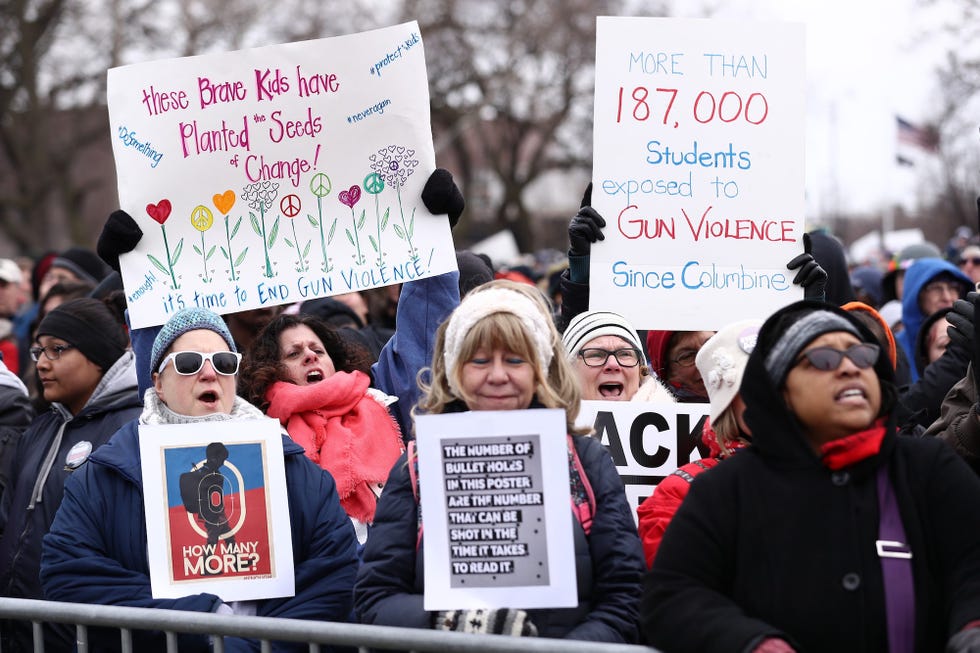
“That support is a clear sign to lawmakers to enact legislation prohibiting civilian ownership of semiautomatic weapons, increasing the minimum age to buy a gun from 18 to 21 years old, and establishing more comprehensive background checks on all purchasers of firearms. But the demonstrators should seek more effective and more lasting reform. They should demand a repeal of the Second Amendment.”

Getty Images

This echoed the Times‘ conservative columnist Bret Stephens after the Las Vegas massacre in October:

“In fact, the more closely one looks at what passes for “common sense” gun laws, the more feckless they appear. Americans who claim to be outraged by gun crimes should want to do something more than tinker at the margins of a legal regime that most of the developed world rightly considers nuts. They should want to change it fundamentally and permanently.”

“There is only one way to do this: Repeal the Second Amendment.”

This was even floated by Karl Rove, the Republican operative who masterminded George W. Bush’s campaigns, after the massacre at Mother Emanuel church in Charleston:

“Now maybe there’s some magic law that will keep us from having more of these. I mean basically the only way to guarantee that we will dramatically reduce acts of violence involving guns is to basically remove guns from society, and until somebody gets enough “oomph” to repeal the Second Amendment, that’s not going to happen.”

For his part, Stevens—not Stephens—seems to think this would be a “simple” process:

“Overturning that decision via a constitutional amendment to get rid of the Second Amendment would be simple and would do more to weaken the N.R.A.’s ability to stymie legislative debate and block constructive gun control legislation than any other available option.”

This is a very legalistic take on things, befitting a judge. There is, indeed, a straightforward process to repealing an amendment—on paper. In reality, it is a Sisyphean political task. The last time a federal lawmaker introduced a bill to repeal the Second Amendment was in 1993, when Rep. Major Owens of New York brought one to the House. It went nowhere, just as it likely would now.

Getty Images

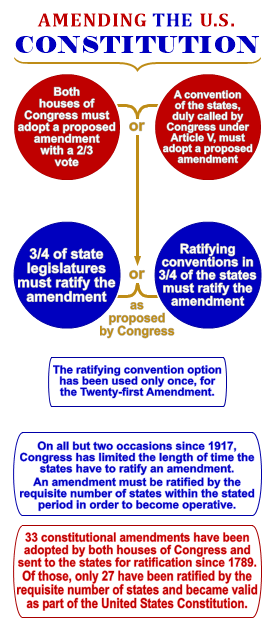
Even if Democrats regained control of both houses of Congress, the prospective amendment requires the approval of two-thirds of both houses. If it cleared that hurdle, it would need the approval of three-fourths of state legislatures. That doesn’t seem likely, even accounting for Stephens’—not Stevens’—slightly more realistic optimism:

“Repealing the Amendment may seem like political Mission Impossible today, but in the era of same-sex marriage it’s worth recalling that most great causes begin as improbable ones. Gun ownership should never be outlawed, just as it isn’t outlawed in Britain or Australia. But it doesn’t need a blanket Constitutional protection, either.”

All that said, there is political utility in staking out a position on the far end of the spectrum. Just ask Republicans. On gun rights alone, the NRA and its Republican lackeys have adopted the position that any restriction on gun ownership is unconstitutional and oppressive—and at the same time, that no gun restrictions will work, because criminals will still break the law.

(The latter, it bears repeating, is an argument against all laws. Laws are meant to construct obstacles to, and institute penalties for, bad behavior. The goal is to deter it, not prevent it from happening anywhere, ever. That someone robbed a bank is not evidence we should just give up on having laws against robbing banks. What if we tried passing better laws? As for the former, the Constitution specifically outlines how to amend it, meaning the Founders did not intend for it to be a sacred text that could never be changed. That’s why we’ve amended it 17 times since.)

Getty Images

That’s how Congress could not even pass a fix for federal background checks after a gunman with an AR-15-style rifle gunned down 20 six-year-olds in the halls of their elementary school in Newtown, Connecticut. The NRA dragged the conversation among gun-rights advocates so far to the extreme that even modest solutions became unacceptable. Lawmakers were then threatened with the wrath of this radicalized constituency, even if a huge majority of gun owners backed the background checks fix. The loudest, most radical voices won out.

On the flip side, Democrats have repeatedly shown why beginning a debate by staking out a position of compromise is political malpractice. When President Obama embarked on his quest to pass healthcare reform, he quickly abandoned any push for a universal healthcare system like Medicare for All. As the process moved along, he also scrapped plans for a “public option,” the next-best thing for liberals.

RELATED STORY

Share These Gun Violence Numbers with Anyone

What he presented to Republicans in Congress was already a compromise: the Affordable Care Act was modeled on Mitt Romney’s brainchild in Massachusetts, and sought to, in part, use market forces to bring down healthcare costs. By this point, Republicans had embraced an ethos of all-out power politics, so they called it socialism and said Obama wanted to kill your grandma with a Death Panel.

Obama narrowly succeeded without support from a single Republican. If he’d started out calling for Medicare for All, would Republicans have backed something like the ACA? And might the ultimate solution have been somewhere in between—like, say, a public option?

For the longest time, Democrats have called for incremental changes to our gun laws. They want to expand universal background checks, institute waiting periods, and, on the “extreme” end, ban semiautomatic weapons. This has gotten them exactly nowhere. What if there was a Freedom Caucus-like group in the Democratic Party—without the complete detachment from reality—that argued for outright repeal of the Second Amendment? As Stephens put it in his op-ed, repealing the Second Amendment doesn’t necessarily mean ending gun ownership.

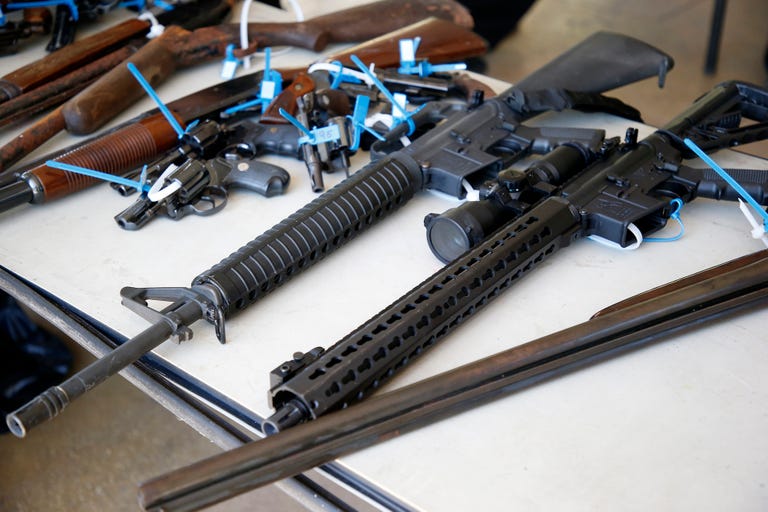
There’s a strong argument that some Americans need to own a gun to defend themselves, whether they live in rural areas where it takes too long for police to respond or they are, say, a single woman living in a dangerous neighborhood. Hunting is ingrained in local culture in large swathes of America, and should be possible. The question is what guns should be permitted for these uses, and who should be permitted to have them. Common sense, and every other developed country in the world, would say a handgun or a hunting rifle—not an AR-15.

Getty Images

Repealing the Second Amendment would simply make it easier to pass restrictions on gun ownership, as Stephens suggests. It should be possible under the amendment—two of the first three words of it are “well regulated”—but constant legal action from the NRA and others has made that impossible. That culminated with the Supreme Court’s 2008 decision in Heller v. District of Columbia, which, in a bit of conservative judicial activism, essentially established the individual right to bear arms under the Second Amendment more than 200 years after its passage. Much like with Citizens United and the flood of corrupt, unaccountable money it has allowed into our politics, the Supreme Court has exacerbated a problem the rest of us must now solve.

Even if repeal is politically treacherous, there must be a constituency in the nation’s highest legislative body that backs it. It is probably the right thing to do, but at the very least, it pulls the conversation back from the cliff over which gun-rights extremists have all of our feet dangling. Amid calls for outright repeal, more Republicans might warm up to the idea that it shouldn’t be easier for an untrained civilian to get a weapon of war than to drive a car. And, when the grand compromise finally reaches the table, Democrats can get it across the line by allowing AR-15’s to be kept and used at gun ranges. That’s the Art of the Deal.

Related:

Under the Second Amendment, there’s no constitutional right to own an AR-15

Occupy Democrats

February 27, 2018

Share this video with ANYONE you know who thinks the AR-15 is a constitutional right under the Second Amendment – but it’s NOT!!

Shared by Occupy Democrats; like our page for more!

Ari Melber Reminds Us All: the AR-15 is NOT Protected by the Second Amendment

Share this video with ANYONE you know who thinks the AR-15 is a constitutional right under the Second Amendment – but it's NOT!!Shared by Occupy Democrats; like our page for more!

Posted by Occupy Democrats on Tuesday, February 27, 2018

Trickle-down economics has been a cruel hoax

Robert Reich added a new episode on  Facebook Watch.
March 27, 2018

By appointing Larry Kudlow to head the National Economic Council, Trump is doubling down on trickle-down economics. Some inside the White House are even proposing another round of tax cuts for the wealthy and corporations. But trickle-down has been a cruel hoax. Here’s the evidence.

The Evidence of Trickle-Down's Failure

By appointing Larry Kudlow to head the National Economic Council, Trump is doubling down on trickle-down economics. Some inside the White House are even proposing another round of tax cuts for the wealthy and corporations. But trickle-down has been a cruel hoax. Here's the evidence.

Posted by Robert Reich on Monday, March 26, 2018