At least six U.S. corporations paid their CEO more than 1,000 times their typical worker last year.

U.S. Senator Bernie Sanders — US Senator for Vermont

March 25, 2018

At least six U.S. corporations paid their CEO more than 1,000 times their typical worker last year. That is a disgrace. Institute for Policy Studies

CEO vs. Typical Worker

At least six U.S. corporations paid their CEO more than 1,000 times their typical worker last year. That is a disgrace. Institute for Policy Studies

Posted by U.S. Senator Bernie Sanders on Friday, March 23, 2018

Many proud gun owners believe in gun reform

NowThis

March 25, 2018

Don’t let the NRA fool you: Many proud gun owners believe in gun reform — and they attended the #MarchForOurLives to let the nation know why

Gun Owners Explain Why They Attended the March for Our Lives

Don't let the NRA fool you: Many proud gun owners believe in gun reform — and they attended the #MarchForOurLives to let the nation know why

Posted by NowThis on Sunday, March 25, 2018

March for our Lives – Edna Chavez

MoveOn.org
March 24, 2018

Edna Chavez tells her personal story of living with gun violence in South L.A. One of many powerful moments at today’s March for our Lives.

A Teen's Personal Experience with Gun Violence in L.A.

Edna Chavez tells her personal story of living with gun violence in South L.A. One of many powerful moments at today's March for our Lives.

Posted by MoveOn.org on Saturday, March 24, 2018

March for Our Lives demonstrations in Washington, D.C., and around the world

Yahoo News

Live: March for Our Lives demonstrations in Washington, D.C., and around the world

Dylan Stableford, Senior Editor       March 24, 2018

Hundreds of thousands of people are taking part in March for Our Lives demonstrations around the world on Saturday to call for an end to gun violence. The protests were sparked by a string of deadly school shootings, including the massacre in Parkland, Fla., last month. Organizers say they expect nearly a million in Washington, D.C., alone. Yahoo News is covering the events live from the nation’s Capitol and several other locations. Watch a livestream in the video player above and follow the blog below for the latest updates.

Protesters fill Pennsylvania Avenue during the “March for Our Lives” rally in Washington, D.C., on Saturday. (AP Photo/Jose Luis Magana)

Kelli Grant

A protester displays a sign at the “March for Our Lives” rally in Washington, D.C., on Saturday. (Aaron P. Bernstein/Reuters)


The cover of next week’s @Time magazine. https://t.co/ee5AOww0Eo

Kelli Grant

Former Beatle Sir Paul McCartney joins the “March For Our Lives” rally in New York City on Saturday. (Shannon Stapleton/Reuters)

Kelli Grant

Young girls wave down at marchers from the balcony of the Newseum building as students and gun control advocates hold the “March for Our Lives” rally in Washington, D.C., on Saturday. (Leah Millis/Reuters)

Kelli Grant

Protesters gather for the “March for Our Lives” rally along Pennsylvania Avenue in Washington, D.C., on Saturday. (Chip Somodevilla/Getty Images)

Christina Gregg #MarchForOurLives protesters steadily funneling down Central Park West. https://t.co/xZvyw5PgZC

Kelli Grant

Protesters gather for a “March For Our Lives” rally outside the U.S. Embassy in London. (Stefan Rousseau/PA Images via Getty Images)

Kelli Grant

Activists wear red robes and white bonnets based on “The Handmaid’s Tale” before the “March for Our Lives” rally in downtown Houston, Texas, on Saturday. (Loren Elliott/Reuters)


Dylan Stableford: “My sister doesn’t have a voice anymore because she was slaughtered in her classroom.”

— Carlos Soto, whose sister, Victoria Soto, a teacher at Sandy Hook Elementary School, was killed in the 2014 massacre in Newtown, Conn., speaks to CNN at the “March for Our Lives” rally in Washington, D.C.

Kelli Grant

American students and expats hold signs in a solidarity rally with “March For Our Lives” in front of the European headquarters of the United Nations, in Geneva, Switzerland. (Martial Trezzini/Keystone via AP)

These veterans want assault-style weapons off the streets

NowThis Politics

March 23, 2018

These veterans have seen what assault-style weapons can do in combat, and they want them off the streets

Veterans for Gun Reform Ad

These veterans have seen what assault-style weapons can do in combat, and they want them off the streets

Posted by NowThis Politics on Friday, March 23, 2018

Right-to-work agenda that has its roots in the Jim Crow South

AFSCME

March 20, 2018

The wealthy corporations and billionaires behind Janus v. AFSCME are pushing a dangerous right-to-work agenda that has its roots in the Jim Crow South.

The False Slogan: Racist Roots of Right-To-Work

The wealthy corporations and billionaires behind Janus v. AFSCME are pushing a dangerous right-to-work agenda that has its roots in the Jim Crow South of the 1940s. Vance Muse, who invented right to work, once told a U.S. Senate committee, “I am a Southerner and I am for white supremacy.”Read more: https://afscme.org/racist-roots

Posted by AFSCME on Tuesday, March 20, 2018

Is America on the Verge of a Constitutional Crisis?

The Atlantic

Is America on the Verge of a Constitutional Crisis?

As the Trump presidency approaches a troubling tipping point, it’s time to find the right term for what’s happening to democracy.

Quinta Jurecic and Benjamin Wittes     March 17, 2018
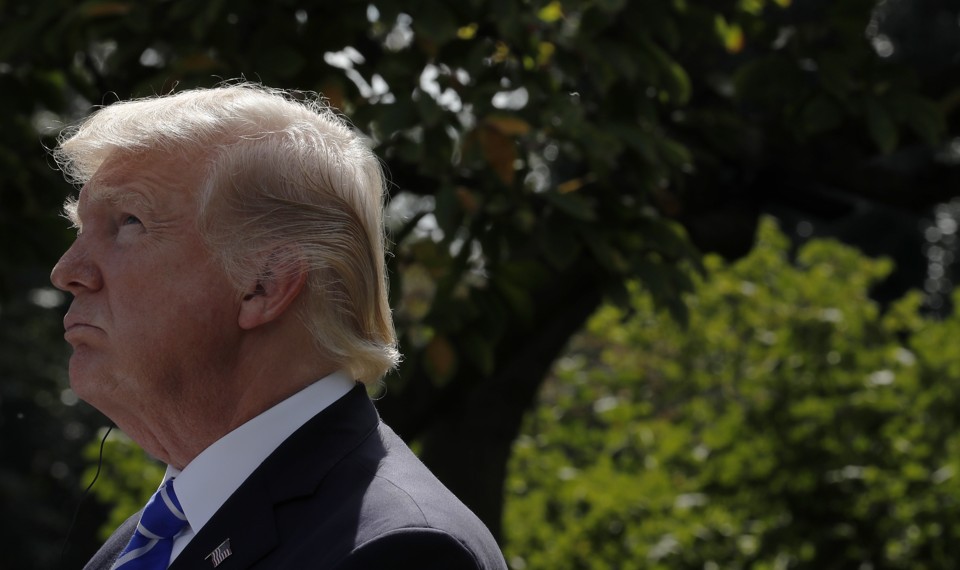
Donald Trump tweeted in exultation after the firing of a former deputy director of the FBI with whom he publicly sparred.Jonathan Ernst / Reuters

Here is something that, even on its own, is astonishing: The president of the United States demanded the firing of the former FBI deputy director, a career civil servant, after tormenting him both publicly and privately—and it worked.

The American public still doesn’t know in any detail what Andrew McCabe, who was dismissed late Friday night, is supposed to have done. But citizens can see exactly what Donald Trump did to McCabe. And the president’s actions are corroding the independence that a healthy constitutional democracy needs in its law enforcement and intelligence apparatus.

McCabe’s firing is part of a pattern. It follows the summary removal of the previous FBI director and comes amid Trump’s repeated threats to fire the attorney general, the deputy attorney, and the special counsel who is investigating him and his associates. McCabe’s ouster unfolded against a chaotic political backdrop that includes Trump’s repeated calls for investigations of his political opponents, demands of loyalty from senior law-enforcement officials, and declarations that the job of those officials is to protect him from investigation.

All of which has led many observers to wonder: Are we in the midst of a constitutional crisis? And if so, would we even know?

quick search on Google Trends shows that public interest in constitutional crises has scaled up impressively in the time since Trump’s election, with spikes in interest appearing at particularly fraught moments: the first travel ban, James Comey’s firing, and several points at which Trump appeared to be on the brink of dismissing Special Counsel Robert Mueller. Now, with the firing of McCabe, the specter of constitutional crisis has reappeared.

The term “constitutional crisis” gets thrown around a lot, but it actually has no fixed meaning. It’s not a legal term of art, though lawyers and law professors—as well as political scientists and journalists—sometimes use it as though it were. Saying that something is a constitutional crisis is a little like saying that someone is going through a “nervous breakdown”—a term that does not map neatly onto any specific clinical condition, but is evocative of a certain constellation of mental-health emergencies. It’s hard to define a constitutional crisis, but you know one when you see it. Or do you?

There have been various attempts to define the term over the years. Writing in the wake of the impeachment of President Bill Clinton, and the turmoil of the 2000 election, the political scientist Keith Whittington noted the speed with which commentators had rushed to declare the country on the brink of a constitutional crisis—even though, as he pointed out, “the republic appears to have survived these events relatively unscathed.”

Whittington instead proposed thinking about constitutional crises as “circumstances in which the constitutional order itself is failing.” In his view, such a crisis could take two forms. There are “operational crises,” in which constitutional rules don’t tell us how to resolve a political dispute; and there are “crises of fidelity,” in which the rules do tell us what to do but aren’t being followed. The latter is probably closest to the common understanding of constitutional crisis—something along the lines of President Andrew Jackson’s famous (if apocryphal) rejoinder to the Supreme Court, “[Justice] John Marshall has made his decision, now let him enforce it.” Or, to point to an example proposed recently by Whittington himself, such a crisis would result if congressional Republicans failed to hold Trump accountable for firing Mueller.

The constitutional scholars Sanford Levinson and Jack Balkin more or less agree with Whittington’s typology, but add a third category of crisis: situations in which the Constitution fails to constrain political disputes within the realm of normalcy. In these cases, each party involved argues that they are acting constitutionally, while their opponent is not. If examples of the crises described by Whittington are relatively far and few between—if they exist at all—Levinson and Balkin view crises of interpretation as comparatively common. One notable example: the battle over secession that began the Civil War.

RELATED STORY
McCabe’s Firing Chips Away at the Justice Department’s Independence

These three categorizations help show what a constitutional crisis could look like, but it’s not entirely clear how they apply to the situation at hand. Whittington, Levinson and Balkin all agree that the notion of a constitutional crisis implies some acute episode—a clear tipping point that tests the legal and constitutional order. But how do we know this presidency isn’t just an example of the voters picking a terrible leader who then leads terribly? At what point does a bad president doing bad things become a problem of constitutional magnitude, let alone a crisis of constitutional magnitude? Indeed, it’s hard to see a crisis when the sun is still rising every day on schedule, when nobody appears to be defying court orders or challenging the authority of the country’s rule-of-law institutions, and when a regularly scheduled midterm election—in which the president’s party is widely expected to perform badly—is scheduled for a few months from now. What exactly is the crisis here?

Another problem with thinking about America’s current woes as a constitutional crisis involves the question of what comes next. That is, assume for a moment we are in some kind of constitutional crisis. So what? What exactly flows from that conclusion? Normally, constitutional conclusions imply certain prescribed outcomes. When a president is impeached, for example, the Senate must hold a trial to determine whether he or she should be removed from office. When serving a second term, a president is not allowed to run for a third term. But if one concludes that we are going through a constitutional crisis, what happens next? The label doesn’t carry any obvious implication, let alone an action item. If it has value, its value is descriptive. It carries cultural and emotional weight but not much else.

Still another problem with the term is that the duration of the crisis is not clear. Does a constitutional crisis take place over days, weeks, or longer? Must it threaten in the immediate term to blow things up if it doesn’t blow over or get resolved through some other process? (Think of the Cuban Missile Crisis, only in domestic constitutional terms.) Or can a constitutional crisis also take place in slow motion?

There’s a better term for what is taking place in America at this moment: “constitutional rot.”

Constitutional rot is what happens, the constitutional scholar John Finn argues, when faith in the key commitments of the Constitution gradually erode, even when the legal structures remain in place. Constitutional rot is what happens when decision-makers abide by the empty text of the Constitution without fidelity to its underlying principles. It’s also what happens when all this takes place and the public either doesn’t realize—or doesn’t care.

Balkin used the same phrase immediately after the firing of James Comey to describe what he saw as “a degradation of constitutional norms that may operate over long periods of time.” Comey’s firing was startling, he argued, but not a constitutional crisis in and of itself. The real constitutional change lay in the slow corruption of public trust in government that had brought Americans to this point.

Rot, in Finn’s words, is “quiet, insidious, and subtle.” It hollows out the system without citizens or officials even noticing. And, as Balkin notes, though “constitutional rot” is distinct from “constitutional crisis,” the former can lead to the latter. Slowly rotting floorboards can suddenly give way to the hidden pit beneath. (Balkin uses a similar metaphor of a rotten tree branch.)

There are clearly elements of rot in our current situation. The evidence is everywhere. Ongoing violations, or attempted violations, of our democratic norms and expectations, have become routine. The overt demands for the politicization of law enforcement have intensified. A highly-politicized media disseminates presidential propaganda. Congress tolerates it all. This is consistent with constitutional rot.

But “constitutional rot” also has its limits as a way of describing Trumpism. Rot, after all, is a one-way street—a process that can be stemmed and slowed but cannot be reversed. Wood does not regenerate. Rotten meat does not heal itself and become fresh again.

Yet in different ways, both Balkin and Finn imagine constitutional rot as potentially reversible. Balkin’s solution is, essentially, that we must elect different and better leaders in the future—presumably before it’s too late to replace the floorboards. Finn takes a different view, making the case that rot can be combated through the development of an engaged and energized citizenry, one that cares about preserving and maintaining constitutional values.

Even amid the constitutional degradation of this moment, both of these rejuvenating mechanisms are very much in evidence. On a daily basis, features of our democratic culture look more like antibodies fighting off an illness than like the rot before an inevitable collapse.

Journalists have been relentless and ferocious and effective in unmasking and reporting the truth—and news institutions have developed more committed readership as a result. A broad democratic coalition of citizens is mobilizing against Trumpism—most recently in a Pennsylvania congressional district believed to be so solidly Republican that Democrats let the incumbent run unopposed in recent elections. Other institutions, including the very FBI that Trump is assaulting, are knuckling down and doing their jobs in the face of pressure. This is not the stuff of a rotting democracy.

Trump can whine and he can fire senior FBI officials, but he has been singularly ineffective either in getting the bureau to investigate his political opponents (they have not yet “locked her up”) or in dropping the Russia investigation, which continues to his apparent endless frustration. If this is constitutional rot, it’s inspiring a surge of public commitment to underlying democratic ideals—including the independence of law enforcement.

What we are seeing, in other words, is a little more dynamic than rot, a phrase that assumes we know the outcome. It’s more like constitutional infection or injury. The wound may indeed lead to a crisis; it may become gangrenous. But to describe the United States today as facing a constitutional crisis misses the frenetic pre-crisis activity of the antibodies fighting the bacteria, alongside the antibiotics the patient is taking.

We are definitely in a period of sustained constitutional infection. The question is whether we can collectively bring that infection under control before we face an acute crisis.

About the authors:

Quinta Jurecic is the deputy managing editor of Lawfare.

Benjamin Wittes is the editor in chief of Lawfare and a senior fellow at the Brookings Institution.

Donald Trump and the New Dawn of Tyranny

Time

Donald Trump and the New Dawn of Tyranny

By Timothy Snyder       March 3, 2018

Timothy Snyder is Yale University’s Housum Professor of History and the author of On Tyranny

President Trump walks to the Oval Office at the White House, on Feb. 24, 2017. Mark Wilson—Getty Images

The Founding Fathers designed the constitution to prevent some Americans from exercising tyranny. Alert to the classical examples they knew, the decline of ancient Greece and Rome into oligarchy and empire, they established the rule of law, checks and balances, and regular elections as the means of preserving the new republic. Thus far, it has worked. But it need not work forever.

We might imagine that the American system must somehow always sustain itself. But a broader look at the history of democratic republics established since our own revolution reveals that most of them have failed. Politicians who emerge from democratic practices can then work to undo democratic institutions. This was true in the rise of fascism in the 1920s and 1930s, as well as during the spread of communism in the 1940s, and indeed in the new wave of authoritarian regime changes of the 21st century. Indeed, absent a truly decisive revolution, which is a rare event, a regime change depends upon such people — regime changers — emerging in one system and transforming it into another.

It is in this light that we should consider President Donald Trump and his closest advisers and spokespeople. Although they occupy the positions they do thanks to an election, there is little reason to believe that they support the American constitutional system as it stands, and much to remind us of authoritarian regimes changes of the recent past. A basic weapon of regime changers, as fascists realized nearly a century ago, is to destroy the concept of truth. Democracy requires the rule of law, the rule of law depends upon trust, and trust depends upon citizens’ acceptance of factuality. The president and his aides actively seek to destroy Americans’ sense of reality. Not only does the White House spread “alternative facts,” but Kellyanne Conway openly proclaims this as right and good. Post-factuality is pre-fascism.

The function of the press, as the Founding Fathers understood, was to generate the common knowledge on which citizens could understand and debate policy, and to prevent rulers from behaving tyrannically. Whether from the far right or the far left, the regime changers of the twentieth century understood that the media had to be bullied and deprived of importance. When Steve Bannon refers to the press as the “opposition,” or Mr. Trump calls journalists “enemies,” they are expressing their support for the demolition of the historical, ethical, and intellectual bases of the political life we take for granted. Indeed, when Mr. Trump calls journalists “enemies of the people,” he is quoting Joseph Stalin.

Since the end of the cold war, the new authoritarian regimes that have emerged in eastern Europe have taken the form of authoritarian kleptocracies: Russia is the most enduring example of this model; a revolution halted the development of a similar regime in Ukraine in 2014. The Founders, opponents of a British monarchy, were alert to the danger that government might serve to enrich a single family. The emoluments clause of the constitution confirms our common sense: no one can be trusted to defend the interests of citizens if his policy choices can make him richer. This president has not revealed the basic financial information about himself, but we know that he has business interests at home and abroad. Russians and Ukrainians have been quick to notice a familiar pattern.

If there is a common thread that links American political rhetoric from the 18th century to today, through the confrontations with fascist and communist rivals and into the 21st century it is the word “democracy.” Our practice has been imperfect, but the endorsement of the idea of rule by the people has been consistent, until now. This president has defied that norm. He has said almost nothing in favor of democracy or, for that matter, civil and human rights. He admires authoritarians. His one major comment on democracy was that he would contest the outcome of elections if they were not in his favor. That is opposition to democracy. Indeed, not recognizing election results and moving to take power anyway is what authoritarians do.

In recent authoritarian regime changes, in Poland and Hungary as well as Russia, the executive power has been able to sideline the judiciary and then humble the legislature. The idea of checks and balances is enshrined in our constitution, but of course also in theirs, is that none of the three branches of government can dominate the others. In denigrating judges, Mr. Trump attacks the geometry of the system. Once the courts are tamed, the legislature cannot defend itself, and we have authoritarianism. If legislators do not support the judiciary, then their turn for humiliation will come, and the laws they pass will be unenforceable. This has been the pattern in recent authoritarian regime changes around the world.

Right-wing authoritarians today use the threat or the reality of terrorism to seek and hold power. The one consistent policy of the Trump administration thus far has been to encourage a Muslim terrorist attack within or upon the United States. Everywhere the first executive order on refugees and immigrants was understood as directed against Muslims. The major consequence, most likely the intended one, is the alienation of Muslims at home and abroad. The proposal to move the US embassy in Israel to Jerusalem is similar: it will never take place, so serves only to alienate and enrage Muslims. Michael Flynn is in the same category: though he was only national security advisor for three weeks, few Muslims will forget that he referred to their religion as a “cancer.” Modern authoritarianism is terror management, and so modern authoritarians need terror attacks: real, simulated, or both. As James Madison noticed long ago, tyranny arises “on some favorable emergency.”

The experience of the 21st century, as well as the experience of the 1930s, teaches that it takes about a year to engineer a regime change. To what, exactly? We cannot deduce, from the Trump administration’s destructive chaos and ideological incoherence, what the post-democratic American regime would be. We can be sure, however, that we would miss being free. The prospect of children and grandchildren growing up under tyranny is terrifyingly real. History can remind us of the fragile fundaments of our own democracy. But what follows now is up to us.

Timothy Snyder is a professor of history at Yale University and the author, most recently, of On Tyranny: Twenty Lessons from the Twentieth Century.

TIME Ideas hosts the world’s leading voices, providing commentary on events in news, society, and culture. We welcome outside contributions. Opinions expressed do not necessarily reflect the views of TIME editors.

The richest 1% took home 82% of the wealth generated around the globe last year.

IJR Blue Presents added a new episode on  Facebook Watch.

January 2018

The richest 1% took home 82% of the wealth generated around the globe last year.

Oxfam says Donald Trump and his “cabinet of billionaires” are partly to blame for the growing inequality.

Wealth Inequality Continues to Grow Under Trump

The richest 1% took home 82% of the wealth generated around the globe last year.Oxfam says Donald Trump and his "cabinet of billionaires" are partly to blame for the growing inequality.

Posted by IJR Blue Presents on Tuesday, January 23, 2018