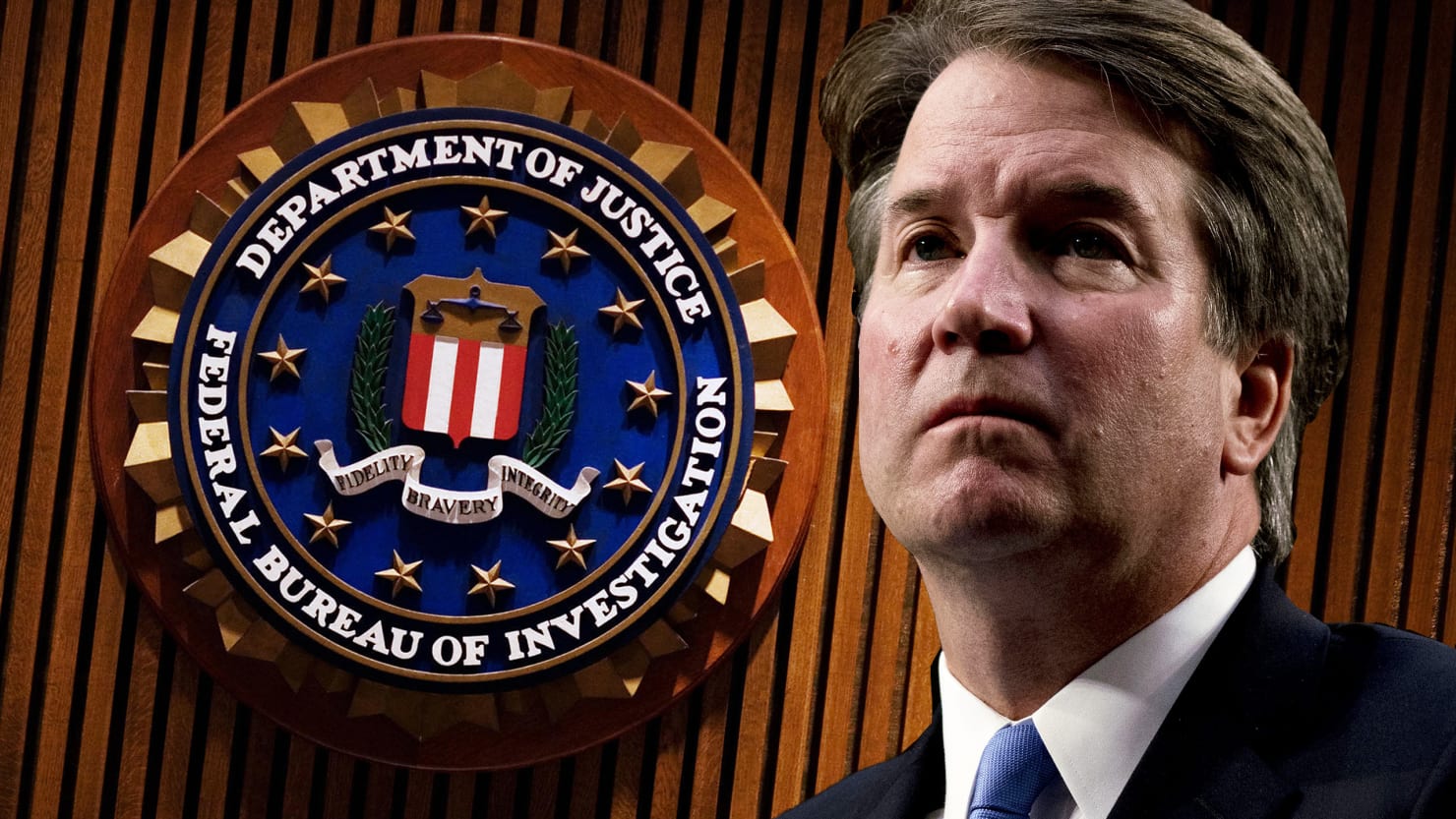
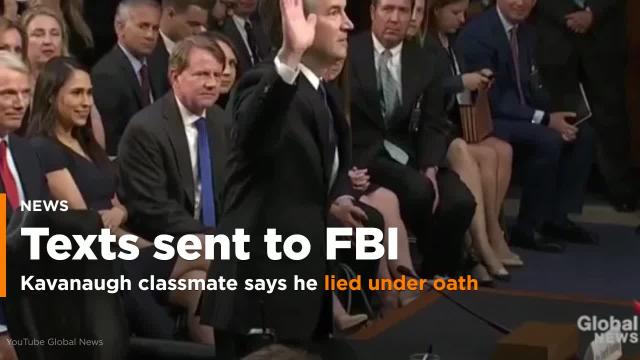
Many Of Brett Kavanaugh’s Ex-Classmates Wanted To Talk — But FBI Reportedly ‘Ignored’ Them

HuffPost

Many Of Brett Kavanaugh’s Ex-Classmates Wanted To Talk — But FBI Reportedly ‘Ignored’ Them

Dominique Mosbergen, HuffPost               October 4, 2018  

Dozens of people reportedly reached out to the FBI in recent days in the hopes of sharing potentially helpful information as the bureau conducted its “limited” probe into the sexual misconduct allegations against Supreme Court nominee Brett Kavanaugh.

But the individuals say investigators did not respond to their outreach — a silence that has prompted questions about just how “limited” in scope the inquiry really was.

The White House announced in the middle of the night on Thursday that it had sent the results of the FBI’s supplemental background investigation of Kavanaugh to the Senate. “With this additional information, the White House is fully confident the Senate will vote to confirm Judge Kavanaugh to the Supreme Court,” deputy press secretary Raj Shah said on Twitter.

Hours earlier, NBC News reported that more than 40 people “with potential information into the sexual misconduct allegations” against Kavanaugh, including multiple high school and college classmates of the judge, had tried to contact the FBI to no avail.

Attorney Alan Abramson told the outlet that he’d reached out to the bureau on behalf of his client, who he described as a friend of Deborah Ramirez, the Yale classmate of Kavanaugh’s who has accused the judge of thrusting his penis in her face at a college party.

Abramson said Ramirez had told his client in the early ’90s “about an incident that happened during Ms. Ramirez’ freshman year at Yale.” He said his client was willing to provide this “pertinent information” to the FBI — but said he had not heard back from the bureau.

On Thursday, HuffPost guest writer William Scheuerman wrote that he lived in the same residential hall at Yale as Kavanaugh, and that he’d called the FBI to suggest a list of people they should contact. The FBI didn’t get in touch with him, Scheuerman said, or with the other friends and neighbors who tried to contact the bureau.

Kenneth Appold, a professor at Princeton Theological Seminary who’d been a suitemate of Kavanaugh’s when the alleged incident with Ramirez occurred, told The New Yorker that he’d also not been contacted by investigators despite having reached out to the FBI and submitting a statement through the bureau’s website.

Appold said he had not been present at the party where the alleged incident had taken place, but said an eyewitness told him about it soon after it occurred.

“I can corroborate Debbie’s account,” Appold told the magazine. “I believe her, because it matches the same story I heard 35 years ago, although the two of us have never talked.”

According to The New Yorker, several other former Yale classmates of Kavanaugh’s said they’d reached out to the FBI about the judge “but had not received a response.” Two high school acquaintances of Kavanaugh’s said they’d submitted sworn declarations to the FBI but had not been contacted by the bureau.

Also on Wednesday, CNN published several more examples of former Yale classmates of Kavanaugh’s whose attempts to contact the FBI with information had amounted to naught. The outlet noted that none of these individuals claim to be direct witnesses of the alleged incident with Ramirez.

Liz Swisher, a former classmate of Kavanaugh’s who had … questioned Kavanaugh’s truthfulness about his drinking at Yale in testimony before the Senate Judiciary Committee, told CNN she had not been contacted by the FBI. Chad Ludington, another former classmate who said he often drank with Kavanaugh during their early years at Yale, also filled out a form, but had not been contacted back by the FBI as of Wednesday afternoon.

[…] Mark Krasberg, an assistant professor of neurosurgery at the University of New Mexico who was also a classmate of Kavanaugh’s and Ramirez’s without direct knowledge of the alleged incident, had also not heard back from the FBI despite numerous attempts to reach out to lawmakers’ offices and FBI offices directly.

Quoting security experts, CNN noted that it’s not unusual for the FBI to ignore requests from people who reach out to them with information.

“As a general matter, if the FBI is conducting an investigation … they decide who they need to talk to,” said Carrie Cordero, a former counsel to the U.S. assistant attorney general for national security.

Still, Democratic lawmakers have expressed alarm at the FBI’s apparent overlooking of potentially important witnesses in their probe of Kavanaugh.

Sen. Dianne Feinstein (D-Calif.) said in a statement Wednesday that she had “serious concerns that this is not a credible investigation.”

Sens. Kirsten Gillibrand (D-N.Y.) and Richard Blumenthal (D-Conn.) told CNN’s Wolf Blitzer that the FBI’s investigation did not appear to be sufficiently thorough.

“[It] doesn’t sound like the complete, thorough investigation that frankly senators deserve and would be due if you had a thorough background check,” Gillibrand said.

According to The New York Times, the FBI reached out to 10 people and interviewed nine as part of its probe into Kavanaugh’s past. Ramirez said she was interviewed by two agents at her lawyer’s office in Boulder, Colorado, last week; and three former classmates of Kavanaugh’s ― Mark JudgeTim Gaudette and Chris Garrett ― were reportedly also questioned as part of the investigation.

Other than Ramirez, at least two other women have accused Kavanaugh of sexual misconduct: Christine Blasey Ford, a California professor who claims the judge sexually assaulted her when they were teenagers; and Julie Swetnick, who has accused Kavanaugh of being present during a “gang rape” in the early 1980s. Neither woman was interviewed by the FBI.

Kavanaugh has vehemently denied the misconduct allegations against him.

Speaking to The New Yorker, Ramirez said this week that she was troubled by what she described as the FBI’s apparent lack of willingness to substantiate her claims.

“I am very alarmed, first, that I was denied an FBI investigation for five days, and then, when one was granted, that it was given on a short timeline and that the people who were key to corroborating my story have not been contacted,” she said. “I feel like I’m being silenced.”

The White House refused to say on Wednesday whether the Trump administration had limited the scope of the FBI’s investigation into Kavanaugh.

Earlier in the week, President Donald Trump had claimed the bureau would have free rein to interview whomever they needed.

This story has been updated with details of Scheuerman’s account.
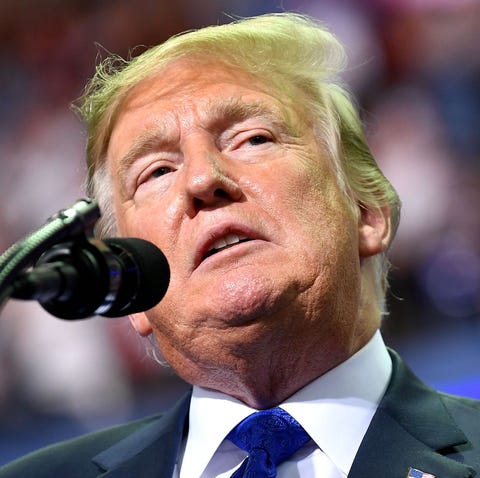
Donald Trump, American president*, disgraces his office once more.

Esquire

This Vicious Buffoon Is a Vessel for All the Worst Elements of the American Condition

Donald Trump, American president*, disgraces his office once more.
US-POLITICS-TRUMP

Getty ImagesMANDEL NGAN

Everyone who does not agree with me is a traitor and a scoundrel.

—HRH George III, King of Great Britain and Ireland

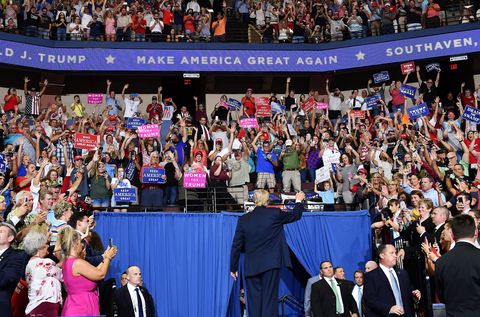
This video should be the only news from now until Election Day, and probably beyond that, all the way to the next Election Day in 2020 as well.

This video captures perfectly where we are as a nation at this moment in history. It shows with startling clarity the end result of civic disengagement and democratic apathy. It shows without question that we have allowed our republic to fall into the hands of a sociopath whose feeling for his fellow human beings can be measured against a poker chip. It shows beyond a shadow of a doubt that the better angels of our nation have been sold out to anger, and greed, and stone hatred. It shows precisely the depths to which our fellow citizens will follow this bag of old and rancid sins. Some of those citizens know better. Some of them don’t. All of them are dangerous blockheads.

US-POLITICS-TRUMP

Look at the man behind the seal of the President of the United States, mocking the recollections of a survivor of sexual assault. In my life, I have watched John Kennedy talk on television about missiles in Cuba. I saw Lyndon Johnson look Richard Russell squarely in the eye and and say, “And we shall overcome.” I saw Richard Nixon resign and Gerald Ford tell the Congress that our long national nightmare was over. I saw Jimmy Carter talk about malaise and Ronald Reagan talk about a shining city on a hill. I saw George H.W. Bush deliver the eulogy for the Soviet bloc, and Bill Clinton comfort the survivors of Timothy McVeigh’s madness in Oklahoma City. I saw George W. Bush struggle to make sense of it all on September 11, 2001, and I saw Barack Obama sing “Amazing Grace” in the wounded sanctuary of Mother Emanuel Church in Charleston, South Carolina.

These were the presidents of my lifetime. These were not perfect men. They were not perfect presidents, god knows. Not one of them was that. But they approached the job, and they took to the podium, with all the gravitas they could muster as appropriate to the job. They tried, at least, to reach for something in the presidency that was beyond their grasp as ordinary human beings. They were not all ennobled by the attempt, but they tried nonetheless.

US-POLITICS-TRUMP

And comes now this hopeless, vicious buffoon, and the audience of equally hopeless and vicious buffoons who laughed and cheered when he made sport of a woman whose lasting memory of the trauma she suffered is the laughter of the perpetrators. Now he comes, a man swathed in scandal, with no interest beyond what he can put in his pocket and what he can put over on a universe of suckers, and he does something like this while occupying an office that we gave him, and while endowed with a public trust that he dishonors every day he wakes up in the White House.

The scion of a multi-generational criminal enterprise, the parameters of which we are only now beginning to comprehend. A vessel for all the worst elements of the American condition. And a cheap, soulless bully besides.

TOPSHOT-US-POLITICS-TRUMP

We have had good presidents and bad—a Buchanan is followed by a Lincoln who is followed by an Andrew Johnson, and so forth. But we never have had such a cheap counterfeit of a president* as currently occupies the office. We have had presidents who have been the worthy targets of scalding scorn, but James Callender went after giants. We never have had a president* so completely deserving of scorn and yet so small in the office that it almost seems a waste of time and energy to summon up the requisite contempt.

Watch him make fun of the woman again. Watch how a republic dies in the empty eyes of an empty man who feels nothing but his own imaginary greatness, and who cannot find in himself the decency simply to shut the fuck up even when it is in his best interest to do so. Presidents don’t have to be heroes to be good presidents. They just have to realize that their humanity is our common humanity, and that their political commonwealth is our political commonwealth, too.

Watch him again, behind the seal of the President of the United States. Isn’t he a funny man? Isn’t what happened to that lady hilarious? Watch the assembled morons cheer. This is the only story now.

What matters about Kavanaugh, and what doesn’t

Yahoo News

Matt Bai’s Political World

Matt Bai        October 3, 2018

More Than 500 Law Professors Condemn Kavanaugh For ‘Lack Of Judicial Temperament’

How Times Journalists Uncovered the Original Source of the President’s Wealth

New York Times

Three reporters spent over a year digging through more than 100,000 pages of documents and chasing down key sources familiar with President Trump’s father and his empire.

By Melina Delkic                 October 2, 2018

The Times obtained more than 100,000 pages of documents for an investigation into the source of the president’s wealth.CreditCreditSonny Figueroa/The New York Times

In the three years since Donald J. Trump announced his candidacy for president, there has been plenty of investigation into his financial history — especially because he broke with tradition and declined to release his tax returns.

In 2016, David Barstow, Susanne Craig and Russ Buettner of The New York Times obtained his 1995 tax returns, showing that he could have avoided paying taxes for nearly two decades. And for their article on Wednesday’s front page, they worked together for more than a year to investigate the wealth that the president inherited from his father.

“It’s unusual to dive into what you think is an extremely well-covered subject and to find so much completely new stuff, stuff that just is astonishing,” Mr. Barstow said. “It’s a great reminder that even things that you think are well described, there are these other deeper layers.”

Over all, the effort was sprawling and multilayered, involving more than 100,000 pages of documents, both public and confidential; interviews with key sources and requests through the Freedom of Information Act. Together, they showed that the president participated in dubious tax schemes in the 1990s, including outright fraud, and that he wasn’t the self-made billionaire he has claimed to be.

Read The Times’s Investigation of the President’s Tax Schemes
Trump Engaged in Suspect Tax Schemes as He Reaped Riches From His Father

The investigation started with a simple question: What was going on with the president’s finances from 1995 to 2005? The team knew he had reported a loss in 1995 of almost $1 billion, as they had reported in 2016, and then a $150 million profit in 2005, as David Cay Johnston, a former New York Times reporter, reported on Rachel Maddow’s MSNBC program last year, based on two pages of those tax returns.

Mr. Barstow, Ms. Craig and Mr. Buettner dug into the fortune that Fred C. Trump, the prolific New York City builder who died in 1999, passed on to President Trump and his surviving siblings, Maryanne Trump Barry, Robert Trump and Elizabeth Trump Grau.

A central finding of the story began to emerge in April 2017, when Ms. Craig had been Google searching an arcane term the group was interested in — “mortgage receivable,” which the Trumps used to describe the mortgages from the children to Fred — paired with the last name “Trump.” She found the disclosure form that the president’s sister Maryanne, a federal judge, had filed related to her Senate confirmation hearing. Unlike the many she filed during her years on the bench, this one was not redacted. In that document, Ms. Craig noticed a $1 million contribution from an obscure family-owned company: All County Building Supply & Maintenance.

“‘What the heck?’” Ms. Craig remembered thinking. “That was the first inkling we had that, hey, there’s something to do with this company that we need to figure out.”

The trio began to talk to people familiar with the president’s father and his empire. Those people told them that the company was a middleman entity created by President Trump and his siblings essentially to move cash from Fred Trump’s companies to his children. After All County bought various items for Fred Trump’s buildings, like boilers and cleaning supplies, a secretary would bill the items to Fred Trump’s buildings with a 20 to 50 percent markup. The siblings would then pocket the difference.

In short, the siblings received millions in untaxed gifts from their father, skirting a 55 percent tax on gifts over a certain value that would have cut the total significantly.

“When we came to that realization, that was a big day for us,” Mr. Buettner said.

Over the next several months, the reporters would obtain tens of thousands of pages of documents, including more than 200 tax returnsfrom Fred Trump, his companies and various Trump partnerships and trusts. (“We have a virtual mountain of spreadsheets,” Mr. Barstow said. “We should have spreadsheets for our spreadsheets.”) The trove included previously secret depositions, including one in which Robert Trump, the president’s brother, admitted that the family used the padded receipts from All County to justify higher rent increases for their tenants in rent-regulated apartments.

This year, another breakthrough came when the team matched a boiler receipt from a personal injury lawsuit Mr. Buettner found that named All County — a man was injured by the boiler in a Trump building — to a boiler receipt they obtained via a FOIA request to New York City. They found two identical purchase-order numbers, with the bill from All County to Fred Trump marking up the boiler price by 20 percent.

“That’s a rare moment of reporting serendipity, right?” Mr. Buettner said. “Two pieces of paper from two separate places that combined to tell you a bigger truth.”

“It was like these two puzzle pieces came together — one from the lawsuit and the other from the FOIA request,” Ms. Craig said. “We call it the Perry Mason moment.”

Mr. Barstow then tracked down the man who sold that boiler to Fred Trump: Leon Eastmond, the owner of A. L. Eastmond & Sons, a Bronx company that makes industrial boilers. Mr. Eastmond said he remembered the lunch meeting during which Fred Trump negotiated the price of 60 boilers, and later receiving checks in the mail from All County. He said that he had never heard of All County before those checks, and that he had mainly interacted with Fred Trump, his secretary and Robert Trump.

If the investigation was a “massive jigsaw puzzle,” then Mr. Eastmondwas “the piece that fit perfectly in the center of the puzzle,” Mr. Barstow said.

Throughout the investigation, they didn’t hit the typical lulls investigative reporters face — the dead ends or the weekslong digs without any big breakthroughs. “There never went three weeks that went by where we didn’t move the ball that much further down,” Ms. Craig said. “We just kept finding stuff and finding stuff.”

The worry, instead, was how they would decide which threads to follow.

The article emphasizes just how much remains to be uncovered in the Trump tax return saga, Ms. Craig, Mr. Barstow and Mr. Buettner said.

“One of the big themes of this story is this one little alleyway that we wandered down, and all that it sort of revealed to us is how little we actually do know about the president’s financial history,” Mr. Barstow said. “In all of the books, all of the profiles, all of the newspaper stories, we haven’t found one mention of Donald Trump and All County Building Supply.”

Melina Delkic is a senior staff editor.

After Budget Cuts, the IRS’ Work Against Tax Cheats Is Facing “Collapse”

ProPublica

After Budget Cuts, the IRS’ Work Against Tax Cheats Is Facing “Collapse”

Audits and criminal referrals are down sharply since Congress cut the tax agency’s budget and management changed priorities.

By Jesse Eisinger and Paul Kiel       October 1, 2018

The Internal Revenue Service headquarters in Washington, D.C. (Andrew Harrer/Bloomberg via Getty Images)

This story was co-published with The New York Times.

Tax evasion is at the center of the criminal cases against two associates of the president, Paul Manafort and Michael Cohen. The sheer scale of their efforts to avoid paying the government has given rise to a head-scratching question: How were they able to cheat the Internal Revenue Service for so many years?

The answer, researchers and former government auditors say, is simple. The IRS pursues fewer cases of tax evasion than it did less than 10 years ago. Provided you’re not a close associate of President Donald Trump, there may never be a better time to be a tax cheat.

Last year, the IRS’s criminal division brought 795 cases in which tax fraud was the primary crime, a decline of almost a quarter since 2010. “That is a startling number,” Don Fort, the chief of criminal investigations for the IRS, acknowledged at an NYU tax conference in June.

Bringing cases against people who evade taxes on legal income is central to the revenue service’s mission. In addition to recouping lost revenue, such cases are supposed “to influence taxpayer behavior for the hundreds of millions of American citizens filing tax returns,” Fort said. With fewer cases, experts fear, Americans will get the message that it’s all right to break the law.

Starting in 2011, Republicans in Congress repeatedly cut the IRS’s budget, forcing the agency to reduce its enforcement staff by a third. But that drop doesn’t entirely explain the reduction in tax fraud cases.

Over time, crimes only tangentially related to taxes, such as drug trafficking and money laundering, have come to account for most of the agency’s cases.

The IRS Loses Its Bite

Starting in 2011, budget cuts have slashed the IRS’s enforcement staff by a third, and the audit rate has fallen even more.

“Due to budget cuts, attrition and a shift in focus, there’s been a collapse in the commitment to take on tax fraud,” said Chuck Pine, who used to be the third-ranking criminal enforcement officer at the IRS and is now a managing director at BDO Consulting. “I believe there are thousands of individuals who have U.S. tax obligations and are not complying with U.S. tax laws.”

The result is huge losses for the government. Business owners don’t pay $125 billion in taxes each year that they owe, according to IRS estimates. That’s enough to finance the departments of State, Energy and Homeland Security, with NASA tossed in for good measure. Unlike wage earners who have their income separately reported to the IRS, business owners are often on the honor system.

The IRS declined to comment on its enforcement efforts.

Cohen’s and Manafort’s cases illustrate different but common types of tax cheating, and how the IRS has struggled to enforce the law. Cohen failed to report income from domestic businesses. Manafort used exotic foreign locales and shell corporations to hide his money.

Cohen’s tax evasion schemes were straightforward. Besides paying off a pornographic movie star and a former Playboy model in violation of campaign finance laws, he pleaded guilty to lying on his tax return. Whether it was income from his business owning taxi medallions, millions of dollars in interest payments on a loan he’d made to another taxi operator or the $30,000 he made by brokering the sale of a luxury handbag, Mr. Cohen simply hid the money from his accountant and the government. Over five years, he didn’t disclose $4.1 million, saving himself $1.5 million in taxes.

The IRS typically catches such evasion by auditing taxpayers. Theoretically, evidence picked up in audits can be used to start criminal cases.

But the rate at which the agency audits tax returns has plummeted by 42 percent since the budget cuts started. Criminal referrals were always rare and are becoming rarer still, dropping from 589 referrals in 2012 to 328 in 2016. With the government conducting 1.2 million audits in 2016, that’s one criminal referral for roughly every 3,600 audits.

“The focus of auditors and tax collectors is not to identify fraud, it’s to collect tax,” said a special agent, who spoke on the condition of anonymity because he was not authorized to speak to the media. Management has set other priorities, he says. “So by default, the employees are not doing it.”

In addition, current and former IRS agents say that audits are not as intensive as they used to be. Because the IRS pushes agents to close audits more quickly, they make fewer requests for records and interviews.

“The quality of those referrals was also down,” said Marie Allen, a recently retired auditor who worked at the IRS for more than 30 years conducting complex financial investigations. “That is what people popularly think we should be doing, and I’m trying to say it ain’t so.”

Budget cuts have diminished the criminal investigation division, trimming the number of agents by a fifth since 2010. Recently, the IRS closed four of its 25 field offices, according to Fort. In New York state, home of the country’s financial industry, the revenue service is down to 161 agents, about a hundred fewer than it had 15 years ago.

It doesn’t help that many agents prefer chasing flashier crimes than tax evasion. Rob Warren, a research associate at Catholic University who previously spent a quarter century at the IRS, interviewed 30 former special agents. He asked each agent which of their cases had been their favorite. The answers, Warren said, typically were only tangentially related to taxes.

“It was usually narcotics, Ponzi schemes, some public corruption,” Warren said. “Agents loved Ponzi cases because there was a real victim, an old lady or something like that.”

Federal prosecutors seek out special agents for these cases because they are skilled financial investigators. And tax crimes, like failing to declare illegal income from, say, a bribe or cocaine sales, can be easier to prove than bribery or selling drugs.

In recent years, the IRS has also been pulled away from classic tax dodging cases by soaring rates of identity theft. IRS management assigned scores of agents to chase perpetrators who used stolen identities to collect tax refunds.

One tax fraud hotbed that has been a clear priority of both the IRS and the Justice Department is going after money Americans stashed overseas without reporting it to the federal government. But there are clear reasons that Manafort, who hid his money in places like Cyprus and St. Vincent and the Grenadines, might still have escaped detection.

Switzerland has been the Justice Department’s primary target over the past 10 years, an effort that has resulted in settlements with the giant Swiss banks UBS and Credit Suisse, and dozens of smaller institutions.

The IRS allowed Americans with foreign accounts to voluntarily disclose them and pay a smaller penalty than they would have had they been caught hiding the information. Some 56,000 people participated, netting the government $11.1 billion. The IRS’s criminal division also brought several cases against people for concealing accounts.

For all this success, there has been little change in the amount of wealth stashed overseas. Americans have about $1.2 trillion of personal assets in tax havens, according to data compiled by Gabriel Zucman, an assistant professor of economics at the University of California, Berkeley, and two colleagues. It’s unclear what portion has been disclosed to the IRS.

“What has happened over the last 10 years is real progress,” Zucman said. “But what the data suggest is that it has not had a dramatic effect on the amount of offshore wealth.” Money has flowed out of Switzerland and into Asian tax havens like Hong Kong and Singapore.

Moreover, the IRS has made little use of new weapons in the fight against wealth hidden overseas. In 2010, President Barack Obama signed a law that was supposed to provide a crucial tool for government auditors and prosecutors. That law, the Foreign Account Tax Compliance Act, required banks with American account holders to report information to the United States. Like employers filing W-2 forms about their workers, these reports would force account holders to come clean.

Eight years later, the program is still getting off the ground. Countries around the world have signed agreements, and more than 100,000 foreign banks have sent information to the United States. But “there is no ongoing compliance impact of the FATCA at this time,” according to a report this year by the inspector general for the IRS.

The report found serious problems with the millions of records collected so far. About half of the records, for example, didn’t include identification numbers for the taxpayers, making it difficult to match the accounts with specific individuals. The IRS hadn’t set up a process for using the records. The agency said it was working on such a system.

Here, too, the cuts to the IRS’s budget have had an impact. During the Obama administration, the IRS asked Congress for hundreds of millions of dollars to carry out the program, but received nothing. Since Trump took office, the revenue service has stopped asking.

Jesse Eisinger is a senior reporter and editor at ProPublica.

Paul Kiel covers business and the economy for ProPublica, reporting on the foreclosure crisis, consumer debt and other financial issues.

Trump Engaged in Tax Schemes and ‘Outright’ Fraud to Inherit Family Wealth

Daily Beast – Daddy’s Money

Trump Engaged in Tax Schemes and ‘Outright’ Fraud to Inherit Family Wealth: NYT

Tasos Katopodis/Getty

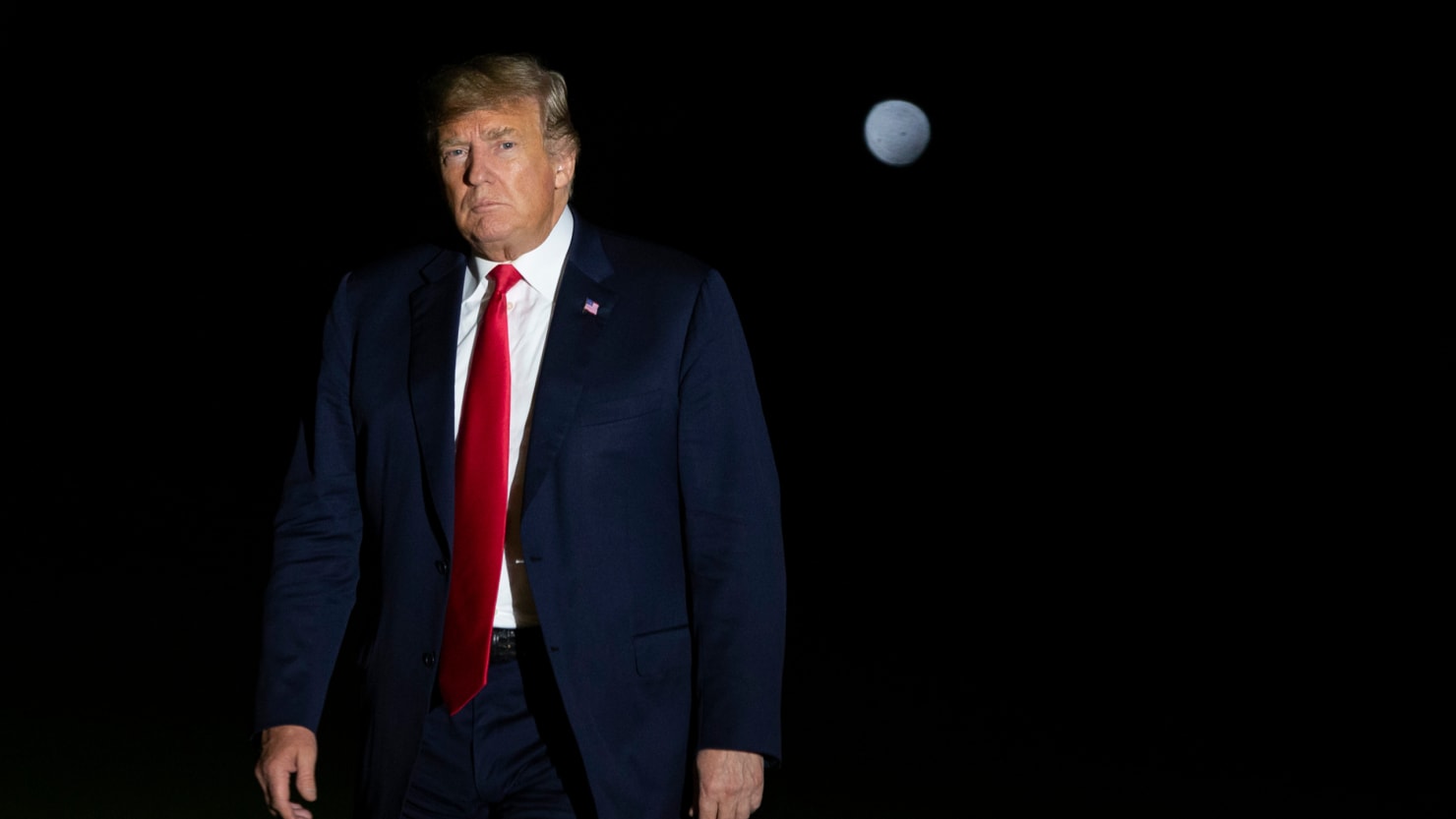
In the 1990’s, President Trump engaged in “dubious” tax schemes and “outright” fraud in an attempt to increase his parents’ wealth, $413 million of which was later transferred to Trump himself, according to an investigation published Tuesday by The New York Times. The Times reports that, among other illicit strategies, Trump and his siblings set up a fake corporation to hide financial gifts, Trump helped his father illegally claim millions in tax deductions, and Trump led his parents to undervalue their real-estate holdings by hundreds of millions of dollars when filing tax returns. Much of this wealth trickled down to Trump (the Times notes that he was a millionaire by the time he was eight), and was taxed far less than it would have been if it had been reported properly. The Times adds that Fred and Mary Trump gave more than $1 billion to their children, which could have been taxed at a rate of 55 percent, or $550 million. Instead, it was taxed at about 5 percent, and the Trumps only paid $52.5 million.

One of Trump’s lawyers denied the allegations, writing in a statement to the Times that the “allegations of fraud and tax evasion are 100 percent false, and highly defamatory […] There was no fraud or tax evasion by anyone. The facts upon which The Times bases its false allegations are extremely inaccurate.” He added that “President Trump had virtually no involvement whatsoever with these matters,” and that “The affairs were handled by other Trump family members who were not experts themselves and therefore relied entirely upon the aforementioned licensed professionals to ensure full compliance with the law.” The Times notes that the statute of limitations has passed for Trump to be criminally prosecuted for helping his parents evade taxes, but that he could be held liable in civil court for tax fraud.

Here’s the Case Against Kavanaugh the FBI Can Make by Friday

Photo Illustration by The Daily Beast

With the Trump White House on Monday backing off its unprecedented effort to dictate an FBI investigation of its own Supreme Court nominee, the bureau now has just four days to complete its extended background check into the sexual assault allegations leveled against Brett Kavanaugh.

There’s not much chance that the bureau will be able to discover by Friday what happened at a small teenage party more than three decades ago. Even if agents find the house and the date, and witnesses who recall Kavanaugh and his friend Mark Judge and accuser Christine Blasey Ford together behind a closed door, that still wouldn’t answer what happened behind the door.

But there’s a real chance that the probe will show that Kavanaugh lied to Congress, and about matters material to his behavior as a teenager and his suitability for the court now. If the probe does not show that because agents avoided asking the questions that would uncover it, that would be another blow to the reputation of the FBI as it’s still reeling from then-director James Comey’s handling of the Hillary Clinton probe in 2016 and by President Donald Trump’s sustained attack since then on its leaders’ professionalism and motives.

You learn about a person’s character when that person is put in a stressful situation. Kavanaugh was put in one when Ford’s name was put out and her accusations evidently weaponized by Sen. Dianne Feinstein (D-CA) at the very end of his confirmation process. His reaction to that stressful situation exposed him.

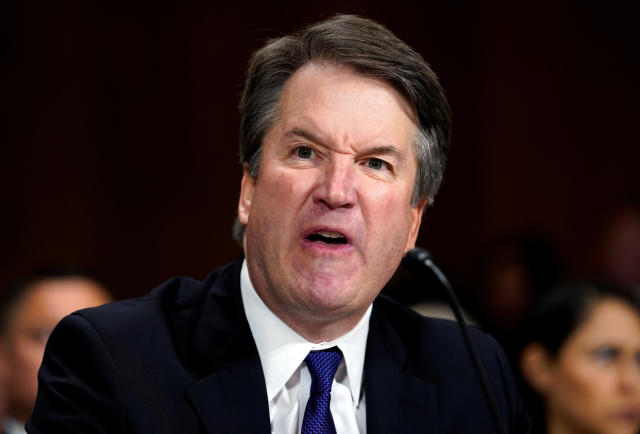
Far from rising above a partisan attack, the nominee dropped any pretense of a judicious demeanor to proclaim himself the victim of “a calculated and orchestrated political hit, fueled with apparent pent-up anger about President Trump and the 2016 election, fear that has been unfairly stoked about my judicial record, revenge on behalf of the Clintons and millions of dollars in money from outside left-wing opposition groups.”

After that angry opening statement, denying the accusations he says have been falsely leveled against him, he evaded questions about his drinking, and lied, it seems clear to me, about his teenage sex talk. It’s that last one that will do him in, fittingly enough, if the FBI isn’t afraid to do its job after these last few years.

As his Georgetown Prep friends each go into a room with an FBI agent, they’ll be asked questions related to the sexual assault that Ford has alleged. If those agents in fact have the discretion the White House insists they do, they should also ask:

Kavanaugh said “FFFFF” was a reference to his friend Squee’s stuttering. Is that how you used the term and understood him to, or did it mean “find ’em, french ’em, finger ’em, fuck ’em, forget ’em”?

Kavanaugh said at his confirmation hearing that the term “boofing” in his yearbook referred to flatulence. Is that how you used the term and understood him to, or was it about anal sex?

And, the big one, given Ford’s claim that the future judge and his friend Mark Judge were together in the room, laughing as Kavanaugh assaulted her:

Kavanaugh testified that “The Devil’s Triangle” was a drinking game. Is that how you used the term and understood him to, or did it mean sex between two men and one woman?

Whatever the “Renate Alumni” know about the party that Ford swears that she can’t forget and Kavanaugh swears that he doesn’t remember, those are questions they can answer, and under penalty of federal law if they “knowingly and willfully… make any materially false, fictitious, or fraudulent statement or representation.”

“It would be no small poetic justice to see Kenneth Starr’s dirty whisperer hoisted on the petard of his own childish sex jokes.”

So if agents are asking those questions—clearly material to Kavanaugh’s conduct and character as a teenager then and as a grown man now—there’s no political path for the handful of senators who could still possibly be swayed by the facts to support him. Just as the FBI aggressively prosecutes liars under 18 U.S.C. § 1001 to discourage all the other prospective liars, the Senate would pay a price if Republicans hold together and avert their eyes after the last baby fig leaf of plausibility has been stripped from Kavanaugh’s naked lies before them.

Judges routinely instruct juries that, if they believe that a witness has lied about one thing they may then conclude that the witness has lied about other things.

Does anyone doubt that Kavanaugh lied about the meaning of his yearbook entries? Not as a boy or young man, but as a 53-year-old federal judge testifying under oath before the Senate in hopes of being confirmed to a seat on our highest court?

The stories remain hers and his, and can’t be reconciled. If the FBI field agents doing the questioning withstand whatever political pressures and ask these obvious questions, senators will have to pick between the person whose account has so far held up and one who has plainly lied. As Sen. Jeff Flake (R-AZ), who before passing Kavanaugh out of committee on a party-line vote demanded an FBI investigation before the full Senate decides on his nomination, said of the nominee Monday night, minimizing his drinking would be one thing, but “if he lied on particular things that [are] demonstrable, then that is disqualifying.”

And it would be no small poetic justice to see Kenneth Starr’s dirty whisperer hoisted on the petard of his own childish sex jokes.

“Unfortunately,” Kavanaugh wrote as he and Starr hunted Clinton, “the nature of the President’s denials requires that the contrary evidence be set forth in graphic, even disconcerting, detail.”

Now it is the nature of the would-be justice’s denials that require the FBI to sort through the meaning of “The Devil’s Triangle” in graphic, even disconcerting detail.

More Yale classmates come forward claiming Brett Kavanaugh has been lying

The Independent

More Yale classmates come forward claiming Brett Kavanaugh has been lying

 Clark Mindock, The Independent      October 2, 2018

Brett Kavanaugh’s Lies Are Catching Up With Him

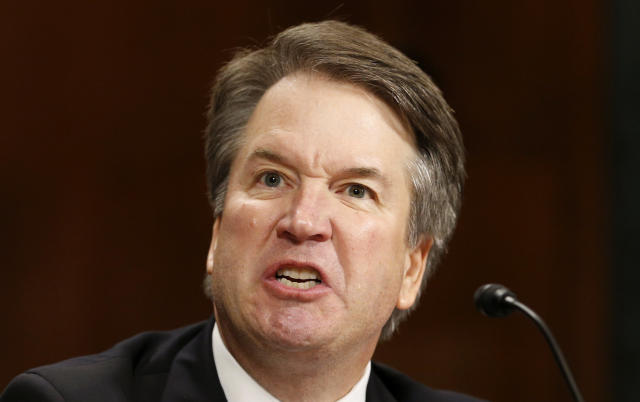
Brett Kavanaugh testifying Thursday. Photo: Matt McClain/AFP/Getty Images

When the second sexual-assault allegation came out against Brett Kavanaugh, I predicted Republicans would pull his nomination. I was wrong. Kavanaugh managed to rally the Republican base like a seasoned politician, changing the question from the specifics of the allegations into a broader cultural war, in which Kavanaugh is a stand-in for every conservative who feels unfairly maligned by smug progressive elites (i.e, every conservative).

Sticking with Kavanaugh made no sense, and still makes no sense. Sometimes people do things that make no sense, though. And Republicans may well decide Kavanaugh’s confirmation is a symbolic battle in the kulturkampf that overrides any cost-benefit analysis. That is certainly what the public posturing by the Republican Party, as epitomized by Lindsey Graham, seems to indicate. But there are real signs of weakness beneath the public bravado.

pair of weekend reports from Axios’s Jonathan Swan conveys the White House’s outward-facing stance. According to administration officials, Kavanaugh is “too big to fail,” because “[t]here’s no time before the [midterm] election to put up a new person.” And if Democrats win a Senate majority, Trump would allegedly prefer to keep the seat vacant rather than compromise with Democrats.

This may be what Trump officials are telling people, and it might even be what they are actually thinking, but the position makes absolutely no sense. If Kavanaugh fails, there might not be enough time to confirm a new justice before the elections, but there will certainly be enough time to confirm one before a new Senate takes over. There are almost two months between the elections and the new Senate. Yes, it would look ugly for Republicans to rush through a new justice after an election that gives Democrats a majority. (Democrats have a two-in-seven chance at the moment.) But this would never stop them from going ahead. The entire Republican caucus, including Susan Collins and Lisa Murkowski, blatantly violated historic norms by holding a Supreme Court spot vacant through all of 2016 just to give their party a chance to fill it. They obviously care a lot about giving their party control of the Supreme Court, and are willing to flout precedent and public opinion to do it. Why would they throw another vacancy away?

Unless the Trump administration is completely ignorant, it is broadcasting threats in order to shore up Republican support for Kavanaugh. Republicans senators may want to pull the damaged nominee and replace him with an equally conservative justice who was never accused of raping anybody, but the White House is shouting that the alternative is getting nobody at all. And why would they make such non-credible threats? Because they’re worried about getting the votes.

That worry also comes through in some of the other reporting. Republicans directing the Kavanaugh fight “conceded [it] to be an uphill battle in which time is not on their side,” reports Politico, also citing a person involved in the battle who puts the odds of confirmation at 50 percent.

The FBI investigation into Kavanaugh is now the key source of uncertainty. Multiple news outlets have reported over the weekend that the White House has dictated limits on the investigation. The FBI reportedly can’t even ask the supermarket that allegedly employed Mark Judge in 1982 for payroll records that would confirm his employment. (Christine Blasey Ford recalled seeing Judge working at the Safeway in Potomac after the alleged attack.)

If the White House chokes off the FBI investigation — or, more precisely, if wavering Republican senators allow the White House to do so and decide to treat an ersatz probe as legitimate — then Kavanaugh might be safe. But the fact that the administration is attempting to strangle the FBI is itself a sign of concern. And the fact that the FBI is obviously leaking about White House interference shows that at least somebody within the Bureau wants to conduct a legitimate investigation.

And what is there to turn up? Potentially a lot. Kavanaugh’s testimony was, at best, wildly misleading. You can find detailed accounts of Kavanaugh’s train of lies hereherehere, and (most thoroughly) here. Would it matter if this is proven? Senator Jeff Flake said on 60 Minutes it would, and provable testimony perjury would be disqualifying. (Obviously there is some cause to doubt whether Flake would follow through on this promise.)

[The New York Times reports this afternoon that the White House has authorized the FBI to interview anybody it deems necessary, as long as the review is complete within a week. The change appears to have come at the behest of Flake, who told an audience, “It does no good to have an investigation that gives us more cover, for example. We actually have to find out what we can find out.” This substantially increases the peril Kavanaugh faces. And Trump’s press conference remarks seemed to signal a willingness to cut Kavanaugh loose if the investigation turns up more damning evidence. “Certainly if they find something I’m going to take that into consideration,” Trump said, when asked if he would consider abandoning Kavanaugh under such circumstances. “Absolutely. I have a very open mind. The person that takes that position is going to be there a long time.”]

The issue of Kavanaugh’s lying is one his conservative defenders have only barely begun to acknowledge. It is probably the central weakness in his candidacy at the moment. Kavanaugh wrote his opening statement the night before his testimony. It was intended to rally his party with red-meat partisan rhetoric, and lead directly to a rapid vote in a flourish of tribalistic emotion. It was not intended to survive a week of close factual scrutiny by the media or potentially the FBI.

Republicans have already prepared a fallback position that Kavanaugh’s underlying offenses happened a long time ago and should not disqualify him. It will be interesting to watch them develop a defense of his perjury. The argument that exists so far simply treats the accusation that Kavanaugh has told lies as so damning that it is unthinkable. “To deny the allegations as he did—invoking his children and parents and so many others who know him—and be lying would mean that he is a sociopath,” editorialized TheWall Street Journal last week. “The logical implication of a ‘no’ vote is that a man with a flawless record of public service lied not only to the public but to his wife, his children and his community,” writes Kimberly Strassel today. “Any Republican who votes against Judge Kavanaugh is implying that he committed perjury in front of the Senate, and should resign or be impeached from his current judicial position, if not charged criminally.”

Well, yes. Kavanaugh has told many, many lies. This doesn’t make him a “sociopath.” Kavanaugh probably believes he did terrible things as a boy, but grew up to be a man who treats women respectfully. I actually accept his characterization of himself as a good father and mentor to girls in his community. The most probable account of his actions is that Kavanaugh (understandably) decided his youthful crimes should not prevent him from attaining the highest position in his career. He also calculated that any partial defense would come unraveled, and settled from the outset on a stance of total denial. This is why he has told lie after lie after lie.

But now Kavanaugh is caught in those lies. He is worried that two Republicans senators might decide they’d rather vote for a justice who hasn’t flagrantly perjured himself. And this fear has legitimate basis.