The Ukrainians “right now have available to them more fixed-wing fighter aircraft than they did two weeks ago,” Kirby said. “And that’s not by accident, that’s because other nations who have experience with those kinds of aircraft have been able to help them get more aircraft up and running.” The U.S. has helped provide Ukraine with airplane parts, “but we have not transported whole aircraft,” he added.
When a reporter asked how many new aircraft Ukraine has received, Kirby said that “without getting into what other nations are providing,” Ukraine has has been “able to increase” its “aircraft fleet size, I think I’d leave it at that.”
The U.S. has been flying in shipments of weapons and defensive materiel on a daily basis for weeks, a senior Pentagon official said Tuesday. “Another one just arrived yesterday and in the next 24 hours we expect they’ll be more than half a dozen, probably more like seven flights coming from the United States.” And “none of these shipments sit around very long before being off loaded off of aircraft and on loaded appropriately in ground transportation to get them into Ukraine,” the official added.
With the U.S. and its allies providing Ukraine a munitions lifeline, Russia is likely to start targeting routes used to move the materiel through Ukraine to the front lines, a Pentagon official said. Even if the Russians did successfully strike bridges, roads, and railway routes used to get the arms to Ukrainian fighters, the official added, there are too many shipments coming in for that to have much effect.
Ukraine’s Air Force has added about 20 more operational aircraft after influx of spare parts, senior US defense official says
By Oren Liebermann, CNN – April 20, 2022
(CNN)The Ukrainian Air Force has added about 20 more operational aircraft to its fleet because of an influx of spare parts, according to a senior US defense official.Though the official wouldn’t specify which country had provided the aircraft parts, the official said Wednesday that the US and other countries had worked “to get them the parts they need to get them in the air.”
The flow of spare parts has allowed Ukraine to expand its fleet of operational military aircraft, despite Russia’s ongoing invasion. The country has more aircraft now than it did three weeks ago, the official said.
A day earlier, Pentagon press secretary John Kirby said Ukraine had received additional fighter aircraft to add to its numbers.
But on Wednesday, the senior defense official walked that back, saying Ukraine had not received more aircraft but had in fact received aircraft parts to make more of its existing aircraft functional.
Still, the official intimated that at least one country was considering sending Ukraine more aircraft.
“I was given to understand that an offer made by another country had actually been effected,” the official said. “That offer has not been effected, so I was ahead of where things actually were.” It is not known which country has made such an offer.
The US has committed to sending Ukraine 16 Mi-17 helicopters, but the administration has declined to get involved in a transfer of MiG-29s from another country to Ukraine via the United States.
Ukrainian President Volodomyr Zelensky has repeatedly asked other countries for Soviet-era MiG-29 Fulcrum fighter jets, which Ukrainian pilots already know how to fly.
Zelensky has asked other Eastern European countries with the fourth-generation airframes to send them to Ukraine, but no country has yet agreed to do so.
On Wednesday, the official Twitter account of Ukraine’s Air Force said, “Ukraine did not receive new aircraft from partners! With the assistance of the US Government, @KpsZSU received spare parts and components for the restoration and repair of the fleet of aircraft in the Armed Forces, which will allow to put into service more equipment.”
Ukraine’s Air Force has been part of its aerial defense network, which also includes S-300 surface-to-air missiles and portable anti-aircraft missiles. The combination of platforms has prevented Russia from establishing air superiority over Ukraine and controlling the skies.
Despite the constant bombardment from Russian missiles and artillery, as well as the strikes on military bases, Ukraine’s Air Force has remained largely intact, though it has suffered some losses.
In early March, about two weeks into the war, the defense official said Ukraine has 56 fighter aircraft, which composed about 80% of its fixed-wing fighters. But the Ukrainians weren’t using their aircraft much, flying only five to 10 missions per day, the official said.
Even now, with more operational aircraft, the Ukrainian Air Force is still flying a very limited number of daily sorties, another defense official said.
Mariupol official warns of ‘last days’ as Russia demands Ukrainian troops surrender
Niamh Cavanagh, Producer April 20, 2022
LONDON — Ukraine’s port city of Mariupol is facing its “last days, if not hours,” a commander in the besieged city revealed this week as Russian forces gave Ukrainian soldiers until noon on Wednesday to surrender — a deadline the Ukrainians let expire.
Thousands of civilians and Ukrainian troops are sheltered in a steel plant, the last remaining stronghold of the city. However, the building is surrounded by Russian forces, leaving the people inside with no access to “normal” supplies of food and water, an adviser for the city’s mayor said.
A woman stands near her destroyed apartment building in Mariupol on Tuesday. (Alexander Ermochenko/Reuters)
“The enemy is outnumbering us 10 to 1,” Serhiy Volyna, a commander from the 36th Separate Marine Brigade, wrote on Facebook on Wednesday. “We appeal and plead to all world leaders to help us. We ask them to use the procedure of extraction and take us to the territory of a third-party state.”
In recent days, Russian forces have intensified their push in the Donbas region, claiming the city of Kreminna in a new offensive to take eastern Ukraine. Russia has been trying to take full control of Mariupol since Feb. 24, when it launched its invasion. Taking control of Donbas would mean Russia would have a southern land corridor to the annexed Crimean Peninsula, which has been occupied by Kremlin forces since 2014.
Russian military vehicles in an area controlled by Russian-backed separatist forces near Mariupol on Monday. (Alexei Alexandrov/AP)
According to Reuters, thousands of Russian troops, backed by artillery, are attempting to advance in what has been coined the “Battle of Donbas.” Moscow intends to seize the two eastern provinces that had already been claimed on behalf of separatists.
On Tuesday, the Azovstal steel plant, believed to be the last major pocket of resistance in Mariupol, was a target of Russian airstrikes. Footage released from Mariupol’s City Council appeared to show the aftermath of a strike on the devastated plant. This led to Ukrainian troops accusing enemy forces of bombing a hospital that was sheltering 300 people — including wounded soldiers and children. The deputy commander of the Azov regiment alleged that Kremlin-led forces had dropped bombs on the steel plant where the “improvised” hospital was.
Smoke rises above Azovstal Iron and Steelworks in Mariupol in this image posted on social media on Tuesday. (Mariupol City Council via Reuters)
Ukraine hopes to evacuate some 6,000 civilians from Mariupol on Wednesday, the city’s mayor, Vadym Boichenko, said. He said 90 buses were waiting to depart from the devastated city but cautioned that a safe-corridor agreement with Russia was not yet final. “We plan to send buses to Mariupol, but for now it is only a preliminary agreement,” Boichenko said on Ukrainian television. “We have managed to get a preliminary agreement on a humanitarian corridor for women, children and elderly persons,” Deputy Prime Minister Iryna Vereshchuk wrote on Telegram.
Russia has blocked previous safety passages in and out of Mariupol, including one that the International Committee of the Red Cross requested at the end of March. In his address, Boichenko added that at least 100,000 civilians remain in Mariupol and that tens of thousands have been killed. The Kremlin has denied intentionally targeting civilians.
Children in a bunker said to be in the Azovstal steel plant in Mariupol, according to Ukraine’s Azov Battalion, in an image released on Monday. (Azov Battalion/Handout via Reuters)
Ukrainian President Volodymyr Zelensky said in a video on Tuesday that the situation in Mariupol remained severe. “The Russian army is blocking any efforts to organize humanitarian corridors and save our people,” he alleged in his nightly address. Meanwhile, according to Russian state TV, about 120 civilians living next to the steel plant left via humanitarian corridors. This report has not been independently verified.
As a new, uglier phase of fighting in Ukraine begins, Western countries are rushing to give Kyiv bigger, better weapons
Christopher Woody – April 20, 2022
Burnt armored personnel carriers and other destroyed military vehicles in a field in Bucha, Ukraine, April 18, 2022.Alexey Furman/Getty Images
Russia renewed its attack on Ukraine this week, focusing on eastern Ukraine’s Donbas region.
The offensive comes as Western countries supply more and heavier weaponry to Ukrainian forces.
A European official said “the envelope” of what countries are willing to give Ukraine “has grown considerably.”
Russia began a new phase of its attack on Ukraine on Monday, focusing on eastern Ukraine’s Donbas region.
The renewed fighting comes as Western countries are providing more and heavier weaponry to Ukraine, arming it for what may be months of intense clashes involving tanks and long-range weapons in the region’s flatter, more open terrain.
The US announced its latest package of security assistance to Ukraine on April 13, providing $800 million worth of equipment —including hundreds of armored vehicles and more Mi-17 helicopters — and weapons, such as unmanned coastal defense vessels, counter-artillery and air-defense radars, and more Switchblade drones.
The package also contained 18 155mm howitzers and 40,000 artillery rounds, which were provided for the first time in light of “the kind of fighting that the Ukrainians” expect in the “more confined geographic area” around Donbas, chief Pentagon spokesman John Kirby said on April 13.
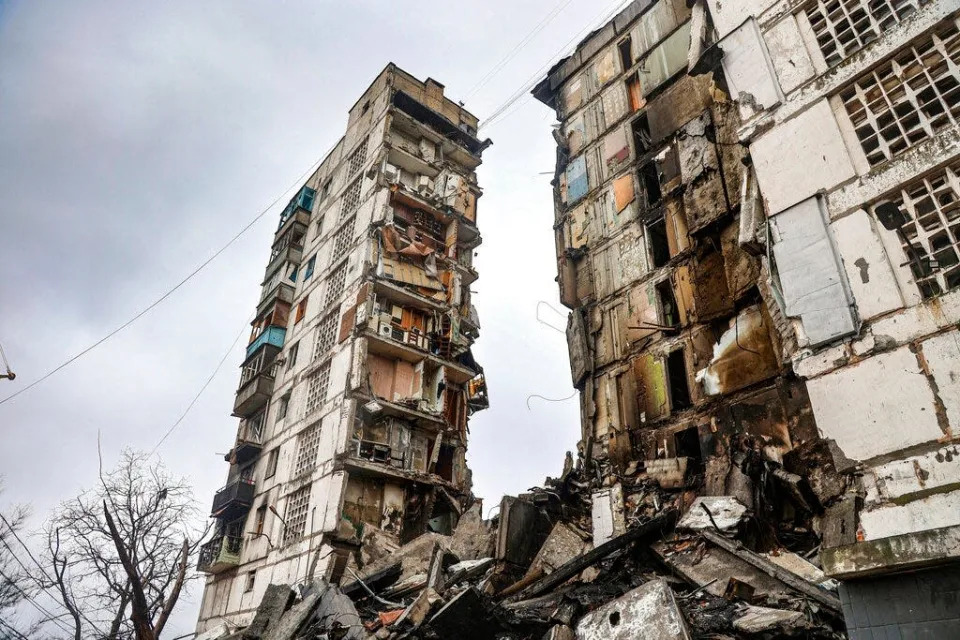
A heavily damaged building in Mariupol, Ukraine, April 13, 2022.AP Photo/Alexei Alexandrov, File
The Ukrainians “specifically asked” for “artillery support,” Kirby said, and this week US troops began training Ukrainians on the howitzers, which differ from the 152mm howitzers used by Ukraine’s military.
After the weeklong training, those Ukrainians will return home and train more of their countrymen, a senior US defense official said Wednesday.
Throughout April, other European countries have said they would provide additional heavy-duty weapons — including tanks, sophisticated air-defense missiles, and coastal defense systems — reflecting an increasing willingness to provide Ukraine with such armaments after two months of defending against Russian attacks.
Ukrainians have “proven that they’re willing to fight and they’re able to,” said Jim Townsend, an adjunct senior fellow at the Center for a New American Security, “but I think what’s really behind this latest push is the type of warfare that they’re going to be dealing with now in the east is different than what they’ve been facing in the Kyiv area.”
‘The envelope’
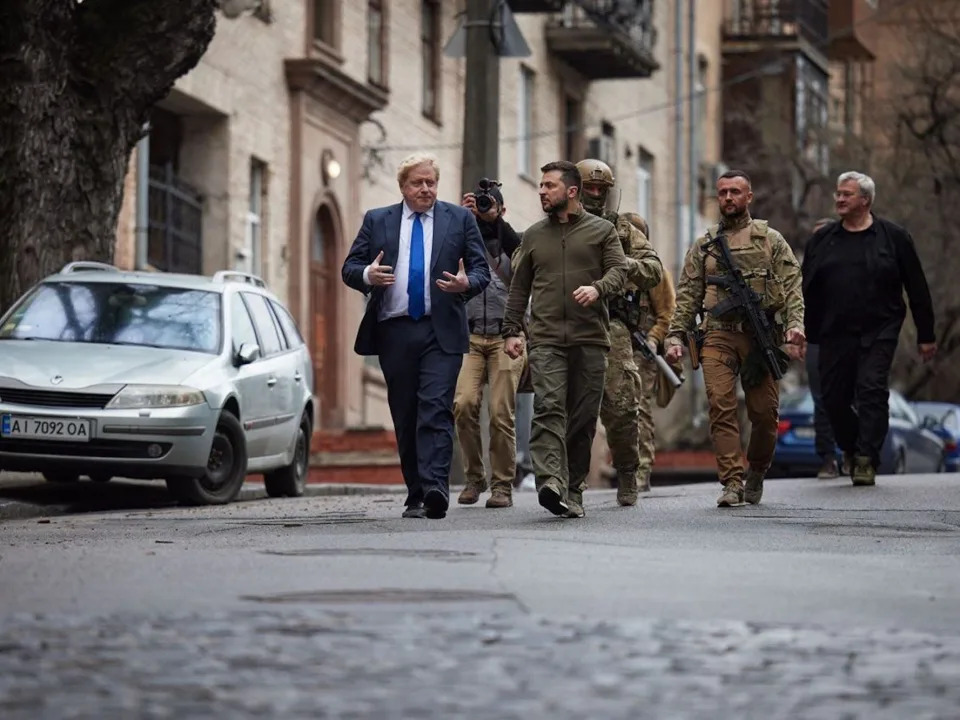
British Prime Minister Boris Johnson with Ukrainian President Volodymyr Zelenskyy in Kyiv, April 9, 2022.Ukrainian Presidency
The US has provided roughly $2.6 billion in security assistance to Ukraine since Russia’s attack began on February 24. The UK has also provided nearly a billion dollars’ worth of financial and military aid since the war started.
Ukrainian President Volodymyr Zelensky thanked British Prime Minister Boris Johnson for the UK’s “decisive and significant support” during Johnson’s April 9 visit to Kyiv, where Johnson announced additional assistance, including 120 armored vehicles and “new anti-ship missile systems.” The UK has already provided thousands of anti-armor and anti-aircraft missiles.
In the days before Johnson’s trip, the Czech Republic sent tanks, multiple rocket launchers, howitzers, and infantry fighting vehicles, and Slovakia donated its S-300 system, becoming the first to provide that kind of long-range anti-aircraft weapon. More recently, the Netherlands said it would send “heavier materiel” to Ukraine, “including armoured vehicles.”
On April 8, a European official said “the envelope” of military assistance that countries were willing to give Ukraine “has grown considerably over the last few weeks.”
Ukrainian troops unload US-made Stinger missiles and other military assistance shipped from Lithuania, in Kyiv, February 13, 2022.SERGEI SUPINSKY/AFP via Getty Images
“We were clearly very quickly in a different place once the Ukrainians were able to hold off the first few days, and I think since then we’ve had a bit more time to really think about this and to think slightly further ahead,” the European official told reporters in Washington, DC.
Other countries still limit what they will provide and are wary of discussing it out of concern for Russia’s reaction.
France’s top military officer said in March that it was important “to remain as unobtrusive as possible” and not to “overplay” support for Ukraine.
Germany’s foreign minister said Wednesday that Berlin had provided anti-armor and anti-aircraft missiles but had “never spoken” about it publicly “so these deliveries could happen quickly.” (Berlin initially refused to send any arms to Ukraine and still declines to send heavy weapons.)
“Some of the nations who are contributing are pretty coy about it,” the European official said, “because they’re worried about retribution.”
Moscow has said it considers providing aid to be involvement in the war, but Kirby said Tuesday that US officials have seen “no indications” that aid shipments “have been hit or deterred” by the Russians.
‘Better and pricklier’
Men next to the turret of a destroyed Russian tank, near Brovary, Ukraine, April 15, 2022.Maxym Marusenko/NurPhoto via Getty Images
Kirby has said US-provided assistance, much of it from US stockpiles, is arriving “incredibly fast,” often within days of authorization. US officials say those packages are devised in coordination with Ukrainian officials.
National security advisor Jake Sullivan said last week that he and Gen. Mark Milley, chairman of the Joint Chiefs of Staff, and Ukrainian defense leaders went “item-by-item through their list” while developing the latest package and that President Joe Biden had “an extremely positive conversation” with Zelenskyy about what was included.
The US has stopped short of providing some weaponry, such as combat aircraft, and other forms of support, such as a no-fly zone over Ukraine.
If Ukraine had gotten “access to all the weapons we need,” Zelenskyy said Tuesday, “we would have already ended this war.”
A Ukrainian flag in the city of Borodyanka, northwest of Kyiv, April 17, 2022.Sergei Chuzavkov/SOPA Images/LightRocket via Getty Images
Another security assistance package similar to the most recent one is reportedly being developed, and that aid should keep flowing, according to Townsend, a former deputy assistant secretary of defense for European and NATO policy.
“They’ll need a lot more ammunition, for instance. They’ll need more artillery, more tanks,” Townsend told Insider, saying the looming fight would be a “war of attrition.”
“When it’s a battle of attrition, they’re going to run out of things,” Townsend said, “so they’ll need to be resupplied quite a bit.”
The European official, speaking on April 8, said discussions about security assistance still focus on what Ukraine needs to “fight tonight” but are also looking at “how we might support Ukraine in rebuilding and modernizing its armed forces to make them even better and pricklier than they’d been in the past.”
Ukraine needs “continued supply of all kinds of equipment,” Ukraine’s ambassador to the US, Oksana Markarova, said Monday. “We always say we need more because the enemy is so much bigger and because the enemy is so brutal and the enemy doesn’t stop, but we are very grateful, very grateful for all the support.”
Neil MacFarquhar and Sophia Kishkovsky – April 19, 2022
A worshiper lights a candle on Sunday, April 17, 2022, at the Church of the Elevation of the Cross in Udine, Italy. The church has severed all ties with the Moscow Patriarchate over its support for the war in Ukraine. (Sergey Ponomarev/The New York Times)
In a small parish in northern Italy affiliated with the Russian Orthodox Church, the mostly Ukrainian worshippers — information technology specialists, migrant factory laborers, nurses and cleaners — decided to repudiate the full-throated support for the war in Ukraine from Patriarch Kirill of Moscow.
The Moscow Patriarch had repeatedly bestowed blessings on the Russian military, giving a historical golden icon of the Virgin Mary to a senior commander, for example, and casting the war as a holy struggle to protect Russia from what he called Western scourges such as gay pride parades. He has been a vocal supporter of Russian President Vladimir Putin, with the church receiving vast financial resources in return.
“We saw that the Moscow Patriarchate was not engaged in theology, it was simply interested in supporting the ideology of the state,” said Archpriest Volodymyr Melnichuk of the Church of the Elevation of the Cross in Udine, Italy, “In essence, the patriarch betrayed his Ukrainian flock.”
So on March 31, the Ukrainian cleric wrote a letter severing all ties to the Moscow Patriarchate.
With the Eastern Orthodox Easter approaching this Sunday, similar tensions are rippling through the church’s more than 200 million faithful, concentrated in eastern and southern Europe. Around the world, the war is dividing national churches, parishes and even families as they reassess relations with Patriarch Kirill and the Russian Orthodox Church.
In the United States, some believers are switching churches. In France, Orthodox seminary students petitioned their bishop to break with the Moscow Patriarchate. In the Netherlands, the police had to intervene at a Rotterdam church after parishioners came to blows over the war.
The Ukraine war has pitted combatants under the Moscow Patriarch against one another and has placed Ukrainian worshippers in an especially untenable position. By tradition, Orthodox worshippers pray for their patriarch at all services.
“How can you accept prayers for the patriarch who is blessing the soldiers trying to kill your son?” said Andreas Loudaros, editor of Orthodoxia.info, an Athens, Greece-based website that covers church affairs.
Doctrinal disputes and intrigues within the Eastern Orthodox Church often spool out over decades, if not centuries. But with remarkable speed, the war has widened schisms long kept below the surface.
Unlike the Roman Catholic Church, with its single, uncontested leader, each of the 15 Orthodox branches enjoys significant sovereignty. Heated debates have erupted within the Eastern Orthodox Church in numerous countries about whether to openly ostracize Patriarch Kirill and Russia.
The Moscow Patriarchate has sought to anoint itself the true seat of Orthodoxy ever since Constantinople, now Istanbul, fell to Islamic invaders in 1453. So Moscow has been at loggerheads for centuries with the ecumenical patriarch of Constantinople, always the spiritual leader of the church. But, the testy relations between Kirill and the current ecumenical patriarch, Bartholomew, burst into the open over the war.
“He should not have identified so much with President Putin and even called Russia’s war against Ukraine ‘sacred,’” the patriarch recently told a group of students.
“It is damaging to the prestige of the whole of Orthodoxy because Orthodoxy doesn’t support war, violence, terrorism,” Bartholomew said in an interview in Istanbul.
Ukraine has been a particular source of antagonism between the two hierarchs. In 2019, Bartholomew granted independence, called “autocephaly,” to a previously unsanctioned church in Ukraine, which had been subordinate to Moscow since 1686.
Afterward, the Russian church severed contacts with Bartholomew. More than half of Ukraine’s parishes rejected the decision and stayed under Moscow’s jurisdiction.
Of the 45 dioceses in Ukraine, encompassing nearly 20,000 parishes, about 22 have stopped mentioning Patriarch Kirill during prayers, said Sergei Chapnin, a Russian religious scholar and frequent church critic.
That is the first step toward breaking with Moscow, though still far from a formal rupture. But the dispute makes it difficult for many Ukrainian bishops to switch allegiances now.
Some faithful in Ukraine question the silence of the bishops, wondering aloud whether they are fans of Putin, have been bribed or blackmailed to stay quiet, or are hedging their bets lest Moscow prevails in the war.
Archpriest Andriy Pinchuk, 44, the former mayor of a small agricultural village just south of the central city of Dnipro, said the hesitancy dismays many parish priests. Russian troops have destroyed countless churches.
“We are ashamed to look into the eyes of regular Ukrainians, we are ashamed of the horrible aggressive words that Patriarch Kirill is saying constantly, we are ashamed of the Ukrainian bishops who put their heads in the sand and fear a rupture with the Moscow Patriarch,” said Pinchuk. Ukrainians constitute a significant part of the Moscow Patriarch’s flock, so losing them would be a blow.
Pinchuk is the author of a petition signed by about 400 Ukrainian clerics asking church hierarchs to declare as heresy Kirill’s support for the Kremlin’s Russkii Mir or “Russian World,” project, which among other things has tried to extend church influence outside Russia as a foreign policy tool.
“The future of any church in Ukraine will not be linked to Moscow unless it wins this war,” said Christophe D’Aloisio, a visiting professor of Eastern Christian and Ecumenical Studies at the University of Louvain in Belgium and an Orthodox parish priest, who signed a declaration in March against the “Russian World” project by more than 1,300 Orthodox scholars and theologians. “But it is the wrong moment to position yourself for or against.”
Patriarch Kirill of Moscow has provoked widespread anger with a series of sermons and speeches, including saying that the country is battling the Antichrist, and urged Russians to rally around the government. Kirill has avoided condemning widely documented attacks on civilians, many of whom are his parishioners. Most national churches have not condemned Kirill.
One possible reason emerges on the website of the Foundation for the Support of Christian Culture and Heritage, which is funded by Rosatom, the Russian state nuclear energy corporation. It lists church projects financed around the world in Bulgaria, Georgia, Poland, Serbia and the United States, among others.
Numerous recipients have not denounced the war. “When you get money from Moscow, it is not easy to be critical,” said D’Aloisio.
About 300 priests, mostly inside Russia, signed a petition against the war. Three Lithuanian priests who were outspoken critics were just fired.
In the United States, some adherents expressed anger that although the two main American branches of Russian origin, the Orthodox Church in America and the Russian Orthodox Church Outside of Russia, had condemned the fighting and worked to help refugees, they avoided criticizing Patriarch Kirill directly.
An influx of converts in recent years, drawn by Putin portraying himself as a bulwark against the West’s moral collapse, has intensified the wrangling.
“It has torn the church apart in some ways,” said the Very Rev. Dr. John Jillions, a retired associate professor of religion and a former parish priest in Bridgeport, Connecticut. “I think that they are too hesitant, they need to come out much more forcefully that they are against Putin’s aggression and Patriarch Kirill’s apparent support.”
Many people are questioning why St. Vladimir’s Orthodox Theological Seminary in Yonkers, New York, accepted a $250,000 donation from the Russian state religious foundation to name a chair in biblical studies after Kirill, suggesting that the money be returned or spent on Ukrainian refugees.
The Very Rev. Dr. Chad Hatfield, president of the seminary, said that the donation was received before the invasion and was under review, and that the Orthodox Church of America had condemned the war.
Archpriest Victor Potapov in Washington, D.C., speaking for the Russian Orthodox Church Outside of Russia, called it wrong to single out Russia for blame, and said the church was offering fervent prayers for the war to end.
Some parishioners are switching churches over the issue. “This is not my church, I cannot go to a church headed by a patriarch who is supporting war,” said Lena Zezulin. She left her church, St. Seraphim’s Russian Orthodox Church in Sea Cliff, Long Island, New York, where she was baptized. She cannot persuade her mother, aged 90, to quit.
By all accounts, a serious cleavage in the church appears inevitable, but the course of the war will determine its depth and the scar tissue left behind.
On Palm Sunday, sitting in the courtyard of an Orthodox church frequented by Ukrainians in Istanbul, Nadiia Kliuieva reeled off the terrible legacy from a conflict sanctified by Kirill, including children killed, women raped and the pain of Ukrainians everywhere.
“I don’t know what kind of Ukrainian you would have to be to keep an association with the Moscow Patriarchate,” she said. “I think many people have opened their eyes.”
Ukrainian volunteers recount three weeks in Russian captivity, allege beatings
Alessandra Prentice and Sergiy Karazy – April 19, 2022
DYMER, Ukraine (Reuters) – Volodymyr Khropun and Yulia Ivannikova-Katsemon say they were helping people flee villages on the front line in northern Ukraine when they were detained by Russian soldiers over two days in March.
Both said they were then held with around 40 other captives on the concrete floor of a nearby factory, their hands bound. Nearly a week later they were transferred in a military truck to Belarus, and on to detention centres in Russia, they said.
Khropun, an electrical engineer, and Ivannikova-Katsemon, an emergency services dispatcher, were freed with 24 others in a prisoner exchange on April 9.
Standing outside the dank windowless room where they say they were kept in the formerly occupied village of Dymer, north of the capital, Khropun and Ivannikova-Katsemon have returned to describe their three weeks in Russian custody, which they said included being beaten. Ivannikova-Katsemon also said she was tasered.
Related video: Volunteers collect body bags in Bucha
Volunteers collect body bags in Bucha
Ukrainian volunteers continued collecting bodies of those killed in the Ukrainian town of Bucha on Thursday, as outrage rises over alleged atrocities carried out by Russian forces in areas near Kyiv. (April 7)
Both said they were working as volunteers for the local Red Cross when they were taken prisoner, interrogated and accused of passing information on the activity of Russian forces to the other side, which they deny.
The Ukrainian Red Cross confirmed they were both volunteers. They were both reported as missing or illegally detained civilians by the Euromaidan SOS initiative of Ukrainian human rights group The Center for Civil Liberties as of March 26.
Reuters was not able to independently verify all the details of their stories. The Kremlin and Russia’s defence ministry did not respond to requests for comment about their accounts.
Khropun and Ivannikova-Katsemon’s detailed narratives shed more light on the mistreatment Ukraine alleges some of its citizens and soldiers have faced in Russian captivity since the start of the war. Their journey also shows one way Russia has transferred some of the hundreds of Ukrainian prisoners it says it holds to Russian territory.
Since the start of the war on Feb. 24, Ukraine and Russia have accused each other of violating the Geneva Conventions that cover the protection of civilians during war and the treatment of prisoners of war.
In March, Russia’s human rights ombudswoman said she had heard about cases of “cruel and inhuman treatment” of Russian POWs in Ukraine.
This month Ukraine’s human rights ombudswoman said returning POWs had described mistreatment while in Russian captivity that included being kept in basements, denied food and made to take off their clothes.
Authorities from both sides have repeatedly said they abide by international humanitarian law in terms of treatment of prisoners.
Speaking in the factory in Dymer, Khropun described what happened when he was first detained by Russian forces, after driving evacuees through a checkpoint on March 18.
“They arrested me, closed my eyes – as in, they pulled a hat over my eyes, bound it on with scotch tape – and then wrapped my hands in tape, like a terrorist. Then I was transferred here,” said Khropun, 44.
He and Ivannikova-Katsemon had both been regularly crossing the front line to help locals escape the fighting around villages north of Kyiv. Ivannikova-Katsemon, 37, was detained similarly the next day, she said.
“There was always hope with God that I would return (home),” said Ivannikova-Katsemon, who has children, occasionally pausing to steady her voice or hold back tears. “The hard thing was not being able to tell family and friends that I was alive and in captivity.”
‘NIGHTMARE COME TO LIFE’
The two said they were held in an unheated room at the small factory in Dymer, huddled on thin mattresses and scraps of cardboard. Around 40 detainees were crammed into the space, sharing a plastic pot for a toilet.
“It was like a nightmare come to life,” Khropun said, speaking to Reuters back in the room where he was held.
He pointed to the dirty mattress he shared with several others. The floor was littered with trash, empty boxes of Russian army rations, zip ties and loops of tape that they said had bound people’s hands.
Ivannikova-Katsemon described how she was able to slightly loosen the binding around her wrists with a safety pin that she kept hold of throughout her time in captivity by hiding it inside her hair tie.
The Russians brought food once or twice a day, mostly army crackers and the occasional pot of cooked food. There were only two plastic spoons so some people ate with their hands, others with scraps of paper, said Khropun.
One of the spoons was still jabbed into a pot that was half-full of what looked like rotting cabbage stew.
A bullet hole was visible in the concrete ceiling of the room. One of the guards had fired into the air to spook them, they said.
BELARUS AND RUSSIA
After nearly a week, Khropun and Ivannikova-Katsemon said that they and around 14 other detainees were loaded onto a military truck. They weren’t told where they were going, but the stop-start journey through Belarus would eventually take them to official detention centres in Russia.
In Belarus, they said they were interrogated by the Russian military. They each received a document that included their photo, date of birth, height, hair colour and other identifying details that designated them as “a person who has shown opposition to the special military operation” – Russia’s term for its war in Ukraine.
They showed Reuters copies of the documents, titled ‘Certificate of Identity’ and issued by the Russian armed forces.
“The first stage was being stripped naked, photographed, the noting of scars, I have a few. Then the pouring of water (on me) and a beating,” Ivannikova-Katsemon said. The document she received lists her scars in a section called “Other features”.
Once in Russia, the two said they passed through several different detention centres. At one point, Ivannikova-Katsemon said she was told she would be sent to work in a timber camp in Russia’s far east.
“I don’t know the place, they just said: Siberia,” she recalled.
Khropun said he faced multiple interrogations in Ukraine, Belarus and Russia, sometimes being forced to kneel for long periods in cold rooms or beaten on his knees or ribs.
He said younger prisoners were singled out for especially tough beatings by guards, who also shaved the captives’ heads and beards, sometimes leaving a tuft or half a moustache as a form of humiliation.
He said he tried to keep up the morale of his fellow detainees, who he said were also Ukrainian civilians. “I’d say, ‘guys – we will all get home 100%. There is just one small question: when?'”
RETURN HOME
On April 8, the two said they were given back the clothes they were wearing when first detained, still dirty from the days spent on the factory floor.
In handcuffs, they were taken by plane to Crimea from where they were driven by truck to Ukraine-controlled territory on April 9.
They said they had been selected for a prisoner swap, but did not know why they were picked over others.
After around three weeks in captivity, they were home.
“Of course there was the sense of joy, but it was somehow hard to fully comprehend,” said Khropun.
Khropun and Ivannikova-Katsemon said they were the only ones to be exchanged from the group of detainees who were sent from Dymer to Russia. They described their fears for the others they believe are still being held in Russia.
The Ukrainian authorities have confirmed that 26 prisoners were swapped with Russia on April 9, but have not named them all. The office of deputy Prime Minister Iryna Vereshchuk, who is in charge of negotiating the swaps, did not respond to a request for comment about the release of Khropun and Ivannikova-Katsemon.
On April 11, Vereshchuk said in total some 1,700 Ukrainian soldiers and civilians were being held in Russia and by pro-Russian separatists in the east of the country.
Ukraine held around 600 Russian military prisoners of war and no civilians as of April 4, according to Vereshchuk.
Russia does not release exact figures, but in late March its human rights ombudswoman said there were more than 500 Ukrainian POWs in Russia.
Ivannikova-Katsemon said she wears a medical corset and takes medicine to manage the pain she feels as a result of her treatment in captivity.
“But these monsters, who supposedly call themselves liberators, did not break me,” she said, standing in the spring sunshine outside the Dymer factory.
(Additional reporting by Stefaniia Bern in Kyiv; Editing by Rachel Armstrong, Frances Kerry and Jan Harvey)
Families of crew aboard Russia’s sunken warship Moskva have begun questioning the official line that it was fully evacuated
Sinéad Baker – April 19, 2022
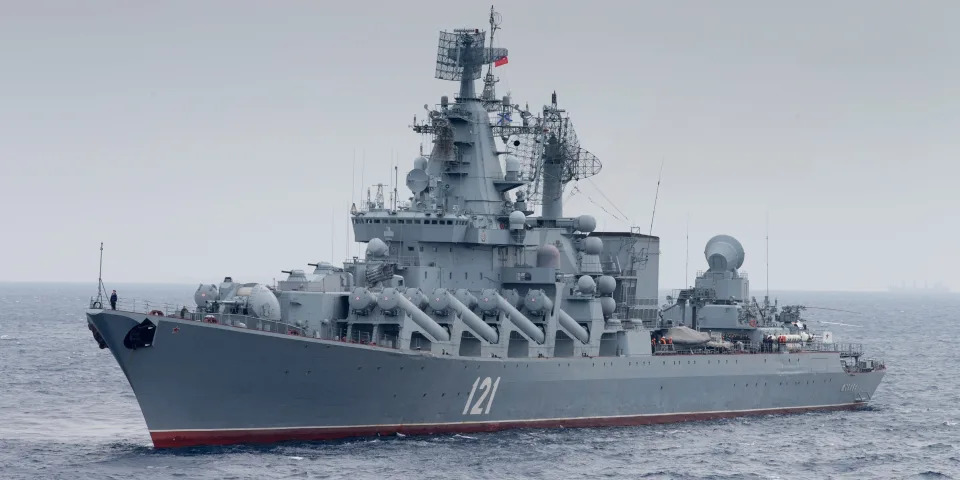
Russian missile cruiser Moskva on patrol in the Mediterranean Sea in December 2015.ussian Defense Ministry Press Service via AP
Moskva, Russia’s Black Sea flagship, sank Thursday after a suspected Ukrainian missile strike.
Families of some crew members are now questioning Russia’s claim it fully evacuated the ship.
A mother of one crew member told The Guardian she was informed Monday that her son had died.
Relatives of crew members aboard the sunken Russian warship Moskva say they haven’t been able to locate their loved ones in the days since it went down.
The Moskva, a missile cruiser that was the flagship of Russia’s Black Sea fleet, sank on Thursday.Russian state media blamed an on-board explosion but Ukraine said it struck the ship with missiles, something the Pentagon later confirmed.
The Moskva is thought to have had around 500 crew on board. Russia said the ship was completely evacuated but the families of some crew members have begun questioning that claim.
Yulia Tsyvova, whose son Andrei was on board, told The Guardian she didn’t receive an update about his whereabouts until Monday, when she received a call from Russia’s defence ministry to say he was dead.
“He was only 19, he was a conscript,” Tsyvova said. “They didn’t tell me anything else, no information on when the funeral would be.”
She added: “I am sure he isn’t the only one who died.”
Dmitry Shkrebets told The Guardian about his son Yegor, a cook on the Moskva, who was said to be listed as missing in action.
“A conscript who isn’t supposed to see active fighting is among those missing in action,” Shkrebets said. “Guys, how can you be missing in action in the middle of the high seas?”
Shkrebets said other families had contacted him to say their sons were missing after the Moskva sank.
Irina Shkrebets, mother of Yegor, said she went to a hospital to look for her son and discovered about 200 burnt bodies.
She told independent Russian news outlet The Insider: “We looked at every burnt kid. I can’t tell you how hard it was, but I couldn’t find mine.”
She added: “There were only 200 people, and there were more than 500 onboard the cruiser. Where were the others?”
Russia has been accused of covering up the scale of its military deaths since it invaded Ukraine on February 24. Reports suggest Russia has transported thousands of dead soldiers to Belarus from Ukraine, and Ukrainian officials have said there are thousands of unclaimed Russian corpses in its morgues.
Some families of Moskva crew members have learned that their loved ones are alive – not by seeing them in person, but from video shared by the Russian military, The Guardian reported.
Some parents were afraid of reprisals from Russia if they were seen to be questioning what happened to their sons, the newspaper said.
Russia is dropping bunker-buster bombs on a Mariupol steel plant where Ukrainian civilians are hiding, commander says
Sinéad Baker – April 19, 2022
Russia is dropping bunker-buster bombs on a Mariupol steel plant where Ukrainian civilians are hiding, commander saysA view shows a plant of Azovstal Iron and Steel Works company behind damaged buildings in Mariupol, Ukraine.REUTERS/Alexander Ermochenko
Ukrainian soldiers and civilians are hiding in a Mariupol steel plant as Russian forces continue attacking.
An Azov Regiment commander said Russia was dropping bunker-busting bombs on the plant.
Officials say civilians, including children, are sheltering there.
Russia is dropping bunker-buster bombs on a steel plant in the southeastern Ukrainian city of Mariupol where soldiers and citizens have been hiding, a Ukrainian military commander said.
Denys Prokopenko, the commander of the Ukrainian National Guard’s Azov Regiment, said on Monday that Russia had started dropping bombs on the Azovstal Iron and Steel Works plant, the Associated Press reported.
Prokopenko said his troops were there alongside civilians.
The plant includes underground tunnels, and Mariupol’s city council said on Telegram on Monday that up to 1,000 citizens were also hiding there.
Bunker busting bombs are designed to hit targets that are deep underground and to penetrate through thick defenses.
Prokopenko said Russian troops were aware that civilians were hiding there, and firing anyway: “Russian occupational forces, and their proxy … know about the civilians, and they keep willingly firing on the factory,” he said.
Russia on Tuesday told troops in the plant to lay down their arms by midday Moscow time if they wanted to live. “All who lay down their arms are guaranteed to remain alive,” Russia’s defense ministry said, Reuters reported.
Mikhail Vershinin, head of the Donetsk regional patrol police, said on Sunday that children were among the civilians at the plant, Politico reported. Mariupol is in Ukraine’s Donetsk region.
The port city of Mariupol has been one of the most-hit parts of Ukraine since Russia’s invasion began on February 24. Seizing Mariupol would give Russia effective control over the land route from Russian-controlled Crimea and the eastern Donbas region, where Russian troops started attacking early Tuesday.
Ukrainian officials estimate that around 21,000 civilians have been killed in the city, and Ukrainian Foreign Minister Dmytro Kuleba said on Sunday: “The city doesn’t exist anymore. The remaining of the Ukrainian army and large group of civilians are basically encircled by the Russian forces.”
Some of those remaining in the city are in the steel plant, which may be the last pocket of resistance in the city.
Russia has ordered Ukrainian soldiers left in Mariupol to surrender, but they have refused.
Yan Gagin, an advisor to the Russia-backed separatist forces in Donetsk, told Russian media outlet Ria Novosti that the steel plant is “basically another city” under Mariupol, and that it was built to withstand bombings.
Harvard Law professor says US should liquidate Russia’s foreign reserves and use the money to fund military aid to Ukraine
Jake Epstein – April 19, 2022
Members of the Ukrainian Territorial Defence Forces attend tactical, combat and first aid training course during Russia’s military invasion launched on Ukraine, in Kharkiv on April 7, 2022.Photo by SERGEY BOBOK/AFP via Getty Images
Russia may have up to $100 billion in foreign exchange reserves sitting in the US.
A Harvard Law School professor is now suggesting that Biden liquidates the assets.
The money could be used to quickly unlock military aid for Ukraine.
A Harvard Law School professor suggested recently that the US should liquidate Russia’s foreign reserves and use the money to fund Ukrainian military aid.
Russia’s central bank may have up to $100 billion in foreign exchange reserves sitting in the US and liquidating the funds may be an “obvious solution” to punishing Russia for its unprovoked war against Ukraine, constitutional law professor Laurence Tribe and Harvard Law student Jeremy Lewin wrote in a New York Times op-ed published on Friday.
When the US Treasury banned transactions with Russia a few days after President Vladimir Putin’s February 24 war declaration against Ukraine, Russia’s assets sitting in the Federal Reserve and other banks were frozen.
Liquidating the funds could be a quick way to unlock money to provide military aid for Ukraine, while also saving American taxpayers from feeling “burdened,” Tribe and Lewin wrote.
Tribe and Lewin said such a move by President Joe Biden would also show that the US is “committed to making even the world’s most powerful states pay for their war crimes.”
Ukraine and the West have accused Russia of committing war crimes in the wake of the recent discovery of mass civilian killings in the Kyiv suburb Bucha.
In response, international organizations started investigating war crimes and crimes against humanity, the EU ramped up its sanctions on Russia, and the US unlocked hundreds of millions in military aid for Ukraine.
Liquidating Russia’s funds would come at a particularly urgent time for Ukraine’s military, Tribe and Lewin wrote, as a renewed Russian offensive takes shape in Ukraine’s eastern Donbas region.
While the US seizing Russian mansions and yachts is significant, the duo argued, the process of selling them to make money would be too slow.
They also added that coming after Russia’s frozen funds — which, unlike assets of oligarchs, are state-owned — means the US can skirt legal protections for what it otherwise private property.
If the US were to make the move, it would not be the first time it made a foreign government physically pay for its actions.
Frozen Iraqi, Iranian, and Venezuelan funds have all been used by past administrations to provide compensation to victims of terror attacks or fund opposition leaders.
And as recently as February, Biden unlocked billions in funds from Afghanistan’s central bank that were frozen after the Taliban seized control of the country last year.
Poland ready to take in at least 10,000 injured Ukrainian soldiers
April 19, 2022
FILE PHOTO: European Union leaders’ summit amid Russia’s invasion of Ukraine, in Brussels
WARSAW (Reuters) – Poland’s health service has capacity to treat at least 10,000 injured Ukrainian soldiers, the Polish prime minister said on Tuesday, as Russia launches a new offensive in eastern Ukraine.
Mateusz Morawiecki told reporters during a visit to the western Ukrainian city of Lviv that Poland was already treating “several dozen” soldiers and was prepared to take in more.
“We are ready to take in at least 10,000 (soldiers), if necessary,” he said. “We are doing everything to take in and treat all injured soldiers from Ukraine.”
Ukrainian President Volodymyr Zelenskiy on Friday told CNN that between 2,500 to 3,000 Ukrainian troops have died so far in the war with Russia and another 10,000 have been injured.
Morawiecki was visiting Lviv to open a Polish-funded “container town” built to provide temporary accommodation for 300-350 refugees in portable cabins.
(Reporting by Alan Charlish and Pawel Florkiewicz; Editing by Edmund Blair)