‘Limited’ Russian offensive operations so far in eastern Ukraine
The U.S. has seen “limited” Russian offensive operations southwest of Donetsk and south of Izium, but these are believed to be “preludes to larger offensive operations that the Russians plan to conduct,” a senior U.S. defense official said.
“These are actual ground offensives, and they are being supported, of course, by some long-range fires, mostly artillery, which is right out of the Russian doctrine,” the official said.
But while there is ongoing fighting in the region, a more devastating offensive is still in the works.
“You’ve seen comments by [Ukraine’s] President Zelenskyy yesterday, and even for [Russian Foreign Minister] Lavrov, about this new offensive beginning … We think that these … are preludes to larger offensive operations that the Russians plan to conduct. So, we’re not pushing back on the notion that offensive operations have begun, but again, we think that this is a prelude of larger offensive operations that are potentially still in the offing here,” the official said.
PHOTO: A Russian military convoy moves on a highway in an area controlled by Russian-backed separatist forces near Mariupol, Ukraine, April 16, 2022. (Alexei Alexandrov/AP)
The Pentagon believes Russia’s military is working to learn from its mistakes fighting in the north, where it was plagued with logistical and supply problems, conducting what officials call “shaping operations” to set favorable conditions on the battlefield before beginning its new offensive in earnest.
“In other words, continue to reinforce, continue to make sure they have logistics and sustainment in place, continue to make sure that they have proper aviation and other enabling capability,” the official said.
Over the last 24 hours, two Russian battalion tactical groups (BTGs), or up to 2,000 more combat troops, have been sent into Ukraine, according to the official. This brings the total to an estimated 78 BTGs inside the country, all in the south and east.
About 75% of Putin’s total combat power originally arrayed against Ukraine remains, according to the official. This takes into account all military capabilities, including troop casualties, destroyed vehicles and aircraft, and expended missiles. This is the lowest assessment we’ve heard out of the Pentagon.
PHOTO: Servicemen of the Donetsk People’s Republic militia look at bodies of Ukrainian soldiers placed in plastic bags in a tunnel in an area controlled by Russian-backed separatist forces in Mariupol, Ukraine, April 18, 2022. (Alexei Alexandrov/AP)
Fall of Mariupol and Donbas ‘not inevitable’
“People speak about this as if it’s inevitable, that Mariupol is going to fall, that it’s inevitable that Donbas will be taken by the Russians. We don’t see it that way. And we’re doing everything we can to make sure that it’s not inevitable,” the official said.
With fighting concentrated around Donbas, Ukraine has to move aid coming in from the U.S. and others all the way across the country.
“Right now we know from our discussions with the Ukrainians that they are getting this materiel, it’s getting into the hands of their fighters,” the official said.
PHOTO: A map shows areas of Mariupol, Ukraine, destroyed and the location where the last pocket of Ukrainian resistance fighters are located, April 18, 2022. (AP)
But Russia aims to isolate Ukrainian forces in the east.
“Clearly what the Russians want to do is cut them off and to defeat them in the Donbas,” the official said, reiterating that defeat is not inevitable.
Ukraine has more operable planes than 2 weeks ago
At a separate briefing later Tuesday, Pentagon spokesman John Kirby said Ukraine currently has more operable military planes right now than it did two weeks ago because Ukraine has received additional aircraft as well as parts to get damaged planes flying again.
Kirby was reticent to provide any details on where the parts and planes came from but stressed that they did not come from the U.S.
“They have received additional aircraft and aircraft parts to help them get more aircraft in the air,” Kirby said at the on-camera briefing at the Pentagon.
“And that’s not by accident, that’s because other nations who had experience with those kinds of aircraft have been able to help them get more aircraft up and running,” said Kirby.
“We certainly have helped with the trans-shipment of some additional spare parts that have helped with their aircraft needs, but we have not transported whole aircraft,” he said.
PHOTO: Damaged and burned vehicles are seen at a destroyed part of the Illich Iron & Steel Works Metallurgical Plant, as smoke rises from the Metallurgical Combine Azovstal during heavy fighting, in Mariupol, Ukraine, April 18, 2022. (Alexei Alexandrov/AP)
Russian missile strikes
The U.S. assesses Russia has fired at least 1,670 missiles against Ukraine since the beginning of the invasion. The official noted that bad weather lowers visibility, making it harder for the U.S. to observe launches and other battlefield actions, so the actual number could be higher.
Despite the recent airstrikes in Kyiv and Lviv, Russia’s firepower is focused on Mariupol and Donbas.
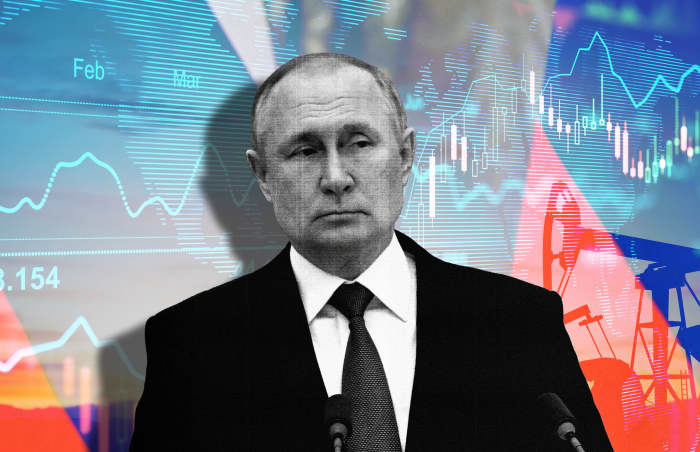
Opinion: Putin has launched the first economic world war, and the EU and the West are his targets
Antonia Colibasanu – April 19, 2022
The Kremlin is prepared to disrupt the West and its socio-economic order
GETTY IMAGES, ISTOCKPHOTO
As momentous as Russia’s invasion of Ukraine is, the most strategically important event in recent weeks was the global economic war between Russia and the U.S. and its allies. Russia, however, has been preparing to confront the West and challenge the Western socio-economic model for a long time.
Russia’s strategic interests in Ukraine are well-known. The geography and history of Russia compel its leaders to create and preserve a buffer between Moscow and the major powers in Western Europe, and to ensure access to the Black Sea. Ukraine is crucial to both goals. But beyond Ukraine, the Kremlin perceives the eastward expansion of Western influence, including into Russia, to be a modern invasion by stealth that threatens the Russian regime.
It is not Western organizations such as NATO and the European Union that challenge the Kremlin, but the socio-economic model that enabled the West to win the Cold War and that enticed Eastern Europeans to want to join the West. When he became president of Russia in 2000, in the wake of the Soviet Union’s collapse and the economic crisis of the 1990s, Vladimir Putin inherited a broken country. Many Russians contemplated joining the European Union, hoping that alignment with the West would bring a better life.
The priority for the Russian establishment was to stabilize and rebuild the country. Putin just wanted to survive politically. Following the example of past successful Russian leaders, he centralized power. Knowing he needed stability and growth to slow the rate of emigration and address Russia’s poor demographics, Putin sought to make Europe economically dependent on Moscow. Looking back at history and the current power balance, he identified Germany as the lynchpin of his strategy of dependence.
‘Russian ties to Germany were key to establishing ties to the European Union more broadly, but this was only the beginning of Russia’s strategy in Europe.’
Russian ties to Germany were key to establishing ties to the European Union more broadly, but this was only the beginning of Russia’s strategy in Europe. Russia opened up its economy to Western investment, established links throughout the Continent and tried to understand the inner workings of EU bureaucracy. It established close business ties with Italy, France and later Hungary, and built a political network that would help expand its influence in Europe. For Moscow, learning about European vulnerabilities was just as important as building up its economy and growing Russia into a stable economic power.
The Kremlin also campaigned to join the World Trade Organization to establish deeper relationships with the world’s biggest economic players. In the process, it benefited from foreign investments in Russia and learned how the global economy works, building partnerships with not just Western economies but also other economic powers. The only problem was that China, its major ally against the West, was not seeing the accelerated growth it hoped for and was still very much dependent on the U.S. market, giving Beijing limited ability to counter U.S. interests in the world and forcing Russia to keep its focus on Europe.
Average Russians saw improvements in their standard of living under Putin. In major Russian cities, life was similar to that in the West. However, when it became a major player in the energy market, Russia also increased its exposure to global economic cycles. The European economic crisis of the 2010s sent shivers through Moscow. Russia’s economy remained fragile overall, and the gap between urban and rural areas remained dangerously high, potentially threatening Putin’s control.
At the same time, the West offered an attractive model to rival Russia’s. It wasn’t so much the growing Western influence in Russia’s buffer zone that bothered the Kremlin, but the fact that ordinary Russians might look at Eastern Europe and see a better model for political organization and economic growth.
Then the pandemic hit. The Russian president apparently feared that the economic insecurity wrought by COVID-19 could threaten his country’s economic security and stability. As the worst socio-economic effects of the pandemic faded, action against the West became urgent. From the Kremlin’s point of view, this was a unique moment. The U.S. has been trying to reduce its presence in Europe and instead focus on the Indo-Pacific and domestic problems. In other words, from the Kremlin’s point of view, the trans-Atlantic alliance and the European Union appear weak. Most important, Russia’s leaders believe they have gained sufficient knowledge of the way the West works and can fight it effectively.
Preparing for war
Russia has been preparing to confront the West since at least the early 2000s. Besides stockpiling foreign reserves, Moscow constructed trade blocs and deepened relations with projects like the Eurasian Economic Union. In Europe, it enticed Germany to become dependent on Russian natural gas, which as is clear today made it extremely difficult for Europe to cut off Russian energy imports. Shifting from gas would require Europe to build new infrastructure — a costly, time-consuming process.
The close German-Russian partnership also benefited the Kremlin’s Europe strategy in other ways. To give a practical example, the EU had plans to make the Danube River fully navigable through the establishment of additional canals, increasing Central Europe’s connection with the Black Sea. This would have given Europe more leverage against Russia at the moment, when the war in Ukraine has forced the rerouting of commercial flows from the Black Sea to much more expensive land routes. Instead, positive relations with Moscow made the project seem unnecessary, and it faded away.
‘It is no coincidence that after 2012, the first full year that Nord Stream 1 was operational, Europe became much more reluctant to adopt policies that could be seen as anti-Russian.’
It is no coincidence that after 2012, the first full year that Nord Stream 1 was operational, Europe became much more reluctant to adopt policies that could be seen as anti-Russian. There was simply no interest in Germany to carry them out. It is also no coincidence that relations between the U.S. and Germany have cooled over that time. The U.S. needed Germany to lead Europe, or at least maintain neutrality, to prevent Russia from expanding its influence in Europe as the U.S. drew back. The fact that Russia joined the World Trade Organization in 2012 gave it even more leverage in the world economy.
Ties with top EU politicians
It is also worth noting that the Kremlin used personal relationships to shore up its influence. Former German Chancellor Gerhard Schroeder was tapped to lead Nord Stream 1. Nord Stream AG also hired former Finnish Prime Minister Paavo Lipponen as a consultant to speed up the permit process in Finland. Former Italian Prime Minister Matteo Renzi served on the board of Delimobil, a Russian car-sharing service. Former Finnish Prime Minister Esko Aho was on the board of Russia’s largest bank, Sberbank. Former Austrian Chancellor Christian Kern resigned from the board of Russia’s state-owned railway company in the early days of the war in Ukraine, while another ex-chancellor, Wolfgang Schussel, remained on the board of Russia’s Lukoil.
This is just a short list of top politicians, all of whom had at least some influence over their country’s foreign policy discussions. They have certainly been useful to Russian economic growth and the advance of Russia’s economic strategy in Europe.
Working closely with Europeans for the past two decades has enabled Russia to learn what is important for the stability of their countries. It has also helped the Kremlin better understand their political agendas and support causes that work to its advantage. For example, Russia enthusiastically supported many green policies, like Germany’s decision to give up nuclear power — which translated into greater reliance on Russian gas. And Russia has openly supported populist parties throughout Europe and effectively used information warfare, all in an attempt to destabilize and ultimately divide Europe.
Globally, Russia has maintained close relations with traditional enemies and competitors of the West. Joining the WTO gave it a stronger position on the global stage, which is used to advance the influence and interests of emerging global players, including the BRICS countries, which also include Brazil, India, China and South Africa. Though the results were modest, Russia promoted the group as an alternative to the West and continued to focus on building ties to China and India, establishing links that it hoped would withstand in a potential confrontation with the West, which we’re seeing play out today.
To counter the current sanctions, it has looked to China for help. The Eurasian Economic Union gives it proxies for continuing to do business with the world. At the same time, Russia’s presence in the Middle East and parts of Africa helps it keep the price of oil high — high enough that it can keep paying its bills. Influence in the Middle East and the Sahel, two highly unstable but resource-rich areas, also gives Russia more leverage over the world economy.
‘Russian strategy certainly has its weaknesses, but Russia has options in countering the West.’
In building its network, Russia has tried to focus on economics and enhancing weaknesses in the global network. It expanded its influence abroad, making sure the dependencies it was encouraging were strong enough to give it leverage but lose enough to allow its withdrawal when necessary. Russian strategy certainly has its weaknesses, but Russia has options in countering the West during the current global economic war. Supporting EU fragmentation through its economic ties in Europe and using the knowledge of European politics that it’s gained over the years are likely the most important elements of its strategy. The moment European citizens feel the repercussion of Western sanctions is when the bloc will become more fragile, which will allow Russia to exploit the EU’s weaknesses.
The world is witnessing its first economic world war of the modern era. The rules are undefined, and the global economy is complex, meaning collateral damage is unavoidable and frequently unpredictable. Slowly, we are becoming aware of the repercussions the sanctions on Russia are having on the global economy. Less clear are the instruments that Russia can employ against the West. How this will change the world is a mystery. All we can do is look back at what Russia has prepared for and guess what could come next. This is only the beginning.
Russia deploys up to 20,000 mercenaries in battle for Ukraine’s Donbas region
Julian Borger in Washington – April 19, 2022
Photograph: AFP/Getty Images
Russia has deployed up to 20,000 mercenaries from Syria, Libya and elsewhere in its new offensive in Ukraine’s Donbas region, sent into battle with no heavy equipment or armoured vehicles, according to a European official.
The official said the estimates of mercenary involvement on the ground in eastern Ukraine range from 10,000 to 20,000 and that it was hard to break down that figure between Syrians, Libyans and other fighters recruited by the Russian mercenary company, the Wagner Group.
“What I can tell you is that we did see some transfer from these areas, Syria and Libya, to the eastern Donbas region, and these guys are mainly used as a mass against the Ukrainian resistance,” the official said. “It’s infantry. They don’t have any heavy equipment or vehicles.”
Syrian ex-soldiers have been offered monthly salaries of between $600 and $3,000, depending on rank and experience, to fight in Ukraine. Wagner is reported to have moved most of its soldiers who had been fighting in Libya to Ukraine, and last month Ukrainian military intelligence claim that Russia had made a deal with the Moscow-backed Libyan warlord Khalifa Haftar to send Libyan fighters.
The mercenaries are being thrown into the Russian attempt to capture as much as possible of eastern Ukraine, in what western defence officials have described as a rush to have some sort of victory that Vladimir Putin can announce at the 9 May military parade in Moscow commemorating the second world war.
The Kremlin is seen as having four objectives in this second phase of its war in Ukraine, the European official said: capturing the Donbas, securing a land bridge to Crimea in which the besieged city of Mariupol is crucial, seizing Kherson oblast to secure the supply of freshwater to Crimea, and capturing additional territory that could be used as a buffer or a bargaining chip in negotiations.
Russia is still thought to have three-quarters of the armed force it began the war with in February: 76 battalion tactical groups, about 60,000 troops in all. Western officials say the Russian army faces many of the same limitations that led to its defeat in the battle for Kyiv and the north.
It has logistical challenges even though the supply lines to the Donbas are shorter, and much will depend on the condition of the roads and railways.
“You need to keep in mind that the Russian army is very dependent on railroads and the train network has been targeted many times by the resistance,” the European official said. Furthermore, morale in the Russian ranks is low and getting lower, the official said.
“They don’t like this war because they don’t like the idea of killing people who speak Russian. They have lost many comrades in the north and they have lost the navy cruiser Moskva.”
Third, the Russians still do not have guaranteed air superiority so cannot provide permanent close air support to their troops on the ground, the official said.
Russian commanders are seeking to crush the last stand by Ukrainian marines in Mariupol to free up troops to push north with the aim of cutting off Ukrainian forces fighting in the Donbas, a senior US defence official told reporters on Tuesday.
The official said, however, there was no inevitability about that happening, pointing out that the Ukrainian military was being replenished on a daily basis with new weaponry.
After talking to allied leaders, Joe Biden announced that the US would be providing Ukraine with long range howitzers, which the US defense official said would arrive “very, very soon”. The official added that seven planeloads of equipment, part of the $800m tranche approved last week, will begin arriving in the next 24 hours. The Pentagon said that Ukraine had also received aircraft recently, but not from the US. Washington has however supplied aircraft spare parts to help get more of Ukraine’s planes in the air.
Ukrainian survivors believe at least 20 people died during the month-long Russian occupation, including 11 elderly villagers who passed away while inside the basement. No official death toll has been released by Ukrainian officials.
Surviving off limited food and forced to go to the bathroom in buckets, men, women and children huddled together — four people per square meter — as Russian forces ransacked and destroyed their homes. Adults slept sitting up, while mothers used their bodies as makeshift beds for their children. The youngest Ukrainian held captive was just 2 months old.
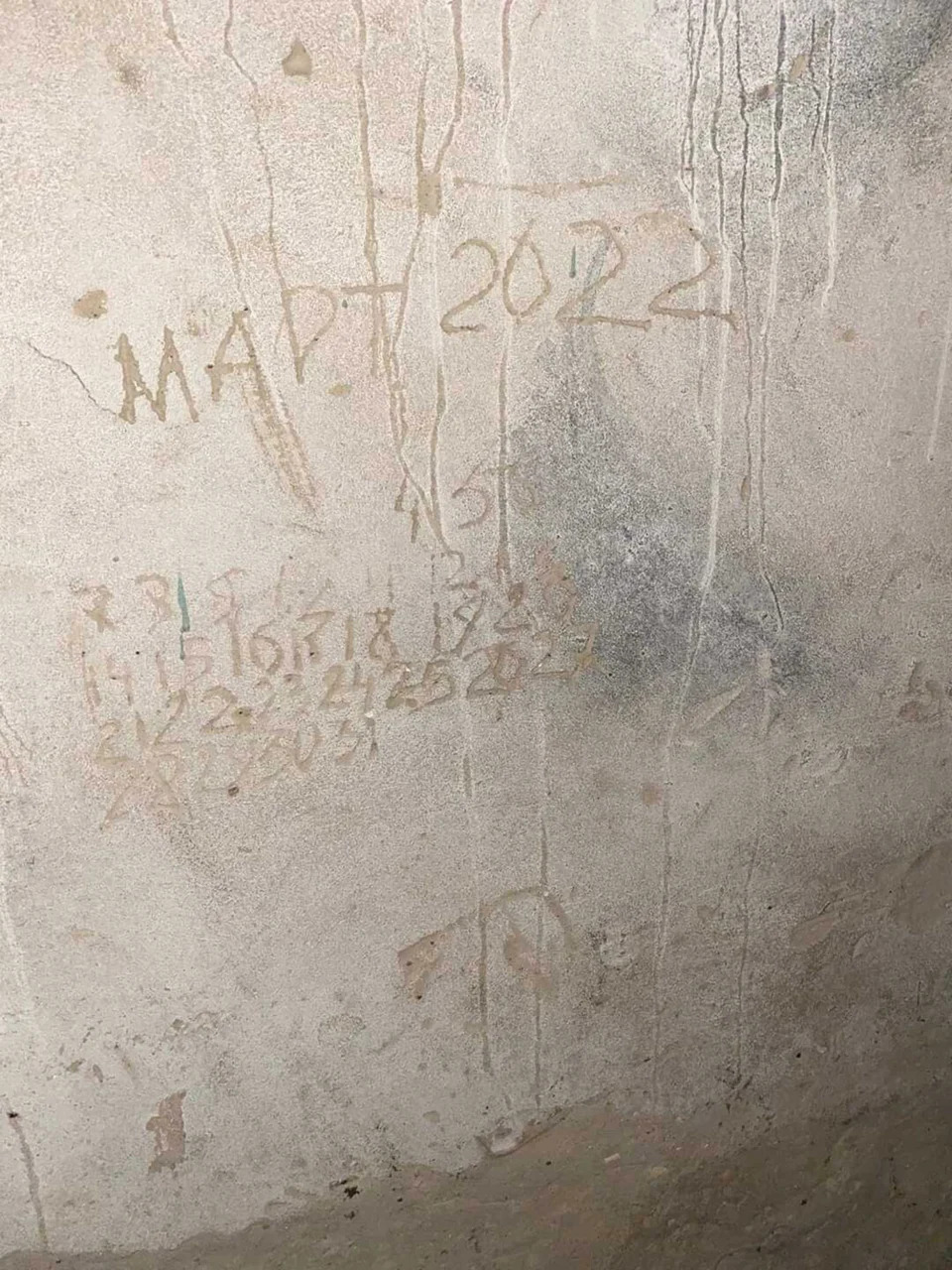
To keep track of time, villagers etched the passing days into one of the basement walls.
A picture of the makeshift calendar, etched into the walls of the school’s basement, so those held captive could keep track of the passing days. (Courtesy Tetyana Diohtyar)
TODAY Parents spoke, through a translator, to three Ukrainian women who were held captive by Russian troops in Yahidne and described, in detail, the conditions of their imprisonment. Now liberated, they say they want to world to know what the Russian military did to their homes, their village and their families.
The Defiant Grandmother
Valentyna Lohvynchuk, 56, told TODAY Parents Russians began shelling her village on the first day of March. Afraid, she hid in the cellar in the basement of her home with others from her village. They stayed in the basement until March 3 when, at around 4 pm, Russian soldiers came to her home.
“At first they were just shooting everywhere around — we could hear them from the basement,” Lohvynchuk told TODAY Parents. “Then they opened the basement doors and immediately threw something small inside: Some small explosive package.”
Lohvynchuk and the others began to cry out, begging the soldiers not to shoot.
“We started crying, yelling, ‘Please, do not kill us. Here in the basement, you can see it’s only women and children,'” she explained. “Then they said, ‘OK. Actually, we came here to protect you.'”
The soldiers took the women and children from their home, rounding up all the citizens of the town and holding them hostage in the basement of the village school.
A picture of the town’s school, where the Russian soldiers held 350 Ukrainian adults and around 75 children captive in the basement. (Courtesy Tetyana Diohtyar)
“There were 350 adults and 76 children,” Lohvynchuk said. “When they were pushing us into the basement, we saw that next to the school in the village there was a huge hole in the ground. We thought it was a potential mass grave and we were afraid we would all be killed and just thrown into this hole.”
With no access to electricity, medical care and limited access to food and clean drinking water, the elders of the village began to die.
“Over time, 11 elderly people died,” Lohvynchuk explained. “We were not allowed to bury them properly.” At times, the bodies laid next to the survivors for days before Russian troops allowed some of the villagers to take the bodies to the surface, where “there was some special place, which was used to burn fire, next to the school, and they allowed us to put some corpses there.”
“All people were very frightened, and didn’t speak much,” she added. “We were all just praying to God, and asking God to help.”
One evening, Lohvynchuk says a drunk Russian soldier descended into the basement, demanding a young Ukrainian woman go with him. Fearing the soldier had intended to rape the woman, the villagers formed a human shield around her.
“We were all around her. We started asking him, begging him, imploring him,” Lohvynchuk said. “Thank God, he listened to us, and he left her alone.”
On March 30, Russian troops locked the basement doors and barricaded them from the outside, warning their captives not to leave. From inside the basement, the villagers heard terrible explosions and began to fear that the Russians intended to purposefully bomb the school, killing everyone inside. Two weeks earlier, on March 16, Russian forces bombed a theater used as a shelter in Mariupol, killing up to 300 people.
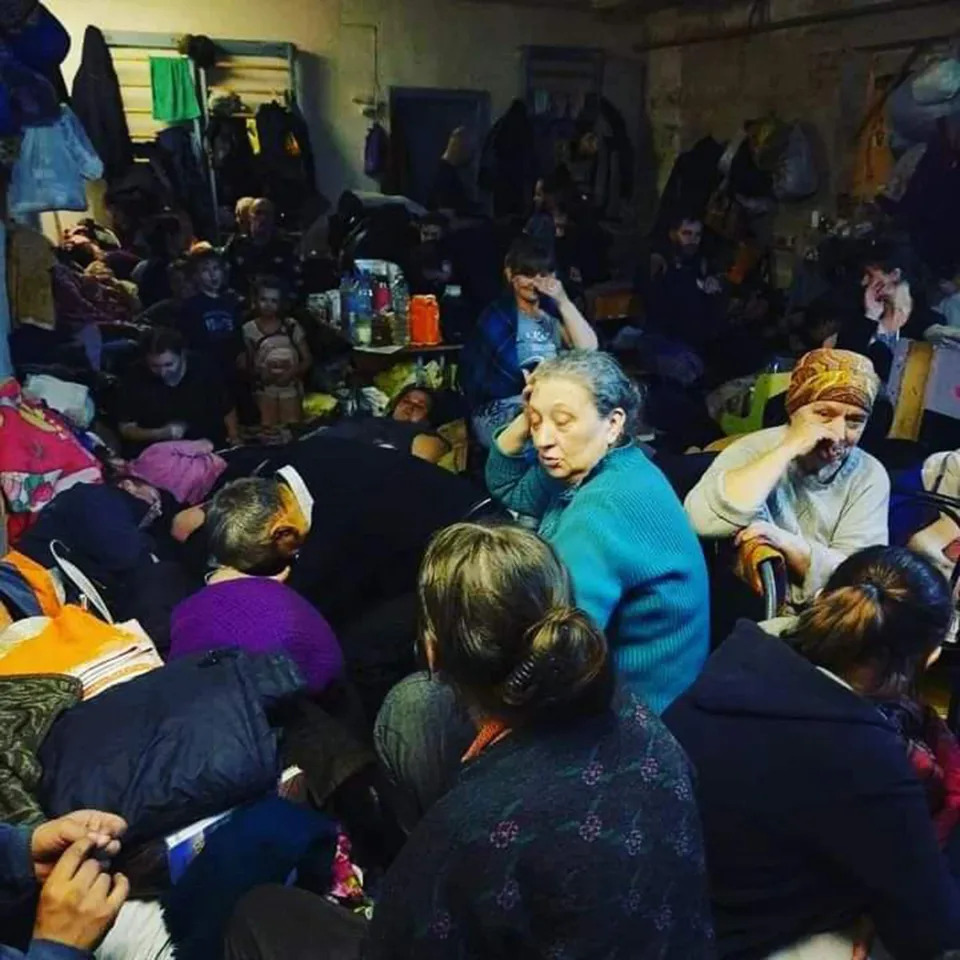
A photo of the town’s citizens, held captive in the town’s school’s basement for weeks. There was barely enough room to stand, let alone sit or lay down. (Courtesy Tetyana Diohtyar)
At around 6:30 pm, some of the Ukrainian men trapped in the basement forced the doors open, and found the school and the town deserted. The Russian forces left nothing but destruction in their wake.
“They lived in our houses and after they left everything was damaged,” Lohvynchuk explained. “They stole everything they could, and everything they couldn’t take they just broke or set on fire. I don’t know how to call them people. They are not human beings.”
On March 31, Ukrainian forces arrived at the village, and a group of volunteers helped Lohvynchuk travel to Yagotin, near Kyiv, to live with her daughter, son-in-law, and two granddaughters.
While safe, Lohvynchuk says the horrors of Russian occupation will stay with her forever.
“I have not come back to my senses since this experience,” she explained. “Today my daughter took me to the ophthalmologist, and my eyesight has deteriorated. I believe it’s from the stress.”
“Before the Russian soldiers left, they told us Putin’s plan,” she added. “His plan was to have our village inhabited by the Tuva Republic in Russia. That Ukrainians must be exterminated — no place for them to live here — and Russians would take this land. That was Putin’s plan.”
Tetyana Diohtyar, 36, is a mother of three children, ages 10, 4, and 4 months old. Diohtyar lived with her husband and children close to Cherniv, and traveled to Yahidne for refuge after the first Russian bombs fell, assuming the soldiers would not bother to attack such a small town.
She was staying with her husband’s two brothers and their families when the Russian troops invaded Yahidne.
“On March 3, we heard very loud gunfire very close to our building,” Diohtyar told TODAY Parents. “We immediately took all of our kids and very quickly rushed to the cellar.”
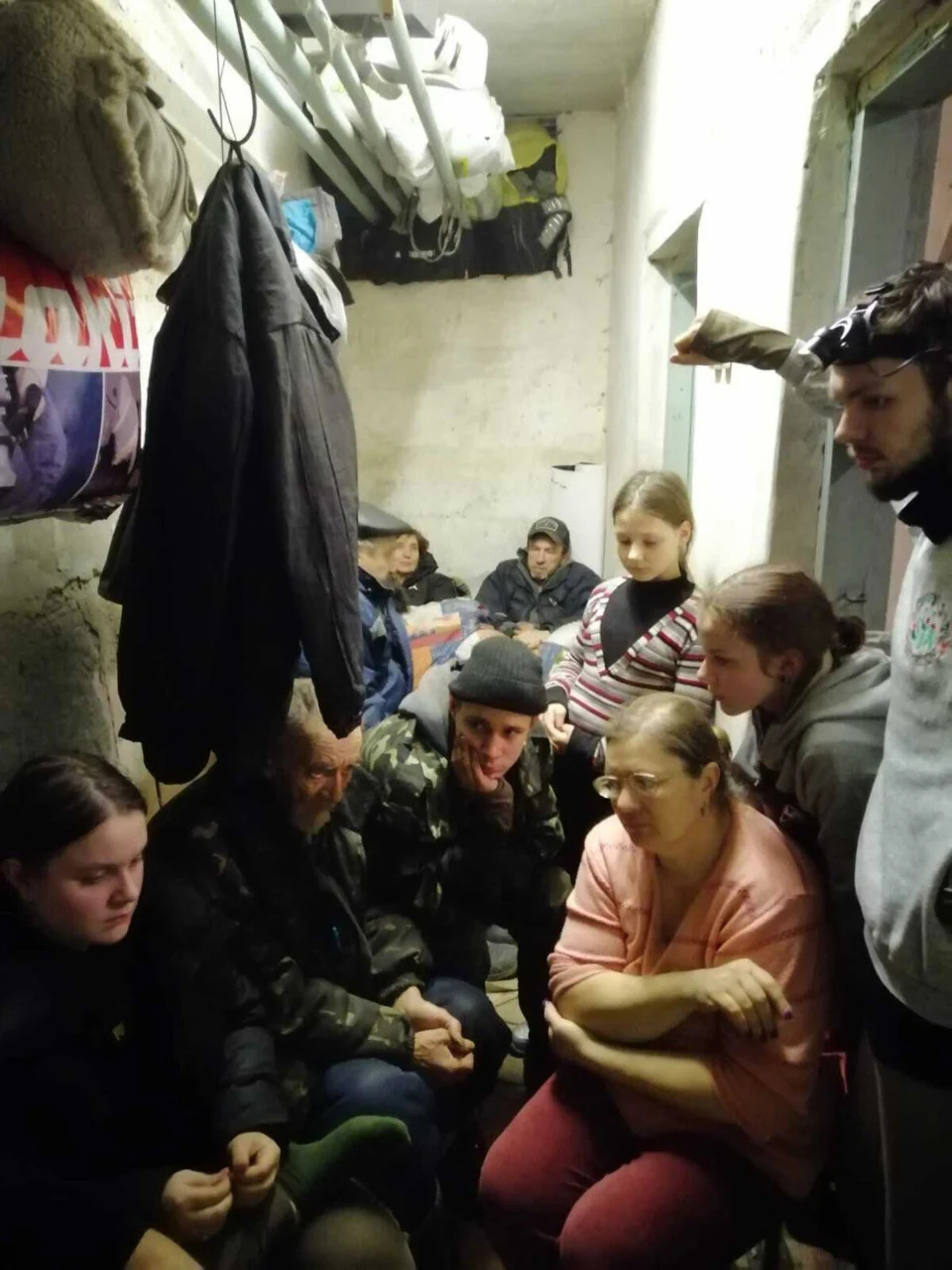
A family huddles together in the basement of the town’s school. The citizens had to ration food and water in order to survive. At times, it was so hot they couldn’t breathe. (Courtesy Tetyana Diohtyar)
After 20 minutes, the families heard people walking around their home — they were shouting and cursing. They quickly realized the voices were looking for them.
“A bit later, one military man appeared in the cellar,” Diohtyar explained. “I was in panic. I took my youngest son in my arms and I started crying, yelling and imploring him please, for God’s sake, don’t touch us. Don’t kill us. We have only kids here.”
The soldier took her husband and his two brothers away — she did not know what was going to happen to them. The solider only told them to remain in the cellar. Her 10-year-old daughter cried out for her father, begging God to bring him back to her.
The soldiers interrogated her husband, who is a member of a rescue team in Ukraine. After finding what they believed to be a military uniform, they held a gun to his face. It was only after her husband explained that he’s a first responder, not a soldier, that the Russian soldier lowered his weapon.
After 15 minutes, the men returned to the cellar — the soldiers had searched them and confiscated their cell phones. They then took the older children — ages 15, 18 and 20 — and searched them, too. After finding two computers and their iPhones, the soldiers began to interrogate the children, who are students attending school in Ukraine.
The soldiers stripped the two young men naked, and forced the young woman on her knees.
“They asked them why they had these gadgets and how they got them,” Diohtyar explained. “(The students) explained that they earned money to buy them. The soldiers were surprised that Ukrainians could earn enough money to buy an iPhone.”
“The children could not understand why, as students, they couldn’t have a notebook,” she added. “Why these people didn’t understand these are just things they needed for studying.”
Diohtyar says that once everyone was returned to the cellar, a solider told the family they had been authorized to kill them all.
“They said they would not do it now, though,” she added. “They told us to wait to die until midday tomorrow.”
The Russian soldiers left the town in ruins. Many of the Ukrainian occupants did not have a home to come back to. (Courtesy Tetyana Diohtyar)
The next day, the family heard knocking on the cellar door. The soldiers had returned, and told them they had 10 minutes to get to the basement of the village school or they would throw a grenade into the cellar.
The family entered the basement on March 5, and were able to find a small room to house the whole family — 18 people in total.
“We could just sit and sleep while we were sitting,” Diohtyar explained. “We took kids on us — on our bodies. We were sort of making layers of people and younger kids, they were over their mothers’ bodies.”
Diohtyar was breastfeeding, and began to fear she would not have an adequate amount of food to produce enough milk for her then 3-month-old.
“There was a scarcity of food,” she explained. “We ate only once, maximum twice a day. I was all the time trying to drink enough liquid to make sure I would have milk. Luckily, I did have milk to feed my child.”
For weeks, the family lived in darkness. Without any electricity, the villagers lit candles, burned oil and lit any cotton they could find on fire. While the weather was brutally cold, inside the crowded basement it grew hot and suffocating. Diohtyar says the inability to breathe is one of the reasons why 11 of the village’s elders perished inside the basement.
“Sometimes they allowed us to take the dead body out on the same day,” she added. “But in some cases, they would allow us to do it on the next day or even two days later.”
To keep the children calm, with the permission of the Russian soldiers the villagers raided the school. They brought the children crayons for them to write on the basement walls, as well as paint and paper. From the kindergarten classes, the adults brought children legos, cars and other toys.
On March 30, Diohtyar says they were beginning to run out of food and asked the soldiers if they could emerge from the basement to gather more bread, cereal and grains. In response, an officer gave the villagers two handwritten copies of a Russian anthem and told the villagers he would allow them to gather more food if they learned the anthem by heart and sang it.
“We refused to do it. We didn’t do it,” Diohtyar said. “Luckily, shortly after that, we were free.”
A picture of another destroyed civilian building.
Once liberated, Diohtyar and her family returned to the family’s home only to find it completely destroyed.
“We literally had only the floor and walls left. Everything else — all windows, all furniture, all doors, door frames — they were all broken and burnt,” she said. “They stole our washing machine, mattresses, sofas, and destroyed what they could not take away. We could hardly find anything to take with us. We could not even find clothes for the kids to take with us.”
The family also found their dog lying dead outside, shot by Russian soldiers.
Now in western Ukraine, Diohtyar says her 10-year-old daughter cries constantly. But Diohtyar is determined to be strong for her family.
“I am a strong woman. We will go back to our village and rebuild our house. I will plant flowers in the flower beds and eat apples from the apple trees, which we have in the orchard,” she said. “We will plant new trees. My kids are next to me and I will live for my kids.”
“We should not forget about this experience,” she added. “We will overcome it and rebuild our house. Renew everything we can. The most important thing is that we are lucky we have all survived.”
The Courageous Widow
Antonia, 29, who asked that her last name be withheld for her safety, told TODAY Parents that she traveled to Yahidne with her husband and 7-year-old son to stay with her mother, assuming it would be “a much safer place for us to stay, to kind of hide away from the dangers of war.”
Like so many of her fellow Ukrainians, her family hid in the home’s cellar once the Russian shelling began.
“There were three families staying in my mother’s house at first,” Antonia told TODAY Parents. “Our family, my husband and my son; My friend from Cherniv and her son; my step-father’s niece and her husband.”
On March 5, Russian soldiers broke into her mother’s home and found the family hiding.
A photo of the captive Ukrainians, kept in a basement for weeks. (Courtesy Tetyana Diohtyar)
“There were three men with guns,” she said. “Of course, our kids were very scared. They started crying immediately. The soldiers started yelling at us, asking us, ‘Why are you hiding here?'”
Antonia says they tried to explain to the soldiers that they wanted to stay in their home — they did not want to evacuate. The soldiers demanded everyone give them their cell phones and write down their passwords, then allowed them to return to the cellar. They were told that if they left the cellar for any reason, they would be killed.
“My husband kept one cell phone, and as soon as we got to the cellar he called his mother and told her to delete him from all the chats he was a member of and post on his Facebook page that his phone was in the hands of the Russians,” Antonia said. “He did not want Russians to get his information.”
At that moment, a Russian soldier appeared and caught her husband on the phone. They immediately took him and the other adult man in the cellar away.
“Unfortunately, that was the last moment I saw my husband,” Antonia said. “I managed to tell (the Russian soldiers) not to touch my husband. ‘Don’t touch him,’ I said. These were the last words that were addressed to him and my husband.”
Her son was sleeping when the soldiers took his dad away. When he awoke, he immediately asked Antonia where his father was.
“I had to tell him that his father was taken to prison. That he’s a prisoner now,” she said. “He was very scared and upset and he kept asking me, ‘Oh, mommy, will we see our father again? How will they treat him? I hope they will not make any pain to him. They will not torture him.’ And I tried to calm our son down. I tried to tell him that everything would be fine.”
Two days later, the soldiers returned, aiming their guns at the remaining family members and ordering them to leave the cellar and go to the village school’s basement.
“We had to run to school — there was constant shelling and explosions around us. Some gunfire. We were very scared and my son was in tears all the time. He was afraid,” Antonia explained. “Then something exploded pretty close to us and we immediately fell to the ground. I was trying to close my son with my body, and when it got quiet he actually started disturbing me and saying, ‘Mommy, mommy, let us quickly run.’ So we started running towards school again.”
Antonia and her family were some of the last villagers to enter the school basement.
Immediately, Antonia tried to find her husband. When she realized he was not in the basement with the others, she began to fear the worst. Determined to focus on her son and the needs of her remaining family members, she tried to find enough room for the family to stand or sit. They began to ration food — the adults often skipped meals in order to feed the children.
There was near-constant shelling and bombing while the Russians held the town’s citizens captive. (Courtesy Tetyana Diohtyar)
“We were in the basement for 11 days,” Antonia said. “It was the longest 11 days of my life. There was no room to lie down. We tried to sleep while we were sitting next to each other.”
On March 9, a Russian soldier asked a woman in the basement to come with him — he wanted her to identify two dead bodies found in a nearby cellar. When the woman returned, she told the villagers not to worry — the bodies were not local. But a very real chill crept down Antonia’s spine.
“I went up to her and asked her if she could describe their clothes,” Antonia said. “When she described what they were wearing, I understood it was my husband.”
She wanted to openly weep, but she feared drawing attention to herself. If Russian soldiers had decided her husband deserved to die, she thought, what would keep them from deciding she deserved death, too?
“I could not allow myself to express any emotions,” she explained. “I had to subdue my emotions. I cried at night, but only quietly and when no one could see.” She decided not to tell her son anything. Maybe, just maybe, someone else was wearing her husband’s clothes.
“I wanted to have this little hope,” Antonia added. “I could not tell my son that his father was dead.”
The town’s courageous mine-sniffing dog, who is tasked with finding explosives left behind by Russian forces. (Courtesy Tetyana Diohtyar)
After the village was liberated, Antonia was able to communicate with family members back home in Chernihiv. She was told two dead bodies were delivered to a morgue in Chernihiv. Her husband’s cousin had identified one of the bodies as that of her husband. He sent her a picture of her husband’s body.
“I had mentally accepted that my husband was most likely dead,” Antonia said. “So when I saw that picture, the only thing I was thinking was how I was going to tell my son, and how to do it the right way.”
Antonia then called her mother, and it was during her conversation that her 7-year-old overheard her say that her husband had been killed.
“He immediately asked me, ‘So, what do you mean? You mean I don’t have a father? Where’s my father? Will he come back? Do you mean he won’t come back? You mean I will not see him again?'” she said. “And I said, ‘Yes, unfortunately you are correct. Your father is no longer alive.'”
Before the war, Antonia had lost her step-father. When describing his death to her son, she would tell him that his grandfather was no longer living on earth, but in the sky — he was now a star. Upon learning his father had died, her young son leaned on that same understanding.
“Immediately, when he understood his father was dead, he asked me, ‘So, our father is also a star now?'” she explained. “And I told him, ‘Yes, he is a star.’ Then that night, we went out in the dark, looked up at the sky and tried to find his grandfather and father in the stars.”
Antonia and her husband celebrated their 8th wedding anniversary on Feb. 25. She says he was a wonderful man and father, who was dedicated to his job and had a lot of friends — friends who are now helping to care for Antonia and her son, who are now safely in Poland.
She says her husband also loved to fish — a hobby Antonia’s son also grew to enjoy. The two used to bet on who could catch the most fish. Now, Antonia says her son will catch fish for his father.
“My son is my purpose in life now,” she added. “I will keep living for him.”
Ukraine’s military gets more aircraft and parts to repair others, Pentagon says
April 19, 2022
WASHINGTON (Reuters) – Ukraine’s military has received additional aircraft as well parts for repairs to get damaged aircraft flying again, the Pentagon said on Tuesday.
Ukraine has defied expectations of allies and military experts by not only keeping its air force operational nearly two months after the start of Russia’s invasion but actually repairing aircraft and, apparently, adding to its inventory.
Pentagon spokesman John Kirby did not offer details on which countries provided aircraft, but acknowledged new transfers and said Ukraine had more operable fighter aircraft than it had two weeks ago.
“They have received additional aircraft and aircraft parts to help them get more aircraft in the air,” Kirby told a news briefing, without elaborating.
Kirby said Washington had not provided any aircraft to Kyiv.
“We certainly have helped with the trans-shipment of some additional spare parts that have helped with their aircraft needs, but we have not transported whole aircraft,” he said.
Still, that might soon change. The United States has announced plans to transfer Russian-made helicopters to Ukraine that had once been intended for Afghanistan.
More than 50 days into the war, the skies over Ukraine are still contested in part due to Ukraine’s fleet of aircraft and air defenses, including portable, shoulder-fired surface-to-air missiles provided by the United States and its allies.
That has allowed Ukraine to wage a much more effective ground campaign than if Russia had air dominance and could defend its invading forces from the skies.
(Reporting by Idrees Ali and Phil Stewart; Editing by Leslie Adler and Sandra Maler)
Related:
The Hill
Ukraine gets additional aircraft, plane parts to bolster fleet
Ellen Mitchell – April 19, 2022
Ukraine has been given additional fighter aircraft and aircraft parts from other countries to increase its fleet amid Russia’s attack, the Pentagon’s top spokesperson said Tuesday.
“I would just say, without getting into what other nations are providing, that they have received additional platforms and parts to be able to increase their fleet size, their aircraft fleet size. I think I’d leave it at that,” press secretary John Kirby told reporters.
He also said Ukrainian forces have received support “to get some of their fixed wing aircraft more operable again,” and now have available to them more fixed-wing fighter aircraft than they did two weeks ago.
“That’s not by accident,” Kirby said. “That’s because other nations who have experience with those kinds of aircraft have been able to help them get more aircraft up and running.”
The United States has begun to flow into Europe security assistance for Ukraine from the $800 million lethal aid package approved by the Biden administration last week.
A flight carrying such assistance arrived in Europe yesterday, with seven more expected to arrive on the continent in the next 24 hours, a U.S. defense official told reporters earlier Tuesday.
The overall package includes 11 Mi-17 helicopters, 300 Switchblade drones, 18 Howitzers, 200 M113 armored personnel carriers, 10 counter-artillery radars, 500 Javelin anti-tank missiles, chemical attack protective equipment, body armor and helmets.
“None of these shipments sit around very long before being offloaded off of aircraft and onloaded appropriately in ground transportation to get them into Ukraine,” the official added.
Kirby said Tuesday that every day “there’s somewhere on the neighborhood of eight to 10 flights” laden with Ukrainian military aid landing at European locations.
“They’re not all U.S. flights and they’re not all coming from America — but eight to 10 flights … that material is getting put on pallets and put on a ground delivery transportation means and getting into Ukraine via a various amount of routes,” Kirby said.
Of note are the heavier systems being given of late from the U.S. and other NATO nations — including aircraft, Howitzers and tanks — due to Russia’s warnings that such military aid would be seen as interfering in the war.
Ukraine says ‘Battle of Donbas’ has begun, Russia pushing in east
April 18, 2022
FILE PHOTO: A local resident rides a bicycle past a charred armoured vehicle in Volnovakha
(Reuters) – Russian forces launched a new offensive push along most of Ukraine’s eastern flank on Monday and the “Battle of Donbas” has now begun, Ukrainian President Volodymr Zelenskiy and senior officials said.
Ukraine’s army has been bracing for a new Russian assault on its eastern flank since Moscow withdrew its forces from near Kyiv and from Ukraine’s north late last month in order to focus on an assault in the Ukrainian region of Donbas.
“We can now say that Russian forces have started the battle of the Donbas, for which they have long prepared,” Zelenskiy said in a video address.
Ukraine Security Council Secretary Oleksiy Danilov said in televised comments: “They (Russian forces) began their attempt to start the active phase this morning.
“This morning, along almost the entire front line of the (eastern) Donetsk, Luhansk and Kharkiv regions, the occupiers attempted to break through our defences,” he said.
Russia has been bulking up its forces in the east of Ukraine using troops that it pulled out of Ukraine’s north and neighbouring Belarus, a close Russian ally.
In a post on Facebook, the Ukrainian armed forces command said that Russia’s main military force was concentrating on taking control of the entirety of the Donetsk and Luhansk regions that make up the swathe of land known as the Donbas.
“The second phase of the war has begun… Believe in our army, it is very strong,” the Ukrainian president’s chief of staff, Andriy Yermak, wrote on the Telegram messaging app.
Russia’s reinforcements have set the stage for a protracted battle that military analysts say is certain to inflict heavy losses on both sides as the Russians try to encircle Ukraine’s fighters dug in to defend the Donbas region.
(Reporting by Maria Starkova in Lviv; editing by Jonathan Oatis and Sandra Maler)
Russia-Ukraine war latest: Russia launches offensive in eastern Ukraine, Mariupol on brink of collapse
Niamh Cavanagh, Producer – April 19, 2022
LONDON — Russian forces started a brutal offensive in eastern Ukraine this week and have already seized what is believed to be their first Ukrainian city as part of their “next phase” of the war, which is nearing its third month. It comes as Russia called on Kyiv forces to surrender the final pocket of resistance in Mariupol as the port city remains on the brink of collapse.
‘Battle for Donbas’
The bodies of civilians killed in the southern port city of Mariupol, Ukraine. (Alexander Ermochenko/Reuters)
Ukrainian President Volodymyr Zelensky said Tuesday that Russian forces had begun their long-expected offensive in a bid to take control of the country’s eastern region. “Now we can already state that the Russian troops have begun the battle for the Donbas, for which they have been preparing for a long time,” he said in an address late Monday night. The Ukrainian president added that a “significant part of the entire Russian army is now concentrated on this offensive.” Andriy Yermak, Zelensky’s chief of staff, called the latest offensive the “second phase of the war.” Zelensky has said he’s not willing to give up eastern territory in order to end the war.
The General Staff of the Ukrainian Armed Forces said Russian troops are focusing their efforts to take full control of the Donbas area. “The occupiers made an attempt to break through our defenses along nearly the entire frontline,” the General Staff said in a statement on Tuesday. Taking control of Donbas would mean that Russia would have a southern land corridor to the annexed Crimean Peninsula, which has been occupied by Kremlin forces since 2014.
First Ukrainian city seized in new offensive
Civilians evacuating from Kramatorsk, Ukraine, board a transport on Tuesday. (Andriy Andriyenko/AP)
Russian forces have taken control of the eastern city of Kreminna, the regional governor said Tuesday. Serhiy Gaidai, the governor of Luhansk, said in a briefing that Kyiv forces had left the city. “Kreminna is under the control of the ‘Orcs’ [Russians]. They have entered the city,” he said. “Our defenders had to withdraw. They have entrenched themselves in new positions and continue to fight the Russian army.” Gaidai added that Kremlin-led troops had attacked the city “from all sides.” Regarding the death toll from fighting, he said: “It is impossible to calculate the number of dead among the civilian population. We have official statistics — about 200 dead — but in reality there are many more.” It is believed to be the first city captured in Russia’s new offensive.
Russian officials call on troops in Mariupol to surrender steel plant
Smoke rises above Azovstal Iron and Steelworks in Mariupol in this image posted on social media on Tuesday. (Mariupol City Council via Reuters)
Russia’s Defense Ministry called on all troops in the besieged city of Mariupol to surrender the Azovstal steel plant by noon on Tuesday. It is believed that Azovstal is the last major pocket of resistance in the city. “All who lay down their arms are guaranteed to remain alive,” the Kremlin’s Defense Ministry said. Moscow estimates that 400 foreign mercenaries and 2,500 Ukrainian troops are in the plant. Footage released from the City Council appeared to show the aftermath of an airstrike on the plant.
Police estimate that at least 1,000 civilians, including children, are sheltering in the building. Mykhailo Vershynin, chief of Mariupol patrol police, told CNN that Azovstal had “quite large reserves” of much-needed food and water. Meanwhile, Denys Prokopenko, the commander of the Ukrainian National Guard’s Azov Regiment, alleged that Russia had been dropping “bunker-buster” bombs on the plant. These types of bombs are designed to penetrate strong defenses and to hit targets that are underground.
U.S. military assistance arrives in Ukraine
Ammunition, weapons and other equipment bound for Ukraine are processed at Dover Air Force Base in Delaware in January. (Mauricio Campino/U.S. Air Force via AP)
The assistance includes 40,000 artillery rounds, 11 Mi-17 helicopters and 18 155-mm Howitzers. As it is the first time Ukrainian soldiers will have come into contact with a Howitzer, the U.S. military is expected to start training them in the coming days, a senior defense official said. Pentagon press secretary John Kirby said the first shipment had arrived in Ukraine just 48 hours after President Biden authorized the assistance, which he noted was at an “unprecedented speed.”
Cover thumbnail photo: Alexander Ermochenko/Reuters
With troops concentrated for a major ground assault, airstrikes bombarding cities and Ukraine’s forces steeling for what could be a series of decisive battles, many expect this Russian offensive to be better equipped and organized than the failed first phase of the war.
So why has Russian President Vladimir Putin refocused his military’s efforts on this region of eastern Ukraine, and what should we expect in the days and weeks to come? NBC News takes a look.
From industry to invasion
Simply put, the region is of territorial and ideological significance and making gains there could provide the Kremlin some form of victory after struggling to achieve its initial objectives in the war.
Valeriy Akimenko, a senior research associate at Conflict Studies Research Centre, said that Russia sees the land as valuable and “as historically Russian, ‘gifted’ to Ukraine during the Soviet era.”
“It is also part of the ‘Russian World’ concept Moscow aims to construct,” he added.
The region, almost twice the size of Belgium, is an industrial powerhouse filled with valuable coal and metal deposits and processing centers as well as strategically important ports on the Sea of Azov, which sits between Russia, Crimea and Ukraine.
Since Russia illegally annexed Crimea in 2014, Moscow-backed separatists have battled Ukrainian forces in the Donbas. The conflict lasted eight years and killed an estimated 14,000 people, according to the United Nations, until Russia invaded its neighbor nearly two months ago.
That move followed Putin’s recognition of the independence of two breakaway regions in eastern Ukraine, the self-proclaimed “Donetsk People’s Republic” and “Luhansk People’s Republic.” They are named after the two main areas that together make up the Donbas.
“Technically, the aim of the Russian ‘operation’ is to ‘defend Donbas’, one of the narratives promoted [by the Kremlin],” Akimenko said. “Thus, the capture of Donbas would allow Russia to claim success [and] declare ‘victory,’ interim as that might be given Russia’s evidently greater ambitions.”
Putin originally appeared set on deposing Ukrainian President Volodymyr Zelenskyy’s western-leaning government and re-exerting the Kremlin’s influence over its neighbor with a sweeping military operation.
But with casualties mounting and western sanctions hitting his economy, the so-called “liberation” of Donbas might prove appealing — particularly if it arrives in time for Russia’s annual Victory Day on May 9.
While all eyes have been on Kyiv, Ukrainian forces have long been fighting in defense of eastern Ukraine.
It’s a location where some of the bloodiest battles have occurred over the past eight weeks, from towns near Kharkiv in the north to Mariupol in the south, where Ukrainian forces are desperately battling to maintain a foothold in the crucial port city under siege.
Life on the Front-Line Ukrainian City of Mariupol (Christopher Occhicone / Bloomberg via Getty Images file)
Now that Russian forces have regrouped in Ukraine’s east and south, the expectation by both Ukrainian state officials and outside observers is that Moscow will try to take the territory and begin an offensive from there, especially after its efforts to occupy Kyiv failed.
“The operating assumption is that once the effort to invade Ukraine from multiple fronts has failed, then Russia decided to recalibrate its offenses and start to focus all its forces on one region in the hope that that will enable Russia to break through Ukrainian defense lines,” said Udi Greenberg, a historian of modern Europe at Dartmouth College
Victory for Russia then could be to annex the Donbas, slicing off a significant portion of Ukraine and depriving the country of access to those resources that make the region so valuable. Or, if they believe they could see further success, Russia could use the territory as a launching pad to continue its offensive through the rest of the country.
‘Dancing in Donbas’
But Ukraine and its military, which has been able to maintain heavy resistance and produced effective counterattacks in the region, sees neither of those options as tenable.
The Ukrainian military said that over the past 24 hours its forces had repelled seven Russian attacks in the Donbas that were supported by strategic bombers, drones and surface-to-air missile systems.
The country has created a defensive belt through the heart of the region, from the north to the southeast, according to Leonid Polyakov, Ukraine’s former vice minister of defense, who has remained in Kyiv through the war.
“South of Kharkiv they tried to break through toward Kramatorsk, toward the administrative border of Donetsk Oblast,” he explained, using a word that refers to an administrative region. “Luhansk is largely under their control except for major populated areas, while Donetsk is largely under our control. We resist there for the moment.”
Polyakov said that the Ukrainians are keeping their forces highly maneuverable to find weak points in the Russian lines and attempting to encircle their foes, but he admitted they have also been forced back at points by Russia’s greater numbers.
That includes one town in the Donbas, Kreminna, where local officials said Moscow’s troops had seized control in the hours after launching their intensified assault.
The Russians have resisted Ukrainian counterattacks toward occupied territory in Donbas in Kherson, a city on the Black Sea, and Zaporizhia, an industrial city further north on the Dnipro River. That has become a key offensive line for Russian forces, as it creates a corridor to supply chains maintained in Crimea.
The fighting can often see the two sides push each other back and forth without any significant change in the overall battlefield picture.
“This is what we call ‘dancing in Donbas,’” Polyakov said.
TOPSHOT-UKRAINE-RUSSIA-CONFLICT (Fadel Senna / AFP via Getty Images)
Ukrainians remain optimistic that they can win this war. But they see the fight as one not just being waged on the ground and in the air with Russia, but as a constant struggle to secure more support from their partners in the West that they say could prove decisive.
Oleksiy Arestovich, an adviser to Ukraine President Volodymyr Zelenskyy, said in a social media post that the battle for Donbas was essential to the country and its “outcome will determine the fate of this phase of the war.”
While Russian forces may occupy cities and towns and kill Ukrainian troops, he remained confident that the Ukrainian military would maintain an “active, mobile defense” and beat back their invaders.
“The forces that the Russians have accumulated in the Donbas region are not enough to achieve their goals, these forces are disparate and weakened,” he said. “The only justification for this attack is the political will to move forward and the inability of the military to convince the Russian political leadership that they cannot achieve their goals.”
The main challenge for Ukraine remains the same: acquiring enough weapons for the battles ahead.
Polyakov said they have enough troops, pilots, gunners, missile crews and tank crews, but they don’t have enough ammunition, jets, guns, missiles and tanks to keep up the resistance and push the Russians from their land.
“There is a direct link in how much our civilians suffer in captured regions like Donbas and how quickly our partners and allies can overcome their bureaucracy and deliver what they can to us,” he said.
How 12-Year-Old Orphan Was Unwittingly Sucked Into Russia’s Ukraine Propaganda: ‘She Is So Scared’
Virginia Chamlee – April 19, 2022
Mariupol
SERGEY BOBOK/AFP via Getty Mariupol
Amid Russia’s continued invasion of Ukraine, a 12-year-old orphaned girl has somehow found herself unwittingly at the center of the country’s propaganda efforts, a new report details.
According to a CNN story published Sunday, Kira Obedinsky — whose mother died when she was a child — found herself parent-less when her dad was killed in Russia’s assault on Mariupol, one of the hardest-hit parts of Ukraine in recent weeks.
CNN reports that, days after her father was shot to death on March 17, Kira and her dad’s girlfriend attempted to leave on foot, but she was injured in a landmine explosion. And that’s when things took a turn.
Kira was taken to a hospital controlled by Moscow-backed separatists and, in footage released by Russian media, could be seen looking happy while talking about how she was allowed to call her grandfather.
While the video is meant to send a positive message, the girl’s grandfather, named Oleksander, told CNN it was a false one. The reality, he said, was that Kira is alone, without any family, and was relocated without her will.
He told the network that Russians forces had taken away Kira’s documents and told her she would be provided with new ones in Russia, where she would eventually be taken to an orphanage — an account adding to others of Ukrainians forcibly moved to Russia during the war.
Oleksander added to CNN that, in an audio message Kira sent him, she could be heard saying: “I haven’t seen you for so long. I want to cry.”
Reportedly speaking to The Guardian, the 67-year-old Oleksander said his granddaughter seemed okay when he able to connect with her via video call.
“She was in a hospital bed, she had shrapnel wounds around her ear and face and her legs, but she seemed okay,” he told the newspaper. “I was so relieved. But she told me she’s in Donetsk [a separatist region in eastern Ukraine], and it seems like she’s on her own. She told me they’re taking her to a Russian city.”
Elsewhere in the interview, however, he said his granddaughter seemed “scared” by the confusing situation.
“She is so scared. She doesn’t know where or why she is going,” Oleksander said. “I can’t say for sure what she understands about what’s going on and the war … She’s seen people killed in front of her, explosions and shelling. She just wants to come back to her family and come back home.”
RELATED VIDEO: Maks Chmerkovskiy Returns to Poland to Help Refugees Escaping Ukraine — ‘It Is Getting Worse’
A Ukrainian official claimed last month that more than 400,000 people in the country had been taken to Russia against their will as the war rages.
Lyudmyla Denisova, Ukraine’s ombudsperson monitoring human rights, said those people could be used as “hostages” to pressure the country to relent as it defends itself from attack. Russia has insisted that the people actually wanted to leave Ukraine.
The number of those relocated includes 84,000 children, the Associated Press reported in March.
Russian forces were also blamed for taking at least one entire Ukrainian city — Chernihiv — hostage by cutting off its access to the capital city of Kyiv.
In Mariupol, where Obedinsky was living prior to the war, the situation has been similarly dire.
Just last month, the Mariupol city council said that “several thousand” residents had been forcibly taken to Russia, CNN reported.
According to the network, the city issued a statement in which it claimed “the occupiers illegally took people from the Livoberezhny district and from the shelter in the sports club building, where more than a thousand people (mostly women and children) were hiding from the constant bombing.”
The statement added that some of those residents were taken to camps, where Russians checked their phones and documents, then to remote cities in Russia, per CNN.
Children of Bucha
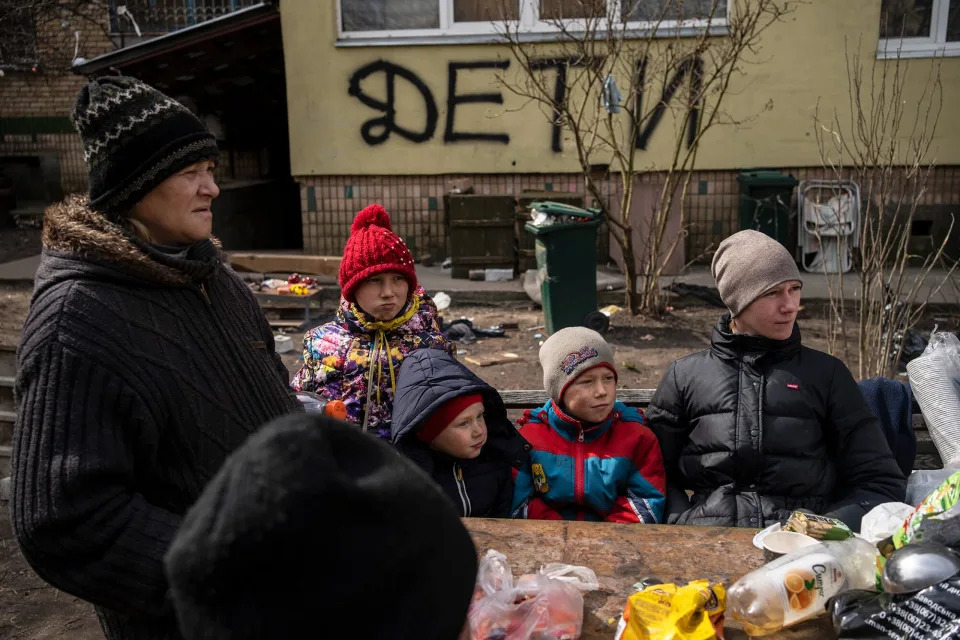
Rodrigo Abd/AP Photo Neighbors wait for a free food delivery in Bucha on the outskirts of Kyiv, Ukraine, on April 8.
Russian forces launched their large-scale invasion of Ukraine on Feb. 24 — marking the first major land conflict in Europe in decades.
Details of the fighting change by the day, but hundreds of civilians have already been reported dead or wounded, including children. Millions of Ukrainians have also fled, the United Nations says.
“You don’t know where to go, where to run, who you have to call. This is just panic,” Liliya Marynchak, a 45-year-old teacher in Ivano-Frankivsk, Ukraine, told PEOPLE of the moment her city was bombed — one of numerous accounts of bombardment by the Russians.
With NATO forces massing in the region around Ukraine, various countries have also pledged aid or military support to the resistance. Ukrainian President Volodymyr Zelenskyy called for peace talks — so far unsuccessful — while urging his country to fight back.
Putin insists Ukraine has historic ties to Russia and he is acting in the best security interests of his country. Zelenskyy vowed not to bend.
“Nobody is going to break us, we’re strong, we’re Ukrainians,” he told the European Union in a speech in the early days of the fighting, adding, “Life will win over death. And light will win over darkness.”
Russia’s special-operations forces are under fire in Ukraine
Stavros Atlamazoglou – April 18, 2022
Russian Spetsnaz troops march through Red Square in a Victory Day military parade, May 9, 2021.Mikhail Svetlov/Getty Images
Amid its struggles in Ukraine, Russia’s military has relied heavily on its most highly trained troops.
The fighting has taken a outsize toll on those troops, including Russia’s famed Spetsnaz special operators.
Moscow may rely on those operators even more as it renews its campaign with a focus on eastern Ukraine.
Russian forces have struggled in Ukraine, failing to achieve any of their primary objectives after two months of fighting.
Moscow has reduced its ambitions, focusing on eastern Ukraine. It appears to be renewing its offensive, but its performance has already affected assessments of its military prowess, calling into question its status as a “near peer” force.
Among the Russian units affected are the famed Spetsnaz. During and after the Cold War, these special operators achieved legendary status in the West. Recent successes in Crimea and Syria seemed to add to their credentials.
Alongside the rest of the Russian military, however, their reputation is being tarnished in Ukraine.
The city of Irpin, only miles from Kyiv, was a base Russian special-operations forces until Ukrainian forces ousted the Russians in late March. The brutal fight for the port city of Mariupol — the kind of strategic target where Moscow has concentrated its most capable forces — appears to have taken an outsize toll on Russia’s special operators.
Spetsnaz: Russia’s special operators
Troops with the Russian military’s 14th Separate Special Purpose Brigade during an exercise, February 15, 2017.Russian Ministry of Defense/Mil.ru
Moscow established the Spetsnaz, its first special-operations unit, in the 1950s to conduct strategic missions.
Spetsnaz initially had a strategic role, but now every special-operations unit in the Russian military, law enforcement, and emergency and security services are called Spetsnaz.
In general, military Spetsnaz units are a light infantry airborne force that can act as shock troops. A few elite Spetsnaz units, such as Alpha and Vympel Groups, have strategic missions, such as counterterrorism, counterproliferation, and the security of nuclear installations.
There has been limited reporting on what Russian special-operations units have done in Ukraine or how they’ve performed, but their missions there may include special reconnaissance, direct-action operations, and unconventional warfare.
One of the few advantages that Russia’s military has leveraged against Ukraine is its long-range weapons. Russia has launched more than 1,500 ballistic and cruise missiles at Ukrainian targets.
Troops of the Russian military’s 2nd Separate Special Purpose Brigade, a Spetsnaz GRU brigade, during an exercise.Konstantin Morozov/Russian Ministry of Defense/Mil.ru
Russian special operators could infiltrate close to those targets and use specialized equipment to help guide the munition. Moscow’s utter disregard for collateral damage means it may not be using such targeting assistance, but that skill set could still be used if the Kremlin wants to take out the Ukrainian leadership with a strategic strike.
Russian special-operations forces might also be conducting direct-action operations, such as raids and ambushes, in pursuit of tactical-level goals, such as capturing a city block.
Generally, it would be folly to use special operators for conventional operations, as their potential casualties would squander the time and expense used to train them to a high level, but the lack of progress may prompt Russian commanders to do so, especially in urban settings where the close-quarters-combat training of Russian commandos might make the difference between winning and losing.
Russia may also use its special-operations forces for unconventional warfare and asymmetric operations. Russian forces have been supporting separatist forces in eastern Ukraine for years, and that effort may expand as Moscow redirects its military campaign toward that region.
Russian special operators may also target Ukrainian strategic targets, such as airfields or fuel and arms depots. There have already been reports of Russian naval commandos attacking a Ukrainian military intelligence ship.
Learning from the enemy
Members of the Russian military’s 22nd Separate Guards Special Purpose Brigade during an exercise, November 24, 2017.Russian Ministry of Defense/Mil.ru
When it comes to special-operations forces, the Russian military has had ample opportunity to learn from the US.
For the past 20 years, US special operators have been at the tip of the spear. Their ability to conduct high-reward missions with less military or political risk than larger conventional units has made them a go-to option for American policymakers.
Russia’s military began a major reorganization in 2008, part of which was the formation of a dedicated special-operations command organization. Created in 2009, the Russian Special Operations Forces Command is a strategic-level special-operations organization tasked with the hardest, most important missions.
“The Russians aren’t stupid. They would have seen how successful we’ve been employing SOF [special-operations forces] downrange during the GWOT [Global War on Terror] and have taken their notes. That’s what we would do,” a retired Delta Force operator told Insider.
What Russian forces have learned in terms of military doctrine isn’t apparent, but open-source information showed “how our operations have influenced their equipment and training,” said the retired operator, speaking anonymously because they still work with their unit.
Troops of the Russian military’s 22nd Separate Guards Special Purpose Brigade during an exercise, November 24, 2017.Russian Ministry of Defense/Mil.ru
“It’s funny because sometimes it’s hard to distinguish between an American and Russian operator because they tend to both wear MultiCam [camouflage], high-cut helmets, and carry similar assault loadouts. It’s only from the weapons that you can really tell the difference,” the former operator added.
Moscow drew on the creation of the US’s Joint Special Operations Command, which is a component of US Special Operations Command, as a model for its new command.
Although smaller than Russia’s new command, JSOC contains the US military’s special missions units, the most elite special-operations organizations that comprise the US national mission strike force.
Moscow wanted to replicate the effectiveness of the JSOC, bringing together its top special-operations units to facilitate better command and control. Even Spetsnaz units from the GRU, Russia’s military intelligence agency, were transferred to the new organization, though they were reassigned to the GRU in 2013.
“People in SOF tend to be cut from the same cloth. The training, mission sets, and funding might be different — and in some cases worlds apart — but the people at the highest levels tend to be very similar,” the retired operator said.
Stavros Atlamazoglou is a defense journalist specializing in special operations, a Hellenic Army veteran (national service with the 575th Marine Battalion and Army HQ), and a Johns Hopkins University graduate.