What the dead say: Ukraine investigators gather evidence of Russian atrocities

Los Angeles Times

What the dead say: Ukraine investigators gather evidence of Russian atrocities

Carolyn Cole, Laura King – April 20, 2022

BORODYANKA Ukraine-APRIL 20, 2022-The bodies of six people in a mass grave and three others a few yards away, were uncovered in the town of Borodianka on April 20, 2022. Ukraine criminal police investigators documented the evidence of war crimes before putting the bodies into body bags. (Carolyn Cole / Los Angeles Times)
Bodies in a mass grave were uncovered by investigators documenting possible war crimes in the town of Borodianka, Ukraine, on Wednesday. (Carolyn Cole/Los Angeles Times)

The dead are so many. And they are everywhere.

A son found lying with his hands folded beneath his cheek, as if sleeping. People run over by Russian armored vehicles, their mangled remains pulled from a mass grave. A woman’s corpse covered only by a thin nightgown that offered no scrim of dignity.

In the brutal landscape of what were once placid and prosperous suburbs and satellite towns near the Ukrainian capital, Kyiv, investigators struggle daily to document evidence of mass atrocities against the people who once lived here.

Because the dead, in their way, can speak.

A woman stands in a field in front of bodies found in a mass grave in the town of Borodianka
Nadya Boyko waits as investigators inspect bodies found in a mass grave in Borodianka, Ukraine, on Wednesday. Among the dead was her son Constantine, who was shot by Russians. (Carolyn Cole/Los Angeles Times)

They work painstakingly, these caretakers and curators, these examiners and searchers who are affording the most meticulous care to this scatter of carnage. For the sake of the knowledge to bring the perpetrators to justice — perhaps.

And painstakingly, also, in the sense that they — along with the stunned mourners they minister to as best they can — are absorbing the horror of what transpired here, along roadsides, in cellars, and in the mud of gardens and backyards.

The Russians have been gone for nearly as long as they occupied these small Ukrainian communities, living among those whose lives they would take or change forever. Over the weeks, it became clearer that the Russian military advance would stall here, that the invaders’ imagined swift and triumphal push into the capital would be derailed in a tangle of logistical and other problems.

For that ignominious failure, and the backlash it ignited, civilians paid the price. Hundreds died here, Ukrainian officials say, and an outraged world is demanding war crimes investigations and eventual accountability.

That’s for later. For now, a sorrowful procession arrives daily at the morgue in Bucha, a town whose name has become a byword for hideous suffering coming to light weeks after the fact. The crowd is small and desolate, waiting for the bodies of loved ones to be formally identified and released as the exactitude of forensic science folds into simple grief.
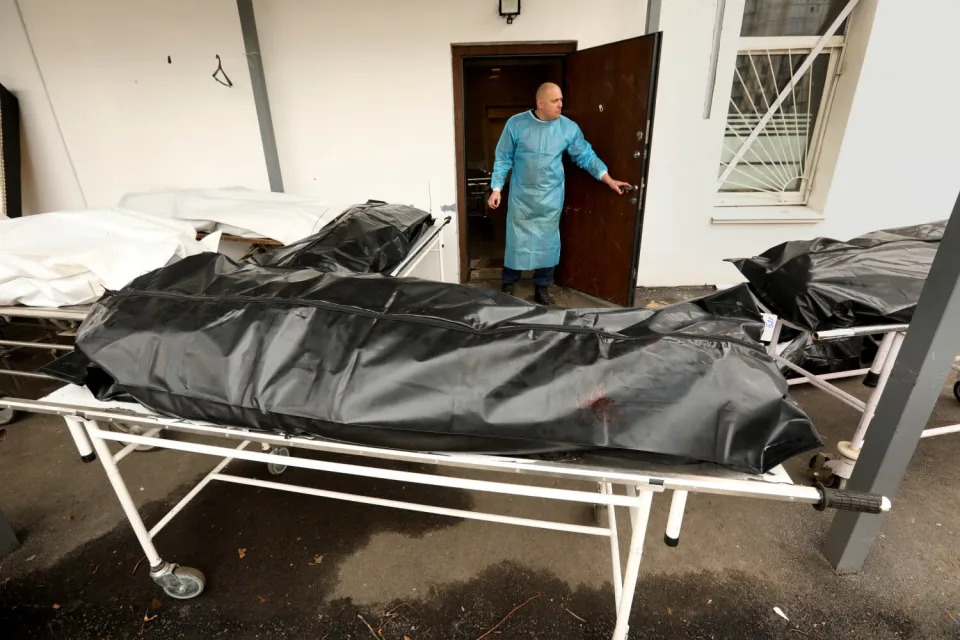
Body bags on gurneys outside the morgue in Bucha, Ukraine.
Body bags on gurneys outside the morgue in Bucha, Ukraine, on Tuesday. Families wait outside for investigators to finish their work so that they can take their loved ones home for burial. (Carolyn Cole/Los Angeles Times)

Out front, a dozen gurneys bore numbered plastic body bags. Some of the remains had been exhumed days before from the mass grave at the church of St. George, a few blocks away. More than 50 bodies were recovered there.

Now, the ragged trench has been filled in with dirt. A bloodied comforter still lay on the ground.

At the morgue, Zena Laboonska leaned over the body bag holding her 31-year-old son, Sergey Sydorchuk, bearing a tag with the number 184. With both hands, she touched the white plastic covering.

Nearby, a man named Sergey Bauepa was waiting to collect the remains of his son Nicolai, dead at 37. Even after an interval of weeks, the father had the air of a person trying to process something beyond his capacity to wonder.

“They killed him,” he said.

Up the road in the heavily damaged town of Borodyanka, black-clad Ukrainian police investigators went about their bleak task: taking pictures and measurements of a dug-up grave containing six bodies.

A woman cries as she touches the body of her son, one of many in body bags outside the Bucha, Ukraine, morgue.
Zena Laboonska cries as she touches a body bag containing her son Sergey Sydorchuk outside the morgue in Bucha, Ukraine. (Carolyn Cole/Los Angeles Times)

Alexander Salov, 39, already knew the fate of his 64-year-old father, Sergey: body mainly intact, head crushed. He stood in front of a Russian armored vehicle, trying to stop it, witnesses said. It ran him over.

Another of the six bodies in the grave also had been run over by heavy vehicles, while four other corpses, at least one of them a woman, bore the marks of gunshot wounds.

A few yards away, police tape marked off an area where three other bodies, two male and one female, were uncovered by police investigators. Nadya Boyko had buried her son there after he was shot and killed by Russian troops on Feb. 28.

Now, after the investigators finished their work, she would return him to the earth a second time.

The body of a woman exhumed was covered only by a thin nightgown, suggestive of other horrors. Along with cataloging the many signs of execution-style killings, war-crimes investigators are documenting evidence of sexual atrocities committed by the occupying forces.

Bodies exhumed from a mass grave lie on the ground as investigators work in the town of Borodianka, Ukraine.
Bodies exhumed from a mass grave lie on the ground as investigators work in the town of Borodianka, Ukraine. (Carolyn Cole/Los Angeles Times)

Near the town of Andriivka, about 50 miles north of Kyiv, Nadya Savran knew something was wrong when her son Igor, a car mechanic, didn’t come home on March 19. The Russians had occupied their village since Feb. 26, two days after the invasion began.

She feared the worst. But even after the Russians retreated on March 30, the 66-year-old mother was told it was too dangerous to look for him. The area was laced with mines.

Finally, as if in an eerie game of hide-and-seek, townspeople inspected two underground bunkers the Russians had created by burying a car and truck. Nearby, in a white building with wooden doors, she found her 46-year-old son’s body lying on his side, shot twice in the chest.
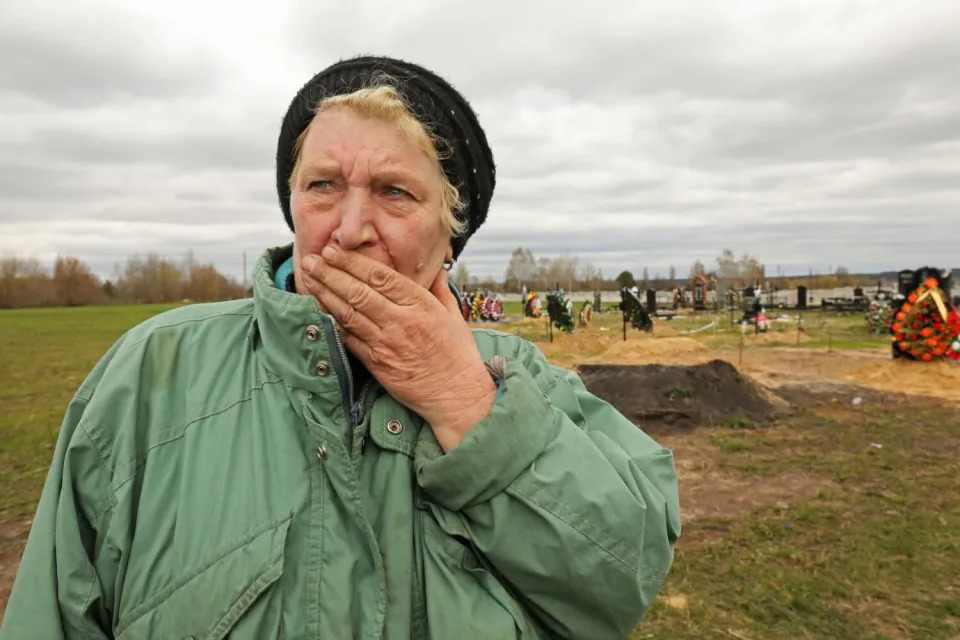
A woman covers her mouth with her hand standing in front of a mass gravesite
Nadya Savran, 66, found the body of her son Igor in the town of Andriivka, shot twice in the chest by the Russians. He is now buried beside his best friend in the town cemetery. (Carolyn Cole/Los Angeles Times)

Recounting the moment, she mimed a posture of sleep — slumber, as that of a child.

Now there are a dozen freshly dug graves in the town’s graveyard, newly cleared of mines. Igor and his boyhood friend Vladimir Pozharnikov, who went missing at the same time, are buried side by side.

Atop their graves are yellow flowers and pieces of candy. A butter cookie.

Savran and her son had talked about the Russian presence, but didn’t fully grasp how war so quickly encroaches. When he was out of the house, she didn’t hide in the basement; she stayed in the living room, with her cat for company.

She remembers something he said to her during those days, as if the very idea that someone would attack him for no reason was unfathomable.

“Why,” he asked, “should I have to die?”

No answer came. Perhaps one never would.

Cole reported from Bucha and King from Berlin.
Michigan state senator hits back at GOP colleague accusing her of ‘grooming’ kids

Yahoo! News

Michigan state senator hits back at GOP colleague accusing her of ‘grooming’ kids

Christopher Wilson, Senior Writer – April 20, 2022

Michigan state Sen. Mallory McMorrow pushed back in a viral speech against the growing trend of Republicans labeling their Democratic opponents as groomers and pedophiles.

McMorrow responded Tuesday morning to accusations made in a fundraising email by Republican state Sen. Lana Theis that her Democratic colleague wanted to “groom and sexualize kindergarteners.”

“I didn’t expect to wake up yesterday to the news that the senator from the 22nd District had, overnight, accused me by name of grooming and sexualizing children in an email fundraising for herself,” McMorrow said at the beginning of her remarks. “So I sat on it for a while wondering: Why me? And then I realized: Because I am the biggest threat to your hollow, hateful scheme. Because you can’t claim that you are targeting marginalized kids in the name of ‘parental rights’ if another parent is standing up to say no.”

Michigan state Sen. Mallory McMorrow.
Michigan state Sen. Mallory McMorrow. (Senate TV via Twitter)

Republicans have attempted to position themselves as the party of parental rights, with state legislatures across the country introducing a series of bills targeting the LGBTQ community, with those opposing the legislation being labeled as “groomers.” They’ve also targeted books that discuss race and gender while attempting to make it illegal for parents to seek gender-affirming care for transgender children. Prominent right-wing media figures have focused on anti-LGBTQ attacks in recent weeks.

“So then what?” continued McMorrow. “Then you dehumanize and marginalize me. You say that I’m one of them. You say she’s a groomer, she supports pedophilia, she wants children to believe that they were responsible for slavery and to feel bad about themselves because they’re white.”

McMorrow’s speech has been viewed over 9 million times in the less than 24 hours since she posted it to her Twitter account. During her comments, she talked about growing up being active in the church, working with her mother at a soup kitchen and the civil rights work of Father Ted Hesburgh, the former president of her alma mater, Notre Dame.

“I learned that service was far more important than performative nonsense like being seen in the same pew every Sunday or writing ‘Christian’ in your Twitter bio and using that as a shield to target and marginalize already marginalized people,” McMorrow said, emphasizing that she is a white, straight, Christian, suburban mom and that those promoting the attacks were using it to deflect from the fact that they weren’t working on the real issues.

“I know that hate will only win if people like me stand by and let it happen,” concluded McMorrow, who was first elected in 2018 and is on the ballot again this November. “So I want to be very clear right now: Call me whatever you want. I hope you brought in a few dollars. I hope it made you sleep good last night. I know who I am. I know what faith and service means and what it calls for in this moment. We will not let hate win.”

Theis’s rhetoric against McMorrow in the fundraising email sent out on Monday read, “These are the people we are up against. Progressive social media trolls like Senator Malloy McMorrow (D-Snowflake) who are outraged they can’t teach can’t groom and sexualize kindergarteners or that 8-year-olds are responsible for slavery.” She added that “enlightened elites” believe parents “must surrender to the wisdom of teacher unions, trans-activists, and the education bureaucracy.”

Theis targeted McMorrow and other Democrats in the Senate after they walked out of a session last Wednesday due to the content of Theis’s invocation, which the legislators took as a precursor to action against LGBTQ educators.

“Dear Lord, across the country we’re seeing in the news that our children are under attack. That there are forces that desire things for them other than what their parents would have them see and hear and know. Dear Lord, I pray for your guidance in this chamber to protect the most vulnerable among us,” said Theis, who is chair of the Senate Education and Career Readiness Committee.

Michigan state Sen. Lana Theis.
Michigan state Sen. Lana Theis in 2019. (David Eggert/AP)

“The ‘forces’ are, of course, public school teachers, and the ‘things’ are the LGBTQ community,” tweeted Democratic state Sen. Dayna Polehanki. “To pervert the Senate Invocation in this way is beyond the pale.”

“Without sharing or repeating closed-minded harmful words from a sitting Senator under the guise of a ‘prayer,’ to every child in Michigan — you are perfect and welcome and loved for being exactly who you are,” added McMorrow on Twitter.

A number of GOP senators used the confirmation hearings of new Supreme Court Justice Ketanji Brown Jackson to label her as soft on child pornography offenders, despite repeated analyses showing that Jackson’s rulings were within the mainstream of her fellow judges. When three Republican senators said they would vote to confirm Jackson, Rep. Marjorie Taylor Greene, R-Ga., called them “pro-pedophile.” The following day, she referred to Democrats as the “party of pedophiles.”

Greene’s comments and the general trend toward accusations of pedophilia echo the QAnon conspiracy theory, supported by Greene in the past, which alleges that former President Donald Trump was working to take down a powerful cabal of child traffickers typically portrayed as the Democratic elite. Believers in the debunked theory frequently allege that their political opponents support pedophiles. Those pushing the accusations have a large audience, as a recent survey from the Public Religion Research Institute found that 16% of Americans believed that “the government, media, and financial worlds in the U.S. are controlled by a group of Satan-worshipping pedophiles who run a global child sex-trafficking operation.”

Rep. Marjorie Taylor Greene of Georgia.
Rep. Marjorie Taylor Greene, R-Ga., addresses Trump supporters in Commerce, Ga., on March 26. (Megan Varner/Getty Images)

McMorrow’s direct response is a contrast to what the national Democratic strategy has been to the increase of Republicans claiming they are a party of “pedophiles” and “groomers.” Vice News spoke to a number of prominent House Democrats last week about Greene’s comments.

“I don’t even really pay attention to anything she says because she has nothing rational to say. It seems to me to be a ridiculous allegation,” said Rep. Hakeem Jeffries, D-N.Y., a member of House Democratic leadership. “We’re focused right now on getting things done for everyday Americans: lowering costs, addressing gas prices and inflation. They can continue to peddle lies and conspiracy theories.”

“I see polling that shows that that outrageous characterization is landing with some folks,” Rep. Eric Swalwell, D-Calif., told the outlet. “But you also don’t really want to give oxygen to the land of misfit toys, which is where this is coming [from].”

Czech companies set to work with Ukraine military on equipment repairs

Associated Press

Czech companies set to work with Ukraine military on equipment repairs

Defense Ministry in Prague says the Czech Republic was the first partner country officially approached by Ukraine with such a request

Associated Press – April 20, 2022

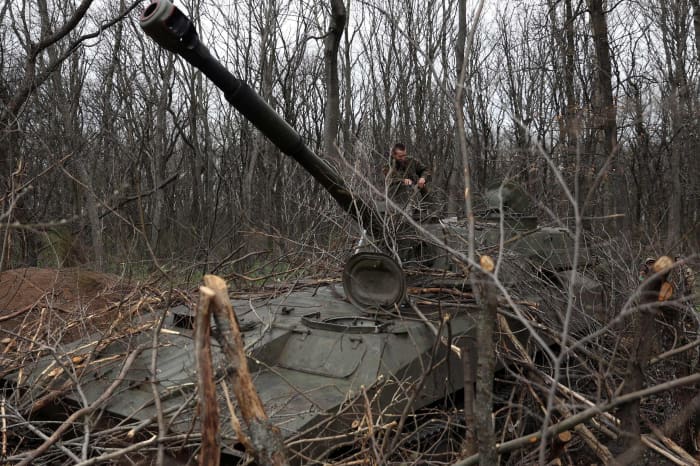
Ukrainian artillery men gesture last week beside a tank at the front line near Lysychansk in the Luhansk region. ANATOLII STEPANOV/AGENCE FRANCE-PRESSE/GETTY IMAGES

The Czech Defense Ministry says local companies will work to repair Ukrainian military equipment damaged in fighting the invading Russian military.

The ministry says the first contract will focus on fixing T-64 Soviet-era tanks. Various armored vehicles of BRD and BRDM types will follow.

The ministry says the Czech Republic was the first partner country officially approached by Ukraine with such a request.

Read on: Pentagon estimates Russia has lost 25% of the combat force it deployed to Ukraine

Thousands flee Russia over government crackdown on protests, news outlets

CBS News

Thousands flee Russia over government crackdown on protests, news outlets

Lilia Luciano – April 20, 2022

Thousands flee Russia over government crackdown on protests, news outlets

Thousands of Russians are fleeing their home country as the Kremlin cracks down on anyone protesting the war in Ukraine and news outlets reporting on it. The Russian government has enacted new laws threatening jail time for spreading “misinformation” about the military.

A mother and her two children managed to escape to San Francisco, citing the fear of being persecuted.

“I’m actually very angry that I had to go. But… what did it for me was another of Putin’s speeches when he mentioned atomic weapons, I was like ‘now I’m scared,'” the mother, Yulia, told CBS News.

Yulia, her sister Olga and her brother Yakov are all U.S. citizens. Their parents fled the Soviet Union in the 80s as political refugees. After college, though, Yulia returned to the country.

“Russia was very exciting,” Yulia said. “It was new and it just seemed very free. So then, cut to 20 years later, I’m a refugee again.”

“I’m trying to fight the feeling of being a failure,” she added. “I mean, my parent’s did so much to get us out, and here I am again.”

Yulia and her children are dual citizens, which made it easier for them to get out of Russia. But, she said she was forced to leave behind her 93-year-old grandmother.

Yakov visited Moscow from his home in Massachusetts and took over trying to get their grandmother out, but he said he soon realized what he was up against.

“We talked to almost every single embassy in Europe,” Yakov said.

Anaida Zadykyan, an immigration lawyer in Los Angeles, told CBS News that Russians are hitting a dead end when it comes to fleeing.

“All the sanctions that western countries took against Russia, there is basically no flights. It’s really hard to get out right now,” she said.

More Russians are heading to Mexico, where it is easier to get a tourist visa, before making their way to the U.S. border to seek asylum.

More than 7,000 Russians have entered the U.S. through the southern border this year — almost double the number from last year.

Zadykyan said of those feeing that, “most of the people that I see are the supporters of the opposition, bright individuals, educated. Some people are members of the LGBT community. It’s like younger crowds in their 20s.”

“It’s going to be really bad for Russia, not just in an economic sense, but like, in a cultural sense,” Yakov said.

Yakov later told CBS News over Zoom that an embassy was able to fast track an emergency visa appointment in Armenia because of his grandmother’s medical issues. After a month and a half, the family finally welcomed their matriarch to the U.S.

Allies send Ukraine ‘spare parts,’ adding 20 aircraft to fleet as Russia bombardment increases: DOD

Fox News

Allies send Ukraine ‘spare parts,’ adding 20 aircraft to fleet as Russia bombardment increases: DOD

Caitlin McFall – April 20, 2022

The U.S. and its NATO allies have refused to send Ukraine warplanes over concerns it would escalate the conflict, but a senior U.S. defense official confirmed Wednesday that “spare parts” have been sent instead.

Allies have been able to bolster Ukraine’s air capabilities by sending it supplies and parts needed to expand its operational fixed-wing aircraft fleet.

“They have more than 20 additional aircraft available to them than they did three weeks ago,” the senior U.S. official said.

Pentagon press secretary John Kirby echoed these claims and told reporters that “through U.S. coordination and provision” Ukrainians have been sent “enough spare parts and additional equipment such that they have been able to put in operation more fixed-wing aircraft in their fleet.”

It is unclear how many operational fixed-wing aircraft Ukraine has in total.

Ukrainian President Volodymyr Zelenskyy has pleaded with NATO allies to enforce a no-fly zone or send warplanes to help staunch the barrage of Russian missiles.

Defense officials estimate that Russia has levied upwards of 1,670 missiles at Ukrainian targets since the invasion commenced nearly eight weeks ago.

Top Pentagon officials previously argued the majority of Russia’s missiles were launched from surface-to-air platforms – but Russian forces appear to be changing tact as they focus their efforts in eastern Ukraine after failing to take Kyiv.

RUSSIA TESTS NEW SARMAT INTERCONTINENTAL BALLISTIC MISSILE IN WHAT PUTIN HAILS AS ‘TRULY UNIQUE WEAPON’

A Ukrainian multiple rocket launcher BM-21 "Grad" shells a Russian troop position near Luhansk in the Donbas region on Sunday. <span class="copyright">Photo by ANATOLII STEPANOV/AFP via Getty Images</span>
A Ukrainian multiple rocket launcher BM-21 “Grad” shells a Russian troop position near Luhansk in the Donbas region on Sunday. Photo by ANATOLII STEPANOV/AFP via Getty Images

“It appears as if one of the things they’ve tried to learn to do better is air-to-ground integration,” the senior U.S. defense official said. “We’re seeing some preliminary signs of that here in the early phases of this Donbas fight.”

Security officials have warned that Russia’s second campaign in eastern Ukraine has not actually started despite some offensive movements by Moscow’s forces in the region.

Instead, officials believe Russia is still carrying out “shaping operations” to bolster its campaign in the region after experiencing a series of failures during its initial invasion.

The senior defense official said Russia is not only moving in artillery units to deal with a different terrain in the east, but command and control units and rotary-wing aviation support to assist with logistics – both of which have proven to be “weakness” points in Russia’s force posture so far.

Russia has also refitted its troops with new supplies.

Defense officials believe roughly 82 battalion tactical groups have re-entered Ukraine, the majority of which are in the nation’s easternmost regions.

Smoke rises above Azovstal steelworks, in Mariupol, Ukraine, in this still image obtained from a recent drone video posted on social media. <span class="copyright">MARIUPOL CITY COUNCIL/via REUTERS THIS IMAGE HAS BEEN SUPPLIED BY A THIRD PARTY. MANDATORY CREDIT. NO RESALES. NO ARCHIVES.</span>
Smoke rises above Azovstal steelworks, in Mariupol, Ukraine, in this still image obtained from a recent drone video posted on social media. MARIUPOL CITY COUNCIL/via REUTERS THIS IMAGE HAS BEEN SUPPLIED BY A THIRD PARTY. MANDATORY CREDIT. NO RESALES. NO ARCHIVES.

Bomber strikes appear to have become more frequent, particularly in cities like Mariupol, where Russian ground forces have been stalled for weeks in their attempts to completely besiege the city.

“In general, we continue to see a sense of weariness out of Russian pilots,” the official said noting they often fire without crossing any borders and do not stay in Ukrainian airspace for long. “But they are using, again as a part of these shaping operations, they are using airstrikes from fixed-wing bombers in support of what they are trying to get done on the ground.”

Putin Must be Stopped, Now!

John Hanno, tarbabys.com – April 8, 2022

Again and Again, Ukraine’s soldiers for Democracy and independence have defeated and also exposed Putin’s vaunted military machine as an undisciplined collection of disillusioned conscripts, terrorists, murderers, rapists, looters and soulless examples of a pseudo militaristic, malevolent failed state.

Their failures in the north and west going mano a mano against Ukraine’s courageous and resourceful seasoned soldiers and army volunteers defending the capital of Kiev, forced them to retreat to Belarus to reconstitute battered and depleted units, hoping to move them East to the Donbas region, in a desperate attempt to placate Putin’s bruised ego and preserve his precarious decades long reign of terror.

The civilized connected world sees the daily carnage and misery wrought on Ukraine’s civilian population, the destruction of once beautiful cities and the futility of Putin’s marauding, barbaric army.

But because of Putin’s all powerful state run media and clamp down on independent news, Russia’s military blunders and failures, troop desertions and true body counts never reach the Russian nightly news. Consequently, Putin’s approval ratings have improved by almost 20 points, to 83% since he ordered his Generals to slash and burn everyone and everything in the path of Putin’s march to historic infamy or within range of Russia’s guided rockets and missiles.

Can we really believe these polls? If you lived in Moscow or St. Petersburg, what would you say if someone asked if you supported Czar Vlad and his holy war? Of course I do, yes indeed? No speekie Russian? Fines and prison terms in a Siberian gulag are to be avoided at all costs.

I’m guessing the Russian’s who are successfully inculcated by the Kremlin state run department of propaganda or chose not to be informed by anything or anyone, even their own connected family and friends, is similar to the hordes of American’s stupefied by our own far right media, trump reality channel, or the Fox News Alternative truth apparatus. Hell, the same percentage of republi-cons believe trump won the 2020 election.

Editorial cartoon

It’s clear that Putin and a large segment of his army have no boundaries and obey no international laws or norms. The threat of appearing before a war crimes tribunal won’t sway them from engaging in the worst conduct imaginable. Ethnic cleansing, purification, pacification, de-nazification and other Kremlin niceties, are their excuses and justifications for Genocide.

President Zelensky and the world have witnessed the human carnage recently uncovered when the Russians vacated the suburbs of Kiev and are dreading what they will find in Mariuapol and other cities under siege.

The Russian missile fired at the Kramatorsk train station carried a cluster bomb that killed 57 people, including 5 children and injured more than 100. What kind of monsters target desperate women and children, and terrified old and disabled people waiting for the train that will take them away from a war zone?

Our National Security Council, some in the Biden Administration and in NATO are worried that if you beat Putin too badly, he might do something irrational like using chemical or nuclear weapons. Do you think for one minute that Putin is worried about beating the people of Ukraine, or the EU or NATO or the U.S. too badly. He’s proved in Afghanistan, in Chechnya, in Georgia, in Syria and now in Ukraine again that his barbarism is boundless. Monster is too tame a word for Vlad the Not Great and the Butcher of Syria General he just tasked with pulverizing Ukraine into submission, and preferably before Putin’s May 9th Festivus.

Col Gen Alexander Dvornikov, Commander of Russia's Southern Military District, attends a Victory Day military parade held in Teatralnaya Square.

Gen. Alexander Dvornikov, known as the “Butcher of Syria,” has been tapped to lead Russia’s invasion of Ukraine. Erik Romanenko/TASS via ZUMA Press

The U.S. must step up to the existential threat to world peace and prosperity. Just like trump and his criminal enterprises, including most of the republi-cons in congress, Putin plays by no set of rules. The U.S. and NATO must bend their own rules a bit if they’re going to stop the Neo Soviet Empire from turning the entire Baltic region into Putin’s Autocratic Kleptocracy.

The first thing is to stop broadcasting military plans and intentions. Speculating about how to bring those MiG-29 fighter jets from Slovakia to Ukraine should never have been discussed in public.

The best defense is to use the element of surprise and an unpredictable offense to defeat this diabolical opponent. If that means supplying offensive weapons the Russians wouldn’t or couldn’t anticipate, or scraping together an imposing “unofficial” fleet of fighter jets and bombers, with the Ukrainian flag blazoned on their tail fins, capable of enforcing a no fly zone, then that’s what the world must do.

And delivering ASAP, anti ship guided missiles to Southern Ukraine would help defend Ukraine’s sea ports of Odessa and Mariupol from Russia’s Black Sea Fleet and stop Putin’s plans of attempting to land lock and hinder Ukraine’s ability to import and export food, military armaments and manufactured goods.

Already, predictions abound about how many 10’s of millions will suffer starvation when Russia and Ukraine’s food production is curtailed. 400 million people depend on them for their food. Together, Russia and Ukraine produce 12% of the worlds food calories.

There is no second chance or plan B that could work this time. For every missile or rocket launched by Russia into Eastern and Southern Ukraine, 3 or 4 must be returned. For each and every tank, rocket launcher and personnel carrier redirected into Eastern Ukraine for this new assault, the U.S., NATO and others must supply a half dozen Javilin anti-tank missiles. The only thing Putin will understand is an overwhelming force. This is not the time to pussyfoot.

Defeating Putin — now — is an economic imperative

Yahoo! Finance

Defeating Putin — now — is an economic imperative

Rick Newman, Senior Columnist – April 20, 2022

He might secretly be the world’s richest person, but Russian President Vladimir Putin is also the world’s greatest value destroyer.

The International Monetary Fund estimates that Putin’s barbaric invasion of Ukraine will lower world economic growth by eight-tenths of a percentage point this year and two-tenths next year. That might not sound like a lot, but given the size of the world economy, it amounts to about $935 billion in lost output, roughly equivalent to zeroing out the entire economy of Turkey or the Netherlands. The toll could easily top $1 trillion if the war drags on or escalates.

This is the destruction caused by one man demanding the ruination of a large, peaceful and productive country. It’s not an unstoppable virus, a complex financial contagion or an unforeseen natural disaster. The cost of Putin’s fanaticism is obviously acute in Ukraine, which is suffering thousands of deaths and hundreds of billions of dollars of damage to civilian infrastructure. But Putin’s war is raising the cost of fuel, grain and other vital products literally everywhere. It will cost lives and lower living standards in dozens of nations nowhere near the battlefields.

Financial markets have adjusted to Putin’s mayhem, which is both good and bad. It’s good because a resilient global economy lumbers forward. Sanctions on Russia have forced workarounds in the markets for oil, natural gas, and other Russian minerals and products that are now in limited supply or wholly unavailable. Five million Ukrainian refugees in Europe and elsewhere — many displaced by Putin deliberately — are straining relief systems. The risk of a broader war between Putin and the NATO alliance is real and terrifying. Yet markets are patching themselves up and a Putin recession seems unlikely.

It’s bad because functional markets may relegate Russia’s violent crusade to background noise and blunt the urgency for all nations that seek prosperity to defeat Putin, now. The United States and many nations in Europe and elsewhere have hit Russia with tough sanctions that will hinder its military power, over time. But those sanctions could go further, and they haven’t mainly because some European leaders feel they can’t shut off Russian energy imports without damaging their own economies too much. Some Western nations also fear that giving Ukraine advanced weaponry, such as tanks and fighter jets, might lead Putin to strike back directly at the donor countries.

Russian President Vladimir Putin visits the construction site of the Amur launch complex for Angara rockets at the Vostochny Cosmodrome in Amur Region, Russia April 12, 2022. Sputnik/Mikhail Klimentyev/Kremlin via REUTERS ATTENTION EDITORS - THIS IMAGE WAS PROVIDED BY A THIRD PARTY.
Russian President Vladimir Putin visits the construction site of the Amur launch complex for Angara rockets at the Vostochny Cosmodrome in Amur Region, Russia April 12, 2022. Sputnik/Mikhail Klimentyev/Kremlin via REUTERS

Yet the West is now at a point where it can bear the risk and cost of confronting Putin, or face him down later at multiples of the present cost.

The time is ripe to beat Putin

There may never be a better opportunity to defang Putin. Russian forces spectacularly failed to capture Ukraine’s capital, Kyiv, and impose a puppet government. They retreated from central Ukraine in disarray, exposing vast holes in a military looted from top to bottom, like the entire Russian economy. Old, neglected equipment broke down routinely. Undisciplined troops employed lazy tactics. Broken supply lines left units short of food and fuel. Intercepted phone calls revealed panicked Russian conscripts desperate to escape and, in some cases, refusing to fight. In southern Ukraine, coastal defense troops sank the Russian navy’s Black Sea flagship, the Moskva, destroying a $750 million fighting platform with two missiles costing perhaps a couple million dollars. Putin’s military may be more vulnerable than at any time during his two-decade rule.

Despite that, Russian forces now seem to be launching a new campaign to carve off as much of eastern and southern Ukraine as they can get. At some point, Putin may seek a “peace” settlement that leaves Russia in control of whatever territory it can take and keep.

There can be no peace with Putin. The Ukraine invasion is at least Putin’s fourth attempt in 15 years to take neighboring territory with force and kluge together some remnants of the old USSR. Putin’s territorial gains to date would seal off Ukraine’s access to ports on the Sea of Azov, and he probably aims to capture Ukraine’s Black Sea coastline as well, leaving it no seaports to the outside world. If Putin could accomplish that, he would have military force on the border of tiny Moldova, where he also has territorial ambitions. Moldova isn’t a NATO member, but it borders Romania, which is.

Russian missile strikes deep into western Ukraine, just miles from the border with NATO-member Poland, show Putin is willing to cut it close and risk an errant attack on a NATO member, which would oblige the alliance to respond. Nobody should assume Putin would stop in Ukraine, if the war ends with Russian territorial gains. He’d continue to claw for turf and military advantage. China’s communist rulers, meanwhile, are watching closely, to see if democratic powers have the mettle and attention span to stop the sort of aggression they may someday attempt in Taiwan or other parts of Asia.

Ukraine's President Volodymyr Zelenskiy speaks during a joint news conference with European Council President Charles Michel after their meeting, as Russia's attack on Ukraine continues, in Kyiv, Ukraine April 20, 2022. REUTERS/Valentyn Ogirenko
Ukraine’s President Volodymyr Zelenskiy speaks during a joint news conference with European Council President Charles Michel after their meeting, as Russia’s attack on Ukraine continues, in Kyiv, Ukraine April 20, 2022. REUTERS/Valentyn Ogirenko

The Western goal at this point should be a complete Ukrainian victory, with all Russian forces out of the country. Leave Putin in power in Russia; regime change is a reckless goal. NATO shouldn’t send troops, but Western nations should supply everything short of that and maximize the economic pressure on Russia, to end Putin’s medieval adventurism once and for all.

On April 19, a Stanford University working group published a list of several dozen specific recommendations for cutting off the cash Putin uses to fund his military. The ultimate goal should be a complete ban on Russian oil, coal and natural gas products, Russia’s main source of capital. Since that would be difficult for some nations to do quickly, interim measures could include tariffs on Russian energy products that would force Russia to cut the underlying price to remain competitive, reducing the proceeds going back to Russia. Importing nations could also require energy payments be held in escrow accounts until the Ukraine war ends. The Stanford group also calls for designating Russia as a state sponsor of terrorism, which would trigger other types of sanctions.

As for military aid, Eliot Cohen of the Johns Hopkins School of Advanced International Studies argues that the United States should boost the value of materiel support for Ukraine from several billion dollars to tens of billions, and include heavy weapons that could be decisive on the battlefield, such as tanks and artillery. The Biden administration is moving in that direction, but Cohen, writing in the Atlantic, says the pivot is too slow, given that “decisive action is urgently required to tip the balance between a costly success and a calamity.”

The fastest way to help Ukrainian forces is with more Soviet-style equipment they already know how to use. Most of this would have to come from eastern and central European nations such as Poland, Lithuania and the Czech Republic, which are already sending some such weapons. The U.S. role is to facilitate delivery and help these nations backfill donated equipment with newer systems, covertly if necessary. Western defense contractors surely won’t object.

Every path involves risk. If Europe and the United States put everything they have into ejecting Russian forces from Ukraine, Putin could lash out with chemical or biological attacks or even a nuclear strike of some kind. But if he succeeds even partially in Ukraine, he could do the same thing later, when he’s closer to NATO borders. Tighter limits on Russian energy imports would be tough on European nations such as Germany and Italy that can’t readily replace the energy. But better to do it on their own terms now, than to let Putin dictate the terms later. Nobody wants to bear the cost of Putin’s war, but there will always be another Putin war and the cost will only go up.

A Foreign Fighter on What It Was Like on Ukraine’s Front Line

Time

A Foreign Fighter on What It Was Like on Ukraine’s Front Line

Lisa Abend – April 20, 2022

24 years old Povilas Adomas Limontas, a bartender from Kaunas, has signed up to join the Foreign Legion of Territorial defense of Ukraine. Vilnius, Lithuania.

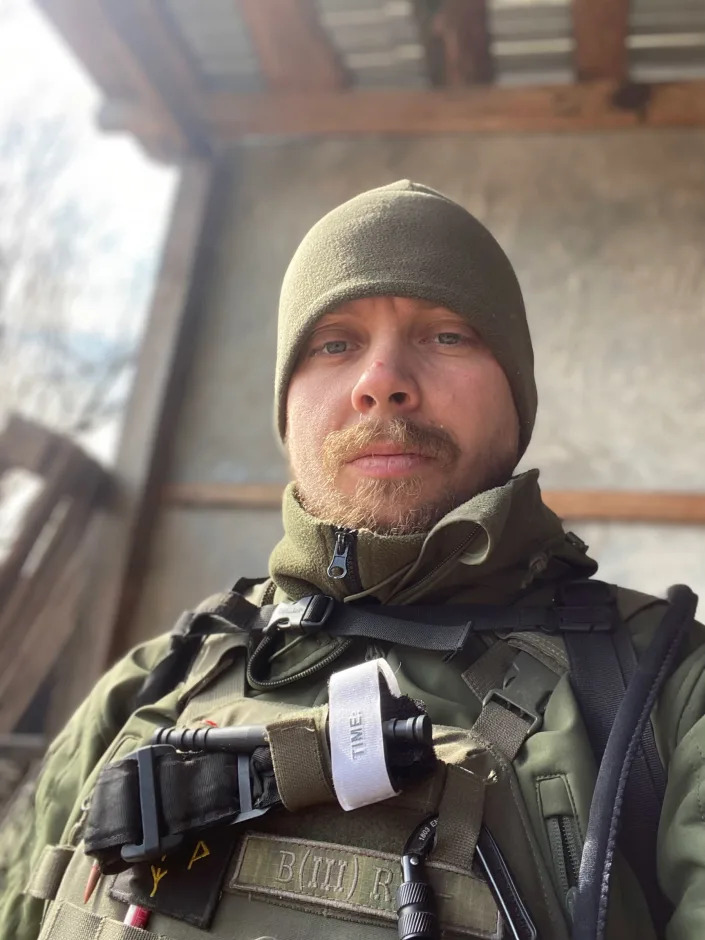
Povilas Adomas Limontas, a 24-year-old bartender from Kaunas, Lithuania, on March. 3. He signed up to join the International Legion of Defense of Ukraine. Credit – Tadas Kazakevicius for TIME

TIME first met Povilas Limontas outside the Ukrainian embassy in Vilnius, Lithuania a week after Russia invaded Ukraine. The bartender, then 24, had left his home in Kaunas, and taken the train that morning so that he could register as a volunteer fighter. An orphan who had spent two years in the Lithuanian army military experience and a strong sense of moral duty, he had felt that “it would be selfish” not to go.

Even with registration papers in hand, it took him a while to figure out how exactly to get Ukraine; in the end, he traveled with a fellow Lithuanian who was running humanitarian aid to the country, and returning with refugees. He tried and failed twice to cross the border. One attempt turned out to be a blessing in disguise: had he not been turned away, Limontas would have been at the international training center outside Lviv when Russia bombed it on March 13, killing 35. After he was finally admitted to the country in mid-March, he eventually made his way to Kyiv along with some fellow volunteers from the Czech Republic and Sweden. There, as a unit, they were assigned to support the Territorial Defense Forces. Over the coming month, they would see about two weeks of combat, and witnessed the atrocities in Bucha after it was liberated.

His assignment over, Limontas arrived back at his home in Kaunas, Lithuania on April 7. He is debating whether to return to Ukraine. Limontas spoke to TIME’s Lisa Abend on April 17.

Povilas Limontas in the Kyiv region on March 28.<span class="copyright">Courtesy Povilas Limontas</span>
Povilas Limontas in the Kyiv region on March 28.Courtesy Povilas Limontas

We spent about four days at the central military base where we were given our weapons–an AK47. There was training for people who were green, but we weren’t, so we told them to give us some targets and 10 or 20 shots to warm up with so we could get familiar with the gun. And that was it; we were good to go. One thing that I liked was that no one asked, “Why are you here?” Everyone understood that I was there to fight against evil.

We saw our first action about two weeks after arriving in Ukraine. We were bodyguards for someone important who was visiting the front and the two of us with the most experience went to the front in Irpin [a city northwest of Kyiv]. That was intense. In Kyiv there had been alarms whenever the rockets were coming. There were long periods with no sirens, and when they came, you still had time to go to a shelter, hide, smoke a cigarette. But in Irpin, there was no silence, there was no 20 seconds in between the siren and the explosion. It was just bombs coming all the time from right and left—and dangerously close, about 400 meters from where we were.

Read More: Meet the Foreign Volunteers Risking Their Lives to Defend Ukraine—and Europe

I went on a couple more of those bodyguard missions. During the third one, we had our first firefight. This was in Irpin, in the forest, and the enemy was about 200 meters away; they were trying to ambush the Ukrainians. We came in as reinforcements, and fired a bit, but after a little while, we had to run, because one thing I had learned in Lithuania is that if you’re in a firefight with Russians, you only have 10 minutes before they send in artillery. The fight lasted five or 10 minutes, but in my head it felt like five seconds.

Later, we spent nine days on a second frontline, defending a village near the river outside Kyiv. We were told that the village needed support, and that we were there to relieve some of the units already in place. As soon as we got there—in the first 10 seconds after we exited our vehicles—we were shelled. We fell down on our faces. The explosions were 200 meters, 100 meters away from us, and they just kept coming. It was right when we arrived, so there’s a good possibility we were targeted.

My best buddy was a Czech guy, and at first the two of us joked that it would be nice if we were still alive on the third day, because we were getting shelled so much that first night. Then, after a while, we were just hoping for one more day. We basically didn’t sleep the first night because every two hours we had to guide other guys to the positions in the trenches, and every time we got 50 meters from our shelter there’d be a whistle, we’d get down, and boom. I think I almost died four or five times just the first night. I got a little bit of shrapnel in the back of my helmet. It’s a small piece but that’s all it takes.

My closest brush with death came on the fourth or fifth day. We did shifts, filling in the gaps for territorial defense fighters. At about 8 a.m., I had finished my shift and was walking back to the shelter alone, which wasn’t very bright of me. I heard a whistle, but it wasn’t the normal kind of whistle, where it’s likely that you’ll live. This was a whistle that was very close, like a kettle boiling on maximum heat. My legs just collapsed, and I hit the ground and covered my neck. It exploded maybe 10 meters away; there was a house there and it was completely destroyed. Only one brick wall was left, and that is what saved me. If the artillery had hit on the left side instead of the right, I’d be gone.

Destruction and devastation in a village on the outskirts of Irpin on April 1.<span class="copyright">Courtesy Povilas Limontas</span>
Destruction and devastation in a village on the outskirts of Irpin on April 1.Courtesy Povilas Limontas

Before I left Lithuania, I had said that if a rocket was wasted on me instead of children, I would take that deal. Well, it wasn’t one or two rockets. Hundreds were wasted on me in those 9 days. And I lived, so it turned out to be a good deal.

On the seventh day, the Ukrainians told us they were retaking the city of Stoyanka, close to Bucha, and they needed our support. They gave me a grenade launcher because I had been trained during my time in the Lithuanian army to use it. I don’t actually know how they managed to get one, but it was like getting a Christmas present.

When we were headed to Stoyanka, we knew there was a good chance we wouldn’t make it back home. So before we left, my Czech friend gave me a piece of paper with a phone number and said, “This is the phone number of my girlfriend. If I fall, you’ll have to call her.” I went numb for a second because I thought those kinds of moments only existed in movies. I responded by telling him that if I fell, he had to send the latest video of me to my friends. Then we just nodded to each other and went to work.

Read More: Ukrainians Are Speaking Up About Rape as a War Crime to Ensure the World Holds Russia Accountable

We expected huge resistance there, but it was nothing. So we helped clear the streets, working with the special police who were clearing houses and basements. The operation took maybe 10 hours, but at the end, the Ukrainians had taken the city. And then a few days later they posted that they had re-taken all of the Kyiv region.

The Ukrainians have so much spirit. Just looking at them gives you strength. They are not afraid, they share everything, they joke around, but also they are very sharp and willing to fight anywhere anytime. It’s impossible to win against a country like that.

When I think about the Ukrainian volunteers who joined the fight after the invasion started, the two words that come to mind are “stupid brave.” Ukrainians are stupid brave. Give them a gun and they will go fight. That can be good and bad, but it’s better to be motivated to fight without skill, than to have skill and be afraid to fight.

As for me, I wasn’t afraid. I didn’t feel anything while I was there. I didn’t let myself be guided by emotions. At one point we went to Bucha as protection for some journalists who were following Ukrainian soldiers as they collected the bodies. Literally everything that hadn’t been nailed down was stolen—they stole the ATMs, and cash registers from supermarkets. There was shattered glass everywhere, shrapnel from the artillery, animals shot. We went into a kindergarten complex that the Russians had used as a command post, and we went into the basement where they shot and executed people. The walls were red with blood. My boots stuck to the floor because the blood hadn’t dried yet.

Read More: A Visit to the Crime Scene Russian Troops Left Behind at a Summer Camp in Bucha

I didn’t have any emotion. I left all my feelings at home basically. But now that I’m back home, I feel like they’re catching up with me, these new feelings that I don’t know how to deal with. I’ve had a hard time understanding what happened. Because it doesn’t matter how strong you are. Your mind is not used to seeing violence like that.

Now that I’m back in Lithuania my mission is to go on every radio, talk show, newspaper possible. People get used to things like this and I need to remind them that the war is not over, and people still need support—in food, ammunition, and medicine. Five euros is still a donation and 5 euros can feed people like me for 5 days.

I don’t think my time in Ukraine changed my perspective on the world or on life. But I know that I didn’t come back the same as I left. What stands out in my mind is after we retook Stoyanka, when we went back to the village. I had been carrying 40 kilos of gear, and it was really hot and we had drunk all of our water. We hadn’t slept in 30 hours. We got back to the village, and slept and the next day, when we woke up, the frontline had moved very far away. The artillery couldn’t reach us. We were standing outside, smoking cigarettes, and there were no whistles, they were just gone. It was the first time in seven or eight days that it was safe to stand outside. It felt like we had made a difference and that my trip wasn’t for nothing. That was a very, very nice feeling.

Povilas Limontas sitting on a tank in Bucha on April 4.<span class="copyright">Courtesy Povilas Limontas</span>
Povilas Limontas sitting on a tank in Bucha on April 4.Courtesy Povilas Limontas

We did our mission, and we defended the village. But I don’t consider it a victory. There had been 200 or 250 houses in that town, and there was nothing left. Maybe if you replaced the windows and the roof, you could live in a few of them. All the others were destroyed; I mean, there were only two bricks left. So we won, but at a huge price.

About 20 hours after the frontline had moved, the elderly people who lived in the village came back. There was this one old woman who was standing in front of her house, which looked like it had been cut down the middle—one whole side was completely blown off. She just let out this huge sigh. And then she went to her garden and started digging. I guess everyone has their own coping mechanism.

As told to Lisa Abend

EU’s Michel tells Ukrainians during Kyiv visit: ‘History will not forget’

Reuters

EU’s Michel tells Ukrainians during Kyiv visit: ‘History will not forget’

Sergiy Karazy – April 20, 2022

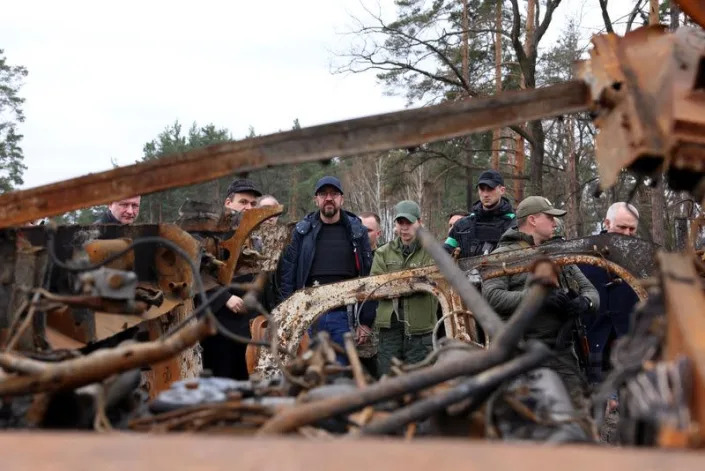
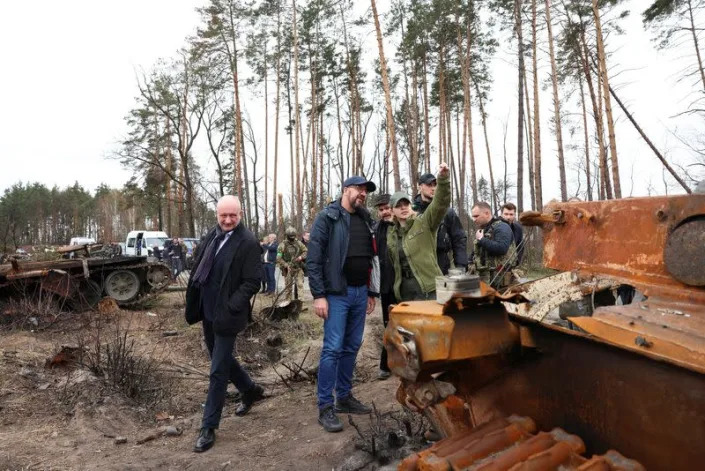
European Council President Michel visits Borodianka

KYIV (Reuters) -European Council President Charles Michel pledged European solidarity with Ukraine during a surprise visit to Kyiv on Wednesday and said justice must be done for alleged Russian war crimes.

Michel, the head of the European Council, which represents the European Union’s 27 member states, visited the town of Borodianka northwest of Kyiv before holding talks with President Volodymyr Zelenskiy in the capital.

Ukraine suspects that Russian troops carried out atrocities in Borodianka and Bucha, another town near the capital. Moscow denies targeting civilians and has described the allegations as fabricated by Kyiv to justify more sanctions against it.

“There are no words … to explain what I feel. These are atrocities, these are war crimes. It must be punished. It will be punished,” Michel told a joint news conference with Zelenskiy in Kyiv.

He said separately on Twitter: “History will not forget the war crimes that have been committed here. … There can be no peace without justice.”

Michel’s trip followed visits this month to Kyiv by European Commission President Ursula von der Leyen, European Union foreign policy chief Josep Borrell and European Parliament President Roberta Metsola.

“You are not alone,” Michel said, praising the courage of the Ukrainian people. “We are with you and will do everything which is possible to support you and to make sure that Ukraine will win the war.”

ZELENSKIY SEEKS OIL AND GAS EMBARGO

Michel said the EU had already provided Ukraine with 1.5 billion euros ($1.63 billion) of military equipment as well as imposing sanctions on Russia, but would look for more ways to respond to Russia’s Feb. 24 invasion.

“I am convinced … that sooner or later we will target oil and gas,” he said, without giving details.

EU states have been divided over whether to impose an embargo on Russian oil or gas, with Germany among countries that are heavily dependent on energy imports from Russia.

Zelenskiy welcomed the “political signal” Michel had sent by visiting Borodianka, but urged Brussels to strengthen sanctions pressure on Russia and called for a “complete energy embargo including imports of oil and gas.”

He welcomed a sixth package of sanctions being prepared by the EU, but added: “Oil should be part of the sixth package. Without it this package will be empty, will not be powerful enough.”

Zelenskiy said he and Michel had also discussed answers that Ukraine has provided to a questionnaire on compliance with EU criteria which is considered a starting point for Ukraine in its drive for EU membership.

($1 = 0.9223 euros)

(Reporting by Kyiv newsroom; Additional reporting by John Chalmers in Brussels; Writing by Timothy Heritage; Editing by Leslie Adler)

Experts predict lasting environmental damage from Russia’s invasion of Ukraine

Good Morning America

Experts predict lasting environmental damage from Russia’s invasion of Ukraine

Julia Jacobo – April 20, 2022

As Russia’s invasion of Ukraine continues, environmental experts and activists are warning of a ripple effect of problems, including long-lasting damage to the war-ravaged country’s urban, agricultural and industrial areas.

Nearly two months into its invasion, Russia has begun its long-feared offensive in eastern Ukraine along the 300-mile front near Donbas, a region with a 200-year history of coal mining and heavy industry.

The past seven weeks have been mired by death, displacement and the demolition of a country’s landscape that will take years to repair, experts told ABC News. In addition to the direct impact on Ukrainians, consequences of the war will be felt socially, economically and environmentally.

“Russia’s invasion of Ukraine raises a host of unique and potentially profound environmental concerns for not only the people of Ukraine, but the wider region, including much of Europe,” Carroll Muffett, president and CEO of the Center for International Environmental Law, told ABC News. “Those human impacts of the war take on a lot of forms and a lot of dimensions, and many of them last long after long after the hostilities have ceased.”

While there were catastrophic environmental consequences during World War I and II, conflicts during recent history provide a more detailed blueprint for the sheer amount of greenhouse gases emitted during modern wars.

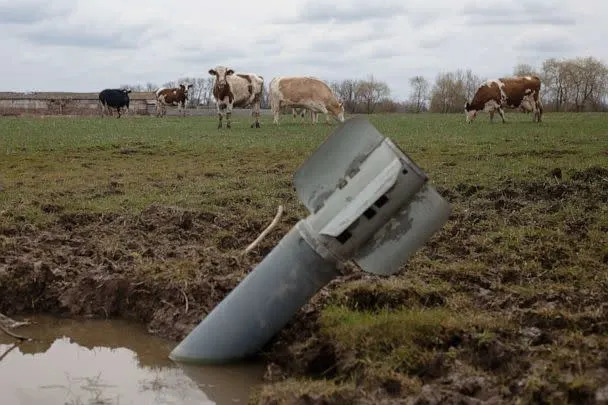
PHOTO: A rocket sits in a field near grazing cows on April 10, 2022 in Lukashivka village, Ukraine. (Anastasia Vlasova/Getty Images)

As a result of the global War on Terror that began in 2001, 1.2 million metric tons of greenhouse gases were released, the equivalent to the annual emissions of 257 million passenger cars — more than twice the current number of cars on the road in the U.S., according to a 2019 report released by Brown University’s Watson Institute of International and Public Affairs.

In addition to the hundreds of thousands of tons of carbon monoxide, carbon dioxide, nitrogen oxides, hydrocarbons and sulfur dioxide emitted from military vehicles, and other heavy machinery, heavy deforestation occurred in Afghanistan as a result of illegal logging, especially by warlords, which then destroyed wildlife habitat, according to the report.

“We now understand the environmental dimensions of war in ways that we didn’t decades ago,” Muffett said. “This is a particularly egregious situation, because the entire world is calling for Russia to end its its invasion right now.”

Once the conflict is over, the environment in Ukraine is going to be the local government’s “No. 1 priority,” Doug Weir, research and policy director of The Conflict and Environment Observatory, told ABC News.

MORE: Russia begins long-feared offensive in Ukraine’s east

These are the areas of most environmental concern, according to experts:

Industrial regions

Ukraine is a heavily industrialized country, especially in its eastern regions. It contains a large number of mines and refineries of chemical plants that produce substances such as ammonia and urea, Muffett said.

Assessing the damage from attacks on industrial sites and new nuclear facilities will be among the Ukrainian government’s priorities, Weir said.

In addition, there are “serious concerns” about the forced closure of several coal mines, which are now flooding with acid mine drainage without the proper methods to pump out the water, Weir said. Those toxins are then seeping into the groundwater aquifers

“We’ve already seen hints at how those could play out,” she said, adding that multiple refineries in Ukraine have already been hit. “One of the things that the lessons of the the invasion of Kuwait and the Iraq war is teach us is that strikes against facilities of these kinds pose profound risks for massive releases and really long-term damage.”

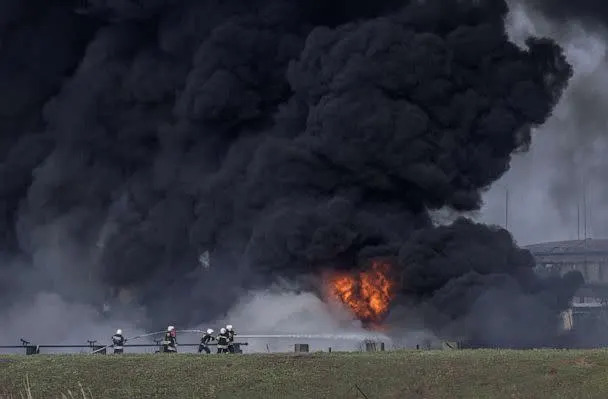
PHOTO: Firefighters work to put out a blaze at the Lysychansk Oil Refinery after if was hit by a missile, April 16, 2022, in Lysychansk, Luhansk region, Ukraine. (Marko Djurica/Reuters)
Agricultural fields

Researchers are estimating that millions of people could suffer from malnutrition in the years following the invasion as a result of lack of arable land.

Initial assessments show large swaths of agriculture areas affected by heavy shelling an unexploded ordinances, Weir said.

Olha Boiko, a Ukrainian climate activist and coordinator for the Climate Action Network for Eastern Europe and East Asia, said she and her fellow activists still in Ukraine are worried about the state of the agricultural fields and their suitability to grow wheat after the war, which is one of the country’s largest exports, she said.

PHOTO: Goats eat grass next to unexploded shell of multiple rocket launch system, in the village of Teterivka, in Kyiv region, Ukraine, April 14, 2022. (Vladyslav Musiienko/Reuters)
Wildlife and natural ecosystems

The plethora of military vehicles trampling over the Ukrainian border are creating an unforgiving landscape, experts said.

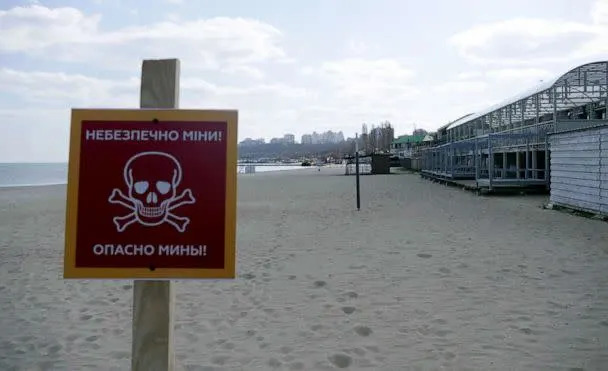
In an effort to defend their country, Ukrainian military laid landmines over at least one beach near Odesa, according to the Conflict and Environment Observatory.

Boiko also alleged that Russian forces have blown up oil exporting equipment, polluted the Black Sea and filled fields with landmines, which were found as Russian forces retreated the regions surrounding Kyiv.

MORE: Images show destruction left in Ukraine town of Borodyanka after Russian occupation

Fighting close to Kherson, near the southern coast of Ukraine, resulted in fires in the Black Sea Biosphere Reserve that were so large they were detectable from space and likely destroyed trees and unique habitats for birds, according to the observatory.

“There have been risks to wildlife and biodiversity we’ve seen that play out in Ukraine, with active battles in in insignificant wetlands,” Muffett said.

PHOTO: A sign warns beach-goers of potential land mines, in Odessa, Ukraine, April 4, 2022. (Igor Tkachenko/Reuters)
Urban areas

One of Russia’s military strategies has been to besieging cities by firing weapons indiscriminately into them, Weir said.

When Russian troops retreated the areas on the outskirts Kyiv after failing to take the capital, the devastation left in cities such as Bucha, Borodyanka and Irpin was immediately apparent.

Buildings were burned or completely destroyed. Burned-out cars littered the roadways. Entire neighborhoods were reduced to rubble.

The rebuilding phase is going to be a “huge task,” Weir said.

“From an environmental point of view, there’s going to be a huge amount of work needed to properly assess these sites, locate potentially hazardous sites,” Weir said, adding that environmental remediation process for the potentially hazardous sites can be complex and expensive.

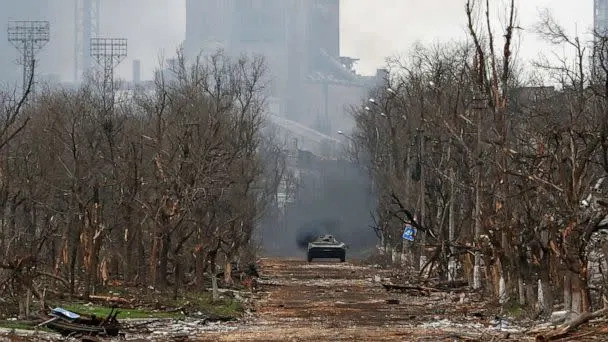
PHOTO: An armored vehicle of pro-Russian troops drives along a street during fighting near an iron and steel plant in the southern port city of Mariupol, Ukraine, April 12, 2022. (Alexander Ermochenko/Reuters)
Nuclear facilities

Soon after the conflict began, Russian troops took hold of the exclusion zone surrounding the Chernobyl power plant, raising concerns that an errant explosive could create another radioactive event at the site of the world’s worst nuclear accident in 1986.

The destroyed reactor was sealed in 2019 under a $2 billion stadium-sized metal structure, but the other three untouched reactors remain fully exposed. Within them sits a pool of 5 million pounds of spent nuclear fuel, as well as dangerous isotopes, such as uranium and plutonium. If hit, the storage facility has the potential to cause an even larger disaster than in 1986 and could prompt widespread evacuations all over Europe, Muffett said.

MORE: Protecting natural resources could lead to less armed conflict: Report

“The conduct of active military operations in a country with four nuclear facilities and 15 active nuclear reactors poses extraordinary risks,” Muffett said, admonishing Russia for immediately targeting Chernobyl despite “no legitimate military objectives associated with that site.”

Russian troops have cut off power to Chernobyl in ways the site was not “sustained for,” and untrained Russian servicemen disturbed radioactive soil and raised dust as they moved through the area, Muffett said.

“We’ve seen missile strikes actually put a nuclear facility on fire,” she said. “And, in the immediate hours after the fire began, firefighters were unable to reach the blaze, because they were in a live fire situation. These are these are really extraordinary risks.”

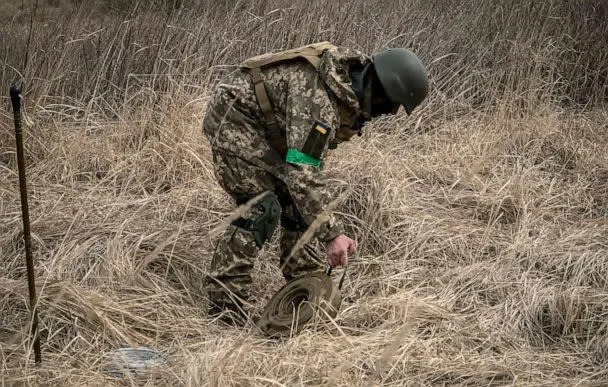
PHOTO: A member of a bomb disposal squad works in a mine field near Brovary, northeast of Kyiv, Ukraine, April 14, 2022. (Fadel Senna/AFP via Getty Images)
The role Russian oil plays in the conflict

The conflict in Ukraine is the latest demonstration of the “deep linkages between fossil fuels and conflict,” Muffett said. Boiko, who left Kyiv on Feb. 24, said the connection that fossil fuels play in the current war are “obvious,” because Russia is using the funds from its oil industry to fund the conflict.

“We’ve seen Putin’s regime look to weaponize its own natural gas and oil resources as a way to intimidate countries in Europe and beyond from coming to Ukraine to aid,” Muffett said. “And so, this is a fossil fueled conflict in every conceivable way.”

The environmental activists who remain in Ukraine, those who aren’t helping with the immediate humanitarian relief, are bringing attention to the fact that the E.U. and U.S. have been “very dependent” on Russia’s fossil fuels for years, Boiko said.

While the U.S. has imposed sanctions on all Russian oil and other energy sources, the European Union’s embargo only extends to coal, and not to oil and gas. About 40% of the EU’s gas comes from Russia, according to the observatory.

“This is exactly the leverage that has been used by Russia that is pressuring, basically, other countries to not impose sanctions to not do anything about this war to not help Ukraine,” Boiko said.

MORE: Concerns mount over conflict in Chernobyl exclusion zone

But Boiko said the conflict and the aftermath could eventually lead to positive steps in the fight against climate change, because the sanctions imposed on Russia lead to less less fossil fuel consumption. She said the phasing out of fossil fuels could happen more quickly, now that a major world player in oil exports has essentially been eliminated.

“The fact that this conflict is accelerating conversations within Europe about how they free themselves from reliance on fossil oil and fossil gas is also a big step forward,” Muffett said.