Britain to send world’s most advanced anti-aircraft missile system to Ukraine

The Telegraph

Britain to send world’s most advanced anti-aircraft missile system to Ukraine

Dominic Nicholls – March 9, 2022
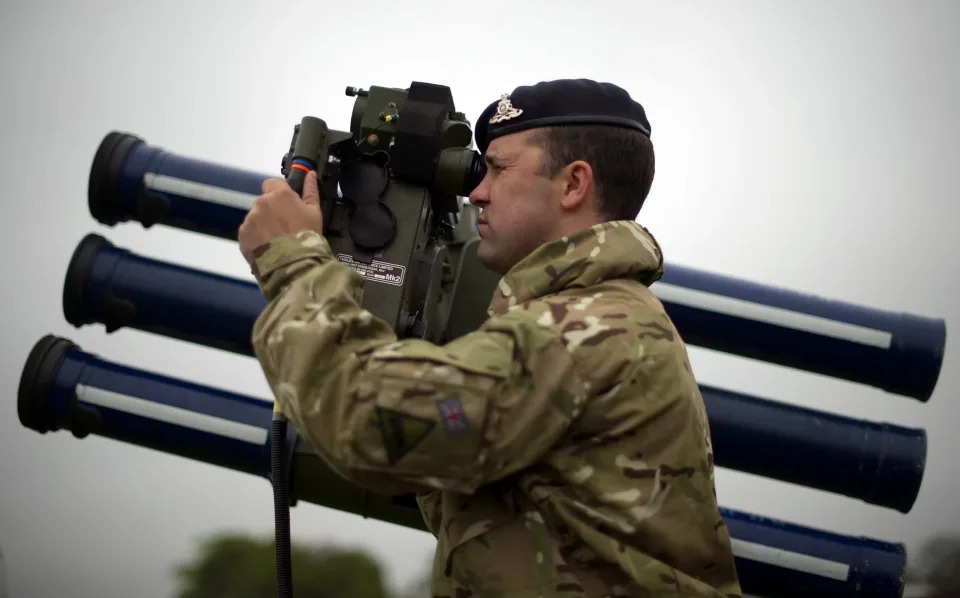
The Starstreak missile uses three dart-like projectiles allowing multiple hits on the target - Eddie Mulholland for the Telegraph
The Starstreak missile uses three dart-like projectiles allowing multiple hits on the target – Eddie Mulholland for the Telegraph

Britain is set to send the world’s most advanced anti-aircraft missile system to Ukraine, the Defence Secretary has announced.

Ben Wallace on Wednesday told MPs he is looking at providing the Starstreak High-Velocity Missile systems to the Ukrainians, stepping up the UK’s military assistance to Kyiv.

Designed to destroy fighter jets and helicopters, Starstreak is the fastest short-range surface-to-air missile in the world, travelling at over Mach 3.

The missile uses three dart-like projectiles allowing multiple hits on the target. It can be fired from the shoulder, from a lightweight multiple launcher or from armoured vehicles.

Earlier versions of the system, which is made by defence firm Thales in Belfast, were deployed on top of tower blocks for the 2012 London Olympics, a move which caused some concern among residents.

As it was, no missiles were fired during the Olympic games.
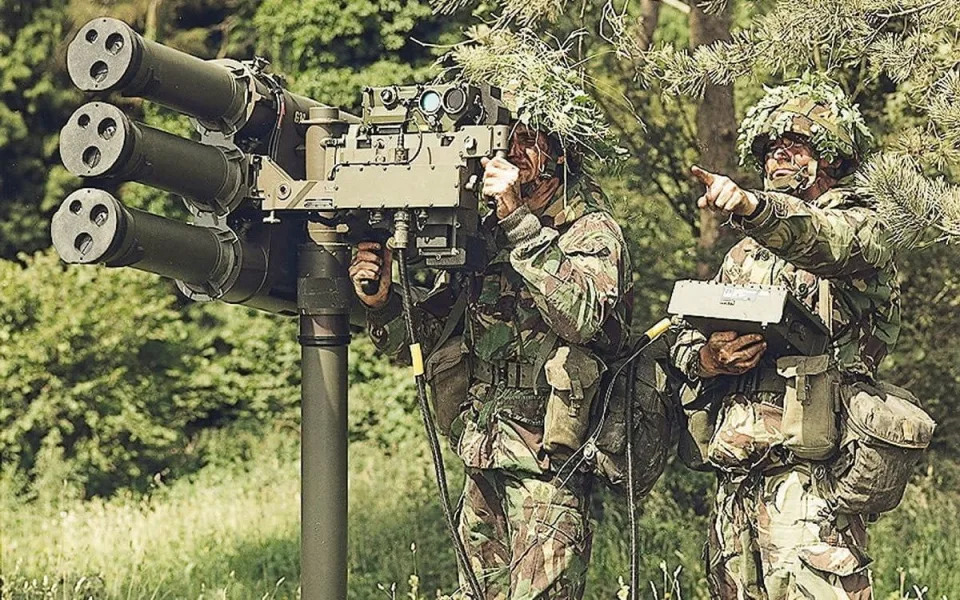
The missile can be fired from the shoulder, from a lightweight multiple launcher or from armoured vehicles - PA
The missile can be fired from the shoulder, from a lightweight multiple launcher or from armoured vehicles – PA

The system relies on its immense speed to defeat aircraft manoeuvring around a battlefield.

‘Defensive’ lethal aid

Military officials hope the missile, described as “defensive” lethal aid by Mr Wallace, will help Ukraine gain control of the skies and further erode Russia’s fighter jet and helicopter fleets.

Once fired, the missile carrying the three darts uses a small charge to blast it clear of the launch tube. This motor cuts out before the missile has left the tube to prevent injury to the operator.

At about four metres from the soldier firing the weapon, a second booster fires to accelerate the missile rapidly to over Mach 3.

The missile homes in on the target aiming for two laser beams “painted” on the aircraft by the launch unit. All the soldier firing the weapon has to do is keep the target in the sights.

Three times the speed of sound
Military officials hope the missile will help Ukraine gain control of the skies - PA
Military officials hope the missile will help Ukraine gain control of the skies – PA

The target aircraft has no time to hide behind buildings or outrun the missile, which travels at more than three times the speed of sound.

Approaching the target, the three darts, known as “hitiles”, separate from the missile and coast towards the aircraft.

The kinetic energy generated by travelling at such speed will destroy most targets, but to ensure complete destruction each dart contains a delayed initiation 0.9kg blast fragmentation warhead that explodes inside the aircraft.Addressing the Commons, Mr Wallace explained the rationale for the potential donation of such missiles. “As the conflict intensifies, the Russians are changing their tactics, so the Ukrainians need to, too,” he said.

“We can all see the horrific devastation inflicted on civilian areas by Russian artillery and airstrikes, which have been indiscriminate and murderous. It is therefore vital that Ukraine maintains its ability to fly and to suppress Russian air attack,” he added.

Highlighting that the international community has already given man-portable air defence missiles, he said the Ukrainian forces’ capability “needs strengthening”.

Following requests for further help from Ukrainian President Volodymyr Zelensky, Mr Wallace said providing Starstreak will “allow the Ukrainian forces to better defend their skies”

He sought to characterise the weapon supplies as defensive and tactical in nature, so as to avoid handing Vladimir Putin an excuse to refer again to the potential use of nuclear weapons.

“Everything we do is bound by the decision to supply defensive systems and [is] calibrated not to escalate to a strategic level,” the Defence Secretary said.

However, in another sign that London is stepping up the level of support it is prepared to give, he announced that Britain is about to dispatch a “small consignment” of Javelin missiles to Ukraine.

The US and Estonia have already been supplying Kyiv with the infrared-guided anti-tank munitions. Ukraine has been sent a variety of arms that target tanks by the West, including Panzerfaust 3 anti-tank weapons from the Netherlands, and AT4 anti-missile launchers from Sweden.

Mr Wallace updated the Commons on other lethal assistance the UK has provided to the Ukrainians in the 14 days since the Russian assault commenced.

This includes 1,615 next-generation light anti-weapons known as “NLAWs”, on top of 2,000 of the missiles that were sent before Moscow invaded.

The Defence Secretary highlighted that body armour, helmets, boots, ear defenders, ration packs, range-finders and communications equipment had also been donated to Ukraine.

“We shall also be increasing supplies of rations, medical equipment, and other non-lethal military aid,” he said.

Britain was the first European nation to supply lethal aid to Kyiv, he said, adding that the UK has also “invested in building Ukrainian military capacity since 2015”, alongside the US, Canada and Sweden.

Reuters

Britain plans to supply Ukraine with anti-aircraft missiles – minister

March 9, 2022

Cabinet meeting in London

LONDON (Reuters) – Britain is planning to supply Ukraine with anti-aircraft missiles to help it defend its skies from Russian invasion, defence minister Ben Wallace said, stressing that the technology fell within the definition of defensive weapons.

“It is vital… that Ukraine maintains its ability to fly and suppress Russian air attack,” Wallace told lawmakers.

“In response to Ukrainian requests, the government has taken the decision to explore the donation of STARStreak high-velocity man-portable anti-air missiles. We believe that this system will remain within the definition of defensive weapons, but will allow the Ukrainian force to better defend their skies.”

Wallace said the decision had been taken in principle to supply the systems, and the government was working out how to get them into Ukraine and train Ukrainian forces to use them.

The STARStreak system is made by Thales.

If confirmed, the supply would mark a significant step in Britain’s support for Ukraine. So far, Ukraine has praised Britain’s contribution of thousands of anti-tank missiles which have helped slow the Russian advance on Kyiv.

However Britain’s support has been limited to defensive weaponry.

“Everything we do is bound by the decision to supply defensive systems, and are calibrated not to escalate to a strategic level,” Wallace said.

As a member of the NATO military alliance, Britain has rejected pleas from Ukraine to impose a no-fly zone over the country. Britain says that could mean NATO forces shooting down Russian planes, resulting in a significant escalation of the conflict.

A proposed plan to allow Poland to donate fighter jets for use in Ukraine was rejected by the United States on Tuesday. Poland now says any supply of fighter jets to Ukraine must be done jointly by NATO countries.

Wallace said that was a matter for Poland.

(Reporting by Kylie MacLellan, writing by Alistair Smout; editing by William James, Michael Holden and Nick Macfie)

Defense News

Britain mulls giving ‘Starstreak’ air-defense weapons to Ukraine

Andrew Chuter – March 9, 2022

CARL COURT

LONDON — Britain has stepped up its supply of weapons to the Ukrainian military, adding Starstreak anti-air missiles to a list that already includes significant numbers of anti-tank weapons.

Defence Secretary Ben Wallace told lawmakers Mar. 9 that the government was “exploring” the supply of Starstreak but later confirmed that the decision had already been taken in principle to provide the Thales UK-built, short-range weapon.

Issues such as training still had to be resolved, however, said the defense secretary.

Wallace also told Parliament that Britain would supply limited numbers of Lockheed Martin- and Raytheon-built Javelin anti-tank missiles alongside non-lethal items such as ration packs and medical supplies.

“We believe that this system will remain within the definition of defensive weapons but will allow the defending force to better defend the skies,” Wallace said, referring to the Starstreak capabilities.

Wallace told lawmakers that Russia was now using unguided bombs, and that with 95 percent of its forces around Ukraine committed, Moscow was trying to encourage private Russian troops from organizations like the Wagner Group to join the fight.

Citing Ukrainian data, he said Russia is believed to have lost 285 tanks, 985 armored vehicles, 44 aircraft, 48 helicopters, 109 artillery pieces. Some 11,000 Russian troops had been killed, he added, noting that the Ukrainian figures were unverified.

Starstreak is a high-velocity missile designed to provide air defense against helicopters, low flying fixed wing jets and unmanned air vehicles out to a range upwards of 4 miles.

The British have fielded the weapon since 1997, first mounted on an armored vehicle, but more recently as a lightweight, multiple-missile launcher and in shoulder-launched configurations.

Starstreak is the second significant weapon system supplied to the Ukrainian military by the British recently.

Just ahead of the Russian invasion Royal Air Force C-17 airlifters delivered Next Generation Light Anti-tank Weapons (NLAW) to Ukraine.

Like the Starstreak, the NLAW was built at a Thales UK factory just outside Belfast, Northern Ireland, although the anti-tank weapon was largely developed by Saab in Sweden as a collaborative effort between the two countries.

Wallace updated lawmakers on the volume of NLAWs supplied to the Ukraine, saying Britain had initially provided 2000 weapons but had now increased that number to 3615 missiles, with efforts continuing to deliver more.

The weapons are coming from British military stockpiles. Wallace said work was underway to replenish them.

The weapons supply is part of a wider aid contribution from the British, which includes a big increase in humanitarian donations by the government.

Although Britain is pouring money into aid and the supply of weapons Wallace didn’t address the broader issue of increased defense spending during his statement.

The government announced a £16.5 billion ($22.3 billion) increase over four years in 2021, but a yet-bigger increase would appear to have broad support across Parliament.

The parliamentary Defence Committee has been advocating a substantial rise in Britain’s underfunded military for several years.

A plan for increased spending could come as soon as the next few weeks.

How much is enough is a difficult question, said John Louth, an independent defense analyst here.

“They will have to consider going back to the 1980s spending levels if not before,” he added. “Certainly I can see it going up to 3.5% of gross domestic product [from 2percent now], maybe a little more. The lesson from the Cold War though is that it’s no good doing that unless you are taking an integrated approach with allies.”

Like other analysts here Louth reckons the government’s integrated defense review, released just 12 months ago, will need a rethink, if not shredding, in the wake of the Russian invasion.

Louth said rethinking the role and capabilities of Britain’s shrinking army Army was the immediate priority.

“The British Army have to wake up to the fact that the future isn’t going to be exquisite, highly technical stand-off weapons. It is probably going to be lots of people in traditional looking vehicles with the ability to maneuver. It changes the sense of the Army just being a recruiting ground for the special forces,” he said.

The secret world of offshore banking is proving it can stand up to kleptocrats

The Washington Post

The secret world of offshore banking is proving it can stand up to kleptocrats

Brooke Harrington – March 8, 2022

Russian President Vladimir Putin congratulates women on the upcoming International Women’s Day as he meets with flight personnel, students and employees of the Aeroflot Aviation School on the suburbs of Moscow, Russia March 5, 2022. Sputnik/Mikhail Klimentyev/Kremlin via REUTERS ATTENTION EDITORS – THIS IMAGE WAS PROVIDED BY A THIRD PARTY. (Sputnik Photo Agency / reuters)

Russia’s invasion of Ukraine has produced an unexpected side effect: The complicated offshore financial system is rapidly proving it can dismantle itself.

The war has galvanized an extraordinary coalition among tax havens that usually compete fiercely with one another to attract Russian wealth. Led by the European Union, the United States, United Kingdom, Switzerland and Monaco – all of which have long been favored asset hiding places for Russia’s richest individuals – are suddenly cooperating to impose sanctions and expel Russian President Vladimir Putin’s cronies from the zone of legal and financial impunity known as “fiscal paradise.”

In addition to separate sanctions on Russian banks and other organizations, each of those jurisdictions has now frozen or seized the personal wealth of top Russian government officials, billionaire business executives and state media representatives. Other jurisdictions have also joined the fight. Singapore stopped short of individual sanctions, but the popular tax haven made the “almost unprecedented” move to shut out Russian banks. Even Cyprus – so dependent on Putin’s cronies that it has been described as a “Russian bank with dirty money posing as an E.U. state” – has risked the wrath of its top clients by breaking off an agreement to let Russian planes use Cypriot airspace and Russian naval ships dock in Cypriot ports.

These are extraordinary developments in their own right, no matter what Putin does next in Ukraine. Even if the sanctions don’t produce the intended Russian withdrawal, they have shown that tax havens can act collectively in the best interests of society by refusing to aid and abet kleptocrats. This is such a revelation because for decades, offshore centers – ranging from giants like the United States and Switzerland to tiny islands such as Nevis in the Caribbean – have insisted that this cannot be done under any circumstances. But as several commentators have noted, the news keeps showing us that the impossible is indeed possible.

Most importantly, the fiscal paradises of the world have demonstrated that they are willing and able, when they wish, to break down their own walls of silence and complicity – even though this threatens their core business model. Just how serious a threat that represents to kleptocrats can be judged by their reactions to this move. When the Panama Papers exposed what many suspected to be portions of Putin’s personal fortune, he allegedly viewed the revelations as a “personal attack,” demanding retaliation against the West in the form of interference with the 2016 U.S. presidential election. Those data leaks, filled with revelations about rampant corruption among government and business leaders worldwide, were the first breach in the nearly impenetrable secrecy that has always been the main product of the world’s tax havens.

A few years later, Putin now describes coordinated sanctions against supporters of his regime as “akin to an act of war.” The coalition dealing out the sanctions apparently views these measures in the same light. The French finance minister described last week’s seizure of a yacht owned by Igor Sechin – a former deputy prime minister, now considered the second-most powerful Russian after Putin himself – as part of an “all-out economic and financial war in Russia.”

With Russian offshore wealth estimated conservatively as equivalent to 85 percent of the country’s GDP, there is a great deal at stake, but it is not just the money. Anti-corruption campaigners like Alexei Navalny who have fought for years against Russian kleptocracy insist that sanctioning and seizing oligarchs’ offshore wealth is essential to halting the abuses of Putin’s regime.

Just two years ago, Navalny claimed sanctions on Russian oligarchs were failing precisely because they were implemented in a piecemeal, “chaotic” and halfhearted manner by countries like the United States and Great Britain. But that has changed almost overnight. While some critics still view progress on sanctions as unnecessarily slow – especially in “Londongrad,” as the British capital is sometimes known because of its friendliness to Russian wealth – some observers have already declared that “the era of Russian money in London is over.”

Where will Russian wealth go now that Putin’s war has galvanized so many other tax havens to unite in shutting out the oligarchs? Now that the offshore system has shown that it can expel some of its most cherished clients from fiscal paradise, kleptocrats from outside Russia must be wondering whether that fate will befall them next. They cannot unsee what we have all seen: that the wall of offshore omerta can and will be breached in unpredictable ways.

It would be a consummate irony if Putin himself accomplished with his invasion of Ukraine what a string of devastating offshore leaks could not: the self-destruction of the offshore financial system. He has unquestionably, if unintentionally, accelerated the process “John Doe” and the insiders behind the 2017 Paradise Papers and 2021 Pandora Papers leaks began by breaching the wall of seemingly impenetrable tax haven secrecy.

Brooke Harrington is a professor of sociology at Dartmouth College and the author of “Capital Without Borders: Wealth Managers and the One Percent.”

‘They were sent as cannon fodder’: Siberian governor confronted by relatives of Russian unit

The Guardian

‘They were sent as cannon fodder’: Siberian governor confronted by relatives of Russian unit

Pjotr Sauer – March 8, 2022

A Russian governor in Siberia has been confronted by angry citizens who blamed him for deploying a local riot police unit to Ukraine to become “cannon fodder”, a video clip circulating online showed.

The footage, first posted by Radio Free Europe (RFE) on Monday, showed a fiery exchange between Sergei Tsivilyov, the governor of the Kemerovo region, and people in the city of Novokuznetsk.

“They lied to everyone, they deceived everyone … Why did you send them there?” one woman asks Tsivilyov, saying that the soldiers thought they were going for military drills in Belarus.

“They didn’t know their objective … They were sent as cannon fodder,” the woman adds.

Russia-Ukraine war: Ukraine accuses Russia of breaking Mariupol ceasefire and shelling humanitarian corridor – live
Russia accused of shelling Mariupol evacuation route as civilians flee Sumy

The governor would not have been responsible for the decision to deploy the unit, which would have been made by the country’s national guard, a separate internal military force directly subordinated to the president, Vladimir Putin.

According to RFE, the confrontation took place on Saturday at the gymnasium of the training base for riot police units, some of whose officers were killed or captured in Ukraine.

As the fighting in Ukraine nears its third week, more and more relatives of killed and captured Russian soldiers have expressed their opposition to the war, saying their loved ones were not told in advance about the country’s plans to invade Ukraine. Videos of captured Russian soldiers issued by the Ukrainians also appear to show that Russian troops were not informed of the invasion until the very end.

Western military experts have raised questions about Russian troops’ morale and preparedness in Ukraine, which could explain why Moscow’s blitzkrieg plan to overwhelm Ukraine and take Kyiv has so far failed.

Russia has revealed very little information about the state of its soldiers fighting in Ukraine. Last week, Russia’s defence ministry said that 498 Russian soldiers had died in Ukraine. Ukraine’s military claimed on Sunday that more than 11,000 Russian troops had been killed since the invasion of Ukraine began.

In the video, Tsivilyov defended the invasion, saying that Russia’s actions in Ukraine “shouldn’t be criticised”.

“Look, you can shout and blame everyone right now, but I think that, while a military operation is in process, one shouldn’t make any conclusions,” Tsivilyov said.

Russian officials, as well as state media, have been referring to Russia’s invasion of Ukraine as a “special military operation” rather than a “war” or “invasion”.

Authorities have also introduced a number of new laws aimed at stifling public opposition to the war.

On Friday, Putin signed into law a bill that introduced jail terms of up to 15 years for fake news about the Russian army, forcing many Russian and international outlets to cease their coverage of the events.

And while the authorities have been successful at getting a large segment of the population behind its war efforts, videos such as the Novokuznetsk footage circulating online suggest the war is deeply unpopular among those who have lost friends and relatives in Ukraine.

The Guardian previously spoke to family members of a Russian sniper captured in Ukraine, who similarly expressed anger and shock about their relative’s involvement in the war.

“Young boys are thrown like cannon fodder, and most importantly for what? For palaces in Gelendzhik?” the close family member of the captured sniper Leonid Paktishev said, referring to the palatial mansion on the Black Sea that Russian independent journalists have said is linked to Putin.

Pussy Riot’s Nadya Tolokonnikova: ‘You cannot play nice with Putin. He is insane. He might open fire on his own people’

The Guardian – Interview

Pussy Riot’s Nadya Tolokonnikova: ‘You cannot play nice with Putin. He is insane. He might open fire on his own people’

Zoe Williams – March 8, 2022

The Russian artist – who spent two years in a Siberian jail for singing an anti-Putin ‘punk prayer’ – is using NFTs to fight the dictator, raising $7m in five days. At a time like this, she says, only activism will keep you sane

‘I’m in a panic, I’m crying every day’ … Nadya Tolokonnikova at a concert in Tennessee earlier this month.
‘I’m in a panic, I’m crying every day’ … Nadya Tolokonnikova at a concert in Tennessee earlier this month. Photograph: Paul A Hebert/LiveMusicToday/REX/Shutterstock

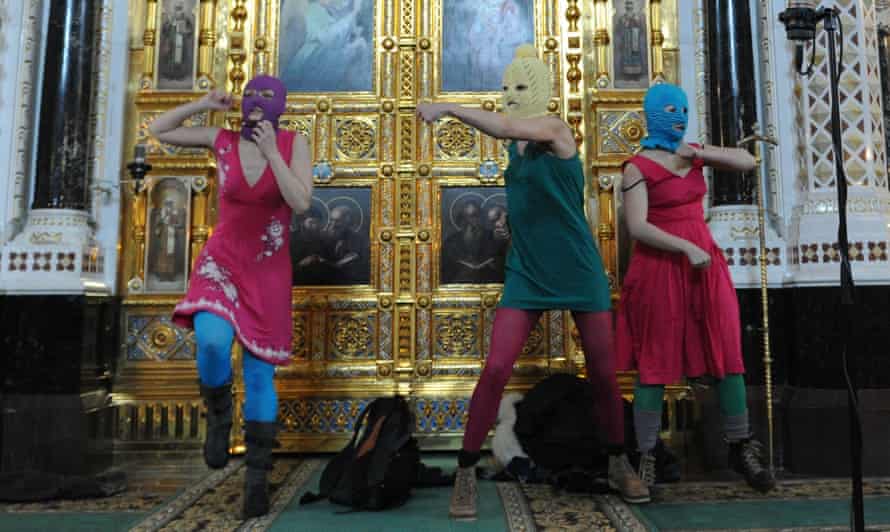
Nadya Tolokonnikova is in a geographically undisclosed location, speaking to me by Zoom, in a Pussy Riot T-shirt, looking purposeful, driven and singleminded. Her feminist protest art has been deadly serious since its inception, when she founded Pussy Riot in 2011. The watching world may have been entertained by its playful notes, the guerrilla gigs in unauthorised places, culminating in the event for which she was prosecuted, in Moscow’s Cathedral of Christ the Saviour, when she sang Punk Prayer: Mother of God, Drive Putin Away.

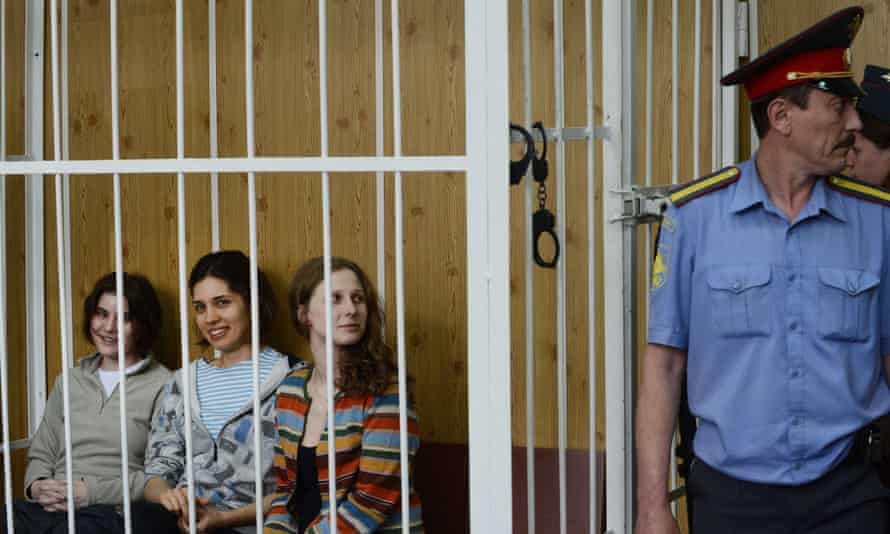
But the consequences have always been seismic and severe. Tolokonnikova, along with two other members of Pussy Riot, were sentenced to two years in prison for hooliganism in 2012, separated from their very young children, went on hunger strike, endured unimaginably harsh conditions and were named prisoners of conscience by Amnesty International.

Tolokonnikova is “nomadic by nature”, she says. “This planet is my home. I’ve always been an anarchist. I’m not really a big fan of borders or nation states.” But beneath those abstracts there exist concrete dangers. She was declared a “foreign agent” by the Kremlin in December, as was the independent news outlet she founded upon her release from prison, Mediazone.

Sentenced to two years … Pussy Riot perform inside Moscow’s Cathedral of Christ the Saviour.
Sentenced to two years … Pussy Riot perform inside Moscow’s Cathedral of Christ the Saviour. Photograph: ITAR-TASS News Agency/Alamy

“Putin just signed a law that said you’re going to get 15 years in jail for even discussing the war in Ukraine,” she says matter-of-factly. “You cannot even call it a war, you have to call it a special military operation.” The jeopardy of being a known Russian dissident is greater now than it has been in decades, and nobody understands that more keenly than Tolokonnikova, who was born in 1989, too young to remember Perestroika.

Yet her focus is anything but self-protective. When Putin invaded Ukraine on 24 February, she and various collaborators from the world of cryptocurrency launched the Ukraine DAO (decentralised autonomous organisation). It was a 1/1 NFT of the Ukrainian flag, and the group invited people to bid for collective ownership of the image, raising $7.1m in five days.

“We felt, me and my friends in crypto, that we had to react somehow. I’m personally convinced that in situations like this, activism is the only thing that can keep you sane. Just looking at disasters and tragedies and not doing anything about it is really detrimental for the world, but also it slowly destroys you and makes you feel helpless.” The money has already been distributed to the organisation Come Back Alive, which has been mobilising support for the Ukrainian army since 2014 with medical care, ammunition, training and defence analytics.

I was ready to die. If you fight with a dictator, you have to show them that you are ready to fight to the end

Tolokonnikova is devastated by the invasion of Ukraine. “I’m in a panic, I’m crying every day. I don’t think it was in any sense necessary, I don’t think it was in any sense logical. It wasn’t something that had to happen, it’s a disaster that will end thousands of people’s lives. I’m freaking out.” Yet she never had the luxury of complacency about what Putin was capable of. “The global community was extremely complacent, and I see two reasons: hypocrisy, based on greed. People would make statements that they did not support Putin’s politics, and his oppression of the political opposition, and the wars that he started – this isn’t the first war by any means. But at the same time they would continue doing business with him.” Nobody was interested in following the money; asking how the oligarchs coming out of Russia, fetching up in Europe and Miami, had come upon their vast wealth.

“Stupidity,” she continues, bluntly: “this is the second reason. People underestimate how dangerous dictators are. In 2014, we spoke to the UK parliament, we spoke at the Senate in the US, we were asked by a lot of people how they should talk to Putin, how they should frame the conversation, and I always advised that they should be as strict as they could. You cannot play nice with Putin.” This wisdom was won, not so much by her arrest for offending the thin-skinned leader but during her time in prison. “Dictators act a lot like prison wardens. They treat kindness as weakness.”

‘I think Putin is digging his own grave’ … Tolokonnikova performing at the Women’s March and Rally for Abortion Justice in Texas last year.
‘I think Putin is digging his own grave’ … Tolokonnikova performing at the Women’s March and Rally for Abortion Justice in Texas last year. Photograph: Sergio Flores/AFP/Getty Images

Both during her sentence and following her release in 2014, Tolokonnikova campaigned in ways that political prisoners throughout history would recognise. First, with a hunger strike. “Starting that, I was pretty much ready to die. If you fight with a dictator, you have to show them that you are ready to fight to the end. I think this is why Ukraine is actually winning: they might lose some cities but they’re willing to fight to the end, and that is not the case for the Russian army.”

She gained support worldwide, and from figures such as Madonna and Hillary Clinton. She began to exchange letters with Slavoj Žižek which were subsequently turned into a book, Comradely Greetings. What she remembers now, though, was the concrete impact on prison conditions. A week into her hunger strike, Putin’s right-hand man on human rights called her personally, in prison, to discuss the brutal conditions she was protesting against: 18 hour days of labour with only one day off every six weeks; very little sleep; horrific violence at the hands of guards and other inmates.

“This was fairly insane. I was the lowest person on the social ladder, and he had to call me.” Later, the prison director and architect of this slave labour system, Yury Kupriyanov, was convicted for it and served a suspended two-year sentence, and the Russian correctional headquarters “had to make a statement. They named me, and said I was right.”

Everything I’m doing is to be a greater pain in the arse to Putin

Tolokonnikova’s sentence left its mark: “I was traumatised by prison. I was barely functional when I got released. I suffered from a really severe depression in 2014. I’m still on medication for depression caused by PTSD.” The daughter from whom she was separated by incarceration is now 14; “she’s a social democrat,” Tolokonnikova says approvingly, if a bit wryly. “She says that in her generation, people want greater equality.”

Her experience hasn’t blunted her activism, which is now concentrated at the frontier of technological possibility. She originally thought cryptocurrencies were just a toy for rich techies but their potential for activists – being independent of central banks and governments, immune to corporate takeover – dawned on her in early 2021, and since that time she has raised: “quite substantial sums for different charitable causes. We raised money for a shelter for victims of domestic violence. We were able to move dozens of women from a really dangerous place in Russia, outside of Russia. We raised money in August of last year for political prisoners in Russia.”

Besides that, today she is helping launch the UnicornDAO, a crypto fund whose mission is to buy artworks from female and LGBTQ+ artists. “It’s not going to be just buying up their works of art; we’re going to be working with them, helping them in various ways to have stable and sustainable careers.” Unicorn’s first purchase was by the Russian-born, New York-based artist Olive Allen.

Detained … the band at a court hearing in Moscow in 2012.
Detained … the band at a court hearing in Moscow in 2012. Photograph: Natalia Kolesnikova/AFP/Getty Images

“I feel like the NFT world is a great way to redistribute money,” Tolokonnikova says, “but we see these old patterns being repeated. Misogyny doesn’t go anywhere, it just migrates over to digital artwork. Women account for only five per cent of all NFT sales. It’s so much more difficult to prove there is value in your words if you happen to be a woman.”

These explorations in crypto can sound mercurial, one minute driving cultural change, the next raising money, the next trying to create democratic agency independent of nation states – and it’s by no means clear what that would look like – but Tolokonnikova’s reading of Russian politics, and what it would take to force change, is entirely practical. It would take “a mass uprising, millions of people coming to the streets and refusing to leave until Putin is gone. That is obviously incredibly dangerous. Putin is insane, so he might open fire at his own people. I definitely understand why everybody is not already on the streets.”

Alongside that, “another force of change may come from Putin’s closet circle. I honestly think Putin is digging his own grave now. The number of oligarchs who are close to him who have publicly supported Ukraine, and are standing against the war, is significant, and that hasn’t happened in 20 years.”

She sees a worthy successor to Putin in opposition leader Alexei Navalny. “Better social programes, and redistribution, that’s all part of his programe. I’ve known him since 2007 – it has been really interesting to witness his platform become more and more social democratic, even though he doesn’t describe himself as that. He doesn’t use labels. I think it’s smart. He doesn’t want to divide people.” And as she recalls her own time in prison, Tolokonnikova urges the world not to forget that Navalny still languishes in jail. Her own work, specifically the UnicornDAO, “is not connected to Putin directly anyhow. But everything I’m doing is to be a greater pain in the arse to Putin, because it’s so personal to me.”

Putin’s invasion of Ukraine ‘is really splitting Russian society,’ expert explains

Yahoo! Finance

Putin’s invasion of Ukraine ‘is really splitting Russian society,’ expert explains

Michael B. Kelley, Director Editorial – March 7, 2022

Russian President Vladimir Putin owns the ongoing invasion of Ukraine, one expert explained, and that means that the totalitarian leader will also own what comes next.

“This was a decision that was taken by a single individual in consultation with maybe a half dozen members of his national security council,” Timothy Frye, professor of post-Soviet foreign policy at Columbia University, told Yahoo Finance (video above). “So there’s very little elite buy-in. And the Russian public has always been skittish about conflict with Ukraine and is perfectly willing to recognize Ukrainian sovereignty. The public opinion is very clear on that question. So what we’ve seen is a great deal of repression within Russia, both of the mass public and a real attempt to silence elite opinion. And that’s a very difficult thing to do in a country with as diverse interest as Russia has.”

Russia's President Vladimir Putin speaks with his French counterpart Emmanuel Macron during a video conference call at the Novo-Ogaryovo state residence outside Moscow, Russia June 26, 2020. Sputnik/Mikhail Klimentyev/Kremlin via REUTERS  ATTENTION EDITORS - THIS IMAGE WAS PROVIDED BY A THIRD PARTY.
Russia’s President Vladimir Putin speaks with his French counterpart Emmanuel Macron during a video conference call at the Novo-Ogaryovo state residence outside Moscow, Russia June 26, 2020. Sputnik/Mikhail Klimentyev/Kremlin via REUTERS
‘This invasion is really splitting Russian society’

Frye, author of “Weak Strongman: The Limits of Power in Putin’s Russia,” added that this doesn’t mean that Putin could easily be overthrown — after all, “it’s really difficult to overthrow an autocrat.” Instead, Russia experts are watching to see if significant cracks emerge in support for Putin from elites and the public.

“The information environment of Russia is really still controlled by the Russian state, even as lots of videos are getting through,” Frye explained. “And it’s really unclear what direction the kind of battle of hearts and minds are going to go. When your country is involved in a war, patriotic elements within the country often rise up. So I think this invasion is really splitting Russian society between those who favor a view of fortress Russia versus those who want to bring Russia into the 21st century. And it’s really unclear which side is going to win out.”

VORONEZH, RUSSIA - 2022/03/06: The police arrest an anti-war activist on the streets of Voronezh on a weekend of pro and anti-war actions.
Over the weekend, pro and anti-war actions were held in Voronezh, located several hundred kilometers from the border with Ukraine. (Photo by Mihail Siergiejevicz/SOPA Images/LightRocket via Getty Images)
The police arrest an anti-war activist on the streets of Voronezh, Russia, on a weekend of pro and anti-war protests. (Photo by Mihail Siergiejevicz/SOPA Images/LightRocket via Getty Images)

Following Russia’s invasion of Ukraine in late February, the West swiftly moved to punish Putin’s regime by freezing Russian assets, cutting off some of the country’s banks from the SWIFT messaging system, sanctioning individual Russian oligarchs, and other measures. Various prominent companies also distanced themselves from Russia. Domestically, thousands of Russians have been arrested for protesting the war.

In terms of the economic pain, Frye noted that “the Russian economy is already at the threat of seizing up. The sanctions on the central bank are really unprecedented. And they’re much greater than I think anyone expected, certainly than Vladimir Putin expected.”

‘Ukraine seems to be in no mood to negotiate’

Asked about what comes next, Frye explained that “one thing that Putin has always been very afraid of domestic instability. So I think the impact of these sanctions and all of the Western policy are less to try to get the economic elites to turn on Putin than just trying to make the country ungovernable. And at some point, that might be one way we could constrain Putin from pushing further into Ukraine and to try to find some negotiated agreement.”

The war status in Ukraine, according to the UK Ministry of Defence as Monday morning. (UK Ministry of Defence)

In the meantime, there is a brutal war raging in Ukraine. Russia seems to have failed to meet its objectives thus far and is increasingly bombing civilians. The Ukrainian resistance, meanwhile, appears to be both strong in battle and determined to revolt against any attempt at Russian occupation of the country.

Negotiations between the two sides are ongoing.

“Russia’s ability to occupy the country given the incredible hostility of the Ukrainian population towards Russia… would make a long-term occupation really difficult,” Frye said, later adding: “Ukraine seems to be in no mood to negotiate. They feel like they can wear down the Russian government. And by inflicting costs, they can really make life uncomfortable for Putin.”

Ukraine: Russian invasion ‘not going well’ and ‘getting more desperate’, says UK minister

Yahoo! News

Ukraine: Russian invasion ‘not going well’ and ‘getting more desperate’, says UK minister

Kate Buck – March 8, 2022

TOPSHOT - Servicemen of the Ukrainian Military Forces speak after following their battle agianst Russian troops and Russia-backed separatists near Zolote village, Lugansk region on March 6, 2022. - Russia's invasion of Ukraine, now in its eleventh day, has seen more than 1.5 million people flee the country in what the UN has called
Ukrainian Military Forces speak after following their battle agianst Russian troops on Sunday (Getty)

Russia’s invasion of Ukraine is ‘not going particularly well’ and the Kremlin is ‘getting more desperate’ as Vladimir Putin’s troops feel ‘let down’ by their leaders, a minister has claimed.

Western officials believe Putin had hoped to have Ukraine well under his control within days of launching the invasion, but say poor planning, bad leadership and a fierce line of resistance from the Ukrainian people have stalled the Russian progress.

The US defence office has claimed Russia has deployed nearly all the 150,000 troops who were stationed on the border, but has only “made little progress”.

An unnamed official added the Russians are “frustrated by a stiff Ukrainian resistance as well as their own internal challenges”.

The nation’s largest cities are still under Ukrainian control, but coming under constant Russian bombardment as Putin’s force step-up their campaign of misery.

Speaking to Sky News, UK defense secretary Ben Wallace said: “Well it’s not going particularly well for the Russians, it’s day 13, way off their timetable. 

Russian President Vladimir Putin attends a flag raising ceremony on the ferry Marshal Rokossovsky via a video link at the Novo-Ogaryovo state residence outside Moscow on March 4, 2022. (Photo by Alexey NIKOLSKY / SPUTNIK / AFP) (Photo by ALEXEY NIKOLSKY/SPUTNIK/AFP via Getty Images)
Vladimir Putin had hoped to have Ukraine well under his control within days of launching his invasion (Getty)

“On one level sadly there’s lots of casualties, we’ve seen the indiscriminate shelling which has killed numerous civilians.

“We’ve also recognised that probably the biggest casualties so far in the war are Russian military soldiers who have been let down by appalling leaders, appalling leadership and appalling plans, and now you see them literally at large scales dying.”

On Wednesday, Russia admitted for the first time admitted it had suffered heavy losses, saying in a statement 498 of its troops had died.

The UK has said the death toll will be “considerably higher” than figures released by the Kremlin.

Ukrainian officials have claimed over 9,000 Russian soldiers have died. The figure has not been independently verified.

Read more: Putin isn’t insane and won’t use nuclear weapons, says ex-Russian foreign minister

Civilians leaving the city of Irpin during the evacuation during the Russia-Ukraine War, on March 7, 2022 (Photo by Andrea Filigheddu/NurPhoto via Getty Images)
Russia’s invasion has sparked the largest humanitarian crisis since World War Two, with over 1.7 million refugees fleeing Ukraine. (Getty)
A woman on wheelchair leaves the city of Irpin during the evacuation during the Russia-Ukraine War, on March 7, 2022 (Photo by Andrea Filigheddu/NurPhoto via Getty Images)
Civilians have been fleeing their homes as the Russian forces use weapons against them (Getty)

“I think that is something that will be seen in the Kremlin, whether they will admit to each other the failure of their aggressive and illegal invasion of Ukraine,” Wallace added.

A 40-mile-convoy of around 15,000 soldiers has been spotted outside of Kyiv for days now, but has stalled, reportedly due to supply issues.

Wallace added: “We’ve seen the column is still stuck north of Kyiv, there are reports overnight of Ukrainian special forces destroying over 20 Russian helicopters and I think we can see that Russia have a real logistic problem.

Watch: Lviv mayor calls for global help to feed refugees

Mayor of western Ukrainian city pleads for global help to feed refugees

The mayor of Lviv calls for international help because the city in far western Ukraine is struggling to feed and house the thousands of people who have fled there from war-torn regions of the country.

“That affects morale, they’re getting more desperate and you can see them getting more desperate because they’re shelling more and more innocent people, they’re trying even to get out on humanitarian corridors as we saw yesterday

“I think this goes right to the heart of the challenge that Russia has built itself a trap and the international community has united against them and we’re seeing the devastation that it’s leaving behind.”

Russia’s invasion has sparked the largest humanitarian crisis in Europe since World War Two.

The UN’s latest figures have say 2 million refugees have fled their homes and gone into neighbouring countries for safety.

The capital of Kyiv and second-largest city of Kharkiv still remain under the control of the Ukrainians but have come under severe shelling from Russian forces.

Ukrainian police officers patrol a street following a shelling in Ukraine's second-biggest city of Kharkiv on March 7, 2022. - On the 12th day of Russia's invasion of Ukraine March 7, 2022, Russian forces pressed a siege of the key southern port of Mariupol and sought to increase pressure on the capital Kyiv. Kyiv remains under Ukrainian control as does Kharkiv in the east, with the overall Russian ground advance little changed over the last 24 hours in the face of fierce Ukrainian resistance. (Photo by Sergey BOBOK / AFP) (Photo by SERGEY BOBOK/AFP via Getty Images)
Ukrainian police officers patrol a street following a shelling in Kharkiv (Getty)

International attention has turned to the town of Irpin in recent days, after Putin’s troops shelled humanitarian corridors which had opened up for people to evacuate.

3 Russian billionaires resign from board of $22 billion investment firm LetterOne after it locked out 2 Russian oligarchs over the invasion of Ukraine

Business Insider

3 Russian billionaires resign from board of $22 billion investment firm LetterOne after it locked out 2 Russian oligarchs over the invasion of Ukraine

Kate Duffy – March 8, 2022

Russian President Vladimir Putin.
Russian President Vladimir Putin. 
  • German Khan, Alexei Kuzmichev, and Andrei Kosogov have left the investment firm LetterOne.
  • They weren’t sanctioned but thought stepping down was in the company’s interests, LetterOne said.
  • It comes less than a week after sanctioned oligarchs Mikhail Fridman and Petr Aven left the firm.

Three Russian billionaires have resigned from the board of a $22 billion investment firm amid their country’s ongoing invasion of Ukraine.

It comes after London-based LetterOne froze out Mikhail Fridman and Petr Aven, who are subject to Western sanctions, blocking access to their buildings last week and forbidding them to talk to employees.

German Khan, Alexei Kuzmichev, and Andrei Kosogov — who are not subject to any sanctions — all stepped down from their positions with the company on Monday. 

“None of these three individuals has been sanctioned, but they believe that this is the right thing to do in the long-term interests of LetterOne, its employees, and the many jobs it supports in its portfolio companies,” the firm said in a statement sent to Insider.

Khan, 60, who helped to found LetterOne and is a partner in Alfa Group, said in the statement that he supported the board’s actions and called for an end to the war.

“The majority of LetterOne founders have deep roots in Ukraine, and the destruction of the cities where I spent my childhood and which are home to the graves of our ancestors is heartbreaking,” said Khan, who has a net worth of almost $6.9 billion, according to a Bloomberg estimate.

Kuzmichev, 59, was a cofounder of Alfa-Bank, the biggest private bank in Russia, and has a net worth of about $5.2 billion, according to Bloomberg. Kosogov, 60, is a member of Alfa Group’s board and is valued at $1.2 billion, according to Forbes’ estimates

LetterOne also said in Monday’s statement that Fridman and Aven, who left the company’s board on Wednesday, had their shares in the firm “frozen indefinitely” and can’t receive dividends or other financial funds from LetterOne.https://12831157c45b9bf9dbd0be7ad0c2ac7d.safeframe.googlesyndication.com/safeframe/1-0-38/html/container.html

Mervyn Davies, the chairman who is now in charge of LetterOne, told the Financial Times that they were locked out of the offices, blocked from accessing documents, and banned from speaking with employees.

LetterOne is set to donate $150 million to help people affected by the war in Ukraine, and shareholders have agreed that all dividends will go toward relief efforts, the company’s statement said.

McDonald’s closes all stores in Russia

McDonald’s closes all stores in Russia

Oriana Gonzalez – March 8, 2022

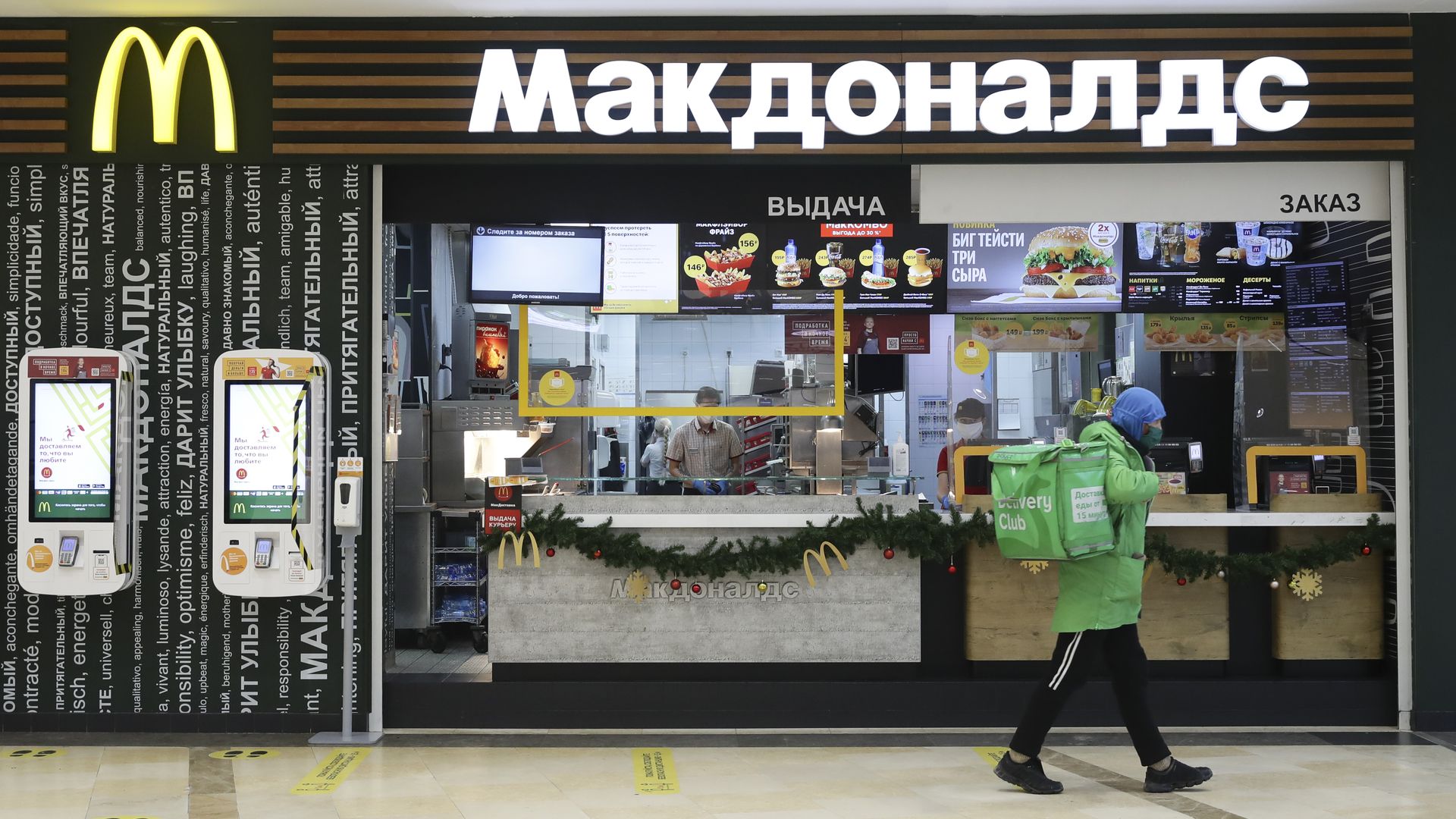
Picture of a McDonalds in Russia
Photo: Kirill Kukhmar\TASS via Getty Images

McDonald’s is temporarily closing all stores in Russia over strongman Vladimir Putin’s unprovoked invasion of Ukraine, the chain announced Tuesday.

State of play: McDonald’s CEO Chris Kempczinski said the company will continue to pay its 62,000 Russian employees, but added that “it’s impossible to predict when we might be able to reopen our restaurants in Russia.”

  • Kempczinski said McDonald’s has been experiencing supply chain issues “along with other operational impacts” in Russia.
  • He added that the Ronald McDonald House Charities chapter in Russia will continue to operate, adding that the Ukrainian chapter is focused on “partnering with local hospitals and providing humanitarian aid throughout the country.”
  • The company has also temporarily closed 100 of its locations in Ukraine and employees are still getting paid, AP reports.

The big picture: Companies and businesses around the world have been pausing their operations in Russia and condemning the ongoing attack.

What they’re saying: “The conflict in Ukraine and the humanitarian crisis in Europe has caused unspeakable suffering to innocent people. As a System, we join the world in condemning aggression and violence and praying for peace,” said Kempczinski.

  • “[O]ur values mean we cannot ignore the needless human suffering unfolding in Ukraine.”
  • “As we move forward, McDonald’s will continue to assess the situation and determine if any additional measures are required.”

Half of US adults exposed to harmful lead levels as kids

Associated Press

Half of US adults exposed to harmful lead levels as kids

By Drew Costley – March 7, 2022

Over 170 million U.S.-born people who were adults in 2015 were exposed to harmful levels of lead as children, a new study estimates.

Researchers used blood-lead level, census and leaded gasoline consumption data to examine how widespread early childhood lead exposure was in the country between 1940 and 2015.

In a paper published in the Proceedings of the National Academy of Sciences on Monday, they estimated that half the U.S. adult population in 2015 had been exposed to lead levels surpassing five micrograms per deciliter — the Centers for Disease Control and Prevention threshold for harmful lead exposure at the time.

The scientists from Florida State University and Duke University also found that 90% of children born in the U.S. between 1950 and 1981 had blood-lead levels higher than the CDC threshold. And the researchers found significant impact on cognitive development: on average, early childhood exposure to lead resulted in a 2.6-point drop in IQ.

The researchers only examined lead exposure caused by leaded gasoline, the dominant form of exposure from the 1940s to the late 1980s, according to data from the U.S. Geological Survey. Leaded gasoline for on-road vehicles was phased out starting in the 1970s, then finally banned in 1996.

Video: Nearly 50% of bald eagles have chronic lead poisoning

Study lead author Michael McFarland, an associate professor of sociology at Florida State University, said the findings were “infuriating” because it was long known that lead exposure was harmful, based on anecdotal evidence of lead’s health impacts throughout history.

Though the U.S. has implemented tougher regulations to protect Americans from lead poisoning in recent decades, the public health impacts of exposure could last for several decades, experts told the Associated Press.

“Childhood lead exposure is not just here and now. It’s going to impact your lifelong health,” said Abheet Solomon, a senior program manager at the United Nations Children’s Fund.

Early childhood lead exposure is known to have many impacts on cognitive development, but it also increases risk for developing hypertension and heart disease, experts said.

“I think the connection to IQ is larger than we thought and it’s startlingly large,” said Ted Schwaba, a researcher at University of Texas-Austin who studies personality psychology and was not part of the new study.

Schwaba said the study’s use of an average to represent the cognitive impacts of lead exposure could result in an overestimation of impacts on some people and underestimation in others.

Previous research on the relationship between lead exposure and IQ found a similar impact, though over a shorter study period.

Bruce Lanphear, a health sciences professor at Simon Fraser University in Vancouver who has researched lead exposure and IQ, said his 2005 study found the initial exposure to lead was the most harmful when it comes to loss of cognitive ability as measured by IQ.

“The more tragic part is that we keep making the same … mistakes again,” Lanphear said. “First it was lead, then it was air pollution. … Now it’s PFAS chemicals and phthalates (chemicals used to make plastics more durable). And it keeps going on and on.

“And we can’t stop long enough to ask ourselves should we be regulating chemicals differently,” he said.

The Associated Press Health and Science Department receives support from the Howard Hughes Medical Institute’s Department of Science Education. The AP is solely responsible for all content.