Social media reveals and distorts the reality of war in Ukraine

Yahoo! News 360

Social media reveals and distorts the reality of war in Ukraine

Mike Bebernes, Senior Editor – March 7, 2022

“The 360” shows you diverse perspectives on the day’s top stories and debates. Why Russia is losing the information war against Ukraine.

What’s happening

Russia’s invasion of Ukraine isn’t the first war to take place during the era of social media, but perhaps no other conflict has ever seen the online and real worlds so intensely intertwined.

Since the earliest moments when Russian troops advanced over Ukraine’s borders, local citizens have documented their experiences in intimate detail on Facebook, Instagram, Twitter and TikTok — providing the world a window into the triumphant and harrowing moments of their lives under siege. Digital tools have also provided practical support. Online observers used Google Maps to track the Russian army’s movements, and an American urban warfare expert shared tips on Twitter for Ukrainians defending their cities. Ukrainian President Volodymyr Zelensky has made frequent use of social media to boost morale at home and urge other nations to support his country’s cause.

Social media platforms have also been plagued by a flood of misinformation shared by both individual users and organized groups intending to distort the facts on the ground. The Russian government has engaged in an elaborate, and largely ineffective, campaign to undermine Ukraine’s resistance. Ukraine’s official accounts have also shared dubious information, though at a much smaller and less coordinated level than the Russians.

Big Tech companies have taken aggressive steps to combat disinformation from official Russian sources. Russian state-controlled news networks RT and Sputnik have been blocked in Europe on Facebook, Instagram, TikTok and YouTube. Russia has retaliated by blocking access to Facebook and Twitter and passing a new law that threatens with prison time anyone promoting what authorities consider to be “fake news” about the war. That law compelled TikTok, along with several Western news networks, to suspend its service within Russia.

Why there’s debate

There’s little question that social media is having a real effect on the war, but most experts say its impact is too complex to be viewed as either purely helpful or harmful.

Many credit social media for helping to establish a clear narrative of the conflict, establishing Russia as the unquestioned aggressor despite Moscow’s efforts to manipulate the truth. They also argue that the constant stream of first-person accounts from ordinary Ukrainians has humanized their struggle in a way that traditional news media often fails to do. Though social media’s effects are difficult to quantify, some political experts say Ukraine’s dominance in the war over public perception may have played a significant role in convincing Western governments to offer substantial material support to Ukraine and issue punishing sanctions against Russia.

For all of social media’s benefits, disinformation researchers worry that the “fog of war” being created by the flow of false information and out-of-context moments makes it all but impossible to track facts on the ground. There are also concerns that social media algorithms, which tend to reward posts that elicit a strong emotional response, will warp users’ understanding of the conflict. Others argue that it’s a disservice to the Ukrainian people for outside observers to repackage their real-life tragedies and triumphs into content competing to become the next viral post.

Perspectives
Benefits

Social media has helped Ukraine dominate Russia in the information war

“Russia’s war for Ukraine’s territory is being waged with tanks and artillery, but the battle for the world’s hearts and minds is being fought largely on social media — and there, at least, Vladimir Putin is losing.” — Stephen L. Carter, Bloomberg

The intimacy of social media helps the world understand the human stakes of war

“As an American living in the 21st century, I’ve had the privilege to have not (yet) experienced a land war in my own backyard. It’s something that’s unfathomable to anyone who hasn’t; the videos and images coming out of Ukraine, from the people on the ground, offer the tiniest fraction of understanding what that might look like.” — Samantha Cole, Vice

Social media has been key in rallying global support behind Ukraine

“Social media didn’t cause any of this resistance. But it amplified these stories quickly and at scale, overwhelming what analysts say has been a shockingly inept information strategy from the Russians. And with every viral TikTok about the situation unfolding … support for the resistance grows.” — Casey Newton, Verge

Social media can cover the conflict with a breadth the news media can’t

“Social media is an imperfect chronicler of wartime. In some cases, it may also be the most reliable source we have.” — Kyle Chayka, New Yorker

No other medium allows people to get access to so much information so quickly

“This kind of proliferation of media is not new, but there’s something compelling about learning about worldwide events this way, almost as if social media has trained our brains to gather our own sources. Say what you will about short attention spans in the internet age, there is some benefit to being rewired to gather intelligence from multiple sources to make sense of what’s going on.” — Angela Watercutter, Wired

The war may permanently change how Big Tech treats dangerous actors

“By taking action against the Kremlin, tech companies have adopted policies that could become the de facto norm for future conflicts. These decisions could fundamentally change the companies’ relationships with governments that are being forced, in real time, to acknowledge the power that social media wields in a time of war.” — Mark Scott and Rebecca Kern, Politico

Drawbacks

It’s impossible to separate fact from fiction online

“The intensity and immediacy of social media are creating a new kind of fog of war, in which information and disinformation are continuously entangled with each other — clarifying and confusing in almost equal measure.” — Craig Timberg and Drew Harwell, Washington Post

Millions of individual moments don’t add up to make an accurate account of the war

“Social media is a little like pointillism — a collection of tiny dots that, taken together, reveal a broader picture. But, over the long term, war defies such a portrayal.” — Mathew Ingram, Columbia Journalism Review

Unreliable tech companies have too much power over important archives of the war

“We find ourselves in a precarious, highly dependent dance with the tech titans: a policy change, an enforcement modification, a poorly trained moderator, an imprecise detection algorithm, an inadequate appeals mechanism can all lead to the erasure of material.” — Amre Metwally, Slate

Ukrainians are real people, not sources of content

“American social platforms have given us unprecedented access to Russia’s invasion of Ukraine, but have also flattened it all into viral sameness, demanding more content, more reactions, more views, more replies.” — Tech commentator Ryan Broderick

Truth is often distorted for the sake of narratives

“For the first few days of the conflict, it felt as if the desire to figure out the truth on the ground had evaporated. What replaced it was a fantastical vision that turned a brutal, terrifying and bloody invasion into the Ukrainian version of the film ‘Braveheart.’” — Jay Caspian Kang, New York Times

Online support of Ukraine may evaporate once the novelty wears off

“Despite the power of social media, users have short attention spans. Look no further than the initial support Western Twitter users threw behind protesters during the Arab Spring in the early 2010s before eventually losing interest and tuning out. … If Western users do turn away from the conflict, support for Ukraine could dry up — along with its chances of beating down Putin and staying independent of Russia.” — Daniel Howley, Yahoo Finance

The impulse to participate, rather than just observe, can be harmful

“The internet, for those trying to follow what’s happening in conflict zones without being there themselves, can be a deeply unpleasant place to linger. It can feel as though you are obligated to stay there or risk ignorance or complicity. … And yet, demands that individuals with little to no connection to a crisis ‘speak on it’ often end up with people sharing unhelpful or harmful information and opinions.” — Rebecca Jennings, Vox

Residents fleeing town near Kyiv caught in shelling

Reuters

Residents fleeing town near Kyiv caught in shelling

Carlos Barria and Mehmet Emin Caliskan – March 6, 2022

IRPIN, Ukraine (Reuters) -Ukrainians fleeing the town of Irpin just outside Kyiv were caught in shelling by Russian forces on Sunday and forced to dive for cover, Reuters witnesses said.

Irpin, some 25 km (16 miles) northwest of the capital, has seen intense fighting in recent days. Russia’s military is closing in on the Kyiv, which was home to around 3.4 million people before the invasion sparked an exodus of civilians.

Irpin residents scurried along pavements clutching children, luggage and pets as they made their way to waiting buses and cars that would take them further from the clashes.

Soldiers and fellow residents helped elderly men and women who were falling behind. Some people crouched down when explosions went off nearby, apparently from mortar rounds.

Reuters reporters did not witness casualties in the shelling, but several news outlets said that at least three people were killed – a woman and two children.

The top of the front page of Monday's New York Times.

The New York Times published a photograph it said was of four members of a family – a woman, a man and two children – lying on the ground in Irpin.

The caption said they were trying to flee when a mortar struck, and that the father, being tended to by Ukrainian soldiers in the image, was the only one still with a pulse.

Reuters could not independently verify what happened.

Ukraine’s Interior Ministry said on Sunday it would continue the evacuation of civilians from Irpin after recent shelling of the town and its environs.

The State Emergency Service also said it was setting up tents to provide medical care to all those who needed it.

Russia’s invasion of Ukraine has driven more than 1.5 million people to flee to neighbouring countries in the fastest growing refugee crisis in Europe since World War Two, UN High Commissioner for Refugees Filippo Grandi said on Sunday.

Millions more have been displaced internally, trying to get to the relative safety of western Ukraine.

BARRICADES AND TRENCHES

In Kyiv itself, Ukrainian soldiers bolstered defences by digging trenches, blocking roads and liaising with civil defence units as Russian forces bombarded the surrounding areas.

While the armed forces and civilian volunteers dug in, thousands of people continued to try to flee the city as fears of a full assault mounted.

Russia has concentrated much of its firepower on the south and east of the country since its assault began on Feb. 24, besieging cities including Mariupol and Kharkiv with shelling and air strikes and causing extensive damage and casualties.

Kyiv has been spared the worst of the fighting so far, but intense battles have raged in neighbouring towns and villages and Russia’s defence ministry released footage on Sunday of some of its tracked military vehicles on the move near the capital.

Video provided by Ukraine’s armed forces taken on Saturday in the Kyiv region showed Ukrainian efforts to defend the capital, with piles of sandbags and concrete slabs laid across a main road where Ukrainian soldiers checked passing cars.

A smaller road was blocked by metal “hedgehog” anti-tank barriers, and machine gun positions had been erected. Civilians who have vowed to join the battle to protect Kyiv stored dozens of Molotov cocktails.

Russia calls its actions in Ukraine a “special operation” designed to destroy its neighbour’s military capabilities and capture what it regards as dangerous nationalists.

President Volodymyr Zelenskiy remains in Ukraine and has called on his people to defend their country.

Kateryna Laskari, a production company executive, left her home city Kyiv soon after the invasion began.

She reached a small village 50 km (31 miles) away where her family has a house, and has stayed there with her three-year-old son, Simon, her pregnant sister, who is due to give birth in two weeks and their parents.

“Of course, I’m frightened as is everybody, but I have so many people I’m responsible for. I’m responsible for my family, I’m responsible for my business,” she told Reuters via Zoom.

“But to tell the truth, I thought I would be even more frightened. Now I feel like a soldier. I feel that I have a lot of energy to just to fight, because I know that we will win.”

(Additional reporting by Aleksandar Vasovic in Kyiv and Aleksandra Michalska in New YorkWriting by Mike Collett-WhiteEditing by Raissa Kasolowsky and Frances Kerry)

NYT photographer captures chilling image of 4 Ukrainian civilians killed by Russian strike

Yahoo! News

NYT photographer captures chilling image of 4 Ukrainian civilians killed by Russian strike

Dylan Stableford, Senior Writer – March 7, 2022

The New York Times on Monday published at the top of its front page a chilling photo of four Ukrainian civilians, including two children, who were killed by Russian mortar fire as they were attempting to flee.

According to Lynsey Addario, the New York Times photographer who took the photo, the image shows Ukrainian soldiers trying to save a man, who is lying on the pavement moments after being hit by a mortar while trying to evacuate the town of Irpin, just west of the capital, Kyiv, on Sunday. Three other people — a woman, her teenage son and her daughter — lie dead behind him. The man later died.

Their luggage was left scattered about, along with a “green carrying case for a small dog that was barking,” Addario reported.

“We witnessed the Russian military bracket their mortars directly onto the civilian pedestrian path, where men, women, children, the elderly, ill and handicapped streamed out of Irpin,” Addario added in a post on Instagram. “I’ve witnessed many horrors in the past twenty years of covering war, but the intentional targeting of children and women is pure evil.”

The top of the front page of Monday's New York Times.
The top of the front page of Monday’s New York Times. (New York Times)

People in Irpin have been using a battered bridge, which had been intentionally blown up by Ukrainian forces to slow the Russian advance, to cross into the relative safety of Kyiv.

According to the Times, only a dozen or so Ukrainian soldiers were in the immediate area of the bridge on Sunday. They were not fighting but instead “helping carry civilians’ luggage and children.”

Irpin Mayor Oleksandr Markushin said that at least eight civilians were killed along the route over the weekend. He said Russian forces were intentionally targeting civilians.

“This is not an army. These are animals,” Markushin said on CNN. “They are killing civilians. They are shelling our city, our residential buildings. They are firing on ambulances. This is just a. Monstrosity. They are animals. They are not people.”

Other photographers in the area captured similar scenes of panicked Ukrainians desperately trying to escape heavy Russian shelling along the evacuation route.

Ukrainians dressed for cold weather, some standing and some on the ground, look for cover on a sidewalk partially covered by bare trees.
Residents look for cover as they try to escape from the town of Irpin, Ukraine, on Sunday after heavy shelling on the only escape route used by locals. (Carlos Barria/Reuters)

In other cities, Ukrainian officials said Russian artillery fire and airstrikes had prevented residents from making agreed-to evacuations. Russian President Vladimir Putin accused Ukraine of sabotaging the effort.

U.S. Secretary of State Antony Blinken said that he was aware of the reports of Russians targeting Ukrainian civilians, and that the United States is monitoring Russians for possible war crimes.

“We’ve seen very credible reports of deliberate attacks on civilians, which would constitute a war crime,” Blinken said on CNN’s “State of the Union” Sunday. “They’re very credible. And we’re documenting everything.”

An arm and bloody hand are partially covered by a sheet.
The body of a person killed by Russian shelling lies covered in the street in Irpin on Sunday. (AP Photo/Diego Herrera Carcedo)

Russian soldiers shot at British gardeners trying to rescue Ukrainians

Yahoo! News

Russian soldiers shot at British gardeners trying to rescue Ukrainians

Emily Cleary – March 7, 2022

Joe McCarthy inspects an abandoned military vehicle they came across en route to Sumy, Ukraine, to help fleeing refugees (Tik Tok)
A screenshot of a video uploaded by Joe McCarthy inspecting an abandoned military vehicle they came across en route to Sumy, Ukraine, to help fleeing refugees (Tik Tok)

Two landscape gardeners who travelled to Ukraine to help refugees escape to Poland have had to turn back after being shot at by Russian soldiers.

Gary Taylor, 45, and Joe McCarthy, 55, set off last week to rescue people who wanted to escape the crisis in Ukraine but had no transport.

They have completed two “missions” to help people get to safety, taking them across the border to Poland and Romania.

The pair have been sharing some of their journey by livestream and on TikTok clips.

Joe, from Bonnyrigg, Midlothian, and Gary, from Falkirk, emptied out their van, carpeted the back and filled it with sleeping bags and duvets to keep people warm. They have so far raised £18,000 for their mission.

But in a tearful video post on social media on Sunday, Joe’s wife, Fiona, revealed the pair had encountered a Russian convoy.

Fiona said: “Guys, they won’t be back online.

“They’ve had their van raided. They’ve shot the tyres out, two front tyres.

“They’ve taken Joe’s phone, so all they’ve got left is Gary’s phone.

“They’ll definitely not be back online because the TikTok was all on Joe’s phone. I’ll keep you updated as much as I can but please, keep praying for them, thank you.”

In another message later, she was able to report the pair were safe and getting back on the road.

Joe McCarthy had been sharing his 'mission' online as he and business partner Gary Taylor travelled to Ukraine to help refugees escape the Russian invasion (Tik Tok)
Joe McCarthy had been sharing his ‘mission’ online as he and business partner Gary Taylor travelled to Ukraine to help refugees escape the Russian invasion (Tik Tok)

“Some Ukrainians have helped them – they’re at a garage getting new tyres.”

McCarthy said her husband and Taylor had entered the city of Sumy, where they were due to pick up people.

“All the roads were blocked off so they managed to get a police escort in, but they’re now stuck behind a large convoy of army vehicles so it’s going to be a wee while before they actually get to the families they’re picking up and then probably the same trying to get back out again.”

But then later she added: “They’ve had to turn back.

Joe McCarthy's wife Fiona said their convoy had been hit by Russian fire  (Tik Tok)
Joe McCarthy’s wife Fiona said their convoy had been hit by Russian fire (Tik Tok)

“The Russian army have fired shots at them as a warning and told them to turn back so unfortunately they won’t be able to get to the families.

“I’m afraid they’ve not been able to collect them.

“I think they’re safe-ish for now but there’s troops and troops of Russian army passing by them.

“Please pray for them.”

McCarthy and Taylor had headed to the city of Sumy, in north-eastern Ukraine close to the Russian border, to drive refugees to the Polish border where makeshift camps have been set up to house people before they are relocated.

Sumy has been under attack by Russia since its invasion started last month.

Racheal Diyaolu, a 19-year-old Irish student, was among hundreds of international students in the city.

After days of sheltering from airstrikes and shelling it is believed she finally found safe passage to Poland with McCarthy and Taylor.

Her sister, Christiana, told the BBC that the men had their phones seized during the attack on Sunday before being told to turn back.

“Luckily they were able to find an alternative route into Sumy and stayed there overnight and then continued their mission this morning,” she added.

People remove debris at the site of a military base building that, according to the Ukrainian ground forces, was destroyed by an air strike, in the town of Okhtyrka in the Sumy region, Ukraine February 28, 2022. Irina Rybakova/Press service of the Ukrainian ground forces/Handout via REUTERS ATTENTION EDITORS - THIS IMAGE HAS BEEN SUPPLIED BY A THIRD PARTY.
Men remove debris at the site of a military base building in the town of Okhtyrka in the Sumy region (Irina Rybakova/Press service of the Ukrainian ground forces/Handout via Reuters)

The UK government has urged any nationals still in Ukraine to leave, and has asked people not to travel to the area for any reason.

Defence minister Ben Wallace and chief of the defence staff Sir Tony Radakin have urged people not to rush towards “the sound of gunfire”.

Radakin said: “We’ve been very clear that it’s unlawful as well as unhelpful for UK military and for the UK population to start going towards Ukraine in that sense.

“Support from the UK, support in whatever way you can. But this isn’t really something that you want to rush to, in terms of the sound of gunfire. This is about sensible support, based in the UK.”

Watch: Destruction in Ukraine’s heavily bombarded Kharkiv

Crisis in Ukraine: Through TikTok and textbooks, American teens getting front-row seat to history

Bucks County Courier Times

Crisis in Ukraine: Through TikTok and textbooks, American teens getting front-row seat to history

Lillian Wu – March 7, 2022

While watching the Winter Olympics last month, I wondered if history was repeating itself in Russia. I’d read about a military buildup on the Russian-Ukrainian border since October, and now, I couldn’t help but think about how Putin had sent troops to Crimea right after the 2014 Winter Olympics.

In the days leading up to the invasion, I was surprised to see how transparent the White House was being with intelligence information. I associated foreign conflicts as spars handled by intelligence agencies and executive privilege and Cold War secrecy. The White House revealing that it had intercepted information about Russia’s plans was an invitation to Americans and the rest of the world to take a front row seat and keep up with events in real time.

I also imagine that the transparency was meant to counter and paralyze the potency of parallel disinformation from the Kremlin.

The result of the US’s swift response to Russia is a rare unity across the country about the need to uphold Ukraine’s sovereignty, as evidenced by applause from both sides of the aisle at Biden’s recent State of the Union address.

What is twiplomacy?: What the Russia-Ukraine conflict can teach us about diplomacy in the age of social media

More from Lily Wu: What we can learn from the saga of tennis great Novak Djokovic

When Putin invaded on Feb, 24, four days after the Olympics ended, I observed the conflict from two perspectives: that of a teenager and that of a history student.

As a teenager, I was again reminded that we live in a world of instant information. Rather than seeing video footage of the war through a medium like TV, I could swipe a few times on TikTok and see a video recorded by an eyewitness.

For teenagers all over the world, the accessibility of these videos is eye-opening: We are seeing these primary accounts because those filming are not separate from us. The difference between us and refugees is random chance that we were born in the U.S. and not Ukraine.

A Ukrainian Army soldier inspects fragments of a downed aircraft in Kyiv, Ukraine, Friday. It was unclear what aircraft crashed and what brought it down amid the Russian invasion in Ukraine.

Seeing 15-second footage of refugees crowding onto trains on route to Poland, of a car barely squeezing out of the fumes from a nearby missile strike, even of Russian soldiers crying in interrogation and saying that they’d been told the invasion was just an exercise, has reminded me to adjust my perspective of my troubles and appreciate how lucky I am.

Not all the footage is disheartening, either — the Ukrainian people have proven themselves to be very brave, not least with President Zelensky joining the defense himself.

It is heartening to see unity from the West in its sanctions against Russia. Before the invasion, the trans-Atlantic relationship seemed to be leaning toward the “strategic autonomy” championed by French President Macron. Putin united the West against him, and it did so in a sweeping fashion, with countries like Switzerland breaking its tradition of neutrality, and Germany not allowing weapons to be transported through the country, respectively. The biggest economic sanction passed, banning Russia from SWIFT, also is an amazing precedent.

As a student, all kinds of connections to what I studied in world history last year fired in my head when watching the news.

Most obvious is Putin’s “justification” for war being to rescue Russians in Ukraine, mirroring Hitler’s claims of rescuing Germans in Czechoslovakia. As in 1939, Europe is trying to recover from the economic and emotional fallout of a war — in 1939, it was World War I and the influenza; in 2022, it is the COVID-19 pandemic. The difference this time around is that Europe has learned that appeasement will not work, even if there is still rebuilding to do at home.

Putin’s justification for invasion, including Ukraine historically belonging to Russia, is ironic. Historically, Russia belonged to the Mongols. Historically, parts of France belong to the Greeks. Given Europe’s history with territory wars, Putin’s claim opens a can of worms.

I think it’s possible that another one of Putin’s reasons for war is to distract Russians from his domestic troubles. The dissident Alexei Navalny has found some success gathering an opposition and rousing protestors, causing Putin enough trouble to warrant an assassination attempt in August. He is still active now in support of Ukraine. Thousands of Russians have been arrested for domestic protests against the Kremlin.

The latest on the conflict: Ukraine calls Russia’s proposed evacuation routes ‘unacceptable’; more talks planned Monday: Live updates

Of course, a real revolution by the people is no easy feat, but in the face of an escalating war and imminent economic attrition, maybe Russians could make their anger heard.

To me, that evokes an image reminiscent of the October Revolution, when Lenin led Russian civilians in a coup against the tsar and birthed the Soviet Union. One of Russians’ grievances in 1917 was an unpopular war. Could Navalny be a new Lenin? I don’t know. A revolution materializing, though, would be like coming full circle for Russia — as the will of the people created the Soviet empire, so could the will of the people topple the vestiges of the Soviet empire embodied by Vladimir Putin.

I don’t know enough to predict anything that will happen with this war; few people can. But in this past week, I’ve been reminded a lot of Mark Twain’s quote: “History doesn’t repeat itself, but it often rhymes.”

If history can offer Ukrainians and the rest of the world any comfort, it is that allied forces will prevail.

Lily Wu
Lily Wu

Lily Wu is a junior at Hatboro-Horsham High School in Pennsylvania. She’s editor-in-chief of the student newspaper, on the girls’ varsity tennis team and runs a book club with friends. She loves Greek mythology.

Escape Routes Are Land Mined as Tanks Arrive in Kyiv Suburbs

Daily Beast

Escape Routes Are Land Mined as Tanks Arrive in Kyiv Suburbs

Barbie Latza Nadeau – March 7, 2022

Carlos Barria/Reuters

As delegations from Ukraine and Russia prepare for a third attempt at negotiations in the 12-day-old war, increased fighting has created scenes of chaos across the beleaguered nation.

Russian tanks were spotted in the Kyiv suburb of Irpin where thousands of people are crammed into apartment high rises, vulnerable to Russian missile attacks. As shelling picked up pace on Monday, women, children and elderly men crammed onto trains out of the city headed west in what has become an increasingly desperate situation for those who still can’t quite believe their country is being invaded. The United Nations predicts that at least 5 million Ukrainians will be displaced in the war.

As bullets rained down over the port city of Mariupol, which has seen some of the deadliest clashes of the war so far, a ceasefire agreement meant to allow civilians to escape has again been breached after neither side reportedly put down their weapons. The director of the International Committee of the Red Cross told the BBC on Monday that even if the ceasefire is honored, the way out is extremely dangerous. Some of his staff were trying to leave town along a path designated safe only to find it had been laced with land mines. It is unclear who laid the mines, but both sides blamed the other. “The road indicated to them was actually mined,” Dominik Stillhart told BBC Monday. “That is why it is so important that the two parties have a precise agreement for us then to be able to facilitate it on the ground.”

<div class="inline-image__credit">Carlos Barria/Reuters</div>
Carlos Barria/Reuters

The escape routes that have been offered so far have proved to be a boobytrap with civilians fleeing the war bombed over the weekend.-

A spokesman for Ukrainian President Volodymyr Zelensky told Reuters on Monday that civilians have been granted a safe route out of Kharkiv, but only heading straight to Russia or Belarus, which has aligned itself as Russia’s chief ally in this war. “They are citizens of Ukraine, they should have the right to evacuate to the territory of Ukraine,” he told Reuters, calling Russia’s invitation “completely immoral” accusing Russia of simply doing it for optics, to “use people’s suffering to create a television picture.”

British government minister James Cleverly called the corridor to Russia “cynical beyond belief,” telling BBC News: “Providing evacuation into the arms of the country that is currently destroying yours is a nonsense.”

Meanwhile, fighting rages on across the country with air raid sirens ringing out in the port city of Odessa and Russian tanks now concentrating on southern cities. “The Russian occupation forces command is shifting its focus to the South, trying to deprive Ukraine of access to the Black and Azov Seas, which, in their opinion, will create conditions for economic suppression of the Ukrainian Resistance,” Ukraine National Security and Defense Council posted on Facebook. “The enemy does not give up hopes to seize Kyiv and mounts resources to encircle Dnipro.”

After years of living in Moscow, I have bad news: No one should expect the Russian people to suddenly rise up against Putin now

MarketWatch

After years of living in Moscow, I have bad news: No one should expect the Russian people to suddenly rise up against Putin now

By Lukas I. Alperto – March 8, 2022

Years of state-controlled media, stifled dissent and increases in standards of living have bred an almost impenetrable political complacency.
Vladimir Putin has lulled Russians into a deep political sleep that even crushing sanctions and the threat of global war won’t quickly wake them from. MARKETWATCH PHOTO ILLUSTRATION/GETTY IMAGES, ISTOCKPHOTO

In late 2011, tens of thousands of Russians took to the streets of Moscow to demand that election results rife with alleged fraud be overturned. 

It was the biggest challenge to Vladimir Putin’s authority since he took power a decade earlier, and that it wasn’t immediately crushed gave hope that perhaps change was coming to Russia. 

“There has been a phase shift — like water starting to boil — anything is possible from here,” one protestor told me at the time. It was a level of optimism that has not been seen since. 

As Russia wages war in Ukraine and deals with crippling economic sanctions that have crushed the ruble, sent prices soaring, and shredded its citizens’ savings, street protests have begun anew, but it is hard to imagine public outcry strong enough to shake the Putin regime.    

Over the past decade, the Kremlin has systematically hounded whatever vestiges of the protest movement into silence. Many of its organizers now live abroad. Its most well-known figure, Alexei Navalny, has been jailed.

For the rest of the country, years of increasingly monolithic messaging through state media has further undermined whatever resistance might take root. 

The Russian population has been lulled into a deep political sleep under Putin after being bombarded for years by such lies and misinformation on TV, following decades of a similar approach under Soviet rule. Why bother being engaged if you don’t know what to believe? 

Many are convinced that Russia is simply trying to dislodge Nazis who have taken power in Kyiv and that Ukrainian people are welcoming Russian soldiers with open arms. Nowhere to be seen on state-controlled television are images of Ukrainian housing blocks blasted to dust and fleeing civilians killed by indiscriminate Russian shelling.   

What little independent media remained has been entirely shut down under new rules from the Kremlin vowing to harshly punish any news outlet that deviated from the official line. Even foreign media has been forced to curtail operations so as not to run afoul of the new rules,  

Average Russians have also seen their standard of living improve under Putin following the turbulent 1990s when Russia was recovering from the collapse of the Soviet Union. Wages have risen. Average people can afford foreign cars and annual holidays to the beaches in Greece and Egypt. For years, many had little interest in rocking the boat.

And the brutal stifling of all dissent has driven home to many that there is little upside to being politically engaged, unless you were fully for Putin. As a matter of survival, it was better to just keep your mouth shut.  

The oligarchs don’t pick their leader, Putin picks who his oligarchs are. They have limited influence, so a palace coup from the business class seems unlikely. 

It is difficult to imagine Russia’s sudden global pariah status and the collapse of the economy quickly changing this dynamic. 

The other theory is that sanctions will cause such deep economic pain to the country’s oligarchs, who are seeing their yachts and overseas villas being seized, that they will rise up and push Putin into changing course.

But that betrays a fundamental misunderstanding of Russia’s power dynamics — the oligarchs don’t pick their leader, Putin picks who his oligarchs are. They have limited influence, so a palace coup from the business class seems unlikely. 

Putin’s power lies with the country’s all powerful intelligence agencies, defense complex and police force, none of which he is likely to lose anytime soon.

Perhaps sanctions and the threat of global war will rouse long dormant forces in Russia, but it seems unlikely that that will happen swiftly. 

Lukas I. Alpert is a financial crimes reporter for MarketWatch, and a former Moscow correspondent for The Wall Street Journal.

An exiled oligarch who spent almost a decade in a Russian prison predicts the Ukraine war will end Putin’s regime

Business Insider

An exiled oligarch who spent almost a decade in a Russian prison predicts the Ukraine war will end Putin’s regime

Hannah Towey – March 7, 2022

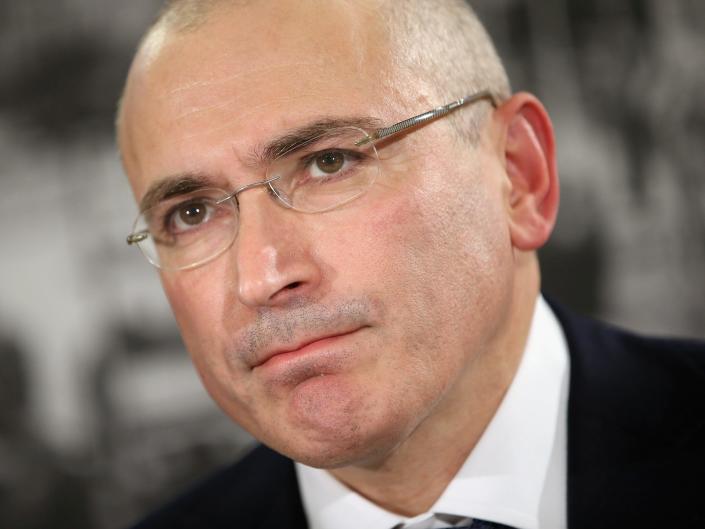
Mikhail Khodorkovsky, the former Yukos oil company chairman who was charged with embezzlement and tax evasion, speaks to the media at his first press conference since his release from a Russian prison.
Mikhail Khodorkovsky, the former Yukos oil company chairman who was charged with embezzlement and tax evasion, speaks to the media after his release from a Russian prison.Sean Gallup/Getty Images
  • Mikhail Khodorkovsky was once Russia’s richest man, before spending almost a decade in prison.
  • He told CNN that the Ukraine war has “significantly reduced” Putin’s ability to stay in power.
  • “We are no longer thinking in terms of him being around another decade,” he said in the interview.

Mikhail Khodorkovsky — an exiled oligarch who was once the richest man in Russia — said on Friday that Vladimir Putin’s invasion of Ukraine has “significantly reduced” the longtime president’s chances of remaining in power.

“I’m convinced that Putin hasn’t got much time left. Maybe a year, maybe three,” he told CNN during an interview, adding later, “Today we are no longer thinking in terms of him being around another decade as we thought a week ago.”

Khodorkovsky is the former CEO of the Russian oil giant Yukos, a position that temporarily made him Russia’s richest man in 2003 with a reported net worth of $15 billion. In 2001, he founded Open Russia, a diplomacy initiative that was later shut down by Russian authorities.

After being charged with fraud and tax evasion, Khodorkovsky was sentenced to nine years in prison in 2005. He was later pardoned by Putin and released a year early in 2013.

Detention Centre no. 1, where Andrei Pivovarov - former head of the exiled Kremlin critic Mikhail Khodorkovsky's pro-democracy group Open Russia — is being held after his arrest last year.
Detention Center No. 1, where Andrei Pivovarov — the former head of the exiled Kremlin critic Mikhail Khodorkovsky’s pro-democracy group Open Russia — is being held after his 2021 arrest.KIRILL KUDRYAVTSEV/AFP via Getty Images

Khodorkovsky said his imprisonment was politically motivated. Putin’s former prime minister testified that the Kremlin ordered Khodorkovsky’s arrest due to his funding of the opposition party, according to a 2010 Reuters report.

Now the exiled businessman lives in London and is known as one of Putin’s most outspoken critics. In his interview with CNN, Khodorkovsky said Putin is his “personal enemy” but also “the enemy of humankind.” A handful of Russian billionaires have spoken out over the past week to similarly denounce the invasion of Ukraine.

His prediction that Russia’s attack on Ukraine will eventually end Putin’s rule has been echoed by experts at the Kennan Institute, a Russian research center in the US.

“The attack on Ukraine was not just an absolute crime,” Mikhail Minakov, the institute’s senior advisor on Ukraine, wrote in a blog post last week. “It was an irreparable mistake that put into motion the end-game for Putin’s regime in Russia.”

Hate for Putin’s Russia Consumes Ukraine

The New York Times

Hate for Putin’s Russia Consumes Ukraine

Maria Varenikova – March 7, 2022

A funeral near Lviv, Ukraine, on Sunday, March 6, 2022, for a member of the Ukrainian Army who died while fighting Russian forces. (Ivor Prickett/The New York Times)

LVIV, Ukraine — Trapped in his apartment on the outskirts of Kyiv during fierce battles over the weekend, the well-known Ukrainian poet Oleksandr Irvanets composed a few lines that encapsulated the national mood.

“I shout out to the whole world,” he wrote in a short poem published online by his fans, who have since lost touch with the writer and were worried that he may have fallen behind Russian lines. “I won’t forgive anyone!”

If there is one overriding emotion gripping Ukraine right now, it is hate.

It is a deep, seething bitterness for President Vladimir Putin, his military and his government. But Ukrainians are not giving a pass to ordinary Russians, either, calling them complicit through years of political passivity. The hatred is vented by mothers in bomb shelters, by volunteers preparing to fight on the front lines, by intellectuals and by artists.

The emotion is so powerful it could not be assuaged even by an Orthodox religious holiday on Sunday intended to foster forgiveness before Lent. Called Forgiveness Sunday, the holiday is recognized in both the Russian and Ukrainian Orthodox churches.

And this hatred has overwhelmed the close personal ties between two Slavic nations, where many people have family living in both countries.

Billboards have gone up along roadsides in gigantic block letters, telling Russians in profanity-laced language to get out. Social media posts in spaces often shared by Russians and Ukrainians have been awash in furious comments.

Some Ukrainians have posted pictures of people killed in the military assault in Russian chat rooms on the Telegram app. They have vented by writing on the reviews pages for websites of Moscow restaurants.

And they have been mocking Russians in scathing terms for complaining about hardships with banking transactions or the collapsing ruble currency because of international sanctions.

“Damn, what’s wrong with Apple Pay?” Stanislav Bobrytsky, a Ukrainian computer programmer also trapped in the fighting around the capital, Kyiv, wrote sarcastically about how Russians are responding to the war. “I cannot pay for a latte in my favorite coffee shop.”

Putin is the target of much of the Ukrainians’ unbridled resentment.

The authoritarian leader is to blame, almost all Ukrainians agree. But the frustration is also directed more broadly at Russian society.

Many Ukrainians chastise Russians for increasingly accepting middle-class comforts afforded by the country’s oil wealth in exchange for declining to resist limits on their freedoms. They blame millions of Russians, who Ukrainians say gave up on the post-Soviet dreams of freedom and openness to the West, for enabling the war.

“Are your iPhones all right?” another Ukrainian writer, Andriy Bondar, asked Russians on his Facebook page, after a thinly attended anti-war rally in Moscow that was broken up by the riot police. “We are very worried about you. It’s so cruel they use rubber sticks, those terrible riot police.”

President Volodymyr Zelenskyy of Ukraine also appealed to Russians on Sunday to protest for their own sakes as much as for the Ukrainians.

“Don’t miss this opportunity,” he said in comments directed at Russians.

“Citizens of Russia, for you this is a struggle not only for peace in Ukraine, it is a struggle for your country, for the best that was in it, for the freedom that you saw, for the prosperity that you felt,” he added. “If you keep silent now, then only your poverty will speak for you later, and only repression will answer. Do not be silent!”

Zelenskyy did not hold back on how he felt about the Russian military.

“We will not forgive the shooting of unarmed people,” he said.

There were virtually no anti-war protests in Russia before the conflict began, though small demonstrations have been staged in recent days. Most participants were arrested.

Yuri Makarov, the chief editor of the Ukrainian national broadcasting company and the head of a national literature and arts award committee, said the war had driven a deep wedge between the Ukrainian and Russian societies that will be hard to heal. Russians, he said, have become Ukrainians’ “collective enemies.”

Some modicum of popular support is enabling the fighting, he said.

“The orders to shell the residential areas of Mariupol, Kharkiv and Zhytomyr were given by specific colonels, captains and junior lieutenants, not by Putin or Shoigu,” he said, referring to the Russian president and his minister of defense, Sergei K. Shoigu. “It is their choice and their responsibility,” he added.

“As for the Russians, I am not interested in their motivation now. They, with the exception of a few, were quite comfortable being in a full dictatorship,” he added.

Olha Koba, a psychologist in Kyiv, said that “anger and hate in this situation is a normal reaction and important to validate.” But it is important to channel it into something useful, she said, such as making incendiary bombs out of empty bottles.

“When people are happy about the death of Russian soldiers, it is explicable” she said. “There is a subconscious understanding that this soldier will no longer be able to kill their loved ones.”

Irvanets, the poet who sent his bitter composition to friends over the weekend, wrote that he had composed the lines in “a city shattered by missiles,” and he referenced the upcoming holiday on Sunday.

But by Forgiveness Sunday, his fans were writing on social media that he had not been in contact and they were concerned that something had happened to him.

“I will never forgive Russia,” the poet wrote.

Decoding the ‘Z’ — the mysterious Russian military symbol that’s been co-opted by Russia’s nationalist movement

Insider

Decoding the ‘Z’ — the mysterious Russian military symbol that’s been co-opted by Russia’s nationalist movement

Cheryl Teh – March 7, 2022

A protester holds a "Z" sign banner, in reference to Russian tanks marked with the letter, during a rally organised by Serbian right-wing organisations in support of Russian attacks on Ukraine, in Belgrade March 4, 2022.
Around a thousand Serbian ultra nationalist supporters marched in Belgrade in support of the Russian attacks on Ukraine, some carrying banners with a white “Z.”Milos Miskov/Anadolu Agency via Getty Images
  • A new emblem has surfaced in the Ukraine-Russia conflict: a “Z,” stylized in a thick brushstroke.
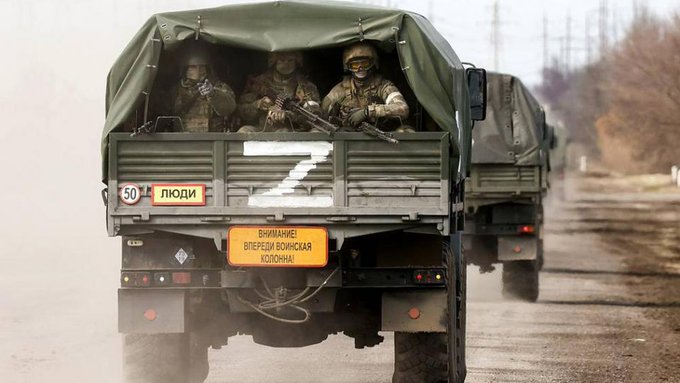
  • The “Z” was spotted on Russian tanks invading Ukraine and painted on the sides of military vehicles.
  • It may have started off as a Russian signal for victory, but has been appropriated as a symbol of the far-right.

A new symbol of Russia’s war against Ukraine has emerged — a white “Z” emblem, stylized in a thick brushstroke. It has found its way onto the signs and t-shirts of ultra-right, pro-Russian protesters, been painted on Russian tanks and military vehicles, and been worn as a show of support for Russia’s invasion.

In the past several weeks, the “Z” has gone from a military marking to a potent symbol of support for Russia’s invasion of Ukraine. And there are signs that Russian nationalist groups have co-opted the mark as well.

The emblem was first spotted on Russian tanks in February
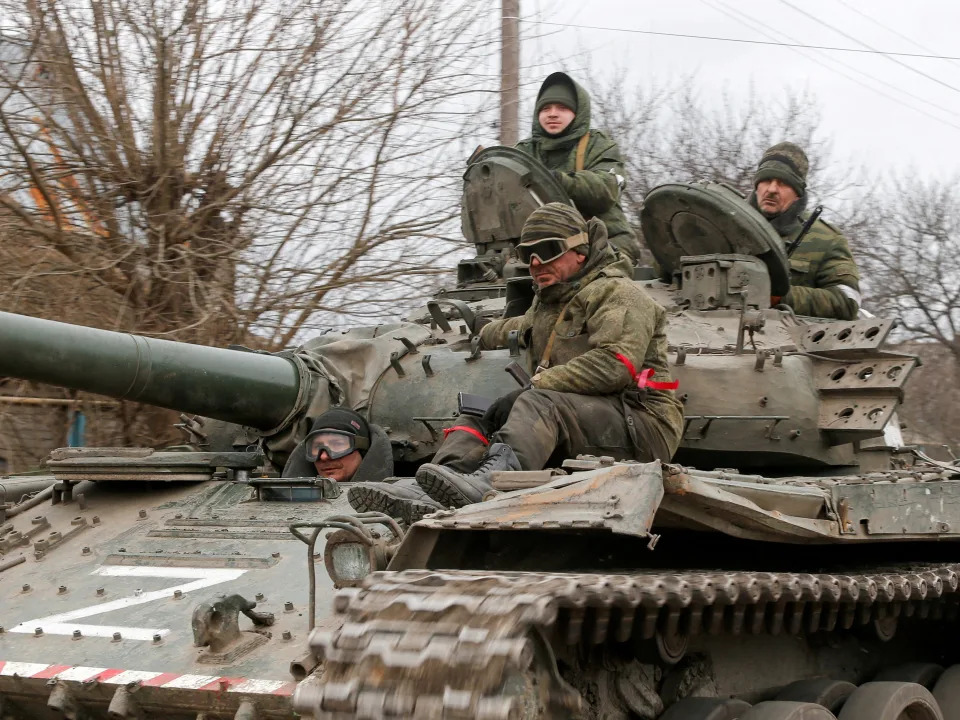
Service members of pro-Russian troops in uniforms without insignia are seen atop of a tank with the letter "Z" painted on its sides in the separatist-controlled settlement of Buhas (Bugas), as Russia's invasion of Ukraine continues, in the Donetsk region, Ukraine March 1, 2022.
The original meaning of the “Z” symbol is unclear and has not been confirmed by official sources.Alexander Ermochenko/Reuters

The “Z” symbol was first spotted on February 22, emblazoned on Russian military vehicles rolling into Ukraine’s Donetsk region.

Twitter commenters speculated that the “Z” symbols, which appeared on tanks framed by squares, triangles, and other painted shapes, could be a way to delineate infantries.

Kamil Galeev, a former Galina Starovoitova Fellow on Human Rights and Conflict Resolution at the policy think tank the Wilson Center, tweeted that some interpreted the “Z” as short for “za pobedy” — the Russian term for “victory.” Others have guessed the “Z” is short for “zapad” (or west) and is meant to designate west-bound infantry.

The meaning of the symbol has yet to be confirmed by Russian military sources.

Image

Let’s discuss what’s happening in Russia. To put it simply, it’s going full fascist. Authorities launched a propaganda campaign to gain popular support for their invasion of Ukraine and they’re getting lots of it. You can see “Z” on these guys’ clothes. What does it mean?

Image
“Z” is a letter that Russian Military are putting on their vehicles departing to Ukraine. Some interpret “Z” as “Za pobedy” (for victory). Others – as “Zapad” (West). Anyway, this symbol invented just a few days ago became a symbol of new Russian ideology and national identity
A symbol of Russian nationalism and a rallying cry in support of Putin
A tank with the symbol "Z" painted on its side is seen in the separatist-controlled village of Bugas during Ukraine-Russia conflict in the Donetsk region, Ukraine March 6, 2022
The “Z” symbol has appeared on the sides of Russian military vehicles in the country’s invasion of Ukraine.Alexander Ermochenko/ Reuters

Despite the letter “Z” not being in the Cyrillic Russian alphabet, the letter appears to have woven itself into the broader Russian wartime narrative.

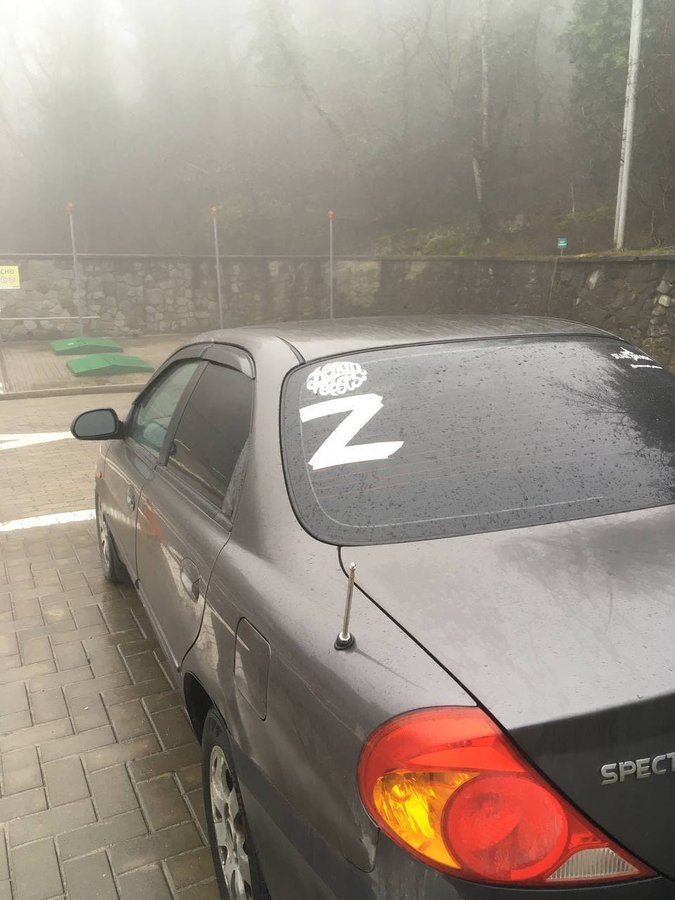
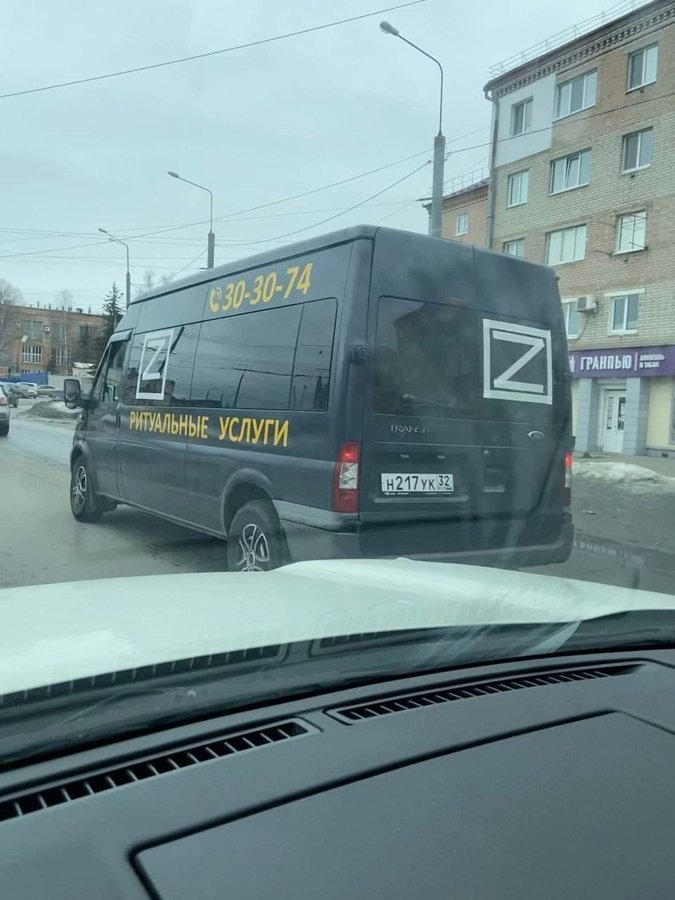
Cars were spotted around Russia emblazoned with the “Z” logo, and businesses have also co-opted the symbol.

Image
It found a lot of supporters. Many Russians are putting “Z” on their cars – that’s totally voluntary and to my best knowledge nobody’s forcing them
Image
Business owners put “Z” – showing their support of invasion on their trucks. Here you see a funeral service fully endorsing Z message

On March 4, a crowd of pro-Russian far-right Serbian protesters marching in Belgrade waved signs decorated with the “Z.”

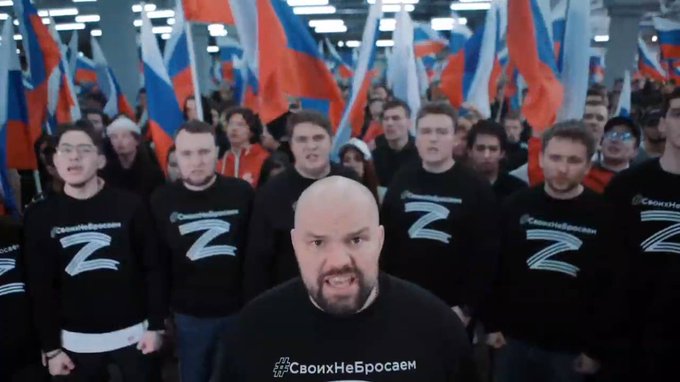
Similarly, a group of Russian nationalist protesters in Leningrad were filmed wearing hoodies emblazoned with a white “Z” along with the words “We don’t give up our own.” It is unclear when the video was taken, but it surfaced on social media in the first week of March.

The slogan echoed false Russian propagandist claims that the invasion is meant to “liberate” and “de-Nazify” Ukraine — an independently-governed democracy led by a Jewish president.

On Sunday, a Russian gymnast appeared at a medal ceremony with a “Z” taped to his uniform
Image

Russian gymnast Ivan Kuliak taped a “Z” symbol on the front of his uniform while accepting a medal at the gymnastics World Cup in Doha on Sunday. He came in third, behind Ukraine’s Illia Kovtun, who came in first.

The International Gymnastics Federation has called on the Gymnastics Ethics Foundation to investigate Kuliak’s actions.

Pro-Putin figures also donned the symbol. Maria Butina, a convicted Russian spy and current member of the Russian State Duma, was seen in a video removing her blazer and drawing a “Z” on her lapel.

Insider’s live blog of the Russian invasion is covering developments as they happen.