Invading Russian troops ‘will be dog food’ insists defiant Ukrainian general
Andy Wells, Freelance Writer – March 10, 2022
Service members of pro-Russian troops drive an armoured vehicle in the separatist-controlled settlement of Rybinskoye in the Donetsk region, Ukraine. (Reuters)
As the war in Ukraine rages on, a defiant Ukrainian General has sent out a stark warning to Russian troops entering the country.
Vladimir Putin’s soldiers in Mykolaiv, a key staging post for control of the Black Sea, have been met with fierce resistance, putting an early end to Russia’s attempt at advancing.
General Dmytro Marchenko, of Ukraine’s Armed Forces, has now told The Times that Ukrainian resistance is not phased by Russian soldiers continuing with their bombardment.
He said: “It’s unpleasant to say this but their corpses are food for stray dogs.
“We’re not able to retrieve them because of continuing Russian fire in those areas.”
A residential building damaged by shelling, amid the Russian invasion of Ukraine, in Mykolayiv, Ukraine. (State Emergency Service of Ukraine/Reuters)
Marchenko insisted that Ukrainian troops “won’t shoot any Russian soldiers who give up” but warned: “The rest of them will become dog food.”
While troops have been forced to a retreat in Mykolaiv, Vladimir Putin continues his deadly onslaught in other parts of the country – including striking at maternity hospital in the besieged port city of Mariupol.
Watch: Mykolaiv mayor gives update on his besieged city https://s.yimg.com/rx/vrm/builds/40459743/xdomain-vpaid.html?id=3
Boris Johnson described the attach as “depraved” and said the UK was considering more support for Ukraine to defend itself against airstrikes.
Mariupol deputy mayor Sergei Orlov said this morning that at least three people had been killed in the strike, including a six-year-old child.
Around 17 people were reportedly injured in the strike against the hospital, where the vast majority of patients are pregnant women – many of whom were in labour.
A person is carried out after the destruction of Mariupol children’s hospital in Mariupol, Ukraine. (Reuters)A car burns after the destruction of Mariupol children’s hospital, in Mariupol, Ukraine. (Reuters)
Defence minister James Heappey accused Russia of committing a war crime by striking the hospital, telling BBC Breakfast this morning: “We ask ourselves the question how did this happen? Was it an indiscriminate use of artillery or missiles into a built-up area, or was a hospital explicitly targeted?
“Both are equally despicable, both, as the Ukrainians have pointed out, would amount to a war crime.”
Pressed on whether he thinks the attack constitutes a war crime, he replied: “Yes, if you deliberately target a piece of civilian infrastructure like a hospital, yes.
President of Ukraine Volodymyr Zelenskyy condemned the strike on a maternity hospital in Mariupol as an ‘atrocity’. (Getty)
“If you use indiscriminate artillery into an urban area without due regard for the reality, you could hit a protected site like a hospital, then that too in my view is.”
President Zelenskyy posted footage online showing the damage from what he said was a “direct strike” on the hospital, with windows blown out and debris strewn through the corridors.
In a call on Wednesday evening, Johnson joined Zelenskyy in condemning the strike, noting that this, together with reports Russian forces had failed to respect ceasefire agreements, was “yet further evidence that Putin was acting with careless disregard for international humanitarian law”, Downing Street said.
More Russian troops were killed in Ukraine in 2 weeks than U.S. troops in entire Iraq War, U.S. estimates
Peter Weber, Senior editor – March 10, 2022
Dead Russian soldier in Ukraine Anastasia Vlasova/Getty Images
Russian forces continue to make inroads in southern Ukraine, but few military experts seem to think the war is going very well for Russia. The invading army has suffered “very, very significant casualties,” a U.S. official told CBS News on Wednesday, putting the U.S. estimate at between 5,000 and 6,000 Russian troops killed in action. That’s comparable to losses in World War II battles, the U.S. official said. It’s also, as Fox News’ Jacqui Heinrich notes, “more than the number of Americans killed during the Iraq War.”
The U.S. estimate is about halfway between the 500 Russian casualties Moscow claims and the 12,000 Russian deaths claimed by Ukraine. The U.S. intelligence estimate also puts Ukraine’s casualties at 2,000 to 4,000 killed troops plus hundreds or thousands of slain civilians.
Putin planned his “disastrous” Ukraine war “in high secrecy in order to avoid leaks,” and his risk-reward analysis was skewed by a lack contingency planning from his tiny circle of generals, misplaced optimism in Russia’s sanctions-proofing, and the surprisingly “deplorable state of Russian expertise on Ukraine,” Russia expert Alexander Gabuev at the Carnegie Moscow Center tweeted Wednesday. The result is “a tragedy for Ukraine, and a catastrophe for Russia.”
“Putin truly believed people would greet (Russians) with flowers. Instead, they were met with Molotov cocktails,” Ukrainian diplomat Volodomyr Shalkivskyi said at Australia’s National Press Club on Thursday. “Russian soldiers going into Ukraine did not have extra ammo or food in their packs. They did however have a parade uniform for a Russian victory parade through Kyiv,” he added. “You cannot win a war against a free people determined to fight for their freedom. There is no way we will give up.”
Satellite images show a large Russian military convoy deployed near a Ukrainian airport northwest of Kyiv
Lauren Frias – March 10, 2022
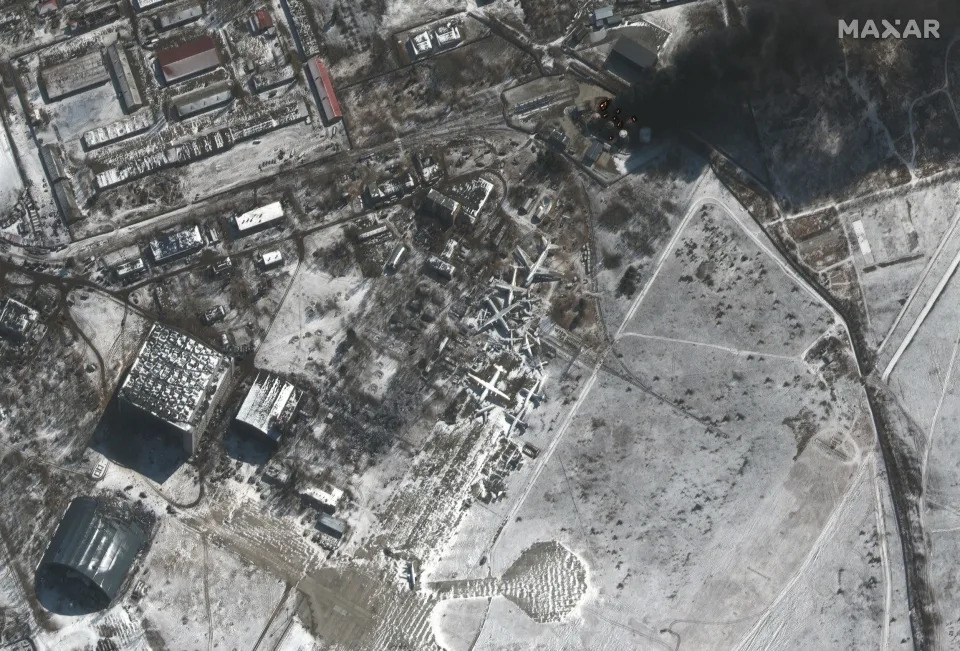
Troops and military vehicles deployed in Ozera, northeast of Antonov Airport.Maxar Technologies
A Russian military convoy was seen deployed in towns north of Kyiv, satellite images show.
The convoy was spotted near the Antonov Airport in Hostomel, Ukraine, which is 54 kilometers, or 33 miles, northwest of the capital.
The deployment points to Russian efforts to move further into Ukraine amid its ongoing assault on the country.
Satellite images show a Russian military convoy driving through a town near a Ukrainian airport north of Kyiv.
The convoy was spotted near the Antonov Airport in Hostomel, Ukraine, which is 54 kilometers, or 33 miles, northwest of the capital.
The images taken by Maxar Technologies point to a Russian effort to expand its presence throughout Ukraine outside of Kyiv amid its ongoing assault on the country.
“On this morning’s imagery (collected at 11:37 AM local time on March 10th), the large Russian military convoy that was last seen northwest of Kyiv near Antonov Airport has largely dispersed and redeployed,” Maxar reported.
“Armored units are seen maneuvering in and through the surrounding towns close to the airport, elements of the convoy further north have repositioned and are deployed in forests/along tree lines near Lubyanka with towed artillery howitzers in firing positions nearby,” according to an email from the space technology company.
Other images captured fuel storage tanks on fire near the airport on fire and military equipment deployed around the airport itself.
Fuel storage tanks on fire and military equipment deployed around Antonov Airport.Maxar TechnologiesFuel storage tanks on fire and military equipment deployed around Antonov Airport.Maxar Technologies
CIA director: Putin’s “propaganda bubble” is failing in Ukraine
Zachary Basu – March 10, 2022
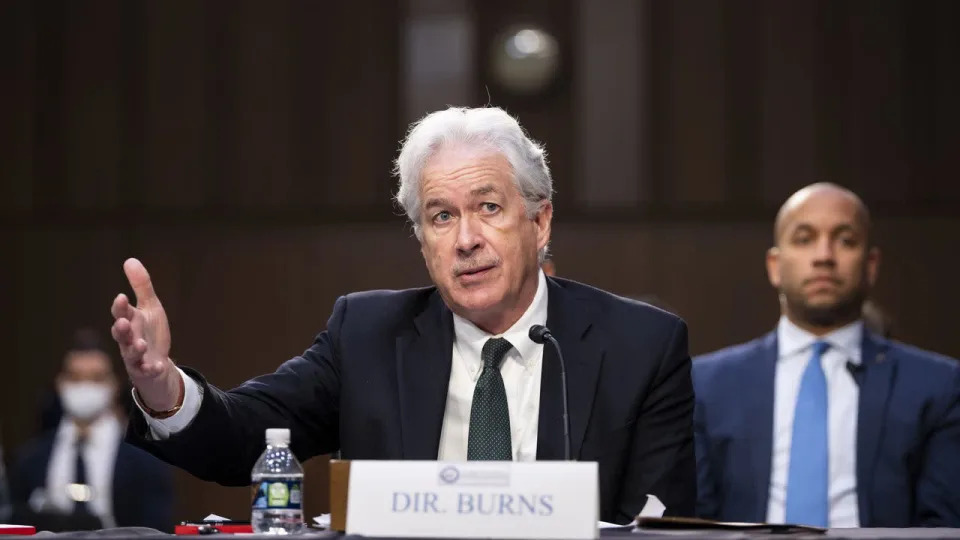
CIA Director Bill Burns testified Thursday that he believes Vladimir Putin is “losing the information war” in Ukraine, undermining the Russian leader’s ability to rally support at home and abroad for his war of aggression.
Why it matters: Putin has spent two decades building a “propaganda bubble” and laundering disinformation through state media, Burns said. That’s why the U.S. has adopted the novel approach of attempting to preemptively debunk Russia’s narratives about Ukraine, blunting the impact of “false flag” operations that succeeded in the past.
Driving the news: The Biden administration has in recent days warned that Russia may attempt to use chemical or biological weapons in Ukraine, after Kremlin-controlled media began propagating stories about dangerous bioweapons labs in Ukraine allegedly funded by the U.S.
The U.S. government has rejected these claims as complete fabrications and suggested that Russia may use them as “false pretexts in an attempt to justify its own horrific actions in Ukraine.”
Exploiting disinformation around chemical weapons has long been part of Putin’s “playbook,” Burns said, pointing to Russia’s poisoning of former double agent Sergei Skripal in 2017 and opposition leader Alexei Navalny in 2020.
Russia has also sought to cover up the Assad regime’s use of chemical weapons in Syria.
What they’re saying: “I am convinced that our efforts at selective declassification, to preempt those kind of false flag narratives and the creation of false narratives, have been so important,” testified Burns, a former veteran career diplomat and U.S. ambassador to Russia, to the Senate Intelligence Committee.
“In all the years I spent as a career diplomat, I saw too many instances in which we lost information wars with the Russians,” he continued.
“In this case, I think we have had a great deal of effect disrupting their tactics and their calculations and demonstrating to the entire world that this is premeditated and unprovoked aggression built on a body of lies and false narratives. So this is one information war that I think Putin is losing.”
The big picture: Even as Putin has “intensified his domination of state-run media” and “strangulation of independent media,” Burns suggested Russia is struggling to fully control the narrative at home.
“There are lots of Russians who have VPN accounts, who have access to YouTube to this day, who have access to information, and I don’t believe he can wall off indefinitely Russians from the truth,” Burns testified.
The bombing of a maternity ward and children’s hospital in Mariupol on Wednesday is one particularly potent example, as Russia has scrambled to rationalize the brutality of an attack that has triggered outrage all over the world.
Zoom in: Some Russian officials have claimed that the hospital was occupied by a neo-Nazi militia, and that no civilians were targeted.
Others have said the airstrike was “staged” by Ukraine.
The Russian embassy in London suggested on Twitter that a wounded pregnant woman photographed at the site of the bombing was a crisis actor — prompting the platform to remove the post for violating its rules on “denial of violent events.”
The bottom line: “The realities of killed and wounded coming home in increasing numbers, the realities of the economic consequences for ordinary Russians … the realities of the horrific scenes of hospitals and schools being bombed next door in Ukraine — I don’t think he can bottle up the truth indefinitely,” Burns said.
Even Russian State TV Is Pleading With Putin to Stop the War
Julia Davis – March 10, 2022
MIKHAIL KLIMENTYEV
There is a notable mood shift in Russia, as darkness sets over its economy and the invasion of Ukraine hits major problems. While the beginning of President Vladimir Putin’s full-scale war against Ukraine was greeted with cheers, clapping, and demands of Champagne in the studio, the reality sobered up even the most pro-Kremlin pundits and experts on Russian state television.
The ugly truth about Russia’s invasion of Ukraine is slipping through the cracks, despite the government’s authoritarian attempts to control the narrative.
The Kremlin-controlled state media is doing its best to flip the situation upside down, blaming the victims of Russia’s aggression for all of the casualties. On Wednesday’s edition of the state TV show The Evening With Vladimir Soloviev, the host claimed the fallout of Russia’s bombing of a maternity hospital this week was “fake” with no one there to be injured, despite photos of pregnant women being carried away from the blast that killed at least one child. A guest on 60 Minutes last Saturday even claimed Ukrainians “are firing on each other and blaming us.”
On Thursday, Russia’s Foreign Minister Sergei Lavrov claimed that Russia never attacked Ukraine and repeated the same lies as Soloviev about the total absence of patients in the maternity ward and children’s hospital bombed by Russia.
Putin’s most trusted propagandists are becoming ever more desperate to distort or deny the evidence of the atrocities because the truth is finding its way past the roadblocks erected by the Kremlin. Russian citizens are not pleased either with the war, nor with the financial price they have to pay for their leader’s ill-conceived military conquests.
Even the infamous show run by Soloviev—who was recently sanctioned as an accomplice of Putin by the European Union—became dominated by predictions of Russian doom and gloom. Andrey Sidorov, deputy dean of world politics at Moscow State University, cautioned: “For our country, this period won’t be easy. It will be very difficult. It might be even more difficult than it was for the Soviet Union from 1945 until the 1960s… We’re more integrated into the global economy than the Soviet Union, we’re more dependent on imports—and the main part is that the Cold War is the war of the minds, first and foremost. Unfortunately, the Soviet Union had a consolidating idea on which its system was built. Unlike the Soviet Union, Russia has nothing like that to offer.”
State TV pundit Karen Shakhnazarov pointed out: “The war in Ukraine paints a frightening picture, it has a very oppressive influence on our society. Ukraine, whichever way you see it, is something with which Russia has thousands of human links. The suffering of one group of innocents does not compensate for the suffering of other innocent people… I don’t see the probability of denazification of such an enormous country. We would need to bring in 1.5 million soldiers to control all of it. At the same time, I don’t see any political power that would consolidate the Ukrainian society in a pro-Russian direction… Those who talked of their mass attraction to Russia obviously didn’t see things the way they are. The most important thing in this scenario is to stop our military action. Others will say that sanctions will remain. Yes, they will remain, but in my opinion discontinuing the active phase of a military operation is very important.”
Resorting to the traditional propaganda tropes prevalent in Russian state media, Shakhnazarov accused the United States of starting the war—and trying to prolong it indefinitely. He speculated: “What are they achieving by prolonging the war? First of all, public opinion within Russia is changing. People are shocked by the masses of refugees, the humanitarian catastrophe, people start to imagine themselves in their place. It’s starting to affect them. To say that the Nazis are doing that is not quite convincing, strictly speaking… On top of that, economic sanctions will start to affect them, and seriously. There will probably be scarcity. A lot of products we don’t produce, even the simplest ones. There’ll be unemployment. They really thought through these sanctions, they’re hitting us with real continuity. It’s a well-planned operation… Yes, this is a war of the United States with Russia… These sanctions are hitting us very precisely.
“This threatens the change of public opinion in Russia, the destabilization of our power structures… with the possibility of a full destabilization of the country and a civil war. This apocalyptic scenario is based on the script written by the Americans. They benefit through us dragging out the military operation. We need to end it somehow. If we achieved the demilitarization and freed the Donbas, that is sufficient… I have a hard time imagining taking cities such as Kyiv. I can’t imagine how that would look. If this picture starts to transform into an absolute humanitarian disaster, even our close allies like China and India will be forced to distance themselves from us. This public opinion, with which they’re saturating the entire world, can play out badly for us… Ending this operation will stabilize things within the country.”
The host frowned at the apparent departure from the officially approved line of thinking and deferred to the commander-in-chief. However, the next expert agreed with Shakhnazarov. Semyon Bagdasarov, a Russian Middle East expert, grimly said: “We didn’t even feel the impact of the sanctions just yet… We need to be ready for total isolation. I’m not panicking, just calling things by their proper name.”
Soloviev angrily sniped: “Gotcha. We should just lay down and die.”
Bagdasarov continued: “Now about Ukraine. I agree with Karen. We had prior experiences of bringing in our troops, destroying the military infrastructure and leaving. I think that our army fulfilled their task of demilitarization of the country by destroying most of their military installations… To restore their military they will need at least 10 years… Let Ukrainians do this denazification on their own. We can’t do it for them… As for their neutrality, yes, we should squeeze it out of them, and that’s it. We don’t need to stay there longer than necessary… Do we need to get into another Afghanistan, but even worse? There are more people and they’re more advanced in their handling of weapons. We don’t need that. Enough already… As for the sanctions, the world has never seen such massive sanctions.”
Dmitry Abzalov, director of the Center for Strategic Communications, pointed out that even though energy prices will go up for most of the West, it won’t do much to ease the pain for the Russians: “We’ll still be the ones taking the terminal hit, and an incomparable one, even though other countries will also suffer some losses. We’ll all be going to hell together—except for maybe China—but going to hell together with the French or Germans won’t make our people feel any better.” Abzalov argued that after taking additional territories in Eastern Ukraine, Russia should get out of Dodge, believing that all Western companies that temporarily paused their operations in Russia would then rush to come back. “It’s about toxicity, not just sanctions… It will go away once the situation stabilizes.”
Prior to the invasion of Ukraine, state TV experts predicted that Russia could overtake it in a matter of minutes or a few days. Stunned by the fierce resistance on the part of Ukrainians, Soloviev described them as “the army that is second in Europe, after ours, and which has been prepared for eight years and armed with everything you can imagine.”
Soloviev added: “This is a frightening war that is being waged against us by America.”
To lighten the mood in the studio, the host resorted to one of the favorite pastimes of many Kremlin propagandists: playing yet another Fox News clip of Tucker Carlson and his frequent guest Ret. Col. Doug Macgregor. In the translated video, Macgregor predicted Russia’s easy military victories over Ukraine and its total invincibility to Western sanctions. Soloviev sighed and smiled: “He’s a lot more optimistic than my previous experts in the studio.”
Russian state television goes off message by denouncing Ukraine war
James Kilner – March 10, 2022
Russia 1 is usually a reliable source of propaganda, but guests on one of its most popular shows spoke out against the invasion of Ukraine – Russian Defense Ministry Press Service
Russian state television has broadcast calls for Vladimir Putin, the country’s president, to stop his war in Ukraine during a programme in which pundits openly likened the invasion to “Afghanistan, but even worse”.
Vladimir Soloviyev, usually one of the Kremlin’s most reliable chief propagandists, had to interrupt guests on his prime time television talk show to stop their criticism of Russia’s invasion of Ukraine.
He told Mr Soloviyev: “I have a hard time imagining taking cities such as Kyiv. I can’t imagine how that would look.”
He went on to call for the conflict to be brought to an end, saying: “If this picture starts to transform into an absolute humanitarian disaster, even our close allies like China and India will be forced to distance themselves from us.
“This public opinion, with which they’re saturating the entire world, can play out badly for us … Ending this operation will stabilise things within the country.”
Later during the broadcast of An Evening with Vladimir Soloviyev, one of Russian television’s most-watched programmes, guest Semyon Bagdasarov, an academic, said: “Do we need to get into another Afghanistan, but even worse?”
He said that in Ukraine “there are more people and they’re more advanced in their weapon handling”, adding: “We don’t need that. Enough already.”
The reference to Afghanistan, a conflict that scarred the Soviet Union and still scars Russia, was particularly poignant. The Soviet Union pulled out of Afghanistan in 1989, 10 years after it invaded, humiliated.
Historians have said that the Afghanistan failure and the disillusionment that millions felt after it helped pull down the Soviet Union two years later. Thousands of Soviet soldiers were killed in the war, which became deeply unpopular at home.
The invasion of Ukraine has been likened to the Soviet Union’s war in Afghanistan in the 1980s – AP Photo/Estate of Alexander Sekretarev
A clearly irritated Mr Soloviyev, who owns a villa in Italy that has been seized and sanctioned by the European Union, interrupted Mr Bagdasarov.
The Kremlin relies heavily on state television to project the message that Putin’s so-called “special operation” to rescue the Russian kinfolk of Ukraine from Nazis is going to plan.
Kremlin state television is one of the few sources of information about the war for the Russian public, after authorities restricted access to some social media sites and forced independent stations off the air.
News of the setbacks in Ukraine appears to be filtering back to Russia. Over the weekend, a video emerged which showed mothers of soldiers angrily confronting a regional official and accusing the Kremlin of using their sons as “cannon fodder”.
The prime time Vladimir Soloviyev show is not the only one that appears to be straying off-message.
On the Russian ministry of defence’s television channel, Zvezda, a serving army officer explained to a talk show audience how Russian soldiers were dying in Ukraine.
“Our guys over there, from Donetsk and Luhansk, and our special operation forces are dying and our country,” he said.
“No, no, no,” interrupted the presenter who gets up from his desk gesticulating and marches across the studio shouting: “Stop!”
“Our youth are still dying,” the soldier continued.
By this time, the presenter had come up to him and shouted: “Can you stop now? I will tell you what our guys are doing there. Our guys are smashing the fascist snakes. It’s a triumph of the Russian army. It’s a Russian renaissance.”
Just a few weeks ago many influential figures on the U.S. right loved, just loved Vladimir Putin. In fact, some of them still can’t quit him. For example, Tucker Carlson, while he has grudgingly backed off from full-on Putin support, is still blaming America for the war and promoting Russian disinformation about U.S.-funded bioweapons labs.
For the most part, however, America’s Putin lovers are having a moment of truth. It’s not so much that Putin stands revealed as a tyrant willing to kill large numbers of innocent people — they knew or should have known that already. The problem is that the strongman they admired — whom Donald Trump praised as “savvy” and a “genius” just before he invaded Ukraine — is turning out to be remarkably weak. And that’s not an accident. Russia is facing disaster precisely because it is ruled by a man who accepts no criticism and brooks no dissent.
On the military side, a war Russia clearly envisioned as a blitzkrieg that would overrun Ukraine in days has yet to capture any of the country’s top 10 cities — although long-range bombardment is turning those cities into rubble. On the economic side, Putin’s attempt to insulate himself from potential Western sanctions has been a debacle, with everything indicating that Russia will have a depression-level slump. To see why this matters, you need to understand the sources of the right’s infatuation with a brutal dictator, an infatuation that began even before Trump’s rise.
Some of this dictator-love reflected the belief that Putin was a champion of antiwokeness — someone who wouldn’t accuse you of being a racist, who denounced cancel culture and “gay propaganda.”
Some of it reflected a creepy fascination with Putin’s alleged masculinity — Sarah Palin declared that he wrestled bears while President Barack Obama wore “mom jeans” — and the apparent toughness of Putin’s people. Just last year Senator Ted Cruz contrasted footage of a shaven-headed Russian soldier with a U.S. Army recruiting ad to mock our “woke, emasculated” military.
Finally, many on the right simply like the idea of authoritarian rule. Just a few days ago Trump, who has dialed back his praise for Putin, chose instead to express admiration for North Korea’s Kim Jong-un. Kim’s generals and aides, he noted, “cowered” when the dictator spoke, adding that “I want my people to act like that.”
But we’re now relearning an old lesson: Sometimes, what looks like strength is actually a source of weakness.
Whatever eventually happens in the war, it’s clear that Russia’s military was far less formidable than it appeared on paper. Russian forces appear to be undertrained and badly led; there also seem to be problems with Russian equipment, such as communications devices.
These weaknesses might have been apparent to Putin before the war if investigative journalists or independent watchdogs within his government had been in a position to assess the country’s true military readiness. But such things aren’t possible in Putin’s Russia.
The invaders were also clearly shocked by Ukraine’s resistance — both by its resolve and by its competence. Realistic intelligence assessments might have warned Russia that this might happen; but would you want to have been the official standing up and saying, “Mr. President, I’m afraid we may be underestimating the Ukrainians”?
On the economic side, I have to admit that both the West’s willingness to impose sanctions and the effectiveness of those sanctions have surprised just about everyone, myself included.
Still, economic officials and independent experts in Russia should have warned Putin in advance that “Fortress Russia” was a deeply flawed idea. It shouldn’t have required deep analysis to realize that Putin’s $630 billion in foreign exchange reserves would become largely unusable if the world’s democracies cut off Russia’s access to the world banking system. It also shouldn’t have required deep analysis to realize that Russia’s economy is deeply dependent on imports of capital goods and other essential industrial inputs.
But again, would you have wanted to be the diplomat telling Putin that the West isn’t as decadent as he thinks, the banker telling him that his vaunted “war chest” will be useless in a crisis, the economist telling him that Russia needs imports?
The point is that the case for an open society — a society that allows dissent and criticism — goes beyond truth and morality. Open societies are also, by and large, more effective than closed-off autocracies. That is, while you might imagine that there are big advantages to rule by a strongman who can simply tell people what to do, these advantages are more than offset by the absence of free discussion and independent thought. Nobody can tell the strongman that he’s wrong or urge him to think twice before making a disastrous decision.
Which brings me back to America’s erstwhile Putin admirers. I’d like to think that they’ll take Russia’s Ukraine debacle as an object lesson and rethink their own hostility to democracy. OK, I don’t really expect that to happen. But we can always hope.
Chinese leader promises more jobs to support recovery
Associated Press – March 10, 2022
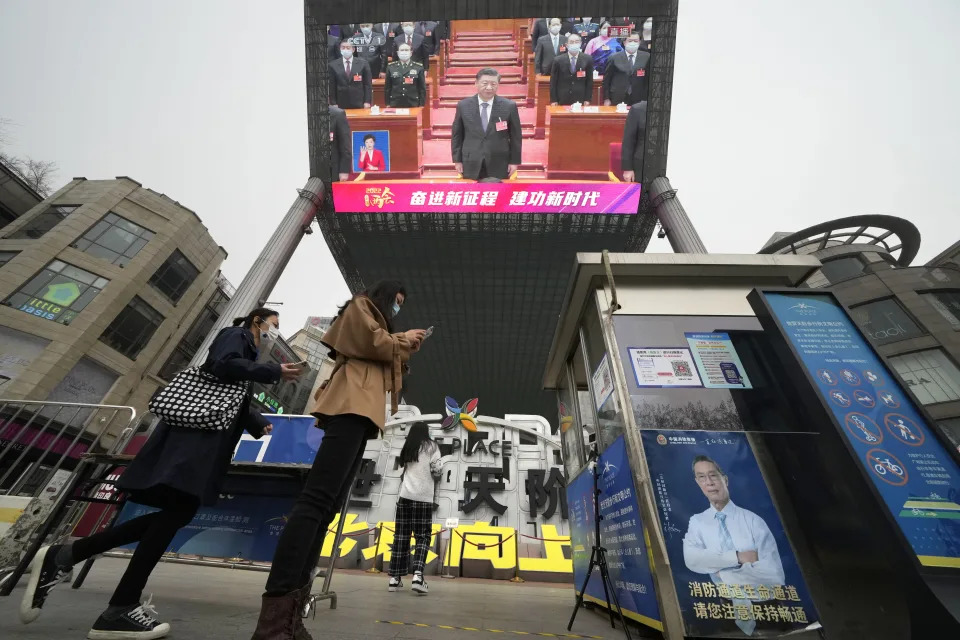
Women scan health check QR codes to enter a shopping mall as a large video screen shows Chinese President Xi Jinping during coverage of the closing session of China’s National People’s Congress (NPC) in Beijing, Friday, March 11, 2022. (AP Photo/Ng Han Guan)ASSOCIATED PRESSSecurity officers stand guard near Tiananmen Gate before the closing session of China’s National People’s Congress (NPC) at the Great Hall of the People in Beijing, Friday, March 11, 2022. (AP Photo/Sam McNeil)ASSOCIATED PRESSA security officer stands guard outside the Great Hall of the People before the closing session of China’s National People’s Congress (NPC) at the Great Hall of the People in Beijing, Friday, March 11, 2022. (AP Photo/Sam McNeil)ASSOCIATED PRESSSecurity officers stand guard near Tiananmen Gate before the closing session of China’s National People’s Congress (NPC) at the Great Hall of the People in Beijing, Friday, March 11, 2022. (AP Photo/Ng Han Guan)ASSOCIATED PRESSA delivery driver stands near a large video screen at a shopping mall showing Chinese President Xi Jinping during coverage of the closing session of China’s National People’s Congress (NPC) in Beijing, Friday, March 11, 2022. (AP Photo/Ng Han Guan)ASSOCIATED PRESSPeople walk past a large video screen at a shopping mall showing coverage of the closing session of China’s National People’s Congress (NPC) in Beijing, Friday, March 11, 2022. (AP Photo/Ng Han Guan)ASSOCIATED PRESSA person watches a large video screen at a shopping mall showing coverage of the closing session of China’s National People’s Congress (NPC) in Beijing, Friday, March 11, 2022. (AP Photo/Ng Han Guan)ASSOCIATED PRESS
BEIJING (AP) — China’s government hopes to generate as many as 13 million new jobs this year to help reverse a painful economic slowdown, the country’s No. 2 leader said Friday.
Premier Li Keqiang promised “pro-job policies” including tax and fee cuts totaling 2.5 trillion yuan ($400 billion) for businesses, especially small entrepreneurs.
Job losses spiked after economic growth slid to 4% over a year earlier in the final quarter of 2021, down from the full year’s 8.1% expansion. That followed a plunge in construction after Beijing tightened controls on debt in its vast real estate industry, adding to strains from the coronavirus pandemic and weak export demand.
China has been hit this month by higher energy costs after Russia’s attack on Ukraine caused global oil prices to soar.
“China aims to create 11 million — or preferably 13 million — urban jobs in 2022,” Li said at a news conference after the closing of the annual meeting of China’s ceremonial legislature.
Li called on Washington to repeal tariffs hikes on Chinese goods imposed in a fight with Beijing over its technology ambitions but gave no indication of possible concessions or other initiatives to resolve the conflict.
Trade envoys of the two governments have yet to meet since President Joe Biden took office in January 2020. They have talked by phone but announced no plans for face-to-face talks or changes in their official stances.
Li said Chinese business leaders he talked with support tax cuts as the quickest way to generate jobs instead of government-led investment or handing out vouchers to households to boost consumer spending.
“We need to rely on market-oriented avenues and means to resolve issues related to employment,” Li said.
Economic growth tumbled last year after Beijing tightened control on surging debt in the real estate industry, which Chinese leaders say is dangerously high. That triggered a slump in housing sales and construction, important economic engines.
Forecasters expect activity to weaken further before rebounding in mid-year. That is due in part to Beijing’s desire to rely on its traditional tool of encouraging real estate investment, which might push up debt and housing costs.
The ruling party earlier announced an annual economic growth target of 5.5%. That was the weakest goal since the 1990s and would be a marked decline from last year’s 8.1% growth.
Economists say achieving even that modest target will require additional government stimulus. Li earlier announced plans to inject money into the economy through higher spending on public works but said Beijing wants to restrain its budget deficit.
Li warned global conditions are “very challenging” after saying earlier that hitting Beijing’s growth target will require ”arduous efforts.”
The weeklong meeting of the 3,000-plus members of the National People’s Congress took place against a backdrop of Russia’s war on Ukraine and the COVID-19 surge.
On Friday, Li called for ceasefire negotiations in Ukraine and promised Chinese help but avoided criticizing Russia and gave no indication Beijing was backing off its support for President Vladimir Putin.
Chinese state media have echoed Russia’s position and said Washington was to blame for the war.
The NPC meeting also served as a sounding board for public concerns including the trafficking of women and children following an outcry over reports of a mother found chained in a shed.
Russia’s attack on Ukraine echoes Beijing’s tensions with Taiwan, the self-ruled island democracy the ruling party claims as part of its territory and has threatened to invade.
A spokesperson for NPC delegation from the ruling party’s military wing, the People’s Liberation Army, this week blamed “separatist activities and collusion with external forces” for tensions with Taiwan and said the more the “United States and Japan make waves on the Taiwan question, the tougher actions we will take.”
The White House and U.S. State Department this week accused Beijing of aiding Russian disinformation efforts, including false claims over U.S. biological weapons labs and chemical weapons development in Ukraine.
Foreign Ministry spokesperson Zhao Lijian on Wednesday said China “urges the U.S. to disclose details on U.S.-financed biological labs in Ukraine, including types of viruses stored and research has been conducted.”
U.S. State Department spokesperson Ned Price called the allegations “outright lies” invented by Russia “in an attempt to justify its own horrific actions in Ukraine.”
This week, China has seen the number of domestic COVID-19 cases shoot to highs that are small compared to much of the world but have been unseen in China since the original outbreak two years ago. On Friday, 397 cases of local transmission were reported nationwide.
Russia moves towards nationalizing assets of firms that leave – ruling party
March 9, 2022
(Reuters) – Russia’s ruling party, United Russia, said on Wednesday that a government commission had approved the first step towards nationalising assets of foreign firms that leave the country in the wake of economic sanctions over Ukraine.
United Russia added in a statement on the Telegram messaging app that the commission on lawmaking activity had supported a bill allowing for firms more than 25% owned by foreigners from “unfriendly states” to be put into external administration.
“This will prevent bankruptcy and save jobs,” it said.
Corporate actions to censure Russia over its invasion of Ukraine vary widely, with some firms like U.S. carmaker Ford temporarily shutting down factories but others like British energy company BP promising to exit the country.
United Russia said according to the proposed bill companies who had announced they were leaving Russia could refuse to go into administration if within five days they resumed activities or sold shares, providing that the business and employees remained.
Otherwise, a court would appoint a temporary administration for three months, after which the shares of the new organization would be put up for auction and the old one would be liquidated, it added.
Kyiv governor calls fight for city ‘Judgement Day’
March 9, 2022
STORY: New recruits to Ukraine’s territorial defense forces in Kyiv got a lesson on Wednesday in newly-arrived weaponry, meant to punch a hole through a Russian tank.
And this instructor, who only gave his name as Alex, told Reuters these men were ready to welcome the Russian army when it tries to take the city.
“Russians can enter Kyiv but they’re not gonna leave it. They’re all gonna be burned up here.”
Many expected Kyiv to quickly fall in the early days of the war.
But more than two weeks into the Russian invasion – which Moscow calls a “special military operation” – Moscow’s military missteps and tenacious Ukrainian resistance has kept the capitol from changing hands.
“Of course, we understand and see that the enemy wants to seize Kyiv, we understand that very well.”
Oleksiy Kuleba is the governor of the Kyiv region.
“Of course, they were not able to seize Kyiv immediately; their aim was to do so in two or three days. This is a well-known fact. They failed because of the heroic actions of our armed forces and ordinary people who stood up to defend our city, our country.”
He spoke to Reuters about the struggle ahead in almost apocalyptic terms.
“For us, this is Judgment Day. It is a struggle between good and evil. And either way, we would die, but we would not let them seize our city.”
Sounds and symbols of Ukrainian resolve spring up around the city.
On Wednesday, the remaining musicians of the Kyiv-Classic Symphony Orchestra performed the Ukrainian and the European Union anthems. The show was broadcast live on Ukrainian TV.
The conductor called the concert an action for peace.
That is the message here: praying for peace; preparing for battle.