Will Paulette Jordan become the nation’s first Native American governor?

August 3, 2018

In the deeply conservative Republican state of Idaho, Paulette Jordan is running for governor. If she wins, she’d become the nation’s first Native American governor. Jordan wants more money for health care and public schools.

And she’s finding support. https://cnn.it/2vxfzVT

Meet Paulette Jordan, an Idaho state legislator running for governor

In the deeply conservative Republican state of Idaho, Paulette Jordan is running for governor. If she wins, she'd become the nation's first Native American governor. Jordan wants more money for health care and public schools. And she's finding support. https://cnn.it/2vxfzVT

Posted by CNN on Thursday, August 2, 2018

For every $100 of white family wealth, black families only have about $5.04.

The Root is with Splinter.

July 2018

In America today, for every $100 of white family wealth, black families only have about $5.04.

It’s a direct result of centuries of racist banking policies and practices that systematically kept black Americans from opportunities to prosper.

Standing Rock Native Americans

Think also of the Native lands & resources taken violently in violation of treaties with our Native American Brothers and Sisters.

Racist History of Banking

In America today, for every $100 of white family wealth, black families only have about $5.04. It’s a direct result of centuries of racist banking policies and practices that systematically kept black Americans from opportunities to prosper.

Posted by The Root on Wednesday, July 11, 2018

Florida Red Tide Outbreak Sickens Thousands

Stranger Than Fiction News was live. Follow

August 1, 2018

BREAKING: FLORIDA RED TIDE OUTBREAK SICKENS THOUSANDS OF PEOPLE AND DEVASTATES MARINE LIFE – BEACHES LINED WITH DEAD TURTLES, MANATEES AND FISH

BREAKING: FLORIDA RED TIDE OUTBREAK SICKENS THOUSANDS OF PEOPLE AND DEVASTATES MARINE LIFE – BEACHES LINED WITH DEAD TURTLES, MANATEES AND FISH

BREAKING: FLORIDA RED TIDE OUTBREAK SICKENS THOUSANDS OF PEOPLE AND DEVASTATES MARINE LIFE – BEACHES LINED WITH DEAD TURTLES, MANATEES AND FISH

Posted by Stranger Than Fiction News on Wednesday, August 1, 2018

Medicare for All’s potential savings

August 3, 2018

Medicare for All’s potential savings has us hungry for more, so here’s a breakdown of how it saves America money and provides better care for all of us… using donuts.

Your Donut Intake Will Not Be Limited Under Medicare for All

Medicare for All's potential savings has us hungry for more, so here's a breakdown of how it saves America money and provides better care for all of us… using donuts.

Posted by MoveOn on Friday, August 3, 2018

Global Heatwave is Symptom of Early Stage Cycle of Civilization Collapse

Welcome to a 1C planet: the precursor of an 8C catastrophe in 82 years if we keep burning up fossil fuels like there’s no tomorrow

Published by INSURGE intelligence, a crowdfunded investigative journalism platform for people and planet. Support us to report where others fear to tread.

The extreme weather events of the summer of 2018 are not just symptoms of climate breakdown. They are early stage warnings of a protracted process of civilisational collapse as industrial societies face some of the opening symptoms of having already breached the limits of a safe climate. These events are a taste of things to come on a business-as-usual trajectory. They elicit a sense of how industrial civilisational systems are vulnerable to collapse due to escalating climate impacts. And they highlight the urgent necessity of communities everywhere undertaking steps to achieve a systemic civilisational transition toward post-capitalist systems which can survive and prosper after fossil fuels.

Climate ‘doom’ is already here

This summer’s extreme weather has hit home some stark realities.

Climate disaster is not slated to happen in some far-flung theoretical future.

It’s here, and now.

Droughts threatening food supplies, floods in Japan, extreme rainfall in the eastern US, wildfires in California, Sweden and Greece.

In the UK, holiday-makers trying to cross the Channel tunnel to France faced massive queues when air conditioning facilities on trains failed due to the heatwave. Thousands of people were stranded for five hours in the 30C heat without water.

In southern Laos, heavy rains led to a dam collapse, rendering thousands of people homeless and flooding several villages.

‘World On Fire’: Climate Breakdown

Most of the traditional media did not report these incidents as symptoms of an evolving climate crisis.

Some commentators did point out that the events might be linked to climate change.

None at all acknowledged that these extreme weather events might be related to the fact that since 2015, we have essentially inhabited a planet that is already around 1C warmer than the pre-industrial average: and that therefore, we are already, based on the best available science, inhabiting a dangerous climate.

Global warming reaches 1°C above preindustrial, warmest in more than 11,000 years

The breaching of the 1C tipping point — which former NASA climate science chief James Hansen pinpointed as the upper limit to retain a safe climate — was followed this March by atmospheric carbon concentrations reaching, for the first time since records began, 400 ppm (parts per million).

400.350.org

Once again, the safe upper limit highlighted by Hansen and colleagues — 350 ppm — has already been breached.

Yet these critical climate milestones have been breached consecutively with barely a murmur from either the traditional and alternative media.

The recent spate of catastrophic events are not mere anomalies. They are the latest signifiers of a climate system that is increasingly out of balance — a system that was already fatally struck off balance through industrial overexploitation of natural resources centuries ago.

The Climate “Doomsday” is Already Here

Our sense-making apparatus is broken

But for the most part, the sense-making apparatus by which we understand what is happening in the world — the Global Media-Industrial Complex (a network of media communications portals comprised of both traditional corporate and alternative outlets) — has failed to convey these stark realities to the vast majority of the human population.

We are largely unaware that 19th and early 20th century climate change induced by industrial fossil fuel burning has already had devastating impacts on the regional climate of Sub-Saharan Africa; just as it now continues to have escalating devastating impacts on weather systems all over the world.

The reality which we are not being told is this: these are the grave consequences of inhabiting a planet where global average temperatures are roughly 1C higher than the pre-industrial norm.

Sadly, instead of confronting this fundamentally existential threat to the human species — one which in its fatal potential implications point to the bankruptcy of the prevailing paradigms of social, political and economic organisation (along with the ideology and value-systems associated with them) — the preoccupation of the Global Media-Industrial Complex is at worst to focus human mind and behaviour on consumerist trivialities.

At best, its focus is to pull us into useless, polarising left-right dichotomies and forms of impotent outrage that tend to distract us from taking transformative systemic action, internally (within and through our own selves, behaviour psychologies, beliefs, values, consciousness and spirit) and externally (in our relationships as well as our structural-institutional and socio-cultural contexts).

Collapse happens when the system is overwhelmed

These are the ingredients for the beginning of civilisational collapse processes. In each of these cases, we see how extreme weather events induced by climate change creates unanticipated conditions for which international, national and local institutions are woefully unprepared.

In order to respond, massive new expenditures are involved, including emergency mobilisations as well as new spending to try to build more robust adaptations that might be better prepared ‘next time’.

But the reality is that we are already failing to avert an ongoing trajectory of global temperatures rising to not merely a dangerous 2C (imagine a doubling intensity of the sorts of events we’ve seen this summer happening year on year); but, potentially, as high as 8C (the catastrophic impacts of which would render much of the planet uninhabitable).

EXCLUSIVE: Liberal philanthropy is dooming the planet to climate disaster, documents reveal

In these contexts, we can begin to see how a protracted collapse process might unfold. Such a collapse process does not in itself guarantee the ‘end of the world’, or even simply the disappearance of civilisation.

What it does imply is that specific political, economic, social, military and other institutional systems are likely to become increasingly overwhelmed due to rising costs of responding to unpredictable and unanticipated climate wild cards.

It should be noted that as those costs are rising, we are simultaneously facing diminishing economic returns from our constant overexploitation of planetary resources, in terms of fossil fuels and other natural resourcs.

Govt economic advisor warns British defence planners that growth is ending

In other words, in coming decades, business-as-usual implies a future of tepid if not declining economic growth, amidst escalating costs of fossil fuel consumption, compounded by exponentially accelerating costs of intensifying climate impacts as they begin to erode and then pummel and then destroy the habitable infrastructure of industrial civilization as we know it.

Collapse does not arrive in this scenario as a singular point of terminal completion. Rather, collapse occurs as a a series of discrete but consecutive and interconnected amplifying feedback processes by which these dynamics interact and worsen one another.

Earth System Disruption (ESD) — the biophysical processes of climate, energy and ecological breakdown — increasingly lead to Human System Destabilisation (HSD). HSD in turn inhibits our capacity to meaningfully respond and adapt to the conditions of ESD. ESD, meanwhile, simply worsens. This, eventually, leads to further HSD. The cycle continues as a self-reinforcing amplifying feedback loop, and each time round the cycle comprises a process of collapse.

Failing States, Collapsing Systems – BioPhysical Triggers of Political Violence | Nafeez Mosaddeq

This model, which I developed in my Springer Energy Briefs study Failing States, Collapse Systems, demonstrates that the type of collapse we are likely to see occurring in coming years is a protracted, cyclical process that worsens with each round. It is not a final process, and it is not set-in-stone. At each point, the possibility of intervening at critical points to mitigate, ameliorate, adapt, or subvert still exists. But it gets harder and harder to do so effectively the deeper into the collapse cycle we go.

Insanity

One primary sympton of the collapse process is that as it deepens, the capacity of the prevailing civilisational configuration to understand what is happening becomes increasingly diminished.

Far from waking up and taking action, we see that the human species is becoming increasingly mired in obsessing over geopolitical and economic competition, self-defeating acts of ‘self’-preservation (where the ‘self’ is completely misidentified), and focused entirely on projecting problems onto the ‘Other’.

A key signifier of how insidious this is, is in yourself. Look to see how your critical preoccupations are not with yourself or those with which you identify; but that and those whom you oppose and consider to be ‘wrong.’

Only ‘collective intelligence’ can help us stave off an uninhabitable planet

At core, the critical precondition for effective action at this point is for each of us to radically subvert and challenge these processes through a combination of internal introspection and outward action.

In ourselves, the task ahead is for each of us to become the seeds of that new, potential civilisational form — ‘another world’ which is waiting to be birthed not through some far-flung ‘revolution’ in the future, but here and now through the transformations we undertake in ourselves and in our contexts.

We first wake up. We wake up to the reality of what is happening in the world. We then wake up to our own complicity in that reality and truly face up to the intricate acts of self-deception we routinely undertake to conceal ourselves from this complicity. We then look to mobilise ourselves anew to undo these threads of complicity where feasible, and to create new patterns of work and play that connect us back with the Earth and the Cosmos. And we work to connect our own re-patterning with the re-patterning work of others, with a view to plant the seed-networks of the next system — a system which is not so much ‘next’, but here and now, emergent in the fresh choices we make everyday.

So… welcome. Welcome to a 1C planet. Welcome to the fight to save ourselves from ourselves.

This story was 100% reader-funded. Please support our independent journalism and share widely.

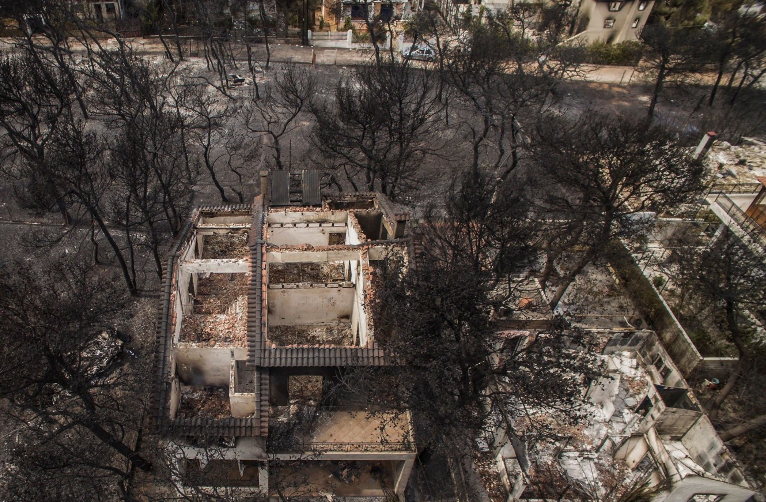
Teaser photo credit: Greek Red Cross workers discovered 26 bodies in the devastated resort village of Mati near Athens after horrendous wildfires

These Sustainable Homes Are Made From Trash, But They’re Absolutely Stunning

Bring Me is at Earthship Biotecture.

April 28, Taos NM.

These Sustainable Homes Are Made From Trash, But They’re Absolutely Stunning

These Sustainable Homes Are Made From Trash, But They're Absolutely Stunning

These Sustainable Homes Are Made From Trash, But They're Absolutely Stunning

Posted by Bring Me on Saturday, April 28, 2018

The sad last act of Rudy Giuliani

Yahoo News

The sad last act of Rudy Giuliani

Matt Bai’s Political World

Matt Bai     August 2, 2018

Global Heat Waves Rippling Across Planet

August 1, 2018
Record-breaking heat waves are rippling across the planet, bringing death and destruction in their wake.

Global Heat Waves

Record-breaking heat waves are rippling across the planet, bringing death and destruction in their wake. via Climate Facts

Posted by EcoWatch on Wednesday, August 1, 2018

LeBron James Neatly Dismissed Trump’s Racial Divisiveness in a Must-See Interview

Esquire

LeBron James Neatly Dismissed Trump’s Racial Divisiveness in a Must-See Interview

The world’s greatest basketball player says he’d ‘never sit across’ from the president.

By Jack Holmes     July 31, 2018

YouTube

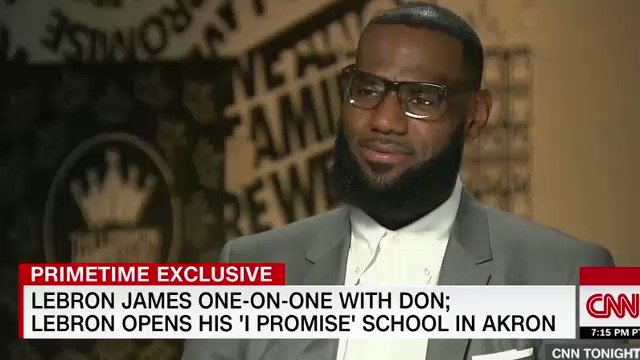
Monday was the first day of school for hundreds of children in Akron, Ohio. They will attend a brand new academy, the I Promise School, which was built by Akron native LeBron James through his LeBron James Family Foundation. The world’s greatest basketball player launched the school to give at-risk youth in the area, as he once was, the opportunity to thrive—academically, athletically, and otherwise—despite sometimes perilous circumstances. In an endearing touch, James will give each student at his school a bike, “because he often credits his bicycle as a huge factor in his childhood that gave him an escape from dangerous parts of his neighborhood and the freedom to explore.”

To mark the occasion, James sat down with CNN’s Don Lemon for a wide-ranging conversation that often strayed into far larger issues. That included race, and the president:

CNN: LeBron James (@KingJames) says Trump’s trying to use sport to divide people, but he believes it brings people together. He sits down with @donlemon at the opening of his new elementary school for at-risk children in his hometown of Akron, Ohio. Watch 10pET https://cnn.it/2K7QBS8 

While sports are not, strictly speaking, always a unifying force—racism remains a persistent problem in, say, European soccer—athletics are certainly often a way to build bridges of understanding where none might exist otherwise. And there is no denying that the president has, in complete contrast to that, used sports as a wedge to drive people apart.

Rather than embrace their displays as an opportunity to discuss the realities of racial injustice in policing, Trump called the predominantly black athletes who have chosen to protest during the national anthem “sons of bitches” from the presidential podium. He also suggested they be fired. He has repeatedly sought fights with black athletes over whether they will attend championship ceremonies at the White House. There is no question he sees political gain in ginning up resentment among his supporters for wealthy athletes of color who exercise their First Amendment right to dissent. Of course, that’s part of a larger program of racial resentment and xenophobia. Elsewhere in the interview, James said simply that Trump has given people more confidence to air their racism in public—to “throw it in your face.”

Donald Trump Holds Campaign Rally In Warren, Michigan

One measure of this will be the reaction to the launch of James’ school. A calling card of those who oppose the anthem protests begun by Colin Kaepernick, and athlete activism more generally, is their accusation that athletes who protest on the field are not doing anything for their communities off of it. This has never been true: Kaepernick, for instance, has now given $1 million to charities serving underprivileged communities across the country, just as he promised. But James has now embarked on a grand mission in service of the community where he was born and raised by a single mother, from which he made it out against the odds. He will now intervene in the lives of hundreds of Akron children to try to give them the best shot of making it, too. Surely we can expect the same suspects who demand athletes walk the walk off the field to applaud him now—regardless of what he says about the president.

I Promise School Grand Opening Celebration With LeBron James

We can’t, of course, because none of this is about the practicalities. It’s not about Respect For The Anthem, which plenty of fans angry about the protests spend at the concession stand buying beer. It’s not about The Troops, whom so many people are so eager to speak on behalf of. (I spoke to four members of our armed forces, and they had a diverse array of viewpoints on the anthem protests. You know, like any group of Americans might.) And it’s not about “Chicago,” or “black-on-black crime,” or “doing something for the community,” as you might hear in the conservative infotainment sphere. It’s about telling a group of primarily black athletes to “shut up and dribble,” as Fox News’ Laura Ingraham once told LeBron James.

James himself is under no illusions about all that, as reflected in his answer to Lemon’s question on what he’d say to Donald Trump, American president, if he were sitting across from him:

Don Lemon asks LeBron what he would say to Trump if he were seated with them during today’s interview.

LeBron: “I would never sit across from him.”

This is reminiscent of an all-time James tweet: his response to Trump’s Mean Girls White House un-invitation to Steph Curry:

LeBron James: U bum @StephenCurry30 already said he ain’t going! So therefore ain’t no invite. Going to White House was a great honor until you showed up!

The fact is that Donald Trump is not having a good-faith discussion about any of this. He just sees it as a useful cudgel in his eternal battle against The Other. There’s no real reason to engage someone who calls you a “son of a bitch” for exercising your First Amendment rights in response to what you perceive to be a profound social injustice. Better to build a school, and make 240 kids’ dreams that much closer to a waking reality.

The whole interview is worth your time:

WATCH NEXT

Building Dignity for the Homeless Through Farming

Civil Eats

Anthony Reyes: Building Dignity for the Homeless Through Farming

The farm manager at the Homeless Garden Project in Santa Cruz, Reyes approaches agricultural systems from a justice lens.

Anthony Reyes found his calling working at the intersection of farming and social justice with organizations such as the Tilth Alliance in Seattle, the youth education program Common Threads Farm in Bellingham, and now with the Homeless Garden Project in Santa Cruz. Reyes credits his college days at the University of California, Santa Cruz, for his passion for sustainable agriculture with a food justice focus. Reyes, a biracial Millennial with Mexican-American roots, always wanted to return to the area, a hub for farming with a mission. In 2017, he returned to the community where he first learned to grow food and view agricultural systems through a justice lens.

In his first year at the Homeless Garden Project, Anthony Reyes says he was asked about every stereotype imaginable when working with this marginalized population. Chief among them: Do homeless people really work? There’s a lot of stigma associated with this population, he says. “For the record, the crews here are some of the most hardworking people I’ve ever met,” says Reyes of the participants in the non-profit’s year-long employment-training program at Natural Bridges Farm.

The project serves people in Santa Cruz County who are homeless or formerly homeless, who have experienced barriers to employment, and who want to maintain a stable productive place in society. “The crew tackles every task seriously with passion and heart.”

Reyes spends his days on the farm bouncing between different posts—whether the field, greenhouse, farm stand, or kitchen—helping crews with their tasks on the 3.5-acre farm, which grows row crops and flowers. He’s also in charge of the organization’s three-pronged Community Supported Agriculture program. CSAs, an alternative marketing model that features a direct relationship between farmer and consumer, accounts for about 10 percent of the 25-year-old institution’s income.

The program includes a traditional CSA, a U-pick version, and a scholarship fund, where people can donate to a CSA program for 10 local organizations serving the needy. Flowers go to a local hospice program and the program includes a value-added enterprise making and selling jams, dried herbs, and floral wreaths, which are sold at their downtown store, in a new shop in nearby Capitola, and online.

Relationships are central to Reyes’s job, he says, and inform every aspect of work on the farm, which is slated to expand to a 9-acre permanent site expected to be fully operational in 2020. The 28-year-old strives to treat each crew member with care, compassion, and respect. He says he learns as much from his 17-member crew as they learn from him. “Every single day they inspire me. The farm itself is such a place of radical inclusivity. Everyone is embraced and welcomed,” he says. “And that is reflected in the pride people take in the work and the collaboration on the farm. It’s really a beautiful thing to witness on a day-to-day basis.”

Reyes has farming in his blood: Wisconsin dairy farmers make up his mother’s side of the family. His father is of Mexican heritage and his paternal grandfather ran a “mow and blow” business in Los Angeles. The smell of grass and a four-stroke engine is embedded in childhood memories, he says, and he looked up to his grandfather, a gentle soul. In college, Reyes says his studies helped him begin to see agriculture and outside work though a social justice lens. A key mentor on campus: a UC Santa Cruz lead groundskeeper whom he worked with, Jose Sanchez.

anthony reyes at the Homeless Garden ProjectHis “juiciest” days, Reyes says, are whenever he can get his hands in the earth. “I make some of the deepest connections with our crew members simply working alongside them,” he says. “Working the soil creates a safe space for people to be seen and heard for who they are.”

Reyes has seen first-hand what a difference growing food can make in someone’s life. “There’s something very restorative and transformative about planting a seed and watering it and watching it grow into a flourishing plant that can provide sustenance,” he says. “From a little speck in your hand to the harvest for your lunch: That has a calming, therapeutic effect.”

Crew members see the fruits of their labor and the value that it brings. “There are very real, tangible benefits at the end of the day, whether someone has spent it building a bed, weeding, or picking. You can see the difference you’ve made,” says Reyes. “There’s ownership and a sense of accomplishment.”

As Reyes points out, homelessness and joblessness go hand in hand. Lack of job skills, a spotty work history, an absent social support network, and low self-esteem can all make the transition out of homelessness more difficult. The Homeless Garden Project’s program is designed to address these concerns, in addition to the challenges that come with substance abuse, mental health issues, physical or developmental disability, and the unique problems faced by veterans—all obstacles that disproportionately impact the homeless community.

Housing is one of the most immediate problems. Some of the Homeless Garden Project’s clientele live in shelters, while others camp outside or in cars, or reside in tenuous subsidized housing situations. A team of social work interns help garden crew members find stable employment and housing. The interns also help the crew find resources to address other obstacles like transportation, substance abuse, and mental health problems.

feeding people at the Homeless Garden Project“Every single person on the crew has personal challenges they’re trying to work through. We very much meet people where they are,” says Reyes. In a region known for exorbitant rents and real estate, Reyes is well aware that many residents of the greater community—including some farm project volunteers—are just a paycheck or two away from homelessness themselves.

Measuring success comes in multiple ways. More than 90 percent of participants in the program find stable housing and employment at the end of their garden project tenure. There’s also the less quantifiable personal growth that Reyes observes in his crews over time: “I watch people try new things and come out of their shell.”

His own on-the-job goals? “I remind myself constantly to show up, and what it means to be present. I’ve learned so much about myself in this line of work,” he says. “It’s also given me more confidence and allowed me to be okay with, and find strength in, vulnerability. It’s not just me. Every single person who steps onto the farm is changed by it.”

Reprinted with permission from Hungry for Change, a publication of the Berkeley Food Institute. Read about other California emerging food systems changemakers here.

Photos: Fabián Aguirre and Maya Pisciotto, The Understory.