In her Senate floor speech on Friday, Sen. Susan Collins (R-Maine) resolutely defended Supreme Court nominee Brett Kavanaugh both on his judicial philosophies and against sexual assault allegations, sounding no different than ring-wing GOP senators like Orrin Hatch of Utah or John Cornyn of Texas.
She validated and rewarded the Trumpian tactics of Senate Judiciary Committee chairman Chuck Grassley (R-Iowa), who stacked the deck against Christine Blasey Ford and the others who alleged sexual misconduct by Kavanaugh. Despite his clear and repeated lies, Collins lauded Kavanaugh’s “forceful” testimony to the committee denying all of the accusations,
Even after that, some in the Beltway media over the weekend were still locked in time, describing Collins, as they always have, as a “moderate.” One New York Times reporter actually characterized her speech as “reasoned [and] carefully researched.”
But these descriptions were fewer and far between compared to the past. And in Maine, where it matters, a Portland Press Herald editorial called the speech anything but reasoned and careful, clearly identifying what was either naivete or political spin:
Even in areas where experts in the field raised warnings, Collins put her judgment ahead of theirs… Only Collins appears to believe that Kavanaugh considered Roe v. Wade “settled law” or that he was deeply committed to preserving precedent, something legal scholars say is inconsistent with the way the Supreme Court works. It makes precedent when it wants to, and it takes only five votes to do it.
Similar to the characterizations of the late Sen. John McCain (R-Ariz.) despite facts to the contrary, Collins has consistently been described as a “moderate” or a “maverick” by many establishment Washington political reporters, treating her with kid gloves in discussing possible political motivations.
Often in a Washington bubble themselves, they’ve allowed Collins to perpetuate a myth that she’s a principled bridge-builder who rises above partisanship, so much so that she believes it herself and thinks she’s invincible. Collins appears to have no idea what she’s about to face if she’s seeking re-election in 2020 (and she implied she will in a CNN appearance on Sunday defending her support for Kavanaugh), drunk on the standing ovation she received from Republicans on the Senate floor and the accolades that no doubt came in from President Donald Trump’s base all across the country.
Yes, she voted to protect funding for Planned Parenthood, voted to end the ban on gays serving openly in the military and has defended the environment. These high-profile votes, in a GOP caucus that is so extreme, allowed her to distinguish herself ― and allowed some in the Washington press to distinguish her ― as someone who was anything but right-wing.
But this was always simplistic. Collins voted with Senate Majority Leader Mitch McConnell (R-Ky.) and the White House almost 90 percent of the time in the first year of the Trump administration. Her much-heralded vote against Obamacare repeal was negated by her vote for the GOP tax bill. She insisted that in backing that latter bill she got a promise from McConnell that the Senate would consider several fixes to Obamacare ― pledges that never materialized.
Collins refused to support marriage equality as that debate heated up in Maine over the years and as LGBTQ activists came under vicious verbal assault by extremists in the GOP. She finally came out for marriage equality in 2014, two years after the state became one of the few in which marriage equality was achieved via a ballot measure. Thus, she never actually lifted a finger to help Mainers get equality.
She announced her evolution just in time for her re-election bid in 2014, having garnered the endorsement of the Human Rights Campaign, the largest national LGBTQ group. That backing, along with endorsements of her from abortion rights groups, helped her thwart her Democratic challenger.
Collins has since voted to confirm a constant stream of stridently anti-choice, anti-LGBTQ judges nominated to the federal courts by Trump.
Collins voted to confirm Neil Gorsuch to the Supreme Court, who, like Kavanaugh, promised her and the world that he respected precedent, even calling the Obergefell marriage equality ruling “absolutely settled law.” Four months after joining the court Gorsuch wrote a vigorous dissent inviting states to challenge Obergefell.
Collins’ party-line votes on district level and appeals court judges ― posts that are a top priority of McConnell’s ― haven’t gotten much media attention. That has only helped Collins ― and McConnell ― continue to promote the myth of her as a moderate while she votes with the GOP’s right-wing on the issues that mattered most to it.
Whether she is trying to avert a 2020 primary from the right that Trump could lead against her ― he has already threatened Sen. Murkowski (R-Alaska) with political retribution for voting against Kavanaugh ― or she truly believed what she was saying, Collins this time couldn’t keep her political machinations under the radar. The allegations against Kavanaugh ― and the outrage over him they sparked ― placed a glaring spotlight on her vote.
Nor could Collins even get cover from her good friends in the Senate ― Murkowski was joined by conservative Democratic Sen. Heidi Heitkamp of North Dakota in opposing Kavanaugh, even though the latter lawmaker conceded the vote could harm her re-election bid this year. So Collins stood as the sole so-called “moderate” woman in the Senate to have abandoned millions of women across the country and many others who will be hurt by the court’s likely lurch to the extreme right.
In this moment, the mask of moderation has been ripped off Collins. There will be those who say that she’s untouchable ― as they have said in the past ― and that Mainers who re-elected her before will do so again. They’ll tell you that she’ll have plenty of money from the Koch brothers and others, and she surely will.
But we’re in a different time, both nationally, with regard to the political energy of women and the Me Too movement, and in Maine. Already, people in Maine running a grassroots campaign have raised $3.5 million via crowdfunding to funnel to the Democratic opponent who takes on Collins in 2020. Several potential candidates have emerged in the past few days, as Democratic officials look to a deep pool of possible contenders in the state.
Polls in recent weeks found voters in Maine would be less likely to vote to re-elect Collins if she voted to confirm Kavanaugh. And in a Suffolk University poll in early August, she had only a 49 percent favorable rating, down from an impressive 67 percent in a Portland Press Herald 2016 poll.
University of New England political science professor Brian Duff told the Press Herald last week that voting against Kavanaugh “would be the more popular choice in Maine and easier for her to recover from, especially if she is able to vote for another conservative appointee later.” Two years, he said, is a long time in politics and “it’s hard to see a primary challenger emerging with any strength just because she voted ‘no’ on Brett Kavanaugh.”
Now that she’s voted yes, however, Collins can’t put her mask back on.
The Human Rights Campaign and several other national LGBTQ groups slammed her for backing Kavanaugh, as did Planned Parenthood and NARAL. It seems implausible that any of these groups would risk their members’ outrage by backing Collins in 2020.
And what does Collins do about Trump in her re-election year? In 2016, she announced in a scathing Op-Ed that she wasn’t voting for him that year, vocally distancing herself from his bigotry and recklessness as Hillary Clinton took Maine in the election. In 2020 Trump ― who tweeted accolades to Collins over the weekend ― presumably will be on the ballot with her. Will she dare endorse him ― or dare to not?
And as Kavanaugh rules with the far right of the court on issue after issue, as he undoubtedly will, Collins will sink even further, having taken full ownership of this Supreme Court nomination in the end.
Collins had a good gig, promoting herself as something she’s not. She’s now been fully exposed.
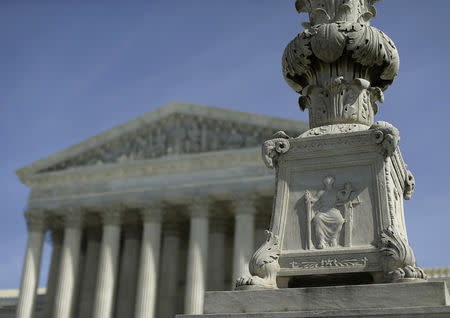
FILE PHOTO: The exterior of the U.S. Supreme Court is seen in Washington March 5, 2014. REUTERS/Gary Cameron/File Photo
WASHINGTON (Reuters) – The U.S. Supreme Court on Tuesday turned aside appeals of a 2017 lower court ruling by its newest justice, Brett Kavanaugh, that struck down an environmental rule imposed under former President Barack Obama regulating a potent greenhouse gas linked to climate change.
The appeals had been brought by an environmental group and companies that supported the 2015 rule that had limited hydrofluorocarbons, which are used in a variety of products including spray cans and air conditioners.
The ruling authored by Kavanaugh, confirmed by the Senate on Saturday after a contentious political battle, was made by a divided three-judge panel of the U.S. Court of Appeals for the District of Columbia Circuit, the court on which he formerly served. The 2-1 ruling threw out the rule issued by the U.S. Environmental Protection Agency during Obama’s presidency.
Tuesday marks Kavanaugh’s first day on the court.
The Senate backed President Donald Trump’s nominee 50-48 after a contentious confirmation process during which Kavanaugh denied allegations of sexual misconduct decades dating from the 1980s.
Kavanaugh has a long history of skepticism toward environmental regulations, especially those concerning air pollution. [L1N1U519A]
“However much we might sympathize or agree with EPA’s policy objectives, EPA may act only within the boundaries of its statutory authority,” Kavanaugh wrote in the ruling.
If the high court had agreed to hear the case, Kavanaugh would not have participated. The decision not to hear the case was made privately by the justices before Kavanaugh was confirmed by the Senate.
The court rejected two separate appeals, one by the Natural Resources Defense Council environmental group and another by companies that supported the regulation, including Honeywell International Inc . Manufacturers including Mexichem Fluor Inc, a unit of Mexichem SAB de CV , and Arkema Inc, part of Arkema SA , also were part of the coalition that challenged the regulation.
The Trump administration had urged the high court not to take the case because the EPA currently is reconsidering the regulation and agrees with Kavanaugh’s interpretation of the law.
(Reporting by Lawrence Hurley; Editing by Will Dunham)
Bernie Sanders Progressive Virtues (From August 2018)
If you haven’t caught this week’s Real Time with Bill Maher, it’s one of the best, most substantive espisodes in a long time. Here Nancy MacLean discusses the Koch Brother’s hidden agenda, and it’s beyond distrubing.
If you haven't caught this week's Real Time with Bill Maher, it's one of the best, most substantive espisodes in a long time. Here Nancy MacLean discusses the Koch Brother's hidden agenda, and it's beyond distrubing.
Was There a Connection Between a Russian Bank and the Trump Campaign?
A team of computer scientists sifted through records of unusual Web traffic in search of answers.
By Dexter Filkins October 8, 2018 (for October 15, 2018 issue)
A set of cryptic data has inspired a years-long argument over its meaning.
Illustration by Jarek Waszul
In June, 2016, after news broke that the Democratic National Committee had been hacked, a group of prominent computer scientists went on alert. Reports said that the infiltrators were probably Russian, which suggested to most members of the group that one of the country’s intelligence agencies had been involved. They speculated that if the Russians were hacking the Democrats they must be hacking the Republicans, too. “We thought there was no way in the world the Russians would just attack the Democrats,” one of the computer scientists, who asked to be identified only as Max, told me.
The group was small—a handful of scientists, scattered across the country—and politically diverse. (Max described himself as “a John McCain Republican.”) Its members sometimes worked with law enforcement or for private clients, but mostly they acted as self-appointed guardians of the Internet, trying to thwart hackers and to keep the system clean of malware—software that hackers use to control a computer remotely, or to extract data. “People think the Internet runs on its own,” Max told me. “It doesn’t. We do this to keep the Internet safe.” The hack of the D.N.C. seemed like a pernicious attack on the integrity of the Web, as well as on the American political system. The scientists decided to investigate whether any Republicans had been hacked, too. “We were trying to protect them,” Max said.
Max’s group began combing the Domain Name System, a worldwide network that acts as a sort of phone book for the Internet, translating easy-to-remember domain names into I.P. addresses, the strings of numbers that computers use to identify one another. Whenever someone goes online—to send an e-mail, to visit a Web site—her device contacts the Domain Name System to locate the computer that it is trying to connect with. Each query, known as a D.N.S. lookup, can be logged, leaving records in a constellation of servers that extends through private companies, public institutions, and universities. Max and his group are part of a community that has unusual access to these records, which are especially useful to cybersecurity experts who work to protect clients from attacks.
Max and the other computer scientists asked me to withhold their names, out of concern for their privacy and their security. I met with Max and his lawyer repeatedly, and interviewed other prominent computer experts. (Among them were Jean Camp, of Indiana University; Steven Bellovin, of Columbia University; Daniel Kahn Gillmor, of the A.C.L.U.; Richard Clayton, of the University of Cambridge; Matt Blaze, of the University of Pennsylvania; and Paul Vixie, of Farsight Security.) Several of them independently reviewed the records that Max’s group had discovered and confirmed that they would be difficult to fake. A senior aide on Capitol Hill, who works in national security, said that Max’s research is widely respected among experts in computer science and cybersecurity.
As Max and his colleagues searched D.N.S. logs for domains associated with Republican candidates, they were perplexed by what they encountered. “We went looking for fingerprints similar to what was on the D.N.C. computers, but we didn’t find what we were looking for,” Max told me. “We found something totally different—something unique.” In the small town of Lititz, Pennsylvania, a domain linked to the Trump Organization (mail1.trump-email.com) seemed to be behaving in a peculiar way. The server that housed the domain belonged to a company called Listrak, which mostly helped deliver mass-marketing e-mails: blasts of messages advertising spa treatments, Las Vegas weekends, and other enticements. Some Trump Organization domains sent mass e-mail blasts, but the one that Max and his colleagues spotted appeared not to be sending anything. At the same time, though, a very small group of companies seemed to be trying to communicate with it.
Examining records for the Trump domain, Max’s group discovered D.N.S. lookups from a pair of servers owned by Alfa Bank, one of the largest banks in Russia. Alfa Bank’s computers were looking up the address of the Trump server nearly every day. There were dozens of lookups on some days and far fewer on others, but the total number was notable: between May and September, Alfa Bank looked up the Trump Organization’s domain more than two thousand times. “We were watching this happen in real time—it was like watching an airplane fly by,” Max said. “And we thought, Why the hell is a Russian bank communicating with a server that belongs to the Trump Organization, and at such a rate?”
Only one other entity seemed to be reaching out to the Trump Organization’s domain with any frequency: Spectrum Health, of Grand Rapids, Michigan. Spectrum Health is closely linked to the DeVos family; Richard DeVos, Jr., is the chairman of the board, and one of its hospitals is named after his mother. His wife, Betsy DeVos, was appointed Secretary of Education by Donald Trump. Her brother, Erik Prince, is a Trump associate who has attracted the scrutiny of Robert Mueller, the special counsel investigating Trump’s ties to Russia. Mueller has been looking into Prince’s meeting, following the election, with a Russian official in the Seychelles, at which he reportedly discussed setting up a back channel between Trump and the Russian President, Vladimir Putin. (Prince maintains that the meeting was “incidental.”) In the summer of 2016, Max and the others weren’t aware of any of this. “We didn’t know who DeVos was,” Max said.
The D.N.S. records raised vexing questions. Why was the Trump Organization’s domain, set up to send mass-marketing e-mails, conducting such meager activity? And why were computers at Alfa Bank and Spectrum Health trying to reach a server that didn’t seem to be doing anything? After analyzing the data, Max said, “We decided this was a covert communication channel.”
The Trump Organization, Alfa Bank, and Spectrum Health have repeatedly denied any contact. But the question of whether Max’s conclusion was correct remains enormously consequential. Was this evidence of an illicit connection between Russia and the Trump campaign? Or was it merely a coincidence, cyber trash, that fed suspicions in a dark time?
In August, 2016, Max decided to reveal the data that he and his colleagues had assembled. “If the covert communications were real, this potential threat to our country needed to be known before the election,” he said. After some discussion, he and his lawyer decided to hand over the findings to Eric Lichtblau, of the Times. Lichtblau met with Max, and began to look at the data.
Lichtblau had done breakthrough reporting on National Security Agency surveillance, and he knew that Max’s findings would require sophisticated analysis. D.N.S. lookups are metadata—records that indicate computer interactions but don’t necessarily demonstrate human communication. Lichtblau shared the data with three leading computer scientists, and, like Max, they were struck by the unusual traffic on the server. As Lichtblau talked to experts, he became increasingly convinced that the data suggested a substantive connection. “Not only is there clearly something there but there’s clearly something that someone has gone to great lengths to conceal,” he told me. Jean Camp, of Indiana University, had also vetted some of the data. “These people who should not be communicating are clearly communicating,” she said. In order to encourage discussion among analysts, Camp posted a portion of the raw data on her Web site.
As Lichtblau wrote a draft of an article for the Times, Max’s lawyer contacted the F.B.I. to alert agents that a story about Trump would be running in a national publication, and to pass along the data. A few days later, an F.B.I. official called Lichtblau and asked him to come to the Bureau’s headquarters, in Washington, D.C.
At the meeting, in late September, 2016, a roomful of officials told Lichtblau that they were looking into potential Russian interference in the election. According to a source who was briefed on the investigation, the Bureau had intelligence from informants suggesting a possible connection between the Trump Organization and Russian banks, but no data. The information from Max’s group could be a significant advance. “The F.B.I. was looking for people in the United States who were helping Russia to influence the election,” the source said. “It was very important to the Bureau. It was urgent.”
The F.B.I. officials asked Lichtblau to delay publishing his story, saying that releasing the news could jeopardize their investigation. As the story sat, Dean Baquet, the Times’ executive editor, decided that it would not suffice to report the existence of computer contacts without knowing their purpose. Lichtblau disagreed, arguing that his story contained important news: that the F.B.I. had opened a counterintelligence investigation into Russian contacts with Trump’s aides. “It was a really tense debate,” Baquet told me. “If I were the reporter, I would have wanted to run it, too. It felt like there was something there.” But, with the election looming, Baquet thought that he could not publish the story without being more confident in its conclusions.
Over time, the F.B.I.’s interest in the possibility of an Alfa Bank connection seemed to wane. An agency official told Lichtblau that there could be an innocuous explanation for the computer traffic. Then, on October 30th, Senate Minority Leader Harry Reid wrote a letter to James Comey, the director of the F.B.I., charging that the Bureau was withholding information about “close ties and coordination” between the Trump campaign and Russia. “We had a window,” Lichtblau said. His story about Alfa Bank ran the next day. But it bore only a modest resemblance to what he had filed. The headline— “investigating donald trump, f.b.i. sees no clear link to russia”—seemed to exonerate the Trump campaign. And, though the article mentioned the server, it omitted any reference to the computer scientists who had told Lichtblau that the Trump Organization and Alfa Bank might have been communicating. “We were saying that the investigation was basically over—and it was just beginning,” Lichtblau told me.
That same day, Slate ran a story, by Franklin Foer, that made a detailed case for the possibility of a covert link between Alfa Bank and Trump. Foer’s report was based largely on information from a colleague of Max’s who called himself Tea Leaves. Foer quoted several outside experts; most said that there appeared to be no other plausible explanation for the data.
One remarkable aspect of Foer’s story involved the way that the Trump domain had stopped working. On September 21st, he wrote, the Times had delivered potential evidence of communications to B.G.R., a Washington lobbying firm that worked for Alfa Bank. Two days later, the Trump domain vanished from the Internet. (Technically, its “A record,” which translates the domain name to an I.P. address, was deleted. If the D.N.S. is a phone book, the domain name was effectively decoupled from its number.) For four days, the servers at Alfa Bank kept trying to look up the Trump domain. Then, ten minutes after the last attempt, one of them looked up another domain, which had been configured to lead to the same Trump Organization server.
“I bark and I bark but I never feel like I effect real change.”
Max’s group was surprised. The Trump domain had been shut down after the Timescontacted Alfa Bank’s representatives—but before the newspaper contacted Trump. “That shows a human interaction,” Max concluded. “Certain actions leave fingerprints.” He reasoned that someone representing Alfa Bank had alerted the Trump Organization, which shut down the domain, set up another one, and then informed Alfa Bank of the new address.
A week after the Times story appeared, Trump won the election. On Inauguration Day, Liz Spayd, the Times’ ombudsman, published a column criticizing the paper’s handling of stories related to Trump and Russia, including the Alfa Bank connection. “The Times was too timid in its decisions not to publish the material it had,” she wrote. Spayd’s article did not sit well with Baquet. “It was a bad column,” he told the Washington Post. Spayd argued that Slate had acted correctly by publishing a more aggressive story, which Baquet dismissed as a “fairly ridiculous conclusion.” That June, Spayd’s job was eliminated, as the paper’s publisher said that the position of ombudsman had become outdated in the digital age. When I talked to Baquet recently, he still felt that he had been right to resist discussing the server in greater depth, but he acknowledged that the Times had been too quick to disclaim the possibility of Trump’s connections to Russia. “The story was written too knowingly,” he said. “The headline was flawed. We didn’t know then what we know now.”
In April, 2017, Lichtblau left the Times, after fifteen years—in part, he said, because of the way that the Alfa Bank story was handled. He went to work for CNN, but resigned less than two months later, amid controversy over another story that he had worked on, about the Trump aide Anthony Scaramucci. This April, Lichtblau returned to the Times newsroom for a celebration: he had been part of a team of Times reporters that was awarded a Pulitzer Prize for its work on other aspects of the Trump campaign. “It was quite a year,” he said.
Meanwhile, the Trump-Alfa Bank story seemed to fade. The Trump campaign dismissed any connection, saying, “The only covert server is the one Hillary Clinton recklessly established in her basement.” Bloggers and tech journalists assailed the Slate piece online. The cybersecurity researcher Robert Graham called the analysis “nonsense,” and complained, “This is why we can’t have nice things on the Internet.” He pointed out several problems. For instance, Foer’s sources had found that the Trump domain was blocking incoming e-mail, and argued that this was evidence that Trump and Alfa Bank were maintaining a private communications network; in fact, Listrak routinely configured its marketing servers to send e-mail but not to receive it. Graham also noted that the domain was administered not by Trump but by Cendyn, a company in Boca Raton that handled his company’s marketing e-mail.
Alfa Bank hired two cybersecurity firms, Mandiant and Stroz Friedberg, to review the data. Both firms reported that they had found no evidence of communications with the Trump Organization. The bank also began trying to uncover the anonymous sources in the Slate piece. Attorneys representing Alfa contacted Jean Camp, telling her that they were considering legal action and asking her to identify the researchers who had assembled the data. She declined to reveal their names. “This is what tenure is for,” she told me.
Alfa Bank was founded by Mikhail Fridman, in the last years of the Soviet Union. Fridman was born in western Ukraine and studied metallurgy in college. Like many others of his generation, he was introduced to the market economy through hustle. He sold theater tickets, washed windows, and ran a student discothèque. After the Soviet Union collapsed, in 1991, Fridman joined the scramble to befriend members of the new government and amass a fortune with help from the state. Along with an economist named Petr Aven, who had previously served as the country’s minister for foreign economic relations, Fridman built Alfa Bank into one of the most successful businesses in the new Russia. Its parent company, Alfa Group, now controls the country’s largest private bank, along with financial institutions in several European nations.
Fridman and Aven acquired reputations as brilliant, relentless businessmen. Describing the lawless post-Soviet years to the journalist Chrystia Freeland, who is now the foreign minister of Canada, Fridman said, “We were absolute savages.” In a notorious episode in 2008, a group of Russian companies, including Alfa Group, tried to gain control of a joint venture they’d formed with British Petroleum. The power struggle was so fierce that the C.E.O. of the joint venture, Robert Dudley, felt compelled to leave Russia. The oligarchs kept pushing for control of the BP venture until it was sold to a state-owned petroleum company, for fifty-five billion dollars; Alfa Group’s cut was almost fourteen billion.
Alfa Bank prospered during the Yeltsin years and has continued to do so under Putin. Though Fridman and Aven are not part of Putin’s innermost circle, they have managed to avoid the fate of some other oligarchs, who have had assets seized and, in a few cases, been imprisoned, after falling out of favor. Michael McFaul, a former U.S. Ambassador to Russia, told me he was impressed that Fridman and Aven had “navigated the very difficult world of maintaining their private business interests and not crossing the Kremlin.”
One reason the server story alarmed Alfa Bank was that it threatened the bank’s standing in Washington. Members of Russia’s government and many of its businessmen have been under American economic sanctions since 2014, when Russia annexed Crimea, but Alfa’s principals and representatives have enjoyed access to U.S. politicians at the highest levels. Fridman and Aven met several times with officials at the Obama White House, discussing such issues as Russia’s effort to gain entrance to the World Trade Organization. (Alfa Bank maintains that it has “never advocated for political or trade issues on behalf of the Russian government.”) “Fridman and Aven were seen as people that Washington could talk to about U.S.-Russia, because they checked two boxes—they were ‘polite company’ oligarchs, and they could shed light on Putin’s intentions and perspective,” a senior official in the Obama Administration told me. “They got meetings at State and on the Hill and at the White House. And they were understood to be operating with the consent and guidance of Vladimir Putin.”
Alfa is still closely tied to the Russian system, but Fridman and Aven live much of the time in the United Kingdom. If there was a communications link with the Trump Organization, it might have been created without their knowledge. According to experts I spoke to, large Russian companies typically have a member of the intelligence services, either active or retired, working at a senior level. If a company’s services are required in some way, the officer—called a kurator—coördinates them. “A company couldn’t say no,” a Washington-based Russia expert told me. (When asked about this, an Alfa Bank spokesperson said, “To our knowledge there are no senior intelligence officials at senior levels at Alfa Bank.”)
This past May, I saw Petr Aven in New York, at the Four Seasons Hotel. He had just come from a dinner in Washington, at which he had met a group of prominent Americans, including officials from the White House, to discuss Russia’s economic situation. Aven seemed worried about surveillance; before we sat down, he brought his phone to the other side of the lobby and hid it behind a plant. He wouldn’t say much for the record, but he told me that his bank didn’t have “any connection at all with Trump—nothing.”
Aven and Fridman have visited Washington less often since Trump took office. But Trump’s victory appeared to elevate Alfa Bank’s connections there—at least by association. Don McGahn, the White House counsel, came from Jones Day, one of the law firms that represent Alfa Bank in the United States. McGahn brought five Jones Day lawyers with him into the White House; six more were appointed to senior posts in the Administration. Jones Day has done work for businesses belonging to a long list of Russian oligarchs, including Oleg Deripaska, Viktor Vekselberg, and Alexander Mashkevich. The firm has also represented the Trump campaign in its dealings with Robert Mueller. For this reason, McGahn secured an ethics waiver that allows him to talk to his old firm when its clients have business before the U.S. government.
In June, 2017, Trump nominated Brian Benczkowski, a lawyer who had overseen the Stroz Friedberg report for Alfa Bank, to lead the criminal division of the Justice Department. At his confirmation hearing, Benczkowski said emphatically that Stroz Friedberg, like Mandiant, had rejected the possibility of complicity. The investigation, he said, found that “there was no communications link between the Trump Organization and Alfa Bank.”
Democratic senators expressed concern that Benczkowski had taken on work for Alfa Bank; he had been a senior member of Trump’s transition team and had good reason to expect that he would be appointed to a job in the Administration. “The client was a Russian bank that is under suspicion of having a direct connection with the Trump campaign,” Senator Richard Durbin said, during the hearing.
He and the other Democratic senators were especially troubled that Benczkowski would not commit to recusing himself from dealing with Mueller’s investigation, even though he had worked for two of Russia’s leading oligarchs. “Why did you refuse to recuse yourself?” Senator Dianne Feinstein asked.
“I don’t know what’s in Special Prosecutor Mueller’s investigation,” Benczkowski said. “I’m a lawyer in private practice. I have no idea what he’s up to, other than what I read in the papers.”
Despite these questions, the Republican-led committee approved Benczkowski. This past July, the Senate confirmed him.
While Republicans in Congress have rejected the possibility of collusion, with some joining Trump in calling the Mueller inquiry a politically motivated “witch hunt,” a few Democrats have continued to pursue the matter. After Trump’s Inauguration, two Democratic senators who had reviewed the data assembled by Max’s group—Mark Warner and a colleague who requested anonymity—asked the F.B.I. for an assessment of any potential contacts between Alfa Bank and the Trump Organization. The material was also brought to the attention of the C.I.A., which found it substantial enough to suggest that the F.B.I. investigate. In March, 2017, a Pennsylvania news outlet called Lancaster Online reported that F.B.I. agents had visited the offices of Listrak, the company that housed the Trump server. Ross Kramer, Listrak’s C.E.O., told me, “I gave them everything they asked for.”
Around the same time, the second Democratic senator approached a former Senate staffer named Daniel Jones and asked him to give the data a closer look. Jones had served as a counterterrorism investigator for the F.B.I. and then spent ten years working for the Senate Intelligence Committee, where he led the inquiry into the use of torture under the George W. Bush Administration. Now he was running an investigations firm, the Penn Quarter Group, and a nonprofit initiative called the Democracy Integrity Project, which was intended to help keep elections free from foreign interference.
To assess the Alfa Bank data, Jones assembled a team of computer scientists, divided into two groups, one on each coast. (They also consulted with Jean Camp, who agreed to coöperate despite the possibility that Alfa Bank might take legal action.) All these experts have national reputations in the field. Some have held senior cybersecurity jobs in the Pentagon, the White House, and the intelligence services, as well as in leading American technology companies. In order to encourage an unbiased outcome, Jones never introduced the East Coast group to the West Coast group.
I met several times with the two members of the East Coast group and spoke with them repeatedly. They used pseudonyms, Paul and Leto, in part because they had been alarmed by encounters with Russia while they were working at high levels of government. Leto said that, in 2016, as he was investigating cyber intrusions that seemed to originate in Russia, he became convinced that he was being followed. Both he and Paul believed that their phones had been hacked. These incursions coincided with a period of intense Russian activity in the U.S., including the hacking of the D.N.C., a pro-Trump social-media blitz, and the arrival of Maria Butina, who is accused of being a Russian agent sent to ingratiate herself with American conservative leaders. (Butina has denied the accusations.)
As Paul and Leto began working, they needed to verify that Max’s data presented an accurate picture of the traffic. After the Slate story appeared, skeptics pointed out that no one has a comprehensive view of the Domain Name System. They speculated that other entities, besides Alfa Bank and Spectrum Health, had looked up the Trump domain, and that Max had failed to see them. The D.N.S. company Dyn told a reporter that it had seen lookups from other computers around the world. But Dyn turned out to have registered only two additional lookups, both from the same address in the Netherlands.
Max and his colleagues maintain that they are able to see nearly all the D.N.S. lookups on a given domain; the senior Capitol Hill aide I spoke to affirmed that Max’s group is widely understood to have this capability. Paul Vixie, one of the original architects of the D.N.S. network, examined the data and told me, “If this is a forgery, it’s better than any forgery I’ve seen.” Jones’s team also ran analyses and real-time tests to check Max’s access to D.N.S. records. “It’s completely implausible that he could have fooled us,” Paul said.
Max had provided the Jones team with thirty-seven million D.N.S. records, enough to fill thousands of screens with time stamps and I.P. addresses—long strings of numbers and letters in green type. Over the course of several months, Paul and Leto examined the data for patterns and anomalies. “We stared at a lot of green screens,” Paul said. They regarded their inquiry as a statistical enterprise, capturing each Alfa Bank D.N.S. query from the ocean of data that they had been given and plotting it over a four-month period. Both said that they began their work as skeptics. “I started from an assumption that this is a bunch of nonsense,” Leto told me.
Much of the information that was publicly available might well have supported that assumption. Foer’s article in Slate had prompted online discussions, in which commentators offered explanations ranging from the benign to the sinister. The timing of the lookups, which came in the summer just before the election, invited speculation. Foer claimed that the biggest flurries of traffic coincided with major campaign events, including the party conventions. Paul and Leto were dubious. If anything, the traffic coincided with Paul Manafort’s time as Trump’s campaign manager—but the D.N.S. queries continued after Manafort stepped down. “A lot of people are seeing faces in clouds,” Leto said.
The Trump Organization had done little to clarify the matter. In October, 2016, it released a statement denying interactions with Alfa Bank “or any Russian entity.” Instead, it offered a peculiar explanation for the D.N.S. traffic: it had been triggered when “an existing banking customer of Cendyn”—the marketing firm—had used the company’s systems to send communications to Alfa Bank. Such a scenario would be highly irregular; it was as if Gmail had allowed a user to send e-mail from another user’s account. “It makes no sense,” Paul told me.
Trump’s advocates claimed that the investigations sponsored by Alfa Bank had proved that Alfa and the Trump Organization were not communicating. In fact, they sidestepped the question. Mandiant, one of the cybersecurity firms, said that it was unable to inspect the bank’s D.N.S. logs from 2016, because Alfa retained such records for only twenty-four hours. The other firm, Stroz Friedberg, gave the same explanation for why it, too, was “unable to verify” the data.
As Jones’s team vetted the data, they examined various possible explanations. One was malware, which had played a role in the hack of the D.N.C.’s computers. Most malware has “distinctive patterns of behavior,” Camp told me. It is typically sent out in a blast, aimed simultaneously at multiple domains. There is a “payload”—a mechanism that activates the malicious activity—and a “recruitment mechanism,” which enables the malware to take over parts of a vulnerable computer. None of the experts whom Jones assembled found any evidence of this behavior on the Trump server. “Malware doesn’t keep banging on the door like that,” Paul said.
A second possibility was marketing e-mail. After the Slate article appeared, some commentators suggested that Trump’s server had innocently sent promotional e-mails to Alfa Bank, and that a computer there had responded with queries designed to verify the identity of the sender. This became a catchall answer for anyone who couldn’t explain what had happened. “Either this is something innocuous, like spam,” Rachel Cohen, a press secretary for Senator Warner, told me, “or it’s completely nefarious.”
Alfa Bank had received Trump marketing e-mails in the past. But Cendyn had told CNN that it stopped sending e-mails for the Trump Organization in March, 2016, before the peculiar activity began; Trump had transferred his online marketing to another company, called Serenata. Jones’s team investigated, and found additional evidence that the server wasn’t sending marketing e-mails at the time. One indicator was the unusually limited traffic. Kramer, of Listrak, told me that a typical client sends “tens of thousands of e-mails a day” to huge numbers of recipients. If the Trump server was following that pattern, it would have generated significant D.N.S. traffic. To establish a kind of control group, Jones’s team asked Max to capture the D.N.S. logs for the Denihan Hospitality Group—a hotel chain, similar in size to Trump’s, which was using Cendyn and Listrak to send marketing e-mails. In a sample spanning August and September, 2016, a Denihan domain received more than twenty thousand D.N.S. queries, from more than a thousand I.P. addresses. In the same period, the Trump domain had twenty-five hundred lookups, nearly all of them from Alfa Bank and Spectrum Health.
The timing and the frequency of the D.N.S. lookups also did not suggest spam, Paul and Leto believed. Mass-marketing e-mails are typically sent by an automated process, one after another, in an unbroken rhythm. The Alfa queries seemed to fall into two categories. Some came in a steady pulse, while others arrived irregularly—sometimes many in a day, sometimes a few. “The timing of the communication was not random, and it wasn’t regular-periodic,” Paul said. “It was a better match for human activity.”
But, if the Trump server wasn’t sending or receiving e-mail, what could explain the traffic? There was the possibility of “spoofing”—essentially, faking an identity. Did someone try to make it appear, falsely, that Alfa Bank was reaching out to the Trump Organization? Jones’s team concluded that such an attack would have been unlikely to produce thousands of D.N.S. lookups, over such a long time. “Maybe for a few days, but not four months,” Leto said. There was also a question of motive. In the spring of 2016, very few people knew that Max and his colleagues were able to monitor D.N.S. traffic so comprehensively, so any spoofers would have been impersonating Alfa Bank with little expectation of being detected. News stories investigating the links between Trump and Russia were months away. “Why would someone do that?” Steven Bellovin, of Columbia, said. “And why would they pick those organizations?”
When I saw Petr Aven at the Four Seasons, he argued that the connections with the Trump Organization had been fabricated in order to frame his company. “This is a conspiracy against us,” he told me. “It is really much bigger than the computers.” Aven did not elaborate, but Jeffrey Birnbaum, a spokesperson for Alfa Bank, supplied more detail. The bank, he said, suspected that “we are victims of classic Russian kompromat—a well-known scam in which Russian competitors pay analysts to write false reports to damage reputations.” Birnbaum described the press inquiries into the matter as an extended affliction. “This has been a terrible ordeal for Alfa Bank, like living through a Kafka novel,” he said. (Max rejected the idea that his group had fabricated data. “If we were going to lie, then we would have made up a much better story than this!” he said.)
“Rapunzel, Rapunzel, let down twenty-two dollars and thirty-seven cents.”
Because Alfa Bank did not retain its D.N.S. logs (many large companies don’t), its assessments of what produced the lookups in early 2016 are necessarily speculative. “We are as mystified as anybody about these false allegations,” Birnbaum told me this September. In a series of exchanges over three weeks, he offered a range of possibilities. He suggested that the data had been faked, but also that they had been stolen from the bank’s logs. He attributed the traffic to kompromat, but also expounded a scenario in which it had been caused by a technical glitch: Trump e-mails “hidden” in the system were intermittently processed by the bank’s security software, an application called Trend Micro Deep Discovery Inspector. In this explanation, Trump marketing e-mails from before March, 2016, had made it through the spam filter and been stored in a permanent archive, where the bank backs up all its e-mail. Periodically, the bank re-scanned that archive, as updates to the security software provided new information about which senders might be unsafe. During scans, the system performed D.N.S. lookups for every domain name contained in every e-mail. In the course of several months, the bank said, this could account for the traffic.
The experts I spoke to confirmed that this was a technically plausible, if highly inefficient, way to configure security software. But the explanation raised questions of its own. Alfa Bank said that its scans ran for two days after each update. But Max’s data don’t show a consistent pattern of two-day spikes. Another concern lay in the chronology. The bank had received e-mails from the Trump domain in late 2015 and early 2016, which should have triggered lookups. But, according to the data, the lookups didn’t begin until May, 2016. In response to a question about this discrepancy, Birnbaum said that the Trend Micro software had not been “fully integrated” until March—but that wouldn’t account for the time between March and May.
A third problem was that, if Alfa Bank wasn’t receiving new e-mails from the Trump Organization after March, 2016, then the number of Trump e-mails in the archive—and thus the number of lookups—should have remained steady through the summer. But Max’s data showed a different pattern: no lookups in the spring, a small number in May, and then a slow increase starting in June, with spikes that lasted until the system went offline. When asked about the increase, Birnbaum offered another refinement of the explanation. The bank had previously said that the software had performed checks of old e-mails “multiple times over the six-month period.” Now he said that a security update “around August” had caused old e-mails to be re-scanned.
In any case, for an explanation of this kind to work, it would require the servers at Spectrum Health to be simultaneously experiencing the same glitch, or another one with similar effects. (Spectrum declined to answer questions about its computer systems.) Trend Micro has thousands of users, most of them businesses, but in the sample that Max and his colleagues could see, only Alfa Bank and Spectrum Health exhibited this peculiar behavior.
For some, the most baffling part of the puzzle was the way that the lookups stopped. The Trump domain vanished from the Web on the morning of Friday, September 23rd, two days after the Times presented its data to B.G.R., Alfa Bank’s lobbyists in Washington, but before it called Trump or Cendyn. In Max’s view, this was evidence of direct contact between Alfa Bank and Trump. One researcher whom Foer interviewed put it vividly: “The knee was hit in Moscow, the leg kicked in New York.” There is, however, at least one possibility that doesn’t involve Moscow: the lobbyists in Washington could have passed along a warning to Trump, as a courtesy. But B.G.R. denies doing this, calling the idea “ridiculous on its face.”
Whatever the reason that the Trump domain vanished, Alfa Bank’s servers continued trying to look it up: Max’s group observed fifteen failed attempts that Friday, twenty-eight on Saturday, none on Sunday, ninety on Monday, twenty on Tuesday. Spectrum Health’s machine kept trying, too, in a weeklong spasm of activity that entailed thousands of seemingly automated lookups. Spectrum never succeeded in relocating the Trump server—but Alfa did. On the night of Tuesday, September 27th, ten minutes after the bank made its last failed attempt, it looked up the domain name trump1.contact-client.com—which was, it turned out, another route to the same Trump server.
The alternative domain name does not appear to have been previously active; no one has produced an e-mail sent from it. So how did Alfa find it? The easiest method would have been by consulting a ptr record, which shows what domain names are associated with a given I.P. address. But the ptr record for the Trump address did not include the alternative name.
Birnbaum said that Alfa Bank’s researchers, investigating the traffic, found the new name in other public records and then performed a test lookup. Vixie said that such a lookup would be unusual, and questioned why the bank would feel that it was necessary: “Why did Alfa look up either name? And especially the second name?”
According to Max’s data, Alfa Bank looked up the new domain name only once. In the following months, he and his group stopped collecting data on the Trump Organization domains. After the Slate story came out, curious readers looked up the address thousands of times, and the D.N.S. traffic devolved into statistical noise. The Trump Organization now controls the original domain; in March, 2017, Cendyn told CNN that it had been “transferred back.” Records show that Cendyn handed over the domain only a few days before the CNN story ran—a year after the last e-mail was sent from it. Jones’s team believed that Cendyn had continued its relationship with the Trump Organization in 2016. “There were thousands of e-mails between Trump and Cendyn through the entire period that Alfa Bank was looking up the Trump server,” Max told me. Cendyn said that this was “regular business correspondence,” related to transferring back the domain. When I called the company’s C.E.O., Richard Deyo, to ask more broadly about the situation, he said, “This is old news—that’s just Internet traffic,” and then hung up. A spokesperson for Serenata, which took over Trump’s hotel marketing, told me that the company had nothing to say. “Don’t call again,” she said.
As Jones’s team sifted through explanations for the traffic, they began constructing their own theory. “What you have here is a minimally viable technical footprint of a small number of people who are using what I suspect is an ad-hoc system to communicate,” Paul said. “Anytime the F.B.I. or anyone else pulls apart a cyber-crime organization, there is always some communication structure that’s used for command and control. That’s where the high-value communications happen.” (Max and his colleagues did not see any D.N.S. evidence that the Trump Organization was attempting to access the server; they speculated that the organization was using a virtual private network, or V.P.N., a common security measure that obscures users’ digital footprints.)
If this was a communications mechanism, it appeared to have been relatively simple, suggesting that it had been set up spontaneously and refined over time. Because the Trump Organization did not have administrative control of the server, Paul and Leto theorized that any such system would have incorporated software that one of the parties was already using. “The likely scenario is not that the people using the server were incredibly sophisticated networking geniuses doing something obscure and special,” Max said. “The likely scenario is that they adapted a server and vender already available to them, which they felt was away from prying eyes.” Leto told me that he envisioned “something like a bulletin-board system.” Or it could have been an instant-messaging system that was part of software already in use on the server.
Kramer, of Listrak, insisted that his company’s servers were used exclusively for mass marketing. “We only do one thing here,” he told me. But Listrak’s services can be integrated with numerous Cendyn software packages, some of which allow instant messaging. One possibility is Metron, used to manage events at hotels. In fact, the Trump Organization’s October, 2016, statement, blaming the unusual traffic on a “banking customer” of Cendyn, suggested that the communications had gone through Metron, which supports both messaging and e-mail.
The parties might also have been using Webmail—e-mail that leaves few digital traces, other than D.N.S. lookups. Or, Paul and Leto said, they could have been communicating through software used to compose marketing e-mails. They might have used a method called foldering, in which messages are written but not sent; instead, they are saved in a drafts folder, where an accomplice who also has access to the account can read them. “This is a very common way for people to communicate with each other who don’t want to be detected,” Leto told me. David Petraeus, when he was the director of the C.I.A., used this method to exchange intimacies—and to share classified information—with his lover, Paula Broadwell. In June, an attorney for the Mueller investigation accused Paul Manafort of using foldering to facilitate secret communications.
Given the limitations of D.N.S. data, none of the independent experts I spoke to could be certain of what Alfa Bank and the Trump Organization were doing. Some of them cautioned that it was impossible even to guess at every way that an e-mail system might malfunction. A senior analyst at a D.N.S.-service provider said, “Things can get messed up in unexpected ways.” But Paul and Leto maintained that they had considered and rejected every scenario that they had encountered in decades of cybersecurity work. “Is it possible there is an innocuous explanation for all this?” Paul said. “Yes, of course. And it’s also possible that space aliens did this. It’s possible—just not very likely.”
Paul and Leto periodically went back to Max in the course of their research, interrogating his assumptions and asking for more information. In one tranche of data that he gave them, they noticed that a third entity, in addition to Alfa Bank and Spectrum Health, had been looking up the Trump domain: Heartland Payment Systems, a payments processor based in Princeton. Of the thirty-five hundred D.N.S. queries seen for the Trump domain, Heartland made only seventy-six—but no other visible entity made more than two. Heartland had a link to Alfa Bank, but a tenuous one. It had recently been acquired by Global Payments, which, in 2009, had paid seventy-five million dollars for United Card Services, Russia’s leading credit-card-processing company; two years later, United Card Services bought Alfa Bank’s credit-card-processing unit. (A spokesperson for Global Payments said that her company had never had any relationship with the Trump Organization or with Alfa Bank, and that its U.S. and Russia operations functioned entirely independently.)
Spectrum Health has a similarly indirect business tie to Alfa Bank. Richard DeVos’ father co-founded Amway, and his brother, Doug, has served as the company’s president since 2002. In 2014, Amway joined with Alfa Bank to create an “Alfa-Amway” loyalty-card program in Russia. But such connections are circumstantial at best; the DeVos family seems far more clearly linked to Trump than to Russia.
If Trump and Alfa Bank—as well as Spectrum Health and Heartland Payment Systems—were communicating, what might they have been talking about? Max and some of the other scientists I spoke to theorized that they may have been using the system to signal one another about events or tasks that had to be performed: money to be transferred, for instance, or data to be copied. “My guess is that, whenever someone wanted to talk, they would do a D.N.S. lookup and then route the traffic somewhere else,” Richard Clayton, of the University of Cambridge, said. Camp also speculated that the system may have been used to coördinate the movement of data. She noted that Cambridge Analytica, which was working for the Trump campaign, took millions of personal records from Facebook. In Camp’s scenario, these could have been transferred to the Russian government, to help guide its targeting of American voters before the election.
The researchers I spoke with were careful to point out that the limits of D.N.S. data prevent them from going beyond speculation. If employees of the companies were talking, the traffic reveals nothing about who they were or what they were saying; it is difficult to rule out something as banal as a protracted game of video poker. “If I’m a cop, I’m not going to take this to the D.A. and say we’re ready to prosecute,” Leto said. “I’m going to say we have enough to ask for a search warrant.” More complete information could be difficult to obtain. This March, after Republicans on the House Intelligence Committee announced that it had found no evidence of collusion between the Trump campaign and Russia, the committee’s Democrats filed a dissent, arguing that there were many matters still to be investigated, including the Trump Organization’s connections to Alfa Bank. The Democrats implored the majority to force Cendyn to turn over computer data that would help determine what had happened. Those records could show who in the Trump Organization used the server. There would probably also be a record of who shut down the Trump domain after the Times contacted Alfa Bank. Cendyn might have records of any outgoing communications sent by the Trump Organization. But the request for further investigation is unlikely to proceed as long as Republicans hold the majority. “We’ve all looked at the data, and it doesn’t look right,” a congressional staffer told me. “But how do you get to the truth?”
The enigma, for now, remains an enigma. The only people likely to finally resolve the question of Alfa Bank and the Trump Organization are federal investigators. Max told me that no one in his group had been contacted. But, he said, it wasn’t necessary for anyone in the F.B.I. to talk to him, if the agents gathered the right information from other sources, like Listrak and Cendyn. “I hope Mueller has all of it,” he said. ♦
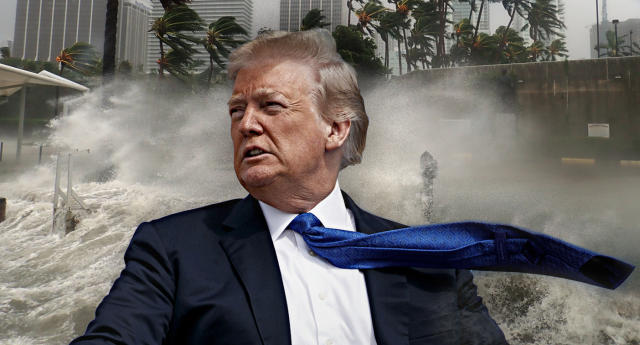
Photo illustration: Yahoo News; photos: Evan Vucci/AP, Warren Faidley/Corbis/Getty Images
As a journalist, I go back a long way in writing about global warming, although rumors that I covered the end of the Ice Age are exaggerated. In the late 1980’s, or maybe it was the early 1980’s, I interviewed an environmental lobbyist about the politics of the “greenhouse effect,” which was what we used to call climate change. In my innocent youth, or maybe early middle age, I found it hard to understand the reluctance of the Reagan administration to address, or even acknowledge, this threat to the global ecosystem.
“Don’t these people have children?” I asked incredulously.
“Well,” the lobbyist replied with a shrug, “the rule is you dance with who brung ya” — meaning officials who owed their positions to support from the fossil fuel industry were not about turn against their patrons merely out of concern for the future of life on earth.
The question came back to mind recently when the Washington Post reported that the Trump administration was acknowledging a mainstream scientific prediction for global warming: a catastrophic 7-degree (Fahrenheit) rise in average temperature, cumulative since pre-industrial levels, by the end of the century — swamping islands and coastlines, disrupting agriculture and making parts of the globe uninhabitably hot.
“I was shocked when I saw this,” said David Pettit, a senior attorney at the Natural Resources Defense Council. “I thought, wait, they’re putting this out? This is the administration, it’s not some aging hippie in Santa Monica.”
But the administration wasn’t bringing up this scenario to emphasize the need for more urgent action to fight climate change. Instead, it treated it as a reason to do nothing, on the grounds that the world is screwed no matter what, so why bother trying to save it?
This marks the endpoint of the process of rationalizing inaction whose beginning I witnessed 30-some years ago. It began by denying the fact of global warming, then in the face of evidence admitting it was happening but claiming human activity wasn’t responsible, then arguing that people were causing it but the effects would be tolerable, or preferable to incurring the costs of controlling it, and has now arrived at the position that it’s too late to do anything about it.
The 7-degree calculation, buried in an environmental impact statement from the National Highway Traffic Safety Administration, assumes that worldwide greenhouse gas emissions continue indefinitely at the same level after 2021. Thus it concedes in advance the failure of the 2015 Paris Agreement on global warming, which is meant to limit further increases in global temperature to roughly half that amount by transitioning away from burning fossil fuels for energy. Trump has already announced his intention to withdraw from the agreement. The NHTSA statement was in support of scrapping one part of the Obama administration’s plan to comply with the agreement, a mandated increase in fuel-efficiency standards for new cars and trucks through 2026 — because we’re all doomed anyway.
By NHTSA’s calculations, the net effect of the Obama plan would provide at best a marginal benefit for the climate, amounting to a small fraction of a degree, compared to the Trump administration’s preferred approach, which is to do nothing. Meeting the Obama standards “would require substantial increases in technology innovation and adoption compared to today’s levels and would require the economy and the vehicle fleet to move away from the use of fossil fuels, which is not currently technologically feasible or economically feasible,” the statement says.
“They made some assumptions to make the number come out where they wanted,” Pettit told me. “They wanted to show their proposal won’t make any significant difference. They got to the number they attribute to the Obama rules by a crazy assumption that after 2021 nobody does anything else to fight global warming. That gets you to the 7 degrees.”
Needless to say, most environmentalists don’t agree that it is not feasible for “the vehicle fleet to move away from the use of fossil fuels,” because it is already starting to happen. The administration proposal seems motivated almost entirely by right-wing ideology and reflexive hostility to anything originating with its predecessor. Not even the auto industry is calling for freezing mileage requirements. Detroit would prefer some leeway in meeting the standards proposed by Obama, which in very general terms require a corporate-fleet average increase to 55 miles per gallon by the mid 2020’s. But carmakers have to design their products years in advance and don’t want the uncertainty of going through a whole new rule-making process, or the ensuing lawsuits from environmentalists and from individual states. Also, they want to be able to sell their cars in other countries, which are trying to limit carbon emissions. The Motor & Equipment Manufacturers Association, representing over 1,000 suppliers of automobile parts, submitted a comment on the administration proposal that made these points. The group asserted that freezing mileage standards “would result in a loss of 67,000 direct auto industry jobs with a full impact of 500,000 direct, indirect, and induced jobs by 2025,” compared with letting the Obama rules take effect.
Also, some of those people probably have children too.
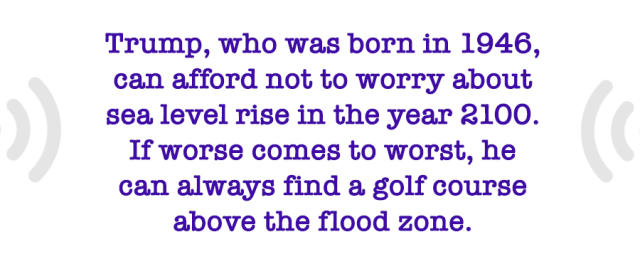
Which brings me to Trump, and what this little episode says about him. Matt Taibbi, in Rolling Stone, aptly describes Trump’s philosophy as “nihilism,” the denial of meaning and purpose in human existence. I never thought of Trump possessing any kind of considered philosophy that extended beyond “I’ve got mine,” but maybe I was underestimating him. Someone with the “very good brain” he likes to boast about — his uncle was a professor at MIT, in case you didn’t know — undoubtedly is well versed in the philosophy of Nietzsche. Trump certainly fits the description of one kind of postmodern nihilist found here: “a dehumanized conformist, alienated, indifferent, and baffled, directing psychological energy into hedonistic narcissism or into a deep res-sentiment that often explodes in violence.” If life has no meaning, you might as well take advantage of its pleasures, which is what Trump has been doing all along. Trump, who was born in 1946, can afford not to worry about sea level rise in the year 2100. If worse comes to worst, he can always find a golf course above the flood zone, or put one behind a wall. Apres Trump, le deluge. Or even before then — just ask the residents of North Carolina.
And by the same token, why should he be concerned about adding almost $900 billion to the national debt? Trump won’t be around when the bill comes due, and even if he is, the New York Times just published a 14,000-word article explaining how successful he’s been at wriggling out of paying taxes. Why should he worry about the implications for American democracy of his reckless trampling of civic and political norms? Norms are meant to be broken by people like Trump, who are in the best position to profit from the wreckage.
Of course, nihilism is opposed to Christianity, but I suspect that even the evangelical hucksters who cluster around Trump realize that he is a pagan at heart.
But Trump, as we know, has children, and grandchildren who could well be alive into the next century. Does he think about them at all? To even ask the question is to answer it. I am of the same generation as Trump, and if I outlive him it probably won’t be for too many years. If I had to think of one thing he has done for me, it’s to give me a reason to be glad I’m old.
The Grand Old Party was on a downward trajectory long before trump Inc. commandeered the controls and turned it into a cult of Kleptocrats, climate deniers, spendthrifts, fiscally responsible cynics, evangelical back-sliders, sexual predators, and morally reprehensible apologists. Compassionate Conservatism, although never a plausible Republi-con policy, is now a form of pure political derision by what’s left of your grandfathers GOP.
America is tragically being governed by it’s crazy uncle; that loon who shows up at family events and ruins everyone’s party. He’s inconsolable, unapproachable, uncompromising, unhinged and unapologetic when he spews out bigoted or nonsensical dribble. He lies with abandon and nominated a kindred coagulated mini me in brett kavanaugh.
America endures the most shameful era in it’s highly respected and emulated Democratic history. Decadence is too mild a word.
It’s not just that trump is undeniably the worse president in history; and not just that trump is clearly one of the worst business executives in U.S. history (read the Times 38 page history of trump’s Fraudland); it’s that he’s one of the most despicable humans ever to aspire to public office and allege reverence for public service.
There’s no adjective too strong to describe what trump and his enablers in Congress represent – Despicable 3 Are We!
Like a crack addict who will do absolutely anything for his next fix; trump’s fix of course is “winning” the moment. Pushing any crazy conspiracy, telling any lie, belittling or degrading any person, even victims of sexual abuse, just to achieve any edge, or gain, no matter how insignificant, inconsequential; no matter how disruptive or destructive to our Republic.
trump and his entire administration spends most waking hours, and even unconscious dreams, scheming ways to make themselves richer and more powerful; and trump has used the presidency to heal his failing business ventures and cash in before the justice department shows up at 1600 Pennsylvania Avenue with an arrest warrant or articles of impeachment.
I have to save room to criticize the Republi-cons in congress and trumps unwavering lemmings. I find myself frequently checking thesaurus, looking for words strong enough to adequately describe what they allow as just normal trump behavior.
The Republi-con party and along with them, their depraved Evangelicals, will be forever tainted as the party of Nationalists, racists, abusers, moral degenerates and grifters.
trump brags about violating our constitution, breaking the law and ignoring centuries of U.S. precedent by turning desperate asylum seekers away from our borders. He conducts U.S. foreign policy so as to enrich himself, his family, his billionaire friends and his political donors. He attempts to use the justice department to protect him and his cronies and punish his enemies. He nominated kavanaugh solely for the purpose of ensuring his corrupt usurpation of our Democratic institutions will continue unchecked.
Progressive, critical thinking Americans must brush aside the nonsensical flotsam and jetsam ebbing daily from trump’s white house and keep their eye on the damage undermining our constitution, our institutions and our environment.
trump attempts to scare the bejesus out of his faithful and proclaims “only I can fix it,” instead of working together democratically; the M.O for despotism 101.
If kavanaugh is confirmed before a full and fair investigation by the FBI or some other legitimate fact finding body, the political whitewash will further divide the county; and the GOP will forever be labeled as the Grab Our Pussy Party. Sadly, I think most trump supporters couldn’t care less.
Will the few semi-moderate republi-cons in the Senate finally decide they’ve had enough and put America and kavanaugh’s family out of their misery and vote against his confirmation. Not likely; but hope springs eternal.
I would like to pose a few questions for the republi-con Senators who adamantly refused to be swayed. If your daughters or grand-daughters, maybe like kavanaugh’s two daughters, Elizabeth age 10 and Margaret age 13, were victims of a bunch of privileged, marauding, mean drunks who believe they’re entitled to get naive young women drugged or drunk and stand in line for their turn at ‘boys will be boys’ rights of passage, would they demand justice for their children? Would they still want justice 35 years later if their loved ones suffered in silence but finally found the courage to come forward so someone else could be spared a similar fate? Would you want a full and fair investigation or is it more important to toe the party line?
North Dakota Senator Heidi Heitkamp, locked in a tight reelection campaign, displayed extreme courage today by announcing she will not vote to confirm kavanaugh, saying: “In my judgment, Judge Kavanaugh is not someone we want on the Supreme Court.”
Senators Manchin, Flake, Murkowski and Collins should do the right thing and stand with Sen. Heitkamp.
Update:
Senators Heitkamp and Murkowski both voted against kavanaugh. The rest will have to live with their decision to confirm a right-wing zealot, climate denier and serial abuser for the United States Supreme Court. The truth usually exposes itself eventually. Hopefully, justice will be done.
On Thursday, North Dakota Senator Heidi Heitkamp announced she will vote no on Brett Kavanaugh’s nomination to the Supreme Court. This was a surprise. Heitkamp, who has said little about the nomination until now, voted to confirm Trump’s previous Supreme Court pick, Neil Gorsuch. The most recent polls show her losing ground to a male challenger who said of Christine Blasey Ford’s allegations, “Nothing evidently happened in it all, even by her own accusation… It was supposedly an attempt or something that never went anywhere,” and then “Even if it’s all true, does it disqualify him? It certainly means that he did something really bad 36 years ago, but does it disqualify him from the Supreme Court?”
To Heitkamp it did. That the Kavanaugh vote may well go along party lines means Heitkamp is unlikely to win the same hosannas of bipartisanship bestowed upon Jeff Flake in the past week. Nonetheless, it required real courage, and the explanation she gave for her refusal was striking. As Senate Republicans have been shamelessly portraying Brett Kavanaugh as the victim of a Jim Crow-era lynch mob, and as Trump declares it “a very scary time for young men in America,” Heitkamp, a white woman under enormous political pressure in a right-leaning state, chose to make clear who she believes the real victims are.
That includes, but is not limited to, Christine Blasey Ford. “When I listened to Dr. Ford testify, I heard the voices of women I have known throughout my life who have similar stories of sexual assault and abuse,” Heitkamp said in a statement. “Countless North Dakotans and others close to me have since reached out and told me their stories of being raped or sexually assaulted — and expressed the same anguish and fear.”
In the end, Christine Blasey Ford’s privilege and access, her lawyers and her girlish voice and her desire to be of help, were not enough to grant her due process. Due process would have meant being interviewed by the FBI and having the man she accused be subject to a more searching inquiry than five-minute bursts from Democrats and aggrieved monologues from Republicans. It would have meant the FBI following up with the leads those lawyers offered. It wouldn’t have included Senate Judiciary Republicans using the press to pass on smears of Ford instead of having the FBI adjudicate them.
Heitkamp’s statement acknowledged that historically, many victims have gotten even less, and she evoked her work to expand the reach of the Violence Against Women Act: “I insisted that it include increased protection for Native women and girls”
If that sounds like banal press release talk, it isn’t. Those increased protections were the subject of a furious fight, waged five years ago, that wound up hinging on whether white men would be held accountable. A federally funded study found that Native women were not only likelier than other women to be victims of violence, they were ”significantly more likely to have experienced violence by an interracial perpetrator.” But the very notion infuriated Senator Chuck Grassley. “The non-Indian doesn’t get a fair trial,” he insisted back then.
That would be the same Senator Chuck Grassley who is presiding over Kavanaugh’s nomination now, amid an ever-louder conservative chorus that the judge — previously touted for his elite institutional acceptance — is actually the railroaded minority here. “We remember that Atticus Finch was a lawyer who did not believe that a mere accusation was synonymous with guilt,” said Senator John Cornyn. “He represented an unpopular person who many people presumed was guilty of a heinous crime because of his race, and his race alone.”
We also remember that Atticus Finch was a fictional white lawyer hailed as a hero for defending a black man against a white woman’s false charges of rape. That was based on an ugly reality, one in which white women’s stories of assault were only heard when their often false charges targeted black men and bolstered white supremacy; white women supplied the rationale for protection, and white men provided the mob violence. Today, powerful people understand that they need to at least appear as if they’re listening to women, even as they are reluctant to shift the balance of power any more than absolutely necessary. There are still white women who know they stand to benefit far more from aligning themselves with white, male supremacy than some objective standard of justice for all. The women supporting Kavanaugh – and voting to confirm him – are proof of this.
Thursday morning on NPR, Missy Bigelow Carr, one of the 64 women who had rapidly vouched for Brett Kavanaugh’s high school rectitude, said coolly of Ford, “I didn’t necessarily find her that credible.” Asked about Kavanaugh’s blustery, teary testimony, though, Carr replied, “I found it emotional, as did many of my friends and people that know me and know my support of Brett, who texted me and emailed me and spoke to me how they felt it was emotional, that they were crying in a lot of cases, sobbing in other cases. It was emotional to see. It was a guy fighting for his reputation feeling that it was him against the world, which I think it has been.”
The interviewer, Rachel Martin, asked Carr if she thought that, if Kavanaugh had committed sexual assault as a high school or college student, it would be disqualifying. There was a long pause. Carr sighed. “I think that would depend on it — I guess essentially it really depends, there’s so many degrees. I think now we’re in a day where times are a little different than they were back then with what those accusations were. I think you have to look at the entire life of somebody, not something they did as a teenager back in those days there was certainly drinking of beer, that’s when you’re doing these kinds of things. An incident in high school, it’s kind of hard to believe that at this level of federal government that that’s what we’re looking at to try to disqualify somebody from this position.”
So strong is the urge to defend Kavanaugh — whom she conceded she had mostly lost touch with since their youth — that she was offering a forgiveness Kavanaugh has never asked for. “A white patriarchy persists in part by making white women dependent on white men, and then ensuring that those women enjoy benefits in exchange for their support of those men’s continued dominance, at the purposeful expense of identification with, connection to, and support of other women,” my colleague Rebecca Traister writes in her book Good and Mad.
That was, of course, true in the era Cornyn was trying to evoke on Kavanaugh’s behalf, and it is true now in the refrain heard on the right from “mothers of sons.” Here’s NRA spokeswoman Dana Loesch: “As a women, and as a mother of sons, I am horrified by where this is leading for boys in our country.” Memes circulated with messages like, ““Mothers of sons should be scared. It is terrifying that at any time, any girl can make up any story about any boy that can neither be proved or disproved, and ruin any boy’s life.” In Mothers of Massive Resistance: White Women and the Politics of White Supremacy, Elizabeth Gillespie McRae points out that the women who fought to protect racial hierarchy “justified their their political activism in the name of motherhood, attesting to the real power that particular gendered identities carried in the public realm. Often the assertion of ‘motherhood’ was understood to elevate their concerns and grant them a kind of moral supremacy.”
That moral supremacy, deployed on behalf of the men who run the Senate, the House, the Presidency, and soon the Supreme Court, was available to Heidi Heitkamp. It could have helped her stay a senator. This was her choice. Even if in the end it makes no difference to the outcome, her resistance matters.
The FBI Report Doesn’t Clear Kavanaugh. It Just Clears Republicans’ Consciences.
Michelle Ruiz, Vogue October 4, 2018
The FBI’s so-called “investigation” into Brett Kavanaugh is complete, and according to Republican Senate Judiciary Chairman Chuck Grassley, the as-yet confidential report reveals “no hint of misconduct” by Trump’s Supreme Court pick, former Keg City Club treasurer, and BFF of Tobin and Squi. The wheels are already in motion: Senate Majority Leader Mitch McConnell (who previously vowed to ”plow [Kavanaugh] right through” any opposition) has set up a preliminary vote for Friday, which, if he has the votes, will be followed by a final vote over the weekend. None of this is surprising, because the FBI probe was never really intended to unearth the truth about Kavanaugh.
From the beginning, the “investigation” was a way for retiring Republican Sen. Jeff Flake—and Senators Lisa Murkowski and Susan Collins—to perform some light moral gymnastics that gave the appearance of doing their due diligence on the publicly divisive nomination. Hilariously, Collins and Flake have already called the investigation “very thorough,” when it was anything but. Regardless, the probe has now served its purpose for Republicans: By drastically limiting its time and, more importantly, its scope, the FBI investigation has turned up likely very little. It doesn’t really clear Kavanaugh. But it does clear Republican consciences, paving the way for them to vote for a partisan judge with an unstable demeanor multiply accused of assault, and still sleep at night.
Flake said last week that he believed it would be “proper” to delay the full Senate floor vote on Kavanaugh pending an FBI investigation. But a proper investigation is not what the Senate got. Really a supplemental background check, the report had a firm one-week deadline from the get-go; the entirety of it ended up spanning a whopping three business days. Exactly six people were interviewed, all of whom had previously released statements making their memories (or lack thereof) crystal clear. A majority (four) of them were Kavanaugh’s high school friends: Mark Judge, P. J. Smyth, Tim Gaudette, and Chris Garrett. One was Dr. Christine Blasey Ford’s high school friend, Leland Keyser, who has said she doesn’t remember the night of the alleged assault, but believes the allegations. The sixth interviewee was Kavanaugh’s second accuser, his Yale classmate Debbie Ramirez, who alleges he drunkenly waved his penis in her face.
More notable is who the the FBI didn’t interview: first and foremost, Dr. Ford, whose absence from the proceedings prompted condemnation from her attorneys, who said that any investigation that did not include her or the witnesses who corroborate her testimony “cannot be called an investigation.” In fact, of the three women who have come forward against Kavanaugh, the FBI only talked directly to one—Ramirez—while also ignoring Kavanaugh’s third accuser, Julie Swetnick, who alleges Kavanaugh and Judge groped women against their will and lined up as part of gang rape “trains” in high school. The FBI also declined to speak to some Yale classmates of Kavanaugh’s, who said they reached out to the FBI to corroborate some of the allegations, and to suggest Kavanaugh had been lying under oath, as well as to refute Kavanaugh’s tearful, downright hysterical insistence that he wasn’t a blackout drunk in his youth. One, Chad Ludington, told *The New York Times,,* “If he lied about his past actions on national television . . . I believe those lies should have consequences.” Us too! But guess what, Chad? They will not.
An investigation ordered by the Trump White House that was limited in what and who it could investigate was over before it ever began. It is absolutely no coincidence that authorities spoke overwhelmingly to Kavanaugh’s friends and didn’t bother to talk to anyone attempting to back up the accounts of the accusers. (We’ll wait for Jeff Flake’s calls for proper, civilized, bipartisan procedure.) This is particularly gutting with respect to Dr. Ford, who risked her reputation, her privacy, her family’s safety—everything, really—to come forward in the public interest of sharing that the man likely to be the country’s next Supreme Court justice assaulted her in 1982. Her attorneys may have spoken for many people when they said in a statement: “We are profoundly disappointed that after the tremendous sacrifice she made in coming forward, those directing the FBI investigation were not interested in seeking the truth.”
The sham investigation followed a sham hearing, as put on by the Republican-led Senate Judiciary Committee—which allowed only Ford and Kavanaugh to speak, but neither of the other two accusers—staging an epic he said/she said . . . only to shrug and decry the lack of evidence unearthed in that very he said/she said. Flake and others are just pretending to want the truth, when what they really want is an alibi; to stick by conservative supporters while dabbling in a little political theater for the CNN crowd. He—and Flake and Murkowski—are now free to vote their consciences. And rest assured, come November, so will we.