The Story of Plastic: A new movie about plastic waste
By Eliza Erskine October 14, 2019
Lead Image Source : eddie howell on Unsplash
Support OneGreenPlanet
Being publicly-funded gives us a greater chance to continue providing you with high quality content. Please support us!
The Story of Plastic is a new movie all about plastic waste, from production to pollution. The movie is directed by Deia Schlosberg and is presented by The Story of Stuff Project.
The Story of Stuff is known for its digital shorts on topics like plastic waste and consumption. The film includes scenes from around the globe and shows how companies contribute to the plastic problem.
The film made its world premiere at the Mill Valley Film Festival on October 6. The film tells a true “story” of plastic, going through the supply chain. It starts with how plastic is made and then shows it in landfills and other sites of plastic waste. The Story of Plastic shows how plastic recycling is essentially a myth better suited for glass and metals.
Statistics like plastic’s 14% recycling rate are shown in the film. The film shows the impact plastic has on third world countries and where it’s being shipped to once it’s thrown into a trash can in the United States. Much of plastic is only seen as trash or as marine pollution. The film hopes to show plastic through all stages in order to put pressure on plastic production and stop it at the source.
Watch The Story of Plastic teaser trailer:
Executive Producer Stiv Wilson spoke to the Revelator about the movie and what he hopes it will accomplish, “For a long time, I think, the plastic pollution issue has been framed as an ocean issue, and what we haven’t really talked about enough is what the whole system of plastic looks like. Plastic pollutes at every stage of its life cycle. I don’t think most people know that if you want it to stop plastic from going into the ocean in Indonesia you need to ban fracking in the Ohio River valley. The U.S. is the largest exporter of oil and gas as feedstocks for plastic — we feed China, we feed Europe — because of the fracking boom here.”
For more Animal, Earth, Life, Vegan Food, Health, and Recipe content published daily, subscribe to the One Green Planet Newsletter! Also, don’t forget to download the Food Monster App on iTunes — with over 15,000 delicious recipes it is the largest meatless, vegan and allergy-friendly recipe resource to help reduce your environmental footprint, save animals and get healthy!
Lastly, being publicly-funded gives us a greater chance to continue providing you with high quality content. Please consider supporting us by donating!
Beating Trump Won’t Change What The Republican Party Has Become
Beating Trump is high on the list of things Democrats want to do next year. In fact, it is at the very top of that list. But simply beating this madman won’t change the nature of the problems with the Republican Party, and could actually make them worse. Ring of Fire’s Farron Cousins discusses this.
Republicans Have No Leg to Stand On and They Know It
Trump has no real argument for why Gordon Sondland can’t testify before Congress, and neither do congressional Republicans.
By Charles P. Pierce October 8, 2019
MANDEL NGANGETTY IMAGES
“Well, Johnny Olson, it’s Tuesday. What’s our impeachable offense today?”
“For today’s winner, we have a lovely obstruction of Congress.” From The New York Times:
The decision to block Gordon D. Sondland, the United States ambassador to the European Union, from speaking with investigators for three House committees is certain to provoke an immediate conflict with potentially profound consequences for the White House and President Trump. House Democrats have repeatedly warned that if the administration tries to interfere with their investigation, it will be construed as obstruction, a charge they see as potentially worthy of impeachment…
…But in making the decision, hours before he was scheduled to sit for a deposition in the basement of the Capitol, the Trump administration appears to be calculating that it is better off risking the House’s ire than letting Mr. Sondland show up and set a precedent for cooperation with an inquiry they have strenuously argued is illegitimate.
Reaction from the obstructed Congress in question was swift and predictable: the Democrats threatened to add another count to the indictment, and the Republicans pretended they were born last Saturday. From Rep. Adam Schiff via CNN:
“The failure to produce this witness, the failure to produce these documents we consider yet additional strong evidence of obstruction of the constitutional functions of Congress.
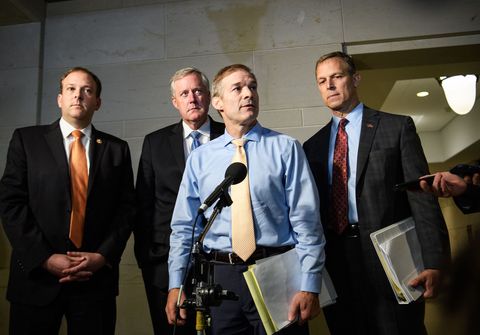
Here with a contrary view is Rep. Jim Jordan.
“You think about what the Democrats are trying to do: Impeach the President of the United States 13 months prior to an election, based on an anonymous whistleblower with no firsthand knowledge who has a bias against the President.”
The Republicans have no leg to stand on and they know it. There’s no privilege they can invoke. Sondland is obviously a key witness directly involved with the events that the House is tasked with investigating. The way you know that is that the president*’s account on the electric Twitter machine admits that’s the case.
I would love to send Ambassador Sondland, a really good man and great American, to testify, but unfortunately he would be testifying before a totally compromised kangaroo court, where Republican’s rights have been taken away, and true facts are not allowed out for the public to see. Importantly, Ambassador Sondland’s tweet, which few report, stated, “I believe you are incorrect about President Trump’s intentions. The President has been crystal clear: no quid pro quo’s of any kind.” That says it ALL!
Trump Kills a Tariff Loophole in Latest Blow to Renewables
Brian Eckhouse and Christopher Martin October 4, 2019
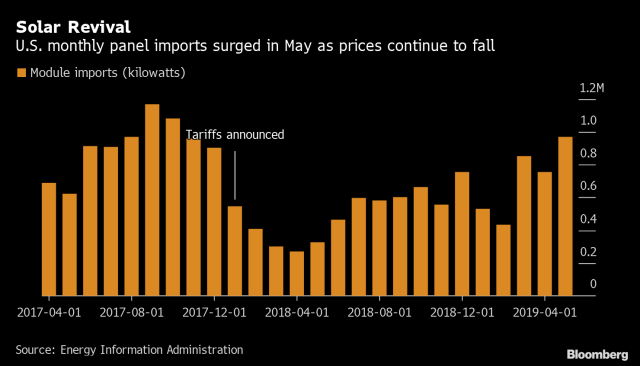
(Bloomberg) — The Trump administration dealt a fresh blow to renewable energy developers on Friday by stripping away an exemption the industry was counting on to weather the president’s tariffs on imported panels.
The U.S. Trade Representative said Friday it was eliminating a loophole granted about four months ago for bifacial solar panels, which generate electricity on both sides. They’ll now be subject to the duties Trump announced on imported equipment in early 2018, currently at 25%. The change takes effect Oct. 28.
The exclusion had been a reprieve for the solar industry, which lost thousands of jobs and put projects on ice as a result of the tariffs. Some panel manufacturers had already begun shifting supply chains to produce more bifacial panels. Stripping the exemption is a blow to developers who build big U.S. solar projects. American panel makers First Solar Inc. and SunPower Corp. will regain an edge on foreign competitors.
“The solar tariffs are back,” Tara Narayanan, an analyst at BloombergNEF, said in an interview Friday. “U.S. solar developers cannot buy products with lower costs and higher output as they briefly thought they could.”
First Solar, the largest U.S. solar panel maker, rose 0.5% to $59.60 at 5:16 p.m. SunPower gained 0.7% to $10.62.
What BloombergNEF Says
“The withdraw of tariff exemption for bifacial will cool down its popularity in the U.S. a little, but not stop the rise of the technology, which introduces improved economics even without tariff exemption.”– Xiaoting Wang, solar analyst
Developers that have used bifacial panels and stand to take a hit from ending the exclusion include Renewable Energy Systems Americas Inc.and Swinerton Inc.
While bifacial panels accounted for just 3% of the solar market last year, BloombergNEF had projected a swift ramp-up in production as manufacturers tried to insulate themselves from U.S. tariffs.
The trade group Solar Energy Industries Association fought to preserve the exemption, saying bifacial technology held “great promise for creating jobs, right here in America.”
“We’re obviously disappointed,” the group’s general counsel, John Smirnow, said Friday. “We look forward to making sure the bifacial exemption gets a fair hearing” during the solar tariff’s mid-term review process.
The U.S. Trade Representative said in its filing that “the exclusion will likely result in significant increases in imports of bifacial solar panels, and that such panels likely will compete with domestically produced” products.
SunPower, based in San Jose, California, opposed the exemption without a cap, saying that it would otherwise defeat the purpose of the tariffs. “It just means everyone is going to make a bifacial,” the company’s chief executive officer, Tom Werner, said in a Sept. 23 interview.
–With assistance from Joe Ryan and Ari Natter.
To contact the reporters on this story: Brian Eckhouse in New York at beckhouse@bloomberg.net;Christopher Martin in New York at cmartin11@bloomberg.net
To contact the editors responsible for this story: Lynn Doan at ldoan6@bloomberg.net, Joe Ryan, Pratish Narayanan
Experts are raising questions about why the Justice Department did not open an investigation.
By Ken Dilanian and Julia Ainsley October 4, 2019
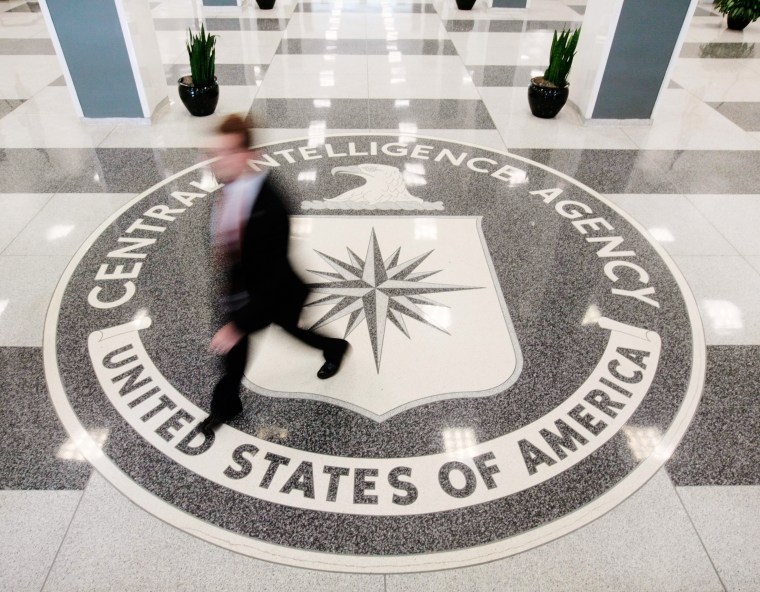
The lobby of the CIA Headquarters building in McLean, Virginia.Larry Downing / Reuters file
WASHINGTON — Weeks before the whistleblower’s complaint became public, the CIA’s top lawyer made what she considered to be a criminal referral to the Justice Department about the whistleblower’s allegations that President Donald Trump abused his office in pressuring the Ukrainian president, U.S. officials familiar with the matter tell NBC News.
The move by the CIA’s general counsel, Trump appointee Courtney Simmons Elwood, meant she and other senior officials had concluded a potential crime had been committed, raising more questions about why the Justice Department later declined to open an investigation.
The phone call that Elwood considered to be a criminal referral is in addition to the referral later received as a letter from the Inspector General for the Intelligence Community regarding the whistleblower complaint.
Justice Department officials said they were unclear whether Elwood was making a criminal referral and followed up with her later to seek clarification but she remained vague.
In the days since an anonymous whistleblower complaint was made public accusing him of wrongdoing, trump has lashed out at his accuser and other insiders who provided the accuser with information, suggesting they were improperly spying on what was a “perfect” call between him and the Ukrainian president.
But a timeline provided by U.S. officials familiar with the matter shows that multiple senior government officials appointed by Trump found the whistleblower’s complaints credible, troubling, and worthy of further inquiry starting soon after the president’s July phone call.
While that timeline and the CIA general counsel’s contact with the DOJ has been previously disclosed, it has not been reported that the CIA’s top lawyer intended her call to be a criminal referral about the president’s conduct, acting under rules set forth in a memo governing how intelligence agencies should report allegations of federal crimes.
The fact that she and other top Trump administration political appointees saw potential misconduct in the whistleblower’s early account of alleged presidential abuses puts a new spotlight on the Justice Department’s later decision to decline to open a criminal investigation — a decision that the Justice Department said publicly was based purely on an analysis of whether the president committed a campaign finance law violation.
“They didn’t do any of the sort of bread-and-butter type investigatory steps that would flush out what potential crimes may have been committed,” said Berit Berger, a former federal prosecutor who heads the Center for the Advancement of Public Integrity at Columbia Law School. “I don’t understand the rationale for that and it’s just so contrary to how normal prosecutors work. We have started investigations on far less.”
Elwood, the CIA’s general counsel, first learned about the matter because the complainant, a CIA officer, passed his concerns about the president on to her through a colleague. On Aug. 14, she participated in a conference call with the top national security lawyer at the White House and the chief of the Justice Department’s National Security Division.
On that call, Elwood and John Eisenberg, the top legal adviser to the White House National Security Council, told the top Justice Department national security lawyer, John Demers, that the allegations merited examination by the DOJ, officials said.
According to the officials, Elwood was acting under rules that a report must occur if there is a reasonable basis to the allegations, defined as “facts and circumstances…that would cause a person of reasonable caution to believe that a crime has been, is being, or will be committed.”
A DOJ official said Attorney General William Barr was made aware of the conversation with Elwood and Eisenberg, and their concerns about the president’s behavior, in the days that followed.
Justice Department officials now say they didn’t consider the phone conversation a formal criminal referral because it was not in written form. A separate criminal referral came later from the Office of the Director of National Intelligence, which was based solely on the whistleblower’s official written complaint.
When Elwood and Eisenberg spoke with DOJ, no one on the phone had seen the whistleblower’s formal complaint to the inspector general of the intelligence community, which had been submitted two days before the call and was still a secret. The issue of campaign finance law was not part of their deliberations, the officials said.
A ‘thing of value’
It is illegal for Americans to solicit foreign contributions to political campaigns. Justice Department officials said they decided there was no criminal case after determining that Trump didn’t violate campaign finance law by asking the Ukrainian president to investigate his political rival, because such a request did not meet the test for a “thing of value” under the law.
Justice Department officials have said they only investigated the president’s Ukraine call for violations of campaign finance law because it was the only statute mentioned in the whistleblower’s complaint. Former federal prosecutors contend that the conduct could have fit other criminal statutes, including those involving extortion, bribery, conflict of interest or fraud, that might apply to the president or those close to him.
The decision not to open an investigation meant there was no FBI examination of documents or interviews of witnesses to the phone call, participants in the White House decision to withhold military funding from Ukraine, the president’s lawyer, Rudy Giuliani, and Ukrainian officials who were the target of Trump and Giuliani’s entreaties.
Text messages turned over to Congress Thursday night, in which diplomats appear to suggest there was a linkage between aid and Ukraine’s willingness to investigate a case involving Joe Biden, were not examined as part of the Justice Department’s review, officials said, adding that they conducted purely a legal analysis.
Justice Department spokeswoman Kerri Kupec told NBC News that the decision not to open an investigation was made by the head of the criminal division, Brian Benczkowski, in consultation with career lawyers at the public integrity section. She and other officials declined to say whether anyone dissented.
Attorney General William Barr.Jacquelyn Martin / AP
The operative DOJ standard that the president can’t be indicted while in office was not a factor, she said. Attorney General William Barr has said he believes the president can be investigated and prosecutors can make a determination whether he committed criminal conduct.
“Relying on established procedures set forth in the Justice Manual, the Department’s Criminal Division reviewed the official record of the call and determined, based on the facts and applicable law, that there was no campaign finance violation and that no further action was warranted,” said Kupec.
Kupec declined to comment on whether the Justice Department was investigating any other aspect of the Ukraine matter. There has been no public indication, however, of any such investigation.
Some legal experts are puzzled by Justice Department’s narrow approach.
“They are not by any stretch of the imagination limited to the referral,” said Chuck Rosenberg, an NBC News contributor and former U.S. Attorney. “They have the authority — in fact, they have the obligation — to look more deeply and more broadly and bring whatever charges are appropriate.”
Berger added, “When you get a criminal referral, you don’t go into it saying, ‘This is the criminal violation and now I’m going to see if the facts prove it.’ You start with the facts and the evidence and then you see what potential crimes those facts support. It seems backwards to say, ‘We are going to look at this just as a campaign finance violation and oops, we don’t see it — case closed.'”
In a case in which a government official is allegedly using his office for personal gain, and pressuring someone to extract a favor, the bribery and extortion statutes are usually considered, Berger said. The Foreign Corrupt Practices Act, which prohibits bribery of foreign officials, may also have been implicated, she said.
‘I have received information’
In his written complaint, the CIA officer who became the whistleblower framed his allegations this way: “I have received information from multiple U.S. government officials that the President of the United States is using the power of his office to solicit interference from a foreign country in the 2020 election.”
But when he first passed on his concerns, they were not so specific, officials said. He first complained at his own agency, sending word through a colleague to a CIA lawyer. The complaint eventually reached the spy agency’s top lawyer, Elwood, officials said.
She was told there were concerns about the president’s conduct on a call with a foreign leader, but not which leader, officials said.
She also was told that others at the National Security Council shared the concerns, so she called Eisenberg, the top NSC lawyer, officials said. He was already aware that people inside his agency believed something improper had occurred on the July 25 call with the Ukrainian president, officials said.
After consulting with others at their respective agencies and learning more details about the complaint, Elwood and Eisenberg alerted the DOJ’s Demers, during the Aug. 14 phone call, in what Elwood considered to be a criminal referral. Demers read the transcript of the July 25 call, officials said, on August 15.
What the DOJ did next is not entirely clear. A DOJ official said it was the department’s perspective that a phone call did not constitute a formal criminal referral that allowed them to consider an investigation, and that a referral needed to be in writing.
The whistleblower was already taking separate action. On Aug. 12, he filed a complaint with the inspector general of the intelligence community, after consulting with a staff member on the House Intelligence Committee, officials said.
At the end of August, the acting director of national intelligence, Joseph Maguire, sent the Justice Department his own criminal referral based on the whistleblower complaint, he has confirmed.
Kupec says career prosecutors in the Public Integrity Section, which works on corruption cases, were involved in deciding how to proceed, as was the national security division and the Office of Legal Counsel.
A senior DOJ lawyer who briefed reporters said the department had no basis on which to open a criminal investigation because Trump’s request of Ukrainian President Volodymyr Zelenskiy to investigate a case involving his political opponent couldn’t amount to a quantifiable “thing of value” under campaign finance law.
DOJ officials said they focused on campaign finance law because that was how the allegations were framed in the whistleblower complaint.
“All relevant components of the department agreed with this legal conclusion,” the DOJ’s Kupec said.
Paul Seamus Ryan, vice president of policy and litigation at Common Cause, is among those questioning even the narrow campaign finance analysis. Common Cause has filed a complaint with the Justice Department and the Federal Election Commission accusing Trump of violating campaign law.
It wouldn’t have been difficult for the government to determine how much money Ukraine would have spent in an investigation of Joe Biden and his son, he said,
“That would give them a dollar amount to show that Trump solicited ‘something of value,'” Ryan said.
Ken Dilanian is a correspondent covering intelligence and national security for the NBC News Investigative Unit.
Julia Ainsley is a correspondent covering the Department of Homeland Security and the Department of Justice for the NBC News Investigative Unit.