Lisa Murkowski says of the Senate: ‘The train has to go off the cliff before you get the rescue crew’
Brent D. Griffiths January 19, 2022
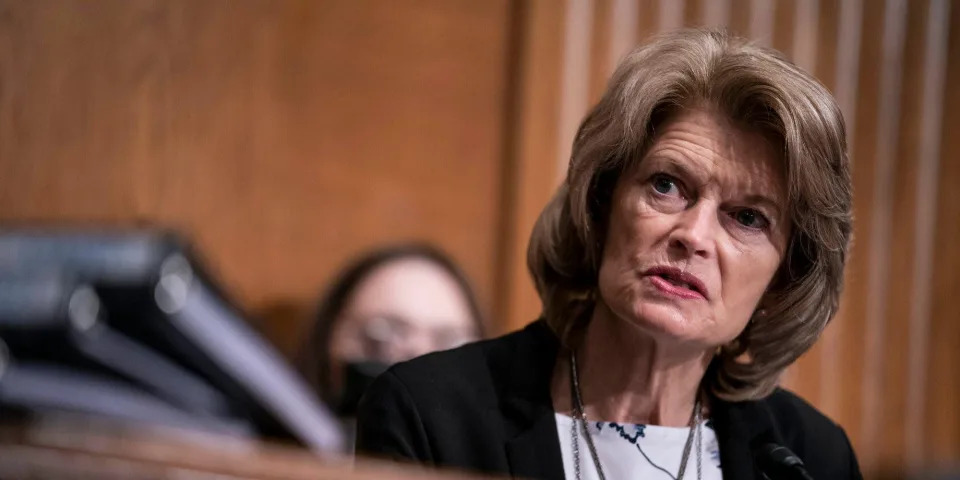
Sen. Lisa Murkowski, a Republican from AlaskaSarah Silbiger/Pool Photo via AP, File
Sen. Lisa Murkowski on Wednesday gave a dour outlook for her chamber.
The Alaska lawmaker compared the state of relations to a rescue crew sorting through a wreckage.
Senators are poised to come to a head over voting rights and filibuster rules.
Sen. Lisa Murkowski told reporters on Wednesday that the outlook for the upper chamber is “dismal” with the two parties headed for a showdown over voting rights and filibuster rules later tonight.
“Maybe what has to happen is we just have to completely go off the edge, the train has to go off the cliff before you get the rescue crew down below trying to salvage things,” Murkowski told reporters, according to HuffPost’s Igor Bobic. “I don’t know.”
The Alaska Republican has built a reputation as one of the Senate’s few remaining centrists. She was the only Republican to support Democrats’ 2020 efforts to restore key provisions of the Voting Rights Act of 1965 that the Supreme Court has weakened over time. Like all other GOP senators, she opposes Democrats’ efforts to weaken the filibuster in order to pass voting rights legislation.
“I question whether or not changing the rules actually works to change the attitude,” Murkowski said on the floor earlier on Wednesday. “It is much easier to try to do things alone than to try to build consensus.”
Murkowski, who previously won reelection on a write-in campaign, stated last year that she will run again in 2022. Trump has vowed to try to oust her from her seat.
Murkowski is not the only one to express a dour outlook either. Later on Wednesday, Democrats are expected to fail in their efforts to pass voting rights legislation.
Citing “unconstitutional political gerrymandering,” Democratic Gov. Andy Beshear on Wednesday vetoed the House Republican majority’s new maps for the 100 House districts and the GOP-dominated legislature’s plans to redraw the state’s six congressional districts.
The GOP holds veto-proof super-majorities in both chambers of the legislature, so they can override the governor. But Republican legislative leaders hoped to put this issue behind them during the first week of the session early this month.
“We are disappointed that the governor has chosen to again veto lawfully enacted legislation,” House Speaker David Osborne, R-Prospect, said in a prepared statement on the vetoes.
“He is wrong on the facts, wrong on the law, and he knows it,” Osborne said. “This proposal meets all legal considerations. It splits no precincts, divides the fewest number of counties possible, and preserves communities of interest.”
On the congressional district map, Beshear specifically cited the redrawn 1st Congressional District, which would now extend from Fulton County on the Mississippi River to Franklin County in the Bluegrass region. Democrats protested that this was intended to remove Franklin County’s Democratic votes from Central Kentucky’s more moderate 6th Congressional District, attaching it to the far more conservative 1st District.
“Under this map, someone driving from Lexington to Louisville would drive across five of the state’s congressional districts, but it would take over four hours to get from one side of the First District to the other,” Beshear wrote in his veto message.
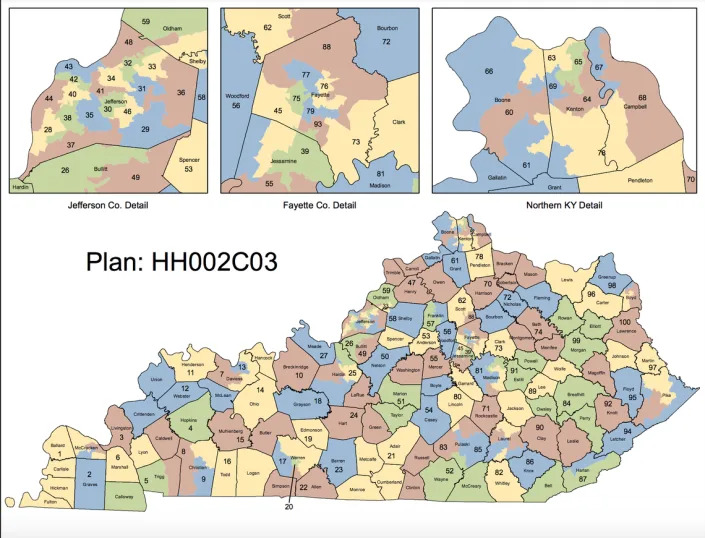
On the state legislative map, Beshear criticized the House plan for excessively splitting up counties, particularly urban counties that lean Democratic, such as Jefferson, Fayette, Boone and Warren, for partisan reasons that favor the Republican majorities.
“This redistricting plan appears designed to deprive certain communities of representation,” Beshear wrote. “Moreover, according to the demographic data the House released after it passed this bill, this plan appears to dilute the voices of certain minority communities.”
Pictured above is the new House map passed by the state legislature on Saturday.
Stacey Abrams: Voting rights legislation can be passed
SUDHIN THANAWALA January 19, 2022
FILE – Then-Georgia gubernatorial Democratic candidate Stacey Abrams speaks during an interview with The Associated Press on Dec. 16, 2021, in Decatur, Ga. Stacey Abrams has used a campaign stop in Atlanta to applaud the push for voting rights in Congress and express support for President Biden. Abrams was noticeably absent from Biden’s visit last week to Atlanta, where he called for an end to the filibuster to pass voting legislation. Abrams said Wednesday, jan. 19, 2022 that she was a proud Democrat and “President Joe Biden is my president.” She took questions from the media at the headquarters of the Georgia AFL-CIO union, which announced that it was endorsing her for Georgia governor. Abrams also said she was proud of the work that was going to happen on Capitol Hill to keep the focus on voting rights. (AP Photo/Brynn Anderson, file) (ASSOCIATED PRESS)
ATLANTA (AP) — Stacey Abrams used a Wednesday campaign stop in Atlanta to applaud the push for voting rights in Congress and express support for President Joe Biden.
Abrams was noticeably absent from Biden’s visit last week to Atlanta, where he called for an end to the filibuster to pass voting legislation. An aide blamed a scheduling conflict, and in a statement released after Biden spoke, Abrams said she welcomed his commitment to changing the filibuster for voting bills.
On Wednesday, Abrams said she was a “proud Democrat, and President Joe Biden is my president.” She took questions from the media at the headquarters of the Georgia AFL-CIO union, which announced that it was endorsing her campaign for Georgia governor.
She said of Biden, “I am proud to work with him on not only the issues facing us on voting rights, but I’m proud of the resources he has sent to Georgia.”
Abrams also said she was “proud of the work that’s going to happen on Capitol Hill today to keep” voting rights “front and center for every Georgian and every American.”
“I believe legislation can be passed because I know that we’ve done it before,” she said.
“But we also have to remember that civil rights and voting rights took a long time,” she added.
Senators opened debate Wednesday on voting legislation that’s almost certain to be defeated. Despite his late push, Biden has been unable to persuade two holdout Democrats, Kyrsten Sinema of Arizona and Joe Manchin of West Virginia, to change Senate rules so the party can overpower a Republican filibuster blocking the voting bill.
Democrats and civil rights leaders say the bill is vital for protecting democracy after Republican-led state legislatures passed a slew of new voting restrictions following President Donald Trump’s false claims of voting fraud. Republicans have accused Democrats of pushing a sprawling federal takeover of election systems.
Abrams blasted new voting rules in Georgia, saying they were a response to the success voters had in casting ballots.
She also called for Medicaid expansion in the state and criticized plans recently pushed by Republican Gov. Brian Kemp to do away with the need for a license to carry a handgun in public. The current license requirement includes a background check. Kemp, citing a surge in violent crime, has said Georgia residents should have their constitutional rights protected and be able to protect themselves and their families.
Abrams said the license change was antithetical to Kemp’s emphasis on public safety.
“Because when you say that you want people to be safe, how can you say that you are willing to take away background checks and mental health checks before someone can have a weapon in this state?” she asked.
Unable to win the battle of ideas, Pa. Republicans are damaging the state constitution
Ray E. Landis – January 19, 2022
Amending the Constitution of the United States, which has happened only 17 times since the Bill of Rights was enacted in 1791, is a meticulous process with various hurdles designed to ensure any amendment is carefully considered. Amending the Pennsylvania Constitution, on the other hand, is not as arduous.
Since the latest version of the Pennsylvania Constitution was adopted in 1968, it has been amended 46 times. Republicans in the General Assembly are anxious to add on to that number, as they continue to plot how to assert their will upon residents of the commonwealth when the party controls only one of the three branches of government.
The purpose of the Pennsylvania Constitution is to establish the rights and responsibilities of the citizens of the commonwealth and to establish how its governmental and judicial systems will operate.
The process of amending the Pennsylvania Constitution is relatively straightforward and seems, at first glance, to be an exercise in democracy. An amendment must be approved by majorities in both houses of the General Assembly in two consecutive sessions. If this happens, the proposed amendment is then placed on the ballot in the next statewide election and is enacted if a majority of the voters in that election approve of it.
The Republican majority in the current General Assembly has increasingly come to view the amendment process as a way to avoid the objections of Gov. Tom Wolf to their policy preferences. As of early January 2022, Wolf has vetoed 54 bills passed by the General Assembly.
In frustration, Republicans have begun to propose constitutional amendments, which bypass the need for the signature of the governor, in order to get their policies enacted — and to increase the political power of the legislative branch of government.
This could be viewed as the General Assembly taking their case for enactment of their policies to the people of the commonwealth. But there are flaws in the process which Republicans are exploiting. The first flaw is the nature of the General Assembly.
Over and over the Republican majority makes the claim they are the true representatives of the “people of Pennsylvania.” A basic look at election results tells a different story.
The governor was elected by votes of all Pennsylvanians. He received hundreds of thousands more votes than Republican candidates for either the state House or state Senate, but Republicans gained the majority of seats in the General Assembly because of how the districts in which they ran for office were constructed.
Given this, shouldn’t it be expected if more Pennsylvanians voted for the governor than Republicans in the General Assembly a vote on a constitutional amendment opposed by the governor but supported by Republicans would fail? This is the second flaw in the process Republicans are taking advantage of.
Constitutional amendments are voted on by the people of Pennsylvania at the next statewide election after the amendment is passed the second time. Republicans in the General Assembly have scheduled votes to ensure constitutional amendments will be voted on in odd-year primary elections.
Odd-year primaries are the statewide elections featuring the lowest turnout of voters, and voters who are not registered as either Democrats or Republicans rarely have opportunities to vote for candidates.
This makes it the perfect election for Republicans to place constitutional amendments on the ballot. Statistically, Republicans are more likely to vote in primary elections, and it is no coincidence that Republican-sponsored constitutional amendments were adopted in May of 2021, when voters chose candidates for school boards, judicial positions, and local races.
In their latest scheme, Republicans are turning toward a constitutional amendment strategy to change the process of reapportionment for General Assembly districts.
The state House passed a proposed amendment which would eliminate the current redistricting commission and replace it with a new “citizens” commission, with the majority of members appointed by partisan legislators.
The key aspect of this proposal, however, is the new commission must pass their proposal by a two-thirds majority. If it fails to do so, the General Assembly may draw its own maps, perpetuating the current partisan makeup in the Legislature.
Republicans face a changing demographic landscape in Pennsylvania. The legislative redistricting commission’s proposed map threatens their majority in the state House (and their ability to pass constitutional amendments).
The Pennsylvania Capitol is shown in Harrisburg, Pa., Wednesday, Sept. 15, 2021.
Thus, their loud, hysterical complaints about the map and threat to sue about the process. Their hope, of course, is to stall the process and force the 2022 elections to be run in the current legislative districts, in which Republicans have a distinct advantage.
Such a result could ensure a Republican majority for the 2023-24 session, enabling them to pass their constitutional amendment, place it on the 2023 primary ballot, and have it approved by a small percentage of Pennsylvania voters, resulting in their perpetual control of the redistricting process.
How undemocratic.
Opinion contributor Ray E. Landis writes about the issues important to older Pennsylvanians. His work appears biweekly on the Capital-Star’s Commentary Page, where this column was first published.
Pennsylvania Capital-Star is part of States Newsroom, a network of news bureaus supported by grants and a coalition of donors as a 501c(3) public charity. Pennsylvania Capital-Star maintains editorial independence.
Letter: Let’s give credit to the Republicans who believe in our democracy
Delaware News Journal Letters to the Editor January 19, 2022
After the anniversary of the Jan. 6 insurrection, it is time we recognized the true heroes of the Republican Party.
They are not the dopey louts who rampaged through our nation’s capitol and the moral cowards who still cover for them. They are not the ranting demagogues exploiting the emotions of the resentful. They were the unsung people not seeking attention, but doing their jobs: from poll workers to police officers.
Former Vice President Dick Cheney walks with his daughter Rep. Liz Cheney, R-Wy., vice chair of the House panel investigating the Jan. 6 U.S. Capitol insurrection, in the Capitol Rotunda at the Capitol in Washington, Thursday, Jan. 6, 2022.
They were Republican state legislators and governors who did not bend to pressure to overturn the elections in their state. They were Republican judges who did not allow mere allegations unsupported by credible evidence to deny votes that happened. They were a Vice President who stayed loyal to the Constitution and the rule of law above any man. They were Republican congressional representatives and senators who did not fear to try and hold their own president accountable, and dared to stand on their conscience instead of follow the majority in their party.
They did not win. But they showed more bravery than the majority in their party who did.
It is Republicans like those who could save the soul of the party from being lost to a band of fascists, if they find the nerve to do so.
My father was a lifelong Republican who served in the U.S. Navy during World War II. After the sacrifices that generation made to defeat fascism, I’m glad he was not alive to see his party dishonored by America’s Mussolini.
Joe Manchin sees ‘no use’ in holding a vote on voting rights that is almost certain to fail — thanks in part to him
Brent D. Griffiths January 19, 2022
Sen. Joe Manchin of West Virginia speaks with reportersTom Williams/CQ-Roll Call Inc. via Getty Images
Joe Manchin wants to avoid an expected vote that will divide the Democratic Party.
Manchin still wants his party to continue to work on voting rights.
Top party leaders have brushed off efforts to delay a vote.
Sen. Joe Manchin said that he doesn’t see the point of Senate Majority Leader Chuck Schumer forcing a vote later Wednesday on the party’s major voting rights proposals given that they are virtually destined to fail, thanks in part to his stance.
“I would like to see us stay on the bill. There’s no use to try to bring this to finality by having a vote that’s going to fail tonight,” Manchin of West Virginia told CNN’s Manu Raju ahead of a pivotal day for Democrats.
Senate Majority Leader Chuck Schumer has pledged to force a vote that weakens the Senate’s filibuster after Republicans blocked the party from passing voting rights legislation. Democrats, including Manchin, are united behind the party’s two bills but Manchin and Sen. Kyrsten Sinema are steadfast in opposition to changing filibuster rules.
Republicans are expected to block Democrats from passing their legislation. Schumer is then expected to force senators to consider changing the filibuster, the de-facto 60-vote threshold for most legislation, but due to Manchin and Sinema’s opposition that effort will also fail.
Senate Minority Leader Mitch McConnell called Schumer’s expected moves a “sad spectacle.” Schumer and President Joe Biden have repeatedly said the party’s voting rights proposals are about the continuation of the American experiment itself. Schumer has stressed that it is important for all senators, including his fellow Democrats, to put their views on the record.
Manchin told CNN that he will also speak on the Senate floor later today. On Tuesday night, Manchin emphatically declared that he would oppose any changes to the filibuster even if it led to a future primary challenger.
Top party leaders are also eager to move on to other topics. Rep. Hakeem Jeffries of New York, chair of the House Democratic caucus, told reporters that Senate Democrats will soon return to Biden’s massive spending plan known as Build Back Better.
Staff writer Grace Panetta contributed to this report.
100+ Ultra-Rich People Warn Fellow Elites: ‘It’s Taxes or Pitchforks’
“History paints a pretty bleak picture of what the endgame of extremely unequal societies looks like,” reads an open letter signed by millionaires and billionaires calling for higher taxes on people like themselves.
Jake Johnson January 19, 2022
A demonstrator gestures in front of a bonfire during a protest against Chilean President Sebastian Pinera’s government in Santiago on March 13, 2020. (Photo: Martin Bernetti/AFP via Getty Images)
A group of more than 100 millionaires and billionaires on Wednesday presented fellow members of the global economic elite with a stark choice: “It’s taxes or pitchforks.”
In an open letter published amid the corporate-dominated virtual Davos summit, 102 rich individuals—including such prominent figures as Disney heiress Abigail Disney and venture capitalist Nick Hanauer—warned that “history paints a pretty bleak picture of what the endgame of extremely unequal societies looks like.”
“For all our well-being—rich and poor alike—it’s time to confront inequality and choose to tax the rich.”
“For all our well-being—rich and poor alike—it’s time to confront inequality and choose to tax the rich,” the letter reads. “Show the people of the world that you deserve their trust.”
The letter was released hours after an analysis conducted by the Fight Inequality Alliance, the Institute for Policy Studies, Oxfam, and Patriotic Millionaires showed that a modest annual wealth tax targeting the world’s millionaires and billionaires would raise $2.52 trillion dollars a year, enough to lift billions of people out of poverty and vaccinate the world against Covid-19.
But signatories to the new letter note that such a solution is unlikely to win broad support among attendees of the World Economic Forum (WEF), the yearly gathering of global elites that’s typically held in Davos, Switzerland. Due to the coronavirus pandemic, this year’s WEF is taking place virtually.
“If you’re participating in the World Economic Forum’s ‘online Davos’ this January, you’re going to be joining an exclusive group of people looking for an answer to the question behind this year’s theme, ‘How do we work together and restore trust?'” the letter reads. “You’re not going to find the answer in a private forum, surrounded by other millionaires and billionaires and the world’s most powerful people. If you’re paying attention, you’ll find that you’re part of the problem.”
The letter—signed by rich individuals from Denmark, Germany, Austria, and other nations—continues:
Trust—in politics, in society, in one another—is not built in tiny side rooms only accessible by the very richest and most powerful. It’s not built by billionaire space travelers who make a fortune out of a pandemic but pay almost nothing in taxes and provide poor wages for their workers. Trust is built through accountability, through well-oiled, fair, and open democracies that provide good services and support all their citizens.
And the bedrock of a strong democracy is a fair tax system. A fair tax system.
As millionaires, we know that the current tax system is not fair. Most of us can say that, while the world has gone through an immense amount of suffering in the last two years, we have actually seen our wealth rise during the pandemic—yet few if any of us can honestly say that we pay our fair share in taxes.
This injustice baked into the foundation of the international tax system has created a colossal lack of trust between the people of the world and the elites who are the architects of this system…
To put it simply, restoring trust requires taxing the rich. The world—every country in it—must demand the rich pay their fair share. Tax us, the rich, and tax us now.
Made significantly worse by the ongoing coronavirus pandemic, skyrocketing income and wealth inequality has been at the heart of recent mass protest movements in South America, the Middle East, Europe, the United States, and elsewhere—grassroots uprisings that have frequently been met with brutal police repression.
“It’s time we right the wrongs of an unequal world.”
But little of substance has been done in recent years to reverse the decades-long trend of staggering wealth accumulation at the very top and declining standards of living for large swaths of the global population.
According to an Oxfam analysis published earlier this week, the 10 richest men in the world have seen their combined fortunes grow by more than $1.2 billion per day since the coronavirus pandemic hit two years ago while tens of millions worldwide have been pushed into poverty.
Progressive advocates and lawmakers have long argued that raising taxes on the rich—while far from a panacea for deep-seated societal ills—would help rein in soaring inequities and raise revenue for governments to spend on alleviating poverty, providing universal healthcare, and meeting other basic needs.
Gemma McGough, a British entrepreneur and a founding member of Patriotic Millionaires U.K., reiterated that case in a statement Wednesday.
“A common value most people share is that if something’s not fair then it’s not right. But tax systems the world over have unfairness built-in, so why should people trust them?” said McGough, one of the new letter’s signatories. “They are asked to shoulder our shared economic burden again and again, while the richest people watch their wealth, and their comfort, continue to rise.”
“It’s time we right the wrongs of an unequal world,” McGough added. “It’s time we tax the rich.”
New Mexico Republican who signed bogus electoral certificate says he has ‘no regrets whatsoever’
Algernon D’Ammassa January 18, 2022
A bogus electoral certificate signed by prominent New Mexico Republicans and sent to the national archive in the wake of the 2020 presidential election has gotten new scrutiny over the past week.
The peculiar action received scant attention in the shadow of a lawsuit from President Donald Trump’s campaign on the day that New Mexico electors gathered at the state Capitol building in Santa Fe to deliver New Mexico’s five electoral college votes to Democrats Joe Biden and Kamala Harris for president and vice president.
Alternative electoral certificates from New Mexico and six other states were first published by American Oversightand have taken on greater significance as the U.S. House select committee investigating the Jan. 6, 2021 assault on the U.S. Capitol scrutinizes efforts by Trump supporters to subvert the certification of Biden’s election win in several states.
Michigan Attorney General Dana Nessel, a Democrat, described a similar action by Republicans in that state as “election fraud” and referred the case to federal prosecutors while continuing to mull state charges as well, Ann Arbor News reported.
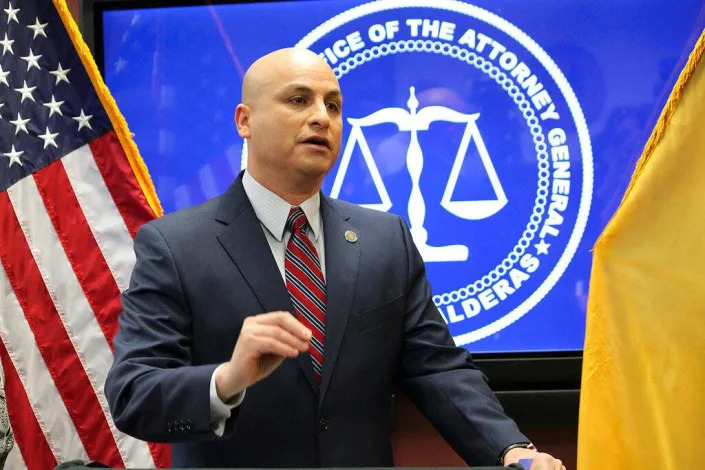
In this Feb. 26, 2019, file photo, New Mexico Attorney General Hector Balderas talks during a news conference in Albuquerque, New Mexico.
New Mexico Attorney General Hector Balderas, also a Democrat, has similarly referred the New Mexico Republicans’ certificate to U.S. Attorney Fred J. Federici.
“Election laws are the foundation of our democracy and must be respected,” Balderas said in a statement. “While review under state law is ongoing, we have referred this matter to the appropriate federal law-enforcement authorities and will provide any assistance they deem necessary.”
New Mexico Republicans, for their part, including the signers who argued they might be the rightful electors, have mostly been silent. One of the signers, however, told the Las Cruces Sun-News he has “no regrets whatsoever.”
The state Republican Party did not respond to queries for this story.
Undermining the 2020 election
It was Dec.14, 2020 when Democratic electors cast their votes after Biden won New Mexico’s popular vote by 501,614 votes to President Donald Trump’s 401,894. The result was executed on a certificate of ascertainment by Gov. Michelle Lujan Grisham and filed according to regular process.
On the same day, the Trump campaign filed a lawsuit over New Mexico’s use of drop boxes to collect completed ballots, one of a series of measures taken to enhance public safety in the first year of the COVID-19 pandemic.
Weeks later, the campaign dropped the matter, but the president continued to assert false claims of widespread voter fraud and insist he was the rightful winner, all evidence — in the wake of audits and recounts in multiple states — to the contrary.
Also on Dec. 14, New Mexico Republican electors also turned up at the state capitol and were refused admittance, but nonetheless signed their own election certificate in support of Trump and Vice President Mike Pence.
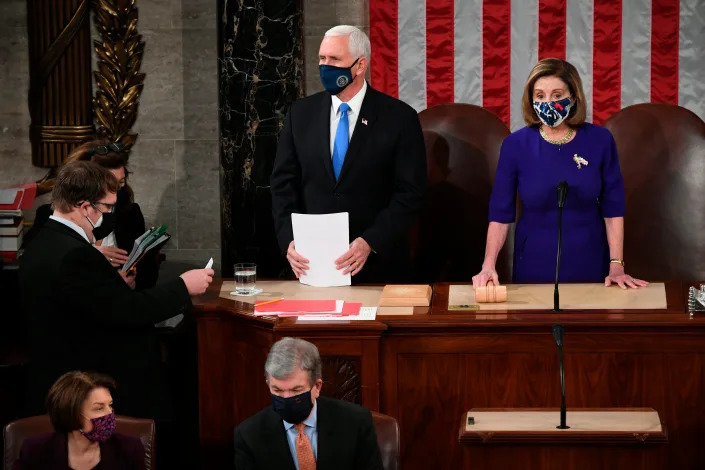
FILE – Vice President Mike Pence presides over a joint session of Congress as it convenes to count the Electoral College votes cast in November’s election, at the Capitol in Washington, Jan. 6, 2021. Speaker of the House Nancy Pelosi, D-Calif., stands at right. Pence did not bend to President Donald Trump’s extraordinary pressure to intervene and presided over the count in line with his ceremonial role. He announced the certification of Biden’s victory before dawn, hours after a mob of Trump’s supporters violently ransacked the building. (Saul Loeb/Pool via AP, File) ORG XMIT: WX106
The signers were businessmen Jewll Powdrell and Lupe Garcia; Deborah Maestas, a former state GOP chairperson; Rosie Tripp, a former GOP national committee member from Socorro who has held elected offices; and Anissa Ford-Tinnin, who signed as a substitute for oil businessman (and another former state party chairperson) Harvey Yates.
According to the document, the parallel certification was undertaken “on the understanding that it might later be determined that we are the duly elected and qualified Electors for President and Vice President of the United States of America from New Mexico.”
The certificate was then signed and filed with the National Archives and Records Administration. There was, however, never any merit to the claim that New Mexico’s election result might be overturned in favor of Trump.
“It didn’t have any real impact on the counting of electoral votes,” Alex Curtas, a spokesman for New Mexico Secretary of State Maggie Toulouse Oliver, told the Sun-News, adding, “They didn’t disrupt the actual authentic electoral college count. The election went off as it should have.”
Weeks later, on Jan. 6, 2021, supporters of the president assaulted Congress as it met to finalize the election, after Trump called on them to march to the Capitol during a fiery rally near the White House.
After order was restored and the proceedings continued, newly sworn Congresswoman Rep. Yvette Herrell, a Republican representing southern New Mexico, objected to certifying election results in Biden’s favor from Arizona and Pennsylvania.
U.S. Rep. Yvette Herrell, R-N.M., objecting to certification of Pennsylvania’s Electoral College results for the Nov. 3, 2020 presidential election, on the floor of the U.S. House of Representatives in Washington, D.C. on Thursday, Jan. 7, 2021.
Herrell’s office did not respond to queries from the Sun-News about the GOP electoral certificates or her thoughts, in retrospect, about the validity of Biden’s election.
Despite Republican objections in Congress, the election results were confirmed and Biden and Harris were inaugurated on Jan. 20, 2021 in the presence of heightened security at the Capitol and throughout Washington, D.C.
‘No regrets whatsoever’
Powdrell, a Rio Rancho businessman identified as chairperson on the Republicans’ electoral certificate, told the Sun-News he had “no regrets whatsoever” about signing the certificate that day.
It was Powdrell’s first time serving as a presidential elector for his party, and he recalled that after being refused admittance at the state Capitol building, the group signed the certificate in the lobby.
He dismissed renewed attention on the certificate as a “non-issue.”
“Now that the election is over, why are we talking about it?” he asked, laughing. “How can you undermine an election that had already been done?”
His intention in signing the certificate was “to say I support the Republican Party,” he said, not to undermine the process.
Asked whether he accepted Biden’s victory in the election as genuine, Powdrell hedged, first saying, “The election was what it was and unless you’ve got definitive, undisputable, irreversible facts to refute it, it is what it is.”
He then suggested that such evidence might exist, but that courts refused to hear it. The Trump campaign and allies filed lawsuits and motions to intervene in several states and before the U.S. Supreme Court in the weeks following the election. None of the challenges prevailed.
“The courts won’t hear it,” Powdrell said, “so maybe it’s time that you presented those facts to the general public and let the general public decide.”
‘They have real consequences’
Curtas said the Secretary of State’s Office supported further investigation of the Republicans’ certificate, saying what seemed like a stunt in December 2020 was subsequently revealed as part of a darker picture following Jan. 6 and subsequent revelations of efforts to overturn the election for Trump.
“It’s exactly those kind of acts and the narrative they perpetuated that led to the violence on Jan. 6,” Curtas said. “They have real consequences and really can undermine our democratic processes.”
Since the Jan. 6 uprising, Curtas said, “Voting rights is very much in the narrative right now both at the state and federal level,” including an ambitious package of election proposals Toulouse Oliver and the governor have presented to state lawmakers for the current legislative session.
However, he said proposals to address problems such as counterfeit or “alternative” electoral certificates are hard to define, noting that the effort did not disrupt the election process directly even if it served to seed doubts in the process.
Voice of the people: Republican voters must decide – autocracy or democracy
The Ledger January 19, 2022
Republican voters must decide – autocracy or democracy
This is the year that Republican voters must take a deep look into their values and decide, autocracy or democracy? Believing the truth or the Big Lie and other conspiracy theories? Freedom and justice for all or limited voting rights for minorities?
Watching today’s GOP leaders, a term I use loosely, I see a governor overstepping his bounds with top-down policies to local governments, a governor who requests his own police force (can you say “Brownshirts?”), and a cultural warrior for imaginary foes like voter fraud while ignoring the real fraud that the GOP was involved in with the ghost candidates scandal. Then there is the effort to stop the teaching of Critical Race Theory in our public schools. Let’s be truthful, CRT has never been taught in any public schools.-
What is driving the self-respecting Republicans away from GOP values of the past may well be the Great Replacement Theory, a fear that they are being replaced, discounted and losing control of an ever-increasing population of immigrants. Remember Charlottesville chants, “Jews will not replace us!” This is the basis for GRT.
Republicans are the only ones who can end this tomfoolery perpetrated by Trump and his cronies.
Bruce W. Paulson, Winter Haven
Join the discussion
The Ledger encourages its readers to share their opinions through letters to the editor. Submit your letter by clicking here, or send it to voice@theledger.com. Include your name, street address, a phone number and an email address. Only your name and city of residence will be printed. Letters are limited to 200 words or less and are subject to editing.
Democracy is at risk from repeated Republican lying about the 2020 election. You can stop this nonsense.
USA Today-Wisconsin Editorial Board – January 19, 2022
Assembly Speaker Robin Vos, left, and former Supreme Court Justice Michael Gableman, right.
This story was republished on Jan. 19, 2022 to make it free for all
Voting is the beating heart of democracy, the way we claim control of this government of the people. But in Wisconsin, an infection in the bloodstream of the body politic is threatening our ability to be self-governing.
Donald Trump’s repeated lies about the 2020 election over the past year have put our democracy at grave risk, but he has not done this alone. His enablers, from U.S. Sen. Ron Johnson to Assembly Speaker Robin Vos, have refused to stand up to a dangerous man.
If they won’t do their duty, then citizens must: Tell Johnson, Vos and the rest to stop undermining confidence in Wisconsin elections.
Here are the facts. Donald Trump lost the popular vote in Wisconsin by about 20,600 votes; he lost nationally by 7 million. Recounts in Milwaukee and Dane counties last year confirmed that he lost. Courts repeatedly threw out ludicrous challenges by Trump backers.
And an Associated Press review of every potential case of voter fraud in six battleground states that the former president complained about found fewer than 475 votes in dispute. Biden won Arizona, Georgia, Michigan, Nevada, Pennsylvania and Wisconsin; the disputed ballots represent just 0.15% of his margin in those states.
In other words, there was no steal and nothing to investigate. Just lies.
But the Republican sycophants in Wisconsin insist on appeasing Trump.
After Trump hectored him last summer for not doing enough to investigate and spread the former president’s lies, Vos launched a partisan review with former state Supreme Court Justice Michael Gableman at the helm. Gableman bungled it, choosing to talk to more conspiracy theorists than election experts. His work has been an embarrassment to the state, even to many Republicans.
In November, Johnson literally called for the takeover of federal elections by the partisans in the Wisconsin Legislature. In other words, his own party. Johnson said local officials should ignore the bipartisan Elections Commission that his own party set up six years ago.
The stench of racism permeates much of this, especially efforts by Republicans to clamp down on access to voting. People of color are likely to be most affected.
But the lying also corrodes trust in the most basic act of democracy.
A wide majority of Republicans — 68% nationwide according to a Marquette University Law School Poll in November — don’t have confidence in the 2020 election.
This growing lack of trust opens the door for more problems in 2024. If every election a politician loses is now somehow “rigged,” then the very idea of elections is suspect.
This breakdown in faith could lead to what Trump falsely claims happened to him: a stolen election.
Imagine if in 2024 a Democrat once again carries the popular vote in Wisconsin in a close presidential election, but the Republican-dominated Legislature chooses to certify an alternative slate of electors to cast the state’s 10 electoral votes. It could make the chaos following the 2020 vote look like child’s play.
Johnson would be happy to take the first step toward such a corruption: He would seize control of election oversight — taking that job away from a bipartisan commission. Similar efforts are ongoing in other battleground states.
Laura Thornton, director of the Alliance for Securing Democracy of the German Marshall Fund of the United States, has seen it all before. The German Marshall Fund is a non-partisan policy organization that advocates for democracy and human rights around the world.
“I spent more than two decades living and working overseas to advance democracy and credible elections — giving me plenty of opportunity to see the lengths to which autocrats will go to gain power,” Thornton wrote of Wisconsin recently.
“Even so, the proposed Wisconsin power grab is shocking in its brazenness. If this occurred in any of the countries where the United States provides aid, it would immediately be called out as a threat to democracy.”
We believe the state should do all it can to make it easier for everyone to vote. With that in mind, we supported drop boxes and other outreach, especially with a deadly pandemic raging. But there is also no doubt that the conduct of elections can be improved.
Installing cameras to monitor drop boxes strikes us as a reasonable idea. Beginning the counting of absentee ballots before election night so the final results can be learned earlier is another.