Trump Is Obsessed With Being a Loser

The Atlantic – Ideas

Trump Is Obsessed With Being a Loser

His electoral defeat has pulled him into a deep, dark place. He wants to pull the rest of us into it as well.

By Peter Wehner  – February 7, 2022

An illustration of Donald Trump in silhouette standing by an L
The Atlantic

Donald trump has made clear time and time again that, in his view, the worst thing that can happen to a person is to be judged a “loser.” In the 2020 presidential election he was, in fact, a loser, but his narcissism and the incredibly fragile self-esteem that undergirds it won’t allow him to accept that reality. He has spent the past 15 months attempting to overthrow the election in an effort to make himself the winner and, after that effort failed, rewriting the narrative, portraying himself as a victim of “THE CRIME OF THE CENTURY.”

Almost every public comment Trump makes these days is focused on the election. America’s 45th president said in a statement last week that his vice president, Mike Pence, should have “overturned” the election. In a speech, he indicated that if he were to become president again, he’d likely pardon the people who on January 6, 2021, violently stormed the Capitol to stop the certification of the election, part of his ongoing effort to turn insurrectionists and those charged with seditious conspiracy into martyrs. He also warned that he would incite unrest if prosecutors who are investigating him and his businesses took action against him.

Trump’s mind has no room to entertain any other thoughts, at least not for long. His defeat is his obsession; it has pulled him into a deep, dark place. He wants to pull the rest of us into it as well.

Idiscuss trump in psychological terms because I have said for a half-dozen years—and previously in these pages—that the most important thing to understand about Trump is his disordered personality; it’s the only way to even begin to think about how to deal with him. (I’m not the only person to think that.)

Trump seems unable to incorporate anything critical about himself, hence his need to create an imaginary world in which he really won the 2020 election but was the victim of a conspiracy that borders on intergalactic. He’s performed a moral inversion in which the supporters who stormed the Capitol are the true patriots; they, like he, are being unfairly persecuted. They are the defenders of democracy; the people who are holding them accountable are the enemies of America.

Another reason Trump’s mindset matters is that millions of his followers—passionate, committed, incensed, aggrieved, and absolutely sure they are right and righteous—have entered his hall of mirrors. To understand the GOP, one must understand Trump. It’s true that his hold on the party has weakened some since he left office; that was inevitable. But he is still far and away the dominant figure in the GOP and, at this juncture at least, its mostly likely presidential nominee in 2024. As Shane Goldmacher and Maggie Haberman of The New York Times put it, “the Republican Party is very much still Mr. Trump’s, transforming his lies about a stolen 2020 election into an article of faith, and even a litmus test that he is seeking to impose on the 2022 primaries with the candidates he backs. He is the party’s most coveted endorser, its top fund-raiser and the polling front-runner for the 2024 presidential nomination.”

The Trump era has conditioned many in the Republican Party to think like he does—and those who don’t are too afraid to speak out against his malicious transgressions. Even Republican Senator Susan Collins of Maine—who voted to impeach Trump, who represents a blue state, who isn’t up for reelection for four years, and who clearly views Trump as a threat to American democracy—bobbed and weaved when she was asked if she would support Trump in 2024. The proper response would have been: of course not!

As if to prove that the GOP is now an instrument of Trump’s obsession, late last week Republican leaders meeting in Salt Lake City censured Representative Adam Kinzinger and Representative Liz Cheney because of their work on the January 6 committee. The Republican National Committee also announced that it would fund Cheney’s primary opponent.

Cheney and Kinzinger engaged in a “Democrat-led persecution of ordinary citizens who engaged in legitimate political discourse,” the Republican National Committee’s chair, Ronna McDaniel, said. McDaniel’s words were echoed in the censure, which accused Cheney and Kinzinger of “participating in a Democrat-led persecution of ordinary citizens engaged in legitimate political discourse.”

Even in a Trump-led party, it is stunning that Republican leaders would seek to whitewash a violent attack on the Capitol to overturn a presidential election. This is not just moral degradation; it is moral nihilism.

McDaniel’s insistence, after a great deal of blowback, that “legitimate political discourse” referred only to nonviolent protesters isn’t convincing. For one thing, there is no “persecution”—to use the language from the RNC resolution—by the January 6 congressional committee aimed at people who gathered peacefully before the assault on the Capitol. For another, Trump’s dangling of a pardon could apply only to those who were arrested for attacking the Capitol. And in a resolution in which the events of January 6 were central, the RNC did not see fit to say a single critical word about the violent mob that stormed the Capitol. That is itself quite telling.

Amanda Carpenter, who once worked for Senator Ted Cruz, put it well: “The fact the RNC is censuring Cheney and Kinzinger for investigating January 6 and not condemning Trump for causing January 6 is absolutely demented.”

Even The Wall Street Journal editorial page felt compelled to issue this warning: “Republicans should not get within 10 miles of defending the Capitol riot. What is to be gained by the RNC’s indulgence of President Trump’s vendettas?” The answer, of course, is that they may be true believers—and even if they aren’t, they understand, perhaps better than The Journal’s editorial writers, what MAGA world is demanding.

To put this “indulgence” in perspective, contrast the behavior of the Republican Party in the United States with the Conservative Party in the United Kingdom. As Mark Landler, the Times’ London-bureau chief, has noted, Tory members of Parliament have been far more critical of Prime Minister Boris Johnson—who didn’t incite an attack on the House of Commons but did host drinking parties during lockdown—than Republicans have been critical of Trump. The Tory party understands the distinction between partisan loyalty and craven, unpatriotic fealty; the Republican Party does not.

I’ve sensed lately that some people on the right—individuals who defended Trump at virtually every turn in his presidency but knew privately, deep in their heart, that they had made moral accommodations they weren’t proud of—wish the rest of us would just move on from Trump. Media coverage of the former president brings to the foreground the cost of their Faustian bargain.

Shortly after the election, some of us tried to move on. But unfortunately, Trump and MAGA world had something different in mind—undermining trust in our elections, storming the Capitol, propagating malicious and destructive lies. There is now an entire media industry—Right Wing Inc.—built around the distorted and disturbed mind of Donald J. Trump.

A wise conservative friend of mine who is a critic of the left recently told me, “At the elite level, the Republican Party is much worse than the Democratic Party when it comes to the health of American democracy. It is led by, and defined by, Trump, who wants to attack our institutions at every level.”

So he does, and so he has. Trump was dangerous, his mind disordered, before; he’s more dangerous, his mind more disordered, now. He’s obsessed and enraged, consumed by vengeance, and moving us closer to political violence. His behavior needs attention not because of the past but because of the future. A second Trump term would make the first one look like a walk in the park.

About the author: Peter Wehner is a contributing writer at The Atlantic and a senior fellow at the Ethics and Public Policy Center. He writes widely on political, cultural, religious, and national-security issues, and he is the author of The Death of Politics: How to Heal Our Frayed Republic After Trump.

Trump White House staffers frequently put important documents into ‘burn bags’ and sent them to the Pentagon for incineration

Insider

Trump White House staffers frequently put important documents into ‘burn bags’ and sent them to the Pentagon for incineration, report says

Joshua Zitser – February 6, 2022

Trump signs a document
President Donald Trump signs a document on February 18, 2020, in Beverly Hills, California.Evan Vucci/AP Photo
  • Trump-era White House staffers frequently put documents in “burn bags,” per The Washington Post.
  • Regular “burn runs” would see these bags taken to the Pentagon for incineration, The Post said.
  • It was up to the staffers to decide which documents to preserve and which to destroy, the media outlet reported.

It has been widely reported that former President Donald Trump had a penchant for tearing apart presidential documents, but new details have emerged about how his aides disposed of potentially important papers.

According to The Washington Post, staffers frequently put documents into “burn bags” to be incinerated at the Pentagon.

Burn bags resemble paper grocery bags and are widely available throughout the White House complex. Organizations dealing with top-secret information, like the CIA and NSA, often use them because destruction via burn bags is considered superior to shredding.

A typical burn bag used by the United States Department of Defense.
A typical burn bag used by the United States Department of Defense.Sturmovik, Wikimedia Commons

There are two types of “burn bags,” one for classified and the other for unclassified material, but both are ultimately destroyed, per The Post.

The media outlet reported that, in Trump’s White House, there were regular “burn runs” in which the classified bags were transported to the Pentagon for incineration.

A senior Trump White House official told The Post that he and other staffers regularly put documents into “burn bags” to be incinerated, and, he said, it was up to them which would be destroyed.

Meanwhile, records personnel would attempt to manage the volume of torn documents being consigned to burn bags. They would tip the contents onto a table to puzzle out which documents needed to be taped back together and preserved, a former official told The Washington Post.

Problems with record preservation in the Trump administration are well-documented. Insider reported that the House select committee investigating the January 6 attack received Trump-era White House documents that had been torn up and taped back together by staff assigned to jigsaw them back together.

Historians raised concerns during his tenure that his presidential records would be poorly preserved or destroyed entirely – potentially violating the Presidential Records Act.

“The biggest takeaway I have from that behavior is it reflects a conviction that he was above the law,” said presidential historian Lindsay Chervinsky, told The Washington Post. “He did not see himself bound by those things.”

Meet the young Black farmers fighting environmental food injustice: ‘Sustainability is about longevity’

Yahoo! Life

Meet the young Black farmers fighting environmental food injustice: ‘Sustainability is about longevity’

Rachel Sarah – February 7, 2022

"People think that justice has to be super radical," says Ivy Walls, founder of Ivy Leaf Farms. "But it can be as simple as supporting the farmer who is growing food in your community."
“People think that justice has to be super radical,” says Ivy Walls, founder of Ivy Leaf Farms. “But it can be as simple as supporting the farmer who is growing food in your community.”

In Unearthed, Gen Z climate-change activists discuss some of the most pressing issues facing our planet — and reveal what you can do to help make a real difference.

Extreme heat, droughts and severe downpours fueled by the climate crisis are affecting crops around the world. And farmers, perhaps more than anyone, understand that climate change, with its decreasing crop yields, require action before it is too late — and that includes funding to enable farmers “to truly revolutionize current ways of farming globally,” implored researchers in the journal Nature Food recently.

In the United States, Black farmers point out how communities of color — often located in urban “food deserts,” with little access to fresh fruits and vegetables, thus increasing the reliance on unsustainable practices such as eating at fast-food chains and having to drive long distances to well-stocked stores — are most vulnerable to the climate crisis.

“If we are to create a society that values Black life, we cannot ignore the role of food and land,” wrote Leah Penniman, co-director of Soul Fire Farm in Grafton, New York, of the 80-acre farm, which, like many other small Black farms across the country, is bringing “diverse communities together on this healing land to share skills on sustainable agriculture, natural building, spiritual activism, health, and environmental justice,” notes its website.

“People think that justice has to be super radical,” says Ivy Walls, founder of Ivy Leaf Farms in South Houston, Tex. “But it can be as simple as supporting the farmer who is growing food in your community. When you do that, you’re supporting so many other people. Because farmers who are making money will produce more food, right?”

Food justice means providing healthy, nourishing, affordable food to people right where they live. It also means educating people to grow their own food, as well as creating a welcoming space where people can gather, work together and support each other.

That’s the also the aim of Kamal Bell, founder of Sankofa Farms in North Carolina, on a mission to create a sustainable food source for families of color in rural and urban areas, and also provide new economic and educational opportunities.

Since 2016, Bell and his mostly Gen Z team — local youth between the ages of 11 and 17 — have worked year-round on this thriving 12-acre farm outside of Durham. (Sankofa is a West African term that signifies remembering your past as you move forward and progress in life.) They grow everything from lettuce and cucumbers to peppers and tomatoes. They also have prospering beehives and chickens.

Feeding local communities through farming

Walls, after graduating from Prairie View A&M University in 2016 — with a Bachelor’s degree in Biology and minor in Chemistry — first got a job as an infection preventionist, which had her working closely with COVID-19 patients during the current pandemic. That’s when she began making the connections between staying healthy and having access to fresh produce.

“They turned this community into a dump, with literally miles high worth of trash,” says Walls about the history of her Sunnyside, which she describes as a “historically Black neighborhood,” that eventually “kind of got forgotten,” adding that the city dump there once housed a toxin-spewing incinerator.

In 1912, a white councilman had segregated, or annexed, Sunnyside, along with other neighborhoods in Texas, and by the 1960s, the community had so many Black-owned businesses that residents called a stretch of Cullen Boulevard “Black Wall Street.” But in the 1980s, the oil bust shuttered many doors, leaving the neighborhood to become a desert economically.

Sunnyside also became a food desert, Walls says. Because while the incinerator in Sunnyside has since closed, today the community of roughly 20,000 people has yet another health-risking problem: only one grocery store — Fiesta Mart — which is reviewed on Yelp with one-and-half stars, and described as “old” and “dusty.”

It all compelled Walls to found Ivy Leaf Farms in 2020, when she was just 25, with an initial investment of $500. Today her dad, a computer engineer for NASA, is her lead farmhand.

Everything that Walls grows is free to her community; she even drops off produce free of charge to Sunnyside residents. “I raise money by selling seeds and merch,” she says. While the land she farms was already owned by her family, she’s also received grants aplenty — including from Kellogg’s, the NAACP and even Beyonce.

Walls has also joined forces with Jeremy Peaches, a fellow Prairie View A&M University alumnus, to found Black Farmer Box — a farmer-owned, community-operated affordable food system to provide fresh food to food desert communities, supporting local Black farmers through the purchase of wholesale produce, and creating jobs and opportunities; they also have plans to open a new fresh food grocery store. Walls hopes her business can become a “blueprint” for the nation, and others have similar goals.

“A lot of our work right now is in advocating for Black farmers, and as well as fighting on the legal front to make sure that Black farmers receive some form of debt relief,” says LeeAnn C. Morrissette, of the National Black Food & Justice Alliance, a member-based organization consisting of Black farmers and food justice organizations working towards Black food and land sovereignty.

The Justice for Black Farmers Act — landmark legislation aimed at addressing and correcting historic discrimination within the U.S. Department of Agriculture in federal farm assistance, introduced by Sen. Corey Booker — calls for “making up to 160 acres of land available to any Black person committed to stewarding land,” as well as providing resources, funds and legal support to Black-led organizations, training programs and more.

Morrissette explains, for example, that debt relief in the United States would help small and medium farmers stay in business, keep their land and continue to feed communities across the country as we recover from the pandemic.

“It’s important for people to educate themselves about what it takes to grow food,” says Yemi Amu, who founded Oko Farms in New York City in 2013. Most people don’t know where their food comes from, she says, or how farmers, many of whom are immigrants, make a living. “Folks need to expand their awareness to include rights for farmers.”

“We often don’t talk about how farmers in the United States are dealing with drought because of climate change,” adds Amu, who runs two urban farms in Brooklyn. Through the farms she cultivates a variety of freshwater fish and plants using a recirculating closed loop system known as “aquaponics,” which allows farmers to cultivate both freshwater fish and vegetables while saving water — not to mention that the waste from fish such as koi and goldfish acts to fertilize the plants. Like Sankofa and Ivy Leaf Farms, Oko Farms provides fresh produce to the community, and also offers workshops to teach others how to create a soilless farm.

“We talk a lot about water and the role of water in agriculture to raise awareness about water use and water scarcity,” says Amu about her workshops, which are open to kids, youth and adults.

Adds Bell, “Sustainability is about longevity. We should be able to pass our farms to the next generation.”

It’s why he and so many other farm owners are focused on youth. “Young people, for us, is how we address sustainability,” says Bell. “It means having human interactions. It means ensuring that youth look at farming as a potential career.”

How to be a part of the food-justice movement

“Get involved in your local food system,” says Morrissette. “Find out who your local farmers are, and if you can, buy from BIPOC farmers.”

Indexes of Black-owned farms can be found here and here. Shopping there will not only work toward turning food deserts around, but will cut down on food miles — the distance food travels to reach stores — and the related fossil-fuel emissions.

Bell from Sankofa Farms agrees that supporting farmers who are doing the work is crucial. He encourages businesses to collaborate with farmers in creative ways, like compensating them to hold workshops or team building events on a local farm.

“Farms could always use some extra help!” Bell says. “Farming is labor intensive and if you have some free time and are willing to learn, then offering your time can be helpful. Farming is also susceptible to Mother Nature… So if you have a giving heart, it’s not a bad idea to send your favorite farmer a contribution every now or then.”

Walls also encourages people to “try to grow something.”

“Don’t be scared to grow something in your own backyard, on your balcony, on your windowsill,” she says. “I would love to challenge everyone to grow one meal that comes from your backyard.”

Judge orders U.S. to pay more than $230 million to Texas church shooting victims

Reuters

Judge orders U.S. to pay more than $230 million to Texas church shooting victims

Jonathan Stempel – February 7, 2022

(Reuters) – A federal judge ordered the U.S. government to pay slightly more than $230 million to survivors and family members of victims of a 2017 mass shooting at a Texas church that killed 26 people.

U.S. District Judge Xavier Rodriguez ruled seven months after finding the government 60% responsible for the Nov. 5, 2017, massacre by former Air Force airman Devin Patrick Kelley at the First Baptist Church in Sutherland Springs, Texas.

“The losses and pain these families have experienced is immeasurable,” wrote Rodriguez, who works in San Antonio, Texas.

Kelley, whom the judge found 40% responsible, used firearms he should not have been allowed to buy after admitting in a 2012 court martial to domestic assault. The Air Force had failed to enter that plea in a database used for background checks.

In addition to those killed, 22 people were injured when Kelley, 26, dressed in black and wearing a skull mask, opened fire at a Sunday service at the church, 31 miles (50 km) east of San Antonio.

He later died of a self-inflicted gunshot to the head following a police chase.

In his 185-page decision, Rodriguez rejected what he called the government’s effort to “obfuscate its responsibility” by adopting a “no-fault” approach to damages similar to that used to compensate victims of the Sept. 11, 2001, attacks.

Monday’s decision covered about 80 claimants, most of whom were awarded money.

A spokeswoman for the Air Force said it was aware of the awards and reviewing the decision.

In December 2018, a government report said the Air Force had missed six chances to alert law enforcement about Kelley’s history of domestic abuse.

(Reporting by Jonathan Stempel in New York and Steve Gorman in Los Angeles; Editing by Leslie Adler)

Republican chief justice tarnishes the court with embarrassing dissent in NC maps ruling

The Charlotte Observer

Republican chief justice tarnishes the court with embarrassing dissent in NC maps ruling

the Editorial Board – February 5, 2022

The North Carolina Supreme Court’s Democratic majority handed down a win for democracy Friday when it struck down maps gerrymandered by Republicans.

But Chief Justice Paul Newby, joined by his fellow Republican justices, handed down what amounted to a judicial tantrum.

Newby “respectfully” dissented to the ruling by repeating an argument circulated widely by Republicans lately: that the court’s Democratic justices are guided by politics, not jurisprudence.

“A majority of this Court, however, tosses judicial restraint aside, seizing the opportunity to advance its agenda,” Newby wrote in his dissent. Newby also accused the court’s majority of “seeking to hide its partisan bias.”

The legal basis for Newby’s dissent is ludicrous in itself. Newby argues that since electoral maps are drawn by members of the General Assembly, who are chosen by voters, any judicial intervention in the redistricting process usurps the will of the people. That’s a head-scratching argument when the primary issue is that the maps drawn by Republicans all but guarantee that the legislature does not, in fact, represent the will of the people.

But Newby didn’t just dispute the merits of the majority ruling, as a judge appropriately does in a dissenting opinion. He went a step further by questioning the merits of his colleagues and the court itself. It was behavior unbecoming of a justice, let alone the chief justice of the state Supreme Court.

North Carolina Republicans, of course, will be North Carolina Republicans. As with previous rulings that didn’t go their way, they lambasted the court’s Democratic majority Friday, christening the justices “bought and paid for” partisan hacks and even suggesting they ought to be impeached.

That’s unfortunate, and it should be out of bounds for lawmakers of either party. But for that narrative to be repeated by a chief justice, in his written dissent, is an altogether different and troubling development. It’s hard to imagine U.S. Supreme Court Chief Justice John Roberts accusing his colleagues of bias or calling their ethics into question. Despite the many issues on which they vehemently disagree, justices on the U.S. Supreme Court have generally strived to maintain a minimum level of respect for one another, at least in the public eye.

It’s not the first time that Newby has publicly maligned his colleagues. In 2019, Newby, who at the time was the lone Republican on the court, criticized his fellow justices in a campaign speech, calling them “AOCs” and accusing them of “judicial activism.”

But perhaps that’s just what you get when you elect justices to the state’s highest court through partisan elections, and allow campaigns to be funded by private dollars rather than by public financing. It is, after all, nearly impossible to keep politics out of a court that isn’t designed to be apolitical. The result was apparent Friday: a state Supreme Court soiled by the same toxic partisanship that poisons other branches of government, eroding public trust in the court and every justice who sits on it.

It is, in many ways, emblematic of another political dispute that has paralleled North Carolina’s redistricting battle: a fight over the legitimacy of the state Supreme Court itself. In recent months, the high court has been weighed down by accusations of partisanship, threats of impeachment and demands for recusal — not just in the redistricting case, but in others as well. We fear that’s led North Carolinians to be skeptical of the courts and their ability to decide cases fairly. With public confidence in our institutions dwindling, a chief justice should focus on restoring that trust, not work to accelerate its decline.

Unfortunately, that wasn’t the case here. Newby sounded a lot more like a Trump-era politician than a Supreme Court justice. And in doing so, he revealed that it’s he who’s seeing things through a partisan, political lens. It is the very thing that Republicans have accused the court’s Democratic justices of all along.

The 1918 flu didn’t end in 1918. Here’s what its third year can teach us.

The Washington Post

The 1918 flu didn’t end in 1918. Here’s what its third year can teach us.

Jess McHugh – February 6, 2022

FILE – In this November 1918 photo made available by the Library of Congress, a girl stands next to her sister lying in bed. The girl became so worried she telephoned the Red Cross Home Service who came to help the woman fight the influenza virus. (Library of Congress via AP, File) (ASSOCIATED PRESS)

In New York City in 1920 – nearly two years into a deadly influenza epidemic that would claim at least 50 million lives worldwide – the new year began on a bright note.

“Best Health Report for City in 53 Years,” boasted a headline in the New York Times on Jan. 4, 1920, after New York had survived three devastating waves of the flu virus. The nation as a whole, which would ultimately lose 675,000 people to the disease, believed that the end might finally be in sight.

Within a few weeks, however, those optimistic headlines began to change. Before the end of the month, New York City would experience a surge in influenza cases. Chicago and other urban centers reported the same.

Residents should prepare themselves for an “influenza return,” New York City health commissioner Royal Copeland warned. He predicted that the virus variant responsible for the surge would be milder and that those who had fallen ill the previous year would be immune. He was wrong, at least in part: While many places worldwide did not see a fourth wave of the great influenza pandemic, several metropolises – including New York City, Chicago and Detroit – had another deadly season in store.

As the coronavirus pandemic creeps into its third year, the 1918 influenza pandemic can offer some insight into how this chapter of history might draw to a close. But an “ending,” when it comes to viruses such as these, is a misleading word. Eventually, experts say, the novel coronavirus is likely to transition from a deadly and disruptive pathogen to a milder, more seasonal nuisance.

In the meantime, though, the country’s experience a century ago suggests that we could be in for a lot more pain – especially if we let our guard down.

The 1918 flu lasted far beyond 1918. Two years after it began, just as officials such as Copeland were declaring victory and cities were easing restrictions, a fourth wave hit parts of the country, bringing punishing caseloads that pushed some hospitals to the brink of collapse and left many more Americans dead.

The virus did not seem so menacing when it began: The first wave in the spring of 1918 was relatively mild. But it returned with a vengeance in the fall, probably having mutated. That second wave burned through patients around the world. Street cars were converted into hearses, and priests collected bodies with horse-drawn carriages.

During the second wave alone, more Americans were killed by the flu than died in the First World War, the Second World War, the Korean War and the Vietnam War combined.

The flu pandemic seemed to affect young people in particular, for reasons that historians and scientists are still debating. When the first recorded cases arrived, World War I was raging, and the cramped conditions of the trenches meant that the virus could pass rapidly from soldier to soldier, and the conditions in field hospitals often hastened the spread. Other experts have suggested that people in their 20s and 30s were less likely to have prior immunity to similar flu viruses.

Regardless, the virus alone lowered life expectancy in the United States by more than 12 years. As many as 10 percent of all young adults living through the time of the flu pandemic may have died of it, according to historian John M. Barry in his book “The Great Influenza.”

By the winter of 1919-1920, Americans were weary of the limitations on daily life. Nearly all of the public health restrictions – such as mask-wearing, social distancing and the closure of schools and churches – had been lifted. A hasty return to public gatherings led to an increase in case numbers. Politicians either blamed people’s carelessness for the re-emergence of the virus or downplayed the seriousness of it.

The fourth wave was not front-page news in the way that prior spikes had been. The coverage was often relegated to small paragraphs deep inside newspapers, reporting thousands of new cases on a weekly or even daily basis. By February 1920, there was an epidemic in a state prison in New Jersey, and some courts were forced to halt proceedings because of illness.

One physician wrote a letter to the editor in the New York Times in the winter of 1920, begging people to avoid “needless exposure to influenza” through unnecessary social contact. The doctor warned that anyone who visited someone who was ill was then “capable of spreading the disease to any number of others who might have escaped, thereby putting an extra drain upon the already overburdened hospitals, nurses, and doctors.”

But if the fourth wave failed to generate the kinds of headlines and fear of its predecessors, it wasn’t for a lack of lethality. In New York City, more people died in the period from December 1919 to April 1920 than in the first and third waves, according to a research paper on influenza mortality in the city. Detroit, St. Louis and Minneapolis also experienced significant fourth waves, and severe “excess mortality” was reported in many counties in Michigan because of the flu.

Local governments’ public health interventions actually may have contributed to the fourth wave by limiting the virus’s spread in prior waves. Letting the virus run rampant, however, would not have been advisable either, said Wan Yang, an assistant professor of epidemiology at Columbia University and an author of the paper on New York City influenza mortality. “More infection could also lead to more mutation, so that could generate a new virus variant that can then erode your prior immunity, so it’s an interplay depending on how the virus is going to evolve, which is really unpredictable,” Yang said.

Influenza viruses and coronaviruses are genetically different, so it’s not possible to make a one-to-one comparison with the 1918 pandemic. Yang noted that the novel coronavirus appears to mutate far faster than the 1918 influenza virus. Management of the current pandemic also has benefited from many scientific developments that were not available a century ago, including more-sanitary hospital conditions, better access to clean water, and – perhaps what is most notable – a vaccine.

Still, we can get a glimpse into our future by looking at the past. The 1918 flu virus, after lingering in a deadly form for more than two years, eventually grew milder. Now it is “part of every seasonal flu we have,” said Ann Reid, the executive director of the National Center for Science Education, who helped sequence the genome of the 1918 influenza virus in the 1990s. Her research found that some genetic aspects of the 1918 virus continued to be present in new outbreaks, including pandemics in 1957 and 1968. People with immunity to the 1918 virus were therefore likely to have some protection from its genetic cousins.

“Eventually, everyone in the world will have some base level of immunity to this coronavirus, so even when it mutates into a new strain, people won’t be entirely vulnerable to it,” Reid said.

The best we can hope for with the current pandemic is an evolution that is to the flu virus’s. “I think it’s going to stay,” Yang said of the novel coronavirus. “I don’t think elimination is feasible or even realistic at this point. Hopefully we can live more peacefully with this virus.”

State leaders ask Texans to trust the power grid, doubt elections

Corpus Christi Caller – Times

Analysis: State leaders ask Texans to trust the power grid, doubt elections

Ross Ramsey – February 6, 2022

Shaking confidence in something can undermine its success — even when everything is working.

The people who lined up in some of the state’s grocery stores this week were there, in part, because last year’s winter storm and electric blackouts wrecked their confidence in the reliability of the electric grid.

The storm this week isn’t nearly as severe as the one a year ago. Electric companies were on high alert, and prepared in ways they weren’t last year. The state’s politicians, worried that a blackout would be as bad for their reelection chances as it is for the health of Texas residents, were much more diligent. So were the rest of us, which is why we were buying water and food and batteries.

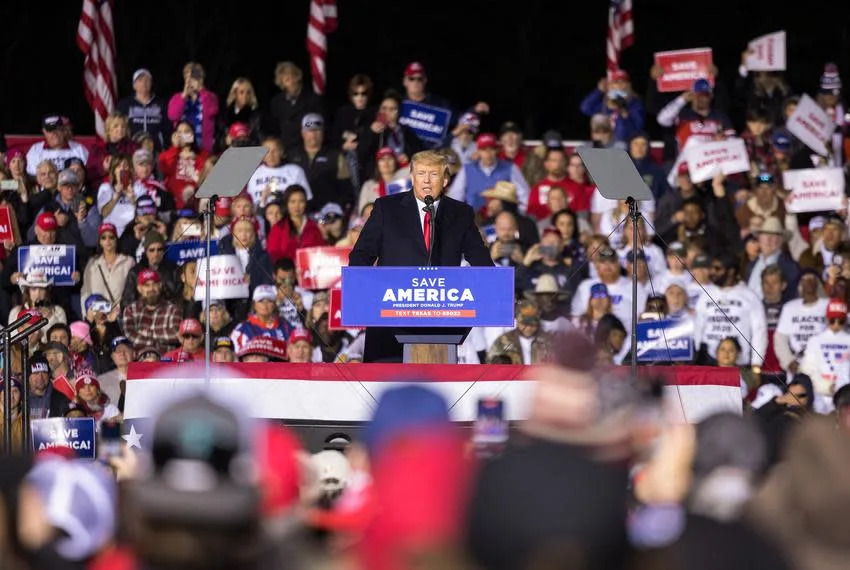
Former President Donald Trump spoke at a rally last month in Conroe.

The system is working like it’s supposed to. If it keeps going this way, we could regain our assurance that the people in control can keep the lights on when the weather is nasty.

If only all of us could do that with elections.

Failure isn’t the only way to shake public confidence. You can destroy confidence by attacking an election system that works, just because it turned President Donald Trump out of office.

“We all know who won in 2020,” Texas Lt. Gov. Dan Patrick told the crowd at a Trump rally in Conroe last Saturday, repeating the “Big Lie” that is the heartbeat of Trump’s post-presidency. Patrick and state Agriculture Commissioner Sid Miller both let the crowd know they want Trump to run again in 2024. Both are themselves up for reelection this year, depending on the support of a Texas Republican Party still in thrall to the former president.

A fair number of those voters can’t believe they were outnumbered in the 2020 election, that the majority of American voters disagreed with them, and that the Electoral College produced the same result as the popular vote. Trump won in Texas, besting Joe Biden by more than 600,000 votes, or 5.6 percentage points. But nationally, Biden got 7.1 million more votes, and won the Electoral College 306-232.

For all of the keening about it, the election wasn’t all that close. But Trump and his supporters won’t let go, protesting the vote counting, launching an insurrection at the U.S. Capitol in January 2021, pressing forward with new voting laws spurred by unsubstantiated claims of election fraud and holding rallies — like the one on Saturday — promoting the idea that any election they don’t win is corrupted.

At the rally, Trump raised that specter himself, saying Texas is “never, ever turning blue — that is, unless they rig the election.” To Abbott, he added, “Don’t let ’em do it, governor.”

When the 2000 presidential election results were questioned by the Democrats backing Al Gore and Joe Lieberman, Republicans for George W. Bush and Dick Cheney pushed back hard — and successfully. Republican sloganeers turned out satirical versions of the Gore/Lieberman signs that instead said “Sore/Loserman,” and “Enough is enough.”

The 2000 election protest ended before the end of 2000, after the U.S. Supreme Court decided against allowing a Florida recount and Gore conceded. The Democrats weren’t happy about losing, but they didn’t storm the Capitol. The public wouldn’t have supported them if they had tried.

Here we are, a couple of decades later: same shoe, different foot.

This time, the sore losers haven’t given up. Some of them hold state positions in Texas, administering and defending the very system that produced Biden’s win over Trump, and that produced their own wins, too. The state’s top Republicans can rally with Trump and others and cry foul about the elections if they want. But they’re products of the same system they protest.

Protest enough election results, and people will start believing you. It erodes their confidence, just like confidence was eroded when the lights went off last February. The elections didn’t fail like the grid failed. They just didn’t produce the result the minority of voters preferred.

Messing with that is a dangerous thing to do, if your power depends on their confidence in your democracy.

This article originally appeared in The Texas Tribune at https://www.texastribune.org/2022/02/04/texas-electric-grid-elections/.

The Texas Tribune is a member-supported, nonpartisan newsroom informing and engaging Texans on state politics and policy. Learn more at texastribune.org.

Conservative National Review Calls GOP ‘Morally Repellent’ For Latest Jan. 6 Response

HuffPost

Conservative National Review Calls GOP ‘Morally Repellent’ For Latest Jan. 6 Response

Mary Papenfuss – February 6, 2022

The conservative National Review magazine on Saturday savaged its usual ally the Republican National Committee as “morally repellent” and “politically self-destructive” for how it recently addressed last year’s violent attack on the Capitol by Donald Trump supporters.

The magazine slashed the RNC for censuring Reps. Liz Cheney (R-Wyo.) and Adam Kinzinger (R-Ill.) on Friday for daring to serve on the House select committee probing the Jan. 6, 2021, Capitol riot.

Particularly startling, in censuring the lawmakers, the RNC described the attack on the Capitol as “legitimate political discourse.” Some 140 police officers were injured when the mob stormed the Capitol that day and more than 740 people have been arrested in conjunction with the riot.

“The action of the mob on January 6 was an indefensible disgrace,” the Review flatly declared in its editorial. “It is deserving of both political accountability and criminal prosecution. Aspects of it are also fit subjects for a properly conducted congressional inquiry. It is wrong to minimize or excuse what happened that day.”

The RNC’s massive misstep in labeling the Capitol action “legitimate political discourse” is “political malpractice of the highest order coming from people whose entire job is politics,” the Review noted.

It will be “used against hundreds of elected Republicans who were not consulted” in the drafting of the wording and “do not endorse its sentiment,” the magazine added.

“The RNC bought the entire party a bounty of bad headlines and easy attack ads,” the Review concluded. “It did so for no good purpose, and its action will only encourage those who see riots as legitimate political discourse. A mistake, and worse, a shame.”

Check out the full editorial.

Related…

If a passenger misbehaves, put them on a no-fly list

CNN

If a passenger misbehaves, put them on a no-fly list

Buttigieg: No-fly list for unruly passengers ‘should be on the table’

Opinion By Dean Obeidallah – February 6, 2022

Dean Obeidallah, a former attorney, is the host of SiriusXM radio’s daily program “The Dean Obeidallah Show” and a columnist for The Daily Beast. The opinions expressed in this commentary are his own.

(CNN)Look! Up in the sky: It’s a bird … it’s a plane … it’s an unruly passenger assaulting a flight attendant.

That sums up 2021 for many flight crews across the US, given that last year was the worst on record for the number of unruly passengers. Overall, the Federal Aviation Administration logged a startling 5,981 cases of unruly passenger behavior in 2021, with close to 72% of incidents stemming from mask mandates on planes. As a result, the FAA notes it initiated nearly 1,100 investigations into unruly passengers last year, more than in the previous seven years combined.

The horrible — and, at times, illegal — conduct ranged from verbal abuse to physical attacks. Sara Nelson, the president of the Association of Flight Attendants union, testified before Congress last September that an alarming 61% of the incidents up to that point had involved passengers hurling racist, sexist or homophobic slurs at the flight crew.

Worse, flight crew members have been physically assaulted, such as when a Southwest flight attendant had two teeth knocked out by an angry passenger last May. And it’s not just the flight crews on the plane who are facing bad behavior; airline ground workers at the gate have reported being punched in the face, slammed against doors, verbally abused and spat upon.

We can all debate what’s behind the spike in flight passengers’ disruptive and even violent behavior, although it seems clear to me there’s a political component. I wrote about this issue last June, noting nearly three-quarters of these incidents were related to mask compliance after former President Donald Trump and other prominent Republicans had publicly mocked mask wearing.

In December, Alaska Airlines Senior Vice President Diana Birkett Rakow told Axios she believed the onslaught of unruly behavior could be tied at least in part to the “politicization” of masks and vaccines.

Regardless of the cause, flight crews who are simply doing their jobs so the rest of us can get to our destinations safely should not have to endure verbal and physical abuse.

That’s why a federal “no-fly” list for unruly passengers is long overdue. The data from the past year says it all: It’s past time for the DOJ to ban reckless passengers from commercial flights to send the message that such conduct will not be tolerated.

Delta CEO Ed Bastian has called for the Justice Department to enact a “no-fly” list not once but twice within the past year, most recently on Friday. In a letter to US Attorney General Merrick Garland, Bastian explained his hope that this type of punishment “will help prevent future incidents and serve as a strong symbol of the consequences of not complying with crew member instructions on commercial aircraft.

“Bastian first requested a federal “no fly” list for bad behavior last September. And while the DOJ did commit to making it a “priority” to prosecute passengers who “assault, intimidate or threaten violence against flight crews and flight attendants,” there still hasn’t been any movement on a “no-fly” list.

Bastian is 100% correct that such a measure is necessary to truly make a difference in flight safety. Delta has already placed nearly 1,900 people on a company “no-fly” list, but this punishment must be industry-wide in order to better deter this type of misconduct.

The FAA installed a “zero tolerance policy” in January 2021 to protect flight crews from disruptive passengers, skipping over lighter measures like warnings in favor of tougher penalties like stiff fines and jail time.

But the reality is that it is clearly not enough: While the rate of unruly passenger incidents has dropped about 50% since last year’s highs, as of February 1 there were still 323 reports of unruly passengers. According to the FAA, 205 of those reports were related to face mask compliance.

That explains Bastian’s renewed push for a “no-fly” list, which has been echoed by flight attendant union president Nelson. In September, she told Congress that there needs to be a centralized “no-fly” list that would suspend a person’s ability to fly on any airline for a period of time.

While the FAA can fine people and, if the conduct rises to a crime, law enforcement can criminally prosecute those involved, the possibility of an industry-wide flight ban could deter more bad conduct than both of those consequences.

Imagine if the length of time a person could be banned from flying was commensurate to the wrong, just like how our criminal justice system tailors the punishment to fit the crime. Not being able to take a commercial flight into, outside of or within the United States for a significant period of time would likely be reason enough to rethink threatening a flight attendant, especially given how many people need to fly as a component of their work.

The concept of a “no-fly” list isn’t new, and it has been controversial: When used to combat terrorism, the vague qualifications used to create the list led to accusations of abuse, particularly targeting Muslim Americans without cause. But a “no-fly” list for unruly passengers would be more straightforward: Violent or rowdy behavior on a flight in violation of federal law and/or FAA regulations would be grounds for being placed on this list.

There should be, though, a clear and accessible procedure that would allow a person to appeal their inclusion on the list to the DOJ and ultimately the courts.

If we want to make air travel safe for all of us, from passengers to the flight crew, it’s time to step up the punishment for unruly passengers. Perhaps in the future, when stuck on a bus for nine hours instead of sitting on a plane for two, they can reflect on why their actions were so wrong. A “no-fly” list sends a powerful message to everyone that you either behave civilly on the plane, or be gone. And that’s not just a win for the flight crews, it’s a win for society overall.

Even Canadians fear US democracy could end soon

Even Canadians fear US democracy could end soon

Trump's rally in Texas shows exactly why he's so dangerous

Trump’s rally in Texas shows exactly why he’s so dangerous

Hedge fund billionaire Ray Dalio warns the 2024 elections will lead to civil war

Fortune

Hedge fund billionaire Ray Dalio warns the 2024 elections will lead to civil war

Nicole Goodkind – February 4, 2022

Samuel Corum—Getty Images

Hedge fund billionaire Ray Dalio has a jolting message for Americans: The U.S. is hurtling toward civil war. Yes, you read that right.

The co–chief investment officer and chairman of Bridgewater Associates warned in a LinkedIn post on Thursday that large deficits, high taxes, and high inflation combined with widespread wealth inequality and unprecedented Washington partisanship will lead to civil war, “though these fights can be more or less violent,” he said.

When foreign powers like China and Russia challenge a country dealing with high levels of disagreement, “it is an especially risky period,” wrote Dalio. “I believe we are in this period now.”

An increase in populism and extremism, plus fights between the left and right, are classic indicators of future warlike conflict, he said. Political extremists see respecting the law as secondary to winning, and internal conflicts become self-reinforcing, added Dalio, alluding to Jan. 6, 2021, when supporters of President Donald Trump stormed the U.S. Capitol in an attempt to overturn the outcome of the presidential election, resulting in the deaths of five people and numerous injuries.

Dalio, who is promoting his new book about economic histories and the rise and fall of nations, also laid out what he described as six stages of internal disorder and order. It begins with the creation of a new government followed by periods of peace and prosperity. Eventually, excess spending and the accumulation of wealth and power weigh on the system, leading to “bad financial conditions and intense conflict,” the stage we’re in now, according to Dalio. The next step, he says, is civil war and revolution, which leads back to step one.

“History shows that raising taxes and cutting spending when there are large wealth gaps and bad economic conditions, more than anything else, has been a leading indicator of civil wars or revolutions of some type,” he said.

Dalio has long voiced concern about issues such as income equality and has called for higher tax rates for the wealthy. In the past, he’s made campaign contributions to late Republican Sen. John McCain, but he has made no contributions in recent years.

In the 2022 midterm elections, Dalio predicts moderates will lose seats while extremists and populists in both parties will gain them. He also predicts that Supreme Court rulings will become more contentious, leading to big tests of power. By the 2024 presidential election, he said, there will be a “battle between the populists of the right and the populists of the left in which neither side will accept losing.”

“Such a sequence of events will be consistent with the typical path that leads to civil war,” he said.

And while Dalio says this civil war could look very different from previous ones, it’s not unfathomable that people will die, just as they did on Jan. 6.

“The most obvious clear marker of going into a bad civil war is people dying,” he wrote. “History shows that when people start dying in conflicts—even just a few of them—that one expects much worse because then emotions and the need for retributions fuel more fighting.”

This story was originally featured on Fortune.com