The ‘Clown Car’ of Reasons That Trump Could Go Down
The Daily Beast – February 18, 2022
Photo Illustration by The Daily Beast/Getty
Donald Trump is closer to wearing an orange jumpsuit than he’s ever been.
That’s what TrumpNation author Tim O’Brien thinks anyway. It’s been three years since the investigation into the Trump Organization began and no Trump has been arrested. But with the news this Thursday that Donald has been court-ordered to testify and last week’s bombshell that his accounting firm Mazars USA was dropping him, O’Brien believes that could change.
He tells Molly Jong-Fast in this episode of The New Abnormal that jail time is a real possibility for the Trumps and the signs are there.
“Donald Trump has never been under the microscope with well-resourced, aggressive law enforcement officials like he is right now in the state of New York,” he says. “The prosecutors believe they have extremely compelling evidence against the former president. They’re not gonna bring a case against a former president unless they feel they’re on solid ground. So this is gonna become quite a legal showdown.”
Mazars jumping ship is one of the most “gigantic red flags that could be waved in front of your face”—especially because they “had a clown car” of reasons to do it, says O’Brien, who gives a rundown of them in the episode.
Later on the show, Molly asks former Biden White House senior adviser Andy Slavitt if COVID will ever go away, what the new Pfizer COVID-19 pills will be able to do, and if we should try to stay cautious or just live as normally as possible (Spoiler: He says a little bit of both).
And Daily Beast politics reporter Ursula Perano breaks down the restrictive Texas voting law, SB1, that’s ironically hurting rural districts, including red ones with Republican politicians.
Plus! Molly and co-host Andy Levy discuss the forgotten Trump child, Eric, and why Barron has a better chance of becoming president before him. Also, does Sean Hannity hate cops now?
‘Irreversible’: No easy fix for water fouled by gas driller
Michael Rubinkam – February 18, 2022
Gas Drilling Water Pollution 9/9
Ray Kemble talks about his water issues in his home in Dimock, Pa., Feb. 14, 2022. Kemble recently met with officials in the Pennsylvania attorney general’s office regarding the criminal case against a gas driller charged with polluting Dimock’s groundwater with methane. Faulty gas wells drilled by Cabot Oil & Gas were blamed for leaking methane into the groundwater in Dimock, in one of the best-known pollution cases ever to emerge from the U.S. drilling and fracking boom. (AP Photo/Mike Rubinkam)
In this Jan. 4, 2022, photo a portion of a water treatment system for homeowners Tim and Deb Maye is shown in Dimock, Pa. They assert the system never worked properly to remove contaminants from their well water. Faulty gas wells drilled by Cabot Oil & Gas were blamed for leaking methane into the groundwater in Dimock, in one of the best-known pollution cases ever to emerge from the U.S. drilling and fracking boom. The attorney general’s office recently floated the idea of treatment systems as a way to resolve its criminal environmental case against Cabot, prompting pushback from some residents who want to be connected to public water. (AP Photo/Mike Rubinkam)
In this Jan. 4, 2022, photo the control panel for a water treatment system for homeowners Tim and Deb Maye is shown in Dimock, Pa. They assert the system never worked properly to remove contaminants from their well water. Faulty gas wells drilled by Cabot Oil & Gas were blamed for leaking methane into the groundwater in Dimock, in one of the best-known pollution cases ever to emerge from the U.S. drilling and fracking boom. In 2010, the Pennsylvania Department of Environmental Protection negotiated a settlement with Cabot to install water treatment systems at residents’ homes, but some say the systems did not work well. (AP Photo/Mike Rubinkam)
In this Jan. 4, 2022, Tim Maye stands next to the shed outside his home with a water treatment system in Dimock, Pa. Maye says his system, designed to remove gas drilling-related contaminants from his well water, never seemed to work properly. Faulty gas wells drilled by Cabot Oil & Gas were blamed for leaking methane into the groundwater in Dimock, in one of the best-known pollution cases ever to emerge from the U.S. drilling and fracking boom. (AP Photo/Mike Rubinkam)
In this Jan. 4, 2022, photo Tim Maye holds a log sheet showing some of the maintenance visits for his water treatment system in Dimock, Pa. Maye says his system, designed to remove gas drilling-related contaminants from his well water, never seemed to work properly. Faulty gas wells drilled by Cabot Oil & Gas were blamed for leaking methane into the groundwater in Dimock, in one of the best-known pollution cases ever to emerge from the U.S. drilling and fracking boom. In 2010, the Pennsylvania Department of Environmental Protection negotiated a settlement with Cabot to install water treatment systems at residents’ homes, but some say the systems did not work well. (AP Photo/Mike Rubinkam)
In this Jan. 4, 2022, photo Tim Maye shows a water treatment system in a shed outside his home in Dimock, Pa. Maye says his system, designed to remove gas drilling-related contaminants from his well water, never seemed to work properly. Faulty gas wells drilled by Cabot Oil & Gas were blamed for leaking methane into the groundwater in Dimock, in one of the best-known pollution cases ever to emerge from the U.S. drilling and fracking boom. (AP Photo/Mike Rubinkam)
Ray Kemble of Dimock, Pa., protests hydraulic fracturing outside a Marcellus Shale industry conference as he holds a jug of what he says is his well water, Sept. 20, 2012, in Philadelphia. Faulty gas wells drilled by Cabot Oil & Gas were blamed for leaking methane into the groundwater in Dimock, in one of the best-known pollution cases ever to emerge from the U.S. drilling and fracking boom. It has now entered a difficult new phase as prosecutors pursue criminal charges against Pennsylvania’s most prolific gas driller — and push for a settlement they say could yield more significant benefits for affected homeowners than a conviction. (AP Photo/Matt Rourke)
In this Feb. 13, 2012, photo, Ray Kemble pumps water from a truck into his neighbor’s tank in Dimock, Pa. Faulty gas wells drilled by Cabot Oil & Gas were blamed for leaking methane into the groundwater in Dimock, in one of the best-known pollution cases ever to emerge from the U.S. drilling and fracking boom. The attorney general’s office recently floated the idea of treatment systems as a way to resolve its criminal environmental case against Cabot, prompting pushback from some residents who want to be connected to public water. (AP Photo/Matt Rourke, File)
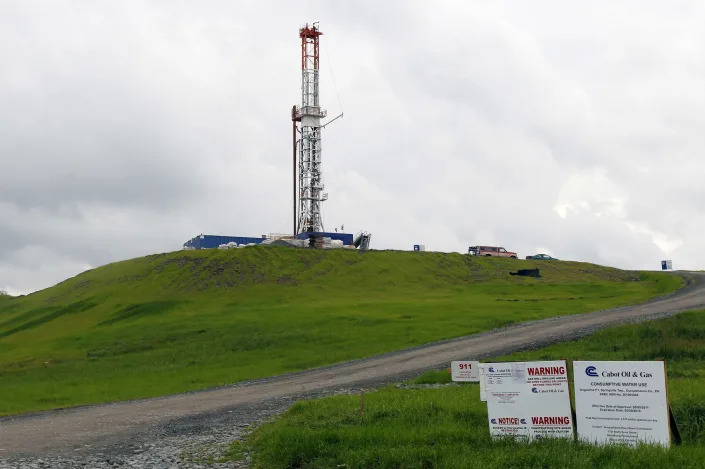
FILE – In this file photo from Oct. 14, 2011, a drilling rig is seen in Springville, Pa. State regulators blamed faulty gas wells drilled for leaking methane into the groundwater in nearby Dimock, Pa. One of the best-known pollution cases ever to emerge from the U.S. drilling and fracking boom has entered a difficult new phase as prosecutors pursue criminal charges against Pennsylvania’s busiest gas driller. The attorney general’s office is pushing for a settlement they say could yield more significant benefits for affected homeowners than a conviction. (AP Photo/Alex Brandon, File)
DIMOCK, Pa. (AP) — Meeting with a man whose well water has been polluted for years, officials in the Pennsylvania attorney general’s office asked him whether he’d consider accepting a treatment system from the gas driller charged with fouling his aquifer.
Not a chance, Ray Kemble told them.
“Are you going to drink and bathe in it?” Kemble asked the prosecutor and her colleague, a special agent, according to a recording of the conversation obtained by The Associated Press. “Are you two going to come here and live in this house on that system for a month and use that water?”
The officials demurred.
One of the best-known pollution cases ever to emerge from the U.S. drilling and fracking boom has entered a difficult new phase as prosecutors pursue criminal charges against the state’s most prolific gas driller — and push for a settlement they say could yield more significant benefits for homeowners than a conviction.
But the option prosecutors recently discussed has put them at odds with some residents who reject individual water treatment systems as inadequate and unworkable. These residents want to be hooked up to public water — itself a controversial idea in their rural community, one that state environmental officials talked up more than a decade ago but ultimately abandoned under legal threat from the driller and local officials.
The residents’ opposition to treatment systems illustrates the delicacy of the attorney general’s task in Dimock, a place synonymous with the fracking debate, where acrimony and distrust are the default after nearly 14 years of bad water and broken promises to fix it.
It was an exploding water well that first aroused public attention in the previously anonymous patchwork of homes and farms about 150 miles (240 kilometers) north of Philadelphia. Around that time, residents began reporting their well water was making them sick with symptoms including vomiting, dizziness and rashes.
Anti-drilling celebrities and documentary filmmakers descended, holding Dimock up as an example of natural gas industry malfeasance in the nation’s No. 2 gas-producing state. Industry backers, meanwhile, touted the economic benefits of cheap gas and accused green groups of greatly exaggerating the threat, even as state regulators concluded that Texas-based Cabot Oil & Gas had fouled Dimock’s groundwater.
The hoopla eventually died down, but Dimock’s water remained polluted. Fresh contamination cases have been reported as recently as December.
The state’s criminal case against the driller dates to 2020, when Attorney General Josh Shapiro — a Democrat now running for governor — charged Cabot with violating the law by allowing methane from the company’s faulty gas wells to escape into drinking-water aquifers in Dimock and nearby communities.
Shapiro’s spokesperson, Jacklin Rhoads, declined to answer questions about the “existence or substance of any discussions” with the company regarding a settlement.
But she said the state’s criminal environmental laws offer “limited tools” for holding polluters accountable. The penalty for a conviction under the state’s Clean Streams Law is a maximum $50,000 fine for each violation.
“While a settlement has the potential to deliver more for victims than the penalties of a guilty verdict, our goal is to resolve the case — through trial or through settlement — in a way that maximizes the restoration and protection of clean water for residents,” Rhoads said.
A company spokesperson declined to comment, citing the “active legal matter.” The company has long defended its record and denied responsibility for the contamination of Dimock’s groundwater.
It’s not clear if treatment systems remain under consideration, given the pushback from residents, but Kemble has his reasons for being skeptical.
In 2010, after discarding their plan to connect residents to public water, state environmental officials entered into a settlement with the company. Cabot offered to install individual water filtration systems, as well as a monetary award equal to twice the tax value of each resident’s home.
The agreement, struck without residents’ input or consent, infuriated those who had made it clear they did not trust Cabot with their water. But many residents took the money — and the treatment systems.
Some worked well, others were prone to breaking down, and all required costly upkeep, according to Joe Nally, who installed and maintained dozens of the systems for Cabot and other drilling companies.
“It was absolutely a maintenance issue with them,” said Nally, who left the industry years ago.
The system Cabot installed at Tim and Deb Maye’s house now sits, disused, in a shed outside their home.
Handwritten logs show hundreds of visits by contractors over the years as the elaborate setup of tanks, filters and control panels broke down, leaked and failed to remove bacteria.
Eventually, the DEP allowed Cabot to hand financial responsibility for repairs and maintenance to the Mayes. The couple said they never agreed to that. The system never worked right, they said.
The Mayes now use their untreated well water for bathing and flushing toilets, and bottled water for everything else.
“This was supposed to be our forever home,” said Deb Maye, who had moved with her family to Dimock to escape the bustle of the Philadelphia suburbs. “And the DEP and the gas company ruined it.”
Until Feb. 11, when he left state employment, Scott Perry was a DEP deputy secretary and longtime head of the agency’s oil and gas division. He acknowledged in a late January interview that treatment systems “did not work perfectly right out of the gate.” But he said they “absolutely do work,” adding some residents are satisfied.
“All of the homeowners were provided with two times the value of their home so that they could attend to their drinking water needs in the matter they best see fit. And several of them have chosen to not maintain their systems, and that’s unfortunate,” Perry said.
He said the water line his agency once touted as a permanent fix couldn’t have been built, given the political, logistical and legal realities of the day, and asserted that Dimock’s aquifer is healing even as Coterra remains banned from drilling in a part of the township.
“We will not allow the oil and gas industry to leave a legacy of polluted groundwater,” he said.
Ukraine, Poland and UK agree on accord to combat Russian aggression
February 17, 2022
British Foreign Secretary Liz Truss and her counterparts in Poland and Ukraine issued a joint statement on Thursday saying that the three nations would be developing a “trilateral memorandum of co-operation” to support Ukraine and combat Russian aggression amid rising tensions between the two Eastern European nations.
“This will demonstrate our commitment to further strengthening the strategic cooperation and engagement between our 3 nations on the highest priority issues in support of Ukraine,” the three said.
“We will work together to advance our cooperation, which includes but not limited to co-ordinating support to the International Crimea Platform, increasing our collaboration on cyber security, energy security, and boosting strategic communications to counter disinformation,” they added.
The three said that the United Kingdom and Poland stood in solidarity with Ukraine in helping the former Soviet state defend its independence and sovereignty and would provide Ukraine with support.
The joint statement also offered a thinly veiled rebuke at Russia, without naming the country specifically, for its efforts at trying to dictate whether Ukraine should be a part of the North Atlantic Treaty Organization.
“We reiterate that each European State is free to choose or change its security arrangements, including treaties of alliance, and no State can consider any part of Europe as its sphere of influence,” the three said.
The prime ministers of Poland and Ukraine signaled earlier this month that a trilateral cooperation was in the works.
“I hope that in the near future we will be able to officially launch a new regional format of cooperation Ukraine-Poland-UK, in the context of ongoing Russian aggression, we should sign a trilateral document on cooperation to strengthen regional security,” Ukrainain Prime Minister Denys Shmygal said during a joint news conference with Polish Prime Minister Mateusz Morawiecki, according to Reuters.
The development comes as Russia has amassed around 150,000 troops near Ukraine, though Moscow claims that it has pulled back some of those troops – statements that have been met with scrutiny by U.S. officials and others.
President Biden said on Thursday that Russia could invade Ukraine “within the next several days.”
Nearly 4 million children fall into poverty as expanded child tax credit ends
Christopher Wilson, Senior Writer – February 18, 2022
Nearly 4 million American children fell into poverty in the month of January, due to the expiration of the expanded child tax credit at the end of last year. According to new data released Thursday by Columbia University, there was a 41 percent increase in child poverty between December and January, as millions of families stopped receiving the extra $300 per month. The Columbia release noted that “Latino and Black children experienced the largest percentage-point increases in poverty.”
Democrats passed the expanded child tax credit as part of their pandemic relief bill in March of last year, which resulted in payments beginning last July worth up to $250 per child ages 6 to 17 and up to $300 per child under 6. The last of those payments went out in December, as opposition from Republican senators and Sen. Joe Manchin, D-W.Va., stopped an extension of the program. A November poll from Yahoo News and YouGov found that 49 percent of U.S. adults support extending the credit for an additional year, with 31 percent in opposition.
Parents and their children participate in a demonstration in support of the child tax credit outside the U.S. Capitol on Dec. 13, 2021. (Sarah Silbiger/Bloomberg via Getty Images)
Studies last year from Columbia and the left-leaning think tank Center on Budget and Policy Priorities found that the expanded tax credit cut childhood poverty in the country by at least 40 percent. Due to the extension’s failure to pass, 61 million children in 36 million households who received the payment in December were affected.
While President Biden pushed for an extension of the credit, passage in the Senate required either the support of all 50 Democrats or votes from at least 10 Republicans — none of whom voted for the American Rescue Plan, which contained the expanded credits, in March 2021.
While nearly every other Democrat was on board, Manchin didn’t support a continuation of the plan as it was originally passed, calling for work requirements and a lower income cap on the families eligible to receive it. An analysis last fall found that Manchin’s proposed changes would have resulted in nearly 190,000 West Virginia children, and 37 million nationwide, no longer receiving the aid. In December, ABC News reported that Manchin had expressed concerns to colleagues that parents would use the payments to buy drugs.
Following the release of the Columbia data, Rep. Alexandria Ocasio-Cortez, D-N.Y., blasted Manchin in a series of tweets citing the uptick in child poverty.
President Biden delivers remarks about child tax credit payments at the White House on July 15, 2021. (Tom Brenner/Reuters)
“One US Senator ‘heard stories’ about people allegedly using the Child Tax Credit ‘for drugs’ without any evidence or data to back it up,” the progressive congresswoman wrote, citing Manchin. “He then used that as justification to nuke the entire national program, causing millions of kids to fall into poverty in weeks. Horrifying.
“Meanwhile the press talks about it like it’s some beltway drama without ever showing the people who are sleeping in bubble jackets with no heat or the kids going hungry waiting for some guy in a yacht to decide if they are fully human or not,” she continued, referring to Manchin’s boat in Washington, D.C., where protesters gathered to urge him to support Biden’s full domestic agenda. “It’s just shameful, all of it.”
Democratic lawmakers expressed hope during a press conference last week that Manchin might eventually come around on the program.
Sen. Joe Manchin, D-W.Va., is followed by reporters as he walks through the Senate subway on Feb. 16. (Anna Moneymaker/Getty Images)
“Sen. Manchin has not slammed the door on this,” said Sen. Michael Bennet, D-Colo. “We know over the last six months that people have spent the money the way we said they were going to spend the money, which was to buy groceries, to pay for rent, really importantly to pay for child care so they could stay at work.”
Republicans have argued that the child tax credit disincentivizes work, while proponents rebut that raising children itself is work. Speaking about Biden’s broader Build Back Better agenda, which would include paid family leave and subsidies for child care, Manchin had said he did not want America to become an “entitlement society.”
In September, the U.S. Census Bureau reported that pandemic relief programs that were passed in 2020, such as expanded unemployment benefits, prevented more than 5 million people from falling into poverty. Meanwhile, direct stimulus payments pulled more than 11 million Americans above the line, dropping the overall poverty rate 3 percent. Those programs, however, were temporary, with the expanded unemployment ending last September and Congress not issuing any further stimulus payments.
U.S. sea levels to rise by a foot through 2050, causing “profound” flooding
Andrew Freedman – February 16, 2022
The U.S. is poised to see as much of a rise in sea levels through the year 2050 as it has experienced in the past century, with additional increases through 2150, according to a comprehensive new federal report out Tuesday.
Why it matters: Sea-level rise is one of the most tangible present-day effects from human-caused climate change that is being felt in the U.S., with coastal flood events becoming far more common and damaging in just the past few decades.
Driving the news: The National Oceanic and Atmospheric Administration (NOAA) released the report along with about six other federal agencies that play a role in tracking the rise in sea level.
It updates figures from 2017 by taking into account the newest sea level rise projections, and breaks trends down into different time periods. Data from tide gauges, satellite instruments and the latest computer models are all incorporated.
The report includes extreme water level probabilities for points along the U.S. coastline, and will be incorporated into the next National Climate Assessment, which is underway.
The assessment projects an additional 10- to 12-inch increase in sea levels by 2050, with higher amounts in some parts of the country due to changes in land height and ocean currents.
The East and Gulf coasts are expected to see a greater rise in sea level than the West Coast, for example.
The big picture: The range of sea level rise at the global, national and regional levels has narrowed since 2017, thanks to improved measurements, a better understanding of polar ice sheets and refinements of computer modeling.
The report projects the sea level rise along the contiguous U.S. coastline to be between 1 and 7 feet in 2100, compared to 2000 levels, and 2.6 to 13 feet by 2150.
The range in these projections largely depends on the amount of greenhouse gas emissions and resulting warming.
Threat level: The report warns that the sea level rise through 2050 will dramatically escalate the frequency and severity of coastal flooding, including so-called “sunny day” flooding at times of high tide in areas such as Charleston, S.C. and Miami.
The report says that nationally, a “flood regime shift” is projected to occur by 2050, with moderate high tide flood frequencies to increase by more than a factor of 10 nationally, along with a five-fold increase in major high tide flood frequencies.
It notes that “significant consequences” are in store for coastal infrastructure, absent new efforts to reduce risk exposure.
Moderate and typically damaging high tide flooding is projected to increase from an average frequency of 0.3 events per year in 2020, to 4 events per year in 2050, the report finds.
And minor or nuisance high tide flooding, currently becoming the norm in parts of Miami and influencing real estate prices, is likely to dramatically increase from about three events per year as a national average in 2020 to more than 10 events per year.
“The minor nuisance-like flooding that’s becoming a growing problem in many East and Gulf Coast communities, some West Coast, is likely to become damaging flooding,” said NOAA oceanographer William Sweet during a press conference call. “That extra foot on average or so around the country is just going to reach further inland and grow deeper and more severe.”
What they’re saying: Ben Strauss, CEO and chief scientist of the research group Climate Central, said, “Just one foot of sea level rise will change a lot of American lives.”
“Nationwide, about a million Americans live on land less than one yardstick above the high tide line. That jumps to five million below two yardsticks — the size of Houston plus Chicago, averaging almost 70,000 people per vertical inch,” he said via email.
“Our national sea level threat has started slowly, but it’s going to accelerate like a rocket,” Strauss added.
Jeremy Porter, chief research officer at the nonprofit First Street Foundation, said the findings “amplify concerns” raised in his work about the non-linear growth in sea level rise and flood risk.
“The simple addition of a few inches of sea level rise exponentially increases the consequences of coastal surge events,” he said in an email.
Of note: The most extreme sea level rise scenario from NOAA’s 2017 report, which showed an increase of 8 feet of global mean sea level rise by 2100, is no longer considered plausible, the new analysis shows.
Editor’s note: This story has been updated with Ben Strauss and Jeremy Porter’s comments.
Here’s what Tampa Bay can expect from new sea level rise projections
Zachary T. Sampson, Tampa Bay Times – February 16, 2022
Douglas R. Clifford/Tampa Bay Times/Times
Florida’s near-future of higher sea levels and more flooding is coming into sharper focus, according to a new government report, even as scientists say worst-case conditions appear to be further off than initially thought — giving people additional time to prepare.
Across the United States, sea levels are expected to jump 10 to 12 inches in the next three decades — about the same rise that took place over the last 100 years, according to researchers at several federal agencies and universities, led by the National Oceanic and Atmospheric Administration. Damaging floods could happen 10 times as often, scientists say.
In Tampa Bay, a regional advisory panel has recommended that local governments plan for a range of sea level rise between roughly 11 and 31 inches from 2000 to 2050, based on a similar federal study published five years ago. The new projections, announced Tuesday, would raise the low end of that spectrum to just over a foot and drop the high end to about 19 inches in St. Petersburg.
“It’s a shift in the timing, not so much in the height,” said Gary Mitchum, associate dean at the University of South Florida College of Marine Science, who served as a reviewer for the federal report. Mitchum is a member of the regional science advisory panel, which he said will assess the data and revise its guidelines as needed.
Though the latest study lops off a previous “extreme” projection for sea level rise over the next few decades, Mitchum said people could still face similar conditions after 2100. He said Floridians should think of the estimates like a “cone of uncertainty” for approaching hurricanes.
“We’ve taken that cone, and we’ve narrowed it down,” he said. “There’s still going to be a hurricane. There are still going to be impacts. But we have a much better idea now of what they are.”
Sea level rise has accelerated across the world, spurred by global warming. People burn fossil fuels, releasing greenhouse gases that heat the atmosphere. Warm temperatures cause water to expand and ice sheets to melt. Scientists say earth is locked into more heating and sea level rise, but people can stave off the worst consequences of climate change by lowering emissions.
Compared to past research, the new report frames discussions more around a 30-year window, relatable to people as the length of a standard mortgage. Richard Spinrad, who leads the National Oceanic and Atmospheric Administration, called it “a wake-up call for the United States.”
Nicole LeBoeuf, director of the National Ocean Service, said she grew up on the Texas coast and knows how shorelines shift naturally. But the problems mounting before cities today are different.
“These are not the kind of changes we grew up with,” LeBoeuf said. “Make no mistake: Sea level rise is upon us.”
South Florida, and especially Miami, is already a prominent example for sunny-day flooding, which fills streets with seawater during peak tides. That phenomenon will migrate to other cities and soak waterfront neighborhoods more frequently, said Thomas Wahl, a University of Central Florida engineering professor who was a reviewer for the government report.
Meanwhile, he said, storm surges that Floridians already fear will be more devastating.
“We don’t need as big a storm surge anymore — we maybe don’t need a Category 3 hurricane making landfall, but maybe a tropical depression” to cause serious flooding, Wahl said.
A few inches of saltwater intrusion is costly. Regular floods cause infrastructure like stormwater pipes to degrade more quickly and can make low-lying neighborhoods hard to reach.
Higher water doesn’t only affect people and property. It will lead to more beach erosion and the loss of coastal marshes in places like Hernando County, said Davina Passeri, a research oceanographer for the U.S. Geological Survey in St. Petersburg. The state’s natural shoreline has offered protection from flooding and waves during storms, while serving as a key habitat for animals like birds and turtles.
“Between the dunes and the marshes … we’re going to lose that natural buffer,” said Passeri, who, like Mitchum and Wahl, reviewed the federal report. She is also a member of Tampa Bay’s Climate Science Advisory Panel.
In Pinellas County, the research reinforces the need for local governments to react, said Hank Hodde, the county’s sustainability and resiliency coordinator.
“I just hope this report can help fine-tune what we’re already doing and bring new people on board,” he said.
The study also highlights how quickly science is advancing while climate change becomes a more urgent, universal discussion.
Wahl remembers that when he started his career 15 years ago, “We didn’t have a name for high tide flooding.” Now everyone knows the term, if they haven’t already experienced the effects themselves.
Sea-level rise is coming for Washington communities. Here’s how Whatcom is preparing
Ysabelle Kempe – February 17, 2022
Washington’s shorelines are at risk as scientists predict an average 4 to 6 inches of sea-level rise for the region over the next three decades, according to a new government report by the National Oceanic and Atmospheric Administration and other agencies.
In Whatcom County, that has profound implications for coastal communities, tribes, ecosystems and agriculture. Rising sea levels could also increase flooding inland, as the Nooksack River’s flow into Bellingham Bay is further obstructed by pressure from the ocean, said Ellyn Murphy, chair of Whatcom’s Climate Impact Advisory Committee.
The new federal report is a stark reminder of how our lives and communities are being altered by human-caused climate change, which fuels sea-level rise as warming seawater expands and ice sheets and glaciers melt. The document’s findings, which update those from 2017 and project about a foot of sea-level rise by 2050 across the U.S. on average, elicited calls to action from leaders nationwide, including Sen. Maria Cantwell from Washington.
“Today’s NOAA report is alarming – in the next 30 years the sea will rise as much as it has in the last 100 years,” Cantwell said in a statement on Tuesday, Feb. 15. “We have to ensure that our coastal communities have the tools and resources to prepare and adapt to climate change and sea-level rise.”-
NOAA’s sea-level rise projections until 2050 are highly certain, even if humans do dramatically reduce greenhouse gas emissions spewed into the atmosphere as we continue to burn fossil fuels, the agency says. But we still need to curb our emissions, the agency warned in the report. Failing to do so could cause even worse sea-level rise — between 1.5 and 5 additional feet by the end of the century.
A NOAA online visualization shows the impacts of a 3-foot sea-level rise for Whatcom and Skagit counties. Water depth is shown in blue and green denotes low-lying areas.
Whatcom, Lummi plans
Whatcom is already confronting how rising oceans will change our communities. Last year, the public and County Council asked county staff to include sea-level rise in the 2021 update to its Shoreline Management Program, a land-use policy and regulation document, said Chris Elder, senior planner of natural resources for the county, in an email to The Bellingham Herald.
But the county staff needed more data to determine the extent and potential impacts of sea-level rise, so it hasn’t yet been included in county code modifications, Elder said. However, the conversation prompted the county to apply for and earn $100,000 in state Department of Ecology grant funds to complete a project that will guide how sea-level rise should be integrated into local planning efforts. A number of other organizations and governments will participate in the project: Bellingham, Ferndale and Blaine cities, Port of Bellingham, Lummi Nation, U.S. Geological Survey and Washington Sea Grant.
“Several of these organizations are already implementing their own coastal resilience projects and we’re hoping that through this County effort we can really get all Whatcom coastal jurisdictions on a similar page of understanding around the impacts and build some collaborative efforts to address those impacts,” Elder wrote in an email to The Herald.
The county and other local partners are also providing support and funding for the Puget Sound Coastal Storm Modeling System, an effort by the U.S. Geological Survey to arm communities with tools for assessing and managing sea-level rise impacts.
The Lummi Nation is particularly vulnerable to the creeping fingers of sea-level rise: The low-lying reservation is home to the Lummi River floodplain and is bordered to the east by the Nooksack River floodplain, according to the 2016 Lummi Nation Atlas. In November, flooding from the Nooksack River cut off the reservation from the mainland.
Sea-level rise endangers Lummi Schelangen, or “way of life,” according to the tribe’s 2016 Climate Change Mitigation and Adaptation Plan: It will inundate much of the tidelands that make up about a third of the reservation’s acreage. Tidelands provide important habitat to shellfish, which the tribe harvests for food, and are important for ceremonial and commercial reasons. Coastal erosion could damage tribal burial sites, archaeological sites and artifacts.
When the seas come, sometimes the best option is to pick up and move, the tribe’s plan determined: “In some areas, managed retreat, wherein inland migration is facilitated, is likely to be the most viable long-term option to protect human life and reduce property damages.”
Miep Gies — who is pictured here by the movable bookcase that hid Anne Frank’s secret annex — risked her life to hide Anne, her family, and four other Jews for over two years. After the Frank family was arrested, it was Gies who saved Anne’s diary and kept it safe until after the war. Now published in more than 60 languages, Eleanor Roosevelt called Anne’s diary “one of the wisest and most moving commentaries on war and its impact on human beings that I have ever read.”
Born on this day in Vienna in 1909, Gies moved in with a foster family in the Netherlands to escape food shortages in Austria following WWI. In 1933, she began working for Anne’s father, Otto Frank, as a secretary and soon became close friends with the family. After Anne’s older sister, Margot, received a summons to report to a Nazi work camp in Germany, the Frank family went into hiding. Gies, along with a few other employees, concealed them in secret rooms in the office building where they worked — a hiding place now famously known as the Secret Annex. Gies and her husband also hid an anti-Nazi university student in their own apartment. As she didn’t dare tell anyone, not even her foster parents, of her activities, Gies developed a system for acquiring food and other supplies surreptitiously, so that no one would suspect she was shopping for more than just her own family.
Over the two years the Franks were in hiding, Gies developed a close friendship with the teenage Anne. The hiding place was discovered after the German police received a tip about the existence of the Secret Annex and everyone hiding there was arrested. Gies went to the police station and attempted to buy their freedom but sadly without success. The effort could have cost her more than money: Gies could have been executed for hiding Jews — in fact two others, Victor Kugler and Johannes Kleiman, who helped hide the Franks were arrested and sent to work camps. Fortunately, the police officer who interrogated Gies discovered she was from his home town in Austria and let her go.
Before the Secret Annex was emptied by the police, Gies retrieved Anne’s diaries and hid them in her desk drawer. When the war was over, Gies turned the diaries over to the family’s only survivor, Otto Frank. She didn’t read them until the second printing and remarked that if she had read them during the war, she would have had to destroy them as they included the names of those who hid the Franks and of their black market suppliers.
Gies, who is pictured here with her husband Jan during a visit to the Anne Frank House in 1987, died in 2010 at the age of 100. While she has been widely honored for her actions during the war, including by the Netherlands, Germany, Israel, and Austria, Gies didn’t consider what she did extraordinary; rather she hoped that her actions showed that “even an ordinary secretary or a housewife or a teenager can, within their own small ways, turn on a small light in a dark room.”
Kamila Valieva’s coach harshly criticized the 15-year-old skater right after she fell at the Olympics: ‘Why did you stop fighting?’
Rebecca Cohen and Meridith Cash – February 17, 2022
Kamila Valieva of Russia reacts with coaches Eteri Tutberidze and Daniil Gleikhengauz after performing during the Women Single Skating Free Skating on day thirteen of the Beijing 2022 Winter Olympic Games.
Russian figure skater Kamila Valieva placed 4th in the women’s free skate at the Beijing Olympics.
The gold-medal favorite fell twice during her routine and was visibly upset as she left the ice.
The 15-year-old’s coach, Eteri Tutberidze, was caught harshly criticizing her on the broadcast.
Russian figure skater Kamila Valieva, the teen skating sensation embroiled in a doping scandal, left the ice in dispair after falling twice during her free skate program at the 2022 Beijing Olympics on Thursday.
But rather than offering the 15-year-old skating star some words of encouragement or comfort following her shocking flame-out, Valieva’s coach — Eteri Tutberidze — could only muster criticism.
“Why did you let it go?” Tutberidze was heard asking Valieva in Russian during the live broadcast of the women’s figure skating event.
“Why did you stop fighting? Explain it to me, why?” Tutberidze continued as the distraught teenager stepped off the ice. “You let it go after that axel. Why?”
Tutberidze and Valieva in 2021.
A tearful Valieva — who finished in fourth place — did not respond to her coach. As her scores were announced, the star buried her head in her hands and sobbed.
Tutberidze laid her hand on Valieva’s back as the teen broke down and cried.
It was a stunning collapse for the highly-rated Valieva, whose eligibility to compete at the games came under question last week after news emerged that she’d failed a drug test in December. She tested positive for trimetazidine, a drug the World Anti-Doping Agency categorizes as a “hormone and metabolic modulator,” according to The Associated Press.
Valieva sobs after finishing in fourth.
When taken without proper cause, the drug can bolster endurance and improve circulation. Both effects could give a high-level figure skater a competitive advantage.
Valieva was initially slapped with a provisional suspension from the Russian Anti-Doping Agency after the positive test surfaced. But following a swift appeal, the ban was overturned on February 9.
The International Olympic Committee then challenged that decision in the Court of Arbitration for Sport. On Monday, the court issued a ruling that lifted Valieva’s provisional suspension and paved the way for the teen to compete in the individual competition.
Valieva’s mother and coach insisted she was taking the drugs for “heart variations, but anti-doping officials have said that it is highly unlikely such a young, elite athlete would be taking this combination of drugs. The pair of “legal” medications found in Valieva’s system could also be used to boost endurance.
But major figures in the skating world haven’t placed blame for the scandal on Valieva’s shoulders. Retired Team USA skater Polina Edmunds argued that the entire situation was “very traumatizing” for the 15-year-old and that the adults in her life should have been responsible for protecting her.
Valieva during Tuesday’s Olympic event.
“She should not have been allowed to compete,” Edmunds wrote on Twitter. “It’s devastating that she was put in this situation, on all levels.”
Tutberidze has been scrutinized for years over her training methods with young Russian skaters, Gabrielle Paluch previously reported for Insider. Prominent coaches have gone so far as to refer to Tutberidze’s athletes as “disposable” or “perishable goods.”
Some have referred to the “Eteri expiration date” — the time when, around age 17, her athletes are often forced to retire due to injury or diminishing results.
Critics have accused the 47-year-old of trading her athletes’ health for medals for their country.
For most of the last decade, Tutberidze’s rink in Moscow has churned out countless young female champions. Her athletes win by performing difficult jumps such as quads — which are worth roughly double the points of a triple, making skaters who land them nearly impossible to beat — but burn out dramatically as they go through puberty.
Valieva will be 19 years old by the time the next games roll around in 2026: past the “expiration date” fans have grown to lament.
Valieva holds her head in her hands as Tutberidze speaks following Thursday’s competition.
Extreme Drought Is Crashing Food Production Whether Russia Invades or Not
In a world increasingly feeling the effects of climate change, the media must examine the role climate can play in igniting and inflaming conflicts.
By Mark Hertsgaard – February 17, 2022
The North Crimean Canal in Kalanchak, Ukraine, is seen with a low level of water on September 29, 2020. Crimea at the time was facing drought as Ukrainian authorities blocked the irrigation canal following the annexation of Crimea by Russia. (Pierre Crom / Getty Images)
This story is part of Covering Climate Now, a global journalism collaboration cofounded by Columbia Journalism Review and The Nation strengthening coverage of the climate story. The author is CCNow’s executive director and co-founder.
Last Friday, as speculation that Russia was preparing to invade Ukraine mounted, ABC News reported that “the specter of a military confrontation” was “pumping fresh life into the debate over whether president Joe Biden’s climate agenda is brushing up against difficult geopolitical realities.” The story, which was produced by the network’s newly formed climate unit and ABC’s investigative team, was perhaps the first in the US media to examine the climate angle of the Ukraine conflict. It should not be the last. Even as newsrooms provide steady updates on the most immediate elements concerning Ukraine, from military maneuvers to diplomatic negotiations, they must help audiences understand the Ukraine conflict in its broader context.
Energy—especially the supply and price of methane gas—is an intrinsic part of the international tensions at the Ukrainian border. Russia has long supplied much of the gas used to heat homes and power factories in Europe, especially in Germany. There has been abundant coverage of the Nord Stream 2 pipeline, which runs between Russia and Germany and could double the former’s gas exports to Europe, and which Biden and German Chancellor Olaf Schulz have pledged to block if Russia does invade Ukraine. However, such coverage has rarely explored the climate issues at hand.
Military officials and security analysts in numerous countries have been incorporating climate change into their planning and proposals for decades. Even under former US President George W. Bush, who downplayed climate science and shunned climate action, the Pentagon was studying how drought and other forms of extreme weather might trigger military conflict, including nuclear war, between India and Pakistan. Journalists need to catch up.
ABC’s February 11 story by Lucien Bruggeman admirably pulled together both the energy and climate dimensions of the Ukraine conflict. Bruggeman briefly touched on recent arguments from “oil interests and Republican lawmakers,” including an American Petroleum Institute spokesman and US Senator Lisa Murkowski, that President Biden had inadvertently strengthened Russia’s hand in the Ukraine conflict by cutting US fossil-fuel production in the name of combating climate change, but it then brought in comments from experts across the ideological spectrum to call out that red herring. Erin Sikorsky, a former intelligence official who directs the Center for Climate and Security, advised administration critics and conflict spectators not to conflate “the short-term crisis and the long-term strategy.” The global economy is increasingly leaving fossil fuels behind in favor of renewable energy. The United States should hasten that transition, experts reasoned, precisely to avoid the dependence on imported gas that makes Europe vulnerable to Russian pressure in the current crisis.
Ukraine, a major grain exporter, has also been walloped by droughts in recent years—another climate story with international consequences that has been relatively under-covered. The country has long ranked among the most productive agricultural areas on Earth—under the old Soviet Union, it was the nation’s breadbasket—but climate change is dramatically decreasing output and, by extension, threatening the stability of food prices around the world. A report from the Atlantic Council last year emphasized the impacts of drought on Ukraine’s grain exports, noting that they had “fallen sharply year-on-year during the current season due to smaller harvests caused by severe drought conditions.” When an agricultural power as important as Ukraine suddenly starts producing and exporting much less food, it is a recipe for social dislocation, human suffering, and political unrest, both inside the country and beyond. Less production translates into higher prices. The price of food is something people everywhere care about, which makes it something journalists need to be talking about.
In 2013, Thomas Friedman reported for The New York Times on how a severe drought fueled by climate change helped trigger the popular uprising that evolved into one of the most vicious civil wars of modern times. Samir Aita, a Syrian economist, told Friedman that, while the drought did not directly bring about the war, the failure of Syrian strongman Bashar al-Assad to support the people imperiled by the drought politicized “a lot of very simple farmers and their kids.” A subsequent report from the Center for American Progress, the Center for Climate and Security, and the Stimson Center likewise argued that drought had hastened the Arab Spring uprisings. The Middle East and North Africa were “already dealing with internal sociopolitical, economic and climatic tensions,” Scientific American wrote, drawing on that report. “The 2010 global food crisis helped drive it over the edge.”
“Drought is the overriding danger as climate change intensifies,” I wrote in my book HOT: Living Through the Next Fifty Years on Earth. “Floods may attract more media coverage, but historically droughts have killed far more people.” A peer-reviewed article published in Nature this week concluded that the extreme drought gripping the Southwestern United States has made for the driest two decades the region has seen for the last 1,300 years. With heat-trapping emissions and global temperatures both continuing to rise, drought is bound to keep afflicting the US, Ukraine, and many other regions of the world. The consequences—for food production, social stability, and war and peace—are immense. News coverage should treat them accordingly.
Mark Hertsgaard is the executive director of Covering Climate Now, a global journalism initiative committed to more and better coverage of the climate story. He is also the environment correspondent for The Nation and author of books including HOT: Living Through the Next Fifty Years on Earth.