Trump wants Wyoming lawmakers to change election laws to block Liz Cheney from receiving crossover votes

Insider

Trump wants Wyoming lawmakers to change their election laws to block Liz Cheney from receiving crossover votes in the state’s GOP primary

John L. Dorman – February 19, 2022
Trump
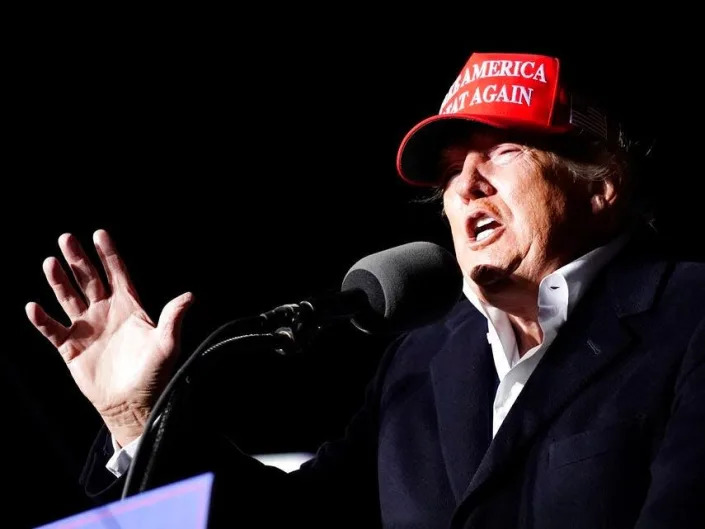
Former President Donald Trump speaks at a “Save America” rally in Florence, Ariz., on January 15, 2022.AP Photo/Ross D. Franklin
  • Trump on Thursday backed a Wyoming proposal that would end crossover voting in state primaries.
  • The bill would cut off potential support for Rep. Liz Cheney, who has fallen out of favor with many Republicans.
  • The measure would bar non-Republicans from requesting a GOP ballot and voting in another party’s primary.

Former President Donald Trump is pushing Wyoming lawmakers to back legislation that would bar Democrats and other non-Republicans from casting ballots in statewide GOP primaries, in a move widely seen as a way to sink Rep. Liz Cheney’s prospects for renomination by the party.

Cheney — who has clashed with Trump over his debunked election claims and the January 6 insurrection at the US Capitol — is set to face water rights attorney Harriet Hageman in a Republican primary in August.

The proposed legislation, known as SF0097 — which was introduced by Wyoming state Sen. Bo Biteman — would prevent Democrats, Republicans, and independents from switching their party affiliation on the day of the primary election to vote in another party’s primary.

On Thursday, Trump applauded the legislation through his spokesperson, Liz Harrington.

“This critically important bill ensures that the voters in each party will separately choose their nominees for the General Election, which is how it should be!” the former president said in a statement released on Twitter. 

He continued: “It makes total sense that only Democrats vote in the Democrat primary and only Republicans vote in the Republican primary. This bill has my Complete and Total Endorsement and Support.”

Politico on Thursday reported that several of Trump’s political associates were privately advocating for passage of the bill, with several state Republicans pushing for the change to ensure that Democrats don’t switch parties to support Cheney in the GOP primary.

Hageman, one of several Republican primary challengers to Cheney, represents the congresswoman’s highest-profile challenge, as she has been endorsed by the former president and House Minority Leader Kevin McCarthy of California.

Trump and David McIntosh — a former Indiana congressman who now leads the conservative Club for Growth — both called Republican Wyoming Gov. Mark Gordon in recent weeks in a bid to get his support for the bill, according to two individuals with knowledge of the situation who spoke with Politico.

Michael Perlman, the communications director for Gordon, told the outlet that while Gordon has had conversations about the bill, the governor was not being pressured to make changes.

“The Governor has had many conversations about this issue, including with President Trump and David McIntosh, however characterizing that as ‘pressure’ would be incorrect,” he said. “Governor Gordon is going to do what’s best for Wyoming and he respects the legislative process.”
Bennie Thompson Liz Cheney
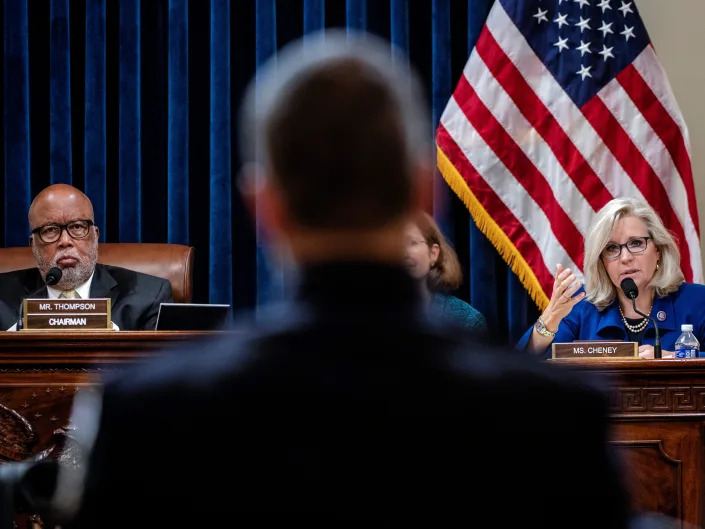
Rep. Bennie Thompson (D-Mississippi), left, listens as Rep. Liz Cheney (R-Wyoming) speaks during the House select committee hearing on the Jan. 6 attack in Washington, DC, on July 27, 2021. Washington Metropolitan Police Department officer Michael Fanone is at center.Bill O’Leary/The Washington Post via AP, Pool
Cheney has become a polarizing figure among state Republicans

The former president’s eldest son, Donald Trump Jr., tweeted in support of the proposal on Thursday, telling voters in the Equality State to “pay attention” to the issue. And Matt Schlapp, the American Conservative Union chairman who has close ties to Trump, tweeted that his organization might use support of the bill in scoring legislators.

“There was a big push this morning to get all of our MAGA influencers to push it and make a big deal out of it,” a GOP operative told Politico.

Last year, Wyoming legislators rejected a bill backed by Trump Jr. that would have mandated that candidates running in primaries receive a majority of the vote to avoid primary runoff elections.

When Cheney sought the GOP House nomination in 2016, she won with 39% of the vote in a multicandidate primary before cruising to an easy win in the general election. However, if a runoff election law had been in place at the time, the runner-up in the GOP primary could potentially have consolidated a majority of the vote in a second contest and defeated Cheney.

While speaking with The New York Times earlier this month, Cheney insisted that she would not ask Democrats to vote in the Republican primary to support her candidacy, despite her flagging popularity among base voters.

According to The Times, only 31% of Wyoming Republicans had a favorable opinion of Cheney in a recent private poll, compared to 60% who viewed her unfavorably.

The congresswoman has deep roots in the state, as her widespread name recognition is inextricably linked to that of her father, former Vice President Dick Cheney.

However, she has forged a polarizing legacy as a result of her criticism of Trump.

Cheney quickly ascended the GOP leadership ladder, becoming the House Republican Conference Chair only two years after joining the lower chamber. She was a reliable supporter of Trump’s agenda for the vast majority of his tenure in the White House.

That changed after January 6; she harshly criticized the former president’s response to the riot and his continued claims of a stolen election, eventually voting to impeach him for for incitement of insurrection.

After being stripped of her leadership position, House Speaker Nancy Pelosi of California tapped Cheney to serve as the vice chair of the January 6 select committee, which has continued to probe the riot in the face of deep opposition from Trump and most congressional Republicans.
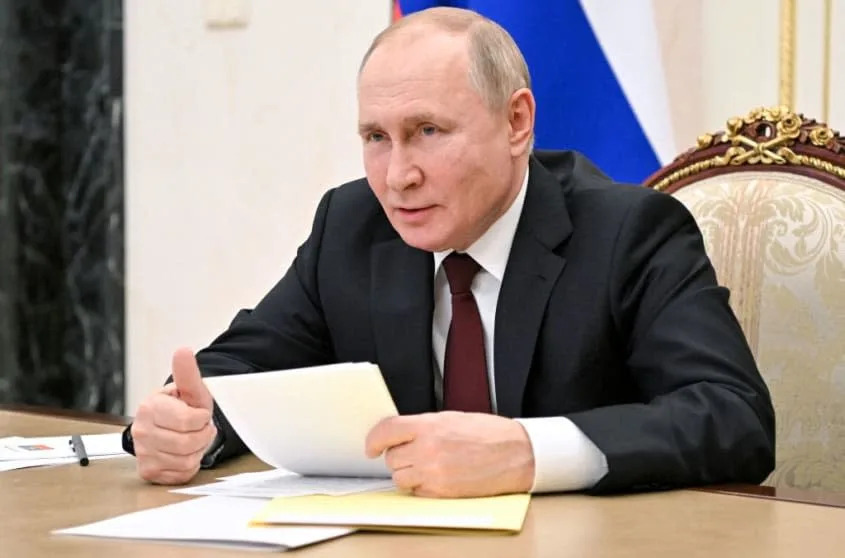
Economic sanctions may make Russian invasion too costly

The Register Mail

Sue Hulett: Economic sanctions may make Russian invasion too costly

Sue Hulett – February 19, 2022

Vladimir Putin who reimposed Soviet-style dictatorship in his 23 years as leader of Russia, has also engineered a series of international power grabs. He invaded and annexed parts of two former colonies (Georgia in 2008) and Ukraine in 2014-2022), supported Syria’s dictator in his brutal crushing of civil war in Syria (2012-2022), and killed thousands of Muslims in the Russian province of Chechnya.

Presidents G. W. Bush, Barack Obama, and Donald Trump under reacted to these and other displays of Putin’s attempts to recreate the Soviet/Russian Empire, although Obama and other NATO members eventually imposed painful economic sanctions on Russia after the annexation of Crimea and takeover of two other Ukrainian provinces in 2014. President Trump and Biden escalated defensive military and economic aid to Ukraine. All NATO members increased their defense budget contributions to European security. However, Putin remains largely undeterred, especially in regard to his appetite to re-conquer Ukraine (independent Ukraine now seeks European Union and NATO membership).

Gun crime: Here’s what happened the night a Galesburg gun shop burglary turned bloody, Jan. 6, 2021

While Joe Biden’s chaotic and catastrophic (for the image of U.S. power) retreat from Afghanistan in 2021 embolden adversaries like China, Iran, and Russia, he is standing tall against Putin’s push to conquer in Europe. While pledging no U.S. troops to engage Russian troops if they invade the rest of Ukraine, he has rebuked Putin for his invasion preparations, played team-ball with other committed NATO allies, and revealed satellite and other intel on Russian troops (150,000+ on Ukraine’s borders), weapons, and maneuvers. He increased military aid to Ukraine and several nearby NATO members. He predicts Russia will invade, but will pay a huge economic and public relations price for invasion. Many tens of thousands of Ukrainians and thousands of Russians will die as a result. Biden and NATO pledge to impose new widespread economic sanctions (likely including the halting of the Russian-German oil pipeline) should Putin attack.

President Biden hopes that a consistent resistance to Putin’s plans for conquest and to undermine NATO unity will convince Putin to withdraw. As President Reagan said as he helped collapse the Soviet Empire in the 1980s, “Since the dawn of the atomic age, we’ve sought to reduce the risk of war by maintaining a strong deterrent and by seeking genuine arms control. “Deterrence” means … making sure any adversary who thinks about attacking the United States, or our allies, or our vital interests, concludes that the risks to him outweigh any potential gains. Once he understands that, he won’t attack. We maintain the peace through our strength; weakness only invites aggression.” While Putin masses front-line troops on Ukraine’s borders and pledges to dry-run nuclear missiles as a part of maneuvers on the border, Putin has also said he has no intention to invade and that diplomacy on Russian terms could commence.

More: Roundtable: Grading President Biden’s first year in office

However, as the Biden administration and NATO leaders know, Putin’s nuclear saber-rattling and his version of diplomacy are problematic and appeasement is not an option. Putin regrets the collapse of the Soviet empire, intends to restore Russian global power, and insists that former colonies bordering Russia must be “pro-Russian” and under Russian control just as in the good old days before the West interfered. Most of the former Soviet satellites (colonies) fled into Europe and NATO after the Soviet Union collapsed. Ukraine remained neutral and even returned to Russia the nuclear missiles that the Soviets had placed in Ukraine. The Russians in exchange pledged to do do nothing to endanger Ukrainian security. But Putin’s revanchist (I want all of Ukraine) pressures on Ukraine literally drove it westward as it sought to be European, independent, and secure.

It will be a challenge to negotiate with Putin. But he does want success on the cheap. Putin hopes that threats, posturing, displays of military firepower, deception, and boldness will win the day as the West backdowns in the face of pressure. Clearly NATO unity (there are 29 members) is sometimes vulnerable to conflicting interests and economic priorities. And, all have rejected war in Europe since WW II. Biden’s inconsistent foreign policy of retreat (Afghanistan, the Middle East, and so on) also makes the U.S. vulnerable to a determined aggressor or global power-seeker. So Putin may have hoped, to exploit Western appeasement to take Ukraine with little Western response.

However it looks like Biden’s and NATO’s firm commitment to Ukraine and to resist Putin’s aggression by way of renewed economic sanctions and military vitality surprised Putin and may convince him to negotiate rather than invade. If he pursues empire-by-aggression it will be a tragedy for Ukraine, but also for Russia as it will face a renewed NATO mission.

Louisa Sue Hulett is Professor Emerita (Political Science) at Knox College.

Russia to stage massive nuclear drills amid Ukraine standoff

Associated Press

Russia to stage massive nuclear drills amid Ukraine standoff

February 18, 2022

MOSCOW (AP) — The Russian military on Friday announced massive drills of its strategic forces, a stark reminder of the country’s nuclear might amid Western fears that Moscow might be preparing to invade Ukraine.

The Defense Ministry said Russian President Vladimir Putin will personally oversee Saturday’s exercise, which will involve multiple practice launches of intercontinental ballistic missiles and cruise missiles.

The ministry said it planned the maneuvers some time ago to check the readiness of Russia’s military command and personnel, as well as the reliability of its nuclear and conventional weapons.

The war games follow U.S. President Joe Biden’s warning on Thursday that Russia could invade Ukraine within days.

Western fears focus on an estimated 150,000 Russian troops — including about 60% of Russia’s overall ground forces — concentrated near Ukraine’s borders. The Kremlin insists it has no plans to invade.

But Moscow has demanded that the U.S. and its allies keep Ukraine and other ex-Soviet nations out of NATO, not deploy weapons in Ukraine and pull back NATO forces from Eastern Europe.

Washington and its allies bluntly rejected the Russian demands, and Moscow threatened to take unspecified “military-technical measures” if the West continued to stonewall.

Russia holds massive drills of its strategic nuclear forces on an annual basis, but the maneuvers planned for Saturday pointedly involve the Black Sea Fleet. The fleet is based on the Crimean Peninsula, which Russia annexed from Ukraine in 2014.

___

Follow AP’s coverage of the tension between Russia and Ukraine at

Images show military activity in Belarus, Crimea and western Russia

Reuters

Images show military activity in Belarus, Crimea and western Russia – satellite firm

By Kanishka Singh and Dan Whitcomb – February 18, 2022

(Reuters) – Satellite imagery taken this week shows military activity in multiple locations across Belarus, the annexed Crimea region of Ukraine and western Russia near Ukraine’s border, a private U.S. company said on Friday.

U.S.-based Maxar Technologies, which has been tracking the buildup of Russian forces for weeks, said the images show recent helicopter deployments, consisting of both troop transport and ground attack helicopters, at multiple locations close to the border. They also show additional ground attack aircraft, air defense units and drone equipment have been deployed, it said.- ADVERTISEMENT -https://s.yimg.com/rq/darla/4-10-1/html/r-sf-flx.html

Reuters could not independently verify what was shown in the images.

U.S. President Joe Biden said on Friday that Russian President Vladimir Putin has decided to invade Ukraine, and that he was spreading false information to try to build a pretext for a military strike that could happen in days. Russia says it has no such intention and accuses the West of irresponsible fear-mongering.

Maxar said the images showed that a large new deployment of at least 50 helicopters had arrived in northwest Belarus.

A new helicopter unit and battle group deployment consisting of tanks, armored personnel carriers and support equipment was deployed at an airfield about 16 kilometers (9.9 miles) from the Ukraine border, the satellite firm said.

(Reporting by Dan Whitcomb and Kanishka Singh; Editing by Leslie Adler and Tim Ahmann)

Why would Vladimir Putin risk a Ukraine invasion? Check his ‘ego,’ analysts suggest.

The Week

Why would Vladimir Putin risk a Ukraine invasion? Check his ‘ego,’ analysts suggest.

Peter Weber, Senior editor – February 18, 2022

Vladimir Putin
Vladimir Putin Alexey Nikolsky/Sputnik/AFP/Getty Images

President Biden, Defense Secretary Lloyd Austin, Secretary of State Antony Blinken, and numerous other U.S. officials delivered the same dire message on Thursday: All signs point to Russia invading Ukraine within days.

“Biden and his top aides acknowledge they are risking American credibility” by constantly warning that Russian President Vladimir Putin is about to launch a bloody, “unprovoked land war in Europe,” The New York Times reports. But they say “they would rather be accused of hyperbole and fearmongering than be proven right.”

Russia has maintained it has no plans to invade Ukraine, and Russian journalist Vladimir Pozner told NPR News on Tuesday that the feeling among Russians is that “Russia can win nothing by invading Ukraine,” On the contrary, he said, “it can lose a lot. Not only would it be a drawn-out guerrilla warfare kind of thing, which Russia cannot really bear. It would be total destruction of any kind of respect for Russia. There’s nothing to win and a lot to lose. And there are people who say that’s exactly what the West wants.”

On the Ukraine border, though, “most military indicators are in the red,” a Western intelligence official tells The Washington Post. “It all comes down to a political decision about whether to launch an attack. The Russians are actively fabricating the casus belli.”

“Putin has enough troops in place now to do what he wants to do when he wants to do it,” says Politico national security editor Ben Pauker, and when assessing whether he will invade, “the word we don’t hear often enough is ‘ego.'”

Putin has “played the pressure/escalation game many times before in order to extend the sphere of Moscow’s influence” or just “put himself back in the center of the world stage,” Pauker writes. “But this time, it seems he’s boxed himself into a corner: invade and suffer the consequences of international opprobrium and crippling sanctions, or pull the troops back and return home to a public that might smell weakness. I think ego is a significant part of why observers are so worried that he might actually do this, despite the consequences.”

Putin’s sated ego might help avert an “overt” Russian invasion, too, former U.S. NATO ambassador Douglas Lute suggested Thursday. “He enjoys this position,” Lute told the Times. “Everyone’s paying attention to him, like they haven’t in years. And he feels in control.”

‘What Mr. Putin did not want’: U.S. approves $6B tank deal with Poland

Politico

‘What Mr. Putin did not want’: U.S. approves $6B tank deal with Poland

Paul McLeary – February 18, 2022

Alex Brandon/AP Photo

The State Department on Friday approved a long-awaited $6 billion deal to sell Poland 250 Abrams tanks, an announcement that comes as more U.S. troops and aircraft flood into the country in the face of a possible Russian invasion of Ukraine.

Defense Secretary Lloyd Austin announced the deal early Friday while in a Warsaw press conference alongside his Polish counterpart Mariusz Blaszczak.

“What Mr. Putin did not want was a stronger NATO on his flank, and that’s exactly what he has today,” Austin said.

The eventual delivery “will also strengthen our interoperability with the Polish armed forces, boosting the credibility of our combined deterrence efforts and those of our other NATO Allies.”

The package is another piece in Poland’s sweeping military modernization effort, coming on top of a $6.5 billion deal Poland forged in 2019 to buy 32 F-35 fighter planes, and other agreements to buy mobile rocket artillery systems from the United States.

In Vienna, the U.S. ambassador to the Organization for Security and Cooperation in Europe, Michael Carpenter, upped Washington’s assessment of the force Russia has built up along Ukraine’s border, saying between 169,000 and 190,000 troops “are in and near Ukraine as compared with about 100,000 on January 30.”

The Biden administration has deployed about 5,000 more troops to Poland over the past two weeks, bolstering the 4,000 troops already there, while dispatching two Stryker brigades based in Germany to Romania and Bulgaria.

A U.S. military official told POLITICO that the American role in Poland is “pretty limited” and focused on training with the Polish military and assisting and processing any American citizens who might flee any fighting in Ukraine.

“I think there are a lot of unknowns about what’s really going to happen,” the official, who asked to remain anonymous to discuss a sensitive issue, adding that any large flood of Ukrainians fleeing the fighting would be up to the Polish government and European Union to handle, and “we would have to be asked to do that.”

Austin addressed the issue in Warsaw on Friday, saying “if Russia further invades Ukraine, Poland could see tens of thousands of displaced Ukrainians and others flowing across its border, trying to save themselves and their families from the scourge of war.”

This week has seen a flurry of new activity as NATO and its allies seek to forestall a fresh Russian push into Ukraine. Vice President Kamala Harris met with NATO chief Jens Stoltenberg and Eastern European heads of state at the Munich Security Conference early Friday. In the afternoon, President Joe Biden will host a call about the Ukraine crisis with the leaders of Canada, France, Germany, Italy, Poland, Romania, Britain, the EU and NATO.

While the deal for the Abrams tanks has been approved, the Polish government still has to negotiate a final contract with General Dynamics and other U.S. defense companies that build the tanks and its components. That means it will be months, if not years, before the first tanks arrive in Poland.

Members of the House and Senate have in recent weeks pushed the administration to fast-track the sale.

The timing of the deal can be seen as a piece of a larger U.S. push in Eastern Europe.

This week saw a buildup in American airpower in the region, as eight additional F-15s from Seymour Johnson Air Force Base, N.C., arrived at the Lask Air Base in Poland, doubling the number of American F-15s which arrived there this month. Six more F-16s arrived in Estonia this month to help police the Baltic Sea.

This week, an additional eight F-16s based in Germany moved to an air base in Romania, and Utah-based F-35s moved to Germany.

Column: The latest conservative to join the resistance? Ted Cruz’s mentor

Los Angeles Times

Column: The latest conservative to join the resistance? Ted Cruz’s mentor

Jackie Calmes – February 18, 2022

This undated photo provided by the 4th U.S. Circuit Court of Appeals shows Judge J. Michael Luttig who is considered one of the candidates to replace U.S. Supreme Court Chief Justice William Rehnquist who died at his home Saturday, Sept. 3, 2005. (AP Photo/4th U.S. Circuit Court of Appeals) ORG XMIT: WX103
Judge J. Michael Luttig (Associated Press)

It’s been a measure of former federal Judge J. Michael Luttig’s stature in the conservative legal movement that Supreme Court justices hired so many of his law clerks — 40 over 15 years. Then two of those proteges became (in)famous: Texas Sen. Ted Cruz and Trump lawyer John C. Eastman, lead actors in the plot to overturn Joe Biden’s election.

Now Luttig is doing penance of a sort: He’s joined the Resistance — against former President Trump, certainly, but also against his erstwhile mentees.

Early on, Luttig did so only by invitation: Two days before Jan. 6, 2021, then-Vice President Mike Pence sought Luttig’s counsel to counter Trump’s demands that Pence, in presiding over Congress’ count of Biden’s electoral votes, reject the votes of six states. Pence, in his letter to Congress ahead of the proceedings, name-checked Luttig to argue that a vice president has no such power.

For Pence, the opinion of a jurist so revered on the right was “armor” against the inevitable slings and arrows from the MAGA army, as conservative lawyer George Conway put it to me. Luttig told me he’s testified behind closed doors about his role to investigators for the House committee probing the Jan. 6 insurrection.-

Lately, however, events have provoked him to go public about his concerns about “the existential threat” to the Republican Party, and by extension our democracy. Many conservative readers tell me to get over Trump, forget Jan. 6 and quit fretting about democracy. I won’t, but neither will Luttig, a protege of former Chief Justice Warren E. Burger, law clerk to Antonin Scalia, a judge for 15 years on the U.S. 4th Circuit Court of Appeals and a contender on George W. Bush’s shortlist of Supreme Court candidates.

Here’s Luttig’s lament about Trump’s Republican Party this week to a group of conservative lawyers:

“For the past six years, I have watched and listened in disgust that not one single leader of ours with the moral authority, the courage and the will to stand up and say, ‘No, this is not who we are, this is not what America is and it’s not what we want to be,’ has done so.”

The final straws for Luttig were the Republican National Committee’s recent resolution that censured Republican Reps. Liz Cheney and Adam Kinzinger for participating on the Jan. 6 committee and called the insurrection “legitimate political discourse,” and Trump’s attacks on Senate Republican leader Mitch McConnell for criticizing the RNC and of Pence for publicly stating “Trump is wrong” to say Pence could overturn the election.

Luttig elaborated by email: “This feels like a seminal moment in America when all of what the country has witnessed and endured for these years seems to be building to volcanic crescendo…. We are in political war to the death — with each other,” and “American democracy hangs in the balance.”

That more Republicans aren’t standing up to “this nonsense, this utter madness,” he said, is “the definition of failed leadership.”

That brings us back to Cruz and Eastman. They not only haven’t stood up to the madness, but they also exemplify it — Cruz by leading a cabal of Republicans who opposed certification of Biden votes on Jan. 6, and by his general Trump toadyism, and Eastman by his authorship of the memo giving a false constitutional gloss to Trump’s coup strategy.

The 67-year-old Luttig, relatively new to Twitter, has trolled his former clerks like a pro. Anyone familiar with the bonds typical between a judge and his or her clerks — Luttig’s call themselves “Luttigators” — knows that his public chastisements have to bother Eastman and even the seemingly impervious-to-criticism Cruz, who once described Luttig as “like a father to me.”

In threaded tweets, Luttig flayed Eastman’s legal analysis, calling it “incorrect at every turn.” He pounced after Cruz tweeted a photo of the removal of a 50-ton slab etched with the 1st Amendment from the defunct Newseum near the Capitol; Cruz snarkily suggested it was a metaphor for the wreckage ahead from the Biden administration. Turns out the slab was simply being relocated, partly at the expense of Luttig and his wife, Elizabeth.

“Had he asked,” Luttig tweeted, “I would have told [Cruz] once again that the facts matter and it was foolish of him to demagogue the Constitution by mocking the removal of the iconic First Amendment tablet for reinstallation at its new home at the National Constitution Center in Philadelphia.”

Ouch.

Luttig is now working with members of Congress and their aides to rewrite the flawed 1887 Electoral Count Act to prevent demagogues like Cruz and Eastman from potentially using it again to threaten democracy after the 2024 election.

He has been asked whether the Constitution empowers the states or Congress to disqualify Trump and others from seeking federal office if they are found to have participated in an insurrection. Luttig thinks federal courts would be willing to take such cases, but that it’s unlikely the states or Congress would press the matter.

It’s beyond sad that Trump has forced such questions. But, as Luttig told me, “that is because he was pushing the Constitution and the laws to their limits more than any president in history.”

Take it from the Judge.

Vladimir Putin: Crafty Strategist or Aggrieved and Reckless Leader?

New York Times

Vladimir Putin: Crafty Strategist or Aggrieved and Reckless Leader?

Anton Troianovski – February 18, 2022

A Ukrainian military tank exercise in Donetsk Oblast is abruptly cancelled on Thursday, Feb. 17, 2022, amid jitters about an impending Russian attack. (Tyler Hicks/The New York Times)

MOSCOW — At this moment of crescendo for the Ukraine crisis, it all comes down to what kind of leader President Vladimir Putin is.

In Moscow, many analysts remain convinced that the Russian president is essentially rational, and that the risks of invading Ukraine would be so great that his huge troop buildup makes sense only as a very convincing bluff. But some also leave the door open to the idea that he has fundamentally changed amid the pandemic, a shift that may have left him more paranoid, more aggrieved and more reckless.

The 20-foot-long table Putin has used to socially distance himself this month from European leaders flying in for crisis talks symbolizes, to some longtime observers, his detachment from the rest of the world. For almost two years, Putin has ensconced himself in a virus-free cocoon unlike that of any Western leader, with state television showing him holding most key meetings by teleconference alone in a room and keeping even his own ministers at a distance on the rare occasions that he summons them in person.

Speculation over a leader’s mental state is always fraught, but as Putin’s momentous decision approaches, Moscow commentators puzzling over what he might do next in Ukraine are finding some degree of armchair psychology hard to avoid.

“There’s this impression of irritation, of a lack of interest, of an unwillingness to delve into anything new,” Ekaterina Schulmann, a political scientist and former member of Putin’s human rights council, said of the president’s recent public appearances. “The public is being shown that he has been in practical isolation, with ever fewer breaks, since the spring of 2020.”

A large-scale invasion of Ukraine, many analysts point out, would be an enormous escalation compared with any of the actions Putin has taken before. In 2014, the Kremlin’s subterfuge allowed Russian forces stripped of identifying markings to capture Crimea without firing a single shot. The proxy war Putin fomented in Ukraine’s east allowed him to deny being a party to the conflict.

“Starting a full-scale war is completely not in Putin’s interest,” said Anastasia Likhacheva, the dean of world economy and international affairs at the Higher School of Economics in Moscow. “It is very difficult for me to find any rational explanation for a desire to carry out such a campaign.”

Even if Putin were able to take control of Ukraine, she noted, such a war would accomplish the opposite of what the president says he wants: rolling back the NATO presence in Eastern Europe. In the case of a war, the NATO allies would be “more unified than ever,” Likhacheva said, and they would be likely to deploy powerful new weaponry along Russia’s western frontiers.

At home, Putin has always been keen to project the aura of a sober statesman, overruling the nationalist firebrands on prime-time talk shows and in parliament who have been urging him for years to annex more of Ukraine.

And while he casts himself as Russia’s guarantor of stability, he could face stark economic headwinds from Western sanctions and social upheaval if there are casualties on the battlefield and among civilians. Millions of Russians have relatives in Ukraine.

For the moment, Russians largely appear to subscribe to the Kremlin narrative that the West is the aggressor in the Ukraine crisis, said Denis Volkov, director of the Levada Center, an independent pollster in Moscow. The alarmist messaging out of Washington about an imminent Russian invasion has only bolstered that view, he said, because it makes the West seem to be the one that is “exerting pressure and escalating tensions.”

If Putin were to carry out a short and limited military operation along the lines of the five-day war against Georgia in 2008, he said, Russians could be expected to support it.

But “if this is a lengthy, bloody war, we get to a situation where it’s impossible to forecast,” Volkov said. “Stability ends.”

Given that such a war still seems unthinkable and irrational to so many in Moscow, Russian foreign policy experts generally see the standoff over Ukraine as the latest stage in Putin’s yearslong effort to compel the West to accept what he sees as fundamental Russian security concerns. In the 1990s, that thinking goes, the West forced a new European order upon a weak Russia that disregarded its historical need for a geopolitical buffer zone to its west. And now that Russia is stronger, these experts say, it would be reasonable for any Kremlin leader to try to redraw that map.

Fyodor Lukyanov, a prominent Moscow foreign policy analyst who advises the Kremlin, said Putin’s goal now was “to force the outcome of the Cold War to be partially revised.” But he still believes Putin will stop short of full-scale invasion, instead using “special, asymmetric or hybrid means” — including making the West believe that he is truly prepared to attack.

“A bluff has to be very convincing,” Lukyanov said. And the United States, he went on, with its robust portrayals of an aggressive Russia poised for invasion, “is playing along at 200%.”

By this line of thinking, Russian analysts say, U.S. officials are falling for an exaggerated image of Putin as an evil genius. Since Putin’s past attempts to negotiate with the West over arms control and NATO expansion failed, they say, the Kremlin chose to raise the stakes to a point at which its interests became impossible to ignore.

“He is very successful at using the negative image that has been created of him as a demon,” said Dmitri Trenin, head of the Carnegie Moscow Center think tank, describing Putin as capitalizing on fears that he was prepared to unleash a horrific war. “The plan was to create a threat, to create the sense that a war could happen.”

But the experts have been wrong before. In 2014, Putin seized Crimea, even as few Moscow analysts were predicting a military intervention. And skeptics of the view that Putin is bluffing point out that during the pandemic, he has already taken actions that earlier seemed unlikely. His harsh crackdown against the network of Alexei Navalny, for example, has contradicted what had been a widely held view that Putin was happy to allow some domestic dissent as an escape valve to manage discontent.

“Putin, in the last year, has crossed a lot of Rubicons,” Michael Kofman, director of Russia studies at CNA, a research institute based in Arlington, Virginia, said last week. “Folks who believe that something this dramatic is unlikely or improbable may not have observed that qualitative shift in the last two years.”

‘The Bloody Czar’: Did a False-Flag Operation Fuel Putin’s Rise?

National Review

‘The Bloody Czar’: Did a False-Flag Operation Fuel Putin’s Rise?

Mark Antonio Wright – February 18, 2022

As a (further) Russian invasion of Ukraine grows more and more likely, last night I decided to re-read David Satter’s August 2016 cover story in the magazine, “The Bloody Czar.”

Satter, an American journalist with extensive experience in Russia and the former Soviet Union, detailed the rise of Vladimir Putin from obscurity to the pinnacle of power in Moscow — and how it all could have been catalyzed by a murderous false-flag operation.

“I believe,” Satter wrote, “that Vladimir Putin came to power as the result of an act of terror committed against his own people.”

The evidence is overwhelming that the apartment-house bombings in 1999 in Moscow, Buinaksk, and Volgodonsk, which provided a pretext for the second Chechen war and catapulted Putin into the presidency, were carried out by the Russian Federal Security Service (FSB). Yet, to this day, an indifferent world has made little attempt to grasp the significance of what was the greatest political provocation since the burning of the Reichstag.

“I have been trying,” Satter continued, “to call attention to the facts behind the bombings since 1999. I consider this a moral obligation, because ignoring the fact that a man in charge of the world’s largest nuclear arsenal came to power through an act of terror is highly dangerous in itself.”

The apartment bombings — which were quickly blamed on Islamist Chechen rebels — killed hundreds of Russian civilians. Putin, newly named as the political successor to then-president Boris Yeltsin, vowed revenge and was shot into power. He then proceeded to prosecute the war in the breakaway province of Chechnya and crushed the rebels. Combined with a general economic boom, Putin become the undisputed and, for a time, extremely popular, ruler of Russia.

But, Satter writes, “Almost from the start . . . there were doubts about the provenance of the bombings, which could not have been better calculated to rescue the fortunes of Yeltsin and his entourage.”

Suspicions deepened when a fifth bomb was discovered in the basement of a building in Ryazan, a city southeast of Moscow, and those who had placed it turned out to be not Chechen terrorists but agents of the FSB. After these agents were arrested by local police, Nikolai Patrushev, the head of the FSB, said that the bomb had been a fake and that it had been planted in Ryazan as part of a training exercise. The bomb, however, tested positive for hexogen, the explosive used in the four successful apartment bombings. An investigation of the Ryazan incident was published in the newspaper Novaya Gazeta, and the public’s misgivings grew so widespread that the FSB agreed to a televised meeting between its top officials and residents of the affected building. The FSB in this way tried to demonstrate its openness, but the meeting was a disaster: It left the overwhelming impression that the incident in Ryazan was a failed political provocation.

Three days after the broadcast, Putin was elected. Attention to the Ryazan incident faded, and it began to appear that the bombings would become just the latest in the long list of Russia’s unsolved crimes.

It’s sober reading. If you want to understand the roots of what’s going on in the Donbas, read the whole thing here.

We Finally Know What Putin Planned for a False Flag Op Against Ukraine

Daily Beast

We Finally Know What Putin Planned for a False Flag Op Against Ukraine

Shannon Vavra – February 18, 2022

(Photo by Pascal Le Segretain/Getty Images)

Russian news agencies are amplifying claims that they have prevented an attempt from Ukraine to explode a chlorine gas tank in separatist territory, Horlivka, in what experts say appears to be the latest attempt from Russia to claim Ukraine is the aggressor and create a pretext to invade.

Ukrainian intelligence warned last month of this very prospect. Ukraine’s defense intelligence agency warned that Russia was preparing to use the presence of chemicals in the same location, Horlivka, as a pretense to attack or advance its aggression against Ukraine.

The news comes just as fears around the world mount that Russia might claim a pretext—and even fabricate one—to invade Ukraine. And at this hour, concerns appear higher than ever that Russia might be poised to launch an all-out assault on Ukraine. Russian media has claimed in recent hours there was an explosion in the Donetsk People’s Republic (DNR), in what could be the long-awaited false flag operation from Russian President Vladimir Putin. Claims are circulating that the explosion was a car bomb targeting the head of Donbas regional security, Denis Sinenkov.

Pro-Putin Kingpin Declares War Is Coming for Ukraine on Live TV

In just the last several hours, the cadence of bad news coming from Russia has picked up. Russian-backed forces have been shelling targets in Eastern Ukraine and there is little evidence Russia is pulling back forces as it has claimed. The news of the car bomb comes just after the DNR in Eastern Ukraine announced an evacuation due to an alleged imminent attack coming. The Luhansk People’s Republic (LNR) has also ordered an evacuation, according to Reuters.

The head of the DNR Denis Pushilin claims the reason for the evacuation is that Ukrainian President Vladimir Zelesnky is plotting an offensive soon. Valerii Zaluzhnyi, the commander-in-chief of Ukraine’s Armed Forces said in an address that claims Ukraine is planning an attack are false. Ukraine’s foreign minister Dmytro Kuleba said in a statement, “we categorically refute Russian disinformation reports on Ukraine’s alleged offensive operations or acts of sabotage in chemical production facilities.”

U.S. officials have been warning for weeks that Russian leadership is seeking out some kind of pretext for invasion, and in some cases will use its own saboteurs to create a justification to pull the trigger and attack, a senior administration official told The Daily Beast.

And this looks like it fits the bill, as it could create the perfect justification Putin can bring back home to justify an attack, Doug London, a former Senior Operations Officer in the CIA’s Clandestine Service, told The Daily Beast.

On some level, Putin “needs to show the Russian people that he’s standing up for their security, fighting evil, that the threat is genuine, that everything Russia’s doing is not to start a war, but because ‘we’re the victims here and we’ve got to protect ourselves,’” London said.

In recent days the Biden administration has been working to expose just exactly how Russia is planning to create a pretext to invade, according to U.S. intelligence agencies’ collection, in an attempt to destabilize Putin’s plans for invasion. In one case, the Biden administration released information alleging Russia was plotting to produce propaganda videos with graphic images of corpses.

Ukraine’s earlier attempt to call out Russia’s plans in Horlivka in advance of Russian claims about Horlivka and chemicals fit right into that playbook, experts say.

This Surprise ‘Mystery Bridge’ Could Be Putin’s Secret Path to War

“Everything that we’re seeing … is part of a scenario that is already in play of creating false provocations, of then having to respond to those provocations, and ultimately committing new aggression against Ukraine,” Secretary of State Tony Blinken said Friday at the Munich Security Conference of the recent escalations.

Western attempts to quickly declassify intelligence information on Russia’s internal plans and make them public might not prevent Putin from invading, but the efforts could alter Putin’s game plans, putting him back on his haunches and at a disadvantage, London said.

“It certainly puts them in a difficult position because basically we’re calling the shots. If we’re putting out predictive material that’s borne out by Russian actions or statements,” it shows ”we’re anticipating and acting to shape events through insight, and now the Russians are deliberating, ‘well do we still go through with it or not, and if we do can we control escalation and the narrative, and if we don’t, have we lost credibility?’”

The ultimate outcome would be to set Putin back and trip him up just as he’s going in for the jugular, said London.

“Then we may be impacting Putin’s timeline and undermining his credibility,” said London, who recently published a memoir on his time in the CIA, The Recruiter: Spying and the Lost Art of American Intelligence. “It forces him to respond, seizing the initiative, so he’s becoming more reactive, adding pressure to Russian decision making.”

For now, Pushilin seems convinced war is here. When asked Friday if a war is beginning, his answer?

“Unfortunately, yes.”