In new front of information war, U.S. repeatedly declassifies intelligence on Ukraine and Russia

Yahoo! News

In new front of information war, U.S. repeatedly declassifies intelligence on Ukraine and Russia

Zach Dorfman, National Security Correspondent – February 19, 2022

In 2014, amid Russia’s last major assault on Ukraine, U.S. officials picked up some disturbing intelligence: A “major politician” and “confidante” of Russian President Vladimir Putin was privately calling for the Russian military to march toward the Ukrainian capital of Kyiv.

The Russian politician was arguing that “we should take [Kyiv], because we could, it wouldn’t take long,” that it was “only so many miles” to the Ukrainian capital, so “let’s keep going,” recalled a former CIA official. CIA experts considered it enough of a legitimate threat that they took it “up the chain,” recalled the former official.

Russia, of course, did not launch a military attack on Kyiv in 2014, and the intelligence about the Russian official’s advocacy for a full-scale invasion of Ukraine stayed secret.

But now, with growing fears that Moscow is preparing for a full-scale invasion, the Biden administration has abandoned the U.S.’s normally tight-lipped attitude toward releasing intelligence information and is pursuing a strategic — and according to former officials, unprecedented — declassification campaign aimed at exposing Russia’s actions in Ukraine.

In recent days, U.S. officials have called out a number of Russian “false flag” operations that they say are designed to provide a pretext to invade Ukraine. These have included allegations of a potential Russian-authored chemical assault designed to look like Ukrainian aggression, and even a plot to create a detailed yet fake movie showing the lethal aftermath of a Ukrainian attack. Officials have also publicly named Russian military intelligence as responsible for a disruptive cyber operation that targeted Ukraine’s defense ministry and banks earlier this week.

Experts say the revelations have been aimed at throwing Russia off balance by exposing their plans before they’re brought to fruition — and showing that the U.S. has the capability to surveil many of Russia’s actions.

By the end of the Trump administration, U.S. spy agencies had developed a “much better understanding of what the Russians are doing in a strategic sense,” said a former senior CIA official, who spoke on the condition of anonymity to discuss sensitive capabilities. “There were some extraordinary sources, obviously those are really fragile, so I’m not sure if those accesses are still in place, but I have to imagine they are.”

The CIA declined to comment.

Russian President Vladimir Putin
Russian President Vladimir Putin in Moscow last Thursday. (Alexey Nikolsky/Sputnik/Kremlin via Reuters)

Though many were supportive of the declassification effort, former intelligence officials who spoke with Yahoo News were divided over whether the Biden administration’s strategy could actually change Russia’s decision to invade. President Biden’s own recent remarks on Putin’s decision to attack Kyiv seems to underline the inability for the U.S. to compel Putin to de-escalate.

But the strategy has other benefits, according to former officials — including vitiating Russia’s pretexts for war in the court of public opinion, and by exposing potential technical or human compromises within the Russian government, which could send Moscow’s counterintelligence experts spinning out on time-consuming hunts for the sources of the intelligence. However, there is also the risk that the Russians will succeed in identifying those U.S. intelligence sources and shut them down.

The Russians are “going to lie anyway, and try and shape a narrative,” said Michael van Landingham, a former CIA Russia analyst. “And what you’re seeing now is the U.S. committing to preemptive selective de-classification” in the hope that the exposure will force the Russians to de-escalate or push onward without the cover provided by Russia-authored fake justifications for war.

The high-stakes confrontation could also have Putin wondering about the bona fides of Russia’s own U.S. agents, according to a former senior counterintelligence official. “He’ll be questioning, and doubting, anything that comes from his U.S. sources,” said the former official. “That’s good for us.”

The distrust of intelligence can cut both ways. Particularly when it comes to Russia, it’s hard not to believe that there isn’t “a game within a game within a game within a game,” said the former CIA official.

Much of what had been obtained by U.S. intelligence on the false flag operations attempting to justify an invasion could have been purposely planted by Russia to be picked up by U.S. spying efforts, according to Dan Hoffman, the former CIA chief of station in Moscow. The Biden’s administration’s strategy of releasing intelligence is a “double-edged sword, and it has not demonstrated that it has changed Putin’s calculus,” said Hoffman. “Putin is a KGB guy, so he might be feeding us disinformation.”

Civilians take part in a military training course in Kyiv, Ukraine
Civilians take part in a military training course in Kyiv, Ukraine. (Chris McGrath/Getty Images)

Some Ukrainian officials have also been skeptical about the ultimate purpose of the intelligence they’ve received. While they’re being fed high-quality signals intelligence by the U.S. and other allies about Moscow’s plans, some Ukrainian officials “aren’t really sure” what to make of it, said a former senior CIA official in close contact with Ukrainian security officials.

The Ukrainian officials believe “that the Russians want to show us all this stuff” being picked up by the U.S. and other intelligence services, that “they want us to be on edge,” said the former official. So while the Ukrainian security officials believe they’re “taking all prudent measures,” they’re not “panicking” over the information being passed to them, said the former official.

The confusion by the Ukrainian security officials about how to read the intelligence is exacerbated by a lack of confidence in Ukrainian President Volodymyr Zelensky’s handling of the crisis. “There’s a lot of angst [by the Ukrainian security officials] that the presidential administration is not very professional,” said the former senior agency official. (The Ukrainian Embassy in Washington, D.C., did not return a request for comment.)

Biden administration officials share this view, said a former national security official in touch with colleagues in government. “Their interactions with Kyiv have been frustratingly fruitless,” said the former official. Administration officials “understand, on the public side, Zelensky’s trying to keep his economy and own polity from collapsing.” But officials — to no avail — kept hammering to their Ukrainian counterparts that an invasion was likely, telling them, “No, no, seriously: It’s coming.”

Separatist leaders in eastern Ukraine declare full military mobilisation

Reuters

Separatist leaders in eastern Ukraine declare full military mobilisation

February 19, 2022

MOSCOW (Reuters) – Russian-backed separatist leaders in eastern Ukraine declared a full military mobilisation on Saturday, a day after ordering women and children to evacuate to southern Russia because of what they said was the threat of conflict.

Denis Pushilin, head of the self-proclaimed Donetsk People’s Republic, said in a video statement that he had signed a decree on mobilisation and called on men “able to hold a weapon in their hands” to come to military commissariats.

Another separatist leader, Leonid Pasechnik, signed a similar decree for the Luhansk People’s Republic shortly afterwards.

Separatist authorities on Friday announced plans to evacuate around 700,000 people, citing fears of an imminent attack by Ukrainian forces – an accusation Kyiv flatly denied.

Less than 7,000 people had been evacuated from Donetsk as of Saturday morning, the local emergencies ministry said.

The Ukrainian military said on Saturday it had recorded 12 ceasefire violations by pro-Russian separatists in eastern Ukraine in the morning after 66 cases in the previous 24 hours.

Separatist authorities also reported what they said was shelling by Ukrainian forces of several villages on Saturday.

Both sides regularly trade blame for ceasefire violations.

(Reporting by Maria Kiselyova; Editing by Andrew Osborn)

Russia has lists of prominent Ukrainian figures to arrest or kill should Moscow invade, U.S. officials say

The Week

Russia has lists of prominent Ukrainian figures to arrest or kill should Moscow invade, U.S. officials say

Brigid Kennedy, Staff Writer – February 18, 2022

The U.S. reportedly has intelligence that, in the event of a Russian-led invasion of Ukraine, Moscow may “target prominent political opponents, anti-corruption activists, and Belarusian and Russian dissidents living in exile,” Foreign Policy reports. Though no such invasion has yet occured, Western officials as well as President Biden have cautioned it could go down any day now.

According to four people familiar with the intelligence in question, “Russia has drafted lists of Ukrainian political figures and other prominent individuals to be targeted for either arrest or assassination in the event of a Russian assault on Ukraine,” Foreign Policy writes.

“These acts, which in past Russian operations have included targeted killings, kidnappings/forced disappearances, detentions, and the use of torture, would likely target those who oppose Russian actions, including Russian and Belarusian dissidents in exile in Ukraine, journalists and anti-corruption activists, and vulnerable populations such as religious and ethnic minorities and LGBTQI+ persons,” one official said.

The White House is also reportedly shocked at how “formalized” the lists are, Foreign Policy notes. Those included on the lists seem to essentially be “anyone who could challenge the Russian agenda.”

One Belarusian official said that though his team had advised Belarusians living in Ukraine on how to handle a Russian attack, “they had not been informed of a specific threat to Belarusian dissidents,” writes Foreign Policy.

Biden will speak on the ongoing crisis at the Russia-Ukraine border at 4 p.m. on Friday.

Zelensky: Ukraine wants ‘clear’ time frame for NATO membership

The Hill

Zelensky: Ukraine wants ‘clear’ time frame for NATO membership

February 19, 2022

Ukrainian President Volodymyr Zelensky on Saturday asked NATO and the European Union (EU) for a firm and “honest” answer on his country’s prospects for entry into the alliance at the Munich Security Conference.

During remarks on Saturday afternoon, the Ukrainian president questioned why the EU avoids questions about his country’s membership status, asking, “Doesn’t Ukraine deserve direct, honest answers?”

“This also applies to NATO. We are told the door is open. But for now, no outsiders are allowed in,” he said while addressing world leaders in Munich, Kyiv-based news agency Interfax-Ukraine reported.

He added that if some or all members of the NATO alliance don’t want to include Ukraine, “they should be honest with the country.”

Russia has demanded that NATO guarantee it will not expand any further eastward, claiming the organization’s proximity to its borders threatens its national security. It has also requested assurances that Ukraine will never be permitted to join the alliance.

“An open door is good, but we need open answers, not questions that have not been closed for years. Isn’t the right to the truth included in our enhanced opportunities?” Zelensky added.

“Eight years ago, Ukrainians made their choice, many gave their lives for it. Is it really possible that eight years after that, Ukraine should constantly call for recognition of the European prospect? Since 2014, the Russian Federation has been convinced that we have chosen the wrong path, and that no one is waiting for us in Europe,” he said on Saturday.

Zelensky was referring to the 2014 Euromaidan protests that brought down the government of then-President Viktor Yanukovych, which was partly prompted by the government’s perceived closeness to Russia. Yanukovych’s government also suspended the signing of the EU-Ukraine Association Agreement.

Russian-backed separatists in the Donbas region rebelled against the new government in Kyiv shortly after, sparking the country’s ongoing conflict.

The news comes amid Western fears of an impending Russian invasion into the country. For its part, the Russian military has incrementally amassed hundreds of thousands of troops at its border with the former Soviet state.

Russia has previously denied that it plans to invade Ukraine, but on Saturday, Russian President Vladimir Putin oversaw nuclear exercises in what experts say is a show of military strength.

The situation has also been compounded by an increasingly volatile situation in eastern Ukraine, where leaders of separatist territories called on able-bodied men to fight.

Zelensky during his speech cited the U.S.’s continued warnings of imminent Russian aggression, including those from President Biden. He said in order to “really help Ukraine, Western countries do not need to constantly talk only about the dates of a possible invasion.”

“We will defend our land on Feb. 16, March 1, and Dec. 31. We need other dates much more. And everyone understands perfectly well which ones,” he emphasized.

Zelensky addressed the gathering soon after he concluded his scheduled meeting with Vice President Harris on the sidelines of the conference.

Harris and Zelensky, along with their aides, sat across from each other and engaged in a brief dialogue in front of press, where he told Harris, via an interpreter, that “the only thing we want is to have peace.”

Finland likens Russia’s treatment of Ukraine to Soviet threats

Reuters

Finland likens Russia’s treatment of Ukraine to Soviet threats

February 19, 2022

Munich Security Conference, in Munich

(Reuters) – Finland’s president on Saturday compared Russia’s current treatment of Ukraine to an attempt by Soviet dictator Josef Stalin to threaten and divide Finland before invading in 1939.

“All what happens in Ukraine, all what happens in the Western world at the moment, reminds me of what happened in Finland,” President Sauli Niinisto told a security conference in Munich.

“Stalin thought that he will split the nation and it’s easy to go and invade Finland. Totally the opposite happened. People united, and we see the same in Ukraine.”

Finland, part of the Russian empire from 1809 to 1917, resisted an initial Soviet invasion in 1939. The Nordic country later sided with Nazi Germany for much of World War Two and lost a chunk of its pre-war territory to the Soviet Union in peace treaties afterwards. During the Cold War, Finland was neutral between the West and the Soviet Union.

(Reporting by David Milliken)

Mildred Harnack, the only American in the leadership of the German resistance to Hitler.

Suppressed Histories Archives

May be a closeup of 1 person

“Mildred Harnack was beheaded on Hitler’s direct order. Born in Milwaukee, she was 26 when she moved to Germany to pursue a PhD. As an American grad student in Berlin, she saw Germany swiftly progress from democracy to fascist dictatorship. She and her husband Arvid began holding secret meetings in their apartment. She recruited working-class Germans into the resistance, helped Jews escape, plotted acts of sabotage, and collaborated in writing leaflets that denounced Hitler and called for revolution.

“Mildred Harnack nicknamed their resistance group “the Circle.” The group was diverse: its members were Jewish, Catholic, Protestant, atheist. They were factory workers and office workers, students and professors, journalists and artists. Over 40% were women….”The Gestapo arrested Mildred Harnack on Sept 7, 1942 and gave her group a name: the Rote Kapelle (Red Orchestra). Postwar testimonies and notes smuggled out of a Berlin women’s prison describe the daily interrogations and torture that Mildred and others in the group endured.

“Mildred Harnack and 75 of her German coconspirators were forced to undergo a mass trial at the highest military court in Nazi Germany. A panel of 5 judges sentenced her to 6 years at a prison camp but Hitler overruled the decision and ordered her execution “Before her execution Mildred spent the last hours of her life in a prison cell translating poems by Goethe. The title of my book ALL THE FREQUENT TROUBLES OF OUR DAYS is a line from one of them. A prison chaplain smuggled out the book of poems under the folds of his robe.

“On February 16, 1943 at Plötzensee Prison in Berlin, Mildred Harnack was strapped to a guillotine and beheaded. According to all available records, she was the only American in the leadership of the German resistance to Hitler.”

More great pictures and info here. https://twitter.com/RRRDonner/status/1493952833846140935

Kremlin says repeated predictions of Ukraine invasion may have ‘detrimental consequences’

The Hill

Kremlin says repeated predictions of Ukraine invasion may have ‘detrimental consequences’

February 20, 2022

The Kremlin spokesperson on Sunday warned that repeated suggestions by Western governments of an imminent Russian invasion of Ukraine may have adverse consequences.

Speaking with Russian state television, Dmitry Peskov said Russian President Vladimir Putin takes no notice of such statements.

“The fact is that this directly leads to an increase in tension. And when tension is escalated to the maximum, as it is now, for example, on the line of contact [in eastern Ukraine], then any spark, any unplanned incident or any minor planned provocation can lead to irreparable consequences,” Peskov told Rossiya 1 state TV, according to Reuters.

“So all this has – may have – detrimental consequences. The daily exercise of announcing a date for Russia to invade Ukraine is a very bad practice,” Peskov added.

Peskov was responding to remarks from President Biden who said Friday he was “convinced” that Putin had decided on whether he would invade Ukraine.

Secretary of State Antony Blinken reiterated much of the same predictions on Sunday, saying current intelligence indicated that Putin was planning on following through with an invasion.

“Everything we’re seeing tells us that the decision we believe President Putin has made to invade is moving forward,” Blinken said.

Up to 190,000 Russian troops are believed to have amassed along Ukraine’s borders. On Sunday, Belarus announced that joint military exercises with Russia that were meant to end this week would be extended.

Images show new Russian deployments of armor and troops near Ukraine – Maxar

Reuters

Images show new Russian deployments of armor and troops near Ukraine – Maxar

February 20, 2022

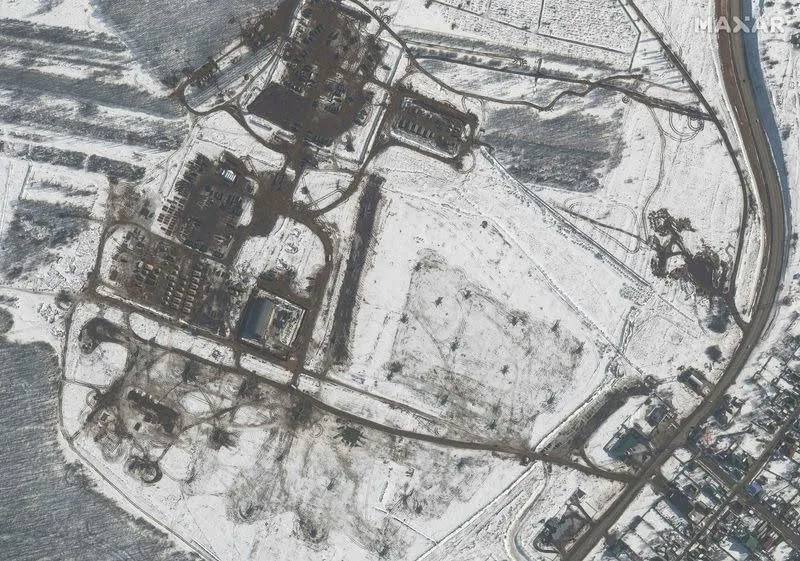
A satellite image shows an overview of a helicopter deployment, a battle group, and troops, in Valuyki
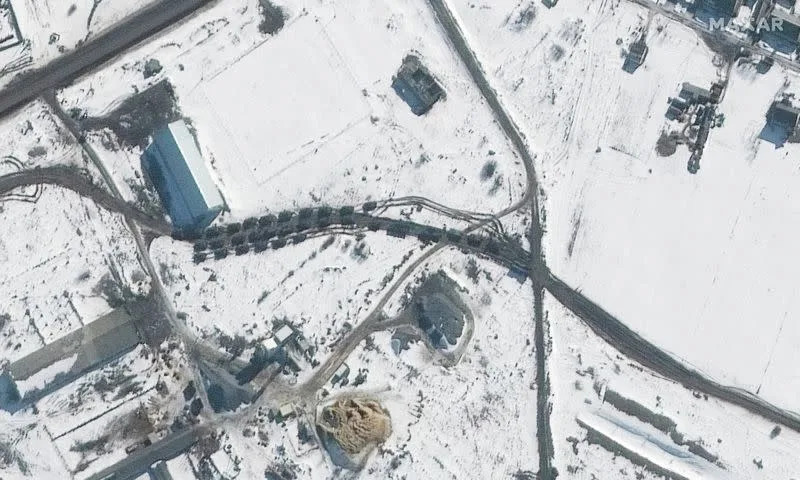
A satellite image shows a motorized rifle battalion in a convoy, near Soloti

A satellite image shows an overview of a helicopter deployment, a battle group, and troops, in Valuyki

(Reuters) – Satellite images show multiple new field deployments of armored equipment and troops from Russian garrisons near the border with Ukraine, a private U.S. company said on Sunday, in what its director said indicated increased military readiness.

The new activity comes as Russia extended military drills in Belarus that were due to end on Sunday, heightening fears among Western powers over an imminent Russian invasion of Ukraine.

The images released by U.S.-based Maxar Technologies, which has been tracking the buildup of Russian forces for weeks, could not be independently verified by Reuters.

“This new activity represents a change in the pattern of the previously observed deployments of battle groups (tanks, armored personnel carriers, artillery and support equipment),” Maxar said in a release on Sunday.

Several large deployments of battle groups had been observed around the military garrison at Soloti, Russia, as of Feb. 13 according to satellite images, Maxar said.

Images on Sunday showed most of the combat units and support equipment at Soloti had departed. Extensive vehicle tracks and some convoys of armored equipment were seen throughout the area, the company said.

Some equipment has also been deployed east of nearby Valuyki, Russia, in a field approximately 15 km (9 miles) north of the Ukrainian border. A number of new field deployments are also seen northwest of the Russian city of Belgorod, Maxar said.

Based on the tracks and the snow, the activity appeared to be recent, Stephen Wood, senior director at Maxar News Bureau, told Reuters.

“To me it indicates an increased state of readiness,” he said.

(Reporting by Michelle Price and Costas Pitas; Editing by Daniel Wallis)

Latest satellite images show shift in Russian military activity near Ukraine

The Hill

Latest satellite images show shift in Russian military activity near Ukraine

February 20, 2022

New satellite images by Maxar Technologies collected over the weekend show an apparent shift in Russia’s military deployment around Ukraine as officials continue to warn about an impending invasion, according to The New York Times.

Some smaller deployments are now visible with several units shown to be on training grounds or outside of bases.

Most of the locations are in Russia’s Belgorod area, which is 25 miles from Ukraine’s boarder in western Russia. Images also showed a helicopter landing site being established in the last two weeks.

Analysis by Maxar cited by the Times indicate that units and equipment at a military garrison near the town of Valuyki have left.

Other footage, including a TikTok video, showed Russian military deployment less than five miles from the Ukrainian border, according to the Times.

The latest satellite imagery analysis comes as Russia has deployed as many as 190,000 troops in Russia and Belarus, with the number growing in recent weeks.

The U.S. and other Western governments have pressured for diplomatic solutions while threatening sanctions against Russia if it opts to further invade Ukraine.

In a statement, White House press secretary Jen Psaki said on Sunday that President Biden has accepted a meeting “in principle” with Russian President Vladimir Putin in an effort to de-escalate the tension within the Ukrainian border so long as no invasions occur this week.

“As the President has repeatedly made clear, we are committed to pursuing diplomacy until the moment an invasion begins. Secretary Blinken and Foreign Minister Lavrov are scheduled to meet later this week in Europe, provided Russia does not proceed with military action,” Psaki said in the statement, referring to Secretary of State Antony Blinken and Russian Foreign Minister Sergey Lavrov.

Letters to the Editor: The Republican silence is deafening

Austin American Statesman

Letters to the Editor: The Republican silence is deafening

Austin American-Statesman – February 19, 2022

Former President Donald Trump, shown in April 20, 2020  speaking at the White House.
Former President Donald Trump, shown in April 20, 2020 speaking at the White House.
Trump brought classified documents home; where are the law-and-order Republicans?

The Republican silence is deafening. Hillary’s use of her private email server caused screams of “Lock her up,” condemnation and turmoil that it shook the very foundations of Washington.

Now we learn that Trump ripped up documents and that his aides had to tape them back together. We are also learning that Trump brought 15 boxes of documents home with him. Although those documents were not secure, some were marked as classified The final insult was Trump flushing documents down the toilet.

Where is Ted Cruz? Where is Louie Gohmert? Where is Ken Paxton? Where is Gov. Abbott? Where are any of those law-and-order Republicans? Their silence and is a threat to our democracy.

Can I get a “Lock him up”?

Randy Broussard, Temple

Relying on print sources in search for factual and complete reporting

Re: Feb. 12 commentary, “How to lose your audience.”

I agree with Kathleen Parker’s analysis of the change at CNN since its inception back in the early ’80s. However, she shouldn’t forget what has happened over at Fox.

It’s changed from “We report, you decide” to entertainment and editorializing, leaving me and thousands like me wondering where to go for actual, factual and complete reporting. Too often the talking heads leave out important information and context in order to slant the reporting in a particular way.

It leaves me shaking my head. Oh, by the way, I have eschewed CNN, Fox, MSNBC and the other cable sources, and search written sources of news such as the Statesman, but still wonder if I am getting the entire story. Fortunately, I am retired and have the time to search multiple sources of information in order to get the full story. Sorry that the rest of the country does not have that luxury.

John Williams, Hutto

It’s unfair to blame Biden for how the war ended in Afghanistan

Re: Feb. 13 commentary, “Why is Ukraine America’s problem?”

I know Marc Thiessen’s column runs under the category “From the Right” but he has gone overboard in blaming President Biden for the unfortunate ending of the war in Afghanistan.

His criticism is known as the “Johnny at the Bat” theory. Poor Johnny is at bat in the bottom of the ninth with two outs. Alas, Johnny goes down swinging. And the cries arise from the crowd, “Johnny lost the game for us” and “Kick Johnny off the team.” Never mind that Johnny made only one out of 27 outs.

Yes, our president made the last out but he was preceded by Presidents Bush, Obama, and Trump, any one who could have ended the game themselves. President Biden inherited a fait accompli from Trump’s misguided schedule to abandon Afghanistan.

Tom Thornell, Lockhart