Russia’s Richest Lose $32 Billion as Ukraine Crisis Deepens
Ben Stupples – February 22, 2022
(Bloomberg) — The fortunes of Russia’s super-rich have tumbled $32 billion this year, with the escalating conflict in Ukraine poised to make that wealth destruction much larger.
U.S. President Joe Biden on Tuesday unleashed sanctions targeting Russia’s sale of sovereign debt abroad and the country’s elites, and said he’s sending an unspecified number of additional U.S. troops to the Baltics in a defensive move to defend NATO countries.
Gennady Timchenko heads the list of Russian billionaires who have seen their fortunes drop, with almost a third of his wealth disappearing this year, according to the Bloomberg Billionaires Index, a listing of the world’s 500 richest people.
Timchenko, 69, the son of a Soviet military officer who met and befriended Russian Federation President Vladimir Putin during the early 1990s, now has a fortune of about $16 billion, with the bulk of his wealth derived from a stake in Russia gas producer Novatek, according to Bloomberg’s wealth index.
Fellow Novatek shareholder Leonid Mikhelson’s fortune has tumbled $6.2 billion this year, while Lukoil Chairman Vagit Alekperov’s net worth has declined about $3.5 billion in the same period as the energy company’s stock has slid almost 17%.
The country’s 23 billionaires currently have a net worth of $343 billion, according to the wealth list, down from $375 billion at year-end.
Markets slumped further this week after Putin recognized two separatist republics in Ukraine, leading to Germany halting an energy project with Russia and the U.K. imposing sanctions on five of the country’s banks and three of its wealthy individuals, including Timchenko.
Also on the U.K.’s sanctions list are Boris Rotenberg, 65, and his nephew, Igor, 48, whose families made their fortune through gas-pipeline construction firm Stroygazmontazh.
Read more: Here Are the Russian Billionaires Facing Sanctions Over Ukraine
Igor’s father, Arkady, one of Putin’s former judo sparring partners, sold the pipeline firm in 2019 for about $1.3 billion. He purchased a minority stake from his younger brother Boris five years earlier when both siblings and Timchenko were hit with U.S. sanctions over Russia’s annexation of Crimea.
Additionally, U.S. Secretary of State Antony Blinken said Tuesday he wouldn’t meet with Russian Foreign Minister Sergei Lavrov this week because it “does not make sense” given Russia’s moves in Ukraine.
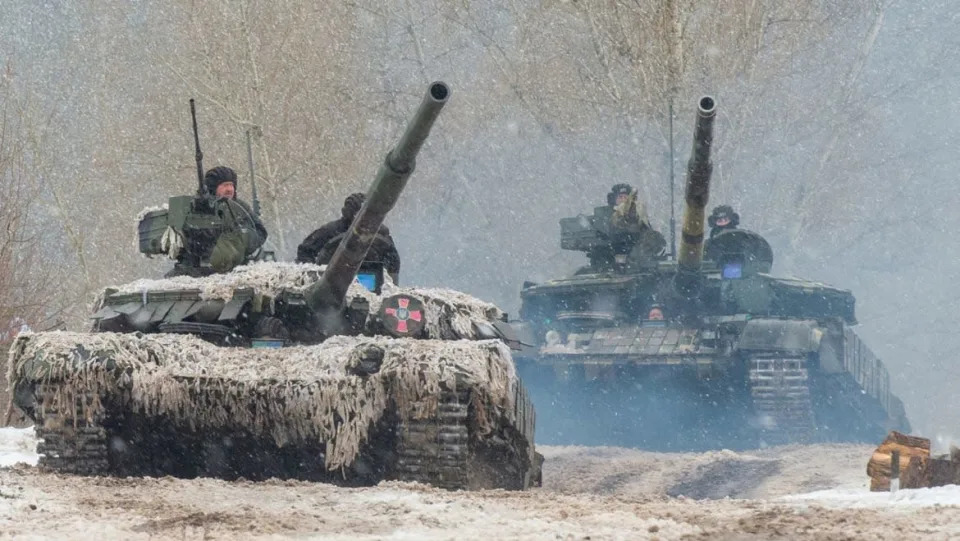
Why did Moscow decide to send troops and tanks into the country and risk potentially severe punishment from the international community?
Ukraine was not looking to fight its far more powerful neighbor and had already been struggling to deal with Russian-backed separatist rebellions in its southeastern Donbas region. So why did Moscow decide to risk potentially severe punishment from the international community?
Experts do not share a consensus about what motivated Russia to make its move, but there are a number of non-mutually exclusive factors that likely fueled this action. Much of it has to do with long-held concerns that Russia has about security in the region and its fear of Ukraine becoming increasingly independent from its influence. Then there’s the element of timing: It appears Putin calculated that he had the strategic upper hand and decided this was a particularly good time to strike to advance his interests.
In December, Russia sent a list of security demands to the U.S. calling for, among other things, a halt to NATO’s eastward expansion right up to its borders, ending Western military assistance to Ukraine, removing NATO troops and bases from former Soviet Union territory and a ban on intermediate-range missiles in Europe — and it threatened to use military force if its demands were not met diplomatically.
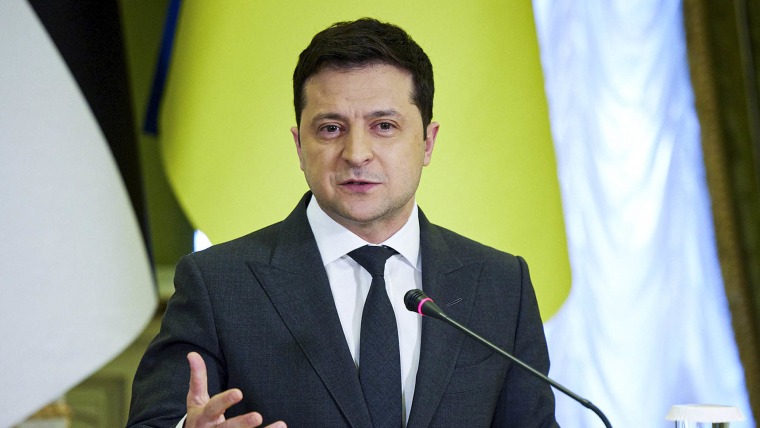
Ukraine’s Zelensky Calls on allies to impose sanctions on Russia
The major item Russia is particularly concerned about is the looming prospect of Ukraine entering NATO, a possibility that’s been floated by the U.S. for many years but for which there is no clear timeline. Anatol Lieven, the senior research fellow on Russia and Europe at the Quincy Institute for Responsible Statecraft and the author of “Ukraine and Russia: A Fraternal Rivalry,” has likened that possibility to Mexico entering military alliances with China — a development that would be, of course, deeply alarming for the U.S.
This is a concern that predates Putin. As Lieven told me in a recent interview, Russia has long expressed warnings that NATO’s expansionism could trigger war:
Since the beginning of NATO expansion in the mid-’90s, when Russia had a very different government under Boris Yeltsin, the Russian government, and Russian commentators and officials, opposed NATO enlargement but also warned that if this went as far as taking in Georgia and Ukraine, then there would be confrontation and strong likelihood of war. They said that explicitly over and over again. So this is not about Putin.
The Russian foreign policy establishment as a whole has long considered Ukraine joining NATO to be a major threat, and militarily dominating Ukraine is a potential way to forestall that possibility.
Regional analysts have also pointed out that Russia fears how Ukraine’s status as a democracy — which has allowed it to develop an increasingly anti-Russian orientation in recent years — poses a threat to Russia’s influence over its neighbors, as well as Russia’s own internal stability.
Putin was a KGB officer in East Germany when the Soviet Union collapsed. That experience has shaped his perception of the threats that emerge from street movements, protests and anti-authoritarian rhetoric, according to Anne Applebaum, historian and staff writer at The Atlantic.
When Putin considers Ukraine — which has seen two major pro-democracy uprisings, the last of which led to the ouster of the pro-Russian president of Ukraine in 2014 — he sees a country with which Russia has rich historical and cultural ties moving irreversibly out of its sphere of influence. In fact, he also fears Ukraine’s influence on Russia, as Peter Dickinson of the Atlantic Council’s UkraineAlert wrote in December:
The emergence of a genuinely independent and democratic Ukraine is viewed by many in the Kremlin as a direct attack on Russia’s imperial identity and an existential threat to the country’s authoritarian system of government. For a generation of Russian leaders still haunted by the pro-democracy uprisings that sparked the collapse of the USSR, the rise of a European Ukraine looks ominously like the next stage in a nightmare scenario stretching all the way back to the fall of the Berlin Wall. …
… He recognizes that as Ukrainian democracy matures and consolidates, it will inevitably inspire demands for similar change within Russia itself and serve as a growing threat to his own authoritarian regime.
Putin sees intervention as an opportunity to bring Ukraine back into the fold and undermine its potentially infectious democratic energy.
Energy prices are rising around the world, and the surge is particularly big in Europe — where many countries are dependent on Russian natural gas for things like heating their homes. Analysts say sanctions against Russia could cause an energy crisis in Europe on the scale of the 1970s oil crisis. That’s why we’ve seen hesitation from the Germans on joining threats to sanction Russia into oblivion if it entered Ukraine. Moscow knows Europe’s hands are tied to some extent, making the incursion less costly now than it might be at another moment.
Another factor with timing might be that Russia has decided that the Biden administration’s renewed focus on confrontation with China leaves it with less room to maneuver on Russia
Whether Putin will succeed in achieving his goals remains to be seen; it’s still unclear how big and how ambitious his incursion will be. And the possibility that this will backfire in some ways by engendering more hostility from Ukrainians over the longer term looms large.
In any case, as with all war, civilians will bear the brunt of cold geopolitical maneuvering. Let’s hope for the best for Ukrainians and their right to self-determination as the country faces off against a formidable foe and the international community scrambles to decide what it will do to deter Russia from going further.
Here are key things to understand about the pipeline:
WHAT IS NORD STREAM 2?
It’s a 1,230-kilometer-long (764-mile-long) natural gas pipeline under the Baltic Sea, running from Russia to Germany’s Baltic coast.
It runs parallel to an earlier Nord Stream pipeline and would double its capacity, to 110 billion cubic meters of gas a year. It means Gazprom can send gas to Europe’s pipeline system without using existing pipelines running through Ukraine and Poland.
The pipeline has been filled with gas but had been awaiting approval by Germany and the European Commission.
HOW IS SCHOLZ BLOCKING THE PIPELINE?
Germany’s utility regulator was reviewing the pipeline for compliance with European regulations on fair competition. It’s that approval process that Scholz said Tuesday that he was suspending.
Germany was required to submit a report on how the pipeline would affect energy security, and Scholz said that report was being withdrawn.
WHY IS SCHOLZ TAKING ACTION NOW?
Scholz, who took power in December, backed the project as finance minister for his predecessor, Angela Merkel, and his Social Democratic Party supported it. As Russia massed troops near Ukraine’s border, Scholz avoided referring to Nord Stream 2 specifically even as U.S. officials said it would not move forward if Russia invaded.
But Scholz warned that Russia would face “severe consequences” and that sanctions must be ready ahead of time. Germany had agreed with the U.S. to act against Nord Stream 2 if Russia used gas as a weapon or attacked Ukraine.
The chancellor said Tuesday that Russia recognizing the independence of rebel-held areas in Ukraine marked a “serious break of international law” and that it was necessary to “send a clear signal to Moscow that such actions won’t remain without consequences.”
Nord Stream 2 would offer an alternative to Ukraine’s aging system that Gazprom says needs refurbishment, lower costs by saving transit fees paid to Ukraine, and avoid episodes like brief 2006 and 2009 gas cutoffs over price and payment disputes between Russia and Ukraine.
Europe is a key market for Gazprom, whose sales support the Russian government budget. Europe needs gas because it’s replacing decommissioned coal and nuclear plants before renewable energy sources such as wind and solar are sufficiently built up.
WHY IS THE U.S. AGAINST NORD STREAM 2?
The White House was in “close consultations with Germany” and welcomed their announcement, press secretary Jen Psaki tweeted Tuesday.
The U.S., European NATO allies such as Poland, and Ukraine have opposed the project going back before the Biden administration, saying it increases Europe’s dependence on Russian gas and gives Russia the possibility of using gas as a geopolitical weapon. Europe imports most of its gas and gets roughly 40% of its supply from Russia.
The pipeline, which went forward under Merkel, has been an irritant in U.S.-German relations. Biden waived sanctions against the pipeline’s operator when it was almost complete in return for an agreement from Germany to take action against Russia if it used gas as a weapon or attacks Ukraine.
In Congress, Republicans and Democrats — in a rare bit of agreement — have long objected to Nord Stream 2.
WILL SUSPENDING NORD STREAM 2 MAKE EUROPEANS FREEZE THIS WINTER?
No. Even before Scholz’s move, regulators made clear the approval process could not be completed in the first half of the year. That means the pipeline was not going to help meet heating and electricity needs this winter as the continent faces a gas shortage.
The winter shortage has continued to feed concerns about relying on Russian gas. Russia held back from short-term gas sales — even though it fulfilled long-term contracts with European customers — and failed to fill its underground storage in Europe.
Russian President Vladimir Putin has said the shortage underlines the need to quickly approve Nord Stream 2, increasing concerns about Russia using gas to gain leverage over Europe.
COULD RUSSIA CUT OFF GAS TO EUROPE IN RETALIATION?
While Europe needs Russian gas, Gazprom also needs the European market. That interdependence is why many think Russia won’t cut off supplies to Europe, and Russian officials have underlined they have no intention to do that.
Meanwhile, the Ukraine crisis, on top of the winter shortage, is has already given European governments more reason to find their gas somewhere else, such as through liquefied natural gas, or LNG, brought by ship from the U.S., Algeria and other places.
Former Russian President Dmitry Medvedev, who is now deputy chair of Russia’s Security Council, tweeted his displeasure after Germany suspended Nord Stream 2: “Welcome to the brave new world where Europeans are very soon going to pay 2,000 euros for 1.000 cubic meters of natural gas!”
The spot market gas price in Europe was 829 euros ($940) per thousand cubic meters Tuesday. It was 1,743 euros (nearly $2,000) in late December amid jitters over the Ukraine crisis, and prices have since fallen as Europe has secured more LNG.
___
Associated Press writers Vladimir Isachenkov in Moscow, Geir Moulson and Frank Jordans in Berlin, and Lisa Mascaro and Ellen Knickmeyer in Washington contributed.
Putin moves troops, Biden levies sanctions and Europe prepares for war
Alexander Nazaryan, Senior W. H. Correspondent – February 21, 2022
WASHINGTON — Europe edged closer to war on Monday as Russian President Vladimir Putin ordered troops into Donetsk and Luhansk, two territories in Ukraine on which Russia has laid claim for years. He did so under the guise of “peacekeeping,” even as he made clear that he did not accept the basic premise of Ukrainian sovereignty.
“Ukraine is not just a neighboring country, they are a part of our culture,” the Russian leader said in a Monday night speech. Many Russians, especially those with fond memories of the Soviet Union, feel much the same way. But it is not clear that they are willing to risk a costly conflict to achieve Putin’s vision of reconstructing the Soviet-era empire. Having concluded that a Russian invasion is all but assured, the United States and allied Western powers have committed to defending Ukraine with economic sanctions and shipments of military hardware — but have steered clear of committing troops.
“This was a speech to the Russian people to justify a war,” a senior Biden administration said on Monday of Putin’s remarks. The Russian strongman justified sending troops to Donetsk and Luhansk by first claiming that the two regions, which border Russia, were “independent” of Ukraine. International observers widely consider that to be a dubious claim.
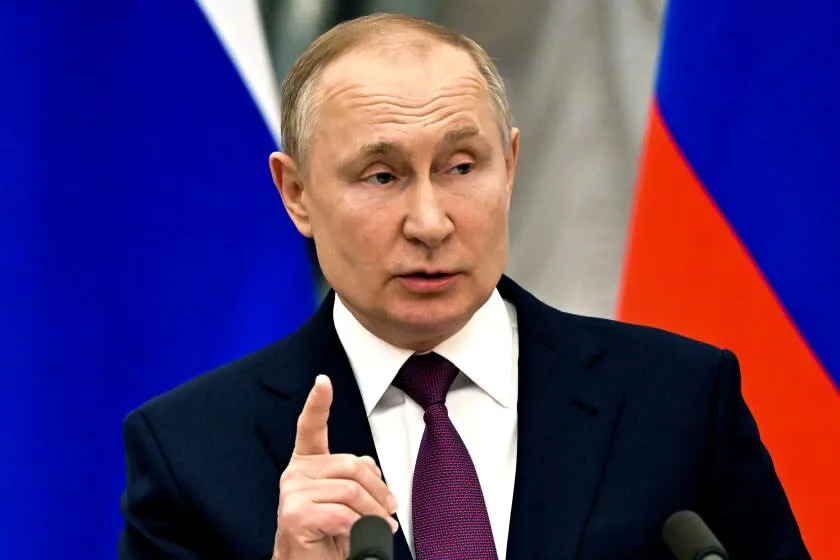
President Vladimir Putin at the Kremlin in Moscow on Monday. (Kremlin Press Office/Handout/Anadolu Agency via Getty Images)
Biden spoke on Monday with Ukrainian leader Volodymyr Zelensky “to reaffirm the commitment of the United States to Ukraine’s sovereignty and territorial integrity,” according to a White House description of the call. Ukraine, however, is not a member of NATO, meaning that the U.S.-led alliance would not send troops under its Article 5, which provides for a collective military defense of member states.
A seasoned diplomat from his time in the U.S. Senate and the vice president to Barack Obama, Biden has vowed to restore the U.S. to the role of international leadership he claims his predecessor, Donald Trump, squandered. But the disastrous Afghanistan withdrawal of U.S. forces — which took place almost exactly six months ago — appears to have tarnished Biden’s claims of foreign policy mastery.
Putin seems intent on challenging Biden’s leadership; late on Monday, columns of Russian troops were spotted entering Donetsk.
In recent days, some of the most consequential shuttle diplomacy meant to avert a war in Ukraine has been undertaken by French president Emmanuel Macron, who on Sunday appeared to broker a meeting between Putin and Biden scheduled for later in the week. Biden spoke with Macron and chancellor Olaf Scholz of Germany on Monday. “They discussed how they will continue to coordinate their response on next steps,” a White House summary of the call said.
U.S. President Joe Biden signs an executive order to prohibit trade and investment between U.S. individuals and the two breakaway regions of eastern Ukraine recognized as independent by Russia on Feb. 21, 2022. The White House/Handout via REUTERS
Late Monday, at the request of Zelensky, the United Nations Security Council was set to meet regarding the situation in Ukraine.
For the moment, the U.S. foreign policy establishment is operating on the assumption that an invasion will take place. On Monday, Biden ordered U.S. diplomats who had remained in Ukraine out of the country, into neighboring Poland.
GOP Senate candidate JD Vance said he doesn’t ‘really care what happens to Ukraine’
Kelsey Vlamis – February 20, 2022
Vance is a venture capitalist and author of the bestselling memoir “Hillbilly Elegy.”Jeffrey Dean/AP Photo
JD Vance said he wants Biden to focus on the US border instead of Ukraine and Russia.
Vance, who is running for Senate in Ohio, said he doesn’t care about what happens to Ukraine.
His comments come as the US warns Russia could attack Ukraine at any time.
JD Vance, a Republican running for US Senate in Ohio, said he’s not particularly interested in the Ukraine-Russia conflict.
“I gotta be honest with you, I don’t really care what happens to Ukraine one way or another,” Vance said on an episode of Steve Bannon’s War Room. “I do care about the fact that in my community right now the leading cause of death among 18-45-year-olds is Mexican fentanyl that’s coming across the southern border.”
“I’m sick of Joe Biden focusing on the border of a country I don’t care about while he lets the border of his own country become a total war zone,” Vance said.
Vance, a venture capitalist and author of the bestselling memoir “Hillbilly Elegy,” is running in the high-profile Ohio race to replace retiring GOP Sen. Rob Portman. Vance posted a clip of his comments about Ukraine to Twitter on Saturday.
Vance, who served in the Marines, added that he didn’t enlist “to go and fight Vladmir Putin because he didn’t believe in transgender rights,” suggesting that as the reason the US does not want Russia to invade Ukraine.
Letters to the Editor: If you think NATO is the real threat, you’re falling for Russian propaganda
February 21, 2022
Russian President Vladimir Putin speaks during a news conference with German Chancellor Olaf Scholz in Moscow on Feb. 15. (Sergey Guneev / Associated Press)
To the editor: A letter writer repeats the preposterous Russian lie that North Atlantic Treaty Organization expansion to Eastern Europe after the Cold War is a manifestation of Western imperialism and a threat to Russia’s security.
NATO expanded eastward for one reason only: After the fall of the Soviet Union, the countries that were freed from being Soviet republics or satellite states were eager to be protected from the possibility that Russia would one day change its mind and seek to use military force to reinstate Russian control.
NATO is purely a defensive alliance; the member states do not seek one square inch of Russian territory, and they represent no threat to the integrity of Russia.
On the other hand, NATO is an obstacle to Russian President Vladimir Putin’s goal of regaining dominance of Eastern Europe, and that is why he vilifies it.
Cyril Barnert, Los Angeles
..
To the editor: The letter writer who takes a Russian view of NATO needs to read Putin’s essay on Ukraine from last July (available online). It reads like Adolf Hitler’s distortions regarding the Sudetenland before World War II.
Putin’s history is highly selective; it omits Josef Stalin’s practice of ethnic boxcars to populate all the “nations” of the Soviet Union.
Putin now decries the unfair treatment of “friends” in Ukraine and justifies “reuniting” with them. Paranoid Russia has done that for hundreds of years to maintain buffer states. NATO is preventing some expansion. Countries like Lithuania are integrating their ethnic Russian populations to effect a similar result.
Do not be fooled. I studied Russian language and history at West Point last century. Their technology has changed, not their goals.
George N. Giacoppe, Riverside
..
To the editor: Mass graves of Russians? Chopped up body parts? Babies in tiny coffins?
Russian disinformation says all this is happening in Ukraine. Have you ever met a Ukrainian? Not gonna happen. Putin is a comedian for crying out loud.
But seriously, you can’t really blame the Russian president. He did, after all, learn from the best. I’m sure he was taking notes 20 years ago as another super power justified an invasion based on a bucket of lies.
Mike Reynolds, San Diego
..
To the editor: The Gibraltar strategy seems to be in play in the situation involving Russia and Ukraine.
During the Franco dictatorship in Spain, whenever trouble was brewing internally, there was a sudden interest in some controversy related to the conflict over Gibraltar, which sits on the Iberian peninsula but is a British territory.
Redirecting the public’s focus from internal affairs to external events seems to be a common ploy of many governments.
Russian Military Claims Ukrainian Attackers Just Breached Their Border
Barbie Latza Nadeau – February 21, 2022
SERGEY BOBOK
As the lumbering threat of a Russian invasion of Ukraine continues unabated, the Russian military claimed that five so-called “saboteurs” were assassinated Monday after crossing into Russia from Ukraine.
The report mirrors almost exactly what the Biden administration warned could be “false flags” or trigger points that Russia will respond to as a pretext to launch its invasion.
“As a result of clashes, five people who violated the Russian border from a group of saboteurs were killed,” the Russian military said in a statement, according to Reuters. No Russians died in the alleged border infraction. Russia also said Ukraine had destroyed a border outpost used by the FSB (Federal Security Service) in early morning shelling.
Russia has also claimed in recent days that Ukrainian forces are staging attacks on the pro-Russian separatist areas of Luhansk and Donetsk.
Ukraine has denied any such incursion or attacks took place. The Minister of Foreign affairs, Dmytro Kuleba, took to Twitter Monday to dismiss the claims with big red ‘X’s denying an attack on Donetsk or Luhansk, or that it sent saboteurs over the Russian border, or that it shelled Russian territory or border crossings.
Monday, Putin also called a special meeting of his security council, after which he said he is “considering a request to recognize separatist-held regions of Ukraine.” In a statement televised on Russian state media, he said, “The purpose of today’s meeting is to listen to colleagues and to determine our further steps in this direction, including the appeal from the leaders of the Donetsk People’s Republic and Luhansk People’s Republic to Russia seeking recognition of their sovereignty and the resolution of the state Duma on the same subject,” he said, mirroring earlier comments that the West has interpreted as another potential pretext to invade Ukraine in order to protect the newly-recognized regions.
Despite a flurry of last-minute attempts at diplomacy—including talk of a summit between presidents Joe Biden and Vladimir Putin—all hell seems soon to break loose in Ukraine.
Monday, Biden’s national security advisor Jake Sullivan warned that Russia’s imminent attack on Ukraine will be “extremely violent” and that it could begin literally at any moment.
“We believe that any military operation of this size, scope and magnitude of what we believe the Russians are planning will be extremely violent,” he told NBC Today show on a frenzied circuit of morning TV on President’s Day. “It will cost the lives of Ukrainians and Russians, civilians and military personnel alike.”
He told the network that new intelligence garnered in recent days suggest “an even greater form of brutality because this will not simply be some conventional war between two armies.” He went on to say Russia will target the Ukrainian people “to repress them, to crush them, to harm them.”
He then appeared on ABC Good Morning America, telling them that “all signs look like President Putin and the Russians are proceeding with a plan to execute a major military invasion of Ukraine.” That plan was bolstered over the weekend with Russian military hardware painted with an ominous white “Z” lettering rolling toward strategic points along the Ukrainian frontier. “We have seen just in the last 24 hours further moves of Russian units to the border with no other good explanation other than they’re getting in position to attack.”
Over the weekend, French President Emmanuel Macron invited Biden and Putin to a summit, which Biden signaled he would attend on the condition that Russian not invade Ukraine, but the Kremlin called reports of any such meeting “premature.”
As Sullivan reiterated that any attack on Ukraine would be met with the “full force of American and Allied might,” unsubstantiated news reports of ceasefire infractions along the border continue unabated. Video posted on Twitter showed a fuel station burning on the front line in Eastern Ukraine as civilians fled against a backdrop of gunfire.
The European Union, which will feel the impact of an eventual war first-hand, approved an emergency package with $1.36 billion to support Ukraine through loans, according to a statement by the European Union Council released Monday. “It intends to provide swift support in a situation of acute crisis and to strengthen Ukraine’s resilience.”
Ukraine-Russia crisis: What to know in the escalating crisis
By Venessa Gera – February 21, 2022
Ukraine Russian Tensions
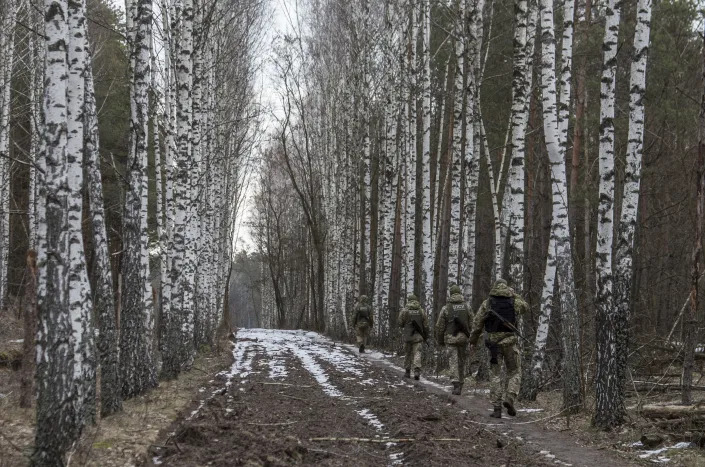
Ukrainian border guard officers patrol the Ukrainian-Belarusian state border at a checkpoint in Novi Yarylovychi, Ukraine, Monday, Feb.21, 2022.(AP Photo/Oleksandr Ratushniak)
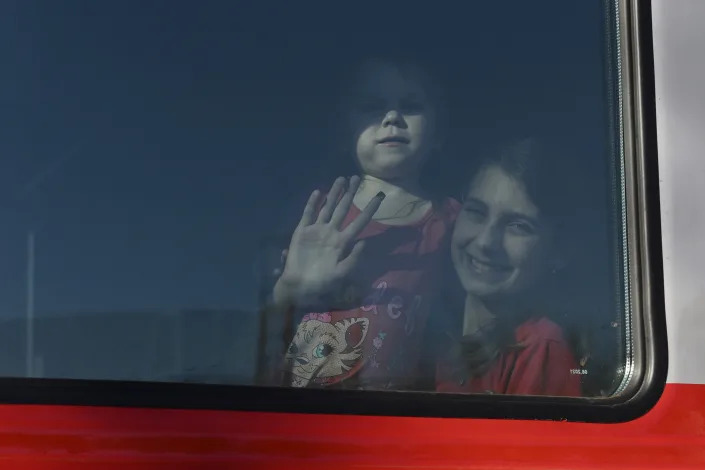
A woman and her child from the Donetsk and Luhansk regions, the territory controlled by pro-Russia separatist governments in eastern Ukraine, waves from a train on their way to temporary shelter in another region of Russia, at the railway station in Taganrog, Russia, Monday, Feb. 21, 2022. World leaders are making another diplomatic push in hopes of preventing a Russian invasion of Ukraine, even as heavy shelling continues in Ukraine’s east. (AP Photo)
Displaced civilians from the Donetsk and Luhansk regions, the territory controlled by pro-Russia separatist governments in eastern Ukraine, rest in a sport hall in Taganrog, Russia, Monday, Feb. 21, 2022. World leaders are making another diplomatic push in hopes of preventing a Russian invasion of Ukraine, even as heavy shelling continues in Ukraine’s east. (AP Photo)
Anastasia Manha, 23, lulls her 2 month-old son Mykyta, where she lives with her family members, after alleged shelling by separatists forces in Novognativka, eastern Ukraine, Sunday, Feb. 20, 2022. Russia is extending military drills near Ukraine’s northern borders after two days of sustained shelling along the contact line between Ukrainian soldiers and Russia-backed separatists in eastern Ukraine. The exercises in Belarus, which borders Ukraine to the north, originally were set to end on Sunday. (AP Photo/Evgeniy Maloletka)
A Ukrainian serviceman pauses while walking to a frontline position outside Popasna, in the Luhansk region, eastern Ukraine, Sunday, Feb. 20, 2022. Russia extended military drills near Ukraine’s northern borders Sunday amid increased fears that two days of sustained shelling along the contact line between soldiers and Russia-backed separatists in eastern Ukraine could spark an invasion. Ukraine’s president appealed for a cease-fire. (AP Photo/Vadim Ghirda)
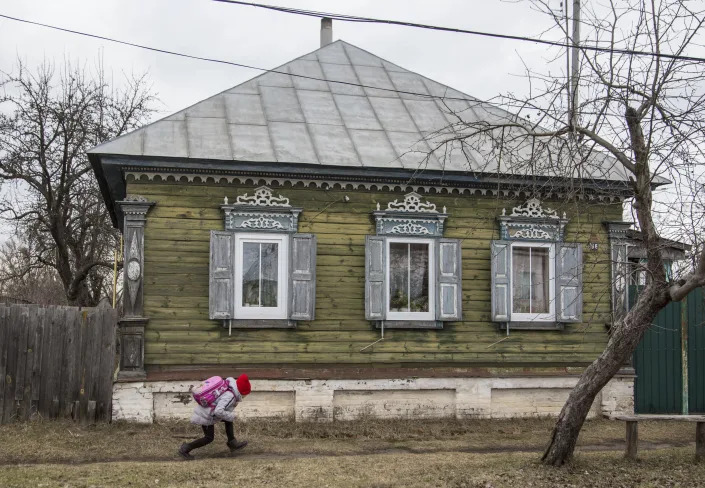
A schoolgirl runs in Ukraine’s village of Dobryanka close to the Belarus border, Monday, Feb. 21, 2022. (AP Photo/Oleksandr Ratushniak)
Sofia, 4, looks at a photographer inside a house where she lives with her parents and family members, after alleged shelling by separatists forces in Novognativka, eastern Ukraine, Sunday, Feb. 20, 2022. Russia is extending military drills near Ukraine’s northern borders after two days of sustained shelling along the contact line between Ukrainian soldiers and Russia-backed separatists in eastern Ukraine. The exercises in Belarus, which borders Ukraine to the north, originally were set to end on Sunday. (AP Photo/Evgeniy Maloletka)
Russian President Vladimir Putin talks via videoconference with members of the Russian Paralympic Committee team on the eve of the XIII Paralympic Winter Games in Beijing, in Moscow, Russia, Monday, Feb. 21, 2022. (Alexei Nikolsky, Sputnik, Kremlin Pool Photo via AP)
People line up to withdraw money from an ATM in Donetsk, the territory controlled by pro-Russian militants, eastern Ukraine, Monday, Feb. 21, 2022. World leaders are making another diplomatic push in hopes of preventing a Russian invasion of Ukraine, even as heavy shelling continues in Ukraine’s east. (AP Photo/Alexei Alexandrov)More
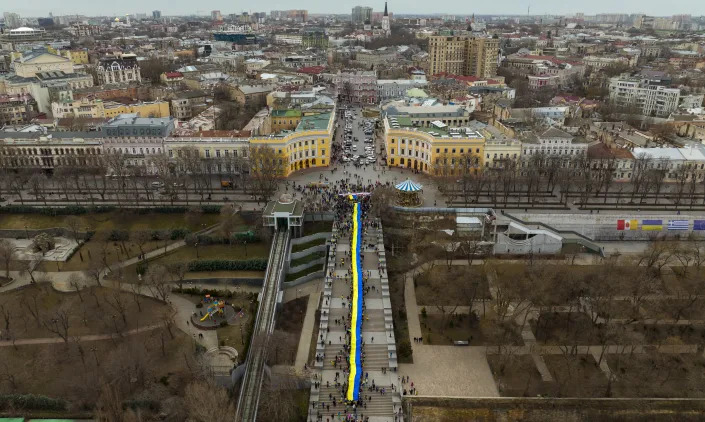
Demonstrators holding a huge Ukrainian flag march along the street in Odessa, Ukraine, Sunday, Feb. 20, 2022. Thousands of people in Odessa marched through the streets of the city in a show of unity on Sunday, marking the date on which, eight years ago, more than a hundred people were killed during Ukraine’s Maidan revolution. Waving national flags and placards with slogans such as, ‘No Putin, No Cry’, people said they had come out to demonstrate against a potential Russian invasion, and said that they were prepared to defend their city if needed. (AP Photo/Emilio Morenatti)
Demonstrators march along the street in Odessa, Ukraine, Sunday, Feb. 20, 2022. Thousands of people in Odessa marched through the streets of the city in a show of unity on Sunday, marking the date on which, eight years ago, more than a hundred people were killed during Ukraine’s Maidan revolution. Waving national flags and placards with slogans such as, ‘No Putin, No Cry’, people said they had come out to demonstrate against a potential Russian invasion, and said that they were prepared to defend their city if needed. (AP Photo/Emilio Morenatti)
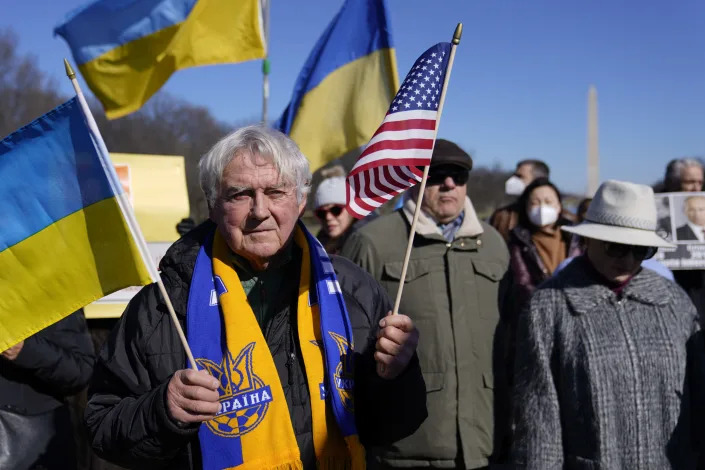
People gather for a vigil in solidarity with Ukraine, Sunday, Feb. 20, 2022, at the Lincoln Memorial in Washington. (AP Photo/Patrick Semansky)
A boy plays with a weapon as an instructor shows a Kalashnikov assault rifle while training members of a Ukrainian far-right group train, in Kyiv, Ukraine, Sunday, Feb. 20, 2022. Russia extended military drills near Ukraine’s northern borders Sunday amid increased fears that two days of sustained shelling along the contact line between soldiers and Russia-backed separatists in eastern Ukraine could spark an invasion. (AP Photo/Efrem Lukatsky)
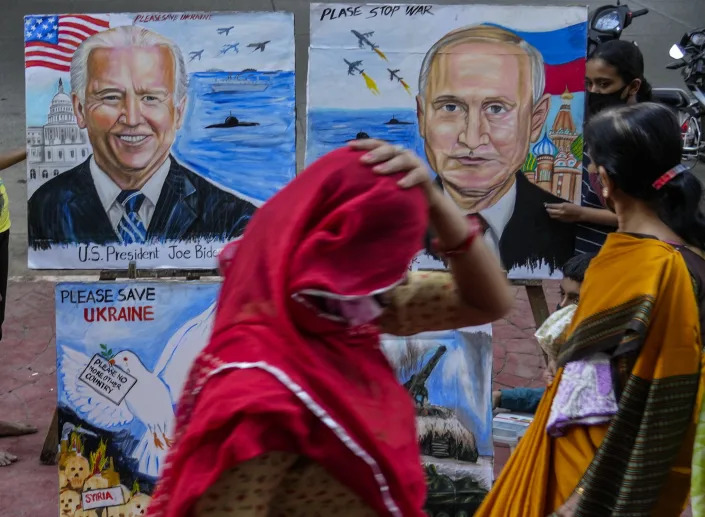
A woman adjusts her sari as she walks past as students of an art school display their art works calling for peace amid fears of a Russian offensive on Ukraine on a pavement in Mumbai, India, Monday, Feb. 21, 2022. (AP Photo/Rafiq Maqbool)
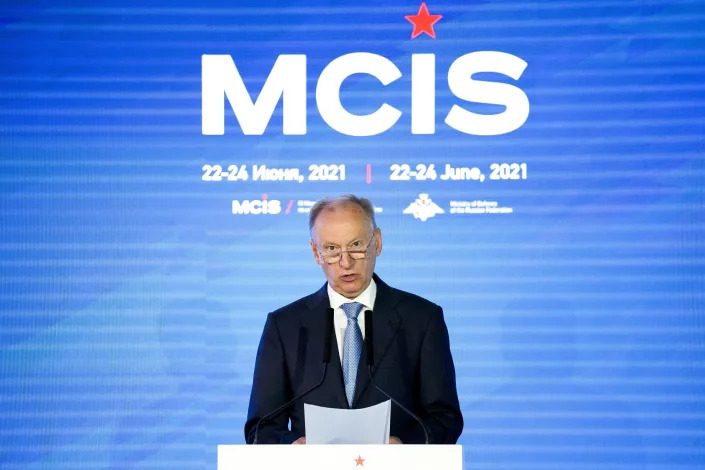
Russia’s security council secretary Nikolai Patrushev delivers his speech at the IX Moscow conference on international security in Moscow, Russia, on June 24, 2021. With all eyes on a possible Russia invasion of Ukraine, Russian President Vladimir Putin is sending his top security envoy to the Balkans where Moscow has been trying to maintain influence mainly through its ally Serbia. Serbia’s pro-government media said Monday Nikolai Patrushev, the powerful secretary of the Kremlin’s Security Council, is due to arrive in Belgrade next week for talks with Serbia’s President Aleksandar Vucic. (AP Photo/Alexander Zemlianichenko, Pool)
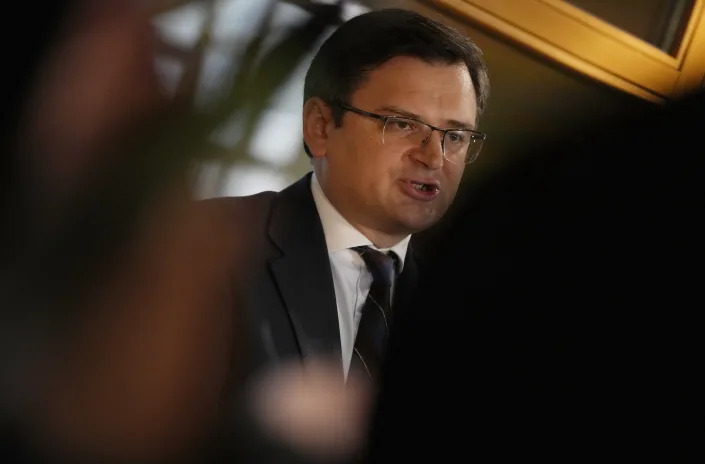
Ukraine’s Foreign Minister Dmytro Kuleba speaks during a media conference on the sidelines of a meeting of EU foreign ministers in Brussels, Monday, Feb. 21, 2022. The European Union’s top diplomat, foreign policy chief Josep Borrell, welcomed the prospect of a summit but said that should diplomacy fail the 27-nation has finalized its package of sanctions for use if Putin orders an invasion. (AP Photo/Virginia Mayo)
Ukraine’s Foreign Minister Dmytro Kuleba speaks during a media conference on the sidelines of a meeting of EU foreign ministers in Brussels, Monday, Feb. 21, 2022. The European Union’s top diplomat, foreign policy chief Josep Borrell, welcomed the prospect of a summit but said that should diplomacy fail the 27-nation has finalized its package of sanctions for use if Putin orders an invasion. (AP Photo/Virginia Mayo)
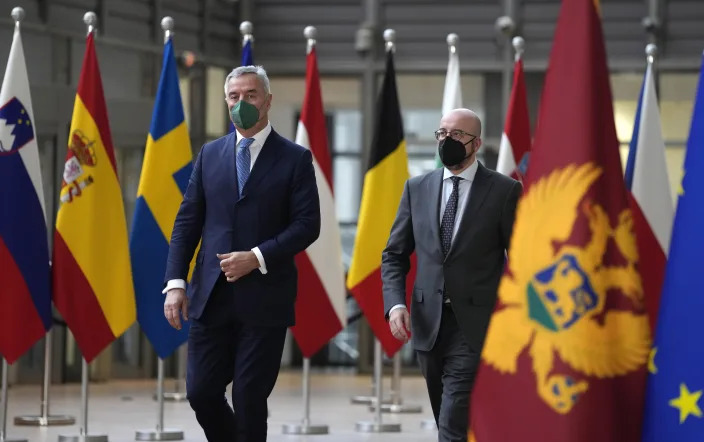
European Council President Charles Michel, right, walks with Montenegro’s President Milo Dukanovic prior to a meeting at the European Council building in Brussels, Monday, Feb. 21, 2022. (AP Photo/Virginia Mayo)
Austria’s Chancellor Karl Nehammer speaks during a news conference about the current situation in the Ukraine in Vienna, Austria, Monday, Feb. 21, 2022. (AP Photo/Lisa Leutner)
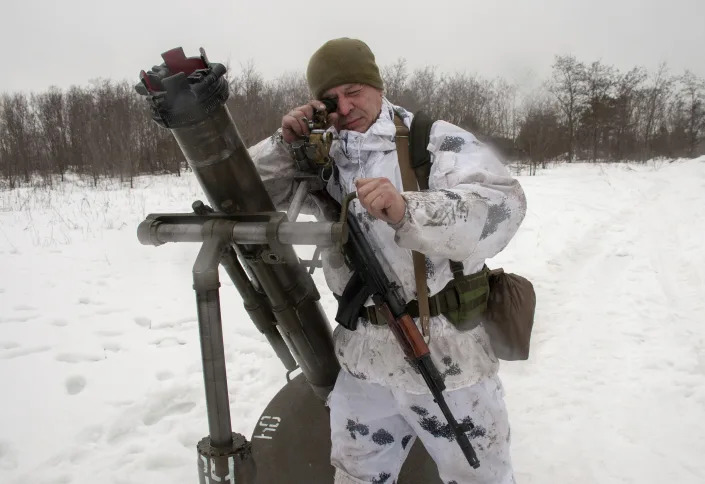
A Ukrainian soldier trains during military drills close to Kharkiv, Ukraine, Thursday, Feb. 10, 2022. Britain’s top diplomat has urged Russia to take the path of diplomacy even as thousands of Russian troops engaged in sweeping maneuvers in Belarus as part of a military buildup near Ukraine. (AP Photo/Andrew Marienko)
WARSAW, Poland (AP) — Global efforts to head off a Russian invasion of Ukraine were dealt a serious blow Monday when Russian President Vladimir Putin signed decrees recognizing the independence of two separatist regions in eastern Ukraine and ordered his military to “maintain peace” in the disputed areas.
But Putin’s moves, made as shelling continued in those areas, could be a precursor to the Kremlin sending in troops and weapons to support Russian-backed separatists. Doing so is sure to deepen already inflamed tensions between Russia and the West.
The White House said President Joe Biden had agreed “in principle” to meeting Putin only if the Kremlin refrains from launching an assault on Ukraine. Even in advance of any invasion, however, both Biden and the European Union said they would move ahead with targeted sanctions in response to Putin’s decrees.
U.S. officials said Biden would soon issue an executive order prohibiting Americans from investing and doing business in rebel-held areas. The order would also allow the U.S. to impose sanctions on anyone in the area, a move to exact economic pain on key supporters of the breakaway incursion.
In a joint statement, EU Commission President Ursula von der Leyen and Council President Charles Michel called Russia’s recognition of the disputed territories “a blatant violation of international law” and also vowed economic repercussions.
A Biden-Putin meeting would offer some new hope of averting a Russian invasion that U.S. officials said appeared imminent, as an estimated 150,000 Russian troops await Putin’s orders to strike. It was uncertain when — or if — troops massing at the border would enter Ukraine.
Here is a look at the latest developments in the security crisis in Eastern Europe:
PUTIN DECREES INDEPENDENCE FOR SEPARATIST REGIONS
In a long, ranting speech during a meeting of the Russian presidential Security Council, Putin charged that Ukraine had inherited Russia’s historic lands and after the Soviet collapse was used by the West to contain Russia.
His decision to recognize the independence of separatist regions in eastern Ukraine severely ratcheted up the volatility. Western officials fear that Russia could invade Ukraine any moment, using skirmishes in eastern Ukraine as a pretext for an attack.
The decree allows Russia to sign treaties with rebel territories in eastern Ukraine and openly send troops and weapons there.
Putin’s decree tasked his foreign minister with establishing formal diplomatic relations with the separatist regions and offer mutual assistance when requested by rebel leaders to “maintain peace” in the two regions.
The decision came Monday after the Russian Security Council meeting, and it effectively shatters the 2015 Minsk peace agreements, which ended large-scale fighting. Violence has nevertheless simmered — and has seen a spike in recent weeks in the wider crisis.
A U.S. official said that a recognition of the two regions would be “condemnable.”
“If carried out, this would again result in the upending of the rules-based international order, under the threat of force,” Michael Carpenter, the U.S. ambassador to the Organization for Security and Cooperation in Europe, told a special session of the organization in Vienna.
The meeting of Putin’s presidential Security Council followed televised statements by separatist leaders, who pleaded with Putin to recognize them as independent states and sign friendship treaties envisaging military aid to protect them from what they described as the ongoing Ukrainian military offensive. Russia’s lower house made the same plea last week.
Ukrainian authorities deny launching an offensive and accuse Russia of provocation as shelling intensifies along the line of contact.
WILL BIDEN AND PUTIN MEET?
The U.S. and Russian presidents have tentatively agreed to meet in a last-ditch diplomatic effort to stave off Moscow’s invasion of Ukraine, its first since Russia annexed Crimea from Ukraine in 2014.
Yet both seem cautious about a possible meeting.
The White House says the meeting will only happen if Russia does not invade Ukraine, noting that heavy shelling is continuing in eastern Ukraine.
Kremlin spokesman Dmitry Peskov, for his part, said Monday “it’s premature to talk about specific plans for a summit.”
French President Emmanuel Macron sought to broker the possible meeting between Biden and Putin in a series of phone calls that dragged deep into Sunday night. Macron’s office said both leaders had “accepted the principle of such a summit,” to be followed by a broader meeting involving other leaders too.
The White House said Biden on Monday conferred with Macron and German Chancellor Olaf Scholz during a 30-minute call.
U.S. Secretary of State Antony Blinken and Russian Foreign Minister Sergey Lavrov were to lay the groundwork for the summit at a meeting Thursday, according to Macron’s office.
WHAT’S THE SITUATION ON UKRAINE’S EASTERN FRONT?
Heavy shelling has increased in recent days along the tense line of contact between Ukrainian forces and Russian-backed separatist rebels in Ukraine’s eastern industrial heartland of Donbas.
The conflict there began after Russia’s annexation of Crimea. The fighting has claimed at least 14,000 lives but had been largely quiet for a while.
Ukrainian military spokesman Pavlo Kovalchyuk said Ukrainian positions were shelled 80 times Sunday and eight times early Monday, noting that the separatists were “cynically firing from residential areas using civilians as shields.” He said Ukrainian forces weren’t returning fire.
In the village of Novognativka on the government-controlled side, 60-year-old Ekaterina Evseeva, said the shelling was worse than at the height of fighting.
“It’s worse than 2014,” she said, her voice trembling. “We are on the edge of nervous breakdowns. And there is nowhere to run.”
RUSSIAN TROOPS STAY IN BELARUS, ADDING TO FEARS
Russian troops who have been carrying out military exercises in Belarus, which is located on Ukraine’s northern border, were supposed to go home when those war games ended Sunday. But now Moscow and Minsk say that the Russian troops are staying indefinitely.
The continued deployment of the Russian forces in Belarus raised concerns that Russia could send those troops to sweep down on the Ukrainian capital of Kyiv, a city of 3 million less than a three-hour drive away from the Belarus border.
UKRAINE PROJECTS CALM
Despite Biden’s assertion that Putin has made the decision to roll Russian forces into Ukraine, Ukrainian officials sought to project calm, saying that they weren’t seeing an invasion as imminent.
Defense Minister Oleksii Reznikov said Monday that Russia has amassed 147,000 troops around Ukraine, including 9,000 in Belarus, arguing that the number is insufficient for an offensive on the Ukrainian capital.
“The talk about an attack on Kyiv from the Belarusian side sounds ridiculous,” he said, charging that Russia is using the troops there to create fear.
Over the weekend at the Polish border, many Ukrainians were also returning home from shopping or working in the neighboring EU country. Some said they were not afraid and vowed to take up arms against Russia in case of an assault.
EU OFFERS TO ADVISE UKRAINE
For all the posturing and vows of reprisal from Western leaders, direct military intervention has thus far been ruled out.
However, Ukrainian Foreign Minister Dmytro Kuleba said Monday the European Union has agreed to set up a military education advisory mission in his country.
Kuleba told reporters in Brussels after meeting with the bloc’s foreign ministers that an agreement had been reached in principle to roll out the advisory training military mission.
“This is not combat forces,” he said. “This is a new element in the cooperation between Ukraine and the European Union.”
The move could involve sending European officers to Ukraine’s military schools to help educate its armed forces. It’s likely to take several months to set up.
Russia has sought promises from NATO that it would never offer membership to Ukraine and other former Soviet republics, a condition that the West has rejected.
The chairman of the U.S. Joint Chiefs of Staff, Gen. Mark A. Milley, spoke Monday with the commander-in-chief of the Ukrainian armed forces, Lt. Gen. Valery Zaluzhny.
Milley called Ukraine a key partner to NATO, according to the Pentagon’s summary of the phone call.
THE LATEST BRITISH WARNINGS
British Prime Minister Boris Johnson said he was preparing to speak to Ukrainian President Volodymyr Zelenskyy and “offer him the support of the United Kingdom.”
Earlier, Britain’s defense secretary, Ben Wallace, urged Putin to turn away from military action and pursue diplomacy not just for the sake of Ukrainians but to prevent Russian deaths.
Russians know the consequences of the past actions, including the invasion of Afghanistan and Russia’s invasion of Chechnya, he said.
“These are just two examples when too many young men returned home in zinc-lined coffins, and the government therefore urges President Putin for the sake of his own people, and even at this 11th hour, to rule out the invasion of Ukraine,” he said.
Wallace told the House of Commons that Putin had continued to build up forces in the region. Russia has now massed 65% of its land combat power on the Ukrainian border, he said.
U.K. Foreign Secretary Liz Truss said the West was preparing “for the worst-case scenario,” adding: “We must make the cost for Russia intolerably high.”
Associated Press writers Vladimir Isachenkov in Moscow; Yuras Karmanau and Lori Hinnant in Kyiv, Ukraine; Jill Lawless and Danica Kirka in London; Lorne Cook in Brussels, Frances D’Emilio in Rome, Angela Charlton in Paris and Bobby Caina Calvan in New York contributed to this report.
‘This should terrify the nation’: the Trump ally seeking to run Arizona’s elections
Ed Pilkington – February 21,2022
Photograph: Rachel Mummey/Reuters
Last September, Donald Trump released a statement through his Save America website. “It is my great honor to endorse a true warrior,” he proclaimed, “a patriot who has fought for our country, who was willing to say what few others had the courage to say, who has my Complete and Total Endorsement.”
Former US presidents usually reserve their most gushing praise – replete with Capital Letters – for global allies or people they are promoting for high office. A candidate for the US Senate, perhaps, or someone vying to become governor of one of the biggest states.
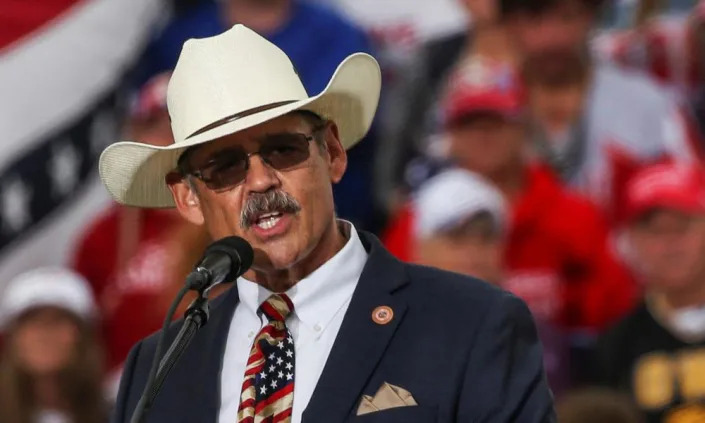
Trump by contrast was heaping plaudits on an individual running for an elected post that a year ago most people had never heard of, let alone cared about. He was endorsing Mark Finchem, a Republican lawmaker from Tucson, in his bid to become Arizona’s secretary of state.
Until Trump’s endorsement, Finchem, like the relatively obscure position for which he is now standing, was scarcely known outside politically informed Arizona circles. Today he is a celebrity on the “Save America” circuit, one of a coterie of local politicians who have been thrown into the national spotlight by Trump as he lays the foundations for a possible ground attack on democracy in the 2024 presidential election.
The role of secretary of state is critical to the smooth workings and integrity of elections in many states, Arizona included. The post holder is the chief election officer, with powers to certify election results, vet the legal status of candidates and approve infrastructure such as voting machines.
What’s so insidious about the Trump plan is that it is focusing on state-level races
Jake Dean
In short, they are in charge of conducting and counting the vote.
About three weeks after Trump lost the 2020 presidential election – and on the same day that Joe Biden’s 10,457-vote victory in Arizona was certified – Finchem hosted Rudy Giuliani at a downtown Phoenix hotel. Giuliani, then Trump’s personal lawyer, announced a new theory for why the result should be overturned: that Biden had relied on fraudulent votes from among the 5 million undocumented immigrants living in the state – a striking number given that Arizona only has a total of 7 million residents.
Two weeks after that, Finchem was among 30 Republican lawmakers in Arizona who signed a joint resolution. It called on Congress to block the state’s 11 electoral college votes for Biden and instead accept “the alternate 11 electoral votes for Donald J Trump”.
Finchem was present in Washington on 6 January 2021, the day that hundreds of angry Trump supporters stormed the US Capitol, resulting in the deaths of five people with 140 police officers injured. He had come to speak at a planned “Stop the Steal” rally, later cancelled, to spread the “big lie” that the election had been rigged.
Communications between Finchem and the organizers of the “Stop the Steal” rally earned the lawmaker a knock on the door from the January 6 committee this week. The powerful congressional investigation into the insurrection issued a subpoena for him to appear before the panel and to hand over documents relating to the effort to subvert democracy.
Finchem will have to answer to the committee for what he did in the wake of the 2020 election, or face legal consequences. But there’s a more disconcerting question thrown up by his candidacy for secretary of state: were he to win the position, would he be willing and able to overturn the result of the 2024 presidential election in Arizona, potentially paving the way for a political coup?
“Someone who wants to dismantle, disrupt and completely destroy democracy is running to be our state’s top election officer,” said Reginald Bolding, the Democratic minority leader in the Arizona House who is running against Finchem in the secretary of state race. “That should terrify not just Arizona, but the entire nation.”
•••
Trump has so far endorsed three secretary of state candidates in this year’s election cycle, and Finchem is arguably the most controversial of the bunch. (The other two are Jody Hice in Georgia and Kristina Karamo in Michigan.)
Originally from Kalamazoo in Michigan, he spent 21 years as a public safety officer before retiring to Tucson and setting up his own small business. In 2014 he was elected to the Arizona legislature, representing Oro Valley.
Even before Finchem was inaugurated as a lawmaker, he was stirring up controversy. On the campaign trail in 2014, he announced that he was “an Oath Keeper committed to the exercise of limited, constitutional governance”.
The Oath Keepers are a militia group with a list of 25,000 current or past members, many from military or law enforcement backgrounds. They have been heavily implicated in the January 6 insurrection.
The founder of the Oath Keepers, Stewart Rhodes, and nine co-defendants are facing trial for seditious conspiracy based on allegations that they meticulously planned an armed attack on the heart of American democracy.
Finchem entered the Arizona legislature in January 2015 and soon was carving out a colourful reputation. With his bushy moustache, cowboy hat and boots, and offbeat political views, his hometown news outlet Tucson Weekly dubbed him “one of the nuttier lawmakers” in the state.
Bolding, who entered the legislature at the same time as Finchem, remembers being called into his office soon after they both started. “He wanted to show me a map of how Isis and other terrorist groups were pouring over the border with Mexico to invade the United States,” Bolding told the Guardian.
One of the first measures sponsored by Finchem reduced state taxes on gold coins on the basis that they were “legal tender”. He then introduced legislation that would have imposed a “code of ethics” on teachers – a “gag law” as some decried it – that would have restricted learning in class.
The nine-point code was later revealed to have been cut and pasted from a campaign calling itself “Stop K-12 Indoctrination” backed by the far-right Muslim-bashing David Horowitz Freedom Center.
“In essence he wanted a pledge of fealty from teachers that they wouldn’t discuss ‘anti-American’ subjects,” said Jake Dean, who has reported on Finchem for the Tucson Weekly.
It was not until Trump began to fire up his supporters with his big lie about the 2020 election that Finchem truly found his political voice. The state lawmaker was a key advocate of the self-proclaimed “audit” of votes in Maricopa county carried out by Cyber Ninjas, the Florida-based company that spent six months scavenging for proof of election fraud and failed to produce any.
To this day no credible evidence of major fraud in the 2020 election has been presented, yet Finchem continues to beat that drum. Last month he told a Trump rally in Florence, Arizona: “We know it, and they know it. Donald Trump won.”
In his latest ruse, Finchem this month introduced a new bill, HCR2033, which seeks to decertify the 2020 election results in Arizona’s three largest counties. There is no legal mechanism for decertifying election results after the event.
As the August primary election to choose the Republican and Democratic candidates for secretary of state draws closer, attention is likely to fall increasingly on Finchem’s appearance in Washington on the day of the insurrection. Allegations that he played a role in inciting the Capitol attacks led to an unsuccessful attempt to have him recalled from the legislature, as well as a motion by Arizona Democrats to have him expelled from the chamber.
“The consensus in our caucus was that individuals who participated in the January 6 insurrection do not belong serving as members of the legislature,” Bolding said.
Finchem has responded to claims that he helped organize the insurrection by threatening to sue. Through lawyers he has denied that he played any role in the violent assault on the Capitol building, saying that he “never directly witnessed the Capitol breach, and that he was in fact warned away from the Capitol when the breach began”.
In his telling of events, he was in Washington that day to deliver to Mike Pence an “evidence book” of purported fraud in the Arizona election and to ask the then vice-president to delay certification of Biden’s victory. For Finchem, January 6 remains a “patriotic event” dedicated to the exercise of free speech; if there were any criminality it was all the responsibility of anti-fascist and Black Lives Matter activists.
The Guardian reached out to Finchem to invite him to explain his presence and actions in Washington on January 6, but he did not respond.
Finchem at Arizona’s capitol in Phoenix in 2018. Photograph: Bob Christie/AP
He has repeatedly insisted that he never came within 500 yards of the Capitol building. But photos and video footage captured by Getty Images and examined by the Arizona Mirror show him walking through the crowd of Trump supporters in front of the east steps of the Capitol after the insurrection was already under way.
At 3.14pm on January 6, more than two hours after the outer police barrier protecting the Capitol was overcome by insurrectionists, Finchem posted a photograph on Twitter that he has since taken down. It is not known who took the photo, but it shows rioters close to the east steps of the building above the words: “What happens when the People feel they have been ignored, and Congress refuses to acknowledge rampant fraud. #stopthesteal.”
•••
Finchem’s campaign to become the next secretary of state of Arizona is going well. Last year his campaign raised $660,000, Politico reported – more than three times Bolding’s haul.
Bolding sees that as indicative of a fundamental problem. On the right, individuals and groups have spotted an opportunity in the secretary of state positions and are avidly targeting them; on the left there is little sign of equivalent energy or awareness.
“The public in general may not understand what’s at stake here. All Democrats, all Americans, should be concerned about this and what it could do to the 2024 presidential election,” he said.
Dean agrees that there is a perilous void in public knowledge. “What’s so insidious about the Trump plan is that it is focusing on state-level races where voters know very little about what the secretary of state does. That’s a danger, as it gives Finchem a realistic path in which he could win – and Finchem will do what Trump wants.”
Putin’s Baseless Claims of Genocide Hint at More Than War
Max Fisher – February 20, 2022
A protester throws a Molotov cocktail at riot police near Independence Square in Kiev, Ukraine, Feb. 20, 2014. (Sergey Ponomarev/The New York Times)
Moscow, in another escalation toward a possible invasion of Ukraine, is issuing a growing drumbeat of accusations, all without evidence, that center on a single word.
“What is happening in the Donbas today is genocide,” President Vladimir Putin of Russia said Tuesday, referring to Ukraine’s east.
Senior Russian officials and state media have since echoed Putin’s use of “genocide.” Russian diplomats circulated a document to the United Nations Security Council accusing Ukraine of “exterminating the civilian population” in its east.
On Friday, Russia-backed separatists, who control parts of Ukraine’s east, claimed that Ukraine’s military was about to attack, and ordered women and children to evacuate. Extensive coverage on Russian state media portrayed Russian minorities as fleeing a tyrannical Ukrainian military, and President Joe Biden called such incidents ploys fabricated as pretext for a Russian invasion.
The Kremlin has long asserted that Ukraine’s government persecutes ethnic Russians and Russian-speaking citizens. The charge, backed by lurid and false tales of anti-Russian violence, served as justification in 2014 for Russia’s annexation of Crimea and its invasion of eastern Ukraine.
The recent resurgence of such language, now voiced directly by Putin, indicates what analysts and Western governments say may again be a prelude to invasion.
But invocations of genocide represent more than just a superficial casus belli. They reflect Moscow’s sincere belief that, in a world dominated by a hostile West, it is the rightful protector of Russian populations throughout the former Soviet republics.
In that worldview, any break from Moscow’s influence within its sphere constitutes an attack on the Russian people as a whole — particularly in Ukraine, which Putin considers effectively Russian.
Claims of genocide, then, are a way to assert Russia’s sovereignty throughout an ethnic Russian empire that extends well beyond its formal borders — and a right to control that empire with force.
Clashes of Civilizations
“There’s a long history of use and abuse of genocide rhetoric in post-Soviet countries,” said Matthew Kupfer, an analyst based in the Ukrainian capital, Kyiv, who has studied Moscow’s use of such claims.
Since the Soviet Union fell, and with it the ideological basis of its constituent states, those countries have reorganized their identities around the memory of World War II.
Genocide, as a symbol of the Nazis, became shorthand for anything deemed “absolute evil,” Kupfer said, making opposition to that evil a national imperative.
In the turmoil of 1990s Russia, nationalist writers like Sergei Glazyev won large audiences by calling Western policies an “economic genocide” against the Russian race.
And when relations between Moscow and some of its former satellites broke down in the mid-2000s, charges of genocide became the language of confrontation.
Pro-democracy uprisings in several former Soviet republics installed new governments, which championed their newly dominant non-Russian majorities.
Ukraine’s leaders, for instance, moved to elevate the Ukrainian language’s official status starting in 2004 and to label a devastating famine in the 1930s as a deliberate Soviet campaign of genocide.
Some Russian nationalists returned the charge, accusing those new governments of plotting to marginalize or even exterminate the Russian minorities within their borders.
As Russian nationalists rose in influence — in 2012, Putin appointed Glazyev as a senior adviser on regional matters — a view took hold in Moscow that any threat to its influence over former Soviet republics imperiled the Russian race as a whole.
In 2014, Ukrainians again revolted, initially over their president’s decision to reject a trade deal with the European Union, in favor of one with Russia.
The protests snowballed into demands to turn away from Russia and embrace a fully separate Ukrainian identity, which confirmed Moscow’s worst fears of a threat to Russian influence. Kremlin allies again leveled accusations of genocide, at first mostly as a generic expression of condemnation.
This became more than rhetorical as Moscow exploited Ukraine’s demographic divisions, in which Russian speakers were, at first, wary of Kyiv’s moves toward Europe.
Russia invaded the mostly Russian region of Crimea and backed militants in Ukraine’s mostly Russophone east, presenting itself as protecting populations to which it held a special responsibility.
Sectarian division served Moscow’s agenda, which meant that so did the specter of Ukrainian atrocities against the Russian minority.
State media saturated Russian homes with false stories, including ones about mass graves filled with Russian minority civilians and a 3-year-old boy crucified by Ukrainian forces that had retaken a separatist-held town. Russian citizens’ support for Moscow’s incursions surged.
The Russian World
Putin, seizing on Moscow’s successes acting as protector of Russians in Ukraine, began energetically championing what he termed the “Russian world.” In his telling, it is a sphere of influence rooted in ethnicity — an ethnicity that faces continuing threats of genocide.
This new mission solves several problems for Putin. It presents Russia’s interventions in neighboring states, typically to weaken unfriendly governments or prop up friendly ones, as defensive.
It tells Russian citizens, who have suffered under eight years of Western-led sanctions in retaliation for Russia’s aggression toward Ukraine, that they are sacrificing for a heroic struggle akin to World War II. It gives them a great empire to once more feel pride in.
And, maybe most important, it provides an ideological justification for a government, otherwise associated with corruption, that offers citizens fewer rights or opportunities.
As Moscow’s challenges have grown, so have its claims of a great struggle to protect the Russian race, often centered on Ukraine.
In 2015, as Russia’s economy cratered, Putin criticized Ukraine’s efforts to isolate Russia-backed separatists: “It smells of genocide,” he said. His government pledged to investigate the “genocide of the Russian-speaking population” in Ukraine.
And, in 2018, amid diplomatic crises that left Russia internationally isolated, a Kremlin-allied lawmaker accused Ukraine of seeking “a genocide against Russian people in the Donbas” while Russia’s foreign minister warned of “genocide through sanctions.”
The claims were hardly bluster alone. Many coincided with a military escalation in Ukraine, either by Russian armed forces or pro-Moscow separatists.
But each round also revealed a Kremlin growing steadily more paranoid and confrontational as its sphere of influence has come under greater pressure from crisis in Belarus, an uprising in Kazakhstan and an increasingly hard-line stance toward Moscow in Ukraine.
An Uncertain Escalation
In December, with Russia’s military beginning to build up on Ukraine’s borders, Putin repeated a familiar justification, saying the situation in Ukraine’s east “looks like genocide.”
“Claims of ‘genocide’ of Russian speakers in eastern Ukraine have been a constant background hum on Russian state propaganda channels” ever since, said Alexey Kovalev, a Russian journalist who heads a fact-checking organization.
But, unlike in 2014, Kovalev has written, Russians do not appear to be responding. There has been little of the past groundswell of outrage or sympathy.
Russian views of Ukraine, once fiercely hostile, are 45% favorable and 43% negative, a recent poll found. Although Russians widely backed the 2014 invasions of Ukraine, they express little enthusiasm for another.
“People are kind of burned out from Ukraine being on TV all the time,” Kupfer said. Although state media has pushed some tales similar to those in 2014, it has done so more sparingly.
“It may simply be that they recognize war will not be popular with the public,” Kupfer added of the Kremlin.
Tellingly, Russian claims of genocide during this crisis have often been aimed abroad, rather than at home, and come from figures with diplomatic weight.
In a Facebook post Thursday, Russia’s ambassador to the United States cited long-debunked “atrocities” in Ukraine to accuse the United States of abetting “a policy to force the Russian-speaking population out of their current places of residence.”
Thomas de Waal, a Russia expert for the Carnegie Endowment for International Peace, called such high-level comments “worrying” and said they indicated an “official rhetorical escalation.”
As with so many of Russia’s recent provocations, de Waal said, it is difficult to say whether such statements are intended to telegraph, or merely feint at, a Russian invasion of Ukraine.
In either case, the escalation may reflect the national mission increasingly central to Putin’s Russia: a strong, defiant protector of Russians abroad who will never be safe without it.