Supreme Court Justice Clarence Thomas’ wife had ties to January 6 rally organizers and efforts to overturn the 2020 election: report
Oma Seddiq – February 22, 2022
Supreme Court Associate Justice Clarence Thomas, right, and his wife, Virginia “Ginni” Thomas, at the White House in 2019.AP Photo/Patrick Semansky
Ginni Thomas had ties to organizers of a January 6, 2021, rally, The New York Times reported.
The Times also reported on her connections with people who sought to overturn the 2020 election.
Thomas served on the board of a conservative group that pushed members to challenge the results.
Supreme Court Justice Clarence Thomas’ wife, Virginia “Ginni” Thomas, had ties to organizers of the January 6, 2021, rallies in support of President Donald Trump as well as to efforts to subvert the 2020 election results, according to a New York Times Magazine report published Tuesday.
The Times revealed details about Thomas’ role, which had been previously unreported. The Washington Post reported last month that Thomas shared a Facebook post on January 6 before the violence broke out. “LOVE MAGA people!!!! GOD BLESS EACH OF YOU STANDING UP OR PRAYING.” she wrote.
Thomas, a longtime conservative activist, played a peacemaking role among rally organizers “so that there wouldn’t be any division around January 6,” Dustin Stockton, who helped organize the Ellipse rally, told The Times. The rally on the Ellipse, just south of the White House, took place shortly before a crowd of Trump supporters descended on the Capitol, clashed with law enforcement, and interrupted the 2020 election certification.
“The way it was presented to me was that Ginni was uniting these different factions around a singular mission on January 6,” Stockton said. The Times noted that other rally organizers disputed Stockton’s account about Thomas but did not offer specifics.
Thomas also served on the advisory board of Turning Point USA, a conservative nonprofit that sponsored the event and provided buses for rallygoers on January 6, The Times reported.
Thomas is also connected with people who sought to undo the 2020 election results. John Eastman, the lawyer who wrote a memo on how Vice President Mike Pence could overturn the election results, previously clerked for Clarence Thomas at the Supreme Court and is a close friend to the couple, according to The Times.
Steve Bannon, a onetime White House chief strategist for Trump, also endorsed efforts to challenge the election results. Ginni Thomas founded a group called Groundswell with Bannon’s support, The Times reported.
Thomas also served on the board of the Council for National Policy’s political arm, CNP Action, which circulated a document titled “Election Results and Legal Battles: What Now?” after the presidential election, according to The Times. The document urged members to call on Republican state lawmakers to challenge the 2020 election results.
In December 2020, CNP Action shared a newsletter with a report called “Five States and the Election Irregularities and Issues,” featuring five swing states where Trump had been attempting to overturn the results. The newsletter pointed to “historical, legal precedent for Congress to count a slate of electors different from that certified by the Governor of the state,” according to The Times.
Top Russian official taunts Europe with sky-high gas prices after Germany axes Nord Stream 2 pipeline
Natalie Musumeci, John Haltiwanger – February 22, 2022
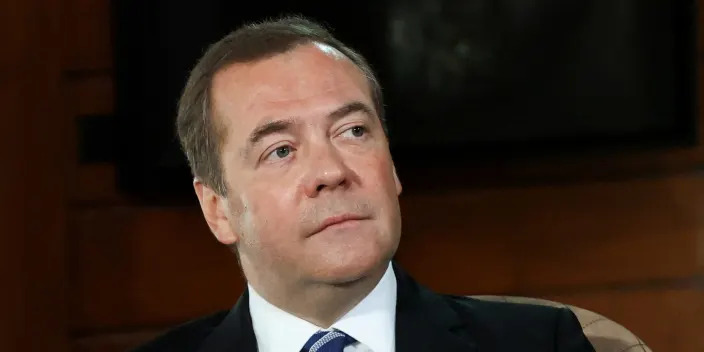
Dmitry Medvedev, the deputy chairman of Russia’s security council, during an interview in January.Sputnik/Yulia Zyryanova/Pool via Reuters
The deputy chair of Russia’s security council taunted Europe with higher gas prices on Tuesday.
He made the comment after Germany put a stop to the Nord Stream 2 pipeline.
Germany halted the pipeline amid Russia’s decision to order troops into eastern Ukraine.
A top Russian government official on Tuesday taunted Europe with sky-high gas prices after Germany put a stop to the Nord Stream 2 pipeline amid Russia’s decision to order troops into eastern Ukraine.
“German Chancellor Olaf Scholz has issued an order to halt the process of certifying the Nord Stream 2 gas pipeline,” Dmitry Medvedev, a former Russian president and the deputy chair of Russia’s security council, said in a tweet.
“Well. Welcome to the brave new world where Europeans are very soon going to pay €2.000 for 1.000 cubic meters of natural gas!” he added.
In an interview with CNN, Jonathan Finer, a deputy US national security advisor, described Russia’s latest moves as “the beginning of an invasion” of Ukraine.
Nord Stream 2 is highly controversial; the Ukrainian government and lawmakers on both sides of the aisle in Washington have opposed it. Critics have contended that Nord Stream 2 would give Russia far too much leverage over Europe. The pipeline also bypasses Ukraine, depriving it of billions in gas transit fees.
Nord Stream 2 was not yet operational — it was waiting on German certification.
For months Germany had tiptoed around committing to halting the pipeline if Russia took action against Ukraine. But President Joe Biden earlier this month said that if Russia invaded Ukraine there would “no longer be a Nord Stream 2.”
The White House applauded Germany’s swift reaction to Russia’s actions.
Biden “made clear that if Russia invaded Ukraine, we would act with Germany to ensure Nord Stream 2 does not move forward,” Jen Psaki, the White House press secretary, said in a tweet on Tuesday. “We have been in close consultations with Germany overnight and welcome their announcement. We will be following up with our own measures today.”
Why Putin didn’t invade Ukraine during the last U.S. administration
Why didn’t Russia invade Ukraine during Trump’s term? Perhaps because Putin was so pleased to see Trump pursuing goals in line with Moscow’s agenda.
By Steve Benen – February 22, 2022
After the National Archives confirmed on Friday that Donald Trump brought classified national security documents to Mar-a-Lago, the former president issued a long, rambling response, insisting the controversy was unimportant. But toward the end of the written tirade, the Republican added an unrelated thought, seemingly in passing.
Trump was apparently trying to argue that he didn’t have time to worry about tasks such as presidential records keeping. He was, Trump added, “too busy making sure Russia didn’t attack Ukraine.”
How subtle. The former president wants the public to know Vladimir Putin didn’t invade Ukraine during his term — unlike the current U.S. president.
There’s been plenty of related chatter of late in Republican circles. Putin targeted Georgia during George W. Bush’s tenure, Crimea during Barack Obama’s terms, and all of Ukraine after Joe Biden became president, but the Russian autocrat’s ambitions were restrained during Trump’s time in the White House. This, the right tells us, should be seen as proof of … something.
National Review’s Rich Lowry made the case via Twitter last night, “The sheer unpredictably of Trump, his anger at being defied or disrespected, his willingness to take the occasional big risk (the Soleimani strike), all had to make Putin frightened or wary of him in a way that he simply isn’t of Joe Biden.”
That’s certainly one way of looking at recent events, though it’s probably not the best way.
It’s important to acknowledge what motivates the Russian leader. The Atlantic’s Anne Applebaum summarized matters nicely a few weeks ago:
[Putin] wants to put so much strain on Western and democratic institutions, especially the European Union and NATO, that they break up. He wants to keep dictators in power wherever he can, in Syria, Venezuela, and Iran. He wants to undermine America, to shrink American influence, to remove the power of the democracy rhetoric that so many people in his part of the world still associate with America. He wants America itself to fail.
It led The Washington Post’s Jennifer Rubin to add yesterday, “Trump’s foreign policy sought to do much of what Putin wants to achieve, including intimidating Ukraine by withholding vital defensive weapons.”
Quite right. Putin wanted to undermine the NATO alliance, and Trump undermined the NATO alliance. Putin wanted to weaken the E.U., and Trump made little effort to express his disdain for the E.U. Putin wanted to weaken the U.S. political system, and Trump was unnervingly aggressive in trying to weaken the U.S. political system.
Putin wanted to hurt Ukraine, and Trump launched an extortion scheme that threatened to hurt Ukraine.
Why didn’t the Russian leader deploy troops into Ukraine during Trump’s term? Perhaps because Putin was so pleased with an American president who pursued goals in line with Moscow’s agenda.
Had Putin launched an invasion, it risked upsetting the course he was already delighted to see. Why would the Russian leader get in the way of the progress Trump was already delivering?
Steve Benen is a producer for “The Rachel Maddow Show,” the editor of MaddowBlog and an MSNBC political contributor. He’s also the bestselling author of “The Impostors: How Republicans Quit Governing and Seized American Politics.”
Putin Rival Dishes on How to Deal With the Spiraling President
Noga Tarnopolsky – February 22, 2022
ATALIA KOLESNIKOVA/AFP via Getty Images
JERUSALEM—Former Polish President Aleksander Kwaśniewski has sat across a table from Vladimir Putin on dozens of occasions. Having traded jabs with the Russian president through countless conflicts during his 10-year-long-tenure—most notably when he helped Ukraine get rid of a pro-Russia president who came to power after an allegedly fraudulent election—Kwaśniewski has never been known to back down from a face-off with Putin.
Now, with the Russian president on the verge of launching a full-scale invasion of Ukraine that could spark a devastating war, Kwaśniewski has some thoughts on how to manage the latest round of aggression from Moscow. And it involves doing exactly the opposite of what Putin has demanded of the U.S. and NATO.
NATO should immediately accept Ukraine as a full member, Kwaśniewski, who was the president of Poland from 1995-2005, told The Daily Beast while on a visit to Jerusalem.
“If Putin can decide in one night that Donetsk and Luhansk are no longer part of Ukraine, why can we not decide that Ukraine is a member of NATO?,” he said after meeting with Israeli leaders at the Conference of Presidents of Major American Jewish Organizations, which he attended following the Munich Security Conference. “For me the real test will be the question of NATO. Ukraine—even a partial, divided Ukraine—must become a member of NATO now, not next week,” he added, alluding to Donetsk and Luhansk, the two Ukrainian provinces that have been de facto annexed by Russia.
For months, Vladimir Putin has been aggressively pushing for guarantees from NATO that Ukraine be barred from the alliance, using Western leaders’ refusal to cede to that demand as justification for Moscow’s continued military escalations. Ukrainian president Volodymyr Zelensky, meanwhile, has remained firm in his stance that his country should have the right to join the alliance as a member state, with all the security perks that come with it.
On Tuesday, the international military alliance did not address the possibility of upgrading Ukraine’s status, but in a press conference NATO chief Jens Stoltenberg acknowledged that “every indication is that Russia continues to plan for a full-scale attack on Ukraine… More and more of the forces are moving out of the camps and are in combat formations and ready to strike.”
As the world eyes Ukraine’s borders for signs of a full-scale invasion that Kwaśniewski believes is Putin’s “next likely step,” other skilled observers of Putin warn that he has already launched something just as dire: an endless multi-level onslaught that hovers just beneath the Biden administration’s benchmark for direct military intervention.
With Ukraine nearly encircled by Russian forces, two provinces declared “independent” and regular cyber attacks, “they want to make our lives impossible so we agree that anything is better than this—even their takeover,” said Ruslan Kavatsiuk, a former adviser to Ukrainian army chief of staff Viktor Muzhenko, who as an officer fought against the Russian forces in the region of Donbass, in 2014.
“They want to crack our minds,” Kavatsiuk told The Daily Beast. “Their main problem is that they are afraid about entering without the population’s agreement. They want us to say ‘we can’t survive like this, give us anything else, even you.’’”
Nonetheless, Kavatsiuk, who has allegedly learned that he’s on a Russian kill list should the Ukrainian government be overthrown by Russian forces, added that no “other military has killed more Russian soldiers than the Ukrainian armed forces.” When Russia invaded Crimea, he said, Russian forces were stopped even by an overpowered Ukrainian military. “They didn’t stop at Crimea because they felt like it.”
Ukraine has long held the imaginations of ambitious Russian leaders and of dissenters dreaming of freedom from the Russian yoke. Natan Sharansky, a native of Donetsk and its most famous dissident, who spent nine years in Soviet prisons in the 1980s, recalled in an interview with The Daily Beast conversations about Ukraine with fellow convicts. “In our scenarios, once the Soviet Union fell Ukraine would become independent, and would quickly become a country like France… Ukraine has great potential as a democracy and for Putin, the main concern is that Ukraine is the principal stumbling block preventing him from restoring the Soviet empire.”
“The more their direction is towards the west and NATO, the more Putin thinks ‘we want our lands back,’” he added.
“Obama demonstrated incredible weakness when he did what he did with Syrian chemical weapons, Assad survived and the Russians built their bases,” Sharansky, who became an Israeli politician after his release, said. “It was a mistake that Israel took this so quietly.” Remarking on his country’s predicament, Israeli foreign minister Yair Lapid said on Monday that “Russia is our neighbor to the north.”
A year later, Putin annexed the Crimean peninsula, part of Ukraine, to Russia through a silent invasion of un-uniformed soldiers. The West imposed sanctions on Russia. “It was clear the West was not going to do anything to stop him, Sharansky said. “He wanted Crimea for a long time, and it was a difficult decision for him, but the weakness of an American president who did not hold to his own word made it much easier.”
Putin, Kavatsiuk says, miscalculated the support he enjoys in Ukraine by assuming that Russian speakers—a group including every Ukrainian over the age of 30, who lived under Soviet domination—would support his endeavor to annex part or all of Ukraine to a greater Russia.
Kavatsiuk, who is deputy CEO of Kyiv’s Babyn Yar Holocaust Memorial Center, said that some natively Russian-speaking Ukrainians switch to Ukrainian when traveling abroad so as not to be perceived as Russians.
“The language is not an issue,” he said. “The question is are you pro-European Union or pro-Russia? Do you want to be part of the free world or part of a country that is one big Guantanamo prison? We choose freedom and democracy day after day, again and again, we choose democracy because it is part of our DNA,” he said.
While foreign embassies have fled the capital city of Kyiv, a move Kavatsiuk calls “cowardly,” Ukrainian citizens remain subject to an extraordinary psychological and economic assault. Many with family in the western part of the country are trying to find refuge among relatives.
“Psychologically, how long can people live under such pressure?” Kwaśniewski asked, recalling his visit, less than a week ago, to Dnipro, Ukraine’s fourth largest city in the nation’s endangered east, which is only 160 miles from the city of Donetsk. “I saw very, very serious citizens. They don’t smile. They are prepared to fight. Putin may have underestimated their will.”
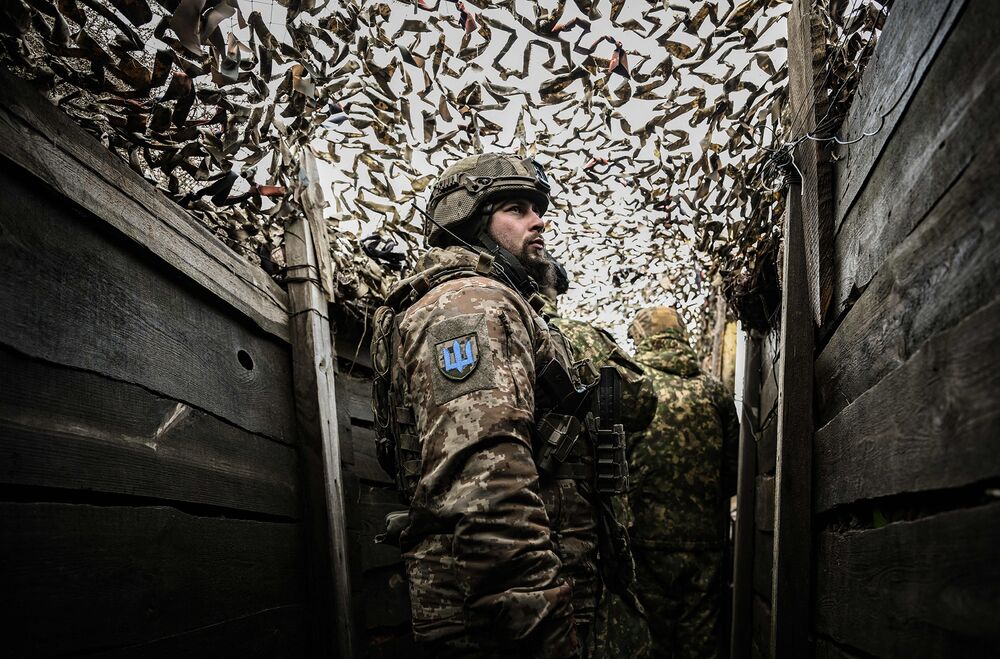
A Ukrainian Army soldier at a front line position in Krymske, in eastern Ukraine, on Saturday, Feb. 19, 2022. (Tyler Hicks/The New York Times)
There have been dozens of wars in the almost 80 years since World War II ended. But if Russia invades Ukraine in the coming days, it will be different from almost all of them. It will be another sign that the world may be entering an alarming new era in which authoritarianism is on the rise.
Here are the two main ways that a war in Ukraine would be distinct.
1. Regional dominance
A Russian invasion of Ukraine seems likely to involve one of the world’s largest militaries launching an unprovoked ground invasion of a neighboring country. The apparent goal would be an expansion of regional dominance, either through annexation or the establishment of a puppet government.
Few other conflicts since World War II fit this description. Some of the closest analogies are the Soviet Union’s invasion of Afghanistan in the 1970s, Czechoslovakia in the 1960s and Hungary in the 1950s — as well as Vladimir Putin’s 2014 annexation of Crimea. The U.S., for its part, invaded Panama in the 1980s and used the CIA to overthrow an elected government in Guatemala in the 1950s. Of course, it also launched several faraway wars, in Iraq, Vietnam and elsewhere.
But the world’s most powerful countries have rarely used force to expand their boundaries or set up client states in their region. Instead, they have generally abided by the treaties and international rules established in the 1940s. The phrase “Pax Americana” describes this stability.
The relative peace has had enormous benefits. Living standards have surged, with people living longer, healthier and more comfortable lives on average than their ancestors. In recent decades, the largest gains have come in lower-income countries. The decline in warfare has played a central role: By the start of this century, the rate at which people were dying in armed conflicts had fallen to the lowest level in recorded history, as Joshua Goldstein, Steven Pinker and other scholars have noted.
A Russian invasion of Ukraine would look like the kind of war that has been largely absent in the past 80 years and that was once common. It would involve a powerful nation setting out to expand its regional dominance by taking over a neighbor. A war like this — a voluntary war of aggression — would be a sign that Putin believed that Pax Americana was over and that the U.S., the European Union and their allies had become too weak to exact painful consequences.
As Anne Applebaum has written in The Atlantic, Putin and his inner circle are part of a new breed of autocrats, along with the rulers of China, Iran and Venezuela: “people who aren’t interested in treaties and documents, people who only respect hard power.”
This is why many people in Taiwan find the situation in Ukraine to be chilling, as my New York Times colleagues Steven Lee Myers and Amy Qin have explained. “If the Western powers fail to respond to Russia, they do embolden the Chinese thinking regarding action on Taiwan,” said Lai I-chung, a Taiwanese official with ties to its leaders. If the world is entering an era in which countries again make decisions based, above all, on what their military power allows them to do, it would be a big change.
2. Democratic recession
Political scientists have been warning for several years that democracy is in decline around the world. Larry Diamond of Stanford University has described the trend as a “democratic recession.”
Freedom House, which tracks every country in the world, reports that global political freedom has declined every year since 2006. Last year, Freedom House concluded, “the countries experiencing deterioration outnumbered those with improvements by the largest margin recorded since the negative trend began.”
A Russian takeover of Ukraine would contribute to this democratic recession in a new way: An autocracy would be taking over a democracy by force.
Ukraine is a largely democratic nation of more than 40 million people, with a pro-Western president, Volodymyr Zelenskyy, who in 2019 won 73% of the vote in the election’s final round. That victory and recent polls both indicate that most Ukrainians want to live in a country that resembles the European nations to its west — and the U.S. — more than it resembles Russia.
But Putin and his inner circle believe that liberal democracies are in decline, a view that Xi Jinping and other top Chinese officials share.
They know that the U.S. and Europe are now struggling to lift living standards for much of their populations. Putin and Xi also know that many Western countries are polarized, rived by cultural conflicts between metropolitan areas and more rural ones. Major political parties are weak (as in the case of the old center-left parties in Britain, France and elsewhere) or themselves behaving in anti-democratic ways (as with the Republican Party in the United States.).
These problems have given Putin and his top aides confidence to act aggressively, believing that “the American-led order is in deep crisis,” Alexander Gabuev of the Carnegie Moscow Center wrote in The Economist this weekend.
In the view of Putin’s regime, Gabuev explained: “A new multipolar order is taking shape that reflects an unstoppable shift in power to authoritarian regimes that support traditional values. A feisty, resurgent Russia is a pioneering force behind the arrival of this new order, along with a rising China.”
The situation in Ukraine remains highly uncertain. Putin may still choose not to invade, given the potential for a protracted war, a large number of Russian casualties and economic turmoil. An invasion would be a spectacular gamble with almost no modern equivalent — which is also why it would be a sign that the world might be changing.
White House hails Germany’s decision to halt certification of Nord Stream 2 pipeline to punish Russia
Caitlin Dickson, Reporter – February 22, 2022
The White House on Tuesday called Germany’s decision to halt certification of the new Nord Stream 2 natural gas pipeline “a major turning point in the world’s energy independence from Russia.”
Daleep Singh, who serves as deputy national security adviser for international economics and deputy director of the National Economic Council, made the comment during a White House press briefing in regard to steps taken by the U.S. and its NATO allies to punish Russia for its decision to recognize and send troops into two Moscow-backed separatist regions in eastern Ukraine.
White House press secretary Jen Psaki and deputy national security adviser Daleep Singh at the daily press briefing at the White House on Tuesday. (Drew Angerer/Getty Images)
Singh began his remarks by highlighting German Chancellor Olaf Scholz’s announcement Tuesday that Germany was halting certification of the Nord Stream 2 project, a newly constructed natural gas pipeline between Russia and Germany that critics said gave the Kremlin too much power over energy policy in Europe. Singh said the ultimate decision on the pipeline followed U.S. “consultations overnight with Germany.”
“That’s an $11 billion investment in a prized gas pipeline, controlled by Russia, that will now go to waste. And it sacrifices what would have been a cash cow for Russia’s coffers,” Singh said. “But it’s not just about the money. This decision will relieve Russia’s geostrategic chokehold over Europe through its supply of gas, and it’s a major turning point in the world’s energy independence from Russia.”
During a joint press conference with Scholz at the White House earlier this month, Biden vowed to “bring an end” to the pipeline if Russia were to move forward with an invasion of Ukraine, “that means tanks or troops crossing the border of Ukraine.” At the time, the German chancellor was less willing to echo this specific promise, saying only that he and Biden were “absolutely united, we will not be taking different steps.”
Russia’s Nord Stream pipeline
During Tuesday’s briefing, White House press secretary Jen Psaki said President Biden “has never been a supporter of Nord Stream 2,” and added that while the president didn’t feel it was appropriate to take preemptive sanctions against the project, “the announcement by the German chancellor today was not by accident.”
Biden, she said, “never felt it was a good project, [he’s] been clear about that.”
Biden has acknowledged that the harsh sanctions the U.S. and its allies have pledged in response to Russia’s increased aggression against Ukraine, including the halting of Nord Stream 2, will likely drive up oil and gas prices worldwide. The president said Tuesday that he was taking “robust action to make sure the pain of sanctions is targeted at the Russian economy and not ours.”
“I want to limit the pain American people are feeling at the gas pump,” Biden said during his remarks at the White House.
Singh reiterated that point but declined to provide more specifics on how, exactly, the administration was working to minimize the impact of sanctions on Americans, saying only that the White House is engaged in an “ongoing effort and sensitive effort” to coordinate with major energy producers and consumers.
Asked when Americans could expect to see a difference in the price of gasoline at the pump, Singh declined to provide a timeline but said that “the collective power and authorities at our disposal, plus diplomatic maneuvers at our disposal, collectively we think will be effective at bringing down the price of gas and of oil.”
Russia’s Richest Lose $32 Billion as Ukraine Crisis Deepens
Ben Stupples – February 22, 2022
(Bloomberg) — The fortunes of Russia’s super-rich have tumbled $32 billion this year, with the escalating conflict in Ukraine poised to make that wealth destruction much larger.
U.S. President Joe Biden on Tuesday unleashed sanctions targeting Russia’s sale of sovereign debt abroad and the country’s elites, and said he’s sending an unspecified number of additional U.S. troops to the Baltics in a defensive move to defend NATO countries.
Gennady Timchenko heads the list of Russian billionaires who have seen their fortunes drop, with almost a third of his wealth disappearing since Jan. 1, according to the Bloomberg Billionaires Index, a listing of the world’s 500 richest people.
Timchenko, 69, the son of a Soviet military officer who met and befriended Russian Federation President Vladimir Putin during the early 1990s, now has a fortune of about $16 billion, with the bulk of his wealth derived from a stake in Russia gas producer Novatek, according to Bloomberg’s wealth index.
Fellow Novatek shareholder Leonid Mikhelson’s fortune has tumbled $6.2 billion this year, while Lukoil Chairman Vagit Alekperov’s net worth has declined about $3.5 billion in the same period as the energy company’s stock has slid almost 17%.
The country’s 23 billionaires currently have a net worth of $343 billion, according to the wealth list, down from $375 billion at year-end.
Markets slumped further this week after Putin recognized two separatist republics in Ukraine, leading to Germany halting an energy project with Russia and the U.K. imposing sanctions on five of the country’s banks and three of its wealthy individuals, including Timchenko.
Also on the U.K.’s sanctions list are Boris Rotenberg, 65, and his nephew, Igor, 48, whose families made their fortune through gas-pipeline construction firm Stroygazmontazh.
Read more: Here Are the Russian Billionaires Facing Sanctions Over Ukraine
Igor’s father, Arkady, one of Putin’s former judo sparring partners, sold the pipeline firm in 2019 for about $1.3 billion. He purchased a minority stake from his younger brother Boris five years earlier when both siblings and Timchenko were hit with U.S. sanctions over Russia’s annexation of Crimea.
Harvard economist and former Obama adviser says Russia is ‘basically a big gas station’ and is otherwise ‘incredibly unimportant’ in the global economy
Matthew Loh – February 21, 2022
Russia’s President Vladimir Putin signed decrees to recognize independence of the Donetsk and Luhansk. Moscow ordered troops into these areas on Monday, escalating the prospect of outright war between Russia and Ukraine.Alexei Nikolsky/TASS via Getty Images
Harvard economist Jason Furman said Russia’s economy is ‘unimportant’ except for its gas resources, The New York Times reported.
His comments come as the US and Europe prepare heavy sanctions on Russia if it invades Ukraine.
But there are concerns that their plans to punish Moscow will penalize the rest of the world too.
Russia’s economy is “incredibly unimportant in the global economy except for oil and gas,” Jason Furman, Harvard economist and ex-adviser to former President Barack Obama, told The New York Times.
“It’s basically a big gas station,” he said.
His comments come as the West prepares heavy sanctions on Russia if it invades Ukraine. While they have the potential to throw the entire Russian economy into chaos, these measures could also reverberate to further damage the US, Europe, and the rest of the world as they battle inflation and rising energy prices — a ripple effect that the West hopes to mitigate.
Despite Russia’s size and wealth in raw materials, its economy is more on-par with Brazil than with nations like Germany, France, and the UK, according to the latest nominal GDP data from the World Bank. According to the World Bank, its economy is weaker than Italy’s and South Korea’s, two nations with less than half of Russia’s population.
But as Furman notes, Russia’s oil and gas exports are significant to the world.
The European Union imports around 80% of the natural gases it uses, according to the US Energy Information Administration, and Russia accounts for 41% of the natural gas imports and 27% of the oil imports in the continent, per Eurostat.
On the other hand, Ukraine has also been a major supplier of grain to other regions, sending 40% of its wheat and corn exports to the Middle East and Africa, The Times reported.
In response to a potential food crisis in those regions, US Secretary of Agriculture Tom Vilsack said on Saturday that American farmers would increase production and “step in and help our partners,” the Associated Press reported.
Ukraine accounts for 12% of the entire world’s grain exports, and is estimated to provide 16% of global corn exports this year, the AP reported. Vilsack told the outlet he believed that American consumers would largely be unaffected, but Europeans would face “a different story.”
“You have to look at the backdrop against which this is coming,” Gregory Daco, chief economist for consulting firm EY-Parthenon, told The Times. “There is high inflation, strained supply chains and uncertainty about what central banks are going to do and how insistent price rises are.”
What Ukraine-Russia Tensions Mean for Stocks and Investor Portfolios
Central bank tightening and slowing growth loom as larger long-term threats for equities, according to strategists on both sides of the Atlantic.
ByCharlie Wells – February 22, 2022
Ukrainian troops patrol outside the town of Novoluhanske, eastern Ukraine, on Feb. 19.Photographer: Aris Messinis/AFP/Getty Images
Tensions in Ukraine have markets on edge. Stocks are swinging, oil is closing in on $100 a barrel and uncertainty looms over investors big and small.
But it’s more of a short-term headache than a long-term drag. That’s the view of analysts on both sides of the Atlantic trying to discern what the geopolitical crisis means for investor portfolios in the wake of Russia recognizing two self-proclaimed republics in eastern Ukraine.
Tom Essaye, a former Merrill Lynch trader who founded “The Sevens Report” newsletter, sees the conflict dominating near-term headlines. But he doesn’t expect it to dictate market moves in the long or even medium term. Instead, the most important factors “remain Fed tightening and economic growth,” he wrote.
JPMorgan strategists led by Dubravko Lakos-Bujas were of a similar mind in their recent note to clients, citing the larger risk of tightening monetary policy for equities and noting that Russia-Ukraine tensions are a low earnings risk for U.S. corporates.
“But an energy price shock amidst an aggressive central bank pivot focused on inflation could further dampen investor sentiment and growth outlook,” they wrote.
In the U.K., Bloomberg Intelligence equities strategist Tim Craighead wrote that European stocks face limited risk, “unless Russian energy supplies are cut.” The crisis might “shuffle the leader board temporarily” in terms of European equities, but Craighead noted that the market seems to be more focused on rising inflation, elevated margins and central bank tightening.
Still, Steve Clayton, who manages HL Select Funds at Hargreaves Lansdown in the U.K., noted that the crisis won’t be over in a blip.
“Russian troops have not massed along the Ukrainian border in order to hold a cake sale,” he wrote in a note on Tuesday. “However this unfolds, tensions and uncertainties are likely to run hot for some time to come. The market will not like any escalation, nor will it trust any settlement between the parties unless accompanied by a rapid demobilization of Russian forces around Ukraine.”
Clayton sees U.S. Treasuries and Japanese government bonds as potential beneficiaries as investors seek safe havens. Given the nature of the conflict, he also points to defense stocks such as Bae Systems Plc as possible destinations, given that “European politicians are unlikely to urge for lower defense spending while the Russian bear is growling angrily.”
Banking stocks — which have been outperforming in Europe so far this year — could be losers. The U.K. just announced sanctions on five Russian banks. The EU proposed a package of sanctions on banks that finance Russian operations in the region.
“Effective sanctions will impact on economic activity and banks will be where it is felt in the West,” Clayton wrote. “Lending volumes would be hit too, if tensions really rocket, because cautious consumers and businesses will refrain from borrowing until they feel more confident.”
Travel and leisure could also lose some steam, as they tend to when international tensions rise, wrote Clayton. Among several stocks, he pointed to Wizz Air, which has a significant network across Central and Eastern Europe.
“Times of tension are when defensiveness can pay off,” he wrote. “People still have to eat, take medicines and get operated upon. Food retailers and drug companies like Sainsbury and AstraZeneca could be interesting, but Tesco’s exposure to Central Europe will not help.”
Putin recognizes independence of separatist Ukraine regions in possible prelude to invasion
February 21, 2022
Move could trigger harsh sanctions from West; Russian military says it killed five suspected ‘saboteurs’ who crossed from Ukraine
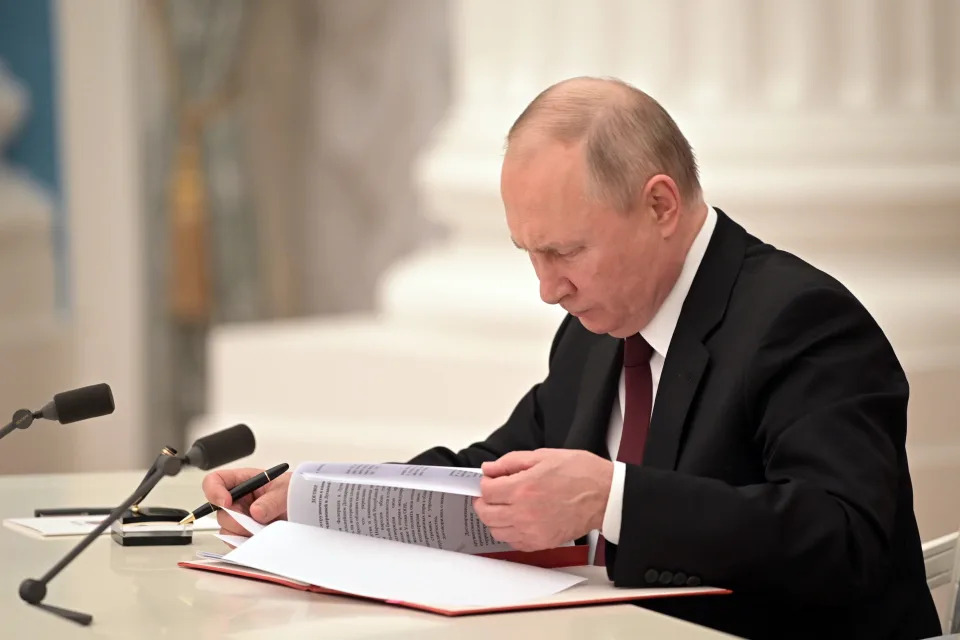
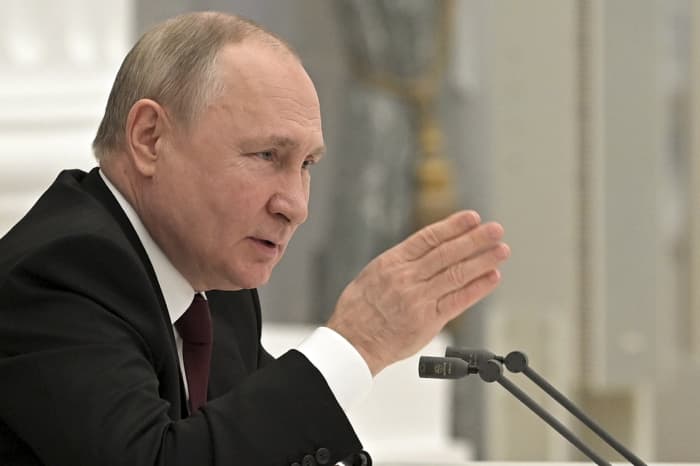
Russian President Vladimir Putin speaks during a Security Council meeting in the Kremlin in Moscow on Monday, Feb. 21, 2022. SPUTNIK, KREMLIN POOL PHOTO VIA AP
MOSCOW — Russian President Vladimir Putin on Monday recognized the independence of separatist regions in eastern Ukraine and paved the way to provide them military support — a direct challenge to the West that will fuel fears that Russia could imminently invade Ukraine.
The carefully staged move announced in the Kremlin could lead to new sanctions on Russia and flies in the face of European efforts for a diplomatic solution to the escalating crisis, which has brought East-West relations to a new low and jeopardized trade. Britain’s prime minister called it a “breach of international law.”
The European Union immediately said it will slap sanctions on those involved in recognizing Ukraine’s breakaway regions as independent.
It came amid a spike in skirmishes in the eastern regions that Western powers believe Russia could use as a pretext for an attack on the western-looking democracy that has defied Moscow’s attempts to pull it back into its orbit.
Putin justified his decision in a far-reaching, pre-recorded speech blaming NATO for the current crisis and calling the U.S.-led alliance an existential threat to Russia. Sweeping through more than a century of history, he painted today’s Ukraine as a modern construct that is inextricably linked to Russia. He charged that Ukraine had inherited Russia’s historic lands and after the Soviet collapse was used by the West to contain Russia.
Ukrainians shrugged off the move as meaningless, but it remains a fundamental blow to their country eight years after fighting erupted the Donetsk and Luhansk regions between Russia-backed separatists and Ukrainian forces.
After his speech, Putin signed decrees in the Kremlin recognizing those regions’ independence and called on lawmakers to approve measures paving the way for military support.
Until now, Ukraine and the West have accused Russia of supporting the separatists, but Moscow has denied that, saying that Russians who fought there were volunteers.
European leaders had urged Putin to not to recognized the regions’ independence, and the EU foreign policy chief threatened possible sanctions if he did. Ukraine’s president convened an emergency meeting of top security officials.
According to the Kremlin, German Chancellor Olaf Scholz and French President Emmanuel Macron voiced “disappointment with such a development” but also “readiness to continue contacts.”
At an earlier meeting of Putin’s Security Council, a stream of top Russian officials argued for recognizing the separatist regions’ independence. At one point, one slipped up and said he favored including them as part of Russian territory — but Putin quickly corrected him.
With an estimated 150,000 Russian troops massed on three sides of Ukraine, the U.S. has warned that Moscow has already decided to invade. Still, the American and Russian presidents tentatively agreed to a possible meeting in a last-ditch effort to avoid war.
If Russia moves in, the meeting will be off, but the prospect of a face-to-face summit resuscitated hopes that diplomacy could prevent a devastating conflict, which would result in massive casualties and huge economic damage across Europe, which is heavily dependent on Russian energy.
European Union foreign policy chief Josep Borrell said at an EU foreign ministers meeting in Brussels that, “If there is a recognition, I will put sanctions on the table and the (EU) ministers will decide” whether to agree to impose them.
Even as the diplomatic efforts inched forward, potential flashpoints multiplied. Sustained shelling continued Monday in Ukraine’s east. Unusually, Russia said it had fended off an “incursion” from Ukraine — which Ukrainian officials denied. And Russia decided to prolong military drills in Belarus, which could offer a staging ground for an attack on the Ukrainian capital, Kyiv.
Earlier Monday, leaders of the separatist regions released televised statements pleading with Putin to recognize them and sign treaties that would allow for military aid to protect them from what they described as an ongoing Ukrainian military offensive. Russia’s lower house of parliament made the same plea last week.
Ukrainian authorities deny launching an offensive and accuse Russia of provocation.
Putin’s announcement shatters a 2015 peace deal signed in Minsk requiring Ukrainian authorities to offer a broad self-rule to the rebel regions, which marked a major diplomatic coup for Moscow.
The deal was resented by many in Ukraine who saw it as a capitulation, a blow to the country’s integrity and a betrayal of national interests. Putin and other officials argued Monday that Ukrainian authorities have shown no appetite for implementing it.
With the prospect of war looming, French President Emmanuel Macron scrambled to broker a meeting between U.S. President Joe Biden and Putin, who denies he plans to attack Ukraine.
Russia says it wants Western guarantees that NATO won’t allow Ukraine and other former Soviet countries to join as members — and Putin said Monday that a simple moratorium on Ukraine’s accession wouldn’t be enough. Moscow has also demanded the alliance halt weapons deployments to Ukraine and roll back its forces from Eastern Europe — demands flatly rejected by the West.
Macron’s office said both leaders had “accepted the principle of such a summit,” to be followed by a broader meeting that would include other “relevant stakeholders to discuss security and strategic stability in Europe.”
The language from Moscow and Washington was more cautious, but neither side denied a meeting is under discussion.
During the Kremlin meeting, several top officials spoke skeptically about a possible summit, saying it was unlikely to yield any results.
U.S. national security adviser Jake Sullivan, meanwhile, said the administration has always been ready to talk to avert a war — but was also prepared to respond to any attack.
“So when President Macron asked President Biden yesterday if he was prepared in principle to meet with President Putin, if Russia did not invade, of course President Biden said yes,” he told NBC’s “Today” show on Monday. “But every indication we see on the ground right now in terms of the disposition of Russian forces is that they are, in fact, getting prepared for a major attack on Ukraine.”
Since Thursday, shelling has spiked along the tense line of contact that separates Ukrainian forces and Russian-backed rebels in Ukraine’s eastern industrial heartland of Donbas. Over 14,000 people have been killed since conflict erupted there in 2014, shortly after Moscow annexed Ukraine’s Crimean Peninsula.
Ukraine and the separatist rebels have traded blame for massive cease-fire violations with hundreds of explosions recorded daily.
While Russia-backed separatists have charged that Ukrainian forces were firing on residential areas, Associated Press journalists reporting from several towns and villages in Ukrainian-held territory along the line of contact have not witnessed any notable escalation from the Ukrainian side and have documented signs of intensified shelling by the separatists that destroyed homes and ripped up roads.
Some residents of the main rebel-held city of Donetsk described sporadic shelling by Ukrainian forces, but they added that it wasn’t on the same scale as earlier in the conflict.
The separatist authorities said Monday that at least four civilians were killed by Ukrainian shelling over the past 24 hours and several others were wounded. Ukraine’s military said two Ukrainian soldiers were killed over the weekend, and another serviceman was wounded Monday.
Ukrainian military spokesman Pavlo Kovalchyuk insisted that Ukrainian forces weren’t returning fire.
In the village of Novognativka on the Ukraine government-controlled side, 60-year-old Ekaterina Evseeva, said the shelling was worse than at the height of fighting early in the conflict.
“We are on the edge of nervous breakdowns. And there is nowhere to run,” she said, her voice trembling.
In another worrying sign, the Russian military said it killed five suspected “saboteurs” who crossed from Ukraine into Russia’s Rostov region and also destroyed two armored vehicles and took a Ukrainian serviceman prisoner. Ukrainian Border Guard spokesman Andriy Demchenko dismissed the claim as “disinformation.”
Amid the heightened invasion fears, the U.S. administration sent a letter to the United Nations human rights chief claiming that Moscow has compiled a list of Ukrainians to be killed or sent to detention camps after the invasion. The letter, first reported by the New York Times, was obtained by the AP.
Kremlin spokesman Dmitry Peskov said the claim was a lie and no such list exists.