Putin Made a Profound Miscalculation on Ukraine

By Yaroslav Hrytsak – March 19, 2022

Dr. Hrytsak is a Ukrainian historian and a professor at the Ukrainian Catholic University.

Credit…Masha Krasnova-Shabaeva

LVIV, Ukraine — Ukraine is once again at the center of a potentially global conflict. World War I, as the historian Dominic Lieven put it, “turned on the fate of Ukraine.” World War II, according to the legendary journalist Edgar Snow, was “first of all a Ukrainian war.” Now the threat of a third world war hinges on what could happen in Ukraine.

It’s a striking repetition. Why has Ukraine, a midsize country of 40 million people on the eastern edge of Europe, been at the epicenter of warfare not once, not twice, but three times?

Part of the answer, at least, is geographical. Set between Russia and Germany, Ukraine has long been viewed as the site of struggle for the domination of the continent. But the deeper reasons are historical in nature. Ukraine, which has a common origin point with Russia, has developed differently over the course of centuries, diverging in crucial ways from its neighbor to the east.

President Vladimir Putin likes to invoke history as part of the reason for his bloody invasion. Ukraine and Russia, he asserts, are in fact one country: Ukraine, in effect, doesn’t exist. This, of course, is entirely wrong. But he is right to think history holds a key to understanding the present. He just doesn’t realize that far from enabling his success, it’s what will thwart him.

In 1904 an English geographer named Halford John Mackinder made a bold prediction. In an article titled “The Geographical Pivot of History,” he suggested that whoever controlled Eastern Europe would control the world. On either side of this vast region were Russia and Germany, poised to do battle. And in between was Ukraine, with its rich resources of grain, coal and oil.

There’s no need to go into the finer details of Mackinder’s theory; it had its flaws. Yet it proved extremely influential after World War I and became something of a self-fulfilling prophecy. Thanks to the Nazi geopolitician Karl Haushofer, the concept migrated into Hitler’s “Mein Kampf.” Lenin and Stalin had not read Mackinder but acted as if they had. For them, Ukraine was the bridge that would carry the Russian Revolution westward into Germany, making it a world revolution. The path to conflict again ran through Ukraine.

The war, when it came, was catastrophic: In Ukraine, around seven million perished. In the aftermath, Ukraine was sealed up in the Soviet Union, and the question for a time seemed settled. With the collapse of Communism, many believed that Mackinder’s thesis was outdated and the future belonged to independent and sovereign states, free from the ambitions of bigger neighbors. They were wrong.

Mackinder’s argument — that Eastern Europe and Ukraine held the key for a contest between Russia and Germany — never went away. In fact, it took pride of place in Mr. Putin’s mind. With one change, however: He substituted Germany with the West in its entirety. Ukraine, to Mr. Putin, became the battleground for a civilizational contest between Russia and the West.

He didn’t act on it at first. In the early years of his tenure, he seemed to expect — in line with those in Boris Yeltsin’s circle who oversaw the end of the Soviet Union — that Ukrainian independence wouldn’t last long. In time, Ukraine would be begging to be taken back. It didn’t happen. Though some Ukrainians remained under the sway of Russian culture, politically they leaned to the West, as shown by the Orange Revolution of 2004, when millions of Ukrainians protested against electoral fraud.

So Mr. Putin changed course. Soon after the war in Georgia in 2008, in which the Kremlin seized control of two Georgian regions, he designed a new strategic policy for Ukraine. According to the plan, any steps Kyiv might take in the direction of the West would be punished with military aggression. The objective was to cleave off Ukraine’s Russophone east and turn the rest of the country into a vassal state headed by a Kremlin puppet.

At the time, it seemed fantastical, ludicrous. Nobody believed it could be genuine. But by the final weeks of Ukraine’s Maidan revolution in 2014, in which Ukrainians demanded an end to corruption and an embrace of the West, it became horribly clear that Russia was intent on aggression. And so it proved: In a rapid-fire operation, Mr. Putin seized Crimea and parts of the Donbas. But crucially, the full extent of his ambition was thwarted, in large part through the heroic resistance mounted by volunteers in the country’s east.

Mr. Putin miscalculated in two ways. First, he was hoping that, as had been the case with his war against Georgia, the West would tacitly swallow his aggression against Ukraine. A unified response from the West was not something he expected. Second, since in his mind Russians and Ukrainians were one nation, Mr. Putin believed Russian troops needed barely to enter Ukraine to be welcomed with flowers. This never materialized.

What happened in Ukraine in 2014 confirmed what liberal Ukrainian historians have been saying for a long time: The chief distinction between Ukrainians and Russians lies not in language, religion or culture — here they are relatively close — but in political traditions. Simply put, a victorious democratic revolution is almost impossible in Russia, whereas a viable authoritarian government is almost impossible in Ukraine.

The reason for this divergence is historical. Up until the end of World War I (and in the case of western Ukraine, the end of World War II), Ukrainian lands were under the strong political and cultural influence of Poland. This influence was not Polish per se; it was, rather, a Western influence. As the Harvard Byzantinist Ihor Sevcenko put it, in Ukraine the West was clad in Polish dress. Central to this influence were the ideas of constraining centralized power, an organized civil society and some freedom of assembly.

Mr. Putin seems to have learned nothing from his failures in 2014. He has launched a full-scale invasion, seemingly intended to remove the Ukrainian government from power and pacify the country. But again, Russian aggression has been met with heroic Ukrainian resistance and united the West. Though Mr. Putin may escalate further, he is far from the military victory he sought. A master tactician but inept strategist, he has made his most profound miscalculation.

Yet it’s one based on the belief that he is at war not with Ukraine but with the West in Ukrainian lands. It’s essential to grasp this point. The only way to defeat him is to turn his belief — that Ukraine is fighting not alone but with the help of the West and as part of the West — into a waking nightmare.

How this could be done, whether through humanitarian and military help, incorporating Ukraine into the European Union or even supplying it with its own Marshall Plan, are open questions. What matters is the political will to answer them. After all, the struggle for Ukraine, as history tells us, is about much more than just Ukraine or Europe. It is the struggle for the shape of the world to come.

Yaroslav Hrytsak is a professor of history at the Ukrainian Catholic University and the author, most recently, of a global history of Ukraine.

While Putin Shrinks, Zelensky Soars

By Maureen Dowd – March 19, 2022

Credit…Kirill Kudryavtsev/Agence France-Presse — Getty Images

WASHINGTON — Myron Cohen, a garment district silk salesman turned popular comedian in the Ed Sullivan era, loved to tell this chestnut:

Picture a skinny little guy, a shrimp, a nothing. He walks into a lumber camp looking for a job.

The foreman is skeptical, so the shrimp steps up and fells a towering oak in 90 seconds.

“Where’d you learn that?” says the foreman.

“In the Sahara Forest,” replies the guy.

“You mean the Sahara Desert,” the foreman corrects.

“Sure, now,” the guy says.

Hubris guided Vladimir Putin’s malevolent and maladroit invasion of Ukraine. As The Associated Press pointed out, U.S. military officials assumed Russia would deploy electronic and cyber warfare to blind and paralyze Ukrainian air defenses and communications. But the Russians did not take control of Ukrainian airspace when they launched their attack.

Putin was cocksure, dismissing Volodymyr Zelensky as a shrimp, a nothing. But Zelensky has shown the world what true stature is.

Putin has always had a Napoleon complex, puffing out his bare chest on horseback; fishing shirtless in Siberia; winning staged judo and hockey displays.

But Zelensky understands that stature is not about phony macho photo shoots. Stature is a physical quality, but, more important, it is a human and moral quality. Keats was barely over five feet, but look at his spiritual size.

Our military leaders have lately been quoting Napoleon, who said, “The moral is to the physical as three to one.” We have seen this with the Ukrainians, who are not only courageously resisting the Russians, but also launching counteroffensives.

As The Times reported, the number of Russian casualties has hurt morale; our intelligence reports have described Russian soldiers simply parking their tanks and wandering into the woods.

Putin doesn’t realize what the world knows: You don’t show your muscularity by razing cities, by bombing a maternity hospital, a boarding school for the visually impaired, a bread line, a community center and a shelter painted with a message in Russian pleading that children are inside. What kind of monster treats the word “CHILDREN” as an invitation to kill? This just proves that the Russian dictator is, as President Biden and his secretary of state contended, a war criminal.

You don’t show your power by starting a war that reveals how weak and mediocre your army is and strengthens European bonds when your goal is to divide and weaken Europe.

No matter what happens in Ukraine, Putin will be a loser with no moral stature and Zelensky will have towering moral stature.

Donald Trump, who called Putin’s barbaric strategy “genius” and “savvy” after spending four years legitimizing that malefactor, also comes out a loser. Trump is stuck on the fringe of his party, sharing the wrong side of a moral divide with Tucker Carlson, J.D. Vance, Madison Cawthorn and Marjorie Taylor Greene.

Trump and Putin, what a pair, shrinking in stature in the eyes of the world. Tiny, tiny Trump and cruel fool Putin. The corrupt, paranoid germophobes love surrounding themselves with sycophants, conjuring delusional worlds and giving unhinged rants.

Putin let loose on those who question his misbegotten war: “Any people, and even more so the Russian people, will be able to distinguish true patriots from scum and traitors and simply spit them out like a midge that accidentally flew into their mouths. Spit out on the pavement.”

He even went after his pals, the oligarchs, “who can’t do without foie gras, oysters or the so-called gender freedoms” in Miami or the French Riviera.

Trump and Putin sowed the seeds of their own destruction. They wanted all of the attention and credit. Now they deserve all of the blame.

Grandiosity and fantasy worlds will trip up these poisonous authoritarians. Neither man has a democratic bone in his body. And both think they know better than anyone else.

“When you have an autocrat who’s been in power for too long, they don’t listen to people anymore, and this war was afflicted by very bad decision making,” Ruth Ben-Ghiat, a historian who teaches at New York University, said on MSNBC. This has left Putin vulnerable and humiliated before Russian elites and the world, she said. But it has also, parlously, left him without an offramp “because autocrats don’t negotiate.”

Stephen Kotkin, a professor of history and international affairs at Princeton, told The New Yorker’s David Remnick that the Russians have a fractured identity. Culturally and scientifically, they are a world-class power. But economically and politically, they have a hard time matching the West, so “they resort to coercion.”

“The worst part of this dynamic in Russian history is the conflation of the Russian state with some personal ruler,” Kotkin said. “Instead of getting the strong state that they want to manage the gulf with the West, they instead get a personalist regime. They get a dictatorship, which usually becomes a despotism.”

Zelensky spoke to a joint meeting of Congress on Wednesday, comparing the terror in Ukrainian skies to the death hailed down from the skies on Pearl Harbor in 1941 and on New York and Washington on 9/11. He also showed a devastating video that brought tears to lawmakers’ eyes.

Underlining his role as David to Putin’s Goliath, Zelensky said, “Strong doesn’t mean big.” Strong means supporting human rights and freedom and demanding the right to die when “your time comes and not when it’s wanted by someone else, by your neighbor.”

Zelenskyy calls the Russian military ‘incompetent, capable of simply driving their people to slaughter’

Business Insider

Zelenskyy calls the Russian military ‘incompetent, capable of simply driving their people to slaughter’

Katie Balevic – March 20, 2022

A column of Russian military vehicles is seen abandoned in the snow, in a forest not far from Kharkiv, in the east on March 6, 2022.
A column of Russian military vehicles is seen abandoned in the snow, in a forest not far from Kharkiv, in the east on March 6, 2022.Sergey Bobok/Getty Images
  • Zelenskyy said an “incompetent” Russian military was leading to “unprecedented losses.”
  • He has said some 14,000 Russian soldiers have died, while Western estimates are closer to 7,000.
  • Zelenskyy added that some Russian combat units were destroyed “by 80-90%” during the fighting.

In a stark message Sunday, Ukrainian President Volodymyr Zelenskyy said some areas of combat have been “simply piled with corpses of Russian soldiers.”

The Ukrainian president said that his forces continue to deter Russian forces and “inflict unprecedented losses on Russian troops.” He added that the Russian military has proven itself “incompetent, capable of simply driving their people to slaughter.”

“Some units of the occupiers were destroyed by 80-90%,” Zelenskyy said on Telegram. “In places of especially fierce battles, the frontline of our defense is simply piled with the corpses of Russian soldiers.”

“And these corpses, these bodies, are not taken away,” he added. “New units are driven on the offensive through these bodies. Some reserves that the command of the Russian troops collect wherever they can.”

Zelenskyy has said over 14,000 Russian soldiers have died thus far. US intelligence estimated last week that 7,000 of the 150,000 Russian troops involved in the war have died.

“We are well aware that Russia has just a bottomless human resource and a lot of equipment, missiles, and bombs. But I want to ask the citizens of Russia. What have they done to you over the years that you stopped noticing your losses?” Zelenskyy said. “This is 14,000 mothers, 14,000 fathers. These are wives, these are children, relatives, and friends. And you don’t notice it?”

He warned there would “only be more victims” as Russia’s war against Ukraine continues. Zelenskyy has called for peace talks with Russia multiple times in the last several weeks, warning that Russia will otherwise incur losses that will take “several generations to recover” from.

During an interview with CNN on Sunday, Zelenskyy said he is ready for negotiations with Russian President Vladimir Putin, but he warned that if those talks failed, it “would mean that this is a third World War,” Insider’s John Dorman reported.

“Ukraine has always sought a peaceful solution,” Zelenskyy said on Telegram. “Because we count everyone killed, because every ruined family, every ruined house matters to us. Because were are Ukrainians, and for us, a person is priceless.”

Read the original article on Business Insider

‘A psychopath’: Chechen warlord Kadyrov raises prospect of more brutal phase to Ukraine war

Yahoo! News

‘A psychopath’: Chechen warlord Kadyrov raises prospect of more brutal phase to Ukraine war

Alexander Nazaryan, Senior W. H. Correspondent – March 19, 2022

WASHINGTON — Launched by Moscow in 1999, the second Chechen war elevated the stature of Russia’s new and then little-known prime minister, a former intelligence officer named Vladimir Putin. Intended to bring the mountainous Islamic region back under the Kremlin’s control, the exceptionally brutal campaign endeared Putin to Russians nostalgic for a show of strength from what was considered by much of the world to be a fading nuclear superpower.

“The bandits will be destroyed,” Putin said at the time, in an echo of how he would talk of the “Nazis” he now claims to be purging from Ukraine’s government and military. “We must go through the mountain caves and scatter and destroy all those who are armed.”

So when Chechen warlord Ramzan Kadyrov announced earlier this week that he was in Ukraine to support Putin’s invasion, it seemed as if the past had caught up with the present. Even though Kadyrov’s journey to the front — he claimed on social media to have nearly reached the capital, Kyiv, which is still under Ukrainian control — may have been fictitious, amounting to little more than a publicity stunt, some say his involvement could lead to an even bloodier conflict.

Ramzan Kadyrov
Chechen regional leader Ramzan Kadyrov. (Musa Sadulayev/AP)

“Kadyrov is a psychopath who personally tortures his political prisoners,” Russia expert Michael Weiss told Yahoo News, alluding to Kadyrov’s well-known human rights abuses. Weiss and others say the apparent presence of Kadyrov’s soldiers in Ukraine could signal a new phase of fighting, one in which the rules of conventional warfare are discarded as Putin becomes more desperate for victory.

Kadyrov, 45, rules Chechnya under Putin’s supervision. And if Ukrainian President Volodymyr Zelensky is the conflict’s leading man, Kadyrov is the more colorful counterpart to chief villain Putin, given to brandishing a golden gun and trotting out a pet tiger. And even as he was supposedly preparing for war, Kadyrov engaged in a social media feud with Tesla founder Elon Musk.

His cartoonish demeanor, however, disguises a deep lust for power and a penchant for violence. Kadyrov commands a paramilitary outfit called the Kadyrovites, who work to suppress any rebellion in Chechnya, which has struggled to free itself from Russia (and other empires) for centuries. By doing Putin’s bidding — which has included hunting down opponents in Istanbul and Berlin — Kadyrov essentially guarantees he will retain the Kremlin’s support.

“The Russian military is facing a critical lack of manpower,” explains Emil Aslan, professor of security studies at Charles University in Prague. Kadyrovites, he told Yahoo News, “are an essential asset to the Russian military, both in tactical and psychological terms.”

A burned tank in Volnovakha, Ukraine
A burned tank in Volnovakha, Ukraine. (Stringer/Anadolu Agency via Getty Images)

White House press secretary Jen Psaki said on Thursday that the Biden administration could not confirm the presence of Chechen fighters in Ukraine. But such confirmation has come from battlefield reports, as well as from social media posts, where a kind of meta-battle is being waged for world opinion.

The Kremlin has not hyped Kadyrov’s role and, in fact, challenged the bombastic warlord’s own assertion that he was on the outskirts of Kyiv. At the same time, the Kremlin has few other allies to turn to.

“Russia’s scrounging for troops in Chechnya and beyond is probably a sign of how poorly the war has gone for them,” says Ben Friedman, policy director at the Washington, D.C., think tank Defense Priorities.

Although Ukraine’s military is much smaller than Russia’s, poorly trained Russian conscripts have been repelled repeatedly since Putin launched an invasion last month. And with the United States and other nations continuing to supply weapons to Kyiv, Russia could be coming dangerously close to defeat, potentially leaving it to rely on the kind of grueling warfare that allowed Putin to declare victory in Chechnya two decades ago, after an earlier attempt to conquer the Muslim-majority region proved unsuccessful.

Russian President Boris Yeltsin launched a disastrous invasion of Chechnya in 1994, seeking to keep the small, oil-rich republic from gaining independence. Yet Chechnya mounted a furious defense that culminated in a battle for Grozny, the Chechen capital, that left hundreds of Russian soldiers dead. The humiliated Russian army retreated, and Chechnya achieved a measure of autonomy — and peace.

Grozny, Chechnya
Grozny, the capital of Chechnya, was besieged by the Russian army in August 1996. (Eric Bouvet/Gamma-Rapho via Getty Images)

An earnest student of Soviet propaganda, Putin could now be trying to use crude stereotypes about Chechens’ fighting prowess to frighten an otherwise emboldened Ukrainian resistance.

After a series of apartment bombings in Moscow and elsewhere that were blamed on Chechens — but were likely carried out by Kremlin security services — Putin started a second Chechen war that saw Grozny leveled and the small republic’s civil society effectively destroyed. In exchange for their loyalty, the Kadyrov family — who had once been rebels themselves — were given unfettered power over the Chechen populace. They have wielded that power ruthlessly, in particular when it comes to the nation’s gay and lesbian population.

A 2006 report by Human Rights Watch found that dissidents could face almost medieval retribution. “They started kicking me, and then brought an ‘infernal machine’ to give me electric shocks. They attached the wires to my toes and kept cranking the handle to release the current. I couldn’t bear it,” a survivor of Kadyrov’s torture, named in the report as “Khamid Kh.,” testified.

Bringing such methods to Ukraine would only exacerbate a conflict that has already led President Biden to call Putin a “war criminal.”

A supporter of Putin’s campaign from the start, Kadyrov said earlier this week that he was on the battlefield and ready to fight. That assertion was later debunked by a Ukrainian news outlet that determined Kadyrov’s announcement had actually been sent from Chechnya. Still, Chechens are involved in the conflict, with Ukraine accusing them of trying to assassinate Zelensky.

Ukrainian President Volodymyr Zelensky
Ukrainian President Volodymyr Zelensky speaks to the U.S. Congress from Kyiv on Wednesday. (Ukrainian Presidency/Handout/Anadolu Agency via Getty Images)

Their role could broaden should Russia’s assault fail to take Kyiv and other large cities. If forces aligned with Kadyrov “are asked to target neighborhoods, target civilians, they will do it,” says Jean-François Ratelle, a University of Ottawa expert on the Chechen wars. “They could be used to commit war crimes against civilians.”

Putin could also use Chechens to shoot Russian conscripts attempting to desert, Ratelle said. The practice has precedent in Russian history: During World War II, Soviet dictator Joseph Stalin had Red Army frontline soldiers trailed by security services ordered to shoot anyone trying to retreat from the terrifying German onslaught.

So far, all the alleged war crimes in Ukraine appear to have been committed by Russians at the Kremlin’s behest. But the prospect that Kadyrov could become more involved in the conflict alarms experts on Chechnya and its tumultuous history.

Weiss, the Russia expert, said reports that Putin was recruiting fighters in Syria — where Russia helped bolster dictator Bashar Assad’s ruthless regime in that nation’s civil war — were another development pointing to an escalation. “Putin is throwing everything he can into this war.”

If the second Chechen war cemented Putin’s grip on Russia, the unprovoked invasion of Ukraine could prove his undoing — but not before thousands more soldiers and civilians die in the process, especially if he looks to Kadyrov for the cruelly unconventional warfare that is the Chechen warlord’s calling card.

Russian President Vladimir Putin
Russian President Vladimir Putin at an event in Moscow on Friday marking the eighth anniversary of Russia’s annexation of Crimea. (Ramil Sitdikov/AFP via Getty Images)

Others see Kadyrov’s belligerent shows of support for the war in Ukraine as a desperate attempt to frighten Ukrainians with racist tropes about Muslim Chechens and their supposed disposition toward violence.

Yet while Kadyrov himself is loyal to Putin — little surprise, since Putin installed his father as the leader of Chechnya in 2000; the elder Kadyrov was assassinated by separatists in 2004 — other Chechens despise the strongman and his Kremlin ties, choosing instead to fight on behalf of Ukraine.

“I want to tell Ukrainians that real Chechens, today, are defending Ukraine,” a dissident Chechen commander said last month.

Markarova says reparations, security guarantee talks need to occur if Russia exits Ukraine

The Hill

Markarova says reparations, security guarantee talks need to occur if Russia exits Ukraine

March 20, 2022

Ukrainian ambassador to the U.S. Oksana Markarova on Sunday said that if Russia ended its invasion of Ukraine and withdrew from the country, the issue of reparations and safety guarantees would need to be discussed.

Markarova discussed the current state of Ukraine on CBS’s “Face the Nation” when host Margaret Brennan asked her what Ukraine’s vision for an end to the war looked like, noting that Secretary of State Antony Blinken had recently said that a withdrawal of Russian troops would not be enough for U.S. sanctions to be lifted.

“I will let Secretary Blinken to say what he said. But for us, clearly, it’s a brutal attack. We’ve lost people, many of our cities are destroyed and still are being destroyed. We’ve lost 60 universities completely, I mean, they’re erased… So we need this to stop they need to stop and get out from Ukraine,” Markarova said.

“But we also need to be talking about reparations, about the security guarantees and everything else. We need to know that this attack – which I want to remind is not the first attack, Russia attacked us in 2014. Russia attacked us in 1980 and so we know that the goal that Russia has in this now as it’s used to having in the past is to destroy Ukraine,” she added.

Despite the continued destruction and civilian deaths, Markarova said Ukraine was still open to negotiations that would lead to an end to the war.

“Now of course from the day one, our president said we would like this to stop we are ready to negotiate. Negotiate does not mean to surrender. We are not ready to give up on either our dreams on the territorial sovereignty or integrity,” she said. “But we are ready to negotiate even with the brutal enemy in order to stop it. And we’re asking all of our friends and allies to help us to aid fight successfully, but also to put all the pressure so that Russia negotiates.”

Ukraine has ‘defeated the initial Russian campaign,’ study concludes

The Week

Ukraine has ‘defeated the initial Russian campaign,’ study concludes

Grayson Quay, Weekend editor – March 20, 2022

Ukrainian soldiers in Kyiv
Ukrainian soldiers in Kyiv FADEL SENNA / AFP) (Photo by FADEL SENNA/AFP via Getty Images

The D.C.-based Institute for the Study of War concluded that “Ukrainian forces have defeated the initial Russian campaign of this war,” in an assessment published Saturday, The New York Times reported.

The assessment argues that Russia had failed in its initial goal of swiftly capturing Kyiv and other major cities and toppling the Ukrainian government and that Russian forces “are very unlikely” to capture these major objectives if they persist in their present strategy.

“The doctrinally sound Russian response,” the assessment concluded, would be for Russian forces to pause and regroup instead of “continuing to feed small collections of reinforcements into an ongoing effort to keep the current campaign alive.”

United States Secretary of Defense Lloyd Austin made similar comments in Bulgaria on Saturday. “I think [Russia] envisioned that they would move rapidly and very quickly seize the capital city. They’ve not been able to do that,” he said, according to CNN.

In an address to the nation delivered Sunday, Ukrainian President Volodymyr Zelensky said over 14,000 Russian troops have been killed since the invasion began on Feb. 24. The U.S. estimates Russian military deaths at around 7,000.

“In places of especially fierce battles, the frontline of our defense is simply piled with the corpses of Russian soldiers,” Zelensky said.

Kori Schake, the director of foreign and defense policy at the right-leaning American Enterprise Institute, wrote in The Washington Post on Thursday that the “deficiencies of the Russian military are exacerbating the damage and risks of the war.”

Schake argued that “Russia’s first resort to overcome inadequacies has been to shift its focus from attacking military forces to targeting civilian populations indiscriminately.”

As of Saturday, the United Nations Office of the High Commissioner for Human Rights was able to confirm that 847 Ukrainian civilians have been killed in the fighting, though the report also says the “OHCHR believes that the actual figures are considerably higher.”

Russia uses hypersonic missiles in strike on Ukraine arms depot

Reuters

Russia uses hypersonic missiles in strike on Ukraine arms depot

March 19, 2022

LONDON (Reuters) – Russia said on Saturday it had used hypersonic Kinzhal (Dagger) missiles to destroy a large weapons depot in Ukraine’s western Ivano-Frankivsk region.

Russia’s Interfax news agency said it was the first time Russia had deployed the hypersonic Kinzhal system since it sent its troops into Ukraine on Feb. 24.

Defence ministry spokesman Igor Konashenkov told a briefing that the underground depot hit by the Kinzhal system on Friday housed Ukrainian missiles and aircraft ammunition, according to a recording of the briefing shared by Russian news agencies.

Reuters was not able to independently verify Konashenkov’s statements.

A spokesperson for Ukraine’s air force command confirmed a Russian missile strike on Delyatyn in the Ivano-Frankivsk region on Friday, without giving further details.

Russia prides itself on its advanced weaponry, and President Vladimir Putin said in December that Russia was the global leader in hypersonic missiles, whose speed, manoeuvrability and altitude make them difficult to track and intercept.

The Kinzhal missiles are part of an array of weapons unveiled in 2018.

Konashenkov added on Saturday that Russian forces had also destroyed military radio and reconnaissance centres near the Ukrainian port city of Odessa using the Bastion coastal missile system.

Moscow refers to its actions in Ukraine as a “special operation” to weaken its southern neighbour’s military capabilities and root out people it calls dangerous nationalists.

Ukrainian forces have mounted stiff resistance and Western countries have imposed sweeping sanctions on Russia in an effort to force it to withdraw its forces.

(Reporting by Reuters; Editing by Kevin Liffey, Frances Kerry and Helen Popper)

The power of the new Ukraine

The Guardian

The power of the new Ukraine

James Meek – March 20 2022

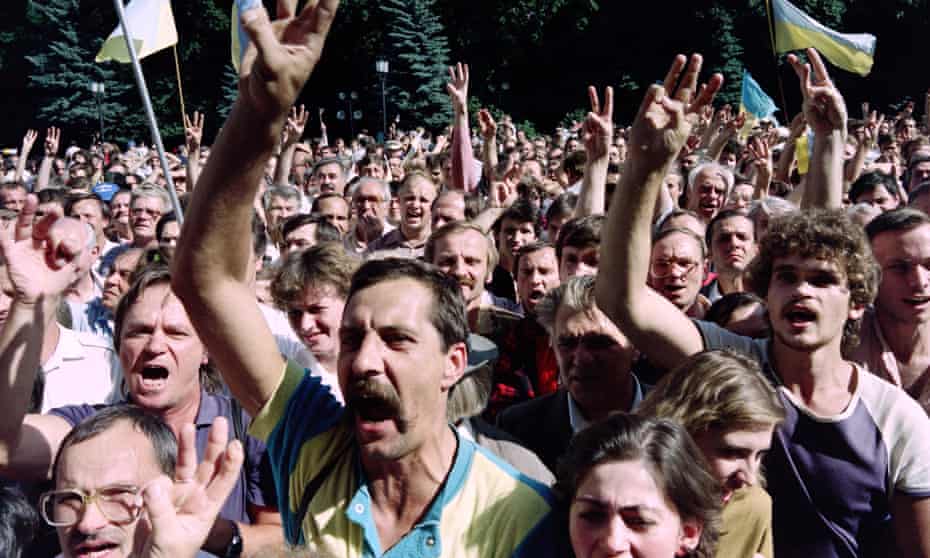
Pro-independence demonstrators at a rally in central Kyiv in 1991
Pro-independence demonstrators at a rally in central Kyiv in 1991. Photograph: Anatoly Sapronenkov/AFP/Getty Images

How the country has transformed from a Russian client state to a would-be EU nation where liberals and nationalists have found common cause

Ukraine has been an independent country for more than half Vladimir Putin’s adult life (he turns 70 this year). It’s been a free republic for more than 30 years, long enough for the first generation of Ukrainians born since independence to have school-age children of their own. It’s had seven different leaders, all of them still alive.

It would be sentimental – and patronizing – to talk about a country having “grown up”. But 30 years is long enough for countries to change, for better or for worse; long enough for countries to have eras. Ukraine was well into its second era, its European era, when Putin invaded last month. Putin never accepted the right of post-Soviet Ukraine to exist in independent Ukraine’s first era. In terms of understanding the country, that’s the period he’s stuck in; Putin doesn’t acknowledge that a second era began.

The west shares many of the Kremlin’s misapprehensions about Ukraine. We are still too ready to see the country through the cliche of a “nationalist, Ukrainian-speaking” west and a “Russia-friendly, Russian-speaking” south and east. Or, more crudely and colourfully, neo-communist miners in the east, neo-Nazis in the west. Of course it was never that simple, even in post-Soviet Ukraine. But European-era Ukraine, which emerged in 2014, overturned its own political fundamentals. Faced with an existential struggle against a powerful, ruthless neighbour, Russia, where nationalism now serves autocracy, an emergent class of Ukrainian liberals made common cause with Ukrainian nationalists. It’s been an uncomfortable alliance but it has kept the country together. As Ukraine defends itself against Putin’s terror campaign, mutually estranged liberals and nationalists in other countries – the US, England, France – would do well to watch.

To talk about “European Ukraine” isn’t to describe an achieved state but a state of hope: hope of membership in the European Union – more meaningful to Ukraine, at least until Russia attacked, than membership of Nato.

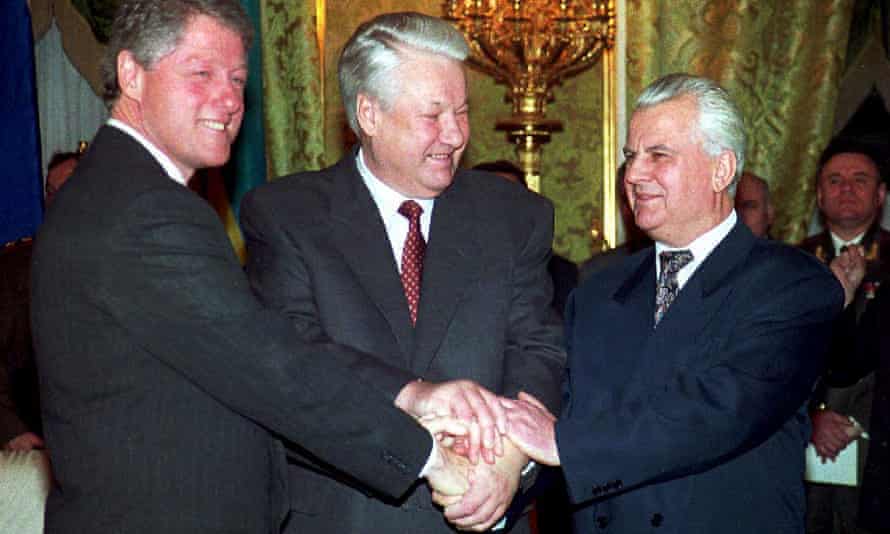
Bill Clinton, Boris Yeltsin and Ukraine’s Leonid Kravchuk after signing a nuclear disarmament agreement in the Kremlin in 1994.
Bill Clinton, Boris Yeltsin and Ukraine’s Leonid Kravchuk after signing a nuclear disarmament agreement in the Kremlin in 1994. Photograph: Sergei Supinsky/AFP/Getty Images

Advertisement

Ukraine’s hope of Europe had its material side, a hope of grants, jobs and trade. Since the “revolution of dignity” – also known as “Maidan” – in 2014, trade with the EU soared while trade with Russia plunged. More than a million Ukrainians went to work, legally or otherwise, in the EU. Since Russia invaded Ukraine on 24 February, much has been made in Britain of the EU’s openness to Ukrainian refugees compared with the barriers put up by London. But it’s a depressing reflection of how mainstream anti-immigrant assumptions have become in the UK that virtually no one in Britain is aware the EU gave Ukrainians visa-free access years ago, as a reward for their country’s sacrifices in Europe’s name. Since 2017, as a result of that and of Brexit, Ukrainians have levelled up and Britons levelled down to identical rights of EU entry: 90 days’ stay without a visa.

Beyond the material hopes of European-era Ukraine, there is the prospect, less tangible and more powerful, of an alternative form of nationhood. Rather than the archaic, romantic, racial mystifications of old Ukrainian nationalism, or Putin’s neo-imperial vision of Ukraine pulverised and remade as a puppet state to serve Russian nationalism, it’s of Ukraine pursuing its free course as an equal member of a self-constraining, self-governing association of countries, the EU.

The beauty of the EU, for Ukraine, is the capaciousness of its model for both liberals and nationalists. In some ways, the aims of European-era Ukraine closely resemble those of the Scottish National party and the Irish republic: to use the economic power of the EU to leverage their own, to break out of the orbit of a delusional post-imperial culture, to find national self-determination by accepting multinational rules. As Tom Nairn wrote of Scotland, a country could aspire to “a new interdependence where our nationhood will count, rather than towards mere isolation”.

For Ukraine’s more conservative nationalists, it’s Poland and Hungary that offer the more appealing EU models – stridently patriotic, subordinating media, courts and education to national ideals and social conservatism, all while getting subsidies and trading freely within the EU.

The prelude to Ukraine’s European era occurred in 2013 under president Viktor Yanukovych, a profoundly corrupt politician from the east of the country. Although seen as a proxy for Kremlin interests, and generally loyal to the idea of post-Soviet Ukraine as a Russian client state, he threw his weight behind an association agreement with the EU. He had his country on side, but Putin gave it to be understood that he considered it a betrayal – Ukraine could partner with the EU or Russia, not both.

Whether Yanukovych was genuinely up for the deal with Brussels, or simply angling for a bigger bung from Moscow, he changed his mind at the last minute, took a large loan from Putin and turned his back on the EU.Advertisement

It was November. Protests began in Kyiv against abandonment of the EU deal. There were calls for Yanukovych to resign. Small, peaceful protests were put down violently by the police. Parliament, then controlled by Yanukovych allies, passed repressive laws against free speech and gatherings. As 2013 passed into 2014, the protests grew, their demands expanded and their base spread. Opposition to Yanukovych and calls for deeper ties to Europe evolved into attacks on the entire corrupt, oligarchic system of business and government.

Young members of the liberal intelligentsia were joined by radical nationalist groups, by small-business owners and by factory workers. Opposition MPs aligned themselves with the protesters. Increasingly violent street battles were waged around Kyiv’s central square, Maidan Nezalezhnosti. Barricades went up. Weapons escalated from clubs and stones and shields to molotov cocktails, to stun grenades and rubber bullets, to actual bullets. Some police were shot; more than 100 protesters were killed.

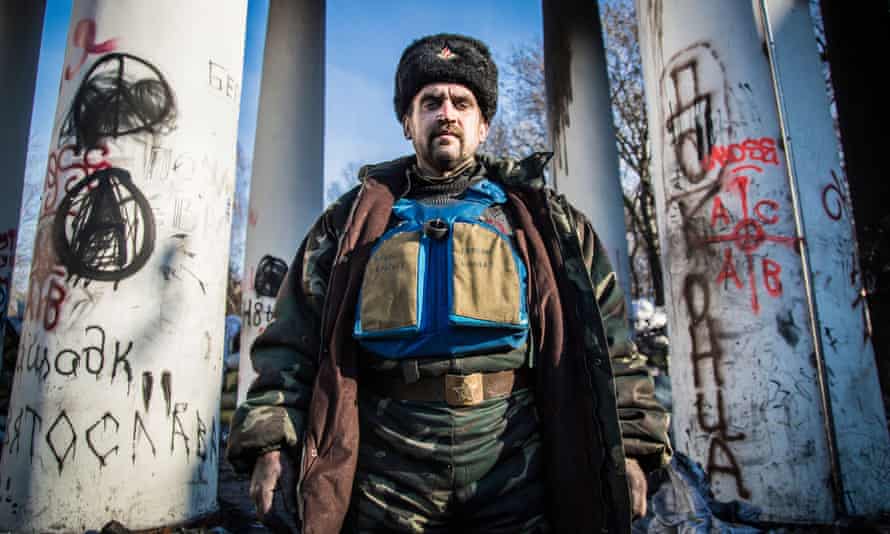
A protester in 2014
In 2014, protests erupted in Kyiv’s Maidan Square over the government’s withdrawal from EU talks. More than 100 were killed; president Viktor Yanukovych fled to Russia. Photograph: Getty Images

In the third week of February, for reasons still mysterious – perhaps because the security forces ceased to believe in the president – the regime collapsed. European foreign ministers brokered a peace deal with Yanukovych, the Maidan crowd refused to accept it, and Yanukovych fled the country. Parliament voted in an interim government and prepared for new elections.

Barely had the revolutionaries’ victory sunk in before Russia annexed Crimea in a nearly bloodless coup de main. In Yanukovych’s home region of Donbas, on the border with Russia, locals angry at the treatment of their lawfully elected president seized administrative buildings. They were quickly ousted, only to be replaced, in April, by a new wave of rebels helped by volunteers from Russia. Fighting escalated to a full-scale war, culminating in incursions by regular Russian troops. Thousands of people were killed. By 2015, the front lines had stabilised and fighting lessened, with part of Donbas under joint Russian-rebel control. The rest of Ukraine was at peace. In 2017, the association agreement with the EU came into force.Advertisement

Even before the war in the Donbas began, there were warnings of what the longer term held. In what reads now as an astonishingly accurate forecast of what was to come, in an interview with a Ukrainian paper in March 2014, the former Putin adviser Andrei Illarionov spelled it out, failing only to predict that eight years would pass first. “There’s an aim and a plan to attack Ukraine which was put together years ago,” he said. It has many different elements … Crimea, the south-east and, of course, a change of power in Kyiv. And then there are other things: a new [Ukrainian] constitution, to be written in the Kremlin, disarmament of the Ukrainian people, liquidation of Maidan, and so on.”

“Liquidation of Maidan” sounds different from the current Kremlin programme, until you realise this is simply “denazification” by another name.


It might seem trivial now, when Ukraine is on fire and hundreds are being killed every day, when all that seems important is how many Russian tanks and planes and soldiers the Ukrainians have to blow up to make Putin stop, to talk about abstractions like nationalism and liberalism. And yet without these forces coming together over the past seven years of semi-peace, would Ukraine have held out this long?

I remember being surprised, when I visited Kyiv at the end of February 2014, to see how focused liberals and nationalists alike were on a European future. The spokesman for one of the most notorious radical nationalist groups, Right Sector, talked to me about Poland as a model for the country. European flags were everywhere. I went for dinner one evening with a friend of a friend, a successful businesswoman. The Maidan was very localised; a huge encampment of brown tents crowded together, wreathed in the smoke of hundreds of stoves, in which exhausted people, who had fought nightly battles in freezing conditions, lived difficult lives away from home. But right next door to it were expensive restaurants with waiters in spotless white shirts serving fine wines and tuna carpaccio. “You know, the nationalists were very important,” said the businesswoman, sipping her grenache. “They did very good work at the leading edge.”

I’ve always been in two minds about that conversation with someone who had been very kind to me. On the one hand, it had that air of somebody being grateful that somebody else was doing their dirty work; that one person had education, good taste and proper gentle sentiments, and they were grateful that their interests were being protected by another person who risked their life with a petrol bomb and a brick, and whose most conservative, chauvinist views the first person would definitely not want to hear at their dinner table in peacetime. On the other hand, my friend’s friend was being honest about the realities of a dangerous situation, and resistance towards a nasty, increasingly repressive regime: that she was not one of nature’s fighters, and she was glad to have people prepared to fight for their country on her side. “Nationalist” and “liberal”, after all, are words with an extremely broad range of meanings.

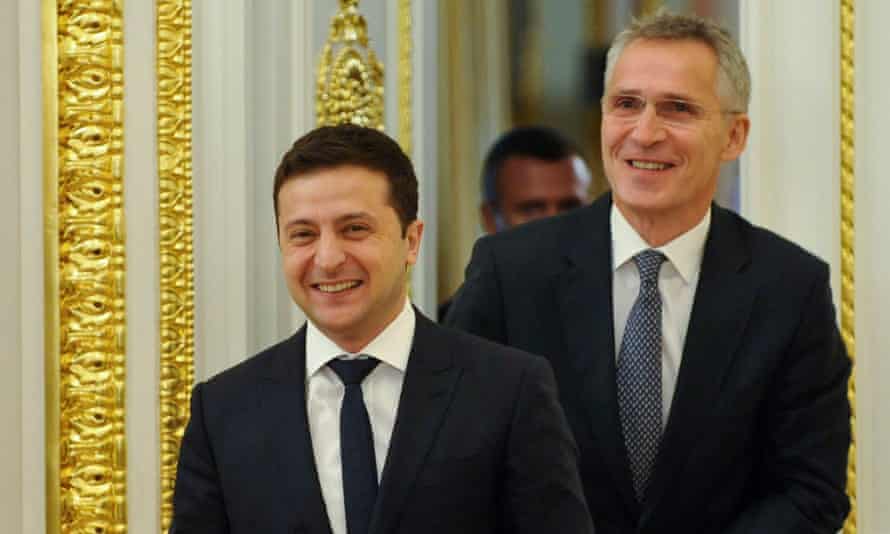
President Volodymyr Zelenskiy and Nato secretary general Jens Stoltenberg meet in Kyiv as Ukraine decides to pursue Nato as well as EU membership.
President Volodymyr Zelenskiy and Nato secretary general Jens Stoltenberg meet in Kyiv as Ukraine decides to pursue Nato as well as EU membership. Photograph: Sergei Chuzavkov/Shutterstock

“For me, ‘national’ is what allows me to defend Ukraine as an independent, sovereign nation,” said the Ukrainian philosopher Evhen Bistritsky in 2018, at a time when disillusionment with Ukraine’s post-Maidan failures to get to grips with corruption and institutional inertia was running deep.

“I am a liberal, defending the independence of Ukraine. Part of Ukrainian society supports conservative values, linking them to security. If we’re really only going to preach universal, classical, liberal values … we promote discord in the country.”

In a country not fighting for its existence, in the US, perhaps, or Britain, or France, in some safe part of the EU, such language would have marked Bistritsky out as a centrist, a moderate, even, more pejoratively, an undemocratic compromiser. In the present Ukrainian context, faced with the Russian killing machine, “discord” becomes “failure to fill the ranks”.

Recently the Ukrainian writer Artem Chekh published Absolute Zero, his memoir of service in the Ukrainian army on the Donbas front in 2015. In it he faces up to the strangeness of being a liberal, cosmopolitan, intellectual man serving alongside workers and farmers who see the world in patriotic, if cynical, absolutes. I went around to his flat in Kyiv a few weeks ago for coffee and cake. Now he has taken up a gun again to protect the city against the invader. In an article for the London Review of Books blog, he lists his comrades: “a music producer, an owner of a household chemicals store, a teacher, an artist, a bank clerk, a former investigator, a doctor. The ability to write, paint, act, play a musical instrument or dance doesn’t matter now. What counts is military experience.”

Ukraine ‘temporarily’ loses access to Sea of Azov – Defense Ministry

Reuters

Ukraine ‘temporarily’ loses access to Sea of Azov – Defense Ministry

March 18, 2022

FILE PHOTO: Ships are seen near the Azov Sea port of Mariupol

(Reuters) – Ukraine’s defence ministry said late on Friday it lost access to the Sea of Azov “temporarily” as invading Russian forces were tightening their grip around the Sea’s major port of Mariupol.

“The occupiers have partially succeeded in the Donetsk operational district, temporarily depriving Ukraine of access to the Sea of Azov,” Ukraine’s defence ministry said in a statement.

The ministry did not specify in its statement whether Ukraine’s forces have regained access to the Sea.

Russia said on Friday its forces were “tightening the noose” around Mariupol, where an estimated 80% of the city’s homes had been damaged more some 1,000 people may still be trapped in makeshift bomb shelters beneath a destroyed theatre.

Mariupol, with its strategic location on the coast of the Sea of Azov, has been a target since the start of the war on Feb. 24 when Russian President Vladimir Putin launched what he called a “special military operation”.

The city lies on the route between the Russian-annexed peninsula of Crimea to the west, and the Donetsk region to the east, which is partially controlled by pro-Russian separatists.

Russia claimed as early as March 1 that its forces had cut off the Ukrainian military from the Sea of Azov.

(Reporting by Lidia Kelly; Editing by Kenneth Maxwell)

Putin replaced 1,000 personal staff members in February over fears they would poison him, report says

Business Insider

Putin replaced 1,000 personal staff members in February over fears they would poison him, report says

Jake Epstein – March 18, 2022

Russian President Vladimir Putin attends the opening ceremony of the 2022 Winter Olympics in Beijing
Vladimir Putin.Alexei Druzhinin/Getty Images
  • Putin replaced 1,000 personal staff members in February over fears they would poison him.
  • The Daily Beast reported that those sacked included bodyguards, cooks, launderers, and secretaries.
  • A French agent said an attempted assassination would come from within the Kremlin.

Russian President Vladimir Putin replaced about 1,000 personal staff members in February over fears that they would poison him, a report said.

Those sacked included bodyguards, cooks, launderers, and secretaries, The Daily Beast reported on Wednesday, citing a Russian government source.

February was marked by US and Western officials repeatedly warning that Russia was preparing to stage a pretext to justify waging war against Ukraine after it spent months gathering troops along their shared border.

As much of the world has condemned Russia’s ongoing bombardment of Ukraine, an operative for France’s General Directorate for External Security told The Daily Beast that carrying out an attempted assassination of Putin “is on every intelligence agency’s design table.”

South Carolina Sen. Lindsey Graham has even called for Putin’s assassination, drawing criticism from fellow Republican lawmakers.

“The only way this ends is for somebody in Russia to take this guy out,” Graham tweeted earlier in March. “You would be doing your country — and the world — a great service.”

The operative told The Daily Beast that an attempted assassination wouldn’t be the job of a foreign government.

“The attempt will be from within the Kremlin,” the operative said. “Russian intelligence is likely the only one left that deploys poison as a default” to assassinate people.

Poison as a killing tool is not unheard of in Russia. Alexei Navalny, the prominent Kremlin critic, was poisoned with the Soviet-era nerve agent Novichok in Siberia in August 2020, and Putin has been widely accused of ordering the attack.