Russia’s staggering losses over 3 weeks of Ukraine fighting already exceed entire wars
Julie Coleman and Alex Ford – March 19, 2022
Smoke rises from a Russian tank destroyed by the Ukrainian forces on the side of a road in Lugansk region.
7,000 Russian troops have been killed in battle, according to a US intelligence estimate.
Russian troop deaths are already more than the number of American troops killed in either the Iraq or Afghanistan wars.
At this rate, Russia is suffering what could soon be unsustainable losses.
In the three weeks since Russia launched its war against Ukraine, the fighting has taken a heavy toll on both sides and the civilians trapped in cities like Kharkiv and Mariupol, where authorities are trying to rescue 1,300 people who had sheltered in a theater that was attacked.
The toll also appears to be huge and mounting for Russia’s military.
Seven thousand Russian troops have been killed in battle so far, according to a US intelligence estimate reported by the New York Times, and that’s a conservative estimate. Four Russian generals have died and the Times reported on March 16 that between 14,000 and 21,000 Russians troops had been injured.
By this estimate, Russian military deaths are now much higher than the number of American troops killed in either the Iraq or Afghanistan wars, at 4,825 and 3,576 respectively.
The Russian casualties appear to be of a scale similar to those at Iwo Jima — one of the bloodiest battles in Marine Corps history – where about 6,852 US troops died and around 19,000 were injured in five weeks of fighting against an entrenched Japanese force, which sustained an estimated 18,000 dead and missing.
If Russian forces were to continue losing troops at this rate, in a year about 121,000 Russian troops would be dead, with injured likely to be three or four times higher — suggesting Russia’s offensive must break the Ukrainian resistance or suffer unsustainable losses. That toll, for example, would be higher than American casualties during the Korean War, where 36,576 Americans died over the course of three years.
Ukraine’s military has also suffered heavy losses, likely to be much higher than the 1,300 troops Ukraine has confirmed as killed.
Some Russians are breaking through Putin’s digital iron curtain – leading to fights with friends and family
Cat Zakrzewski and Gerrit De Vynck – March 19, 2022
BRAZIL – 2021/10/20: In this photo illustration, the Virtual Private Network (VPN) is seen displayed on a smartphone. This type of connection establishes safe internet browsing, making your location invisible. (Photo Illustration by Rafael Henrique/SOPA Images/LightRocket via Getty Images) (SOPA Images via Getty Images)
Days after Russian tanks rolled into Ukraine, Maria, a 37-year-old mother in western Russia, downloaded a virtual private network, an effort to circumvent the blockade she saw descending across the country’s Internet.
The instinct proved correct. As the Kremlin began reversing years of relative Internet freedom and restricting American social networks and Western news sites, the VPN proved a lifeline, allowing her to chat with a friend in the United States and read updates on Facebook and Instagram, refreshing news about the war every 10 to 20 minutes. Maria thinks the conflict is a “tragedy” and says reading about it leaves her with “anger, sadness and empathy.”
But Maria says her mother believes what she sees on Russian-state run television, where the Russian invasion is portrayed as a righteous military campaign to free Ukraine from Nazis. The different visions have led to bitter arguments, and after one that left her mother in tears, Maria vowed to stop talking to her about the war.
Some Russians – often with social, educational or professional ties to the United States and Western Europe – are trying to pierce Russian President Vladimir Putin’s propaganda bubble, at times leaving them at odds with their own families, friends and co-workers. The war in Ukraine is only deepening the divide that was already present between young, tech-savvy people and an older generation who gets their news mostly from TV and has always been more comfortable with Putin’s vision of the country.
Nearly 85% of the country’s population is online, according to data from the World Bank. But only some of those people use American social networks. In 2022, about half of Russian Internet users were on Instagram, and only a fraction were on Facebook and Twitter, according to data from research firm eMarketer.
Many Russians who go online have come to rely on a range of digital tools to outmaneuver Russian censors. They seek out independent news about the war online, splitting them from others whose information comes from government propaganda that floods TV, government-backed websites and large swaths of social networks that remain unrestricted, like Telegram or VK, which are home to many pro-government groups.
This ideological gulf was reflected in interviews with a half-dozen people in Russia, who in most instances spoke on the condition of anonymity to avoid violating the country’s fake news law.
“Shock, hatred and depression,” are the words Mikhail Shevelev, a Moscow-based journalist, uses to describe the “very serious” and “drastic” divide that has emerged between people reading independent online sources and those who primarily get their news from TV.
“It’s really difficult for anyone – even Russians who do not live in Russia – to understand the scale of absolutely illogical perceptions of information and outright lies,” he said.
Older Russians make up the primary viewership of Russia’s state television news, which has been flooded with reports of fake U.S. biowarfare labs and Ukrainian “Nazis.”
At the same time, Putin is using increasingly advanced censorship technology. In addition to the recent restrictions on Facebook and Twitter, Russia has blocked the websites of many major Western media outlets, including Britain’s BBC and Germany’s Deutsche Welle. In response to sanctions and public pressure, major tech companies including Apple, Microsoft and Amazon have suspended some sales and services in the country, further contributing to what’s being called a “digital iron curtain.”
Still, Russians seem determined to get around the restrictions. According to the digital intelligence firm Sensor Tower, the top five VPNs in Apple’s App Store and the Google Play store were downloaded 6.4 million times between Feb. 24 and March 13. In the three weeks before Russia invaded Ukraine, the same VPN apps were downloaded only 253,000 times.
Independent Russian media organizations, which have moved their reporters outside of the country, still report some of what’s happening in Ukraine, and there are still some discussions happening on community groups on VK, Russia’s most popular social media network, according to Russians who spoke to The Washington Post. Some Russians are also finding independent news on Telegram and YouTube, which Russia has not yet blocked.
Alexander, a tech worker from Moscow in his 20s, said he’s aware of people who’ve unfriended each other online, writing posts about how they’ll never shake a certain person’s hand again because of their opinion on the war. “My aunt, she stopped talking to a few of her friends whom she knew for ages,” he said.
Bot accounts, widely assumed to be run by government employees, muddy the picture by commenting and posting pro-government messages on VK, said Daria, a Moscow resident in her 20s. “It’s sometimes difficult to distinguish a bot from a genuine government supporter.”
Some Russians who use VPNs are finding the posts and arguments around the war too intense and are pulling back.
Lucy, a 29-year-old designer from the North Caucasus region in Russia, said she has cut back on using Instagram because of angry comments against Russians. She has relatives in Ukraine who’ve had to flee the Russian attack, and said she is half Ukrainian herself. But the heated environment online has pushed her away from engaging on social media.
“At the beginning, I empathized a lot with them. I might not be there, but as I’m a very sensitive person I can feel the pain they’re going through,” she said. As the war progressed, she began getting death threats online, and she unfollowed many of the Ukrainian accounts she had been following. “It’s very hard to be blamed for something you don’t do personally,” Lucy said.
Other young Russians said these online attacks on Russians are pushing some toward a more pro-war position in line with the government. One channel on Telegram was full of memes and posts decrying “Russophobia,” and saying that Western countries were supporting Ukraine out of hatred against Russians.
One pro-government Telegram group, with over 110,000 subscribers, posted a video of what it claimed were volunteers heading to Ukraine to help with the invasion. “We don’t need the whole world with us, dear friends. It is enough if all the Russian peoples are with us,” read the caption under the video.
Putin’s years-long campaign to tighten his grip on Russia’s once-open information ecosystem intensified in November 2019, when the country’s “sovereign Internet” law came into force. That law required Internet providers in Russia to install government-issued black boxes on their premises that would enable the government to control Web traffic by giving the Russian government the power to slow a site from loading or block it entirely.
Some people in Russia are also turning to Tor, an open source system that enables anonymous communications, to visit services. Twitter and Facebook have built versions of their platforms that work with the software. Artem Kozliuk, head of the Russian digital rights group Roskomsvoboda, said that he and others in the country are navigating an increasingly complex mix of VPNs and special browser plug-ins to access basic information on both their laptops and phones. His organization is putting together a guide to help people navigate the different services.
“Now information goes through many proxy systems, through many obstacles before it reaches users,” he said.
Despite the surge in VPN interest, the Kremlin’s crackdown has made many fearful of sharing their political views online. And the two-tier information system continues to rule Russian opinion.
“A huge number of Russians, including me, don’t comment and don’t share their opinion on social media in any way,” Daria said. “People who watch television do believe that there are no civilian casualties and our government only fights against nationalists who oppress Russians living in Ukraine . . . People who read and watch government-controlled sources aren’t exposed to pictures of destroyed cities and fleeing Ukrainians.”
Ilya Yablokov, a lecturer at the University of Sheffield who studies the Russian Internet, said he believes Russia’s censorship abilities so far have allowed the government to succeed in controlling the narrative inside the country’s borders. But that may not always be the case
“It’s the control of power, it’s the control of narrative, it’s the control of population,” he said. “The question is for how long are they going to be winning?”
– – –
The Washington Post’s Heather Kelly and Craig Timberg contributed to this report.
The event was held at Luzhniki Stadium in the center of Moscow. Attendees wore the Russian colors of red, white and blue. “We don’t abandon our own,” one slogan adorning the stadium said, in a seeming echo of the message that an embittered Putin delivered on Wednesday, when he castigated Russians who either have fled to or are siding with the West in protest of the war in Ukraine.
“For Russia” and “For a World Without Nazism,” read other slogans hanging in the packed stadium on the banks of the Moscow River, as Putin’s unprovoked assault on Russia’s sovereign neighbor enters its fourth week.
Russian President Vladimir Putin delivers a speech on Friday at Luzhniki Stadium in Moscow. (RIA Novosti Host Photo Agency/Alexander Vilf via Reuters)
He invoked Russia’s proud military history and its defeats of both Hitler and Napoleon. Its military record has been tarnished more recently by corruption, incompetence and abuse, all of which have become evident during the Ukrainian campaign.
“Shoulder to shoulder. They help, support each other. And if needed, they take a bullet on the battlefield — as if for their own brother,” Putin told the flag-waving rally attendees. “We haven’t seen such unity in a long time.”
At one point, the video feed of the Moscow rally — which included musical performances and a reading of patriotic poetry — was interrupted, with the live feed replaced by recorded footage. According to a social media post from RIA Novosti, the state-owned wire service, the disruption was caused by a server malfunction.
People watch a broadcast of Putin’s speech outside the stadium. (RIA Novosti Host Photo Agency/Vladimir Astapkovich via Reuters)
The rally was called “Crimean Spring,” in reference to the eighth anniversary of Putin’s invasion of the Black Sea peninsula of Crimea, which was originally part of Ukraine. Whereas that 2014 campaign, which also saw Putin invade two eastern provinces, did not encounter significant resistance or a united international response, the war in Ukraine has gone poorly for Russia, leading some to wonder if Putin badly miscalculated sentiment both at home and abroad.
Putin continued to claim that his invasion of Ukraine was necessary to prevent “genocide,” which the U.S. had predicted he would use as a pretext for the assault.
According to the United Nations, more than 700 civilians have been killed since Russia launched the invasion on Feb. 24.
Ukraine’s Mariupol says Russia forcefully deported thousands of its people
March 19, 2022
FILE PHOTO: A view shows a damaged residential building in the besieged city of Mariupol
(Reuters) – The city council of Ukraine’s Mariupol said Russian forces forcefully deported several thousand people from the besieged city last week, after Russia had spoken of “refugees” arriving from the strategic port.
“Over the past week, several thousand Mariupol residents were deported onto the Russian territory,” the council said in a statement on its Telegram channel late on Saturday.
“The occupiers illegally took people from the Livoberezhniy district and from the shelter in the sports club building, where more than a thousand people (mostly women and children) were hiding from the constant bombing.”
Reuters could not independently verify the claims.
Russia’s Defence Ministry said busses carrying people it called refugees from Mariupol began to arrive to Russia on Tuesday, Russian news agency RIA Novosti reported last week. The ministry was not immediately available to comment on the Mariupol city council’s claims.
Some 400,000 people have been trapped in Mariupol, on the Sea of Azov, for more than two weeks, sheltering from heavy bombardment that has severed central supplies of electricity, heating and water, according to local authorities.
The Russian TASS news agency reported on Saturday that 13 busses were moving to Russia, carrying more than 350 people, about 50 of whom were to be sent by rail to the Yaroslavl region and the rest to temporary transition centres in Taganrog, a port city in Russia’s Rostov region.
Russia’s Defence Ministry said this month that Russia had prepared 200 busses to “evacuate” Mariupol citizens.
RIA Novosti agency, citing emergency services, reported last week that nearly 300,000 people, including some 60,000 children, have arrived in Russia from the Luhansk and Donbas regions, including from Mariupol, in recent weeks.
Russia’s Defence Ministry said this month that more than 2.6 million people in Ukraine have asked to be evacuated.
Reuters could not immediately verify those reports.
Mariupol, a key connection to the Black Sea, has been a target since the start of the war on Feb. 24, when Russian President Vladimir Putin launched what he calls a “special military operation” to demilitarise and “denazify” Ukraine. Ukraine and the West say Putin launched an unprovoked war of aggression.
As Russia has sought to seize most of Ukraine’s southern coast, Mariupol has assumed great importance, lying between the Russian-annexed peninsula of Crimea to the west and the Donetsk region to the east, which is partially controlled by pro-Russian separatists.
(Reporting by Lidia Kelly; Editing by William Mallard)
Russian military slog in Ukraine a ‘dreadful mess’ for Putin
Ellen Knickmeyer – March 18, 2022
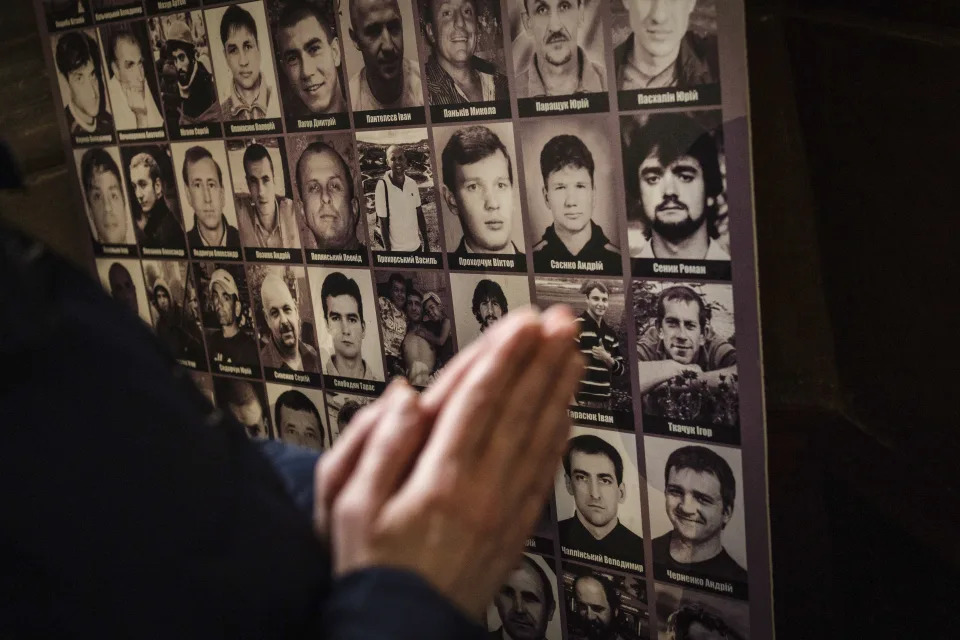
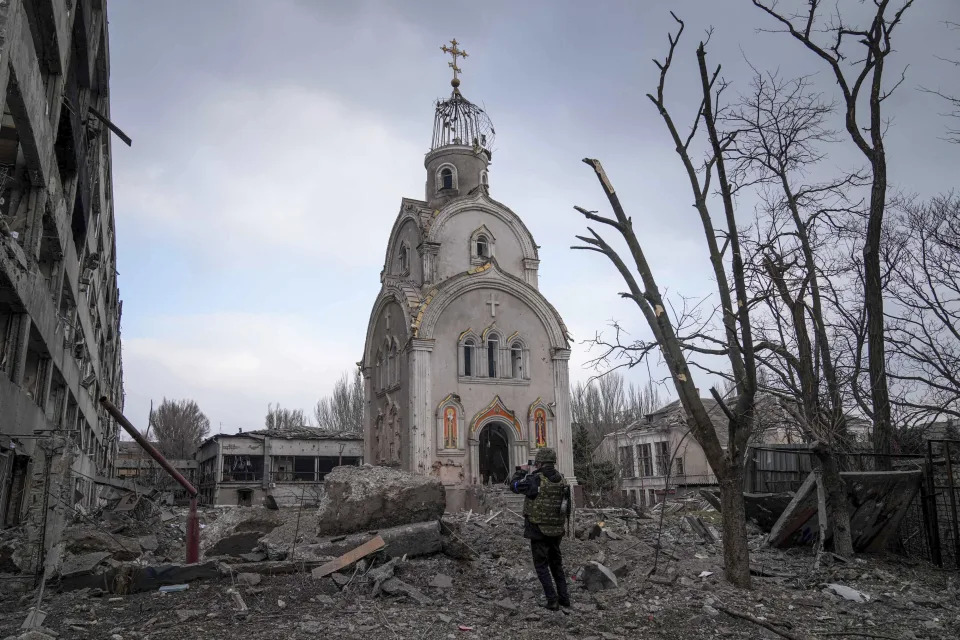
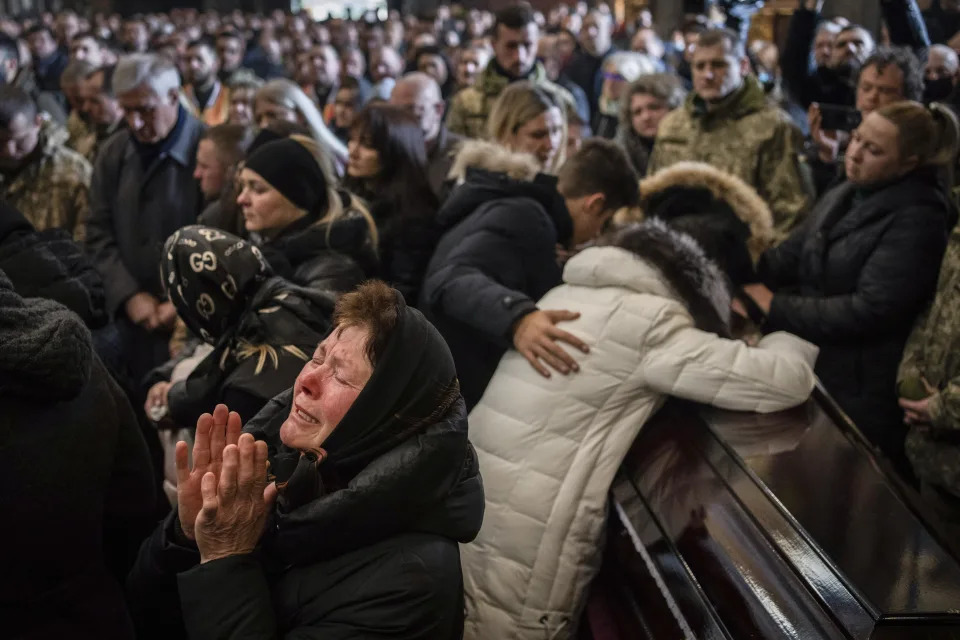
FILE – A Ukrainian Territorial Defence Forces member holds an NLAW anti-tank weapon, in the outskirts of Kyiv, Ukraine, March 9, 2022. (AP Photo/Efrem Lukatsky, File) ASSOCIATED PRESSFILE – Cars drive past a destroyed Russian tank as a convoy of vehicles evacuating civilians leaves Irpin, on the outskirts of Kyiv, Ukraine, March 9, 2022. (AP Photo/Vadim Ghirda, File) ASSOCIATED PRESSFILE – A Christian worshiper prays in front of pictures of fallen soldiers at the Saints Peter and Paul Garrison Church in Lviv, western Ukraine, March 6, 2022. The memorial is dedicated to Ukrainian soldiers who died after 2014. (AP Photo/Bernat Armangue, File) ASSOCIATED PRESSFILE – A Ukrainian serviceman takes a photograph of a damaged church after shelling in a residential district in Mariupol, Ukraine, March 10, 2022. (AP Photo/Evgeniy Maloletka, File) ASSOCIATED PRESSFILE – Apartments damaged by shelling, in Kharkiv, Ukraine, March 13, 2022. (AP Photo/Andrew Marienko, File) ASSOCIATED PRESSFILE – Relatives and friends attend a funeral ceremony for four of the Ukrainian military servicemen, who were killed during an airstrike in a military base in Yavoriv, in a church in Lviv, Ukraine, March 15, 2022. (AP Photo/Bernat Armangue, File) ASSOCIATED PRESSFILE – Khreshchatyk, one of the main streets in Kyiv, Ukraine, empty due to curfew, March 1, 2022. (AP Photo/Emilio Morenatti, File) ASSOCIATED PRESSRussia Ukraine War The Grind FILE – An elderly woman is assisted while crossing the Irpin river on an improvised path under a bridge, that was destroyed by Ukrainian troops designed to slow any Russian military advance, while fleeing the town of Irpin, Ukraine, March 5, 2022. (AP Photo/Vadim Ghirda, File) ASSOCIATED PRESS
A truck carrying Russian troops crashes, its doors blown open by a rocket-propelled grenade. Foreign-supplied drones target Russian command posts. Orthodox priests in trailing vestments parade Ukraine’s blue and yellow flag in defiance of their Russian captors in the occupied city of Berdyansk.
Russia has lost hundreds of tanks, many left charred or abandoned along the roads, and its death toll is on a pace to outstrip that of the country’s previous military campaigns in recent years.
Yet more than three weeks into the war, with Putin’s initial aim of an easy change in government in Kyiv long gone, Russia’s military still has a strong hand. With their greater might and stockpile of city-flattening munitions, Russian forces can fight on for whatever the Russian president may plan next, whether leveraging a negotiated settlement or brute destruction, military analysts say.
Despite all the determination of Ukraine’s people, all the losses among Russia’s forces and all the errors of Kremlin leaders, there is no sign that the war will soon be over. Even if Putin fails to take control of his neighbor, he can keep up the punishing attacks on its cities and people. Ukraine’s president said Russia is trying to starve Ukraine’s cities into submission and that Putin is deliberately creating “a humanitarian catastrophe.”
“His instinct will be always to double down because he’s got himself into a dreadful mess, a huge strategic blunder,” said Michael Clarke, former head of the British-based Royal United Services Institute, a defense think tank.
“And I don’t think it’s in his character to try to retrieve that, except by carrying on, going forward,” he said.
At the start, Russians thought “they would install, you know, some pro-Russian government and call it a day and declare victory,” said Dmitry Gorenburg, a researcher on Russia’s security at the Virginia-based CNA think tank. “That was sort of Plan A, and as near as we can tell, they didn’t really have a Plan B.”
Russia’s first apparent plan — attack key Ukrainian military targets, and make a quick run to Kyiv, the capital — failed immediately. It was foiled by Ukraine’s defenses along with the countless mistakes and organizational failures by a Russian force that had been told it was only mobilized for military drills.
Clarke, the British researcher, related accounts of Russian troops selling communication equipment and fuel out of military vehicles to locals during the weeks they waited on Ukraine’s borders.
Putin’s forces are in position to capture the besieged port city of Mariupol. Overall, Russians appear to be fighting with three objectives now: to surround Kyiv, to encircle spread-out Ukrainian fighters in the east and to break through to the major port city of Odessa in the west, said Michael Kofman, an expert on the Russian military and program director at CNA.
Kofman cautions that much of the information on the war is coming from Ukrainians or from their American or other allies. That makes the partial picture skewed and a full picture impossible.
A senior U.S. defense official on Friday said the Russians have launched more than 1,080 missiles since the start of the war and that they retain about 90% of the combat power they had arrayed around Ukraine at the beginning of the invasion.
The U.S. assesses that the airspace over Ukraine remains contested, the official said, speaking on condition of anonymity to discuss the military assessments. The Ukrainian air force is continuing to fly aircraft and employ air and missile defenses..
“Just look at the map, and you just look at how little progress the Russians have been able to make,” Pentagon spokesman John Kirby said recently.
The math of military conquests and occupation may be against Putin in Ukraine.
Estimates of Russian deaths vary widely. Yet even conservative figures are in the low thousands. That’s a much faster pace than in previous Russian offensives, threatening support for the war among ordinary Russians. Russia had 64 deaths in five days of fighting during its 2008 war with Georgia. It lost about 15,000 in Afghanistan over 10 years, and more than 11,000 over years of fighting in Chechnya.
Russia’s number of dead and wounded in Ukraine is nearing the 10% benchmark of diminished combat effectiveness, Gorenburg said. The reported battlefield deaths of four Russian generals — out of an estimated 20 in the fight — signal impaired command, he said.
Researchers tracking only those Russian equipment losses that were photographed or recorded on video say Russia has lost more than 1,500 tanks, trucks, mounted equipment and other heavy gear. Two out of three of those were captured or abandoned, signaling the failings of the Russian troops that let them go.
Meanwhile, Russia needs to limit its use of smart, long-range missiles in case they’re needed in any larger war with NATO, military analysts say. On Saturday, the Russian military said it has used its latest hypersonic missile for the first time in combat, claiming that the Kinzhal, with a range of up to 2,000 kilometers (about 1,250 miles), destroyed an underground warehouse storing Ukrainian missiles and aviation ammunition.
When it comes to the grinding job of capturing and holding cities, conventional military metrics suggest Russia needs a 5-to-1 advantage in urban fighting, analysts say. Meanwhile, the formula for ruling a restive territory in the face of armed opposition is 20 fighters for every 1,000 people — or 800,000 Russian troops for Ukraine’s more than 40 million people, Clarke notes. That’s almost as many as Russia’s entire active-duty military of 900,000.
On the ground, that means controlling any substantial chunk of Ukrainian territory long term would take more resources than Russia could foreseeably commit.
Other Russian options remain possible, including a negotiated settlement. Moscow is demanding that Ukraine formally embrace neutrality, thus swearing off any alliance with NATO, and recognize the independence of the separatist regions in the east and Russian sovereignty over Crimea, which Russia annexed in 2014.
Russia’s other options include an unrelenting air campaign in which it bombs and depopulates cities as it did in Chechnya and Syria. U.S. officials also warn of the risk of Russian chemical attacks, and the threat of escalation to nuclear war.
“Unless the Russians intend to be completely genocidal — they could flatten all the major cities, and Ukrainians will rise up against Russian occupation — there will be just constant guerrilla war” if Russian troops remain, Clarke said.
——
Associated Press writer Lolita C. Baldor contributed to this report.
A satellite image shows Russian helicopters destroyed at Ukraine’s Kherson International Airport.
Ukraine’s military said the attack happened Tuesday. It is not clear how many helicopters were hit.
Ukraine said earlier this month that it destroyed 30 Russian helicopters in a different attack.
A satellite image shows destroyed Russian helicopters at a Ukrainian airport after an overnight attack.
The image, taken on Wednesday by a Maxar Technologies satellite, shows the aftermath of a Tuesday strike by Ukrainian forces at Kherson International Airport in the south of the country.
Ukraine’s military said it hit the airport on Tuesday. It is not clear what kind of weaponry was used in the attack, or how many helicopters were destroyed.
CNN reported on Tuesday that at least three Russian military helicopters were destroyed.
There is no indication of whether there were any casualties in the attack.
Ukraine previously said that it destroyed 30 Russian helicopters on a Kherson airfield on March 7.
Russia captured the city of Kherson on March 2. It was the first major Ukrainian city to be seized by Russia in its invasion, which it started on February 24.
Top ex-Kremlin official quits post after condemning Ukraine war
Arkady Dvorkovich, Russian economist – March 18, 2022
Russian Deputy PM Dvorkovich waits before annual state of nation address attended by Russian President Putin at Kremlin in Moscow
(Reuters) – A former Russian deputy prime minister who spoke out against the Kremlin’s actions in Ukraine has quit as chair of a prestigious foundation after a lawmaker accused him of a “national betrayal” and demanded his dismissal.
Arkady Dvorkovich, deputy prime minister from 2012 to 2018, became one of Russia’s most senior establishment figures to question the war when he told U.S. media this week that his thoughts were with Ukrainian civilians.
His comments prompted a senior ruling party lawmaker to demand that he be fired and to accuse him of being part of a “fifth column” undermining Russia.
The 49-year-old had been chairman since 2018 of the Skolkovo Foundation, an innovation and technology hub on the outskirts of Moscow that brands itself as a kind of Russian Silicon Valley.
On Friday, the Skolkovo Foundation said in a statement that Dvorkovich had decided to step down. He could not be reached immediately for comment. He remains president of the International Chess Federation (FIDE).
Igor Shuvalov, chairman of the foundation’s board of directors, said Dvorkovich had resigned, saying that he could no longer combine his duties at Skolkovo with his responsibilities at FIDE under the current circumstances.
Thousands of people have been detained for protesting against Russia’s Feb. 24 invasion of Ukraine, which officials in Moscow describe as a “special military operation” to demilitarise and “de-nazify” its former Soviet neighbour.
President Vladimir Putin on Wednesday delivered a stark warning to people he called “traitors” in Russia who he said the West wanted to use as a fifth column to destroy the country.
After his comments to Western media, Dvorkovich said in a statement on Skolkovo’s website that he was “sincerely proud of the courage of our (Russian) soldiers” and that Russia had been targeted by “harsh and senseless sanctions”.
But the following day, Andrei Turchak, a lawmaker from the ruling United Russia party, called for his sacking.
“He has made his choice,” Turchak said. “This is nothing but the very national betrayal, the behaviour of the fifth column, which the president spoke about today.”
What to know about the tiny, remote-controlled drones the U.S. is giving Ukraine
Bryan McBournie – March 18, 2022
Switchblade drones are among the military support items President Biden announced yesterday in an $800 million package for Ukraine.
Why it matters: Unlike the large drones the U.S. military uses for reconnaissance and deploying weapons against targets, these tiny Switchblades are themselves the weapon.
Why are Switchblade drones called “kamikaze drones”?
The Switchblade drones are sometimes called “kamikaze drones” because they act as single-use, remote-controlled bombs.
They are small and easily deployed, and are intended to hit targets that are outside the line of sight. They are launched out of a tube much like a mortar.
Once launched, the Switchblade drone can be controlled from the ground before striking its programmed target.
It has a feature that allows a service member to call off the strike should the target have moved away or civilians are in the area.
Manufacturer AeroVironment has two different models.
What is a Switchblade 300 drone?
The Switchblade 300 drone weighs 5.5 lbs. and is small enough to be transported in a rucksack.
It can fly for up to 15 minutes, with a range of just over six miles.
It has a cruising speed of 63 mph and top speed of 100 mph.
It’s designed for strikes on soldiers.
What is a Switchblade 600 drone?
The Switchblade 600 drone weighs 50 lbs. and fly for more than 40 minutes, with a range of about 25 miles.
It has a cruising speed of 70 mph and top speed of 115 mph, and it was designed for strikes on soldiers and tanks.
It’s not clear how many of each model are being sent in the support package.
What Turkish drones are in Ukraine?
Ukraine has used Turkish-made Bayraktar TB2s to launch guided missiles at Russian tanks, missile launchers and supply trains, according to the U.S. Department of Defense.
The Bayraktar TB2s are not considered to be particularly fast or stealthy.
But drones have had success against keeping Russian forces from securing air superiority.
The smaller, more easily deployed Switchblades are expected to be even more effective in the war.
What they’re saying: “These were designed for U.S. Special Operations Command and are exactly the type of weapons systems that can have an immediate impact on the battlefield,” said Mick Mulroy, former deputy assistant secretary of defense.
Putin replaced 1,000 personal staff members in February over fears they would poison him, report says
Jake Epstein – March 18, 2022
Vladimir Putin.Alexei Druzhinin/Getty Images
Putin replaced 1,000 personal staff members in February over fears they would poison him.
The Daily Beast reported that those sacked included bodyguards, cooks, launderers, and secretaries.
A French agent said an attempted assassination would come from within the Kremlin.
Russian President Vladimir Putin replaced about 1,000 personal staff members in February over fears that they would poison him, a report said.
Those sacked included bodyguards, cooks, launderers, and secretaries, The Daily Beast reported on Wednesday, citing a Russian government source.
February was marked by US and Western officials repeatedly warning that Russia was preparing to stage a pretext to justify waging war against Ukraine after it spent months gathering troops along their shared border.
As much of the world has condemned Russia’s ongoing bombardment of Ukraine, an operative for France’s General Directorate for External Security told The Daily Beast that carrying out an attempted assassination of Putin “is on every intelligence agency’s design table.”
South Carolina Sen. Lindsey Graham has even called for Putin’s assassination, drawing criticism from fellow Republican lawmakers.
“The only way this ends is for somebody in Russia to take this guy out,” Graham tweeted earlier in March. “You would be doing your country — and the world — a great service.”
The operative told The Daily Beast that an attempted assassination wouldn’t be the job of a foreign government.
“The attempt will be from within the Kremlin,” the operative said. “Russian intelligence is likely the only one left that deploys poison as a default” to assassinate people.
Poison as a killing tool is not unheard of in Russia. Alexei Navalny, the prominent Kremlin critic, was poisoned with the Soviet-era nerve agent Novichok in Siberia in August 2020, and Putin has been widely accused of ordering the attack.
Inside the cutting-edge Switchblade drones the U.S. is shipping to Ukraine
Niamh Cavanagh, Producer – March 18, 2022
On Wednesday. the White House announced a new $800 million military support package for Ukraine in a bid to help that country fight back against the ongoing Russian invasion. Part of the aid package is for cutting-edge aerial drones that experts say could prove exceedingly lethal to Russian forces.
Manufactured by the California company AeroVironment, the drones come in two variations: the Switchblade 600 and the 300. The latter is built to hit at smaller and more precise targets; the 600 is built to strike armored vehicles and tanks.
The 300 is less than 2 feet long, weighs 5.5 pounds and can fly up to 15 minutes. The larger drone weighs 50 pounds and can fly for 40 minutes over a range of 25 miles. Both can be carried in a backpack and deployed by individual soldiers. It has not been confirmed whether both models will be included in the shipment.
Switchblade 600 drone. (AeroVironment)
According to its manufacturer, the drones can cruise at around 65 mph and come fitted with cameras and GPS systems. They are single-use, which means they explode after striking their target and are not recoverable after they have been launched. The Switchblades also have a “wave-off” feature so that operators can abort a mission if civilians appear near the target or if the enemy withdraws.
“These were designed for U.S. Special Operations Command and are exactly the type of weapons systems that can have an immediate impact on the battlefield,” Mick Mulroy, a former deputy assistant secretary of defense, told ABC News.
Ukraine’s drones have proved vital in carrying out successful attacks in the early stages of the invasion. Jack Watling of the London-based Royal United Services Institute told Euronews that Ukraine had used drones to strike Russian forces before they were able to set up their air defenses in the battlefield.
Watling went on to say that the Ukrainian army drones “have been essentially flying in at a low level and then coming up and raiding with them. So striking targets of opportunity.”
A senior defense official confirmed the Switchblades’ effectiveness for Ukrainian forces by claiming that the drones would be useful in taking out long-range Russian artillery as Russia ramps up the bombardment of major cities in Ukraine.
An illustration of a Switchblade 600 drone launch. (AeroVironment)
On Friday, the Times of London reported that an elite Ukrainian drone unit had destroyed dozens of “priority targets” by attacking static Russian forces as they slept. That specialist unit within the army, named Aerorozvidka, has reportedly been striking vehicles, including tanks and trucks, since the invasion began on Feb. 24.
“We strike at night, when Russians sleep,” Yaroslav Honchar, the unit’s commander, said from his base in Kyiv.
The latest allocation of military aid came after Ukrainian President Volodymyr Zelensky called on the West to “do more” in the fight against Moscow’s aggression when he addressed Congress on Wednesday. In his speech, Zelensky invoked the horror of the 9/11 terror attacks as he pleaded for more military aid.