Ukraine War Threatens to Cause a Global Food Crisis

The New York Times

Ukraine War Threatens to Cause a Global Food Crisis

Jack Nicas – March 21, 2022
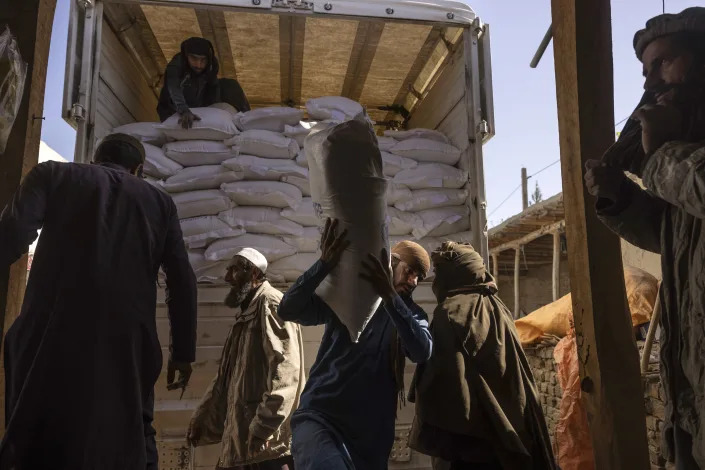
Laborers unload sacks of flour from a World Food Program convoy that traveled from Kabul to Afghanistan's Tagab district, Oct. 27, 2021. (Victor J. Blue/The New York Times)
Laborers unload sacks of flour from a World Food Program convoy that traveled from Kabul to Afghanistan’s Tagab district, Oct. 27, 2021. (Victor J. Blue/The New York Times)

The war in Ukraine has delivered a shock to global energy markets. Now the planet is facing a deeper crisis: a shortage of food.

A crucial portion of the world’s wheat, corn and barley is trapped in Russia and Ukraine because of the war, while an even larger portion of the world’s fertilizers is stuck in Russia and Belarus. The result is that global food and fertilizer prices are soaring. Since the invasion last month, wheat prices have increased by 21%, barley by 33% and some fertilizers by 40%.

The upheaval is compounded by major challenges that were already increasing prices and squeezing supplies, including the pandemic, shipping constraints, high energy costs and recent droughts, floods and fires.

Now economists, aid organizations and government officials are warning of the repercussions: an increase in world hunger.

The looming disaster is laying bare the consequences of a major war in the modern era of globalization. Prices for food, fertilizer, oil, gas and even metals like aluminum, nickel and palladium are all rising fast — and experts expect worse as the effects cascade.

“Ukraine has only compounded a catastrophe on top of a catastrophe,” said David M. Beasley, executive director of the World Food Program, the U.N. agency that feeds 125 million people a day. “There is no precedent even close to this since World War II.”

Ukrainian farms are about to miss critical planting and harvesting seasons. European fertilizer plants are significantly cutting production because of high energy prices. Farmers from Brazil to Texas are cutting back on fertilizer, threatening the size of the next harvests.

China, facing its worst wheat crop in decades after severe flooding, is planning to buy much more of the world’s dwindling supply. And India, which ordinarily exports a small amount of wheat, has already seen foreign demand more than triple compared with last year.

Around the world, the result will be even-higher grocery bills. In February, U.S. grocery prices were already up 8.6% over a year prior, the largest increase in 40 years, according to government data. Economists expect the war to further inflate those prices.

For those living on the brink of food insecurity, the latest surge in prices could push many over the edge. After remaining mostly flat for five years, hunger rose by about 18% during the pandemic to between 720 million and 811 million people. Earlier this month, the United Nations said that the war’s impact on the global food market alone could cause an additional 7.6 million to 13.1 million people to go hungry.

The World Food Program’s costs have already increased by $71 million a month, enough to cut daily rations for 3.8 million people.

“We’ll be taking food from the hungry to give to the starving,” Beasley said.

Rising prices and hunger also present a potential new dimension to the world’s view of the war. Could they further fuel anger at Russia and calls for intervention? Or would frustration be targeted at the Western sanctions that are helping to trap food and fertilizer?

While virtually every country will face higher prices, some places could struggle to find enough food at all.

Armenia, Mongolia, Kazakhstan and Eritrea have imported virtually all of their wheat from Russia and Ukraine and must find new sources. But they are competing against much larger buyers, including Turkey, Egypt, Bangladesh and Iran, which have obtained more than 60% of their wheat from the two warring countries.

And all of them will be bidding on an even smaller supply because China, the world’s biggest producer and consumer of wheat, is expected to buy much more than usual on world markets this year. March 5, China revealed that severe flooding last year had delayed the planting of a third of the country’s wheat crop, and now the upcoming harvest looks bleak.

“This year’s seedling situation can be said to be the worst in history,” said China’s agriculture minister, Tang Renjian.

Rising food prices have long been a catalyst for social and political upheavals in poor African and Arab countries, and many subsidize staples like bread in efforts to avoid such problems. But their economies and budgets — already strained by the pandemic and high energy costs — are now at risk of buckling under the cost of food, economists said.

Tunisia struggled to pay for some food imports before the war and now is trying to prevent an economic collapse. Inflation has already set off protests in Morocco and is helping stir renewed unrest and violent crackdowns in Sudan.

“A lot of people think that this is just going to mean that their bagels are going to become more expensive. And that’s absolutely true, but that’s not what this is about,” said Ben Isaacson, a longtime agriculture analyst with Scotiabank.

Since the 1970s, North Africa and the Middle East have grappled with repeated uprisings.

“What actually led to people going into the streets and protesting?” he said. “It starts from food shortages and from food price inflation.”

Countries afflicted by protracted conflict, including Yemen, Syria, South Sudan and Ethiopia, are already facing severe hunger emergencies that experts fear could quickly worsen.

In Afghanistan, aid workers warn that the humanitarian crisis has already been exacerbated by the war in Ukraine, making it more difficult to feed the roughly 23 million Afghans — more than half the population — who do not have enough to eat.

Nooruddin Zaker Ahmadi, director of Bashir Navid Complex, an Afghan imports company, said that prices were rising across the board. It took him five days in Russia this month to find cooking oil. He bought 15-liter cartons for $30 each and will sell them at the Afghan market for $35. Before the war, he sold them for $23.

“The United States thinks it has only sanctioned Russia and its banks,” he said. “But the United States has sanctioned the whole world.”

For the global food market, there are few worse countries to be in conflict than Russia and Ukraine. Over the past five years, they have together accounted for nearly 30% of the exports of the world’s wheat; 17% of corn; 32% of barley, a crucial source of animal feed; and 75% of sunflower seed oil, an important cooking oil in some parts of the world.

Russia has largely been unable to export food because of sanctions that have effectively cut it off financially. Ukraine, meanwhile, has been cut off physically. Russia has blocked the Black Sea for exports, and Ukraine lacks enough rail cars to transport food over land.

What is now becoming more worrisome is the next harvest, particularly in Ukraine. On March 11, Ukraine’s agriculture minister begged allies for 1,900 rail cars of fuel, saying that the country’s farms had run out after supplies were diverted to the military. Without that fuel, he said, Ukrainian farmers would be unable to plant or harvest.

There are other hurdles. The United Nations estimated that up to 30% of Ukrainian farmland could become a war zone. And with millions of Ukrainians fleeing the country or joining the front lines, far fewer can work the fields.

Russian and Ukrainian wheat is not easily replaced. Inventories are already tight in the United States and Canada, according to the United Nations, while Argentina is limiting exports, and Australia is already at full shipping capacity. Over the past year, wheat prices are up 69%. Among other major food exports of Russia and Ukraine, corn prices are up 36% and barley 82%.

The war also threatens another longer-term shock to the food markets: a shortage of fertilizer.

Matt Huie, a farmer near Corpus Christi, Texas, said that skyrocketing prices had already forced him to stop applying fertilizer to the grazing fields that nourish his hundreds of cows, assuring that they will be skinnier come slaughter. Now he is worried he will have to also reduce fertilizer for his next corn crop, which would slash its yield.

“We’ve gotten into uncharted territory,” he said.

Russia is the world’s largest fertilizer exporter, providing about 15% of the world supply. This month, just as farmers around the world prepared for planting, Russia told its fertilizer producers to halt exports. Sanctions already were making such transactions difficult.

Sanctions also have hit Russia’s closest ally, Belarus, a leading producer of potash-based fertilizer, critical for many major crops, including soybeans and corn. But even before the Ukraine war, Belarus’ fertilizer exports were blocked because of sanctions over its seizure of an expatriate dissident who had been a passenger in a Ryanair jetliner forced to land in the country.

In another ominous signal to fertilizer customers, earlier this month European fertilizer producers said they were slowing or halting production because of soaring energy prices. Many fertilizers are made with natural gas.

The world’s major fertilizers have now more than doubled or tripled in price over the past year.

Brazil, the world’s largest producer of soybeans, purchases nearly half its potash fertilizer from Russia and Belarus. It now has just three months of stockpiles left. The national soybean farmers association has instructed members to use less fertilizer, if any, this season. Brazil’s soybean crop, already diminished by a severe drought, is now likely to be even smaller.

“They’re preventing fertilizers from getting to producing countries,” said Antonio Galvan, the soybean association’s president, criticizing international sanctions. “How many millions are going starve to death because of the lack of these fertilizers?”

Brazil sells most of its soybeans to China, which uses much of the crop to feed livestock. Fewer, more expensive soybeans could force ranchers to cut back on such animal feed, meaning smaller cows, pigs and chickens — and higher prices for meat.

Jon Bakehouse, a corn and soybean farmer in Hastings, Iowa, said he prepaid for fertilizer late last year because he worried about a looming shortage.His fertilizer still has not arrived, and he now has less than a month to apply it to his corn crop. Without it, he said, his yields would be halved.

“You know when they show the cars jumping in slow motion and the passengers inside are up in the air? That’s what it feels like,” he said. “We’re all just kind of suspended in the air, waiting for the car to land. Who knows if it’s going to be a nice, gentle landing or if it’s going to be a nosedive into the ditch.”

Ukraine releases powerful video showing devastation of Russian invasion

Yahoo! News

Ukraine releases powerful video showing devastation of Russian invasion

Kate Buck – March 21, 2022

The Ukrainian government has released a new video encapsulating what it says is the scale of destruction caused by Russia’s invasion.

The country has come under Russian fire for 26 days, with the heavy bombardment of major cities becoming increasingly intense in recent days.

The UN estimates around 1,000 civilians have been killed (though Ukraine claims it is double the amount) while more than 3.2 million people have been forced to flee in what has become a major humanitarian crisis. A further 6.5 million people inside Ukraine have been displaced, the UN estimates.

In a video shared on the Ukrainian Armed Forces Twitter page on Sunday, President Zelenskyy laments what has been lost in less than a month of war.

“‘Was’ – a simple verb. Merely a part of speech used in every day life,” he says.

“But it’s not that simple for us. Because now the everyday Ukrainian simply cannot say “was” without bursting into tears.

Read more: 6.5 million people displaced inside Ukraine due to war

Zelenskyy talks in English to lament what has been lost in less than a month. (@DefenceU)

“This was my home. This was my friend. This was my dog. This was my car. This was my job. And this was my father. And this was my daughter.

“The millions and millions of Russian wounds are bleeding.

“Russia has drowned Ukraine in tears and blood and children’s corpses.”

But Zelenskyy also looks to the future, telling citizens they will rebuild and start anew.

He says: “But there is one thing Russia doesn’t get. ‘Was’ is the word that describes its life. And we Ukrainians already know what will come next.

“We will win.

“And there will be new houses. There will be new cities. There will be new dreams.

Russia invaded Ukraine 26 days ago (@DefenceU)

“There will be a new story. Those we’ve lost will be remembered.

“And we will sing again, and we will celebrate anew.

“Ukraine was beautiful but now it will become great.”

It is widely believed Putin’s invasion has not gone as expected. Western officials say a combination of poor leadership and strategy plus fierce resistance has meant slower than expected progress.

As a result, Russia appears to have embarked on a deadly war of attrition. Britain’s chief of defence intelligence Lieutenant General Sir Jim Hockenhull said the Kremlin has been forced to switch tactics, turning to the “reckless and indiscriminate” use of firepower which will inevitably lead to more civilian casualties.

The Russians have “enormous” stocks of artillery ammunition and could maintain their bombardment for weeks in an attempt to force Ukraine into submission, Western officials say.

The capital of Kyiv has been a key target for Putin’s forces, with British military intelligence suggesting Russian forces still remain more than 25km outside of the city centre and are likely to try to encircle the city over the coming weeks.

Watch: Russian shelling flattens Kyiv shopping centre

Russian shelling flattens Kyiv shopping center

Shelling by the Russian military destroyed a shopping center near the center of Kyiv, Ukraine on Sunday night. The attack left at least six dead, according to Associated Press journalists at the scene. (March 21)

KYIV, UKRAINE - MARCH 21: An aerial view of the completely destroyed shopping mall after a Russian shelling in Kyiv, Ukraine on March 21, 2022. (Photo by Emin Sansar/Anadolu Agency via Getty Images)
Four people died in the bombing, authorities said (Getty)

Overnight, four people died after a shopping mall in Kyiv was bombed, authorities said.

And in the northern Ukrainian town of Novoselytsya, people were told to seek shelter after a fertiliser plant was shelled in the early hours of Monday morning.

Sumy regional governor, Dmytro Zhyvytskyiy, said one of the ammonia tanks was damaged, spilling chemicals into the air.

“As a result of Russian enemy shelling, a tank with ammonia with a capacity of 50 tonnes was damaged,” Zhyvytskyiy said, adding that there was no threat to the nearby population of the city of Sumy.

Zhyvytskyiy added the area within a 2.5km of the plant was dangerous, advising people should shelter in shelters and basements, describing ammonia as a “colourless gas with a pungent suffocating odour”.

“Ammonia is lighter than air, therefore shelters, basements and lower floors should be used for protection,” he said in a Telegram message.

The latest US weapon heading to Ukraine

Insider – Military and Defense

The latest US weapon heading to Ukraine: a 2-foot long, 5-pound drone designed for one-way missions

Stavros Atlamazoglou – March 21, 2022

Marine launches Switchblade drone
A US Marine launches a Switchblade drone during an exercise, September 2, 2020. 
  • The US is sending billions of dollars’ worth of security assistance to Ukraine.
  • The latest aid package includes more US-made Stinger anti-aircraft and Javelin anti-tank missiles.
  • It also includes 100 Switchblade drones, designed for one-way missions against enemy targets.

The latest package of US security assistance to Ukraine, worth $800 million, is packed with weapons that can take a toll on invading Russian forces.

FGM-148 Javelin anti-tank weapons, FIM-92 Stinger anti-aircraft missiles, and AT-4 anti-tank unguided missiles, as well as grenade launchers, body armor, and tens of millions of bullets are just some of the security aid the US is sending Kyiv.

The latest package also includes 100 Switchblade tactical unmanned systems — also known as “kamikaze drones” — that could make life for Russian troops that much harder.

The Switchblade
Marine with Switchblade drone
A US Marine prepares a Switchblade during an exercise, March 3, 2022. 

First developed to counter insurgents in Afghanistan, the Switchblade has become a staple of the US military’s conventional and special-operations arsenals.

There are two versions of the Switchblade drone, Switchblade 300 and Switchblade 600. What differentiates them is the size of the munition they carry.

The Switchblade 300 carries an explosive charge the size of a Claymore mine — an anti-personnel mine made out of C-4 explosive and hundreds of small metal ball bearings — and is designed to take out infantry and artillery targets.

At 2 feet and slightly over 5 pounds, the Switchblade 300 can be launched from a small tube akin to a mortar. It has a speed of 100 mph but a very short operational range of only 15 minutes (or 6 miles), thus making it truly tactical.

The Switchblade 600 packs a larger explosive charge. It has a bigger operational range of 40 minutes (or 24 miles) and a cruising speed of 70 mph, but it’s also heavier, at 120 pounds. With an explosive charge similar to that of the Javelin anti-tank missile, the Switchblade 600 is designed to take out tanks and armored targets.

Both loitering munitions have an onboard sensor with GPS to guide them to the target, and they can strike both mobile and stationary objects. They also include a “wave off” function that allows the operator to abort a strike if the circumstances on the ground change — for example, if civilians approach the target.

Marines with Switchblade 300 drone
A US Marine with a Switchblade 300 drone, October 23, 2019. 

US Special Operations Command has been using the Switchblade 300 since the early 2010s, and in September it awarded AeroVironment a $20 million contract for the Switchblade 600.

“We’ve been using Switchblades for some time now. They are really effective downrange because they put distance between the operator and his target. It was really effective in Syria and Iraq against ISIS,” a Green Beret assigned to a National Guard unit told Insider.

ISIS fighters often attempted to take out special-operations teams or their forward-operating bases with car bombs. “On some rare occasions we would use Switchblades to take them out en route. It’s also a good option for urban warfare because you can be very precise and avoid collateral damage,” added the Green Beret, who was not authorized to speak to the media.

In addition to carrying out strikes, Switchblades can gather tactical intelligence, conduct surveillance, do target acquisition, and provide reconnaissance for operators and help commanders develop better situational awareness on the battlefield.

Switchblade 600 can “track and engage non-line-of-sight targets and light armored vehicles with precision lethal effects,” Brett Hush, vice president and product line general manager for TMS at AeroVironment, said after the company received the SOCOM contract.

The -600 model can also be easily transported and deployed from fixed and mobile platforms, allowing operators to overwhelm targets while minimizing their exposure to enemy fire, Hush said.

Loitering munitions vs. drones
U.S. airmen prepare a U.S. Air Force MQ-9 Reaper drone as it leaves on a mission at Kandahar Air Field, Afghanistan March 9, 2016. Picture taken March 9, 2016. REUTERS/Josh Smith
US airmen prepare an MQ-9 Reaper drone for a mission in Afghanistan, March 9, 2016. 

The difference between loitering munitions and large drones is simple: the former are designed to be expendable and the latter are designed to provide cheap and sustained intelligence-gathering and strike options to commanders.

Once fired, there is no coming back for loitering munitions. They are tactical in nature and meant to solve problems a small unit would face on the ground. For instance, a platoon of Army Rangers or Navy SEALs in Afghanistan would use a Switchblade 300 to take out Taliban fighters who are escaping a compound on a motorbike.

Larger drones, such as the MQ-9 Reaper or RQ-4 Global Hawk, are designed to provide near-constant coverage of the battlefield to allow commanders on the ground and back in headquarters to make more-informed decisions. Armed drones like the Reaper can also provide close air support or conduct precision strikes.

Loitering munitions are also cheaper. An MQ-9 costs $56 million, and one of the AGM-114 Hellfire missiles that it fires costs over $100,000. A Switchblade 300 costs about $6,000.

Both are designated “unmanned aerial systems,” and despite their different roles, both are cost-effective ways to track and attack opposing forces while reducing the risk to their operators.

Stavros Atlamazoglou is a defense journalist specializing in special operations, a Hellenic Army veteran (national service with the 575th Marine Battalion and Army HQ), and a Johns Hopkins University graduate.

The top Russian naval commander died near Mariupol, Russia said, the latest senior officer killed in Ukraine

Business Insider

The top Russian naval commander died near Mariupol, Russia said, the latest senior officer killed in Ukraine

Tom Porter – March 21, 2022

mariupol evacuations uk
Civilians trapped in Mariupol are evacuated on March 20, 2022.Stringer/Anadolu Agency via Getty Images
  • The deputy commander of Russia’s Black Sea fleet was killed near the besieged city of Mariupol, Russian officials said.
  • Andrei Paly is the latest senior Russian official to be killed in the war with Ukraine.
  • US officials said Russian military setbacks had caused top officials to take unusually advanced positions, leaving them vulnerable to attack.

The deputy commander of Russia’s Black Sea fleet was killed in combat near the besieged Ukrainian city of Mariupol, Russian officials said.

Captain 1st rank Andrei Paly is the latest senior Russian officer to be killed in the war with Ukraine.

His death was announced Sunday by Mikhail Razvozhayev, the pro-Russian governor of the Ukrainian city of Sevastopol, on Telegram.

“Andrei Nikolaevich chose as the mission of his life to defend the Motherland and died for our peaceful future,” Razvozhayev wrote, according to the Russian news outlet MKRU.

Russia annexed the Crimean peninsula city of Sevastopol from Ukraine in 2014, and bases its Black Sea fleet there.

Ekaterina Altabaeva, a senator in Sevastopol, also announced Paly’s death on Russia’s VK social-media network.

“Sevastopol has suffered a heavy, irreparable loss … Paly died in the battles for the liberation of Mariupol from the Nazis,” wrote Altabaeva, referring to Russian propaganda’s attempt to portray its invasion as a mission to “denazify” Ukraine.

Paly’s death was also confirmed by the secretary of the Nakhimov naval college, Konstantin Tsarenko, on VK, BBC Monitoring reported.

The Russian defense ministry has not confirmed Paly’s death, however.

An unusually high number of senior Russian officials have been killed in Ukraine.

US officials told The New York Times last week that four Russian generals had been killed in stalled invasion so far, with military setbacks leading them to take unusually advanced positions to personally direct operations, leaving them vulnerable to attack.

Over the weekend, Ukraine said its forces had killed a fifth Russian general, Lieutenant-General Andrei Mordvichev, near Kyiv.

Russian forces have for weeks been besieging Mariupol, where around 30,000 civilians remain trapped with no electricity or running water, and limited food supplies. Ukrainian forces rejected a Russian offer to relinquish control of the city on Sunday.

According to Russian media outlet Kommersant, Paly, 51, was born in Kyiv and defected to the Russian navy in 1993. He was appointed deputy commander of the Black Sea fleet in 2019, the report said.

U.S. fighters say they felt calling to join Ukraine’s cause

Reuters

U.S. fighters say they felt calling to join Ukraine’s cause

Abdelaziz Boumzar and Marko Djurica – March 20, 2022

  • U.S. fighters say felt calling to join Ukraine combat
  • U.S. fighters say felt calling to join Ukraine combat

BROVARY, Ukraine (Reuters) – Three U.S. volunteer fighters who have risked their lives alongside Ukrainian soldiers said they had joined the struggle against Russian forces to stop civilians suffering and in the name of freedom.

The group, including a female college student from New York who works at JFK airport, spoke of their narrow escape after they said the vehicle they were travelling in hit a land mine on Sunday on the frontline near the capital Kyiv.

Reuters could not independently verify the identity of the three foreign fighters nor their description of the incident.

A Ukrainian combatant who was with the three at the time was being treated at Brovary Hospital on the outskirts of the capital after suffering serious injuries.

“We thought he was dead, he was slumped over and unresponsive,” Alexis Antilla, who was acting as a combat medic for the team of fighters and was herself injured in the explosion, told Reuters at the hospital.

“When the fire started to consume him, he started to wake up and we were able to get him out,” she said.

Speaking a couple of hours after the incident, Antilla said a second landmine exploded shortly after the first, sending rounds of ammunition that the group was carrying flying past their heads.

Despite the close encounter with death, she said she wanted to return to the frontline as soon as her injuries healed.

“I felt a calling to come here, I felt like it was the right thing to do, I feel like what’s happening here, what Putin is doing, is evil,” she said.

“There is no need to put millions and millions of people through the suffering and torment that they are going through, and I felt I had to be here to help in any way that I could.”

Red Taylor, from Tennessee, said that the Ukrainian with them spoke good English and spotted the landmine but that the group “could not even count a second between the time he said there are landmines everywhere and the ‘boom'”.

Their commander, who only gave his name as Rob and said he was from Connecticut, has been fighting in Ukraine for three weeks.

“I don’t like what they are doing to the civilians and what they are doing to all these people. My boys and me feel the same. There has to be justice in this world for people that want to live free, and that’s what we fight for,” he said.

Russia launched its invasion of Ukraine on Feb. 24, calling it a “special operation” to demilitarize Ukraine and capture nationalists. While Ukraine’s armed forces are heavily outnumbered, they have mounted significant resistance.

Ukraine has also established an international legion for people from abroad, and President Volodymyr Zelenskiy has publicly urged foreigners to come and fight side-by-side with Ukrainians against the Russians, whom he describes as “war criminals”.

Zelenskiy has said that more than 16,000 foreigners have volunteered, without specifying how many had arrived.

(Reporting by Abdelaziz Boumzar and Marko Djurica; Writing by Silvia Aloisi; Editing by Hugh Lawson)

S&P slashed Russia’s debt to junk

Business Insider

S&P slashed Russia’s debt to junk and says there are already 30 corporate ‘fallen angels’ as a result of the war. Here are 5 charts that show the hit to ‘Russia Inc’s’ creditworthiness

Hamza Fareed Malik – March 20, 2022

A tank in Ukraine
Thousands of civilians have already been killed since Russia invaded Ukraine on February 24, and millions have fled the violence.Sergey Bobok/Getty Images
  • Ratings agency S&P Global has downgraded a slew of companies since the start of the war in Ukraine.
  • This week, the agency cut Russia’s sovereign rating deep into junk as sanctions have slammed its economy.
  • The agency said there are already 30 corporates that have tumbled into junk territory as a direct result of the war.

Russia’s invasion of Ukraine has come with a heavy price for the government. Western sanctions have isolated it from the international financial system and choked off demand for many of its key exports.

Sanctions have cut off Russia’s access to much of its foreign reserves, threatening to plunge the country into default as it could struggle to meet its foreign debt payments. The ruble has plummeted to record lows and the country’s stock market has been paralyzed for weeks.

S&P Global this week cut Russia’s credit rating to “CC”, which it defines as “default imminent with little prospect for recovery.” Four years ago, almost to the day, the agency awarded Russia an investment-grade “BBB-” rating.

It’s not just the government that will struggle to raise capital on the global market. Sanctions have thrown the future of many of its biggest companies into doubt. S&P Global said this week it had made 121 changes to the ratings of companies that cited the Russia-Ukraine war, rising energy prices, or both as reasons. Of that total, 77 were Russian.

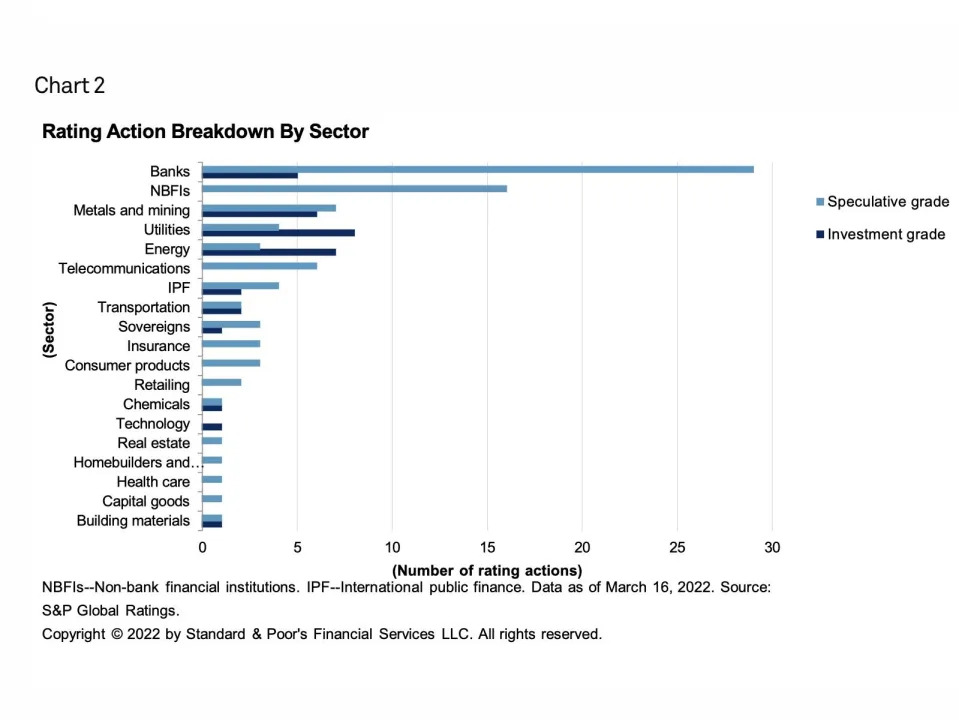
“In terms of creditworthiness, the Russian-Ukraine conflict has had the largest impact on banks, with 28% of total related rating actions,” the agency said.

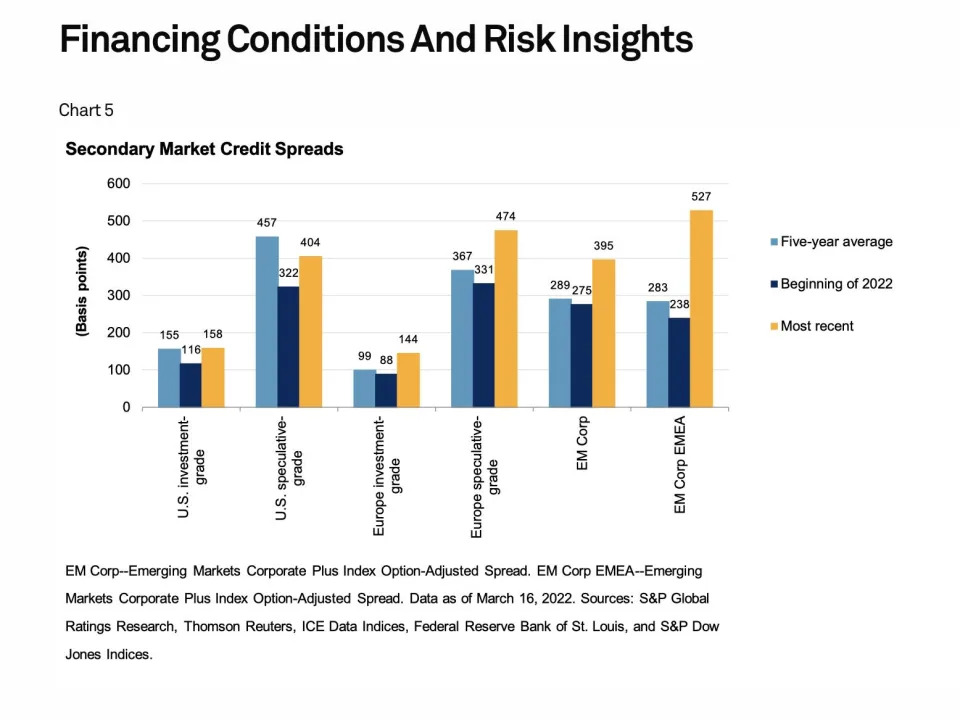
And investors are taking no chances. S&P Global Ratings noted the risk premium on European emerging-market corporate debt is now almost double its five-year average, compared to a roughly in-line reading at the start of the year. Formerly lucrative firms, such as banks, energy producers and mining companies, have been reduced to junk status. Commodity traders are deliberately shunning Russian shipments of key raw materials and countries are scrambling to wean themselves off Russian energy supplies.

The agency said there are already 30 “fallen angels” as a direct result of the Russia-Ukraine conflict. The term refers to an issuer whose credit rating has been cut from investment grade to speculative grade, also known as junk.

Shares in some of the country’s biggest corporates no longer trade in New York or London, where stock in the likes of Sberbank, oil and gas producers Gazprom and Rosneft, and metal producers Norilsk and Rusal, plunged to almost $0 a couple of weeks ago.

And it won’t end there. S&P Global said there was huge uncertainty around the extent, the outcome and the consequences of Russia’s war in Ukraine.

“Irrespective of the duration of military hostilities, sanctions and related political risks are likely to remain in place for some time,” S&P said. “Potential effects could include dislocated commodities markets–notably for oil and gas–supply chain disruptions, inflationary pressures, weaker growth, and capital market volatility.”

S&P shared several charts that show the extent of the impact to the creditworthiness of Russian companies:

Distribution of ratings action related to the Russia-Ukraine conflict and energy prices

Distribution of ratings action related to the Russia-Ukraine conflict and energy prices
Credit: S&P Global RatingsS&P Global Ratings

Rating action breakdown by sector

Rating action breakdown by sector
Credit: S&P Global RatingsS&P Global Ratings

Rating action breakdown by rating category

Rating action breakdown by rating category
Credit: S&P Global RatingsS&P Global Ratings

Breakdown of rating action by domicile

Breakdown of rating action by domicile
Credit: S&P Global RatingsS&P Global Ratings

Secondary market credit spreads

Secondary market credit spreads
Credit: S&P Global RatingsS&P Global Ratings

Slovakia starts deploying Patriot air defense system – minister

Reuters

Slovakia starts deploying Patriot air defense system – minister

March 20, 2022

U.S. long range air defence systems Patriot and British radar Giraffe AMB are displayed during Toburq Legacy 2017 air defence exercise in the military airfield near Siauliai

PRAGUE (Reuters) – The Patriot air defence system has started arriving in Slovakia from NATO partner countries and the deployment will continue in the coming days, Slovakia’s defence minister said on Sunday.

The system will be operated by German and Dutch troops and will initially be deployed at the Sliac airport in central Slovakia to help reinforce the defence of NATO’s eastern flank.

Russia’s invasion of Ukraine has prompted the alliance to bolster its defences.

The Patriot system will be part of a new NATO battlegroup in Slovakia, which neighbours Ukraine.

“I am happy to confirm that the first units in charge of deploying the Patriot air defence system are gradually arriving to Slovakia,” Defence Minister Jaroslav Nad said on Facebook.

Nad said the Patriot system will be a complement and not a replacement of the Soviet-era S-300 system that Slovakia operates.

“Temporarily, the system will be deployed at the Sliac air force base, further deployment areas are being consulted … so that the security umbrella covers the largest possible part of Slovak territory,” Nad said.

The minister said last week that Slovakia is willing to give the S-300 to Ukraine if and when it gets a proper replacement.

He reiterated on Sunday that Slovakia was looking for its own replacement of S-300 due to its age, capabilities and dependence on Russia.

Russia has warned against any shipments of advanced air defences to Ukraine and has warned it may target Western arms supplies.

(Reporting by Jan Lopatka; Editing by David Clarke and Frances Kerry)

An elite Ukrainian drone unit exploits the cover of night to destroy Russian tanks and trucks while their soldiers sleep, report says

Business Insider

An elite Ukrainian drone unit exploits the cover of night to destroy Russian tanks and trucks while their soldiers sleep, report says

Alia Shoaib – March 20, 2022

A Russian tank sits in the streets of Kherson.
A Russian tank sits in the streets of Kherson, Ukraine.Courtesy of Igor.
  • An elite Ukrainian drone unit has been striking Russian targets with anti-tank grenades while troops sleep.
  • The drone unit has destroyed dozens of “priority targets” including Russian tanks, command trucks and other vehicles.
  • Ukrainian forces have had surprising success in using drones to destroy Russian equipment.

An elite Ukrainian drone unit is destroying the weaponry of the invading Russian forces as their soldiers’ sleep, The Times of London reported.

Aerorozvidka, a specialist air reconnaissance unit within the army, says it has destroyed dozens of “priority targets” including Russian tanks, command trucks, and other vehicles in nighttime raids, the paper reported.- ADVERTISEMENT -https://s.yimg.com/rq/darla/4-10-1/html/r-sf-flx.html

Russian forces stop moving during the night and typically hide their tanks in between houses in villages where conventional artillery cannot strike them, Yaroslav Honchar, the unit commander based in Kyiv, told the paper.

But the elite drone unit, which has dozens of squads of expert drone pilots, has these stationary vehicles in its cross-hairs.

“We strike at night, when Russians sleep,” Honchar told the paper. “In the night it’s impossible to see our drones.”

“We look specifically for the most valuable truck in the convoy and then we hit it precisely and we can do it really well with very low collateral damage. Even in the villages, it’s possible. You can get much closer at night,” he said.

The unit’s arsenal of drones ranges from cheap commercial ones to heavy-duty octocopters that have been modified to drop anti-tank grenades and to see with thermal cameras, according to the paper.

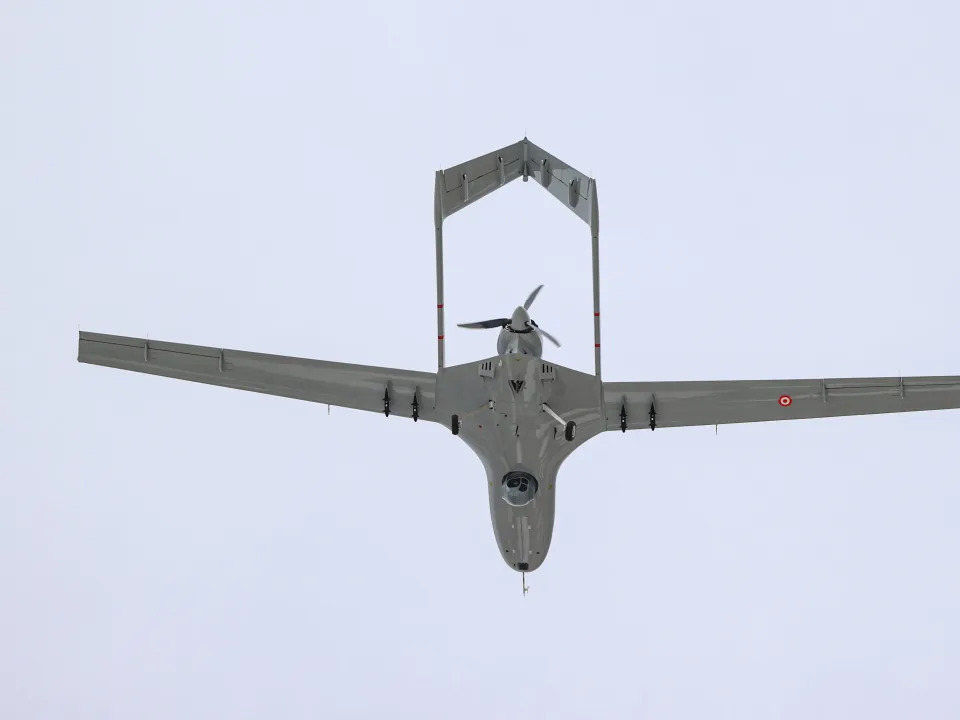
A Bayraktar TB2 drone.
A Bayraktar TB2 drone.Muhammed Enes Yildirim/Anadolu Agency via Getty Images.

The R18 drone has a 4km range and capacity to drop 5kg bombs is particularly prized by Honchar’s drone warriors, the paper said. The team also uses PD-1, or Punisher drone, developed by Ukraine, that can carry 3kg of explosives and hit targets up to 30 miles.

Since Russia began its invasion, Ukrainian forces have had success in using drones such as the highly-rated Turkish-made Bayraktar TB-2 to destroy the equipment of invading forces, Justin Bronk, a research fellow at the Royal United Services Institute (RUSI) wrote in The Spectator.

The success of the drones “speaks more to the skill of its Ukrainian operators and the incompetence and operational failures of Russian forces,” Bronk wrote.

Aerorozvidka’s drone unit, which flys up to 300 missions a day, according to The Times, operates using Elon Musk’s Starlink satellite system, which was activated in Ukraine days after Russia invaded.

This means drone teams can operate regardless of internet or power outages, which are currently rampant across the country.

“If we use a drone with thermal vision at night, the drone must connect through Starlink to the artillery guy and create target acquisition,” an Aerorozvidka leader told The Times.

Aerorozvidka uses an advanced Nato-supported intelligence system, Delta, which pulls together information from various sources including satellites and drone reconnaissance to precisely identify targets.

This helps the unit make the most efficient use of their limited supply of bombs, according to The Times.

Aerorozvidka was created by model plane enthusiasts in 2014 and has since been integrated into the Ukrainian general staff following the success of its operations against Russian forces in Crimea, The Times said.

In recent weeks, supporters from around Europe have been donating drone parts and other equipment such as 3D printers to help build and repair devices damaged by Russian rifles.

Read the original article on Business Insider

Ukraine Reminds Georgia of Its Own War With Russia. That Creates a Dilemma.

Russia invaded Georgia in 2008. To many Georgians, that means the country should stand unequivocally with Ukraine. But the government is more cautious.


By Patrick Kingsley, Photographs by Laetitia Vancon

March 19, 2022

A Soviet housing complex in Tbilisi. Many Georgians wish the government would oppose the Kremlin more vocally. 

KHURVALETI, Georgia — When she hears the latest news from Ukraine, Tina Marghishvili, a Georgian farmer, remembers the forest her father planted. She remembers her childhood home, her cows, her family orchard — all the land and belongings that her family hasn’t seen since 2008, when Russian troops forced them from their hometown during that year’s Russian-Georgian war.

“I watch the Ukraine news, I remember 2008, and it makes me cry,” said Ms. Marghishvili, 57, who now lives in a camp for Georgians displaced by that 2008 war. “Georgia should be sanctioning Russia, blockading them, boycotting their exports.”

And for Ms. Marghishvili, the big mystery is: Why hasn’t the Georgian government already done that?

Along Russia’s borders, in post-Soviet countries like Georgia that remain caught between Russian and Western influence, the Russian invasion of Ukraine has presented governments with a strategic dilemma.

Tina Marghishvili, a farmer who was diplaced from her family land in 2008 during the Russian-Georgian war. 
In the foothills of mountains in South Ossetia, a camp for Georgians displaced by the 2008 war.

Apart from Belarus, none have backed the Russian offensive. But nor have they strongly opposed it — fearful of upsetting a dominant neighbor that is a major source of trade and remittances, a guarantor of some countries’ security and a potential aggressor to others.

A small, mountainous country of 3.7 million people at the southeastern extreme of the European continent, Georgia is perhaps running the narrowest gauntlet. Russia invaded parts of Georgia 14 years ago, and Russian troops still protect South Ossetia and Abkhazia, two secessionist statelets that broke away from Georgia during the 1990s and then expanded in 2008. That has put Russia in de facto control of roughly a fifth of Georgian territory, including the town in South Ossetia where Ms. Marghishvili once lived.

To the Georgian government, this precarious dynamic makes it unwise to speak out too strongly against Russia, lest Russia turn on Georgia next.

“We live next to a volcano,” said Giorgi Khelashvili, a lawmaker for Georgia’s ruling party, Georgian Dream. “The volcano just erupted, and it just happens that the lava is currently flowing down the other side of the mountain.”

But this cautious approach has put the Georgian government at odds with most of its population — creating a far more pointed clash between majority opinion on Ukraine and government policy than in most other European countries.

Recent polling suggests nearly 60 percent of Georgians want a stronger stance on Ukraine from their elected officials, and many have hung Ukrainian flags from their apartments and offices in Tbilisi, the Georgian capital. Tens of thousands of Georgians have rallied to support Ukraine, and to criticize the government’s equivocal approach to a brotherly nation.

“We have different lands and different countries, but we have the same sky and we have the same enemy,” said Dato Turashvili, a popular Georgian novelist, and one of many Georgians flying a Ukrainian flag outside his home.

An antiwar demonstration outside the Russian embassy in Tbilisi earlier this month.
Dato Turashvili, a popular Georgian novelist. 

“The Georgian government says, ‘It’s better to be careful, Russia is dangerous’ — but that doesn’t matter to the Kremlin,” said Mr. Turashvili. “If they take Kyiv, they will take Tbilisi.”

The government says the criticism is unfair, since it has taken some measures that could anger Russia.

Days after the invasion began, Georgia submitted a rushed application for membership in the European Union — a largely symbolic indication of its pro-Western orientation, since full membership is years away. The government sent humanitarian aid to Ukraine, admitted more than 5,000 Ukrainian refugees and voted in favor of a United Nations resolution condemning the invasion of Ukraine.

Georgia has also admitted more than 30,000 Russians since the war started, of whom 12,000 have remained there, with Tbilisi joining Istanbul as one of the primary destinations for the new wave of young Russian exiles.

But despite rising anger from Georgian society, the Georgian government has generally avoided condemning Russia directly, and has refused to impose sanctions on the Russian economy. The government has clashed with the country’s ceremonial president, who has taken a stronger position; prevented a charter plane of Georgian volunteers from flying to Ukraine; and blocked entry to several Russian dissidents.

The Georgian prime minister, Irakli Garibashvili, also dismissed the effectiveness of sanctions, suggesting that no external actor could save Ukraine — a comment that many Georgians found needlessly defeatist. Tellingly, Russia did not include Georgia on a recent list of countries it had deemed unfriendly, while Ukraine has withdrawn its ambassador to Georgia.

All this has led to allegations that Georgian Dream has been co-opted by Moscow — unproven claims that have nevertheless gained momentum because the party’s founder and former leader, the billionaire Bidzina Ivanishvili, made much of his fortune in Russia. Mr. Ivanishvili’s representatives ignored several interview requests. But he no longer has a formal role in the party, and the party denies claims of Russian interference.

The Georgian Parliament on a recent weekday. 
Giorgi Khelashvili, a lawmaker in Georgia’s ruling party, Georgian Dream.

“If that had been the case,” said Mr. Khelashvili, the Georgian Dream lawmaker, “then Georgia’s permanent insistence on integrating with the West, and most importantly our latest declaration about joining the European Union, would have seemed quite out of logic.”

But to many Georgians, the party’s attitude to Russia still strays from pragmatism into needless deference, said Olesya Vartanyan, a Tbilisi-based analyst for the International Crisis Group, a global affairs research institute.

For years, Ms. Vartanyan had tried to avoid describing Georgian Dream as pro-Russian, choosing instead to argue that the party’s interests merely aligned with Russia’s. Now, for the first time, she said, “I say this is not the Georgian Dream, this is the Russian Dream.”

One cause of the government’s caution can be found a few hundred yards from the home of Ms. Marghishvili, the displaced farmer. She now lives close to the boundary of South Ossetia, one of the two breakaway territories guarded by Russian troops. The southern tip of South Ossetia runs just 500 yards north of Georgia’s main east-west highway, meaning that Russian troops stationed there could cut Georgia in half within minutes.

Up a potholed road lies Khurvaleti, one of hundreds of Georgian villages bisected by the boundary line. In the years since 2008, Russian troops have increasingly fortified this boundary with fences and ditches — cutting off many Georgians from their homes, and often arresting those who still try to cross it.

South Ossetia seen from the highway to Tbilisi. Russian forces stationed 500 yards away could divide the country within minutes. 
Valya Vanishvili, 85, in Khurvaleti, Georgia. “The Russians are doing to Ukraine what they did to us,” she said. 

Since the start of the Russian invasion of Ukraine, Georgian intelligence officers have detected no indications of renewed Russian aggression against Georgia, said Giorgi Sabedashvili, head of analysis at the Georgian state security service.

But in villages like Khurvaleti, where the situation is always tense, this is little comfort.

Since the Russian invasion of Ukraine began, “people are more afraid here,” said Valya Vanishvili, 85, a Khurvaleti resident whose home has been separated from the rest of the village by a Russian fence.

“The Russians are doing to Ukraine what they did to us,” said Ms. Vanishvili, standing on one side of the fence as two Times journalists stood on the other. “Maybe something will happen again here,” she added.

To some Georgians, these fears justify the government’s ambiguous position on Ukraine.

Supporters of the government stance include the Georgian Orthodox Church, one of the country’s most powerful civil institutions, whose priests have historically criticized the liberal values they associate with the West.

“We remember that Russian troops are standing just 50 kilometers away,” said the Rev. Andrea Jaghmaidze, a spokesman for the church, referring to the boundary between Georgia and South Ossetia, about 30 miles distant. “Therefore great wisdom should be shown,” he added, “so as not to place extra burden on the country.”

The Georgian Orthodox Church remains one of the most powerful institutions in the country, and one hesistant to criticize Russia too strongly. 
A statue of Joseph Stalin, founder of the Soviet Union, at his birthplace in Gori, Georgia. 

But many Georgians feel that it would be not only more dignified to take a more vocal stance, but also more strategic.

By taking an ambiguous stance on Ukraine, Georgia risks signaling to the West that it is uninterested in proper ties with Europe and North America, and therefore not worth the West’s support, said Giorgi Gakharia, a former prime minister.

“If your standing is not clear, and if your standing is not values-based,” then “the Brits, the Germans, the French, the Americans will have questions,” Mr. Gakharia said. “Where does Georgia stand?”

In some cases, the desire for a stronger stance against the Russian state has morphed into anger at the new Russian émigrés, who have found themselves in an intimidating environment.

“Citizens of the Russian Federation,” reads a flyer recently posted across central Tbilisi. “You are not welcome here.”

Some Georgian landlords have refused to rent apartments to Russian tenants. Alexey Voloshinov, a 20-year-old journalist for Rosbalt, a Russian news organization listed by the Kremlin as a foreign agent, said a landlord had refused him tenancy last week “because we’re Russians, and the Russian soldiers killed her son in the Russian-Georgian war in 2008,” Mr. Voloshinov said.

Mr. Turashvili, the novelist, empathizes with dissidents and journalists like Mr. Voloshinov. His most famous novel, “Flight From The U.S.S.R.,” is about a group of Georgian dissidents who tried to escape the Soviet Union in the 1980s.

But in a sign of the times, even Mr. Turashvili is wary of admitting too large a wave of Russians. Like many Georgians, he worries that a majority have fled for financial reasons rather than any sincere opposition to the Kremlin.

“They have the best writers in Russia,” Mr. Turashvili said. “But maybe no good readers.”

More than 30,000 Russians have traveled to Georgia since the start of the invasion of Ukraine; about 12,000 remain. 

Mariam Zibzibadze contributed reporting.

The Battle for Kyiv Looms as a Long and Bloody Conflict

Ukraine’s capital is the biggest prize of all for the Russian military. If Russia tries to take control, it could lead to one of the biggest urban conflicts since World War II.

By Andrew E. Kramer, Photographs by Lynsey Addario

March 19, 2022

Credit…Ukrainian security forces at a fortified checkpoint next to a market that provides food, shelter and medical care for up to 5,000 soldiers and the needy around northern Kyiv. 

KYIV, Ukraine — The city of Kyiv covers 325 square miles and is divided by a broad river. It has about 500,000 structures — factories, ornate churches and high-rise apartments — many on narrow, winding streets. Roughly two million people remain after extensive evacuations of women and children.

To the northwest and to the east, tens of thousands of Russian troops are pressing toward the city, Ukraine’s capital, backed by columns of tanks, armored vehicles and artillery. Inside Kyiv, Ukrainian soldiers and civilian volunteers are fortifying the downtown with barriers, anti-tank mines and artillery.

Kyiv remains the biggest prize of all for the Russian military; it is the seat of government and ingrained in both Russian and Ukrainian identity. But capturing it, military analysts say, would require a furious and bloody conflict that could be the world’s biggest urban battle in 80 years.

 Lt. Artyom Bolyukh, right, and Mykola Kravchenko, Ukrainian soldiers, patrolling last Sunday in Horenka, a suburb of Kyiv. Mr. Kravchenko was killed the next day. 
Lt. Artyom Bolyukh, right, and Mykola Kravchenko, Ukrainian soldiers, patrolling last Sunday in Horenka, a suburb of Kyiv. Mr. Kravchenko was killed the next day. 
Ukrainian soldiers near a checkpoint in Horenka, just north of Kyiv. 

“What we are looking at in Kyiv would dwarf anything we’ve seen since World War II,” said David Kilcullen, a retired lieutenant colonel in the Australian Army who has extensively studied urban combat. “If they really, really want to level Kyiv, they can,” he said of the Russian leadership. “But the level of political and economic damage would be tremendous.”

For comparison, one of the largest urban battles this century was the nine-month siege of Mosul, Iraq, in 2016 and 2017 to oust its Islamic State occupiers. Mosul covers 70 square miles and had a wartime population of about 750,000 people — a fraction of the numbers for Kyiv, where the metropolitan area’s prewar population was 3.6 million.

Negotiations over a cease-fire are continuing, and a long, heated battle over Kyiv is not inevitable. Despite superior numbers and firepower, Russia has not achieved a breakthrough. A Western official, in a briefing with reporters this past week, said the Russians had taken heavy casualties, been unable to establish any meaningful off-road presence, and — perhaps most surprising — failed to achieve dominance in the air.

But the first stages of the battle have already begun, with cruise missile bombardments, troop movements to encircle the city and a fight to gain air superiority. Savage, street-by-street gunfights akin to guerrilla warfare have broken out in northwestern suburbs like Irpin, an important gateway into the city. It could be the beginning of a long, drawn-out siege using hunger and street fighting to advance toward the city center.

Smoke south of Kyiv  this month after a night of numerous and heavy explosions around the capital.
Smoke south of Kyiv this month after a night of numerous and heavy explosions around the capital.

After three weeks of fighting in the suburbs, Ukrainian soldiers and volunteers, who are operating in loosely organized small units and relying heavily on ambushes, are growing more confident in the city’s defense. Part of their strategy is to make the assault so costly for the Russian army in lives that it will exhaust or demoralize its troops before they reach the city center.

“There’s no talk of capitulation for Kyiv,” said Lt. Tetiana Chornovol, the commander of an anti-tank missile unit operating on the outskirts of the city. “Everything is going far better than we thought.”

Lieutenant Chornovol, 42, is a former activist in Ukraine’s street protest movement who sent her two children to safety before reporting for duty as a reserve officer. She commands two teams of a half-dozen or so people each, firing Ukrainian-made, tripod-mounted missiles, which they transport to ambush positions in their personal cars.

Ukrainian families running across  tracks in early March to catch a train heading west from Kyiv.
Ukrainian families running across tracks in early March to catch a train heading west from Kyiv.
Children on an evacuation train departing Kyiv on March 3. 

Lieutenant Chornovol drives a red Chevy Volt electric hatchback, which she calls an “ecologically clean killing machine.”

Interviewed beside a burning grocery warehouse in the suburban town of Brovary, the lieutenant popped the hatchback to reveal a beige tube, holding a Stugna-P missile. It has a range of three miles and hits a target within a diameter of one foot.

The town of Horenka, about a mile north of Kyiv, is a tableau of destruction from Russian shelling.

Seemingly unfazed by combat, Lieutenant Chornovol described the Ukrainian tactic of ambushes that has defined the early phases of the battle for the capital. Last week, she said, she blew up a Russian tank a few miles east of Brovary on the M01 highway.

“We look for firing positions where we can see a stretch of road,” Lieutenant Chornovol said, adding that “we know a column will drive on the road” eventually. With her car parked some distance away, covered in camouflage, she and her team lay in wait in a tree line for three days before a Russian column came rumbling down the road.

When the command came to open fire, she used a laser to lock in on the tank, pushed a button, then watched as the tank lit up in flames before she rushed back to her car to escape return fire. “I shoot at armor,” she said, when asked about the human toll. “If they climb inside, it’s their fault.”

Destroyed Russian tanks  on a main road after battles near Brovary, north of Kyiv, last week. 
Destroyed Russian tanks on a main road after battles near Brovary, north of Kyiv, last week. Credit…Felipe Dana/Associated Press
“There’s no talk of capitulation for Kyiv,” said Lt. Tetiana Chornovol, the commander of an anti-tank missile unit operating on the outskirts of Kyiv.

The tactics Lieutenant Chornovol described are indicative of the city’s defenses, which rely on a blend of sophisticated air defense systems, army troops, civilian volunteers and paramilitary organizations.

An urban environment favors booby traps, ambushes and lightly armed but mobile defenders against a regular army. Ukrainians have laid out pie-sized anti-tank mines on the shoulders of roads, which can be quickly dragged across streets to block advances. In cities, the urban grid channels the invader’s armored vehicles into narrow streets, where they become vulnerable.

The Russians also have a formidable force, but of a different nature. They rely on superior troop numbers and powerful, but less mobile, weaponry.

Russian tanks, for instance, are moving methodically in long columns through small towns outside Kyiv, rarely straying from roads. At times, the vehicles are creating gigantic traffic jams.

On the Dnieper River’s west bank, soldiers and vehicles from two Siberia-based Combined Arms Armies — parlance for large Russian military groupings — are creeping forward, said Michael Kofman, the director of Russia studies at CNA, a research institute in Arlington, Va. Russian special forces units, or Spetsnaz, have turned the once-tranquil suburb of Irpin into a battle zone, he said.

On the eastern bank, Russia’s 41st Combined Arms Army has been probing into outlying towns like Brovary, where Lieutenant Chornovol blew up a Russian tank.

Why the Russians are advancing tanks into the urban landscape of Kyiv’s outskirts, where they are vulnerable to ambush, is something of a mystery, Mr. Kofman said. “They are trying to make quick progress down roads while the Ukrainians are trying to engage them in cities, rather than out in the open fields,” he said.

And time is not on the Russians’ side. Kyiv is surrounded by bogs, thawing now with the coming spring and hampering any efforts by the Russians to fan out with their heavy weapons around the city’s perimeter. Tanks that venture off roads are already sinking into the mud.

It remains unclear whether the Russian army will attempt a full urban assault, Mr. Kofman said, but the movements so far suggest plans to at least encircle Kyiv.

Julia, a teacher, with fellow volunteer fighters awaiting deployment to fight Russian troops encircling Kyiv.  

That will require gaining dominance in the sky, which Russia has unsuccessfully been trying to achieve. Ukrainian and Russian pilots have clashed in dogfights over Kyiv and a Russian jet crashed into one neighborhood. Sometimes, the plumes of Ukrainian surface-to-air missiles can be seen rising into the sky.

Russia has failed to control the sky over Kyiv, analysts say, because it has not destroyed the city’s air defense missiles or all the secretive air strips in western Ukraine used by Ukrainian pilots in flights to defend the capital.

At night in Kyiv, booms are heard from air defense strikes overhead, and in the morning, the mangled, silvery, metallic remnants of Russian cruise missiles, fired from Russian territory hundreds of miles away, can be found in parking lots and gardens around the city.

The ground fighting has become a vicious battle for suburban towns and highways, fought over a landscape of warehouses, car dealerships and neighborhoods of single-story homes and apartment blocks on the city’s outskirts, interspersed with tracts of pine forest.

A residential building after it was hit last month by missiles in Kyiv.
Civilians evacuated across the remnants of a destroyed bridge in Irpin, a northwest suburb. 

In the town of Horenka, about a mile north of Kyiv, for example, what had been a quiet suburb is now a tableau of destruction from Russian shelling. Roads are pockmarked with craters from mortar rounds and littered with shorn tree branches. Cars are perforated by shrapnel, and sheet metal has been blown off houses. A sprawling warehouse of a French home improvement and gardening retailer, Leroy Merlin, burned.

On a roadside were two empty carrying tubes for American-supplied Javelin anti-tank missiles. “Raytheon/Lockheed Martin,” read the stenciled markings. “Guided missile surface attack.” Ukrainians have been joking that, after the war, they will use these tubes to store potatoes.

As Russian forces approached Kyiv this month, Ukrainian families moved into underground and makeshift shelters. 

In Horenka a few days ago, a dog injured in the fighting hobbled forlornly on three legs amid an array of bricks from a destroyed home.

“A month ago, people lived here, it was a normal town,” said Lt. Artyom Bolyukh, a former architect now in the army who uses the nickname The Artist. “Now this is our outer perimeter.”

Like Lieutenant Chornovol, he traveled to and from his position by civilian car, a gray Toyota station wagon, blending into the thin stream of traffic still on Kyiv’s streets.

To fully encircle Kyiv, the Russians must engage in several more suburban battles. At that point, two options would open for the Russian military, according to Mr. Kilcullen, the expert on urban combat: starve the city or try a block-by-block assault.

Modern cities typically have limited stocks of food, as grocery stores rely on regular deliveries, and Kyiv is no exception. But severe food shortages would most likely not begin in Kyiv for at least a month, according to Mr. Kilcullen. For now, a highway to the southwest remains open for supplies of weapons and food.

Street fighting, on the other hand, would cause significant casualties for the invaders. The Russian military might also skip some steps of a classic urban assault, trying, for example, a special forces raid on the city center or a battle before the encirclement is completed, Mr. Kilcullen said.

Ukrainian volunteers entered a bunker in Kyiv last month as a siren signaled a possible incoming attack.
President Volodymyr Zelensky of Ukraine at a Kyiv news conference in early March. 

And despite Ukrainian tactical successes in the battle for the suburbs using small units like Lieutenant Chornovol’s ambush teams, the Russian force remains a formidable threat, said Dima Adamsky, an expert on Russian security policy at Reichman University in Israel.

“It is adapting,” he said, “and it is continuing to fulfill its operational plans.”

Security forces guarding Kyiv’s Maidan Nezalezhnosti, or Independence Square,  this month.
Security forces guarding Kyiv’s Maidan Nezalezhnosti, or Independence Square, this month.