As Russia Stalls in Ukraine, Dissent Brews Over Putin’s Leadership

The New York Times

As Russia Stalls in Ukraine, Dissent Brews Over Putin’s Leadership

Anton Troianovski and Michael Schwirtz – March 23, 2022
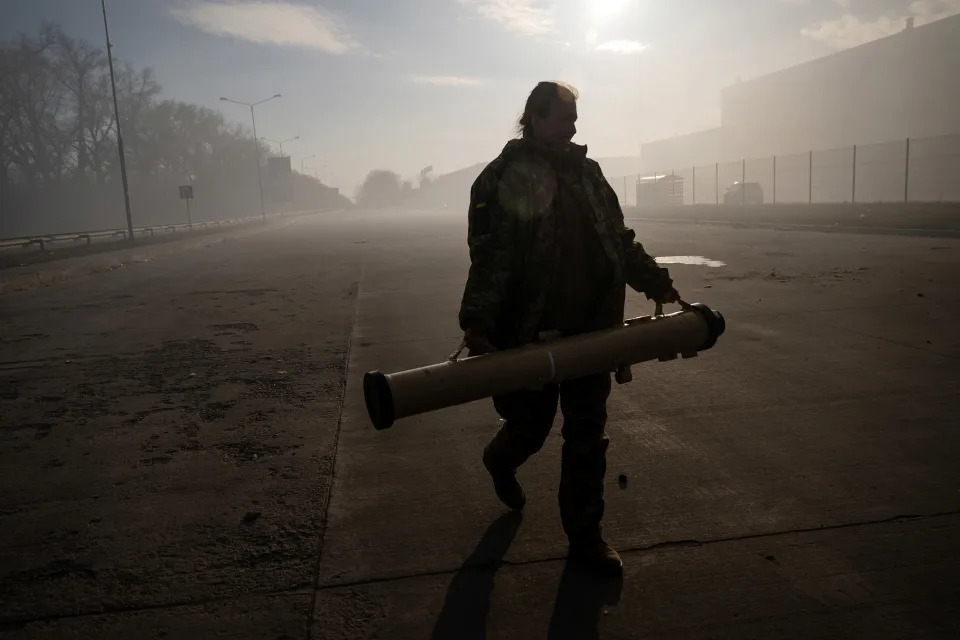
Lt. Tetiana Chornovol, the commander of an anti-tank missile unit, holds the missile tube for a Skif, or Stugna-P, system, in the outskirts of Kyiv, on March 14, 2022. (Lynsey Addario/The New York Times) -- NO SALES
Lt. Tetiana Chornovol, the commander of an anti-tank missile unit, holds the missile tube for a Skif, or Stugna-P, system, in the outskirts of Kyiv, on March 14, 2022. (Lynsey Addario/The New York Times) — NO SALES

In January, the head of a group of serving and retired Russian military officers declared that invading Ukraine would be “pointless and extremely dangerous.” It would kill thousands, he said, make Russians and Ukrainians enemies for life, risk a war with NATO and threaten “the existence of Russia itself as a state.”

To many Russians, that seemed like a far-fetched scenario, since few imagined that an invasion of Ukraine was really possible. But two months later, as Russia’s advance stalls in Ukraine, the prophecy looms large. Reached by phone this week, the retired general who authored the declaration, Leonid Ivashov, said he stood by it, although he could not speak freely given Russia’s wartime censorship: “I do not disavow what I said.”

In Russia, the slow going and the heavy toll of President Vladimir Putin’s war on Ukraine are setting off questions about his military’s planning capability, his confidence in his top spies and loyal defense minister, and the quality of the intelligence that reaches him. It also shows the pitfalls of Putin’s top-down governance, in which officials and military officers have little leeway to make their own decisions and adapt to developments in real time.

The failures of Putin’s campaign are apparent in the striking number of senior military commanders believed to have been killed in the fighting. Ukraine says it has killed at least six Russian generals, while Russia acknowledges one of their deaths, along with that of the deputy commander of its Black Sea fleet. U.S. officials say they cannot confirm the number of Russian troop deaths, but that Russia’s invasion plan appears to have been stymied by bad intelligence.

The lack of progress is so apparent that a blame game has begun among some Russian supporters of the war — even as Russian propaganda claims that the slog is a consequence of the military’s care to avoid harming civilians. Igor Girkin, a former colonel in Russia’s FSB intelligence agency and the former “defense minister” of Russian-backed separatists in eastern Ukraine, said in a video interview posted online on Monday that Russia had made a “catastrophically incorrect assessment” of Ukraine’s forces.

“The enemy was underestimated in every aspect,” Girkin said.

The Russian forces’ poor performance has also surprised analysts, who predicted at the start of the war that Russia’s massive, technologically advanced military would make short work of Ukraine. Putin himself seems to have counted on his troops quickly seizing major cities, including the capital, Kyiv, decapitating the government and installing a puppet regime under the Kremlin’s control.

“Take power into your own hands,” Putin urged Ukrainian soldiers on the second day of the invasion, apparently hoping Ukraine would go down without a fight.

Instead, Ukraine fought back. Nearly a month has passed, and Russian troops appear bogged down in the face of relentless attacks from a much weaker, though far more maneuverable, Ukrainian military.

“There was probably the hope that they wouldn’t resist so intensely,” Yevgeny Buzhinsky, ​​a retired lieutenant general and a regular Russian state television commentator, said of Ukraine’s forces. “They were expected to be more reasonable.”

As if responding to criticism, Putin has said repeatedly in his public comments about the war that it is going “according to plan.”

“We can definitively say that nothing is going to plan,” countered Pavel Luzin, a Russian military analyst. “It has been decades since the Soviet and Russian armies have seen such great losses in such a short period of time.”

Russia last announced its combat losses three weeks ago — 498 deaths as of March 2. U.S. officials now say that a conservative estimate puts the Russian military death toll at 7,000. Russia says it lost a total of 11,000 service members in nearly a decade of fighting in Chechnya.

The failures in Ukraine have started to create fissures within Russian leadership, according to Andrei Soldatov, an author and expert on Russia’s military and security services. The top Russian intelligence official in charge of overseeing the recruitment of spies and diversionary operations in Ukraine has been put under house arrest along with his deputy, Soldatov said. Even Russia’s defense minister, Sergei Shoigu, who vacations with Putin and has been spoken of as a potential presidential successor, has suffered a loss of standing, according to Soldatov’s sources.

“It looks like everybody is on edge,” Soldatov said.

Soldatov’s claims could not be independently verified, and some independent experts have challenged them. But Shoigu has not been shown meeting with Putin in person since Feb. 27, when he and his top military commander, Gen. Valery Gerasimov, sat at the end of a long table as Putin, on the opposite end, ordered them to place Russia’s nuclear forces at a higher level of readiness.

“The war has shown that the army fights poorly,” Luzin, the Russian military analyst, said. “The defense minister is responsible for this.”

The battlefield deaths of senior Russian commanders also reflect poorly on the Kremlin’s war planning. Capt. Andrei Paliy, the deputy commander of Russia’s Black Sea fleet, died in combat over the port city of Mariupol, Russian officials said Sunday.

After Maj. Gen. Andrei Sukhovetsky, the deputy commander of the 41st Combined Arms Army, was killed four days into the war, the city of Novorossiysk, where he was previously based, issued a statement remembering him as “a faithful comrade, a valiant warrior, a wise commander and a selfless defender of the Fatherland.”

“Epaulets give no protection to terrorists,” Ukraine’s military intelligence service said in its statement announcing Sukhovetsky’s death.

There was also Maj. Gen. Oleg Mityayev, among the Russian military’s most seasoned commanders. He had led Russia’s largest foreign military base in Tajikistan and was second in command of Russia’s forces in Syria. When Putin ordered his troops to invade Ukraine, Mityayev was tapped to lead the storied 150th Motorized Rifle Division, whose soldiers helped take the Reichstag building in Berlin precipitating Nazi Germany’s defeat in 1945.

According to Kyiv, he lasted less than three weeks in Ukraine. After he was killed in battle, either Russian forces left his body behind, or it was captured by the far-right Azov Battalion, which posted a photo of the bloody corpse on Telegram with the caption, “Glory to Ukraine.”

Russian officials have not confirmed his death — or those of another four generals that Ukraine claims to have killed. But even accounting for the fog of war, experts say that Russia has suffered a damaging death toll among its military leaders on the ground in Ukraine, which could soon erode Russia’s military effectiveness.

The deaths reflect operational security failures as well as the challenges of the Russian military’s top-heavy command structure in the face of a much nimbler Ukrainian fighting force.

“In modern warfare, you don’t have a lot of generals getting knocked off,” said Lt. Gen. Ben Hodges, the former commander of the U.S. Army in Europe. “But this is a very lethal battlefield.”

Gen. Joseph L. Votel, the former commander of U.S. Central Command, said that the deaths could reflect Russia’s challenges on the ground — and reports that some Russian units did not understand the mission at hand and had even abandoned equipment. As a result, he said, military leaders appeared to be operating closer to the front to “supervise and keep their troops in the fight, by personal example or intimidation.”

“Continuing to lose senior leaders is not good,” he said in an email. “Eventually, loss of leadership affects morale, fighting prowess and effectiveness.”

For Russia’s generals, part of the problem is that many of them have spent recent decades fighting a different type of war. In Chechnya at the beginning of the 2000s, Russia succeeded in pacifying a separatist uprising in a small territory by resorting to scorched-earth decimation of entire cities. More recently in Syria, Russia’s operations have been driven by airstrikes against a population that lacks sophisticated weapons or even a regular army.

Ukraine, while far weaker militarily, has been learning from its eight-year war against Russian-backed separatist forces in the country’s east — a similar war, in miniature, to the one being fought now. Ukraine has its own air force, which remains largely intact, and modern anti-aircraft systems. As convoys of Russian armor have lumbered along Ukrainian highways, Ukrainian forces have deployed drones and highly maneuverable infantry units to devastating effect, leaving abandoned and burning vehicles.

Throughout Ukraine, Russian forces have now largely stalled. But analysts caution that the military setbacks will not deter Putin — who has cast the war at home as an existential one for Russia, and is increasingly signaling to the Russian public to prepare for a long fight.

The question is whether heavy losses and the pain of Western sanctions could force Putin to accept some kind of compromise to end the war — and whether President Volodymyr Zelenskyy of Ukraine would be prepared to offer concessions to satisfy him. On Tuesday, Dmitry Peskov, the Kremlin’s spokesperson, played down any hopes of an imminent cease-fire, describing talks with Ukraine as going “much more slowly and less substantively than we would like.”

“The Russian leadership can’t lose,” said Andrei Kortunov, director-general of the Russian International Affairs Council, a research organization close to the Russian government. “No matter what, they will need to end this whole story with some kind of victory.”

Russian generals are dying in Ukraine partly because they are struggling to get conscripts to follow orders

Business Insider

Russian generals are dying in Ukraine partly because they are struggling to get conscripts to follow orders, report says

Tom Porter – March 22, 2022

  • Ukraine says it’s killed at least five Russian generals, an unusually high total for senior officers.
  • A European diplomat told Foreign Policy that poor communications were leaving commanders exposed.
  • Russia is sustaining high overall casualties in its invasion of Ukraine.

Russian generals are moving into advanced positions leaving them exposed to attacks because they’re struggling to get their orders through to conscripts, a European official told Foreign Policy magazine.

Ukrainian officials have said Ukrainian forces have killed at least five Russian generals so far. Such a toll is unusually high for such senior officers.

Russian tank
Smoke rises from a Russian tank destroyed by Ukrainian forces in February.Anatolii Stepanov / AFP) (Photo by ANATOLII STEPANOV/AFP via Getty Images

On Saturday, Ukraine said its forces had killed Lt. Gen. Andrei Mordvichev when they struck an airfield near Kherson, one of the few Ukrainian cities Russia has managed to occupy.

On Sunday, Russian officials said a senior naval commander, Andrei Paly, had been killed by Ukrainian forces near the besieged city of Mariupol.

A European diplomat briefed on intelligence reports told Foreign Policy that a failure of Russian communications systems was leaving generals exposed to interception and targeted strikes.

The diplomat also said that difficulties in getting conscripted troops to follow orders were making them take positions close to the front.

The Russian military is using conscripts alongside its regular military in the invasion of Ukraine, despite having promised that it would not. Experts have said conscripted troops are often poorly trained and have low morale.

“They’re struggling on the front line to get their orders through,” the European diplomat said. “They’re having to go to the front line to make things happen, which is putting them at much greater risk than you would normally see.”

The diplomat said that about 20% of Russia’s top commanders in Ukraine had been killed in the conflict, reducing its military effectiveness and stalling its advance.

The theory corroborates a report published Monday by Insider’s Christopher Woody.

The report cited a US official as saying Russian generals were at inherently greater risk than their US counterparts because of a Russian command structure that gives lower-ranking officers less autonomy and demands closer involvement of generals.

US officials believe that about 7,000 Russian troops have been killed in the fighting so far. On Monday, a Russian tabloid reported, citing the country’s defense ministry, that the death toll was higher than 9,000, but it subsequently retracted the claim.

Putin’s invasion has killed over 120 children, Ukraine says

Yahoo! News

Putin’s invasion has killed over 120 children, Ukraine says

Kate Buck – March 23, 2022

ZAPORIZHZHIA, UKRAINE - MARCH 22: A girl who seriously injured during Russian attacks receives treatment at regional children's hospital in Zaporizhzhia, Ukraine on March 22, 2022. Patients barely have sunlight due to sandbags and boards blocking the windows. (Photo by Stringer/Anadolu Agency via Getty Images)
A girl who seriously injured during Russian attacks receives treatment at regional children’s hospital in Zaporizhzhia. (Getty)

Ukraine has claimed that 121 children have been killed during the course of the Russian invasion, amid reports thousands have been kidnapped and taken across the border.

Since Vladimir Putin’s forces entered Ukraine on 24 February, a further 167 children have been wounded, the office of the prosecutor general said on Wednesday.

The figures have not been able to be independently verified.

Ukraine also claimed on Tuesday that 2,389 children had been “kidnapped” by Russia and transported across the border from the eastern oblasts of Donetsk and Luhansk.

The US Embassy in Kyiv cited the Ukrainian foreign ministry, tweeting: “This is not assistance. It is kidnapping.

The ministry called it a “gross violation of international law”.

EDITORS NOTE: Graphic content / Nurses tend to a child in a room protected by sandbags at Zaporizhzhia Regional Clinical Children's Hospital on March 22, 2022. - Thousands of refugees from Mariupol have fled to the southern Ukraine city of Zaporizhzhia. European Union foreign policy chief described as a
Nurses tend to a child in a room protected by sandbags at Zaporizhzhia Regional Clinical Children’s Hospital. (Getty)
PRZEMYSL, POLAND - MARCH 22: People, mainly women and children, arrive at Przemysl train station after travelling on a train from war-torn Ukraine on March 22, 2022 in Przemysl Poland. Nearly two-thirds of the more than 3 million people to have fled Ukraine since Russia's invasion last month have come to Poland, which shares a 310-mile border with its eastern neighbor. (Photo by Jeff J Mitchell/Getty Images) (Photo by Jeff J Mitchell/Getty Images)
People, mainly women and children, arrive at Przemysl train station after travelling on a train from Ukraine. (Getty)

The claims of kidnapping also cannot be independently verified as the area has been besieged by the invading forces for over two weeks.

In the southern city of Mariupol, more than 100,000 people are believed to be trapped inside the bombard city with no access to food, water, power or heat.

Authorities in Mariupol said several thousand of its residents had been forcibly deported to Russia.

Read more: US Embassy accuses Russia of kidnapping children amid reports it’s deporting thousands of Ukrainians by force

Intense Russian air strikes have turned Mariupol into the “ashes of a dead land”, the city council said on Tuesday, as street fighting and bombardments raged in the port city.

Both civilians and Ukrainian troops were coming under Russian fire, said regional governor Pavlo Kyrylenko.

Russian forces and Russian-backed separatist units had taken about half of the port city, normally home to around 400,000 people, Russia’s RIA news agency said, citing a separatist leader.

Watch: Kyiv mayor Vitali Klitschko says he cries ‘every day’ at destruction Putin has causedScroll back up to restore default view.

But in an early morning address, Ukrainian president Volodymyr Zelenskyy held out hope for negotiations, which have yielded little since the invasion began.

“It’s very difficult, sometimes confrontational,” he said. “But step by step we are moving forward.”

Putin’s incursion into Ukraine has forced more than 3.5 million to flee, brought the unprecedented isolation of Russia’s economy, and raised fears of wider conflict in the West unthought-of for decades.

Mariupol has become the focus of the war that erupted when Putin sent his troops over the border on what he calls a “special military operation” to demilitarise Ukraine and replace its pro-Western leadership.

Russia has maintained only military targets are being hit as Putin’s forces carry out a “special military operation” – but footage from the scenes of the attacks tell of a different reality.

A nursery in Okhtyrka, 70 miles from Kharkiv, was destroyed when it was bombed on 25 February, just over 24 hours into the invasion.

A girl is among those killed in the invasion
Polina is among those killed in the invasion, after the car she and her parents were in was shot. (Getty)
Marianna has given birth to a baby girl, her family have said(AP)
Marianna Podgurska, a beauty blogger from Mariupol, gave birth to a baby girl shortly after the bombing. (AP)

Six people died after the Sonechko Nursery and Kindergarten was targeted, including seven-year-old Alisa Hlans and her grandfather, who is said to have been killed in front of her as he tried to rescue the youngster.

Amnesty International claimed the attack was from cluster bombs which were released in the residential area.

In Kyiv a fourth-grade student from Kyiv called Polina, who is thought to be either nine or 10, and her parents, were killed when the car they were in was shot at by Russian troops in Kyiv.

On 9 March, Russia sparked further international condemnation when a children’s and maternity hospital in Mariupol was bombed.

Pictures and video from the scene showed heavily pregnant women being pulled from the rubble, covered in injuries.

A six-year-old girl and two adults were reported dead in the immediate aftermath of the attack, which Russia claimed was “fake news”, claiming it was a viable military target.

Another woman caught up in the bombing, who was pictured being carried away on a stretcher, was subsequently reported dead five days later alongside her newborn baby.

Russia-Ukraine war: Key things to know about the conflict

Associated Press

Russia-Ukraine war: Key things to know about the conflict

March 23, 2022

  • A woman sits on a bench and a Ukrainian serviceman guards the area during a press conference by Kyiv Mayor Vitali Klitschko and his brother, former heavyweight boxing world champion Wladimir Klitschko, in Kyiv, Ukraine,Wednesday, March 23, 2022. From a public park in the city, Klitschko said 264 civilians had so far died from Russian bombardment on the capital, including four children. As he spoke to reporters, explosions and loud gunfire echoed across the city. (AP Photo/Vadim Ghirda)A woman sits on a bench and a Ukrainian serviceman guards the area during a press conference by Kyiv Mayor Vitali Klitschko and his brother, former heavyweight boxing world champion Wladimir Klitschko, in Kyiv, Ukraine. From a public park in the city, Klitschko said 264 civilians had so far died from Russian bombardment on the capital, including four children. As he spoke to reporters, explosions and loud gunfire echoed across the city. (AP Photo/Vadim Ghirda)
  • Kyiv Mayor Vitali Klitschko, right, stands next to his brother, former heavyweight boxing world champion Wladimir Klitschko, during a press conference, in Kyiv, Ukraine,Wednesday, March 23, 2022. From a public park in the city, Mayor Klitschko, said 264 civilians had so far died from Russian bombardment on the capital, including four children. As he spoke to reporters, explosions and loud gunfire echoed across the city. (AP Photo/Vadim Ghirda)Kyiv Mayor Vitali Klitschko, right, stands next to his brother, former heavyweight boxing world champion Wladimir Klitschko, during a press conference, in Kyiv, Ukraine. From a public park in the city, Mayor Klitschko, said 264 civilians had so far died from Russian bombardment on the capital, including four children. As he spoke to reporters, explosions and loud gunfire echoed across the city. (AP Photo/Vadim Ghirda)
  • Neighbours carry pieces of broken window from apartments damaged by shelling, in Kyiv, Ukraine, Wednesday, March 23, 2022. (AP Photo/Rodrigo Abd)Neighbours carry pieces of broken window from apartments damaged by shelling, in Kyiv, Ukraine. (AP Photo/Rodrigo Abd)
  • A Ukrainian firefighter sprays water inside a house destroyed by shelling, in Kyiv, Ukraine,Wednesday, March 23, 2022. The Kyiv city administration says Russian forces shelled the Ukrainian capital overnight and early Wednesday morning, in the districts of Sviatoshynskyi and Shevchenkivskyi, damaging buildings. (AP Photo/Vadim Ghirda)A Ukrainian firefighter sprays water inside a house destroyed by shelling, in Kyiv, Ukraine. The Kyiv city administration says Russian forces shelled the Ukrainian capital overnight and early Wednesday morning, in the districts of Sviatoshynskyi and Shevchenkivskyi, damaging buildings. (AP Photo/Vadim Ghirda)
  • President Joe Biden, escorted by Colonel Matthew Jones, Commander, 89th Airlift Wing, walks to board Air Force One at Andrews Air Force Base, Md., Wednesday, March 23, 2022. Biden is traveling to Europe to meet with World counterparts on Russia's invasion of Ukraine. (AP Photo/Evan Vucci)President Joe Biden, escorted by Colonel Matthew Jones, Commander, 89th Airlift Wing, walks to board Air Force One at Andrews Air Force Base, Md.. Biden is traveling to Europe to meet with World counterparts on Russia’s invasion of Ukraine. (AP Photo/Evan Vucci)
  • New bulletproof vests are displayed in an artists co-living studio space that is used as a bomb shelter and a place to help the Territorial Defense Units, in Kyiv, Ukraine,Wednesday, March 23, 2022. (AP Photo/Rodrigo Abd)New bulletproof vests are displayed in an artists co-living studio space that is used as a bomb shelter and a place to help the Territorial Defense Units, in Kyiv, Ukraine. (AP Photo/Rodrigo Abd)
  • Men work on the construction of plates for bulletproof vests in an artists co-living studio space that is used as a bomb shelter and a place to help the Territorial Defense Units, in Kyiv, Ukraine,Wednesday, March 23, 2022. (AP Photo/Rodrigo Abd)Men work on the construction of plates for bulletproof vests in an artists co-living studio space that is used as a bomb shelter and a place to help the Territorial Defense Units, in Kyiv, Ukraine. (AP Photo/Rodrigo Abd)
  • Muralist Arti exercises inside an artists' co-living studio space that is used as a bomb shelter and a place to help the Territorial Defense Units, in Kyiv, Ukraine,Wednesday, March 23, 2022. (AP Photo/ (AP Photo/Rodrigo Abd) Muralist Arti exercises inside an artists’ co-living studio space that is used as a bomb shelter and a place to help the Territorial Defense Units, in Kyiv, Ukraine. (AP Photo/ (AP Photo/Rodrigo Abd)
  • The tail of a rocket sticks out in a memorial for the thousands of Polish officers killed in 1940 by Soviet secret police in the Katyn massacre, in Kharkiv, Ukraine, Wednesday, March 23, 2022. (AP Photo/Andrew Marienko)
  • The tail of a rocket sticks out in a memorial for the thousands of Polish officers killed in 1940 by Soviet secret police in the Katyn massacre, in Kharkiv, Ukraine. (AP Photo/Andrew Marienko)

One month into Russia’s invasion of Ukraine, fire rained down on a shopping mall and high-rise buildings in Kyiv, as the outnumbered Ukrainian military waged intense battles to defend the capital and other key cities from falling under Russian control.

A barrage of strikes on cities have wreaked destruction across Ukraine over the past four weeks, but Russian forces appeared stalled outside major cities in the face of fiercer-than-expected Ukrainian resistance. NATO estimated on Wednesday that 7,000 to 15,000 Russian soldiers have been killed since the war started Feb. 24.

On Wednesday, the U.S. made a formal determination that Russian troops have committed war crimes in Ukraine, as some of the millions who have fled continue to recount tales of horror. As one woman told The Associated Press: “People are being killed day and night.”

Here are some key things to know about the conflict:

WHAT IS HAPPENING ON THE GROUND?

The capital of Kyiv is still under fire. A barrage of shelling rocked the city on Wednesday, with rockets slamming into a shopping mall and high-rise buildings in the districts of Sviatoshynskyi and Shevchenkivskyi.

Destruction was extensive and fires from the shelling injured four residents, city officials said.

From a public park in Kyiv, mayor Vitali Klitschko said Russian bombardment had so far killed 264 civilians in the capital, including four children. As he spoke to reporters, explosions and loud gunfire echoed across the city.

Wednesday’s shelling claimed the life of another journalist. The independent Russian news outlet The Insider said Russian journalist Oksana Baulina was killed in a Kyiv neighborhood.

Russian forces were also bombing the ancient city of Chernihiv in northern Ukraine, the governor said Wednesday, destroying a bridge that had been critical for evacuations and aid deliveries.

WHAT IS HAPPENING IN MARIUPOL?

Mariupol, a strategic port city on the Sea of Azov, has become a vivid symbol of the war’s savage destruction.

Some 100,000 of Mariupol’s prewar population of 430,000 remain trapped in the city, Ukrainian President Volodymyr Zelenskyy said. They are subject to relentless Russian bombardment from the sea and skies, and struggling to survive without heat, food or clean water.

Zelenskyy accused the Russians of seizing a humanitarian convoy that was trying to get food and supplies to residents. Deputy Prime Minister Iryna Vereshchuk said 11 bus drivers and four rescue workers were being held captive.

Zelenskyy said what’s happening in Mariupol is “inhumane.”

WHAT HAS THE AP DIRECTLY WITNESSED OR CONFIRMED?

Firefighters sprayed water on a smoldering residential building that was demolished by Russian shelling in western Kyiv early Wednesday. As the sound of fighting rumbled in the distance, fire service spokesperson Svitlana Vologda told the AP that the fire was the largest since the war began, in terms of requests for firefighters to respond.

Kyiv was shaken by a constant barrage of shelling Wednesday and plumes of black smoke rose from the western outskirts of the city. At dusk, air raid sirens wailed over the capital as attacks continued.

In the seaside city of Odesa, fondly known as the Pearl of the Black Sea, street musicians played under cloudless skies as people fled.

Odesa has so far been spared the worst of Russia’s onslaughts, but a major attack on Ukraine’s biggest port city seems inevitable. Anxiety is growing. The streets are stacked with sandbags and barricades. Tearful families waved goodbye to loved ones at the train station.

“I can’t understand what has happened,” said Igor Topsi, a musician.

WHAT ARE UKRAINIAN REFUGEES SAYING?

Some of the more than 3.5 million people who have fled Ukraine have shared nightmarish stories of death, destruction and the painful separation from loved ones.

Natalia Savchenko, 37, arrived in Medyka, Poland, on Wednesday and said the situation in the eastern city of Kharkiv is “terrible.” She said there is no electricity or water, and children are not being given medicine or food.

“People are being killed day and night. They are shooting with everything they have,” she said.

At the train station in Przemysl, Poland, Kateryna Mytkevich said her family was trapped in Chernihiv for three weeks and hoped the war would pass them by — but then “bombs began to fall.”

“Our children are dying. My son had to stay in Chernihiv, I could only take my daughter with me. It hurts a lot.” said Mytkevich, 39.

Volodymr Fedorovych, 77, also fled Chernihiv, saying: “There was nothing, there wasn’t even bread.” He said bread was brought in every three days, and on one day, he walked away from the bread line to get some tea when a bomb fell without warning.

“Sixteen people died and 47 were taken by ambulance, some of them without arms and legs. Horrible. There were one hundred people in that queue,” he said. Ukrainian officials have said that 10 people were killed in a bombing of a bread line last week.

HAS RUSSIA COMMITTED WAR CRIMES?

According to the United States, yes.

Secretary of State Antony Blinken said the U.S. made the formal determination after a “careful review” of public and intelligence sources.

Blinken said there have been numerous credible reports of indiscriminate attacks and attacks deliberately targeting civilians. He said Russian forces have destroyed apartment buildings, schools, hospitals, shopping centers, and ambulances “leaving thousands of innocent civilians killed or wounded.”

Blinken said the U.S. would work with others to prosecute offenders. The International Criminal Court at The Hague is already investigating.

The announcement comes as U.S. President Joe Biden headed to Brussels, where he is expected to roll out new sanctions against Russia and coordinate more military assistance for Ukraine. Biden described the possibility that Russia could use chemical weapons in Ukraine as a “real threat” and said it’s an issue that world leaders will discuss at the NATO summit.

WHAT IS RUSSIA’S MILITARY PLANNING?

A senior U.S. defense official said Wednesday that Russian ground forces appear to be setting up defensive positions about 15 to 20 kilometers (9 to 12 miles) outside Kyiv, as they continue to make little to no progress toward the city’s center.

The official, who spoke on condition of anonymity to discuss military assessments, said it appears Russian forces are no longer trying to advance into Kyiv and are instead turning priorities to the Donbas region, in what could be an effort to prevent Ukrainian troops from moving west to defend other cities.

In an ominous sign that Moscow might consider using nuclear weapons, a senior Russian official said the country’s nuclear arsenal would help deter the West from intervening in Ukraine.

Dmitry Rogozin, the head of the state aerospace corporation, Roscosmos, said in televised remarks that Russia “is capable of physically destroying any aggressor or any aggressor group within minutes at any distance,” He said Moscow’s nuclear stockpiles include tactical nuclear weapons, designed for use on battlefields, and far more powerful nuclear-tipped intercontinental ballistic missiles. Roscosmos oversees missile-building facilities.

Rogozin, known for his bluster, did not make clear what actions would be seen as interfering.

— Associated Press writer Lolita C. Baldor in Washington contributed to this report.

HOW MANY RUSSIAN AND UKRAINIAN TROOPS HAVE DIED?

An exact figure has been hard to pinpoint, as official numbers have not been regularly released by either country.

NATO estimated Wednesday that 7,000 to 15,000 Russian soldiers have been killed — the alliance’s first public estimate on Russian casualties since the war began. The official spoke on condition of anonymity under ground rules set by NATO.

Back on March 2, Russia said nearly 500 soldiers had been killed and almost 1,600 wounded.

The most recent figure for Ukraine’s military losses came from Zelenskyy on March 12, when he said that about 1,300 Ukrainian servicemen had been killed.

— Associated Press writer Robert Burns in Washington contributed to this report.

Follow the AP’s coverage of the war at https://apnews.com/hub/russia-ukraine

A top prosecutor who abruptly left the Manhattan DA’s office said in his resignation letter there’s ‘no doubt’ that Trump committed ‘numerous’ felonies

Business Insider

A top prosecutor who abruptly left the Manhattan DA’s office said in his resignation letter there’s ‘no doubt’ that Trump committed ‘numerous’ felonies

Sonam Sheth – March 23, 2022

Trump looking confused in front of a chandelier.
Former President Donald Trump.Drew Angerer/Getty Images
  • A former top prosecutor from the Manhattan DA’s office said in his resignation letter that Trump is guilty of “numerous” felonies, NYT reported.
  • Mark Pomerantz and Carey Dunne, who were leading the DA’s Trump probe, abruptly resigned last month.
  • Dunne and Pomerantz planned to charge Trump with falsifying business records, per NYT.

One of the two top prosecutors who suddenly left the Manhattan district attorney’s office last month said in his resignation letter that he believes former President Donald Trump is guilty of “numerous” felonies, The New York Times reported.

“The team that has been investigating Mr. Trump harbors no doubt about whether he committed crimes — he did,” the prosecutor, Mark Pomerantz, said in his resignation latter, according to The Times.

Pomerantz and Carey Dunne, the other senior prosecutor who was leading the DA’s criminal investigation into the Trump Organization’s business dealings, resigned in February after the new district attorney, Alvin Bragg, expressed doubts about moving forward with a case against the former president.

Pomerantz said in his resignation letter, dated February 23, that Trump was in fact “guilty of numerous felony violations” and that it would be a “grave failure of justice” to not hold him accountable for his actions, according to The Times.

The report said that Pomerantz and Dunne had planned to charge Trump with falsifying business records, which is a felony in the state of New York.

But Bragg’s reluctance to pursue a criminal case against Trump, and Pomerantz and Dunne’s subsequent resignations, has thrown the fate of the longrunning criminal investigation into disarray.

A spokesperson for the DA’s office previously told Insider that “the investigation is ongoing” and “we can’t comment further.”

The DA’s office has fought to keep the resignation letters of Pomerantz and Dunne from becoming public.

The letters “reflect internal deliberations and opinions about an on-going investigation,” a records official told Insider in response to a Freedom of Information Act request.”Further, the documents reference matters attending a grand jury proceeding, which is exempt from disclosure.”

The DA’s office previously indicted the Trump Organization and its longtime chief bookkeeper, Allen Weisselberg, on 15 felony counts. Trump has not been charged with a crime.

The first round of charges stemming from the inquiry, brought against the Trump Organization and Weisselberg, zeroed in on alleged tax-evasion schemes. But the investigation later shifted to focus on whether the Trump Organization, and Trump himself, artificially inflated or deflated the value of assets for loan and tax purposes, respectively.

The DA’s investigation had recently homed in on whether Trump exaggerated his financial net worth when applying for loans. His longtime accounting firm, Mazars USA, cut ties with him earlier in February after determining, based on revelations from a separate civil investigation by the New York attorney general’s office, that ten years of his financial statements “should no longer be relied upon.”

Related:

Manhattan prosecutor who resigned says Trump guilty of felonies

Reuters

Manhattan prosecutor who resigned says Trump guilty of felonies – New York Times

March 23, 2022

FILE PHOTO: Former U.S. President Donald Trump gestures as he speaks during the Conservative Political Action Conference (CPAC) in Orlando

WASHINGTON (Reuters) – One of the prosecutors who had led a New York criminal probe into Donald Trump and his business practices said in a resignation letter last month that the former president was “guilty of numerous felony violations,” the New York Times reported on Wednesday.

Mark Pomerantz, who resigned on Feb. 23 after Manhattan District Attorney Alvin Bragg had indicated to him he had doubts about pursuing a case against Trump, also said it was “a grave failure of justice” not to hold Trump accountable, according to the Times.

“The team that has been investigating Mr. Trump harbors no doubt about whether he committed crimes – he did,” Pomerantz wrote, according to the Times, which published what it said was the letter.

In the United States, criminal defendants are presumed innocent unless proven guilty beyond a reasonable doubt.

Bragg’s predecessor Cyrus Vance had said in court filings that the office was investigating “possibly extensive and protracted criminal conduct” at the Trump Organization, including tax and insurance fraud and falsification of business records.

Pomerantz did not immediately respond to a request for comment from Reuters. Ron Fischetti, a lawyer for Trump, also did not immediately respond to a request for comment. Neither the Trump Organization nor its lawyer Alan Futerfas immediately responded to requests for comment.

The Times quoted Fischetti as saying charges against Trump were not warranted and applauding Bragg for not pursuing the case.

Another prosecutor, Carey Dunne, resigned on the same day as Pomerantz. Bragg, who took office on Jan. 1, was not confident the prosecutors could demonstrate Trump had intended to inflate the value of his real estate, the Times reported.

A spokeswoman for Bragg, Danielle Filson, told the Times the investigation was continuing.

A civil investigation into Trump and the Trump Organization is being conducted by New York Attorney General Letitia James.

Trump has previously denied wrongdoing and said the state and city investigations were politically motivated.

(Reporting by Eric Beech; Editing by Mary Milliken, Noeleen Walder and William Mallard)

Kremlin lashes out at Poland for siding with Ukraine

Yahoo! News

Kremlin lashes out at Poland for siding with Ukraine

Alexander Nazaryan, Senior W. H. Correspondent – March 22, 2022

In a blistering social media post, former Russian President Dmitry Medvedev, now a top Kremlin security adviser, lashed out at Poland for its support of Ukraine, reviving and escalating decades-long tensions between Moscow and Warsaw.

Poland’s surprisingly spirited defense of Ukraine would prove “expensive and pointless,” Medvedev predicted, ominously adding that he was confident that Warsaw would “make the right choice” and embrace Russia again.

Medvedev is a close ally of Russian President Vladimir Putin and served a four-year placeholder presidency when Putin was facing term limits. Medvedev went on to serve as Putin’s prime minister and is now deputy chairman of the Kremlin’s security council. Putin is the chairman.

In Monday’s post on the Telegram social network, Medvedev lamented that “the interests of Polish citizens have been sacrificed to Russophobia” by “talentless politicians and their puppeteers” in the United States. He branded Polish leaders — two of whom, Jaroslaw Kaczynski and Mateusz Morawiecki, traveled to besieged Kyiv last week with other Eastern European leaders to meet with Ukrainian President Volodymyr Zelensky — “political imbeciles” who were spreading “vulgar” propaganda about Russia.

All standing in front of a table with microphones, Volodymyr Zelenskiy shakes hands with Polish Prime Minister Mateusz Morawiecki during a joint news briefing with Ukrainian Prime Minister Denys Shmygal, Czech Prime Minister Petr Fiala, Slovenian Prime Minister Janez Jansa and Polish Deputy Prime Minister Jaroslaw Kaczynski.
Ukrainian President Volodymyr Zelensky shakes hands with Polish Prime Minister Mateusz Morawiecki during a news briefing with Ukrainian Prime Minister Denys Shmygal, Czech Prime Minister Petr Fiala, Slovenian Prime Minister Janez Jansa and Polish Deputy Prime Minister Jaroslaw Kaczynski in Kyiv, March 15. (Ukrainian Presidential Press Service/Handout via Reuters)

Most observers see propaganda emanating primarily from Russia’s tightly controlled media outlets, which have mostly portrayed the unprovoked invasion of Ukraine as a justified operation of limited scope.

Inna Sovsun, a member of the Ukrainian Parliament and a leader of the liberal Holos (“Voice”) party, branded Medvedev’s musings “psychotic” on Twitter, adding that the “rhetoric is so similar to what we were hearing about” Ukraine in the months leading up to last month’s invasion, which has shattered the post-Cold War order in Eastern Europe.

“This is a direct assault on Poland,” Sovsun wrote.

Medvedev’s anger appears to stem from the Kremlin’s disappointment with Warsaw, where a socially conservative, nationalist government may have been seen as sympathetic to Putin as he launched the invasion of Ukraine. Like so much else about the war, that would appear a grave miscalculation on Moscow’s part.

Poland has taken in more than 2 million Ukrainian refugees, in a show of solidarity that would have been unthinkable only a few years ago. Not only that, but the country’s suddenly emboldened leaders have proposed transferring fighter jets to Ukraine — a proposal that caught U.S. diplomats and military leaders by surprise — and starting an international peacekeeping force to beat back the stalled Russian invasion. Perhaps most worrisome for Moscow, Poland has become a key hub for the transfer of military supplies to Ukraine, including powerful antitank and antiair weapons that have thus far stymied the Russian assault.

People wearing cold weather clothes stand in a long line leading to a fence next to a stadium.
Refugees from Ukraine wait in line for Polish national identification numbers in front of the National Stadium in Warsaw on March 19. (Maciek Jazwiecki/Agencja Wyborcza.pl via Reuters)

“I never thought we had this in us,” a Polish student told the New York Times of these developments. “Nobody knew we could be mobilized like this.”

Those same developments angered a Kremlin that is finding few allies in its purported effort to “de-Nazify” Ukraine, whose president is Jewish and had family perish in the Holocaust. To the contrary, nations that had rebelled from Russian influence see little reason to help an effort that could, in the future, turn against them.

After all, Putin has been clear that he feels Russia needs to reestablish itself as a regional superpower. Last year he published a 5,000-word article titled “On the Historical Unity of Russians and Ukrainians,” which portrayed Ukraine as an artificial construct due to its long history with Russia. He could arguably apply the same revisionist logic to justify conquering other ex-Soviet bloc, Slavic nations — like Poland — even at the cost of triggering a broader European conflict.

Poland’s defiance has nevertheless clearly pained elites in the Kremlin. “Sooner or later they will understand that hatred of Russia does not strengthen the society, does not contribute to prosperity and peace,” Medvedev wrote in his embittered Telegram post, one of his first on a network that is widely used in Russia and Ukraine.

Much as Putin has throughout the war with Ukraine, Medvedev engaged in revisionist history that rendered Russia as both hero and victim. He noted that it was the Red Army that expelled Adolf Hitler from Poland, but he ignored the fact that Hitler and Soviet dictator Joseph Stalin agreed to split Poland ahead of the Nazi invasion. In 1940, Soviet security services murdered more than 20,000 Polish officers and intellectuals in what came to be known as the Katyn Massacre.

Black and white image, from above, of a mass grave in a clearing with dozens of people wearing long coats and hats or military uniforms standing by as two people hold a stretcher partway into a large hole in the ground.
Bodies in a mass grave. The 1940 Katyn Massacre was perpetrated by the political police of the USSR on thousands of Poles in Russia. (Kok-Lochon/Gamma-Rapho via Getty Images)

Later, after World War II, Poland suffered from decades of repression under Soviet rule. As in Ukraine, the lack of geographic distance made autonomy nearly impossible to exercise, though the Solidarity movement of the 1980s proved among the most potent antiauthoritarian forces to challenge the Kremlin.

Ukraine experienced similar depredations at the hands of Russia, both before and after World War II. But in its recent attempts to reclaim influence over Eastern Europe, the Kremlin has mounted a campaign of falsehoods and grievances that recalls Soviet propaganda in its overweening inaccuracies.

“History is now being redrawn, monuments are being demolished,” Medvedev lamented on Telegram.

Poland neighbors Ukraine but — unlike Ukraine — is a member of NATO. If Putin were to attack Poland, NATO’s collective defense clause would necessitate a military response from much of Europe and the United States. Given how poorly the Ukrainian invasion has gone for Russia, such an attack doesn’t seem likely — but the Kremlin’s bluster is disconcerting all the same.

Dmitry Medvedev sits in a chair at a table in front of a backdrop with Russian writing.
Dmitry Medvedev, deputy chairman of the Russian security council, at a video meeting on March 16. (Yekaterina Shtukina, Sputnik, Government Pool Photo via AP)

“We should take this seriously,” Ukraine expert Alina Polyakova, head of the Center for European Policy Analysis, said of Medvedev’s provocative post.

President Biden, who has vowed to defend “every inch” of NATO territory with the U.S. military, is set to visit Poland on Friday after meeting with European leaders in Brussels.

How Ukraine’s Outgunned Air Force Is Fighting Back Against Russian Jets

The New York Times

How Ukraine’s Outgunned Air Force Is Fighting Back Against Russian Jets

Maria Varenikova and Andrew E. Kramer – March 22, 2022

Andriy, a Ukrainian Air Force pilot.

LVIV, Ukraine — Each night, Ukrainian pilots such as Andriy loiter in an undisclosed aircraft hangar, waiting, waiting, until the tension is broken with a shouted, one-word command: “Air!”

Andriy hustles into his Su-27 supersonic jet and hastily taxis toward the runway, getting airborne as quickly as possible. He takes off so fast that he doesn’t yet know his mission for the night, although the big picture is always the same — to bring the fight to a Russian air force that is vastly superior in numbers but has failed to win control of the skies above Ukraine.

“I don’t do any checks,” said Andriy, a Ukrainian air force pilot who as a condition of granting an interview was not permitted to give his surname or rank. “I just take off.”

Nearly a month into the fighting, one of the biggest surprises of the war in Ukraine is Russia’s failure to defeat the Ukrainian air force. Military analysts had expected Russian forces to quickly destroy or paralyze Ukraine’s air defenses and military aircraft, yet neither has happened. Instead, “Top Gun”-style aerial dogfights, rare in modern warfare, are now raging above the country.

“Every time when I fly, it’s for a real fight,” said Andriy, who is 25 and has flown 10 missions in the war. “In every fight with Russian jets, there is no equality. They always have five times more” planes in the air.

The success of Ukrainian pilots has helped protect Ukrainian soldiers on the ground and prevented wider bombing in cities, since pilots have intercepted some Russian cruise missiles. Ukrainian officials also say the country’s military has shot down 97 fixed-wing Russian aircraft. That number could not be verified, but the crumpled remnants of Russian fighter jets have crashed into rivers, fields and houses.

The Ukrainian air force is operating in near total secrecy. Its fighter jets can fly from air strips in western Ukraine, airports that have been bombed yet retain enough runway for takeoffs or landings — or even from highways, analysts say. They are vastly outnumbered: Russia is believed to fly about 200 sorties per day while Ukraine flies five to 10.

Ukrainian pilots do have one advantage. In most of the country, Russian planes fly over territory controlled by the Ukrainian military, which can move anti-aircraft missiles to harass — and shoot down — planes.

“Ukraine has been effective in the sky because we operate on our own land,” said Yuriy Ihnat, a spokesperson for the Ukrainian air force. “The enemy flying into our airspace is flying into the zone of our air defense systems.” He described the strategy as luring Russian planes into air defense traps.

Dave Deptula, dean of the Mitchell Institute for Aerospace Studies and principal attack planner for the Desert Storm air campaign in Iraq, said the impressive performance of the Ukrainian pilots had helped counter their disadvantages in numbers. He said Ukraine now has roughly 55 operational fighter jets, a number that is dwindling from shoot-downs and mechanical failures, as Ukrainian pilots are “stressing them to max performance.”

Ukrainian President Volodymyr Zelenskyy has appealed repeatedly to Western governments to replenish the Ukrainian air force and has asked NATO to enforce a no-fly zone over the country, a step Western leaders have refused to take. Slovakia and Poland have considered sending MiG-29 fighter jets, which Ukrainian pilots could fly with minimal additional training, but as yet no transfers have been made.

“Russian troops have already fired nearly 1,000 missiles at Ukraine, countless bombs,” Zelenskyy said in a video address to Congress on March 16, appealing for more planes. “And you know that they exist, and you have them, but they are on earth, not in Ukraine — in the Ukrainian sky.”

Deptula said transferring these jets into Ukraine is critical. “Without resupply,” he said, “they will run out of airplanes before they run out of pilots.”

Pilotless drones are also a tool in the Ukrainian military’s arsenal but not in the battle for control of the airspace. Ukraine flies a Turkish-made armed drone, the Bayraktar TB-2, a plodding, propeller aircraft that is lethally effective in destroying tanks or artillery pieces on the ground but cannot hit targets in the air. If Ukraine’s air defenses fail, Russian jets could easily pick them off.

As in other aspects of Ukraine’s war effort, volunteers play a role in the air battles. A volunteer network watches and listens for Russian jets, calling in coordinates and estimated speed and altitude. Other private Ukrainian pilots have removed up-to-date civilian navigation equipment from their planes and handed it over to the air force, in case it can be helpful.

Air-to-air combat has been rare in modern war, with only isolated examples in recent decades. U.S. pilots, for example, have not flown extensive aerial dogfights since the first Iraq War in 1991. Since then, U.S. fighter jets have engaged in air-to-air combat on just a few occasions, shooting down 10 planes in the Balkan War and one plane in Syria, according to Deptula.

In the night sky, Andriy said he relies on instruments to discern the positions of enemy planes, which he says are always present. He has shot down Russian jets but was not permitted to say how many or which type. He said his targeting system can fire at planes a few dozen miles away.

“I mostly have tasks of hitting airborne targets, of intercepting enemy jets,” he said. “I wait for the missile to lock on my target. After that, I press fire.”

When he shoots down a Russian jet, he said, “I am happy that this plane will no longer bomb my peaceful towns. And as we see in practice, that is exactly what Russian jets do.”

Most of the aerial combat in Ukraine has been nocturnal, as Russian aircraft attack in the dark when they are less vulnerable to air defenses. In the dogfights over Ukraine, Andriy said, the Russians have been flying an array of modern Sukhoi jets, such as the Su-30, Su-34 and Su-35.

“I had situations when I was approaching a Russian plane to a close enough distance to target and fire,” he said. “I could already detect it but was waiting for my missile to lock on while at the same time from the ground they tell me that a missile was fired at me already.”

He said he maneuvered his jet through a series of extreme banks, dives and climbs in order to exhaust the fuel supplies of the missiles coming after him. “The time I have to save myself depends on how far away the missile was fired at me and what kind of missile,” he said.

Still, he said in an interview on a clear, sunny day, “I can still feel a huge rush of adrenaline in my body because every flight is a fight.”

Andriy graduated from the Kharkiv Air Force School after deciding to become a pilot as a teenager. “Neither me nor my friends ever thought we would have to face a real war,” he said. “But that’s not how it turned out.”

Andriy has moved his wife to a safer part of Ukraine, but she has not left the country, he said. She spends her days weaving homemade camouflage nets for the Ukrainian army. He never tells family members when he is going on duty, he said, calling only after returning from a night flight.

“I only have to use my skills to win,” Andriy said. “My skills are better than the Russians. But on the other hand, many of my friends, and even those more experienced than me, are already dead.”

US suggests Russian forces are devastating Mariupol because Putin is angry that Ukrainians are resisting

Business Insider

US suggests Russian forces are devastating Mariupol because Putin is angry that Ukrainians are resisting

Jake Epstein – March 22, 2022

Russian President Vladimir Putin
Russian President Vladimir Putin in January 2022.Alexey Nikolsky/Getty Images
  • The US State Department said Russia’s bombardment on Mariupol could be fueled by “vengeance.”
  • Spokesperson Ned Price said Putin may have been surprised by Ukraine’s resistance and that Russian forces are taking it out on the city’s civilians.
  • Ukraine’s southern port city has been devastated by Russian forces during the ongoing war.

The US State Department suggested that Russian forces are bombarding civilians in the southern port city of Mariupol because President Vladimir Putin is angry that Ukrainians are resisting.

State Department spokesperson Ned Price said during a Tuesday press briefing that there are a number of theories as to why Putin’s forces have “brutalized” the population with shelling and airstrikes.

“Mariupol is, of course, a strategic location,” Price said. “But there also may be an element of vengeance… against this population, with Putin perhaps having been under the misimpression — whether he was misinformed or just unwitting of reality — that his forces would not be greeted as anything other than the aggressors that they are.”

Price added that Russian forces have faced stiff resistance to the advancement of Russian forces in Mariupol.

Price added that the ferocity of the Ukrainian defense may have surprised the Kremlin — leading to the ongoing onslaught against the besieged city.

“We have seen the residents of Mariupol rise up to defend their homeland, their country, to defend their territorial integrity the sovereignty and independence of Ukraine,” Price said.

Explosion in Mariupol, Ukraine
An explosion is seen in an apartment building after Russian’s army tank fires in Mariupol, Ukraine, Friday, March 11, 2022.AP Photo/Evgeniy Maloletka

Mariupol has been devastated by Russian forces after nearly a month into Russia’s war against Ukraine, which has refused to surrender.

Soldiers and civilians of the besieged city have been buried in mass graves after intense Russian attacks, and convoys of cars filled with people trying to escape the city stretch for miles.

Schools, hospitals, and homes have all been targeted by Russian forces, including a theater sheltering hundreds of children that was bombed.

Ukrainian officials have also claimed that Putin’s forces have forcibly deported thousands of civilians to remote Russian cities.

Meanwhile, multiple attempts by Ukraine and Russia to mediate a ceasefire or create humanitarian corridors to safely evacuate civilians have not been successful.

President Volodymyr Zelenskyy has slammed the brutal assault, calling Russia’s actions “war crimes.”

“The besieged Mariupol will go down in history of responsibility for war crimes. The terror the occupiers did to the peaceful city will be remembered for centuries to come,” Zelenskyy said in a video address on Telegram on Sunday.

Deadbeat Dads and Ex-Cons Rounded up to Fight by Desperate Putin, Says Ukraine

Daily Beast

Deadbeat Dads and Ex-Cons Rounded up to Fight by Desperate Putin, Says Ukraine

Allison Quinn – March 22, 2022

DANIEL LEAL
DANIEL LEAL

After weeks of devastating losses and plummeting morale, the Russian military has devised a new way to bolster its ranks of soldiers being sent to kill civilians in Ukraine: preying on men who’ve fallen behind on alimony or credit card payments.

That’s according to the Main Intelligence Directorate of the Ukrainian Defense Ministry, which reports that those in debt are offered the chance to have their obligations erased in exchange for signing a contract with the Russian military. Russian prosecutors are also said to be seeking out those who’ve run afoul of the law and offering similar proposals.

“The number of such people is increasing… considering the consequences of the sanctions on the Russian economy,” the Ukrainian intelligence agency noted.

Such proposals have reportedly been documented in Tatarstan, Pyatigorsk, Rostov-on-Don, and the North Caucasus.

News of the new recruiting method comes after data from the Russian Defense Ministry was leaked Tuesday showing that more than 9,800 troops have been killed since Vladimir Putin launched his “special operation” on Feb. 24.

In between those thousands of deaths were myriad reports of Russian soldiers abandoning their tanks or feigning fuel shortages to avoid joining the war, along with similar reports of Russian soldiers seeking food from Ukrainian villagers.

Kremlin spokesman Dmitry Peskov, meanwhile, has insisted that Russian morale is high.

On Wednesday, he claimed it was an “absolutely irrefutable fact” that the overwhelming majority of Russians support Putin’s war against Ukraine.

It’s not clear how much of that support is manufactured, however, as a new troll factory in St. Petersburg calling itself “Cyber Front Z” has reportedly set up shop to flood the Russian internet with comments in support of Putin’s aggression.

The Russian news outlet Fontanka reports that one of its reporters managed to infiltrate the propaganda operation, which is said to rely heavily on staffers who up until now were being paid to write phony reviews on online shopping sites.

Employees are reportedly promised a salary of 45,000 rubles ($427) a month to post pro-Kremlin comments on videos shared online that are critical of the war or feature Ukrainian officials.

“The main work will be to create a patriotic picture in the comments under trending videos and in the category ‘politics and news,’” reads a message from the “curator” of the troll factory’s YouTube section.

For help with commenting, the curator reportedly sent staffers notes and pictures featuring the emblem of RIA FAN, a news site that is part of a media group whose board of trustees is headed by none other than Putin pal Yevgeny Prigozhin.

“Look, when they write that no one in Russia supports the actions of authorities, you write the opposite. You don’t need to say the majority. ‘I support it.’ … Write that, ‘well I have acquaintances that support the authorities,’” the curator was quoted saying.

When asked who was bankrolling the whole operation, the curator was quick to disavow any ties to the Russian government.

“He’s not at all connected to the Defense Ministry, it’s just a caring entrepreneur.”

Russian troops are getting frostbite in Ukraine because they don’t have the right cold-weather gear

Business Insider

Russian troops are getting frostbite in Ukraine because they don’t have the right cold-weather gear, US official says

Jake Epstein – March 22, 2022

Russian Army Western Military District tank army units loaded onto a troop train in February.
Russia’s advance on Ukraine has appeared to largely stall.Russian Defence Ministry/Getty Images
  • A US official said some Russians were getting frostbite in Ukraine because they had the wrong gear.
  • The official said the issue had forced those troops to the sidelines of the fighting.
  • It’s the latest setback Russian forces have faced in their invasion.

Russian forces are getting frostbite while fighting in Ukraine because they don’t have adequate cold-weather gear, a senior US defense official said.

The official told reporters during a Tuesday Pentagon briefing that the frostbite problem had forced some Russian troops to the sidelines during the war.

“They’re struggling on many fronts,” the official said, according to the Task & Purpose reporter Haley Britzky.

It’s the latest setback Russian forces have faced in their invasion of Ukraine, which began on February 24.

A US defense official told reporters at a Monday background briefing that Russian forces were experiencing issues with morale within their ranks because they did not expect such a fierce resistance from Ukraine.

Many Russian troops also had no idea which orders they’d be forced to take in Ukraine, the official said. Russian forces were also having communication and logistical problems in Ukraine, the official said.

Russia’s advance on Ukraine has appeared to largely stall across multiple fronts as it struggles to achieve significant military objectives.

As a result, Russian forces are ramping up their assault on Ukrainian cities and civilians, leaving scores dead and displacing millions.