EXPLAINER: How the US and allies can freeze Russian gold
Fatima Hussein – March 24, 2022
British Prime Minister Boris Johnson, left, and Turkey’s President Tayyip Erdogan attend a bilateral meeting during a NATO summit on Russia’s invasion of Ukraine, at the alliance’s headquarters in Brussels. (Henry Nicholls/Pool, AP)
From left, Britain’s Prime Minister Boris Johnson, French President Emmanuel Macron and U.S. President Joe Biden arrive for a G7 leaders’ group photo during a NATO summit in Brussels, (Henry Nicholls/Pool via AP)
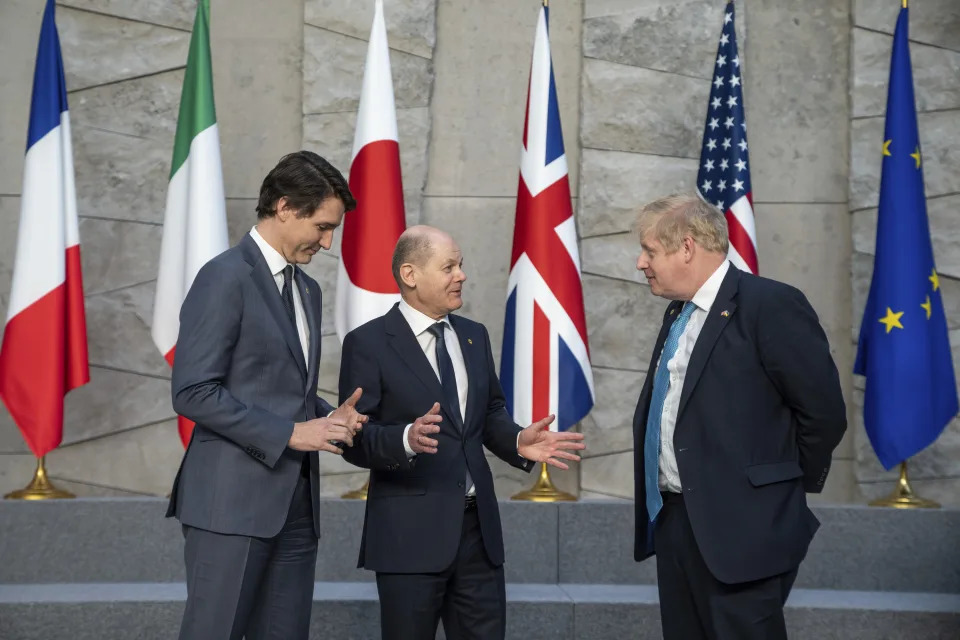
Canadian Prime Minister Justin Trudeau, left, talks with German Chancellor Olaf Scholz, center, and British Prime Minister Boris Johnson, right, during an extraordinary NATO summit at NATO headquarters in Brussels, Belgium, Thursday.
Russian gold purchases increased in 2014, after the U.S. issued sanctions on Russia for Putin’s invasion of Crimea. Now the country holds $100 billion to 140 billion in gold reserves, which is roughly 20 percent of the holdings in the Russian Central Bank, according to U.S. officials. Additionally, the Bank of Russia announced Feb. 28, shortly after several Russian banks were removed from the SWIFT bank messaging system, that it would resume the purchase of gold on the domestic precious metals market.
HOW COULD RUSSIA USE GOLD TO EVADE SANCTIONS?
The U.S. says that Russia can and has used gold to support its currency as a way to circumvent the impact of sanctions. One way to do that is by swapping the gold for a more liquid foreign exchange that is not subject to current sanctions. Another way would be to sell the bullion through gold markets and dealers. The gold could also be used to directly purchase goods and services from willing sellers.
HOW WOULD THE SANCTIONS APPLY?
The U.S. announcement to block gold transactions was done alongside Group of Seven and European Union allies that will also impose the gold reserve ban. New guidance from the U.S. Treasury Department states that American individuals, including gold dealers, distributors, wholesalers, buyers, and financial institutions are generally banned from buying, selling or facilitating gold-related transactions involving Russia and the various parties that have been sanctioned.
WHAT KIND OF IMPACT COULD THIS HAVE ON RUSSIA?
The move should further impact the country’s ability to launder money and will in effect apply secondary sanctions on people who trade in gold with Russia, experts say. “It is another way to close sanctions loopholes, and increase economic pressure on Russian entities,” said Rachel Ziemba, an adjunct senior fellow at the Center for a New American Security. The ban on gold transactions is also an attempt to prevent innovative financial transactions through other countries that continue to do business with Russia.
WHAT OTHER SANCTIONS HAVE BEEN IMPOSED?
The U.S. also took additional sanctions actions on Thursday. It sanctioned dozens of Russian defense companies, 328 members of the Russian State Duma — or state assembly — and the head of Russia’s largest financial institution. Those actions are on top of export controls and financial penalties issued in the past month on Putin, his inner circle, some of the country’s top financial institutions, along with several banking institutions’ removal from the SWIFT bank messaging system.
Russian Defense Minister Sergei Shoigu resurfaced on Russian state media on Thursday after nearly two weeks out of the public eye, Reuters reported.
Shoigu was seen in a snippet of footage showing him attending a virtual meeting with Russian President Vladimir Putin and others on the country’s Security Council.
Russian news agency RIA broadcast the footage after some Russian news outlets noted his prolonged absence from public view.
“The defense minister has a lot on his mind right now. A special military operation is underway. Now is not really the time for media activity,” Kremlin spokesman Dmitry Peskov told journalists on Thursday, according to Reuters.
The development comes four weeks after Russia began its invasion into Ukraine, dubbed a “special military operation” by Moscow.
A senior military official from NATO told several news outlets that, based on numbers provided by Ukrainian officials, up to 40,000 Russian soldiers have been killed, taken prisoner, are missing or are injured. As many as 15,000 Russian troops have been killed in the fighting, along with six generals.
Russia is likely to challenge those figures, however, and has not provided casualty estimates in recent weeks.
Before Russia’s invasion on Feb. 24, many Western officials projected Ukraine could fall within a matter of days. However, a month into the fighting, Moscow has seized only a handful of smaller cities and Russian advances have faced fierce pushback on the ground and in the sky.
Defense Secretary Lloyd Austin offered a bleak assessment last week of how Russian forces were progressing in Ukraine, saying that Moscow had “struggled with logistics” and made “missteps.”
“I don’t see, you know, evidence of good employment of tactical intelligence. I don’t see integration of air capability with a ground maneuver,” Austin told CNN’s Don Lemon.
“And so there are a number of things that we would expect to have seen that we just haven’t seen, and the Russians really have had some … problems. So, many of their assumptions have not proven to be true as they entered this fight.”
U.S. and allies aiming to provide anti-ship missiles to Kyiv, official says
March 24, 2022
BRUSSELS (Reuters) – The United States and its allies are working on supporting Ukraine with anti-ship missiles, a senior U.S. administration official said on Thursday.
“We have started consulting with allies on providing anti-ship missiles to Ukraine,” the official said on the sidelines of the NATO summit in Brussels. “There may be some technical challenges with making that happen but that is something that we are consulting with allies and starting to work on.”
Ukrainian President Volodymyr Zelenskiy joined NATO leaders via videolink but did not repeat requests for NATO membership or the establishment of a no-fly zone, according to the official.
“The mood overall has been sober, it’s been resolute and it’s been incredibly united,” the official said of the atmosphere at the summit meeting.
(Reporting by Jarrett Renshaw and Sabine Siebold, editing by Marine Strauss)
A big rig semi truck transports boxes of pears. vitpho / iStock / Getty Images Plus
Food travels long distances – sometimes hundreds or thousands of miles – to reach our plates. Mapping the trajectory of many processed foods is to draw zig-zags across the globe, connecting faraway fields, factories, distribution centers, and store shelves.
The concept of “food miles” was created in the 1990s to warn consumers of the connection between long-distance food transportation and mounting global carbon emissions. Recent estimates figure that, in the U.S., processed food typically travels over 1,300 miles and fresh produce over 1,500 miles before it’s consumed. Ultimately, the further food travels, the more fossil fuels are needed, which in turn results in more greenhouse gas emissions that fuel climate change.
Just 10 companies – among them Nestlé, Mondolez, and Unilever – control almost all large food and beverage companies in the world. This concentration of food suppliers has left less room for small, local farmers, and means more and more of our food is transported across the country – or the globe – before being eaten. Take Iowa, for example: in 1870, 100% of all apples consumed in the state were also produced there. By the end of the 20th century, however, only 15% of apples consumed were produced by Iowa farmers.
The globalization of our food supply has also allowed consumers to become accustomed to foods grown only in other regions – think of coffee, which isn’t grown anywhere in the contiguous U.S. – or out-of-season foods that must be transported from warmer climates. Strawberries bought at a local farmers market during their summer growing season, for example, will have a lower food mileage than those shipped from California and purchased at a grocery store in December.
Different methods have been employed over time to calculate food miles. The Weighted Average Source Distance (WASD) formula was developed by Annika Carlsson-Kanyama in 1997, and considers the weight of the transported food and the distance it travels from the place of production to the place of sale. To analyze foods with multiple ingredients – including many processed foods, like bread, packaged desserts, snacks, etc. – The Leopold Center for Sustainable Agriculture developed the Weighted Total Source Distance (WTSD) formula, which calculates the weight and distance traveled of each individual ingredient.
How Are Food Miles Calculated?
The WASD and WTSD are helpful formulas, but the Weighted Average Emissions Ratio (WAER) formula – developed in 2004 by the nonprofit LifeCycles – also takes into account the greenhouse gas emissions associated with the mode of transportation employed. So, it’s not just the literal miles traveled that matters, but the means by which it’s transported.
The Impact of Faraway Food
Both transportation and agriculture are major culprits in human-caused climate change. In the U.S., transportation accounts for the largest share of national greenhouse gas emissions, and, according to the IPCC, agriculture accounts for one-fifth of all global CO2 emissions. The U.S. food system alone consumes more energy than all of France annually.
Within the food system itself, transportation comprises 14% of all energy used, but greenhouse gas emissions are also related to where the food was produced: The Leopold Center found that conventionally-sourced food uses 4 to 17 times more fuel than local food, and produces 5 to 17 times more CO2. For processed foods, the impact is even larger. Think of a frozen lasagna: the wheat for the pasta might be grown in Kansas, the tomatoes and spinach for the sauce in California, the beef raised in Texas, and the cheese made in Wisconsin. Some of these materials might even need to be transported from the farm to another location to be processed – like the wheat to be made into sheets of lasagna noodles – then to the factory to be assembled, packaged, and finally shipped to grocery stores.
Food miles also take into account the mode of transportation used – by water, road, rail, or air, in order of efficiency – which are not all created equal; transporting food by plane creates 50% more greenhouse gas emissions than food transported by sea. A 2005 study found that while air transportation only accounts for 1% of food transportation in the UK, it is responsible for 11% of the country’s emissions.
Food mileage should also include how the food is procured by the customer. In our car-based society, where car-ownership rates by household have remained above 90% for a decade, many shoppers drive to a store to purchase their groceries. In 2015, researchers found that the median distance to the nearest food store for Americans was 0.9 miles, and that 40% of the population lived further than 1 mile from a food store, necessitating a car for many people in order to do their shopping.
Debate Over Food Miles
Climate and agricultural scientists don’t all agree on the benefits or accuracy of food miles when determining the environmental impact of food products.
Many argue that this metric doesn’t take into account the whole carbon footprint of an item, or its non-emissions-related environmental impacts during production, like pesticide use, water pollution, or farmers’ rights. “Working out carbon footprints is horribly complicated,” said African agriculture expert professor Gareth Edwards-Jones of Bangor University in an interview with The Guardian. “It is not just where something is grown and how far it has to travel, but also how it is grown, how it is stored, how it is prepared.”
Local food is often espoused as the greener option, but this isn’t always true. For example, the energy needed to heat a greenhouse in the Northeast to grow tomatoes in the winter might actually be a more carbon-intensive process than shipping the tomatoes from California. A Swedish study found that tomatoes imported to Sweden from Spain were actually less energy-intensive than those grown locally in greenhouses.
Some companies and organizations have instead begun using the Life Cycle Assessment (LCA) method to analyze the impact of their product. This method takes into account all stages in the life cycle of the product, from production, to processing, to packaging, to transportation, to disposal. The analysis goes beyond carbon emissions and considers other environmental factors like air and water pollution, use of natural resources, and impacts on human health.
How to Reduce Food Miles
While the benefit of food miles might be contested, lowering your environmental impact with your food choices is always beneficial.
To find the food miles of your favorite products, use this food miles calculator, or research where the product comes from. It might be unrealistic to expunge all faraway foods from your diet – given expense and convenience – but some items might be replaceable with local alternatives. Consider joining a CSA to get fresh produce from nearby farms at regular intervals, or shopping from local producers at a farmers market. Better yet, grow your own food! The only food miles to calculate will be the distance from your backyard or front stoop to your kitchen.
Eating seasonal produce will also ensure that your produce wasn’t shipped across the country to reach your plate. While you can’t always know if something was transported by plane, many perishables that need to be eaten quickly after harvesting are – like berries – so refraining from eating these products until they’re in season will cut down on air transport.
Beyond food miles, minimize your impact by cutting down on food-related emissions in other ways. Limiting or cutting out meat and dairy is among the most impactful of changes, as 57% of emissions from food production are attributed to animal-based food (including the production of livestock feed). Going fully vegan or vegetarian is great, but not imperative; just reducing animal products in your diet makes a difference. Lastly, instead of tossing food scraps in the trash, compost them at home to keep organic waste out of landfills.
Biden’s risk-averse approach to Russia could create greater threat, experts say
Shannon Crawford – March 23, 2022
President Joe Biden’s high-stakes summit with other NATO leaders on Thursday will be one of the most scrutinized meetings on the world stage in decades, and could have enormous implications for both the war in Ukraine and the global balance of power.
Despite calls from Ukraine to do more to help stave off Russia’s ruthless invasion, Biden has taken a cautious approach — wary of escalating the conflict by drawing in U.S. forces as part of a more direct NATO response. But after nearly a month of fighting, some foreign policy and national security experts ABC News spoke to say it may be time for the alliance to take on a more direct role.
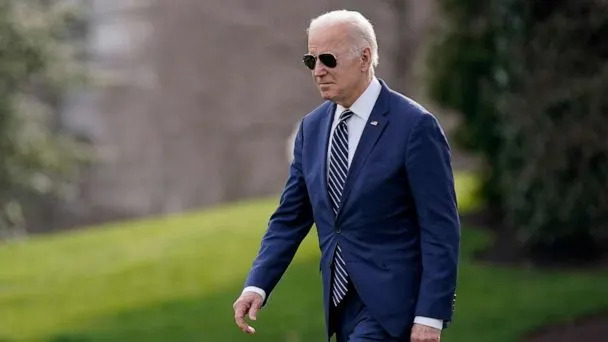
PHOTO: President Joe Biden walks on the South Lawn of the White House before boarding Marine One, March 18, 2022. (Patrick Semansky/AP)
Preparing for ‘the worst case’
Since before the fighting broke out, Biden has insisted that American troops would not fight Russian forces inside Ukraine, warning that going head-to-head would lead to “a third world war.”
But Barry Pavel, a former National Security Council senior official during the Bush and Obama administration and the senior vice president and director of the Scowcroft Center for Strategy and Security at the Atlantic Council, says that’s far from inevitable.
“There have been other cases where U.S. and Russian forces have unfortunately come into friction and World War III didn’t start,” Pavel said, characterizing the strategy as simplistic. “There are hundreds of options that could be done between what NATO is doing now and risking World War III.”
The greater threat, warns Pavel, might be in leaving Putin unchecked.
“If he is emboldened by success in Ukraine, then he will be more aggressive in his efforts to nibble and to move into areas of perceived weakness in NATO members,” he said. “If he achieves his goal, you’ll have Russian forces on the borders of seven NATO members, including nuclear forces in Belarus, and so he’ll use that new posture to really heighten European insecurity to a great degree.”
And it isn’t Biden’s — or NATO’s — choice alone. Moscow could also escalate the conflict by striking a NATO member, either intentionally or accidentally, triggering a sweeping response.
“Article 5 — in the most basic sense — is NATO’s ‘Three Musketeers’ provision, which is to say, ‘all for one and one for all’ — an attack against any member is an attack against every member of NATO,” said Sean Monaghan, a former civil servant in the U.K. Ministry of Defence and a visiting fellow at the Center for Strategic and International Studies, calling it “the most important red line in international politics.”
“This is a contingency that NATO forces are already preparing for,” said Monaghan. “That’s what the military does — prepare for the worst case.”
While the response to a Russian strike wouldn’t necessarily need to be eye for an eye, Monaghan says in theory, the alliance would be obligated to provide “an overwhelming response” if any member state was hit.
“The practice, some would say that NATO being collective of 30 nations, that have to reach consensus for any actions to be to be taken, that might hinder a response. But I think in this conflict, NATO has shown itself to be quite a lot more resolute and speedier of action than many people would have predicted,” he added.
PHOTO: A U.S. Navy pilot sits in a Boeing EA-18G Growler electronic warfare aircraft on the deck of the USS Harry S. Truman carrier cruising in the Mediterranean Sea, March 17, 2022. (Giuseppe Distefano/AP)
The next phase for NATO
While the Biden administration has underscored the power of NATO’s overwhelming unity in the face of Russian aggression, when it comes to charting a path forward to counter the Kremlin, cracks within the alliance are beginning to emerge. While the summit will be an opportunity for the powers to get on the same page, it may also cast a spotlight on areas of disagreement.
For instance, Poland plans to propose a peacekeeping mission to Ukraine — a move the U.S. has effectively ruled out. Article 5 lays plain that an attack on a member merits a response, but will the alliance retaliate if Russia resorts to chemical weapons in Ukraine? And while NATO may not be willing to establish a no-fly zone over the country, Pavel says that doesn’t mean there isn’t a debate to be had about what more can be done to help the country defend its own airspace.
“In terms of the weapons pipeline, we should be doing much more. We can’t let the Ukrainians fly aircraft in their own defense? Forget these ridiculous restrictions on what equipment we can provide a sovereign country who asks for it to defend themselves against an invading force” he said, referencing the U.S. and other allies’ hesitancy to hand over fighter jets to Ukraine for fear of Russian retaliation.
Pavel added that additional anti-aircraft and anti-ship weaponry, as well as enhanced intelligence support and humanitarian aid on the ground, could go a long way in resistance efforts.
Thomas Graham, a former NSC senior director for Russia and a distinguished fellow at the Council on Foreign Relations, says that beyond discussing support for Ukraine, NATO leaders should use the upcoming summit to make sharpen their signaling to the Kremlin.
“NATO leaders want to make sure that they’ve done everything that they can in order to deter the Russians,” he said. “Have we augmented the forces in Eastern Europe to the appropriate levels? And have we convinced the Russians that in fact we are determined to honor the Article Five guarantee and protect every inch of NATO territory?”
Monahan predicts this week’s gathering will result in a reversal to a mindset not seen since the days of the Soviet Union.
“We can foresee it as the beginning of a step change, almost a return to NATO’s Cold War posture of, if not territorial defense, then a much increased forward presence designed to deter a Russian regime that is clearly willing to resort to war” he said.
PHOTO: A U.S. Marine participates in a military exercise called ‘Cold Response 2022,’ a gathering of around 30,000 troops from NATO member countries plus Finland and Sweden, amid Russia’s invasion of Ukraine, in Evenes, Norway, March 22, 2022. (Yves Herman/Reuters)
Battle lines of the future
Beyond addressing the immediate crisis, experts say NATO must ensure it is ready to respond to a more aggressive Russia and prepare for the new geopolitical frontier it is forging.
“The war in Ukraine will end at some point will end, but Russia will remain,” said Graham. “And what the conflict has demonstrated is that the hopes we had had for integrating Russia into the Euro-Atlantic community are dead.”
Pavel says plotting out a strategy not only for ending the conflict — but for managing exactly how the conflict ends — will be critical.
“When wars have ended in the past, the new boundaries have been drawn where the force set, through the middle of Germany, through the middle of Berlin,” Pavel said. “When the dust settles, where do we want Russian forces to be and where do we want Ukrainian and potentially NATO forces to be?”
Another repercussion may be an onslaught of arms races. Russia’s alleged deployment of hypersonic missiles—a technology the U.S. has not yet mastered—is an area of competition, but Pavel says it’s not the only one.
“Putin has spent 10, 15 years modernizing the Russian nuclear forces — a lot of new types of exotic Russian nuclear weapons, pretty significant,” he said. “Certainly, the U.S. and some NATO members have nuclear capabilities, but they are aging. They have not been modernized at the pace that we should be doing.”
“All of this means that we’ll have we’ll have a lot more to do, unfortunately, on the security agenda going forward,” Pavel added.
Filmmaker who documented Russia’s propaganda says Trump ‘fits neatly’ into Moscow’s narrative as the only US leader who ‘wasn’t trying to destroy the Russian way of life’
Cheryl Teh – March 23, 2022
Former President Donald Trump and Russian President Vladimir Putin in Helsinki on July 16, 2018.Yuri Kadobnov/AFP via Getty Images
The filmmaker Maxim Pozdorovkin said Donald Trump fit “neatly” into an anti-West Kremlin narrative.
He said Trump was portrayed as the only US leader not “trying to destroy the Russian way of life.”
He described Russia as “fully and artfully” waging an information war for the past decade.
A filmmaker who has extensively documented Russian propaganda said this week that of all the US leaders, former President Donald Trump fit “neatly” into the Kremlin’s anti-West narrative.
In an interview with The Washington Post, Maxim Pozdorovkin — whose award-winning documentary “Our New President” follows Trump’s election in 2016 as depicted by Russia’s state-linked media — gave his take on Moscow’s long-standing propaganda campaign against the US and the West.
Pozdorovkin told The Post that in the decade leading up to Russia’s invasion of Ukraine, Russians had been fed the same message “over and over” by President Vladimir Putin’s government that the West was constantly attempting to “stifle and destroy” their society. He said Trump “fits neatly” in Moscow’s propaganda efforts because he could be portrayed as the “one American leader who wasn’t trying to destroy the Russian way of life.”
In the context of that narrative, Pozdorovkin said, the domestic backlash that Trump faced in the US — no matter the real reason — could be framed as being fueled by anti-Russia interests.
“It’s been an information war — a totally one-sided information war — and it has been waged so fully and artfully that it’s made a lot of what’s happening now preemptively possible,” he told the outlet.
“The Russian media has been totally shadowboxing for years; no one was fighting back,” he said later in the interview. “But that doesn’t really matter. If you ingrain this message of victimhood so completely, what it does is when there’s any kind of Putin aggressive action, as there is now, a lot of people in Russia don’t see it as aggressive.
“They just see it as standing up for their way of life.”
US finds Russian troops have committed war crimes in Ukraine
Matthew Lee – March 23, 2022
WASHINGTON (AP) — The Biden administration on Wednesday made a formal determination that Russian troops have committed war crimes in Ukraine and said it would work with others to prosecute offenders, Secretary of State Antony Blinken said.
“Today, I can announce that, based on information currently available, the U.S. government assesses that members of Russia’s forces have committed war crimes in Ukraine,” Blinken said in a statement released as he was traveling to Brussels with President Joe Biden for an emergency summit of NATO leaders.
The assessment was based on a “careful review” of public and intelligence sources since Russia launched its invasion of Ukraine last month, he said.
America’s top diplomat said the United States would share that information with allies, partners and international institutions tasked with investigating allegations of war crimes and crimes against humanity.
“We’ve seen numerous credible reports of indiscriminate attacks and attacks deliberately targeting civilians, as well as other atrocities. Russia’s forces have destroyed apartment buildings, schools, hospitals, critical infrastructure, civilian vehicles, shopping centers, and ambulances, leaving thousands of innocent civilians killed or wounded,” Blinken said said.
He cited attacks on the civilian population in the besieged city of Mariupol and elsewhere.
Neither Russia nor the U.S. recognizes the authority of the International Criminal Court at The Hague, presenting obvious difficulties for seeking accountability for war crimes committed in Ukraine.
The U.S. could still assist a prosecution before the court, which earlier opened an investigation into atrocities committed in Ukraine, by helping to gather evidence against Russian forces in Ukraine, using some of the vast abilities it has deployed to track and monitor what has been happening in the conflict.
The U.S. could also provide support and backing to a commission of inquiry established by the U.N. Human Rights Council.
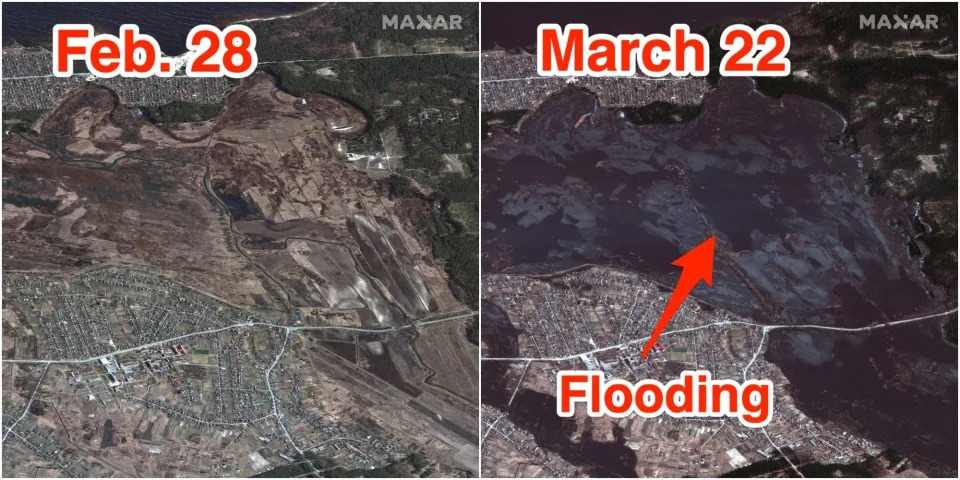
A river basin to the northwest of Kyiv has been flooded.
It’s unclear whether this was intentional, but it could be a move to block Russian troops.
If the troops were unable to cross the river, they wouldn’t be able to capture Kyiv from the West, per CNN.
Satellite images show flooding in the Irpin River basin northwest of Kyiv.
It is unclear what caused the flooding, but this could be a strategic move by Ukraine to block the advance of Russian troops on the capital, analysts have said. The basin borders a large reservoir.
It could be an example of “hydraulic warfare” from Ukraine to block the advancing Russian troops targeting the city’s northwest, analysts previously told the Washington Post. If the Russian forces cannot cross the Irpin river, they will not be able to take Kyiv from the west, according to CNN.
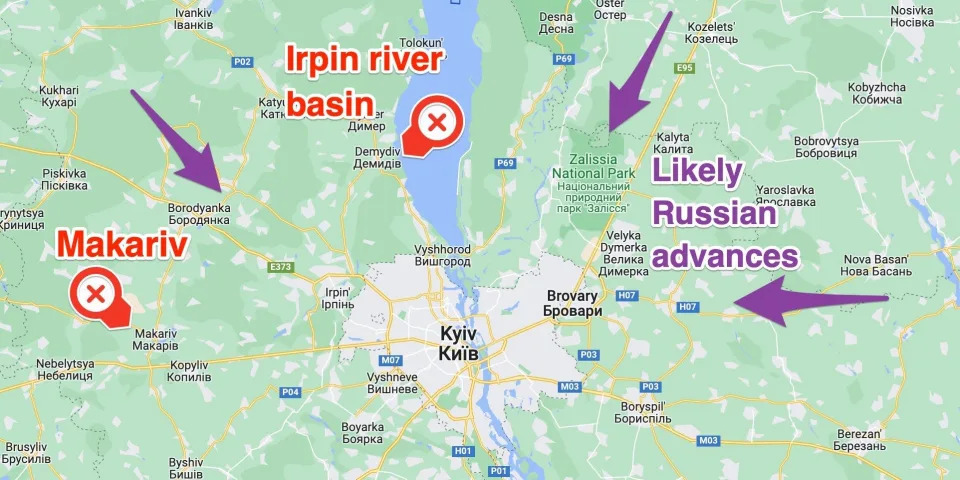
According to the UK’s defense intelligence, Russian troops have driven towards Kyiv from the north, west, and east since the war began on February 24. Capturing Kyiv is seen as Russia’s primary goal in its invasion of Ukraine, but it has struggled to make headway facing fierce resistance from Ukrainian forces.
Ukraine said Tuesday that it had recaptured Makariv, a town west of Kyiv, the Associated Press said, further blunting Russia’s ambition to launch an assault on the city from the northwest.
A map of the region around Kyiv shows the Irpin River Basin, Makariv, and the likely axes of Russian troop advances, per the UK Defense.Google Maps/Insider
Ukraine’s ambassador to the US said on February 26 that Russian forces had destroyed a dam in the water reservoir North of Kyiv. However, it is unclear whether that event is connected to the flooding, per The Washington Post.
German minister says further Strela missiles are on way to Ukraine
March 23, 2022
FILE PHOTO: Ukrainian servicemen take part in anti-aircraft military drills in Volyn Region
BERLIN (Reuters) – German Foreign Minister Annalena Baerbock said on Wednesday that after delays in deliveries, further supplies of Strela missiles, which had been in the inventories of the former Communist East German army, were on the way to Ukraine.
Russia’s invasion of Ukraine prompted Germany to stage a historic reversal of its policy of not sending weapons to conflict zones, but the Ukrainian government has been frustrated by delays.
“I can clearly say that further Strela deliveries are on the way,” Baerbock told the Bundestag lower house of parliament.
“We are one of the biggest weapons suppliers in this situation, it doesn’t make us proud but it’s what we must do to help Ukraine,” she added.
She also said that a first flight carrying Ukrainian refugees from Moldova to Germany would take place on Friday or Saturday.
(Reporting by Miranda Murray and Madeline Chambers)
Russian Crew of Mystery ‘Putin Yacht’ Just Vanished Overnight in Tuscany
Barbie Latza Nadeau – March 23, 2022
Federico Scoppa/AFP via Reuters
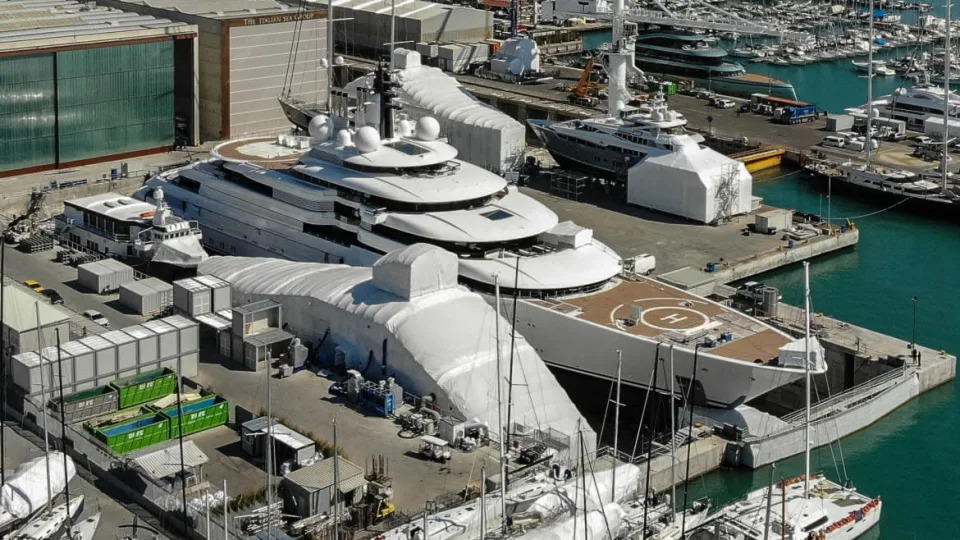
ROME—For the last two weeks, Russian oligarch watchers have had their eyes on the Scheherazade mega yacht docked in the posh Marina di Carrara in northern Tuscany. There are growing suspicions that the $700 million, six-deck super-luxurious vessel—with its two helicopter pads, various swimming pools, his-and-hers beauty salons and gold fixtures that would make Donald Trump jealous—belongs to Vladimir Putin.
Until two days ago, its Russian crew, led by British captain Guy Bennett Pearce, whose mother told the Daily Telegraphher son would “never work for a murderer,” didn’t leave the ship. But The Daily Beast has learned that all that changed this week when the Russian crew disappeared overnight, replaced by an entirely British set, who, despite Brexit constraints that would require work visas, seem to have descended out of nowhere.
The crew change caught the attention of Italy’s General Confederation of Labor, which confirmed to The Daily Beast that the Russians are gone. “Yes, they were all Russians until a few days ago,” Paolo Gozzani, secretary of the confederation, told The Daily Beast. “Today the crew is made up entirely of English. We are monitoring the situation inside the shipyards but not because I care whether it is Putin’s or not: I am worried about the repercussions that a seizure, or a freezing of assets, could have on the shipyard workers.”
Italian financial police, who have already confiscated millions of dollars worth of yachts, villas, and bank accounts tied to sanctions against Russia, are working to untangle reams of documents that may or may not link the ship to Putin. Marianna Ferrante, spokesperson for the Italian Sea Group that manages the port, says the ship arrived about a year ago to be refitted. She says it does not belong to Putin—at least not directly.
Wikicommons Media
But Russian opposition leader Alexei Navalny says it does. His research team published a video they say proves the yacht belongs to Vladimir Putin, a sentiment shared by U.S. intelligence officials after The New York Timesreported alleged ties to the Russian president.
The area where the Scheherazade—named after a key female character in Middle Eastern tale One Thousand and One Nights—is as close to Little Russia as anywhere in Italy. The port is lined with designer shops and a magnet for Russian tourists who flock to Forte dei Marmi resort, which hosts around 500 Russian “regulars” each summer, according to the local tourist board, which says most have cancelled for the upcoming season. In 2010, the residents petitioned to stop Russians from pushing out the locals, but in the end, the Russian Ruble won out and most of the port workers speak enough Russian to accommodate the numerous Russian yachts that are docked there most of the long Italian summers. The port authority said all the Russian yachts disappeared months before Russia’s invasion of Ukraine. All but the Scheherazade, which is currently the only vessel in Italian waters without a distinct owner, according to the Italian Financial police.
Francesco De Pasquale, the mayor of Carrara, has grown weary of the interest in the mega ship. He and the leaders of the Italian Sea Group have issued a joint statement denying Putin is the owner. “According to the documentation available to the company and following what emerged from the checks carried out by the competent authorities, the 140-meter yacht Scheherazade, currently under construction for maintenance activities, is not attributable to the property of Russian President Vladimir Putin,” says the statement, also sent to The Daily Beast.
But the port also conceded that if the Scheherazade were to be seized, it would be disastrous for the port’s 400 workers who have already invested hundreds of hours and materials in the mega yacht refit. “Inside the yard, 400 direct workers and another 200 work in the related industries,” union leader Gazzoni says. “If the yacht, which has been carrying out refitting operations for weeks now, were seized it would be a disaster, an immense impact on the work of the workers; the seizure would freeze a huge area of the construction site, who knows for how long, and would prevent new work from coming in.”

British Prime Minister Boris Johnson, left, and Turkey’s President Tayyip Erdogan attend a bilateral meeting during a NATO summit on Russia’s invasion of Ukraine, at the alliance’s headquarters in Brussels. (Henry Nicholls/Pool, AP)
From left, Britain’s Prime Minister Boris Johnson, French President Emmanuel Macron and U.S. President Joe Biden arrive for a G7 leaders’ group photo during a NATO summit in Brussels, (Henry Nicholls/Pool via AP)