Russia, mired in war, faces economic pain and attempts to isolate it
Andrew Osborn – December 6, 2022
Russian conscripts depart for garrisons, in Omsk
LONDON (Reuters) – Russia’s invasion of Ukraine plunged Europe into its biggest land war since World War Two, igniting a conflict that has killed thousands, displaced millions, pulverised Ukrainian cities and damaged the global economy.
Despite warnings from U.S. intelligence in the run-up to Feb. 24, many European and Ukrainian officials did not believe it would happen. It was far too much for the Russian army to bite off, went the thinking.
Putin, who turned 70 in October, was, however, incensed by what he saw as Ukraine’s treacherous Westwards pivot, and ordered an invasion – which he called “a special military operation” – nonetheless.
His goal was to root out what he saw as excessive and potentially dangerous Western influence in an area where Moscow once held sway and to speed up what he saw as an inevitable historical shift to a multi-polar world.
When in September he announced the annexation of four Ukrainian regions his troops partially controlled, a move the West declared illegal, his desire to enlarge Russia, already the world’s biggest country by territory, became explicit.
The war has so far not gone well for Putin. His forces were beaten back from the Ukrainian capital and then from the north-eastern Kharkiv region. In November, they were forced to quit the southern city of Kherson and the River Dnipro’s west bank.
As winter sets in, his army, which still controls a large chunk of Ukraine, has had more success at destroying Ukrainian infrastructure, inflicting prolonged power and water outages, something Moscow says has a military purpose. Ukraine has accused Russia of terrorism.
After overseeing the Kherson withdrawal, the commander of Russia’s forces is under pressure to deliver on the battlefield.
On the home front, where space for dissent has shrunk to nearly zero and hundreds of thousands of young men are missing from the workforce after fleeing abroad to avoid being called up, people are trying to get on with their lives.
But they cannot escape reminders of the war.
State TV schedules are dominated by rolling talk shows whose guests explain why the war is necessary and funerals for the war dead, whose number is a secret in Russia but estimated in the tens of thousands by the West, have become regular occurrences.
Despite military setbacks and political infighting, eight sources told Reuters in October that Putin’s grip on power remained firm and unofficial polls give him a 70-80% approval rating. Some said that could change fast if defeat beckoned.
WHY IT MATTERS
Russia’s invasion up-ended geopolitics.
NATO, an alliance that French President Emmanuel Macron said in 2019 was in the grips of “brain death”, is poised to add Finland and Sweden even though its further expansion was the very thing Putin opposed.
The United States, which the Democrats fretted had become too isolationist under former president Donald Trump, has provided Ukraine with the lion’s share of the financial and military aid required to keep it in the fight.
Ukraine, which before Feb. 24, had sometimes struggled to get the West interested in a slow-burning war against Russian proxies in its east, has received aid and Western support that once seemed unimaginable.
And Russia, one of the world’s biggest energy and commodity producers, has been hit with the harshest Western sanctions in its modern history.
That and its own retaliatory measures have shrunk its role as one of Europe’s biggest oil and gas suppliers, disrupted global grain and fertiliser markets, fuelled global inflation and increased nuclear tensions to their highest level since the Cuban Missile crisis.
WHAT DOES IT MEAN FOR 2023?
With Ukraine adamant that Russia withdraw from its territory before any peace talks happen, including from annexed Crimea, even a temporary ceasefire looks hard to achieve.
For Russia, 2023 is likely to be a year when it tries to stave off more Western attempts to isolate it.
Political leaders in Iran, North Korea and Belarus remain staunch supporters. China and India have stepped in to buy heavily discounted Russian oil, though Beijing has not been as full-throated in its public support of Moscow as expected.
Cracks have meanwhile begun to open up in the former Soviet Union, where Moscow’s influence is under pressure as some countries try to change the status quo while Russia is busy in Ukraine.
At least two Central Asian countries have voiced public disagreement with Moscow, and Russia’s role as a mediator in a conflict between Azerbaijan and Armenia is being squeezed by the EU and Washington.
Moscow will have to manage its sanctions-hit economy too, a task made harder after the exodus of young men. Economic stability is linked to political stability, which the authorities have tried to ensure by intensifying a crackdown on anyone perceived a threat.
Reuters reported in November that Russia plans to spend nearly a third of its 2023 budget on defence and domestic security while slashing funding for schools, hospitals and roads.
As Putin pays up to keep the war in Ukraine grinding on, managing its fallout at home and abroad is likely to get harder.
Explore the Reuters round-up of news stories that dominated the year, and the outlook for 2023.
(Reporting by Andrew Osborn; Editing by Mike Collett-White and Angus MacSwan)
Appeal Hearing Held Over Navalny’s 9-Year Sentence
Russian opposition politician, anti-corruption campaigner and founder of the Anti-Corruption Foundation (FBK), Alexey Navalny is seen on the screen during his legal appeal against his nine-year prison sentence, in Moscow’s City Court, on May 24, 2022, in Moscow, Russia. Appeal of Kremlin critic Navalny was rejected by the court on Tuesday. Credit – Getty Images
Over the past couple of years, the name Alexei Navalny has become known outside of Russia. You’ve read about him founding the Anti-Corruption Foundation to investigate the illicit wealth of Russian elites, getting detained numerous times over the years for attending protests against Putin’s regime, running for president in 2018, being poisoned in 2020, miraculously recovering and going back to fight for the better future of his country.
For you, these are just headlines around the world. For me, it’s the reality.
My name is Dasha Navalnaya. I’m a 21-year-old studying at Stanford University. My father—Alexei Navalny, became Vladimir Putin’s number one enemy by fighting the Kremlin’s corrupt and bloodthirsty regime.
Since 2011 the Anti-Corruption Foundation has been exposing the corruption of high-ranking government officials in Russia, one of the most famous investigations being Putin’s Palace. In August 2020, my father survived a chemical weapon poisoning with Novichok performed by FSB officers and, several months after recovering, successfully investigated his own assassination attempt.
Despite the dangers he faced, in January 2021, Alexei Navalny went back to Russia and was unlawfully arrested at the airport. He has since been serving his time in prison eye-to-eye with Putin’s jailers. Shortly after his arrest, the Anti-Corruption Foundation was recognized as an extremist organization in Russia. Its team members were prosecuted and forced into exile.
We all know that prison isn’t a place where you want to end up anywhere in the world, but, the conditions of the Russian prison system are far worse than those in the U.S. or Europe. There is nothing like a Russian prison to cripple even those in perfect health. My father survived a chemical weapons poisoning, which took a toll; he spent more than two weeks in a coma and over a month in intensive care. The rehabilitation took months. Shortly after the imprisonment, he started experiencing back pains and a gradual loss of control in his legs. He had to endure a 24-day hunger strike just to get access to medical help.
Barely surviving the hunger strike did not break his spirit—nothing ever will. But the solitary confinement conditions he is now subject to are clearly aimed at mentally breaking and physically killing him. My dad’s “residence” for over two months now – a 7 by 8 feet punishment cell, which is more of a concrete cage for someone of 6 ‘3 height. He spends days sitting on a low-iron stool (which exacerbates his back pain), with a mug being the only thing he’s allowed to keep. Even his bed is fastened to the wall from 6 AM to 10 PM.
On Thursday, November 17th, my dad was moved to the strict regime in a solitary housing unit. The rest of the prisoners live in barracks, which they can freely exit, but he will be permanently locked in the solitary cell. He wrote: “It is a regular cramped cell, like the punishment cell, except that you can have not one, but two books with you and use the prison kiosk, albeit with a very limited budget.” These new conditions will also prevent him from receiving any family visits—they are all completely banned. Being able to have a second book is definitely a bonus for an extremely fast reader like my dad.
I am proud to be my father’s daughter and walk tall knowing that despite the inhuman conditions, he has been standing up against Putin’s war in Ukraine and calling on the Russian people to do everything in their power to fight it.
Protesters hold a banner reading “FREE NAVALNY” as some 2,500 supporters of Russian opposition politician Alexei Navalny march in protest to demand his release from prison in Moscow on January 23, 2021 in Berlin, Germany.Omer Messinger-Getty Images
“Everything has a price, and now, in the spring of 2022, we must pay this price. There’s no one to do it for us. Let’s not ‘be against the war.’ Let’s fight against the war,”—he stated during the trial in March. It is now December, and since August my father has spent 78 days in the punishment cell, serving eight solitary confinement terms back-to-back.
Why was he sent to the solitary confinement punishment cell and now to a long term solitary confinement cell, you ask? Among the violations from the colony administration, my father has been sent to the punishment cell because: unbuttoning jumpsuit” (it is physically impossible to button as the jumpsuit is a few sizes smaller than his), refusing to mop the fence,” and “sweeping the exercise yard poorly and insulting the Сriminal Investigator Lieutenant by addressing him by title and surname instead of his first name and patronymic.” The most recent is simply being an “egregious offender” worthy of the “cell-type” room.
The real reason behind the constant punishments is and always has been, of course, Navalny’s condemnation of the Ukraine war and his opposition to the Putin regime. My father uses every appeal hearing as an opportunity to make an anti-war statement. During his recent hearing, he said: “Your Honor, I declare that I am an innocent person. And I believe that I and others like me did everything possible to prevent what is happening now. And we will continue to do so. And I call on all citizens of Russia to fight this regime, this war, and mobilization.”
“I will spend as much time in a punishment cell as will be necessary to defend my right to speak out against a historic crime Putin is committing” —is a sadly self-fulfilling prophecy in his case. The prison administration made it clear there’s no such thing as a glimpse of the rule of law when it comes to Navalny.
The latter is also attested by the fact that my father’s attorney-client confidentiality privilege no longer exists. The penal colony administration had simply decided to waive it. In recent months, all communication he has had with his lawyers goes through the prison administration. The window in the visiting room has been covered with an opaque film, so lawyers can only hear a voice and see their client’s silhouette as they discuss the defense in the new criminal cases against him (he currently is facing up to 30 years behind bars). My dad’s lawyers no longer have a visual understanding of his health and physical conditions. This is unique even by the low standards of the Russian judicial system.
To me, Alexei Navalny is not only a determined, hard-working, and charismatic leader but also a funny, caring, and incredible father. He taught me how to ride a bike; he helped with math equations and grammar questions when I simply could not wrap my elementary school brain around the concept of semicolons. In middle school, when I made my first attempt to cook porridge, when it turned out to be way too salty, my dad smiled, didn’t discourage me, and ate the whole thing. For hours he helped me learn the poem “The Prophet” by Alexander Pushkin so well it is still engraved in my mind. Every September, he walked my younger brother and me to school on the first day of class. My dad was there for our competitions, concerts, and graduations. And has always written me or anyone he holds close a loving and hilarious letter on our birthday if he was arrested and couldn’t be with us in person.
Now he can’t even do that.
Our family has always taken pride in its optimism: we prefer jokes over complaining when the worse comes. We’ve seen a lot over the years and made sure not to take it too close to heart. My father was detained at least once almost every year between 2011 and 2021, with time spent in prison longer and longer. My mother was detained and tried; my uncle served 3.5 years in prison for the simple crime of having the same last name. Our whole family, including my grandparents and great-grandparents, has been harassed and unlawfully prosecuted many times. Not to mention the “good old times” when the FSB poisoners were close to killing my mother and almost killed my father
It is impossible to get used to the idea that your loved ones can be imprisoned or killed at any time for a made-up reason, but over time it became part of our family routine. “So, I assume you won’t be coming to dinner tonight?” I’d ask my dad whenever he was getting ready to go to a protest. He would respond with a snicker.
The Russian regime has always been based on corruption and it is now based on war – for Putin, these are the two prerequisites for staying in power. That is why he is ready to destroy anyone who dares to expose them. And he treats my father with a personal hatred—as his most implacable opponent for many years.
As you read these lines, Navalny is in mortal danger, but he continues to stand by what he believes in. He has proven willing to sacrifice his freedom, health, and even his life to see Russia become a democratic, prosperous country. And right now, even from prison, he is fighting to make it peaceful. By his example, he supports and inspires millions of Russians who, like him, are unwilling to tolerate war and injustice.
Putin must be defeated. He is a threat not only to Russia and Ukraine but to the world. The very essence of authoritarian power involves a constant increase in bets, an increase in aggression, and the search for new enemies. In order not to lose in this struggle, we must unite.
My father is one of the leaders of this struggle, and he must be out there. He challenges Putin every day, but together we can ensure that his efforts are not in vain and that his words are heard around the world. I now turn to world leaders and ask them to support my call to the Russian government to release my father.
Let’s all strive for a better, more prosperous global future where we can choose our own leaders. Free Alexei Navalny!
Russian Cruise Missiles Were Made Just Months Ago Despite Sanctions
John Ismay – December 6, 2022
Smoke rises after a Russian artillery bombardment in Kherson, Ukraine, on Wednesday, Nov. 23, 2022. (Finbarr O’Reill/The New York Times)
Some of the cruise missiles that Russia launched at Ukraine’s civilian infrastructure in late November were manufactured months after the West imposed sanctions intended to deprive Moscow of the components needed to make those munitions, according to a weapons research group.
Experts examined remnants of Kh-101 cruise missiles found in Kyiv, the capital, after an attack Nov. 23 that knocked out electricity and shut down water systems in large areas of the country. One of the missiles was made this summer, and another was completed after September, markings on the weapons show, according to a report released by investigators Monday.
That Russia has continued to make advanced guided missiles such as the Kh-101 suggests that it has found ways to acquire semiconductors and other materiel despite the sanctions or that it had significant stockpiles of the components before the war began, one researcher said.
The findings are among the most recent by Conflict Armament Research, an independent group based in Britain that identifies and tracks weapons and ammunition used in wars. A small team of its researchers arrived in Kyiv just before the attack at the invitation of the Ukrainian security service.
In four previous research trips to Kyiv since the invasion, the investigators found that almost all of the advanced Russian military gear they examined — including encrypted radios and laser range finders — was built with Western semiconductors.
The investigators were unable to determine whether the Kh-101 remnants they studied were from missiles that reached their targets and exploded or were intercepted in flight and shot down.
The Kh-101 missiles were marked with a 13-digit numerical sequence. Investigators said they believe that the first three digits represent the factory where the missile was made, followed by another three-digit code indicating which of two known versions of the Kh-101 it is and two digits indicating when it was manufactured. A final string of five numbers is believed to denote the missile’s production batch and serial number.
Piotr Butowski, a Polish journalist who has written extensively about Russia’s warplanes and military munitions, said the group’s numerical analysis matched up with his research.
“The first three digits are always ‘315’ — this is the production facility code,” Butowski said in an email. “Kh-101 missiles are developed and manufactured by the Raduga company in Dubna near Moscow.”
In an interview before the report was released, a U.S. defense intelligence analyst said that Butowski’s analysis was consistent with the government’s understanding of how Russian missile producers — including those that make the Kh-101 — mark their weapons. The official, who was not authorized to speak publicly, said Russia was generally believed to be experiencing ammunition stockpile problems and may be using newer munitions alongside those that are much older.
The analyst said that reports from Russia indicate that the government has ordered employees at munition plants to work additional hours in an effort to produce more ordnance, and that it is clear that Russia is now firing fewer long-range weapons such as cruise missiles at a smaller number of targets in Ukraine.
Pentagon officials say Russia has fired thousands of long-range weapons including cruise missiles as well as short- and medium-range ballistic missiles at targets in Ukraine since the war began.
Whether Russia has depleted its inventory of older cruise missiles is unclear. But militaries often use older munitions first in combat because they typically make up a majority of a nation’s stockpile.
On Nov. 23, the same day as the cruise missile attack on Kyiv, Lloyd Austin, the U.S. secretary of defense, told reporters that Russia’s supply of precision-guided weapons had been “significantly reduced” and that it would be more difficult for Russia to rapidly produce them “because of the trade restrictions they have on microchips and other types of things.”
But Damien Spleeters, who led Conflict Armament Research’s investigation, said it would be difficult to say that the Russians are running short on weapons.
“Those claims have been made since April,” he said, “so we’re just pointing to the fact that these cruise missiles being made so recently may be a symptom of that, but it’s not a certainty.”
If There Is a ‘Male Malaise’ With Work, Could One Answer Be at Sea?
Talmon Joseph Smith – December 6, 2022
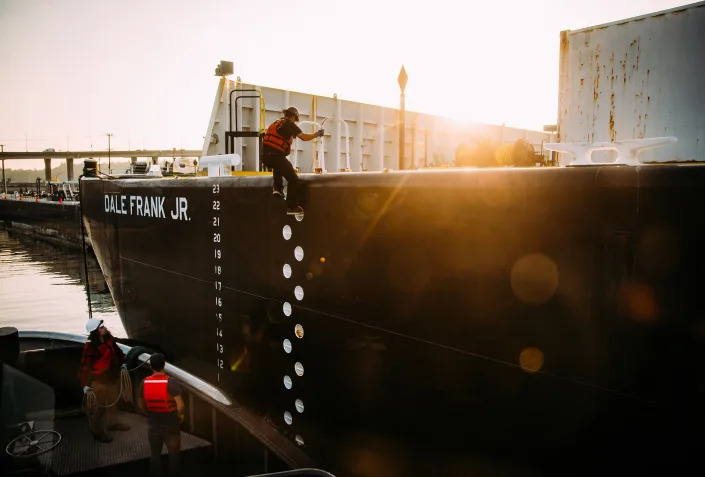
A crew member of the tugboat Millennium Falcon boards the tank barge Dale Frank Jr. in Seattle’s Elliott Bay, Oct. 5, 2022. (Lindsey Wasson/The New York Times)
SEATTLE — Before dawn on a recent day in the port of Seattle, dense autumn fog hugged Puget Sound and ship-to-shore container cranes hovered over the docks like industrial sentinels. Under the dim glimmer of orange floodlights, the crew of the tugboat Millennium Falcon fired up the engines for a long day of towing oil barges and refueling a variety of large vessels, like container ships.
The first thing to know about barges is that they don’t move themselves. They are propelled and guided by tugs like the Falcon, which is owned by Centerline Logistics, one of the largest U.S. transporters of marine petroleum. Such companies may not be household names, but the nation’s energy supply chain would have broken under the pandemic’s pressure without the steady presence of their fleets — and their crews.
“We’re a floating gas station,” said Bowman Harvey, a director of operations at Centerline, as he stood aboard the Falcon, his neck tattoo of the Statue of Liberty pivoting from the base of his flannel whenever he gestured at a machine or busy colleague nearby. Demand is solid, he said, and the enterprise is profitable. The company’s client list, which includes Exxon Mobil and Maersk, the global shipping giant, is robust. But manning the fleet has become a struggle.
Multiyear charter contracts for key lines of business — refueling ships, transporting fuel for refineries and general towing jobs — are locked in across all three coasts, plus Hawaii, Alaska and Puerto Rico, Harvey said. Yet as pandemic-related staffing shortages have eased in other industries, Centerline is still short on staff.
“Hands down,” Harvey said, “our biggest challenge right now is finding crew.”
Safely moving, loading and unloading oil at sea requires both simple and highly skilled jobs that cannot be automated. And the labor supply issues in merchant marine transportation are emblematic of the conundrum seen in a variety of decently paying, male-heavy jobs in the trades.
Over the past 50 years, male labor force participation, the share of men working or actively looking for work, has steadily fallen as female participation has climbed.
Some scholars have a grim explanation for the trend. Nicholas Eberstadt, the conservative-leaning author of “Men Without Work,” argues that there has been a swell in men who are “inert, written off or discounted by society and, perhaps, all too often, even by themselves.” Others, like Brookings Institution senior fellow Richard V. Reeves, put less emphasis on potential social pathologies but say a “male malaise” is hampering households and the economy.
Centerline employees are among about 75,000 categorized by the Department of Labor as water transportation workers, a group in which men outnumber women 5-to-1.
Though the gender split in the industry is more even for onshore office roles, workers and applicants for jobs on the water are predominantly male. Centerline says it has roughly 220 offshore crew members and about 35 openings.
Captains and company managers agree that changing attitudes toward work among young men play a part in the labor shortage. But the strongest consensus opinion is that structural demographic shifts are against them.
“We’re seeing a gray wave of retirement,” Harvey, 38, said.
Even though replacements are needed and, on the whole, lacking, there are new young recruits who are thriving, such as Noah Herrera Johnson, 19, who has joined Centerline as a cadet deckhand, an entry-level role.
On a Thursday morning out in the harbor, Herrera Johnson deftly unknotted, flipped and refastened a series of sailing knots as the crew unmoored from a sister boat that was aiding the refueling of a Norwegian Cruise Line ship. A small crowd of curious cruise passengers peeked down as he bopped through the sequences and the sun’s glare began to pierce the fog, bouncing off the undulating waves.
“I enjoy it a lot,” Herrera Johnson said of his work as he sliced some meat in the galley later on. (Some kitchen work and cleaning are part of the gig and the fraternal ritual of paying dues.)
“I get along with everyone — everyone has stories to tell,” he said. “And I was never good at school.”
Herrera Johnson, who is Mexican American and whose mother is from Seattle, spent most of his life in Cabo San Lucas, in Baja California, until he moved back to the United States shortly after turning 18.
Though entry-level roles aboard don’t require college credentials, new regulations have made at least briefly attending a vocational maritime academy a necessity for those who want to rise quickly up the crew ladder.
Because he is interested in becoming a captain by his late 20s, he began a two-year program at the nearby Pacific Maritime Institute in March, and he earns course credits for work at Centerline between classes.
He got his “first tug” in May: an escapade from New Orleans through the Panama Canal to San Francisco, patched with some bad weather.
“Two months, two long months. It was fun,” he said. “We had a few things going on. We lost steering a few times. But it was cool.”
In short, the industry needs far more Noahs. Many Centerline employees have informally become part-time recruiters — handing out cards, encouraging seemingly capable young men who may be between jobs, undecided about college or disillusioned with the standard 9-to-5 existence to consider being a mariner instead.
“When I’m trying to get friends or family members to come into the business,” Harvey said, “I make sure to remind them: Don’t think of this as a job, think of it as a lifestyle.”
Internet connections aboard are common these days, and there is plenty of downtime for movies, TV, reading, cooking and joking around with sea mates. (On slow days, captains will sometimes do doughnuts in the water like victorious race car drivers, turning the whole vessel into a Tilt-a-Whirl ride for the crew: Sea legs required.)
Of course, those leisurely moments punctuate days and nights of heaving lines, tying knots, making repairs, executing multiple refueling jobs and helping to navigate the tugboat: rain or shine, heat or heavy seas.
It’s “an adventurous life,” Harvey said, one that he and others acknowledge has its pros and cons. Mariners in this sector — whether they are entry-level deckhands, midtier mates and engineers, or crew-leading tankermen and captains — are usually on duty at sea in tight quarters and bunk beds for a month or more.
On the bright side, however, because of an “equal time” policy, full-time crew members are given roughly just as much time off for the same annual pay.
“When I go home, you know, I’m taking essentially 35 days off,” said Capt. Ryan Buckhalter, 48, who’s been a mariner for 20 years. For many, it’s a refreshing work-life balance, he said: none of the nettlesome emails or nagging office politics in between shifts often faced by the average modern office worker trying to get ahead.
Still, Buckhalter, who has a wife and a young daughter, echoed other crew members when he admitted that the setup could also be “tough at times” for families, including his own.
Crew members say they value knowing that their work, unlike more abstract service jobs, is essential to world trade. Average starting salaries for deckhand jobs are $55,000 a year (or about $26 an hour) and as high as $75,000 in places like the San Francisco area, with higher living costs.
The company also offers low-cost health, vision and dental care for employees, and a 401(k) plan with a company match. So CEO Matt Godden said in an interview that he didn’t think wages or benefits were a central reason that his company and competitors with similar offerings had struggled to hire.
“Right now a lot of companies are really hurting,” Buckhalter said. “You kind of got a little gap here with the younger generation not really showing up.”
If the labor market, like any other, operates by supply and demand, managers in the maritime industry say the supply side of the nation’s education and training system is also at fault: It has given priority to the digital over the physical economy, putting what are often called “the jobs of the future” over those society still needs.
Harvey adds that his industry is also grappling with increased Coast Guard licensing requirements for skilled roles, like boat engineers and tankermen, who lead the loading and discharging of oil barges. The regulations help ensure physical and environmental safety standards, Harvey said, but reduce the already limited pool of adequately credentialed candidates.
Women remain a rare sight aboard. Some captains make the case that this stems from hesitance toward a life of bunking and sharing a bathroom with a crop of guys at sea — a self-reinforcing dynamic that company officials say they are working to alleviate.
“We actually do have women that work on the vessels!” said Kimberly Cartagena, senior manager for marketing and public relations at Centerline. “Definitely not as much as men, but we do have a handful.”
Several economists and industry analysts suggested in interviews that another way for companies like Centerline to add crew members would be to expand their digital presence and do social media outreach. Godden said he remained wary.
“If you did something very simple, like you set up a TikTok account, and you sent somebody out every day to create varied little snippets, and you get viral videos of strong men pulling lines and big waves and big pieces of machinery,” Godden said, then a company would risk introducing an inefficient churn of young recruits who would “like the idea of being on a boat” but not be a fan of the unsexy “calluses” that come with the job.
But in the long term, he said, there is reason for optimism. He pointed to the recent establishment of the Maritime High School, which opened a year ago just south of the Seattle-Tacoma airport with its first ninth grade class.
“I think their first class is looking to graduate a hundred people, and then they got goals of getting up to 300, 400 graduates a year,” Godden said. He has been meeting with the school’s leaders this fall and is convinced they will help create the next pipeline in the profession.
“Yes, labor shortages may increase or decrease depending upon how the market works, but I always have this sense that there’s always going to be this sort of built-in group of folks who cannot — just cannot — stand seeing themselves sitting at a desk for 30, 40, 50 years,” Godden said.
“It’s this hands-on business almost like, you know, when you’re a kid and you’re playing with trucks or toys, and then you get to do it in the life-size version.”
270,000 homebuyers who bought in 2022 are underwater on their mortgage
Gabriella Cruz Martinez, Personal finance writer – December 6, 2022
About 270,000 homebuyers who bought during the red-hot housing market this year already owe more than their house is worth, a new analysis found.
Among the 450,000 underwater borrowers in the third quarter, nearly 60% had mortgages originated in the first nine months of 2022, Black Knight found. That’s about 1 in 12 homes purchased in 2022 with a mortgage, or 8%. Nearly 40% of homes bought this year have less than 10% of equity left to tap.
The figures reflect yet another fallout from rapidly rising mortgage rates this year, which have put pressure on housing values as home price growth cools at a record pace month over month.
“Though the home price correction has slowed, it has still exposed a meaningful pocket of equity risk,” Ben Graboske, president of Black Knight data and analytics, said in a news statement. “Make no mistake: negative equity rates continue to run far below historical averages, but a clear bifurcation of risk has emerged between mortgaged homes purchased relatively recently versus those bought early in or before the pandemic.”
(Credit: Black Knight)
Lower-income households hurt the most
Borrowers with purchase loans backed by the Federal Housing Administration (FHA) or Veterans Affairs (VA) were most likely to have slipped underwater, the report found. These are more popular among first-time and lower-income buyers.
Those with FHA loans faced the largest equity challenges, Black Knight found, with more than 25% of folks with FHA loans falling underwater. Additionally, some 80% had less than a 10% equity stake in their homes.
Early-payment defaults (EDP) — loans delinquent within six months of origination — were also rising across product types in recent months with the largest increases among FHA borrowers over the past year. As of October, EDP rates for FHA loans were 150% above 2013-2018 levels, and 25% above their early 2000 averages, the report found.
By contrast, early-payment default among those with conforming loans were more than 70% below early 2000 levels, and VA loans were less than half that same threshold.
“Such loans [FHA] rely on rising home values and principal pay-downs over time to gradually improve their equity position,” Graboske said. “This is … unfortunately, potentially vulnerable cohort that we will continue to keep a close eye on in the months ahead.”
A ‘Just Sold’ sign hangs in front of a home in Miami, Florida. (Credit: Joe Raedle/Getty Images)
Recent buyers at greater risk
Most of the folks at risk of having their loans slip underwater were those who purchased when home prices were at their highest, Black Knight found. At least 10% of June purchase originations – when home prices peaked at $438,000 – were underwater, with more than 30% having less than 10% equity.
Although homeprices have cooled for the last seven months, with prices now 3.2% down from June’s high, the pricing adjustment hasn’t been enough to ease homebuyers’ affordability concerns.
“In a world of interest rates 6.5% and higher, affordability remains perilously close to a 35-year low,” Graboske said. “Risk among earlier purchases is essentially nonexistent given the large equity cushions these mortgage holders are sitting on. More recent homebuyers don’t fare as well.”
Higher mortgage rates may also be limiting the pace of price corrections, Graboske said, due to its damping effect on inventory inflow and subsequent gridlock on home sales activity. The volume of new homes for sale was 19% below the 2017-2019 average, the largest deficit in six years with the exception of March and April 2020 during pandemic-induced lockdowns.
According to the report, the current market is short by more than a half-million listings of what is considered normal by historical measures.
“Add in the effects of typical seasonality and one might expect a far steeper correction in prices than we have endured so far,” Graboske said. “But the never-ending inventory shortage has served to counterbalance these other factors.”
STORY: Men, women and children sat on the metro platform wrapped in warm hats and thick coats as temperatures hovered at around -5 degrees Celsius (23°Fahrenheit).
The governor of the Kyiv capital region said its air defenses were working there.
The Russian attacks later on Monday killed two people in the Zaporizhzhia region where several houses were destroyed, the deputy head of the presidential office, Kyrylo Tymoshenko, said in one of the first reports of the damage.
Cannabis might still be banned federally, but most U.S. adults (88%) say it should be legal, according to a Nov. 22 Pew Research Center poll—and in nearly half of states, it is. Like any psychoactive substance, however, cannabis comes with some health risks, especially for children and adolescents.
Over the last two decades, cannabis cases have flooded hotlines U.S. Poison Control Centers—facilities across the country staffed by toxicology experts who provide 24-hour-a-day guidance to both the general public and health professionals. According to a new study published in Clinical Toxicology on Dec. 5, which reviewed records of nearly 339,000 poison control cases, the number of calls involving marijuana rose 245% among 6- to 18-year-olds between 2000 and 2020. Over 80% of exposures were among adolescents 13 to 18.
The study did not describe the health issues caused by or associated with cannabis in these cases, but physicians who work with children say they can be serious, including episodes of psychosis. Other problems associated with cannabis are less dramatic, but also concerning, including memory problems, worsened mood problems, and trouble in school.
Why were more cases involving children and cannabis reported?
Cannabis cases rose by about 25% between 2010 and 2017, but jumped 40% between 2017 and 2020. This period coincided with the legalization of cannabis in many U.S. states, notes Dr. Adrienne Hughes, an assistant professor of emergency medicine at Oregon Health and Science University and the lead author of the paper. In that time frame, Michigan, Illinois, Arizona, and 10 other states all legalized recreational or medical marijuana use. “Obviously, it’s only legal for adults, and not children, but I think that we can probably agree that it has rendered the drug more accessible to children, and probably contributing to the perception that it’s safe as well,” says Hughes.
Another problem is that over the last few years, young people have increasingly used cannabis in newer forms, including in vapes and as edibles, the authors note. Edibles, in particular, have become more common among calls to Poison Control Centers, even though studies have shown that teens believe they’re less harmful than the traditional method of smoking marijuana, but edibles pose their own set of risks. It can be difficult to manage your dose when consuming edibles, and they may take hours to kick in—which means that kids may unwittingly eat more to try and feel their effects.
What are the risks of cannabis for kids?
Marijuana is safer than many other illicit substances like cocaine or opioids, but that is not to say that it is 100% safe. Research suggests that kids may face greater mental health risks like worsened depression and anxiety, poor attention and memory problems, and cannabis use disorder than adults, as their brains are still developing.
In some cases, cannabis can even land children in the hospital. Dr. Willough Jenkins, a psychiatrist at Rady Children’s Hospital-San Diego, the largest children’s hospital in California, says that she’s seen a dramatic increase in the number of older children being hospitalized after consuming cannabis in the last five years. She now sees several adolescent patients a week with cannabis hyperemesis syndrome, a condition involving severe vomiting which is caused by prolonged exposure to cannabis, which puts people at risk of weight loss, dehydration, and malnourishment. Patients are typically treated with IV fluids or, in some extreme cases, feeding tubes.
Jenkins also sees two or three cases a month in which cannabis use appears to have triggered a psychotic episode. “You have a youth coming into the hospital very confused, usually very disoriented, not knowing where they’re at, hallucinating,” she says. “These youth come in not able to feed themselves, not being able to get to the bathroom.”
How should I talk to my child about cannabis?
Building trust with your kids and creating a “sense of safety” is essential, says Emily Jenkins, who researches youth substance use and is an associate professor in the School of Nursing at the University of British Columbia in Canada (and is not related to Dr. Willough Jenkins). Ideally, you can avoid a specific, serious talk about it, as that could very well make a teenager shut down to anything you’re saying— it’s better to bring up these conversations more frequently and in a more casual way, such as when marijuana is mentioned in a television show.
“We can create a space that’s open, and where young people feel safe to be able to disclose their substance use or cannabis use decision making considerations and practices,” she says. If parents are too harsh when they talk about cannabis, or, on the flip side, if they are too permissive, children may be left with “nowhere to turn when they need advice or guidance,” she says.
How can I help my child to make their cannabis use safer?
Emily Jenkins notes that Canada, where she lives and which has legalized cannabis, offers a list of guidelines designed to make consuming cannabis safer. In particular, she says, parents should recognize that the greatest risks come when kids are younger—under 16, per the Canadian guidelines—and using cannabis too frequently (daily or almost every day). Jenkins adds that choosing cannabis products with a lower THC content (experts often classify a THC level of 15% or more as high potency) as well as avoiding smoking to avoid breathing in carcinogens, can also help.
Dr. Willough Jenkins, the California psychiatrist, says she sometimes works with adolescent patients to adopt healthier ways of smoking, such as reducing the amount they consume or the amount of time they spend using cannabis. Some children are also using marijuana as a way to cope with mental health challenges, such as depression or anxiety, and may need help to address their underlying condition. Experts generally agree that parents should watch for red flags to show their child’s cannabis use is getting out of control, such as missing school or showing up intoxicated; excessive coughing; or acting paranoid. It’s also essential that some teens don’t use cannabis at all—including children with conditions like cystic fibrosis, who are taking other medications and might be at risk of dangerous drug interactions, or who have a family history of psychosis.
Jenkins emphasizes that cannabis use is not “safe.” Even if it doesn’t land most users in the hospital, it comes with very real risks, including addiction. However, when she encounters a patient using cannabis heavily, she does what she can to help them make their use safer. “If I told them you can’t use marijuana, they’d say, ‘see you later,’ which isn’t what I want,” she says. “So even though I would hope they would get to a place where they didn’t need to use marijuana, I work with them where they’re at.”
A new drug appears to slow Alzheimer’s. Here’s what to know
Hannah Critchfield, Tampa Bay Times – December 5, 2022
An experimental drug appears to slow cognitive decline in people with early onset Alzheimer’s.
New data on lecanemab, which is manufactured by Biogen and Esai, was published last week in the New England Journal of Medicine that showed people who took the drug experienced “moderately less decline on measures of cognition and function.”
However, some patients also experienced negative side effects like brain swelling and bleeding — meaning people with early Alzheimer’s disease should be aware of the risks before seeking treatment.
How does it work?
Lecanemab decreases the amount of amyloid plaque in the brain. The protein deposits have long been hypothesized to be linked to the progression of Alzheimer’s.
The theory goes like this: Decrease the plaque and you’ll slow the effects of the memory disease.
The new data on lecanemab provides the strongest support for that theory to date.
“That is huge because it gives the person living with the disease an opportunity to be able to live at a higher level of functioning in their life,” said Keith Gibson, director of diversity, equity and inclusion at the Florida Alzheimer’s Association. “It gives them a greater chance to be as normal as possible before the disease really runs its full course. We’re very, very excited about that.”
The 18-month study, which was funded by its manufacturers and involved people aged 50 to 90 with early Alzheimer’s, nevertheless concluded by noting that “longer trials are warranted to determine the efficacy and safety of lecanemab in early Alzheimer’s disease.”
Who can take it?
The drug is intended for people with early-onset Alzheimer’s or mild cognitive impairment.
People who have more advanced stages of Alzheimer’s will likely not be eligible for the treatment.
Given the negative side effects experienced by some patients involved in the study, patients should speak with their doctors when considering whether to seek out lecanemab.
Can I get it now?
People interested in the drug might not have to wait long.
The Food and Drug Administration is considering lecanemab for accelerated approval, and will make its decision on Jan. 6.
How much will it cost?
Esai has said lecanemab could cost between $9,249 and $35,605 a year, a broad estimate that has yet to be narrowed down.
It’s unclear if the drug will be covered by the Centers for Medicare & Medicaid Services should it receive accelerated approval.
Currently, based on an agency decision made in April, Medicare and Medicaid has said it generally will not pay for Alzheimer’s treatments aimed at attacking amyloid plaque until they receive full approval by the Food and Drug Administration, except in clinical trial settings.
A spokesperson for Medicare and Medicaid said it is reviewing the publication in the New England Journal of Medicine and “has met with manufacturers to learn about their efforts” since the April criteria decision.
What if I’m already on another drug that attempts to slow Alzheimer’s?
There’s currently only one drug on the market that attempts to slow progression of Alzheimer’s by reducing the level of plaque in the brain.
Known as Aduhelm or aducanamab, the controversial treatment received federal approval last year, despite limited results that the drug helped patients.
It’s currently unclear how doctors will advise the limited number of patients who are already receiving Aduhelm treatments and want to switch over to lecanemab, which appears to have more conclusive data about its efficacy.
People who are currently taking Aduhelm and are interested in lecanemab should speak to their physicians about next steps.
Shorter days affect the mood of millions of Americans – a nutritional neuroscientist offers tips on how to avoid the winter blues
Lina Begdache, Associate Professor of Health and Wellness Studies, Binghamton University, State University of New York
December 5, 2022
For those prone to seasonal affective disorder, a shift in the sleep cycle can impact energy levels. Ben Akiba/E+ via Getty Images
The annual pattern of winter depression and melancholy – better known as seasonal affective disorder, or SAD – suggests a strong link between your mood and the amount of light you get during the day.
To put it simply: The less light exposure one has, the more one’s mood may decline.
Wintertime blues are common, but about 10 million Americans are affected every year by a longer lasting depression called seasonal affective disorder. Along with low mood, symptoms include anxious feelings, low self-esteem, longer sleep duration, constant craving for carbohydrates and low physical activity levels.
When daylight saving time ends each fall, the one-hour shift backward reduces the amount of light exposure most people receive in a 24-hour cycle. As the days get shorter, people can experience general moodiness or a longer-term depression that is tied to a shorter exposure to daylight.
This happens due to a misalignment between the sleep-wake cycle, eating schedules and other daily tasks. Research shows that this mismatch may be associated with poor mental health outcomes, such as anxiety and depression.
Our sleep-wake cycle is controlled by the circadian rhythm, an internal clock regulated by light and darkness. Like a regular clock, it resets nearly every 24 hours and controls metabolism, growth and hormone release.
When our brain receives signals of limited daylight, it releases the hormone melatonin to support sleep – even though we still have hours left before the typical bedtime. This can then affect how much energy we have, and when and how much we eat. It can also alter the brain’s ability to adapt to changes in environment. This process, called neuronal plasticity, involves the growth and organization of neural networks. This is crucial for brain repair, maintenance and overall function.
It is possible to readjust the circadian rhythm to better align with the new light and dark schedule. This means getting daylight exposure as soon as possible upon waking up, as well as maintaining sleep, exercise and eating routines that are more in sync with your routine prior to the time change. Eventually, people can gradually transition into the new schedule.
The intimate connection between serotonin and melatonin
Serotonin is a chemical messenger in the brain that is a key player in regulating several functions such as mood, appetite and the circadian rhythm. Serotonin also converts to melatonin with lower light intensity. As mentioned above, melatonin is a hormone that regulates the sleep-wake cycle and signals the brain that it’s time to sleep.
Less daylight exposure during winter months leads to the conversion of serotonin into melatonin earlier in the evening, since it gets dark earlier. As a result, this untimely melatonin release causes a disruption in the sleep-wake cycle. For some people this can cause moodiness, daytime sleepiness and loss of appetite regulation, typically leading to unhealthy snacking. People with seasonal affective disorder often crave foods rich in simple sugars, such as sweets, because there is an intimate connection between carbohydrate consumption, appetite regulation and sleep.
Strategies to combat the winter blues
In winter, most people leave work when it’s turning dark. For this reason, light therapy is typically recommended for those who experience seasonal affective disorder, or even shorter periods of seasonal funk.
This can be as simple as getting some light shortly after awakening. Try to get at least one hour of natural light during the early morning hours, preferably about one hour after your usual morning wake-up time when the circadian clock is most sensitive to light. This is true no matter what your wake-up time is, as long as it’s morning. For people living at northern latitudes where there’s very little sun in winter, light therapy boxes – which replicate outdoor light – can be effective.
You can also improve your sleep quality by avoiding stimulants like coffee, tea or heavy meals close to bedtime. Exercising during the day is also good – it increases serotonin production and supports circadian regulation. A balanced diet of complex carbs and healthy proteins supports steady serotonin and melatonin production, and practicing downtime before bed can reduce stress.
Taking these small steps may help the circadian rhythm adjust faster. For the millions with mood disorders, that could mean happier times during what are literally the darkest days.
Lina Begdache does not work for, consult, own shares in or receive funding from any company or organization that would benefit from this article, and has disclosed no relevant affiliations beyond their academic appointment.
Russia-Ukraine war: Putin ‘becoming more informed’ about challenges, U.S. intel chief says
Niamh Cavanaugh – Reporter – December 5, 2022
Russian President Vladimir Putin in Moscow on Nov. 29. (Sergei Guneyev, Sputnik, Kremlin Pool Photo via AP)
Russia’s war in Ukraine has now entered its 10th month, and as the weather drops below freezing, the invasion enters a new phase. According to the head of U.S. intelligence, the war is running at a “reduced tempo.” Meanwhile, a Kremlin official defended Russia’s repeated strikes against Ukraine’s crucial energy facilities, which the civilian population needs to stay warm this winter. Here are the latest developments.
Putin more ‘informed’ about military difficulties, says intelligence chief
The U.S. director of national intelligence said on Saturday that Russian President Vladimir Putin has become “better informed” about the challenges the military is facing. Speaking at a defense forum, Avril Haines indicated that the Kremlin leader was no longer shielded from negative information about Russia’s standing in the war. Haines also stated that the conflict seemed to be operating at a “reduced tempo” as both sides resupply for a possible spring counteroffensive.
‘Massive missile attack’ launched in Ukraine
Ukrainian officials said Monday that Russia’s military had begun a “massive missile attack” across the country. The deputy head of the president’s office said that two buildings had been hit in the southeastern city of Zaporizhzhia, killing two people and injuring three others, including a small child, the Ukrainian official said. Air raid sirens sounded in cities such as Kyiv, where locals were forced to take shelter in the underground subway system. Ukrenergo, Ukraine’s energy provider, said its facilities had been struck, causing blackouts amid “the eighth massive missile attack by a terrorist country.”
Explosions at Russian military bases
Russian state-linked media outlets reported Monday that two explosions had occurred at air bases in Russia. According to Astra, two aircraft were destroyed and two soldiers were injured and hospitalized after a drone attack. One of the strikes occurred at the Engels-2 air base, which is located hundreds of miles from Russia’s border with Ukraine, the New York Times reported. The other, according to RIA Novosti, happened in an airfield near Ryazan when a fuel truck exploded. Three people died, and at least six others were wounded.
Kremlin defends infrastructure strikes
A local resident whose house has been destroyed sits in a tent for warmth in Borodyanka, near Kyiv, on Sunday. (Dimitar Dilkov/AFP via Getty Images)
Sergey Lavrov, the Kremlin’s foreign minister, defended Russia’s ongoing attacks on Ukraine’s energy infrastructure, stating that they were legitimate targets. “This infrastructure supports the combat capability of the Ukrainian armed forces and nationalist battalions,” Lavrov said Thursday during a video call with reporters. Removing the energy facilities, he said, would in turn minimize the number of Russian casualties, as these infrastructures “allow you to keep pumping deadly weapons into Ukraine.”
Macron talks peace negotiations
French President Emmanuel Macron at a news conference with President Biden at the White House on Dec. 1. (Susan Walsh/AP)
During a state visit to the U.S., French President Emmanuel Macron said that the West should consider Russia’s need for security guarantees if peace talks are to take place again. Speaking in an interview with French media on Saturday, Macron stated that Europe should prepare a “dialogue” for both Russian officials and Ukrainian officials to “return to the table.”
“One of the essential points we must address, as President Putin has always said, is the fear that NATO comes right up to its doors, and the deployment of weapons that could threaten Russia,” Macron said. He added that preparation must be done so that Europe knows “what we are ready to do, how we protect our allies and member states.”
Russia lost 60 aircraft likely from Ukrainian ‘air defense’
The wreckage of a Russian aircraft in a field near the town of Izium, Kharkiv region, on Sept. 30. (Vladyslav Musiienko/Reuters)
The U.K.’s Ministry of Defense revealed on Monday that Russia has lost over 60 fixed-wing aircraft so far in the invasion. At the start of the war, Russia was operating as many as 300 missions per day but is now “conducting significantly” fewer missions per day. “The decrease in sorties is likely a result of continued high threat from Ukrainian air defenses, limitations on the flying hours available to Russian aircraft, and worsening weather,” the Defense Ministry tweeted. “With Russia’s ground attack tactics largely reliant on visual identification and unguided munitions, the Russian air force will likely continue a low rate of ground attack operations through the poor winter weather.”