Supreme Court Justice Samuel Alito gives a middle finger to Congress: ‘No provision in the Constitution gives them the authority to regulate the Supreme Court — period.’
Madison Hall and Azmi Haroun – July 28, 2023
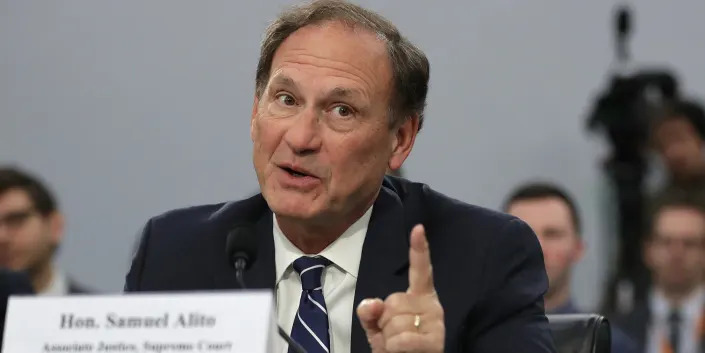
U.S. Supreme Court Associate Justice Samuel AlitoChip Somodevilla/Getty Images
Supreme Court Justice Samuel Alito spoke to The Wall Street Journal about congressional oversight.
“No provision in the Constitution gives them the authority to regulate the Supreme Court,” he said.
The statement comes after months of news reports of ethical impropriety by members of the high court.
After months of news reports documenting instances of Supreme Court justices breaking judicial ethical standards and Democratic lawmakers pushing for a code of conduct to be implemented, conservative Supreme Court Justice Samuel Alito revealed in an interview that he doesn’t believe that Congress has any authority to tell the court what to do.
“Congress did not create the Supreme Court,” Alito said in an interview with The Wall Street Journal. “I know this is a controversial view, but I’m willing to say it. No provision in the Constitution gives them the authority to regulate the Supreme Court — period.”
He added that while he can’t speak for the other justices, he thinks it’s “something we have all thought about.”
The comments perturbed at least two Democratic members of Congress.
Following the article’s publication, Rep. Ted Lieu took to Twitter to remind Alito that Congress does have some oversight of the Supreme Court.
“Dear Justice Alito: You’re on the Supreme Court in part because Congress expanded the Court to 9 Justices,” Lieu tweeted. “Congress can impeach Justices and can in many cases strip the Court of jurisdiction. Congress has always regulated you and will continue to do so. You are not above the law.”
Sen. Sheldon Whitehouse also noted on Twitter that he believes that Alito is part of what he called a “captured court.”
One of the authors of the article who interviewed Alito, David B. Rivkin, is litigating a tax case, Moore v. US, in front of SCOTUS during the court’s next term.
SCOTUS did not immediately return Insider’s request for comment.
In April, GOP mega-donor Harlan Crow and SCOTUS Justice Clarence Thomas first faced scrutiny related to the 20 years worth of undisclosed trips Crow is accused of gifting to Thomas, per ProPublica. The outlet later reported that Crow purchased Thomas’ mother’s house and allowed her to live there without paying rent.
Crow claimed to the Dallas Morning News that the revelations about his relationship with Thomas were a “political hit job.”
In June, ProPublica unearthed that Alito had taken a luxury fishing trip with GOP billionaire Paul Singer, who later had cases before the court. Alito claimed that they never discussed cases on the trip, on which he boarded Singer’s private plane.
Congress has probed Crow’s and Thomas’s relationship, as well as Alito’s dealings, asking for a detailed disclosure of the gifts bestowed to Supreme Court justices.
Ex-Labor Secretary Robert Reich Exposes The Republican Art Of Distraction
Lee MoranUpdated – July 26, 2023
Former Labor Secretary Robert Reich in his latest video takes Republicans to task over five “totally made-up crises” he says they are using to distract Americans.
They are the conservative war on “woke,” attacks on the transgender community, freak-outs over critical race theory, slurring of welfare recipients and claims of out-of-control government spending.
All five “disguise what’s really going on,” Reich warned.
A big lie, an attack on the Capitol — and soon, another indictment
Kyle Cheney – July 26, 2023
Julio Cortez/AP Photo
In a more than two-month blitz that ended in violence, Donald Trump lied, cajoled, inveighed and inspired his supporters to challenge the results of an election he lost. Now, special counsel Jack Smith appears on the verge of indicting Trump for those efforts.
Two and a half years have passed since the insurrection of Jan. 6, 2021. Yet investigators are still piecing together the breadth of Trump’s attempt to derail the transfer of power. It wasn’t a singular plan but in fact was many disparate schemes, led by distinct groups of advisers who embraced increasingly fringe strategies and were not always working in harmony.
Each arm of the effort was held together by one core lie with Trump at the center: that the election was stolen. And each tentacle has faced withering scrutiny from Smith’s investigators, who may ask a federal grand jury any day now to approve criminal charges tied to Trump’s election subversion, mere weeks after Smith charged Trump in a separate case for hoarding classified documents.
But if and when Smith brings charges related to Trump’s wide-ranging bid to cling to power, it will fall to the courts and a jury to determine whether Trump’s conduct — no matter the broad powers and immunities of the presidency — crossed the line into criminality.
The exact charges that Smith will seek are unclear, but here’s a look at the extraordinary range of conduct that will figure into them.
The disinformation campaign
Key figures: Rudy Giuliani, Sidney Powell
Even before votes were cast, Trump began conditioning his supporters to distrust the outcome of the 2020 election, insisting that mail-in voting — which states embraced to contend with Covid-era dangers — would be exploited by Democrats, foreign adversaries and bad actors to steal the election.
Trump rejected advice from his own allies, like campaign manager Bill Stepien and House GOP Leader Kevin McCarthy, to embrace mail-in voting as a way to drive turnout among his supporters. Instead, he set up mail ballots to be a scapegoat for his possible defeat.
In tandem with this effort was Trump’s plan, which he telegraphed to advisers, that he would declare victory on election night — when interim results were likely to be tilted in his favor due to delays in counting mail-in ballots — even though large shifts toward Joe Biden were anticipated as all votes were tallied in the days following the election.
Trump did just that. In the wee hours of the morning on Nov. 4, 2020, at the urging of Trump’s lawyer Rudy Giuliani and against the advice of virtually everyone else in his inner circle, Trump declared victory and warned his supporters that Democrats would try to steal the election.
Trump followed his early claim of victory with a weekslong campaign alleging — without evidence — widespread fraud in a handful of states Biden won: Michigan, Pennsylvania, Wisconsin, Georgia and Arizona. He and his allies filed dozens of lawsuits aimed at overturning the results or throwing out millions of votes in areas that favored Biden. Most were summarily dismissed for lacking substance or being filed in untimely ways.
A last-ditch bid to challenge the results, filed by Texas but supported by Trump in a separate legal brief, was turned aside by the Supreme Court.
Despite being rebuffed in the courts, wild conspiracies proliferated in pro-Trump circles. Figures like Sidney Powell, an attorney who represented Trump’s former national security adviser Michael Flynn in criminal matters, promoted the false notion that election machines made by Dominion Voting Systems had been manipulated by foreign governments to tip the election toward Biden.
In the meantime, Trump barraged the airwaves and his supporters’ inboxes with fundraising appeals and ads accusing Democrats of cheating, stuffing his campaign’s coffers even as many of his own advisers privately indicated that he had, in fact, lost the race.
Smith may be eyeing Trump’s fundraising and messaging tactics for potential crimes related to defrauding donors or the public at large.
The Electoral College, Part I: The states
Key figures: Rudy Giuliani, Jenna Ellis, Brad Raffensperger, John Eastman
As Trump’s efforts flailed in the courts, his allies began eyeing a second target: state legislatures. Although by late November election officials and governors had certified Biden’s victory, Giuliani began promoting the notion that state legislatures could simply override those decisions by citing fraud or “irregularities” that justified a different outcome.
To support this notion, Giuliani and Trump campaign attorney Jenna Ellis traveled to the states Trump was contesting and convened public hearings with sympathetic GOP legislators to highlight allegations of fraud. They pushed GOP-controlled legislatures to attempt to designate pro-Trump slates of presidential electors to replace or compete with Democratic electors that had been certified by election officials and governors.
Most notably, Trump leaned on Georgia Secretary of State Brad Raffensperger, a Republican, to simply “find” the votes that would put Trump ahead of Biden in the state. A recorded Jan. 2, 2021, phone call captured the lengthy exchange and has become fodder for Smith as well as investigators in Georgia.
Raffensperger balked. So did other state leaders, refusing to appoint their own slates of electors despite Trump’s increasing pressure.
This stage of Trump’s strategy is where John Eastman — a conservative attorney with fringe theories about the Electoral College — began gaining prominence in Trump’s orbit. He participated in Trump’s efforts to lean on state legislatures to act, appearing at public hearings convened by Republican legislators. Ultimately, Eastman would become the driving force behind Trump’s final, desperate bid to stay in power, a plan focused squarely on Jan. 6.
The Electoral College, Part II: The fake electors
Key figures: John Eastman, Rudy Giuliani
When the Electoral College met on Dec. 14, 2020, in 50 state capitals and Washington, D.C., no contested states had designated pro-Trump electors to compete with Biden’s electors. Nevertheless, in seven of those states, dozens of pro-Trump activists convened in state capitals, at the same time as Democratic electors, and cast ballots that they claimed made them legitimate presidential electors.
These “alternative” or “contingent” electors signed certificates claiming to be the states’ duly qualified electors and delivered them to the National Archives and Congress, following a process set out in federal law for actual presidential electors.
Enter Eastman. Emails released by the House select committee on Jan. 6 show that after the Electoral College ballots had been cast, he shifted his focus to legitimizing the uncertified electors.
The conservative attorney, who advised Republican legislators during the contested Bush v. Gore election of 2000, had been advising Trump and his allies since before the 2020 election, joining a working group assembled by attorney Cleta Mitchell to develop a post-election litigation strategy.
Within days of the Nov. 3 election, Mitchell asked Eastman to draw up a plan for state legislatures to appoint pro-Trump electors to supplant those certified by governors. Eastman obliged, and his plan, by late November, had made its way to the Oval Office.
Eastman, who would also author Trump’s Supreme Court brief in the Texas case, spent much of December leaning on state legislators to declare their elections invalid, citing fraud and irregularities, and use that as a pretense to appoint alternate electors. Eastman told allies at the time that without the imprimatur of a state legislature, these “contingent” electors wouldn’t have any legal force.
Mulling the seizure of voting machines
Key figures: Sidney Powell, Mike Flynn
After the Supreme Court refused to consider the Texas election challenge Dec. 11, 2020, Trump saw his options dwindle to an increasingly desperate few.
He had begun mobilizing members of Congress to formally challenge the election results Jan. 6, when the House and Senate were required to meet and count electoral votes. And he still hoped state legislatures would swoop in and send their own electors to Washington. But he also began eyeing a more extreme option.
Powell, Flynn and their allies had been in Trump’s ear about the prospect of invoking presidential authority to seize voting machines in the states he was contesting, using a combination of national security directives to justify the move. Various drafts of an executive order supporting such a move circulated in the White House (some of which were turned over to the Jan. 6 select committee).
The conversation culminated in a Dec. 18 Oval Office meeting with Trump, Flynn, Powell, Giuliani and others. At the meeting, Trump flirted with naming Powell a roving “special counsel” to pursue election-related matters, and Flynn advocated for taking the machines. But White House aides and Giuliani pushed back, and Trump ultimately opted against the move.
Hours later, in the middle of the night, Trump issued his first call to supporters to descend on Washington, D.C., on Jan. 6, 2021. “Be there,” he tweeted. “Will be wild.”
Deploying the Justice Department
Key figures: Jeff Rosen, Rich Donoghue, Jeff Clark, Pat Cipollone, Scott Perry
Trump was publicly frustrated that his own Justice Department had openly rejected his claims of widespread election fraud, and when Attorney General Bill Barr resigned in December 2020 — amid open conflict with the president — Trump eyed another mechanism to bolster his bid to remain in power.
Rep. Scott Perry (R-PA.), who espoused some fringe theories about election fraud, had begun connecting Trump with Jeff Clark, a Justice Department official who was sympathetic to his efforts. Several documented meetings or calls with Trump in late December 2020 and early January 2021 showed Clark had Trump’s ear during this crucial period.
Internally, Clark had been pressing Justice Department leaders to issue a letter to the states Trump was challenging, describing “irregularities” and recommending that their legislatures reconvene to consider whether Trump, rather than Biden, should be declared the winner.
Clark faced sharp pushback from Barr’s successor, acting attorney general Jeff Rosen, and his deputy, Rich Donoghue. But Trump briefly considered outflanking them by naming Clark acting attorney general and giving him the perch to implement the effort. But Trump backed down after a mass resignation threat by Trump Justice Department officials and top White House lawyers, including White House counsel Pat Cipollone.
Records revealed by the Jan. 6 select committee indicate that Trump may have briefly effectuated Clark’s appointment as acting attorney general before rescinding it.
The Electoral College, Part III: Pressuring Pence
Key figures: Mike Pence, John Eastman, Greg Jacob, Ken Chesebro
When all else failed, Trump turned firmly to Jan. 6, 2021, seen by his increasingly fringe group of allies as the ultimate deadline to stop the transfer of power to Biden. Though no states had endorsed alternative slates of electors, Congress was still in receipt of the unofficial slates sent in by pro-Trump activists.
The Jan. 6 session, required by the Constitution as well as an 1887 law known as the Electoral Count Act, has long been a formality, a ceremonial gathering to affirm the certified results of the states. Only a handful of times in American history have challenges been brought — and no challenge to a state’s electoral votes had ever been sustained.
But in Trump’s view, the Jan. 6 session was a last stand of sorts. And he had one final cudgel to attempt to stave off a Biden presidency: his vice president, Mike Pence.
The Constitution requires that the vice president — who doubles as the president of the Senate — preside over the counting of Electoral College ballots. So Trump spent the final weeks of his presidency pressing Pence to assert the power to simply refuse to count Biden’s electoral votes. Pence, Trump argued, could cite the competing slates of electors and declare the results to be in doubt, postponing the count and sending the matter back to the states for consideration.
His contention was backed by a coterie of fringe attorneys who had spent a frantic few weeks fleshing out what they dubbed “The president of the Senate strategy.” Emails obtained by the Jan. 6 select committee show Eastman communicating with lawyers like Giuliani and Ken Chesebro, who attempted to muscle through what they acknowledged was a constitutionally dubious plan.
But Pence resisted. He recognized that taking such steps would require violating provisions of the Electoral Count Act and would be an unprecedented assertion of single-handed authority to determine the outcome of the election.
Trump publicly and privately browbeat Pence to change course, but Pence repeatedly refused. On the morning of Jan. 6, Trump called Pence for one final, angry phone call in which he derided Pence for refusing to bend to his will. It was the last time they would speak that day.
As violence unfolded at the Capitol that afternoon, Eastman and Giuliani continued to press Trump’s allies to stop the election process. Giuliani called Republican members of Congress and asked them to mount continued challenges to the results that might buy more time, and Eastman corresponded with a Pence aide, counsel Greg Jacob, in a final effort to get Pence to delay the electoral vote count.
Jacob pushed back on Eastman, even as he fled from the first wave of rioters. He has since become a key witness in California bar discipline authorities’ bid to strip Eastman of his law license over his Jan. 6-related actions.
The rally
Key figures: Ali Alexander, Alex Jones, Steve Bannon
After Trump told his supporters to “be there” for a “wild” protest in Washington, D.C., on Jan. 6, a large pro-Trump faction responded. The tweet invigorated groups like Ali Alexander’s “Stop the Steal” organization, which made plans for a rally on Capitol grounds Jan. 6. Women for America First organized a rally near the White House that became Trump’s primary event that day.
The rally was the primary reason tens of thousands of Trump supporters descended on Washington. And Trump’s tweet imploring them to “be there” has figured into dozens of prosecutions stemming from the riot that followed the rally. It was the moment, prosecutors have argued, that extremists like Proud Boys leader Enrique Tarrio and Oath Keepers leader Stewart Rhodes began mobilizing large contingents to descend on Washington. Both have since been convicted of seditious conspiracy.
The far-right conspiracy theorist and broadcaster Alex Jones, who attended the rally, helped lead hundreds of people from the Ellipse to the Capitol. Nearby, at the Willard Hotel, a pro-Trump “war room” was working to manage the ongoing efforts to overturn the election, featuring participation from Steve Bannon, Giuliani and other Trump allies.
Trump used the rally crowd as a means to pressure Congress, telling them that if they didn’t “fight” to stop Biden’s victory they wouldn’t “have a country anymore.” He then pointed them to the Capitol, where he urged them to march “peacefully and patriotically” to reject the election results.
But Trump’s rhetoric was overwhelmingly packed with apocalyptic imagery, which has led at least one federal judge to say he might plausibly be accused of inciting the violence that followed.
The riot
Key figures: Mark Meadows, Mike Pence, Pat Cipollone
After Trump’s rally speech, he retreated to the White House — furious that his Secret Service detail had resisted his desire to go to the Capitol, where violence had begun to break out.
Instead, he withdrew to the Oval Office dining room, where he watched the chaos at the Capitol unfold on TV. While watching, he resisted desperate pleas from allies like McCarthy and other Republicans in Congress, aides, advisers and family members to explicitly tell his supporters to go home. For hours, Trump ignored those appeals while outnumbered police officers were battered and members of Congress — and Pence — evacuated to safety.
While Pence fled, Trump tweeted an attack on his vice president, saying he lacked the courage to stop Biden’s election. That tweet appeared to inflame the crowd; the Jan. 6 committee has shown how the mob intensified in the ensuing moments and many on hand at the Capitol shared it with those around them.
Throughout the day, Trump held court with a long list of advisers, like chief of staff Mark Meadows and Cipollone. Both have become key witnesses in Smith’s probe. Pence has also testified to the special counsel.
When Trump finally did tell supporters to go home, 187 minutes after the first police line was breached, many in the crowd seemed to respond. Videos from the riot show supporters sharing the tweet with one another and heeding his call.
The damage, however, was done. Five people died during or shortly after the attack; hundreds more were injured. In the 30 months since, more than 1,000 rioters have been criminally charged for what they did Jan. 6. Now, Smith’s next moves — and the secret vote of a grand jury that has undoubtedly heard all of the evidence above — will determine whether Trump, and members of his inner circle, will stand trial, too.
11 Republicans affirmed Donald Trump won in Arizona. What to know about the fake electors
Robert Anglen, Arizona Republic – July 26, 2023
They convened at the Arizona Republican Party headquarters two weeks before Christmas in 2020 and put their names to a lie.
Eleven top party officials, lawmakers and candidates avowed they were the state’s “duly elected and qualified electors” and cast their votes for then-President Donald Trump.
Electors in Arizona are required by law to follow the will of the people. In 2020, legitimate electors designated by the Democratic Party cast their votes for Joe Biden, who had won Arizona by a 10,457-vote margin.
The 11 Republicans weren’t qualified electors for the 2020 election, Trump didn’t win Arizona, and their votes were not official. They celebrated anyway, immortalizing the moment in a Twitter video.
In all, 84 people — including elected officials, candidates, former officeholders and Republican party leaders — from groups in seven swing states falsely claimed to be alternate electors in a coordinated plot to keep Trump in office.
And the 11 Arizonans who applauded eagerly at the time are unwilling to talk about their decisions, declining interview requests, hanging up on calls and retreating from questions.
Here is what you need to know about the GOP’s slate of fake electors.
Tyler Bowyer
Bowyer, 37, is the chief operating officer at Turning Point USA, a nonprofit that advocates for conservative politics on high school, college and university campuses.
Bowyer’s biography on Turning Point’s website touts his “strong desire to combat Marxist-Leninist philosophy from entering the American political mainstream.” He describes himself as a seventh-generation Arizonan.
Republican Gov. Jan Brewer appointed Bowyer as a student regent on the Arizona Board of Regents in 2011. He has worked for the Republican National Committee and served as chairman of the Maricopa County Republican Party from 2015-2017.
In July 2015, Bowyer helped to convene a rally at the Phoenix Convention Center that served as an early national sign of the future president’s appeal.
Bowyer has declined recent interview requests about the electors. In 2022, he told The Arizona Republic he didn’t know “all the details and facts” but emphasized his role as an elector.
“I was an elector − I want to make sure we’re clear here − I was an elector for the Republican Party.”
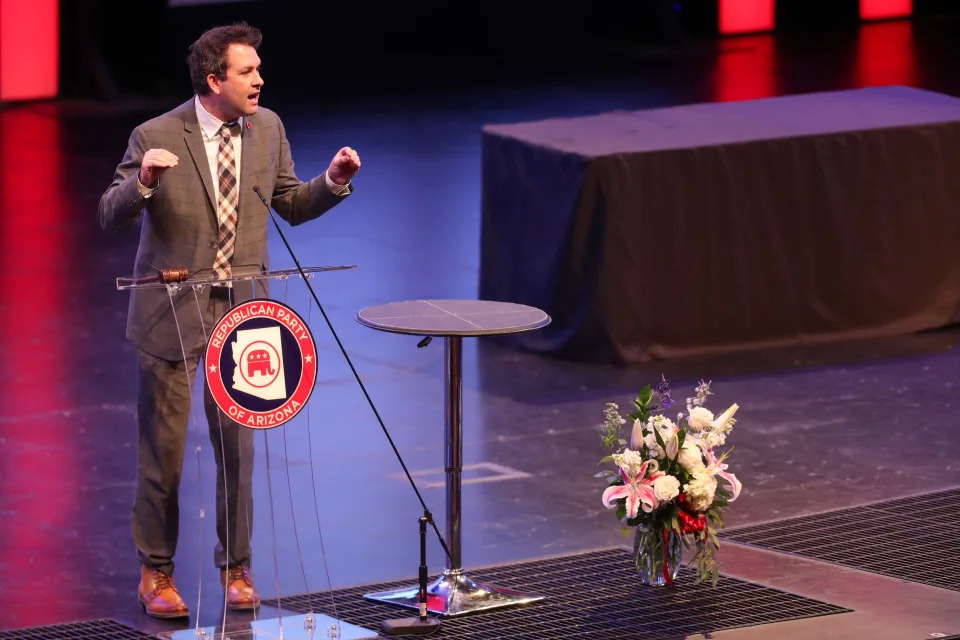
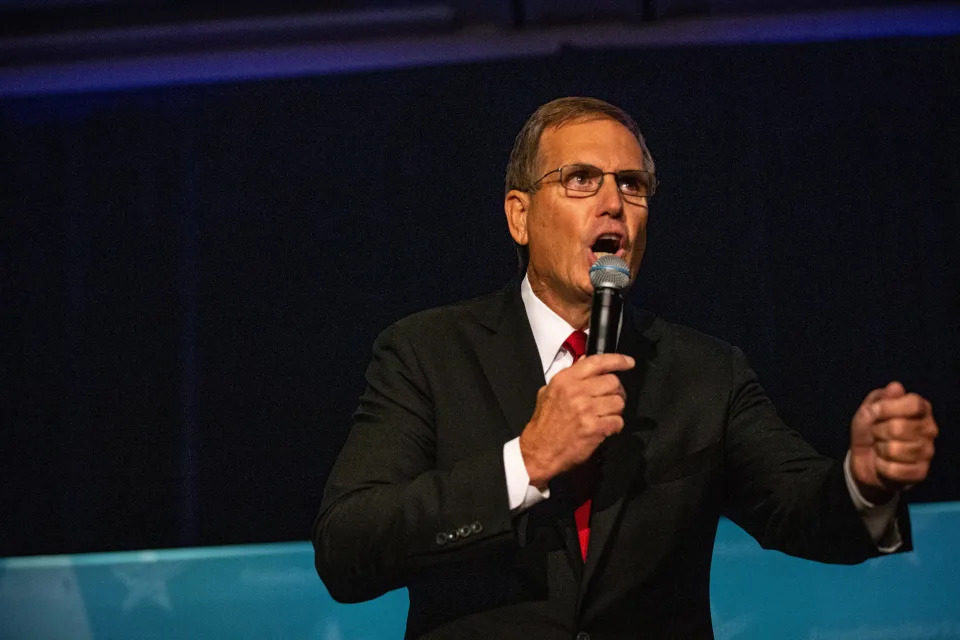
Tyler Bowyer, COO of Turning Point USA, speaks during the Arizona GOP biennial statutory meeting at Dream City Church on Saturday, Jan. 28, 2023, in Phoenix.
Nancy Cottle
Nancy Cottle, 71, of Mesa, chaired the Arizona Trump electors.
Cottle was subpoenaed by House Select Committee investigating the riot at the U.S. Capitol for her “role and participation in the purported slate of electors casting votes for Donald Trump and, to the extent relevant, your role in the events of January 6, 2021.”
She describes herself on Twitter as a “political junkie” and an “ultra MAGA.” Her LinkedIn page lists her as a “strong consulting professional” with a background in business planning. Cottle is the owner of The Branded Image.
She has a master’s degree in operational management from the University of Phoenix and a bachelor’s in health, physical education and speech from Kent State University, according to her bio.
Cottle has not responded to multiple interview requests.
State Sen. Jake Hoffman
State Sen. Jake Hoffman, R-Queen Creek, chairs the Legislature’s conservative Freedom Caucus.
On Jan. 5, 2021, Hoffman sent a letter to Vice President Mike Pence asking him not to accept the state’s official electoral votes. Although Hoffman had not yet taken office, the letter was sent on official state letterhead and had a return address of the state Capitol.
Hoffman has proposed and supported so-called election integrity bills, including one that would trigger an automatic redo of an election in which voters had to wait in line more than 90 minutes and another to break up Maricopa County into four counties. Both of those failed.
Hoffman, 38, is the married father of five, according to online biographies. He previously served on the Higley School Board and the Queen Creek Town Council. He was a communications director with Turning Point USA and runs several conservative digital marketing companies.
In 2020, a company he operated called Rally Forge was accused of operating a troll farm for a Turning Point affiliate and was banned from Facebook and suspended from Twitter. The company paid teens to set up bogus accounts and flood social media with posts sowing distrust in mail-in ballots and downplaying COVID-19.
Another of Hoffman’s companies, 1Ten, received $2.1 million from a political action committee that used spoof donors to boost the campaign of failed gubernatorial candidate Kari Lake. The owners of California businesses who were listed as the source of funds said they had never heard of the PAC − or Lake.
Hoffman has avoided questions about the fake electors. In a brief interview outside the Capitol in 2022, he told The Arizona Republic electors wanted to provide Congress and Pence with “dueling opinions” before walking away.
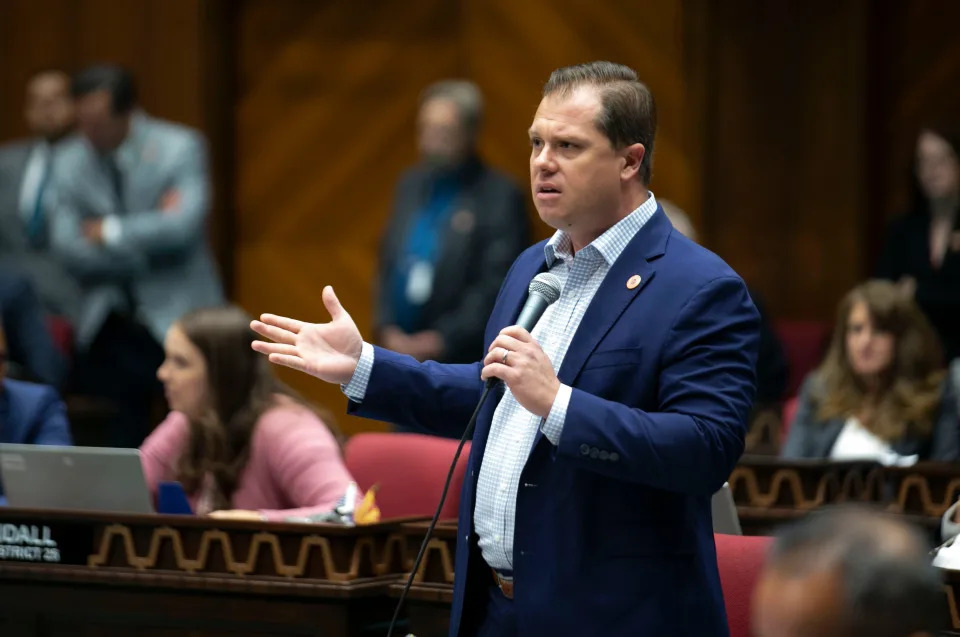
Rep. Jake Hoffman, R-Queen Creek, speaks as the House votes on bills related to the budget at the Arizona Capitol in Phoenix on June 24, 2021.
State Sen. Anthony Kern
State Sen. Anthony Kern, R-Glendale, is an ardent Trump supporter who spoke at “Stop the Steal” rallies and was at the U.S. Capitol when it was sacked by rioters. He has given conflicting accounts about where he was that day, but photos and videos show him on the Capitol steps.
Kern, 61, predicted in speeches he gave before the riot that Jan. 6 would be a “big day,” frothing up crowds by asking if this was “a revolution.” He told The Republic in 2022 what happened at the Capitol was a partisan hoax.
Kern in 2005 was hired as a civilian code enforcement officer for The El Mirage Police Department. He was fired in 2014 for lying to a supervisor after a string of disciplinary problems. The department also put Kern on the Brady list, a database of officers accused of dishonesty.
Kern was elected to Arizona’s House of Representatives in 2015. He falsely claimed on financial disclosure forms that he was a certified law enforcement officer. In 2019, he tried to pass a law to overhaul the Brady List without acknowledging he would directly benefit by getting his name removed. He lost his seat in the 2020 election.
Only people who have done something wrong or had something to hide would need to hire a lawyer, he said.
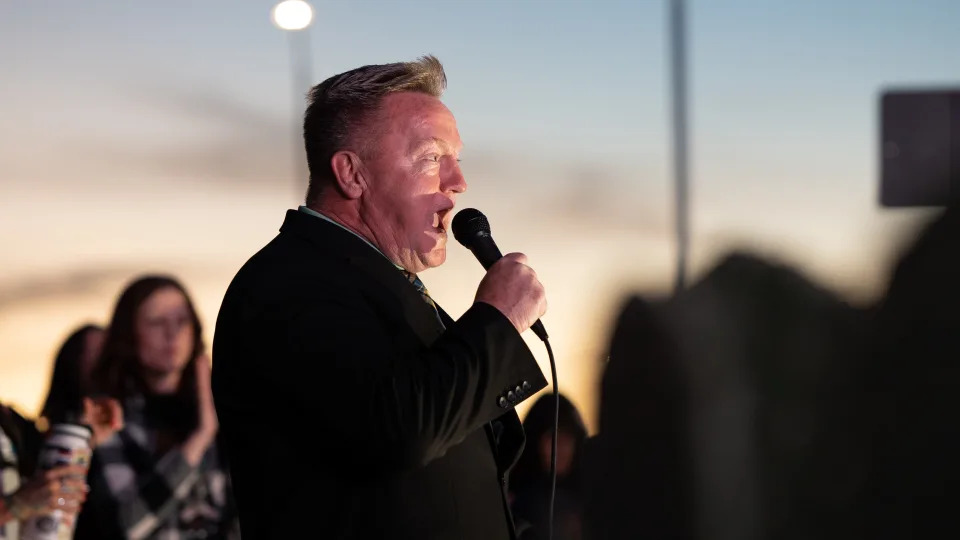
Republican state Sen. Anthony Kern leads a protest across the street from the Washington Elementary School District office on March 9, 2023, in Glendale.
Jim Lamon
Jim Lamon ran for U.S. Senate in 2022 and lost in the Republican primary.
Lamon, 67, of Paradise Valley, is married with two children. He grew up on a farm in Alabama before joining the U.S. Army. He was stationed in Germany in the Cold War and served as an airborne officer.
Lamon earned a bachelor’s degree in civil engineering from the University of Alabama in 1979.
He describes himself on LinkedIn as a Fortune 500 executive. Lamon is the founder of Scottsdale-based Depcom Power, a solar engineering and construction company that employed 1,600 across the nation when he sold it.
Before entering politics, Lamon was known as a reliable donor to Republican causes and candidates, including Trump. He was a behind-the-scenes player in the Arizona Senate’s “audit” and helped bankroll security.
Lamon made immigration and border security a cornerstone of his platform and sought to restore Trump-era policies that returned asylum seekers to Mexico while awaiting court hearings. He was also critical of the Biden Administration’s COVID-19 relief package.
Despite pouring millions of his own money into his campaign, Lamon lost to Republican challenger Blake Masters, who was defeated by Democrat Mark Kelly.
Lamon has not responded to interview requests about the electors. In 2022, while he was running for Senate, he appeared on KTVK-TV’s “Politics Unplugged” and claimed the electors were part of a backup plan in case Trump succeeded in his election fraud challenges.
“The Republican electors put forth a valid document that said, in the event that the election certification was overturned, there would be no excuse not to recognize those electors,” Lamon said.
The signed document, however, had no such proviso.
Jim Lamon speaks to a crowd of Republican voters at the party’s primary debate for the U.S Senate in Phoenix on June 23, 2022.
Montgomery, 72, of Hereford, pushed for hand counts of votes as committee chair and before the 2022 election told Cochise County Supervisors they should ignore warnings about it from then-Secretary of State Katie Hobbs.
He told the supervisors to throw Hobbs’ letter “in the bucket somewhere” and argued a full hand-count would be “easy to do,” according to a report by Votebeat.
Montgomery said former State Rep. Mark Finchem − an election denier and conspiracy theorist − would support hand counts if he won his bid for secretary of state. Finchem lost in a landslide to his Democratic challenger.
The Cochise County Board of Supervisors in September appointed Montgomery to the Palominas Fire District board. The decision came despite protests from some Sierra Vista residents who said Montgomery’s role as a fake elector should disqualify him. They complained Montgomery should not be rewarded for trying to overturn the election.
He is also on the county’s planning and zoning commission.
Montgomery has repeatedly declined to discuss his role as a fake elector. He did not respond to messages left at his home or at the fire district in July.
He was serving as the second vice chair of the Gila County Republican Party when he signed as a Trump elector.
According to online biographies, Moorhead, 78, of Globe, is married and has four children and five grandchildren. He was born in Pennsylvania and served as a Navy corpsman for 14 years, doing multiple tours in Vietnam.
Moorhead has a bachelor’s degree in education from Edinboro State University in Pennsylvania and earned a master’s degree in special education and teaching from New Mexico State University in 1999. He is listed as a consultant on his LinkedIn page.
He taught at schools in New Mexico and Arizona. Moorhead also was a commercial driver for Werner Enterprises until his retirement in 2007.
Moorhead has not responded to calls and messages about his role as a Trump elector.
Lorraine Pellegrino
Loraine Pellegrino, 65, of Phoenix, was secretary for the Arizona Trump electors.
Pellegrino is one of four electors subpoenaed by House Select Committee investigating the Jan. 6, 2021, riot at the U.S. Capitol.
She has an extensive background in Arizona Republican politics. Pellegrino is past president of the Arizona Federation of Republican Women and is a founding member of the Ahwatukee Republican Women’s Club.
Her online biography highlights her election as a delegate to Republican National Committee conventions in 2012, 2016 and 2020. She has served three terms on the Arizona GOP Executive Committee. She lists the recruitment of Republican women to run for office as one of her personal achievements.
Pellegrino has lived in Arizona for 25 years. She was born and raised in Connecticut and has a bachelor’s degree in media studies from Sacred Heart University. She is married and has one son.
Pellegrino in a January 2022 interview said the electors met as a contingency “in case there was a change in the decision here in the state.” She couldn’t say how the plan came together but bristled at the characterization of the group as “alternate” electors.
“We were electors for Trump and we were hoping things would change,” she said. “Just in case, we signed our paperwork to be ready in the event that something was overturned.”
Pellegrino hung up when contacted in July about the attorney general’s investigation.
Greg Safsten
Greg Safsten was executive director of the Arizona Republican Party when he signed as a Trump elector.
Safsten, 35, of Gilbert, was hired as a campaign consultant in 2022 by U.S. Senate candidate Blake Masters, who was defeated in the general election. He had previously worked as an adviser and director for Rep. Andy Biggs and Rep. Matt Salmon.
According to his Legistorm biography, Safsten got his start in 2012 as a field director for Salmon’s campaign and was later hired as his legislative assistant. In 2016, he went to work for the Biggs campaign and ultimately rose to the position of deputy chief of staff.
Police and court records show in 2022 he was arrested and pleaded guilty to extreme DUI.
According to a March 2022, search warrant affidavit filed in Maricopa County Superior Court, a Gilbert police officer saw Safsten speed away from a Taco Bell restaurant “losing control of his vehicle as it fishtailed” and nearly collided with another vehicle.
The officer said Safsten kept going when he initially tried to pull him over, driving at a high rate of speed and weaving between lanes until finally pulling over about a half-mile later. He failed a field sobriety test, records show.
Safsten was fined and sentenced in January to 60 months’ probation, records show.
Safsten’s LinkedIn page has no employment information after August 2022. He bills himself as a “seasoned public relations, communications, public policy & political executive.”
“I work to be the leader and teammate I’d want on my own team,” he writes on his page. “Having formed and led teams in various conditions for over a dozen years, I know what it takes to win.”
Safsten was born and raised in Mesa. He attended Mountain View High School and obtained a bachelor’s degree in international studies from Arizona State University in 2007. He also studied clinical laboratory science at Weber State University in Utah.
Safsten did not respond to an interview request.
Kelli Ward
Kelli Ward is the past chair of the Arizona GOP. She helped to organize the signing of the fake electors, sat at the head of the table during the “signing” video and boasted about the moment on Twitter.
“Oh, yes we did!” Ward wrote in a Dec. 14, 2020 post. “We are the electors who represent the legal voters of Arizona! #Trump2020#MAGA.”
Ward, 54, of Lake Havasu City, was among those subpoenaed by the Jan. 6 committee and the Department of Justice over the slate of fake electors. Her attorney said in 2022 Ward was engaging in First Amendment-protected activity.
Ward is an osteopathic physician turned politician. She was elected to the Arizona Senate in 2013. She resigned to go after John McCain’s U.S. Senate seat in 2016, losing in the Republican primary, 39% to McCain’s 51%. She tried again for U.S. Senate in 2018 and lost in the Republican primary to Martha McSally.
Ward became party chair in 2019 and after the 2020 election became one of Trump’s most ardent supporters, launching several unsuccessful lawsuits to overturn Arizona’s election.
Ward promoted various voter fraud conspiracies and championed the Arizona Senate’s “audit,” delivering frequent YouTube updates as the ballot count unfolded, which turned into a fundraising bonanza for the party’s candidates and causes.
Ward is married and has three children. She was born in West Virginia. She earned a bachelor’s degree in psychology from Duke University and a doctorate from West Virginia School of Osteopathic Medicine. She has a master’s degree in public health from A.T. Still University, according to her legislative biography.
She practiced emergency medicine in Lake Havasu City and Kingman.
Ward was replaced as party chair in 2023. She and her husband announced on YouTube they bought a 44-foot catamaran and were starting a charter business called Sail American Honey.
Ward has not responded to interview requests about the electors.
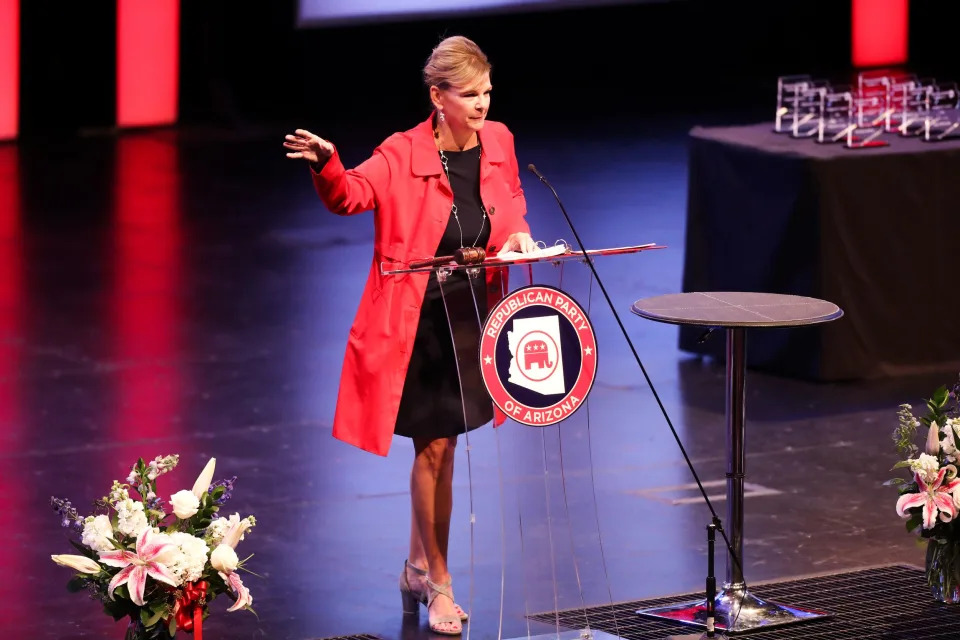
Kelli Ward speaks during the Arizona GOP biennial statutory meeting at Dream City Church on Saturday, Jan. 28, 2023, in Phoenix.
Michael Ward
Michael Ward is Kelli Ward’s husband and a GOP activist. He, too, has been subpoenaed by the Department of Justice for his role as a Trump elector.
Ward, 58, of Lake Havasu City, is an emergency physician and is the state air surgeon in the Arizona Air National Guard, according to his LinkedIn page. He formerly worked at Havasu Regional Medical Center.
Ward first enlisted in the US Air Force in 1983 and began his military medical career. He joined the reserves and was commissioned to active duty in 1992, according to a listing on America’s Mighty Warriors, a veteran’s support group.
Ward earned a doctorate in osteopathic medicine in 1995 from A.T. Still University, where he met Kelli,according to her biography. They were married in 1995. Ward served as his wife’s campaign manager from 2011-2015.
He was accused in 2019 of spitting in the eye of one of his wife’s former volunteers. Police records indicate the alleged incident happened at the Arizona Republican Party’s general election night gala in Paradise Valley.
The former volunteer said Michael Ward was angry because the volunteer was supporting Kelli Ward’s political opponent, Martha McSally, according to police reports. Michael Ward emailed the Paradise Valley police and denied the allegations. He told police his accuser was an attention seeker and known storyteller.
Michael Ward also had a reputation for confronting people on his wife’s behalf. He was accused of bullying a staffer of Sen. John McCain at a Tea Party event in 2016. The moment was captured on video.
Michael Ward did not respond to an interview request about the attorney general’s investigation into the Trump electors.
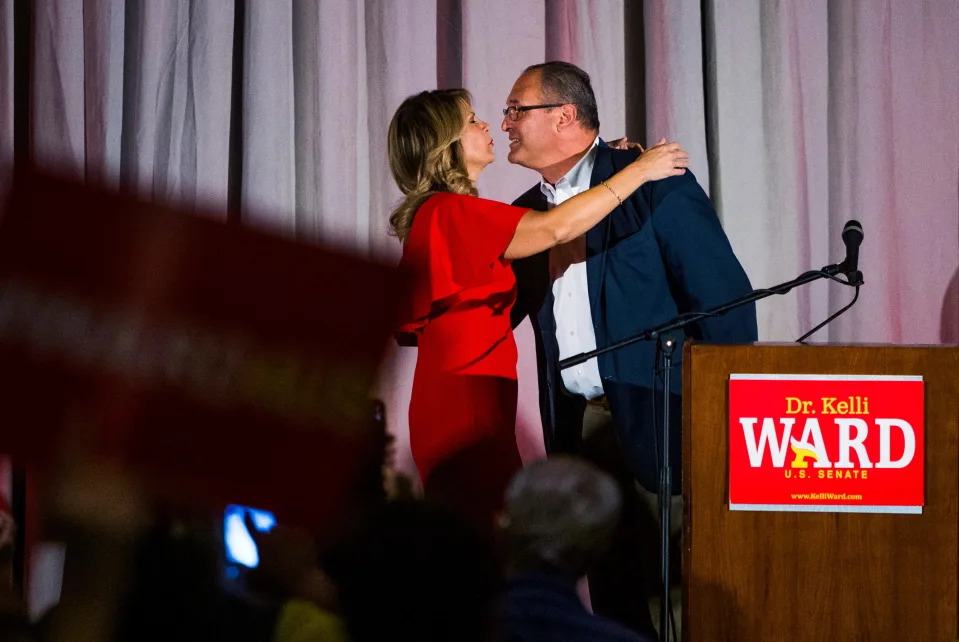
Kelli Ward gets a kiss from her husband, Dr. Michael Ward, before greeting supporters at a primary election night party at Embassy Suites Scottsdale on Aug. 28, 2018.
Arizona’s second slate of fake electors
Arizona spawned a second group of fake electors in 2020 who certified that it, too, had cast the state’s votes for Trump.
The lesser-known Trump loyalists called themselves “The Sovereign Citizens of the Great State of Arizona” and sent the National Archives in Washington, D.C., notarized documents that carried the state seal on their letterhead. The signers were:
Former RNC Chair Names The Chilling Lesson Donald Trump Has Learned For 2024
Lee Moran July 26, 2023
Donald Trump has learned a “very valuable lesson” from his failed efforts to overturn his 2020 election loss, Michael Steele warned on Tuesday.
The former president likely won’t let lawyers again thwart his attempt to subvert democracy if he becomes the GOP nominee in 2024, the former Republican National Committee chair told MSNBC’s Katie Phang.
Instead, Steele said next time around they will just tell Trump: “Yes, sir, how do you need this done? When does it need to be done? And how do we corral the forces across the country to make sure it sticks?”
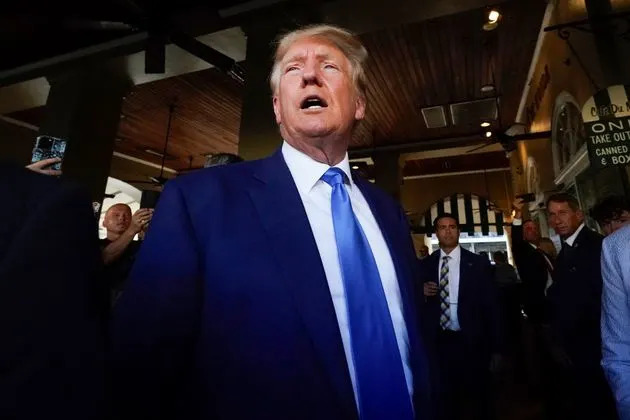
Michael Steele warned that Donald Trump, pictured, has learned a
Michael Steele warned that Donald Trump, pictured, has learned a “very valuable lesson” from 2020.
Steele’s prediction came during a discussion about former senior Justice Department official Richard Donoghue, who this week revealed he’d been interviewed by special counsel Jack Smith’s office as part of the investigation into Trump’s attempts to overturn the election.
Donoghue, during testimony to the House last year, said he’d rejected Trump’s efforts to flip the result. Donoghue’s stance against Trump was important “to understand just how thin that line was for us in 2020 and why that line will be obliterated should he get reelected in ’24,” said Steele.
Trump won’t face such opposition next time around, Steele suggested.
Trump has already reportedly vowed to seize presidential authority “over every part of the federal government that now operates, by either law or tradition, with any measure of independence from political interference by the White House,” according to a New York Times article.
NBC News presidential historian Michael Beschloss this week warned it would mean Trump’s second term would be a “presidential dictatorship.”
Smith is reportedly close to indicting Trump, who last week said he’d received a target letter from the special counsel.
Nearly 28,000 Iowans have been disenrolled from Medicaid. Here’s why:
Michaela Ramm, Des Moines Register – July 26, 2023
Nearly 28,000 Iowans have been disenrolled from Medicaid this year as part of Iowa’s redetermination process — a consequence of continuous coverage no longer being guaranteed.
The latest data from the state’s Health and Human Services Department shows 27,744 Iowans were disenrolled from the safety net health insurance program since April, when Iowa began “unwinding” expanded eligibility.
About 30% of those Iowans — 8,401 — were disenrolled for procedural reasons, including failing to return paperwork.
The remaining 19,343 were deemed ineligible for further coverage, state data shows.
Since April, the state has been reviewing the eligibility of 900,000 Iowans who receive Medicaid and CHIP (the Children’s Health Insurance Program) benefits to determine if they still qualify under pre-pandemic regulations.
Federal health officials and other advocates have raised alarms about the number of people disenrolled for procedural reasons, which refers to those who did not return their paperwork or otherwise failed to complete the renewal process.
They say people may not be aware they’re up for renewal or recently changed addresses and didn’t receive the paperwork.
“What we’re seeing across the country from the first two months is that whilst people have done a lot to prepare, at the same time there are a lot of people losing their coverage,” said Dan Tsai, director of the Center for Medicaid and CHIP Services. “A really high number of folks are losing coverage for what we call procedural reasons.”
State officials managing the redetermination process, however, say the current rate of disenrollment, including procedural drop-offs, was expected. Iowa Medicaid Director Liz Matney said the department’s data show the majority of those kicked off the program have health insurance coverage elsewhere.
“It’s not surprising. If somebody gets renewal paperwork and they say they don’t need Medicaid anymore, why would they submit paperwork?” Matney told the Des Moines Register. “So when the team has been looking at the individuals who are disenrolled for any reason, but particularly for those who are disenrolled for not returning their paperwork, we can tell in our system who has other health insurance.”
That data has not been made publicly available on the state’s dashboard.
Still, officials with the Centers for Medicare and Medicaid Services have called on Iowa and other states to simplify the process. In addition to keeping individuals who qualify on Medicaid, states also need to connect low-income residents with other coverage options, Tsai said.
“We’re looking for states to also do everything in their power, way beyond what the federal minimums are, to try to make it easier for eligible people to keep their coverage,” Tsai told the Register. “If you’re not eligible for Medicaid, we want you on your employer-sponsored coverage. We want you on the ACA plans. We don’t want you uninsured, and that’s the bottom-line focus for us from a federal standpoint.”
Typically, Iowans on Medicaid undergo a redetermination process every year to check their eligibility to see whether they still qualify.
But as part of the federal government’s response to the coronavirus pandemic starting in March 2020, states were required to maintain coverage for individuals on Medicaid, even if they no longer qualified. In exchange, states received enhanced federal funding to manage the health insurance program.
In Iowa, more than 168,000 individuals maintained coverage during the three-year pause on Medicaid redeterminations, state data shows.
That requirement to maintain continuous coverage ended in March 2023, when federal officials ended the national public health emergency.
As a result, the state’s health and human services department is checking the eligibility of hundreds of thousands of Iowans on Medicaid and CHIP, a massive undertaking that must be completed by May of 2024. Matney said state employees are processing close to 70,000 new applications every month, a “huge increase” from the typical redetermination process pre-pandemic.
Early estimates showed about 136,000 Iowans would be disenrolled from Iowa Medicaid, the state’s $7 billion privatized program, by the end of the 12-month unwinding period.
The state agency has worked to automate as much as possible and has launched a public messaging campaign to spread the word to members to turn in their paperwork. The managed care organizations that administer Medicaid benefits also have engaged in direct outreach to members, including knocking on the doors of some members to help them fill out their application, Matney said.
How many Iowans have renewed their coverage?
As of June, 854,791 people were enrolled in Iowa Medicaid and CHIP. That’s 39,053 fewer than in April.https://flo.uri.sh/visualisation/14502335/embed
In the first three months of the “unwinding” process, 105,401 enrollees renewed their coverage under the Iowa Medicaid program, according to state data.
Of those, about half — 51,940 — were renewed on an “ex parte basis” or automatically renewed based on information the state has on the enrollee. The remaining 53,461 enrollees who renewed their coverage filled out and returned the redetermination paperwork sent by the state.
Federal officials call on states to do more. What is Iowa saying?
As the redetermination process continues for the next several months, Matney said she expects the number of individuals disenrolled, including for procedural reasons, will level off.
State officials had flagged enrollees who were likely ineligible for continued coverage, and frontloaded their reviews early in the redetermination process. As a result, Matney said, the rate of procedural dropoffs from April through July will be higher than the remaining months of the unwinding process.
Matney said enrollee data shows as much as 85% of individuals disenrolled from Medicaid have insurance elsewhere, such as an employer-sponsored plan. It also shows most of those who were disenrolled are adults.
The remaining portion is likely still eligible for Medicaid, which is why the state implemented a 90-day grace period to allow members to reapply for coverage, even if they missed the deadline, Matney said.
“If they get their paperwork in within that 90 days, we’ll backdate to the date that they last covered, so there’s no gap,” Matney said.
Members will most likely find out they no longer have Medicaid coverage when they pick up prescriptions. Matney said a possible solution could come in the form of partnerships with pharmacies, allowing those providers to complete presumptive eligibility determinations and help members get back on Medicaid quickly.
However, she said many states are finding pharmacies are not signing on to help with that work.
CMS has recently taken steps to address the number of Americans kicked off Medicaid coverage during this process, even pausing redetermination efforts in some states that have violated federal regulations, according to a press briefing from last week. Federal officials did not list the states involved.
Tsai said CMS officials are continuing to call on states, especially those with higher rates of procedural dropoffs, to utilize federal waivers offered by CMS for states’ redetermination efforts. These temporary policy changes are structured to help ease the process for members and ensure the nation’s uninsured rate doesn’t spike.
Among those waivers is extending postpartum coverage for Medicaid recipients to a year, a policy that has not been adopted in Iowa. Currently, the state provides members with 60 days of postpartum coverage.
“Under that, there definitely is more room for Iowa to be able to take up more of those,” Tsai said.
Matney said at this stage in the unwinding process, she doesn’t see any need to use additional policies offered by federal health officials to ease the process.
“We’ve gone through the list and really done the analysis of what we’re already doing versus what would be more administratively complicated,” Matney said. “The juice isn’t worth the squeeze in some such situations, and so right now, we’re still in the same spot. But we’ll be evaluating that, and if we feel additional waivers are important and necessary to help ease the process for ourselves and for Medicaid members and Iowans in general, we’ll certainly pursue that.”
Michaela Ramm covers health care for the Des Moines Register.
Trump’s downfall is coming: Now the Democrats must use his crimes to finish him
Chauncey DeVega – July 25, 2023
Donald Trump; Capitol Riot; January 6 Photo illustration by Salon/Getty Images
It now appears that Donald Trump, a criminal mastermind who has spent decades evading serious responsibility for his behavior, may finally have met his match. The doubly-indicted ex-president — with a third and fourth indictment likely to follow soon — now faces multiple felony trials and criminal investigations across the country for violations of the Espionage Act, financial fraud and other serious crimes connected with his attempts to overturn the 2020 election.
Last week Trump confirmed that the Department of Justice has sent him a “target letter” indicating that special counsel Jack Smith may soon charge him with defrauding the United States and “deprivation of rights under color of law” in connection with the Jan. 6 coup plot. Trump also faces potential charges related to tampering with witnesses and “obstruction of an official proceeding.”
Experts have noted that one statute cited in the target letter (Section 241 of Title 18) was created during Reconstruction in an attempt by federal authorities to protect the rights of newly freed Black Americans from the Ku Klux Klan and other Southern white terrorist groups.
Trump still has a vast war chest of money and considerable resources of other kinds, but those are being depleted by his growing legal expenses. In all probability, he will still be the 2024 Republican presidential nominee. But his latitude of action and his ability to escape the law appears, at least for now, to be diminishing. The “Trumpocene” era may be drawing to a close, but what may happen next in this truly unprecedented historical period remains unclear.
Are we truly witnessing Trump’s downfall — and if so, why did it take so long? Where would the country be now if Attorney General Merrick Garland had moved faster?
What about Trump’s tens of millions of MAGA followers, the largely subservient Republican Party, the right-wing news media and all the other tools he has at his disposal? Can those resources help him escape justice and accountability once again? In an attempt to make sense of the road ahead for Donald Trump and the fate of American democracy, I recently asked a range of experts to offer their thoughts and insights.
Rachel Bitecofer is a political analyst and election forecaster.
The idea that former President Trump and his co-conspirators might get away with their plain-sight crimes, as serious as attempting to seize permanent power via disrupting the transfer of power, has haunted many of us over the past two years. So it is a big relief to see we have moved past this corrupting idea that American presidents cannot be prosecuted, a concept I feel certain even the Federalists would have found horrifying.
Finding out that the FBI was actively involved with trying to prevent search and seizure in the Mar-a-Lago classified documents case, despite a year of theft, lies, and concealment of important national security documents — combined with reports that Garland and the Department of Justice remained inert on investigating the principals behind the Jan. 6 insurrection until the House select committee forced them into it — does not exactly inspire confidence in the system. The fact is, if the Department of Justice had led, and not followed, on the Jan. 6 investigation we would be living in a very different legal reality than we are now, where we are likely to see a criminally convicted Republican nominee running in the fall general election.
I would like to believe that Trump will be neutralized, and won’t be on the ballot in November of next year. But my experience and instincts tell me this crisis is far from over and that many twists and turns and dangers remain. The fact is, Trump continues to receive preferential treatment from the federal justice system, and that should concern every law abiding American. The “two-tiered system” of justice that Trump and his MAGA allies like Speaker McCarthy decry is actually this: There is one standard for someone like Jack Teixeira, a National Guardsman recently indicted for stealing classified intel who is being held in custody as a risk to national security, and another for Donald Trump, who despite allegedluy committing similar crimes, is free on bond. Few defendants facing charges of classified info disclosures receive bond, let alone release without any conditions or seizure of the defendant’s passport. So, the jury is still out, so to speak, as to whether our federal judicial system can meet this moment.
That said, my assumption is that as indictments stack up across multiple federal and state venues, less committed Republican voters who are currently inclined to vote for Trump will start to conside giving Joe Biden a second term.
Look for the Trump campaign and their allies to flood the zone on polls, as they did during the run-up to the 2022 midterms in an attempt to disguise the failure of their “red wave” to materialize. Keep in mind that the bulk of primary voters do not follow the daily news, and will not start doing so until this fall. I think that state-level “fake elector” charges that tap into the people who powered the conspiracy are likely as important as the prosecutions of Trump himself.
Much of Trump’s power hails from his “supporting cast” of MAGA Republicans, who to this day continue to perpetuate the lies at the heart of the criminal conspiracy. If there are criminal penalties for illegal actions taken by these people, we may start to see Trump’s echo chamber fracture. That is key to breaking the mass psychosis behind the MAGA movement.
Norm Ornstein is emeritus scholar at the American Enterprise Institute and contributing editor for the Atlantic. He is also co-author of the bestselling book “One Nation After Trump: A Guide for the Perplexed, the Disillusioned, the Desperate, and the Not-Yet Deported.”
It is frankly a relief that Trump now is finally going to be charged with the ultimate crimes: direct attempts to destroy American democracy and instigate a violent insurrection. Of course, I would have preferred that this had happened earlier — and I wish Jack Smith had been given the case much earlier to expedite it. But I also know that a case that was not complete and had not tied up every loose end might have ended with a dismissal or an acquittal — or at least with a hung jury because of one diehard Trumpist who would be fine with him shooting someone on Fifth Avenue in broad daylight. We will have to wait to see what the charges are, and who is cooperating. But I doubt that people like Mark Meadows or former Arizona Gov. Ducey would have been willing to cooperate if the ask had come a year or more ago.
The fact that other prosecutors, including Fani Willis, have not brought charges yet shows that this is a common feature of complex and highly charged cases, not simply Merrick Garland dragging his feet. To be sure, nothing would have altered the disgraceful reactions of the Kevin McCarthys and Elise Stefaniks.
The bad news is that even after charges are brought, it will take months before they result in a trial. Some of the delays will no doubt be driven by the bias of Judge Cannon in Florida, but cases involving a lot of classified material inevitably take longer. It is possible we will have one or more trials during the primary stage, or even later than that. And it remains true that none of this seems to be changing the Republican primary voters in their attachment to Trump. He may be a presidential nominee facing multiple criminal trials during the campaign and after the election. That’s nightmarish, to be sure. But what would be more nightmarish is if he were not held accountable for multiple offenses against the United States and all of us.
Cheri Jacobus is a former media spokesperson at the Republican National Committee and founder and president of the political consulting firm Capitol Strategies PR.
While a target letter implies indictments are coming, it’s well over a year late. Possibly too late. Merrick Garland has afforded Trump the luxury of time to build, fundraise, agitate, organize, propagandize, blackmail, brainwash, bribe, threaten, energize, incite, strengthen his hold on his base and possibly grow it. Trump’s appointed judge, Aileen Cannon, has set a trial date for the stolen classified documents case for May, 2024, likely ensuring further delay as the GOP primary will be underway and likely showing Trump as the presumptive nominee. This calendar is fraught with peril for justice and democracy. Had Garland not inexplicably sat on his hands for so long, we’d be in trial stage by now, and the GOP donors and candidates would have plenty of reason to move on from Trump and lead his cult followers away from the cliff.
The reality is that Trump will likely be the GOP nominee and has a very good chance of becoming president again. He can run and serve if he is indicted, prosecuted, found guilty and even if he is serving time in prison. There is nothing in our Constitution forbidding it.
It is becoming apparent that our only hope may be the 14th Amendment, which bars an insurrectionist from office. Section 3 of the amendment — the Disqualification Clause — bars any person from holding state or federal office who took an oath to support the Constitution as an “officer of any State” and then “engaged in insurrection or rebellion” or gave “aid and comfort” to insurrectionists. It would have to be brought to court in each state. A “test” case brought by CREW in New Mexico was successful, as an officeholder who was on the Capitol steps on Jan. 6 was removed from office by a judge. If Trump is properly convicted for his role in the insurrection, the path to keeping him off the ballot (at least in enough states) and out of the White House will be the 14th Amendment.
I’m pleased the walls look to be closing in, and that the special prosecutor appears to be pursuing this aggressively. Accountability here is desperately needed. No one who leads an insurrection against the peaceful transfer of power should be allowed to run for office again. If Garland had moved faster, we might have lived up to such a foundational and crucial principle. The delayed pursuit also sent a message across the country that undermined the seriousness of what happened. If you’re a less partisan voter trying to make sense of all the clamor and rhetoric about Jan. 6, the lack of early movement by the attorney general signaled that it must not have been that bad. That false narrative has shaped perceptions ever since, and will likely do so as any trial proceeds.
Trump will win the Republican primary, and I think Biden remains in a strong position to beat Trump in the general election. The extremism of the far right, made so real by the Dobbs decision and what’s happened since, continues to be the prime driver of voting behavior.
My primary anxiety is whether those on the side of democracy take advantage of this opportunity by competing and winning up and down the ballot, including state legislative races. With democracy in the balance, it’s no longer good enough to simply win federal races in a few swing states, leaving untouched most of the places where extremism is advancing and democracy undermined. To reverse the downward spiral, those fighting for democracy must widen and deepen their battle plan for both ’23 and ’24.
Rich Logis, a former member of the Republican Party and right-wing pundit, is the founder of Perfect Our Union, an organization dedicated to healing political traumatization, building diverse pro-democracy alliances and perfecting our union.
Irrefutably, Trump is partly responsible for the insurrection; the justification of politically motivated violence was one of the reasons I left behind the politically traumatic world of Trump/MAGA/GOP. Jack Smith’s Jan. 6 charges are going to be bad, and I will not be surprised if he charges Trump with seditious conspiracy or treason; Smith knows he must show evidence that Trump knows he lost the 2020 election, and I am certain Smith will provide such proof. We still really don’t know what Trump was doing for three hours, once the insurrectionists breached the Capitol. Privately, the GOP, as well as Trump’s primary opponents, are beyond ecstatic over Trump’s legal problems, but they are grossly incorrect in their likely assumption that such problems weaken Trump: The more he’s indicted, the stronger his support grows with the GOP’s primary voting base.
I fully appreciate that many are dissatisfied with the speed at which Attorney General Garland moved. In fairness, he is not only in an unenviable position but an unprecedented one. I am a staunch defender of Garland: He has never lost a case he has tried, is a man of granite integrity and would not have taken the job had he thought he’d be coaxed into doing anyone’s bidding; this was proven by his prosecution of Hunter Biden. If Trump committed crimes, Garland will win at trial. Holding Trump legally accountable is mandatory, if we, as a nation, are going to overcome the mistake of Trump’s election.
One immense benefit that Trump, DeSantis, etc., have is that most of the American electorate isn’t political; most only pay attention a month, or two, before an election. The Democratic Party needs to stop worrying about Biden’s age and the polls, and start worrying about how to reach the tens upon tens of millions of Americans who are apolitical.
Because of the Electoral College, Trump was much closer to winning in 2020 than the Democratic Party wants to acknowledge. Biden’s re-election is not guaranteed. America has survived one Trump presidency. But another? It is a risk we must not take. The most beneficial outcome for the country is to electorally mercy-kill the GOP. We must be patient in affliction, simultaneously bringing the good news of conserving democracy to the afflicted.
The target letter by Jack Smith reveals that Trump’s numerous criminal transgressions are at the very least catching up to him. Whether or not this will result in any form of accountability remains to be seen, but it is certainly a troubling development for the leading GOP presidential candidate, whose 2016 campaign included the chant, “Lock her up!” Karma, thanks to Merrick Garland and the Justice Department, was slow and late to respond, but this is certainly bad news for Trump and his MAGA minions. Over in Michigan, Attorney General Dana Nessel announced felony charges against 16 Michigan residents for their role in the alleged false electors scheme. This is in addition to the two existing indictments against Trump.
We still haven’t heard from District Attorney Fani Willis of Georgia, who has Trump dead to rights thanks to his phone call asking the secretary of state to “find” him the votes he needs. For normal people who aren’t protected by whiteness, wealth and the GOP, all of this would be enough to send a person to jail for years. However, everything is skewed to mollify the radicalized anger of white rage and MAGA, so I won’t hold my breath for Trump’s incarceration. I remain cynical, because he is a former president and I recall that Richard Nixon never spent a day of his life in jail and went on to a lucrative speaking and writing career. Still, we need more accountability, and this will only increase the pressure on Trump’s minions, such as Meadows and others, to play ball with law enforcement.
These people are brittle and weak porcelain dolls who won’t last a day in jail. They’ll sing like birds. None of this will dampen MAGA support for Trump, and we already see the GOP leadership rallying around him. Even Megyn Kelly, whom Trump mocked and ridiculed, has made amends with her former tormentor. Masochism is the price to pay when you’re in a political cult. I do believe this will weaken Trump and Republicans leading up to 2024, however, and build up the rich narrative of his awesome corruption and the GOP’s utter, craven complacency and complicity.
Experts: Smith just got potentially “highly incriminating” evidence — but it could delay indictment
Igor Derysh – July 25, 2023
Donald Trump; Jack Smith Photo illustration by Salon/Getty Images
Former New York Police Commissioner Bernie Kerik, a close ally of former Trump lawyer Rudy Giuliani, has cut a deal to turn over his findings into supposed 2020 election fraud to special counsel Jack Smith, according to The Daily Beast. Kerik received a full pardon from then-President Trump in February 2020, erasing his 2010 conviction on eight felony charges relating to tax fraud and lying to federal officials. He served nearly three years in prison before his release in 2013.
Smith previously subpoenaed the documents, which are related to Kerik’s work as former President Donald Trump’s on-the-ground investigator looking at widely discredited conspiracy theories about voter fraud, according to the report. Kerik’s team refused to turn over the documents, citing attorney-client privilege because he was working on behalf of Trump’s attorney, but Trump himself waived the privilege on Friday and agreed to let him turn over the documents, Kerik lawyer Tim Parlatore told the outlet.
Smith is expected to receive nearly 2,000 pages of documents describing Kerik’s probe.
National security attorney Bradley Moss called the move a “significant gamble by Trump’s legal team” but it’s unclear why he signed the waiver.
Smith’s team is looking at Trump’s decision process as he pushed baseless voter fraud conspiracies while his advisers refuted the allegations.
Parlatore, who previously represented Trump as well, told The Daily Beast that the evidence may end up being exculpatory because it shows the Trump campaign did hear allegations of fraud and engaged in good faith efforts to investigate the claims.
“From the time he received a subpoena from the January 6 Committee, Mr. Kerik has believed that full disclosure is the best policy so that the public can understand how extensive the legal team’s efforts to investigate election fraud were,” Parlatore told the outlet.
But none of Kerik’s efforts found any proof of voter fraud and virtually all of Trump’s post-election legal challenges failed in court.
New York University Law Prof. Ryan Goodman warned that Kerik’s documents “could be highly incriminating,” citing a D.C. bar committee report on Giuliani that found that the documents “do not show any connection” between allegations and “election fraud.”
Kerik and Giuliani “could not and would not confirm that the information contained in the Kerik documents was true,” the report said, adding that the content is “in many instances facially incredible.”
While Trump’s lawyers could argue that they made a good faith effort, prosecutors can use it to show that the evidence Trump claimed he had was “nothing and unsubstantiated,” former federal prosecutor Elie Honig said on CNN.
“They need to know what’s in those documents,” he said of Smith’s team. “And I think they need to be prepared to counteract those, to say, ‘This is nothing. This is a pile of useless garbage.’ A lot of courts found that, and I think prosecutors have to be ready for that defense.”
Kerik told The Daily Beast that he also agreed to sit down for a formal interview with the feds in mid-August. The outlet noted that the “timing could indicate that Smith isn’t as close to indicting Trump as the former president has recently suggested, but Smith could also conduct the Kerik interview after an indictment.”
Former Watergate prosecutor Jill Wine-Banks agreed that the timeline could be delayed, tweeting that “it may be a long indictment watch.”
Former U.S. Attorney Joyce Vance told MSNBC that it is difficult to gauge Smith’s timeline given that he sent Trump a target letter last week but is still talking to witnesses.
“I think the answer is while we could see an indictment any day, it’s possible that there could be a strategy, for instance, to indict Trump alone and to continue to work on the rest of the case,” Vance said. “That seems a little bit far-fetched to me. This is a case where you want to play everything by the books. You want to treat this the indictment like you would any other case, prepare it against any and all of the defendants you’re looking at.”
Vance added that Smith is reportedly looking to bring a conspiracy charge, which means that “Trump would not be a standalone defendant, he would need some co-defendants.”
CNN legal analyst Norman Eisen, who served as Democratic counsel during Trump’s first impeachment, disagreed that the evidence would slow down Smith.
“I don’t expect… that this huge trove of documents and this additional testimony is going to slow him down or speed him up,” he said on Monday, “but it’s important and he can use it as he prosecutes the case whenever he may charge.”
Former U.S. Attorney Harry Litman cited Trump’s increasingly aggressive rhetoric about the probe as a sign that an indictment is coming soon.
The “hysteria levels from Trump are hitting the stratosphere because this is one that he would know about,” he told MSNBC. “So, to me, the table is set, Smith is ready to go and that’s what the target letter means, save only you guys coming in or not? And by the way, you can’t take two weeks, you know, come in off the pitch after that. Here’s the indictment.
How right-wing news powers the ‘gold IRA’ industry
Jeremy B. Merrill and Hanna Kozlowska – July 25, 2023
Dedicated viewers of Fox News are likely familiar with Lear Capital, a Los Angeles company that sells gold and silver coins. In recent years, the company’s ads have been a constant presence on Fox airwaves, warning viewers to protect their retirement savings from a looming “pension crisis” and “dollar collapse.”
One such ad caught the attention of Terry White, a disabled retiree from New York. In 2018, White invested $174,000 in the coins, according to a lawsuit by the New York attorney general – only to later learn that Lear charged a 33 percent commission.
Over several transactions, White, 70, lost nearly $80,000, putting an “enormous strain” on his finances, said his wife, Jeanne, who blames Fox for their predicament: “They’re negligent,” she said. A regretful White said he thought Fox “wouldn’t take a commercial like that unless it was legitimate.”
While the legitimacy of the gold retirement investment industry is the subject of numerous lawsuits – including allegations of fraud by federal and state regulators against Lear and other companies – its advertising has become a mainstay of right-wing media. The industry spends millions of dollars a year to reach viewers of Fox, Newsmax and other conservative outlets, according to a Washington Post analysis of ad data and financial records, as well as interviews with industry insiders. Former Fox News host Bill O’Reilly and former New York mayor Rudy Giuliani have promoted the coins, while ads for Lear’s competitors have appeared on a podcast hosted by Sen. Ted Cruz (R-Tex.) and Newsmax broadcasts of former president Donald Trump’s political rallies.
An analysis by The Post of political newsletters, social media, podcasts and a national database of television ads collected by the company AdImpact found that pitches to invest in gold coins are a daily presence in media that caters to a right-wing audience and often echo conservative talking points about looming economic and societal collapse. The Post found no similar ads for gold retirement investments in mainstream or left-wing media sources in the databases.
These so-called “gold IRA” companies are not publicly traded, so their revenue, profits and ad budgets largely cannot be determined. Court documents filed by Lear say the company has about $200 million in annual revenue; Dale Whitaker, the former chief financial officer at another company, Augusta Precious Metals, said overall industry revenue likely approaches $1 billion a year.
Over the past decade, more than 30 customers in 20 states have sued a dozen gold IRA companies, including Lear. Federal regulators have sued four companies – two in the past year alone – claiming investors were systematically charged as much as triple the coins’ value.
None of the cases have gone to trial; some are still pending. Of those that have been resolved, most have settled or been sent to arbitration, where outcomes are not made public. The companies have not admitted wrongdoing in any of the cases and say their customers have been adequately informed of the details of their purchases.
Joe Rotunda, enforcement director at the Texas State Securities Board, said the industry is extraordinarily difficult to police because selling gold, even as a retirement investment, is “extremely thinly regulated.”
Experts on commercial speech say Fox and other media outlets have no obligation to spurn advertising from gold IRA companies, despite the allegations. “Courts are very hesitant to impose liability on publishers,” said Harvard law professor Rebecca Tushnet, an expert in First Amendment and advertising law, who said the law is designed primarily to compel truthfulness by advertisers.
Tushnet added that “it might be reasonable, if you found out about the lawsuits, [to] contact the advertiser” and ask questions about the claims before running the ads. But if an advertiser blames their legal troubles on “the woke mob,” she said, “you’re often allowed to believe them.”
Fox News declined to comment. In a statement, Newsmax spokesman Bill Daddi said the network does not see allegations against the gold IRA companies as “a cause to block them from advertising.” Daddi compared them to some major financial firms that have been sued by customers or regulators, and whose ads continue to be accepted by mainstream outlets. For example, Wells Fargo paid $3 billion in 2020 to settle potential charges related to opening fake accounts in customers’ names.
In a statement, Lear Capital spokesperson Tracy Williams defended the company’s operations, saying most of Lear’s customers would have made a profit if they had sold at a recent market high. Williams said that White, the New York retiree, had acknowledged the company’s fee in a recorded call.
Last year, Lear settled New York’s 2021 lawsuit involving White without admitting wrongdoing. However, the company agreed to repay some customers and to disclose its fees more clearly. Lear now gives customers 24 hours to pull out of purchases, Williams said, putting the company at the “vanguard of disclosure … within its industry.”
Lear declined to say how much it spends to advertise on Fox News, but Williams said the network is not Lear’s primary source of customers. Nor is Lear likely to make up a significant share of Fox’s total ad revenue, which exceeds $1 billion a year, according to securities filings.
Fox is a logical place for Lear to advertise because “purchasing physical assets appeals to persons who have concerns regarding … topics often discussed on that platform,” Williams said. She added: “U.S. monetary policy is inseparable from U.S. political dynamics and themes.”
For years, gold IRA industry advertising has echoed accusations against Democratic politicians commonly found in news segments on conservative outlets. The ads tout the coins as a safe haven from economic uncertainty and social upheaval.
Most of the coins are manufactured by the Royal Canadian Mint, which says they’re bullion, a kind of coin whose value is determined by the underlying metal. As such, they meet IRS rules for retirement investments.
Unlike most bullion coins, however, the gold IRA industry’s coins are typically exclusive to the companies who sell them, usually with markups far higher than those charged by mainstream coin retailers, regulators and coin experts say. Alex Reeves, a spokesman for the Royal Canadian Mint, said the mint has no control “over sales practices further down the chain of distribution.”
“They are priced like collectibles, but collectible coins aren’t typically sold in bulk,” said Everett Millman, a precious metals specialist at coin dealer Gainesville Coins. “If a customer spent the same amount of money on products that are more standard, like [Canadian] Silver Maple Leafs, they would end up with a lot more ounces per dollar.”
With the exclusive coins, Millman said, “They’re simply torching money.”
“No one in their right mind would pay the premiums that these guys are charging,” added Ken Lewis, CEO of online coin dealer Apmex, who reviewed several customer invoices at The Post’s request.
The ads explain none of that. Instead, they focus on news events, such as a spate of recent bank failures and “everything that’s happening in the economy right now … with all the talk of inflation,” Rotunda said.
For example, an email ad for Augusta, sent to a Newsmax mailing list last July, warned that “The Biden administration’s economic policies are ‘declaring war’ on retirement savers.” In December, American Hartford Gold Group sent an email ad with the subject line: “Bill O’Reilly Warns: Retirement Funds at Risk From a Biden Recession.” The email is signed by O’Reilly, who did not respond to a request for comment.
Another ad for Hartford sent to the Newsmax mailing list in March warned of “Biden and Yellen’s Secret Plan to Steal your Hard-Earned Money and Bail Out Their Wall Street Buddies.”
Trump rallies are particularly big events for Hartford. On July 1, Newsmax aired a live broadcast of a Trump speech in Pickens, S.C., on a split screen with an ad for Hartford, which also sends “Trump Rally Special” email ads via Newsmax.
Since October 2020, email newsletters distributed by Newsmax have included more than 1,100 ads for gold IRA companies – nearly a quarter of all Newsmax email ads reviewed by The Post. At $1,000 to $5,000 each, according to Augusta financial records from 2016 reviewed by The Post, the ads likely generate more than $1 million a year in revenue.
Daddi, the Newsmax spokesman, said gold IRA companies represent “a small percentage of the total advertisers on Newsmax across all platforms.”
Some conservative figures offer explicit endorsements. Giuliani has called Hartford “the experts I trust most” on his podcast “Common Sense.” The “Verdict with Ted Cruz” podcast has featured ads for Hartford for at least a year, and a recent segment touted Augusta, urging listeners “to protect your dollars … with a gold IRA.” Neither Giuliani nor Cruz responded to requests for comment.
Two media dealmakers who have been involved in negotiations between conservative media figures and the gold IRA industry said revenue from the companies can amount to as much as 10 percent of total earnings for some personalities. The dealmakers spoke on the condition of anonymity to protect their business relationships; one said the biggest personalities stand to earn millions of dollars a year.
Hartford spokesman Steven Goldberg said it runs ads “where we believe it will create the most value.” Among the company’s chosen venues: a “prophetic” evangelical Christian email newsletter, two right-wing TV channels, and more than a dozen conservative radio shows and podcasts, including Giuliani’s and Cruz’s.
One of Hartford’s ads caught the attention of Ed DeSanto, 65, a semiretired Florida medical coder and an avid right-wing radio fan. He invested a $100,000 lump-sum payout from his pension in a Hartford IRA in 2019.
DeSanto said he doesn’t remember exactly where he heard the Hartford ad, but “if you listen to those radio shows, they play those commercials all the time.” He said he believed he was being careful: He picked Hartford because it scored well in a ranking of gold IRA companies he found online. (Such rankings often include disclosures noting that the authors are paid by the gold IRA companies.)
DeSanto’s $100,000 investment netted him just $53,000 worth of gold and silver, according to a Post analysis of his invoices – meaning the coins had been marked up 92 percent over the value of the metal. DeSanto blames himself.
“I did a little bit of research, but evidently not enough,” DeSanto said. “When I found the invoice, it was a big shock.”
In 2018 and 2019, another retiree, John Mathys of Illinois, claimed a Hartford salesman persuaded him to invest his $569,000 retirement savings by “bombarding him” with calls and emails for months, according to a federal lawsuit Mathys filed against Hartford in 2020. The lawsuit was sent to arbitration. Neither Mathys nor his lawyer responded to requests for comment.
Mathys, who was 83 at the time of the lawsuit, is one of three customers who sued Hartford in the past six years accusing the company of fraud. The other two lawsuits settled.
Hartford declined to comment on any of the cases. “We are fully transparent with our clients about the pricing of the products they purchase and the potential range of markup for those products,” Goldberg said in a statement, adding that the company operates “with a steadfast commitment to doing business legally and ethically.”
“We deny the allegation that we’ve misled or otherwise acted improperly,” Goldberg said.
In February and April, DeSanto sold back some of his gold coins to Hartford. Although gold prices had climbed an average of 32 percent since his 2019 purchase, he lost money on the sales, according to a Post analysis of his invoices.
The gold IRA industry’s ties to right-wing media date to the Great Recession, when the price of gold was rising rapidly and Fox commentator Glenn Beck was one of the most popular hosts on TV. Beck recorded ads for Goldline, a gold dealer that also offered IRAs, and interviewed its CEO on his show.
“We could be facing recession, depression or collapse. Nothing left!” Beck told viewers in 2009, urging them to rely on “God, Gold and Guns.” After segments promoting gold investments, Beck’s show would sometimes cut to commercials featuring gold sellers like Goldline, according to a 2010 congressional report.
The gold companies were loyal advertisers: After Beck claimed in 2009 that President Barack Obama was “racist” and had “a deep-seated hatred for White people or the White culture,” many big advertisers dropped his show. Gold sellers were among the few who stayed on, according to reporting at the time.
Goldline soon came under scrutiny, first in congressional hearings, then by Santa Monica, Calif., prosecutors, who charged the company with misdemeanor grand theft, elder theft and conspiracy in 2011. Though Goldline defended its business practices as fully transparent and never admitted wrongdoing, the company later agreed to pay up to $4.5 million to settle the charges.
Beck faded from prominence after departing Fox News in 2011 to start his own channel. He still endorses Goldline on the company’s website. Neither Beck nor Goldline executives responded to requests for comment.
The controversy sent Goldline employees scrambling for safer harbors. Some got jobs at Merit Financial, according to interviews and public records. Merit, whose offices were just a few blocks from Goldline’s in Santa Monica, also sold coins by phone and ran ads on Fox. (Merit’s former owner declined to comment publicly.)
In 2014, Santa Monica prosecutors accused Merit of “an aggressive, nationwide fraud scheme.” The company denied the allegations but went out of business and settled as the case approached trial.
Several Goldline and Merit salesmen then struck out on their own, founding many of the companies that exist today, according to staff lists and interviews with 21 current and former industry employees.
A former Merit salesman founded Augusta Precious Metals, which has been accused of defrauding its customers by Whitaker, its former CFO. Whitaker filed a whistleblower complaint to the Commodity Futures Trading Commission, which has not taken public action. Augusta has denied the allegations, and CEO Isaac Nuriani said in a statement that Whitaker “never had any visibility into Augusta’s business operations.”
Other former Goldline and Merit employees founded Metals.com, the founders said in depositions. That company recruited customers on Facebook, where it faked an endorsement from Fox News host Sean Hannity, a court filing by Georgia securities regulators alleged.
Facebook data reviewed by The Post shows that many Metals.com ads targeted people 59 or older. One 87-year-old customer received daily phone calls from a Metals.com broker who eventually flew to Alabama for a weekend to meet her, regulators alleged. She ultimately invested nearly $90,000, they said – most of which was lost.
The FBI raided Metals.com in 2020. A judge ordered the company shut down after 31 states and the CFTC filed suit, alleging a $185 million commodities fraud, as well as violations of rules about investment advice. Company founders have denied the allegations, saying their company “strived for transparency” and disclosed that it charged a premium. They have also said in court filings that they are under criminal investigation. Company executives did not respond to requests for comment submitted to their lawyer.
After Metals.com closed, some salesmen went to work at Safeguard Metals, according to one of the salesmen, who spoke on the condition of anonymity for fear of retaliation. In February 2022, the Securities and Exchange Commission, CFTC and 27 states sued that company, too. Safeguard recently settled the SEC’s case without admitting liability; the CFTC’s suit is still pending. Safeguard’s lawyers did not respond to a request for comment.
Lear Capital also hired several salesmen from Goldline’s ranks and bought Merit’s database of customers, according to court records and staff lists submitted to California regulators and obtained by The Post through public records requests. Williams, the Lear spokesperson, said “Merit’s liquidation was an opportunity to acquire a customer and prospect base to service and market to in the future” and that Lear performed background checks on everyone it hired.
Lear recently exited bankruptcy reorganization after resolving investigations from dozens of states. It remains in business.
Hartford’s CEO also worked at both Goldline and Merit before starting that company. Goldberg, the Hartford spokesman, declined to comment when asked whether the company was under investigation by state or federal regulators.
DeSanto said he has complained to both the Florida attorney general and the CFTC about his experience with Hartford. He said he spoke twice with CFTC investigators in 2020, but the agency has not taken public action.
In February, DeSanto also called Hartford to try to sell back his coins. He said he was flabbergasted to learn that the salesman who handled his purchase was still employed there. And he was shocked to find O’Reilly’s photo still featured on the company’s website.
“Everything is the same there,” DeSanto marveled. Of O’Reilly, he added: “I would think, for his reputation, he’d want to get away from a company like them.”
Kozlowska is a freelance writer based in New York. The Washington Post’s Sarah Ellison and Dan Morse contributed reporting. Raz Nakhlawi contributed research.
There’s enough blame to go around for Florida’s insurance crisis, but not where you think | Opinion
Robert Sanchez – July 24, 2023
There have been many good reasons to criticize Gov. Ron DeSantis, especially during his second term, but Florida’s property insurance crisis is not among them. It’s a problem that has festered for years and began long before DeSantis came along.
Even so, Florida’s increasingly desperate Democrats tried to blame him and his fellow Republicans last week after Farmers Insurance abruptly announced that it would be reducing its risks by scuttling thousands of policies.
The Farmers move occurred in a state where more than a dozen insurers have recently gone broke, and where others are selectively non-renewing some of their policies, especially for properties in high-risk areas such as barrier islands.
The burden of providing coverage has fallen upon Florida’s “insurer of last resort,” the state-owned Citizens Property Insurance. Now it’s being forced to raise its own rates lest it become insolvent after the next major natural disaster.
Seeing the insurance problems as a political opportunity, Democratic Party Chair Nikki Fried, noting the obvious that Florida’s insurance premiums are “through the roof,” declared that the situation is “totally unacceptable,” and complained that solutions proffered by legislative Democrats “have gone completely unheard.”
Meanwhile, one of Democrats’ legislative leaders had an especially far-fetched notion of what to do to fix the state’s otherwise intractable problems, which are contributing to premiums way above the national average: Her suggestion: Let the insurance commissioner be elected rather than appointed.
That was a solution suggested by House Minority Leader Fentrice Driskell, D-Tampa. She was a 19-year-old Harvard undergraduate back in 1998, when Florida voters resoundingly approved amending the state Constitution to shrink the elected Cabinet and, among other changes, have the insurance commissioner be appointed rather than elected.
It seems that voters had noticed that running a statewide political campaign in a state the size of Florida required tons of money. When candidates for insurance commissioner ran, lots of that money came from — surprise! — the insurance industry itself, including the companies, brokers and agents. Moreover, the successful candidates sometimes had more political skills than useful insights into insurance issues.
As for realistically addressing the underlying factors causing Florida’s property insurance crisis, some of them are — and will remain — beyond the capability of any governor, legislator or insurance commissioner to address.
For instance, to the extent that natural disasters are factors in Florida’s higher rates at a time when forecasters expect windstorms to be more frequent, intense and destructive, no public official — whether elected or appointed — can do much to change the geography of a peninsular state bounded by the warming (and rising) waters of the Atlantic and Gulf.
This has not escaped the attention of the global reinsurance companies, which provide insurance for insurance companies. As a result, they’re charging higher rates to the insurance companies, which pass them along to Florida’s property owners.
Another major factor contributing to the higher rates is inflation. The costs associated with repairing and/or replacing damaged properties have soared, arguably more so in Florida than in other states because Florida’s population surge has outpaced the housing supply, driving up property values.
This came atop generalized inflation throughout the economy as a factor in higher insurance rates. For that, President Biden and Gov. DeSantis could jointly take a bow.
Inflation surged worldwide in part because the Biden administration’s energy policies and profligate spending drove up prices, and Putin’s attack on Ukraine added to the problem.
DeSantis’ short-sighted stance on immigration is causing an exodus of some of the migrant workers who will be needed in the next rebuilding effort. The labor shortage will cause delays and inevitably increase costs after the next big storm.
So, if Florida can do little about the intractable insurance problems related to weather, the reinsurance market or inflation, is there anything left that the state could or should do?
Yes, and the 2023 Florida Legislature did it by enacting a law to end “assignment of benefits” and other kinds of abuses practiced by some of Florida’s politically powerful personal injury lawyers.
DeSantis signed the legislation into law, but just before it took effect the personal injury attorneys filed more than 70,000 lawsuits that will be handled under the former rules, which were favorable to the plaintiffs.
Therefore, this constructive step won’t have an immediate impact, and its long-term impact remains to be seen. Meanwhile, as Florida’s property owners and other residents warily monitor the approach of the busiest portion of the June 1-Nov. 30 hurricane season, they might try resorting to the tactics recommended after each mass shooting: thoughts and prayers.