Florida’s insurance crisis isn’t about ‘woke.’ It’s about state leaders in a stupor | Opinion
The Miami Herald Editorial Board – July 24, 2023
Pedro Portal/pportal@miamiherald.com
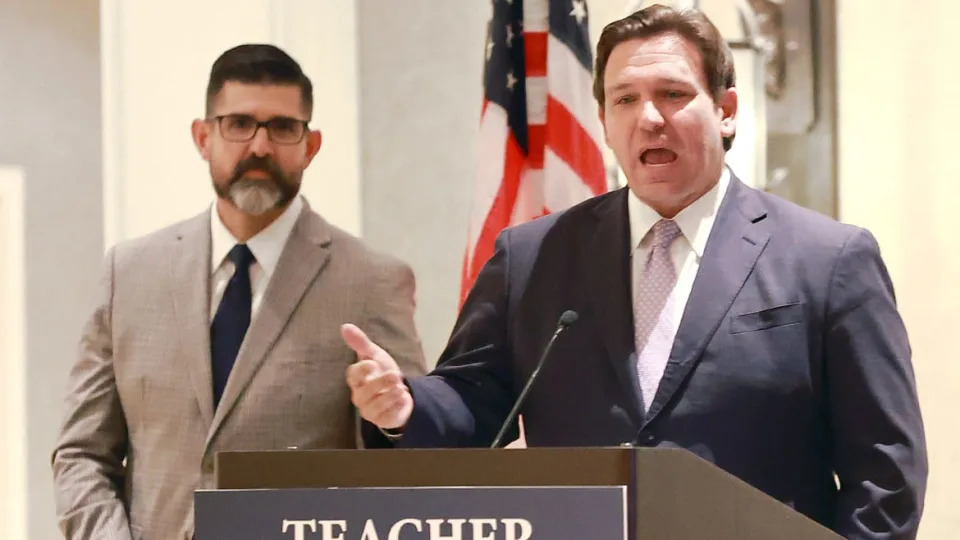
Upon Farmers Insurance’s announcement that it was pulling out of Florida, Jimmy Patronis, the state’s chief financial officer went right to the heart of the state’s continuing insurance crisis: “The more we learn about Farmers Insurance, the more it’s clear its leadership doesn’t know what they’re doing. While they’re bad at helping people, they’re good at virtue signaling.”
As reported in the Herald, Patronis criticized what he called Farmers’ “ ‘sustainable insurance’ and aligning investments with its social values, like avoiding investing in polluters or companies that sexually or racially discriminate against employees.” The concept is called environmental, social and governance investing — ESG, for short — a political target for Republicans lately.
Basically, Patronis blames Farmers for doing business while incorporating a “woke” ideology, the go-to scapegoat these days, the convenient and facile argument in Gov. Ron DeSantis’ Florida.
We beg to differ.
Whether Farmers Insurance rightly values the principles of ESG is irrelevant here. What’s important is that 100,000 policies in Florida — auto, property — are going belly up.
The wrong excuse
It’s not that the company might be woke; it’s that state lawmakers and the governor were asleep at the wheel as other insurance companies fled Florida long before Farmers.
It’s that lawmakers have been in a stupor as Floridians cried out for relief from soaring property insurance rates.
It’s that those same elected leaders were single-minded zombies who protected insurance companies, not homeowners, during two special sessions.
And yet these are the same legislators who were filled with boundless energy when it came to carrying out Gov. DeSantis’ culture wars in his now-lackluster drive toward to the White House.
Now Patronis, not to be left out, is skirmishing with Farmers. When the Editorial Board asked his office what specifically the insurance company had done in the offending area of ESG, Deputy Chief Financial Officer Frank Collins III doubled down: “While Farmers Insurance is keeping their commitment to the United Nations, they’re dumping 100,000 Florida policyholders; too bad their affection for ESG standards couldn’t stop these Floridians from being dropped.”
Know what else is too bad? That this is Patronis’ politically lame attempt to distract Floridians from the fact that 13 companies have gone insolvent in Florida. Others have stopped writing policies in the state, sending property owners’ premiums soaring into the stratosphere and leaving Citizens as the insurer of last resort for so many property owners. Tim Cerio, Citizens president and CEO, has predicted that the number of policies to reach 1.5 million by the end of the year.
Launch a probe?
And while he was denigrating Farmers, Patronis added he planned to look into complaints against the company, which could trigger a market investigation and — perhaps — fines and fees. This, of course, sounds like a retaliatory move in the same vein as our thin-skinned governor’s costly fight against Disney.
If there truly is something for Patronis to investigate, why did he wait until now to actually do his job? As CFO, the state’s so-called “business manager,” he oversees insurance and consumer services, responding to Floridians on finance-related queries, especially complaints about insurance fraud and related matters.
Interestingly, he found the time this month to tout the launch a new online site: “This morning, we deployed the Florida IRS Transparency Portal where Floridians can submit complaints about individual IRS agents,” Patronis announced on July 13. “We will take this information to look for patterns on how the IRS is targeting Floridians, which will help us craft laws to protect our businesses. We also want to provide the public with a tool where they can report harassment by the IRS.”
His curious use of the militaristic word “deploy” aside, we, too, don’t believe individuals and entities should be targeted by the IRS, especially for their political beliefs, and hope that Floridians across the political spectrum will have equal access to his concern.
But while Patronis is protecting Floridians from the tax collector, he’s among the many state leaders who have left us exposed and vulnerable to the state’s insurance crisis.
Resisting the urge to find small positives in the generally horrible.
By Neil Steinberg – July 23, 2023
A cat watches as Chicago police investigate inside an apartment in the 7700 block of South Carpenter Street after an officer shot and killed a man while answering a call of a domestic disturbance in the Gresham building on the South Side, Monday, Oct. 4, 2021.
What is it about stupid people anyway?
You can believe the most god-awful nonsense — factually incorrect, self-flattering, steaming kettles of BS — and parade that stupidity around to the delight of your fellow idiots, cheering and high-fiving one another at big rallies, celebrations of toxic dumbness.
Yet let somebody point it out, let them cough into their fist and mutter, “You’re stupid,” and suddenly the stupid fall to the ground, clutching themselves, declaring their injury to heaven.
It’s so … for want of a better word … stupid. How can some people get upset if you call themstupid when they’re perfectly happy being stupid? It’s a mystery.
Say your house were on fire — a situation even more dire than being stupid. And I say, “Your house is on fire,” causing you to collapse in a heap and declare yourself insulted, insisting that your house — obviously ablaze before us, thick black smoke pulsing out of the windows — is fine and how dare I suggest otherwise? Rude!
Who does that? Stupid people, I suppose.
I haven’t written much about Florida Gov. Ron DeSantis, honestly, because I still suspect he’s some kind of a sham — a performance art piece perhaps — designed to make Donald Trump look good, between his daft war on Disney and his imbecilic assault on history.
Maybe you haven’t heard. In its constant quest to make white people feel better, the state of Florida’s No. 1 priority, apparently, is downplaying race when teaching American history.
Florida’s new curriculum, unsatisfied with presenting racism as a dusty relic of the 19th century, is taking the next step and redefining America’s original sin, slavery, as something akin to high school shop class.
“Slaves developed skills, which, in some instances, could be applied for their personal benefit,” the curriculum notes.
Now, it is one thing to suggest that historic wrongs can have positive consequences. Polish anti-Semitism a hundred years ago was bad, but it drove my grandfather to Cleveland before the real butchery began. Which was good. For him.
But to focus on that scrap of positivity while denying the bulk of the horror is just … stupid. It’s like celebrating that Anne Frank got a best-selling book out of hiding from the Nazis while ignoring that she died in Bergen-Belsen.
Yet there was DeSantis on Friday, doubling down — the go-to move for the stupid since they can’t reevaluate — and supporting the new curriculum.
“They’re probably going to show that some of the folks that eventually parlayed, you know, being a blacksmith into doing things later in life,” DeSantis said.
And they give out free pudding in the Burn Center at Loyola. But were I to tuck a line in a burn story — “Burn patients enjoy free pudding, to their personal benefit, since pudding is delicious” — my editor would ask me to rethink that.
Then again, I’m a professional communicator and snug among — I hope — the non-stupid. We consider our audience.
Let me end with a true story. A photographer mentioned what she calls “crime scene kitties.” Her job takes her to crime scenes, where cats often appear. We got into a discussion of why the kitties are there — drawn by commotion? The cats I know would flee instead. Maybe cats are everywhere but, when standing around crime scenes for hours, she notices them.
“That could be a story!” I said.
Then I did a trick the stupid seldom attempt: I thought about it. I don’t write a lot of crime stories. To swoop into a tragic problem plaguing Chicago — people being murdered — and focus on the cats that wander over, there’s something grotesque about that. Something trivial. Something insulting, to victims and families. I did that empathy thing liberals are so good at, considering people other than myself, and reluctantly concluded: no crime scene kitties story.
That’s why Ron DeSantis should never be president. Because his campaign strategy — appeal to people threatened by anyone not exactly like themselves, people who can’t recognize the racism both in America’s past and in their own hearts right this flippin’ second — is stupid, if effective. We don’t want that guy. As if to underscore the difference, on Saturday the White House announced the creation of national monuments to Emmett Till. Till’s story is jarring and terrible — that photo of him in the casket. And essential and true and American. How could you ponder a history that didn’t include it?
DeSantis’ campaign is hemorrhaging support with this type of GOP voter, polls show
Alex Roarty – July 21, 2023
Lily Smith/The Register/Lily Smith/The Register / USA TODAY NETWORK
Republican voters with a college degree and a built-in skepticism of Donald Trump were supposed to form the backbone of Ron DeSantis’ strategy to win the 2024 GOP presidential primary.
Instead, they’re leaving his campaign in droves.
A trio of Republican primary polls, including previously unpublished data obtained by McClatchyDC, show that Florida’s governor has suffered steep declines in support among GOP voters with at least a bachelor’s degree, an erosion that threatens to undermine his candidacy.
Their defections — which started in the spring and have continued this summer — are disproportionately responsible for DeSantis’ overall decline in the race, where polls show he now sits a distant second place to Trump. In all three surveys, the governor now has barely half the support with college-educated white voters that he did when the year began, larger drop-offs than he suffered with other demographic groups.
The numbers reflect a pressing problem for the Florida Republican as he seeks to reset his campaign amid fundraising concerns and flagging poll numbers, challenging him to recover the lost support among voters who once made him Trump’s top rival for the nomination. The national surveys paint a troubling picture for his campaign, even as his allies insist that recent state-level polling already shows his candidacy regaining momentum.
A poll from decision intelligence company Morning Consult, for instance, found that DeSantis’ support had dropped 18 points among white college-educated Republicans, from 41% when the year began to 23% in mid-July, according to internal data shared with McClatchyDC.
A poll from market research firm Ipsos, meanwhile, found the governor’s support had been halved since mid-March, when it reported he had 39% among college-educated Republicans, according to data shared with McClatchy.
The same survey, released this week, found he had dropped to 20% among those voters, a 19-point decline. (Ipsos’ survey did not distinguish between college-educated white Republicans and college-educated Republicans, although the difference between the makeup of the two groups is small.)
A publicly available survey from Quinnipiac University found the largest drop in support for DeSantis, with the governor going from 51% support in a February poll of college-educated white Republicans to 29% with them now — a 22-point decline.
These voters abandoned DeSantis’ campaign at roughly twice the rate as Republicans without a college degree, a review of polling data found.
None of the three surveys asked why DeSantis has lost the support of college-educated Republicans. But in interviews with non-partisan pollsters and Republican political operatives, some of them speculated that the governor’s decision this year to double down on a sharp-edged conservative agenda could have alienated voters who once viewed him as a more pragmatic, mainstream politician.
“College-educated Republicans were looking for an alternative to Donald Trump, and they initially thought Governor DeSantis, after his 19-point win in Florida, made for a good one,” said Whit Ayres, a veteran GOP pollster. “But the way he has run his campaign, constantly tacking to the right, has turned off many of those people who were initially attracted to him.”
Ayres emphasized that he thought DeSantis still had time to recover from his underwhelming start, arguing people who once supported him can be brought back into the fold with a smart strategy that included more moderate positioning. And some Republican operatives disagree that DeSantis’ more conservative tack is at the root of his drop in support, arguing that Trump’s own popularity, combined with an indictment in March that conservatives saw as wildly unjust, is more responsible for the shift than anything the Florida governor did.
DeSantis’ allies say they already see signs that his popularity has rebounded, dismissing the importance of national surveys instead of state-based polling in places with an early nominating contest. A survey released in New Hampshire this week, from University of New Hampshire Survey Center, found DeSantis receiving 23% support, up from 22% in April, while Trump dropped from 42% to 37%.
The survey showed DeSantis earning the support of 12% of Republicans with only a bachelor’s degree, and 20% support of GOP voters with a graduate degree.
“You’re going to start to see this narrative continue to develop as more state level polling increases, particularly in those states where you see the impact of our ground game,” said an official with Never Back Down, the super PAC supporting DeSantis.
But the official conceded that Trump had gained ground earlier this year after he was indicted by a Manhattan grand jury over allegations he illegally paid hush money to an adult film actress, a prosecution conservatives think is politically motivated. And indeed, while DeSantis’ support with college-educated sank, Trump’s standing with those voters improved markedly since the year began.
Morning Consult, for instance, found Trump’s support nationally with these Republicans improving from 33% to start the year to 46% by mid-July. Among all college-educated GOP voters, Ipsos found him improving from 31% in mid-March to 36% this week.
And Quinnipiac showed him growing from 22% support in February to 34% in a survey released Wednesday.
In all three surveys, Trump now has more support among college-educated voters than DeSantis.
Trump has always fared better among Republicans without a college degree than those with a degree, dating back to his 2016 candidacy when he shocked the GOP establishment and won the party’s nomination. His presidency, in fact, helped shift the party toward a more blue-collar constituency, facilitating an influx of those voters into the GOP’s fold while simultaneously pushing many college-educated men and women, including former Republicans, to start backing Democratic candidates.
Compared to GOP voters without a college degree, GOP pollsters say, college-educated Republicans are socially moderate and fiscally conservative, with some of them both repelled by Trump’s rhetoric and uninterested in his stated aim of making the party’s economic agenda more populist
They might have expected a different approach from DeSantis, political experts say, and soured on him when he didn’t meet that expectation.
“College-educated voters tend to be more liberal,” said Tim Malloy, a polling analyst with Quinnipiac. “And DeSantis has gone right a good deal more than many expected him to do so.”
DeSantis’ support has suffered among Republicans without a college degree, too, though at lower rates than he has among those with degrees.
Among non-college white Republicans, Morning Consult and Quinnipiac found DeSantis’ support dropping 10 and 11 points since the start of the year. Ipsos found his support among non-college Republicans dropping six points since March.
DeSantis’ overall standing in the GOP primary has declined markedly since the start of the year, according to an average of polls compiled by FiveThirtyEight.com. The site has found his support dropping from about 37% to start the year to about 21% now.
Some Republican strategists argue that amid such an overall drop, DeSantis’ standing with college-educated voters was bound to suffer, especially given that he had more of them to lose when the year began. And they question whether DeSantis’ loss of support among college-educated voters is really driving his overall decline.
GOP pollster Patrick Ruffini, for instance, found that DeSantis and Trump were running roughly even with “very conservative” Republicans at the end of last year. The former president, however, had a 65-point edge with those same voters in June, according to a survey his firm conducted.
In an interview, Ruffini said he thinks Trump’s numbers were temporarily low after a disappointing midterm election last year, a time when he had done little campaigning and voters were upset the party hadn’t won control of the U.S. Senate majority. Those frustrations have gradually subsided since, he said.
“You add on top of that something most Republicans see as a tainted and partisan prosecution, and it’s not hard to process what’s been happening here,” he said.
Poll: Trump voters say racism against white Americans is a bigger problem than racism against Black Americans
The polling follows the dismissal of a lawsuit put forth by the survivors of the Tulsa Race Massacre, which many saw as a potential blueprint for reparation efforts.
Marquise Francis and Andrew Romano – July 21, 2023
Trump supporters at a campaign event in Pickens, S.C., July 1. (Sean Rayford/Getty Images)
As public support for reparations for African Americans remains stubbornly low, a new Yahoo News/YouGov poll reveals one major roadblock: Donald Trump voters believe that racism against white Americans has become a bigger problem than racism against Black Americans.
The survey of 1,638 U.S. adults, which was conducted from July 13-17, shows that among 2020 Trump voters, 62% say that racism against Black Americans is a problem today — while 73% say that racism against white Americans is a problem.
Asked how much of a problem racism currently is, just 19% of Trump voters describe racism against Black Americans as a “big problem.” Twice as many (37%) say racism against white Americans is a big problem.
Trump voters and self-identified Republicans — overlapping but not identical cohorts — are the only demographic groups identified by Yahoo News and YouGov who are more likely to say racism against white Americans is a problem than to say the same about racism against Black Americans. A majority (51%) of white Americans, for instance, think racism against people who look like them is a problem — but overall, far more white Americans (72%) say racism against Black Americans is a problem.
A protest from earlier this year in Oakland, Calif., against the killing of Tyre Nichols by police in Memphis, Tenn. (Tayfun Coskun/Anadolu Agency via Getty Images)
Politics, in other words, is the dividing line here — and political dynamics go a long way toward explaining why reparations for Black Americans continue to be so unpopular in the U.S.
The new Yahoo News/YouGov poll follows the dismissal earlier this month of a lawsuit put forth by the three remaining survivors of the 1921 Tulsa Race Massacre seeking reparations for ongoing harm caused by the racist rampage that destroyed their once-thriving majority-Black community a century ago. The trio of survivors had sued under Oklahoma’s public nuisance law, claiming that the ripple effects of the massacre continue to affect the Greenwood community today.
Many supporters saw the Oklahoma suit as a potential blueprint for reparation efforts around the country. But the latest ruling, which dismissed the case with prejudice — meaning it cannot be filed again — is seen as a stinging setback. The survivors and their attorneys have promised to appeal.
Yet the reality is that even with qualifications, most U.S. adults oppose reparations for Black Americans. According to the Yahoo News/YouGov poll, just a quarter of them (24%) say Black Americans should receive “restitution or reparations from the government — not necessarily direct cash payments — as a result of inequities caused by racism and slavery,” while 56% say they should not.
Support is only marginally higher (29%) when respondents are asked specifically about reparations for “descendants of enslaved Black Americans” rather than all “Black Americans.” And even when questioned about reparations for the “three remaining survivors of the Tulsa race massacre” — that is, living people who were directly harmed by racial violence — less than half of Americans are in favor (45%). Most are either opposed (33%) or unsure (22%).
What happened in Tulsa?
The massacre at the center of the court case took place on May 31, 1921, when an angry white mob beat and killed hundreds of Black residents in Greenwood, which had earned the nickname “Black Wall Street” because of the success of its Black residents. Earlier that day, the Tulsa Tribune reported that a Black man had raped a white woman, although there were varying accounts of the incident. Confrontations between Black and white people broke out near the courthouse as the case was being heard.
Over the next two days, 35 city blocks went up in flames. There were widespread reports of looting and more than 1,250 homes burned; 300 people were killed and 800 others were injured as the white mobs outnumbered Black residents who were forced to retreat into the Greenwood district. Generations of Black progress were wiped out in less than 48 hours.
The aftermath of the Tulsa Race Massacre, during which mobs of white residents attacked Black residents and businesses of the Greenwood District in Tulsa, Okla., June 1921. (Bettmann Archive/Getty Images)
Property claims documenting $1.8 million worth of damage, the equivalent of about $27 million today, were deemed obsolete, according to a 2001 state commission report. With most insurance paperwork and bank documents lost in the riot, almost all Greenwood residents had no restitution for their homes or businesses, and couldn’t retrieve their funds from the banks.
The chief motive for the attack, experts say, was white resentment over Black advancement. But it’s translated into little restitution for what was lost.
The big political hurdle
To be clear, reparations for Black Americans are not particularly popular across the political spectrum. Republicans are opposed 84% to 8%; Independents are opposed 62% to 8%. Democrats favor reparations by a 21-point margin (49% to 28%) — but even that’s not majority support, and much of it is attributable to overwhelmingly pro-reparations sentiment (69% to 11%) among Black Americans themselves, who tend to identify as Democrats.
Among white Americans, meanwhile, just 17% say yes to reparations; 66% say no.
Still, the major outliers when it comes to race are on the right-wing. When asked how big a problem racism against Black Americans was in the past, Biden and Trump voters basically agree, with 93% of the former and 85% of the latter agreeing that it was a problem.
Trump at a rally in Carson City, Nev., on Oct. 18, 2020. (Mandel Ngan/AFP via Getty Images)
The disagreement is over whether it’s still a problem today — or rather, as Trump voters seem to believe, whether it’s less of a problem than racism against white Americans, which reparations, in their view, would only exacerbate. When Trump voters are asked why Black Americans shouldn’t receive reparations, the top answer isn’t that “racism never held Black Americans back” (13%); it’s that “racism is no longer holding Black Americans back” (62%). Reparations, they say, would only “increase racial divisions” (57%) because “other Americans have [also] faced inequities because of racism” (60%).
Similarly, Trump voters are the only group (other than Republicans at large) who are more likely than not to say there isn’t any “problem with systemic racism in America” (61%) and to disagree with the idea that “racism is not merely the product of individual bias or prejudice, but also something embedded in legal systems and policies” (55%) — issues that reparations are intended to ameliorate.
A pathway for reparations
Tatishe Nteta, a professor of political science at the University of Massachusetts Amherst and director of the UMass Poll, who’s been surveying how Americans feel about reparations for two years, acknowledges the low popularity of reparations, but notes it’s bigger than public opinion.
“Reparations policy is not necessarily about public opinion,” Nteta told Yahoo News. “It’s about the recognition by a private institution, individuals or governments. It’s about atoning for the mistreatment directed at a particular group.”
Pastor Robert Turner after leading a protest on reparations in Tulsa, Nov. 18, 2020. (Joshua Lott/Washington Post via Getty Images)
Pointing to success at the local level in passing reparations initiatives and programs in progressive cities and towns like Evanston, Ill., Amherst, Mass. and Detroit, Nteta says that any racial and economic redress in those cities could create a domino effect, which could convince other more moderate cities and states to consider.
“If reparations achieves the goal of creating some level of racial equality, and the recipients of reparations are also happy with the atonement by whatever the institution is, then you could use this as a model going forward. You could find more moderate cities or moderate states passing reparations programs once you’ve seen the success in these smaller localities.”
____________
The Yahoo News survey was conducted by YouGov using a nationally representative sample of 1,638 U.S. adults interviewed online from July 13-17, 2023. The sample was weighted according to gender, age, race, education, 2020 election turnout and presidential vote, baseline party identification and current voter registration status. Demographic weighting targets come from the 2019 American Community Survey. Baseline party identification is the respondent’s most recent answer given prior to March 15, 2022, and is weighted to the estimated distribution at that time (32% Democratic, 27% Republican). Respondents were selected from YouGov’s opt-in panel to be representative of all U.S. adults. The margin of error is approximately 2.7%.
Former Sen. Claire McCaskill Goes Scorched Earth On ‘Little, Lily-Livered’ Republicans
Lee Moran – July 21, 2023
Former Sen. Claire McCaskill (D-Mo.) on Thursday ripped the Republican Party for what it’s become in the Donald Trump era.
McCaskill, now a political analyst for MSNBC, recalled on the “Morning Joe” show how GOP leaders in 2012 “rejected” her then-Republican challenger, the late Rep. Todd Akin (R-Mo.), for his comments on “legitimate rape.”
But 11 years later, with the party in thrall to Trump, McCaskill explained how it’s a different story, as even top Republicans continue to defend the former president amid his mounting legal woes and reported imminent indictment in the special counsel probe into the Jan. 6, 2021, attack on the U.S. Capitol.
“The main difference here is not the conduct of the candidate, it is the reaction of the leaders of his party,” McCaskill said, noting how Senate Minority Leader Mitch McConnell (R-Ky.), Sen. Lindsey Graham (R-S.C.) and House Speaker Kevin McCarthy (R-Calif.) all condemned Trump in the immediate aftermath of the insurrection.
“But then they got scared,” she said. “They just became little, lily-livered cowards and were too afraid that, somehow, they couldn’t hold on to their precious office or their precious power if they stated the obvious.”
“So, it is not so much what Donald Trump has done,” McCaskill added. “It’s the rest of the Republican Party who has elevated him and kept him elevated that has brought this upon America.
Florida Schools Will Teach How Slavery Brought ‘Personal Benefit’ to Black People
Allison Quinn – July 20, 2023
Orlando Sentinel/Tribune News Service via Getty
Middle school students in Florida will soon be taught that slavery gave Black people a “personal benefit” because they “developed skills.”
After the Florida Board of Education approved new standards for African American history on Wednesday, high school students will be taught an equally distorted message: that a deadly white mob attack against Black residents of Ocoee, Florida, in 1920 included “acts of violence perpetrated against and by African Americans.”
Dozens of Black residents were killed in the massacre, which was perpetrated to stop them from voting.
According to members of the board, that distorted portrayal of the racist massacre is factually accurate. MaryLynn Magar, a member of the board appointed by Gov. Ron DeSantis, said at the board’s meeting in Orlando on Wednesday that “everything is there” in the new history standards and “the darkest parts of our history are addressed,” the Tallahassee Democrat reported.
The majority of the speakers who provided public testimony on the planned curriculum were vehemently opposed to it, warning that crucial context is omitted, atrocities are glossed over, and in some cases students will be taught to “blame the victim.”
“I am very concerned by these standards, especially some of the notion that enslaved people benefited from being enslaved,” state Rep. Anna Eskamani (D-Orlando) said, per Action News Jax.
“When I see the standards, I’m very concerned,” state Sen. Geraldine Thompson said at the board meeting. “If I were still a professor, I would do what I did very infrequently; I’d have to give this a grade of ‘I’ for incomplete. It recognizes that we have made an effort, we’ve taken a step. However, this history needs to be comprehensive. It needs to be authentic, and it needs additional work.”
“When you look at the history currently, it suggests that the [Ocoee] massacre was sparked by violence from African Americans. That’s blaming the victim,” the Democrat warned.
“Please table this rule and revise it to make sure that my history, our history, is being told factually and completely, and please do not, for the love of God, tell kids that slavery was beneficial because I guarantee you it most certainly was not,” community member Kevin Parker said.
Approval of the new standards is a win for the DeSantis administration, which has effectively sought to create a new educational agenda that shields white students from feeling any sense of guilt for wrongs perpetrated against people of color. The Florida governor signed the “Stop WOKE Act” last year to do just that, restricting how issues of race are taught in public schools and workplaces.
In keeping with the administration’s crusade against “wokeness,” Education Commissioner Manny Diaz defended the new standards against criticism, saying, “This is an in-depth, deep dive into African American history, which is clearly American history as Governor DeSantis has said, and what Florida has done is expand it,” Action News Jax reported.
Paul Burns, the Florida Department of Education’s chancellor of K-12 public schools, also insisted the new standards provide an exhaustive representation of African American history.
“Our standards are factual, objective standards that really teach the good, the bad and the ugly,” he was quoted as saying Wednesday by Florida Phoenix. He denied the new standards portray slavery as beneficial.
Although education officials say teachers are meant to expand upon the new curriculum in the classroom, critics say teachers are unlikely to do that for fear of being singled out and possibly punished for being too “woke.”
The Florida Education Association, the state’s largest teachers union, called the new standards “a big step backward for a state that has required teaching African American history since 1994” in a statement after Wednesday’s vote.
Derrick Johnson, president and CEO of the NAACP, also condemned the new curriculum, saying in a statement: “Our children deserve nothing less than truth, justice, and the equity our ancestors shed blood, sweat, and tears for.”
“Today’s actions by the Florida state government are an attempt to bring our country back to a 19th century America where Black life was not valued, nor our rights protected. It is imperative that we understand that the horrors of slavery and Jim Crow were a violation of human rights and represent the darkest period in American history. We refuse to go back,” he said.
Texas’ Harsh New Border Tactics Are Injuring Migrants
Edgar Sandoval, Jay Root and J. David Goodman – July 20, 2023
Texas law enforcement officers stand near concertina wire on the bank of the Rio Grande river in Eagle Pass, Texas on July 19, 2023. (Go Nakamura/The New York Times)
For more than two years, Gov. Greg Abbott of Texas has pursued an increasingly aggressive approach to the border, sending thousands of National Guard troops and police officers to patrol the Rio Grande and testing the legal limits of state action on immigration.
But in recent weeks, Texas law enforcement officials have taken those tactics much further, embarking on what the state has called a “hold-the-line” operation, according to interviews with state officials and documents reviewed by The New York Times. They have fortified the riverbanks with additional concertina wire, denied water to some migrants, shouted at others to return to Mexico and, in some cases, deliberately failed to alert federal Border Patrol agents who might assist arriving groups in coming ashore and making asylum claims, the review found.
The increasingly brutal, go-it-alone approach has alarmed people inside the U.S. Border Patrol and the Texas Department of Public Safety, the agency chiefly responsible for pursuing the governor’s border policies. Several Texas officers have lodged internal complaints and voiced opposition.
The reality of those tactics in one area of the border, around the small city of Eagle Pass, was detailed in an email by one state police medic, who described exhausted migrants being cut up by razor wire, a teenager breaking his leg to escape the barriers and officers being directed to withhold water from migrants struggling in the perilous heat. The actions described in the email drew broad condemnation from Texas Democrats in Congress and from the White House after the email was reported by the Houston Chronicle.
“If they are true, it is abhorrent. It is despicable. It is dangerous,” said White House press secretary, Karine Jean-Pierre, referring to the reports. “We’re talking about the bedrock values of who we are as a country.” The Justice Department said Wednesday that it was assessing the situation.
But the objections within the Texas Department of Public Safety extended far beyond a single medic: At least three other officers working around Eagle Pass, a main arrival point for migrants who are crossing illegally, have expressed their outrage and misgivings to higher-ups about the actions they have seen, according to internal correspondence and interviews with state officials briefed on the border response.
And it was not only officers describing the harshness of the new tactics. In several interviews with the Times in Eagle Pass, about two hours southwest of San Antonio, migrants nursing wounds said they had encountered phalanxes of law enforcement officers along banks of the United States that were newly bristling with barbed wire, some of it underwater.
“They kept yelling at us, ‘Go back, go back!’” said Reyna Gloria Dominguez, 42, who arrived in Eagle Pass from Honduras in a wheelchair. “We said, ‘We can’t.’ My son told them, ‘She needs help. She’s hurt.’”
Similar scenes have been playing out elsewhere along the border, including in the Texas city of Brownsville, near the mouth of the Rio Grande, where state police officers have been standing guard at crossing points behind two layers of concertina wire.
The increasing aggressiveness has created international tension with Mexico because, in addition to placing concertina wire, Texas also deployed a 1,000-foot floating barrier of buoys into the Rio Grande in Eagle Pass this month. Mexican officials have said the barrier may have violated international treaties and could encroach on Mexican territory.
Texas officials have blamed the Biden administration for allowing a chaotic situation on the border. They said the buoy barrier and concertina wire were designed to deter people from risking a dangerous swim across the Rio Grande and direct them to safe, official border-crossing stations.
“No orders or directions have been given under Operation Lone Star that would compromise the lives of those attempting to cross the border illegally,” Abbott said in a joint statement with top officials from the Texas Department of Public Safety and the Texas Military Department, using the name of the state operation.
The new Texas tactics have frayed relations between state and federal law enforcement agencies that have long worked together to monitor the border.
In a memo to the Texas DPS last month, Border Patrol officials in the Eagle Pass area raised concern that the concertina wire placed along the water by Texas officials was creating new hazards for migrants as well as for federal border agents.
At the same time, state police supervisors have been directed by their own superiors not to alert Border Patrol when encountering groups of migrants, but rather to handle the situation themselves, according to a departmental text message addressed to sergeants, obtained by the Times.
“Can you please push out a message to your troopers,” the text read, referring to those stationed in a city-owned park by the international bridge in Eagle Pass. “They are NOT to call BP when they see a group approaching or already on the bank.” Officers were instead directed to make arrests for criminal trespassing, an element of Operation Lone Star.
The text message, which was sent last week and has not been previously reported, also directed officers to tell migrants to “go back to Mexico” and to cross the border at one of the international bridges.
Many of the migrants who arrived in Eagle Pass after passing through the treacherous new gantlet were left shaken, and some were injured.
Gleyders Durant, 27, a migrant from Venezuela, peeled off bandages on his right foot to reveal several wounds. He said that as he crossed the river on Friday and stepped onto U.S. soil — his 3-year-old son on his shoulders and his wife following them — he felt a sharp pain. Blood gushed through one of his tennis shoes.
“That’s when I realized that I had stepped on a stretch of wire hidden under dark waters,” he said. Panicked, he extended his arms and carried his wife over it. “It was hidden, under the water.”
Nearby, in a respite center in Eagle Pass, another migrant from Venezuela, Marjorie Escobar, 32, described a harrowing encounter Saturday between her group of about 20 people, including children as young as 4, and several law enforcement agents in Texas.
As some in her group threw inflatables and blankets over the concertina wire to avoid injury, she said, the agents began yelling, “Go back to Mexico!” and “If you cross, we are going to arrest and charge you.”
Then, she said, an agent wearing a brown uniform and a cowboy hat who appeared to be a Texas state trooper roughly pulled a blanket off the barrier as people were climbing over it. The abrupt maneuver caused a young woman to hit her face on a spike, leaving a gash on her forehead, Escobar recalled. She said several of the agents stood still for several minutes, until an officer wearing what looked like a soldier’s uniform offered help to the wounded woman.
State officials did not immediately respond to a request for comment on the incident.
“I was still in the river, about to jump over, when I saw what that agent did and was horrified,” she said of the officer in the cowboy hat. “She was crying, saying, ‘Help me, help me.’”
Because of the increased number of migrants being taken to the lone hospital in Eagle Pass, residents have often been waiting up to eight hours to receive medical care, said Mayor Rolando Salinas Jr. “I support legal migration and orderly law enforcement,” he said in an interview Wednesday. “What I am against is the use of tactics that hurt people.”
The tactics by Texas appear to have intensified in the lead-up to the lifting in late May of Title 42, a public health policy imposed during the coronavirus pandemic that allowed federal agents to rapidly expel most arriving migrants.
The Department of Public Safety has defended its approach and said officers were providing assistance to migrants in medical distress. “There is not a directive or policy that instructs troopers to withhold water from migrants or push them back into the river,” an agency spokesperson, Travis Considine, said.
At the same time, Considine said, officers, who have been directed to keep migrants from entering and to instruct them to return to Mexico, are given some discretion in how they carry out those orders.
“If there are women and children who are asking for water, they’re getting water,” he said. “A group of 30 adult males comes, and they’re begging for water. I’m not going to say there are not troopers saying, ‘We’re not going to give you water.’” He said that if the migrants did not seem to be in distress, troopers might tell them to go get water in Mexico.
The four officers who raised concerns said there were explicit orders to deny water to migrants and to tell them to go back to Mexico. Three said they had been told by supervisors that troopers were not to inform the Border Patrol when migrants were in the water or at the Texas riverbank.
One of the officers, Trooper Nicholas Wingate, was a medic. In an email to supervisors July 3, he said numerous migrants, including a pregnant woman, had gotten tangled in the razor wire. He said the woman, 19, was “doubled over” and “in obvious pain, stuck in the casualty wire.” A 4-year-old girl who attempted to cross was “pressed back by Texas Guard soldiers due to orders given to them,” he wrote in the email.
With temperatures soaring past 100 degrees that day, the girl passed out and became “unresponsive,” Wingate wrote. She was taken away by emergency medical workers.
Wingate also described seeing a father with lacerations on his leg after extricating his child from what he called a “barrel trap,” a plastic barrel floating in the water with concertina wire surrounding it. “I believe we have stepped over the line into the inhumane,” he wrote.
Considine said the agency did not deploy “barrel traps.” But he said it was possible that a barrel that had been wrapped in concertina wire in one part of the river to hold it in place had floated away in rising waters, though he said that the agency had not confirmed that was the case.
On the question of coordinating with Border Patrol, Considine said officers did not alert Border Patrol when arresting migrants for criminal trespassing. He said the number of such arrests had increased recently in and around Eagle Pass.
But federal law entitles people who enter the United States, even unlawfully, to claim asylum by stating that they faced persecution in their home country.
It is not clear how many migrants have died while crossing the border in recent weeks.
The river is always treacherous, and four people, including an infant, drowned this month in the span of a few days. According to the sheriff’s office in Maverick County, which includes Eagle Pass, 26 migrants have drowned so far in 2023. There were 77 migrant drownings in the county in all of last year.
For some local officials, the hardened border was sending the wrong message.
“Seeing barbed wire on the bank of the river, it doesn’t look good for the USA,” said Sheriff Tom Schmerber of Maverick County. “We’re used to seeing all that in communist countries. Now we have them here in Texas.”
“It’s kind of like a black eye. And it’s not working anyway,” he added. “It’s not stopping the immigrants.”
Florida’s CFO blames wokeness for insurers leaving the state: ‘I do call them the Bud Light of the insurance industry’
Chris Morris – July 20, 2023
As yet another insurance company is pulling back from issuing policies in Florida following a string of natural disasters, the state’s chief financial officer has accused the industry of pulling out not because of losses, but due to wokeness.
Jimmy Patronis, CFO of the state, lit into Farmers Insurance for its plans to leave the state on CNBC recently, saying “if they would just leave ESG [environmental, social, and corporate governance ] and put it away, and focus on the bottom line, they may not have made this decision to leave the state of Florida with the tail between their legs.”
“I do say they’re too woke,” he added. “I do call them the Bud Light of the insurance industry. I do feel like they have chaos in their C-suite.”
The accusations aren’t helping the state hang onto insurers, though. This week, AAA announced it would not renew the auto or homeowners policies of some customers in Florida, making it the fourth insurer in the past year to back away from the state. (Bankers Insurance and Lexington Insurance, a subsidiary of AIG, left Florida last year.)
All of the companies that have reduced or eliminated their presence in the state have said the string of local hurricanes, including last year’s catastrophic Hurricane Ian, have made it too expensive to cover residents of the state.
The shrinking number of insurance options and the growing number of disasters is hitting Floridians in the wallet. The average homeowner’s premium in the state costs over $4,000, compared to the U.S. average of $1,544, according to E&E News, a division of Politico that focuses on environmental and energy news.
The companies are leaving the state despite legislation meant to encourage them to stay. Last year, Florida created a $1 billion reinsurance fund and set up laws meant to prevent frivolous lawsuits.
Insurance companies have also stepped back from California, with AIG, Allstate and State Farm no longer taking new customers, as wildfires in that state have driven up costs.
Is America on the brink of tyranny? Trump’s plan if elected in 2024 should frighten us all.
Austin Sarat and Dennis Aftergut – July 20, 2023
The New York Times published an article Monday that’s bone-chilling for anyone who cherishes our freedom, democracy and constitutional governance. The story recounted, with full cooperation of Donald Trump’s presidential campaign, his plans to eliminate executive branch constraints on his power if he is elected president in 2024.
The obstacles to be eliminated include an independent Justice Department, independent leadership in administrative agencies and an independent civil service. Richard Neustadt, one of the country’s best known students of the American presidency, has said that in a constitutional democracy the chief executive “does not obtain results by giving orders – or not. … He does not get action without argument. Presidential power is the power to persuade.”
Trump now may face federal charges for his role in fomenting the riot.
And while he was president, in addition to appointing subservient heads of executive departments, he took steps to increase his control over the regulatory authority of administrative agencies. To cite one example, in 2019, Trump forced climate change researchers in the Department of Agriculture to move from Washington, D.C., to Kansas City, Missouri, producing a huge exodus from federal employment.
In 2020, he attempted to undermine the independence of the civil service by issuing an executive order adopting “Schedule F.” It purported to vastly augment a president’s power to hire and fire federal officials by expanding the number of “political appointees” throughout government employment who were outside civil service protections.
Trump’s plan is to centralize power in Oval Office
The Times story outlined his 2025 road map to implement this command-and-control model of executive authority and centralization of power if he’s returned to the Oval Office. In effect, the article described how his team would replace our constitutional republic with an authoritarian state.
Such a state seeks to eliminate the independence of civil servants. Saying good things about bureaucracy may be unpopular, but federal employees’ competence, expert judgment and commitment to governance by law is essential to democratic government.
One definition of an authoritarian state is that it is characterized by the consolidation of power in a single leader, “a controlling regime that justifies itself as a ‘necessary evil.'” That kind of control necessarily features “strict government-imposed constraints on social freedoms such as suppression of political opponents and anti-regime activity.”
Those characteristics describe the contours of the 2025 blueprint that the Trump campaign wanted the public to see via the Times’ report. As the story notes, they are setting the stage, if Trump is elected, “to claim a mandate” for the goal of centralizing power in him.
The Times quoted John McEntee, Trump’s 2020 White House director of personnel, defending the rejection of checks and balances on a president: “Our current executive branch was conceived of by liberals for the purpose of promulgating liberal policies. … What’s necessary is a complete system overhaul.”
Founders warned about danger of too much presidential power
In fact, the executive branch, like the two other branches, was devised by the framers of our Constitution, to limit power by dividing it. Even Alexander Hamilton, who defended energy in the executive branch, suggested that the path to tyranny was marked when government officials are “obliged to take refuge in the absolute power of a single man.”
James Madison joined Hamilton in warning in The Federalist 48 that “power is of an encroaching nature.” For that reason, The Federalist 51 states, “Ambition must be made to counteract ambition.”
It described the paradox facing the framers as this: One must “enable the government to control the governed; and in the next place, oblige it to control itself.”
Trump’s 2025 blueprint would end governmental control on a president so he can dominate and control the governed.
Along with divided power, the central constraint that our founding documents create is the overarching legal institution known as the rule of law. That is why Trump’s plan for a radical reorganization of the executive branch starts with ending “the post-Watergate norm of Justice Department independence from White House political control.”
Controlling the prosecutorial power allows a president to use it to favor friends, destroy enemies and intimidate ordinary citizens tempted to speak out.
That would sound the death knell of American freedom. As John Locke, the 17th century political philosopher who inspired the authors of the Declaration of Independence, wrote, “Wherever law ends, tyranny begins.” Or as Blake Smith put it in an article in Foreign Policy last year, “The bureaucratic ethos is essential to the functioning of the state and the preservation of private life as a separate, unpolitical domain of tolerated freedom.”
At the close of America’s first decade as a constitutional republic, George Washington voluntarily chose not to seek a third term as president to avoid setting the country on the road to the tyranny of lifetime rule by a president. He understood from the revolution against a king that retaining the personal power of one person is the central goal of authoritarianism.
If voters elect Trump president in 2024, he will implement the plan his campaign has purposefully leaked. The outcome is easy to foretell. A bureaucracy purged of those loyal to the Constitution rather than to Trump will send free and fair elections to history’s landfill, along with the Bill of Rights and the freedoms they were designed to protect.
Austin Sarat is the William Nelson Cromwell professor of jurisprudence and political science at Amherst College in Massachusetts.Dennis Aftergut, a former federal prosecutor, is counsel to Lawyers Defending American Democracy.
Authoritarianism Expert Warns Why It’s Critical To Listen To Trump’s Words Right Now
Lee Moran – July 20, 2023
Authoritarianism expert Ruth Ben-Ghiat warned on Wednesday that when Donald Trump talks about obliterating and then politicizing the civil service, and seizing control of every aspect of government if he wins the White House in 2024, he really means it.
“Nobody is ever prepared” for an authoritarian takeover of their country, Ben-Ghiat, a history professor at New York University and author of “Strongmen: Mussolini to the Present,” told MSNBC’s Ali Velshi.
“They think they are going to be the exception. They don’t listen to the warning signs until it’s too late,” she continued.
But Trump is actually “being very clear” with what he is saying, said Ben-Ghiat.
Last week, a New York Times article said Trump would seek to expand presidential authority “over every part of the federal government that now operates, by either law or tradition, with any measure of independence from political interference by the White House.”
Ben-Ghiat cautioned: “Authoritarians always tell you what they are going to do as a kind of challenge and as a warning, and people don’t listen until it’s too late.”
If Trump wins election again, he will “be finishing the job that he started, and by the way that’s not just destroying democracy internally,” she added. His other main aim was “to take America out of the realm of democratic internationalism and align it with autocracies. That will happen as well.”