Kevin McCarthy’s way to defend Trump: Pivot, confuse and corrode democracy | Opinion
Tad Weber – August 1, 2023
Greg Nash
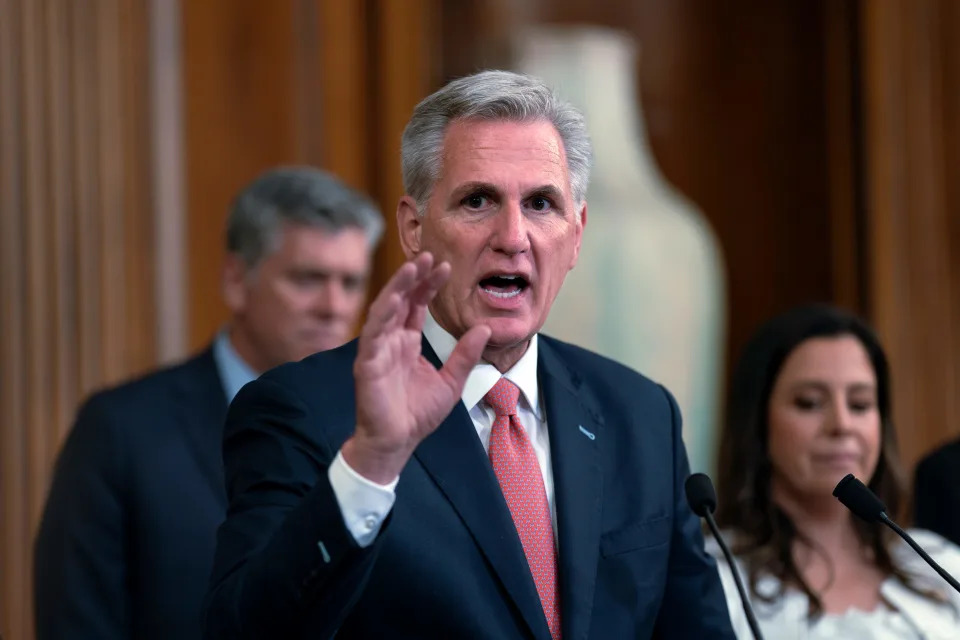
House Speaker Kevin McCarthy is using time-tested political strategies in defense of former President Donald Trump and his legal troubles.
First, pivot. Then deflect. Lastly, confuse.
This was on display recently when the Bakersfield Republican, now the congressional representative for Clovis and eastern parts of Fresno County, was asked about the latest charges added to an indictment against the former president over his alleged mishandling of presidential records.
The Justice Department’s special counsel, Jack Smith, brought additional charges to the indictment that accuse Trump of obstructing justice and willfully keeping a top-secret document. The three charges were added to the 37 already filed.
For review, Trump is being accused of keeping a horde of confidential and top-secret documents at his Florida home in violation of the Presidential Records Act. It requires all such materials to be handed over to the National Archives once a president leaves office.
Trump allegedly did not comply. Among the evidence cited by Smith are photos of documents spilled over the floor at Trump’s Mar-a-Lago home.
In the latest charges, Trump is alleged to have shown some visitors a battle plan for U.S. military forces if they were to attack a foreign country. CNN reported it to be Iran. Trump is heard on an audio recording talking about the document and admitting it is confidential.
In the two obstruction charges, Trump is alleged to have directed a pair of employees to delete security-camera footage at Mar-a-Lago once the Justice Department issued a subpoena for it.
Pivot, deflect, confuse
CNN reporter Manu Raju caught up with McCarthy last Thursday to ask him about the latest charges against Trump.
“What concerns me is you have a sitting president that has a situation like this, but even worse, that had documents, but nothing’s happened,” McCarthy told Raju. “The president, when he was a senator, he took a document. How many years is that and there’s been no prosecution?”
That last point — when Biden was a senator from Delaware — is the attempt to confuse.
McCarthy did not elaborate further, so one is left to assume he is referring to a claim by Trump that Biden has 1,850 boxes of confidential records that he has not turned over.
“By the way, Biden’s got 1,850 boxes,” Trump said at a campaign rally in Georgia. “He’s fighting them on the boxes. He doesn’t want to give the boxes and then they say, ‘Trump is obstructioning’.”
The Associated Press did a fact check of Trump’s claim and found it false.
The National Archives says the 1,850 boxes are actually from Biden’s time in the Senate before he became vice president under then-President Obama. The papers are housed at the University of Delaware.
Records accumulated from serving in the Senate are personal property and not subject to the Presidential Records Act.
“While the FBI has searched the Delaware university records as part of a larger search for classified documents, there is no evidence they were withheld from authorities in any way,” the AP reported.
Corrosive effect
If McCarthy was referring to discoveries earlier this year at Biden’s home and the former private office of official documents from his vice presidential years, the comparison with Trump still does not hold up.
Unlike Trump, Biden has fully cooperated with investigators once the discoveries came to light. He was found to possess a small number of documents. Biden’s attorney general picked a special counsel to investigate the Biden records — a lawyer appointed by Trump when he was president.
Trump, by contrast, has steadfastly opposed efforts by the National Archives to return the documents in his possession. It took an FBI raid at Mar-a-Lago to secure the materials. Thirty-three boxes and 11,000 documents were taken from the Florida home. Trump’s former attorney general Bill Barr said Trump took the documents to “flip the bird” at the government.
As House speaker, McCarthy is one of the most powerful politicians in America today. His constant defense of Trump, in advance of trials, that have not yet even started, is a corrosive agent on American democracy. He stirs doubt and suspicion by regularly repeating that the nation operates with a “two tiers” system of justice — one protecting Biden, one prosecuting Trump.
To see it another way, just flip the script. What if, instead of Trump having been charged for things like obstruction of justice and willful detention of records belonging to the American people, it had been Hillary Clinton? What would McCarthy be saying then?
Column: Is there any way to shift the bizarre Republican conviction that only Trump will save them?
Jonah Goldberg – August 1, 2023
Former President Donald Trump greets supporters as he arrives at New Orleans International Airport on Tuesday. (Gerald Herbert / Associated Press)
“They’re not indicting me, they’re indicting you. I just happen to be standing in the way,” Donald Trump declared (again) in the wake of a new updated federal indictment connected to the classified documents case.
The claim is as effective as it is stupid. The federal government is not, in fact, prosecuting the average Trump supporter for mishandling documents or obstructing justice (save for two Trump aides who allegedly helped him mishandle documents and obstruct justice).
But the idea that Trump is a populist sword-and-shield against the “establishment,” “Deep State,” or “elites” has ensorcelled large swaths of the GOP base, which is at least partly why he’s got a massive lead over his opponents. In the latest New York Times/Siena College poll asking potential Republican primary voters which candidate they would most likely vote for, Trump is at 54%, a 37-point lead over his closest challenger, Florida Gov. Ron DeSantis.
Among his core supporters, about 37% of the party according to a breakdown of the poll by the New York Times’ Nate Cohn, literally nobody thinks he committed any crimes and 94% think the party needs to rally around him against these presumably bogus charges.
Cohn notes that no primary candidate with a lead of at least 20 points at this stage of the race has ever failed to get their party’s nomination.
This alone undermines the MAGA base’s argument for supporting Trump. If the Republican establishment forces were as powerful as Trump and his voters think, they’d be able to do something about it. If the Deep State were half as formidable as they think, Trump would never have been president in the first place.
But large segments of the GOP suffer from the delusion that they are victims of the ruling classes and that the woke left is running everything — or will — if Trump doesn’t stop them.
Even in states with Republican governors and legislative supermajorities, like Tennessee, a certain paranoia that the left could take over at any moment dominates politics. As one GOP state legislator recently said on a leaked conference call, “The left wants Tennessee so bad because if they get us, the Southeast falls and it’s ‘game over’ for the republic.”
Of course, if these left-wing overlords were as fearsome as all that, the GOP would not be in total control of the Volunteer State in the first place. Similarly, if the “RINO” establishment were in charge, Trump wouldn’t be the runaway front-runner.
This is the paradox of Republican politics today. The populists run or at least dominate the party but they derive their power and intensity from the bizarre conviction that they’re powerless victims — and that only Trump can save them.
The delusion is vexing but it also points to the only way to prevent Trump from getting the Republican nomination. The last decade has shown that the only kingmakers in American politics are precisely who they’re supposed to be: the voters. In 2008 Hillary Clinton proved that big money and establishment backing weren’t enough in the face of a popular opponent. Jeb Bush proved the same thing in 2016.
Much of the left and right have convinced themselves that American democracy has been hijacked, to one extent or another, by powerful special interests, billionaire donors, the Deep State, hegemonic party establishments and/or the media. And yet, time and again, the string-pullers have proved to be ordinary people.
Trump will be the nominee unless enough Republican voters either change their minds or consolidate around a challenger. And that remains possible.
Cohn is right that it’s unprecedented for a front-runner to lose with such a lead. But Trump is an unprecedented candidate. A former president with multiple criminal indictments despised by a quarter of his party almost as much as he’s loved by a third of it. You could argue he’s running with an incumbent president’s lead, but for an incumbent president, his lead would be disastrously narrow.
Throughout most of 2003, former Vermont Gov. Howard Dean was seen as the unstoppable, inevitable, Democratic nominee. “Dean has wrapped up the Democratic nomination for president of the United States,” the widely respected analyst Stuart Rothenberg declared (with some minor hedging), in November 2003. By December, Dean was nearly 20 points ahead of his nearest rivals. The next month he was crushed in the Iowa caucuses, as voters started paying attention and changed their minds. Dean didn’t score a single win outside of Vermont.
For those desperate for a Republican nominee other than Trump, hoping voters will change their minds seems scary. But that’s democracy for you.
“Any Republican that doesn’t act on Democratic fraud should be immediately primaried and get out,” Trump told supporters at a campaign rally Saturday in Erie, Pennsylvania. “We got a lot of good, tough Republicans around. People are going to run against them and people are going to win.”
“If (the Biden administration) does not provide the information we need, then we would go to an impeachment inquiry,” McCarthy said at a press conference last week, referencing House Republicans’ various investigations into whether Biden benefitted from Hunter Biden’s foreign business dealings.
Former U.S. President Donald Trump gestures as he enters the Erie Insurance Arena for a political rally while campaigning for the GOP nomination in the 2024 election on July 29, 2023 in Erie, Pennsylvania.
Republican lawmaker: Impeachment is walking ‘the plank’
McCarthy and other GOP lawmakers are finding themselves in a political bind over Trump’s comments. House Republicans only have roughly three weeks when they come back to Washington in September to approve must-pass spending bills, and an impeachment inquiry could take up valuable time needed to avoid a government shutdown.
Rep. Nancy Mace, R-S.C., warned that impeachment could force vulnerable members to “walk the plank.”
“Every time we walk the plank we are putting moderate members, members that won Biden districts, we are putting those seats at risk for 2024. We are putting the majority at risk,” Mace said on “Fox News Sunday.”
Speaker of the House Kevin McCarthy, R-Calif., holds a news conference as the House prepares to leave for its August recess, at the Capitol in Washington, Thursday, July 27, 2023.
“They impeach me, they indict me,” Trump said at his rally in Erie. “And the Republicans just don’t fight the way … they’re supposed to fight.”
GOP leaders are also facing pressure from their right flank in the conference, with members from the ultra-conservative House Freedom Caucus calling to impeach the president.
“I don’t know how anyone, any objective reasonable person couldn’t come to the conclusion that this appears to be impeachment worthy,” Rep. Bob Good, R-Va., a member of the Freedom Caucus said last week, reiterating unsubstantiated claims that Biden was involved as vice president in his son’s business dealings.
House Freedom Caucus Chair Scott Perry, R-Pa., left, and Rep. Bob Good, R-Va., clasp hands before denouncing the fiscal year 2024 appropriations process and so-called “woke” spending by Democrats and President Joe Biden, at the Capitol in Washington, Tuesday, July 25, 2023.
House Republicans walk fine line between investigations and impeachment
Stuck in between the former president’s warnings and the upcoming 2024 elections, GOP lawmakers are struggling between continuing to investigate Biden or swiftly moving to impeach the president.
“We’re working through the process, our constitutional duty to have oversight over the executive branch,” Rep. Kevin Hern, R-Okla., chair of the Republican Study Committee, told reporters last week.
Hern said Republicans are thoroughly investigating whether the president had connections to Hunter Biden’s business dealings and said Democrats “jumped to conclusions” when they impeached Trump.
“The Speaker has said that there may be an impeachment inquiry. That is not impeachment. That is Congress continuing its responsibilities to look into the issues that have been raised,” said Rep. Mike Lawler, R-N.Y., who represents a district Biden won in 2020.
“It’s just an ability to get more information,” House Majority Leader Steve Scalise, R-La., said at a press conference last week, saying an inquiry is “not in of itself an impeachment.”
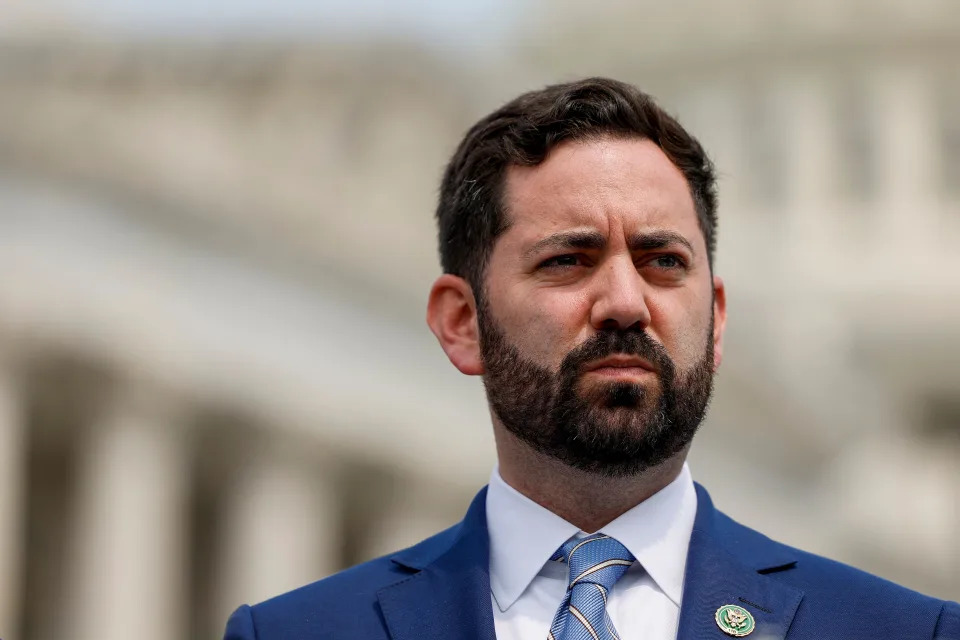
Rep. Mike Lawler, R-N.Y., listens as Rep. Veronica Escobar, D-Texas, and Rep. Maria Salazar, R-Fla., speak during a press conference on immigration outside the U.S. Capitol Building on May 23, 2023 in Washington, DC.
‘It’s a crisis’: Maternal health care disappears for millions
Alice Miranda Ollstein and Megan Messerly – August 1, 2023
Rogelio V. Solis/AP Photo
Access to maternal health care is evaporating in much of the country, as hospitals close and obstetricians become harder to find for millions of pregnant people.
New data from the nonpartisan health advocacy group March of Dimes shows that the U.S. — which already has the worst maternal mortality rate among developed nations — saw a 4 percent decline in hospitals with labor and delivery services between 2019 and 2020.
But the raw figure masks the inequities playing out across the country, according to the report. Alabama and Wyoming lost nearly one-quarter of their birthing hospitals in that time period, while Idaho, Indiana and West Virginia lost roughly 10 percent.
“It’s a crisis,” said Stacey Brayboy, the senior vice president of public policy and government affairs at March of Dimes. “Women are struggling to access care, and that’s before and during and after their pregnancies, and we’ve seen an increase in terms of maternal and infant deaths.”
Access to care is also likely to worsen in the coming years, according to several public health experts, as obstetrics units struggle to stay financially afloat, more people become uninsured and new anti-abortion laws limit the number of physicians willing to practice in several states.
Nationally, about 5.6 million women live in counties with no access to maternity care, according to March of Dimes. Far more, 32 million, are at risk of poor health outcomes because of a lack of care options nearby. March of Dimes considers more than a third of all U.S. counties maternal care deserts, with no access to reproductive health services. States with large rural populations — Alaska, Nebraska, North Dakota, Oklahoma and South Dakota — are especially prone to shortages.
The scarcity of maternal health care is particularly acute in areas with higher instances of underlying health problems that are risk factors for maternal mortality — such as hypertension and diabetes — and where states have not expanded Medicaid, leaving hundreds of thousands uninsured.
The declining access to maternal care is one reason maternal mortality rates in the U.S are so high and rising, Brayboy said.
In 2021, roughly 33 people died for every 100,000 live births in the U.S., according to the CDC, up 40 percent from 2020. That’s roughly 10 times the mortality rate of other industrialized nations such as Spain, Germany, Australia or Japan. The maternal mortality rate for non-Hispanic Black people was 69.9, two-and-a-half times the rate of non-Hispanic whites, according to the CDC.
The report relies on data from 2020 and 2021 — before the Supreme Court overturned Roe v. Wade — and the full impact of state abortion bans on maternal care has yet to be documented. But Tuesday’s report reveals most states that have restricted abortion access since then, or where the procedure remains in limbo pending a court ruling, have seen access to obstetric care decline in recent years.
“Abortion providers, OB-GYNs, nurse practitioners are being pushed out of certain parts of the country that do have these restrictive abortion laws. That’s having a spillover effect for those that want to continue their pregnancies,” said Jamila Taylor, president and CEO of the National WIC Association.
There isn’t, however, a clean red state-blue state divide in the data. A few states with near-total abortion bans saw an improvement in access to birthing hospitals in recent years — including Arkansas, North Dakota and Mississippi — and a few states where abortion remains legal saw access worsen, including California, Maryland, and Washington state.
The situation is particularly dire in Alabama, where the number of hospitals with labor and delivery services decreased by 24 percent between 2019 and 2020, and where many more could soon go out of business. The Alabama Hospital Association warned earlier this year that half of the state’s remaining hospitals are “operating in the red,” and are “likely on a collision course with disaster.”
“Many of them are just teetering on the edge, almost not able to cover payroll,” Farrell Turner, the president of the Alabama Rural Health Association, said in an interview. “There are at least seven more, according to my calculations, that are at very high risk of closing before the year is out.”
One factor fueling the obstetric unit closures across the country is the financial mismatch facing hospitals — maternal care is expensive to provide and reimbursements are low, particularly from Medicaid, which pays for more than 40 percent of births. That’s a particular challenge for rural hospitals, which have a higher proportion of patients on government-run health insurance than their urban counterparts.
March of Dimes found that nearly a third of women in Alabama already have no birthing hospital within a 30-minute drive and for some residents, the nearest hospital is more than 70 minutes away — factors the group said raised the risk for “maternal morbidity and adverse infant outcomes, such as stillbirth and NICU admission.” More than a third of the state is considered a maternal care desert, and more than 18 percent of people giving birth received inadequate prenatal care or none at all.
“People have to drive quite some distance in order to deliver, and to obtain prenatal care leading up to that time,” Turner said. “And many folks either lack transportation or can’t afford the gas to get to the care they need. There are some telehealth options out there, but a lot of people lack access to broadband, so the uptake and implementation has been slow.”
The problem is similar in Wyoming, where five of the state’s 23 counties are maternity care deserts and more than 15 percent of residents have no hospital with labor and delivery services within 30 minutes. The state’s vastness poses particular challenges to accessing care, with people living in counties with the highest travel times spending nearly 90 minutes on average to reach the nearest hospital with obstetric care.
Abortion remains legal in Wyoming because a judge temporarily blocked the state’s new pill ban in June, and the state’s trigger ban remains enjoined. But Dr. Giovannina Anthony, an OB-GYN in Jackson, Wyo., said those laws are already affecting access to maternal health care.
“Abortion bans just create one more deterrent to anyone who might want to practice obstetrics and gynecology in Wyoming,” Anthony said.
Even in North Carolina, which has fewer maternity care deserts than the national average, access to obstetric care is headed in the wrong direction. The number of hospitals with labor and delivery services in the state decreased by 1.9 percent between 2019 and 2020, and the March of Dimes report found that 13.4 percent of people in North Carolina had no birthing hospital within 30 minutes.
“These rural communities where the maternity care deserts are, these individuals tend to be sicker. They can have chronic hypertension. They can have diabetes,” said Karen Sheffield-Abdullah, a certified nurse-midwife who has a doctorate in nursing from the University of North Carolina at Chapel Hill. “These are individuals who are coming in with what we call these comorbidities, and yet there aren’t providers for an hour away? Absolutely maternal morbidity and mortality goes up.”
Sheffield-Abdullah said access to maternity care in the state is likely to worsen because of a new law banning abortion after the first trimester.
“If we look at the most recent ban, getting more restrictive in the types of care that we provide to perinatal individuals is not going to improve our outcomes,” she said. “It only makes it more difficult for minoritized populations to get the care that they need.”
Hospitals are also struggling to recruit and retain OB-GYNs and other maternal health providers. Two Idaho hospitals, for example, shut down their labor and delivery services earlier this year, citing staffing woes exacerbated by the state’s near-total abortion ban, which went into effect last summer.
Dr. Stacy Seyb, a maternal fetal medicine specialist who has practiced for 23 years in Idaho, told POLITICO that two of his colleagues have left the state in the last few months, with several more also considering a move, and applications for medical residencies have plummeted.
“It’s hurting our ability to find doctors for a state that’s already severely underserved,” he said of the state’s abortion ban, which threatens medical providers with felony charges if they perform an abortion or help someone obtain one. “It’s hard to take care of patients while looking over your shoulder. So residents and young doctors are saying: ‘Why would I go there and deal with that?’”
Idaho saw a 12.5 percent decrease in the number of birthing hospitals in the state between 2019 and 2020, and nearly 30 percent of the state is considered a maternal health desert, according to March of Dimes. More than 27 percent of counties have both a high rate of chronic health conditions and high rate of preterm births.
Idaho providers fear the situation will further deteriorate now that abortion is banned in the state, but warn the public might remain in the dark because officials dissolved the state’s maternal mortality review committee in July.
“It’s scary for sure,” said Dr. Kylie Cooper, a former leader of the state’s chapter of the American College of Obstetricians and Gynecologists who left Idaho after the abortion ban went into effect. “Most states have the ability to track data and trends for why people are dying in pregnancy and post-partum, but now I don’t know how that will be tracked at all in Idaho.”
Trump and six unnamed co-conspirators were charged by special counsel Jack Smith for their efforts to overturn the election and block the peaceful transfer of power following his loss to Joe Biden. Those efforts came to a head on Jan. 6, 2021, when Trump’s supporters descended on Washington and laid siege to the U.S. Capitol in an attempt to block the Electoral College certification of the election.
Trump at the “Stop the Steal” rally in Washington, Jan. 6, 2021. (Jacquelyn Martin/AP)
‘Just say that the election was corrupt and leave the rest to me’
On Dec. 27, 2020, Trump called the then-acting Attorney General Jeffery Rosen and the then-acting Deputy Attorney General Richard Donoghue and “raised multiple false claims” about the election, according to the indictment.
“When the Acting Attorney General told the Defendant that the Justice Department could not and would not change the outcome of the election, the Defendant responded, ‘Just say that the election was corrupt and leave the rest to me and the Republican congressmen,’” the indictment states.
‘You’re too honest’
Vice President Mike Pence finishes the work of the Electoral College after a mob loyal to Donald Trump stormed the Capitol in Washington and disrupted the process. (J. Scott Applewhite/AP)
According to the indictment, on Jan. 1, 2021, Trump called Pence to berate him for not going along with a plan to have him reject the certification of the Electoral College vote showing Joe Biden had won the election.
“The Vice President responded that he thought there was no constitutional basis for such authority and that it was improper,” the indictment states. “In response, the Defendant [Trump] told the Vice President, ‘you’re too honest.’”
‘Beamed down from the mothership’
By that time Trump had been told multiple times that his claims of fraud could not be backed up with actual evidence.
“As early as mid-November, for instance, the Senior Campaign Advisor had informed the Defendant that his claims of a large number of dead voters in Georgia were untrue,” the indictment reads.
In an email, that campaign adviser lamented, “you can see why we’re 0-32 on our [court] cases. I’ll obviously help on all fronts, but it’s tough to own any of this when it’s all just conspiracy shit beamed down from the mothership.”
While Trump again portrayed the charges against him as part of a series of “un-American witch hunts,” his former vice president issued a strikingly different assessment.
“Today’s indictment serves as an important reminder: Anyone who puts himself over the Constitution should never be President of the United States,” Pence said in a statement.
The big idea: is it too late to stop extremism taking over politics?
Bizarre conspiracy thinking has infiltrated the mainstream in many western democracies. How can we push back?
Julia Ebner – July 31, 2023
Illustration: Elia Barbieri/The Guardian
Welcome to the 2020s, the beginning of what history books might one day describe as the digital middle ages. Let’s briefly travel back to 2017. I remember sitting in various government buildings briefing politicians and civil servants about QAnon, the emerging internet conspiracy movement whose adherents believe that a cabal of Satan-worshipping elites runs a global paedophile network. We joked about the absurdity of it all but no one took the few thousand anonymous true believers seriously.
Fast-forward to 2023. Significant portions of the population in liberal democracies consider it possible that global elites drink the blood of children in order to stay young. Recent surveys suggest that around 17% of Americans believe in the QAnon myth. Some 5% of Germans believe ideas related to the anti-democratic Reichsbürger movement, which asserts that the German Reich continues to exist and rejects the legitimacy of the modern German state. Up to a third of Britons believe that powerful figures in Hollywood, government and the media are secretly engaged in child trafficking. Is humanity on the return journey from enlightenment to the dark ages?
I am often asked why the UK doesn’t have a successful far-right populist party. My answer is: Because it doesn’t need to
As segments of the public have headed towards extremes, so has our politics. In the US, dozens of congressional candidates, including the successfully elected Lauren Boebert, have been supportive of QAnon. The German far-right populist party Alternative für Deutschland is at an all-time high in terms of both its radicalism and its popularity, while Austria’s xenophobic Freedom party is topping the polls. The recent rise to power of far-right parties such as Fratelli d’Italia and the populist Sweden Democrats bolster this trend.
I am often asked why the UK doesn’t have a successful far-right populist party. My answer is: because it doesn’t need to. Parts of the Conservative party now cater to audiences that would have voted for the BNP or Ukip in the past. A few years ago, the far-right Britain First claimed that 5,000 of its members had joined the Tory party. Not unlike the Republicans in the US, the Tories have increasingly departed from moderate conservative thinking and lean more and more towards radicalism.
In 2020, Conservative MP Daniel Kawczynski was asked to apologise for attending the National Conservatism conference in Rome. The event is well known for attracting international far-right figures such as Italy’s Giorgia Meloni, Hungary’s Viktor Orbán, former Fox News host Tucker Carlson and the hard-right US presidential candidate Ron DeSantis. This year, an entire delegation of leading Conservatives attended the same conference in London. It might be hard for extreme-right parties to rise to power in Britain, but there is no shortage of routes for extremist ideas to reach Westminster.
‘Invasion on our southern coast’ … UK home secretary Suella Braverman. Photograph: AP
Language is a key indicator of radicalisation. The words of Conservative politicians speak for themselves: home secretary Suella Braverman referred to migrants arriving in the UK as an “invasion on our southern coast”, while MP Miriam Cates gave a nod to conspiracy theorists when she warned that “children’s souls” were being “destroyed” by cultural Marxism. Using far-right dog whistles such as “invasion” and “cultural Marxism” invites listeners to open a Pandora’s box of conspiracy myths. Research shows that believing in one makes you more susceptible to others.
I sometimes wonder what a QAnon briefing to policymakers might look like in a few years. What if the room no longer laughs at the ludicrous myths but instead endorses them? One could certainly imagine this scenario in the US if Donald Trump were to win the next election. In 2019 – before conspiracy myths inspired attacks on the US Capitol, the German Reichstag, the New Zealand parliament and the Brazilian Congress – I warned in a Guardian opinion piece of the threat QAnon would soon pose to democracy. Are we now at a point where it is it too late to stop democracies being taken over by far-right ideologies and conspiracy thinking? If so, do we simply have to accept the “new normal”?
There are various ways we can try to prevent and reverse the spread of extremist narratives. For some people who have turned to extremism over the past few years, too little has changed: anger over political inaction on economic inequality is now further fuelled by the exacerbating cost of living crisis. For others, too much has changed: they see themselves as rebels against a takeover by “woke” or “globalist” policies.
What they have in common is a sense that the political class no longer takes their wellbeing seriously, and moves to improve social conditions and reduce inequality would go some way towards reducing such grievances. But beyond that, their fears and frustrations have clearly been instrumentalized by extremists, as well as by opportunistic politicians and profit-oriented social media firms. This means that it is essential to expose extremist manipulation tactics, call out politicians when they normalize conspiracy thinking and regulate algorithm design by the big technology companies that still amplify harmful content.
If the private sector is part of the problem, it can also be part of the solution. Surveys by the Edelman Trust Barometer found that people in liberal democracies have largely lost trust in governments, media and even NGOs but, surprisingly, still trust their employers and workplaces. Companies can play an important role in the fight for democratic values. For example, the Business Council for Democracy tests and develops training courses that firms can offer to employees to help them identify and counter conspiracy myths and targeted disinformation.
Young people should be helped to become good digital citizens with rights and responsibilities online, so that they can develop into critical consumers of information. National school curricula should include a new subject at the intersection of psychology and internet studies to help digital natives understand the forces that their parents have struggled to grasp: the psychological processes that drive digital group dynamics, online engagement and the rise of conspiracy thinking.
Ultimately, the next generation will vote conspiracy theorists in or out of power. Only they can reverse our journey towards the digital middle ages.
Fulton County DA says work is done in Trump probe and ‘we’re ready to go’
Sara Murray, CNN – July 30, 2023
Charlie Neibergall/AP
Fulton County District Attorney Fani Willis reaffirmed in a local news interview that she will announce charging decisions by September 1 in her investigation into efforts by Donald Trump and his allies to overturn Georgia’s 2020 presidential election result, while applauding the ramped-up security measures around the local courthouse.
“The work is accomplished,” Willis told CNN affiliate WXIA at a back-to-school event over the weekend. “We’ve been working for two and half years. We’re ready to go.”
Willis has previously signaled in letters to local officials and those providing security that she would make any charging announcements between July 31 and the end of August. She laid out a variety of security provisions her team plans to take beginning Monday.
Willis’ latest commitment to that time frame comes after a judge scheduled an August 10 hearing on the Trump team’s efforts to disqualify Willis, a Democrat, from the case, toss much of the evidence she has collected and remove another judge in Fulton County from presiding over the case.
In the local news interview, Willis also praised the Fulton County sheriff after barricades recently went up around the county courthouse in anticipation of what the sheriff’s office referred to as “high profile legal proceedings.”
“I think that the sheriff is doing something smart in making sure that the courthouse stays safe,” Willis said. “I’m not willing to put any of the employees or the constituents that come to the courthouse in harm’s way.”
Willis said that people may not be happy with her upcoming announcements and “sometimes when people are unhappy, they act in a way that could create harm.”
Why Republicans can’t get out of their climate bind, even as extreme heat overwhelms the US
Analysis by Ella Nilsen, CNN – July 30, 2023
Deadly heatwaves are baking the US. Scientists just reported that July will be the hottest month on record. And now, after years of skepticism and denial in the GOP ranks, a small number of Republicans are urging their party to get proactive on the climate crisis.
But the GOP is stuck in a climate bind – and likely will be for the next four years, in large part because they’re still living in the shadow of former president and 2024 Republican frontrunner Donald Trump.
Even as more Republican politicians are joining the consensus that climate change is real and caused by humans, Trump’s inflammatory rhetoric has driven the party to the right on climate and extreme weather. Trump has called the extremely settled science of climate change a “hoax” and more recently suggested that the impacts of it “may affect us in 300 years.”
Scientists this week reported that this summer’s unrelenting heat wave would have been “virtually impossible” were it not for the planet-warming pollution from burning fossil fuels. They also confirmed that July will go down as the hottest month on record – and almost certainly that the planet’s temperature is hotter now than it has been in around 120,000 years.
Yet for being one of the most pressing issues of the 21st century, climate is rarely mentioned on the 2024 campaign trail.
“As Donald Trump is the near presumptive nominee of our party in 2024, it’s going to be very hard for a party to adopt a climate-sensitive policy,” Sen. Mitt Romney, a Republican from Utah, told CNN. “But Donald Trump’s not going to be around forever.”
When Republicans do weigh in on climate change – and what we should do about it – they tend to support the idea of capturing planet-warming pollution rather than cutting fossil fuels. But many are reticent to talk about how to solve the problem, and worry Trump is having a chilling effect on policies to combat climate within the party.
“We need to be talking about this,” Rep. John Curtis, a Republican from Utah and chair of the House’s Conservative Climate Caucus, told CNN. “And part of it for Republicans is when you don’t talk about it, you have no ideas at the table; all you’re doing is saying what you don’t like. We need to be saying what we like.”
Extreme weather changes GOP minds
With a few exceptions, Republicans largely are no longer the party of full-on climate change denial. But even as temperatures rise to deadly highs, the GOP is also not actively addressing it. There is still no “robust discussion about how to solve it” within the party, said former South Carolina Rep. Bob Inglis, who now runs the conservative climate group RepublicEn, save for criticism of Democrats’ clean-energy initiatives.
“The good news is Republicans are stopping arguing with thermometers,” Inglis told CNN. Still, he said, “when the experience is multiplied over and over of multiple days of three-digit temperatures in Arizona and record ocean temperatures, people start to say, ‘this is sort of goofy we’re not doing something about this.’”
Meanwhile, the impacts of a dramatically warming atmosphere are becoming more and more apparent each year. Romney and Curtis, two of the loudest climate voices in the party, both represent Utah – a state that’s no stranger to extreme heat and drought, which scientists say is being fueled by rising global temperatures.
“There are a number of states, like mine, that are concerned about wildfires and water,” Romney said, adding he believes Republican governors of impacted states have been vocal about these issues.
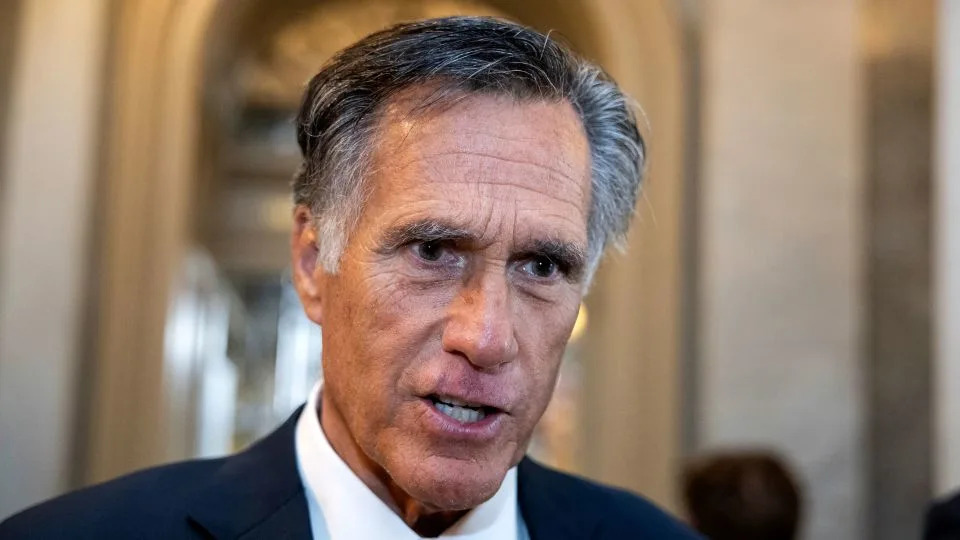
Sen. Mitt Romney is one of a handful of Republicans who wants the party to get proactive on climate solutions. – Francis Chung/POLITICO/AP
Utah and other Western states are looking for ways to cut water use to save the West’s shrinking two largest reservoirs, Lakes Powell and Mead. And even closer to home, Utah’s Great Salt Lake has already disappeared by two-thirds, and scientists are sounding alarms about a rapid continued decline that could kill delicate ecosystems and expose one of fastest-growing metropolitan areas in the nation to toxic dust.
“I think the evidence so far is that the West is getting drier and hotter,” Romney told CNN. “That means that we’re going to have more difficulty with our crops, we’re going to have a harder time keeping the rivers full of water. The Great Salt Lake is probably going to continue to shrink. And unfortunately, we’re going to see more catastrophic fires. If the trends continue, we need to act.”
An issue ‘held hostage’
While Republicans blast Democrats’ clean energy policies ahead of the 2024 elections, it’s less clear what the GOP itself would prefer to do about the climate crisis.
As Curtis tells it, there’s a lot that Republicans and Democrats in Congress agree on. They both want to further reform the permitting process for major energy projects, and they largely agree on the need for more renewable and nuclear energy.
As the head of the largest GOP climate caucus on the Hill, Curtis’ Utah home is “full solar,” he told CNN, and is heated using geothermal energy.
While at a recent event at a natural gas drilling site in Ohio, as smoke from Canada’s devastating wildfire season hung thick in the air, House Speaker Kevin McCarthy was asked how he would solve the climate crisis. He suggested planting a trillion trees to help offset the pollution created by burning fossil fuels – a bill House Republicans introduced in 2020. The measure has not yet passed the House and has an uncertain future in the Senate.
Rep. John Curtis, a Utah Republican, said his home is decked out in solar panels and geothermal energy. – Eva Marie Uzcategui/Bloomberg/Getty Images
But the biggest and most enduring difference between the two parties is that Republicans want fossil fuels – which are fueling climate change with their heat-trapping pollution – to be in the energy mix for years to come.
Democrats, meanwhile, have passed legislation to dramatically speed up the clean energy transition and prioritize the development of wind, solar and electrical transmission to get renewables sending electricity into homes faster.
On Wednesday, Senate Majority Leader Chuck Schumer of New York said Democrats want to pass more climate legislation if they take back a full majority in Congress. He later told CNN the GOP is “way behind” on climate and there’s been “too little” progress on the party’s stances.
“I think we’d get a lot more done with a Democratic House, a Democratic president and continuing to have a Democratic Senate,” Schumer told CNN. “Unfortunately, if you look at some of the Republican House and Senate Super PACs, huge amounts of money come from gas, oil and coal.”
Even though Curtis and Romney are aligned on the party needing to talk about climate change, they differ on how to fix it. While Curtis primarily supports carbon capture and increased research and development into new technologies, Romney is one of the few Republicans speaking in favor of a carbon tax – taxing companies for their pollution.
“It’s very unlikely that a price on carbon would be acceptable in the House of Representatives,” Romney said. “I think you might find a few Republican senators that would be supportive, but that’s not enough.”
The idea certainly doesn’t have the support of Trump, or other 2024 candidates for president, and experts predict climate policy will get little to no airtime during the upcoming presidential race.
“Regrettably, the issue of climate change is currently being held hostage to the culture wars in America,” Edward Maibach, a professor of climate communication at George Mason University and a co-founder of a nationwide climate polling project conducted with Yale University, told CNN in an email. “Donald Trump’s climate denial stance will have a chilling effect on the climate positions of his rivals on the right — even those who know better.”
Even if climate-conscious Republicans say Trump won’t be in the party forever, Inglis said even a few more years may not be enough time to counteract the rapid changes already happening.
“That’s still a long way away,” Inglis said. “The scientists are saying we can’t wait, get moving, get moving.”
US intelligence report says China likely supplying tech for Russian military
Kanishka Singh and Michael Martina – July 27,2023
The flags of the United States and China fly in Boston
WASHINGTON (Reuters) – China is helping Russia evade Western sanctions and likely providing Moscow with military and dual-use technology for use in Ukraine, according to an unclassified U.S. intelligence report released on Thursday.
The assessment by the Office of the Director of National Intelligence (ODNI) was published by the U.S. House of Representatives Permanent Select Committee on Intelligence.
China has repeatedly denied sending military equipment to Russia since Moscow’s all-out invasion of Ukraine in February 2022.
“The PRC is providing some dual-use technology that Moscow’s military uses to continue the war in Ukraine, despite an international cordon of sanctions and export controls,” the ODNI report said.
“The customs records show PRC state-owned defense companies shipping navigation equipment, jamming technology, and fighter jet parts to sanctioned Russian Government-owned defense companies,” the report said.
It also said China has become “an even more critical partner” of Russia after Moscow invaded Ukraine last year.
ODNI said China and Russia had increased the share of bilateral trade settled in China’s yuan currency, and both countries’ financial institutions are expanding their use of domestic payment systems.
China has increased it importation of Russia energy exports, including oil and gas rerouted from Europe, the report said.
ODNI cited much of the information to media reports. It added: “The Intelligence Community lacks sufficient reporting to assess whether Beijing is deliberately inhibiting United States Government export control end-use checks, including interviews and investigations, in the PRC.”
Earlier this month, French President Emmanuel Macron’s top diplomatic adviser Emmanuel Bonne said China was delivering items that could be used as military equipment to Russia, although not on a massive scale.
U.S. officials have previously raised concern about transfers of “dual-use equipment” from China to Russia. However, they have repeatedly said they have yet to see evidence of the transfer of lethal assistance for Russia’s use on the battlefield.
(Reporting by Kanishka Singh and Michael Martina in Washington; Editing by Caitlin Webber and Daniel Wallis)
China defends trade with Russia after the US says equipment used in Ukraine might have been exported
July 28, 2023
FILE – Chinese Foreign Ministry spokesperson Mao Ning gestures during a press conference at the Ministry of Foreign Affairs in Beijing, on July 26, 2023. The Chinese government defended its dealings with Russia as “normal economic and trade cooperation” Friday, July 28, after a United States intelligence report said Beijing possibly provided equipment used in Ukraine that might have military applications. (AP Photo/Ng Han Guan, File) (ASSOCIATED PRESS)More
BEIJING (AP) — The Chinese government defended its dealings with Russia as “normal economic and trade cooperation” Friday after a United States intelligence report said Beijing possibly provided equipment used in Ukraine that might have military applications.
The Biden administration has warned Chinese leader Xi Jinping’s government of unspecified consequences if it supports the Kremlin’s war effort. The latest report cited Russian customs data that showed Chinese state-owned military contractors supplied navigation equipment, fighter jet parts, drones and other goods, but didn’t say whether that might trigger U.S. retaliation.
“China has been carrying out normal economic and trade cooperation with countries around the world, including Russia,” said Foreign Ministry spokesperson Mao Ning. She said Chinese-Russian cooperation “neither targets a third party nor is it subject to interference and coercion by a third party.”
Xi and Russian President Vladimir Putin declared before the February 2022 invasion that their governments had a “no-limits” friendship. Beijing says it is neutral in the war, but it has blocked efforts to censure Moscow in the United Nations and has repeated Russian justifications for the attack.
China is an “increasingly important buttress” for Russia, “probably supplying Moscow with key technology and dual-use equipment used in Ukraine,” said the report by the Office of the Director of National Intelligence, referring to equipment that can have both civilian and military applications.
China has stepped up purchases of Russian oil and gas, which helps Putin’s government offset lost sales after the United States, Europe and Japan cut off most purchases of Russian energy. Beijing can do that without triggering Western sanctions on its own companies, but Washington and its allies are frustrated that it undercuts economic pressure on Moscow.
China rejects Western trade and financial sanctions on Russia because they weren’t authorized by the U.N. Security Council, where Beijing and Moscow have veto power. However, China has appeared to avoid directly defying those sanctions.
“We have also consistently opposed unilateral sanctions and long-arm jurisdiction that have no basis in international law and have not been authorized by the Security Council,” said Mao.