
First-ever ocean plastic cleaner will tackle Great Pacific Garbage Patch

New York Post

First-ever ocean plastic cleaner will tackle Great Pacific Garbage Patch

By Saqib Shah, Orig. Pub. by The Sun        April 23, 2018

Modal Trigger. The Ocean Cleanup.

The first-ever machine to clean up the planet’s largest chunk of ocean plastic is due to set sail.

It’s heading to the Great Pacific Garbage Patch, halfway between California and Hawaii, where it will commence collecting the 1.8 trillion pieces of plastic rubbish amassed there by ocean currents.

The system uses a combination of huge floating nets (dubbed “screens”) held in place by giant tubes, ironically made out of plastic, to suck stubborn waste out of the water.

It will then transfer this debris to large ships that will take it to shore for recycling.

The beginnings of this intricate system will launch from San Francisco Bay within weeks and will start working by July, with plans to keep extending it thereafter.

Modal Trigger. The Ocean Cleanup.

Ultimately, Ocean Cleanup (the Dutch non-profit behind the project) aims to install 60 giant floating scoops, each stretching a mile from end to end.

Fish will be able to escape the screens by passing underneath them, while boats will visit to collect the waste every six to eight weeks.

The ambitious system is the brainchild of Dutch teen prodigy Boyan Slat, who presented his ocean cleaning machine at a Tedx talk six years ago.

Despite skepticism from some scientists, Slat dropped out of unit to pursue the venture, raising $2.2 million from a crowd-funding campaign, with millions more brought in by other investors.

Modal Trigger. The Ocean Cleanup.

Slat commented: “The cleanup of the world’s oceans is just around the corner.”

“Due to our attitude of ‘testing to learn’ until the technology is proven, I am confident that – with our expert partners – we will succeed in our mission.”

The Garbage Patch (GPGP) spans 617,763 sq miles – which is bigger than France, Germany and Spain combined and contains at least 79,000 tons of plastic, according to recent research.

The majority of it is made up of “ghost gear”: parts of abandoned and lost fishing gear, including nets and ropes, often from illegal fishing boats.

Ghost gear kills more than 100,000 whales, dolphins and seals each year, with many of the sea creatures drowned, strangled or mutilated by the plastic, claim scientists.

The GPGP isn’t the only floating mass of junk in our oceans.

It’s technically known as the eastern Pacific Garbage Patch because there is another collection of waste in the western Pacific.

Similar accumulations can also be found in the oceans’ four other circular currents, or gyres, with one patch each in the South Pacific and Indian Ocean and two in the Atlantic.

Fox News host calls on Trump to fire Scott Pruitt

ThinkProgress

Fox News host calls on Trump to fire Scott Pruitt

But President Trump still has full confidence in Pruitt.

Natasha Geiling       April 23, 2018

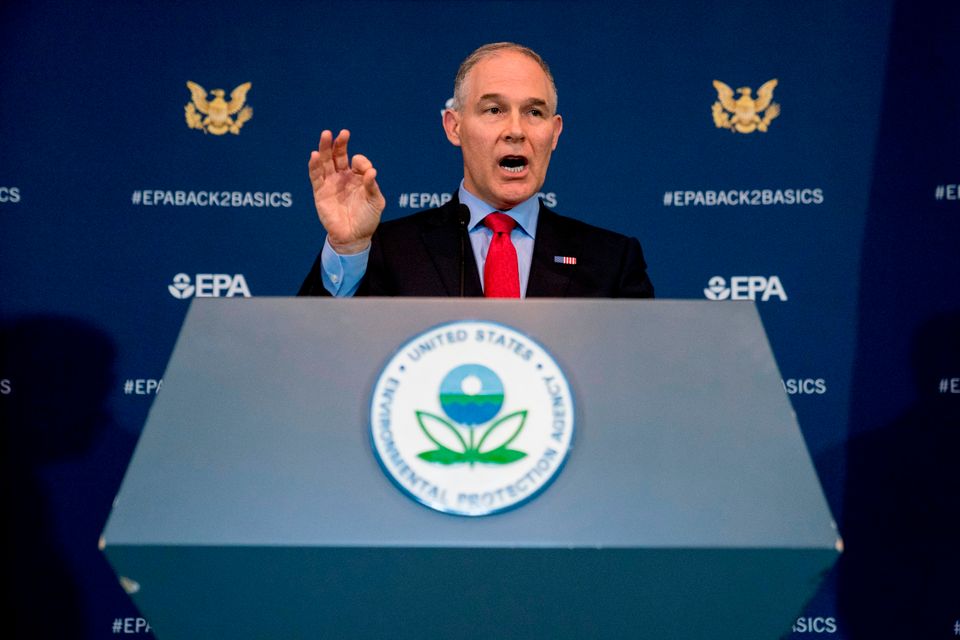
Environmental Protection Agency Administrator Scott Pruitt speaks to the press at a news conference at the EPA on April 2, 2018 in Washington, D.C. Credit: Jason Andrew/Getty Images

Environmental Protection Agency (EPA) Administrator Scott Pruitt is facing more friendly fire after this weekend, as a fourth Republican representative along with a Fox News host called on Pruitt to resign following a barrage of scandals.

On Sunday, in response to a question on Twitter, Rep. Frank LoBiondo (R-NJ) said that Pruitt “should resign” and that he was the “wrong fit from the start for [sic] agency dedicated to protecting our environment.”

Frank LoBiondo: Yes EPA Administrator Scott Pruitt should resign. Wrong fit from start for agency dedicated to protecting our environment. #EarthDay2018 reinforces our need to promote pristine planet via clean air & water, leaving it better for future generations. Requires leadership & balance. https://twitter.com/buckeye1960osu1/status/987829657096654853

LoBiondo is the fifth Republican lawmaker, and fourth Republican representative, to call for Pruitt to resign. In the House, Reps. Carlos Curbelo (R-FL), Ileana Ros-Lehtinen (R-FL) and Elise Stefanik (R-NY) have all called for Pruitt to step down. In the Senate, Sen. Susan Collins (R-ME) remains the only Republican to call for Pruitt’s resignation, though a number have expressed concern with Pruitt’s apparent various ethical lapses.

Last week, 170 lawmakers — all Democrats — from both the House and the Senate introduced a resolution calling for Pruitt to resign.

170 lawmakers sign resolution calling for Scott Pruitt’s resignation, including zero Republicans

But Pruitt is also facing fire from outside of the halls of Congress. On Sunday, former adviser to British Prime Minister David Cameron and L.A.-based Fox News host Steve Hilton called for Trump to fire Pruitt, arguing that the EPA administrator has become a walking example of the kind of “swampy” mentality that Trump promised to end.

“What we need is for President Trump to take the lead, fire Scott Pruitt, and throw out the lobbyists from his administration,” Hilton said.

Hilton’s call for Pruitt’s resignation isn’t the first time that Fox News has taken an antagonistic position towards the administrator’s growing canon of scandals.

In early April, Fox News reporter Ed Henry pressed Pruitt on whether he approved raises for two political aides despite the White House not approving those pay increases. Pruitt denied he had knowledge of the raises, but later reporting revealed that Pruitt was privy to the details.

The growing chorus calling for Pruitt’s resignation comes as new information broke late last week about Pruitt’s dealings with a lobbyist couple from whom he rented a room in Washington.

In early April, ABC News reported that for a six month period during his first year as administrator, Pruitt rented a luxury condo on Capitol Hill from the wife of Steven Hart, a prominent D.C. energy lobbyist. Pruitt paid just $50 a night for the condo, and his daughter stayed there for a period of time during the summer while she was interning in D.C. — leading ethics experts to question whether the agreement constituted a gift from the lobbyist family.

Everything we know about Scott Pruitt’s infamous Capitol Hill apartment

Pruitt and Hart maintained that neither engaged in any business between the EPA and any of Hart’s clients while Pruitt was staying in the condo. On Sunday, however, the Guardian reported that Pruitt and Hart did indeed meet at the EPA in July of 2017 (while Pruitt was staying in Hart’s wife’s condo) to discuss efforts to preserve the Chesapeake Bay.

Also on Sunday, White House legislative director Marc Short told NBC’s Chuck Todd that President Trump still has full confidence in Pruitt.

“Scott Pruitt is doing a phenomenal job and the president is happy with him,” Short said on “Meet the Press.”

On Friday, Hart announced that he would be stepping down from his role of chairman at Williams & Jensen, a D.C.-based lobbying firm that represents companies like Exxon and Enbridge.

Pruitt promised polluters EPA will value their profits over American lives

The Guardian

Pruitt promised polluters EPA will value their profits over American lives

Dana Nuccitelli, The Guardian            April 23, 2018 

Pruitt is one of TIME’s 100 most influential people for his efforts to maximize polluters’ profits 

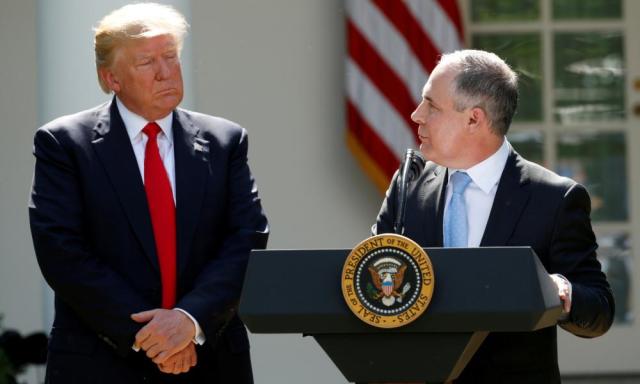
President Trump listens to EPA Administrator Pruitt after announcing decision to withdraw from Paris Climate Agreement in the White House Rose Garden in Washington. Photograph: Kevin Lamarque/Reuters
TIME magazine announced last week that Trump’s EPA administrator Scott Pruitt is among their 100 most influential people of 2018. George W. Bush’s former EPA administrator Christine Todd Whitman delivered the scathing explanation:

If his actions continue in the same direction, during Pruitt’s term at the EPA the environment will be threatened instead of protected, and human health endangered instead of preserved, all with no long-term benefit to the economy.

As a perfect example of those actions, the Daily Caller recently reported that at a gathering at the fossil fuel-funded Heritage Institute, Pruitt announced that the EPA and federal government will soon end two important science-based practices in evaluating the costs and benefits of regulations.

Regulating pollutants has “co-benefits,” like saving lives

When the EPA regulates pollutants, the practice often yields what are called “co-benefits.” For example, limiting allowable mercury pollution can force dirty coal power plants to install pollution-control equipment or shut down. Since coal plants produce other pollutants like soot, the regulations not only reduce mercury levels, but also particulate matter in the air. The latter isn’t an intended consequence of the regulations, but creating cleaner air and healthier Americans are unintended “co-benefits” of limiting another pollutant.

In doing cost-benefit analyses, the EPA accounts for all direct benefits and indirect co-benefits of its regulations. Certain industry groups and conservative pundits don’t like that approach, because they care more about polluter profits than they do about clean air and healthy Americans. However, during the George W. Bush administration in 2003, the Office of Management and Budget issued a guidance saying that it’s important to consider co-benefits:

Your analysis should look beyond the direct benefits and direct costs of your rulemaking and consider any important ancillary benefits and countervailing risks. An ancillary benefit is a favorable impact of the rule that is typically unrelated or secondary to the statutory purpose of the rulemaking (e.g., reduced refinery emissions due to more stringent fuel economy standards for light trucks)

Pruitt wants to disregard this Bush-era guidance and instead consider only the costs and benefits of regulating the “targeted pollutant” (mercury, in our example). They want to ignore the lives saved by also incidentally reducing particulate matter pollution. To be blunt, this makes no sense, unless your goal is to protect polluters at the expense of public and environmental health.

As a backup argument, industry groups argue that the EPA overestimates these co-benefits because particulate matter (specifically, PM2.5) isn’t harmful to human health below a certain threshold value. Not coincidentally, Pruitt’s EPA hired a scientist who has argued that American air is “a little too clean for optimum health.” However, EPA looked at the associated science and issued a memo in 2012 concluding:

Studies demonstrate an association between premature mortality and fine particle pollution at the lowest levels measured in the relevant studies, levels that are significantly below the [National Ambient Air Quality Standards] for fine particles. These studies have not observed a level at which premature mortality effects do not occur. The best scientific evidence, confirmed by independent, Congressionally-mandated expert panels, is that there is no threshold level of fine particle pollution below which health risk reductions are not achieved by reduced exposure.

The bottom line is that when considering all effects, the benefits of EPA pollutant regulations often far outweigh their costs. However, the American public sees the benefits in the form of cleaner air and water, better health, and avoided premature deaths, while industries bear the costs of complying with the regulations by reducing their pollution. Hence industry groups and their allies in the Pruitt EPA are trying to cook the books to favor profits over public health. It’s worth reflecting on the disparity between the president’s claims that EPA’s goal is to achieve “record clean Air & Water” and its apparent actual goal of maximizing polluter industry profits.

Climate costs get a similar treatment

At the Heartland Institute gathering, Pruitt also promised that the Trump administration will stop using the ‘social cost of carbon’ – an estimate of how much carbon pollution costs society via added climate damages – in crafting regulations. The Obama administration first started using the social cost of carbon in cost-benefit analyses of various government regulations. For example, when the Department of Energy considers stricter energy efficiency standards for appliances, it will account for the benefits of slowing climate change by reducing electricity consumption. Industry groups challenged that policy in court, but the Obama administration won.

Under Trump and Pruitt, the EPA has started engaging in bogus accounting to deflate the estimated social cost of carbon, and now Pruitt has promised they’ll stop using it altogether. It’s simply another way for the EPA to put industry profits above public health benefits.

Environmental groups are ready to take Pruitt to court

Pruitt hasn’t yet made good on these promises to the polluting industries, but if he does, environmental groups are confident they can beat him in court. David Doniger, senior strategic director of the National Resource Defense Council’s climate & clean energy program told me:

If Pruitt finalizes the Clean Power Plan repeal or any other rule by revising consideration of co-benefits in this way, or dropping them entirely, you can be 100% sure that we and others will sue, probably in D.C. Circuit challenges to his actions. We are confident the courts will hold this reversal of practice arbitrary and capricious. The only sound way to assess the benefits of a rule, and to weigh them against costs when that is allowed, is to assess all the benefits that can be reasonably expected to come from the action. 

It’s worth remembering that “The mission of EPA is to protect human health and the environment.” The mission of the Pruitt EPA seems to be maximizing polluting industry profits at the expense of human health and the environment.

It’s also important not to let Pruitt’s rank corruption and scandals distract from the damage he’s doing to EPA’s mission. As Christine Todd Whitman noted, the whole world is worse for Trump having nominated and the Senate GOP having confirmed Scott Pruitt to lead the EPA into a new era of maximizing industry profits and pollution at the expense of public and environmental health.

EPA chief signs proposal limiting science used in decisions

The Seattle Times

EPA chief signs proposal limiting science used in decisions

By Michael Biesecker and Seth Borenstein, Associated Press

Originally published April 24, 2018

In this April 3, 2018, file photo, Environmental Protection Agency Administrator Scott Pruitt speaks at a news conference at the EPA in Washington. New internal documents say a sweep for hidden listening devices in Pruitt’s office was shoddy and wasn’t properly certified under U.S. government practices (AP Photo/Andrew Harnik,

WASHINGTON (AP) — Environmental Protection Agency Administrator Scott Pruitt has signed a proposed rule that would restrict the types of scientific studies regulators can use to determine the impact of pesticide and pollution exposure on human health.

Pruitt says the change would increase transparency in the agency’s decision-making by requiring all underlying data used in scientific studies to be made publicly available.

Critics, including former EPA administrators and scientists, say Pruitt’s move is designed to restrict the agency from citing peer-reviewed public-health studies that use patient medical records required to be kept confidential under patient privacy laws.

The embattled EPA administrator signed the proposed order at EPA headquarters Tuesday in an event that was livestreamed on the agency’s website but not open to press coverage.

Earth Day 2018 – Many Thanks to All The Earth Protectors.

John Hanno     April 22, 2018

Earth Day 2018 – Many Thanks to All The Earth Protectors.

                                                                                        Credit: Saving water – clean natural environment – ocean campaign concept with collaborative woman’s hands in droplet shape on blurred wavy clean water background: Love earth, save water – conceptual idea picture.

All the remarkable progress Earth Protectors have made over the last 4 decades is under siege, from this toxic fossil fuel administration, from the do nothing Republi-con fossil fuel enablers in congress and from Republi-con controlled legislatures and governor offices around the country. But these energy Luddites are waging a losing battle.

Earth, water and air protectors will not be deterred. We’ve come too far. Concerned and energized environmental – journalists, activists, entrepreneurs, educators, Native Americans, liberators and patriots will not allow environmental backsliding.

Forward thinking business executives understand the threats from climate change and global warming. They’re directing their investments and expertise toward alternative and sustainable energy research and development. Green investors and smart capitalists are divesting from toxic and stranded fossil fuel losers and embracing the new sustainable industries. Real conservatives realize the benefits of cleaner and cheaper alternative energy. Every day brings notable and momentous successes in these new industries.

But over-leveraged fossil fuel interests and their funders will not go quietly into the scrap heap of history. They’re not afraid to suborn politicians willing to bow down and disregard the best interests of the American people.

                                                                                            Family Holding Earth in their hands -Earth Day. NASA Image

Earth day, celebrated at the beginning of spring, is the perfect opportunity to refocus our environmental bona fides. This Earth Day emphasizes the monumental battle against plastic pollution, highlighted here and at dozens of upstanding environmental organizations.

Stay vigilant and resist protectors.      John Hanno, tarbabys.com

What Produce Should You Be Buying Organic?

EcoWatch – Food

What Produce Should You Be Buying Organic?

By Environmental Working Group    April 10, 2018

All adults and children should eat more fruits and vegetables, whether they are organic or conventionally grown. With EWG’s 2018 Shopper’s Guide to Pesticides in Produce™, you can choose healthy produce while minimizing unwanted doses of multiple toxic pesticides.

Many shoppers don’t realize that pesticide residues are common on conventionally grown produce, even after it is carefully washed or peeled. EWG’s analysis of the most recent tests by the Department of Agriculture found that nearly 70 percent of samples of conventionally grown produce were contaminated with pesticide residues.

The USDA tests found a total of 230 different pesticides and pesticide breakdown products on the thousands of produce samples analyzed. EWG’s analysis of the tests shows that there are stark differences among various types of produce. The Shopper’s Guide lists the Dirty Dozen™ fruits and vegetables with the most pesticide residues, and the Clean Fifteen™, for which few, if any, residues were detected.

Key findings from this year’s guide:

More than one-third of strawberry samples analyzed in 2016 contained 10 or more pesticide residues and breakdown products.

More than 98 percent of samples of strawberries, peaches, potatoes, nectarines, cherries and apples tested positive for residue of at least one pesticide.

Spinach samples had, on average, almost twice as much pesticide residue by weight compared to any other crop.

Avocados and sweet corn were the cleanest. Less than 1 percent of samples showed any detectable pesticides.

More than 80 percent of pineapples, papayas, asparagus, onions and cabbages had no pesticide residues.

No single fruit sample from the Clean Fifteen tested positive for more than four pesticides.

“It is vitally important that everyone eats plenty of produce, but it is also wise to avoid dietary exposure to toxic pesticides, from conception through childhood,” said Sonya Lunder, senior analyst with EWG. “With EWG’s guide, consumers can fill their fridges and fruit bowls with plenty of healthy conventional and organic produce that isn’t contaminated with multiple pesticide residues.”

Twenty-five years after the National Academy of Sciences issued a landmark report raising concerns about children’s exposure to toxic pesticides through their diets, Americans still consume a mixture of pesticides every day. While vegetables and fruits are essential components of a healthy diet, research suggests that pesticides in produce may pose subtle health risks.

New Science Links High-Pesticide Produce to Poorer Fertility

Two recent studies from the Harvard T.H. Chan School of Public Health found a surprising association between consuming high-pesticide-residue produce and fertility problems among study participants.

Women who reported eating two or more servings per day of produce with higher pesticide residues were 26 percent less likely to have a successful pregnancy during the study than participants who ate fewer servings of these foods. Male participants who ate high-residue produce had poorer sperm quality. Both studies enrolled couples seeking treatment at a fertility clinic, and found that the frequency of eating low-residue fruits and vegetables was not associated with fertility problems.

The findings from the studies raise important questions about the safety of pesticide mixtures found on produce, and suggest that people should focus on eating the fruits and vegetables with the fewest pesticide residues. Importantly, the studies’ definitions of higher- and lower-pesticide foods mirror those used for EWG’s Dirty Dozen and Clean Fifteen lists.

Pesticide That Causes Brain Damage in Kids Detected on Some Produce

The neurotoxic insecticide chlorpyrifos, which can harm children’s brains and nervous systems, is applied to apples, bell peppers, peaches, nectarines and other produce.

The U.S. Environmental Protection Agency was slated to ban all uses of chlorpyrifos on foods in early 2017. But EPA Administrator Scott Pruitt reversed course after Dow Chemical, which manufactures the chemical, complained. The American Academy of Pediatrics and EWG urged Pruitt to reconsider his decision, to no avail.

The Academy, which represents 66,000 of the nation’s pediatricians, recommends that parents consult EWG’s Shopper’s Guide to help reduce their children’s ingestion of pesticides.

“There is a reason pediatricians encourage parents to consult EWG’s guide and take other steps to reduce their child’s exposure pesticides,” said Dr. Philip Landrigan of the Icahn School of Medicine at Mount Sinai in New York. “Pesticides can cause harm to infants, babies and young children at even low levels like those found on some foods.”

Landrigan, dean of global health and director of the Children’s Environmental Health Center at Mt. Sinai, was the principal author of the National Academy of Sciences study, Pesticides in the Diets of Infants and Children. The study led to enactment of the 1996 Food Quality Protection Act, which set safety standards for pesticides on foods.

RELATED ARTICLES AROUND THE WEB

The best of EcoWatch, right in your inbox! – EcoWatch

One Mom’s Campaign to Save the Swimmers

Dr. Hyman: ‘Your Fork Is the Most Powerful Tool to Transform Your

Strawberries Top EWG’s Pesticide-Laden ‘Dirty Dozen’ List for Third

EWG | Environmental Working Group

5 Environmental Victories to Inspire You This Earth Day

EcoWatch

5 Environmental Victories to Inspire You This Earth Day

Olivia Rosane       April 20, 2018

Planet Earth is at a crisis point. Researchers say we have to begin reducing carbon dioxide emissions by 2020 if we want to meet the temperature goals outlined in the Paris agreement and avoid catastrophic climate change.

The work to be done can seem overwhelming. A survey published this week found that only 6 percent of Americans think we will succeed in reducing global warming.

But Earth Day weekend is no time to give up! History has shown that when human beings come together to face environmental challenges, we are capable of making the planet a healthier, happier place for humans and non-humans alike.

Here are five environmental victories to inspire you this Earth Day.

  1. The First Earth Day Creates a Movement

Before the first Earth Day in 1970, polluted rivers in the U.S. sometimes caught fire, and industry polluted the air without worrying about consequences. Then Sen. Gaylord Nelson decided to launch a “national teach-in on the environment,” drawing on the tactics of the anti-war movement to unite different struggles against pollution, oil spills and wilderness depletion under a single green umbrella. Twenty million Americans participated in the first Earth Day and it led to major legislative victories, such as the formation of the U.S.Environmental Protection Agency (EPA), the Clean Air Act and the Clean Water Act, which set out to make all U.S. rivers swimmable and fishable again, and insured they would no longer be flammable.

As hard as it might be to believe in today’s political climate, that first Earth Day was a bi-partisan affair. Nelson reached out to Republican Congressman Pete McCloskey to act as the day’s co-chair, in a model of the kind of bipartisan collaboration we need to tackle today’s environmental challenges.

  1. The U.S. Saves Its Symbol

One of the factors that raised environmental consciousness in the U.S. in the decade leading up to the first Earth Day was the 1962 publication of Silent Spring by Rachel Carson. In the book, Carson explained how the widely-used pesticide DDT entered the food chain, killing many more insects than targeted and harming the birds who feasted on the insects, including bald eagles.

According to the U.S. Fish and Wildlife Service (FWS), a year after Carson’s book was published, there were only 487 nesting pairs left in the country. But the U.S. acted to save its national bird. In 1972, the nascent EPA banned DDT, and, in 1978, the species was listed as endangered, five years after the passage of the Endangered Species Act. In 2007, the FWS announced that the bald eagle had entirely recovered.

  1. International Collaboration Closes the Ozone Hole

As insurmountable as global climate change seems at times, there is precedent for nations coming together to solve an environmental problem. When a hole in the ozone layer, which protects the Earth from the ultraviolet rays that cause skin cancer and harm plants, was discovered in the 1980s, nations came together and finalized the Montreal Protocol in 1987.

The protocol banned ozone-depleting products such as chlorofluorocarbons that were used in refrigerants and aerosol sprays. And it worked. A 2018 NASA study found that the reduction in ozone-depleting chemicals had resulted in 20 percent less ozone depletion since 2005.

  1. The Green Belt Movement Plants More Than 50 Million Trees

Prof. Wangari Maathai won the Nobel Peace Prize in 2004 for her role in founding the Green Belt Movement. Fredrick Onyango

In the 1970s, Prof. Wangari Maathai listened to the complaints of women in rural Kenya who told her that they had to walk further for fuel, their local streams were drying, and their food supply was more precarious. Maathai founded the Green Belt Movement in 1972 to encourage them to plant trees in order to improve the soil, store rainwater, and provide fuel and food. Tree planting led to grassroots activism as the women realized the deterioration of their land was also the result of government policies. Overall, the movement has planted more than 51 million trees since its founding.

  1. Maori Win 140-Year-Old Environmental Court Case

In 2017, New Zealand’s parliament granted the Whanganui River, called Te Awa Tupua by the Maori, the legal rights of a person, something the local Maori had petitioned for since 1873. The move honored the persistence of indigenous activists, who are often on the forefront of struggles to protect the environment, and signals that settler governments might finally be willing to learn from a worldview that places fewer separations between human beings and the planet. The legislation included money for compensation and for improving the river’s health, and paved the way for Mount Taranaki to be offered similar legal status later that year.

RELATED ARTICLES AROUND THE WEB

5 Ways to Make This Earth Day Really Count ›

Earth Day Founder Calls for End to Plastic Pollution ›

Earth Day 2018 | Earth Day Network ›

7 Things You Can Do to Create a Plastic-Free Future

EcoWatch – Greenpeace

7 Things You Can Do to Create a Plastic-Free Future

By Jen Fela     April 21, 2018

We’re celebrating a huge moment in the global movement for a plastic-free future: More than one million people around the world have called on big corporations to do their part to end single-use plastics.

Now we’re taking the next big step. We’re setting an ambitious new goal: A Million Acts of Blue.

What’s an Act of Blue?

An Act of Blue is any action that helps to stop single-use plastic from being created in the first place. It’s inspired by love for our amazing blue planet and the urgent need to protect our oceans, waterways, landscapes and communities. It aims to hold corporations accountable for the plastic pollution crisis they helped to create.

Our marine life shouldn’t have to live in a sea of plastic.

Ways to create change in your community.

We’ve created a comprehensive guide to creating change in your community with several kinds of actions you can take. These range from learning and sharing your passion for this issue to passing legislation in your city. Get started today to create a plastic-free future!

  1. Learn, share and join

The first step towards action is knowledge. Are you a member of a community group that is eager to learn more about how they can protect our oceans and communities? Maybe your child’s teacher is looking for ways to teach kids about environmental protection? Our toolkit has powerpoints and tips for giving a presentation—you can even host a movie night!

  1. Be heard in the media

If you want to make change in your community, start with local media! Local newspapers, blogs and magazines are a great venue for getting the word out. In the toolkit, we walk you through how to write a letter to the editor of your local newspaper and how to get it published.

  1. Help create plastic-free supermarkets and restaurants

Nowhere is the dominance of single-use plastics and wasteful packaging more obvious than at the local supermarket. Make waves in your community by working to get a local supermarket to reduce their use of single-use plastics.

  1. Get restaurants to ditch single-use plastics

Fed up with all the plastic straws and utensils at fast food places and cafes? Join the growing movement urging establishments to get rid of throwaway plastic products.

  1. Lobby for local legislation

All over the world, towns, cities and villages are standing up for a plastic-free future by implementing local bans and laws restricting the use of throwaway plastic. Be part of this movement by working with your neighbors to get your local government to do the same.

  1. Organize a local cleanup and #BreakFreeFromPlastic brand audit

Everyone loves a cleanup event, so why not take it to the next level? Get your community together to clean up a local beach, park, or riverbank—but don’t stop there. Go through the single-use plastics collected and identify which companies produced them. Let’s hold corporations responsible for their plastic waste!

  1. Start a community group!

You don’t have to go it alone. We have a lot of work to do, and we’ll get a lot further—and have more fun—together. Get some friends and neighbors together for a plastic-free future!

Greenpeace and MCS (Marine Conservation Society) Mull Beach Clean at Kilninian Beach with pupils from Ulver Primary School, Isle Of Mull. Greenpeace brought its ship the Beluga II on an expedition of scientific research around Scotland, sampling seawater for microplastics and documenting the impact of ocean plastic on some of the UK’s most precious marine life.
Excited to get started? Check out the full Million Acts of Blue toolkit to find out more about how you can work in your own community to end single-use plastics.

RELATED ARTICLES AROUND THE WEB

Call for a Plastic-Free Future – Greenpeace International ›

World’s First Plastic-Free Supermarket Aisle Debuts in the Netherlands ›

85,000 Petition Supermarket Giant to Open Plastic-Free Aisle ›

Scientists Accidentally Develop ‘Mutant’ Enzyme That Eats Plastic ›

Earth Day Tips From the EcoWatch Team

EcoWatch

Earth Day Tips From the EcoWatch Team

Lorraine Chow, reporter        April 21, 2018


At EcoWatch, every day is Earth Day. We don’t just report news about the environment—we aim to make the world a better place through our own actions. From conserving water to cutting waste, here are some tips and tricks from our team on living mindfully and sustainably.

Favorite Product: Dr. Bronner’s Castile soap

It’s Earth-friendly, lasts for months and can be used as soap, shampoo, all-purpose cleaner and even mouthwash (but I wouldn’t recommend that).

Essential Tool: Blender

It has paid for itself in homemade smoothies, soups, sauces and dips. It also means I don’t have to buy those individual foods in unnecessary plastic containers. Blending scraps helps your compost, too!

Earth Day Tip: Skip the straw

If you feel weird about saying “no straw” at restaurants, just tell the waiter that you’re allergic to plastic.

Olivia Rosane, reporter

Favorite Product: Seventh Generation products

Their household cleaning and personal care products are a great way to take care of yourself and your home in a way that is safe both for your health and the planet. Plus, their packaging is made from recycled materials and is designed to be recycled again.

Essential Tool: My portable thermos

I bring it with me when I order coffee or tea to go. That way I don’t have to use paper cups, which are not actually recyclable, and some coffee shops even offer me a discount for bringing my own container!

Earth Day Tip: Get involved

In 2012, researcher Brad Werner ran a computer model and found our best shot at combating climate change was for people to form a mass social movement to demand it. So if you’re worried about the environment, reach out to other people in your community and talk about what you can do together to make a difference!

Tara Bracco, managing editor

Favorite Product: Collapsible water bottle

Whether you’re traveling or running errands, a reusable water bottle that’s light and compact will help keep you hydrated and keep you from buying bottled water.

Essential Tool: Backpack

It’s great for carrying your groceries home from the store, and you won’t have to use plastic bags. If you have a long shopping list, try a rolling suitcase.

Earth Day Tip: Don’t waste water

Turn off the water while you brush your teeth. It can save eight gallons of water a day!

Chris McDermott, news editor

Favorite Product: Clothes from Patagonia

Patagonia makes a wide range of inspired products and their environmental policies are world class. They use only organic cotton in their clothes, and they even offer trade-ins, recycling and repairs at any time.

Essential Tool: RIVER mobile power station and solar generator

This powerful piece of mind is always ready regardless of storms and travel, for as long as one can tap the sun.

Earth Day Tip: Savor something vegan

There’s no nutritional substitute for fresh, unprocessed food, but food science has revolutionized the taste and texture of vegan alternatives. For the pure delight of it, celebrate with Miyoko’s Kitchen vegan cheese, Tofurky Italian sausage (30 grams of protein per serving!) and SoDelicious non-dairy dark chocolate truffle frozen dessert made with cashew milk.

Irma Omerhodzic, associate editor

Favorite Product: Living Libations’s Everybody Loves the Sunshine

Unlike sunscreen, this skin product works with the sun and helps absorb the nutrients from the sun’s rays while giving skin protection at the same time.

“Rather than being afraid of the sun, harmonize with it,” Living Libations says. Love it!

Essential Tool: My bike

Not only is this an emission-free way to get around town, but it also gives my body the activity it needs.

Earth Day Tip: Start small

Your one “small” action isn’t small at all.

Jordan Simmons, social media coordinator

Favorite Product: Sustainable clothing by Amanda Sage Collection

Designer Lana Gurevich uses patterns from Amanda’s transformative paintings to create an ethically and environmentally conscious clothing line. While supporting local businesses and an eco-friendly printing method, the fabrics are made from 100 percent recycled plastic bottles.

Essential Tool: My paintbrush and set of mineral paints

I found the all natural, biodegradable mineral paints at a local farmers’ market in the Sacred Valley of Peru. I used to favor working with acrylic paints until I learned about their high carbon footprint and harmful substances.

Earth Day Tip: Honor Mother Earth

Gather some of Mother Nature’s gifts such as stones, beautiful dried leaves and feathers. Set them in a special place in your home to create a unique “altar” to remind you to honor your Mother each and every day. Find peace and blessings in loving our home—the earth.

RELATED ARTICLES AROUND THE WEB

Earth Day Tips | Earth Day Network ›

National Geographic Celebrates Earth Day 2018 Across Multiple … ›

9 Easy Earth Day Tips You Won’t Find Anywhere Else | HuffPost ›

22 Facts About Plastic Pollution (And 10 Things We Can Do About It)

EcoWatch

22 Facts About Plastic Pollution (And 10 Things We Can Do About It)

By Nicole D’Alessandro    April 7, 2018

It seems nearly impossible to escape plastic in our every day lives, doesn’t it?

And we can’t escape plastic pollution, either.

Plastic is literally at my fingertips all day long. Plastic keyboard. Plastic framed computer monitor. Plastic mouse. The amount of plastic I encounter daily doesn’t end there. Chances are, you can relate. Plastic is an epidemic.

Mr. Trash

If you think your city needs a Mr. Trash, SHARE THIS VIDEO!

Posted by EcoWatch on Thursday, February 23, 2017

But where does all this plastic go? We ship some of it overseas to be recycled. Quite a bit ends up in landfills. And more than you can imagine ends up on the loose as plastic pollution, eventually making its way into our waterways.

Tiny plastic beads used in hundreds of toiletries like facial scrubs and toothpastes have even been found in our Great Lakes—the largest group of freshwater lakes in the world! Giant garbage patches (one twice the size of Texas) can be found floating around in the oceans. And all this plastic pollution is not only a problem for the earth, it’s bad for our health.

Here are 22 Preposterous Facts About Plastic Pollution:

  • Over the last ten years we have produced more plastic than during the whole of the last century.
  • 50 percent of the plastic we use, we use just once and throw away.
  • Plastic accounts for around 10 percent of the total waste we generate.
  • The production of plastic uses around eight percent of the world’s oil production (bioplastics are not a good solution as they require food source crops).
  • Americans throw away 35 billion plastic water bottles every year (source: Brita)
  • Annually approximately 500 billion plastic bags are used worldwide. More than one million bags are used every minute.
  • 46 percent of plastics float (EPA 2006) and it can drift for years before eventually concentrating in the ocean gyres.
  • It takes 500-1,000 years for plastic to degrade.
  • Billions of pounds of plastic can be found in swirling convergences in the oceans making up about 40 percent of the world’s ocean surfaces. 80 percent of pollution enters the ocean from the land.
  • The Great Pacific Garbage Patch is located in the North Pacific Gyre off the coast of California and is the largest ocean garbage site in the world. This floating mass of plastic is twice the size of Texas, with plastic pieces outnumbering sea life six to one.
  • Plastic constitutes approximately 90 percent of all trash floating on the ocean’s surface, with 46,000 pieces of plastic per square mile.
  • One million sea birds and 100,000 marine mammals are killed annually from plastic in our oceans.
  • 44 percent of all seabird species, 22 percent of cetaceans, all sea turtle species and a growing list of fish species have been documented with plastic in or around their bodies.
  • In samples collected in Lake Erie, 85 percent of the plastic particles were smaller than two-tenths of an inch, and much of that was microscopic. Researchers found 1,500 and 1.7 million of these particles per square mile.
  • Virtually every piece of plastic that was ever made still exists in some shape or form (with the exception of the small amount that has been incinerated).
  • Some of these compounds found in plastic have been found to alter hormones or have other potential human health effects.

Here are 10 Ways to “Rise Above Plastic:

  • Choose to reuse when it comes to shopping bags and bottled water. Cloth bags and metal or glass reusable bottles are available locally at great prices.
  • Refuse single-serving packaging, excess packaging, straws and other “disposable” plastics. Carry reusable utensils in your purse, backpack or car to use at bbq’s, potlucks or take-out restaurants.
  • Reduce everyday plastics such as sandwich bags and juice cartons by replacing them with a reusable lunch bag/box that includes a thermos.
  • Bring your to-go mug with you to the coffee shop, smoothie shop or restaurants that let you use them, which is a great way to reduce lids, plastic cups and/or plastic-lined cups.
  • Go digital! No need for plastic cds, dvds and jewel cases when you can buy your music and videos online.
  • Seek out alternatives to the plastic items that you rely on.
  • Recycle. If you must use plastic, try to choose #1 (PETE) or #2 (HDPE), which are the most commonly recycled plastics. Avoid plastic bags and polystyrene foam as both typically have very low recycling rates.
  • Support plastic bag bans, polystyrene foam bans and bottle recycling bills.
  • Spread the word. Talk to your family and friends about why it is important to reduce plastic in our lives and the nasty impacts of plastic pollution.

Watch Rise Above Plastics—Plastics Kill from Surfrider Foundation: