Russia official warns West of destruction for arming Ukraine

Associated Press

Russia official warns West of destruction for arming Ukraine

Andrew Meldrum – January 22, 2023

A student of navy military school visits an exhibition of tanks and APCs of Ukrainian armed forces damaged and captured during the fighting at an exhibition at the museum "Breakthrough of the Siege of Leningrad" in Kirovsk, about 30 kilometres (19 miles) east of St. Petersburg, Russia, Sunday, Jan. 22, 2023. (AP Photo/Dmitri Lovetsky)
A student of navy military school visits an exhibition of tanks and APCs of Ukrainian armed forces damaged and captured during the fighting at an exhibition at the museum “Breakthrough of the Siege of Leningrad” in Kirovsk, about 30 kilometres (19 miles) east of St. Petersburg, Russia, Sunday, Jan. 22, 2023. (AP Photo/Dmitri Lovetsky)

KYIV, Ukraine (AP) — The speaker of the lower house of Russia’s parliament warned Sunday that countries supplying Ukraine with more powerful weapons risked their own destruction, a message that followed new pledges of armored vehicles, air defense systems and other equipment but not the battle tanks Kyiv requested.

Ukraine’s supporters pledged billions of dollars in military aid to Ukraine during a meeting at Ramstein Air Base in Germany on Friday, though the new commitments were overshadowed by a failure to agree on Ukraine’s urgent request for German-made Leopard 2 battle tanks.

State Duma Chairman Vyacheslav Volodin said that governments giving more powerful weapons to Ukraine could cause a “global tragedy that would destroy their countries.”

“Supplies of offensive weapons to the Kyiv regime would lead to a global catastrophe,” he said. “If Washington and NATO supply weapons that would be used for striking peaceful cities and making attempts to seize our territory as they threaten to do, it would trigger a retaliation with more powerful weapons.”

Germany is one of the main donors of weapons to Ukraine, and it ordered a review of its Leopard 2 stocks in preparation for a possible green light. Nonetheless, the government in Berlin has shown caution at each step of increasing its commitments to Ukraine, a hesitancy seen as rooted in its history and political culture.

French President Emmanuel Macron, meanwhile, said Sunday that he does not rule out sending Leclerc battle tanks to Ukraine and had asked his defense minister to “work on” the idea.

Macron spoke during a during a news conference in Paris with German Chancellor Olaf Scholz as their countries commemorating the 60th anniversary of their post-World War II friendship treaty. In a joint declaration, France and Germany committed to their “unwavering support” for Ukraine.

France will make its tank decision based on three criteria, Macron said: that sharing the equipment does not lead to an escalation of the conflict, that it would provide efficient and workable help when training time is taken into account, and that it wouldn’t weaken France’s own military.

Scholz did not respond when asked about the Leopard 2 tanks Sunday, but stressed that his country already has made sizable military contributions to Ukraine.

“The U.S. is doing a lot, Germany is doing a lot, too,” he said. “We have constantly expanded our deliveries with very effective weapons that are already available today. And we have always coordinated all these decisions closely with our important allies and friends.”

Germany’s tentativeness has drawn criticism, particularly from Poland and the Baltic states, countries on NATO’s eastern flank that feel especially threatened by Russia’s renewed aggression.

Polish Prime Minister Mateusz Morawiecki said that if Germany does not consent to transferring Leopard tanks to Ukraine, his country was prepared to build a “smaller coalition” of countries that would send theirs anyway.

“Almost a year had passed since the outbreak of war,” Morawiecki said in an interview with Polish state news agency PAP published Sunday. “Evidence of the Russian army’s war crimes can be seen on television and on YouTube. What more does Germany need to open its eyes and start to act in line with the potential of the German state?”

In Washington, two leading lawmakers urged the U.S. on Sunday to send some of its Abrams tanks to Ukraine in the interests of overcoming Germany’

“If we announced we were giving an Abrams tank, just one, that would unleash” the flow of tanks from Germany, Rep. Michael McCaul, the Republican chairman of the House Foreign Affairs Committee, told ABC’s “This Week on Sunday.” “What I hear is that Germany’s waiting on us to take the lead.”

Sen. Chris Coons, a Democrat who is on the Senate Foreign Relations Committee, also spoke up for the U.S. sending Abrams.

“If it requires our sending some Abrams tanks in order to unlock getting the Leopard tanks from Germany, from Poland, from other allies, I would support that,” Coons said.

Dmitry Medvedev, the deputy head of the Russian Security Council, said the U.S.-led meeting at the air base in Germany “left no doubt that our enemies will try to exhaust or better destroy us,” adding that “they have enough weapons” to achieve the purpose.

Medvedev, a former Russian president, warned on his messaging app channel that “in case of a protracted conflict,” Russia could seek to form a military alliance with “the nations that are fed up with the Americans and a pack of their castrated dogs.”

Ukraine is asking for more weapons as it anticipates Russia’s forces launching a new offensive in the spring.

Oleksii Danilov, the secretary of Ukraine’s Security and Defense Council, warned that Russia may try to intensify its attacks in the south and in the east and to cut supply channels of Western weapons, while conquering Kyiv “remains the main dream” in President Vladimir Putin’s “fantasies,” he said.

In a column published by online newspaper Ukrainska Pravda. he described the Kremlin’s goal in the conflict as a “total and absolute genocide, a total war of destruction”

Among those calling for more arms for Ukraine was the former British prime minister, Boris Johnson, who made a surprise trip to Ukraine on Sunday. Johnson, who was pictured in the Kyiv region town of Borodyanka, said he traveled to Ukraine at the invitation of President Volodymyr Zelenskyy.

“This is the moment to double down and to give the Ukrainians all the tools they need to finish the job. The sooner Putin fails, the better for Ukraine and for the whole world,” Johnson said in a statement.

The last week was especially tragic for Ukraine even by the standards of a brutal war that has gone on for nearly a year, killing tens of thousands of people, uprooting millions more and creating vast destruction of Ukrainian cities.

A barrage of Russian missiles struck an apartment complex in the southeastern city of Dnipro on Jan. 14, killing at least 45 civilians. On Wednesday, a government helicopter crashed into a building housing a kindergarten in a suburb of Kyiv. Ukraine’s interior minister, other officials and a child on the ground were among the 14 people killed.

Zelenskyy vowed Sunday that Ukraine would ultimately prevail in the war.

“We are united because we are strong. We are strong because we are united,” the Ukrainian leader said in a video address as he marked Ukraine Unity Day, which commemorates when east and west Ukraine were united in 1919.

Sylvie Corbet in Paris contributed.

Russia’s Wagner chief writes to White House over new U.S. sanctions

Reuters

Russia’s Wagner chief writes to White House over new U.S. sanctions

January 21, 2023

FILE PHOTO: Wagner private military group centre opens in St Petersburg

(Reuters) – The head of the Russian private military contractor Wagner published on Saturday a short letter to the White House asking what crime his company was accused of, after Washington announced new sanctions on the group.

White House national security spokesperson John Kirby said on Friday that Wagner, which has been supporting Russian forces in their invasion of Ukraine and claiming credit for battlefield advances, would be designated a significant Transnational Criminal Organization.

A letter in English addressed to Kirby and posted on the Telegram channel of Wagner founder Yevgeny Prigozhin’s press service read: “Dear Mr Kirby, Could you please clarify what crime was committed by PMC Wagner?”

Kirby called Wagner “a criminal organization that is committing widespread atrocities and human rights abuses”.

Last month, the White House said Wagner had taken delivery of an arms shipment from North Korea to help bolster Russian forces in Ukraine.

North Korea’s Foreign Ministry called the report groundless and Prigozhin at the time denied taking such a delivery, calling the report “gossip and speculation”.

Washington had already imposed curbs on trade with Wagner in 2017 and again in December in an attempt to restrict its access to weaponry.

The European Union imposed its own sanctions in December 2021 on Wagner, which has been active in Syria, Libya, the Central African Republic, Sudan, Mozambique and Mali, as well as Ukraine.

Prigozhin has described Wagner as a fully independent force with its own aircraft, tanks, rockets and artillery.

He is wanted in the United States for interference in U.S. elections, something that he said in November he had done and would continue to do.

(Writing by Kevin Liffey; Editing by Helen Popper)

Russia’s relationship with U.S. at its ‘lowest historical point,’ Kremlin says

Yahoo! News

Russia’s relationship with U.S. at its ‘lowest historical point,’ Kremlin says

Niamh Cavanagh, Reporter – January 20, 2023

Kremlin spokesman Dmitry Peskov.
Kremlin spokesman Dmitry Peskov at a news conference in Moscow in December. (Sputnik/Valeriy Sharifulin/Pool via Reuters)

LONDON — The Kremlin said Friday that Russia’s relationship with the U.S. is at an all-time low.

Speaking to reporters, Kremlin spokesman Dmitry Peskov said that despite timid hopes from the Geneva summit in 2021, bilateral relations were “at their lowest historical point.” He added, “There is no hope for improvement in the foreseeable future.”

The comments follow months of what has come to be a total breakdown in relations between the two powers. Relations went from bad to worse when after conducting several military drills along Ukraine’s border, Russia’s forces launched what it called a “special military operation” on Feb. 24, 2022. The invasion was met with immediate and harsh sanctions from the U.S. as well as Ukraine’s Western allies.

All hopes for any progress in relations were slashed when the Biden administration threw its full support behind Russia’s neighboring countries Finland and Sweden in joining NATO.

President Biden.
President Biden departs Hartsfield-Jackson Atlanta International Airport on Sunday. (Brendan Smialowski/AFP via Getty Images)

This, according to reports, meant the U.S. would be going against its agreement with Russia in 1991 that NATO would not expand past East Germany. This part of the agreement has been hotly contested, as there had been no legal binding between the two nations that would prohibit countries in Eastern Europe from joining the military alliance.

Over the past 11 months, the Biden administration has made several announcements that the U.S. would be providing Ukraine with billions of dollars in military aid and assistance. With Russia’s recent onslaught of airstrikes on Ukraine, the U.S. and other allies have announced plans to provide the beleaguered nation’s military with more weapons.

On Friday, Peskov told reporters that the wave of assistance from the West would be met with consequences.

“We see a growing indirect and sometimes direct involvement of NATO countries in this conflict,” he said. “We see a devotion to the dramatic delusion that Ukraine can succeed on the battlefield. This is a dramatic delusion of the Western community that will more than once be cause for regret, we are sure of that.”

His remarks came as Western defense ministers gathered at an air base in Germany to discuss supplying further military assistance to Ukraine.

Russia could expand draft age as soon as this spring – lawmaker

Reuters

Russia could expand draft age as soon as this spring – lawmaker

January 12, 2023

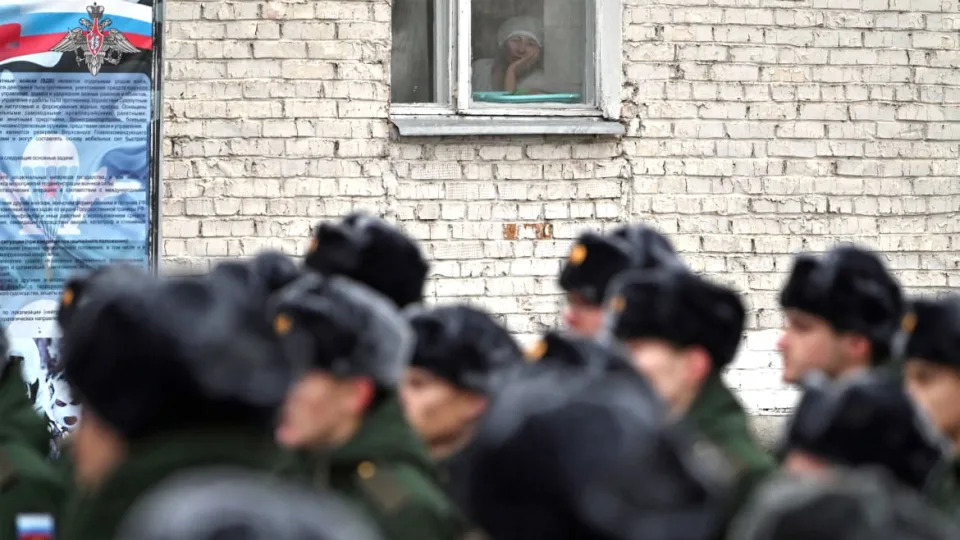
Russian conscripts depart for garrisons, in Omsk

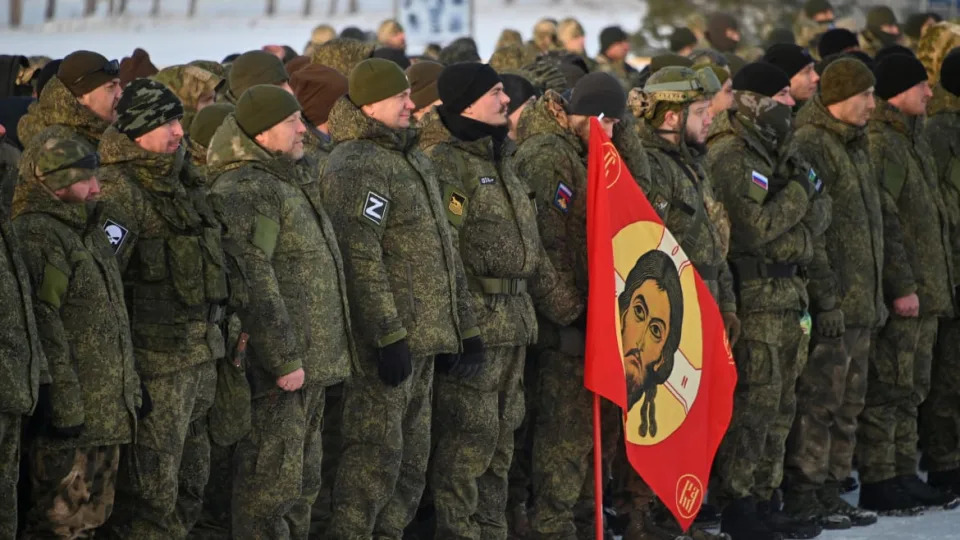
(Reuters) -Russia could raise the upper age limit for citizens to be conscripted into the armed forces as soon as this spring, a senior lawmaker has said, as part of Moscow’s plans to boost the number of Russian troops by 30%.

President Vladimir Putin gave his backing in December to defence ministry proposals to raise the age range for mandatory military service to cover Russian citizens aged 21-30, rather than the current range of 18-27.

The chairman of the Russian parliament’s defence committee, Andrei Kartapolov, said in an interview with the official parliamentary newspaper that Russia could raise the upper age limit for conscription to 30 for this year’s spring draft. But only after a one-to-three year “transition period” would the lower limit be raised from 18 to 21 years, Kartapolov said.

Critics said the idea of a transition period was a transparent attempt to increase the number of Russians eligible to be called up for military service to plug massive manpower shortages resulting from heavy losses in the war in Ukraine.

Kartapolov later dismissed such an interpretation, saying there were no plans to increase the number of conscripts once the draft age has risen to 21.

“The number of conscripts we have is decreasing every year. And that number will not be increased,” TASS news agency quoted him as saying, adding that the number envisaged was in the region of 200,000.

Russia’s armed forces are a mix of contracted soldiers and conscripts. Shoigu has outlined plans to increase the total number of combat personnel to 1.5 million from 1.15 million.

Asked about the possible changes, Kremlin spokesman Dmitry Peskov said on Thursday that President Vladimir Putin “conceptually supported” raising the conscription age, but the exact details were up to the defence ministry to work out.

The role of conscripts in Ukraine came under intense focus soon after Russia’s invasion last February, with the defence ministry acknowledging some had been sent to fight there despite statements from Putin that this would not happen.

In September, Russia announced its first mobilisation since World War Two, calling up more than 300,000 former soldiers – including ex-conscripts – in an emergency draft to support the war in Ukraine. Western governments say Russia has lost tens of thousands of soldiers in nearly 11 months of fighting.

(Reporting by Reuters; Editing by Mark Trevelyan and Gareth Jones)

Terrified Draftees Expose Russia’s New Scheme to Cover Up Cannon Fodder Deaths

Daily Beast

Terrified Draftees Expose Russia’s New Scheme to Cover Up Cannon Fodder Deaths

Allison Quinn – January 12, 2023

Alexey Malgavko/Reuters

Hundreds of Russian draftees reportedly fear they have been sent on a suicide mission by top military officials who are planning to conceal their deaths through an inventive new scheme: changing records to show they are part of a regiment that doesn’t exist.

“They assigned us to regiment 228–such a regiment does not exist,” one of the men told the independent news outlet Sota. “They want to send us to a hot spot tomorrow with machine guns [to go] against tanks, drones, and mortars on minefields. We’re just cannon fodder.”

Sota reports that they’ve obtained an audio message recorded by some of the draftees, appealing for help on behalf of the 400 men who hail from the Altai Republic. In it they say they’re being sent to storm an area near Svatove in Ukraine’s Luhansk region.

“Please help in any way you can. We’ve already been given drugs, [the opioid analgesic] Promedol, in case of serious injuries,” the message said.

The men described manipulation of their official paperwork that effectively rendered them lost without a trace.

“Some colonel-generals came here, I don’t know, they couldn’t find us. We were tossed on the very front, we’re under the artillery.”

The move suggests Russian officials are desperate for some manpower after military analysts noted Ukrainian troops had gained more ground on the Svatove-Kremenna line in recent days. Draftees from Russia’s Tomsk region had also publicly appealed to the governor in November for help with a “difficult situation” near Svatove.

Putin’s Secret ‘Squadron’ of Executioners Exposed for Killing Own Men

As the Kremlin now preps for a “large-scale war” against Ukraine, military officials are apparently hell-bent on making the most of the cannon fodder already on the battlefield. The independent new outlet Agentstvo reported on Thursday that wounded troops are being tossed back on the frontline without any official sign-off from doctors.

“Soldiers with shrapnel in their limbs and bullets through their lungs are being returned to the front,” the outlet noted.

Amid fears of a fresh full-scale mobilization across the whole country, the State Duma’s defense committee is also pushing to drag more Russians into the war.

“We do not have a trained mobilization reserve for waging a large-scale war, if NATO unleashes it. One out of every ten has served in the army, and nine out of ten people have not served in the army. What kind of reserve are they making?” Viktor Sobolyev, a member of the committee, told local media on Wednesday.

He said “100% of young people” should be required to train for a military specialty.

Russia is letting prisoners soak up withering Ukrainian fire in a ‘savage’ battle, ‘trading’ them and others for bullets

Business Insider

Russia is letting prisoners soak up withering Ukrainian fire in a ‘savage’ battle, ‘trading’ them and others for bullets, US official says

Jake Epstein – January 10, 2023

Russia is letting prisoners soak up withering Ukrainian fire in a ‘savage’ battle, ‘trading’ them and others for bullets, US official says. Ukrainian servicemen fire with a CAESAR self-propelled howitzer towards Russian positions in eastern Ukraine on December 28, 2022.SAMEER AL-DOUMY/AFP via Getty Images
  • Russian forces are sending prisoners to absorb heavy Ukrainian fire around the war-torn city of Bakhmut.
  • Moscow’s applying a classic tactic of “trading individuals for bullets,” a senior US military official said.
  • Eastern Ukraine’s Bakhmut has become the epicenter of hostilities between Moscow and Kyiv.

Russia is using prisoners and freshly mobilized troops to absorb heavy Ukrainian fire along the war’s front lines in order to clear the way for its better trained forces to take ground, a US official said, calling the move a classic Russian tactic.

Prisoners recruited by the Wagner Group — a notorious paramilitary organization with close ties to the Kremlin — and others have recently been deployed to the forefront of fighting around eastern Ukraine’s war-torn city of Bakhmut, which has become the epicenter of hostilities between Moscow and Kyiv.

These recruits have been forced to “take the brunt” of Ukrainian firepower in the area before they are replaced by “better trained forces” who move in behind them to try and claim territory, a senior US military official told reporters on Monday.

The official added that Moscow’s current tactic of “trading individuals for bullets” has been used on the battlefield throughout Russian history. Russia, for example, did this with conscripts who were sent into the Chechnya region during the First Chechen War of the mid-1990s.

The senior military official described fighting in the area around Bakhmut, which had a pre-war population of over 73,000 people, as “really severe and savage.” They said rolling exchanges of artillery fire are often followed up with maneuvers by “people that are not their best fighters.”

“You’re talking about thousands upon thousands of artillery rounds that have been delivered between both sides,” the official said. In many cases, they said, there may be “several thousand artillery rounds in a day that are being exchanged.”

Britain’s defense ministry shared in a Tuesday intelligence update that Russian and Wagner forces have been able to advance into the town of Soledar, just a few miles north of Bakhmut. It added that Moscow is likely to use this access to attempt to approach Bakhmut from the north, though it is unlikely to “imminently” do so because Ukraine has control of its supply routes and has held solid defensive lines.

Ukrainian President Volodymyr Zelenskyy said in a nightly address on Monday that Russia has concentrated its “greatest efforts” on Soledar.

“And what did Russia want to gain there? Everything is completely destroyed, there is almost no life left. And thousands of their people were lost,” he said. “The whole land near Soledar is covered with the corpses of the occupiers and scars from the strikes. This is what madness looks like.”

The Institute for the Study of War, a Washington-based think tank, wrote in a recent analysis that Yevgeny Prigozhin, an ally of Russian President Vladimir Putin and the leader of Wagner, has used the mercenary group’s achievements in Soledar as a way to demonstrate that it’s the one force that is able of finding any success in Ukraine.

Laura Cooper, the Pentagon’s deputy assistant secretary of defense for Russia, Ukraine, and Eurasia, acknowledged at a Friday briefing that Wagner has been able to move at a “more rapid clip” than other units in the Russian military.

However, even Prigozhin has said that capturing Bakhmut will be a challenge. In a video published to social media earlier this month, the Wagner founder said that the city features layers of defense and that his fighters lack the necessary heavy armor and equipment.

Over 600 bodies transported in truckloads: Russia hides Makiivka losses, fearing rebellion

Ukrayinska Pravda

Over 600 bodies transported in truckloads: Russia hides Makiivka losses, fearing rebellion

Ukrainska Pravda – January 10, 2023

In a new intercepted call released by the Chief Intelligence Department of Ukraine’s Defence Ministry, a Russian occupier tells his wife that the Russian authorities are keeping quiet about the events in Makiivka to prevent a rebellion when in fact, over 600 Russian invaders died there.

Source: Defence Intelligence of Ukraine

Details: In the conversation, the Russian’s wife tells her husband that the Russians have been taking corpses out of Makiivka “in truckloads” and that 610 people were in fact killed. She was apparently told that by the relatives of another Russian occupier who was directly involved in transporting the bodies.

Quote: “He personally transported the bodies of these people from Makiivka and from another [settlement]… from the hospital. He says 610 people died in Makiivka. He says, ‘I drove 12 Kamaz trucks [filled with bodies – ed.]’.”

In response, the occupier agrees and claims he had already told his wife about it, but she believed what the Russian authorities said.

The Russian soldier’s wife also said Vladimir Putin’s New Year greeting for 2023 was the lamest she had ever seen.

Background:

  • The Defence Forces of Ukraine launched an attack on a Russian military base in occupied Makiivka in Donetsk Oblast on New Year’s Eve, killing 400 and wounding 300 occupiers to varying degrees of severity. The Russian soldiers were stationed in the building of local vocational school no. 19.
  • Igor Girkin (Strelkov), a Russian terrorist and a former so-called “Minister of Defence of the Donetsk People’s Republic”, confirmed the mass killing of Russian servicemen in occupied Makiivka.
  • The Ministry of Defence of the Russian Federation reported that the death toll following the strike on the Russian servicemen’s base in Makiivka had risen to 89.

Russians Fear They’ll Soon Be Starving ‘Like North Koreans’

Daily Beast

Russians Fear They’ll Soon Be Starving ‘Like North Koreans’

Julia Davis – January 10, 2023

Alexey Malgavko/Reuters

Russia rang in the new year with gaudy excess, patriotic fervor and echoes of a Soviet past. In studios filled with visiting servicemen, brought in from the front lines to film the New Year’s extravaganza, hosts and performers toasted victory and mocked the West for the side effects of Russian sanctions. Comedian Yevgeny Petrosyan cheered for the troops, assuring them that the entire country was behind them. He taunted Ukraine and its Western allies: “Like it or not, Russia is enlarging!”

Noisy bravado couldn’t hide the fact that no one was drinking from the champagne glasses seemingly filled with sparkling water, or the blank stares on the faces of the visiting troops. One of the hosts, sports commentator Dmitry Guberniev, compared life to a biathlon—a grueling cross-country ski race with rifle shooting—and surmised: “If you’re having a hard time, then the finish line is near and victory is close!”

Holiday cheer notwithstanding, even Russian propagandists realize that hard times are only starting and attempts to summon a ghost of the Soviet past are directly related to a starkly different way of life that awaits the average Russian. On Wednesday, host of Solovyov Live Sergey Mardan struggled to contain his feelings about “the grinning and glee on the federal channels,” which continued even after the news of a HIMARS strike that killed dozens of Russian troops in Makiivka. Mardan raged: “What happened in Makiivka is a tragedy! A real tragedy! There didn’t have to be a phone call from the top for them to figure out that TV programming should be changed to something that is more fitting. Instead of vulgar anecdotes, put on any old Soviet movie.”

The Soviet grooming that is being implemented by many Russian propagandists is meant to condition the people to the rapid decline in the standards of living to which many of them have become accustomed. The expectations are so dire, Mardan posed a startling question to his economic expert, Denis Raksha: “What are our chances? Do we even have them or not? Will we have to live like South Korea in the 1950s-1960s? Will we end up having to eat fire ants?”

Russia Can Finally See That Putin’s ‘Days Are Numbered’

Raksha explained that if Russia intends to drastically rebuild its economy in order to be self-sustaining everyday life will become quite difficult, even if Russians won’t have to resort to eating ants. He added: “Currently, the industrialization reminiscent of that of the 19th century or the 1920s-1930s is practically impossible. In that case, we’d have to live not like South Koreans, but like North Koreans.”

<div class="inline-image__caption"><p>Workers remove debris of a destroyed building used as temporary accommodation for Russian soldiers, 63 of whom were killed in a Ukrainian missile strike as stated the previous day by Russia's Defence Ministry in Makiivka, Russian-controlled Ukraine, Jan. 3, 2023.</p></div> <div class="inline-image__credit">Alexander Ermochenko/Reuters</div>
Workers remove debris of a destroyed building used as temporary accommodation for Russian soldiers, 63 of whom were killed in a Ukrainian missile strike as stated the previous day by Russia’s Defence Ministry in Makiivka, Russian-controlled Ukraine, Jan. 3, 2023.Alexander Ermochenko/Reuters

Another kind of hunger is also concerning Russian experts: a looming lack of ammunition. On Jan. 2, Victor Murakhovsky, editor-in-chief of the Arsenal of the Fatherland magazine, raised an alarm on his Telegram channel, where he wrote: “In 1914, miscalculations of the General Staff as to the rate of accumulation of shells (900 shots) led to an acute shortage of shells for the army in the field. Urgent measures were required to save the army from a complete shell starvation. The military industry was not ready to solve this problem… the “ammo hunger” was fully eliminated only in 1916.”

Murakhovsky went on to explain his calculations for the same problem that is raising its head now: “In the early 1990s, the Russian army inherited from the Soviet army about 15 million tons of missiles and ammunition… As of January 1, 2013, the Armed Forces of the Russian Federation had 3.7 million tons of ammunition, of which 1.1 million tons are unusable. This means that 2.6 million tons of ammunition are usable. In 2020, almost 300 thousand pieces of ammunition were repaired and more than 20 thousand shells for multiple launch rocket systems were collected. The realistic need for ammunition is MILLIONS of pieces per year.”

During his program, Mardan described the predictions of the upcoming ammunition shortages as “apocalyptic writings” and pondered out loud whether Russian industry would be able to solve this problem. His guest, military expert Vladislav Shurygin, cautiously replied: “I read that post. It should be acknowledged that it was written by one of our best military professionals… but his calculations didn’t include the rate at which the ammo is currently being produced.” He argued that imposing strict usage norms on the battlefield was the way to keep the issue under control. Meanwhile, Russia is reportedly continuing to court other pariah states to source weapons and ammo to replenish its dwindling stocks.

<div class="inline-image__caption"><p>An ammunition depot of the Russian military, which was destroyed by Ukrainian servicemen in the city of Izyum, Kharkiv region on Dec. 13, 2022. Military equipment of the Russian forces and ammunition of various calibers, including non-detonated ones, were destroyed all around.</p></div> <div class="inline-image__credit">Sofiia Bobok/Anadolu Agency via Getty Images</div>
An ammunition depot of the Russian military, which was destroyed by Ukrainian servicemen in the city of Izyum, Kharkiv region on Dec. 13, 2022. Military equipment of the Russian forces and ammunition of various calibers, including non-detonated ones, were destroyed all around.Sofiia Bobok/Anadolu Agency via Getty Images

The simple solution of abandoning Russia’s failing invasion of Ukraine never seems to occur to the pro-Kremlin propagandists. Mardan raged: “The enemy has to be destroyed down to the root! It has to be exterminated! Russian history of the last 1,000 years shows that the deed has to be brought to its final conclusion… If Stalin had deported [the people of] Western Ukraine—to me, it’s still a mystery why he didn’t do it—perhaps none of this would be happening.”

To sweeten the pot, the host rejoiced over millions of Ukrainian refugees who ended up in Russia, while Moscow struggles to alleviate a severe demographic crisis: “Look at how much the Motherland is spending to solve the demographic problem… We got these people [Ukrainians] for free, for nothing—approximately five million of them! Five million souls!”

Concluding the program, Mardan grimly noted: “To everyone who says that Russia should get up off its knees—myself included—my friends, I’m afraid that our former way of life is a thing of the past… It’s practically unavoidable… perhaps we’ll be reflecting upon the past year as our last fat year. On the other hand, a great victory is ahead of us!”

‘What madness looks like’: Russia intensifies Bakhmut attack

Associated Press

‘What madness looks like’: Russia intensifies Bakhmut attack

Andrew Meldrum – January 10, 2023

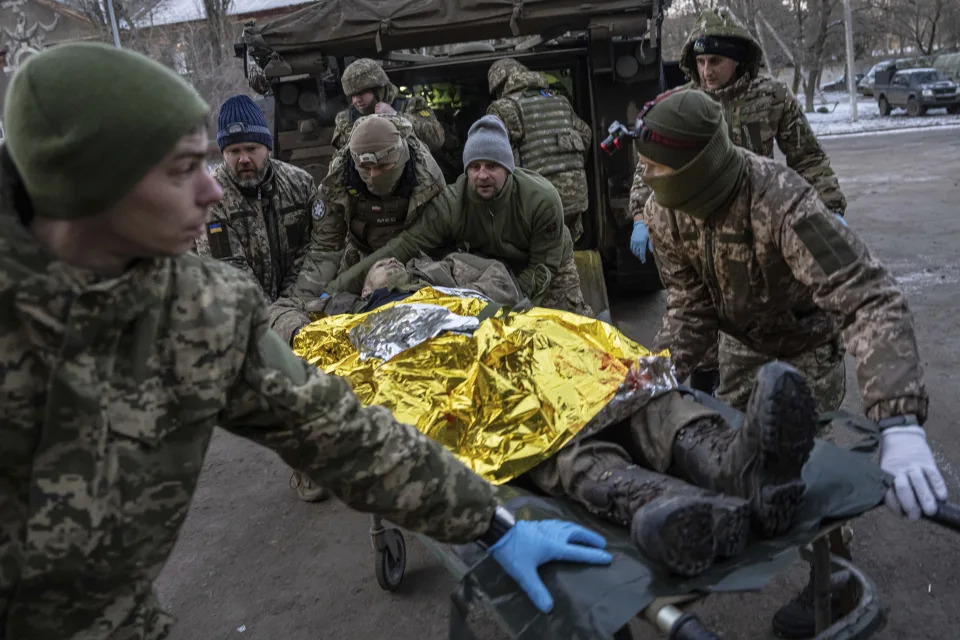
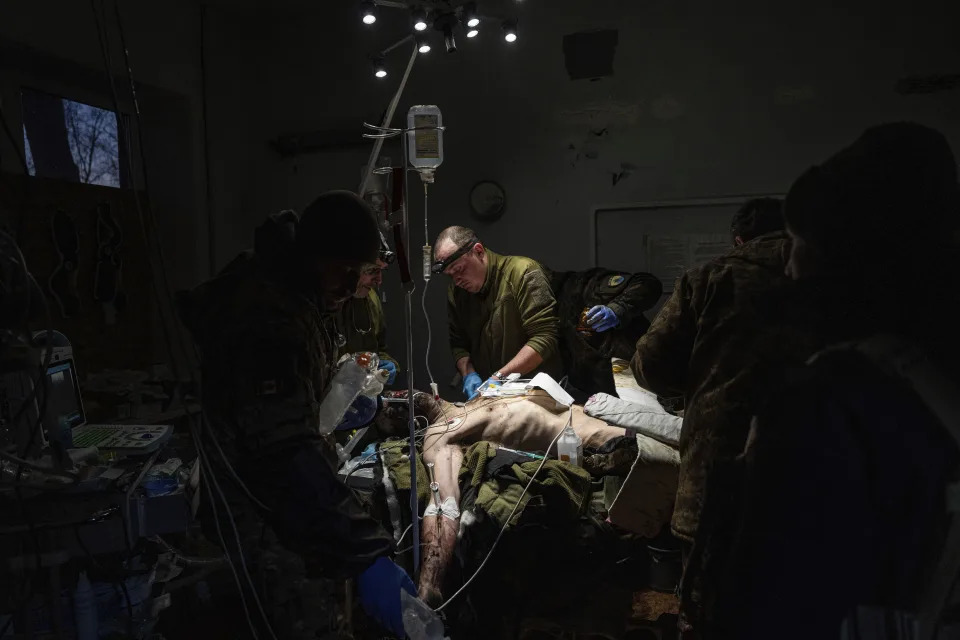
Ukrainian military medics carry an injured Ukrainian serviceman evacuated from the battlefield into a hospital in Donetsk region, Ukraine, Monday, Jan. 9, 2023. The serviceman did not survive. (AP Photo/Evgeniy Maloletka)
Ukrainian military doctors treat their injured comrade who was evacuated from the battlefield at the hospital in Donetsk region, Ukraine, Monday, Jan. 9, 2023. The serviceman did not survive. (AP Photo/Evgeniy Maloletka)
A Ukrainian serviceman carries his injured comrade evacuated from the battlefield into a hospital in Donetsk region, Ukraine, Monday, Jan. 9, 2023. (AP Photo/Evgeniy Maloletka)
Ukrainian military medics carry an injured Ukrainian serviceman evacuated from the battlefield into a hospital in Donetsk region, Ukraine, Monday, Jan. 9, 2023. A serviceman did not survive. (AP Photo/Evgeniy Maloletka)
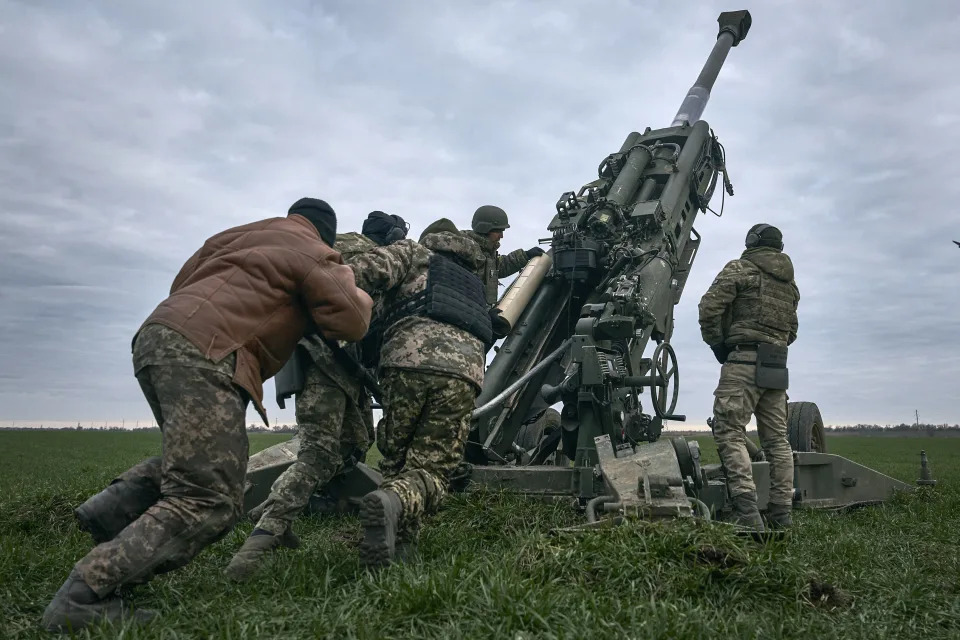
Ukrainian soldiers prepare a U.S.-supplied M777 howitzer to fire at Russian positions in Kherson region, Ukraine, Jan. 9, 2023. (AP Photo/Libkos)
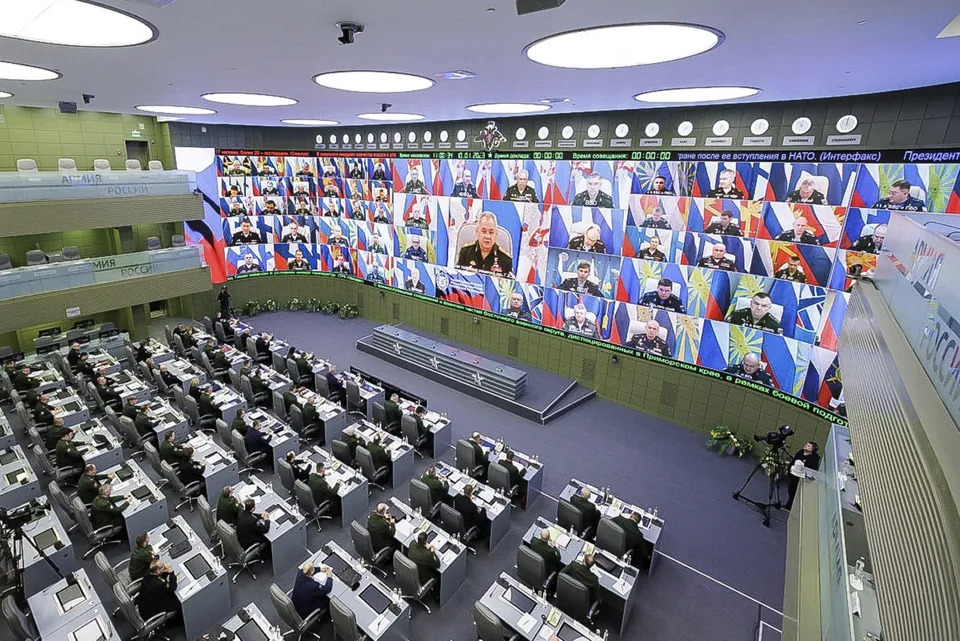
In this handout photo released by Russian Defense Ministry Press Service on Tuesday, Jan. 10, 2023, Russian Defense Minister Sergei Shoigu is seen on the screen as he speaks during a meeting with Russian high level officers in Moscow, Russia. (Russian Defense Ministry Press Service via AP)

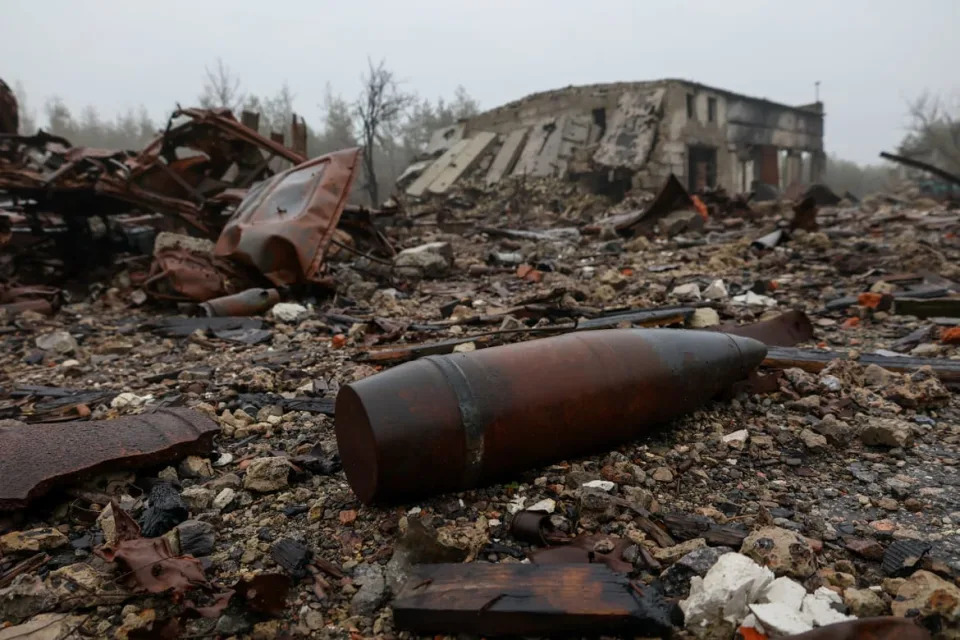
KYIV, Ukraine (AP) — Russian forces are escalating their onslaught against Ukrainian positions around the wrecked city of Bakhmut, Ukrainian officials said, bringing new levels of death and devastation in the grinding, monthslong battle for control of eastern Ukraine that is part of Moscow’s wider war.

“Everything is completely destroyed. There is almost no life left,” Ukrainian President Volodymyr Zelenskyy said late Monday of the scene around Bakhmut and the nearby Donetsk province city of Soledar, known for salt mining and processing.

“The whole land near Soledar is covered with the corpses of the occupiers and scars from the strikes,” Zelenskyy said. “This is what madness looks like.”

Late Tuesday, the head of the Wagner Group, a Russian private military contractor, Dmitry Prigozhin, claimed in audio reports posted on his Russian social media platform that his forces had seized control of Soledar, with battles continuing in a “cauldron” in the city’s center. Ukrainian officials did not comment on the claim, and The Associated Press was unable to verify it.

The U.K. Defense Ministry said earlier that Russian troops alongside soldiers from the Wagner Group had advanced in Soledar and “are likely in control of most of the settlement.”

The ministry said that taking Soledar, 10 kilometers (6 miles) north of Bakhmut, was likely Moscow’s immediate military objective and part of a strategy to encircle Bakhmut. But it added that “Ukrainian forces maintain stable defensive lines in depth and control over supply routes” in the area.

A Western official, speaking on condition of anonymity, said the Wagner Group “has moved from being a niche sideshow of Russia’s war to a major component of the conflict,” adding that its forces now make up as much as a quarter of Russian combatants.

The Kremlin, whose invasion of its neighbor 10 1/2 months ago has suffered numerous reversals, is hungry for victories. Russia illegally annexed Donetsk and three other Ukrainian provinces in September, but its troops have struggled to advance.

After Ukrainian forces recaptured the southern city of Kherson in November, the battle heated up around Bakhmut.

Ukraine’s deputy defense minister, Hanna Malyar, said Russia has thrown “a large number of storm groups” into the fight for the city. “The enemy is advancing literally on the bodies of their own soldiers and is massively using artillery, rocket launchers and mortars, hitting their own troops,” she said.

Pavlo Kyrylenko, the Donetsk region’s Kyiv-appointed governor, on Tuesday described the Russian attacks on Soledar and Bakhmut as relentless.

“The Russian army is reducing Ukrainian cities to rubble using all kinds of weapons in their scorched-earth tactics,” Kyrylenko said in televised remarks. “Russia is waging a war without rules, resulting in civilian deaths and suffering.”

Wounded soldiers arrive around the clock for emergency treatment at a Ukrainian medical stabilization center near the front line around Bakhmut. Medics fought for 30 minutes Monday to save a soldier, but his injuries were too severe.

Another soldier suffered a head injury after a fragment pierced his helmet. Medics quickly stabilized him enough to transfer him to a military hospital.

“We fight to the end to save a life,” Kostyantyn Vasylkevich, a surgeon and the center’s coordinator, told The Associated Press. “Of course, it hurts when it is not possible to save them.”

The Moscow-backed leader of the occupied areas of Donetsk, Denis Pushilin, told Russian state TV control over the city would create “good prospects” for taking over Bakhmut, as well as Siversk, a town further north where Ukrainian fortifications “are also quite serious.”

An exceptional feature of the fighting near Bakhmut is that some of it has taken place around entrances to disused salt mine tunnels which run for some 200 kilometers (120 miles), the British intelligence report noted.

“Both sides are likely concerned that (the tunnels) could be used for infiltration behind their lines,” it said.

In Russia, two signs emerged Tuesday that officials were grappling with the military shortcomings revealed during the conflict in Ukraine.

Russian Defense Minister Shoigu, whose performance has been fiercely criticized in some Russian circles but who has retained Russian President Vladimir Putin’s confidence, said Tuesday that his military would use its experience in Ukraine to improve combat training.

Military communications and control systems will be improved using artificial intelligence, Shoigu said, and troops will be given better tactical gear and equipment.

The second indication of trouble involves Russia’s production of weapons and other supplies its military needs for the fight in Ukraine. The deputy head of Russia’s Security Council, Dmitry Medvedev, warned that officials who failed to meet deadlines for such items could face criminal charges.

Putin appointed Medvedev last month to head a new commission tasked with trying to solve the military’s supply problems. Numerous reports have suggested Russia is running low on certain weapons and was sending some troops into battle with insufficient equipment and clothing.

Part of the Kremlin’s challenge is keeping up with the weapons and supplies that Western allies are providing to Ukraine.

The Patriot surface-to-air guided missile defense system is one of the weapons Ukraine is about to receive, and the Pentagon announced Tuesday that about 100 Ukrainian troops will head to Oklahoma’s Fort Sill as soon as next week to begin training on it. That will help Ukraine protect itself against Russian missile attacks. The United States pledged one Patriot battery last month, and Germany has pledged an additional system.

Germany’s foreign minister, Annalena Baerbock, announced Tuesday while visiting Ukraine’s second largest city, Kharkiv, that her country would also provide 40 million euros ($43 million) to help with demining, energy infrastructure and internet connections, German news agency dpa reported.

Several front-line cities in eastern Ukraine’s Donetsk and Luhansk provinces have witnessed intense fighting in recent months.

Together, the provinces make up the Donbas, a broad industrial region bordering Russia that Putin identified as a focus from the war’s outset and where Moscow-backed separatists have fought since 2014.

Russia’s grinding eastern offensive captured almost all of Luhansk during the summer. Donetsk escaped the same fate, and the Russian military subsequently poured manpower and resources around Bakhmut.

Taking Bakhmut would disrupt Ukraine’s supply lines and open a route for Russian forces to press toward Kramatorsk and Sloviansk, key Ukrainian strongholds in Donetsk.

Like Mariupol and other contested cities, Bakhmut endured a long siege without water and power even before Moscow launched massive strikes to take out public utilities across Ukraine.

Kyrylenko, the Donetsk region’s governor, estimated more than two months ago that 90% of Bakhmut’s prewar population of over 70,000 had fled since Moscow focused on seizing the entire Donbas.

Ukraine’s presidential office said at least four civilians were killed and another 30 wounded in Russian shelling between Monday and Tuesday.

Vitaliy Kim, the governor of the southern Mykolaiv region, said Russian forces shelled the port of Ochakiv and the area around it late Monday and again early Tuesday. He said 15 people, including a 2-year-old child, were wounded.

Wagner’s Desensitized Prison Fighters Keep Staggering Into Bakhmut Like This Is a Zombie Apocalypse

Daily Beast

Wagner’s Desensitized Prison Fighters Keep Staggering Into Bakhmut Like This Is a Zombie Apocalypse

Guillaume Ptak – January 7, 2023

Photo by Diego Herrera Carcedo/Anadolu Agency via Getty Images

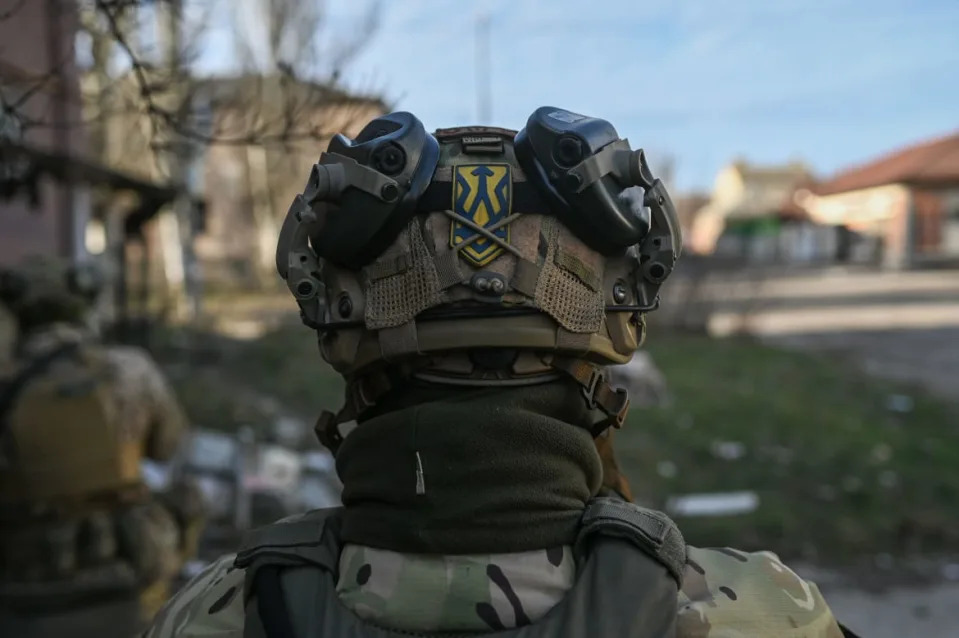
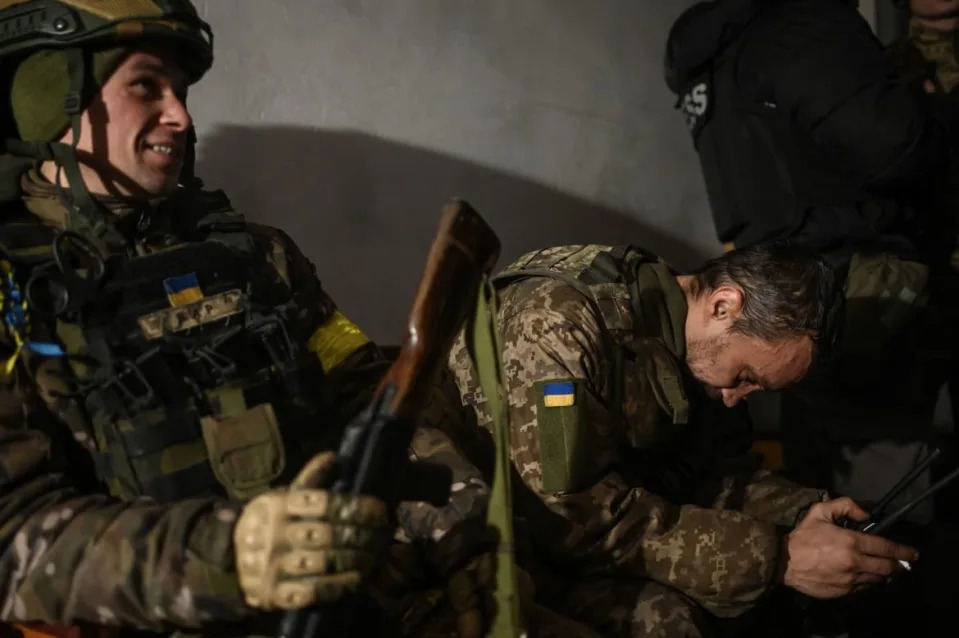
BAKHMUT, Ukraine—In the smoke-filled basement of a nondescript building in the city center of Bakhmut, eastern Ukraine, the men of the SKALA intelligence battalion are getting ready for a risky reconnaissance mission. One of them is burning a last cigarette in the dimly-lit hallway. Clad in a bulletproof vest and helmet, a bearded soldier wraps yellow tape around both his arms—a sign used by Ukrainian soldiers to identify each other on the battlefield. “Be careful out there, there are snipers in this area,” a portly officer warns him, rising from his office chair facing a flatscreen TV that intermittently broadcasts the live-feed of a drone flying over carnage in the city. “I can’t die, my mom won’t let me,” quips the soldier with a weary smile, checking his gear one last time before heading out.

The previously-muffled sound of outgoing artillery becomes sharper and louder as the door to the street swings open. They take off.

“The situation is pretty tense, but we’re controlling it,” says 23-year-old Alexander, clutching his American-made M4 assault rifle. “We’re holding.” With his buzzcut and boyish looks, the young man wouldn’t look out of place in a trendy nightclub in downtown Kyiv. Yet, for weeks, Alexander and the grizzled soldiers of the SKALA battalion have been weathering the storm of daily Russian assaults and shelling on Bakhmut, hunkering down in the basement and doing daily sorties in the gray zone—the stretch of land between Ukrainian and Russian positions. Named after its founder and leader Iurii Skala, the SKALA battalion is tasked with conducting air and ground reconnaissance, as well as “cleaning operations”—a euphemism meaning assaulting enemy positions and taking out the Russian soldiers manning them.

“The drones are our eyes, out there,” says Alexander. Out there is Bakhmut—a salt-mining town of 70,000 inhabitants known for its sparkling white wine—that has been devastated by months of relentless Russian shelling, and gruesome trench warfare that has prompted comparisons with the Battle of the Somme or Passchendaele. The town is a major transport hub and sits on a strategic highway that runs through Ukraine’s Donetsk and Luhansk regions. Yet, some—including one of Ukraine’s top generals—have argued that the town’s strategic value is dubious at best. However, it is one of the few frontline areas where the Russians are still on the advance, and the success-starved Russian high command is desperate to claim a victory, at any cost. Some have theorized that the capture of Bakhmut would constitute a personal prize for Yevgeny Prigozhin, the founder of the infamous Wagner paramilitary group, whose mercenaries make up most of the Russian forces in the area. The U.S. believes Prigozhin has a financial motive: Wagner has often seized lucrative gold and diamond mines in areas where it operates in Africa, and Prigozhin may have set his sights on the salt and gypsum mines around Bakhmut.

This Is How the U.S. Totally Misjudged the War in Ukraine

According to Rem, a former car dealer from Dnipro now correcting artillery fire with the help of his drone, most of the soldiers sent in suicidal assaults on Ukrainian positions in Bakhmut are “zeks,” or convicts, recruited by Wagner to bolster the number of Russian forces in Ukraine. “Mobiks [conscripts] are usually scared, and they scatter when they get shelled. Those guys are not scared,” he said.

Of the Wagnerites, Rem says that they’re a much more effective fighting force than they’re usually given credit for: “They’re making progress, after all.” Desensitized to violence and with nothing left to lose, the prisoners—many of whom are violent criminals including murderers and rapists—are considered by Ukrainian soldiers a tougher enemy than the average army conscript.

<div class="inline-image__caption"><p>A Ukrainian service member stands outside his outpost in Bakhmut during a drone reconnaissance operation on December 01, 2022. </p></div> <div class="inline-image__credit">Justin Yau</div>
A Ukrainian service member stands outside his outpost in Bakhmut during a drone reconnaissance operation on December 01, 2022.Justin Yau

The Russian tactic of sending prison recruits to attack Ukrainian positions—allowing them to identify defenses for the artillery to pummel afterwards—has proven effective, though slow and deadly. While no major breakthrough has occurred, they have been slowly eroding Ukrainian defenses, and creeping every closer to the eastern outskirts of the city.

This assessment was echoed in late December by Oleksandr Danylyuk, a former national security adviser for Ukraine currently working on military planning, who said of the prison conscripts: “They are—I cannot say fearless—but they have nothing to lose pretty much. So, they are attacking constantly and they’ve been killed in big quantities as well.”

Yet those incremental gains on the eastern approach to the city have come at a cost for Russian forces, as evidenced during Prigozhin’s well-publicized visit to the frontline over the New Year. In a series of videos released by Russian news agency RIA Novosti, the Wagner boss first visits a basement filled with the bodies of his fighters, many of them convicts, killed during the battle for Bakhmut, before complaining that “every house [in Bakhmut] has become a fortress”—and that it sometimes takes a week of fighting to take a single house.

According to a U.S. official quoted by The Guardian on Thursday, out of an initial force of nearly 50,000 mercenaries, Wagner has sustained more than 4,100 killed in action and 10,000 wounded, including over 1,000 killed between late November and early December near Bakhmut.

How 46 Toddlers Were Disappeared by Putin in One Fell Swoop

Volodymyr Zelensky’s visit to the city in late December underscored the symbolic value of “fortress Bakhmut”—and the sacrifices made to defend it. A Ukrainian officer serving in the East, who asked to remain anonymous, ventured an estimate of a dozen casualties a day.

Outside SKALA’s command center, the streets are almost empty, save for a couple of civilians hurrying along, carrying grocery bags or pulling carts filled with empty water bottles. The thundering sound of shelling echoes through empty avenues and deserted public squares, bouncing off the facades of destroyed residential buildings and closed-down shops. Here and there, the rocket of a GRAD multiple rocket launcher can be spotted planted upright in the asphalt.

A couple of blocks away from SKALA’s headquarters, sixty-something Hrihorii is busy cutting firewood on the car park of his residential building, seemingly oblivious to the outgoing artillery fire booming in the distance. Clothed in warm winter clothing and black plastic boots, the man says he has no intention to leave his apartment – despite the windows having been shattered the day prior to our visit. “I am waiting for the Ukrainian army to win,” he says with a smile. “I am not leaving.” Next to him, food is simmering in a pot placed over an open fire. The crater from last morning’s shelling is located a mere feet away from his improvised kitchen. Had he been cooking at the time of its landing, Hrihorii would have died.

Back at the command post, a group of a dozen soldiers are returning from a mission in the “gray zone.” The soldiers, drenched in sweat and amped up on adrenaline, hurry through the door, cursing loudly. Roman, a soldier from Dnipro, lights up a cigarette and introduces the other members of his crew, in broken English : Vansi, a heavyweight soldier who had served in Donbas in 2015, and “Bakhmut,” who now serves in the charred ruins of his hometown after sending the rest of his family to safety in Bulgaria. “I haven’t run like this in twenty years,” exclaims Roman, panting. According to him, 50 year-old Russian T-62 tanks were operating in the area. “We couldn’t see them, but we could hear them,” he says. The use of such obsolete models points to the growing deficit of equipment and vehicles among Russian forces, a problem compounded by the sanctions that have targeted the country’s military industry. Yet Ukrainian soldiers say the Russians shouldn’t be underestimated. “It’s still very loud out there, the fight is not over,” says Roman, putting out his cigarette.

<div class="inline-image__caption"><p>Roman (left) and “Bakhmut” (right) are among the Ukrainian fighters frustrating Russia’s efforts to take Bakhmut.</p></div> <div class="inline-image__credit">Justin Yau</div>
Roman (left) and “Bakhmut” (right) are among the Ukrainian fighters frustrating Russia’s efforts to take Bakhmut.Justin Yau