Wagner chief says he’s turning Russian convict fighters destined for Ukraine into ‘cannibals’
Caitlin McFall – January 31, 2023
Wagner chief Yevgeny Prigozhin championed the training efforts of his newest recruits swept from Russia’s penal system and slotted for deployment on Ukraine’s front lines and said they “will make real cannibals.”
The term is not meant as a literal interpretation, explained Russia expert and former Defense Intelligence Agency intelligence officer for Russian Doctrine & Strategy Rebekah Koffler.
The expression is intended as way for Prigozhin to claim he is turning his convicts into fighting machines as they prepare for the warfront in Ukraine.
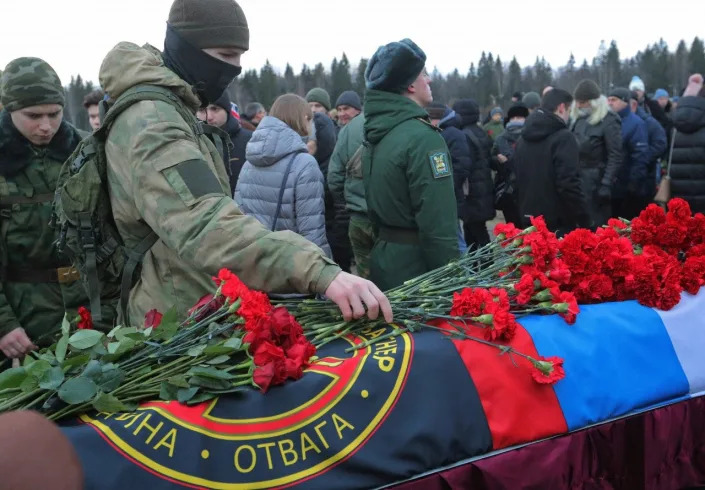
A man places flowers at the coffin during the funeral of Dmitry Menshikov, a mercenary for the private Russian military company Wagner Group, killed during the military conflict in Ukraine, in the Alley of Heroes at a cemetery in Saint Petersburg, Russia December 24, 2022.
In a video shared by the Daily Mail Tuesday, Prigozhin spoke as Wagner forces trained behind him and said, “This is a supplementary training base for our fighters.”
“The primary training is in Molkino and here experienced fighters are given additional training in their specialties,” he said in reference to where Wagner’s main base in Russia is located. “Here they make real cannibals.”
Wagner began offering Russian convicts a chance to fight in Ukraine and in exchange secure their release from prison — no matter the charge.
So long as a convict can survive on the front lines for a six-month stint, they can return home without fulfilling their full prison term.
Though Wagner forces receive ammunitions and equipment from the Russian defense ministry they do not work with or function as a part of the Russian military forces.
Prigozhin, a Putin ally, has concentrated his forces in the most harshly fought over regions in Ukraine like Donetsk and claimed recent victories for Russia were down to his forces, not Russia’s military.
Though the Russian military has sought to distance itself from the brutal mercenary group it claimed earlier this month that Russian military units and Wagner Forces worked as in a “heterogeneous” effort to secure the fiercely contested town of Soledar.
The U.S. estimates that there are some 50,000 hired soldiers in Ukraine, roughly 10,000 are believed to be professional contractors while 40,000 are convicts recruited to backfill flagging numbers on the ground.
Russia plans to receive Iranian ballistic missiles against which Ukraine’s air defense is powerless
Ukrainska Pravda – January 30, 2023
There remains a threat of Russia receiving Iranian ballistic missiles, against which Ukrainian air defence in its current form is powerless.
Source: Colonel Yurii Ihnat, spokesperson for Ukraine’s Air Force, on air of the national joint 24/7 newscast
Details: Ihnat reminded that Ukraine’s air defence forces cannot counter the hostile ballistic missiles and anti-aircraft missiles flying along a ballistic trajectory. He emphasised the importance of providing our country with the Patriot PAC-3 and SAMP-T systems.
Quote: “The main threat that hangs in the air and can still be implemented is, of course, Iranian-made missiles. Russia has not abandoned its intentions to receive kamikaze drones from Iran and, in a certain way, the missiles that were announced earlier: Fateh and Zolfaghar models.
This is ballistics, we have no means against ballistics today. We understand that Russia also has ballistics in the form of the same Kinzhal missiles. This is basically a system, but air-based, which hits on a ballistic trajectory. Similarly, Kh-22 missiles… and S-300, S-400 missiles are anti-aircraft missiles that hit on a ballistic trajectory.
These are the challenges and threats we face today. It is possible to destroy them [the systems – ed.] in positions as well, but our partners also understand that means against ballistic threats are needed. Such as Patriot PAC-3 and SAMP-T.
We see a shift, Italy and France have also declared their readiness to transfer these systems to Ukraine, which is now being actively discussed after the Ramstein. Therefore, the threat is there, it has not disappeared anywhere, and we must respond to it.”
Journalists fight on their own frontline. Support Ukrainska Pravda or become our patron!
U.S. intel chief warns of ‘devastating’ impact of Russian missile attacks
Avril Haines said Thursday night that Moscow is making “very incremental progress” in its war on Ukraine.
Michael Isikoff, Chief Investigative Correspondent – January 27, 2023
Halina Panasian weeps inside her destroyed house in Hlevakha, Ukraine, on Thursday after a Russian rocket attack. (Roman Hrytsyna/AP)
AUSTIN, Texas — President Biden’s chief intelligence adviser raised fresh concerns Thursday night that Russian missile attacks are having a “devastating” impact on the Ukrainian economy, noting that the war has already reduced the country’s gross domestic product by nearly one-third.
Speaking during a question-and-answer session at the Lyndon B. Johnson Presidential Library, Director of National Intelligence Avril Haines said U.S. officials so far “do not see any reduction in the resolve of the Ukrainians to fight this war.”
But at the same time, Haines seemed to offer a more sobering view of the conflict than most Biden administration officials have shared to date. She said the “brutal” missile attacks on Ukrainian infrastructure are taking a far bigger toll than has been publicly understood.
A woman and children walk next to a house in Hlevakha damaged by a Russian military strike. (Valentyn Ogirenko/Reuters)
“What we do see is the impact it’s having on the economy,” she added. “The Ukrainian economy has already been devastated during this conflict. And we’re seeing a reduction of about 30% of the GDP. I mean, it’s really — it’s brutal, and if [the Russians] take down the [Ukrainian energy] grid, and if they have the impact that they’re looking to have on critical infrastructure, it will be really challenging.”
Haines’s comments came on a day when the Russians unleashed another barrage of missiles, killing 12 civilians, as part of a campaign targeting the energy grid with the apparent goal of leaving the country without power and water during the freezing winter months.
Her carefully couched comments on the difficulties facing Ukraine come during a crucial period when the Biden administration and Western allies are racing to step up their military aid to the Kyiv government. Just this week, the White House announced that the United States will send heavy-duty M1 Abrams battle tanks to Ukraine — a move that helped persuade Germany to send some of its even more critically needed Leopard tanks to the country.
An electrical worker checks damage at a power plant after a rocket attack in Kyiv on Thursday. (Daniel Cole/AP)
Haines touted the administration’s declassification of intelligence last year that revealed Russia’s intentions to invade Ukraine during a period when European allies were skeptical that President Vladimir Putin would actually go through with it. And she said the U.S. has continued to provide important tactical battlefield intelligence to the Ukrainian military.
But she also described the war as having devolved into a “grinding conflict” where the movements are in “hundreds of meters.” The frontlines, she noted, have mostly remained “relatively static” even while the Russians press an offensive in the eastern Donbas region in which they have made “very incremental progress.”
The occasion for Haines’s appearance was a forum on declassification of government records sponsored by a little-known federal agency called the Public Interest Declassification Board.
The board has pushed the intelligence community to address what it views as an alarming explosion in classified records that the government can’t even keep track of — an issue that has taken on new relevance with the discovery of classified documents at the homes and offices of former President Donald Trump, President Biden and former Vice President Mike Pence.
On Wednesday, Haines, citing ongoing special counsel investigations, told the Senate Intelligence Committee that she could not accede to requests to share with the panel copies of the documents at issue or even describe them. Her stance drew criticism from senators on both sides of the aisle.
Director of National Intelligence Avril Haines testifies before the Senate Armed Services Committee in May 2022. (Jose Luis Magana/AP)
And she entirely avoided the subject of the Trump, Biden and Pence documents Thursday night, both in prepared remarks and in a later question-and-answer session with Adam Klein, the director of the University of Texas’s Strauss Center for International Security and Law, who never raised the subject. Haines left immediately after the session without taking questions from journalists.
But in her prepared remarks, she did acknowledge that “overclassification” had become a serious problem that has proliferated with an explosion in digital data. She promised new initiatives using technology and artificial intelligence to help reduce the number of such records, now literally in the tens of millions.
“Not only is this an important issue for our democracy, but it undermines our national security,” Haines said, adding that overclassification “erodes our basic trust that citizens have in our government.”
“To be clear, just because information is inconvenient or embarrassing is not a basis for classification,” she said.
Putin is pardoning thieves, hit men, and murderers so that they can go to fight in Ukraine, Kremlin admits
Mia Jankowicz – January 27, 2023
Russian President Vladimir Putin in Moscow on January 3, 2023.MIKHAIL KLIMENTYEV/SPUTNIK/AFP via Getty Images
The Kremlin admitted on Friday that Putin is giving pardons to convicts who fight in Ukraine.
Murderers and hit men have signed up, and would be released after fighting for just six months.
Wagner Group’s founder Yevgeny Prigozhin was seen congratulating one newly-freed batch in January.
The Kremlin has finally admitted that President Vladimir Putin is pardoning Russian convicts who agree to fight for a notorious mercenary army in Ukraine.
This comes after months of battlefield setbacks and as the country relies more and more on mercenary fighters.
Kremlin Press Secretary Dmitry Peskov said on Friday that the pardoning procedure is carried out according to Russian law, reported state-owned news agency TASS.
According to multiple accounts, prisoners at Russian penal colonies have been told they will be pardoned after six months of fighting for the Wagner Group in Ukraine.
The Wagner Group is a private army run by Yevgeny Prigozhin, and notorious for its brutality.
Under Russian law, only the president has the authority to issue pardons, but until Peskov’s statement the Kremlin had been silent on how the Wagner Group was securing pardons for its recruits.
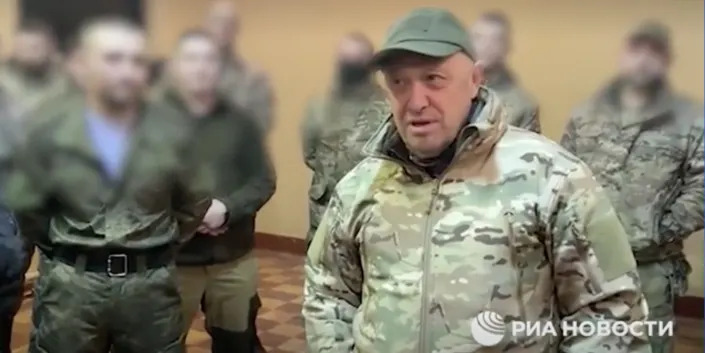
Wagner Group founder Yevgeny Prigozhin addresses former convicts released after serving in Ukraine, according to Russian state-controlled media.RIA Novosti
In September 2022, video emerged that appeared to show Prigozhin personally recruiting convicts from a Russian penal colony, promising them freedom in exchange for fighting.
He also issued a threat: “If you arrive in Ukraine and decide it’s not for you, we execute you,” he said, according to The Financial Times.
In a video that circulated in early January, Prigozhin can be seen congratulating what he said was the first group of convicts to be pardoned after fighting in Ukraine.
He advised them to “behave yourselves” and not “rape broads” now they were free.
US will send Ukraine more advanced Abrams tanks, but without “secret armor”
Ukrainska Pravda – January 26, 2023
The Abrams tanks that the United States intends to transfer to Ukraine are the modern M1A2, not the A1, which the US military has in stock, but they will also be stripped of their so-called secret armor, which includes depleted uranium.
The M1A2 Abrams has more advanced optics and a control system than the A1, which allows for more accurate targeting, and a separate thermal camera for the crew commander, allowing him independent identification of targets in any weather and battlefield conditions.
The new modification of the tank contains digitised control mechanisms, which allow machines to continuously and automatically exchange information, quickly track the location of allied machines, identify enemy positions and process artillery requests.
At the same time, those Abrams that Ukraine will receive will be deprived of the secret armour packages used by the American military, which include depleted uranium. The USA uses the same practice when selling tanks to other countries.
Any modification of the Abrams is significantly more effective in terms of firepower, accuracy and armour compared to the Soviet-era tanks currently used by Ukraine. However, they are more difficult to operate.
Among other things, Abrams tanks have a turbojet engine that uses expensive JP-8 jet fuel, require extensive maintenance, as well as powerful infrastructure, including M88 repair and recovery vehicles to repair broken parts on the battlefield.
Currently, it is equally difficult to determine the timing of when Ukraine will receive Abrams tanks. They will be purchased from the industry. Tanks are assembled in only one place, at the state-owned General Dynamics plant in Ohio, which is currently loaded with new orders for Taiwan and Poland.
On 25 January, US President Joe Biden confirmed his intention to send 31 M1 Abrams tanks to Ukraine, equal to one Ukrainian battalion, to strengthen its defence capabilities against the backdrop of Russian aggression.
For his part, Konstantin Gavrilov, Head of the Russian delegation in Vienna at the OSCE Forum, stated that the German Leopard 2 tanks are equipped with sub-calibre armour-piercing shells with uranium cores, and Moscow will consider their use in Ukraine against Russians as the use of “dirty bombs”.
Putin’s Former Speechwriter Predicts Military Coup in Russia
Allison Quinn – January 26, 2023
Contributor#8523328
A former Kremlin aide is warning that as Moscow blindly pursues its bloody conquest in Ukraine, the situation at home is quietly heading towards a military coup.
Abbas Gallyamov, Vladimir Putin’s former speechwriter, says the conditions are already there for a full revolt.
“The longer the war drags on, the clearer its pointlessness becomes,” Gallyamov writes in a new column for opposition media outlet Mozhem Obyasnit.
The Russian public has largely begun to realize that the Kremlin’s dream of toppling the Kyiv “regime” is not going to happen, Gallyamov notes, and the consolation prize of new “Russian” territories is not winning anybody over.
Discord is also growing in the military, he argues, where “[Wagner boss Yevgeny] Prigozhin has completely discredited the regime in the eyes of service members with his rhetoric, and anger at the authorities allowing a criminal to walk all over them is growing stronger.”
Putin’s cunning, “macho” image has also disintegrated, Gallyamov writes: “As problems pile up in the country and the army that the authorities are unable to solve, Putin is more steadily transforming in people’s eyes from a great strategist to an ordinary, second-rate dictator.”
After months of widespread reports on Russian troops rebelling against their commanders, going public with complaints about top military brass, or deserting the war altogether, Gallyamov notes that all it takes to light the fuse of a full military coup is a little more organization.
“It must be understood that the vast majority of commanders in the army of an authoritarian nation are not staunch supporters of the authorities, but run-of-the-mill opportunists,” he argues.
So once a revolt begins and “yesterday’s loyalties” vanish, military commanders will fight for whoever seems most likely to win, according to Gallyamov. “If complaints against authorities seem convincing to [a commander], then he will most likely decide that that [regime] will not stand against a wave of public anger. And if that’s the case, there’s no reason not to join.”
In addition to the myriad reports about troops revolting against and in some cases even attacking their own commanders, thousands more Russian soldiers have voluntarily handed themselves over to Ukrainian authorities to avoid taking part in the war.
A representative for a Ukrainian hotline called “I Want to Live” told The Guardianon Thursday that a total of 6,543 Russian troops had called up seeking to surrender to the Ukrainian government in a span of about four months.
“During the liberation of Kherson, we had calls from Russians and they told us, ‘Just save our souls because we got stuck somewhere in the mud, our battalion is totally crushed, we have 10 soldiers left, please take us from this mess,” Vitali Matvienko was quoted saying.
He did not say how many of those phone calls led to completed surrenders.
While Russian troops had once bragged about what they were sure would be a lightning-fast takeover of Ukraine, ordinary Russian citizens are now instead seeing a steady drip of death at home, with billboards going up advertising funeral services for “Cargo 200,” a military term for those killed in action.
Incidentally, Russia’s funeral services industry may be one of the only sectors of the economy to hit the jackpot in the war, even as other industries suffer from international sanctions.
The Insiderreports that the industry is blowing up at a record pace and crematoriums are “growing exponentially.”
The owner of a crematorium in Novosibirsk told the outlet there’s so much demand he’s planning to open a whole new military section in the spring.
“Everything will be in the military style, we’ll even set up a cannon,” he said, adding that manufacturers had also begun offering camouflage coffins and “a lot of military paraphernalia.”
Although they may not prove that popular. “Apparently for the relatives it has bad associations,” he said.
Russia fumes over NATO tanks heading to Ukraine, revealing a Kremlin coming to grips with reality
Alexander Nazaryan, Senior W. H. Correspondent – January 26, 2023
WASHINGTON — Russia responded with anger and scorn after Germany and the United States revealed that they would be supplying Ukraine with powerful, advanced battle tanks. Moscow invoked history and warned of a broader conflict.
But in doing so, the Kremlin only highlighted its own political and military constraints.
The move was a “blatant provocation,” said Anatoly Antonov, the Russian ambassador to the United States, ahead of President Biden’s announcement on Wednesday afternoon that his administration would send 31 M1 Abrams tanks to Ukraine in the coming weeks and months.
President Biden announces plans to send Abrams tanks to Ukraine on Wednesday, as Secretary of State Antony Blinken, left, and Defense Secretary Lloyd Austin listen. (Susan Walsh/AP)
“NATO must be destroyed, there are no other options,” mused Vladimir Solovyov, a prominent state television host whose impassioned tirades are valued by the Kremlin for their reach and visceral appeal.
For the most part, however, the warnings emanating from the Kremlin and its top media propagandists had a predictable quality and were tinged with resignation. Russian President Vladimir Putin and his top advisers were likely aware, given consistent and escalating NATO support for Ukraine throughout the last 11 months, that it was perhaps only a matter of time before Western heavy armor made its way to Eastern Europe.
The White House appeared unruffled by the threats.
“The propagandists in the Russian media can say what they will,” National Security Council spokesman John Kirby told Yahoo News at a press briefing at the White House on Wednesday afternoon. Much as Biden had earlier in the day, Kirby argued that the tanks “don’t pose a threat to the Russian homeland. They are designed to help the Ukrainians.”
Russian President Vladimir Putin during a virtual Security Council meeting on Jan. 20. (Mikhail Klimentyev/Sputnik/Kremlin via Reuters)
As Russia groused, Ukrainian PresidentVolodymyr Zelensky was already asking for fighter jets, confident such demands would at least be registered, if not necessarily honored.
His confidence is not unwarranted. When the war began almost a year ago, American officials made distinctions between supposed “offensive” and “defensive” weapons, fearing that sending the former would trigger a damaging Russian response, perhaps against NATO itself.
But as Russia’s bloody invasion persisted well into 2022, those distinctions began to matter less and less. And as Biden and his European counterparts accepted that Ukraine’s defense would be a prolonged affair, concerns about sending ever more powerful weapons to Ukraine subsided.
Wednesday’s announcement followed a meeting last week between German and U.S. military leaders at Ramstein Air Base that failed to produce an agreement on tanks. At the same time, the Ramstein talks made clear just how close Western leaders were in their view of the conflict.
Once it became clear that an agreement had been struck, Russian media outlets — effectively controlled by the Kremlin — dutifully trotted out experts who said the tanks would not significantly change the course of the war.
The arrival of the West’s most sophisticated armored equipment may not come in time to stop an expected Russian offensive, which may come before spring’s warmer weather turns frozen roads into boggy mud. Nor are the Ukrainians, who have never been shy in asking for help, getting as many tanks as they requested.
Abrams battle tanks in Lithuania in 2019. (Mindaugas Kulbis/AP)
“The Russian military and their thugs are still pretty lethal,” Kirby said Wednesday, referring not only to regular Russian troops, but also to Wagner Group paramilitaries who have made some gains around the city of Bakhmut.
All the same, the U.S. and German tank announcements were a sign that the West was committing to Ukraine’s security in the long term, with the nation becoming a kind of bulwark against the territorial expansion Putin and his pan-Slavic ideologues have envisioned.
“We want to make sure that they have the right capabilities to not only defend themselves against the Russian onslaught,” a senior administration official said on Wednesday, but also “the ability to retake and to reclaim their sovereign territory,” including the territory Russia conquered in 2014, during the first stage of its incursion into Ukraine.
Nor are Germany and the United States alone in their commitment, even if the sophistication of the two nations’ tanks has dominated media coverage. France had already committed to sending its AMX-10 RC tanks; Great Britain said it was sending Challenger 2 tanks to Ukraine earlier this month. With so many nations now putting heavy armor into play, Russia finds itself facing a united NATO resistance without any major gaps or disagreements to exploit.
The return of German tanks to Eastern European soil is proving especially galling to Russians, given the heroic defeat of the Nazis during World War II. Among the Soviet Union’s key victories during that conflict was the Battle of Kursk in the summer of 1943, the largest tank battle in world history.
A Leopard 2 tank fires during a military drill in Latvia in September 2022. (Ints Kalnins/Reuters)
Though little known in the West, the battle retains a mythic status in the collective Russian memory. A local official in southern Russia allegedly used 2.2 million rubles (about $31,700) to stage a re-creation of the battle in a university gym late last year.
Kremlin propagandist and RT editor Margarita Simonyan joked on Twitter that come summer, Germany would be sending “gas chambers” to Ukraine, a reference to the Holocaust.
While many Russians already seem to believe the Kremlin’s grievance-laden propaganda, Western officials continued to signal that there was a simple, if unlikely, resolution at hand.
“We’d like to see this war end today, and it absolutely could,” Kirby said on Wednesday. “All Putin has to do is pull his troops out of Ukraine and call it a day, and it’s over.”
Ukraine forces pull back from Donbas town after onslaught
Andrew Meldrum – January 25, 2023
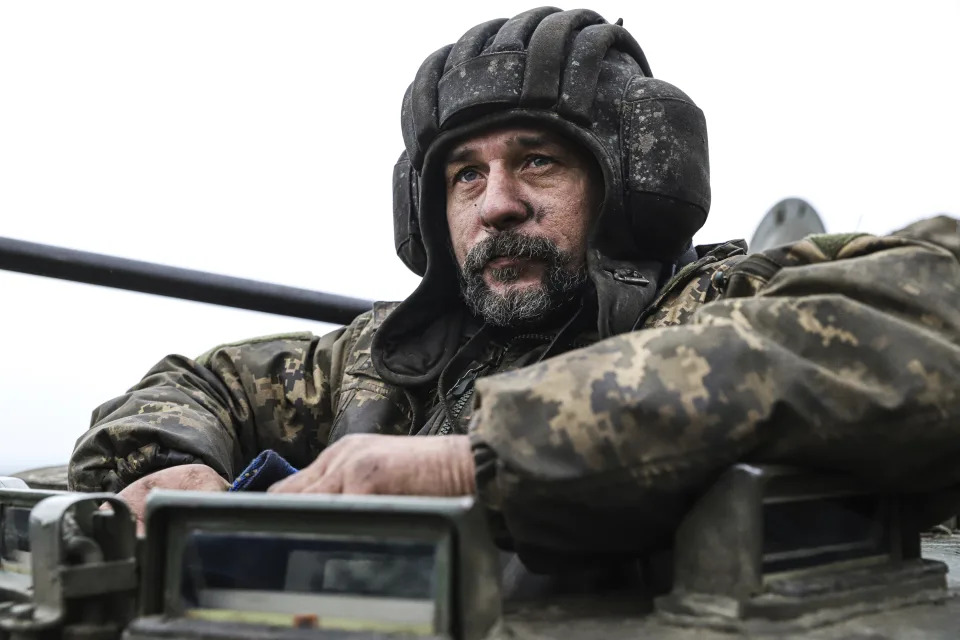
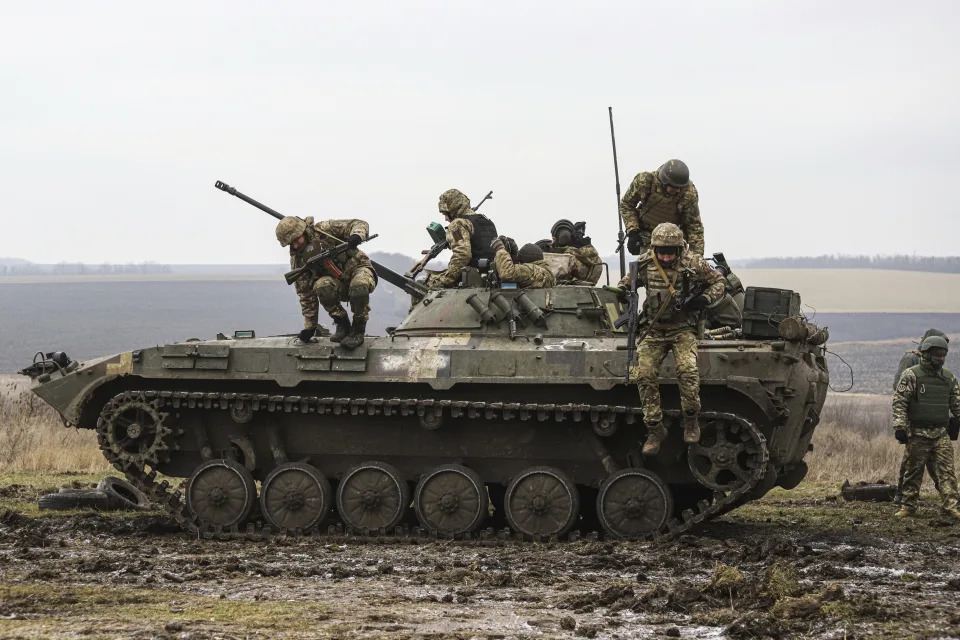
Ukrainian soldiers sit on top of an APC during combat training in Zaporizhzhia region, Ukraine, Tuesday, Jan. 24, 2023. (AP Photo/Kateryna Klochko)A Ukrainian soldier looks out of an APC during combat training in Zaporizhzhia region, Ukraine, Tuesday, Jan. 24, 2023. (AP Photo/Kateryna Klochko)Ukrainian servicemen attend combat training in Zaporizhzhia region, Ukraine, Tuesday, Jan. 24, 2023. (AP Photo/Kateryna Klochko)
KYIV, Ukraine (AP) — Ukrainian forces have conducted an organized retreat from a town in the eastern region of the Donbas, an official said Wednesday, in what is a rare but modest battlefield triumph for the Kremlin after a series of setbacks in its invasion that began almost 11 months ago.
The Ukrainian army retreated from the salt-mining town of Soledar to “preserve the lives of the personnel,” Serhii Cherevatyi, a spokesperson for Ukraine’s forces in the east, told The Associated Press.
The soldiers pulled back to previously prepared defensive positions, he said.
Moscow has portrayed the battle for Soledar, which lies near the city of Bakhmut, as key to capturing the entire Donbas.
The accomplishment takes the Russian forces a step closer to Bakhmut, but military analysts say capturing Soledar is more symbolic than strategic.
Ukraine’s military, which has held out in Soledar against a monthslong onslaught of superior Russian forces, has said its fierce defense of the eastern stronghold helped tie up Russian forces.
Russia claimed almost two weeks ago that it had taken Soledar, but Ukraine denied it.
Many of Russia’s troops around Soledar belong to the private Russian military contractor Wagner Group, and the fighting reportedly has been bloody.
Since its invasion of Ukraine, Moscow has prioritized taking full control of the Donbas — a region made up of the Donetsk and Luhansk provinces, where it has backed a separatist insurgency since 2014. Russia has seized most of Luhansk, but about half of Donetsk remains under Ukraine’s control.
Taking control of the town would potentially allow Russian forces to cut supply lines to Ukrainian forces in Bakhmut, though the strength of Ukraine’s new defensive positions was not known.
The Institute for the Study of War, a think tank in Washington, said earlier this month that the fall of Soledar wouldn’t mark “an operationally significant development and is unlikely to presage an imminent Russian encirclement of Bakhmut.”
The institute said Russian information operations have “overexaggerated the importance of Soledar,” which is a small settlement. It also argued that the long and difficult battle has contributed to the exhaustion of Russian forces.
Perhaps more worrying for Moscow, Western military help for Ukraine is now being stepped up with the delivery of tanks.
Elsewhere, Russian forces have continued to pummel Ukrainian areas, especially in the south and east.
Russian strikes wounded 10 civilians in the eastern Donetsk province on Tuesday, Pavlo Kyrylenko, the provincial governor, said.
Five were wounded when Russian shells slammed into apartment blocks, he said.
The General Staff of the Armed Forces of Ukraine said Wednesday that over the previous 24 hours Russian forces had launched four missile strikes, 26 airstrikes and more than 100 attacks from rocket salvo systems.
Russian forces are concentrating their efforts on establishing control over Donetsk province, conducting offensive operations around the embattled cities of Bakhmut, Lyman and Avdiivka, and the village of Novopavlivka, according to spokesperson Oleksandr Shtupun.
In addition to Donetsk, the Russian attacks struck settlements in the country’s northeastern Kharkiv and Sumy, northern Chernihiv, easternmost Luhansk, southeastern Zaporizhzhia, and southern Kherson provinces.
How Kevin McCarthy Forged an Ironclad Bond With Marjorie Taylor Greene
Jonathan Swan and Catie Edmondson – January 23, 2023
House Minority Leader Kevin McCarthy (R-Calif.), fist bumps with Rep. Marjorie Taylor Greene (R-Ga.) as he arrives for a photo with freshman GOP members of the 117th Congress on the East Steps of the Capitol Building in Washington, on Jan. 4, 2021. (Anna Moneymaker/The New York Times)
WASHINGTON — Days after he won his gavel in a protracted fight with hard-right Republicans, Speaker Kevin McCarthy gushed to a friend about the ironclad bond he had developed with an unlikely ally in his battle for political survival, Rep. Marjorie Taylor Greene of Georgia.
“I will never leave that woman,” McCarthy, R-Calif., told the friend, who described the private conversation on the condition of anonymity. “I will always take care of her.”
Such a declaration from McCarthy would have been unthinkable in 2021, when Greene first arrived on Capitol Hill in a swirl of controversy and provocation. A former QAnon follower who had routinely trafficked in conspiratorial, violent and bigoted statements, Greene was then widely seen as a dangerous liability to the party and a threat to the man who aspired to lead Republicans back to the majority — a person to be controlled and kept in check, not embraced.
But in the time since, a powerful alliance developed between Greene, the far-right rabble-rouser and acolyte of former President Donald Trump, and McCarthy, the affable fixture of the Washington establishment, according to interviews with 20 people with firsthand knowledge of the relationship, many of whom spoke on the condition of anonymity to discuss it.
Their political union — a closer and more complex one than has previously been known — helps explain how McCarthy rose to power atop a party increasingly defined by its extremes, the lengths to which he will go to accommodate those forces, and how much influence Greene and the faction she represents have in defining the agenda of the new House Republican majority.
“If you’re going to be in a fight, you want Marjorie in your foxhole,” McCarthy said. Both he and Greene agreed to brief interviews for this article. “When she picks a fight, she’s going to fight until the fight’s over. She reminds me of my friends from high school, that we’re going to stick together all the way through.”
It is a relationship born of political expediency but fueled by genuine camaraderie, and nurtured by one-on-one meetings as often as once a week, usually at a coffee table in McCarthy’s Capitol office, as well as a constant stream of text messages back and forth.
McCarthy has gone to unusual lengths to defend Greene, even dispatching his general counsel to spend hours on the phone trying to cajole senior executives at Twitter to reactivate her personal account after she was banned last year for violating the platform’s coronavirus misinformation policy.
Greene, in turn, has taken on an outsize role as a policy adviser to McCarthy, who has little in the way of a fixed ideology of his own and has come to regard the Georgia congresswoman as a vital proxy for the desires and demands of the right-wing base that increasingly drives his party. He has adopted her stances on opposing vaccine mandates and questioning funding for the war in Ukraine, and even her call to reinvestigate the Jan. 6, 2021, attack on the Capitol to show what she has called “the other side of the story.”
McCarthy’s agenda, Greene said, “if he sticks to it, will easily vindicate me and prove I moved the conference to the right during my first two years when I served in the minority with no committees.”
‘Kevin Did This to You’
It was a right-wing conspiracy theory that first came between McCarthy and Greene, but not in the way that many people think.
When Greene entered Congress in January 2021, Republican leaders viewed her as a headache, and McCarthy regarded her as potentially beyond redemption. During her primary, social media posts had emerged in which she embraced the QAnon conspiracy theory and warned of “an Islamic invasion of our government.”
Rep. Steve Scalise of Louisiana, the No. 2 Republican, had intervened to oppose Greene — an affront she would not forget — but McCarthy, who eschews confrontation and conflict, would not go that far. He issued a statement through a spokesperson condemning the statements, but did not endorse her opponent.
Weeks after Greene was sworn in, more conspiracy-laden posts surfaced, including diatribes in which she had questioned whether a plane really flew into the Pentagon on Sept. 11, 2001, and endorsed the executions of Democratic politicians including Speaker Nancy Pelosi and President Barack Obama.
Outraged Democrats demanded that McCarthy oust her from congressional committees, and when he made no move to do so, they scheduled a vote to do it themselves. As the pressure built, some of Greene’s far-right allies told her yet another conspiratorial story that she believed: McCarthy, they said, was secretly working with Pelosi to strip her of power.
Enraged, Greene stormed into McCarthy’s office in the Capitol late one night in February 2021 and handed him a letter signed by Republican leaders in her district, urging him to keep her on her committees. They had received “countless” messages, they said, from their voters who were intent on supporting her.
It served as a not-so-subtle warning to McCarthy that the Republican base would be outraged if he did not ensure she kept her committee seats. McCarthy tried to explain to Greene that he agreed that what Democrats were doing was outrageous, but that as minority leader, he had neither the power nor the votes to stop it.
But Greene did not believe McCarthy, a person familiar with her thinking said. After she was booted off the Education and Budget Committees, members of her inner circle told her, “Don’t forget: Kevin did this to you.”
‘The Principal’s Office’
The relationship remained fraught throughout Greene’s first year in Congress, as the same pattern played out again and again in their interactions. A controversy would erupt over an outrageous comment Greene had made, then McCarthy would summon her to deal with the matter privately.
Greene would joke to friends, “Uh-oh, I’ve been called to the principal’s office.”
But even as she continued to traffic in offensive conspiracy theories and spoke at a white nationalist rally, McCarthy refused to punish her and often refrained from even criticizing her comments until pressed by reporters. It was a calculated choice by McCarthy, who leads more by flattery and backslapping than through discipline.
And by early 2022, Greene had begun to believe that McCarthy was willing to go to bat for her. When her personal Twitter account was shut down for violating coronavirus misinformation policies, Greene raced to McCarthy’s office in the Capitol and demanded that he get the social media platform to reinstate her account, according to a person familiar with the exchange.
Instead of telling Greene that he had no power to order a private company to change its content moderation policies, McCarthy directed his general counsel, Machalagh Carr, to appeal to Twitter executives. Over the next two months, Carr would spend hours on the phone with them arguing Greene’s case, and even helped draft a formal appeal on her behalf.
The efforts were unsuccessful at the time, but they impressed Greene and revealed how far McCarthy was prepared to go to defend her. It was part of a broader and methodical courtship of the hard right by McCarthy that included outreach to conservative media figures and Trump’s hard-line immigration adviser Stephen Miller.
He had studied the two previous Republican speakers of the House, former Reps. John Boehner of Ohio and Paul Ryan of Wisconsin, a person familiar with his thinking said, and concluded that one of their fatal errors had been unnecessarily isolating far-right members, who in turn made their lives miserable. So McCarthy set out to do the opposite.
Approaching Symbiosis
Still, the alliance between McCarthy and Greene did not truly begin to flourish for several more months. At a party in the Dallas suburbs at the home of Arthur Schwartz, a GOP consultant and outside adviser to McCarthy, Greene found herself in the corner of a great room chatting with Devin Nunes, a former top Republican on the Intelligence Committee and a committed Trump ally.
Nunes told Greene about the time he had witnessed McCarthy yelling at Rep. Steny Hoyer, D-Md., who was then the majority leader, for his party’s decision to remove Greene from her committees, and threatening that he would do the same to Democrats when Republicans came to power.
Greene recalled it as the first time she had heard from somebody she trusted that McCarthy had defended her, rather than conspired with Democrats to blackball her.
“That conversation had a big impact on me,” she said.
From then on, the two settled into a kind of symbiotic relationship, both feeding off what the other could provide. Greene began regularly visiting McCarthy, frequently dropping by his office, and he began inviting her to high-level policy discussions attended by senior Republicans and praising her contributions.
He was impressed not only by Greene’s seemingly innate understanding of the impulses of the party’s hard-right voters, but also by her prowess at building her own brand. He once remarked to allies with wonder at how Greene, as a freshman, was already known by a three-letter monogram: MTG. “She knows what she’s doing,” McCarthy marveled privately. “You’ve got AOC and MTG.”
After Republicans underperformed expectations in the midterm elections, winning only a narrow majority and guaranteeing that McCarthy would have a tough fight to become speaker, Greene was quick to begin barnstorming the right-wing media circuit as one of his top surrogates, using her conservative credentials to vouch for his.
As her peers on the far-right flank of the party refused to support McCarthy, subjecting the Republican leader to a four-day stretch of defeats, Greene was unflinching in her support, personally whipping votes on the House floor and strategizing on calls with Trump.
Greene’s support for McCarthy created a permission structure for other GOP lawmakers to do the same.
Rep. Barry Moore, R-Ala., said in an interview that when conservatives back home sought an explanation for his support for McCarthy, he would comfort them by replying: “Well, Jim Jordan and Marjorie Taylor Greene are standing with Kevin McCarthy. And so am I.”
The relationship has also paid off for Greene, no longer the fringe backbencher stripped of her power. Republican leaders announced last week that she would serve on two high-profile committees: Oversight and Homeland Security. She is also likely to be appointed to a new Oversight select subcommittee to investigate the coronavirus, according to a source familiar with McCarthy’s thinking who was not authorized to preview decisions that have yet to be finalized.
It is already clear that she is influencing McCarthy’s policy agenda.
After Greene had told McCarthy that vaccine mandates were morally wrong and that he needed to stop them, he fought vociferously — and successfully — to include the repeal of the military coronavirus vaccine mandate in last year’s defense bill.
After she told him that the party faithful could not understand why Congress continued to send money to help Ukraine secure its borders, when the United States’ southern border was not secure, McCarthy helped pave the way for Republicans on the Foreign Affairs Committee to put forward and support a bill sponsored by Greene, who does not sit on the panel, demanding that Congress audit U.S. aid sent to Ukraine.
And after she told McCarthy that many people imprisoned for their actions during the Jan. 6 attack on the Capitol were being victimized, he signaled that Republicans would start an inquiry of their own digging into the work of the panel that was investigating the assault.
“People need to understand that it isn’t just me that deserves credit,” Greene said. “It is the will and the voice of our base that was heard, and Kevin listened to them. I was just a vehicle much of the time.”
In the early hours of Jan. 7, after McCarthy had finally clinched the speakership on the 15th ballot and pallets of Champagne were being wheeled into his new office, Greene opted not to join the celebration. But she sent him a text message the next day telling McCarthy how happy and proud she was — and how she could not wait to get started.
Ukraine’s battlefields look like World War I but with a new and terrifying addition that leaves troops with almost nowhere to hide
John Haltiwanger – January 22, 2023
Ukraine’s battlefields look like World War I but with a new and terrifying addition that leaves troops with almost nowhere to hide. A Ukrainian paratrooper takes shelter in a trench from a BM-21 Grad multiple rocket launcher attack on July 5,2022 in Seversk, Ukraine.Laurent van der Stockt/Getty Images
The conflict in Ukraine has emerged as the first major war involving drone use on both sides.
Experts say that drones have made artillery even more lethal, and are changing the face of warfare.
The debate over whether drones would matter in a conventional war is now over, one expert said.
Trench warfare, relentless artillery, gains measured in mere meters, and heavy casualties on both sides. The battlefields of Ukraine resemble those of World War I, but with a new and terrifying reality — the incessant buzzing of drones, harbingers of death and destruction that are constantly watching from above.
The Ukraine war has essentially become “World War I with 21st century ISR [Intelligence, Surveillance and Reconnaissance],” Mark Cancian, a retired US Marine Corps colonel and senior adviser at the Center for Strategic and International Studies, told Insider.
Ukrainian soldiers work in their artillery unit in the direction of Marinka, 15 January 2023.Diego Herrera Carcedo/Getty ImagesUkrainian soldiers in a trench on the Vuhledar frontline in Donetsk oblast, 5 January 2023.Diego Herrera Carcedo/Getty Images
Both Ukraine and Russia have used drones of all shapes and sizes to spy on each other and to strike targets on a scale that’s never been seen before, and it’s changing the face of warfare. Drones are being used to locate enemy positions and direct fire, crash into and destroy buildings in “kamikaze” attacks, and drop bombs on tanks.
With much of the fighting occurring in rural areas with large open fields that are often dangerous to cross — a modern equivalent of WWI’s horror-filled “No Man’s Land” — drones have proven to be an extremely useful and deadly tool. Both sides are using drones equipped with cameras or other sensors that offer a livestream that can be watched on a laptop or digital tablet to scout out the enemy and coordinate attacks from afar.
Drones have played an important role in adjusting artillery fire and confirming that targets were hit or destroyed. They’re an eye in the sky on the battlefield in Ukraine that’s making artillery even deadlier.
As fighting rages in Ukraine's Donetsk region, Russian forces near the city of Bakhmut are said to be exhausted. Ukrainian troops rely on their air reconnaissance. A drone unit known as The Wings of Madyar provides real-time information to Ukrainian artillery batteries. pic.twitter.com/xJhysmsxIb
“Unmanned systems have been used in greater and greater numbers in conflicts over the last decade, but the Ukraine war took it to a new level. But it is not just about the numbers, but the type of war. Up to last year, there was an active debate as to whether drones could play a role in conventional war, instead of just missions like Afghanistan,” P.W. Singer, a leading expert on modern warfare and senior fellow at the New America think tank in Washington, told Insider.
“That debate is now over,” Singer added.
‘The future of warfare’
Ukrainian servicemen fly a drone on the outskirts of Bakhmut, eastern Ukraine on December 30, 2022.Sameer Al-Doumy/Getty Images
Unmanned aerial vehicles, commonly known as drones, have been used in various capacities in warfare for generations. Some researcherspoint to Austria’s use of pilotless hot-air balloons to bomb Venice in 1849 as the first example.
The US began developing unmanned aircraft as far back as World War I. Remotely piloted aircraft were used for surveillance during the Cold War, and unmanned technology gradually advanced over the 20th century. By the late 1990s, Predator drones were being used by the US and NATO for reconnaissance missions in the Kosovo War.
But it was the onset of the war on terror that saw the use of drones rise exponentially and move away from primarily being employed for reconnaissance. In the years since the 9/11 terror attacks, the US military and CIA have used drones for the surveillance and targeted killings of suspected terrorists in places like Afghanistan, Pakistan, Somalia, and Yemen.
Armed drones have also been used in other conflicts, including in fighting between Azerbaijan and Armenia. Drones have become increasingly attractive to militaries worldwide as the technology has advanced and gotten cheaper. These systems can gather intelligence and execute missions that might otherwise risk the life of a pilot and cost less than building a traditional air force.
The war in Ukraine, however, marks the first time that we’ve seen drones employed in a conflict involving major powers and modern armies on both sides and used so “extensively and over an extended period of time,” Cancian said.
Ukraine has in many ways emerged as a guinea pig for drone warfare. A wide array of unmanned aerial vehicles produced everywhere from the US to China and from Turkey to Iran have been used in battle.
In the early days of the fighting, Ukraine saw success using the Turkish-made Bayraktar TB2 drone to rain hell from above on key Russian assets like armored vehicles. A Bayraktar — which has a range of 186 miles, is the size of a small plane, and is capable of carrying laser-guided bombs — was involved in the attack that sank the Moskva, the flagship of Russia’s Black Sea fleet.
The Turkish-made Bayraktar TB2 drone has been a key instrument used by the Ukrainian military to repel Russian forces.Anadolu Agency/Getty Images
Later in the war, Russia began launching swarms of Iranian-made Shahed-136 “kamikaze” drones, striking targets across Ukraine. The Shahed-136 is a loitering munition — designed to linger or loiter before locating a target and crashing into it. It’s less than 12 feet long, can fly at 115 mph, contains an explosive warhead in its nose, and explodes on impact. These single-use drones are relatively cheap ($20,000 each) and have been used by Russia to destroy vital civilian infrastructure and make life even harder for Ukrainians.
The US has also provided Ukraine with hundreds of Switchblade drones, a type of loitering munition or kamikaze drone, which can be carried in backpacks. Switchblades can be used to strike infantry, armor, and artillery.
“We’re seeing the first use of swarm drones with what have been called ‘kamikaze’ drones, these Iranian Shahed-136s and all of their various relatives — that’s new,” Cancian said, adding, “A lot of people have pointed to that as the future of warfare.”
Ukraine’s Air Force says it shot down six of Russia’s Iranian Shahed-136 kamikaze drones and one Su-25 in the south. But two Shahed-136 drones did strike a building in Odesa, destroying it and killing one person. Video below shows the drones over the city. pic.twitter.com/mLR4d2H0kd
Singer said the Russian military’s use of drones to strike civilian targets sets a dangerous precedent for the future of war.
“It is a parallel to the German use of V-1 missiles towards the end of World War II,” he said. “A nation hoping a new technology will make up for its losses on the battlefield, by terrorizing the home-front.”
Firefighters work after a drone attack on buildings in Kyiv, Ukraine, Monday, Oct. 17, 2022.Roman Hrytsyna/Associated Press
‘They’re always being watched’
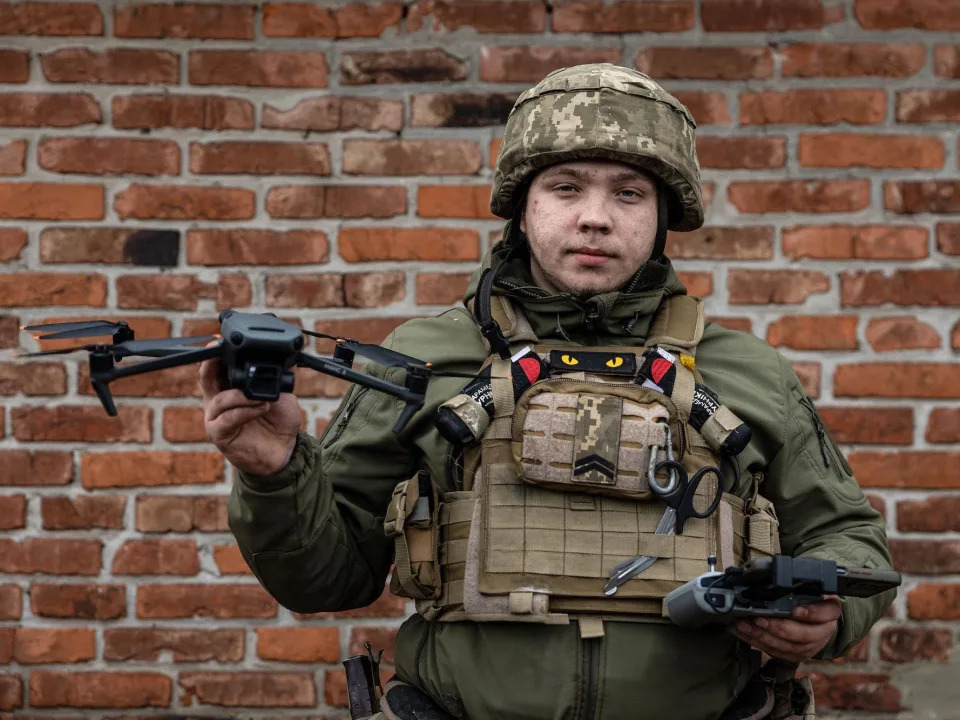
The most prevalent drone on the battlefield in Ukraine can fit in your hand. Indeed, military analysts have been particularly surprised by the heavy reliance on small civilian or commercial drones such as the Chinese-made DJI Mavic 3, which cost less than $3,000 online.
These drones are being used for reconnaissance but have also been weaponized, with soldiers rigging them with improvised explosive devices or grenades.
“Both Ukraine and Russia are now using them in literally hundreds. Every small infantry unit now has one or more flying for them. It was not something that militaries had been training for,” Singer said of the use of cheap commercial drones in Ukraine.
Drones are not necessarily the most important or impactful tool being used in Ukraine, but they’re making other weapons more accurate.
“If you wanted to seek out enemy positions in the past, you would have had to send out special forces units… and you might have lost some troops,” Marina Miron, a defense researcher at Kings College London, told BBC News in early January. “Now, all you’re risking is a drone,” Miron added.
The surveillance element has been significant, with troops on the front line in Ukraine reporting that drones are “always around,” Cancian said, adding, “They’re always being watched.”
A Ukrainian serviceman poses with a drone on the outskirts of Bakhmut, eastern Ukraine on December 30, 2022.Sameer Al-Doumy/Getty ImagesA Ukrainian serviceman shoots at a Russian drone with an assault rifle from a trench at the front line east of Kharkiv on March 31, 2022.Fadel Senna/Getty Images
“We’ve had overhead reconnaissance for a long time, but the scale of it is new and also the ability to connect that with fire support,” Cancian said. “It’s one thing to get a picture of a target and be able to do something about it 24 or 48 hours later, as opposed to being able to do something in 10 minutes.”
Drones have significantly shortened the so-called kill chain, Cancian explained, helping troops swiftly locate targets and provide coordinates for artillery. “Kill chain” is a military phrase or concept referring to the stages of an attack, from identifying a target to engaging it and assessing the damages.
The war in Ukraine has shown that drones are “as essential” in battle as artillery or tanks, Singer said, adding that “drones have arguably been most valuable not in launching their own missiles, but in making Ukrainian artillery so lethal, in pinpointing their fires.”