‘Little by little they are winning’: Tide turns in key Ukraine city. Live updates as Russian offensive begins.
John Bacon, USA TODAY – February 13, 2023
Russia has already begun its expected spring offensive in Ukraine, sending thousands of additional troops in an attempt to overwhelm Ukraine’s defenses, NATO Secretary-General Jens Stoltenberg said Monday.
“The reality is that we have seen the start already,” Stoltenberg said. “We see how they are sending more troops, more weapons, more capabilities.”
Stoltenberg, speaking ahead of a two-day meeting of defense ministers in Brussels, confirmed Ukraine claims that Russian troops appeared to be pushing forward with little regard for their own heavy losses. And he said NATO plans to increase its ammunition stockpiles that have been depleted by the war.
A proposal to provide fighter jets to Ukraine would be discussed, Stoltenberg said, denying Russian assertions that providing them would make NATO countries “direct” parties to the conflict.
►In the the Luhansk region of the Donbas, Russian troops pulled back after several days of intense fighting near Kreminna, Luhansk Gov. Serhii Haidai told Ukrainian TV.
►In the partially occupied southern region of Kherson, artillery hit more than 20 cities and villages – including the regional capital recaptured by Ukrainian forces in November.
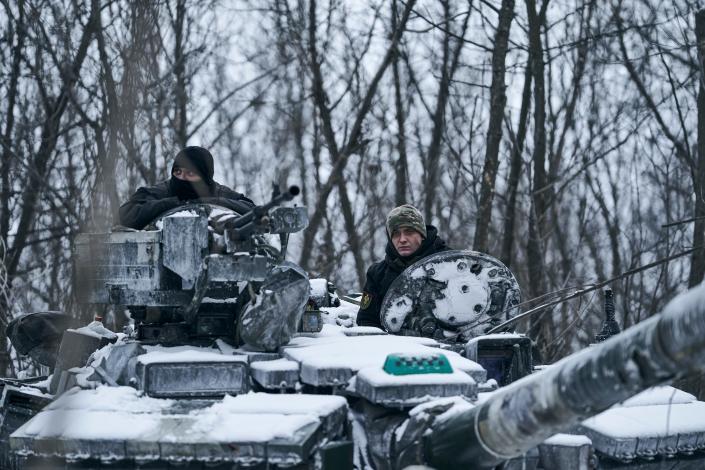
A Ukrainian tank rides to its position in the frontline in Bakhmut, Donetsk region, Ukraine, on Feb. 12, 2023.
Russia gains ground in Bakhmut: ‘Little by little they are winning’
The battle for the pivotal city of Bakhmut in Ukraine’s eastern Donbas region has seen some of the fiercest fighting of the invasion. Ukraine President Volodymyr Zelenskyy’s office said the situation in Bakhmut’s northern suburb of Paraskoviivka was “difficult” amid intense shelling.
Donetsk Gov. Pavlo Kyrylenko said Russian forces appeared to be adding manpower: “We’re seeing a very tough battle in which the Russians aren’t sparing neither themselves nor us.”
Moscow controls both main roads into the city, leaving one back route left – a slender supply line, the BBC reports.
“They have been trying to take the city since July,” Iryna Rybakova, press officer for Ukraine’s 93rd Brigade, told BBC. “Little by little they are winning now. They have more resources, so if they play the long game they will win. I can’t say how long it will take.
“Maybe they will run out of resources. I really hope so.”
Moldovan leader urges vigilance, says Russia sough to subvert government
Moldova’s president claimed Monday that Moscow was plotting to overthrow her government with the aid of external saboteurs to put the nation “at the disposal of Russia” and derail its European Union aspirations. President Maia Sandu said her nation’s intelligence services had confirmed plans – intercepted by Ukraine – developed by the Russian secret services to destroy Moldova’s democracy.
“I want to ask you to stay vigilant, be attentive and trust the official information, as the most aggressive form of attack is the information attack,” she said. “The Kremlin’s attempts to bring violence in our country will fail. We should keep calm. We should trust the Republic of Moldova.”
Ukraine officials blast former Italian premier Berlusconi
Ukraine officials took former Italian Prime Minister Berlusconi to task Monday after he blamed Zelenskyy for the war. Belusconi, breaking with current Italian Prime Minister Giorgia Meloni on the conflict, said Russia would not have invaded Ukraine if Zelenskyy “would have ceased attacking the two autonomous republics of Donbas.”
Meloni’s office said her government maintains “solid and unwavering” support for Ukraine. Kyiv officials were more dramatic in their dissent.
“Berlusconi’s senseless accusations against Zelenskyy are an attempt to kiss Putin’s hands, bloodied up to the elbows,” Ukrainian Foreign Ministry Spokesman Oleg Nikolenko said on Facebook. He accused Berlusconi, a Putin supporter, of trying to “show his loyalty to the Russian dictator.”.
Russia ‘suffering unprecedented battlefield casualties’
Jessica Abrahams – February 12, 2023
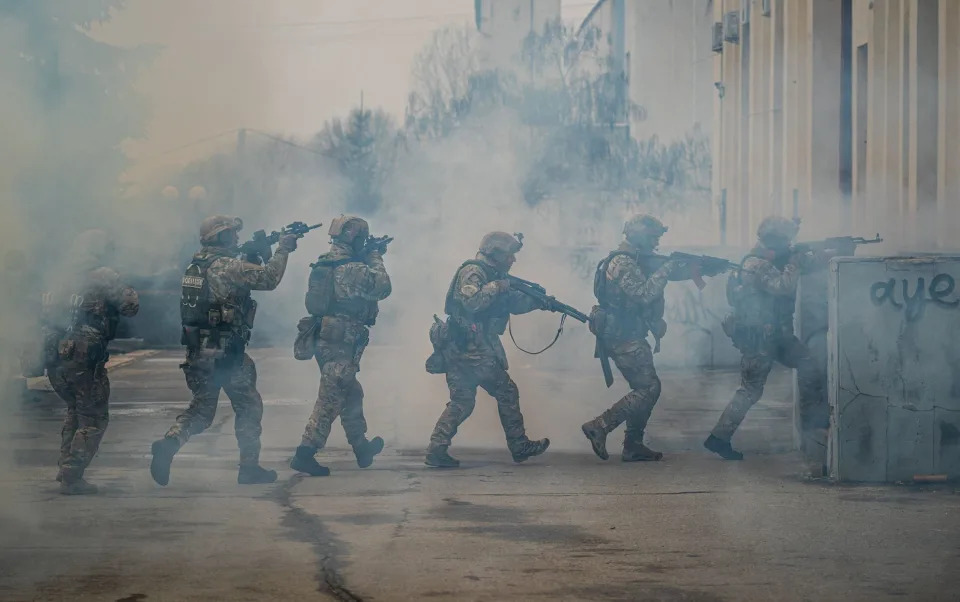
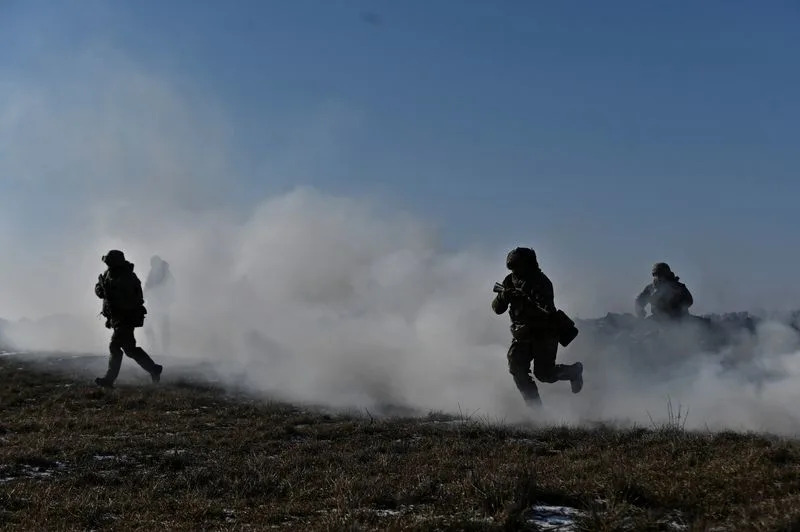
A line of Ukrainian soldiers proceed through a cloud of smoke, their guns raised, as they take part in training – Dimitar DILKOFF / AFP
Russia is suffering unprecedented casualties on the battlefield, according to the UK Ministry of Defence, as Ukraine reported Russia’s deadliest day of the war so far over the weekend.
In its intelligence update on Sunday, the MoD said Moscow’s military has “likely suffered its highest rate of casualties” in the past two weeks, citing casualty statistics released by Ukraine.
Battlefield casualties are difficult to estimate, and Ukrainian figures on Russian losses have sometimes been higher than estimates from Western officials. But while the MoD said it “cannot verify Ukraine’s methodology, the trends the data illustrate are likely accurate”.
According to that data, Russia is suffering an average of more than 800 casualties a day, more than four times the reported rate in June and July last year.
“The uptick in Russian casualties is likely due to a range of factors including lack of trained personnel, coordination, and resources across the front,” the MoD noted. It added that “Ukraine also continues to suffer a high attrition rate.”
On Saturday, Ukraine’s ministry of defence reported that 1,140 Russian fighters had been killed in the previous 24 hours – the highest daily tally of the war so far – bringing its total estimated losses to 136,880 since the conflict began.
While Ukraine provides daily updates, Western officials have only rarely provided casualty estimates. However, the New York Times reported earlier this month that senior US officials believed nearly 200,000 Russians had been killed or wounded.
That echoed an estimate in January from Eirik Kristoffersen, Norway’s defence chief, who said 180,000 Russians may have been killed or wounded compared with around 100,000 Ukrainian servicemen, alongside 30,000 civilian deaths.
However, he added that there was “much uncertainty” around those figures.
The soaring casualty estimates follow weeks of brutal but largely fruitless fighting in the east, with Moscow believed to be making minimal advances.
Russia, showing its advantage from the skies, attacked crucial infrastructure, sending much of the country into another blackout. Zelensky, who asked Europe for fighter jets and air protection, used the attack to underscore what he is missing most in the invasion-turned-war.
The southern city of Zaporizhzhia—which took 35 incoming missiles—and the western city of Khmelnytskyi were particularly hard hit in the Friday attack. Zelensky had warned that Russia would ramp up its offensive in the coming months and that fighter jets especially would be most helpful.
Europe has so far sent tanks and munitions and air-defense systems, but has resisted sending U.S. made fighter jets. They formally asked the Netherlands for help, which was met with hesitencey. “Ukraine has indeed requested to also help with fighter jets,” Netherlands Defense Minister Kajsa Ollongren said. “We always take all of Ukraine’s requests very seriously. They are fighting that war, they are being attacked by Russia. But fighter jets, that is very complex.”
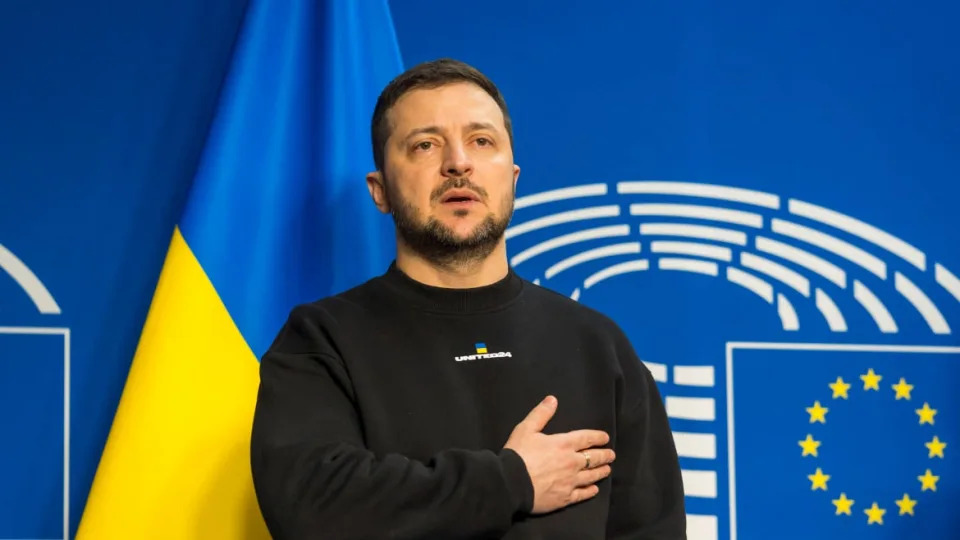
Despite a cozy dinner between Emmanuel Macron and Zelensky on the eve of his address to the European Parliament, France has also denied Zelensky the weapons it really wants—at least for the moment. “There is no way that fighter planes can be delivered in the next few weeks, as time is needed for training, delivery, and training for planes unfamiliar to Ukrainian pilots,” Macron said. “So I am not ruling it out.”
Reluctance to give Ukraine stronger airpower and even longer range missiles is hinged on fears that Ukraine could then attack Russia inside its own territory—which could drastically change the face of the year-old conflict.
Bomber jets take off in Russia, threatening new attacks on Ukraine
Ukrainska Pravda – February 10, 2023
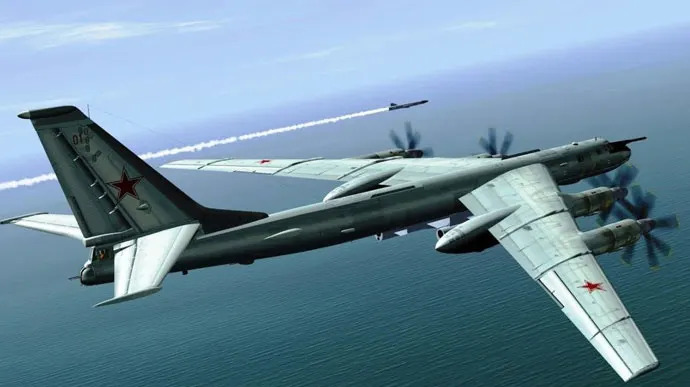
Kyiv City Military Administration has said that several Russian Tu-95 strategic bomber jets took off on the morning of 10 February and has urged Ukrainians to heed air-raid sirens amid fear of a new missile attack.
Source: Kyiv City Military Administration on Telegram; Operational Command Pivden (South) on Facebook
Quote from Serhii Popko, Head of Kyiv City Military Administration: “The enemy has deployed Tu-95 strategic bomber jets that can carry cruise missiles. There is a significant threat of a missile strike. I stress once again: do not ignore air-raid sirens. Find shelter as soon as they are sounded.”
Details: Operational Command Pivden (South) reported that Russia has deployed three missile carriers, including one submarine, with a total array of up to 20 missiles, in the Black Sea soon after the storm in the Black Sea quietened down on the morning of 10 February.
Air-raid sirens were sounded across all of Ukraine at 08:30 Kyiv time.
Background:
Russian forces deployed reconnaissance drones on 9 February; Ukraine’s air defence forces shot down one of them.
Russian forces also deployed Shahed-131/136 attack drones to carry out attacks on Ukraine on the night of 9–10 February.
Dozens of Russian missiles hit Kharkiv, Zaporizhzhia and Dnipro soon after the drone attack.
Around 10 explosions rocked Kharkiv, and Russia struck Zaporizhzhia 17 times within an hour.
Journalists fight on their own frontline. Support Ukrainska Pravda or become our patron!
‘They’re Hunting Me.’ Life as a Ukrainian Mayor on the Front Line
Jeffrey Gettleman – February 10, 2023
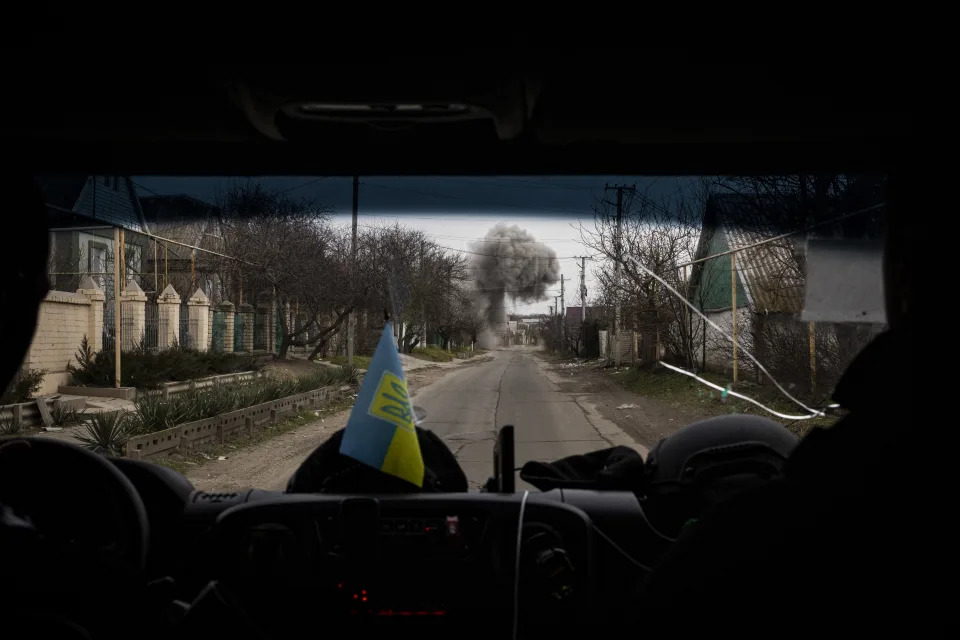
Smoke and dust waft in the air seconds after a Russian shell landed near the road in a suburb of Kherson, Ukraine, Feb. 4, 2023. (Ivor Prickett/The New York Times)
KHERSON, Ukraine — The little green van sped down the road, the Russian forces just across the river. Inside, Halyna Luhova, the mayor of Kherson, cradled a helmet in her lap and gazed out the bulletproof window.
When the first shell ripped open, directly in the path of the van, maybe 200 yards ahead, her driver locked his elbows and tightened his grip on the wheel and drove straight through the cloud of fresh black smoke.
“Oh my God,” Luhova said, as we raced with her through the city. “They’re hunting me.”
The second shell landed even closer.
She’s been almost killed six times. She sleeps on a cot in a hallway. She makes $375 a month, and her city in southern Ukraine has become one of the war’s most pummeled places, fired on by Russian artillery nearly every hour.
But Luhova, the only female mayor of a major city in Ukraine, remains determined to project a sense of normality even though Kherson is anything but normal. She holds regular meetings — in underground bunkers. She excoriates department heads — for taking too long to set up bomb shelters. She circulates in neighborhoods and chit-chats with residents — whose lives have been torn apart by explosions.
She chalks up any complaints about corruption or mismanagement — and there are plenty — to rumor-mongering by Russian-backed collaborators who are paid to frustrate her administration.
Kherson, a port city on the Dnieper River, was captured by Russian forces in March; liberated by Ukrainian forces in November; and now, three months later, lies nearly deserted. Packs of out-of-school children roam the empty boulevards lined with leafless trees and centuries-old buildings cracked in half.
Luhova sees her job defined by basic verbs: bury, clean, fix and feed. Of the 10% or so of Kherson’s original population of 330,000 who remain, many are too old, too poor, too stubborn or too strung out to flee.
She recently became so overwhelmed with their needs — for food, water, generators, internet access, buses, pensions, medicine, firewood — that she said she dropped to 40 minutes of sleep a night and became so exhausted, she had to be put on intravenous drugs. She feels better, she said, though not exactly calm.
“We need those bomb shelters, now,” she snapped at a meeting in early February, when it was several degrees below freezing outside.
In front of her, in an underground office, sat the heads of the city’s main departments, many in winter jackets and hats. The office had no heat.
She was pushing to acquire dozens of free-standing concrete bomb shelters. When an administrator responded that the contracting process needed to be followed or they could be accused of corruption, she exploded.
“You are doing nothing, and I’m getting really pissed off at your stupidity,” Luhova said. “I feel like I don’t have enough air when I’m standing next to you! You will answer in your own blood, your own blood!”
The administrator rolled his eyes and went outside to smoke a cigarette.
In a political culture dominated by macho guys — the mayor of the capital of Kyiv, for instance, is a towering former heavyweight boxing champion — Luhova, 46, in her gray suede boots and black puffy jacket with the fake fur collar, cuts a different figure. Raised by a single mom during the Soviet Union’s last gasps, she laughed thinking about the hardships back then.
“All those terrible lines for beet root — imagine, beet root!” she said.
By the time she was 21, Ukraine was newly independent and she was teaching English at a neighborhood school, married and a mother. She climbed the ranks to school director, which she used as a springboard to be elected to Kherson’s city council eight years ago. Before the Russian invasion last February, she was the council’s secretary, considered the No. 2 official.
Russian forces burned down her house in March, and she left the city shortly after. The Russians tried to make Kherson part of Russia, forcing children to learn Russian in schools and people to use Russian rubles in the markets. In June, they kidnapped her boss, Kherson’s prior mayor, and he hasn’t been seen since. Luhova took his place and became head of Kherson’s military administration.
When she returned in November, she found a city ecstatic that the Russians had been driven out but in terrible shape. The Russians had looted everything from water treatment equipment and centuries-old fine art to Kherson’s fleet of firetrucks and buses. But the Russians didn’t go far.
Ukraine didn’t have the momentum or spare troops to pursue them across the river. So now the Russians sit on the opposite bank across from Kherson and fire at will.
No city in Ukraine, outside the Donbas region in the east where the Russians are advancing, is getting shelled as badly as Kherson. In the past 2 1/2 months, Ukrainian officials said, it has been hit more than 1,800 times.
The shells come with no warning. There are no air raid sirens. These are projectiles fired from tanks, artillery guns, mortars and rocket launchers that blow up a few seconds later — the Russians are that close, less than half a mile in some places. Residents have almost no time to take cover.
The other afternoon, a rocket attack killed two men walking down a sidewalk. There was no military installation nearby.
“Russia’s precise rationale for expending its strained ammunition stocks here is unclear,” said a recent British Defense Intelligence update on Kherson.
Since mid-November, Ukrainian officials say the Russians have wounded hundreds of residents and killed more than 75.
“It’s just revenge,” Luhova said. “There’s an old saying: “If I can’t have it, nobody can,’’’ she said, trying to explain why the Russians would shell the city after retreating. “It’s that stupid but it’s true.”
Kherson may be a war-torn city on the front line of Europe’s deadliest conflict in generations, and Luhova may represent Ukraine’s never-give-up spirit that keeps a Russian flag from flying over this country.
But as in any other city, residents love complaining about their mayor.
“I’ve called more than a hundred times to have my electricity fixed and nobody comes,” said Olena Yermolenko, a retiree who helped run a cell of citizen spies during the Russian occupation. She also repeated accusations on social media that the mayor was stealing humanitarian aid, which Luhova strongly denied.
Oleksandr Slobozhan, executive director of the Association of Ukrainian Cities, said that from everything he knew, the accusations were a smear campaign by pro-Russian agents.
Despite the challenges, Luhova is determined to keep the city running, in the most basic ways. She recently traveled to Kyiv to ask Slobozhan for 20 buses.
“We are paralyzed,” she said. “Our trolleys don’t work and we can’t fix them because when our workers go up to repair the lines, the snipers are killing them.”
She left with a promise of 20 buses.
“I like the way she works,” Slobozhan later said. “She goes forward no matter what.”
Luhova is planning to attend a donor’s conference in Poland later this month; she has been out of the country only a few times in her life. Where she really wants to go is Bali.
“I heard you go there and you come back looking younger,” she joked.
Her husband is a taxi driver in another city, and her two adult sons live far away so she is on her own in Kherson. Most days, she can be found moving around in her little green van.
When we rode along with her, and the shell exploded on the road, her driver turned around as fast as he could.
But the Russians were tracking her. From across the river, they fired a second round. It slammed into a house along the road, and the blast wave shook the van. The van kept going but the munition felt lethally intimate.
That evening, at a house where she stays with friends, on a small pullout bed in a hallway off the kitchen, Luhova shrugged off the close call.
Over a spread of deliciously crunchy homemade pickles and little squares of Brie, she held a glass of cognac between her fingers and made a toast to victory.
“If I could disappear into the air and end this war, I would,” she said. “I’d easily sacrifice myself for ending this hell.”
Russian missiles pound Ukraine’s energy system, force power outages
Olena Harmash – February 10, 2023
Smog is seen during a shelling in the front line city of BakhmutUkrainian service members attend military exercises in Zaporizhzhia region
KYIV (Reuters) – Russia unleashed a new wave of missile strikes on energy infrastructure across Ukraine on Friday, causing emergency power outages for millions of people and prompting new calls by Kyiv for Western arms.
Ukraine’s air force said Russia had fired 71 cruise missiles, of which 61 were shot down, and explosions were reported by local officials around the country including in the capital Kyiv.
At least 17 missiles hit the southeastern city of Zaporizhzhia in an hour in the heaviest attack since Russia invaded Ukraine in February last year, local officials said.
Energy Minister German Galushchenko said thermal and hydro power generation facilities and high-voltage infrastructure had been hit in six regions, forcing emergency electricity shutdowns across most of the country.
“The most difficult situation is in Zaporizhzhia, Kharkiv and Khmelnytskyi regions,” he said, referring to regions in the southeast, northeast and west of Ukraine.
“Thanks to the successful work of the air defense forces and early technical measures, it was possible to preserve the integrity of the energy system of Ukraine. Energy workers are working non-stop to restore energy supply.”
DTEK, Ukraine’s largest private energy company, said four of its thermal power stations had been damaged and two energy workers injured. Water supplies were also hit in some areas, local officials said.
There was no immediate word of any deaths but Oleh Synehubov, governor of the Kharkiv region, said eight people had been wounded.
KYIV WANTS QUICK DECISIONS
The new Russian attacks followed a rare trip abroad this week by Ukrainian President Volodymyr Zelenskiy that included talks with European Union leaders in Brussels aimed at securing more weapons for Ukraine including fighter jets.
“Russia has been striking at Ukrainian cities all night & morning,” presidential adviser Mykhailo Podolyak wrote on Twitter. “Enough talk & political hesitation. Only fast key decisions: long-range missiles, fighter jets, operational supplies logistics for Ukraine.”
Valeriy Zaluzhnyi, commander-in-chief of Ukraine’s armed forces, said two Russian Kalibr missiles launched from the Black Sea had flown through the airspace of Moldova and NATO member Romania before entering Ukraine.
President Volodymyr Zelenskiy said these missiles were a challenge to the military alliance and to collective security.
“These missiles are a challenge to NATO and collective security. This is terror that can and must be stopped,” he said in a video on Telegram messaging app.
Russia did not immediately comment. Moldova confirmed its airspace had been violated by a Russian missile and summoned the Russian ambassador to protest. Romania said a Russian missile launched off a ship near Crimea crossed into Moldovan airspace before hitting Ukraine but did not enter Romanian airspace.
Ukraine could have shot down the missiles but did not do so because it did not want to endanger civilians in foreign countries, the Ukrainian air force spokesperson said.
Russia has carried out repeated waves of attacks on Ukrainian energy facilities in recent months, at times leaving millions of people without light, heating or water supplies during the cold winter.
(Additional reporting by Dan Peleschuk, Max Hunder and Pavel Polityuk; Editing by Timothy Heritage)
Ukraine says it shot down 61 of 71 missiles Russia fired in latest attacks
February 10, 2023
Post-war Ukraine reconstruction conference, in Berlin
KYIV (Reuters) – Russia launched 71 cruise missiles at Ukraine on Friday and 61 of them were shot down, Ukraine’s air force said.
“As of 11:30 a.m., the enemy had launched 71 X-101, X-555 and Kalibr missiles. The air defence forces, Air Force and other components of the Ukrainian Defence Forces destroyed 61 enemy cruise missiles,” it said on the Telegram messaging app.
Ukrainian Prime Minister Denys Shmyhal said earlier on Friday that Russia had fired more than 50 missiles at Ukraine and most of them were shot down.
“Russia cannot accept failures and therefore continues to terrorize the (Ukrainian) population. Another attempt (on Friday) to destroy the Ukrainian energy system and deprive Ukrainians of light, heat, and water,” Shmyhal wrote on Telegram.
The Air Force said Russia had used eight Tu-95MS strategic bombers, and that they had fired X-101 and X-555 missiles from the Caspian Sea and the city of Volgodonsk in Russia.
Russian forces also launched Kalibr sea-launched cruise missiles from ships in the Black Sea, it said.
(Reporting by Pavel Polityuk, Editing by Timothy Heritage)
A Message to the World From Inside a Russian Prison
Ilya Yashin – February 10, 2023
People attend an anti-war protest in Saint Petersburg, Russia, on Feb. 24, 2022 after Russian President Vladimir Putin authorized a military operation in Ukraine. Credit – Anton Vaganov—Reuters
Soon it’ll be a year since the start of the war that the Kremlin unleashed against Ukraine. It has taken thousands of human lives, destroyed entire cities, and turned millions of families into refugees. Vladimir Putin, as the one responsible for this tragedy, has become a true symbol of evil, cursed around the world. But it also seems that, more and more often, the Russian people are treated as enemies. The main claim against the Russians: You did not resist the aggressive policies of your government, and that makes you accomplices to crimes of war.
My name is Ilya Yashin, a Russian opposition politician, whom the Kremlin has kept in prison since the middle of last summer. I’ve been sentenced to 8.5 years of incarceration, because I publicly spoke out against the war in Ukraine. But today I want to say a few words in defense of my nation.
First: We did resist. Since the start of the war and throughout 2022, the police in Russia arrested almost 20,000 opponents of the war. According to human rights groups, protests have taken place almost every day in different cities since February 24, 2022, and only 18 of those days have passed without arrests and detentions. Against this background, we have seen astonishing examples of civil courage. For instance, Vladimir Rumyantsev, a provincial fireman, got three years in prison for building a ham radio to broadcast reports against the war, while Alexei Gorinov, a member of the Moscow city council, got seven years after he called for a minute of silence during a meeting of that chamber to honor the Ukrainian children who had been killed.
Second: People are fleeing from Putin. In the past year, around 700,000 citizens have left Russia. The majority of them have emigrated, not wanting to be involved in military aggression. I want to draw attention to the fact that this is twice as many people left the country than were drafted into the army. Sure, you could probably blame those who chose to escape instead of choosing the path of resistance, prison, and torture. But the fact is that hundreds of thousands of my countrymen left their homes behind, having refused to become killers on the orders of the government.
Third: Those who remain in Russia are living with the rights of hostages. Many of them don’t support the war, but they remain silent, afraid of repressions. But the silence of a hostage who has a terrorist’s gun to his head does not make him an accomplice to the terrorist.
I want to appeal to the wisdom of the international community. Do not demean the Russians, as that kind of rhetoric will only strengthen Putin’s power. By shifting the blame for war crimes from the Kremlin junta onto my fellow citizens, you are easing the Putin regime’s moral and political burden. You are giving him a chance to hide from the just accusations of people who have in essence become a human shield in this situation. I see that as a serious mistake.
Putin has brought enormous suffering to the Ukrainian people. But with this barbaric war he is also killing my country—Russia. I believe that Russians can become allies of the free world in resisting this tyrant. Just extend a hand to my fellow citizens.
Zelensky visits London in rare trip outside Ukraine, pushes for allies to send fighter jets
Brad Dress – February 8, 2023
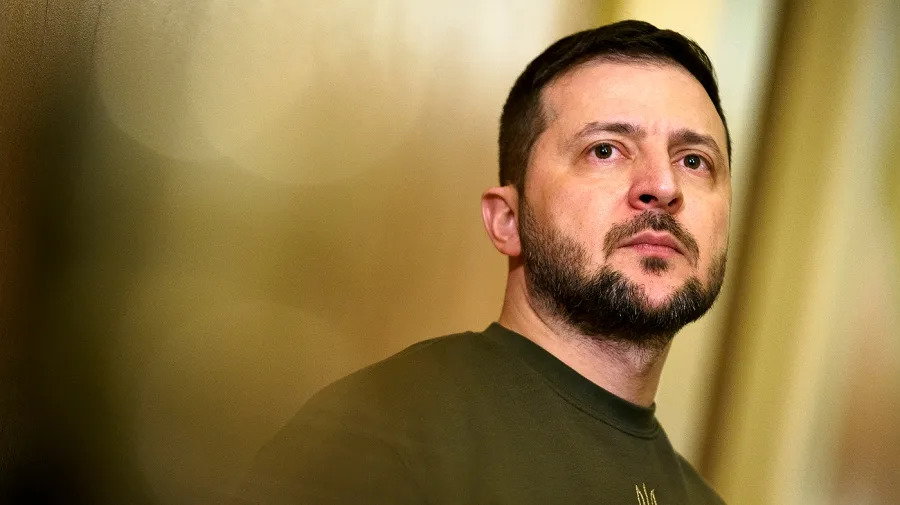
Ukrainian President Volodymyr Zelensky made a surprise visit to London on Wednesday to address the United Kingdom’s Parliament, telling British lawmakers and allies that his country will need more advanced weapons, including modern fighter jets, to fend off Russian forces.
Zelensky made a plea to the crowded British group packed inside the 900-year-old Westminster Hall, asking for not just weapons but also more sanctions against supporters of Russia’s war in Ukraine.
“I’m not just speaking about weapons. We’ve proved together that the world truly helps those who are brave in defending freedom,” the Ukrainian leader said, but “evil is still around today and the battle continues.”
Zelensky noted King Charles III once trained as a jet pilot, using it to segue into an ask for modern fighter jets.
“Provide us with modern planes to empower and protect pilots who will be protecting us,” Zelensky said.
Kyiv has been pushing since the war began to secure modern fighter jets from the U.S. and NATO allies to replace its aging fleet.
Ukrainians have also just completed a similar program to train on Britain’s Challenger 2 main battle tanks, which the country announced last month for Ukraine.
England is one of the largest backers of Kyiv and has provided about $2.5 billion for the country since the war began last February.
The U.K. on Wednesday also slapped a round of new sanctions against six entities with ties to Russia’s military.
The government is also extending an offer to provide longer-range weapons equipment for Kyiv, which Ukraine has also asked for to strike at Russian forces in occupied territory.
During his visit, Zelensky will meet with King Charles III, Prime Minister Rishi Sunak and the nation’s military chiefs.
Sunak on Wednesday said “President Zelenskyy’s visit to the UK is a testament to his country’s courage, determination and fight, and a testament to the unbreakable friendship between our two countries.”
“It also underlines our commitment to not just provide military equipment for the short term, but a long-term pledge to stand shoulder-to-shoulder with Ukraine for years to come,” Sunak said in a statement.
In what is starting to feel like a repeat of the recent tank saga, what seemed impossible is taking on an unassailable momentum. As then, Britain is leading the West.
Yes, if we commit to sending jets it will take Ukraine months to receive them, but this is going to be a long war, and saying we will send them will be a huge blow to Russian morale.
Most would agree that the West was far too slow to make the decision on tanks. If they had been sent nine months ago, where would we be now? How many thousands of lives could have been saved, how many billions of dollars?
As I argued recently, tanks are the first half of the winning equation, and fighter jets the second half. So let me underline why they matter so much at this critical moment, and challenge some of those who are anxious about sending them.
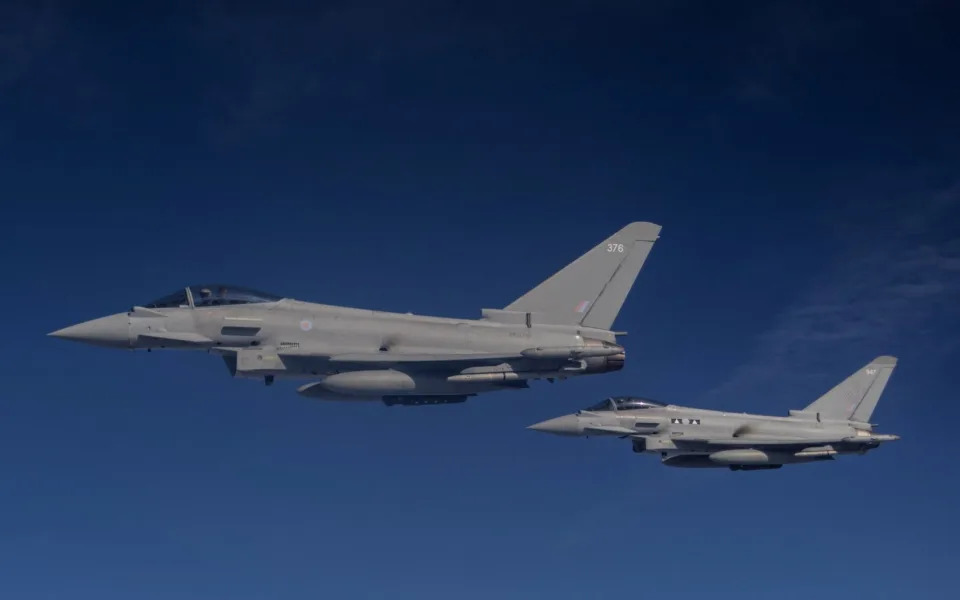
Though they may be few in number, the British Typhoon fighters would inevitably unlock a much larger number of European Typhoons or F-16s, as the British tank did with European tanks. It’s true that as things stand we have very few fighters to spare, but it would still leave our ultra-modern F-35 jets to defend UK shores. As with tanks, these donations would give us an ideal excuse to invest in new fighter aircraft to replace them. I’ll get to that.
More importantly, the donations would signal the most significant demonstration to Putin that we are in this for as long as it takes. The Russians still believe if they can stick the war out as long enough, they will crack the western will to keep supporting Ukraine. As I write, the Russians are apparently preparing 500,000 conscripts to throw into the melee for a final serious attempt to break the will of the Ukrainians. If that fails and the Russian army knows that Western jets are on the way, that could be crucial in future calculations. It might even be another to make them consider the cost of fighting in the first place.
I think there is undue pessimism about the amount of time it takes to train pilots for these aircraft. It’s true that tanks are more my expertise rather than fighter jets. But my instinct is that many of the delays are due to safety concerns – something of a luxury, I would argue, for a country fighting for its life. If the time it takes to train a soldier to use a Challenger 2 tank can be reduced from six months to six weeks, then surely this can be sped up.
Where I do agree with the more cautious commentariat is that all of this has underlined the perilous state of our Armed Forces. But for some that means we should send nothing to Ukraine. I take the opposite view: sending little will only maintain the status quo – holding onto tanks and planes will mean that nothing is done to invest in the future. Instead we should send what we can spare, then invest and expand. To subscribe to the ‘do nothing’ camp is – consciously or not – to facilitate and promote our current woeful policy.
The first duty of the government is to properly protect the nation. Pound for pound we still have the best fighting men and women in the world, but at the moment our lightweight capability is simply insufficient. Ukraine should shake us out of our delusions.
Perhaps one of the more heartening sides of Zelensky’s surprise visit to London was the cross-party unity on display in Parliament for Ukraine. It should give hope to the millions like me around the country that, on what really matters, politicians can come together. I hope MPs do not waste the opportunity and seriously invest in the future – not only our Armed Forces, but in supporting Ukraine to the hilt for the vital months to come.
Col Hamish de Bretton-Gordon OBE is a former commander of the 1st Royal Tank Regiment.
He is a regular contributor to The Telegraph’s daily podcast ‘Ukraine the Latest’ , which has over 22 million downloads. You can listen to our most recent episode, featuring Hamish, here.