In England’s north, Ukraine’s civilians become soldiers

Reuters

In England’s north, Ukraine’s civilians become soldiers

Andy Bruce – February 16, 2023

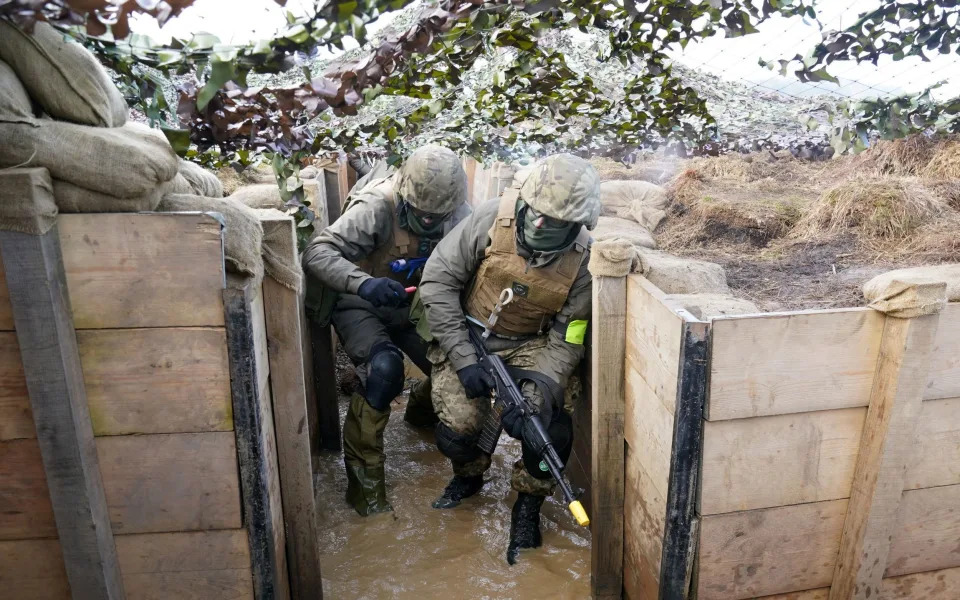
Ukrainian civilians receive urban warfare training at a military installation in the north of England

LONDON (Reuters) – Hundreds of Ukrainian men charged across windswept northern England in army drills on Thursday, some of more than 10,000 sent to Britain over the last year to turn them into soldiers in the war against Russia.

Under the tutelage of forces from Britain, Sweden, Denmark, the Netherlands and Norway, among others, the Ukrainians will be taught over five weeks about the laws of armed conflict, urban and trench warfare, weaponry and battlefield medicine.

Britain’s government said on Thursday it aims to double the number taught in 2023 to 20,000, across a handful of locations around the country.

The move is one part of a ramping-up of support for Ukraine, after NATO alliance officials met the previous day to plot more assistance for Kyiv. Britain is sending 14 Challenger tanks and hundreds more missiles.

One of the recruits, a 48-year Ukrainian furniture maker who called himself Nick, said a year ago he could not have envisaged that he would be taking lessons in warfare in the north of England.

“I will have to use that knowledge to protect our country because there is a lot of blood in Ukraine nowadays and someone has to protect the motherland,” he said via an interpreter.

Russia invaded Ukraine in February last year, saying it had to protect Russian speakers from persecution and prevent the western NATO alliance from using Ukraine to threaten Russia’s security.

Kyiv and its Western allies, including Britain, say these are baseless pretexts for an unprovoked war of acquisition.

On Wednesday, British Defence Secretary Ben Wallace said Britain is training Ukrainian soldiers to fight in a more “Western way” and use less ammunition than the traditional Soviet way of fighting.

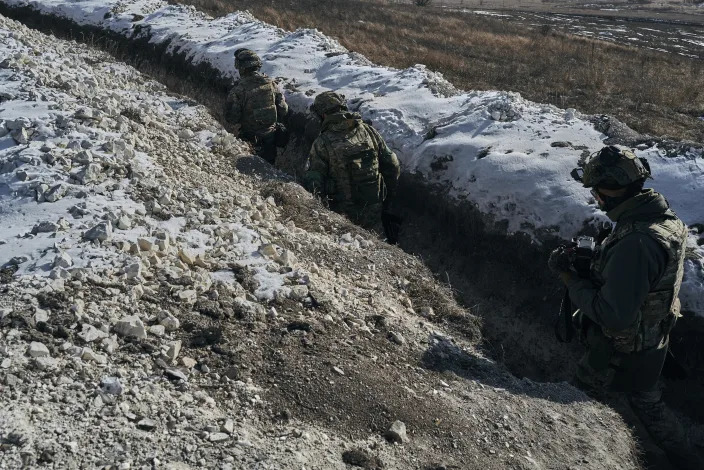
At the trench warfare grounds, where Ukrainian men in combat gear ran through muddy tunnels and dense forests with blank-firing rifles, British army corporal Carter, who declined to give his first name, said the Ukrainians were learning from the world’s top forces.

“I’m sure when they go back they’ll be able to survive and effectively win,” he said.

The programme also includes urban warfare, where men train how to fight in ordinary houses and civilian structures, and shooting practice.

Nick, the Ukrainian soldier, said he would return to Ukraine with confidence.

“I think that all of us will be ready to come back, because Ukraine really needs us, the soldiers who will stand for Ukraine,” he said.

(Reporting by Andy Bruce; editing by Diane Craft)

‘Bodies piled up’ in Russian assault on Bakhmut

Reuters

‘Bodies piled up’ in Russian assault on Bakhmut

February 16, 2023

Ukrainian forces on Thursday fought back against a punishing Russian assault… more than 36 missiles launched in the early hours, according to Ukraine’s Air Force.

Russia’s current focus — the small city of Bakhmut in Donetsk — one of two regions that make up the Donbas, Ukraine’s industrial heartland.

An area now partially occupied by Russia, where Ukrainian forces fight against an onslaught of Russian soldiers.

A spokesman for Ukraine’s 80th Air Assault Brigade said the unit was battling waves of Russian troops.

TARAS DZIOBA: “They have a lot of manpower. They are sending a lot of troops. I don’t think that is sustainable for them to keep attacking this way. There are places where their bodies are just piled up. There is a trench where… They just don’t evacuate their wounded or killed. They just leave them there and send more waves and waves of people.”

Bolstered by tens of thousands of reservists, Russia has intensified ground attacks across southern and eastern Ukraine, and a major new offensive appears to be underway as the first anniversary of its Feb. 24 invasion nears.

Driving the battlefield gains for Russia is the Wagner group – mercenary forces swelled by prison recruits.

In video released Thursday, Wagner Group founder Yevgeny Prigozhin forecast Bakhmut would fall in a matter of weeks.

“I think Wagner Group will manage to encircle Bakhmut in March or April. Although it is very difficult to guess. It depends on Ukrainian activity. They are receiving new types of weapons now. I’m one hundred percent sure we will be destroying these Leopards. One hundred percent we’ll sort out how to burn them.”

The mercenaries and Russian military have tried to take control of the city since last August, while defending Ukrainian forces have put up fierce resistance.

Its capture would give Russia a stepping stone to advance further west.

Thursday’s attack follows a pattern of heavy bombardments after Ukrainian battlefield or diplomatic gains.

NATO allies had met the previous day to plan more military support for Kyiv, as Ukraine burns through munitions fast and clamors for heavier firepower, including tanks and fighter jets.

Nearly Russia’s entire army is in Ukraine, suffering ‘1st World War levels of attrition,’ U.K. says

The Week

Nearly Russia’s entire army is in Ukraine, suffering ‘1st World War levels of attrition,’ U.K. says

Peter Weber, Senior editor – February 16, 2023

Ukrainian soldier in Vuhledar
Ukrainian soldier in Vuhledar Diego Herrera Carcedo/Anadolu Agency via Getty Images

Russia has stepped up its offensive in eastern Ukraine in the past few weeks, but U.S. and European officials say it has insufficient ground forces or equipment to get very far. Russian President Vladimir Putin is likely pushing Russia’s military to secure tangible gains he can celebrate on the first anniversary of his invasion on Feb. 24, Western analysts say, but the poorly trained conscripts Moscow is throwing into battle are making only minor gains and taking heavy losses.

Russia’s forces are too spread out along the frontline “to punch through in a big offensive,” and “we’ve just seen an effort to advance, and that has come at a huge cost to the Russian army,” British Defense Secretary Ben Wallace told BBC News on Wednesday. Russia is incurring “almost First World War levels of attrition, and with success rates of a matter of meters rather than kilometers.”

“We now estimate 97 percent of the Russian army, the whole Russian army, is in Ukraine,” Wallace added. The U.S. military estimated last week that Russia has dedicated about 80 percent of its ground force to the Ukraine invasion.

London’s International Institute for Strategic Studies estimated Wednesday that Russia has lost between 100,000 and 150,000 troops to death or injury in Ukraine, along with more than 2,000 tanks, including half the country’s modern tanks. Wallace cited reports that “a whole Russian brigade was effectively annihilated” in Moscow’s assault on Vuhledar, where Russia “lost over 1,000 people in two days.”

The battle for Vuhledar, a Ukrainian stronghold in Donetsk province at the crossroads of the war’s eastern and southern fronts, “has been viewed as an opening move in an expected Russian spring offensive,” The New York Times reports. But “as they have done throughout the war, the Russian commanders made some basic mistakes, in this case failing to take into account the terrain — open fields littered with antitank mines — or the strength of the Ukrainian forces.”

Col. Oleksii Dmytrashkivskyi, a spokesman for Ukrainian military forces in the area, told the Times that Russia’s 155th and 40th Naval Infantry Brigades, two of the country’s most elite units, were decimated in Vuhledar.

Ukraine is suffering heavy losses, too, and it is running through ammunition so fast Western allies are warning they can’t keep up with Ukraine’s demand. Still, Russia’s new offensive is “likely more aspirational than realistic,” a senior Pentagon official told CNN. This offensive probably won’t succeed any better than past attempts, a senior British military official added, “though they do seem willing to send more troops into the meat grinder.”

Antony Blinken ‘warns Ukraine’ against retaking Crimea

The Telegraph

Antony Blinken ‘warns Ukraine’ against retaking Crimea

Joe Barnes – February 16, 2023

Ukrainian soldiers take part in a military exercise at a military training camp in Yorkshire during a visit by defence ministers from the Joint Expeditionary Force

Antony Blinken, the US secretary of state, has warned a Ukrainian attempt to retake Crimea would be a red line for Vladimir Putin that could escalate the conflict, it has been reported.

Mr Blinken told a group of experts that the US is not seeking to actively encourage Kyiv to reclaim the peninsula that was illegally annexed by Moscow in 2014.

The US’s top diplomat said the decision should be left up to Ukraine to decide alone.

It came after Ukrainian drones were downed over Sevastopol, a major port home to Russia’s Black Sea Fleet, according to the city’s governor.

Kyiv’s armed forces have reportedly launched a series of covert operations to hit Russian military targets on the Crimean peninsula.

President Volodymyr Zelensky has repeatedly pledged to regain the Russian-controlled territory on the southern tip of Ukraine.

But Mr Blinken has always publicly expressed reservations at the prospect of Kyiv launching a serious attempt to recapture Crimea.

Instead, he believes Joe Biden’s administration should focus on supporting Ukraine’s armed forces in the east of the country, where Russia is concentrating its fresh offensive efforts.

The US secretary of state reiterated the long-held position during a Zoom call with a group of exports, according to the Politico news website.

According to two people involved in the discussions, Mr Blinken said Kyiv’s resources would be better used elsewhere on the battlefield than making an attempt to capture Crimea.

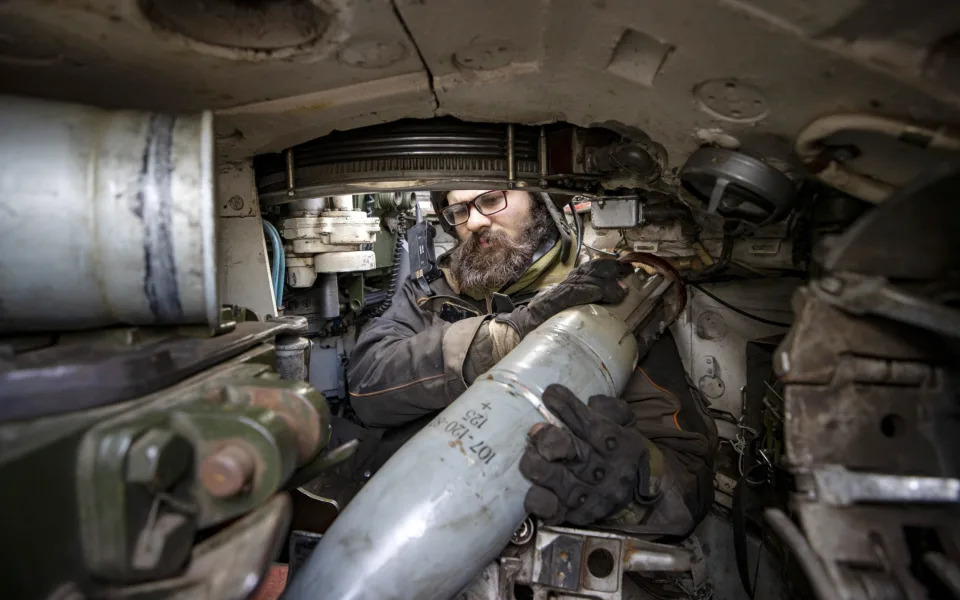
A Ukrainian soldier loads a shell into a tank near the town of Vuhledar

The comments are likely to spark anger in Ukraine given Mr Zelensky’s state war aims of liberating the peninsula.

Kyiv has said it would be able to use US-donated Army Tactical Missile Systems, which have a range of nearly 200 miles, and could be used to strike heavily fortified Russian positions in Crimea.

So far, Washington has said it doesn’t have sufficient stockpiles to deliver the long-range missiles to Ukraine, but Mr Blinken’s comments also shine a light on US reluctance over the system.

Military experts have suggested that recapturing Crimea would be a war in itself because it is defended by tens of thousands of Russian troops dug in defensive positions.

Punching through those lines would need significant amounts of artillery and heavy armour donated from Western countries.

General Mark Milley, the US’s top military commander, said it would be “very, very difficult” to militarily eject Russian forces from occupied areas, including Crimea.

Senior Pentagon officials earlier this month told the House Armed Services Committee that Ukraine would be unable to recapture Crimea imminently.

It is believed Ukraine would be better off attempting to put a stranglehold on the peninsula by targeting the Kerch Strait bridge to mainland Russia, the land bridge through the Donbas and the Sevastopol naval base.

“This would leave a lot of Russian forces without adequate support, without Ukraine actually trying to overrun Crimea, and it would still be a severe blow to Russia’s military effort,” Kurt Volker, a former US special envoy for Ukraine, said.

Last summer, Ukraine appeared to make a start on that plan, with attacks on the Kerch Bridge and a number of military bases.

97% of Russian army estimated to be in Ukraine UK Defence Secretary

Ukrayinska Pravda

97% of Russian army estimated to be in Ukraine UK Defence Secretary

Ukrainska Pravda – February 15, 2023

UK Defence Secretary Ben Wallace has stated that almost the entire Russian army is estimated to be in Ukraine.

Source: Wallace on air with BBC Radio 4, reported by European Pravda

Details: While commenting on Moscow’s offensive strategy, Wallace said that Russia has not been able to amass a single force “to punch through” Ukraine’s defences. Rather, “we’ve just seen an effort to advance”.

“That has come at a huge cost to the Russian army. We now estimate 97% of the Russian army, the whole Russian army, is in Ukraine,” Wallace said.

He has added that the West is strengthening its own security by helping Ukraine defeat Russia in the war.

“If 97% of the Russian army is now committed to Ukraine, with an attrition rate very, very high, and potentially their combat effectiveness depleted by 40%, and nearly two thirds of their tanks destroyed or broken, that has a direct impact on the security of Europe,” he declared.

“I think what Russia is doing in trying to advance, it’s doing in a sort of human way, almost First World War levels of attrition and with success rates of a matter of metres rather than kilometres,” Wallace pointed out.

Wallace goes on to say that the “biggest unknown” is what happens when you have Russian leaders who either have “a gap in reality” or “no regard for human life of [Russia’s] own”.

Background: Information from Western intelligence indicates that Russia is gathering aircraft near its border with Ukraine, which means that Moscow is preparing to engage its aircraft and helicopters to support a ground offensive.

Russians adapt to ‘nerve-wracking’ life under sanctions

AFP

Russians adapt to ‘nerve-wracking’ life under sanctions

February 15, 2023

When Vladimir Stetsenko put his apartment on the market in October, he thought the ad for the newly renovated property in southern Moscow would generate some interest. It did not.

“There was not a single phone call for two or three weeks,” the 61-year-old, who has lived in the Czech Republic for the past two years, told AFP.

That could be because Stetsenko listed the property not long after President Vladimir Putin deployed troops to Ukraine, sparking an unprecedented wave of Western penalties against Moscow and economic uncertainty.

To make matters worse, the apartment hit the market right after Putin mobilized hundreds of thousands of reservists for the fight, adding to an exodus of Russians already selling their homes, moving abroad and creating a huge real estate surplus.

Stetsenko, who has no plans to live in Russia anytime soon, had to knock off about 20 percent from the asking price, and then three people came to view it.

By December, he had offloaded the flat for an equivalent of about 200,000 euros, the same amount he paid for it around a decade ago.

“Selling the apartment was a bit nerve-wracking,” he conceded.

Stetsenko’s experience mirrors that of many Russians, not only in the property market but in the broader economy after the start of Moscow’s offensive in Ukraine, and reflects turmoil in a country hit by multiple rounds of sanctions.

Putin insists Russia is weathering the Western penalties.

A home-grown brand has replaced McDonald’s and supermarkets are offering Russian-made drinks to replace foreign brands like Coca-Cola, which left Russia last year.

Imports from the European Union have fallen but China’s trade with Russia reached a record $190 billion last year, Beijing customs data shows.

In another positive signal for the Kremlin, the International Monetary Fund last month improved its forecast for Russia’s economy, projecting 0.3 percent growth this year, up from an estimated contraction of 2.3 percent.

– Rollercoaster ride –

The housing market appears to reflect trends in the overall economy, which has been pounded but remains afloat.

Real estate analysts say the housing market has been on a rollercoaster ride since Russians panicked when sanctions hit and then adjusted to their new reality.

First, prices spiked in Moscow as homeowners sought to secure their savings.

They then dropped as tens of thousands of Russians opposed to the conflict and worried for their futures packed up and left.

“There is a lot of supply,” said Vadim Orekhov, co-founder of Rio Lux, a real estate agency in Moscow.

“And that leads to strong competition among sellers.”

Real estate agent Anastasia Chichikina said that prices in Moscow, Russia’s capital of more than 12 million people, peaked in March and April.

“People wanted to save as much of their assets as possible,” she said.

“Then a gradual decline began.”

She said the average price per square metre for a flat in Moscow dropped from around 270,000 rubles (3,400 euros) last spring to around 251,000 rubles now.

Oleg Repchenko, who heads the analytical firm Real Estate Market Indicators, sees parallels now with 2014-2015 when the West began slapping sanctions on Russia for annexing Crimea and destabilising Ukraine.

“At the time, after a short-term peak and spike in prices, the cost of housing began to decline,” he said.

– ‘No prospects’ –

While authorities insist that the economy has largely adapted a year after the start of the Kremlin’s assault on Ukraine, economists are much less optimistic.

They say problems are mounting as the West is building on its sanctions program with a 10th EU package looming.

Hundreds of foreign companies have exited, emptying shopping malls, while inflation, which stands at around 12 percent, has undermined the purchasing power of Russian wages.

Foreign tourism has collapsed and supply problems are impacting a slew of industries including car manufacturing.

Several Russian economic observers wrote in a recent analysis that “abnormally” high energy revenues had cushioned the blow from sanctions last year.

But 2023 will be harder, they said in the report published by the independent analysis website Re: Russia, as the budget shrinks and the Kremlin’s economic priorities shift.

“The crisis associated with a massive outflow of capital and the isolation of the Russian economy from a significant part of international markets and the financial system is not behind but ahead,” the analysis concluded.

“After February 24, 2022, the Russian economy has no prospects.”

Top US general says Russia has already ‘lost’ the Ukraine war and has paid an ‘enormous price on the battlefield’

Insider

Top US general says Russia has already ‘lost’ the Ukraine war and has paid an ‘enormous price on the battlefield’

John Haltiwanger – February 14, 2023

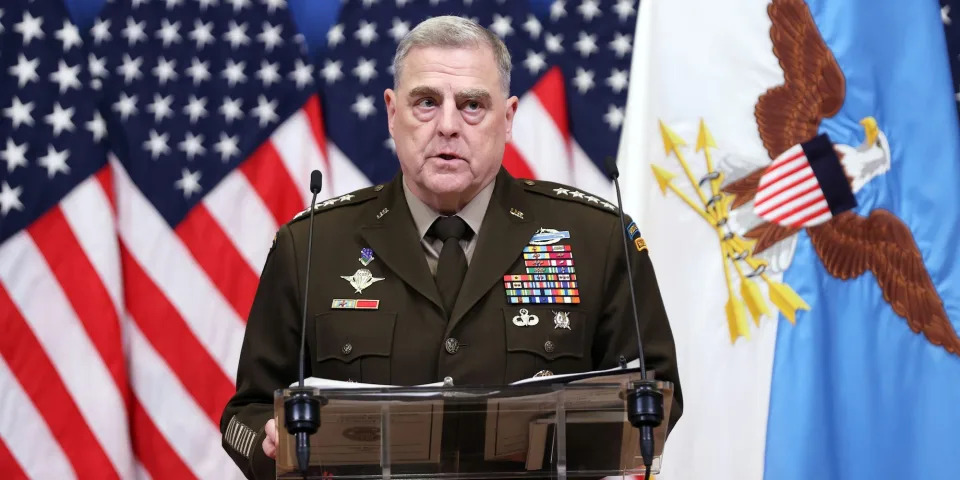
Gen. Mark Milley speaking during a press conference.
Gen. Mark Milley during a press conference at NATO HQ on February 14, 2023 in Brussels, Belgium.Dursun Aydemir/Getty Images
  • Gen. Mark Milley said Russia has “lost” in Ukraine as the war approaches the one-year mark.
  • “They’ve lost strategically, operationally, and tactically,” Milley said.
  • Russia has suffered massive casualties in Ukraine and failed in its initial war aims.

As the war in Ukraine approaches the one-year mark, Joint Chiefs Chairman Gen. Mark Milley said Tuesday that Russia has “lost.”

Russian President Vladimir Putin “thought he could defeat Ukraine quickly, fracture the NATO alliance, and act with impunity. He was wrong,” Milley said while speaking to reporters in Brussels.

The top US general ripped into Moscow for launching an unprovoked invasion of Ukraine, emphasizing that Russia has paid an “enormous price on the battlefield” as a consequence.

“Russia is now a global pariah and the world remains inspired by Ukrainian bravery and resilience. In short, Russia has lost — they’ve lost strategically, operationally, and tactically,” Milley added.

Milley’s comments echoed an assessment from Admiral Sir Tony Radakin, the United Kingdom’s chief of defense staff, who in December said “Russia is losing” and the “free world is winning.”

When Russia invaded Ukraine last February, it was widely expected to conquer Kyiv in a matter of days. But Russian forces failed in that objective as Ukrainian troops put up a far stiffer resistance than expected. With the help of Western-supplied weapons, Ukraine has continued to defy expectations in this war.

Over the course of 2022, the fighting largely shifted to Ukraine’s east and the conflict morphed into a brutal, grinding war of attrition.

Putin illegally annexed four Ukrainian regions in September, claiming them as part of Russia, despite the fact that Russian forces did not fully occupy these regions. A Ukrainian counteroffensive pushed Russian forces into retreat in parts of these territories — including Kherson, the first major city Russia occupied after the invasion.

The war is raging on, and Russia, which mobilized hundreds of thousands of additional troops, has seemingly begun a new offensive in the east with the goal of swallowing the Donbas region — comprised of Donetsk and Luhansk, two of the regions Putin illegally annexed. Russian gains have been limited though.

Both sides have experienced heavy losses since the invasion began. Russian casualties estimated to be nearing 200,000.

NATO Secretary General Jens Stoltenberg has warned that Putin is unfazed by the high rate of casualties and is vying to overwhelm Ukrainian forces with sheer numbers.

Putin is “sending thousands and thousands of more troops, accepting a very high rate of casualty, taking big losses, but putting pressure on the Ukrainians,” the NATO chief said on Monday, adding, “What Russia lacks in quality, they try to compensate in quantity.”

Putin uses armored train for security reasons since beginning of war

Ukrayinska Pravda

Putin uses armored train for security reasons since beginning of war

Ukrainska Pravda – February 13, 2023

Russian President Vladimir Putin has been increasingly using an armoured train for long-distance trips to his residences, which he switched to in the spring of 2021.

Source: investigation of the Dossier Center

Quote: “Vladimir Putin started using an armoured train in the fall of 2021, when the Russian army began to actively prepare for the invasion of Ukraine. After the start of the war, he rides it more and more often, especially to his favourite residence in Valdai.”

Details: Reportedly, Putin may have started favouring an armoured train for security reasons. Unlike airplanes, it is more difficult to track a train because there are no services for tracking passenger trains in real time.

In addition, the two residences of the Russian president, which he visits, are located on the Black Sea coast, where flights are restricted due to the war.

The story says that the armoured train has a car with a bedroom and a workplace, a car for accompanying personnel and a car for special communications.

Outwardly, the armoured train is similar to a regular train, only instead of four axles it has six, instead of one locomotive — several, and special equipment is placed on the roof.

Journalists found out that the special train matching the description belongs to the Grand Service Express company, which was owned by an offshore company associated withvYuriy Kovalchuk, the associate of the Russian President, and businessman Mikhail Rabinovich, who is called a good acquaintance of Kovalchuk.

Putin was photographed aboard of the armoured train only once in 2012, before it was repaired. Photographs of the outside of the train have never been officially published.

The journalists also calculated the approximate cost of the armored train. According to their estimates, it can cost a little more than 1 billion Russian rubles [roughly US$ 13.5 million].

Not only an armored train: a secret railway was built for Putin in Russia

Ukrayinska Pravda

Not only an armored train: a secret railway was built for Putin in Russia

Ukrainska Pravda – February 14, 2023

A secret railway and a network of stations leading to his residences were built in Russia  for Vladimir Putin, the president of the aggressor country. Earlier, it was reported that Putin has started travelling around the country on his armoured train.

SourceProekt (Project) investigative media outlet

Quote: “All of Vladimir Putin’s main residences have been connected to railway lines, and secret stations have been built nearby, as the Project has found out. This confirms the reports of the Dossier Center that the head of state has recently begun to use the train more often than the plane.”

Details: The media outlet has found at least three locations that may be associated with Putin’s secret railway service.

In particular, on the territory of the Valdaysky National Park, there is a guarded railway station with a helipad near the village of Dolgiye Borody, the nearest settlement to Putin’s favourite Valday residence. Three local residents told the media outlet that the station and a special railway line to it were built only for the president.

In addition, according to satellite images, the station in Novo-Ogaryovo appeared in 2015 and is located 400 metres from Putin’s residence in Moscow Oblast. The land under the station was withdrawn from private ownership in favour of the Federal Guard Service by the decision of the then Russian prime minister Dmitry Medvedev. The special station itself is designed for a small number of cars and is hidden behind a high fence with surveillance cameras installed every 10 metres.

To stop the train near the Sochi residence Bocharov Ruchey, a platform and a new dead-end railway line appeared in 2017, hidden from the tracks used by electric trains by a high fence.

The president’s special train has repeatedly been caught on camera by trainspotters and railway workers. For example, in November 2018 or April 2020.

According to the former driver with whom the Proekt spoke, Putin’s armoured train is based in a depot at the Moscow-Kalanchyovskaya railway station with a closed terminal for VIPs. This special station is still functioning, and the high fence surrounding it is additionally reinforced with barbed wire. In 2017, a new highway was laid directly to the platform of the VIP terminal on Kalanchyovskaya. The president’s special train belongs to the Grand Service Express Company, which was associated with Putin’s close friend Yury Kovalchuk.

Background:

  • On 13 February, the Dossier Center reported that Vladimir Putin has been increasingly using an armored train for long-distance trips to his residences, which he switched to in the spring of 2021.
  • In December 2022, it was reported that Putin has an extensive chain of secret bunkers stretching from Moscow to the Urals, and new underground shelters continue to be built in Russia.

Ukrainian and Russian troops “literally tossing grenades at each other”

CBS News

Ukrainian and Russian troops “literally tossing grenades at each other”

Justine Redman – February 14, 2023

Bakhmut, eastern Ukraine — Ukrainian military hardware was on the move Tuesday along the front line north of the embattled town of Bakhmut. They have to keep moving. If they stop, Russia’s invading forces will take aim.

Explosions rang out from both incoming and outgoing artillery fire. Jittery soldiers were told not to hang around too long. Their commanders instructed our CBS News team to spread out and get ready to hit the ground.

The Ukrainian troops brought us to the last village they hold before the Russian front line, only about three miles further east. Commanders told CBS News the line itself had moved only a few hundred yards in months in the area. In some cases, Ukrainian troops have been holding off the Russians with no more than automatic weapons.

The entire time CBS News was near the front line, explosions never stopped ringing out.

It’s always like that, said a commander who goes by the callsign “Thunder.”

“There’s constant incoming,” he said. “It all depends on whether they can see what they’re shooting at. We try not to get spotted.”

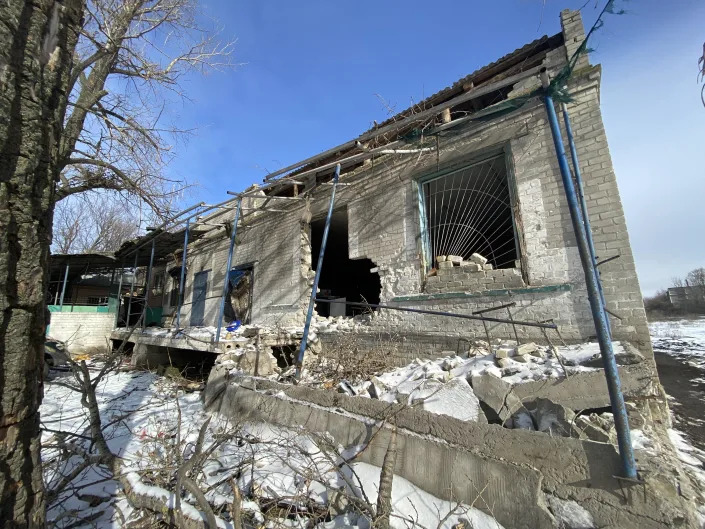
A building heavily damaged by fighting in a village just north of the front line near Bakhmut, eastern Ukraine, is seen in February 2023.  / Credit: CBS News
A building heavily damaged by fighting in a village just north of the front line near Bakhmut, eastern Ukraine, is seen in February 2023. / Credit: CBS News

The fighting is incredibly close.

“It can get as close as five meters,” he said. “We’re literally tossing grenades at each other.”

Close enough, the Ukrainian commander said, to find Russian soldiers fighting from trenches the Ukrainians dug, and the other way around.

Soldiers of the Ukrainian 3rd Army Assault Brigade of the Special Operations Forces (SSO)

The fighting across a long stretch of the front line in eastern Ukraine, which spans hundreds of miles from the north to the south of the country, has crawled to a bloody grind for months.

The Russians have advanced in distances measured in feet. But the cost in human lives has mounted precipitously — on both sides.

Ukraine is battling to hold the ground in the face of a Russian offensive expected to begin in earnest ahead of the one-year anniversary of the invasion next week. That bloody fight will continue, even if there’s not much left to hold onto.