The battle for Bakhmut is getting so close that ‘fistfights have been happening,’ Ukrainian soldier says
John Haltiwanger – March 7, 2023
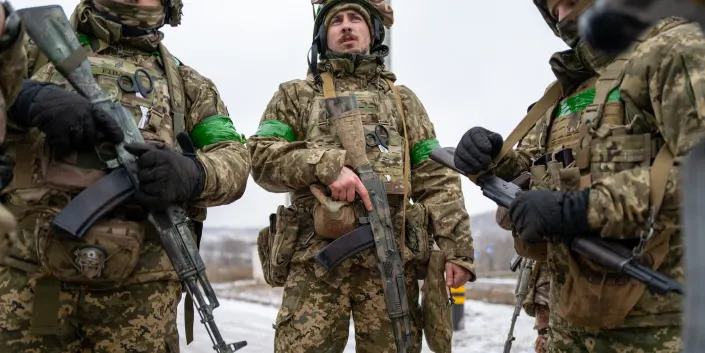
Ukrainian soldiers on the outskirts of Bakhmut on January 14, 2023.Spencer Platt/Getty Images
A Ukrainian soldier told the Washington Post the fighting in Bakhmut is brutal and at close quarters.
The soldier said there have even been fistfights as they fight off waves of Russian mercenaries.
Bakhmut is widely expected to fall to Russian forces soon, but it will be a hollow victory.
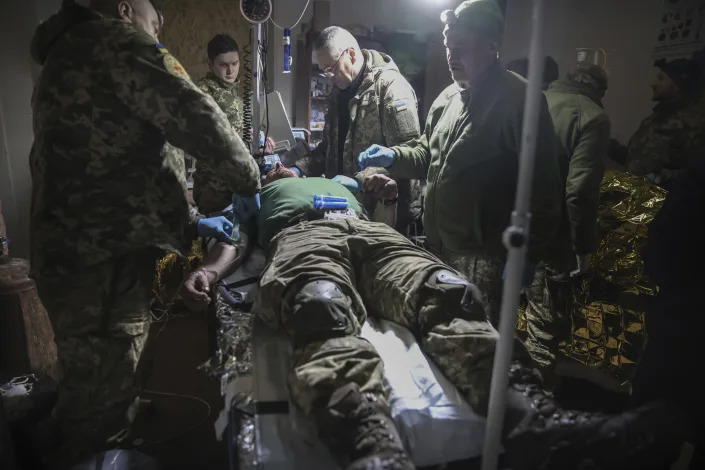
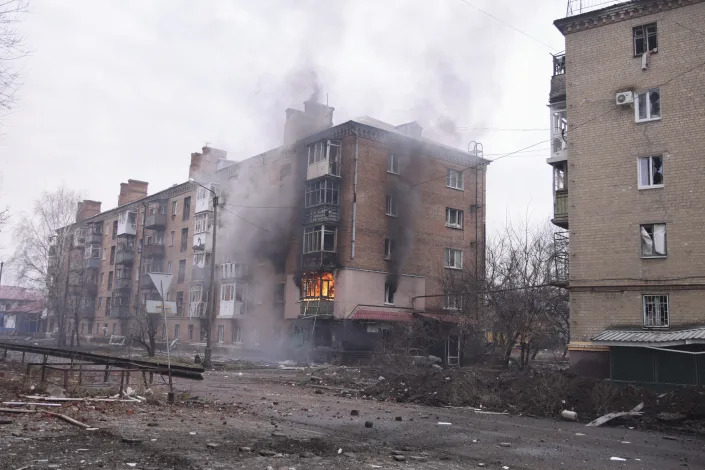
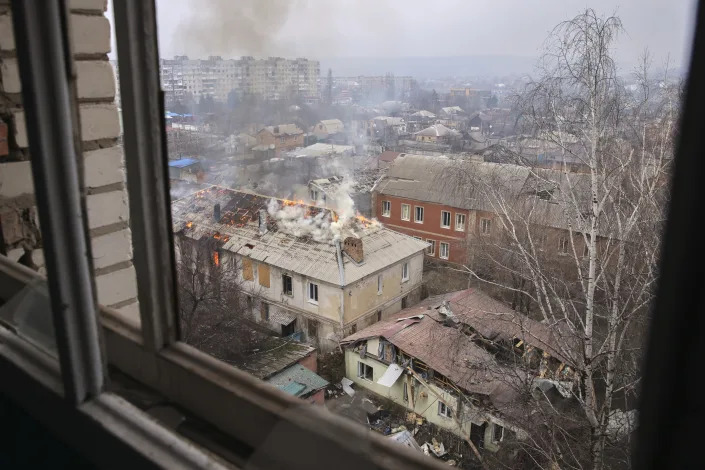
Fighting in the eastern Ukrainian city of Bakhmut, which has been one of the primary battles in the war for months, has featured brutal, close quarters combat, according to a Ukrainian soldier.
In some cases, Ukrainian troops have searched house-to-house for the enemy and been forced to engage in hand-to-hand combat, Dmytro Vatagin, a 48-year-old Ukrainian soldier, told the Washington Post.
“Fistfights have been happening,” Vatagin said. “Everyone has their own fighting story.”
The infamous Wagner mercenary group has played a central role in the fight for Bakhmut. Vatagin told the Post that Wagner has thrown its forces — a mix of seasoned fighters and newly released convicts — “like meat” at the frontline in relentless waves that have exhausted Ukrainian defenders. Wagner has recruited Russian prisoners for the fight and treated them like “cannon fodder,” National Security Council spokesperson John Kirby said last month.
Similarly, UK officials have claimed that some Russian reservists in the attacks were told to fight with shovels.
The mercenary group has suffered roughly 30,000 casualties in the war, Kirby said.
Russia’s extreme costs in assaulting Bakhmut, a city of roughly 70,000 before the war, are seen by most Western analysts as out of step with the strategic value of the gained territory, from which they could advance down two highways should they still have combat power.
“It is more of a symbolic value than it is strategic and operational value,” Defense Secretary Lloyd Austin said of Bakhmut in comments to reporters on Monday, per Reuters.
“The fall of Bakhmut won’t necessarily mean that the Russians have changed the tide of this fight,” Austin added.
The city is seemingly on the verge of falling to Russian forces, but Ukraine is not giving up without a fight and Ukrainian President Volodymyr Zelenskyy on Monday said that his top generals have called for reinforcing Bakhmut’s defense. That said, top military experts have suggested that it might be time for Ukraine to cut its losses in Bakhmut.
“The tenacious defense of Bakhmut achieved a great deal, expending Russian manpower and ammunition. But strategies can reach points of diminishing returns,” Michael Kofman, an expert on the Russian military at the Center for Naval Analyses, said on Twitter.
“This fight doesn’t play to Ukraine’s advantages as a force,” Kofman said, warning that if Ukrainian forces continue to expend resources on Bakhmut “it could impede the success of a more important operation.”
Ukraine unyielding in Bakhmut as Russian troops close in
March 6, 2023
A Ukrainian soldier takes cover in a trench under Russian shelling on the frontline close to Bakhmut, Donetsk region, Ukraine, Sunday, March 5, 2023. (AP Photo/Libkos) (ASSOCIATED PRESS)
KYIV, Ukraine (AP) — Ukrainian military leaders are determined to hold onto Bakhmut, Kyiv officials said Monday, even as Russian forces continued to encroach on the devastated eastern Ukrainian city that they have sought to capture for six months at the cost of thousands of lives.
Ukrainian President Volodymyr Zelenskyy’s office said he chaired a meeting with military officials during which the country’s top brass advocated strengthening Ukrainian positions there.
Intense Russian shelling targeted the Donetsk region city and nearby villages as Moscow deployed more resources there in an apparent bid to finish off Bakhmut’s resistance, according to local officials.
“Civilians are fleeing the region to escape Russian shelling continuing round the clock as additional Russian troops and weapons are being deployed there,” Donetsk Gov. Pavlo Kyrylenko said.
Russian forces that invaded Ukraine just over a year ago have been bearing down on Bakhmut for months, putting Kyiv’s troops on the defensive but unable to deliver a knockout blow.
More broadly, Russia continues to experience difficulty generating battlefield momentum. Moscow’s full-scale invasion on Feb. 24, 2022, soon stalled and then was pushed back by a Ukraine counteroffensive. Over the bitterly cold winter months, the fighting has largely been deadlocked.
Bakhmut doesn’t have any major strategic value, and analysts say its possible fall is unlikely to bring a turning point in the conflict.
Its importance has become psychological — for Russian President Vladimir Putin, prevailing there will finally deliver some good news from the battlefield, while for Kyiv the display of grit and defiance reinforces a message that Ukraine was holding on after a year of brutal attacks to cement support among its Western allies.
U.S. Secretary of Defense Lloyd Austin endorsed that view Monday, saying during a visit to Jordan that Bakhmut has “more of a symbolic value than … strategic and operational value.”
He added that Moscow is “continuing to pour in a lot of ill-trained and ill-equipped troops” in Bakhmut, whereas Ukraine is patiently “building combat power” elsewhere with Western military support ahead of the launch of a possible spring offensive.
Even so, some analysts questioned the wisdom of the Ukrainian defenders holding out much longer, with others suggesting a tactical withdrawal may already be underway.
Michael Kofman, the director of Russia studies at the CAN think tank in Arlington, Virginia, said that Ukraine’s defense of Bakhmut has been effective because it has drained the Russian war effort, but that Kyiv should now look ahead.
“I think the tenacious defense of Bakhmut achieved a great deal, expending Russian manpower and ammunition,” Kofman tweeted late Sunday. “But strategies can reach points of diminishing returns, and given Ukraine is trying to husband resources for an offensive, it could impede the success of a more important operation.”
The Institute for the Study of War, a Washington-based think tank, noted that urban warfare favors the defender but considered that the smartest option now for Kyiv may be to withdraw to positions that are easier to defend.
In recent days, Ukrainian units destroyed two key bridges just outside Bakhmut, including one linking it to the nearby hilltop town of Chasiv Yar along the last remaining Ukrainian resupply route, according to U.K. military intelligence officials and other Western analysts. Demolishing the bridges could be part of efforts to slow down the Russian offensive if Ukrainian forces start pulling back from the city.
“Ukrainian forces are unlikely to withdraw from Bakhmut all at once and may pursue a gradual fighting withdrawal to exhaust Russian forces through continued urban warfare,” the ISW said in an assessment published late Sunday.
The Bakhmut battle has also served to expose Russian military shortcomings and bitter divisions.
Yevgeny Prigozhin, the millionaire owner of the Wagner Group military company that spearheaded the Bakhmut offensive, has been at loggerheads with the Russian Defense Ministry and repeatedly accused it of failing to provide his forces with ammunition. On Sunday, he again criticized top military brass for moving slowly to deliver the promised ammunition, questioning whether the delay was caused “by red tape or treason.”
Putin’s stated ambition is to seize full control of the four provinces, including Donetsk, that Moscow illegally annexed last fall. Russia controls about half of Donetsk province, and to take the remaining half of that province its forces must go through Bakhmut.
The city is the only approach to bigger Ukrainian-held cities since Ukrainian troops took back Izium in Kharkiv province during a counteroffensive last September.
But taking at least six months to conquer Bakhmut, which had a prewar population of 80,000 and was once a popular vacation destination, speaks poorly of the Russian military’s offensive capabilities and may not bode well for the rest of its campaign.
“Russian forces currently do not have the manpower and equipment necessary to sustain offensive operations at scale for a renewed offensive toward (the nearby cities of) Kramatorsk and Slovyansk, let alone for a years-long campaign to capture all of Donetsk Oblast,” the ISW said.
Bakhmut has taken on almost mythic importance to its defenders. It has become like Mariupol — the port city in the same province that Russia captured after an 82-day siege that eventually came down to a mammoth steel mill where determined Ukrainian fighters held out along with civilians.
Moscow looked to cement its rule in the areas it has occupied and annexed. Russian Defense Minister Sergei Shoigu traveled to Mariupol and toured some of the city’s rebuilt infrastructure, the Defense Ministry reported Monday.
Shoigu was shown a newly built hospital, a rescue center of the Emergency Ministry and residential buildings, the ministry said.
A captured Russian prison inmate-turned-soldier said the Wagner Group’s paramilitary trained him for 3 weeks and didn’t expect him to survive the Ukrainian assault
Kenneth Niemeyer – March 5, 2023
Visitors wearing military camouflage stand at the entrance of the ‘PMC Wagner Centre’, which is associated with businessman and founder of the Wagner private military group Yevgeny Prigozhin, during the official opening of the office block during National Unity Day, in St. Petersburg, Russia, Friday, Nov. 4, 2022.Associated Press
A man trained by Russia’s Wagner Group said he didn’t expect to survive his first mission, The Wall Street Journal reported.
The man told the outlet he was a prisoner with convictions for murder and robbery.
The Wagner Group earlier this month said it ended the practice of recruiting prisoners.
A 48-year-old Russian inmate turned soldier told The Wall Street Journal that the Wagner Group only gave him three weeks of training and didn’t expect him to survive his first mission.
The unidentified man, who was captured by Ukrainian soldiers in March, told the Journal he was only trained in one skill — how to crawl in a forest, which indicated to him that he was not expected to survive for very long on the battlefield.
The Wagner Group, a powerful Russian paramilitary group, caused global controversy for offering convicted prisoners in Russia freedom for fighting against Ukraine. Yevgeny Prigozhin, the founder of the group and a longtime ally to Russian President Vladimir Putin, confirmed earlier this month in a Telegram statement that the organization has since stopped recruiting prisoners after fewer continued signing up to participate.
The man, who the outlet reported had convictions for robbery, drug offenses, and murder, said on January 29, two squads of six convicts were ordered to assault a Ukrainian outpost in Bakhmut, according to The Wall Street Journal.
The city of Bakhmut in Eastern Ukraine has been the site of some of the most deadly fighting in the conflict between Russia and Ukraine. A retired US Marine estimated that the average life expectancy of a soldier on the front lines in eastern Ukraine is around four hours.
Only four of the men were “combat fit” by the end of the night while the rest were dead or injured, the outlet reported. The man was given permission to pull back the following morning due to injuries to his arm, he told the Journal.
“Two machine guns were blazing at us, people were being torn to bits, but they kept telling us: keep crawling ahead and dig in. It was just plain dumb,” the man told the outlet.
The man said that soldiers who were injured still had to be allowed by superiors to withdraw, according to the Journal.
“If you don’t push ahead and do what you’re told, you simply get nullified,” he said, according to the outlet. “Everyone knows that.”
“Nullified” is a Wagner term for being executed on the spot, the Journal reported.
A doctor declared the man fit to serve again, and he was sent back to the front lines in Bakhmut where he saw hundreds of dead Wagner troops, he said, according to the outlet.
“We would just stack up all the corpses in one place and leave them there, there was no time to deal with them,” he said.
The man said Wagner did not provide his detail with food, so the troops had to scavenge for their meals, and he was captured by Ukrainian forces after he stumbled into an outpost while lost, the Journal reported.
A regiment of drafted Russian soldiers who made video plea to Putin to stop them being ‘slaughtered’ are now mostly dead, report says
Alia Shoaib – March 4, 2023
This photograph taken on September 11, 2022, shows a Ukranian soldier standing atop an abandoned Russian tank near a village on the outskirts of Izyum, Kharkiv Region, eastern Ukraine, amid the Russian invasion of Ukraine.JUAN BARRETO/AFP via Getty Images
Drafted Russian soldiers made a video appeal to Vladimir Putin for help.
They feared they would be “slaughtered” and criticized their commanders’ “lawless and criminal orders.”
Most of the soldiers in the regiment have died in Donetsk since recording the video, a report says.
Almost an entire regiment of mobilized Russian troops have reportedly died after they recorded a video appeal to President Vladimir Putin saying they were being sent “to be slaughtered” in Ukraine.
The soldiers from Russia’s Irkutsk region in Siberia said they were “illegally” placed under the command of Russian-backed separatists in Donetsk and asked for Putin’s help dealing with their “lawless and criminal orders,” according to Radio Free Europe/Radio Liberty.
“Please help,” the soldiers say in the video while in their uniforms with their faces covered. “There is nowhere else to turn.”
Relatives of two of the soldiers told reporters that nearly the entire regiment was destroyed between February 28 to March 1 after they were sent to storm Ukrainian fortifications near occupied Donetsk, Radio Free Europe/Radio Liberty’s Siberian branch reported.
Some of the troops are wounded but the rest have died and are marked as “missing,” the outlet said.
In the video, which was published by Telegram channel of the Siberian news outlet Lyudi Baikala on February 25, the soldiers directly ask Putin for help.
The draftees said they were sent to the Donbas region in Ukraine and put into assault units within a day and ordered to attack the city of Avdiivka without any support, heavy weapons, or preparation, according to the Russian outlet Meduza.
“Command told us directly that we are expendable and that the only chance we have of returning home is getting injured,” the soldiers say in the video, per Meduza.
They further claimed that commanders from the Donetsk People’s Republic, the unrecognized breakaway republic formed by Russian-backed separatists, would fire machine guns at troops who refused to join the assault units.
The video was the soldiers’ third such appeal, according to the Russian outlet The Insider. The outlet said the men were from Regiment 1439, second battalion. A Russian battalion’s strength ranges from 250 to 950 soldiers and officers.
The Russian Governor of Irkutsk, Igor Kobzev, said on Telegram that he had asked the military prosecutor’s office to look into the video message and added that draftees would be sent to a different place in the future.
Putin ordered the partial mobilization of the country’s military reservists in September, which sparked anti-war protests and thousands of fighting-age men fleeing the country.
Alia Shoaib – March 4, 2023
This photograph taken on September 11, 2022, shows a Ukranian soldier standing atop an abandoned Russian tank near a village on the outskirts of Izyum, Kharkiv Region, eastern Ukraine, amid the Russian invasion of Ukraine.JUAN BARRETO/AFP via Getty Images
Drafted Russian soldiers made a video appeal to Vladimir Putin for help.
They feared they would be “slaughtered” and criticized their commanders’ “lawless and criminal orders.”
Most of the soldiers in the regiment have died in Donetsk since recording the video, a report says.
Almost an entire regiment of mobilized Russian troops have reportedly died after they recorded a video appeal to President Vladimir Putin saying they were being sent “to be slaughtered” in Ukraine.
The soldiers from Russia’s Irkutsk region in Siberia said they were “illegally” placed under the command of Russian-backed separatists in Donetsk and asked for Putin’s help dealing with their “lawless and criminal orders,” according to Radio Free Europe/Radio Liberty.
“Please help,” the soldiers say in the video while in their uniforms with their faces covered. “There is nowhere else to turn.”
Relatives of two of the soldiers told reporters that nearly the entire regiment was destroyed between February 28 to March 1 after they were sent to storm Ukrainian fortifications near occupied Donetsk, Radio Free Europe/Radio Liberty’s Siberian branch reported.
Some of the troops are wounded but the rest have died and are marked as “missing,” the outlet said.
In the video, which was published by Telegram channel of the Siberian news outlet Lyudi Baikala on February 25, the soldiers directly ask Putin for help.
The draftees said they were sent to the Donbas region in Ukraine and put into assault units within a day and ordered to attack the city of Avdiivka without any support, heavy weapons, or preparation, according to the Russian outlet Meduza.
“Command told us directly that we are expendable and that the only chance we have of returning home is getting injured,” the soldiers say in the video, per Meduza.
They further claimed that commanders from the Donetsk People’s Republic, the unrecognized breakaway republic formed by Russian-backed separatists, would fire machine guns at troops who refused to join the assault units.
The video was the soldiers’ third such appeal, according to the Russian outlet The Insider. The outlet said the men were from Regiment 1439, second battalion. A Russian battalion’s strength ranges from 250 to 950 soldiers and officers.
The Russian Governor of Irkutsk, Igor Kobzev, said on Telegram that he had asked the military prosecutor’s office to look into the video message and added that draftees would be sent to a different place in the future.
Putin ordered the partial mobilization of the country’s military reservists in September, which sparked anti-war protests and thousands of fighting-age men fleeing the country.
Day after meeting, Blinken and Lavrov exchange diplomatic swipes
Krishn Kaushik and Simon Lewis – March 3, 2023
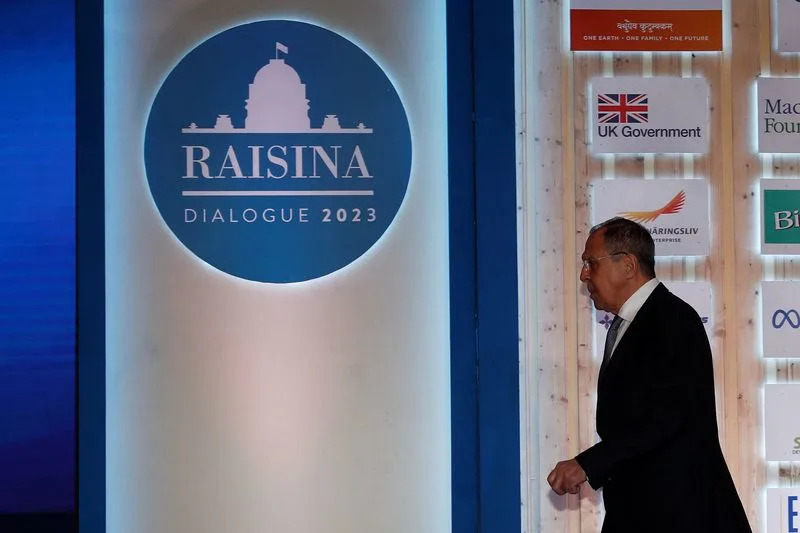
Raisina Dialogue 2023 in New Delhi
NEW DELHI (Reuters) – Russian Foreign Minister Sergei Lavrov accused the United States of hypocrisy after U.S. Secretary of State Antony Blinken said Russia cannot be allowed to wage war in Ukraine with impunity, during a security forum they attended in New Delhi on Friday.
The top diplomats from Moscow and Washington had both attended the Group of 20 foreign ministers gathering in the Indian capital earlier this week, and met in person for the first time since Russian forces invaded Ukraine a year ago.
“If we allow with impunity Russia to do what it’s doing in Ukraine, then that’s a message to would-be aggressors everywhere that they may be able to get away with it too,” Blinken told the Raisina Dialogue strategic affairs forum.
Speaking at the same strategic affairs forum after Blinken, Lavrov said it was “double standards” to question Russia’s action in Ukraine when the United States cited a “threat to its national interest” to justify military intervention in various parts of the world, including the war in Iraq, air strikes on Libya, and the bombing of Yugoslavia during the Kosovo conflict in 1999.
Lavrov also said the question of when Russia will negotiate an end to the war should be put to Ukraine President Volodymyr Zelensky.
“Everybody is asking when Russia is going to negotiate…the West is continuously saying that it is not time to negotiate yet because Ukraine must win in the battlefield before any negotiations,” he said.
At the G20, the United States and its allies called on member countries to keep pressuring Russia to end the conflict, but the G20 was unable to agree on a joint statement on the war due to opposition from China and Russia, which calls its actions a “special military operation” aimed at removing what it says is a threat to its own security.
The Russian minister went on to accuse Washington of “trying to militarise” the Quadrilateral Security Dialogue, a partnership between the United States, Australia, India and Japan that focuses on strategic issues in the Indo-Pacific region.
Earlier in the day Blinken had met with his counterparts from the Quad, as the grouping is informally called, and they issued a statement saying “the use or threat of use of nuclear weapons is inadmissible”.
Late last month, Russian President Vladimir Putin suspended a landmark nuclear arms control treaty and threatened to resume nuclear tests.
During their brief exchange on the sidelines of the G20 meeting on Thursday, Blinken told Lavrov to end the war and urged Moscow to reverse its suspension of the New START (Strategic Arms Reduction Treaty) on nuclear weapons.
The Quad statement also took a barely disguised swipe at China by denouncing actions that increase tensions in the South China Sea, and the “militarisation” of disputed territories in the area.
China has denounced the Quad as a Cold War construct and a clique “targeting other countries”.
(Additional reporting by Tanvi Mehta and Shilpa Jamkhandikar; Writing by Y.P. Rajesh; Editing by Simon Cameron-Moore)
Ukraine Latest: Russia Scoffs at Blinken’s G-20 Chat With Lavrov
Bloomberg News – March 2, 2023
(Bloomberg) — US Secretary of State Antony Blinken unexpectedly spoke briefly with his Russian counterpart while in India for the G-20 foreign ministers meeting, with Russia’s war in Ukraine among the topics. A Russian spokeswoman scoffed that Blinken initiated the encounter with Foreign Minister Sergei Lavrov and “it doesn’t deserve our attention.”
The G-20 officials couldn’t reach agreement on language to describe the war, similar to the outcome of the finance ministers last weekend.
President Vladimir Putin ditched a planned visit to southern Russia as the Kremlin cited an “attack” on the border with Ukraine. The Russian leader called the incident “a terrorist act.”
Key Developments
Putin Denounces Attack Near Border That Ukraine Calls a Set-Up
Blinken Presses Lavrov on Ukraine in Unexpected Chat at G-20
G-20 Top Diplomats Fail to Agree on Language on Russia’s War
EU Leaning Toward More Fiscal Leeway for Defense Spending
(All times CET)
Russia Says Lavrov ‘Disregarded Blinken’ as Usual at G-20 (8:01 p.m.)
Lavrov “disregarded in his usual manner” what Blinken told him about US views on current crises during a short encounter on the sidelines of G-20 foreign ministers conference, according to Lavrov’s spokeswoman Maria Zakharova.
“It doesn’t deserve our attention. There was nothing interestingm” she said in comments on Russian state television. Blinken approached Lavrov, and “we didn’t push him away,” she said.
Russian Support for Army’s Ukraine Actions Increases, Poll Finds (7 p.m.)
A new poll by the independent Levada Center found 77% of Russians surveyed support the Russian army’s actions in Ukraine, up by 6 percentage points from December. People older than 55, who are exempt from the military mobilization, are much more pro-war than young people ages 18 to 24.
But the poll also suggests a majority of Russians wish for the war to end: 43% favored continued military operations in Ukraine while 50% said Moscow should begin peace negotiations. The share of those who want the war to continue rose by 3 percentage points since December, according to the pollster.
Blinken Presses Lavrov on Ukraine in Unexpected Chat (5:44 p.m.)
During a stop in Tashkent on Wednesday, Blinken said he had “no plans” to meet with Russian Foreign Minister Sergei Lavrov at the G-20 gathering. Yet Russia’s foreign ministry said it was Blinken who sought out Thursday’s conversation, which it said didn’t qualify as “talks or a meeting,” according to Interfax.
Blinken didn’t respond to a question during his news conference about why he sought the meeting with Lavrov, and State Department spokespeople declined to comment on the matter.
“I told the foreign minister what I and so many others said last week at the United Nations, and what so many G-20 foreign ministers said today: End this war of aggression, engage in meaningful diplomacy that can produce a just and durable peace,” Blinken told reporters after the encounter, referring to a United Nations vote condemning Russia’s invasion.
More Russian Diesel Being Stranded at Sea (4:30 p.m.)
The volume of Russian diesel stranded at sea keeps swelling to new records as sanctions leave the fuel exporter searching for buyers.
As much as 3.2 million barrels of Russian diesel-type fuel have been idling offshore for seven days or more, according to Kpler data compiled by Bloomberg. The surge in so-called floating storage comes as diesel exports from Russia’s Primorsk port hit the highest since at least 2016.
Read more: Russian Diesel Stranded at Sea Keeps Growing With Buyers Scarce
Top Security Officials From NATO’s Eastern Flank Meet (3:51 p.m.)
Top security officials from Turkey, Romania and Poland — the biggest military powers in NATO’s eastern flank — are meeting in Warsaw to discuss the war in Ukraine and strengthening of domestic defense industries, Poland’s National Security Bureau said.
Turkey’s National Security Council General Secretary Seyfullah Hacımüftüoğlu, Romania’s Ion Oprisor, and Poland’s Jacek Siewiera are in the talks, which also include planning for the next NATO summit in Vilnius in July.
Poland Sees Growing Spy Activity at Kaliningrad Border (3:12 p.m.)
Russia is ramping up spying against Poland in the neighboring Kaliningrad exclave in an attempt to escalate tensions at the border, Stanislaw Zaryn, a spokesman for Poland’s security services, said on Thursday.
Moscow has recently intensified its efforts to collect intelligence about Poland, targeting individuals and questioning Polish citizens in Kaliningrad about army movements and access to sensitive security information, Zaryn told reporters in Warsaw.
Poland in recent months has detained nine people suspected of working for Russian and Belarusian secret services, he said.
China Tells Russia – Again – That It Supports Peace Talks (2:57 p.m.)
China’s Foreign Minister Qin Gang held a meeting with Russian counterpart Lavrov on sideline of the G-20 foreign minister’s meeting in India and exchanged views on Ukraine, according to a readout from the Ministry of Foreign Affairs.
Read more: China Reiterates to Russia It Supports Peace Talks on Ukraine
McDonald’s to Reopen in Odesa, Dnipro (1:11 p.m.)
The US fast-food giant said it plans to reopen stores in Odesa at the end of March and in Dnipro at the end of April. Dnipro “needs a little more time to secure supply chains and logistics process,” McDonald’s Ukraine said on Twitter.
The chain has in recent months reopened dozens of restaurants in Kyiv and the surrounding area, including in Bucha, and in western Ukraine.
Russian Tank Exhibit Spurs Tension in the Baltics (12:29 p.m.)
A display of Russian tanks captured by Ukrainian forces and shipped to the Baltics backfired after supporters of Russian troops began laying flowers on the vehicles.
A fight broke out between two men after one laid a flower at one of the heavily damaged T-72 tanks and another tried to remove it.
Read more: Captured Russian Tank Exhibits Spur Tensions in the Baltics
G-20 Top Diplomats Fail to Agree on Language on Russia’s War (12:45 p.m.)
The foreign ministers of the G-20 couldn’t reach agreement on language to describe Russia’s war in Ukraine, India’s Foreign Minister Subrahmanyam Jaishankar told reporters after a meeting of the grouping. The two-day gathering will issue an outcome document instead of a formal joint statement, Jaishankar added.
A similar meeting of G-20 finance ministers and central bank heads over the weekend failed to reach a consensus on the language to describe Russia’s aggressions in Ukraine, forcing host India to issue a chair’s summary instead of a traditional joint communiqué. Russia and China had deviated from the Bali formula, objecting to the use of the word “war.”
Kremlin spokesman Dmitry Peskov said the president was receiving regular reports on the events from top security officials. Russian state news agencies offered conflicting accounts of the events in the border area near Ukraine on Thursday, with some reporting casualties among civilians blamed on unidentified attackers, who numbered in the dozens.
Ukraine dismissed the claims as a Russian “provocation” aimed at building public support for the invasion. Ukraine’s Northern Military Command warned Feb. 23 that intelligence reports showed sightings of troops without insignia and wearing uniforms similar to Ukrainian ones in Russia’s Bryansk region close to the border.
Poland’s Orlen Won’t End Russian Oil Contract, CEO Says (12:05 p.m.)
PKN Orlen SA, Poland’s largest oil company, won’t terminate a supply contract with a Russian exporter after shipments via the Druzhba pipeline were halted last week, Chief Executive Officer Daniel Obajtek told PAP newswire.
State-controlled Orlen has argued that it needed the European Union sanctions to be able to terminate the Russian contract, which accounts for 10% of the country’s oil usage, without being exposed to contractual penalties. The company is yet to comment whether it expects the oil flows to resume. Polish Prime Minister Mateusz Morawiecki said earlier this week that Orlen wouldn’t get any Russian oil in February and March.
Russia May Run Out of Money in 2024, Deripaska Warns (10:55 a.m.)
Billionaire Oleg Deripaska said Russia could find its coffers empty already next year and needs investment from “friendly” countries to break the hold of sanctions on the economy. “There will be no money already next year,” Deripaska said at the Krasnoyarsk Economic Forum in Siberia. “We will need foreign investors.”
Funds are now running low and “that’s why they’ve already begun to shake us down,” said Deripaska, founder of United Co, Rusal International PJSC, the biggest aluminum producer outside China. His comments are among the most outspoken by a prominent business leader as the government looks to turn the screws on large companies after ending last year with a record fiscal deficit and the budget still deep in the red to start 2023.
Billionaire Deripaska Warns Russia May Run Out of Money in 2024
Moldova’s New Premier Sees No Risk of Military Escalation From Russia (10:10 a.m.)
Moldova’s new Prime Minister Dorin Recean said Russia doesn’t have the necessary resources to escalate its military conflict and invade the tiny nation, because of the distances involved and Ukrainian forces separating it from Moscow’s armed units.
The nation bordering Ukraine has enough capacity to handle a potential escalation from the breakaway region of Transnistria, which hosts Russian military units, but which is now “very much aligned with” the Moldovan government’s peace and security goals, Recean told Romanian state television late Wednesday.
Moldova has come under rising pressure from Russia over the past year, with missiles aimed at Ukraine crossing its airspace, domestic protests, and accusations that Moscow seeks to overthrow its pro-European government.
Scholz Cautions China Against Giving Arms to Russia (9.35 a.m.)
Scholz told the lower house of parliament in Berlin he’s frustrated that China has dropped what he called “a clear condemnation of the Russian attack” agreed by leaders at a Group of 20 summit in Bali last year. “My message to Beijing is clear: Use your influence in Moscow to press for the withdrawal of Russian troops,” Scholz said. “And,” he added, “do not supply weapons to the aggressor Russia.”
The US has warned China not to help arm Russia and US National Security Advisor Jake Sullivan said last week that any weapons support to Moscow would come with “real costs.”
Russia Hits Ukraine’s Zaporizhzhia with Missiles (8:10 a.m.)
Russia launched missiles at the southern Ukrainian city of Zaporizhzhia, hitting a residential four-storey building in the city center at night, police said. Four people were killed and six wounded by a Russian S-300 missile, the prosecutor general’s office said, citing preliminary information. Five people, including a child, were still missing.
More than 10 apartments were destroyed, the police said. “The terrorist state wants to turn every day for our people into a day of terror,” Zelenskiy said in a statement on Telegram addressing the attack.
Strike the heart of Russia and watch its resolve crumble
Con Coughlin – March 2, 2023
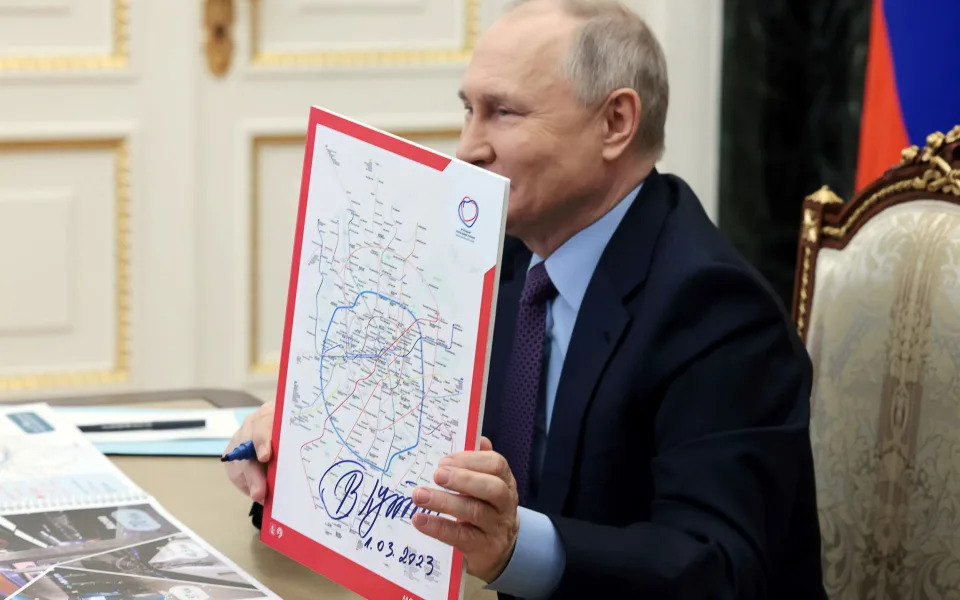
Vladimir Putin takes part in the ceremony of the opening of the Big Circle Line (BCL) of the Moscow subway – MIKHAIL METZEL/Shutterstock
From the moment Vladimir Putin, the Russian president, launched his unprovoked invasion of Ukraine, there has been a distinct feeling of unease among some Western leaders at the prospect of Ukrainian forces attacking targets on Russian soil. While the Russians have shown no qualms about targeting Ukrainian civilians and infrastructure, the Ukrainians have been actively discouraged from responding in kind for fear of provoking a wider escalation in the conflict.
This twisted logic has meant that, even though Russia has maintained its relentless assault on the Ukrainian people, Western allies have been reluctant to provide weaponry that would enable Ukraine to take the fight to Russia.
The provision of long-range Western missile systems is a case in point. After some hesitancy, the US, Britain and other allies eventually agreed to give Kyiv missiles, such as the American HIMARS, but on condition that they were only used to target Russian military operations in Ukraine. The imposition of such restrictions on these and other weapons has placed the Ukrainians at a distinct disadvantage compared with their Russian foes.
No one is advocating that the Ukrainians resort to committing war crimes, as the Russians have done repeatedly during the past year, by targeting Russian civilians. But a number of recent incidents suggest that Ukrainian commanders are no longer prepared to tolerate the constraints placed on them by their Western allies, and are seeking to take the fight well beyond their borders.
Such acts of sabotage are modest compared with the constant bombardment the Russian’s have carried out against Ukraine’s infrastructure. But with the war at a critical juncture, Ukraine is clearly seeking to extend its operations, a development its Western allies should encourage, not hinder.
For all Putin’s attempts to portray the conflict as a great national struggle, the reality is that the war continues to go very badly for the Russian leader. With the number of Russian deaths and casualties said to have reached the 200,000 mark, it is estimated that Moscow has suffered more combat fatalities than it experienced in all the wars it has fought since the Second World War.
That figure, moreover, is likely to rise significantly if Putin continues to sacrifice the lives of tens of thousands of raw conscripts by resorting to tactics last seen on the blood-soaked battlefields of the First World War. In recent weeks, as Russian forces have launched a counter-offensive to capture key cities in eastern Ukraine such as Bakhmut, they are believed to have lost a staggering 40,000 soldiers.
This time last year, a combination of poorly trained and ill-equipped Russian forces, combined with the inhospitable Ukrainian terrain, meant that the much-vaunted military offensive suffered an ignominious defeat. And there is every likelihood the Russians will suffer a similar fate this year as, despite the constant changes in military command and the recruitment of hundreds of thousands of conscripts, they seem determined to repeat the mistakes of the past.
Yet, with the state-controlled Russian media making no mention of the true scale of the losses, the Russian public are unaware of the true extent of the disaster that is befalling their country. Instead they are treated to the grotesque spectacle of pro-Putin supporters seeking to romanticise Russia’s role in invading Ukraine, as was evident from the carefully choreographed rally held at Moscow’s Luzhniki Stadium to mark the first anniversary of the war.
Another concern must be the increasingly erratic behaviour of Putin himself who, when not travelling around the country in a special armoured train on secret railway tracks, reportedly spends his time at his palatial mansion on the outskirts of Moscow, cavorting with his long-term lover, a former Olympic rhythmic gymnastics champion.
If the Russian people truly understood the scale of the calamity facing their country, it is unlikely that they would tolerate the antics of their president, nor the incompetence of his military commanders.
By taking the war deep within Russia’s borders, the Ukrainians are demonstrating to the Russian people in graphic terms that Putin’s so-called “special military operation” is not going as well as he would like them to believe.
Such a strategy is not without risk. Russian efforts to demoralize the Ukrainian people by constantly attacking the country’s infrastructure have ultimately proved counterproductive, as they have only served to strengthen the Ukrainians’ resolve. But if Ukraine is ultimately to prevail in the conflict, the Russian people need to understand that, despite Putin’s claims to the contrary, they are fighting a war they have no chance of winning.
Soils of war: The toxic legacy for Ukraine’s breadbasket
Rod Nickel – March 1, 2023
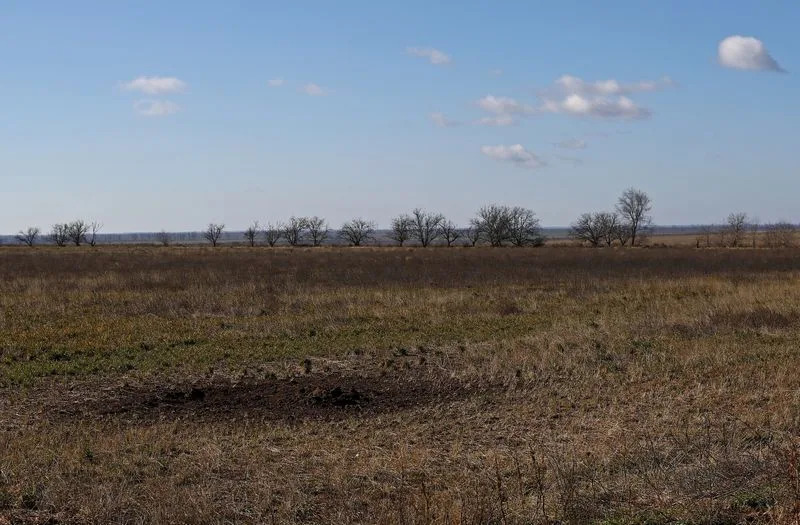
A view of the depression from shelling in field of grain farmer Andrii Povod that has been damaged by shelling and trenches, in BilozerkaGrain farmer Andrii Povod stands beside his field that has been damaged by shelling and trenches, amid Russia’s invasion of Ukraine, in BilozerkaA trench is seen near a field of grain farmer Andrii Povod, amid Russia’s invasion of Ukraine, in Bilozerka
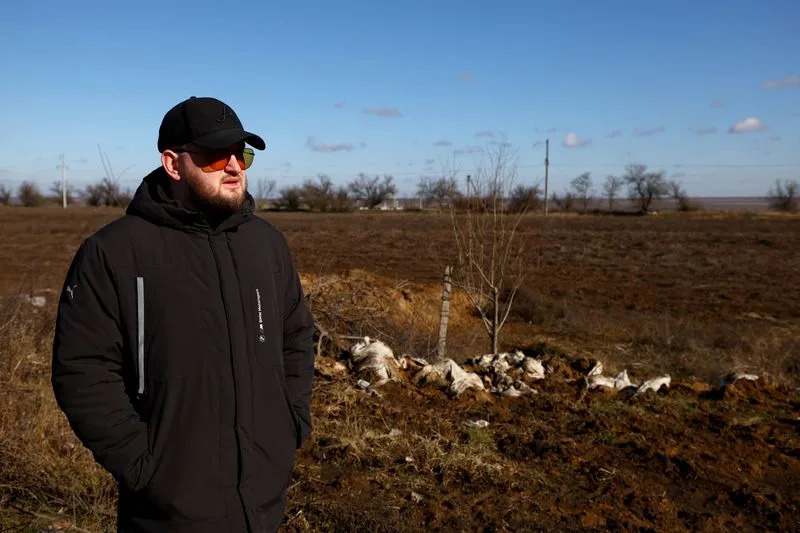
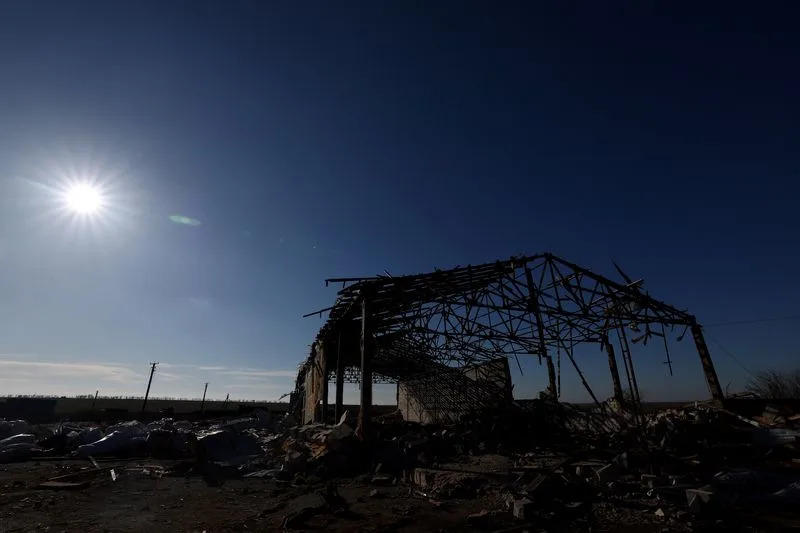
BILOZERKA, Ukraine (Reuters) – When Ukraine recaptured Kherson in November, Andrii Povod returned to find his grain farm in ruins. Two tractors were missing, most of the wheat was gone and all 11 buildings used to store crops and machinery had been bombed and burned.
The farm bears the scars of Russian shelling and unexploded ordnance riddles the fields but it’s the less visible damage to Ukraine’s famously fertile soil after a year of war that could be the hardest to repair.
Scientists looking at soil samples taken from the recaptured Kharkiv region in northeastern Ukraine found that high concentrations of toxins such as mercury and arsenic from munitions and fuel are polluting the ground.
Using the samples and satellite imagery, scientists at Ukraine’s Institute for Soil Science and Agrochemistry Research estimated that the war has degraded at least 10.5 million hectares of agricultural land across Ukraine so far, according to the research shared with Reuters.
That’s a quarter of the agricultural land, including territory still occupied by Russian forces, in a country described as the breadbasket of Europe.
“For our region, it’s a very big problem. This good soil, we cannot reproduce it,” said Povod, 27, walking around his farm near Bilozerka in southeast Ukraine, about 10 km (6 miles) from the Dnipro River that is one of the war’s front lines.
Two dozen experts who spoke with Reuters, including soil scientists, farmers, grain companies and analysts, said it would take decades to fix the damage to Europe’s breadbasket – including contamination, mines and destroyed infrastructure – and that global food supplies could suffer for years to come.
Shelling has also upset the delicate ecosystems of microorganisms that turn soil materials into crop nutrients such as nitrogen while tanks have compressed the earth, making it harder for roots to flourish, the scientists say.
Some areas are so mined and physically transformed by craters and trenches that, like some World War One battlefields, they may never return to farm production, some experts say.
LOSS OF FERTILITY
Before the war, Ukraine was the world’s fourth-largest corn exporter and fifth-biggest wheat seller, and a key supplier to poor countries in Africa and the Middle East that depend on grain imports.
After Russia’s invasion a year ago, global grain prices climbed as the Black Sea ports that usually ship Ukraine’s harvest closed, exacerbating inflation rates around the world.
The war damage could cut Ukraine’s potential grain harvest by 10 to 20 million tonnes a year, or up to a third based on its pre-war output of 60 to 89 million tonnes, the Soil Institute’s director, Sviatoslav Baliuk told Reuters.
Other factors are also important for production levels, such as the area of land farmers plant, climate change, the use of fertilisers and adoption of new farming technology.
Ukraine’s agriculture ministry declined to comment about soil contamination and long-term harm to the industry.
Besides the damage to the soil, Ukrainian farmers are struggling with unexploded shells in many fields, as well as the destruction of irrigation canals, crop silos and port terminals.
Andriy Vadaturskyi, chief executive of Nibulon, one of Ukraine’s biggest grain producers, expects demining alone to take 30 years and said urgent financial help was needed to keep Ukrainian farmers in business.
“Today, there is a problem of high prices but the food is available,” Vadaturskyi said in an interview. “But tomorrow, in one year’s time, it could be the situation if there is no solution, that it will be a shortage of food.”
Ukraine’s most fertile soil – called chernozem – has suffered the most, the institute found. Chernozem is richer than other soils in nutrients such as humus, phosphorus and nitrogen and extends deep into the ground, as much as 1.5 metres.
The institute’s Baliuk said the war damage could lead to an alarming loss of fertility.
Increased toxicity and reduced diversity of microorganisms, for example, have already reduced the energy corn seeds can generate to sprout by an estimated 26%, resulting in lower yields, he said, citing the Institute’s research.
ECHOES OF WORLD WAR ONE
A working group of soil scientists created by the Ukrainian government estimates it would cost $15 billion to remove all mines and restore Ukraine’s soil to its former health.
That restoration can take as little as three years, or more than 200, depending on the type of degradation, Baliuk said.
If studies of damage to land during World War One are anything to go by, some areas will never recover.
U.S. academics Joseph Hupy and Randall Schaetzl, coined the term “bombturbation” in 2006 to describe war’s impact on soil. Among the unseen damage, bomb breaches in bedrock or soil layers can change the water table’s depth, depriving vegetation of a shallow water source, they wrote.
At a former World War One battlefield near Verdun, France, some pre-war grain fields and pastures have gone unfarmed for more than a century due to craters and unexploded shells, a 2008 paper by Remi de Matos-Machado and Hupy said.
Hupy told Reuters that some arable land in Ukraine, too, may never return to crop production due to its contamination and topographic alteration. Many other fields will require significant earth-moving to relevel the ground, along with demining on a massive scale, Hupy said.
Naomi Rintoul-Hynes, senior lecturer in soil science and environmental management at Canterbury Christ Church University, studied soil contamination from World War One and fears the conflict in Ukraine is doing similar, irreversible damage.
“It is of utmost importance that we understand how bad the situation is as it stands,” she said.
Lead, for example, has a half-life of 700 years or more, meaning it may take that long for its concentration in the soil to decrease by half. Such toxins can accumulate so much in plants growing there that human health may become affected, Rintoul-Hynes said.
To be sure, World War One lasted four years, and the war in Ukraine only one year so far, but lead remains a key component of many modern munitions, Rintoul-Hynes said.
DEMINING CHALLENGE
Removing mines and other unexploded ordnance, which cover 26% of Ukraine’s land according to the government, will likely take decades, said Michael Tirre, Europe program manager for the U.S. State Department’s Office of Weapons Removal.
Andrii Pastushenko’s dairy farm in southeastern Ukraine, where he grows cattle feed and sunflowers, is pockmarked with craters and former Russian bunkers.
Though Ukraine recaptured the area in November, Russian forces shell his farm regularly from across the Dnipro River, blowing new holes in his fields and scattering unexploded ordnance, he said.
“We need many months to clear everything and continue to work, maybe years,” said Pastushenko, 39. “There is no help because we are on the first line of fire. No one will help while this is a war zone.”
There is currently no work underway on demining farms in the Kherson region because of a limited number of specialists, said Oleksandr Tolokonnikov, a spokesperson for the Kherson Regional Military Administration.
With so little help available, grain company Nibulon has created a small division dedicated to demining its land in southern Ukraine, a process expected to last decades, Mykhailo Rizak, Nibulon’s deputy director told Reuters.
“This is a very serious problem for Nibulon,” Rizak said.
There’s another long-term problem for Ukraine’s agricultural sector, which accounted for 10% of its gross domestic product before the war. That’s the damage to roads, railways and other infrastructure estimated at $35.3 billion and counting, the Kyiv School of Economics said in October.
“People think as soon as peace is achieved, the food crisis will be solved,” said Caitlin Welsh, director of global food security at the Center for Strategic & International Studies in Washington. “With Ukraine, just repairing the infrastructure is going to take a really long time.”
Farmers’ finances are also in a desperate state, said Dmitry Skornyakov, chief executive of HarvEast, a major Ukrainian farming company.
Many farmers can survive this year, living off the income of a bumper year just before the war, said Skornyakov, but he predicts up to half will have severe financial problems if the conflict drags into 2024.
“The future is from grey to dark at the moment.”
(Reporting by Rod Nickel in Bilozerka; Additional reporting by Pavel Polityuk in Kyiv; Editing by David Clarke)
Putin issues alert after drone strikes 60 miles from Moscow; Russian death toll surpasses all wars since WWII: Ukraine live updates
John Bacon and Jorge L. Ortiz, USA TODAY – February 28, 2023
Russian President Vladimir Putin ordered officials to tighten control of the Ukraine border Tuesday after a flurry of drone attacks targeted regions inside Russia – with one drone crashing just 60 miles from Moscow.
Ukraine authorities did not take responsibility for the attacks but have claimed the right to such forays to turn back Russia’s invasion. Pictures of the drone showed it was a small Ukrainian-made model with a reported range of close to 500 miles but no capacity to carry a large load of explosives.
Russian forces shot down a Ukrainian drone early Tuesday over the Bryansk region, local Gov. Aleksandr Bogomaz said in a Telegram post. He said there were no casualties. Three drones also targeted Russia’s Belgorod region along the border, and one flew through an apartment window in its namesake capital, local authorities reported.
Moscow Regional Gov. Andrei Vorobyov said the Moscow-area drone apparently was targeting – but did not hit – a Gazprom gas distribution facility.
“There are no casualties or destruction on the ground,” he said on Telegram. “There are no risks to the safety of local residents.”
Russian President Vladimir Putin delivers a speech during a meeting of the Federal Security Service board in Moscow on Feb. 28, 2023.
Developments:
►Putin followed through on last week’s vow to suspend the last remaining nuclear arms treaty with the U.S., signing a bill to that effect Tuesday. Putin and Russian authorities have said they’re not pulling out entirely from the New START treaty and will respect its caps on nuclear weapons and continue to notify the U.S. about test launches of ballistic missiles.
►Air raid alarms interrupted TV and radio programming in several Russian regions Tuesday. Russia’s Emergency Ministry said in an online statement that the announcement was a hoax resulting from hacking.
►Flights in and out of the main airport in St. Petersburg, the second-largest city in Russia, were stopped for an hour Tuesday, prompting reports that an unidentified drone was the reason. The Russian military later said it was because of air defense drills.
►At least four civilians were killed and five wounded by renewed Russian shelling in the southern Ukraine city of Kherson and surrounding villages, Ukraine authorities said Tuesday.
►One-third of the Ukrainians who fled to European Union nations because of the war eventually want to return home, the same proportion as those who prefer to stay in their host country, according to nearly 15,000 respondents to a survey conducted by the EU’s Agency for Fundamental Rights. About one-quarter of the respondents were undecided.
Russian death toll surpasses all its wars since WWII
More than 60,000 Russian troops have died in the first year of the Ukraine war, more than all Russian wars since World War II combined, a new study says.
The analysis by the Center for Strategic International Studies estimates that 60,000 to 70,000 Russian soldiers have died in Ukraine. Russia suffered roughly 200,000 to 250,000 total casualties – personnel killed, wounded or missing – during the first year of the war, the analysis says.
In comparison, Russia had 13,000 to 25,000 fatalities in Chechnya from 1994 to 2009, and 14,000 to 16,000 in Afghanistan from 1979 to 1989.
“Some types of authoritarian regimes are willing to accept high casualties in interstate conflicts, but Russian casualty numbers are unprecedented for post-World War II Russia,” the analysis says.
The Ukrainian military has also performed “remarkably well” against a much larger and initially better-equipped Russian military, in part because of the innovation of its forces, the analysis says. It adds that Putin has thus far been willing to accept large numbers of Russian fatalities with limited political repercussions, “but it is unclear that he will be able to do so forever.”
‘Grinding slog’ in front lines unlikely to pick up in near future
A senior Pentagon official calls the front lines in Ukraine “a grinding slog,” and field conditions don’t augur much change in the near future, perhaps even longer.
“I do not think that there’s anything I see that suggests the Russians can sweep across Ukraine and make significant territorial gains anytime in the next year or so,” Colin Kahl, under secretary of defense for policy, told a House committee Tuesday.
Intense fighting continues in the eastern Donbas region as Russia tries to solidify its control, but neither side has gained much ground in the winter. The warming temperatures and softer soil of the upcoming spring don’t lend themselves to major advances either.
“Both sides stay in their positions, because as you see, spring means mud. Thus, it is impossible to move forward,” a Ukrainian commander identified only as Mykola told Reuters.
Tanks, but no tanks
Before their current insistence on getting fighter jets, Ukrainian leaders clamored for modern tanks to confront Russian troops. That request was finally granted Jan. 25, when the U.S. and Germany announced they had overcome their initial reluctance and would provide the vehicles, opening the door for other countries to contribute them as well.
Only they haven’t done much of that.
Ukraine has asked for 300 tanks, the U.S. and its allies have pledged around 100, and few have made it to the battlefield so far. Some of the delay was expected because of the need for training and the challenging logistics of delivering the tanks — the U.S. M1 Abrams, for example, weighs at least 60 tons.
But the same countries that pressured Germany to allow for their Leopard 2 tanks to be sent to Ukraine are running into obstacles, some based on lack of usable supply, some based on political resistance or other factors, the New York Times reported.
“Of course some nations have delivered, or at least announced that they will,” the newspaper quoted German Federal Minister of Defense Boris Pistorius saying at the Munich Security Conference this month. “But others have not done that.”
Contributing: Maureen Groppe, USA TODAY; The Associated Press
Drones fly deep inside Russia; Putin orders border tightened
Susie Blann – February 28, 2023
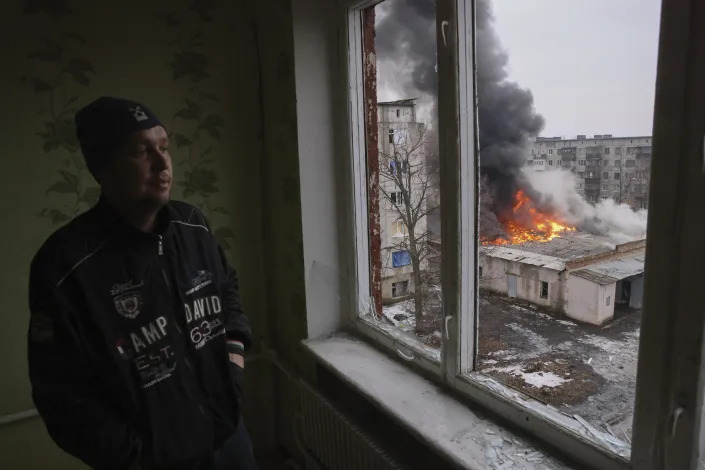
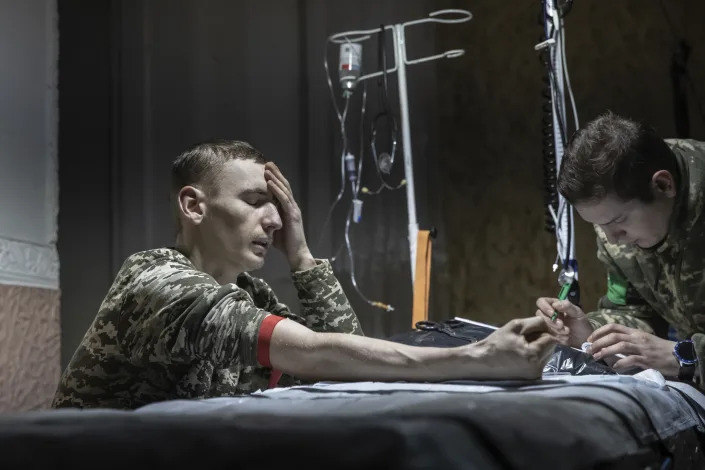
A local resident stands at the window as smoke raises from the burning building after the Russian shelling in the town of Chasiv Yar, the site of the heaviest battles with the Russian troops, Donetsk region, Ukraine, Monday, Feb. 27, 2023. (AP Photo/Yevhen Titov)A medic gives the first aid to a wounded Ukrainian soldier near Bakhmut, the site of the heaviest battles with the Russian troops, Donetsk region, Ukraine, Monday, Feb. 27, 2023. (AP Photo/Yevhen Titov)Medics give the first aid to a wounded Ukrainian soldier near Bakhmut, the site of the heaviest battles with the Russian troops, Donetsk region, Ukraine, Monday, Feb. 27, 2023. (AP Photo/Yevhen Titov)A view of the town of Bakhmut, the site of the heaviest battles with the Russian troops, Donetsk region, Ukraine, Monday, Feb. 27, 2023. (AP Photo/Yevhen Titov)A view of the town of Bakhmut, the site of the heaviest battles with the Russian troops, Donetsk region, Ukraine, Monday, Feb. 27, 2023. (AP Photo/Yevhen Titov)A view of the town of Bakhmut, the site of the heaviest battles with the Russian troops, Donetsk region, Ukraine, Monday, Feb. 27, 2023. (AP Photo/Yevhen Titov)
KYIV, Ukraine (AP) — Drones that the Kremlin said were launched by Ukraine flew deep inside Russian territory, including one that got within 100 kilometers (60 miles) of Moscow, signaling breaches in Russian defenses as President Vladimir Putin ordered stepped-up protection at the border.
Officials said the drones caused no injuries and did not inflict any significant damage, but the attacks on Monday night and Tuesday morning raised questions about Russian defense capabilities more than a year after the country’s full-scale invasion of its neighbor.
Ukrainian officials did not immediately take responsibility, but they similarly have avoided directly acknowledging responsibility for past strikes and sabotage while emphasizing Ukraine’s right to hit any target in Russia.
Although Putin did not refer to any specific attacks in a speech in the Russian capital, his comments came hours after the drones targeted several areas in southern and western Russia. Authorities closed the airspace over St. Petersburg in response to what some reports said was a drone.
Also Tuesday, several Russian television stations aired a missile attack warning that officials blamed on a hacking attack.
The drone attacks targeted regions inside Russia along the border with Ukraine and deeper into the country, according to local Russian authorities.
A drone fell near the village of Gubastovo, less than 100 kilometers (60 miles) from Moscow, Andrei Vorobyov, governor of the region surrounding the Russian capital, said in an online statement.
The drone did not cause any damage, Vorobyov said, but it likely targeted “a civilian infrastructure object.”
Pictures of the drone showed it was a small Ukrainian-made model with a reported range of up to 800 kilometers (nearly 500 miles) but no capacity to carry a large load of explosives.
Russian forces early Tuesday shot down another Ukrainian drone over the Bryansk region, local Gov. Aleksandr Bogomaz said in a Telegram post.
Three drones also targeted Russia’s Belgorod region on Monday night, with one flying through an apartment window in the capital, local authorities reported. Regional Gov. Vyacheslav Gladkov said the drones caused minor damage to buildings and cars.
The Russian Defense Ministry said Ukraine used drones to attack facilities in the Krasnodar region and neighboring Adygea. It said the drones were brought down by electronic warfare assets, adding that one of them crashed into a field and another diverted from its flight path and missed a facility it was supposed to attack.
Russia’s state RIA Novosti news agency reported a fire at the oil facility, and some other Russian reports said that two drones exploded nearby.
While Ukrainian drone strikes on the Russian border regions of Bryansk and Belgorod have become a regular occurrence, other strikes reflected a more ambitious effort.
Some Russian commentators described the drone attacks as an attempt by Ukraine to showcase its capability to strike deep behind the lines, foment tensions in Russia and rally the Ukrainian public. Some Russian war bloggers described the raids as a possible rehearsal for a bigger, more ambitious attack.
Andrei Medvedev, a commentator with Russian state television who serves as a deputy speaker of Moscow’s city legislature and runs a popular blog about the war, warned that the drone strikes could be a precursor to wider attacks within Russia that could accompany Ukraine’s attempt to launch a counteroffensive.
“The strikes of exploding drones on targets behind our lines will be part of that offensive,” Medvedev said, adding that Ukraine could try to extend the range of its drones.
Russia hawks urged strong retaliation. Igor Korotchenko, a retired Russian army colonel turned military commentator, called for a punishing strike on the Ukrainian presidential office in Kyiv.
Another retired military officer, Viktor Alksnis, noted that the drone attacks marked the expansion of the conflict and criticized Putin for failing to deliver a strong response.
Also on Tuesday, authorities reported that airspace around St. Petersburg, Russia’s second-largest city, was temporarily closed, halting all departures and arrivals at the main airport, Pulkovo. Officials did not give a reason for the move, but some Russian reports claimed that it was triggered by an unidentified drone.
The Russian Defense Ministry said it was conducting air defense drills in western Russia.
Last year, Russian authorities repeatedly reported shooting down Ukrainian drones over annexed Crimea. In December, the Russian military said Ukraine used drones to hit two bases for long-range bombers deep inside Russian territory.
Speaking at Russia’s main security agency, the FSB, Putin urged the service to tighten security on the Ukraine border.
In another development that fueled tensions across Russia on Tuesday, an air raid alarm interrupted the programming of several TV channels and radio stations in several regions. Russia’s Emergency Ministry said in an online statement that the announcement was a hoax “resulting from a hacking of the servers of radio stations and TV channels in some regions of the country.”
Meanwhile, satellite photos analyzed by The Associated Press appeared to show a Russian warplane in Belarus that Belarusian guerrillas claimed to have targeted as largely intact.
Tuesday’s high-resolution images from Planet Labs PBC and Maxar Technologies showed the Russian A-50 early warning and control aircraft after what Belarusian opposition activists described as an attack on the Machulishchy air base Sunday outside the Belarusian capital of Minsk.
However, a discoloration could be seen on the aircraft’s distinctive, circular rotodome above its fuselage that could be damage. That discoloration wasn’t seen in earlier images of the aircraft at the air base. The Maxar image also showed what appeared to be vehicles near the airplane as well.
Belarusian activists supporting Ukraine alleged that the aircraft was seriously damaged. Russian and Belarusian officials did not comment on the claims.
In Ukraine, four people were killed and five others wounded Tuesday by renewed Russian shelling of the southern Ukrainian city of Kherson, regional Gov. Oleksandr Prokudin said in a Telegram.
A 68-year-old man was also killed as Russian forces shelled Kupiansk, a town in Ukraine’s northeastern Kharkiv region, Gov. Oleh Syniehubov said.
The fiercest fighting continued to be in eastern areas of Ukraine, where Russia wants control over all four of the provinces it illegally annexed in September.
Ukrainian officials said Russian forces have deployed additional troops and equipment, including the latest T-90 battle tanks, in those areas.
In a video address, Ukraine’s President Volodymyr Zelenskyy thanked U.S. industrialists for supporting Ukraine and voiced hope for their support in rebuilding the country after the war. Zelenskyy noted that the country faces a “colossal task” to restore hundreds of thousands of damaged sites, including “whole cities, industries, productions.”
Associated Press Writer Jon Gambrell contributed to this report from Dubai, United Arab Emirates.