All 500 original members of a Ukrainian battalion were killed or wounded in fighting with Russia, commander says
Charles R. Davis – March 13, 2023
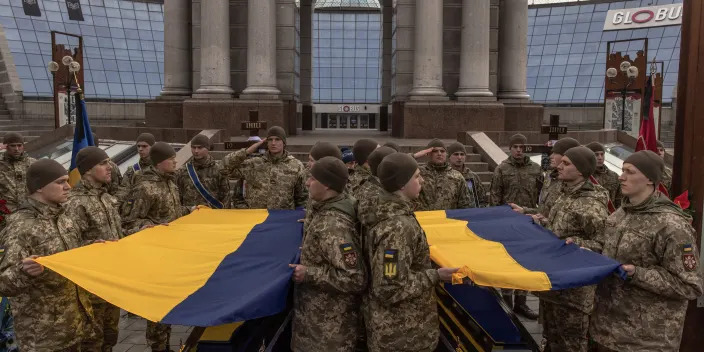
Soldiers hold Ukrainian flags over the coffins with Ukrainian servicemen Oleh Khomiuk and his son, Mykyta Khomiuk, who were killed in Bakhmut, during their funeral service at Independence Square on March 10, 2023 in Kyiv, Ukraine.Roman Pilipey/Getty Images
Ukraine’s defense is being hindered by the loss of experienced soldiers, The Washington Post reported.
One commander said all 500 original members of his battalion had been killed or injured.
Soldiers with significant combat experience “are all already dead or wounded,” the commander said.
The war in Ukraine is bleeding both sides, with each suffering more than 100,000 military casualties (killed and wounded) since Russia launched its full-scale invasion last year. But with Moscow able to draft fighters from a population that dwarfs that of Ukraine, there is growing concern that Kyiv is less capable of suffering sustained losses — and that this will jeopardize its ability to strike back this spring, The Washington Post reported on Monday.
The gravity of the situation is illustrated by the experience of Ukraine’s 46th Air Assault Brigade. A commander of a battalion within the brigade told the Post that he’d lost every one of the 500 people he commanded back in February 2022, leading them to be replaced with fresh recruits far less capable on the battlefield.
The 46th Air Assault Brigade is part of the Ukrainian force battling Russia — and the Wagner mercenary group — over control of Bakhmut in the east of the country. In an assessment published over the weekend, the Institute for the Study of War suggested that the Kremlin is using Wagner’s mercenaries, some recruited from Russian prisons, as cannon fodder amid the fierce fighting in Donetsk, calculating that their loss of life is more palatable to the Russian public than the loss of conventional forces.
The man who commands the Ukrainian battalion, identified by the Post only by his call sign, Kupol, indicated that Kyiv does not have the same luxury.
“The most valuable thing in war is combat experience,” he said, describing the difference between a soldier with six months of experience and one who was freshly trained as “heaven and earth.”
“And there are only a few soldiers with combat experience,” he told the Post. “Unfortunately, they are all already dead or wounded.”
In his own battalion, Kupol said there had been a complete turnover in personnel since the invasion. Off the 500 men he commanded last year, 400 have been wounded and another 100 killed, according to the Post. Their replacements are not ready for war, he added.
“They just drop everything and run. That’s it. Do you understand why? Because the soldier doesn’t shoot. I ask him why, and he says, ‘I’m afraid of the sound of the shot.’ And for some reason, he has never thrown a grenade,” he told the Post. “We need NATO instructors in all our training centers, and our instructors need to be sent over there into the trenches. Because they failed in their task.”
US turns to new ways to punish Russian oligarchs for the war
Fatima Hussein – March 12, 2023
Andrew Adams, director of the Justice Department’s KleptoCapture task force, designed to enforce the economic restrictions imposed on Russia and its billionaires, speaks to the Associated Press in an interview at the AP bureau in Washington, Wednesday, March 1, 2023. (AP Photo/Andrew Harnik)
WASHINGTON (AP) — The U.S. has begun an aggressive new push to inflict pain on Russia’s economy and specifically its oligarchs with the intent of thwarting the Kremlin’s invasion of Ukraine.
From the Treasury Department to the Justice Department, U.S. officials will focus on efforts to legally liquidate the property of Russian oligarchs, expand financial penalties on those who facilitate the evasion of sanctions, and close loopholes in the law that allow oligarchs to use shell companies to move through the U.S. financial system.
Andrew Adams, who heads the U.S. government’s KleptoCapture task force, designed to enforce the economic restrictions within the U.S. imposed on Russia and its billionaires, told The Associated Press that the group is prioritizing its efforts to identify those who help Russians evade sanctions and violate export controls.
“These illicit procurement networks will continue to take up an ever-increasing amount of our bandwidth,” said Adams, who also serves as acting deputy assistant attorney general.
So far, more than $58 billion worth of sanctioned Russians’ assets have been blocked or frozen worldwide, according to a report last week from the Treasury Department. That includes two luxury yachts each worth $300 million in San Diego and Fiji, and six New York and Florida properties worth $75 million owned by sanctioned oligarch Viktor Vekselberg.
The U.S. has begun attempts to punish the associates and wealth managers of oligarchs — in Vekselberg’s case, a federal court in New York indicted Vladimir Voronchenko after he helped maintain Vekselberg’s properties. He was charged in February with conspiring to violate and evade U.S. sanctions.
The case was coordinated through the KleptoCapture group.
“I think it can be quite effective to be sanctioning facilitators,” Adams said, calling them “professional sanctions evasion brokers.”
A February study led by Dartmouth University researchers showed that targeting a few key wealth managers would cause far greater damage to Russia than sanctioning oligarchs individually.
Other attempts to inflict pain on the Russian economy will come from the efforts to liquidate yachts and other property owned by Russian oligarchs and the Kremlin, turning them into cash to benefit Ukraine.
Ukrainian President Volodymyr Zelenskyy has long called for Russian assets to be transferred to Ukraine, and former Biden administration official Daleep Singh told the Senate Banking Committee on Feb. 28 that forfeiting Russia’s billions in assets held by the U.S. is “something we ought to pursue.”
Singh suggested the U.S. should “use the reserves that we have immobilized at the New York Fed, transfer them to Ukraine and allow them to put them up as collateral to raise money.” He ran the White House’s Russia sanctions program when he was national security adviser for international economics.
Adams said the KleptoCapture task force is pursuing efforts to sell Russians’ yachts and other property, despite the legal difficulties of turning property whose owners’ access has been blocked into forfeited assets that the government can take and sell for the benefit of Ukraine.
He stressed that the U.S. will operate under the rule of law. “Part of what that means is that we will not take assets that are not fully, totally forfeited through the judicial procedures and begin confiscating them without a legal basis,” Adams said.
He added that the task force has had “success in working with Congress and working with folks around the executive branch in obtaining authorization to transfer certain forfeited funds to the State Department.”
The Treasury Department said on Thursday that the government is “paving the way” for $5.4 million in seized funds to be sent as foreign assistance to Ukraine.
Additionally, strengthening laws that serve as loopholes for sanctions evaders will also be a priority across federal departments, officials say.
The Financial Crimes Enforcement Network, under Treasury, is expected to roll out rules to address the use of the U.S. real estate market to launder money, including a requirement on disclosing the true ownership of real estate.
Steven Tian, director of research at the Yale Chief Executive Leadership Institute, who tracks companies’ disengagement from Russia, said the new real estate rule is long overdue.
“I would point out that it’s not just unique to Russian oligarchs. As you know, the real estate market makes use of shell companies in the United States, period,” Tian said.
Erica Hanichak, the government affairs director at the FACT Coalition, a nonprofit that promotes corporate transparency, urged the administration to put the rule forward by late March, when the U.S. co-hosts the second Summit for Democracy with the governments of Costa Rica, Netherlands, South Korea and Zambia.
“We’re viewing this as an opportunity for the United States to demonstrate leadership not only in addressing corrupt practices abroad, but looking to our own backyard and addressing the loopholes in our system that facilitate corruption internationally,” she said.
Russia turns to high-tech hypersonic missiles in latest attack on Ukraine
Imtiaz Tyab – March 10, 2023
Near Dnipro, southeast Ukraine — Across Ukraine, people were left Friday to pick up the pieces of Russia’s latest blistering coordinated assault, a barrage of missiles the previous day that left at least six people dead and knocked out power to hundreds of thousands more. The attack saw Moscow turn some of its most sophisticated weapons to elude Ukraine’s potent, Western-supplied air defense systems.
Among the more than 80 missiles unleashed on Ukrainian cities and infrastructure Thursday were six “Kinzhal” [Dagger] hypersonic cruise missiles, according to Ukrainian air force spokesman Yurii Ihnat. The jet-launched rockets are believed to be capable of reaching speeds up to Mach 10 or 12, double the speed of sound (anything over Mach 5 is considered hypersonic).
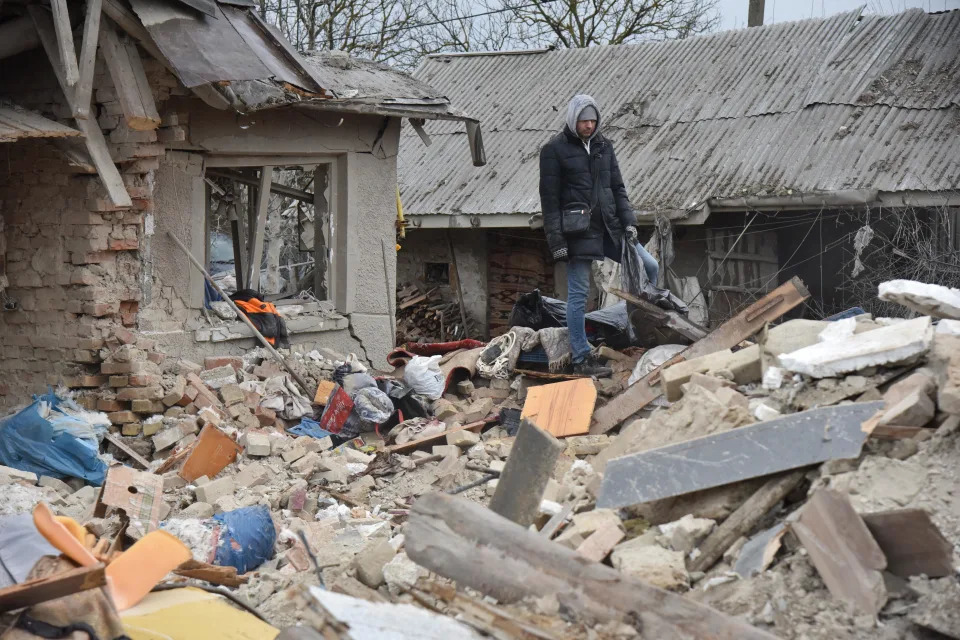
People look at the ruins of houses destroyed by a Russian missile that hit a residential area in the village of Velika Vilshanytsia, near Lviv, Ukraine, March 9, 2023. / Credit: Pavlo Palamarchuk/Anadolu Agency/Getty
Ukraine has acknowledged that it cannot intercept the missiles, which can carry conventional or nuclear warheads. The Russian military has used them at least once previously during the war, about a year ago.
Fitted with conventional warheads hypersonic missiles don’t inflict significantly more damage than other, less-sophisticated rockets, but their ability to avoid interception makes them more lethal. It also makes them more valuable resources for Russia’s military to expend, which may be further evidence of long-reported ammunition and missile shortages that Vladimir Putin has asked his allies in Iran, North Korea and even China to remedy.
Russia’s Defense Ministry said it hit military and industrial targets “as well as the energy facilities that supply them” with its attack on Thursday.
In his daily video address to the Ukrainian people, President Volodymyr Zelenskyy was as defiant as ever after the latest assault.
“No matter how treacherous Russia’s actions are, our state and people will not be in chains,” he said. “Neither missiles nor Russian atrocities will help them.”
While Russia’s air war has reached far across the country, hitting targets even in the far-western city of Lviv on Thursday, the worst of the suffering has been for Ukrainian civilians in the east, where Russian forces have seized a massive swath of the Donbas region — and where they’re pushing hard to seize more.
There, Thursday’s assault was met with a mixture of defiance and disgust.
“This is horrible,” Vasyl, a resident of hard-hit Kherson said. “I don’t have any other words, other than Russia is a horrid devil.”
Moscow’s destruction is evident across the small towns and villages of eastern Ukraine, including in Velyka Novosilka. The town right on the edge of Russian-held ground was once home to 5,000 people, but it’s become a ghost town.
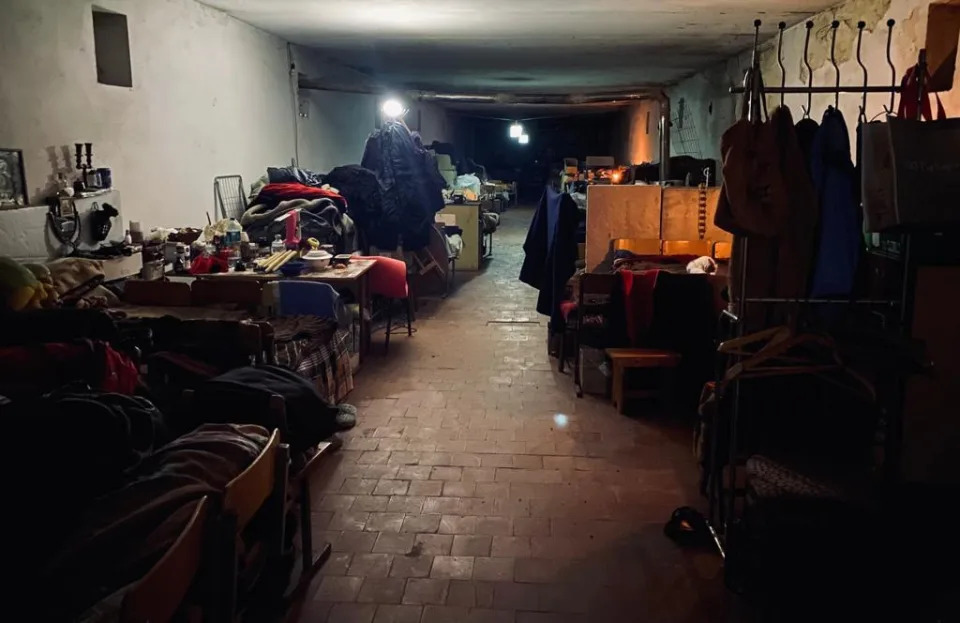
Only about 150 people were still there, and CBS News found them living underground in the basement of a school. It was dark, without electricity or running water, and most of those surviving in the shelter were elderly.
Oleksander Sinkov speaks with CBS News in the basement of a school in the southeast Ukrainian village of Velyka Novosilka, where he took shelter with dozens of other mostly-elderly residents after his home was destroyed early in Russia’s invasion. / Credit: CBS News/Agnes Reau
Oleksander Sinkov moved in a year ago after his home was destroyed.
Asked why he didn’t leave to find somewhere safer, he answered with another question: “And go where? I have a small pension and you can’t get far with that.”
The residents of the school pitch in to help cook and take care of other menial chores as they can, but there’s very little normal about their life in hiding.
Inside the basement of a school in the southeast Ukrainian village of Velyka Novosilka, where dozens of mostly-elderly residents are taking shelter from the war outside. / Credit: CBS News/Agnes Reau
Iryna Babkina was among the youngest people we met in the school. She stayed behind to care for the elderly.
“They cling to this town,” she said of her older neighbors. “We have people here who left and then came back because they couldn’t leave the only home they’ve ever known.”
Iryna Babkina speaks with CBS News in the basement of a school in Velyka Novosilka, southeast Ukraine, where she is sheltering from Russia’s war and helping to look after other residents. / Credit: CBS News/Agnes Reau
It had been weeks since Russia carried out a coordinated attack across the country like Thursday’s, but in the front-line towns like Velyka Novosilka in the east, the shells fall every day, leaving those left behind to survive, barely, however and wherever they can.
Russian wives beg Putin to stop sending husbands into ‘meat grinder’
George Styllis – March 12, 2023
More than a dozen Russian women made the brave appeal to the president
A group of Russian women have appealed to Vladimir Putin to stop sending their husbands and children to the front line like ‘meat’ without adequate training.
In a video shared online, the women say the mobilisation of new recruits to the army has been a betrayal after the Russian President said they would not be sent to the front line immediately.
The women say their sons, husbands and brothers have been “thrown like meat” to storm fortified areas in Ukraine. In the video shared by the independent Telegram news channel SOTA, they can be seen standing in a group holding a sign in Russian that reads, “580 Separate Howitzer Artillery Division”, dated March 11, 2023.
“My husband… is located on the line of contact with the enemy,” one woman says.
Putin ordered the mobilization of more than 300,000 men in September – the first since 1941 – to the shock of many ordinary Russians. Of those who were drafted, many have perished.
Among the reasons for the high casualties have been poor training and a lack of equipment. New recruits have reported being sent to battle with old weapons and unsuitable clothing.
A team of independent Russian journalists called the No Future project says authorities have attempted to cover up the deaths of dozens of mobilised Russians from Volgograd who were sent to fight without any ammunition. The group says new recruits are also deprived of first-aid kits and hot food, while during one training session the men just “played on their phones” for two weeks.
“They are prepared to serve their homeland but according to the specialisation they’ve trained for, not as stormtroopers. We ask that you pull back our guys from the line of contact and provide the artillerymen with artillery and ammunition,” said the woman.
The group’s criticism of the Kremlin comes amid growing anger among Russian wives and mothers over the war.
He has also said “mistakes” were made in the call-up to reinforcements. Despite that, the Kremlin has hinted at a second mobilisation.
MPs have proposed a law that will give Russia’s National Guard more power to enforce military draft orders and another that will allow property to be confiscated from Russians who flee abroad.
Ethnic minorities often bear the brunt of the Russian military’s meat-grinder fighting tactics, according to the report. In Astrakhan, for example, about 75% of the casualties come from the city’s Kazakh and Tatar minorities.
Meanwhile, the populations of Russia’s richest cities – Moscow and St. Petersburg – remain relatively untouched by the carnage in Ukraine. This is especially true for the Kremlin elite.
UK intelligence analysed the families of Russian top officials visible in the first two rows of the audience during the Russian dictator Vladimir Putin’s speech on state of the nation. None of their children are known to serve in the army.
As the Russian Ministry of Defense tries to address the issue of a constant shortage of combat personnel, the isolation of the well-off and more influential part of Russian society from military problems is likely to remain a major consideration, UK intelligence concluded.
Mass Backstabbing Spree Over Putin’s War Sweeps Russia
Noor Ibrahim– March 10, 2023
Sputnik/Mikhail Metzel/Pool via REUTERS
Russian citizens are ratting each other out to authorities in droves for anti-war comments made in bars, beauty salons, and grocery stores in roughly a dozen cities across the country, according to a new report from the independent Russian news outlet Vrestka.
Legal filings obtained by the outlet from Moscow, Bryansk, Novosibirsk, and other cities indicate that citizens have been turned in for “violations” as minor as cracking a joke about the war, listening to Ukrainian music, or even just talking about Russian President Vladimir Putin’s invasion in a public space.
Many of those jailed after being reported by other citizens were charged under Article 20.3.3 of the Code of Administrative Offenses of the Russian Federation, a new law signed by Putin last year criminalizing “public actions aimed at discrediting” Russian Armed Forces.
One Russian man from Bryansk, Mikhail Kolokolnikov, was reportedly fined and jailed for two days after a stranger called authorities on him for saying the phrase “Glory to Ukraine” at a bar on Jan. 15. In an interview with Vrestka, Kolokolnikov said that two officers stormed the bar shortly after he said the phrase to another man, demanding to know, “Who said ‘Glory to Ukraine’ here?”
“The other day, a rocket hit a house in Dnipro,” Kolokolnikov, who was born in Ukraine, told the outlet—explaining why he said the slogan in a public place. “And I used to walk past this house every day to the beach, along the Pobeda embankment. In short, I was still a little angry because of this.”
In another case, Chita resident Ivan Sleponogov was jailed after being accused of saying an anti-war slogan during an Easter church service last April, according to a legal complaint. Sleponogov had allegedly claimed that he was actually chanting “Glory to the guys who died in Ukraine!” in reference to Russian soldiers who were killed in combat, and the case was eventually dropped—after Sleponogov had spent 10 days in jail.
Other cases detailed in the Vrestka investigation include complaints made against Russian citizens for playing a Ukrainian song in the car while driving, drunkenly making pro-Ukrainian statements from a balcony, and criticizing the war in private conversations with friends at a coffee shop. The individuals who made the complaints allegedly include eavesdropping neighbors, coworkers, and janitors.
In many of the cases, according to the outlet, little to no evidence was provided by witnesses who reported the alleged violations.
In some court filings, however, the “anti-war” sentiments allegedly expressed by accused citizens are not so subtle. In Serpukhov, a city near Moscow, two Russian army veterans accused Yuri Nemtov of approaching them at a shopping mall last November with some choice words. “Well, invaders! Go there to die like meat!” he allegedly said.
In race to arm Ukraine, U.S. faces cracks in its manufacturing might
Missy Ryan, The Washington Post – March 9, 2023
Correction: A previous version of this article mischaracterized why Scranton, Pa., is known as “Steamtown.” The name is derived from the steam-powered locomotives that helped fuel the city’s industrial rise, not the early pioneering or electric power. The article has been updated.
SCRANTON, Pa. – A sharp hissing sound fills the factory as red-hot artillery shells are plunged into scalding oil.
Richard Hansen, a Navy veteran who oversees this government-owned munitions facility, explains how the 1,500-degree liquid locks in place chemical properties that ensure when the shells are fired – perhaps on a battlefield in Ukraine – they detonate in the deadly manner intended.
“That’s what we do,” Hansen said. “We build things to kill people.”
The Scranton Army Ammunition Plant, one of a network of facilities involved in producing the U.S. Army’s 155-mm artillery round, is ground zero for the Biden administration’s scramble to accelerate the supply of weapons that Ukraine needs if its military is to prevail in the war with Russia.
The Pentagon’s plan for scaling up production of the shells over the next two years marks a breakthrough in the effort to quench Ukraine’s thirst for weapons. But the conflict has laid bare deep-seated problems that the United States must surmount to effectively manufacture the arms required not just to aid its allies but also for America’s self-defense should conflict erupt with Russia, China or another major power.
Despite boasting the world’s largest military budget – more than $800 billion a year – and its most sophisticated defense industry, the United States has long struggled to efficiently develop and produce the weapons that have enabled U.S. forces to outpace their peers technologically. Those challenges take on new importance as conventional conflict returns to Europe and Washington contemplates the possibility of its own great-power fight.
Even as public support for the vast sums of aid being given to Ukraine grows softer and more divisive, the conflict has sparked a broader conversation about the need to shatter what military leaders describe as the “brittleness” of the U.S. defense industry and devise new means to quickly scale up output of weapons at moments of crisis. Some observers are worried the Pentagon is not doing enough to replenish the billions of dollars in armaments that have left American stocks.
Research conducted by the Center for Strategic and International Studies (CSIS) shows the current output of American factories may be insufficient to prevent the depletion of stockpiles of key items the United States is providing Ukraine. Even at accelerated production rates, it is likely to take at least five years to recover the inventory of Javelin antitank missiles, Stinger surface-to-air missiles and other in-demand items.
Earlier research done by the Washington think tank illustrates a more pervasive problem: The slow pace of U.S. production means it would take as long as 15 years at peacetime production levels, and more than eight years at a wartime tempo, to replace the stocks of major weapons systems such as guided missiles, piloted aircraft and armed drones if they were destroyed in battle or donated to allies.
“It is a wake-up call,” Sen. Jack Reed (D-R.I.), chairman of the Senate Armed Services Committee, said in an interview, referring to the production problems the war has exposed. “We have to have an industrial base that can respond very quickly.”
A year into the Ukraine fight, American military aid has reached a staggering $30 billion, funding everything from night-vision goggles to Abrams tanks. Much of the weaponry was drawn from Pentagon stocks. Other systems must be produced in U.S. factories.
U.S. and NATO officials have touted the powerful effect of foreign arms on the battlefield, where they have enabled Ukrainian troops to hold Kremlin forces at bay and, in places like the southern city of Kherson, reverse Russian gains. But the armament effort also has rattled officials in the United States and Europe, depleting the military stockpiles of donor nations and revealing the gaps in their productive power.
As the front lines have hardened during the frigid winter months, the ground war has become a bloody, artillery-heavy fight, with Ukrainian forces firing an average of 7,700 artillery shells a day, according to the Ukrainian military, greatly outpacing the U.S. prewar production rate of 14,000 155-mm rounds a month. In the first eight months after Russian President Vladimir Putin’s invasion, Ukrainian forces burned through 13 years worth of Stinger antiaircraft missiles and five years of Javelin missiles, according to Raytheon, which produces both weapons.
Gen. Mark A. Milley, chairman of the Joint Chiefs of Staff, has predicted the munitions squeeze may require a further boost in Pentagon spending, potentially ending the era in which ammunition functioned as a military “bill payer,” a part of the defense budget from which officials can trim to fund more expensive items like tanks or planes.
“What the Ukraine conflict showed is that, frankly, our defense industrial base was not at the level that we needed it to be to generate munitions,” Colin Kahl, undersecretary of defense for policy, told lawmakers last week, pointing to the effort to accelerate output of artillery shells, guided rockets and other items. “Those are going to matter a year from now, two years from now, three years from now, because even if the conflict in Ukraine dies down, and nobody can predict whether that will happen, Ukraine is going to need a military that can defend the territory it has clawed back,” he said.
The problem is not limited to ammunition, nor to items being provided to Ukraine. According to Mark Cancian, a retired Marine officer and defense expert with CSIS, the pace of production at U.S. factories means it would take over 10 years to replace the U.S. fleet of UH-60 Black Hawk helicopters, and almost 20 years to replace the stock of advanced medium-range air-to-air missiles. It would be a minimum of 44 years before the Pentagon could replace its fleet of aircraft carriers.
In Europe, the problems are equally grave. NATO Secretary General Jens Stoltenberg warned in February that the wait time for large-caliber weapons has more than tripled, meaning items ordered now will not be delivered for over two years. In Germany, amid plans for a dramatic military expansion, its ammunition supply is believed to be sufficient for two days of fighting. In one war game, British stocks lasted eight days.
To address those problems, European Union leaders are exploring ways to accelerate manufacturing, possibly by using advance-purchase agreements modeled on the race to develop a coronavirus vaccine. In Ukraine, the ammunition crunch is existential. In places like Bakhmut, where Ukrainian troops are locked in a grisly battle with Russian mercenary and military fighters, defending forces say they must ration artillery ammunition because they receive far less than they need.
Fortunately for Kyiv, Russia, with its defense industry under severe sanctions, has a similar problem. According to Kyrylo Budanov, the Ukrainian military intelligence chief, the Kremlin has been forced to reduce the pace of air attacks due to dwindling stocks of key munitions, including the Kalibr and Kh-101 cruise missiles. Producing enough missiles for one major strike, he said recently, now takes up to two months.
The Pentagon’s own analysis of the U.S. defense sector reveals an industry poorly equipped to match the productive prowess of World War II, when U.S. factories churned out planes and weapons that powered the Allied militaries to victory over the Axis powers. Its problems trace in part to the consolidation that occurred after the Cold War, as military spending fell and the number of uniformed personnel shrank by a third.
In a world where no major state-on-state conflict was expected, the federal government welcomed a wave of mergers and acquisitions that dramatically shrank the sector. At one point, 1,000 civilian defense jobs disappeared every day. In the 1990s, the United States had 51 major air and defense contractors. Today, there are five. The number of airplane manufacturers has fallen from eight to three. Meanwhile, 90 percent of missiles now come from three sources.
The Pentagon used to design weapons programs so there would be at least two manufacturing sources, but over time it began to view that excess capacity as wasteful. Officials sought ways to maintain the competition in part by piggybacking off the commercial sector, but it did not always work. “We quit buying more than we needed,” said David Berteau, a former Pentagon acquisition official who heads the Professional Services Council, an industry group. “We quit paying for more than we needed.”
It was easier to overlook production problems during the two decades of counterinsurgent war that followed the 9/11 attacks, when U.S. forces battled lightly armed militants in Iraq, Syria and Afghanistan. That is quickly changing with the demands posed by the large-scale conventional conflict underway now.
Industry experts say inconsistent, unpredictable military demand and short-term contracts dictated by appropriations cycles have further discouraged corporate investment in extra capacity. And because there is no commercial market for items like surface-to-air missiles or precision bombs, companies with specialized production cannot rely on civilian demand to keep them afloat.
Officials note that production lags also are due to the fact that military equipment today is inherently more complicated to build than it was during World War II, when Ford could produce a plane an hour. Now weaponry often requires microelectronics and parts from dozens or hundreds of facilities. Lockheed Martin’s F-35 stealth fighter, for one, contains 300,000 parts sourced from 1,700 suppliers.
Doug Bush, the Army’s chief weapons buyer, characterized the government’s decision to keep facilities like the one in Scranton in operation despite a decades-long absence of such sizable demand as a bet that paid off. “It was a public policy choice. An expensive one,” he said. “But they were kept as an insurance policy for this exact circumstance.”
The Army now plans to boost its monthly capacity for producing 155-mm shells from about 14,000 now to 30,000 this spring, and eventually to 90,000. The military also is spending $80 million to bring a second source online for the Javelin missile’s rocket motor, a key component, and plans to double production to around 4,000 a year.
The Army recently signed a $1.2 billion contract for Raytheon to build six more units of national advanced surface-to-air defense systems, which are being used in the war in Ukraine to defend against Russian missile and drone attacks, but they will not be ready for another two years.
Researchers note, however, that of the $45 billion Congress has appropriated for producing new weapons for Ukraine and replacing donated U.S. stocks, the Pentagon as of February had placed contracts for only around $7 billion, raising questions about whether it is moving fast enough.
Industry officials, lawmakers and Pentagon leaders agree that building a greater ability to quickly expand production of needed weapons will require both time and new investment. “You have to bring all of those different streams of increased production together at the right time,” Bush said. “And so that would be one challenge, and that is just, you know, sequencing a large scale industrial ramp up like this.”
While support for defense spending is typically strong on Capitol Hill, backing for arming Ukraine has slipped, especially among Republicans. One recent poll showed that 40 percent of Republicans now believe the United States is giving too much aid to Ukraine, up from 9 percent last spring.
And it is not clear how much more military spending, which already represents more than 3 percent of gross domestic product, Americans will countenance in an era of inflation and economic strain, no matter the rationale.
At a recent hearing, Rep. Lisa C. McClain (R-Mich.), told Pentagon officials that voters in her district were worried about getting mired in a “never-ending war” in Ukraine. “They believe that we are spending money and resources on a fight overseas, rather than getting our own fiscal house in order,” she said.
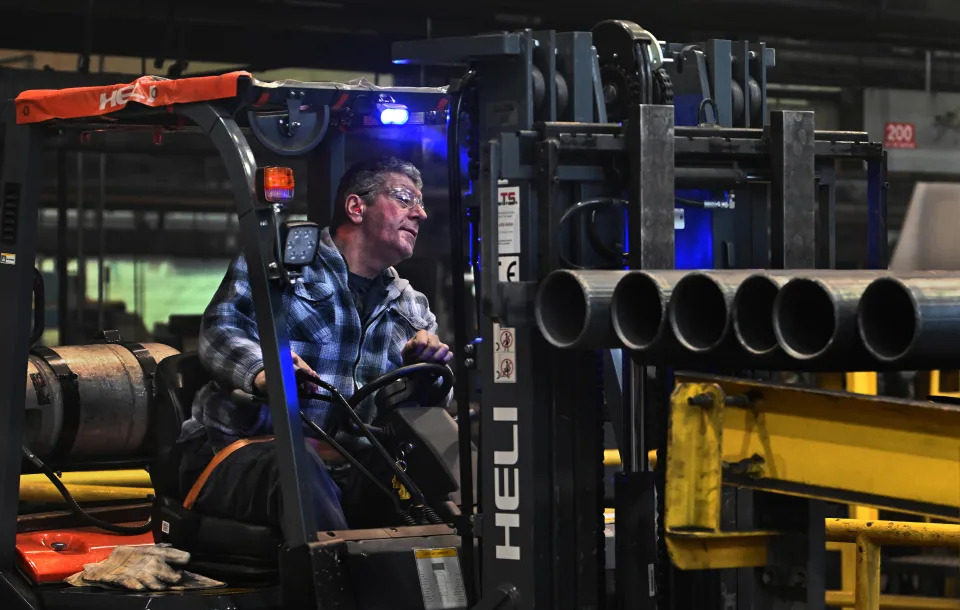
At the Scranton munitions plant, which is operated by General Dynamics, long steel billets undergo a multiday transformation from burning-hot shafts of metal to finished artillery shells ready to be trucked to a plant in Iowa, where they are filled with explosives and dispatched for training or battle. It can be two to three months from when shells leave Scranton until they are ready to be used.
The city surrounding the plant tells the story of broader industrial decline that is another important element in the production scramble today. As its coal and steel industries drew flocks of immigrant workers in the 19th century, Scranton became an important rail hub and was dubbed “Steamtown” for the steam-powered locomotives that helped fuel its rise.
But the city’s population declined along with the coal industry after World War II. Today, the previously booming city center shows the mixed results of economic revitalization efforts: shuttered store fronts, a handful of brewpubs, and an art house movie theater.
President Biden has identified Scranton, his hometown, as a symbol of the erosion of American manufacturing power, vowing to make a reversal of that trend a signature of his administration. “When jobs move overseas, factories at home close down. Once-thriving cities and towns became shadows of what they used to be, and they lost a sense of their self-worth along the way,” he said in late January.
Since its apex in 1979, more than 7 million jobs have disappeared from the American manufacturing sector, over a third of its workforce. The defense sector has also shed a third of its workforce.
While General Dynamics said the historic Scranton plant remains an attractive employer, in part because of its competitive wages, finding the right workers for its facilities is not easy in an economy with low unemployment and a dearth of traditional manufacturing skills like metalworking. “It’s still a challenge,” said Todd Smith, the company’s general manager for northeast Pennsylvania.
Biden has touted new investments in rail and other infrastructure that U.S. officials hope can anchor a new era of American productivity. “Where the hell is it written that . . . America can’t lead the world again in manufacturing?” he demanded.
Scranton Mayor Paige Cognetti said she hopes for added jobs at the Scranton plant, which now employs about 300 people, and other defense manufacturers in the area. “It’s union work. It’s stable work. It’s work that you can build a career and support a family on,” she said. “So any of those types of jobs are critical for us.”
It is not clear how much the Scranton facility, which already runs 24/7 during the week along with some weekend hours, can expand its manufacturing output. Plant officials said the pace of production has not accelerated since the Ukraine war began, and they are not aware of plans to ramp up operations.
While the hoped-for production transformation may not happen fast enough for Ukraine, as Kyiv braces for a massive springtime assault by Kremlin forces, the next conventional conflict could be far larger and more deadly.
The Ukraine scramble “has also given us some ideas of what we need to look at when it comes to Taiwan and China, because we have seen the need to surge,” said Kea Matory, director of legislative policy at the National Defense Industrial Association. “So this is a good learning opportunity for us.”
The Washington Post’s Ellen Nakashima and Dan Lamothe in Washington and Kamila Hrabchuk in Kyiv contributed to this report.
Putin’s Troops Filmed Threatening to Turn Weapons on Bosses
Allison Quinn – March 8, 2023
REUTERS/Alexander Ermochenko
A group of Russian troops sent to Ukraine to fight for the Kremlin’s “new” territory is threatening to raise absolute hell over what they describe as pointless suicide missions—and they’ve made clear they’re willing to turn their weapons on members of their own team if necessary.
The draftees from Kaliningrad have already appealed directly to Russian President Vladimir Putin to complain of ancient weapons, lack of training, and people dying “for nothing.” In a video released publicly earlier this week, they shamed top military brass by saying there appears to be no battlefield strategy whatsoever and declaring that “this is no way to fight a war.”
Now, a video has leaked capturing the aftermath of their complaints. In a five-minute clip released by the independent outlet Ostorozhno, Novosti, the men can be seen surrounding a commander sent out from Kaliningrad and warning him they will put up a fight if they are not heard.
“You can jail us all! How many years is it, 5, 7, 10? We don’t give a fuck!,” one soldier yells after the commander tries but fails to convince them to obey orders and storm Ukrainian positions.
The troops say they were never meant to be part of assault teams, but were instead assigned as members of territorial defenses. The Kremlin-backed proxy troops fighting in occupied Donetsk, they say, send them on suicide missions while they themselves “run away” or sit around away from the gunfire.
They shout that they’d rather go to jail than go on guaranteed-to-fail assault missions “for who knows what.”
“Did you see that puddle of blood here? That person was sent to storm [Ukrainian positions], so he pulled the trigger, because he knew where he was headed,” one soldier says. “Do you want suicides here?”
After the commander responds that they’ve presented a “weak” argument for not obeying orders, they warn that they will use force.
“No one is going on this storm. You can fucking jail us all. And if someone tries to trick us and say we supposedly aren’t going there and then they throw us on the frontline, it will be a shitshow, it won’t be forgiven, we will just go head to head against them,” one soldier says.
“Honestly, we’re ready for that,” he says, asking the entire group: “Is everyone ready for that?”
“Yes, yes! Everyone!” the group responds in unison.
“We are so fucking angry after the deaths of our friends, … we’ll walk on foot, we’ll leave by taxi. Fight your fucking self!” the apparent leader of the group says.
He goes on to tell the commander that several other soldiers had been “taken away,” apparently after also protesting conditions.
“They came at night. What is that? Is it 1939? NKVD? Black ravens?” he said, referring to the Soviet secret police rounding up “enemies” in night-time raids.
The latest uprising by draftees is just the latest of many as the Russian war machine finds itself running out of men to use as cannon fodder. And in a particularly ironic twist, more and more of the same young Russian citizens that Putin claimed to be trying to protect from outside forces with his full-scale invasion are now being sacrificed for the sake of his conquest on Ukrainian land.
“Previously, the Donetsk and Luhansk draftees were used as expendable materials, but now it’s the Russians,” military analyst Kirill Mikhailov told iStories of the mounting conflict between Kremlin-backed troops in Ukraine’s occupied territories. “They cannot fight any other way. If the approach doesn’t fundamentally change, which I doubt, then Russian draftees will keep dying this way.”
Studying Ukraine war, China’s military minds fret over US missiles, Starlink
Eduardo Baptista and Greg Torode – March 7, 2023
Video: How U.S. support of Ukraine affects a potential defense of Taiwan Yahoo Finance’s Rick Newman.
BEIJING/HONG KONG (Reuters) -China needs the capability to shoot down low-earth-orbit Starlink satellites and defend tanks and helicopters against shoulder-fired Javelin missiles, according to Chinese military researchers who are studying Russia’s struggles in Ukraine in planning for possible conflict with U.S.-led forces in Asia.
A Reuters review of almost 100 articles in more than 20 defence journals reveals an effort across China’s military-industrial complex to scrutinise the impact of U.S. weapons and technology that could be deployed against Chinese forces in a war over Taiwan.
The Chinese-language journals, which also examine Ukrainian sabotage operations, reflect the work of hundreds of researchers across a network of People’s Liberation Army (PLA)-linked universities, state-owned weapons manufacturers and military intelligence think-tanks.
While Chinese officials have avoided any openly critical comments about Moscow’s actions or battlefield performance as they call for peace and dialogue, the publicly available journal articles are more candid in their assessments of Russian shortcomings.
China’s defence ministry did not respond to a request for comment about the researchers’ findings. Reuters could not determine how closely the conclusions reflect the thinking among China’s military leaders.
Two military attaches and another diplomat familiar with China’s defence studies said the Communist Party’s Central Military Commission, headed by President Xi Jinping, ultimately sets and directs research needs, and that it was clear from the volume of material that Ukraine was an opportunity the military leadership wanted to seize. The three people and other diplomats spoke to Reuters on the condition of anonymity because they were not authorised to discuss their work publicly.
A U.S. defence official told Reuters that despite differences with the situation in Taiwan, the Ukraine war offered insights for China.
“A key lesson the world should take away from the rapid international response to Russia’s invasion of Ukraine is that aggression will increasingly be met with unity of action,” said the official, who spoke on the condition of anonymity because of the topic’s sensitivity, without addressing concerns raised in the Chinese research about specific U.S. capabilities.
STARLINK GAZING
Half a dozen papers by PLA researchers highlight Chinese concern at the role of Starlink, a satellite network developed by Elon Musk’s U.S.-based space exploration company SpaceX, in securing the communications of Ukraine’s military amid Russian missile attacks on the country’s power grid.
“The excellent performance of ‘Starlink’ satellites in this Russian-Ukrainian conflict will certainly prompt the U.S. and Western countries to use ‘Starlink’ extensively” in possible hostilities in Asia, said a September article co-written by researchers at the Army Engineering University of the PLA.
The authors deemed it “urgent” for China – which aims to develop its own similar satellite network – to find ways to shoot down or disable Starlink. SpaceX did not respond to a request for comment.
The conflict has also forged an apparent consensus among Chinese researchers that drone warfare merits greater investment. China has been testing drones in the skies around Taiwan, a self-ruled democracy that Beijing has vowed to bring under its control.
“These unmanned aerial vehicles will serve as the ‘door kicker’ of future wars,” noted one article in a tank warfare journal published by state-owned arms manufacturer NORINCO, a supplier to the PLA, that described drones’ ability to neutralise enemy defences.
While some of the journals are operated by provincial research institutes, others are official publications for central government bodies such as the State Administration of Science, Technology and Industry for National Defence, which oversees weapons production and military upgrades.
An article in the administration’s official journal in October noted that China should improve its ability to defend military equipment in view of the “serious damage to Russian tanks, armored vehicles and warships” inflicted by Stinger and Javelin missiles operated by Ukrainian fighters.
Collin Koh, a security fellow at Singapore’s S. Rajaratnam School of International Studies, said the Ukrainian conflict had provided impetus to long-standing efforts by China’s military scientists to develop cyber-warfare models and find ways of better protecting armour from modern Western weapons.
“Starlink is really something new for them to worry about; the military application of advanced civilian technology that they can’t easily replicate,” Koh said.
Beyond technology, Koh said he was not surprised that Ukrainian special forces operations inside Russia were being studied by China, which, like Russia, moves troops and weapons by rail, making them vulnerable to sabotage.
Despite its rapid modernisation, the PLA lacks recent combat experience. China’s invasion of Vietnam in 1979 was its last major battle – a conflict that rumbled on until the late 1980s.
Reuters’ review of the Chinese journals comes amid Western concern that China may be planning to supply Russia with lethal aid for its assault on Ukraine, which Beijing denies.
TAIWAN, AND BEYOND
Some of the Chinese articles stress Ukraine’s relevance given the risk of a regional conflict pitting China against the United States and its allies, possibly over Taiwan. The U.S. has a policy of “strategic ambiguity” over whether it would intervene militarily to defend the island, but is bound by law to provide Taiwan with the means to defend itself.
U.S. Central Intelligence Agency Director William Burns has said that Xi has ordered his military to be ready to invade Taiwan by 2027, while noting that the Chinese leader was probably unsettled by Russia’s experience in Ukraine.
One article, published in October by two researchers at the PLA’s National Defence University, analysed the effect of U.S. deliveries of high-mobility artillery rocket systems (HIMARS) to Ukraine, and whether China’s military should be concerned.
“If HIMARS dares to intervene in Taiwan in the future, what was once known as an ‘explosion-causing tool’ will suffer another fate in front of different opponents,” it concluded.
The article highlighted China’s own advanced rocket system, supported by reconnaissance drones, and noted that Ukraine’s success with HIMARS had relied on U.S. sharing of target information and intelligence via Starlink.
Four diplomats, including the two military attaches, said PLA analysts have long worried about superior U.S. military might, but Ukraine has sharpened their focus by providing a window on a large power’s failure to overwhelm a smaller one backed by the West.
While that scenario has obvious Taiwan comparisons, there are differences, particularly given the island’s vulnerability to a Chinese blockade that could force any intervening militaries into a confrontation.
Western countries, by contrast, are able to supply Ukraine by land via its European neighbours.
References to Taiwan are relatively few in the journals reviewed by Reuters, but diplomats and foreign scholars tracking the research say that Chinese defence analysts are tasked to provide separate internal reports for senior political and military leaders. Reuters was unable to access those internal reports.
Taiwanese Defence Minister Chiu Kuo-cheng said in February that China’s military is learning from Russia’s invasion of Ukraine that any attack on Taiwan would have to be swift to succeed. Taiwan is also studying the conflict to update its own battle strategies.
Several articles analyse the strengths of the Ukrainian resistance, including special forces’ sabotage operations inside Russia, the use of the Telegram app to harness civilian intelligence, and the defense of the Azovstal steel plant in Mariupol.
Russian successes are also noted, such as tactical strikes using the Iskander ballistic missile.
The journal Tactical Missile Technology, published by state-owned weapons manufacturer China Aerospace Science and Industry Corporation, produced a detailed analysis of the Iskander, but only released a truncated version to the public.
Many other articles focus on the mistakes of Russia’s invading army, with one in the tank warfare journal identifying outdated tactics and a lack of unified command, while another in an electronic warfare journal said Russian communications interference was insufficient to counter NATO’s provision of intelligence to the Ukrainians, leading to costly ambushes.
A piece published this year by researchers at the Engineering University of the People’s Armed Police assessed the insights China could glean from the blowing-up of the Kerch Bridge in Russian-occupied Crimea. The full analysis has not been released publicly, however.
Beyond the battlefield, the work has covered the information war, which the researchers conclude was won by Ukraine and its allies.
One February article by researchers at the PLA Information Engineering University calls on China to preemptively prepare for a global public opinion backlash similar to that experienced by Russia.
China should “promote the construction of cognitive confrontation platforms” and tighten control of social media to prevent Western information campaigns from influencing its people during a conflict, it said.
(Reporting by Eduardo Baptista in Beijing and Greg Torode in Hong Kong; additional reporting by Idrees Ali and Phil Stewart in Washington. Editing by David Crawshaw.)
Ukraine-Russia war: Russian officers mutiny after devastating tank battle
Arthur Scott-Geddes – March 7, 2023
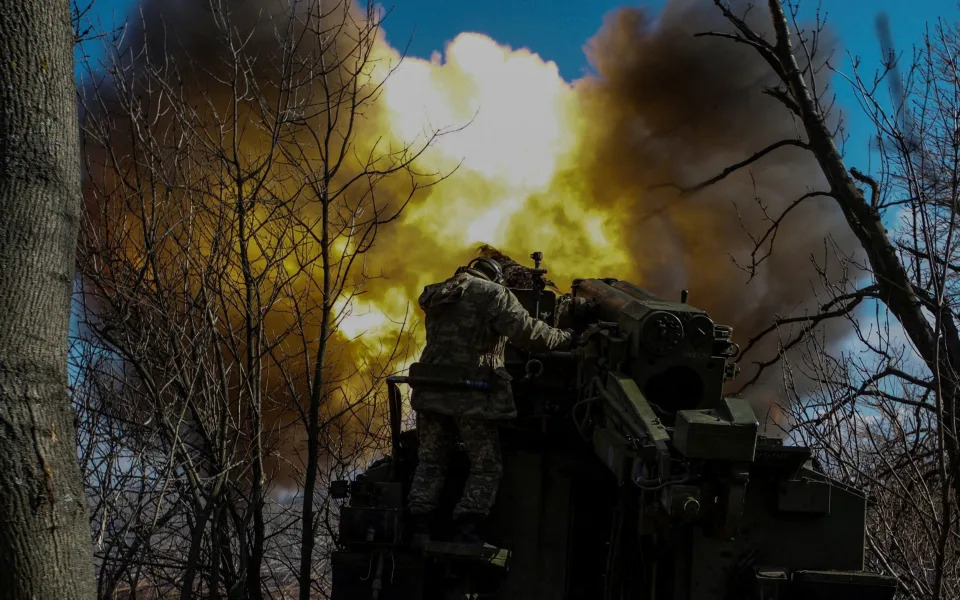
Ukrainian servicemen fire a 2S5 Giatsint-S self-propelled howitzer towards Russian troops outside the frontline town of Bakhmut – Reuters
Senior Russian officers have reportedly refused to continue pressing the attack on Vugledar after suffering heavy losses in a failed assault on the eastern Ukrainian town.
Russia is believed to have lost around 130 tanks and armoured fighting vehicles in a recent disastrous attempt to take the town from Ukraine’s forces.
Ukrainian military officials told the Kyiv Post that the officers of the 155th Brigade, which is believed to have suffered 300 casualties per day during the three-week assault, were refusing orders to continue attacking.
“The leaders of the brigade and senior officers are refusing to proceed with a new senseless attack as demanded by their unskilled commanders – to storm well-defended Ukrainian positions with little protection or preparation,” the Ukrainian military said.
It comes as Russian forces continued their attempt to seize Bakhmut, the eastern salt-mining town at the center of some of the bloodiest fighting of the war.
07:33 AM
Mud hampers Ukraine’s Bakhmut resupply efforts
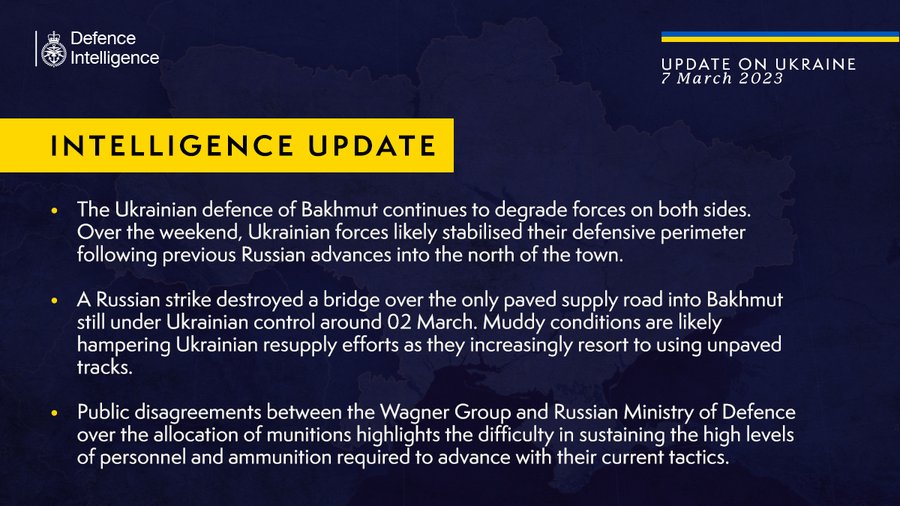
Muddy conditions around Bakhmut are likely hampering Ukraine’s efforts to resupply its troops, according to the Ministry of Defence.
In its daily intelligence briefing, the ministry said: “Muddy conditions are likely hampering Ukrainian resupply efforts as they increasingly resort to using unpaved tracks.”
Numerous reports have suggested that Ukrainian troops defending the eastern town are running seriously low on ammunition as they battle to hold back Russia’s advance.
“The Ukrainian defence of Bakhmut continues to degrade forces on both sides,” the ministry said. “Over the weekend, Ukrainian forces likely stabilised their defensive perimeter following previous Russian advances into the north of the town.
07:25 AM
China claims Ukraine crisis driven by ‘invisible hand’
The Ukraine crisis seems to be driven by an invisible hand pushing for the protraction and escalation of the conflict, China’s foreign minister Qin Gang has claimed.
The “invisible hand” is “using the Ukraine crisis to serve certain geopolitical agendas”, Mr Qin said on the sidelines of an annual parliament meeting in Beijing, calling for dialogue to begin as soon as possible.