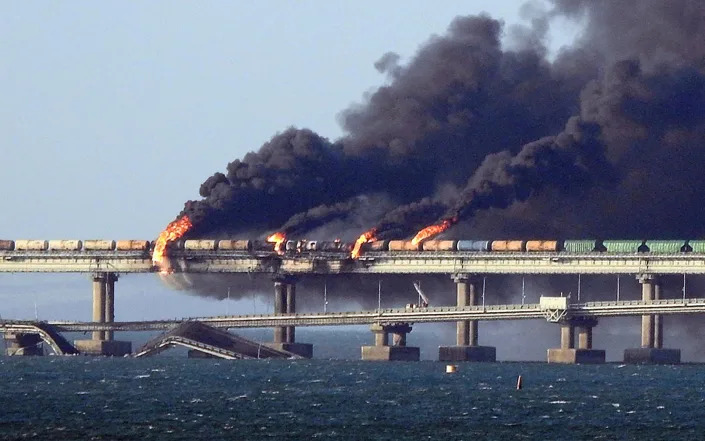
Finally destroying the Kerch bridge could force Russia out of Crimea
As Moscow’s latest offensive in Ukraine slowly but bloodily cranks up, the next phase of this ghastly war has well and truly arrived. Contrary to expectations, the Ukrainians are bravely, and successfully, resisting the tens of thousands of fresh Russian recruits being thrown at them. Nevertheless, according to many Western observers, the chances of a total Russian collapse in the coming year are slim.
I am less certain; we could be surprised. Far from being cowed, Zelensky’s government is emboldened. Kyiv is openly preparing its own major thrust against Russian ground forces in the spring. Vadym Skibitsky, Ukraine’s deputy military intelligence chief, said this week that this counter-offensive will aim to “drive a wedge” between Crimea and the Russian mainland. The Ukrainians are determined to, in his words, “liberate all occupied territories – including Crimea”.
Now, General Ben Hodges, former commander of US forces in Europe, has devised a strategy he believes would not only enable Ukraine to retake Crimea, but would precipitate a total Russian military implosion.
His suggestion is as follows: isolate the peninsula by precision strikes against the two land routes connecting it with Russian territory – the Kerch bridge and the corridor that runs along the Azov sea. Then follow up with a large-scale armoured drive towards the Azov, penetrating Russian defences north of Crimea, bringing rocket and artillery systems into closer range. Russian air, ground and naval forces in the peninsula would then be reduced by precision strike and bombardment, until the point when Ukrainian forces could launch a ground offensive along the Perekop Isthmus and into Crimea.
This concerted attack against the peninsula – isolating it, neutralising and inflicting severe damage against its military infrastructure by long range strikes – would be a major blow for Russian morale. In the absence of decisive battlefield success elsewhere, it would represent a defeat for Moscow that it could not disguise, and could lead to collapse of Russian forces in the field and even to Putin’s downfall.
I agree that this is desirable. But – as so often in this war – without boosting our support, it is unachievable. Even this more limited operation would demand massively increased Western assistance, including many more tanks than have been promised, much larger quantities of ammunition, as well as long-range missile systems which so far have not been provided at all. This additional support would have to be sustained and that would mean stepping up defence industrial production in the US and Europe beyond what has been contemplated so far in this war.
To achieve this is a question of political will on the Continent, one that remains shaky. There are signs now of European leaders pushing Zelensky towards peace talks with Russia rather than the defeat of Moscow’s invasion. That was the message delivered directly to the Ukrainian leader in Paris recently by President Emmanuel Macron and Chancellor Olaf Scholz. Both their countries have said they will not be providing new types of weapons this year. All talk at the moment is of future security assistance and guarantees to Ukraine from Nato after the war ends, as a means of pressuring Zelensky into an accommodation.
Putin recognises this wavering of Western support for Ukrainian offensive action and will be encouraged to press forward his own offensive to maximise territorial gains in advance of any potential negotiations. He is unlikely to achieve his full objectives on the battlefield, but neither will he willingly surrender what he now holds, which is significantly greater Ukrainian territory than when the war began.
With Ukraine denied the resources for decisive success, the scene would then be set for a period of relative quiet followed by the next round of Russian aggression. General Hodges’s plan for Crimea may be overly optimistic, but he is absolutely right to suggest that long-term peace is contingent on Russian battlefield defeat. The scenario that Nato leaders are now planning equals the vanquishment of the West and the emboldenment of both Russia and China. It is a crying shame when the possibility of a total Russian collapse remains within reach.
Colonel Richard Kemp is a former infantry commander
Ukraine says it shot down a Su-25 jet and captured its pilot in revenge for a weekend of shelling: reports
Mia Jankowicz – February 27, 2023
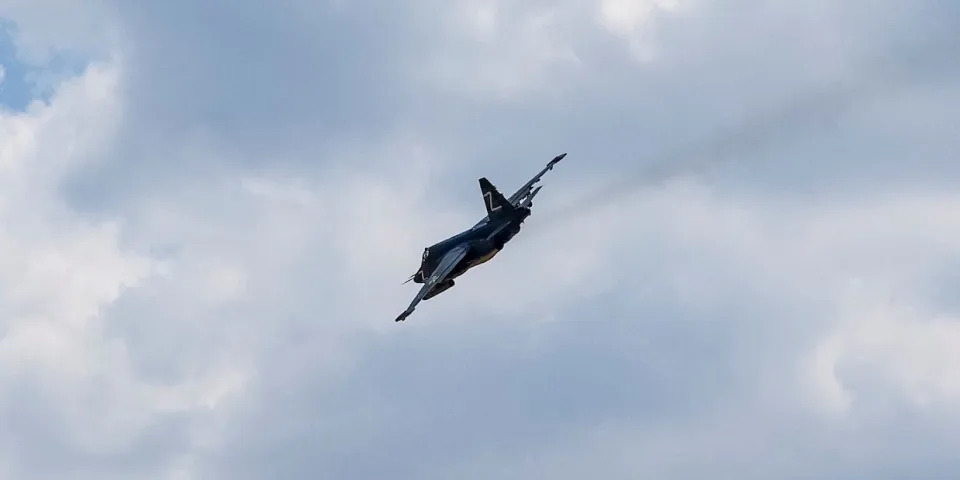
A Russian Su-25 warplane above Olenivka, Donetsk, Ukraine, on July 29, 2022.Alexander Ermochenko TPX via Reuters
Ukraine says it shot down a Russian Su-25 jet in Avdiivka, Donetsk on Sunday.
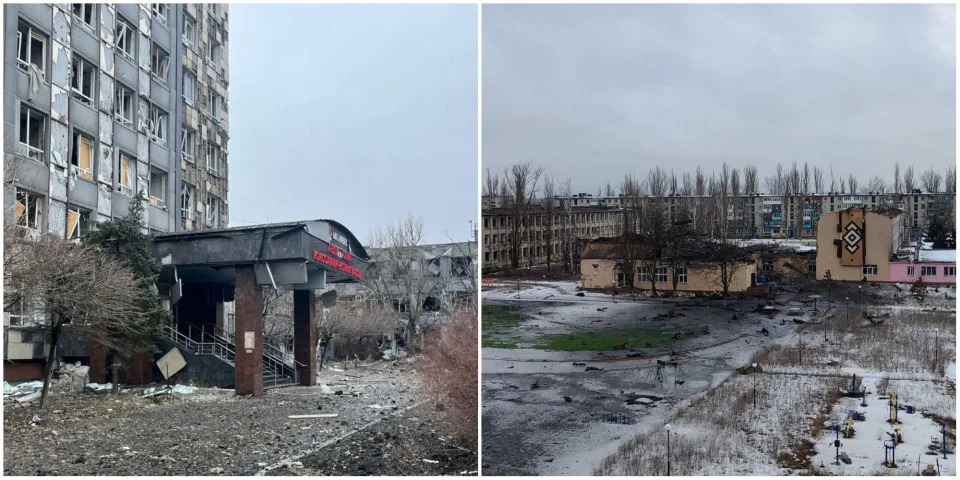
The frontline town is home to a strategic coke plant and was heavily bombed over the weekend.
President Volodymyr Zelenskyy congratulated the troops on the strike, according to reports.
Ukrainian forces took out a Russian Su-25 jet on Sunday, capturing its pilot, in what has been called “revenge” for airstrikes on a valuable industrial plant, according to multiple reports.
The brigade said that Russian forces were losing manpower and equipment in their attempts to advance near the site.
The frontline town of Avdiivka, which sits just north of the city of Donetsk, is home to one of Europe’s largest coke plants, which has been an essential part of the country’s steel industry.
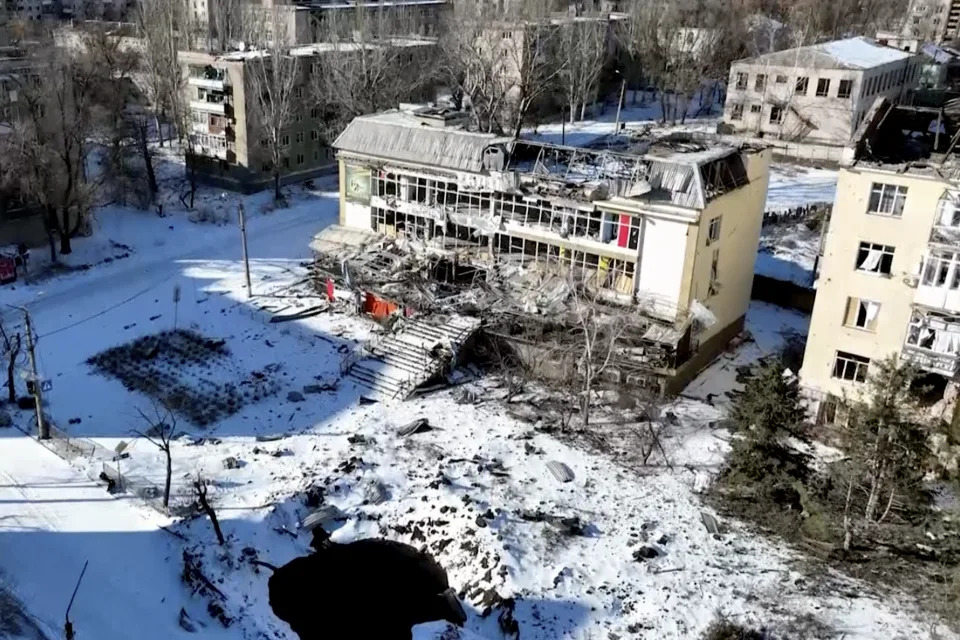
Buildings in Avdiivka, Donetsk region, after Russian shelling on February 25, 2023, per the region’s military administrator.Pavlo Kyrylenko/Telegram
The plant itself was struck by a devastating Russian air raid on Sunday, injuring one employee, according to Musa Magodemov, the Donetsk Region’s people’s deputy.
Magodemov characterized the hit on the Su-25 as revenge, while celebrating the quick response.
President Volodymyr Zelenskyy also congratulated the 110th brigade in his nightly address, Ukrinform reported.
Also known as a “Frogfoot,” the Su-25 originated as a heavy Soviet-era jet designed to provide close air support to ground forces. It’s used by both Ukraine and Russia.
Ukraine military says Russian offensive near Yahidne unsuccessful
February 26, 2023
FILE PHOTO: Russia’s attack on Ukraine continues near the frontline town of Bakhmut
(Reuters) – Ukraine’s military said on Sunday that Russia conducted unsuccessful offensives near Yahidne over the past day, after Russia’s Wagner mercenary group claimed to have captured the village in eastern Ukraine near the focus on intense fighting.
The General Staff of Ukraine’s Armed Forces said in a morning update that Russia keeps concentrating its offensive efforts along the entire Bakhmut front line, were Yahidne is located.
The months-long struggle for Bakhmut, where only about 5,000 of 70,000 residents remain, has seen some of the bloodiest attritional fighting of Russia’s year-old invasion.
Russian mercenary leader Yevgeny Prigozhin said on Saturday his forces had captured Yahidne. On Friday, he had claimed control of Berkhivka, an adjacent village on the outskirts of Bakhmut.
But the Ukrainian bulletin said attacks were continuing, citing “unsuccessful offensives” near six settlements, including Yahidne and Berkhivka, in the Donetsk region, which Moscow claims to have annexed.
Reuters could not verify the battlefield reports of either side.
Ukraine’s Sunday bulletin said Russian forces had shelled the areas of 22 settlements along that part of the front line in Donetsk over the past day, while Ukraine had repelled 71 in Donetsk and elsewhere along the frontline.
The fierce battles along the front lines in Ukraine’s south and east, especially near Bakhmut, now consist of crawling attempts by each side to move the line, sometimes just a few metres at a time.
Russia has made progress towards encircling Bakhmut but failed to capture it in time to deliver a victory for President Vladimir Putin to announce on Friday’s anniversary of his invasion.
(Reporting by Lidia Kelly, Nick Starkov and Ron Popeski; Writing by Lidia Kelly; Editing by William Mallard)
When Russia invaded Ukraine a year ago, President Vladimir Putin had a lot more in his war plan than tanks and missiles. Putin also planned an energy war in parallel with his military war on the ground in Ukraine.
Putin’s military war has gone badly, his army decimated after failing to seize Ukraine, as planned. Putin’s energy war has failed, too. Neither war is over, but the many nations now allied against Russia have done a remarkable job blunting Putin’s most potent economic weapon.
Putin clearly anticipated sanctions against his country in response to the 2022 invasion. He also thought he could counter those sanctions using Russian energy, which Europe in particular was dependent on. Russia is the world’s third-largest oil and natural gas producer, and at the time of the invasion, it was Europe’s top source of gas, needed to produce electricity.
At first, Putin’s energy war worked as planned. Sanctions imposed by the United States and other nations largely exempted Russian energy, to protect consumers from price spikes. But the unpredictable nature of those sanctions, plus instability caused by the war itself, generated a “fear premium” in energy markets that pushed prices up. Oil prices spiked from about $90 before the invasion to nearly $125 four months later.
U.S. gasoline prices hit $5 per gallon last June, damaging President Biden’s popularity and making inflation a bigger everyday concern for Americans than the war in Ukraine. Natural gas prices rose by far more than oil and gasoline. Russia started reducing gas flows to Europe last June, then completely shut the main gas pipeline to Europe in September.
https://flo.uri.sh/story/1836372/embed?auto=1
By late August, European natural gas prices were four times higher than before the war. Wintertime rationing seemed likely, along with a recession caused by sporadic business shutdowns and painful energy inflation. Gas prices surged in the United States as well, though not by as much in Europe, given that gas is not as transportable as oil, generating regional price differences.
Soaring energy prices were exactly the kind of pain Putin planned for nations opposing his war. His hope was that high energy prices among Ukraine’s allies would wreck their economies, undermining public support for sanctions and for aid to Ukraine.
The full-blown energy crisis Putin tried to create never materialized, however. Prices tell the story. Oil, gasoline and natural gas prices are now lower than they were before Putin invaded, as the chart above shows. Russia is still a crucial source of energy, but the nations it tried to bring to heel have reconfigured their energy supply chains with speed and skill nobody foresaw a year ago.
“The last year may be remembered as the twilight for Russian energy leverage,” Richard Morningstar, founding chairman of the Atlantic Council Global Energy Center, wrote in a January report. “Moscow’s energy strategy is not working, and its ability to wield energy chaos as a geopolitical weapon is waning.”
Several concerted actions by Ukraine’s allies parried Putin’s energy offensive. In the United States, President Biden released an unprecedented amount of oil from the strategic reserve, with other countries releasing smaller amounts. Though not huge relative to total oil supply, those releases seem to have reassured markets and brought price relief at the margins.
TOPSHOT – Workers repair high-voltage power lines cut by recent missile strikes near Odessa on December 7, 2022, amid the Russian invasion of Ukraine. – A new barrage of Russian strikes on December 5, left several Ukrainian cities without power, including the eastern city of Sumy and the southern city of Mykolaiv, according to officials. In Odessa, the water services operator said “there is no water supply anywhere” and officials in the central city of Kryvyi Rig said “parts of the city are cut off from electricity, several boiler and pumping stations are disconnected.” (Photo by OLEKSANDR GIMANOV / AFP) (Photo by OLEKSANDR GIMANOV/AFP via Getty Images)
Putin himself blinked. He could have slowed or stopped Russian oil sales, which would undoubtedly have sent prices soaring, given that Russia produces about 10% of the world’s oil. But he never did. Oil sales are Russia’s biggest source of revenue, and Putin desperately needs that funding to pay for a war that is far costlier than he anticipated. Russian oil production has actually remained stable for most of the past year, which is helping Putin keep the war going but also keeping global prices under control.
Europe also dramatically revamped its natural-gas supply chains, with the portion of gas coming from Russia dropping from 40% to less than 10%. And much of that gas goes to Turkey and Balkan nations not fully participating in sanctions. Gas shipped on tankers from the United States and Qatar backfilled much of the supply lost from Russia. Some European power plants also switched from gas to coal, which boosted carbon emissions, but is also likely temporary.
The United States and other large nations have also developed novel ways to begin sanctioning Russian energy while keeping supplies on the market and prices low. In December, a U.S.-led group of large nations imposed a price cap of $60 per barrel on Russian oil. Barrels from Russia generally sell for less than that, since global prices have been around $80 and the market demands a discount for the risk and complexity of purchasing from Russia. But this “buyers cartel” can lower the price and pinch Russia harder.
On February 5, another set of price caps went into effect for Russian petroleum products such as diesel fuel. Putin has vowed to withhold oil from any buyer participating in the price-cap regime, but so far nothing has changed.
Putin may still have some ammunition in reserve. “Given that Washington has strongly signaled an aversion to higher oil prices, and has gone to quite extraordinary lengths to keep a lid on them, there remains an elevated risk that Putin will seek to exploit this pain point in 2023,” Helima Croft, head of global commodity strategy at RBC Capital Markets, wrote in the January Atlantic Council report. “We may be entering a particularly precarious phase in the conflict. Putin may endeavor to demonstrate that he is not a spent force.”
One concern is Russian sabotage of energy facilities in regions where it has some influence, similar to the mysterious explosions that ruptured two undersea gas pipelines running from Russia to Germany last September. Russia has links to mercenary groups in oil-producing nations such as Iraq, Algeria, and Libya, and direct involvement in some energy facilities operated by former Soviet Republics. Some analysts think a surprise slowdown in production from two fields in Kazakhstan last April may have been a dress rehearsal for future Russian sabotage.
People Boycott Popular Beer After Producer Breaks Promise to Pull Out of Russia
It’s not a good look.
Colette Bennett – February 24, 2023
People Boycott Popular Beer After Producer Breaks Promise to Pull Out of Russia
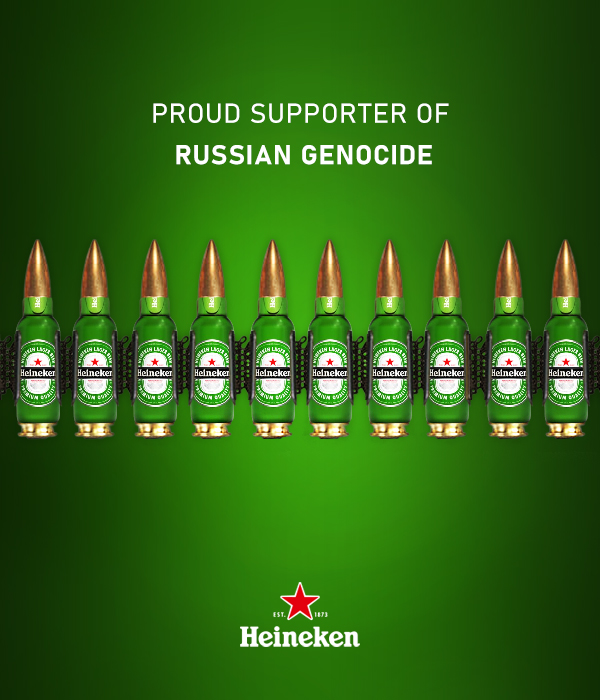
More than 10,000 people are spending their Friday morning on Twitter calling for a boycott of Dutch beer company Heineken.
A tweet featuring an incendiary fan-made image first used the hashtag on Feb. 23, which transformed Heineken’s signature green bottle into pointed bullets and stated “proud supporter of Russian genocide.”
The post also stated: “Heineken launched no less than 61 new products on the #Russian market last year after promising to stop investing there because of the war in #Ukraine.”
Heineken in March 2022 had vowed to pull its business from Russia after the country invaded Ukraine. But an investigative report from Netherlands-based website Follow the Money states that the company’s reports showed its Russian arm “launched 61 new products ‘in record time’ and sold 720,000 hectoliters more beer and soft drinks.”
Heineken was quick to respond to the controversy in a formal statement: “We’re working hard to transfer our business to a viable buyer in very challenging circumstances and we expect at a significant financial loss to the company, amounting to around €300M.
“In the meantime, our local colleagues at Heineken Russia are doing what they can to keep the business going, after fully delisting the Heineken® brand, to avoid nationalisation and ensure their livelihoods are not at risk.”
Ukraine: Drone video shows cost of intense fighting in east
The Associated Press – February 24, 2023
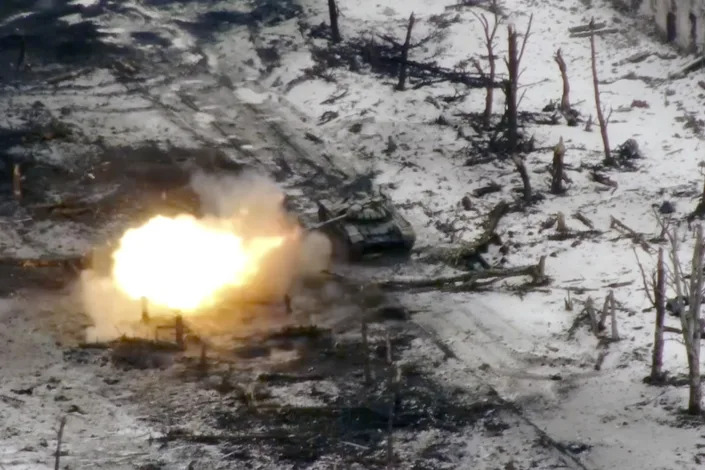
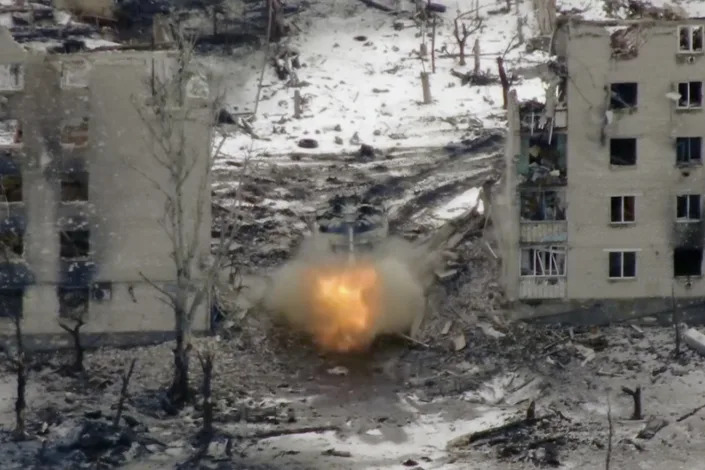
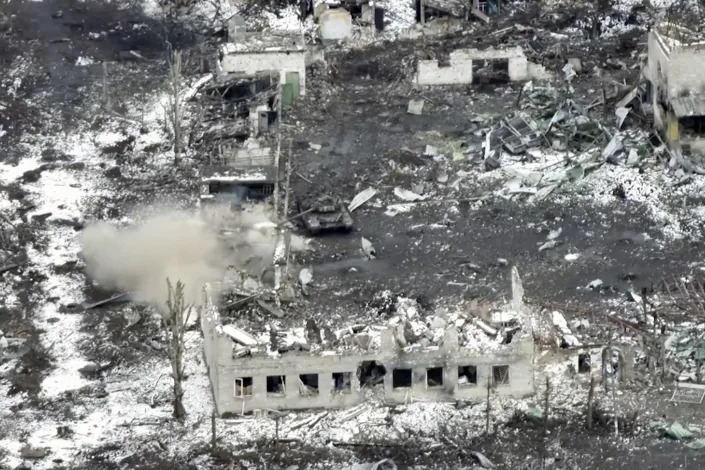
New video footage shot on Feb. 19, 2023 from the air with a drone for The Associated Press shows how particularly intense fighting since the Feb. 24, 2022, invasion has left no building in Marinka intact. Russian tank fire further added to the destruction, pounding what appeared to be Ukrainian positions amid the ruins. (AP Photo)
MARINKA, Ukraine (AP) — The hulking Russian tank swiveled into position between the ruins of two pulverized apartment blocks, paused and fired, a ball of fire and fumes spewing from the muzzle of its cannon.
Just 12 seconds later, it fired again, unleashing another shell on its targets about 50 meters (yards) away on the other side of what had once been a street — many years ago, before fighting destroyed it.
Although Friday marks the grim first anniversary of Russia’s full-scale invasion of Ukraine, combat between Russian-backed forces and Ukrainian troops has raged in the country’s east since 2014.
The town of Marinka is among those that have been reduced to rubble. It is in Ukraine’s eastern Donetsk province, where territory is roughly split between Russian and Ukrainian control. The front line runs through what is left of the town — which is very little.
New video footage shot from the air with a drone for The Associated Press shows how particularly intense fighting since the Feb. 24, 2022, invasion has left no building in Marinka intact. Many are barely recognizable as buildings at all. Shell-fire has also made matchsticks of the town’s trees — many of them ripped apart at the trunk.
Russian tank-fire, filmed Feb. 19, further added to the destruction, pounding what appeared to be Ukrainian positions amid the ruins.
Marinka’s police chief, Artem Schus, describes his town as “completely destroyed.”
Apart from soldiers, the town has been entirely evacuated “because there is no way for the civilian population to live there,” he told The AP in an interview.
Still, dozens of townspeople have been killed and many wounded, he says.
Schus believes that Russian forces are deliberately razing the ruins, blasting walls that still stand, to “destroy all cover, regardless of whether it is a civilian shelter or a military facility.”
He adds: “They destroy everything because, with their tactics, they cannot defeat our troops, and resort to the destruction of all living things.”
AP video journalist Mstyslav Chernov contributed from Krasnohorivka, Ukraine.
Ukrainian soldiers with life-changing war injuries posed for portraits saying they are ‘living monuments’ of a brutal war
Mia Jankowicz – February 24, 2023
Oleksandr lost both his lower legs to a Russian missile.Marta Syrko
Ukrainian photographer Marta Syrko has asked war-injured soldiers to sit for her.
Oleksandr, who lost his lower legs, said he wanted to show that injured bodies can be powerful.
The pictures, both stark and tender, are a reminder of the human cost of Putin’s war.
Last summer, 26-year-old Oleksandr was resting in a trench.
Exactly six months earlier, he had been working as a barista while he trained in graphic design. But after Russia invaded, he became a leader in a mortar batallion.
He was exhausted. The safest place to rest would have been under tree cover along with his squad, but there was no more room there. So he drifted off in the trench.
The next thing he knew he was buried in soil, his legs in excruciating pain. After his friends had scrabbled through the earth, they laid him on his front, not wanting him to glimpse his legs.
He told Insider he accepted his injuries “from the first moment” the missile hit him. (He spoke to Insider through an interpreter.)
So when photographer Marta Syrko asked Oleksandr to sit for her, he felt he could send a message with his body: among other things, to show the world the carnage Putin is inflicting and the cost of defending his country.
‘We need an artist, not just a photographer’
One of Syrko’s main subjects is bodies. A skim through her Instagram feed shows the human form in all its glory, from an advertising-perfect washboard stomach to the soft millefeuille creases of her grandmother’s skin.
After Russia’s invasion, however, more and more people were returning to her hometown of Lviv with life-changing wounds.
So she approached a rehabilitation clinic near the city to ask if any of the soldiers — whose bodies had been radically transformed by war — would let her take portraits of them.
Four men agreed, three of whom lost limbs and one who received serious burns.
Serhii agreed to become one of Syrko’s “Heroes.”Marta Syrko
Among the soldiers was Serhii, pictured above cradling his second child, who had his leg torn off in the shockwave of a blast near Izyum, in Kharkhiv Oblast.
Another, Stanislav, also lost a leg last summer, in Bakhmut — one of the most fiercely contested cities in the entirety of Russia’s bloody war.
Syrko said she was inspired by the classical statues she saw in museums like the Louvre.
Foundational for Western art history, they, too, through wear and tear, are often missing limbs.
Illya Pylypenko received severe burns in a tank.Marta Syrko
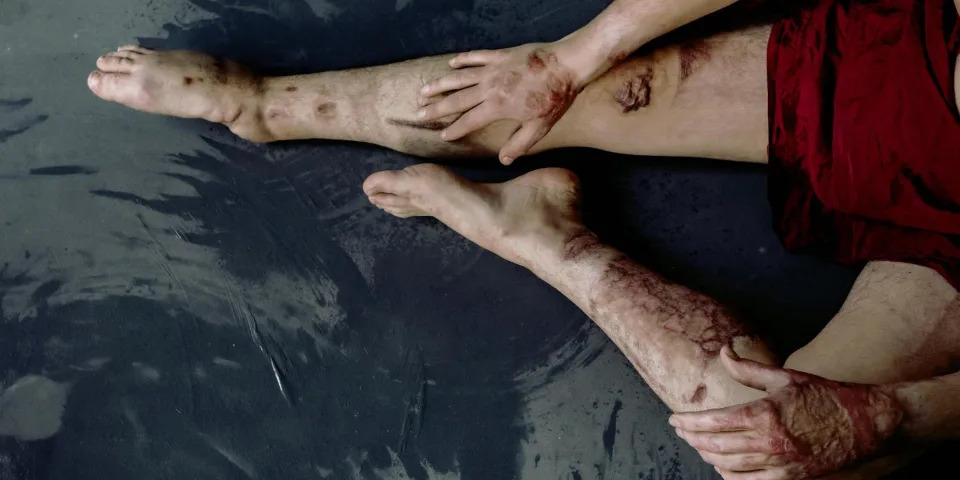
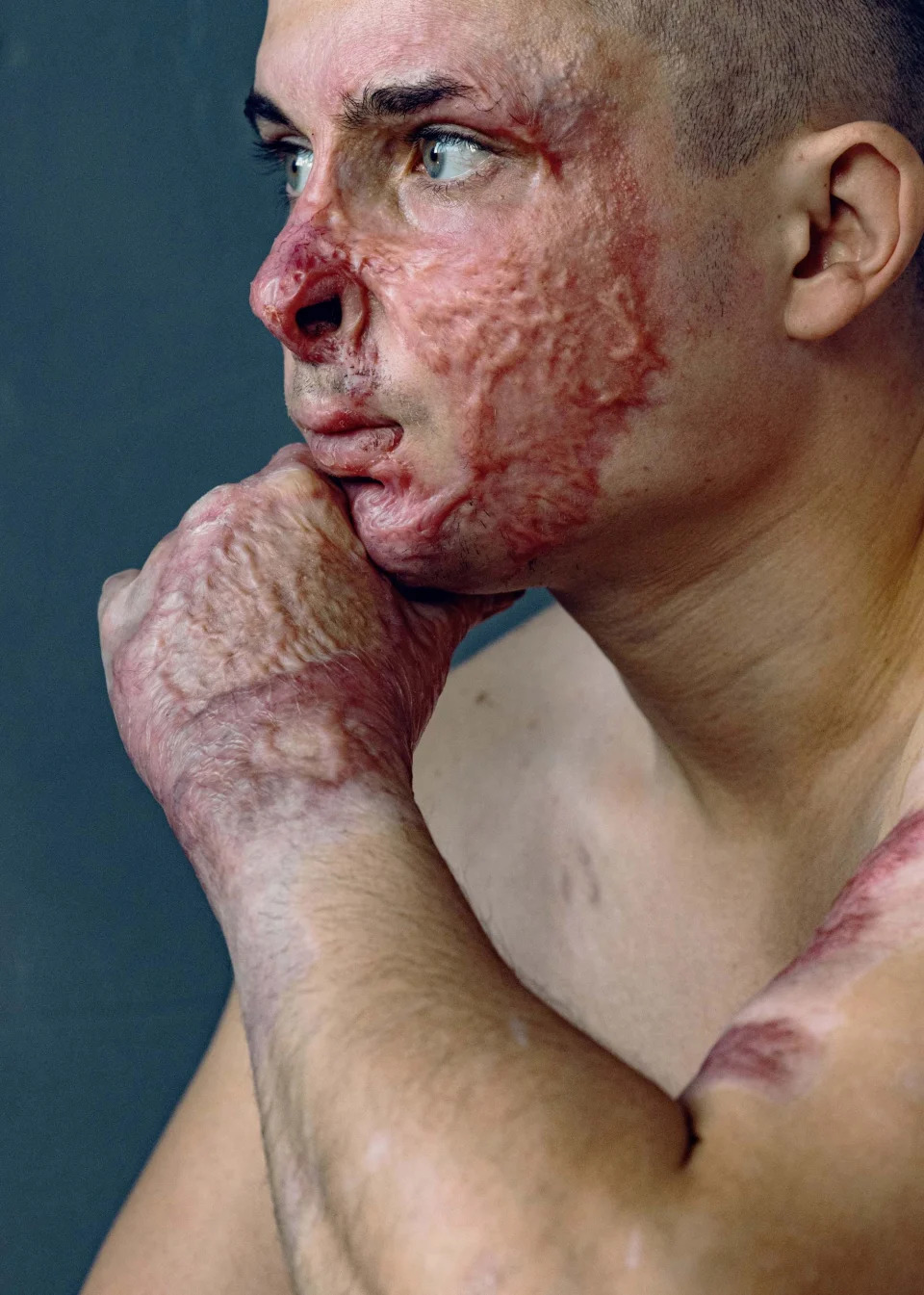
Later, Neopalymi, a charity devoted to treating and rehabilitating people with severe burns, approached Syrko with a request. They asked her to photograph Illya Pylypenko, a soldier who had burns on much of his body after his tank caught fire.
Syrko’s unflinching photos of Pylypenko show how his face, in particular, was transformed.
A photo portrait by artist Marta Syrko of Ukrainian soldier Ilya, who was badly burned. Ilya is seen topless in a three-quarter view, chin in hand, looking ahead. Skin on his hand and arm, and much of his face, is badly damaged with red-colored burns on his otherwise white skin.
Neopalymi, a burns rehabilitation center, asked Syrko to photograph Illya Pylypenko.Marta Syrko
Maksym Turkevych, Neopalymi’s CEO, told Insider in an email that the project needed “an artist, not just a photographer.”
‘We don’t know what to say. How to behave.’
Syrko’s work has many fans, but she said she’s had occasional comments from people who say she’s exploiting disabled people through her work.
Asked about this, Syrko — who is able-bodied — said her aim is to make a real and complex discussion happen.
“It’s a hard question for Ukrainians now, because we don’t know how to act near them,” she said. “We don’t know what to say, how to behave. And so that’s why we have to discuss it.”
Stanislav also lost his lower leg.Marta Syrko
For Oleksandr, the decision to become a “monument” for Syrko’s photos, as he put it, was a deliberate choice that he embraced.
He liked Syrko’s thinking about statues, saying in an Instagram post that people like him are “living monuments, who have been close-up witnesses to war.”
Serhii, pictured here with his son, lost part of his leg near Izyum.Marta Syrko
But public attitudes can be disappointing, even though he was injured defending their homeland, he said. People “look away, and they break into lively talk when ‘monuments’ walk past.”
Society, he said, stops seeing these bodies as beautiful.
“I wanted to become something that would inspire others like me to feel that people are looking at them not with shame, but with exaltation!” he wrote.
This was Neopalymi’s goal, too. “The main reason for us to do it is to show the society that there is a beauty in it, and that they should not be scared or disgusted by this,” said Turkevych, the CEO.
Syrko’s unflinching images of Illya show the effects of his burns.Marta Syrko
With a 122,000-strong Instagram following, Syrko said she had conversations with her subjects about the exposure the pictures could bring.
“I told them that they are probably going to be a little bit popular,” she said. And so they turned out to be — her pictures have been shared by the Ukrainian Ministry of Foreign Affairs’ Twitter account, and by newspaper Ukrainska Pravda.
Oleksandr told Insider, laughing, about his surprise when he arrived at the studio and realized that Syrko wanted him to pose nearly nude.
But he quickly got comfortable. “Marta’s the kind of person with whom you can feel comfortable and free,” he said.
Rebuilding an accessible Ukraine
Oleksandr spoke to Insider from the US, where thanks to a partnership with Ukrainian organization Without Restrictions, he has been undergoing intensive rehabilitation.
There, he’s learning to walk and run on high-tech prostheses. But for some weeks before he flew out, he was using a wheelchair.
Syrko photographed Stanislav in her contemplative artistic style.Marta Syrko
While the Ukrainian government has not confirmed exact numbers of casualties, the number of people with life-changing injuries — whether civilian or soldiers — is likely to make accessibility a key concern for the country’s future.
It’s a realization echoed by disability organizations supporting relief efforts in Ukraine, who at a joint conference last year issued the Riga Declaration, a document calling for the country’s rebuilding to employ universal design principles.
“A lot of cities are in a rebuilding phase,” Syrko said, envisioning a new, post-war Ukraine. “We can start to build it from zero — why can’t we do it correctly?”
‘Never saw such hell’: Russian soldiers in Ukraine call home
Erika Kinetz – February 23, 2023
(AP Illustration/Peter Hamlin)
KYIV, Ukraine (AP) — One Russian soldier tells his mother that the young Ukrainians dead from his first firefight looked just like him. Another explains to his wife that he’s drunk because alcohol makes it easier to kill civilians. A third wants his girlfriend to know that in all the horror, he dreams about just being with her.
About 2,000 secret recordings of intercepted conversations between Russian soldiers in Ukraine and their loved ones back home offer a harrowing new perspective on Vladimir Putin’s year-old war. There is a human mystery at the heart of this conversations heard in intercepted phone calls: How do people raised with a sense of right and wrong end up accepting and perpetrating terrible acts of violence?
The AP identified calls made in March 2022 by soldiers in a military division that Ukrainian prosecutors say committed war crimes in Bucha, a town outside Kyiv that became an early symbol of Russian atrocities.
They show how deeply unprepared young soldiers — and their country — were for the war to come. Many joined the military because they needed money and were informed of their deployment at the last minute. They were told they’d be welcomed as heroes for liberating Ukraine from its Nazi oppressors and their Western backers, and that Kyiv would fall without bloodshed within a week.
The intercepts also show that as soldiers realized how much they’d been misled, they grew more and more afraid. Violence that once would have been unthinkable became normal. Looting and drinking offered moments of rare reprieve. Some said they were following orders to kill civilians or prisoners of war.
They tell their mothers what this war actually looks like: About the teenage Ukrainian boy who got his ears cut off. How the scariest sound is not the whistle of a rocket flying past, but the silence that means it’s coming directly for you. How modern weapons can obliterate the human body so there’s nothing left to bring home.
We listen as their mothers struggle to reconcile their pride and their horror, and as their wives and fathers beg them not to drink too much and to please, please call home.
These are the stories of three of those men — Ivan, Leonid and Maxim. The AP isn’t using their full names to protect their families in Russia. The AP established that they were in areas when atrocities were committed, but has no evidence of their individual actions beyond what they confess.
The AP spoke with the mothers of Ivan and Leonid, but couldn’t reach Maxim or his family. The AP verified these calls with the help of the Dossier Center, an investigative group in London funded by Russian dissident Mikhail Khodorkovsky. The conversations have been edited for length and clarity.
In a joint production on Saturday, Feb. 25, The Associated Press and Reveal from the Center for Investigative Reporting will broadcast never-before-heard audio of Russian soldiers as they confront — and perpetrate — the brutality of Russia’s war in Ukraine.
LEONID
Leonid became a soldier because he needed money. He was in debt and didn’t want to depend on his parents.
“I just wasn’t prepared emotionally for my child to go to war at the age of 19,” his mother told the AP in January. “None of us had experienced anything like this, that your child would live in a time when he has to go and fight.”
Leonid’s mother said Russia needs to protect itself from its enemies. But, like many others, she expected Russia to take parts of eastern Ukraine quickly. Instead, Leonid’s unit got stuck around Bucha.
“No one thought it would be so terrible,” his mother said. “My son just said one thing: ‘My conscience is clear. They opened fire first.’ That’s all.”
In the calls, there is an obvious moral dissonance between the way Leonid’s mother raised him and what he is seeing and doing in Ukraine. Still, she defended her son, insisting he never even came into contact with civilians in Ukraine.
She said everything was calm, civil. There was no trouble at the checkpoints. Nothing bad happened. The war didn’t change her son.
She declined to listen to any of the intercepts: “This is absurd,” she said. “Just don’t try to make it look like my child killed innocent people.”
ONE: Kill if you don’t want to be killed.
Leonid’s introduction to war came on Feb. 24, as his unit crossed into Ukraine from Belarus and decimated a detachment of Ukrainians at the border. After his first fight, Leonid seems to have compassion for the young Ukrainian soldiers they’d just killed.
Mother: “When did you get scared?”
Leonid: “When our commander warned us we would be shot, 100%. He warned us that although we’d be bombed and shot at, our aim was to get through.”
Mother: “Did they shoot you?”
Leonid: “Of course. We defeated them.”
Mother: “Mhm. Did you shoot from your tanks?”
Leonid: “Yeah, we did. We shot from the tanks, machine guns and rifles. We had no losses. We destroyed their four tanks. There were dead bodies lying around and burning. So, we won.”
Mother: “Oh what a nightmare! Lyonka, you wanted to live at that moment, right honey?”
Leonid: “More than ever!”
Mother: “More than ever, right honey?”
Leonid: “Of course.”
Mother: “It’s totally horrible.”
Leonid: “They were lying there, just 18 or 19 years old. Am I different from them? No, I’m not.”
___
TWO: The rules of normal life no longer apply.
Leonid tells his mother their plan was to seize Kyiv within a week, without firing a single bullet. Instead, his unit started taking fire near Chernobyl. They had no maps and the Ukrainians had taken down all the road signs.
“It was so confusing,” he says. “They were well prepared.”
Not expecting a prolonged attack, Russian soldiers ran short on basic supplies. One way for them to get what they needed — or wanted — was to steal.
Many soldiers, including Leonid, talk about money with the wary precision that comes from not having enough. Some take orders from friends and family for certain-sized shoes and parts for specific cars, proud to go home with something to give.
When Leonid tells his mother casually about looting, at first she can’t believe he’s stealing. But it’s become normal for him.
As he speaks, he watches a town burn on the horizon.
“Such a beauty,” he says.
Leonid: “Look, mom, I’m looking at tons of houses — I don’t know, dozens, hundreds — and they’re all empty. Everyone ran away.”
Mother: “So all the people left, right? You guys aren’t looting them, are you? You’re not going into other people’s houses?”
Leonid: “Of course we are, mom. Are you crazy?”
Mother: “Oh, you are. What do you take from there?”
Leonid: “We take food, bed linen, pillows. Blankets, forks, spoons, pans.”
Mother: (laughing) “You gotta be kidding me.”
Leonid: “Whoever doesn’t have any — socks, clean underwear, T-shirts, sweaters.”
___
THREE: The enemy is everybody.
Leonid tells his mother about the terror of going on patrol and not knowing what or who they will encounter. He describes using lethal force at the slightest provocation against just about anyone.
At first, she seems not to believe that Russian soldiers could be killing civilians.
Leonid tells her that civilians were told to flee or shelter in basements, so anyone who was outside must not be a real civilian. Russian soldiers had been told, by Putin and others, that they’d be greeted as liberators and anyone who resisted was a fascist, an insurgent — not a real civilian.
This was a whole-of-society war. Mercy was for suckers.
Mother: “Oh Lyonka, you’ve seen so much stuff there!”
Leonid: “Well … civilians are lying around right on the street with their brains coming out.”
Mother: “Oh God, you mean the locals?”
Leonid: “Yep. Well, like, yeah.”
Mother: “Are they the ones you guys shot or the ones … ”
Leonid: “The ones killed by our army.”
Mother: “Lyonya, they might just be peaceful people.”
Leonid: “Mom, there was a battle. And a guy would just pop up, you know? Maybe he would pull out a grenade launcher … Or we had a case, a young guy was stopped, they took his cellphone. He had all this information about us in his Telegram messages — where to bomb, how many we were, how many tanks we have. And that’s it.”
Mother: “So they knew everything?”
Leonid: “He was shot right there on the spot.”
Mother: “Mhm.”
Leonid: “He was 17 years old. And that’s it, right there.”
Mother: “Mhm.”
Leonid: “There was a prisoner. It was an 18-year-old guy. First, he was shot in his leg. Then his ears were cut off. After that, he admitted everything, and they killed him.”
Mother: “Did he admit it?”
Leonid: “We don’t imprison them. I mean, we kill them all.”
Mother: “Mhm.”
___
FOUR: What it takes to get home alive.
Leonid tells his mother he was nearly killed five times. Things are so disorganized, he says, that it’s not uncommon for Russians to fire on their own troops — it even happened to him. Some soldiers shoot themselves just to get medical leave, he says.
In another call, he tells his girlfriend he’s envious of his buddies who got shot in the feet and could go home. “A bullet in your foot is like four months at home with crutches,” he says. “It would be awesome.”
Then he hangs up because of incoming fire.
Mother: “Hello, Lyonechka.”
Leonid: “I just wanted to call you again. I am able to speak.”
Mother: “Oh, that’s good.”
Leonid: “There are people out here who shoot themselves.”
Mother: “Mhm.”
Leonid: “They do it for the insurance money. You know where they shoot themselves?”
Mother: “That’s silly, Lyonya.”
Leonid: “The bottom part of the left thigh.”
Mother: “It’s bull——, Lyonya. They’re crazy, you know that, right?”
Leonid: “Some people are so scared that they are ready to harm themselves just to leave.”
Mother: “Yeah, it is fear, what can you say here, it’s human fear. Everybody wants to live. I don’t argue with that, but please don’t do that. We all pray for you. You should cross yourself any chance you get, just turn away from everyone and do it. We all pray for you. We’re all worried.”
Leonid: “I’m standing here, and you know what the situation is? I am now 30 meters (100 feet) away from a huge cemetery.” (giggling)
Mother: “Oh, that’s horrible … may it be over soon.”
Leonid says he had to learn to empty his mind.
“Imagine, it’s nighttime. You’re sitting in the dark and it’s quiet out there. Alone with your thoughts. And day after day, you sit there alone with those thoughts,” he tells his girlfriend. “I already learned to think of nothing while sitting outside.
He promises to bring home a collection of bullets for the kids. “Trophies from Ukraine,” he calls them.
His mother says she’s waiting for him.
“Of course I’ll come, why wouldn’t I?” Leonid says.
“Of course, you’ll come,” his mother says. “No doubts. You’re my beloved. Of course, you’ll come. You are my happiness.”
Leonid returned to Russia in May, badly wounded, but alive. He told his mother Russia would win this war.
___
IVAN
Ivan dreamed of being a paratrooper from the time he was a boy, growing up in a village at the edge of Siberia. He used to dress up in fatigues and play paintball with friends in the woods. A photo shows him at 12 years old, smiling with a big Airsoft rifle and a slimy splotch of green near his heart — a sign of certain death in paintball.
Ivan’s dream came true. He entered an elite unit of Russian paratroopers, which crossed into Ukraine the very first day of Putin’s Feb. 24 invasion, one year ago.
___
ONE: Ivan’s road to war.
Ivan was in Belarus on training when they got a Telegram message: “Tomorrow you are leaving for Ukraine. There is a genocide of the Russian population. And we have to stop it.”
When his mother found out he was in Ukraine, she said she stopped speaking for days and took sedatives. Her hair went gray. Still, she was proud of him.
Ivan ended up in Bucha.
Ivan: “Mom, hi.”
Mother: “Hi, son! How …”
Ivan: “How are you?”
Mother: “Vanya, I understand they might be listening so I’m afraid …”
Ivan: “Doesn’t matter.”
Mother: “… to ask where you are, what’s happening. Where are you?”
Ivan: “In Bucha.”
Mother: “In Bucha?”
Ivan: “In Bucha.”
Mother: “Son, be as careful as you can, OK? Don’t go charging around! Always keep a cool head.”
Ivan: “Oh, come on, I‘m not charging around.”
Mother: “Yeah, right! And yesterday you told me how you’re gonna f——— kill everyone out there.” (laughs)
Ivan: “We will kill if we have to.”
Mother: “Huh?”
Ivan: “If we have to — we have to.”
Mother: “I understand you. I’m so proud of you, my son! I don’t even know how to put it. I love you so much. And I bless you for everything, everything! I wish you success in everything. And I’ll wait for you no matter what.”
___
TWO: Love and fear.
Russian soldiers had been told by Putin and others that they’d be welcomed by their brothers and sisters in Ukraine as liberators. Instead, Ivan finds that most Ukrainians want him dead or gone. His mood darkens.
He calls his girlfriend, Olya, and tells her he had a dream about her.
Ivan: “F—-, you know, it’s driving me crazy here. It’s just that … You were just … I felt you, touched you with my hand. I don’t understand how it’s possible, why, where … But I really felt you. I don’t know, I felt something warm, something dear. It’s like something was on fire in my hands, so warm … And that’s it. I don’t know. I was sleeping and then I woke up with all these thoughts. War … You know, when you’re sleeping — and then you’re like … War … Where, where is it? It was just dark in the house, so dark. And I went outside, walked around the streets, and thought: damn, f—- it. And that’s it. I really want to come see you.”
Olya: “I am waiting for you.”
Ivan: “Waiting? OK. I’m waiting, too. Waiting for the time I can come see you … Let’s make a deal. When we see each other, let’s spend the entire day together. Laying around, sitting together, eating, looking at each other — just us, together.”
Olya: (Laughs) “Agreed.”
Ivan: “Together all the time. Hugging, cuddling, kissing … Together all the time, not letting each other go.”
Olya: “Well, yeah!”
Ivan: “You can go f——— crazy here. It’s so f—- up, the s—- that’s happening. I really thought it would be easy here, to tell you the truth. That it’s just gonna be easy to talk, think about it. But it turned out to be hard, you need to think with your head all the time. So that’s that.”
Ivan: “We are really at the front line. As far out as you could be. Kyiv is 15 kilometers (about 10 miles) from us. It is scary, Olya. It really is scary.”
Olya: “Hello?”
Ivan: “Do you hear me?”
The line drops.
___
THREE: The end.
As things get worse for Ivan in Ukraine, his mother’s patriotism deepens and her rage grows. The family has relatives in Kyiv, but seems to believe this is a righteous war against Nazi oppression in Ukraine — and the dark hand of the United States they see behind Kyiv’s tough resistance. She says she’ll go to Ukraine herself to fight.
Mother: “Do you have any predictions about the end …?”
Ivan: “We are here for the time being. We’ll probably stay until they clean up the whole of Ukraine. Maybe they’ll pull us out. Maybe not. We’re going for Kyiv.”
Mother: “What are they going to do?”
Ivan: “We’re not going anywhere until they clean up all of these pests.”
Mother: “Are those bastards getting cleaned up?”
Ivan: “Yes, they are. But they’ve been waiting for us and preparing, you understand? Preparing properly. American motherf——— have been helping them out.”
Mother: “F——— f———. F——— kill them all. You have my blessing.”
Death came for Ivan a decade after that boyhood paintball game.
In July, a local paper published a notice of his funeral with a photo of him, again in fatigues holding a large rifle. Ivan died heroically in Russia’s “special military operation,” the announcement said. We will never forget you. All of Russia shares this grief.
Reached by the AP in January, Ivan’s mother at first denied she’d ever talked with her son from the front. But she agreed to listen to some of the intercepted audio and confirmed it was her speaking with Ivan.
“He wasn’t involved in murders, let alone in looting,” she told the AP before hanging up the phone.
Ivan was her only son.
___
MAXIM
Maxim is drunk in some of the calls, slurring his words, because life at the front line is more than he can take sober.
It’s not clear what military unit Maxim is in, but he makes calls from the same phone as Ivan, on the same days.
He says they’re alone out there and exposed. Communications are so bad they’re taking more fire from their own troops than from the Ukrainians.
He has a bad toothache and his feet are freezing. The hunt for locals — men, women and children —who might be informing on them to the Ukrainian military is constant.
Maxim’s mood flips between boredom and horror — not just at what he has seen, but also what he has done.
___
ONE: Gold!
The only reason Maxim is able to speak with his family back in Russia is because they’ve been stealing phones from locals. He says they’re even shaking down kids.
“We take everything from them,” he explains to his wife. “Because they can also be f——— spotters.”
Stuck just outside Kyiv, bored and unsure why they’re in Ukraine in the first place, Maxim and a half-dozen other guys shot up a shopping mall and made off with all the gold they could carry.
Back home Maxim has money troubles, but here his hands are heavy with treasure. He gleefully calculates and recalculates what his pile of gold might be worth. He says he offered a wad of money the size of his fist to Ukrainian women and children.
“I wanted to give it to normal families with kids, but the people out there were drunks,” he tells his wife.
In the end, he handed the cash off to a random, cleanshaven man he thought looked decent. “I told him: ‘Look here, take it, give it to families with kids and take something for yourself. You’ll figure it out, make it fair.’”
On calls home, the high sweet voice of Maxim’s own young child bubbles in the background as he talks with his wife.
Maxim: “Do you know how much a gram of gold costs here?”
Wife: “No.”
Maxim: “Roughly? About two or three thousand rubles, right?”
Wife: “Well, yeah …”
Maxim: “Well, I have 1½ kilograms (more than three pounds). With labels even.”
Wife: “Holy f—-, are we looters?!”
Maxim: “With labels, yeah. It’s just that we f——- up this … We were shooting at this shopping mall from a tank. Then we go in, and there’s a f——— jewelry store. Everything was taken. But there was a safe there. We cracked it open, and inside … f—- me! So the seven of us loaded up.”
Wife: “I see.”
Maxim: “They had these f——— necklaces, you know. In our money, they’re like 30-40,000 a piece, 60,000 a piece.”
Wife: “Holy crap.”
Maxim: “I scored about a kilo and a half of necklaces, charms, bracelets … these … earrings … earrings with rings …”
Wife: “That’s enough, don’t tell me.”
Maxim: “Anyway, I counted and if it’s 3,000 rubles a gram, then I have about 3.5 million. If you offload it.”
Wife: “Got it. How’s the situation there?”
Maxim: “It’s f——— OK.”
Wife: “OK? Got it.”
Maxim: “We don’t have a f——— thing to do, so we go around and loot the f——— shopping mall.”
Wife: “Just be careful, in the name of Christ.”
___
TWO: Propaganda.
Maxim and his mother discuss the opposing stories about the war being told on Ukrainian and Russian television. They blame the United States and recite conspiracy theories pushed by Russian state media.
But Maxim and his mother believe it’s the Ukrainians who are deluded by fake news and propaganda, not them. The best way to end the war, his mother says, is to kill the presidents of Ukraine and the United States.
Later, Maxim tells his mother that thousands of Russian troops died in the first weeks of war — so many that there’s no time to do anything except haul away the bodies. That’s not what they’re saying on Russian TV, his mother says.
Maxim: “Here, it’s all American. All the weapons.”
Mother: “It’s the Americans driving this, of course! Look at their laboratories. They are developing biological weapons. Coronavirus literally started there.”
Maxim: “Yeah, I also saw somewhere that they used bats.”
Mother: “All of it. Bats, migrating birds, and even coronavirus might be their biological weapon.”
Mother: “They even found all these papers with signatures from the U.S. all over Ukraine. Biden’s son is the mastermind behind all of this.”
Mother: “When will it end? When they stop supplying weapons.”
Maxim: “Mhm.”
Mother: “Until they catch (Ukrainian President Volodymyr) Zelenskyy and execute him, nothing will end. He’s a fool, a fool! He’s a puppet for the U.S. and they really don’t need him, the fool. You watch TV and you feel bad for the people, the civilians, some travelling with young kids.”
Mother: “If I was given a gun, I’d go and shoot Biden.” (Laughs)
Maxim: (Laughs)
___
THREE: War and peace.
The Ukrainian government has been intercepting Russian calls when their phones ping Ukrainian cell towers, providing important real-time intelligence for the military. Now, the calls are also potential evidence for war crimes.
But phones have been dangerous for the soldiers in another, more personal sense. The phone acts as a real-time bridge between two incompatible realities — the war in Ukraine and home.
In Maxim’s calls with his wife, war and peace collide. Even as she teaches their daughter the rules of society — scolding the child for throwing things, for example — Maxim talks about what he’s been stealing. His wife’s world is filled with school crafts and the sounds of children playing outside. In his, volleys of gunfire crack the air.
One night last March, Maxim was having trouble keeping it together on a call with his wife. He’d been drinking, as he did every night.
He told her he’d killed civilians — so many he thinks he’s going crazy. He said he might not make it home alive. He was just sitting there, drunk in the dark, waiting for the Ukrainian artillery strikes to start.
Wife: “Why? Why are you drinking?”
Maxim: “Everyone is like that here. It’s impossible without it here.”
Wife: “How the f—- will you protect yourself if you are tipsy?”
Maxim: “Totally normal. On the contrary, it’s easier to shoot … civilians. Let’s not talk about this. I’ll come back and tell you how it is here and why we drink!”
Wife: “Please, just be careful!”
Maxim: “Everything will be fine. Honestly, I’m scared s—-less myself. I never saw such hell as here. I am f——— shocked.”
Wife: “Why the f—- did you go there?”
Minutes later, he’s on the phone with his child.
“You’re coming back,” the child says.
“Of course,” Maxim says.
___
FOUR: The end?
In their last intercepted call, Maxim’s wife seems to have a premonition.
Wife: “Is everything all right?”
Maxim: “Yeah. Why?”
Wife: “Be honest with me, is everything all right?”
Maxim: “Huh? Why do you ask?”
Wife: “It’s nothing, I just can’t sleep at night.”
Maxim is a little breathless. He and his unit are getting ready to go. His wife asks him where they’re going.
“Forward,” he tells her. “I won’t be able to call for a while.”
The AP has been unable to determine what happened to Maxim.
Solomiia Hera and Anna Pavlova contributed to this report.
British long-range missiles ‘could help Ukraine disrupt Russian navy’
Joe Barnes – February 23, 2023
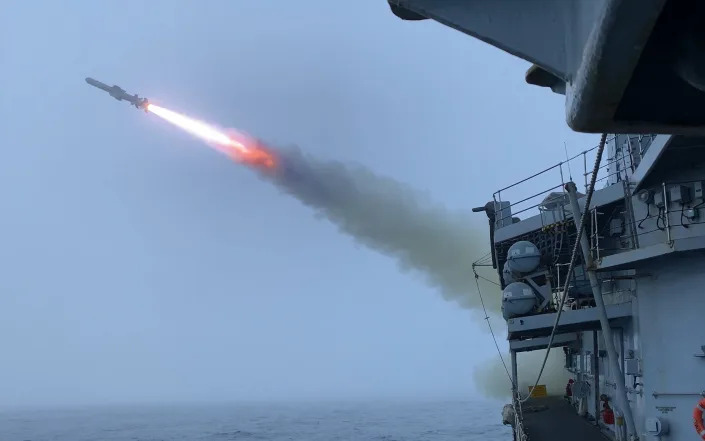
Anti-ship Harpoon missiles, seen here being fired from HMS Westminster, cost £1.2 million each and have a range of around 80 miles – Royal Navy
British long-range missiles would give Ukraine the ability to disrupt Russian logistical chains and push its naval forces more than 80 miles from the coast, say analysts.
As Rishi Sunak urges his Western partners to send longer-range capabilities to Kyiv, discussions are underway in London over whether Harpoon anti-ship missiles or air-to-surface Storm Shadows could be donated to Kyiv.
Ukraine has been gifted US-made Himars and M270 multi-launch rocket systems with a range of 50 miles.
Kyiv’s armed forces have used them to superb effect to force Russian logistics away from the frontline, making it harder for Moscow to supply any advances.
But Mr Zelensky has made the delivery of longer-range weapons a priority in order to hit targets even deeper behind enemy lines as part of his conversations with Western leaders.
Storm Shadow, the RAF’s long-range cruise missile, would deliver that desired effect.
The weapon costs about £2.2 million and can be fired from a fighter jet at targets as far as 350 miles away, although they can be modified to have significantly shorter range.
“The Storm Shadow opens up access to a range of logistics targets not least across the south, dramatically complicating the task for Russian air defenders,” said Justin Crump, of Sibylline, an intelligence and geopolitical risk firm.
“If nothing else, this will force them further to scatter their supply lines and reconsider how best to defend against the threat.”
Ukraine has suggested it could use such a missile to strike Russian targets in occupied Crimea, which some Western governments have privately expressed discomfort at because it could trigger Moscow to escalate the conflict.
Anti-ship missile ‘key’
Another long-range weapon in Britain’s arsenal that could be headed to Ukraine is the Harpoon.
The anti-ship missile could be key in preventing any future amphibious attacks by Russian forces, but also disrupt its Black Sea Fleet from firing their own cruise missiles.
Sea-skimming Harpoons cost £1.2 million each and have a range of around 80 miles when used by the Royal Navy, but some suggest that could be extended to 150 miles.
Mr Crump said: “It remains remarkable that a nation with at best a limited navy has been able to achieve such maritime effects, and Harpoon will further increase the threat to Russian vessels engaged in Kalibr cruise missile launches from the Black Sea.
“This will push Russian surface operations 80 miles offshore – and almost completely close down any potential amphibious operation against Odesa, although that is arguably already a dim and distant memory at this stage.”
Ukraine: Drone footage shows scale of Bakhmut’s destruction
The Associated Press – February 23, 2023
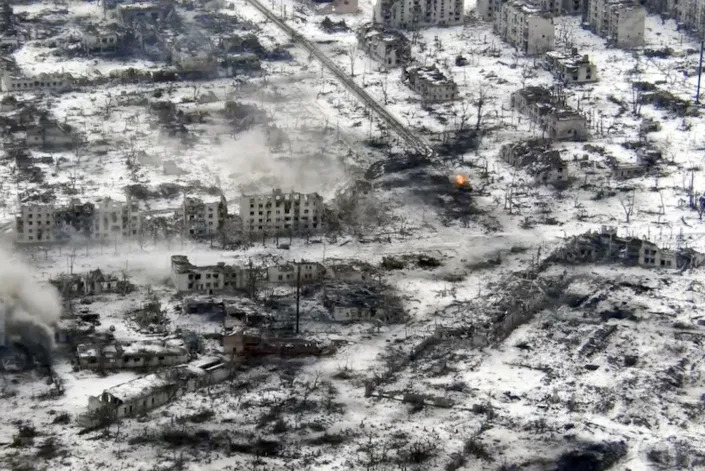
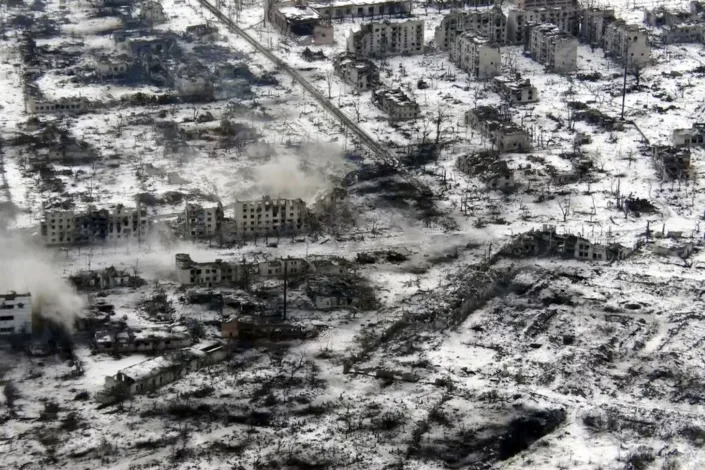
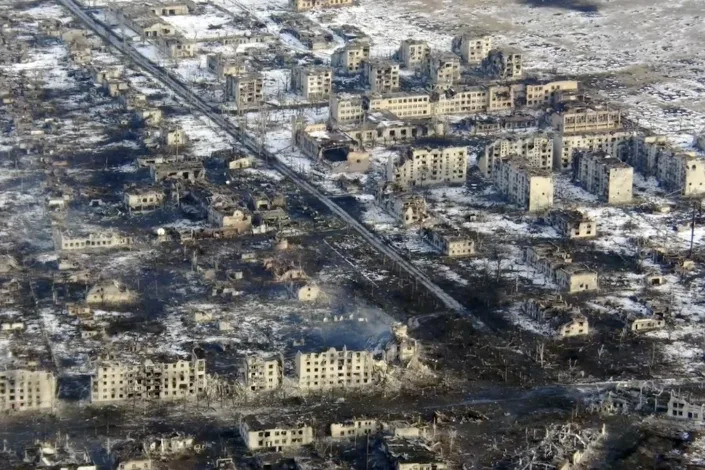
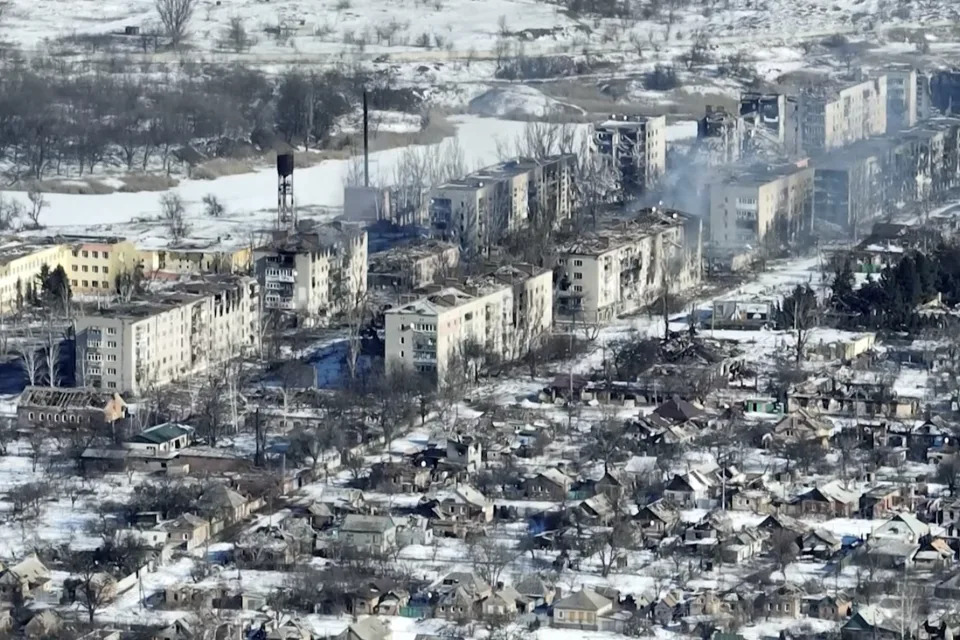
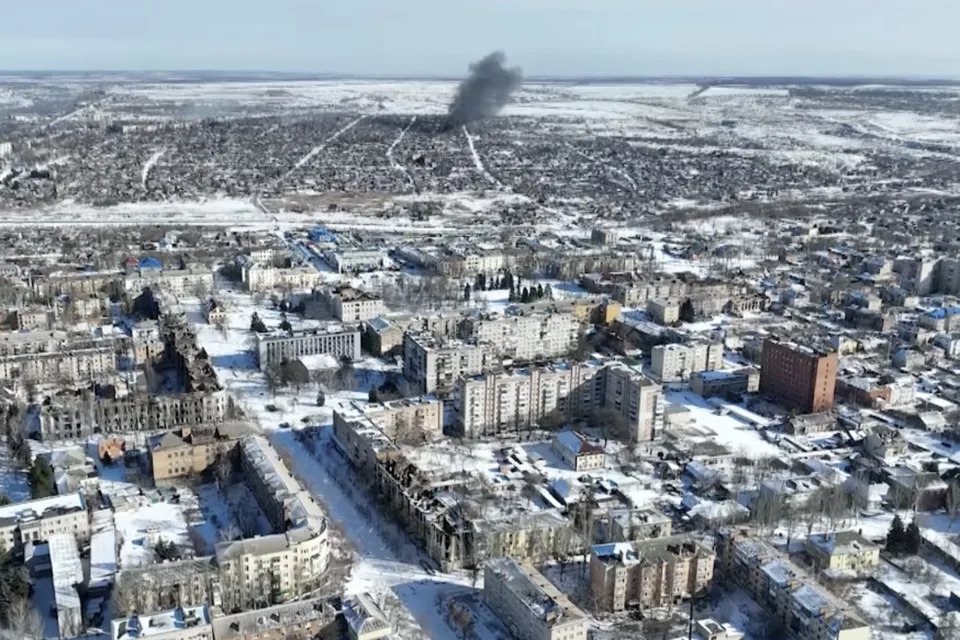
From the air, the scale of destruction becomes plain to see. Entire rows of apartment blocks have been gutted, just the outer walls left standing and the roofs and interior floors gone, exposing the ruins’ innards to the snow and winter frost – and the drone’s prying eye. (AP Photo)New video footage of Bakhmut shot from the air with a drone for The Associated Press shows how the longest battle of the year-long Russian invasion has turned the city of salt and gypsum mines in eastern Ukraine into a ghost town. The footage was shot Feb. 13. From the air, the scale of destruction becomes plain to see. Entire rows of apartment blocks have been gutted, just the outer walls left standing and the roofs and interior floors gone, exposing the ruins’ innards to the snow and winter frost – and the drone’s prying eye. (AP Photo)New video footage of Bakhmut shot from the air with a drone for The Associated Press shows how the longest battle of the year-long Russian invasion has turned the city of salt and gypsum mines in eastern Ukraine into a ghost town. The footage was shot Feb. 13. From the air, the scale of destruction becomes plain to see. Entire rows of apartment blocks have been gutted, just the outer walls left standing and the roofs and interior floors gone, exposing the ruins’ innards to the snow and winter frost – and the drone’s prying eye. (AP Photo)New video footage of Bakhmut shot from the air with a drone for The Associated Press shows how the longest battle of the year-long Russian invasion has turned the city of salt and gypsum mines in eastern Ukraine into a ghost town. The footage was shot Feb. 13. From the air, the scale of destruction becomes plain to see. Entire rows of apartment blocks have been gutted, just the outer walls left standing and the roofs and interior floors gone, exposing the ruins’ innards to the snow and winter frost – and the drone’s prying eye. (AP Photo)New video footage of Bakhmut shot from the air with a drone for The Associated Press shows how the longest battle of the year-long Russian invasion has turned the city of salt and gypsum mines in eastern Ukraine into a ghost town. The footage was shot Feb. 13. From the air, the scale of destruction becomes plain to see. Entire rows of apartment blocks have been gutted, just the outer walls left standing and the roofs and interior floors gone, exposing the ruins’ innards to the snow and winter frost – and the drone’s prying eye. (AP Photo)
BAKHMUT, Ukraine (AP) — Amid the smoking ruins, a lone dog pads in the snow, surely unaware — or perhaps too hungry to care — that death rains down regularly from the skies on the remnants of this Ukrainian city that Russia is pounding into rubble.
But for now Bakhmut stands — growing as a symbol of Ukrainian resistance with each additional day that its defenders hold out against Russia’s relentless shelling and waves of Russian troops taking heavy casualties in a months-long but so far futile campaign to capture it.
New video footage of Bakhmut shot from the air with a drone for The Associated Press shows how the longest battle of the year-long Russian invasion has turned the city of salt and gypsum mines in eastern Ukraine into a ghost town, its jagged destruction testament to the folly of war.
The footage — shot Feb. 13 — shows no people. But they are still there — somewhere, out of sight, in basements and defensive strongholds, trying to survive. Of the prewar population of 80,000, a few thousand residents have refused or been unable to evacuate. The size of the garrison that Ukraine has stationed in the city is kept secret.
Tire tracks on the roads and footprints on the paths covered with snow speak to a continued human presence. In one shot, a car drives swiftly away in the distance. Graffiti spray-painted on the charred, pockmarked outer walls of a blown-out storefront also show people are or were here.
“Bakhmut loves Ukraine,” it reads. Next to that is the stenciled face of Valerii Zaluzhnyi, the commander-in-chief of Ukraine’s armed forces, holding up two fingers in a V-for-victory gesture. “God and Valerii Zaluzhnyi are with us,” reads writing underneath.
A top Ukrainian intelligence official this week likened the fight for Bakhmut to Ukraine’s dogged defense of Mariupol earlier in the war, which tied up Russian forces for months, preventing the Kremlin from deploying them elsewhere.
Likewise, “Bakhmut is also an indicator and a fortress,” the official, Vadym Skibitskyi, said in an AP interview. He said the city has come to represent “the indomitability of our soldiers” and that by holding it, Ukraine is inflicting “unacceptable” casualties on the Russians.
From the air, the scale of destruction becomes plain to see. Entire rows of apartment buildings have been gutted, just the outer walls left standing and the roofs and interior floors gone, exposing the ruins’ innards to the snow and winter frost — and the drone’s prying eye.
Like a caver descending into a chasm, the drone drops slowly into one of the blown-out hulks — all four of its floors now collapsed into a pile of ashes, rubble and rusting metal at the bottom.
Another five-story apartment building has a giant bite torn out of it. A black crow flies through the gap. The drone peers into a kitchen, a once-intimate family place now exposed because one of its outer walls has been torn away. There is still a strainer in the sink and plates on the drying rack above, as though someone still lives there. But the undisturbed dusting of snow on the cloth-covered table suggests they are long gone.
As the drone continues its journey, along streets where crowds no longer walk and past stores where they no longer shop, over parks where children no longer play and where old-timers no longer chew the fat, the names of towns and cities flattened in previous wars spring to mind.
Fleury-devant-Douaumont, France — a village razed in World War I, changing hands 16 times in fighting between French and German troops from June to August 1916. Never rebuilt, it was later declared to have “Died for France” — along with eight other villages destroyed in the fearsome battle for the French town of Verdun.
Or Oradour-sur-Glane, also in France, destroyed in World War II. Its ruins have been left untouched as a memorial to 642 people killed there on June 10, 1944. Nazi troops from the fanatical SS “Das Reich” division herded civilians into barns and a church and torched the village — the biggest civilian massacre by France’s wartime occupiers.
For Ukrainians, Bakhmut also is becoming etched indelibly in the collective consciousness. Its defense is already hailed in song. The track “Bakhmut Fortress,” by Ukrainian band Antytila, has racked up more than 3.8 million views.
“Mom, I’m standing,” they sing. “Motherland, I’m fighting.”
In other developments Thursday:
— The Moldovan government appealed for calm and urged the public to follow only “official and credible” sources of news after Russia alleged Ukraine is planning an “armed provocation” in Moldova’s Moscow-backed breakaway region of Transnistria. Russia maintains about 1,500 “peacekeeping” troops in the region, which is internationally recognized as part of Moldova.
Shortly before the Russian Defense Ministry’s claim, an adviser to Ukraine’s Ministry of Internal Affairs, Anton Herashchenko, said Ukraine and NATO could together return Transnistria to Moldova within 24 hours.
Ukrainian President Volodymyr Zelenskyy has previously stated that Ukraine is ready to provide all necessary assistance to Moldova.
Moscow alleged, citing intelligence data without presenting any evidence, that Ukrainian soldiers disguised as Russian troops planned to launch a false flag attack to blame Russia for invading Ukraine from Transnistria that Kyiv would then use as a pretext for an invasion of the territory.
Late Thursday, the Russian Defense Ministry issued another warning of what it described as an impending Ukrainian “provocation,” reporting a massive Ukrainian military buildup near Transnistria including artillery in positions ready for combat.
“The Russian armed forces will adequately respond to the provocation planned by the Ukrainian side,” the ministry said.
— Russian President Vladimir Putin gave another signal he is digging in for a protracted war, saying his government will prioritize strengthening Russia’s defense capabilities. Speaking on Defender of the Fatherland Day, a public holiday, he announced the deployment of the Sarmat intercontinental ballistic missile system and the delivery of a massive supply of Zircon sea-launched hypersonic missiles to Russian forces. He added that three Borei-class nuclear submarines would be added to the fleet in the coming years.
— The U.N. General Assembly approved a nonbinding resolution Thursday urging Russia to end hostilities in Ukraine and to withdraw its forces.
— At least three civilians were killed and eight others were wounded in Ukraine over the past 24 hours, the presidential office reported. Russian forces over the past day launched more than 80 artillery barrages of six towns and villages in northeastern Ukraine’s Sumy region, which borders Russia, local Ukrainian authorities reported. Ukrainian forces also repelled about 90 Russian attacks in the country’s east, where fierce fighting has raged for months, the Ukrainian military said.
John Leicester and Hanna Arhirova contributed to this report from Kyiv.