Ukraine defense minister thanks UK for sending ‘fantastic’ tanks
March 28, 2023
Ukraine’s Defence Minister Reznikov poses for a picture in front of a British Challenged 2 tank in an unknown location in Ukraine
KYIV (Reuters) – Ukrainian Defence Minister Oleksii Reznikov gave Britain the thumbs up as he took a ride in what he said was the first British Challenger 2 main battle tank to arrive in Ukraine.
Britain said in January it would send 14 of the tanks to Ukraine, which is preparing for a possible counter-offensive against Russian forces that invaded 13 months ago.
Reznikov wrote on Twitter that the tanks had “recently arrived in our country” and posted a video that showed him sitting in one of a long line of tanks in an open field, all of them flying Ukraine’s yellow and blue flag.
“It was a pleasure to take the first Ukrainian Challenger 2 MBT (main battle tank) for a spin,” Reznikov wrote. “These fantastic machines will soon begin their combat missions.”
In the video, he gave the thumbs up sign and thanked British Defence Secretary Ben Wallace for the tanks.
“Marvellous, Ben,” he said in English. “It’s…very good stuff. Thank you very much from Ukraine to the United Kingdom.”
Germany’s defence ministry said on Monday that 18 Leopard 2 battle tanks and 40 Marder infantry fighting vehicles had also arrived in Ukraine.
(Reporting by Dan Peleschuk, Editing by Timothy Heritage)
Bulgaria can provide Ukraine with ammunition that can ‘turn the tide of war’, ex-Defense Minister
The New Voice of Ukraine – March 28, 2023
Ammunition for howitzers during a training exercise at a German military base in Munster, May 10, 2022
Bulgaria will transfer old ammunition worth nearly EUR 175 million ($190 million) to state-owned military plant VMZ, who will forward them to Ukraine through intermediaries, Noev said.
Bulgaria will replace the shipment with newer ammunition.
“This is the largest rearmament of the Bulgarian land forces in recent history. That’s a huge amount of ammunition – hundreds of thousands. There is a huge increase in the price of ammunition, and VMZ will sell this ammunition through intermediaries to Ukraine. This is an amount of ammunition that can turn the tide of the war in some directions on the Ukrainian front,” Euroactiv quoted the former minister as saying.
Bulgaria possesses old Soviet-era ammunition the Ukrainian Armed Forces need for their tanks, howitzers, anti-tank grenades, multiple rocket launchers, and AK-47 assault rifles.
Bulgarian President Rumen Radev said that Sofia sells weapons and ammunition to European countries on the condition of not transferring them to Ukraine.
His claims contradict the parliament’s Dec. 2022 decision to provide Kyiv with direct military aid. Radev dissolved the parliament in early Feb. 2023 and ordered the government to suspend supply until elections are held.
The VMZ plan should be able to work around the president’s commitment to not supply Ukraine, Euroactiv explained.
Bulgaria has already covertly supported Ukraine in one of the most crucial periods of the Russian full-scale invasion.
Bulgaria covered up to one third of the Ukrainian army’s needs, as well as up to 40% of tanks, cars, and diesel fuel supply for the military from April to August 2022, German news site Welt reported.
Putin’s Mercenary Prigozhin Shifts Focus After Ukraine Setbacks
Bloomberg News – March 23, 2023
(Bloomberg) — Yevgeny Prigozhin, the powerful founder of mercenary group Wagner, is preparing to scale back his private army’s operations in Ukraine after Russian military chiefs succeeded in cutting key supplies of men and munitions, people familiar with the matter said.
Seen as an increasing threat by the security and political establishment, Prigozhin is struggling with a manpower and ammunition shortage in Ukraine after he was barred from recruiting from prisons, his primary source of recruits, and deprived of supplies. Wagner troops so far have failed to take their main target – the Ukrainian city of Bakhmut – despite months of trying and staggering losses. Now, Prigozhin is planning to shift focus back to Africa, the people said.
The shift is a sudden turn in fortunes for Prigozhin, a longtime Putin ally who catapulted himself to prominence as the tough-guy alternative to Russia’s faltering military in Ukraine.
But as his fighters struggled to advance more than a few dozen kilometers in and around Bakhmut despite months of fighting, top commanders managed to sow doubts with Putin about Wagner’s vaunted military prowess, arguing that what results he got came from using waves of convict troops sent to their deaths, people close to the Kremlin and intelligence services said, speaking on condition of anonymity to discuss matters that aren’t public.
The Russian leader ultimately stepped in to transfer prison recruiting to the Defense Ministry, cutting off the flow of recruits to Wagner. Munitions supplies from the military slowed. Prigozhin’s independence also rankled with the Kremlin.
“Prigozhin is getting in everyone’s way,” said Tatiana Stanovaya, founder of R.Politik political consultancy. “His only protection now is his personal relationship with Putin, who still considers him useful in a certain way.”
After weeks of complaining publicly that the military wasn’t delivering vital shells and other supplies, Prigozhin admitted ealier this month that Wagner would have to “reset and cut down its size” after the battle for Bakhmut is over. He recently touted Wagner’s capture of a village in the area, but didn’t mention that its population was only two people according to the last census.
There’s no sign at present that Prigozhin will redeploy troops to Africa, but the people familiar with the situation said operations there are likely to get more of his attention in the future as the situation in Ukraine has become more difficult for his forces.
A recruitment announcement posted Monday invited applicants for mercenary vacancies for six months in Ukraine and 9-14 months in Africa, specifying that those who want to serve in African countries would be placed on reserve.
A one-time catering entrepreneur who said he founded Wagner in the Kremlin’s first war in Ukraine in 2014, Prigozhin sent troops to help Russia shore up Syrian strongman Bashar al-Assad. He also built a network in Africa stretching from Libya to Sudan, Mali and the Central African Republic in support of the Kremlin’s geopolitical goals. Most recently, there have been reports Wagner is moving into Burkina Faso after the country ordered French troops to leave. The US and its allies have slapped sanctions on Prigozhin and Wagner.
Leaving on an African tour last month, French President Emmanuel Macron branded Wagner as “the life insurance of failing regimes and putschists,” calling it “a group of criminal mercenaries.”
Italian intelligence warned in a recent report that the increased activity of Russian private military companies could destabilize Northern and Western Africa, prompting an increase of migrant flows toward the European Union. Prime Minister Giorgia Meloni is extremely worried about a summer migration wave, according to a person familiar with her thinking. Her defense minister publicly blamed the mercenaries for fueling a surge in migrant boats crossing the Mediterranean. Prigozhin denied that.
Convict Soldiers
Since the invasion of Ukraine, Prigozhin shifted his major efforts there, winning Kremlin permission to recruit prisoners with promises of early release if they survived six months on the battlefield.
Sent into combat with little preparation, about half of the 40,000 convicts who signed up have been killed or wounded in the fighting in Bakhmut and the capture earlier this year of the small salt-mining town of Soledar, according to UK intelligence estimates. Wagner in addition has some 10,000 professional contractors fighting in Ukraine that it has deployed more cautiously, the US says.
Prigozhin announced last week that he’d opened recruitment centers in sports centers and martial arts clubs in 42 Russian cities and said Sunday he hopes to sign up 30,000 new recruits, but it’s unclear how successful he’ll be in attracting volunteers.
His influence seemed to peak late last year as he publicly attacked Kremlin appointees in Russia and spooked insiders with calls for Stalin-style crackdowns on opponents. Sergei Surovikin, a top general with experience in Syria who was seen as an ally, was given command of the Ukraine invasion.
Prigozhin saved the harshest treatment for top military commanders. In a video posted on social media in December, Wagner fighters used expletives to describe Valery Gerasimov, Russia’s top general, because of their shortage of ammunition. Defense Minister Sergei Shoigu also came in for attacks.
The first outward sign that Prigozhin had gone too far came early this year, when Putin promoted Gerasimov to oversee the war in place of the Prigozhin ally.
Revelations of extreme brutality by Wagner including summary executions of ex-inmates who refused orders to fight that have emerged from defectors who fled to Europe damaged Prigozhin’s reputation in Putin’s eyes, one of the people with knowledge of the issue said.
Prigozhin’s shock troops remain useful from a military perspective, and if Bakhmut falls, Wagner may continue to play a role in further assaults in a bid to seize the remaining Ukrainian-held cities in the eastern Donbas region, said two people close to the Kremlin and intelligence services.
Political Reach
But he won’t be allowed any opportunity in state-controlled media to claim credit for taking Bakhmut, which would be the first significant advance for Russia since mid-2022, said one of them.
Prigozhin has also hinted that he’s not giving up political ambitions inside Russia, where he controls a powerful pro-Kremlin media company and enjoys lucrative state contracts. He said in a recent video message that Wagner will “transform itself from the best private army in the world into an army with ideology, and this ideology will be the struggle for justice.”
Ultimately, without the approval of the Russian leadership, that too could be denied him.
“Prigozhin became far too independent, which violated the balance between the elite clans,” said Andrei Kolesnikov, a senior fellow at the Carnegie Endowment for International Peace. “Only Putin can decide what the limits are.”
His current plan is to focus the private mercenaries’ focus back to countries in Africa, such as Sudan, Mali, and the Central African Republic, where Wagner has deployed forces. On Monday, Wagner posted a recruitment notice offering deployments to African countries that would last between nine to 14 months, Bloomberg reported.
The apparent decision to recalibrate Wagner operations in Ukraine comes after a series of setbacks Wagner has faced in trying to work with the Russian government to wage war in Ukraine. Prigozhin, who enlisted private mercenaries from prison, was blocked in recent weeks from recruiting from prisons. His colleague was also recently barred from accessing Russia’s military command in Ukraine.
Tensions have spilled over into the public eye as well. Wagner Group has also had to resort to pleading with Russia in various videos posted to social media to provide more ammunition they said was desperately needed to try to fight in Ukraine, to no avail.
It’s not clear how quickly the changes will go into effect. Evidence has emerged this week that suggests Wagner Group is still fighting in southern Bakhmut as well as Orikhovo-Vasylivka, Bohdanivka, and in the direction of Predtechyne, according to the Institute for the Study of War.
Though Wagner Group has been working to flood the field with personnel, Prigozhin’s army has so far failed to capture Bakhmut, which they have been trying to seize for months.
The Wagner Group has at times blamed those failures on Russia’s idle efforts to help out Wagner with supplies.
“We appeal to our colleagues and friends from the Ministry of Defense. We are confident there is this ammunition somewhere in the stockpiles, and we need them acutely… We will do the work for you—help us with ammunition,” some Wagner fighters said in a recent video on social media.
Norway watches as Russian subs and aircraft step up Arctic patrols
Tom Costello and Dan De Luce and Joel Seidman – March 23, 2023
ABOARD THE KV SORTLAND — NATO ally Norway has announced that it is boosting the number of naval patrols near vital undersea gas pipelines off its coast, and released a trove of videos exclusively to NBC News illustrating what it sees as a growing Russian threat in the Arctic.
The videos provided by the Royal Norwegian Air Force capture the high-stakes cat-and-mouse game between the two militaries, with Russian attack submarines patrolling near a maze of undersea pipelines carrying vast amounts of natural gas to Europe and telecommunication cables linking Europe and America.
According to the head of the Royal Norwegian Navy, the videos indicate that Russian attack submarines and planes have expanded their presence in the High North, operating near Norway’s natural gas pipelines that represent a vital energy lifeline for Europe.
“We’ve seen increased military activity around Norway in the High North, in the North Atlantic. We have seen Russian submarines operating differently than they did 10 years ago,” Rear Adm. Rune Andersen said last week from the bridge of the Norwegian refueling ship Maud at the Haakonsvern Naval Base in the city of Bergen.
Norway released this video of a Russian surveillance aircraft off its coast. (Norwegian Government)
He did not quantify by how much Russian activity had increased in the past year.
Not only have there been more Russian patrols, their behavior has also changed, with them “operating more unpredictably” and some of their maneuvers appearing “more aggressive,” Andersen added.
A NBC News team accompanied a Norwegian Coast Guard ship, the KV Sortland, on patrol for three days last week in the North Sea, as the 25-member crew kept a close eye on gas installations while contending with heavy winds, frigid temperatures and rough seas.
The uptick in military activity came as tensions between NATO and Russia soared following the invasion of Ukraine. After a drastic drop in the flow of Russian natural gas to Europe, Norway replaced Russia as the top supplier to the continent. And since an unexplained attack last year on the Nord Stream gas pipeline linking Russia and Germany, Norway — backed by its NATO allies — stepped up security for the vast network of pipelines and communication cables off its coast.
“After the explosions, we have actually increased our presence over these installations,” Norwegian Foreign Minister Anniken Huitfeldt said in an interview in Oslo. “Now we really need to protect the whole infrastructure system and also the installations at sea.”
“We are prepared for everything,” she added.
Norway, with more than 5,000 miles of pipelines, is now supplying 30 to 40% of Europe’s natural gas needs, up from about 20% before the Ukraine invasion. The undersea cables in the North Sea are part of a crucial global communications network that keeps data moving around the planet.
In Ukraine, Russia’s military has suffered serious setbacks and Western officials say it remains plagued by logistical and morale problems. But, Andersen said, Russia’s nuclear-powered submarine fleet, much of it based at its Murmansk military base near Norway, remains a formidable threat.
“The submarines and the maritime and air capabilities of the (Russian) northern fleet… they’re largely unaffected by the war in Ukraine. It’s still intact,” he added.
The videos released to NBC News show one submarine’s periscope peeking out of the water, and include footage of the latest Yasen-class attack submarines and a Borei-class submarine designed to carry 16 nuclear-armed ballistic missiles. The imagery also depicts Tupolev TU-142 and Ilyushin II-38 surveillance planes designed to track submarines.
Russia has invested heavily in its submarine fleet, making its boats quieter and more lethal, analysts say. The new Belgorod submarine is designed to carry massive 80-foot-long nuclear torpedoes, as well as smaller mini-submarines capable of carrying out rescues or research, but military experts say the smaller submersibles also could be used to cut cables or pipelines along the ocean floor.
‘Suspicious activity’
Russian submarines, ships and aircraft in the area appear to be conducting surveillance of the gas pipelines, Norwegian officers said.
“They’re around this area. More than once, they’re going back and forth. They’re following the pipeline, “ said Comdr. Tirrell Herland, a Norwegian naval spokesperson, calling it “suspicious activity.”
The Norwegian government released video to NBC News showing this Russian nuclear attack submarine off its coast (Norwegian Government)
The Sortland’s acting captain, Helen Dahl, said Russian fishing trawlers often go dark by turning off their navigational transmitters, and are equipped with an unusual number of antenna — raising suspicions.
Meanwhile, unexplained sightings and events are also raising suspicions of Russian surveillance and activities.
In recent months, drones have been spotted flying over Norwegian gas facilities, airports and other infrastructure. In October, Norwegian police investigated reports of a drone flying over the Karsto gas plant in southwest Norway. The Norwegian government has not said who it thinks may have been behind the drone flights.
In 2021, undersea sensors that help Norway monitor submarines were knocked out and last year, a fiber optic cable between mainland Norway and the Svalbard archipelago in the Arctic was incapacitated in another unexplained incident.
The Troll 1 gas platform in the North Sea. (NBC News)
The Russian Embassy in Washington, D.C., did not respond to a request for comment.
Andersen, the naval chief, said his forces work with private pipeline companies to closely monitor and protect the undersea network of pipelines and cables.
“We have a relatively strong network of sensors. We have activity out there, on the surface, below the surface and in the air, enabling us to have a pretty good picture on what’s moving around in the North Atlantic,” he said.
The undersea infrastructure is a “potential vulnerability in times of conflict,” Andersen said. “And we need to make sure that we are able to monitor, survey and protect it.”
Norway and its NATO allies need to be vigilant given Russia’s track record of carrying out alleged sabotage and retribution outside its borders, including cyber attacks and more lethal operations, according to Ian Brzezinski of the Atlantic Council think tank.
“The list of what the Russians have done in the realm of subterfuge, subversion and assassination is long,” he said. “So, attacking subsurface infrastructure has got to be on their list of options.”
Czech authorities in 2021 accused the Russian military intelligence of setting off massive explosives at its ammunition depots in 2014, and British police in 2018 alleged that Russia used a nerve agent to poison former Russian intelligence officer Sergei Skripal and Yulia, his daughter
Russia has denied that it was behind the explosions at the Czech ammunition warehouses or the poisoning of Skripal in the United Kingdom.
Last week, the Sortland was pulled from its patrol duties to help provide security for a joint press conference by the leaders of NATO, the European Union and Norway who flew to the giant Troll platform in the country’s largest gas field. Three other warships — from Germany, the Netherlands and Spain also stood watch — part of an enhanced NATO presence now in the North Sea.
A fast boat from the Norwegian Coast Guard ship, the KV Sortland, patrols the undersea pipelines in the North Sea. (NBC News)
“Since these installations are so vital, they are also so vulnerable,” NATO Secretary-General Jens Stoltenberg said as the Sortland and the other ships moved nearby.
Stoltenberg, joined by Norwegian Prime Minister Jonas Gahr Støre and European Commission President Ursula von der Leyen, said that the E.U. and NATO are forming a new task force to guard vital infrastructure and that the alliance had deployed more ships to the area since the September sabotage of the Nord Stream pipeline.
The attack on the Nord Stream pipeline, which damaged three of its four pipelines 260 feet under the ocean, remains an unresolved case. An investigation by the German, Swedish and Danish governments is underway, and no findings have been issued.
Tom Costello and Joel Seidman reported from Norway, and Dan De Luce reported from Washington.
Not Stopping Russia in Ukraine Would Force ‘Doubling’ of US Defense Budget, Milley Says
Rebecca Kheel – March 23, 2023
The top general in the U.S. military warned Thursday that not supporting Ukraine now would lead to a massive increase in future defense budgets — and global conflict that has been avoided since World War II ended.
“If that rules-based order, which is in its 80th year, if that goes out the window, then be very careful,” Chairman of the Joint Chiefs Gen. Mark Milley testified to Congress on Thursday. “We’ll be doubling our defense budgets at that point because that will introduce not an era of great power competition. That’ll begin an era of great power conflict. And that’ll be extraordinarily dangerous for the whole world.”
Milley’s remark at a House Appropriations Committee defense subcommittee hearing comes amid growing skepticism from Republicans about the price tag of U.S. aid to Ukraine. Milley was testifying alongside Defense Secretary Lloyd Austin about the Biden administration’s $842 billion request for Pentagon spending for fiscal 2024.
Congress has approved about $113 billion in aid to Ukraine since the war began when Russia invaded its neighbor in February 2022. While that includes humanitarian and economic assistance, the bulk of the funding has gone toward providing weapons to the Ukrainian military.
While still a minority of the party, some members of the GOP have been increasingly vocal about questioning whether support for Ukraine is a good use of U.S. funding, arguing there are more pressing domestic needs or that there has not been enough oversight to ensure the money isn’t misused.
For example, expected Republican presidential candidate and Florida Gov. Ron DeSantis, who was a vocal supporter of arming Ukraine when he was in Congress, last month said the war in Ukraine is a “territorial dispute” that is not a “vital” U.S. national security interest. He has since walked back the comment after criticism from Republican senators.
Even as some Republicans voice more opposition to the aid, the Biden administration continues to take heat from other Republicans over not providing more advanced weapons to Ukraine.
On Thursday, subcommittee Chairman Ken Calvert, R-Calif., while reiterating House GOP leadership’s talking point that it will not provide a “blank check” to Ukraine, criticized the administration for “giving Ukraine just enough assistance to survive, but not enough to win.”
Milley, without calling out any specific criticism of U.S. aid, described the war as an “important national interest” and “fundamental to the United States, to Europe and to global security.”
The general was responding to a question from Rep. Mario Díaz-Balart, R-Fla., who said he thinks “it’s important to defeat [Russian President Vladimir] Putin in the Ukraine” but that it would be “helpful” if U.S. officials more clearly defined their strategic goals.
“The strategic end state is that the global rules-based international order that was put in place in 1945 is upheld,” Milley said. “How do you do that, how do you know you’ve achieved that end state? You achieve that end state when Ukraine remains a free, sovereign, independent country with their territory intact.”
Rep. Chris Stewart, R-Utah, who said he counts himself among those growing more skeptical of the aid, also pressed Milley on whether U.S. goals include Ukraine retaking Crimea, which Russia illegally annexed in 2014.
Milley reiterated that, while he personally believes taking back Crimea would be “an extraordinarily difficult goal to achieve militarily,” whether to try to do so is a decision for the Ukrainians.
“Our task is to help Ukraine defend itself,” Milley added. “The United States is not at war with Russia, even though Russia tries to portray that.”
Russian missiles batter Ukraine, but Bakhmut offensive stalling, say military experts
Dan Peleschuk and Sergiy Chalyi – March 22, 2023
Aftermath of a Russian missile strike in ZaporizhzhiaUkrainian servicemen ride a tank on a road towards the frontline town of Bakhmut in Chasiv YarrUkraine’s President Zelenskiy visits a petrol station in Donetsk region
KYIV/ZAPORIZHZHIA, Ukraine (Reuters) – Russian drones attacked Ukrainian cities and missiles blasted an apartment block, but a months-long ground assault on the eastern town of Bakhmut could be stalling in the face of fierce resistance, according to Ukrainian and British military experts.
Russian forces unleashed a wave of air strikes in the north and south of Ukraine as President Vladimir Putin bid farewell on Wednesday to Chinese leader Xi Jinping following a two day visit to Moscow by his fellow autocrat and “dear friend”.
But staunch resistance by Ukrainian defenders in Bakhmut, the site of Europe’s deadliest infantry battle since World War Two, led British military intelligence to believe Russia’s assault on the town could be running out of steam.
There was still a danger, however, that the Ukrainian garrison in Bakhmut could be surrounded, Britain’s defence ministry said in its intelligence update on Wednesday.
Ukraine’s military General Staff agreed that Russia’s offensive potential in Bakhmut was declining.
Bakhmut has become a key objective for Moscow, which sees the town as a stepping stone toward completing its conquest of the eastern Donbas region.
In a show of defiance, President Volodymyr Zelenskiy’s office released a video of him handing out medals to troops it said were near the Bakhmut front line.
“Ukrainian forces have more or less stabilised the situation in Bakhmut — and Russian forces are unable to do anything,” military analyst Oleh Zhdanov said in a YouTube presentation.
“They may have advanced a couple of hundred metres to the north or south of the city, but this has really achieved nothing.”
During Wednesday night, air raid sirens blared across the capital Kyiv and parts of northern Ukraine, and the military said it had shot down 16 of 21 Iranian-made Shahed suicide drones.
Firefighters battled a blaze in two adjacent residential buildings in the southern city of Zaporizhzhia, where officials said at least one person was killed and 33 wounded by a twin missile strike.
In Rzhyshchiv, a riverside town south of Kyiv, at least eight people were killed and seven injured after a drone struck two dormitories and a college, regional police chief Andrii Nebytov said.
“This must not become ‘just another day’ in Ukraine or anywhere else in the world. The world needs greater unity and determination to defeat Russian terror faster and protect lives,” Zelenskiy tweeted, along with a video of security camera footage showing a building exploding.
A playground and a car park at the scene in Zaporizhzhia were littered with glass, debris and wrecked cars. Emergency workers brought out the wounded along with anyone unable to walk.
An elderly woman with a scratched face sat alone on a bench, wiping tears and whispering prayers.
“When I got out, there was destruction, smoke, people screaming, debris. Then the firefighters and rescuers came,” said Ivan Nalyvaiko, 24.
International groups estimate rebuilding Ukraine will cost $411 billion – 2.6 times Ukraine’s 2022 gross domestic product.
CHINA-RUSSIA UNITY
Hosting Xi in Moscow this week was Putin’s grandest diplomatic gesture since he ordered the invasion of neighbouring Ukraine 13 months ago and became a pariah in the West.
The two men referred to each other as “dear friend”, promised economic cooperation, condemned the West and described relations as the best they have ever been.
Xi departed telling Putin: “Now there are changes that haven’t happened in 100 years. When we are together, we drive these changes.”
“I agree,” Putin said.
But the public remarks were notably short of specifics, and during the visit Xi had almost nothing to say about the Ukraine war, beyond that China’s position was “impartial”.
The White House urged Beijing to pressure Russia to withdraw. Washington also criticised the timing of the trip, just days after the International Criminal Court issued an arrest warrant for Putin on war crimes charges.
China has proposed a peace plan for Ukraine that the West largely dismisses as vague at best, and at worst a ploy to buy time for Putin to regroup his forces.
Ukraine says there can be no peace unless Russia withdraws from occupied land. Moscow says Kyiv must recognise territorial “realities” after its claim to have annexed nearly a fifth of Ukraine.
(Reporting by Reuters bureaux; Writing by Michael Perry; Editing by Simon Cameron-Moore)
Ukraine: The Latest podcast – hard truths from Ukrainian frontline troops
David Knowles – March 22, 2023
A handout photo made available by the Ukrainian Presidential Press Service shows servicemen waiting to meet President Volodymyr Zelensky (not pictured) as he visits the Ukrainian military’s advanced positions in the Bakhmut direction, during a working trip to the Donetsk region, at an undisclosed location in Ukraine, 22 March 2023, amid the Russian invasion of the country. Russian troops entered Ukrainian territory on 24 February 2022, starting a conflict that has provoked destruction and a humanitarian crisis. Ukraine’s President Zelensky visits troops near the Donetsk frontline, Bakhmut – 22 Mar 2023
In today’s episode of Ukraine: The Latest, we bring you updates from across Ukraine, dispel Russian misinformation on British tank rounds, and interview Kyiv Independent reporter Francis Farrell on his time reporting from the front lines across Ukraine.
Assistant Comment Editor Francis Dearnley discussed the significance of Xi Jinping’s visit to Moscow that ended today:
I do think that if we are to summarise this as a glamorous ‘photo opportunity’, I do still think that photo opportunity matters enormously. When the war began, China was publicly – and I stress that word because in private, no doubt, they were making different calculations – cautious about their dealings with Russia, seeing how things would develop.
Evidently, they now think the prospects of a long war and a relatively secure Putin in the short-term mean that backing him publicly is worth it.
Our guest Francis Farrell commented on the morale of the Ukrainian troops he has met.
Almost all of them said the same thing: that they understand their job as infantry is to stand and hold the line. Probably the hardest job in the military in a full scale conventional war between two states like this. But they know what they’re fighting for. It didn’t seem like they were faking their patriotism or anything like that, but they were honest in the sense that they are very, very tired.
Hamish de Bretton-Gordon spoke about Russian disinformation regarding British tank shells that are being supplied to Ukraine:
This is a classic Putin disinformation and absolutely bonkers. Putin has used the threat of new correct escalation from the very start to try and keep NATO out of this conflict and it hasn’t really worked. To suggest that a tank round that contains depleted uranium is some sort of nuclear weapon is absolutely ridiculous.
Yesterday Dom Nicholls interview former US National Security Adviser John Bolton. For a video of the interview click here.
In today’s episode, we also talk to former national security adviser John Bolton.
War in Ukraine is reshaping our world. Every weekday the Telegraph’s top journalists analyse the invasion from all angles – military, humanitarian, political, economic, historical – and tell you what you need to know to stay updated.
With over 24 million downloads, our Ukraine: The Latest podcast is your go-to source for all the latest analysis, live reaction and correspondents reporting on the ground.
Ukraine: The Latest‘s regular contributors are:
David Knowles
David is Head of Social Media at the Telegraph where he has worked for almost two years. Previously he worked for the World Economic Forum in Geneva. He speaks French.
Dominic Nicholls
Dom is Associate Editor (Defence) at the Telegraph having joined in 2018. He previously served for 23 years in the British Army, in tank and helicopter units. He had operational deployments in Iraq, Afghanistan and Northern Ireland.
Francis Dearnley
Francis is Assistant Comment Editor at the Telegraph. Prior to working as a journalist, he was Chief of Staff to the Chair of the Prime Minister’s Policy Board at the Houses of Parliament in London. He studied History at Cambridge University and on the podcast explores how the past shines a light on the latest diplomatic, political, and strategic developments.
They are also regularly joined by the Telegraph‘s foreign correspondents around the world, including Joe Barnes (Brussels), Sophia Yan (China), Nataliya Vasilyeva (Russia), Roland Oliphant (Senior Reporter) and Colin Freeman (Reporter). In London, Venetia Rainey (Weekend Foreign Editor), Katie O’Neill (Assistant Foreign Editor), and Verity Bowman (News Reporter) also frequently appear to offer updates.
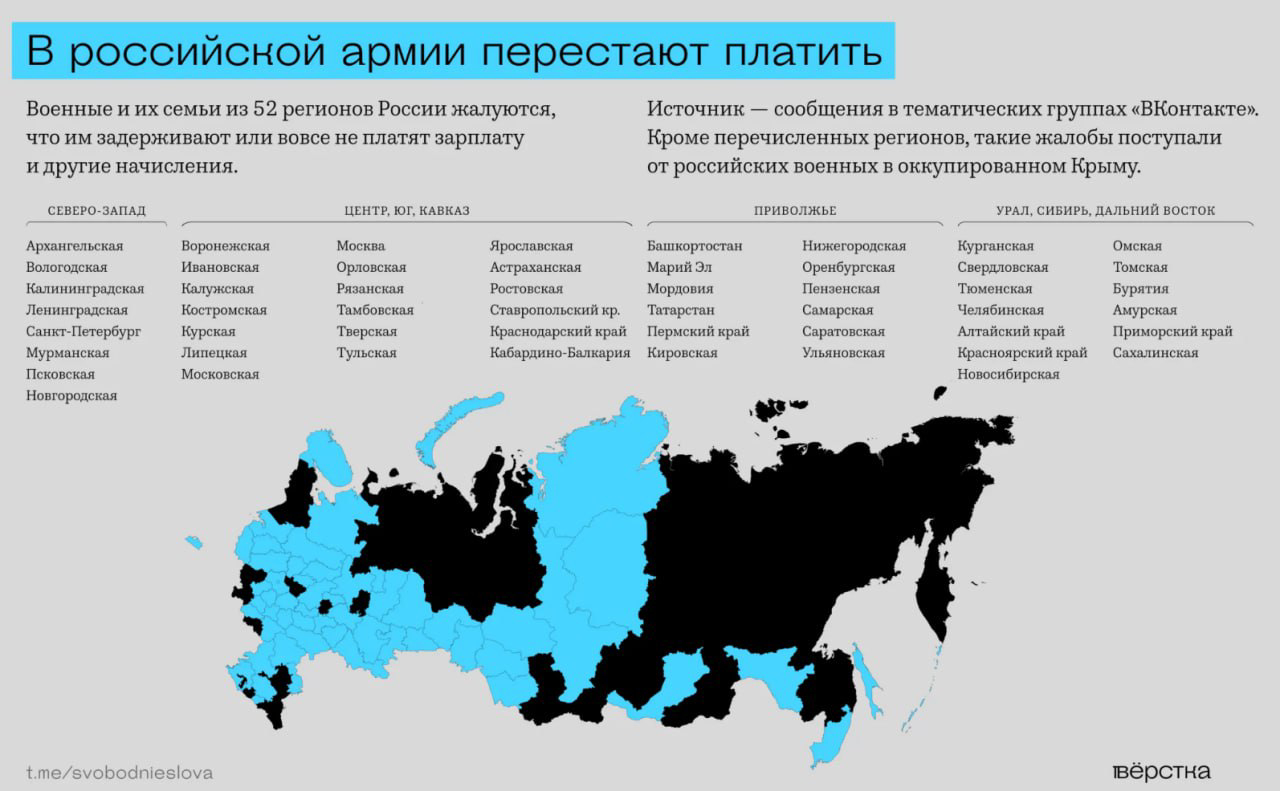
Details: According to the calculations of the news outlet, since the beginning of March 2023, the salaries of the servicemen have been delayed or not paid at all in 52 regions of Russia and in occupied Crimea.
Instead of the promised 195,000 roubles [approx. USD$2,530 – ed.] per month, their accounts receive much smaller amounts.
Judging by the stories of the Russian servicemen themselves and their relatives, frequent problems with payments began in January, but at the same time, individual cases of withholding and non-payment of salaries, allowances and social benefits have been reported at least since November 2022. It is noted that both conscripts and volunteer and contract soldiers face this problem.
Since the beginning of March, dozens of messages about the non-payment have been posted in groups devoted to payments to conscripts on the Russian social network VKontakte.
In the comments, the authors of the complaints are often told that the Ministry of Defence of the Russian Federation officially transfers salaries from the 10th to the 20th of each month and that delays may be related to the transfer of the serviceman himself to another unit. In these cases, some admit that they received payments later. Others publish payslips from the personal online accounts of servicemen on the website of the Ministry of Defence, in which there are zeros in place of payments.
According to Dmytro Loboyko, the Head of the Regional Studies Centre, people from the Russian hinterland associated “the hope of qualitatively changing their lives, but they had to face reality” with payment for participation in hostilities.
Putin is under the influence of strong drugs, Russian political scientist says
March 21, 2023
Russian dictator Vladimir Putin at a meeting with Chinese leader Xi Jinping, March 20, 2023
“If you watched at least a part of the speech to entrepreneurs (Putin’s speech at the Congress of the Russian Union of Industrialists and Entrepreneurs — ed.), you can see a person high on speed, as young people say, meaning someone using powerful stimulant drugs,” Solovei said on the Morning Turn program on the Zhyvyi Hvozd (Living Nail) YouTube channel.
LUKOIL co-owner Vagit Alekperov, his partner Leonid Fedun, former Sibur CEO Dmitry Konov, and Crocus Group owner Araz Agalarov resigned from the Chamber of Industrialists and Entrepreneurs in early March. Russian oligarch Alisher Usmanov also asked to leave the RSPP.
None of them showed up for the meeting with Putin.
Owner of the Novolipetsk Metallurgical Plant, Vladimir Lisin, and owner of Sistema, one of the largest private investors in Russia, Vladimir Yevtushenkov, also did not attend.
As a result, only six people out of the top 20 on the Russian Forbes list participated in the congress and met with Putin.