China could cross a red line and start arming Russia if Ukraine pulls off a major counterattack, leaked Pentagon papers say
Tom Porter – April 11, 2023
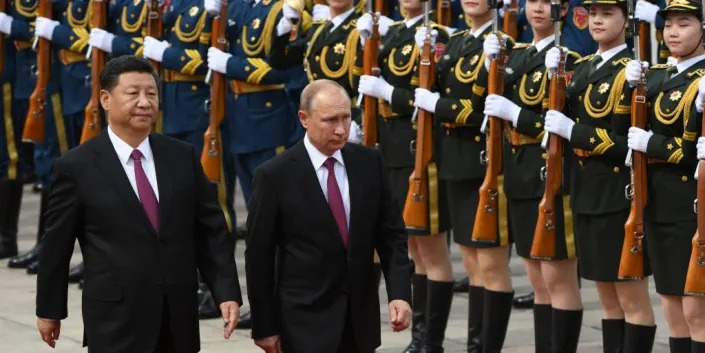
Russia’s President Vladimir Putin (C) reviews a military honour guard with Chinese President Xi Jinping (L) in Beijing on June 8, 2018.GREG BAKER/POOL/AFP via Getty Images
Leaked US documents reveal what could prompt China to begin arming Russia, reports say.
A Ukrainian attack on Russia using NATO weapons could be a red line for China, they say.
The leaked documents contain secret details of US military operations globally.
Leaked Pentagon papers spell out the circumstances that US officials believe could prompt China to get involved in the Ukraine conflict and begin arming its ally Russia, reports say.
The US Defense Department documents posted online appear to contain extensive discussion of the Ukraine conflict, and of China’s military plans and capabilities.
They say that a Ukrainian attack on Russian territory using weapons supplied by NATO would compel Beijing to act, according to The Washington Post and CNN, who have reviewed the documents.
US officials believe that if Ukraine were to strike a significant strategic target or leader in Russia it could be further justification for China to cross a red line and send lethal aid to Russia, reported the Post.
The documents say that, according to US intelligence, Ukraine’s President Volodymyr Zelenskyy had earlier this year discussed using drones to strike Russian deployment lines in Rostov Oblast, which borders eastern Ukraine, CNN reported.
The US has been hesitant to provide Ukraine with long-range missiles amid concerns they could be used to strike targets in Russia, and potentially escalate the conflict.
China could use Ukrainian attacks in Russia “as an opportunity to cast NATO as the aggressor, and may increase its aid to Russia if it deems the attacks were significant,” said CNN, citing the leaks.
Since Russia invaded Ukraine in 2022, China has trodden a careful path, seeking to portray itself as neutral in the conflict. More recently it has acted as a peace broker, while also providing Russia with key diplomatic and economic support. At a recent summit in Moscow, China’s Xi Jinping and Russia’s Vladimir Putin renewed their “no limits” cooperation pact.
But Russian setbacks on the battlefield, and reports that Russia has suffered steep casualties and equipment shortages, have prompted claims that China could start providing lethal aid to Russia.
China has denied the claim, and said it has provided weapons to neither side in the war, while accusing the US of stoking the conflict by providing Ukraine with billions in aid and weapons.
Russia’s economy is becoming more ‘primitive’ and war could push it to the same fate as the Soviet Union, says economist targeted by Moscow
Phil Rosen – April 10, 2023
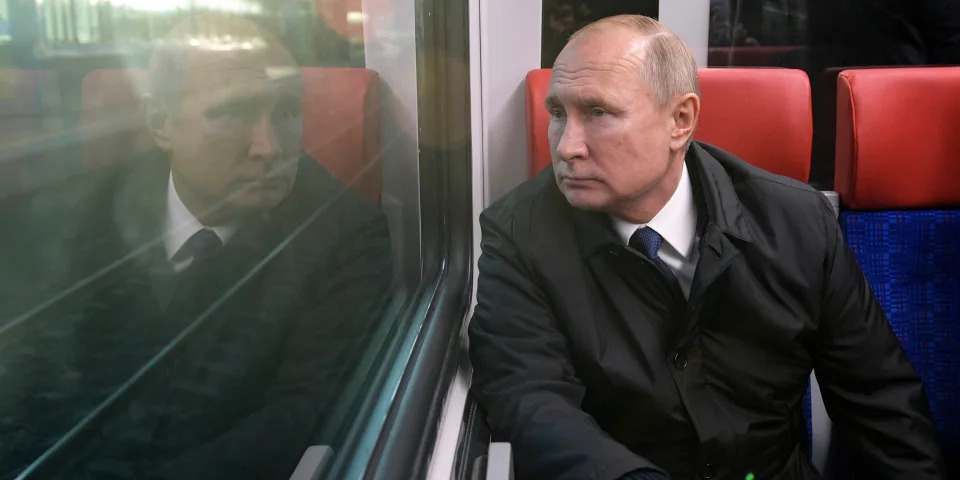
Russian President Vladimir Putin rides a suburban train in Moscow, Russia, in November 2019.Alexei Druzhinin, Sputnik, Kremlin Pool Photo via AP)
Economist Konstantin Sonin said the Russian economy has become more primitive since the war began, Russian news outlet Novaya Gazeta reported.
The economist, who Moscow placed on its wanted list, said Russia could follow the Soviet Union’s path toward “complete economic implosion.”
“Everything that is happening makes the Russian economy more primitive, more backwards.”
Russia’s economy is becoming increasingly primitive as its war in Ukraine drags on, and the repercussions could push it down the same path the Soviet Union endured three decades ago, according to the Russian economist and University of Chicago professor Konstantin Sonin.
Sonin, who Moscow targeted with a criminal case in last month, told Russian news outlet Novaya Gazeta Sunday that the West’s sanctions so far have had “no influence” on the Russia economy. He said it’s instead been Vladimir Putin’s war efforts that have dragged on growth and fueled turmoil.
“Sanctions are a consequence of Russian planes bombing Ukrainian cities, Russian tanks crawling along Ukrainian roads, and Russian soldiers killing Ukrainians,” he said. “Therefore, talking about the influence of sanctions is like talking about the influence of fever on illness.”
The US has led Europe and other nations in imposing various sanctions on Russia and Russian individuals over the last year, including bans on oil and fuel purchases, as well as price cap mechanisms.
The academic explained that the country’s GDP has contracted 3%, instead of expanding 4% as anticipated. And with consumption and retail activity plunging, citizens have suffered even more than what’s been reflected in GDP.
“Everything that is happening makes the Russian economy more primitive, more backwards,” Konstantin said. “This makes backwardness and primitivism more persistent. And I think we are seriously going to follow the Soviet Union’s path from the 1970s to the complete economic implosion of the late 1980s.”
The collapse has already started, in his view. The Kremlin posted a $29 billion deficit in the first quarter, new data showed, as energy revenue continued to decline.
While Russia’s coming demise may not be as dramatic in scale as the Soviet Union’s fall, since certain parameters exist now that weren’t present decades earlier, the economic drag will be severe, Konstantin said.
“[T]he stagnation can reach the level that will cause the full collapse of the state government machine, as it happened in the 1990s.”
Putin’s plundered aircraft not our problem, insurance chief says
Oliver Gill – April 9, 2023
Vladimir Putin seized 500 commercial aircraft after his invasion of Ukraine – MIKHAIL KLIMENTYEV/POOL/AFP via Getty Images
Insurers will go bust if they are forced to cover the cost of Vladimir Putin’s war in Ukraine, the founder of one of the world’s biggest brokers has warned.
Mr Howden said: “The insurance market cannot be a systemic backstop for a war between the UK and Russia. And it’s not designed to be. No policies cover it.
“Otherwise, if we covered it all, it would actually end up with the Government anyway – we’d all go bankrupt.”
Russian authorities seized 500 commercial aircraft owned by overseas leasing companies shortly after the outbreak of war against Ukraine.
The owners, mostly domiciled in Ireland, have tried to claim on insurance but have been rebuffed. They are now suing Lloyd’s of London insurers for their refusal to pay out up to $10bn (£8bn) in claims. A legal showdown in the High Court is scheduled for next year.
Mr Howden said insurers are legitimately refusing to pay under the terms of certain types of cover.
He said: “Ultimately, war has never been something that insurance has been there to cover.”
If insurance policies were broad enough to cover the impact of war, it would force the Government to bail out companies “because there is not enough capital in the insurance market to pay for it,” he said.
“The insurance industry – no-one quite knows – [but it’s] four or five trillion dollars of capital. It’s small. It’s a tenth of the derivative market, for example.”
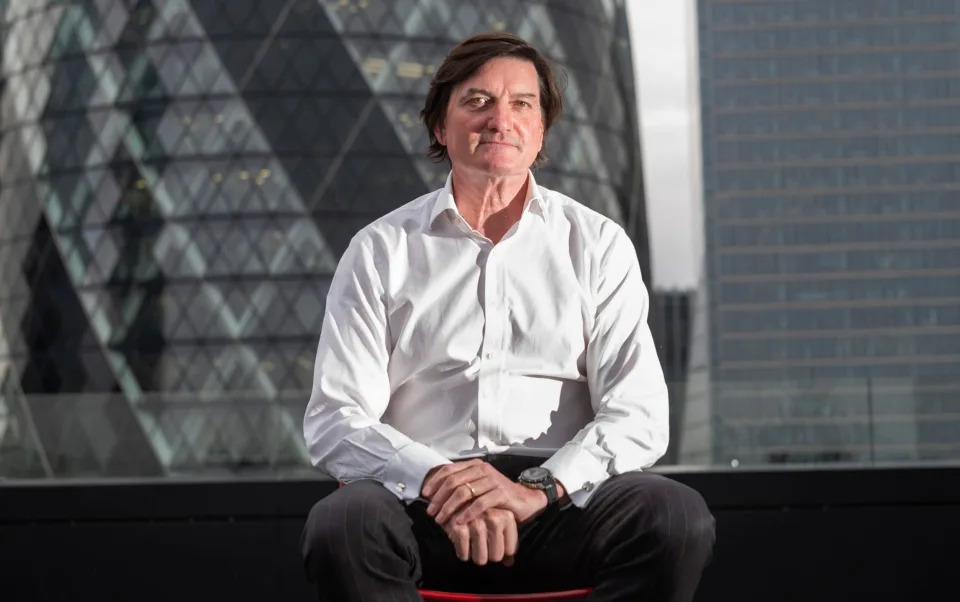
David Howden – David Rose
Howden Group has not underwritten policies itself but has deep connections within the industry as Europe’s largest broker.
The row over the “stolen” planes in Russia comes with the UK insurance sector still reeling from a public backlash to its refusal to pay claims under business interruption policies during the Covid pandemic.- ADVERTISEMENT -https://s.yimg.com/rq/darla/4-11-1/html/r-sf-flx.html
Mr Howden admitted that insurers had handled the crisis poorly.
He said: “Did we cover ourselves in glory over business interruption during the Covid pandemic? No, we didn’t. Should we respond differently? Yes, we should have.”
He said insurers were too focused on the technical detail of policies despite the extraordinary circumstances.
“When the claims come, the insurance company, rightly from a technical point of view but maybe wrongly from a PR point of view, say: ‘I’m very sorry, that’s not covered by our policy.’”
The insurance industry is currently facing a new headache over how to handle cyber insurance.
Members of Lloyd’s of London, the 335-year-old insurance market, have been angered by the institution’s insistence that all cyber policies exclude “state-backed” attacks.
Many hackers are based in countries such as Russia and North Korea. Clarifying which ones are and aren’t backed by the state can be more of an art than a science.
Lloyd’s members complain that the blanket policy is too broad and prevents them from offering coverage they would be happy to sell.
Mr Howden called the row over cyber insurance “ridiculous”. The straight-talking 59-year-old said: “The excitement over cyber is ridiculous.”
“We’re trying to be clear and we try to tell people it’s not covered, [but] suddenly – because we are bad at PR – people go: ‘Oh, my God, they are excluding war.’ It’s never been covered.”
Mr Howden suggested Lloyd’s should settle the argument by drawing up official guidance as to what constitutes a state-backed attack, which the marketplace worries would leave members open to “systematic risk.”
He said: “Most wars are easy to define. Cyber wars are more difficult to define.
“What we should have on cyber is one of the very smart GCHQ people define what is a war, and what is systemic attack. And then you could go out and separately buy from the insurance market your war coverage.”
Mr Howden started his eponymous empire in 1994 with three employees, a dog and £25,000 of funding from an angel investor. These days the company is headquartered in One Creechurch Place, a 156 metre skyscraper in the heart of the City that looks directly over onto the second floor office where it all began.
Mr Howden has created the largest insurance broker in the UK – and the biggest operator outside of the US – through a series of shrewd acquisitions, turbo-charged by private equity investment from General Atlantic and Hg Capital alongside funding from Canadian pension fund CDPQ.
Yet Howden Group is the UK’s fifth-largest employee-owned business, with 4,500 employees owning 35pc of the company.
“Employee ownership is amazing,” Mr Howden said. “We’ve built a business around people.”
The buy-in from staff has helped foster a positive culture without too much effort, he said.
“People care about people and people seem to be having fun. That’s culture. It’s like within your family or friends, it’s how you behave, how you act.”
“Anywhere where I go where they have got their culture on the wall, you know that’s not their culture. You know they are lying.”
Howden Group’s combination of employee-ownership and private investment is precisely the model now being considered by John Lewis, Britain’s biggest employee-owned business.
Mr Howden said: “We don’t have any dividends at all. All the money we make, we reinvest back in, unlike a public company that would use a lot of its capital to pay dividends.”
The long-standing executive is a refreshing counterpoint to the majority of Britain’s carefully manicured executives. Running a privately-owned business means he does not have to mince his words.
“We don’t make f****** kitchens!” he exclaims when asked about Howden Joinery, the kitchen supplier that shares the business’ name and is better known to the general public.
“They’re worth half what we’re worth. They are worth £3.6bn, we are worth £7.2bn.” (Add in Howden’s roughly £4bn in debt and the group boasts an enterprise value in excess of £11bn.)
Mr Howden laments that his business is not as well known as publicly traded peers such as L&G or Aviva.
“We’re opening more offices on the high street than anyone else. We’ve got a market cap that is more than Sainsbury’s – but no-one has heard of us!”
Howden Group’s head offices are an extension of its co-founder’s personal tastes. Life-size figures of dogs, oodles of artwork and clocks of all shapes and sizes are littered across the 14th floor of the company headquarters.
“These clocks are all Howden clocks, because we were clockmakers as well,” he explained, referencing the Victorian clockmakers who bore his family’s name.
For the insurance sector to flourish, it must shake off its stuffy past, he said. Above his office is a cafe and neon-signed bar stocked with beer and wine aplenty – more Shoreditch than Square Mile.
“We want to attract people who aren’t in insurance. We want to get really bright young kids who think they’re going to work with Google,” he said. “Don’t work for Google, come to Howden.”
Mr Howden was arguably destined for a career in insurance. After dropping out of Radley College following his O Levels, he started working at City broker Alexander Howden in 1981. The company had originally been founded by his great-great-great grandfather, though the family connection had been lost by the time he joined.
Today, he lives in Oxfordshire’s Cornbury Park estate, best known among younger generations as the venue that hosts the Wilderness music festival.
“I love life,” Mr Howden said. “I think to be good at a job, you’ve got to be good at life. I don’t think you can really just be a workaholic.”
Soldiers Make Secret Pact to ‘Destroy’ Putin’s Empire From Within
Tom Mutch April 8, 2023
Tom Mutch
KRAMATORSK, Ukraine—The horrors of Ukraine are an eerily familiar sight for Maga, a 30-year-old Chechen fighter who spoke with The Daily Beast using his codename.
“The same torture, the same mass graves… the things the Russians are doing in Ukraine, they were doing back in Chechnya,” Maga told The Daily Beast from his unit’s hideout in eastern Ukraine last month. “They just come and destroy everyone who could be against their power.”
Having fought first to defend Kyiv—and then in the battles for the liberation of the Kharkiv region—Maga said the atrocities he has seen in Putin’s invasion match stories told by his relatives, who fought in the wars for Chechen independence from the Russian Federation in the 1990s.
While much of the world was shocked by the bloody atrocities committed by Putin’s forces in cities like Mariupol and Bucha, for many Chechens none of this came as a surprise.
Now, this shared trauma appears to have formed a bond between Chechens who have flocked to Ukraine to fight against Putin’s invasion and their new Ukrainian comrades, who have agreed that once the war is finished here, they will travel to fight for a free Chechnya.
“If I am alive, I will participate in the liberation of Chechnya,” said Alexander, a 43-year-old Ukrainian fighting with the Dzhokhar Dudayev battalion, who told The Daily Beast he was named after the first President of the independent Chechen Republic that was bombed into submission by Putin. “Why? Because for me they are brotherly people. I adopted a lot from them: the way they relate to life and death, the way they relate to the elders.” His beard, hair and clothing are cut in the local style—while he retains his Christian faith, he looks Chechen in all but name. Alexander and Maga’s battalion contain some of the around 1,000 Chechens fighting for Ukraine, seeing a direct line between Ukraine’s fight to liberate its territory and Chechnya’s struggle for independence. They invited The Daily Beast to visit their modest barracks in a small townhouse in the eastern Ukrainian city of Kramatorsk to tell their stories.
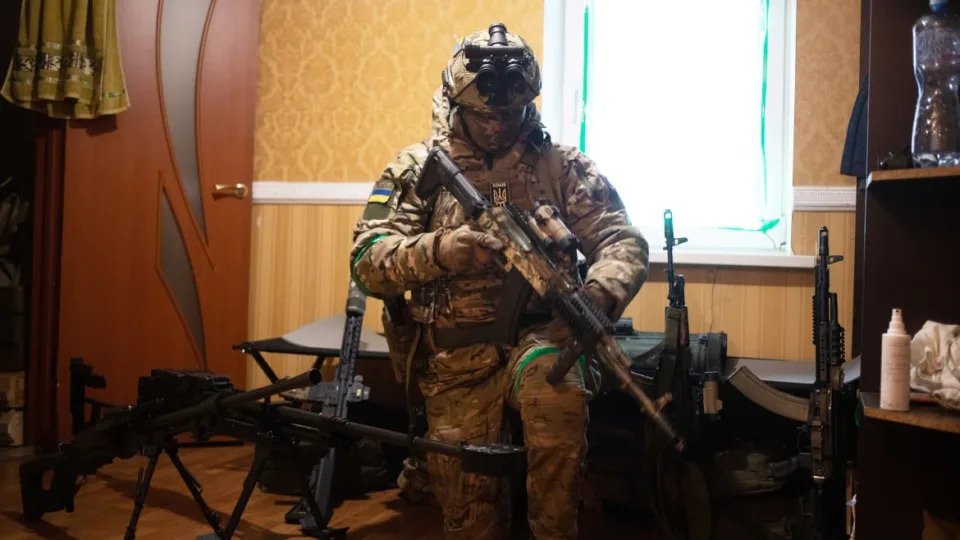
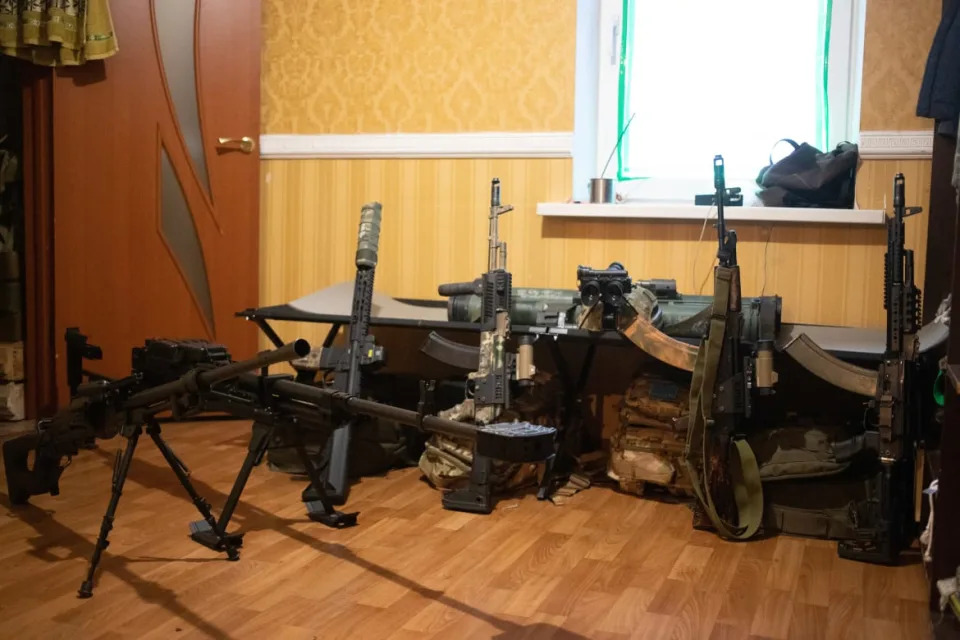
A weapons collection in a barracks in Kramatorsk.Tom Mutch
Members of the battalion spoke with The Daily Beast on condition that their last names be omitted and their faces not photographed. They have recently been fighting on the frontlines in Bakhmut, where they say that Russian tactics are just like those of the Soviets during World War II: “They throw and cover everything in meat and capture [territory] because they have a lot of this meat,” while caring nothing for the lives of their soldiers or Ukrainian civilians caught in the crossfire, one member said.
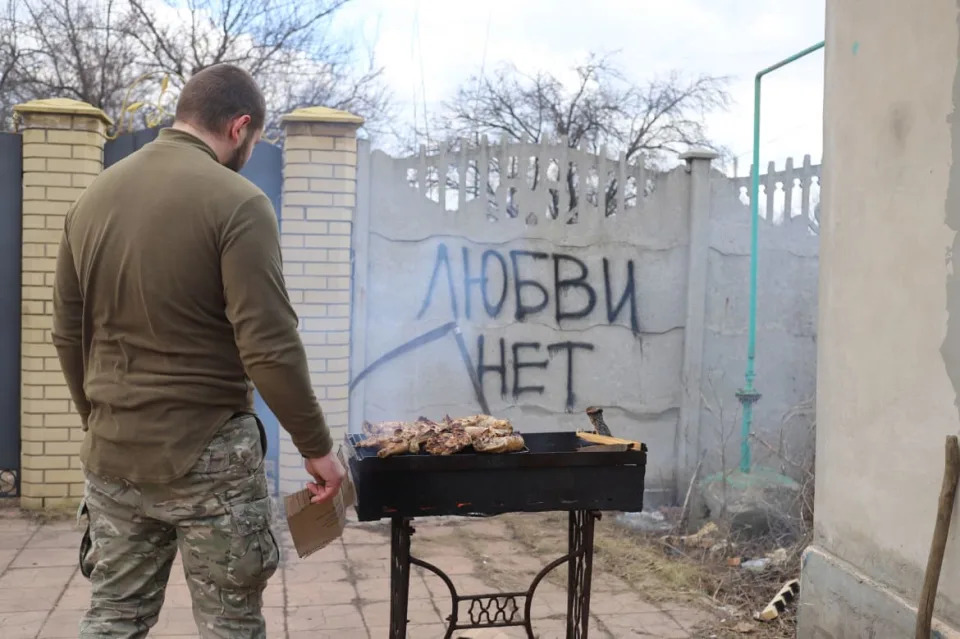
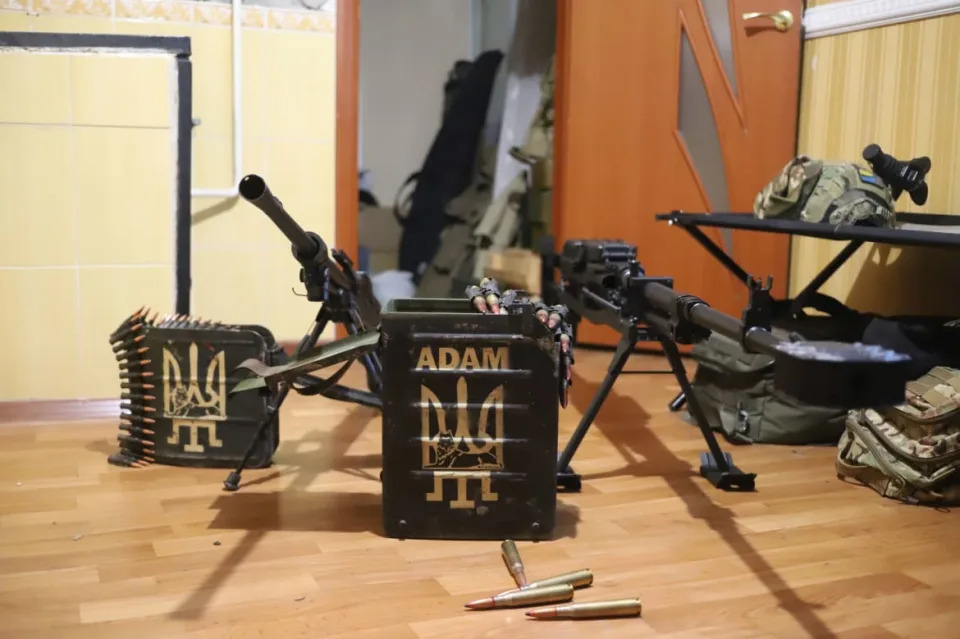
The group keeps a high-powered arsenal inside the townhouse, including 30- and 50-caliber machine guns, AK74 assault rifles, and rocket-propelled grenade launchers. Outside, some men were cooking meat on a barbecue, smoking cigarettes, checking weapons and reloading. A well-groomed puppy scurried around the yard snapping at bits of dropped food. One soldier’s patch featured Ukrainian blue and yellow, followed by a verse from the Quran in Arabic (the vast majority of Chechens are Muslim).
A Ukrainian soldier roasts meat on a barbecue in a backyard in Kramatorsk.Tom Mutch
The Ukrainian parliament has already adopted a resolution declaring Chechnya as an independent state that is occupied by Russia, and denounced what they called a genocide of the Chechen people. Maga said that they have many Ukrainian volunteers enlisting who wish to join to fight—not just in Ukraine, but inside the Russian Federation itself.
“Recruits come here all the time,” he said. “They go through training, and everyone is of course preparing to liberate Ichkeria [the local name for Chechnya] and other territories that are occupied, because there are also Tatarstan, Dagestan and Ingushetia.” This, he believes, will be the only way to stop Russian imperial power for good. “All gas and oil come not from Russian territory, it comes from all occupied countries and territories.”
Troops from these ethnic minority regions have made up the bulk of Russian cannon fodder in this war, with one BBC analysis estimating that men from the Muslim-majority region of Dagestan had died at 10 times the rate of those from Moscow. Some critics claim this is a direct result of a cynical strategy from Putin: avoiding domestic backlash by having ethnic minorities bear the brunt of the meat grinder. “The Russians won’t actually go and fight themselves,” Maga said.
Pro-Ukrainian Chechen fighters gather in a backyard in KramatorskTom Mutch
Déjà Vu
Putin’s rise and grip on power owe much to the wars in Chechnya. The Chechens won the first war, fighting between 1994 and 1996 against overwhelming firepower and eventually wrecking the fragile legitimacy of the new democratic Russian state. In 1999, when Putin took over as prime minister, he unleashed a second war which crushed the fledgling Chechen Republic.
His tactics there presaged those that have horrified the world in Ukraine. He used Russia’s overwhelming advantage in artillery and aircraft to raze the Chechen capital city of Grozny to the ground. He would repeat this tactic several times in Ukraine—most notoriously in Mariupol, but also in Severodonetsk, Volnovakha, and Bakhmut.
Alexander admitted that even he used to find Russian propaganda persuasive. “We were constantly brainwashed that Chechens are our enemies. We were told that on TV all day long. Muslims, terrorists, etc. But let’s just say, we didn’t have the sources [that would allow us] to assess it critically. We had only one source: newspapers and TV, and you believed it!” He is extremely disheartened by his countrymen, and even family members who—despite access to the internet and social media—still believe Russian propaganda about the war in Ukraine.
“Why do the people who live across the border have all the tools now… Why can’t they take another [source of] information, read it, compare, and think, ‘Oh, but why are we doing it? What is the purpose of it all?,’” he said. “They got brainwashed that they are fighting some kind of mythical fascism and they are protecting their motherland. How can you protect your motherland while being on someone else’s territory?”
A weapons collection in a barracks in KramatorskTom Mutch
But the Chechens in Alexander’s unit are not the only ones fighting this war. Some 9,000 more, loyal to the Kremlin-installed Governor Ramzan Kadyrov, are fighting for Russia in Ukraine. They’ve become notorious not just for their brutality, but also for their tendency to post videos of their fighting on TikTok.
The Chechens fighting for Ukraine also want to clear the name of their nation. “These are not good people, Kadyrovites… There’s a Ukrainian word, nepotrib [trash]. It’s TikTok troops… they [also] have these barrier units—Stalin’s method—and no retreat, only forward,” Alexander said, referring to troops who are reportedly tasked with staying behind regular Russian soldiers to shoot any who try to retreat.
For Maga, the only thing that will bring freedom to Chechnya is not just defeat in the war in Ukraine, but the end of the wider Russian empire. “This is necessary for peace both inside and outside Russia’s borders,” he said. “Dudayev [former Chechen leader] said that if today you keep Chechnya as an internal problem of Russia—tomorrow Europe will be an internal problem of Russia.”
“Russia must be broken up, otherwise, there will be no peace for the future generation. That’s our goal—liberation of Chechnya and the whole Caucasus from Russian occupation because, without those lands, Russians won’t go fight themselves. Only when an empire is destroyed, will the people change.”
For Alexander, the key to Ukrainian success is the reason Chechens won their first war against Russia, namely their morale and belief in what they are fighting for.
Alexander, a 43-year-old fighter in the brigadeTom Mutch
“They [the Russians] don’t understand where they’ve come to. They don’t understand that their supposedly ‘world’s second army’ is worth nothing. Why? Because they don’t have that inner strength, they don’t have the motivation, they don’t understand what they are doing. They are just a flock of sheep,” he said. “I will [fight] to the end, as long as I can. Until victory.”
The opening disclaimer for NBC’s Law & Order reads, “The following story is fictional and does not depict any actual person or event.” Never the less, regular viewers recognize recent story lines “ripped from the headlines” on a regular basis. We can reliably predict, the “Trump indicted by New York Grand Jury; becomes the first U.S. President in history to be prosecuted” headline, will soon spark future crime-time episodes.
MAGA World quickly pounced on Manhattan D.A. Alvin Bragg as being, nasty, on a vendetta, a pawn of George Soros, a racist, an animal and above all, a political tool. Some on the left believe he should have waited his turn on the Trump indictment train, but they fail to appreciate the element of statute of limitations.
How often have we faithfully followed story lines from our favorite crime shows, depicting serial (killers- rapists- drug kings -abusers etc. etc.) continued week after week, with the investigative authorities assembling an elaborate white board of circumstantial evidence, but unable to quite convince the D.A. / prosecutor to bring charges on the most serious violations, before the legal clock runs out. They’re convinced the career criminal is as guilty as sin but can’t quite close the deal. That’s when they must, by hook or crook, charge the bastards with any even minor infraction, in order to take them off the streets, before they can continue their carnage and mayhem. And then just when we think all is lost, they uncover the smoking gun, the final nail in the coffin that will put them away for life.
During his half century plus of life in New York and then in the White House, Trump seems to have left no criminal enterprise untapped. Insurrection and attempts to overthrow American Democracy, conspiring with a foreign enemy during his campaigns, theft of confidential government documents, business and bank fraud, tax evasion, money laundering, obstruction of justice in multiple cases, witness intimidation, bribery, campaign violations, perjury, sexual assault, violations with his school and charities, real estate discrimination, slander etc. etc. are just some of allegations leveled against Trump and his various business enterprises. There’s no doubt a list of crimes they haven’t discovered yet.
In the Trump Organization trial, two entities were found guilty by a jury in December of a combined 17 counts related to criminal tax fraud. They were fined the maximum allowed. And his CFO Allen Weisselberg, who is currently incarcerated in New York City’s Rikers Island jail, entered a guilty plea last year and admitted to receiving more than $1.7 million in untaxed compensation. Who can forget all the fines for Trump family financial malfeasance. And who can forget all the Trump miscreants, cronies and conspirators who were hired, fired, indicted, convicted, jailed and utterly defamed.
D.A. Bragg campaigned and won his election on a platform of fairness and equity in the system of justice he’s now responsible for. He pledged to turn the page on a two tier system of justice. Both the right and the left forget that New York, New York is at the top of the list of world class banking, business and financial centers of the world. Trump and his enterprises have been a constant assault against and black eye for that reputation. Enough is enough they said.
After a two year long investigation of Trump and all of his Inc’s, they believe they have the goods and will attempt to take them off the streets of New York forever. Rumors are the good citizen street sweepers of New York have found at least 30 criminal count violations this serial criminal is guilty of. MAGA members of congress cry political persecution, and threaten to tar and feather D.A Bragg, without even seeing the sealed indictment.
The cast of Presidential contenders, previously Trump enablers, often critics, and then turned demonizers, and now turned staunch defenders can’t figure out whether to pee their pants , pray for Trump, or go dumb. Lindsey Graham, Mike Pence, DeSantis and others, must bow to the MAGA monster Trump unleased and which they and others glorified and anointed. The MAGA faithful will not be denied their perceived grievances’.
The Benghazi wing of the Republi-con House of Representatives spends their waking hours trying to out Trumpit their outraged colleagues. They have no one to blame for tomorrows karmatic political awakening but their own cowardice. They turned a blind eye to their twice impeached President’s unending assault on our American Democratic Institutions.
Trump’s entourage leaves South Florida today on a journey most American believe is long overdue. Who knows what happens when he lands in Manhattan. Too many in the MAGA cult hierarchy pray for violence and chaos. Lindsey Graham was particularly apoplectic: “They are trying to drain him dry. He’s spent more money on lawyers than most people spent on campaigns. They’re trying to bleed him dry. Donald J. Trump dot com. Go tonight. Give the president some money to fight this bullshit! This is going to destroy America!”
Wow, that’s richy rich! No doubt Trump has spent more on lawyers (billed but probably not paid) than any single entity by far, but that’s because not only is he allegedly the head of the most complex criminal enterprise in American History, legal warfare is also his primary modus operandi. Sooner or later, some news organization will attempt to add up the cost to all Federal and State Governments and to various businesses and individuals, for them to rein in and take to task, Trump Inc. and his many conspirators and enablers in congress. I’m guessing the bill is closing in on a billion dollars. This is not your Grandfathers conservative, penny pinching GOP.
Trump will try to blame everyone in sight for his legal predicaments, including D.A. Alvin Bragg and his team of prosecutors, Judge Juan Merchan , who will oversee his case, the New Yorkers who indicted him, and probably the jury of his peers who will convict him. But Trump has no one to blame but his own egomaniacal self. His rein of amateurish governing Apprenticeship is being recorded in history, as we speak, as the very biggest prime time “Loser” to ever occupy the White House.
But the biggest blame must be laid at the feet of the MAGA base of nationalistic, racist, misogynistic, anti-Semitic, homophobic, anti government, anti Democratic bomb throwers. They seriously need to ask themselves what kind of a country they want to live in. Some seriously think Vladimir Putin is a better leader than Joe Biden. And that Russia and the autocratic Kremlin leaders promise a more agreeable way of life. Most of the civilized world would disagree. And since Putin unleashed a campaign of war crimes and genocide by invading their peaceful Democratic neighbor Ukraine, more than a million Russian citizens have fled the country; and still many more are trying. And as the MAGA crowd likes to point out on a daily basis, millions of folks flock to our Southern border and now to our Northern border trying to become part of this American Democratic Experience.
American’s need to allow our Justice System protect it’s citizens from serial evildoers. Serial bizzaro man, Lindsey Graham pleads with the MAGA faithful to quickly send in their rent and utility money, so billionaire Trump can mount a legal defense, and also suggests “How can President Trump avoid prosecution in New York?,” asked Graham. “On the way to the DA’s office on Tuesday, Trump should smash some windows, rob a few shops and punch a cop.” MAGA World responded with donations of $5 million within 48 hours.
I don’t believe there’s a single, reputable Fortune 50, 100, 500, 50,000 or any mom and pop business anywhere, who would employ Trump, or pay him any amount, to do any job. Isn’t there an ethical, and reasonable, true conservative Republican anywhere in America that this toxic MAGA crowd would nominate to represent the party?
This sad state of our political climate clearly represents how low, the once “Law and Order” Republican party, has sunk. Heaven help us.
‘Absurdity to a new level’ as Russia takes charge of UN security council
Julian Borger in New York – March 30, 2023
Photograph: Justin Lane/EPA
In Ukraine, Moscow is pursuing an unprovoked war of aggression. In The Hague, Vladimir Putin is facing an arrest warrant for war crimes. But at the UN, Russia is about to take charge of a powerful international body, the security council.
From Saturday, it will be Russia’s turn to take up the monthly presidency of the 15-member council, in line with a rotation that has been unaffected by the Ukraine war.
The last time Russia held the gavel was in February last year, when Putin declared his “special military operation” in the middle of a council session on Ukraine. Fourteen months on, tens of thousands of people have been killed, many of them civilians, cities have been ruined and Putin has been indicted by the international criminal court for the mass abduction of Ukrainian children.
In such circumstances, putting Russia in the driving seat of a world body tasked with “maintaining international peace and security” seems like a cruel April fools joke to many, not least the Ukrainian mission to the UN.
“As of 1 April, they’re taking the level of absurdity to a new level,” said Sergiy Kyslytsya, the Ukrainian permanent representative. “The security council as it is designed is immobilised and incapable to address the issues of their primary responsibility, that is prevention of conflicts and then dealing with conflicts.”
The ambassador said Ukraine would stay away from the security council in April except in the case of an “issue of critical national security interest”. Ukraine is not a current council member, though it is often called to speak on issues related to the war.
The US, Britain, France and their supporters on the council are likely to show their disapproval by downgrading the level of their representation at Russian-hosted events over the course of the month, but no member state is known to be planning any form of boycott or other protest.
The US on Thursday urged Russia to “conduct itself professionally” when it assumes the role, but said there was no means to block Moscow from the post. The Kremlin said on Friday that Russia plans to exercise all its rights on the council.
Diplomats at the UN headquarters in New York point out that most of the council’s agenda in April, like any month, is taken up by routine briefings and reports on UN peacekeeping missions around the world.
“It’s important to protect the rest of the council’s work on other files,” one European diplomat said. “We don’t want to disrupt the work that the council is doing elsewhere, because that would allow Russia’s invasion to have an even wider impact on issues of peace and security around the world.”
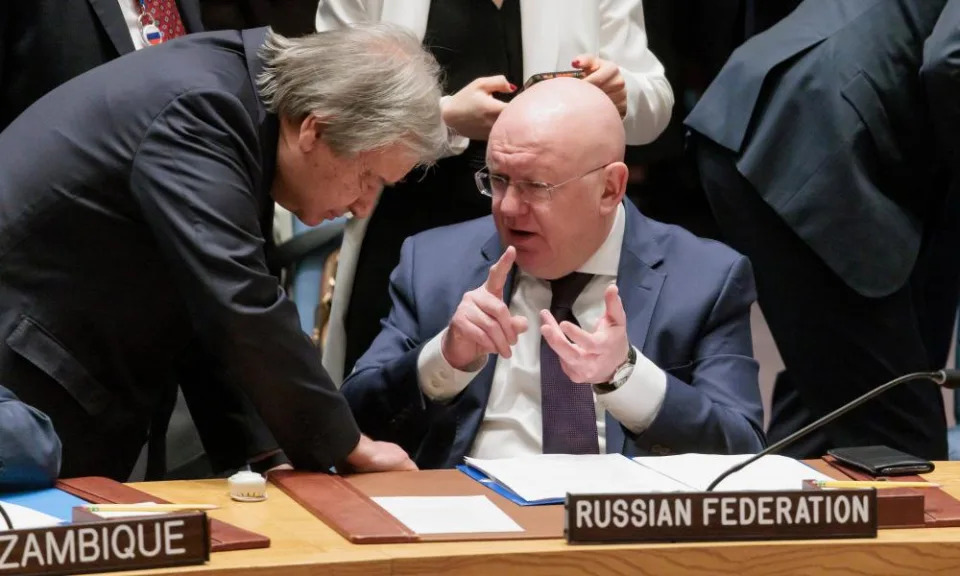
The council presidency does give the monthly incumbent the power to organise its own sessions, and Russia is planning three. On 10 April it will hold a briefing on the “risks stemming from the violations of the agreements regulating the export of weapons and military equipment”, at which it is expected to single out the US for its arms supplies to Ukraine and to other allies over recent years.
Later in the month, it will chair two open debates on “effective multilateralism” and on the situation in the Middle East, over which its foreign minister, Sergei Lavrov, is expected to preside.
The last occasion when a permanent member of the council carried out an unprovoked invasion was the US attack on Iraq. The US was not subjected to the humiliation of repeated overwhelming defeats in the UN general assembly of the kind that Russia has endured over the past year, with about 140 of the 193 member states voting against Moscow’s positions, leaving Belarus, Eritrea, Syria and North Korea as Russia’s only reliable friends.
Russia’s deputy permanent representative, Dmitry Polyanskiy, denied that his mission was becoming a pariah at the UN. “Absolutely not. We feel that the west is embattled in the UN right now because more countries understand our position,” Polyanskiy said, claiming that the western allies had to water down resolutions and arm-twist to get 140 votes. “So I think that it’s rather the west is isolated, but not us in the general assembly.”
As for Putin’s ICC arrest warrant, Polyanskiy dismissed it as “totally irrelevant to any of our activities”. The last time the Russian leader travelled to the UN headquarters was in 2015.
In the security council, the balance of diplomatic forces is less clearcut than in the general assembly. The division of five permanent members – US, UK, France, Russia, China – has hardened considerably, with China regularly echoing Russian talking points in the council. The 10 non-permanent members are elected for two-year terms by the general assembly. Among the current batch, Mozambique, the United Arab Emirates and Gabon have generally stayed neutral over the Ukraine invasion.
Brazil is moving into the neutral column. Polyanskiy said the “Brics” group of Brazil, Russia, India, China and South Africa was drawing closer together and claimed there were 20 other countries interested in affiliation.
Richard Gowan, the UN director at the International Crisis Group, said that under President Luiz Inácio Lula da Silva, Brazil was “making an effort to engage with Russia and position itself as a potential peacemaker over Ukraine”.
“I don’t think Russia has many close allies in the council, but a lot of council members really want to avoid getting caught up in big power games,” Gowan said. “There is a definite sense that a lot of council members want to shift attention to crises other than Ukraine where the UN may be able to do marginally more good.”
There are no security council sessions on Ukraine planned for April, but nine members can vote to force it on to the agenda, or members can hold informal sessions on the subject.
The glaring council impasse and paralysis over Ukraine has served to elevate the importance of the general assembly, but few expect it to bring any long-awaited reform to the running of the council, established by the victors of the second world war.
More likely, Kyslytsya acknowledged, “everybody will get accustomed to this new level of global hypocrisy”.
“That will be a disgrace,” he added. “But I think there’s quite a chance that may happen.”
‘Kick Russia out of the UN’: Group prepares legal challenge as Russia gets set to take UN Security Council presidency
Guy Davies – March 31, 2023
‘Kick Russia out of the UN’: Group prepares legal challenge as Russia gets set to take UN Security Council presidency
The Russian Federation will on April 1 take over the presidency of the U.N. Security Council, a shift in power that may seem extraordinary amid the war in Ukraine.
Despite the international condemnation and the allegations of President Vladimir Putin’s forces committing crimes against humanity in Ukraine, it will be Russia’s turn next month to step into the leadership position, which changes on a monthly basis.
Russia holds the power of veto on Security Council resolutions, something that Ukrainian President Volodymyr Zelenskyy criticized last year, when he said the bloc should act decisively or “dissolve itself” after the atrocities committed in Bucha came to light.
“We are dealing with a state that is turning the veto of the United Nations Security Council into the right to die,” he said.
PHOTO: In this file photo, members of the United Nations Security Council vote on a resolution condemning the referendums on annexing several Russia-occupied regions of Ukraine, in New York, Sept. 30, 2022. (Andrew Kelly/Reuters)
A year on from Zelenskyy’s address, Russia’s membership remains entrenched, as the country sits as a permanent member along with the U.S., France, the U.K. and China. But as Russia is set to take the presidency, one group of lawyers and diplomats is trying to block the move — and kick Russia out of the U.N. entirely.
“If we let Russia’s aggression stand, if Russia gains what it is seeking to gain out of its aggression against Ukraine, really the entire framework that we set up in 1945 is at risk,” Thomas Grant, professor at the Lauterpacht Centre for International Law and a member of Civic Hub, the organization seeking to eject Russia, told ABC News. “We think that the grounds for doing this are extremely strong.”
The organization started as a group of academics and lawyers, but now boasts sitting Ukrainian lawmakers and diplomats in its ranks. They concede that the idea Russia will be booted out of the U.N. entirely is a long shot, but they said they hope at the least to stop Russia from securing the presidency in April. They also want to call Russia’s membership on the U.N. Security Council into question.
PHOTO: Russian President Vladimir Putin attends a cabinet meeting via videoconference at the Novo-Ogaryovo residence outside Moscow, Russia, March 29, 2023. (Gavriil Grigorov/AP)
The group have yet to submit their formal legal challenge, but say they are adamant that the invasion of Ukraine has posed a major challenge to the composition of the U.N.
“There is a famous saying among the members of the Security Council that the Security Council is the master of its own procedures,” Volodymyr Yelchenko, the former Ukrainian ambassador to U.S. and Russia and member of Civic Hub, told ABC News. “They’re very vague.”
For their prospective legal case, he said, their efforts to lobby in Washington, Paris and London, are more important to their case than going to the Security Council directly, members said.
The political argument has perhaps been strengthened by the arrest warrant issued by the International Criminal Court for Putin. There’s also a U.N. resolution calling for Russia’s immediate withdrawal. Those are indications the international community may be responsive to the Civic Hub’s proposal, they said.
“It’s that sort of aggression that is simply not tolerable. If what you want is basic predictability [and security] among countries in their relations … then it’s vital that Russia be identified as an aggressor that ought not be sitting in the principal security organ of the U.N.,” Grant said. “That’s the political case to be made.”
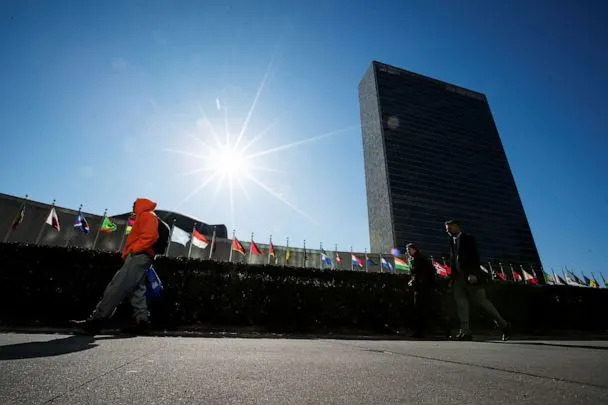
PHOTO: People walk in front of United Nations Headquarters in New York, March 29, 2023. (Eduardo Munoz/Reuters)
Civic Hub’s legal case, which they hope will compel the U.N. to act, however, is completely different.
Rather than formally requesting U.N. membership in 1991 after the dissolution of the Soviet Union, Russia merely inherited their member status, they said.
“Russia has never joined the U.N. in the proper way,” Professor Iouri Loutsenko, a former deputy director of the World Bank and the chairman of Civic Hub, told ABC News. “And this is a legal factor is undisputable.”
PHOTO: Russian Deputy Foreign Minister Sergei Vershinin leaves after talks on Black Sea Grain Initiative at the United Nations in Geneva, on March 13, 2023. (Fabrice Coffrini/AFP via Getty Images)
According to Loutsenko, the group has not received “straight answers” from the U.N. as they have lobbied for their proposal. But, if they were successful, Russia would be denied a voice on the world’s highest diplomatic stage.
“Russia [would] still have a flag in front of New York headquarters,” Grant said. “Its diplomats would still have key cards or whatever they used to get into the building, but they wouldn’t sit in the seats. They would not cast votes, they would not speak from the seat, and they would not be using the council as a broadcast platform for their messaging. So that would be the result.”
By exploiting that legal position, the group hope to isolate Russia even further from the international community, helping end the war in Ukraine and leading to change from within.
Related:
Russia set to take chair of UN security council amid Ukraine war
The Hill
Julia Mueller – March 30, 2023
Russia is set to take the chair position of a United Nations Security Council meeting as it continues to wage its yearlong war on neighboring Ukraine, drawing criticism from Ukrainian leaders.
Ukrainian Foreign Minister Dmytro Kuleba called Russian Foreign Minister Sergey Lavrov’s confirmation to the top Security Council slot during an April meeting in New York “a bad joke,” as the International Criminal Court (ICC) has a warrant out for the arrest of Russian President Vladimir Putin for alleged war crimes.
“Russian UN Security Council presidency on April 1 is a bad joke. Russia has usurped its seat; it’s waging a colonial war; its leader is a war criminal wanted by the ICC for kidnapping children,” Kuleba said on Twitter. “The world can’t be a safe place with Russia at UNSC #BadRussianJoke #InsecurityCouncil.”
The 15 member states of the U.N. Security Council take turns in the presidency position every month. Only five seats on the council are permanent — those held by the U.S., the U.K., France, China and Russia.
Ukraine’s ambassador to the U.N. highlighted comments from the international body’s Secretary-General António Guterres calling the day of Russia’s invasion the saddest moment in his tenure as U.N. chief.
“In fact the saddest in UN history until April 1, 2023 when, unless justice prevails, [Russia] assumes presidency of [the] Security Council. Stop raping justice & quashing UN Charter! Accountability now!” Ambassador Sergiy Kyslytsya wrote on Twitter.
Ukrainian diplomat Olexander Scherba called Russia taking over the Security Council “a bit like Jack the Ripper taking over at the ministry of health.”
White House press secretary Karine Jean-Pierre told reporters on Thursday that the administration expects Russia “to continue to use its seat on the council to spread disinformation” and urged the country “to conduct itself professionally” during its time with the presidency, according to Reuters.
“Unfortunately, Russia is a permanent member of the Security Council, and no feasible international legal pathway exists to change that reality,” Jean-Pierre said.
Russia’s permanent seat on the council — and with it, the power to individually veto any resolution that passes through the international body — has long been a topic of concern that was stoked by Moscow invaded its neighbor. Last February, Russia vetoed a Security Council resolution that would have called on Moscow to cease its attack on Ukraine and withdraw all troops.
The Security Council president is responsible for setting the body’s agenda and calling meetings, though the state gains no additional power over what gets through. Russia held the rotating presidency last February, the month of its invasion.
Bakhmut has turned into a Russian ‘slaughter-fest’
Nick Allen – March 30, 2023
Russian ammunition warehouse burns after it was hit by Ukrainian forces in Bakhmut – @30brigade/Newsflash
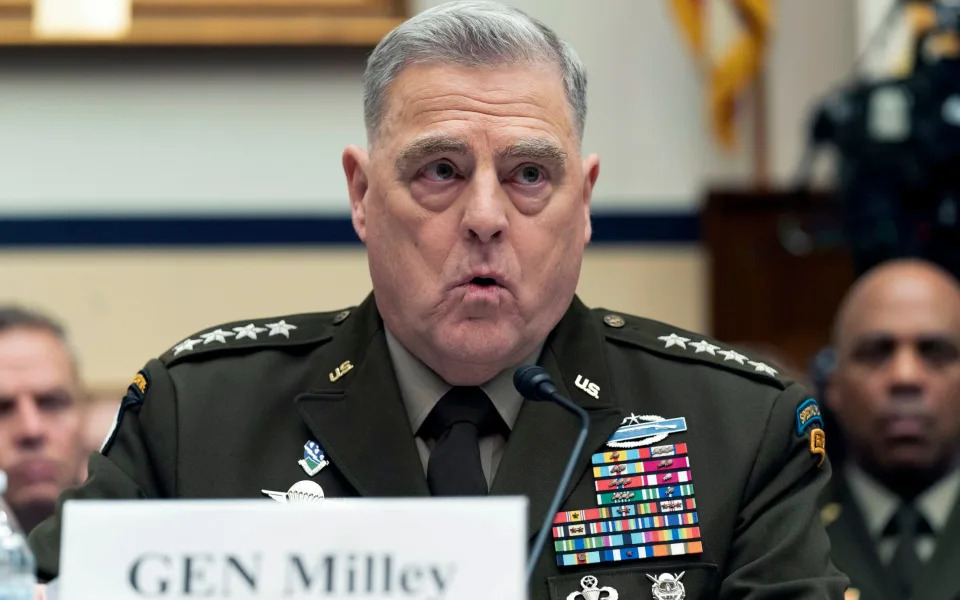
America’s top general said the city of Bakhmut has become a “slaughter-fest for the Russians” and that Vladimir Putin’s forces are getting “hammered” by Ukraine.
He said: “They’re conducting combat operations right now in Bakhmut primarily. It’s probably about 6,000 or so actual mercenaries and maybe another 20,000 or 30,000 recruits that they get, many of whom come from prisons.
“They are suffering an enormous amount of casualties in the Bakhmut area. The Ukrainians are inflicting a lot of death and destruction on these guys.”
Gen Mark Milley – Jose Luis Magana/FR159526 AP
He said the Russians had made “no progress whatsoever” for the last 21 days and it had been “very costly”.
The general added: “So it’s a slaughter-fest for the Russians. They’re getting hammered in the vicinity of Bakhmut and the Ukrainians have fought very, very well.”
Colonel Yevhen Mezhevikin, a Ukrainian commander in Bakhmut, said he was confident Ukraine’s forces could hold the city and push the Russians back.
He told the New York Times: “The enemy exhausted all its reserves. The density of assaults dropped by several times.
“Before, they could assault in all directions simultaneously and in groups of not less than 20, 30 or 40 people, but gradually it is dying down.”
Vitalii Barabash, head of the Avdiivka City Military Administration, said its infrastructure had been “completely ruined”.
He said: “It is impossible to restore or repair, but only to demolish and rebuild. There is not a single house left standing. The city probably hasn’t had a single building standing since summer.”
Having so far failed to capture Bakhmut, Russia has in recent weeks switched its focus to Avdiivka.
He said: “I wouldn’t call it a true full alliance in the real meaning of that word, but we are seeing them [Russia and China] moving closer together, and that’s troublesome.
“Then, if you add in Iran, those three countries together are going to be problematic for many years to come I think.”
Russian troops are dying in Ukraine due to heavy alcohol consumption, poor weapons handling, and hypothermia, UK intel says
Alia Shoaib – April 2, 2023
Russia ordered troops to cross into rebel-held Ukrainian territory on Monday.Russian Defense Ministry Press Service/Associated Press
Russian troops are dying in Ukraine due to incidents linked to alcohol consumption, the UK MoD says.
Heavy drinking is tacitly accepted by the military, even in combat operations, it said.
The ministry estimated that Russia has suffered up to 200,000 casualties since the war began.
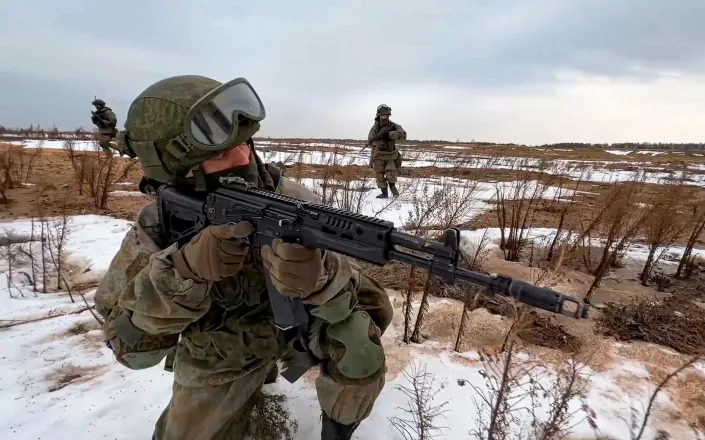
Many Russian troops are dying in Ukraine because of non-combat issues such as alcohol consumption and poor weapons handling drills, the UK defense ministry said in an intelligence update on Sunday.
The ministry estimated that Russia has suffered up to 200,000 casualties since its invasion of Ukraine over a year ago and that a “significant minority” has not been due to the fighting.
A Russian Telegram news channel reported in March that alcohol consumption is a particular issue amongst the deployed Russian troops and that “extremely high” incidents, crimes, and deaths have been linked to it.
The ministry noted that heavy drinking is commonplace in Russian society and has become a tacitly accepted part of military life, even in combat.
Russian commanders are likely finding alcohol abuse to be especially detrimental to combat effectiveness, the ministry said.
Aside from that, it said other common causes of non-combat casualties likely include poor weapon handling drills, road traffic accidents, and hypothermia.
There have been reports of Russian soldiers freezing to death on the front lines during a brutal winter because they are inadequately equipped.
Russia is currently in the midst of a winter offensive, which aims to extend Russian control over the whole Donbas region in Ukraine.
The mission has been largely unsuccessful, with Russia making minimal gains in exchange for high losses.
The battle for Bakhmut has turned into a ‘slaughter-fest’ for Russia, says top US general
Sinéad Baker – March 30, 2023
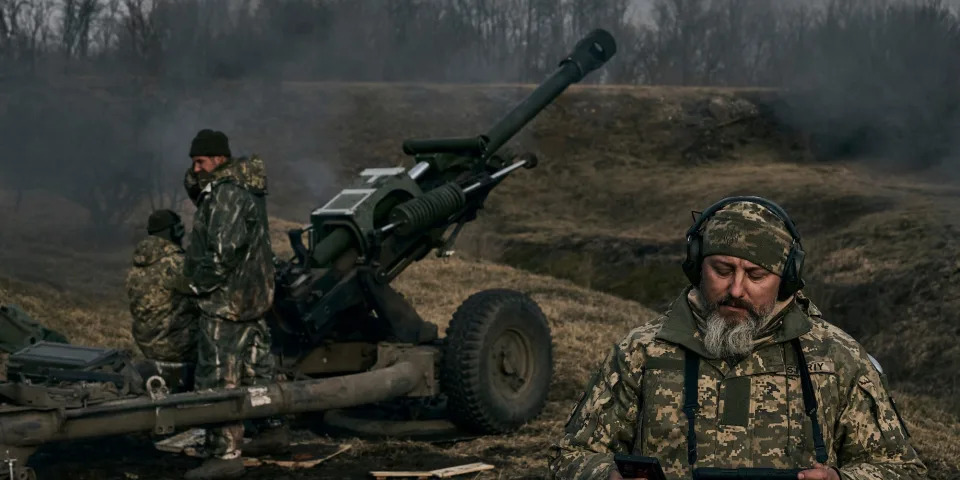
Ukrainian soldiers fire a self-propelled howitzer towards Russian positions near Bakhmut, the site of the heaviest battles, Donetsk region, Ukraine, on March 7, 2023.AP Photo/Libkos
Russia’s efforts to take Bakhmut have become a “slaughter-fest” for its troops, Gen. Mark Milley said.
He said Russia has not made progress for around 20 days, and they are being “hammered” by Ukraine.
Russia likely wants a symbolic victory in Bakhmut, but its progress there has been slowing.
The battle for the eastern Ukrainian city of Bakhmut has turned into a “slaughter-fest” for Russian forces, according to US Gen. Mark Milley, the chairman of the Joint Chiefs of Staff.
Milley was asked at a House Armed Services Committee hearing on Wednesday about Russia’s failure to capture Bakhmut, despite months of fighting to take it.
Bakhmut is considered the bloodiest battle of the invasion so far.
Milley said in response that he believes “Russians are struggling in a big way” there with command issues, logistics, basic tactics, and troop training.
“They are getting slaughtered, the Russian troops are” he said.
Milley added for the last 20 or 21 days “Russians have not made any progress whatsoever in or around Bakhmut.”
“The Ukrainians are doing a very effective area defense that is proving to be very costly to the Russians,” he said.
Russia first started shelling the city in May last year, with fighting ramping up in August. Russia has slowly inched forward, but has failed to capture the city.
Milley went further, describing Bakhmut as a “slaughter-fest for the Russians. They are getting hammered in the vicinity of Bakhmut and the Ukrainians are fighting very, very well.”
Experts say that Russia considers the city a chance for a symbolic victory, after it failed to make significant territorial gains in recent months.
Western officials estimate that between 20,000 and 30,000 Russian troops have been killed or injured in the city, while NATO predicted that Russia was losing five soldiers for every Ukrainian killed.
Ukraine says that it is using the fighting there to grind down Russia’s forces.
Milley said on Wednesday that Russia is “suffering enormous amounts of casualties in the Bakhmut area.”